

When we consider what it means to repair architecture — to repair architecture that is broken; to repair the brokenness of architectural pedagogy and practice — we find an abundance of vocabularies. The first entry for repair in the Oxford English Dictionary provides the most familiar definition in this regard: “To restore (a damaged, worn, or faulty object or structure) to good or proper condition by replacing or fixing parts; to mend, fix.” But fixing, we would argue, can mean ossifying technics as much repairing objects and structures; like restore, it prioritizes past states more than future prospects.
As a counterpoint, we would like to argue for another way to understand the genre of repair in our contemporary world; we would like to offer tending. Tending involves practices that transcend misleading distinctions of “new” and “old”; that call into question unconvincing boosterism for “progress” and “innovation”; and that resist the modernist desire to endlessly impose something “novel” onto the world. Indeed, these habituated distinctions reflect little more than the dutiful services architecture offers modern global capital and neoliberal consumption. 1 In contrast, tending, as we are defining it, resists the very idea of newness. Rather, tending presupposes mindful participation in a continuum of contingencies and possibilities. It focuses on beneficial next states that arise from the inevitability of converging histories. At its core, the practice of tending means learning to anticipate next states, and to nudge inherited circumstances toward beneficial outcomes.
In the context of architecture and all its allied practices, allow us to propose two apposite definitions of “tend”: “to apply oneself to the care of”; and “to have a disposition to advance, go on, come finally, or attain to (unto, towards) some point in time, degree, quality, state, or other non-material category.” 2 (Not insignificantly, the word’s Indo-European root, ten-, means “to stretch.”) Tending thus points to an understanding of repair that is neither episodic nor incidental, and towards a capacious practice that takes a longer, largely non-teleological view of repair-related acts that are contingent upon the terrestrial tendency of things. As Georges Bataille once declared, “A philosophy is never a house; it is a construction site.” 3 Likewise, a design philosophy is never a house; in our view, it is more akin to a tended field.
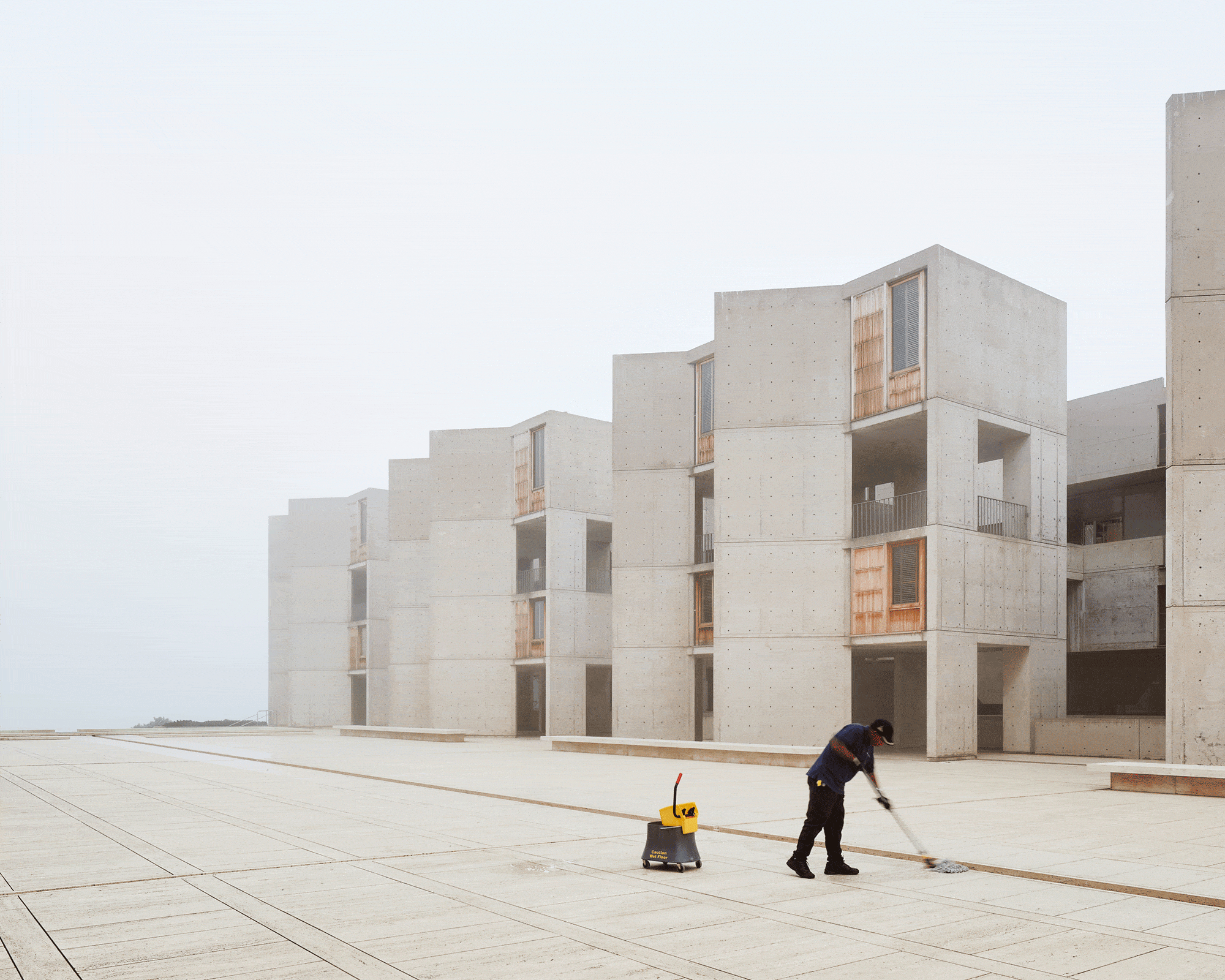
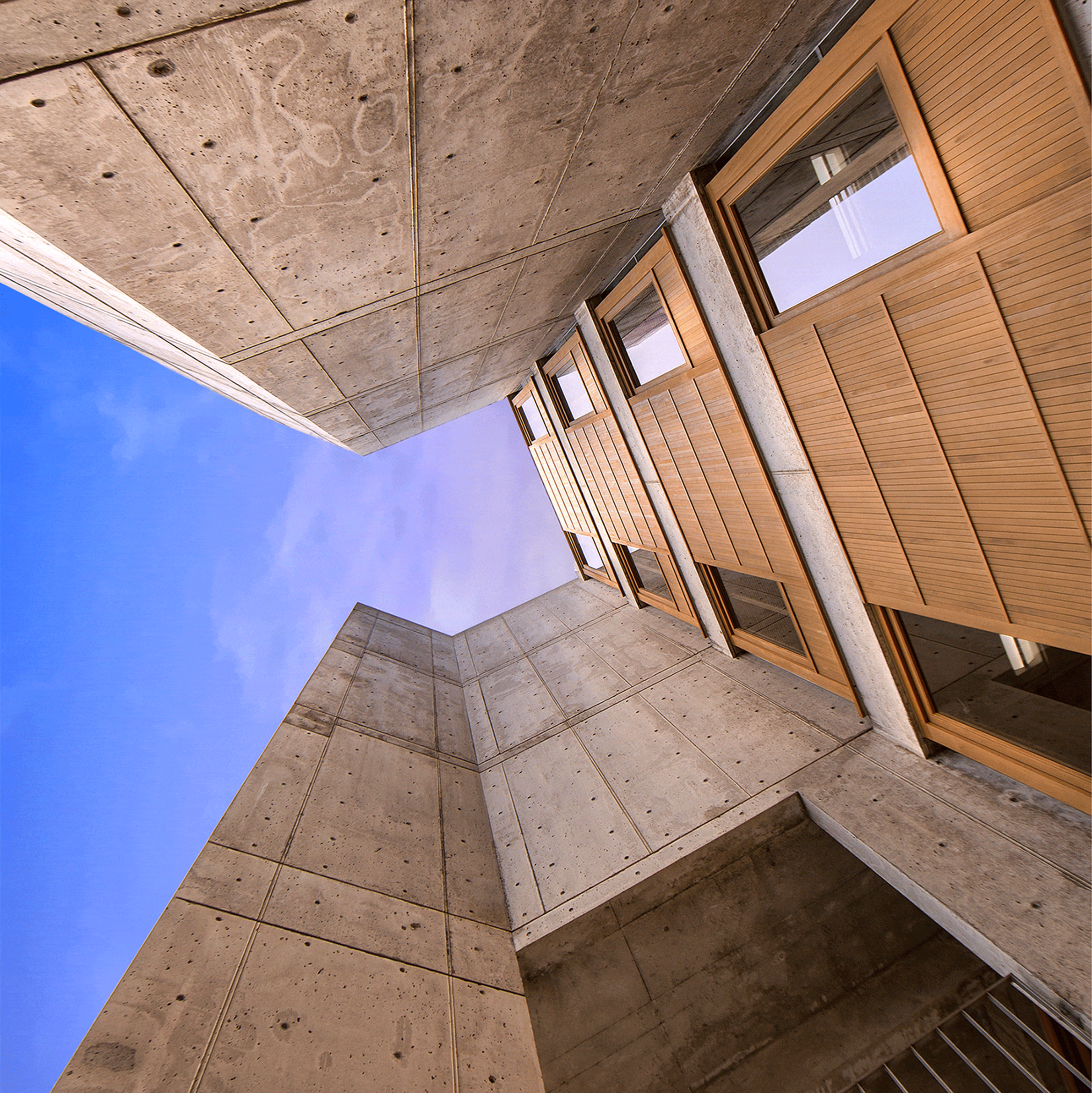
The maintenance of the teak windows at the Salk Institute over the past decades reflects a range of philosophies about repair.
How might the concept and practice of tending be applied in a work of architecture? Consider the case of the Salk Institute for Biological Studies, a research laboratory located on the Torrey Pines Mesa in La Jolla, California, a few thousand feet from the Pacific Ocean, commissioned six decades ago by its founding director, the virologist Jonas Salk, inventor of the polio vaccine, and designed by the office of Louis Kahn. 4 In particular, consider the building’s teak window assemblies, which not long after their installation began to weather in unanticipated ways. Indeed, the maintenance of the windows over the past several decades reflects a range of philosophies about repair. For this reason, close scrutiny of these components illuminates both the particular and the paradigmatic role of tending in building, and the ways in which this practice suggests urgent lessons about design in a broken world. 5


The Salk Institute experienced not only the fading of the teak windows in the salty air of the coast, which was anticipated. Early on, the surface of the wood also began to exhibit an unexpected black coloration. In 1963, not long after the opening of the institute, the chief facility manager noted what he called “a 5 o’clock shadow on all of the panels that do not get much sunlight.” 6 Compared to the expected natural, silver-gray complexion of weathered teak, this “non-uniform” appearance alarmed the client 7; in fact, it triggered a decades-long conundrum for Jonas Salk and his facility department. Salk preferred the even-toned “tobacco” hue of the freshly installed teak, and he occasionally instructed maintenance crews to bleach the window surfaces and scrub them with a wire brush.
Attempts to restore the teak so that it would appear ‘new’ have been a crucial factor in the evolving condition of the windows.
These aggressive treatments, he hoped, would eliminate the black coloration; unfortunately, bleaching and scrubbing treated the symptom, not the cause. Successive interventions exposed fresh layers of wood cells and thus temporarily restored the windows’ original appearance. But the chemical and mechanical abrasions also exacerbated the windows’ vulnerability to weathering, and over time worsened the very defects Salk and his custodians sought to repair. Eventually, the repeated exfoliation reduced the three-quarter-inch teak surface planks nearly by half in some places, which in turn compounded the maintenance challenges; for example, the nails of the window assemblies became rusted, opening up new pathways for leaks in the deteriorating assemblies. A few years ago, as the building approached its 50th anniversary, the Salk Institute undertook a major conservation project to assess, repair, and restore its damaged windows.
The Salk Institute’s particular predisposition to repair — its attempt to restore the teak so that it would appear “new” — has been a crucial factor in the evolving condition of the windows, including this latest conservation effort. So too were the intentions of Louis Kahn, expressed in project documentation, contractual specifications, and construction administration. Architects are often vague when developing specifications for their buildings, so it’s perhaps no great surprise that, in the Salk specifications, the teak is granted a mere eight words: “Exterior Millwork Species: Teak solid stock; Finish: rubbed.” 8 This lack of specificity regarding the teak — its grade and character; how to mill the wood and how (and whether) to finish it — directly affected its changing performance and exterior appearance in the finished building.

The architects thought teak would provide ‘a durable, relatively maintenance-free material.’
Why did the architects choose teak? The consensus among both contemporaneous associates and scholars studying the finished work is that the architects thought it would provide “a durable, relatively maintenance-free material, requiring no finish coating, and that in its gray weathered appearance it would be compatible with the color of the adjacent concrete.” 9 What is less clear is whether the contractors followed the architectural specification and applied the indicated finish — “rubbed,” presumably with wood oil. Whatever the case, the vagueness of the architectural specifications and the details of the windows ultimately precluded weathered teak, even though Kahn was unambiguous in his preference for the weathering of wood: “It’s silly to think that you want to preserve wood,” he said. “I think a yellow house and green leaves looks awful, but a gray house and green leaves looks absolutely marvelous. We have to ask nature to help us out.” 10 In other words, the architect favored the appearance of weathered gray teak over fresh wood. Almost a decade after the Salk Institute’s completion, he put it this way: “The color of the teak is being gradually erased by the salt of the air. Again, very sympathetic. I didn’t like its tobacco juice color at the beginning.” 11
Of course, the Salk Institute was hardly an outlier in Kahn’s oeuvre. Even a cursory review of the architect’s legacy indicates a strong attraction to a grayscale palette: concrete, concrete masonry units, slate, stainless steel, travertine, marble, and various weathering woods such as cedar, cypress, teak. These materials contribute to the raw, rough, even brutal surface variegations of his completed works. 12 Moreover, they account for the degree to which Kahn’s designs seem to anticipate the evolving tendencies of materials over time, more so than many of his fellow mid-20th-century modernists. Yet at the Salk Institute, the client did not share the architect’s propensity for weathering, for allowing the wood to fade to a muted gray; as noted above, Jonas Salk wished to maintain the wood’s original, uniform orange-brown look.
Neither the eminent scientist nor the equally eminent architect seem to have had much interest in the physical properties of wood on a coastal mesa at the edge of the Pacific.
Divergent desires notwithstanding, neither the eminent scientist-client nor the equally eminent architect seem to have had much interest in the actual, physical, practical, or empirical properties and behavior of wood on a temperate site overlooking a coastal mesa on the edge of the Pacific Ocean at 32° north latitude. In dozens of interviews, lectures, and publications, Kahn repeatedly invokes ideas about “nature,” and he seems to understand the term in two distinct but related senses. 13 First, as a claim on some irreducible, immutable, often hidden truth of a thing, its essence and identity; for example: “It is for the architect to derive from the very nature of things … what a thing wants to be” 14; and second, as a plenitude of entities and phenomena, subject to human agency: “Nature cannot make anything that man makes. Man takes nature — the means of making a thing — and isolates its laws.” 15 In this light it might seem ironic to point out that the source of the black coloration of the teak at the Salk Institute for Biological Studies is strictly biological.
Any comprehensive understanding of the wood windows of the Salk Institute — their appearance in the world, their visual tendencies over time, the unanticipated and fateful surface deterioration — must take into account — tend to — their material histories and geographies. And these histories extend back at least two centuries, to the period when old-growth teak trees, tectona grandis, were sprouting and maturing across the hilly forests of the country then called Burma, now Myanmar.
A tree is effectively a three-dimensional printer: it ingests elements of soil and air from its terrestrial milieu, then dendritically distributes these nutrients out and up through a cellulose matrix that we call “wood.” The color and durability of teak, properties that influenced the architects of the Salk Institute to choose this species, derive from the indigenous conditions of Southeast Asia. The Burmese soil and atmosphere explain the wood’s unique characteristics; for example, its resistance to North American termites owes to the presence of tectoquinone, which is believed to be a natural pesticide native to South Asian soil. 16 This durability, which is so appealing to architects, correlates also to the presence and quantity of silica, which likewise emerges from the mineral substrates of the Burmese soil. It was precisely this combination of commercially viable qualities — strength, durability, insect resistance — that made the teak forests of Burma attractive to the imperialists of Britain; ever in search of new resources to supply the shipbuilding needs of their navy, the British conquered much of northwest Burma in the 1820s and soon began harvesting old-growth teak.
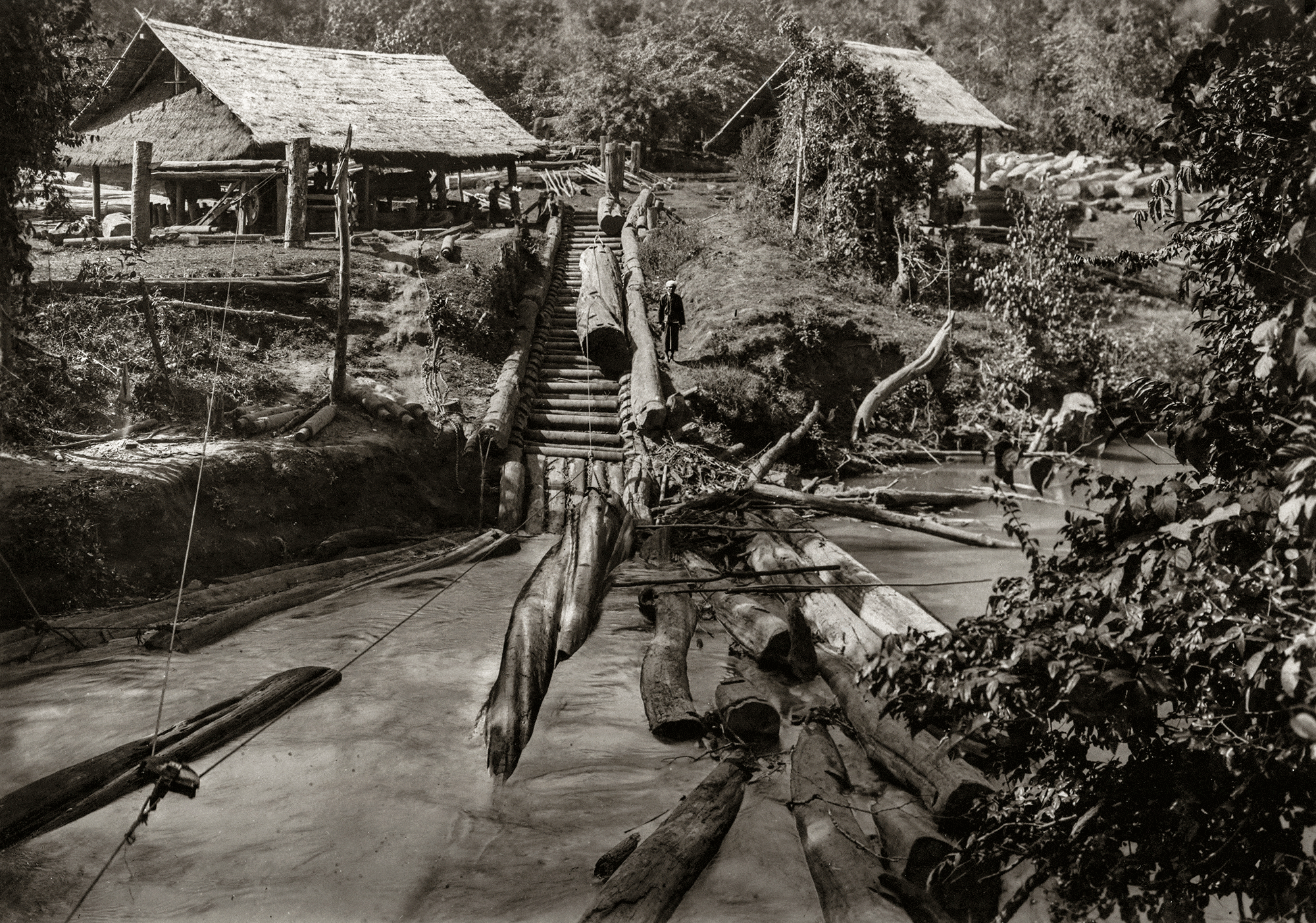
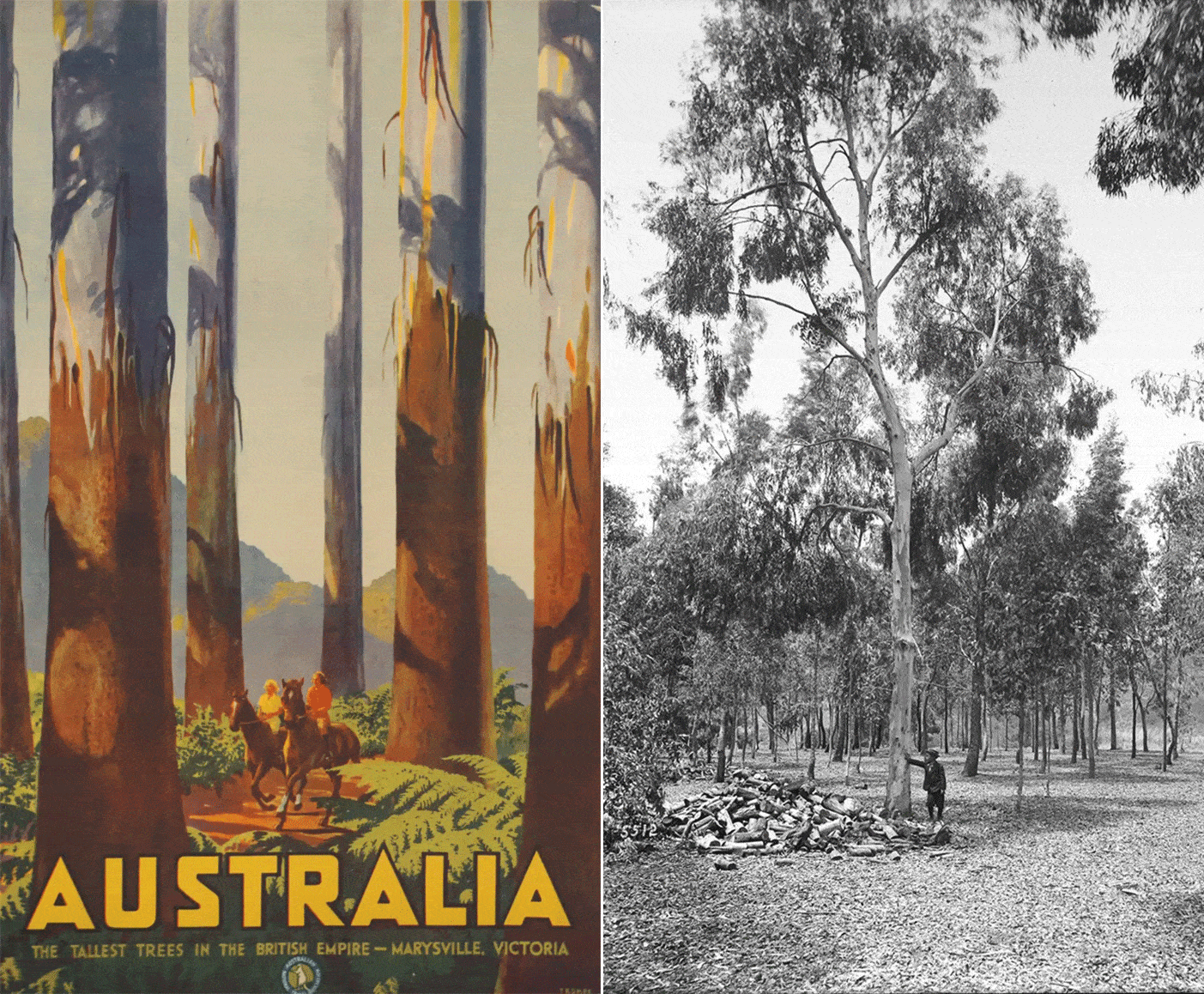

Any comprehensive understanding of the wood windows of the Salk Institute must tend to their material histories and geographies, which extend back two centuries.
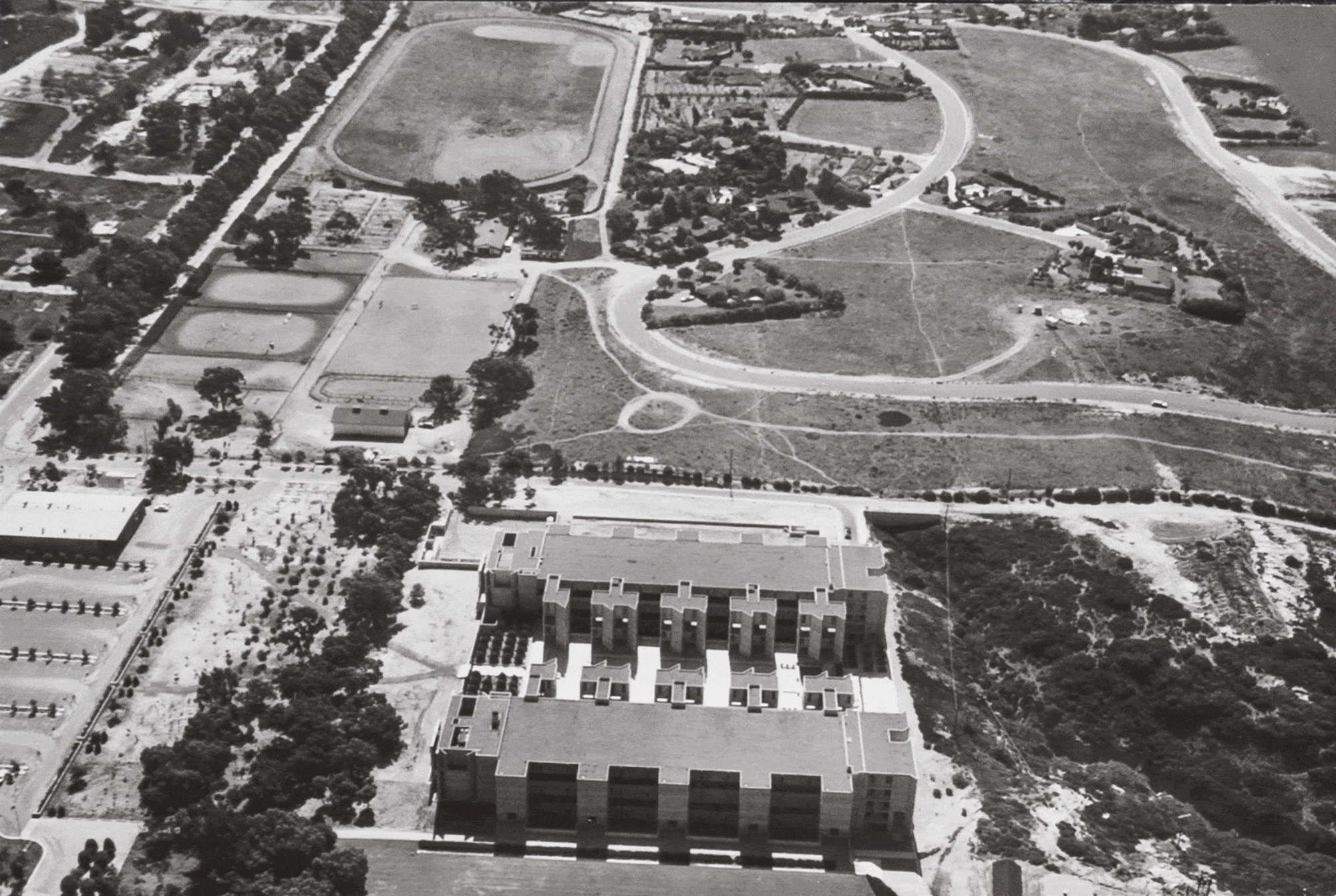
A few years later, across the Pacific Ocean, the newly independent nation of Mexico ceded the territory known as the “Pueblo Lands” to the mission of San Diego, located in what was then the Mexican province of Alta California; these lands encompassed sizable areas of present-day San Diego and La Jolla. At the time, the Torrey Pines Mesa was a scrubby expanse with few trees save the eponymous Pinus torreyana; the nuts of this species provided a dietary staple for the indigenous Kumeyaay people, who inhabited the mesa before its successive colonizations, first by Spain, then Mexico, then the United States. Later in the century, business interests of the British Commonwealth began to globally export a species of eucalyptus native to eastern Australia; “the tallest trees in the British Empire,” eucalypti were prized by investors and builders for their straight boles and rapid growth. By the end of the 19th century, Australian eucalypti were proliferating along the coast of San Diego, ostensibly providing a resource for railroads, shipyards, and building construction in what had by then become the state of California.
As it happened, however, the exporters shipped a shorter, more wiry species of eucalyptus to California. This would limit its commercial application, but not before extensive plantations of the Australian trees spread throughout the west coast, introducing a new species to local biomes. Early in the 20th century, the San Diego city council even created a new municipal position of “Pueblo Forester” to manage the afforestation of a wide swath of coastal plain, including Torrey Pines Mesa. “There was not one tree growing in that area when I took the job,” the city’s forester trumpeted. “There were thousands of acres of fine land going to waste. Eucalyptus at least offered it the possibility of producing something.” 17 With work crews comprised mostly of indigent and incarcerated men, the new forester seeded hundreds of thousands of eucalypti on the arid terrain. Over time, the trees would disperse fungal spores into the atmosphere, which in turn would cause the discoloration of the windows of the Salk Institute that so distressed its founder-scientist.
By the onset of World War I, the future site of the Salk Institute thus reflected and embodied the bio-geophysical intersection of colonial politics stretching across three continents. This intercontinental exchange would continue over the next decades. During World War II, the U.S. military transformed the coastal plain into an artillery training base named Camp Callan. The base included barracks, a glider tow-lane and landing strips, obstacle courses, and “a chemical warfare training center with two gas chambers where troops learned to differentiate phosgene from mustard gas before taking appropriate precautions.” 18 After the war, when Camp Callan was decommissioned, hang gliders and golf balls replaced artillery shells and and grenades. 19
A lengthy report produced by the Getty Conservation Institute in 2017 documents efforts to address the disrepair of the teak windows at the Salk Institute. The 348-page study, commissioned by the institute, begins with a description of the scope of the problem: “The window wall assemblies have presented a number of maintenance challenges to the Salk’s facilities staff almost since construction was completed.”
Various consulting experts then detail a litany of problems. “The growth of a biofilm on the surface of the wood has given the teak a black appearance that varies significantly by exposure,” says one building scientist. “As noted, several cleaning campaigns have been undertaken to remove this biofilm; however, none have produced long-lasting results.” 20 Other experts characterize the black fungal biofilm as “discoloration,” yielding a “non-uniform appearance.” Another makes this not necessarily intuitive but important point: “wood with mold or mildew on the surface remains firm and sound.” 21 A biologist amplifies this observation: “The black pigment in the biofilm is melanin, and it provides protection for the fungi by absorbing UV. It is possible that melanin inhibits the degradation of lignin beneath it, thus preserving the wood.” 22 Another contributor notes, too, that in the effort to remove the discoloration, “metal bristle brushes and frequent cleaning with bleach solutions, in combination with natural surface weathering from environmental factors, have led to significant surface texture and erosion of some of the teak.” 23
What is clear is that had the black biofilm been left intact, it might actually have preserved and protected the wood. What is equally clear is that the mechanical and chemical removal of the black mold — the bleach solutions, the wire brush, the sandblasting — compromised the visual and material integrity of the teak and in turn increased its susceptibility to future weathering and wear. And justifying all these deleterious interventions was the untested assumption that wood can ever weather evenly in this (or any) environment.
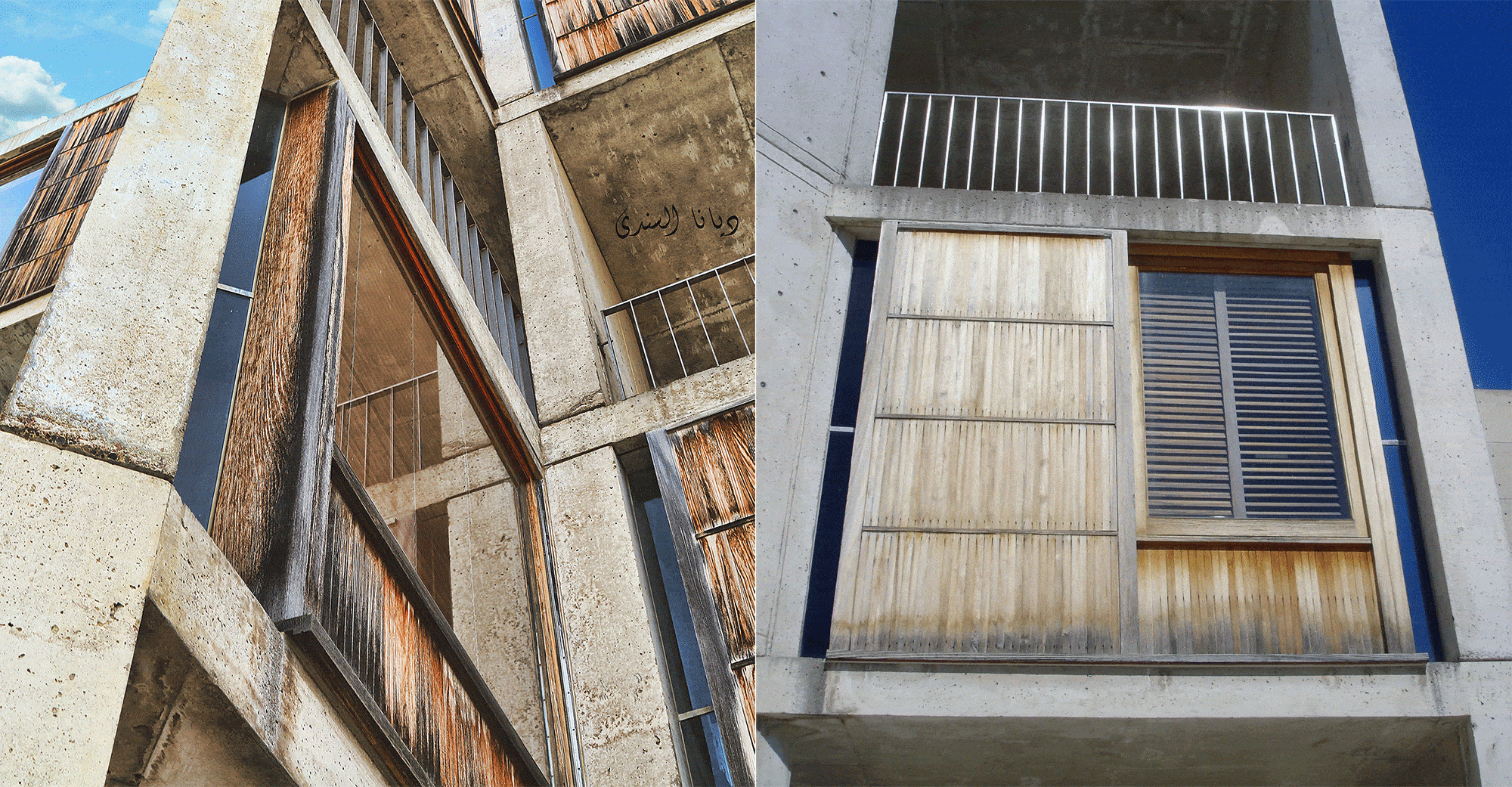
There is no way to ‘repair’ the geopolitical forces that converged to cause the deterioration of the teak windows installed alongside a vestigial eucalyptus grove on Torrey Pines Mesa.
But as we are arguing, the problem of the teak window assemblies has deeper origins. The black biofilm was engendered in the atmosphere of the imported eucalyptus grove east of the entrance to the institute’s courtyard. Its presence arose as much from the colonial importation of plants in the 19th century as from the 20th-century architectural specifications that detailed the windows’ construction. To contend with the black biofilm therefore means we must also contend with the ecological and political re-territorialization that has shaped the site. But of course there exists no technical “solution” or “repair” for the geopolitical forces that converged to cause the deterioration of the teak window panels installed alongside a vestigial eucalyptus grove on Torrey Pines Mesa. What does exist are alternative means to adapt to those forces — to tend to them. 24
The Getty report suggests some of those alternative means. As one of its wood scientists argues: “There is no realistic way to eliminate the growth of the biofilm entirely. … No wood, if left untreated, will achieve an entirely uniform appearance over time.” To expect teak to weather “uniformly” is to ignore its intrinsic properties and propensities: uniformity is simply not the tendency of teak in this place over time. Which raises the question: Is it our cultural expectations about “original appearance” that most needs repair? We are heartened to find a Getty consultant who makes this very case: “One option regarding the appearance of the assemblies is to accept variations in the appearance and let the teak continue to weather naturally.” 25

Ideally, the practice of tending to the Salk Institute’s teak windows would have begun not in the maintenance and repair protocols that follow a building’s completion, but rather during the design and specification processes that precede construction. The specification of wood cuts, for example, will strongly affect the performance of components in a finished building.
Ideally, the practice of tending would have begun not in the repair protocols that follow construction, but during the design of the building.
Wood is an anisotropic material. It can be milled in various ways, with different techniques that result in different grain orientations, which will each exhibit different properties and behaviors. One of the simplest and most common milling techniques involves making successive parallel band saw cuts through a fixed log; the result is slabbed, or live sawn, boards. This technique minimizes the need to manipulate heavy logs, but it produces boards in which the grain is inconsistent. The flat or plain sawn technique starts with cuts to the parallel ends of a log, then continues with further parallel cuts; the result is more consistent grain pattern and performance. Rift sawn boards are cut in a radial pattern, which produces boards with uniform vertical grains that correspond to the wood’s growth rings. Quarter sawn planking, in which the log is first cut into quarters, achieves similar results. Both rift and quarter sawn milling require more time and yield more waste, but the wood that results is usually more stable, an advantage in interior applications, such as hardwood floors.
In the teak at Salk, many of the slats share a vertical grain pattern, which is typically assumed to be a higher quality mill cut. However, this grain pattern exposed more of the soft earlywood to the elements (not to mention the bleach solutions and wire brush), and thus precipitated the severe erosion of the window panels. And here we must point out that the architectural specifications for Salk Institute’s window assemblies did not identify a mill cut. Photographs of the finished building suggest that the windows were constructed with live sawn logs. Yet the best way to promote more uniform weathering would have been to specify plain sawn boards. Here is one of Getty’s wood scientist, in the report, providing an admirably detailed analysis:
[F]lat-sawn slats tend to supply fewer microenvironments suitable for mildew and other airborne biological spores. The deep crevices created by the erosion of the earlywood on vertical-sawn and some rift-sawn slats can allow for moisture and windblown debris to collect in these areas; the rate of evaporation in these crevices is slower than the rate of evaporation on smoother, exposed surfaces. Thus, the valleys on the wood surfaces of vertical-sawn and rift-sawn slats tend to accumulate more organic debris and biological growth than the valleys on flat-sawn material. 26
The conundrum of the teak windows at Salk reflects interlocking material, geographic, technical, and political tendencies that neither architect nor client nor maintenance staff ever sought to examine, and most likely, six decades ago, were largely unaware of. But today we can retrospectively understand these converging tendencies: the biological and political histories of colonial forests and plantations; the techno-aesthetic defaults of commercial wood mills; the tendencies of wood to behave in particular ways based on these defaults; the cumulative effects of wind, humidity, solar exposure, desert dust, fungal spores, and biofilms; the tendencies of two plant species, teak and eucalyptus, to interact in ways not possible but for the colonizing and extractive tendencies of global empires; the tendency of a client to prefer the initial color of teak (orangish-brown) and the architect to prefer its age-worn appearance (weathered gray). All these factors contributed to the “non-uniform appearance” of the teak, and to its repair-induced ruination.
Now, decades later, we also wonder to what extent the practice of tending to all these terrestrial dynamics might have obviated the practice of repair.

An ethics of tending seeks to decolonize preservation by working with the historical, environmental, and biological properties of building.
Why should architects and preservationists welcome an alternative ethics of maintenance and repair, an ethics of tending? One answer is that this ethic involves a shift of focus: it directs our attention away from the cultural expectations and prerogatives of designers, towards a matrix of material properties and terrestrial activities. 27 It seeks to decolonize preservation by understanding and working with the historical, environmental, and biological tendencies of building, and thus to offer practitioners a refreshing interpretation of repair and maintenance as both a “tending to” and “tending toward.” And more: it seeks to radically realign the ecological and sociopolitical dimensions of construction at every stage.
“Tending” accepts, anticipates, and designs in consonance with inevitable change — and it understands this change as a desirable expression of material properties, site dynamics, inter-species coexistence, and the behavior of buildings and their contexts over time. 28 “Tending” is an alternative mode of aesthetic cooperation, a way of productively redirecting our terrestrial circumstances.29 And it requires assiduous attention: observing the full bio-geophysical circumstances that influence how something exists or appears in the world — a window, a building, a plant, a plastic toothbrush — means active inquiry, and greater intellectual, political, and practical commitments as a basis for design, and what we associate with repair.
The thing we make, however big or small, always prefigures its next states: how to remake or unmake it, how to rebuild and unbuild it.
The characterization — and criticism — of the Salk Institute’s teak as “non-uniform” is only possible if one assumes that the wood ought to be visually uniform: an assumption that only fueled the desire to preserve the wood’s original appearance. Alternatively, if one recognizes the importance of the historical and terrestrial circumstances in which a building’s designers and contractors specified, fabricated, and installed its components, then one also understands the differential colorations of the fungal biofilm as an inevitable tendency of the teak. 30 To tend to the design of buildings is to accept and to shape these circumstances rather than repair or restore them, or to try to “fix” their appearance. Tending encourages a fresh interpretation of how architecture appears and evolves in this world, the ways in which it is enmeshed in converging cosmopolitical and terrestrial realities. Here then is one recursive lesson for design in a broken world: the thing we make, however big or small, always prefigures its next states: how to remake or unmake it, how to rebuild and unbuild it, always through terrestrial dynamics and relations that transcend the dreary preoccupations of normative architectural production.
Tending teak, in the case of the Salk Institute, therefore entails tending to a “complex, life-sustaining web” of terrestrial, historical, and environmental conditions. 31 As such, tending offers more than just a potent perspective on repair and maintenance. In the words of Louis Kahn: “When you’re making something you must consult nature” 32; “the architect becomes the advocate of nature, makes everything in the deepest respect for nature.” 33 Stirring words; but an architect would do well to come to grips with exactly what that consultation and advocacy might mean. That Kahn ignored his own admonition to “consult nature” — even in the context of a biological research facility — is bluntly indicative of the profession’s shortcomings: of its unwillingness or inability to reason, imagine, and situate buildings in their environments, or in the dynamics of their past and future states, or in the implacable realities of how architecture reorganizes life on the thin surface of Earth. This unwillingness is a source of brokenness at multiple scales, from windows to buildings to cities to planetary organization.
Given the magnitude of our troubles ― the degree of brokenness we confront ― there are no solutions, no easy repairs. At best, we can opportunistically and optimistically adapt. Tending is an art and practice of adaptation; of the apt. Observing and nudging the complex tendencies of terrestrial systems both small and large, studying them closely and engaging them directly, with practical resolve and political acuity: this is what we mean by “tending building.” We offer tending as a guide to adapting not just teak windows and famous modernist buildings but also, more capaciously, the entire project of architecture as it seeks to engage the next states of an increasingly uncertain world.



.jpg)
If you would like to comment on this article, or anything else on Places Journal, visit our Facebook page or send us a message on Twitter.