
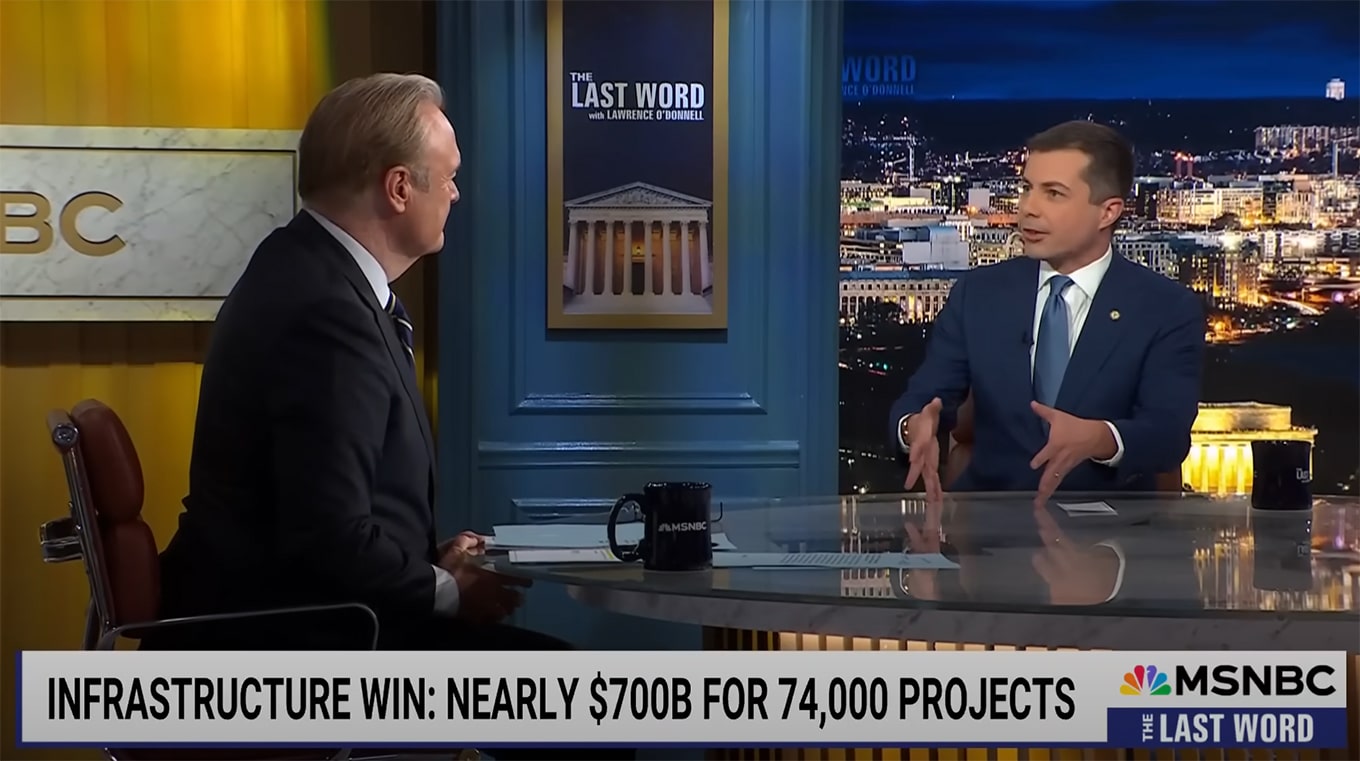
Ten days after the November 2024 election, U.S. Transportation Secretary Pete Buttigieg went on television to claim a “decade of infrastructure” as the Democrats’ consolation prize. They had fumbled the presidency and control of Congress, but their great works would survive. It was not an easy story to spin: “Think of the Interstate Highway program under Eisenhower,” he said. “A massive achievement, but it was one thing. The transcontinental railroad, under Lincoln. But this is a little hard to characterize because it touches so many things.” 1 Though his history lesson was perhaps too simple, Buttigieg had command of the talking points. Earlier in the day, the White House had issued a press release touting the cumulative impact of its “Investing in America” agenda: $695 billion for 74,000 projects across the country. 2 Call it the Big Deal. This “Bidenesque turn of phrase,” Buttigieg said, is “the only way to really capture the transformative investments that have been made.”
The Bipartisan Infrastructure Law doubled federal spending on transportation. But was it actually transformative?
There was a tragic irony to the scene, watching a cabinet member act as the smooth communicator the President could not be. Joe Biden himself never used the phrase, and neither did Kamala Harris, but Buttigieg had been talking up “the Big Deal” since the Bipartisan Infrastructure Law was signed in 2021. 3 If political fortunes turn on convincing citizens that government can materially improve their lives, Buttigieg wanted his boss to get credit for the 367,000 lead pipes replaced and 8,900 school buses deployed, for the bridges and desalination plants and “factories rising out of the prairies.” 4
By the numbers, yes, it was big. The infrastructure law doubled federal spending on transportation, not to mention energy and water systems, broadband internet, and environmental cleanup. 5 It was, according to the White House, “the largest investment in transportation infrastructure … since President Eisenhower’s investment in the Interstate Highway System.” “The largest investment in passenger rail since the inception of Amtrak.” “The largest investment in public transit ever.” But was it actually transformative? Top billing, as usual, went to “improvements on over 196,000 miles of roads.” 6 Armed with supersized budgets, states pushed projects to supersize their highways. This was transportation planners doing what they have done for the past half century: adding lanes.
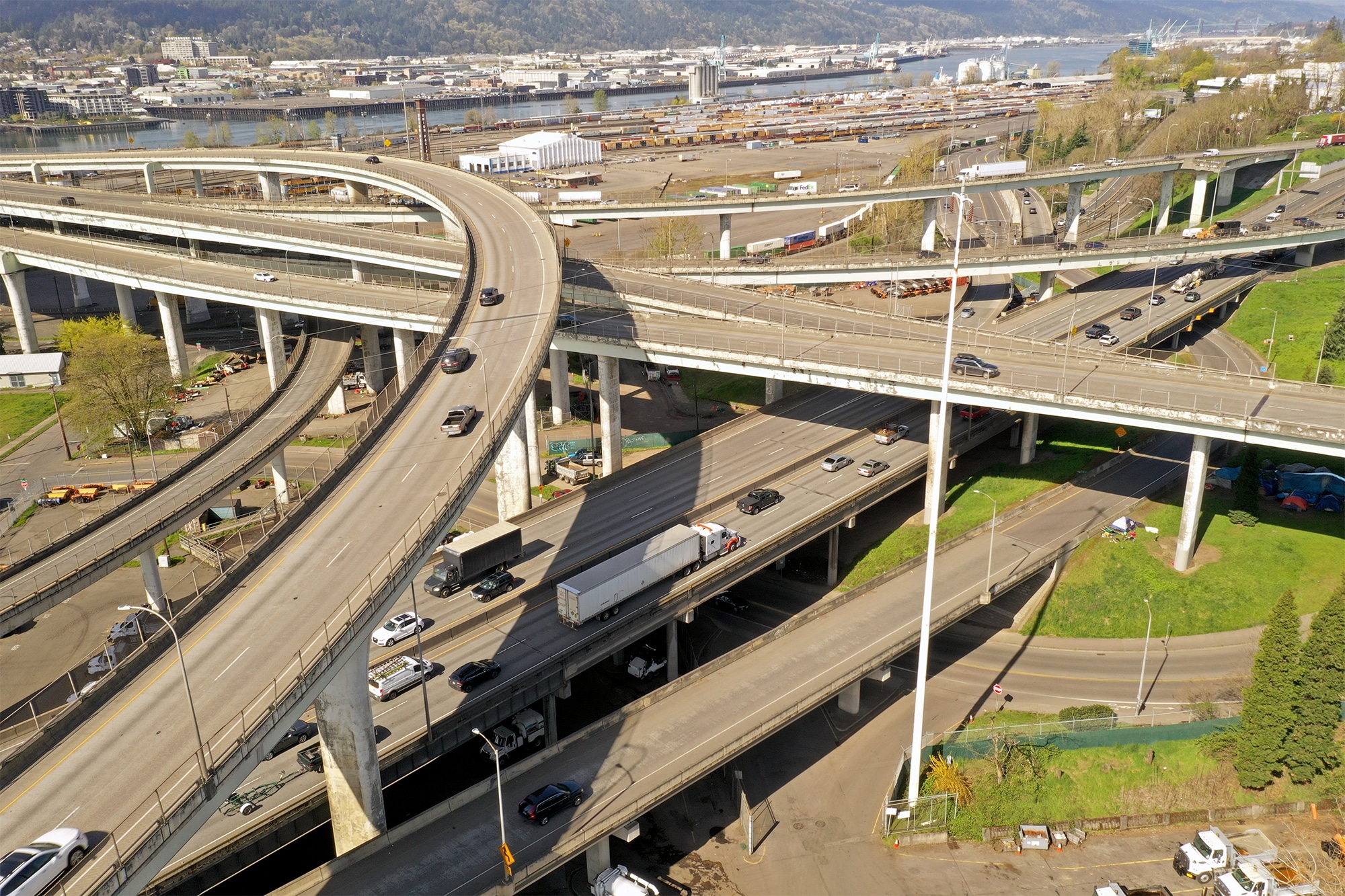
Yet there were also signs of reform. The Bipartisan Infrastructure Law seeded a pilot program that was expanded the following year, in the Inflation Reduction Act, providing $4.1 billion in grants for “Reconnecting Communities,” remedying past mistakes through the “removal, retrofit, or mitigation” of harmful infrastructure. 7 When the program rolled out, Buttigieg spoke about the 20th-century freeways that destroyed Black wealth and hardened racial segregation, the underpasses built so public buses could not access the same beaches as private cars. He called out the “racism that went into those design choices.” 8 Reconfiguring urban freeways, he said, could shift resources toward public transit and open new land for development. This was a win for the freeway removal movement — building on decades of grassroots activism — even if it was less than half of the $10 billion that Senate Democrats wanted. 9 For the first time, the federal government showed it was ready to start rethinking the Interstate system.
Community leaders in Portland envision affordable housing built on top of the freeway that displaced their elders in the 1960s.
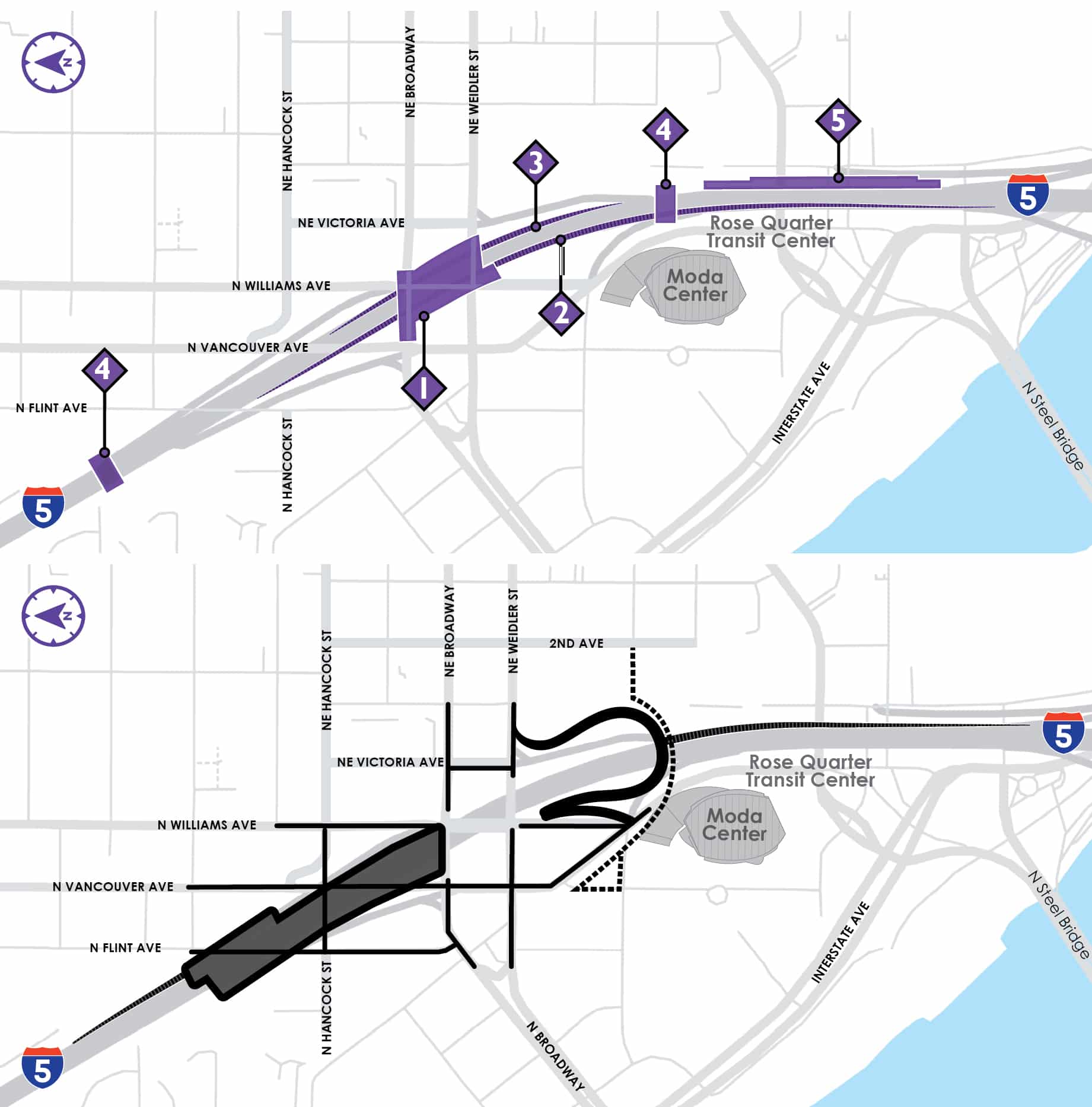
The largest grant in that new program — more than a tenth of the total budget — promised $450 million to the Oregon Department of Transportation to build a freeway cap over six blocks of I‑5 in Northeast Portland. 10 Officially known as the Rose Quarter Improvement Project, it is a vivid illustration of how the Big Deal has played out on the ground. Here the funding was secured with the help of a community organization that wants to reinvest in the historically Black district of Albina — to “buy back land, rebuild community, and reroot Black legacies and Black futures.” 11 They envision affordable housing built on top of the freeway that displaced their elders in the 1960s. But in the minds of Oregon officials, that freeway cap is tied to a longstanding plan to widen the roadbed at the same time.
And so the marquee project of the Reconnecting Communities program is almost perfectly Bidenesque — doubling down on a flawed status quo, while simultaneously incubating a transformative new vision. Ultimately, the big deal in Portland might not be the tenuous freeway project, but everything happening around it.
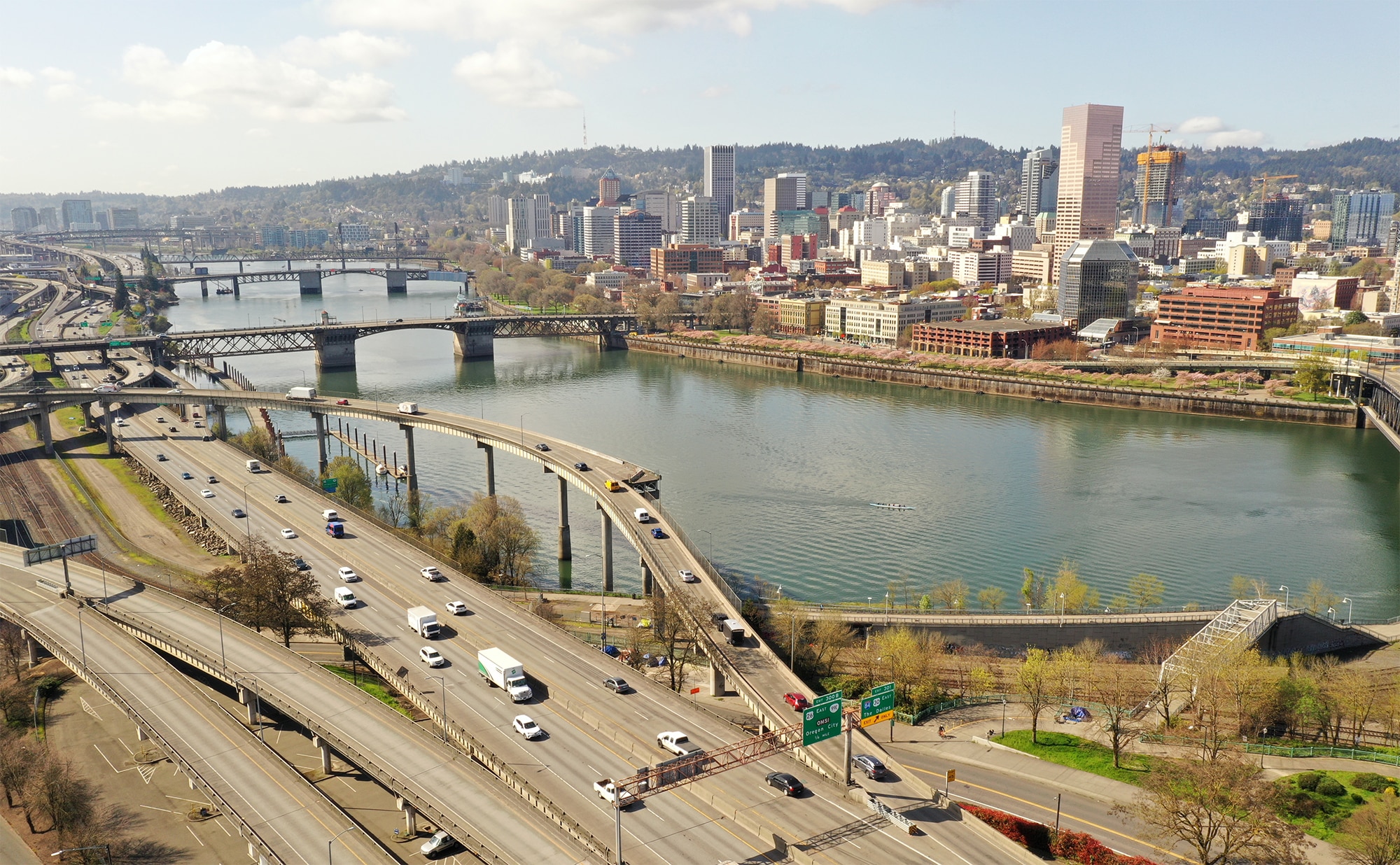
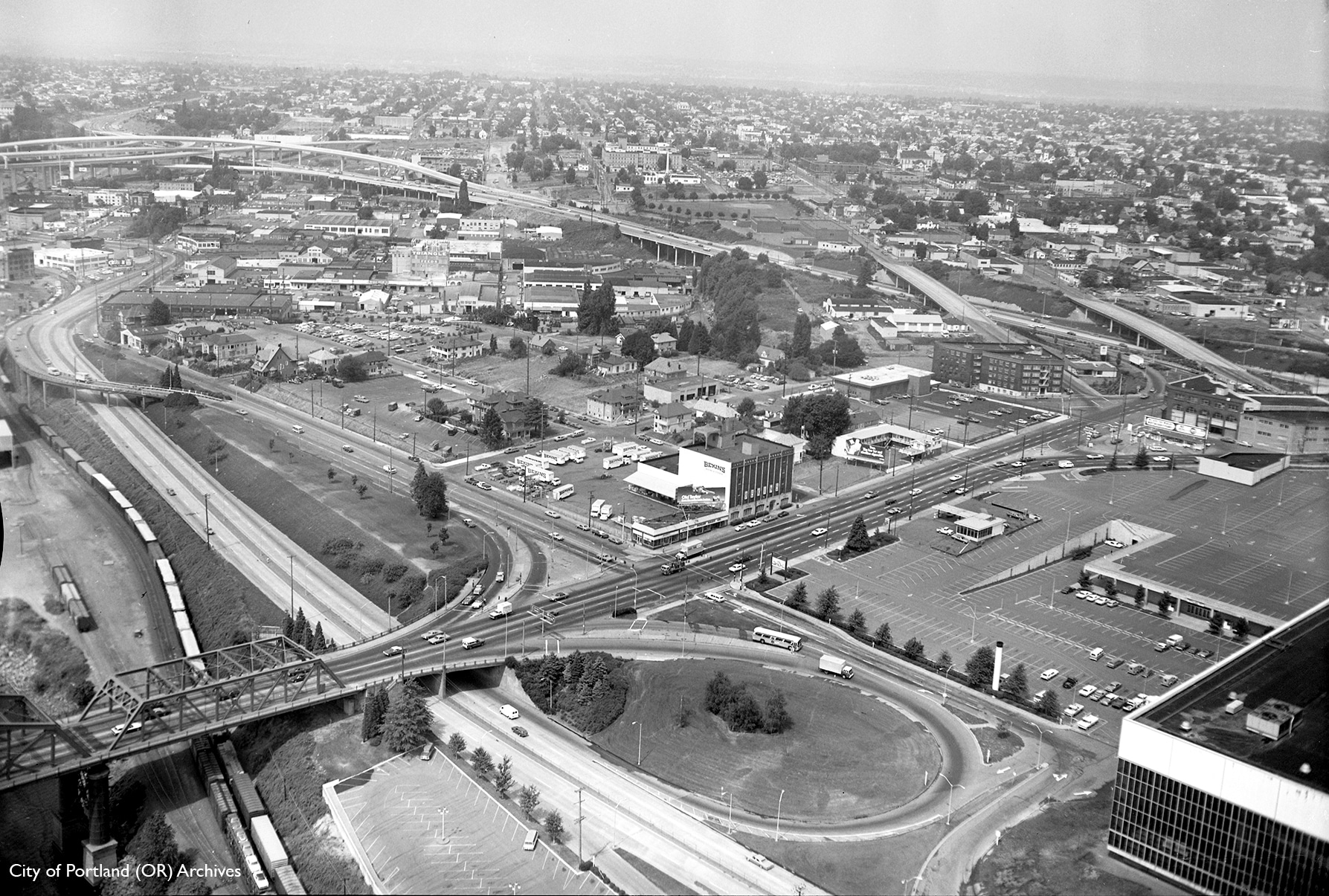
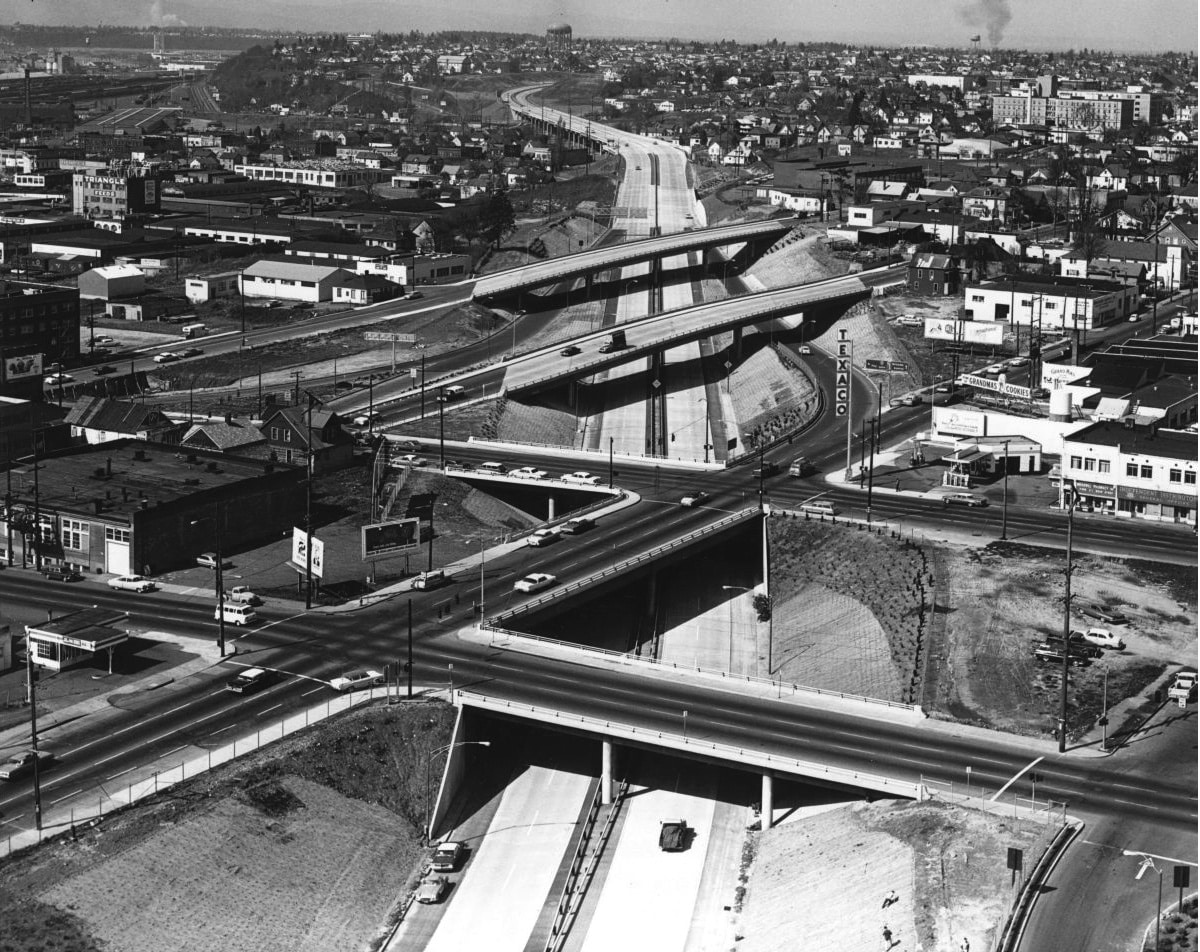
According to some histories, the U.S. freeway removal movement began in Portland, in 1974, with the demolition of Harbor Drive and the creation of a park and promenade along the Willamette River. 12 The project kicked off a downtown revival, benefiting affluent neighborhoods on the west side of the river, in the misty embrace of the Tualatin Mountains. But it was only politically conceivable because of freeways that had been built through middle- and working-class neighborhoods on Portland’s east side. The Marquam Bridge (1966) and Fremont Bridge (1973) completed the construction of I‑5 and I‑405, which merged in the heart of Black Portland. That was no accident.
‘They called it blight,’ Richard Hunter said. ‘But the Black community understood that was a codename for Black.’
In the 1950s, four out of five Black Portlanders resided in the Albina district, near the Union Pacific railyard, in inner Northeast. Tens of thousands of workers had moved to Oregon during World War II to build ships, living in the nation’s largest wartime housing project at Vanport, five miles north, on a slough polluted by slaughterhouse waste. 13 When a catastrophic flood destroyed the Vanport development in 1948, all of those residents were left homeless. Excluded from other neighborhoods due to racial discrimination, Black families found refuge in Albina, filling churches, schools, restaurants, boxing gyms and basketball courts, and the jazz clubs of “Jumptown.” 14 Richard Hunter, who grew up with eight siblings in a one-bedroom house, remembers an overcrowded but tight-knit community. “We were all close together,” he told me. “Life was vibrant.”
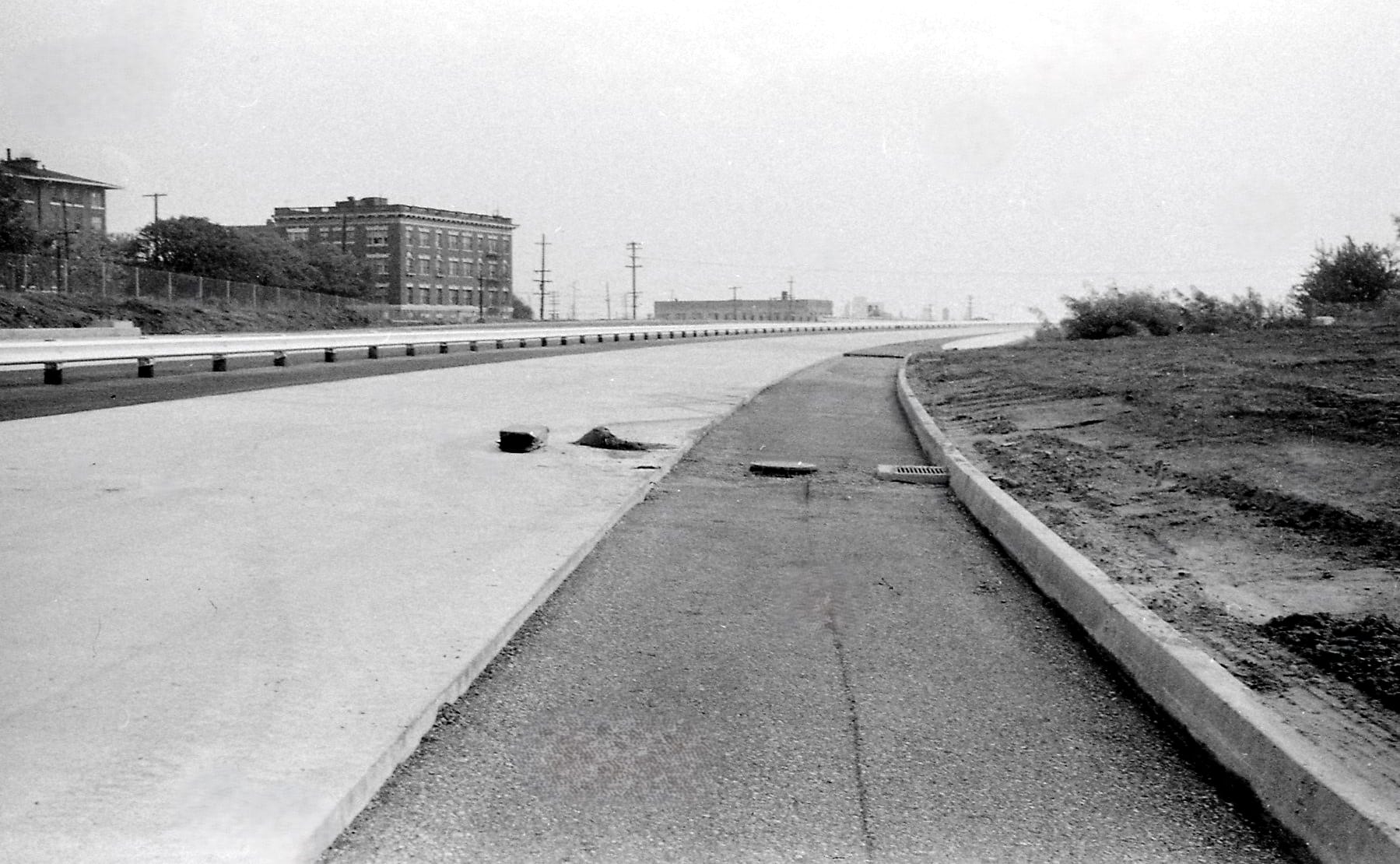
Portland officials, however, weren’t happy to see so many Black people living close to downtown. “They called it blight,” Hunter said. “But the Black community understood that was a codename for Black.” In 1958, his family’s home was taken by eminent domain and razed to make way for I‑5. Across two decades, hundreds more homes, in a wider radius, were demolished for freeway ramps, public buildings, a hospital expansion, and a sports stadium, all in the name of urban renewal. Some owners received compensation that was much lower than the value of their property. 15
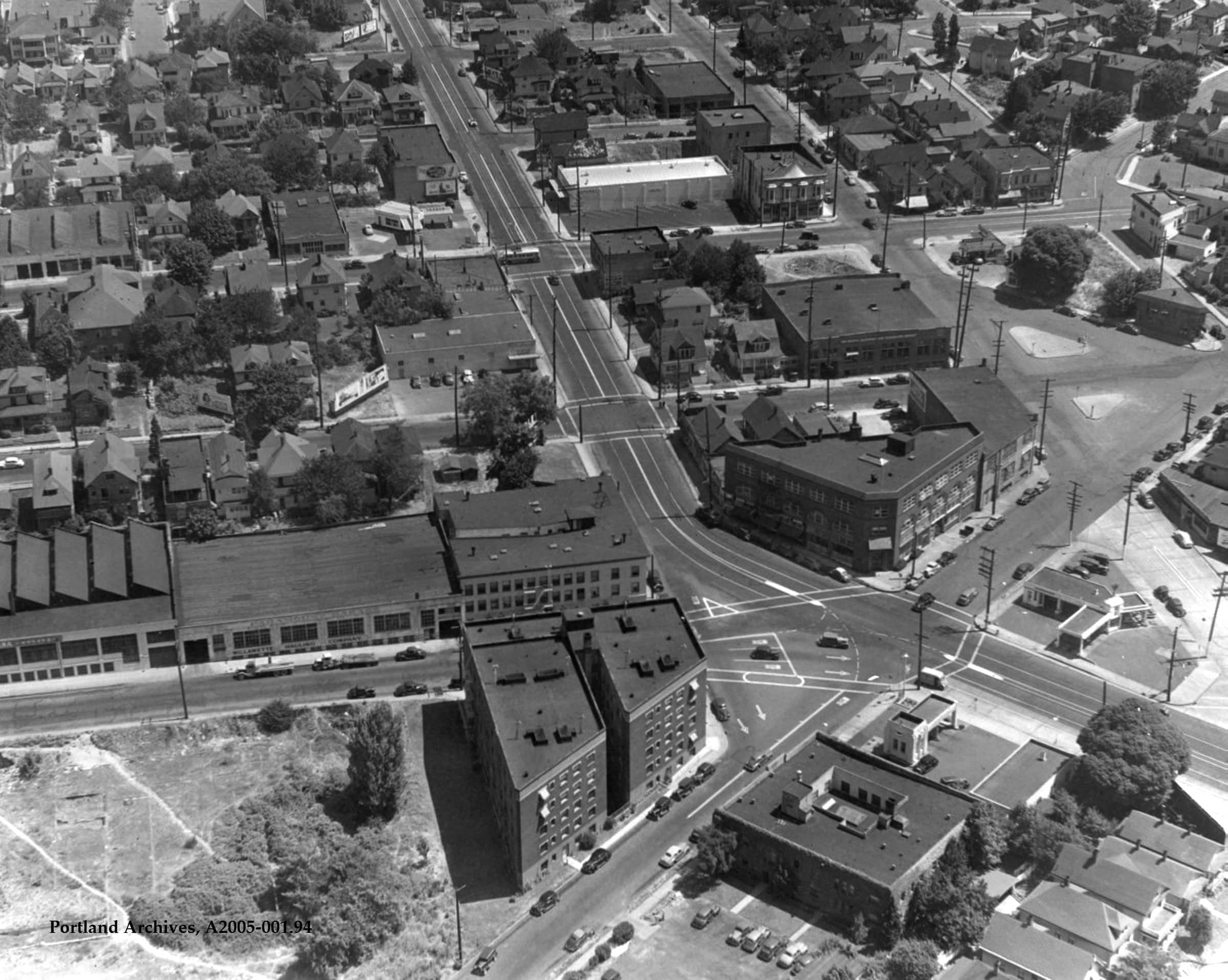
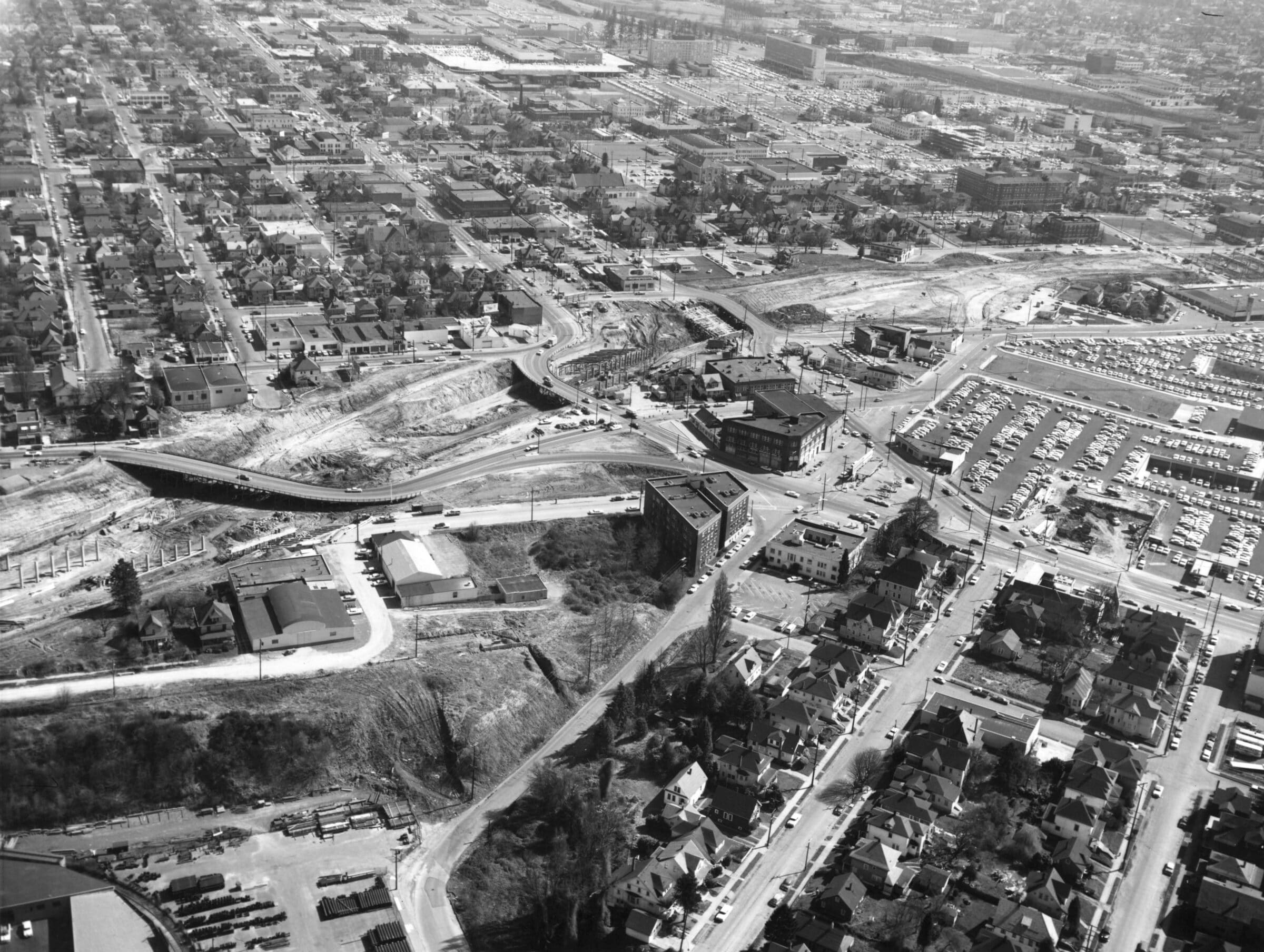
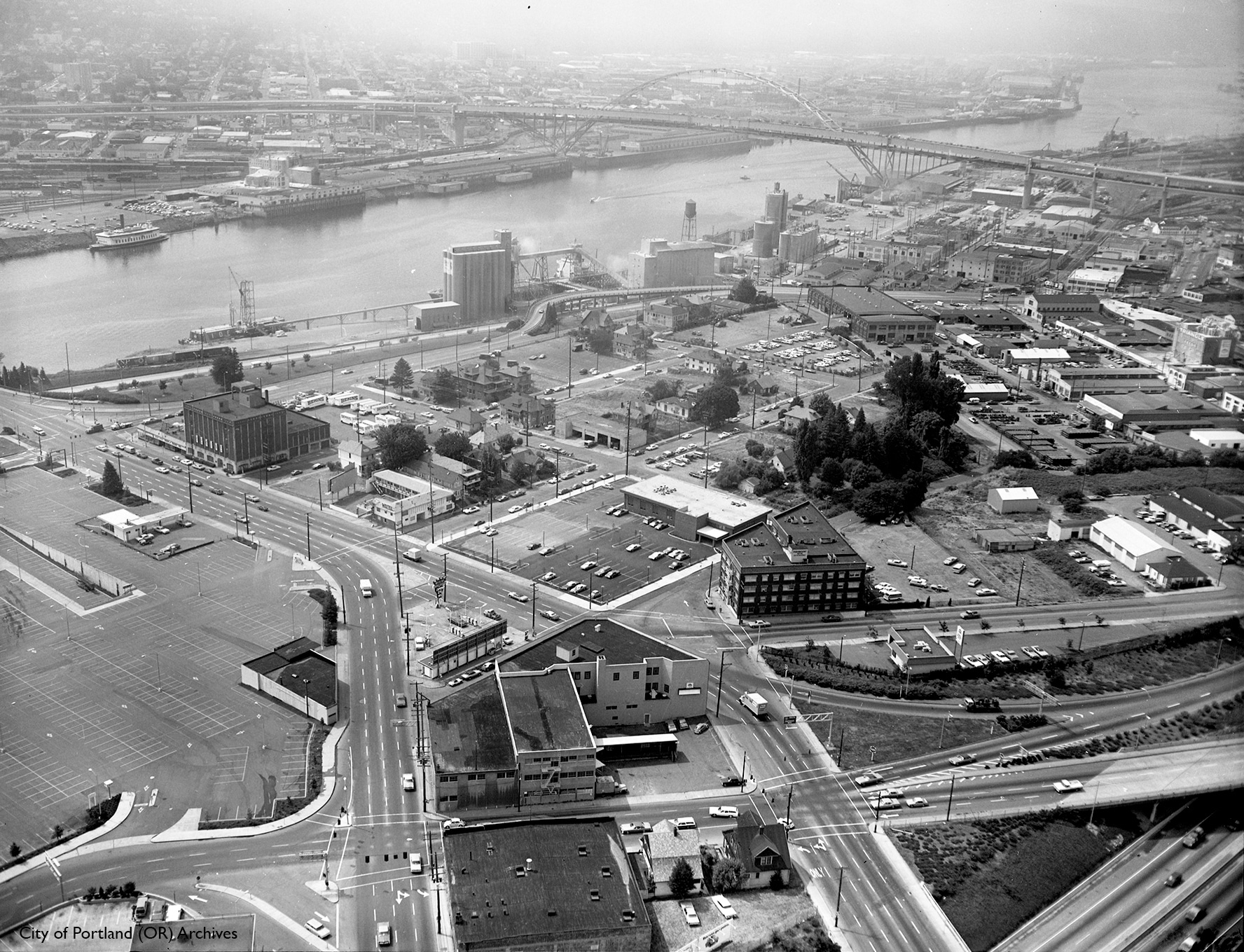
The destruction of Portland’s only Black neighborhood was part of a nationwide “urbicide,” as architecture critic Ada Louise Huxtable wrote at the time. 16 Governments and business interests coordinated to push minority groups out of city centers. The process often began with a freeway coming through. Tulsa’s Black Wall Street, New Orleans’s Faubourg Tremé, and Pittsburgh’s Hill District are among the thriving Black neighborhoods paved over and cut through by interstates. Freeways walled off Chinatowns in Boston, Chicago, Philadelphia, and Sacramento and barreled through Mexican-American neighborhoods like East Los Angeles, San Diego’s Barrio Logan, and Tucson’s Barrio Viejo. 17 And, contrary to myth, freeway evictions did not end with the urban renewal era but continue to the present. A 2021 Los Angeles Times investigation found that federally funded highway projects displaced 200,000 people between 1990 and 2020. 18 “There are Albinas all over this country,” said Sharon Gary-Smith, a community activist who grew up in the Portland neighborhood.
Contrary to myth, freeway evictions did not end with the urban renewal era but continue to the present.
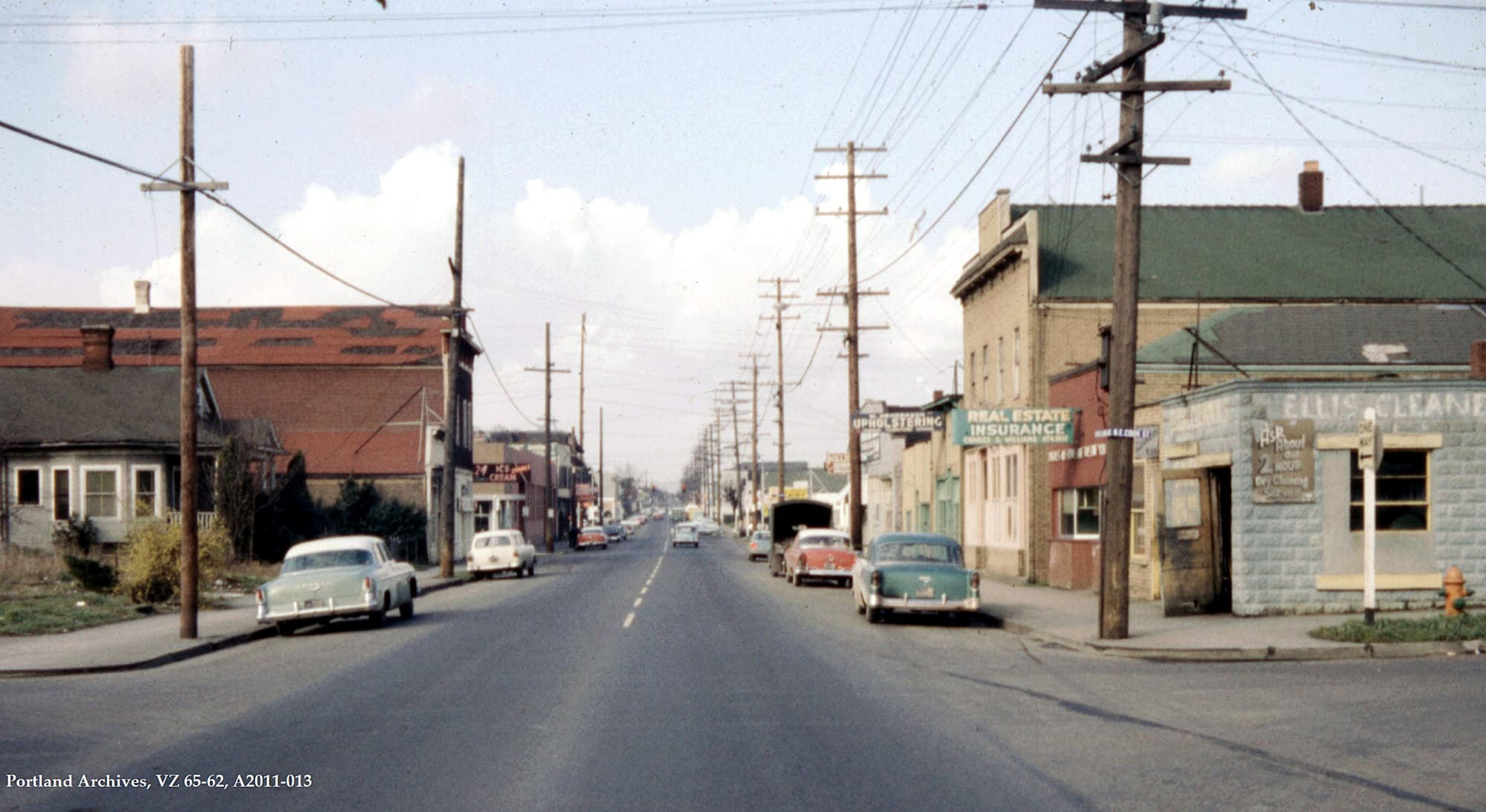
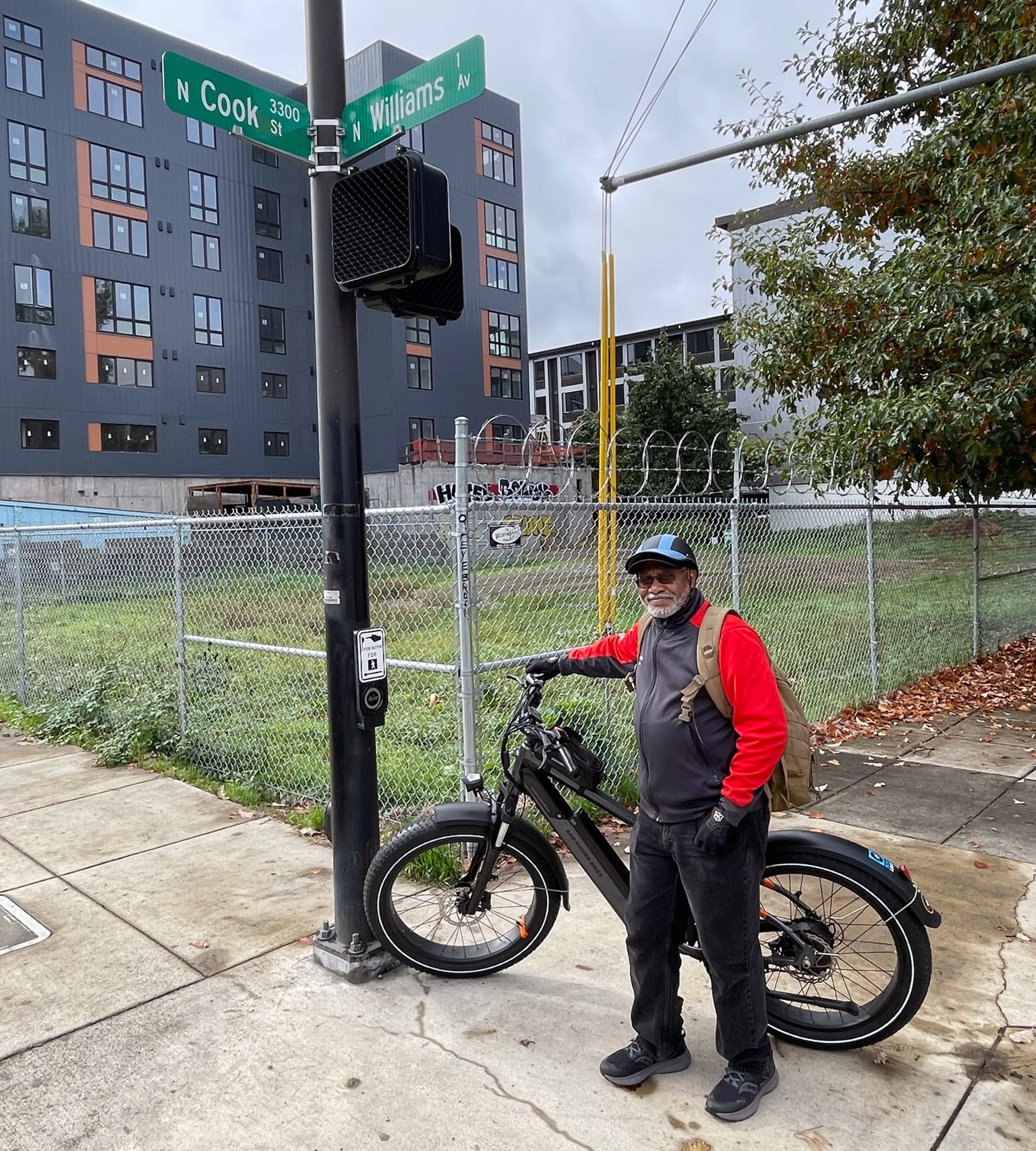
Last fall, a month before the election, Richard Hunter walked with me down Williams Avenue, north of the freeway. He pointed out the vacant lot where his mother’s restaurant and ice cream parlor, Bernice’s Kitchenette, had been. Next door was Ellis Cleaners. On the other side, Batman’s Pool Hall. Across the street, Tropicana Lounge. 19 All gone. The freeway missed these blocks, but businesses couldn’t survive without customers. At least 1,100 families were displaced by urban renewal projects in Albina, and some lots remain vacant to this day, after development plans changed. Two census tracts at the center of the Albina District that had a combined population of 7,215 in 1950 had just 414 residents in 1980. If the neighborhood wasn’t blighted before, it certainly was after its “renewal.” 20
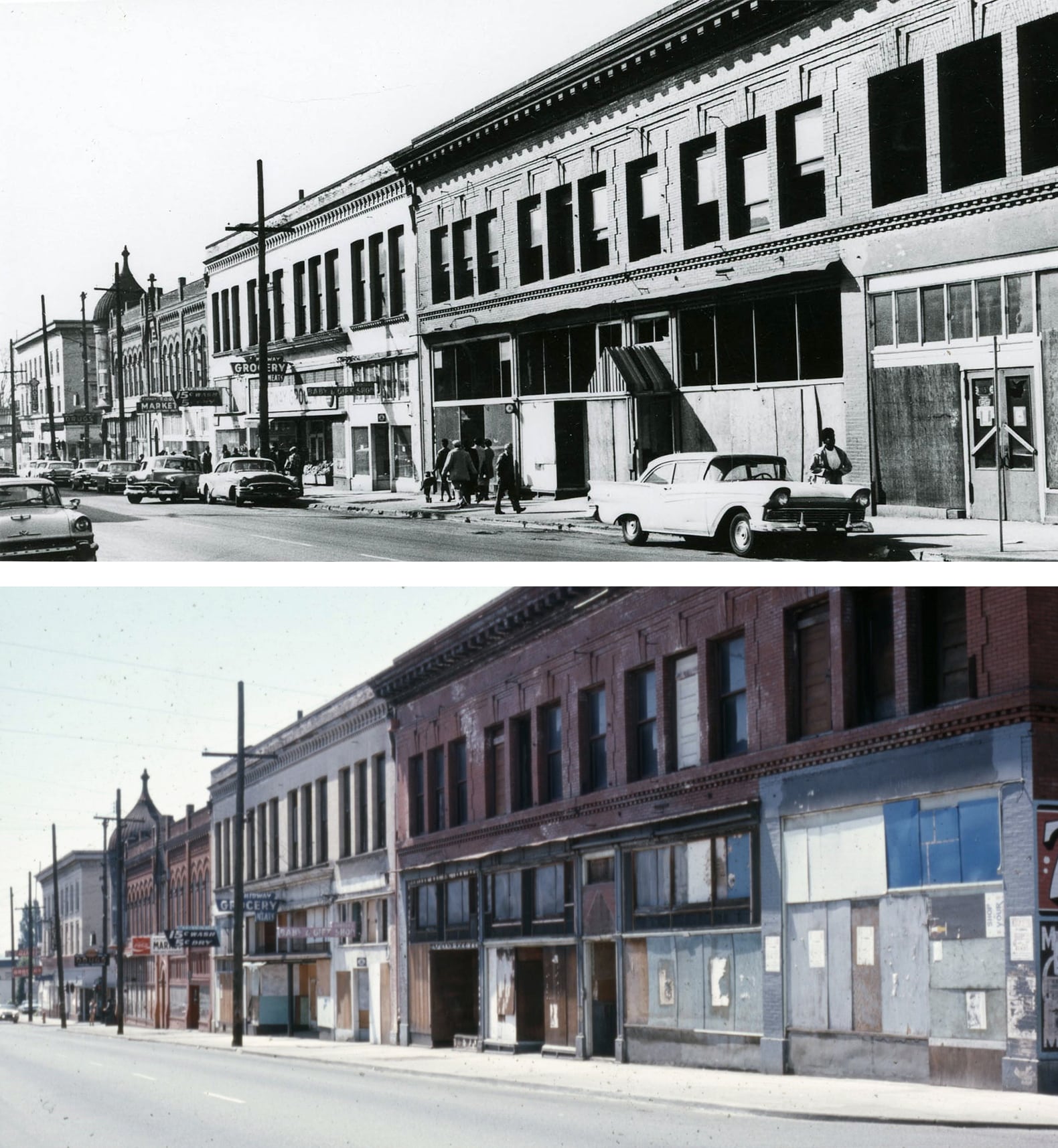
With the cultural and economic center of Black Portland effectively wiped off the map, the district was assigned new names and identities. Lower Albina, between the freeway and the river, is now officially the Rose Quarter. The flowery name was picked by billionaire Paul Allen’s Oregon Arena Corporation, which built a new home for the Trail Blazers basketball team in the 1990s, before going bankrupt. The Rose Quarter is currently home to two stadiums and their garages; freeway onramps and overpasses; and a desolate collection of parking lots serving bureaucratic megastructures, like the oversized ten-acre headquarters for the Portland Public Schools. It’s also an important transit corridor, where four light rail lines and a streetcar converge. To the north and east, the Boise and Eliot neighborhoods epitomize the distinctive form of gentrification sometimes described as Portlandia, with lovingly restored bungalows painted vibrant colors and empty lots activated by food truck pods. Williams Avenue, with its extra-wide bike lane, is lined by new apartment buildings with meditation studios on the ground floor.
Hunter, now in his 70s, still lives in the area, in an affordable housing complex. He has embraced many of the changes, traveling exclusively by electric bike and enjoying the new restaurants. What hurts is that he and others in his community did not benefit financially from the neighborhood’s transformation. “When you took land from people, you took more than just land,” he said. “You took the opportunity to build wealth.”
Portland’s urban design “obviously reflects racism,” as Buttigieg might put it, but the federal government doesn’t have a playbook for how cities can heal scars like these. 21 One idea is to remove the freeway entirely, but that scenario is exceedingly rare in the United States. Most removals have been short stubs, like the Embarcadero Freeway in San Francisco and the Park East Freeway in Milwaukee, or lightly used downtown connectors in depopulating Rust Belt cities such as Akron and Rochester. Celebrated freeway teardowns in Oakland and Providence were actually re-routings that moved viaducts away from dense residential areas. 22
Cities including St. Paul, Kansas City, Detroit, Baltimore, Atlanta, the Bronx, and Buffalo have won grants to build freeway caps.
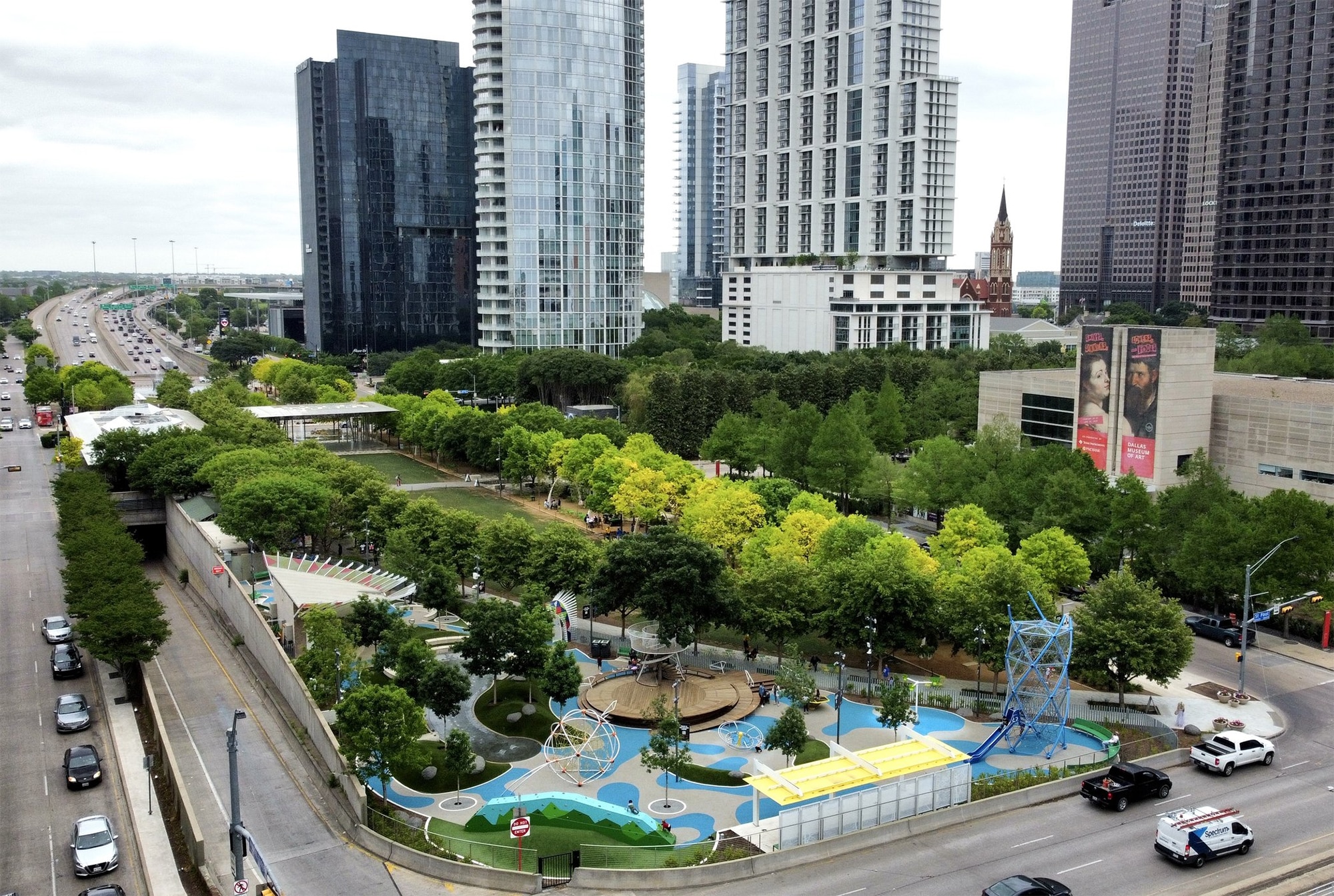
More common today is a freeway “cap,” “cover,” “lid,” or “stitch.” These projects take their cue from Boston’s Big Dig, which sent I‑90 underground, eliminating the surface-level unpleasantries of the freeway while preserving maximal car access to the city center. Under the Reconnecting Communities program, cities including St. Paul, Kansas City, Detroit, Baltimore, Atlanta, the Bronx, and Buffalo have won grants to plan for or begin constructing freeway caps. 23 These projects (none as large or complex as the Big Dig) would turn short stretches of freeway into tunnels, while transforming the land above into something else. Usually that means green space, like the Rose Kennedy Greenway that topped the Boston project, or Klyde Warren Park above the Woodall Rogers Freeway in Dallas.
Oregon is among the states that have folded freeway caps into longstanding expansion projects. Since the 1980s, ODOT has been trying to widen the Rose Quarter Freeway, a nearly two-mile stretch of I‑5 that runs through historic Albina between the I‑405 and I‑84 interchanges. 24 With just two lanes in each direction, this is “the state’s top bottleneck,” project director Megan Channell told me. “It has the highest crash rate for an interstate within Oregon.” Expansion proposals went nowhere until 2017, when the state legislature authorized funding for an “auxiliary” lane in each direction and extra-wide shoulders to clear crashes and stalled vehicles. The road would be widened by digging into the sloped sides of the freeway trench, so that no residents would be displaced. As initially drawn up, the project also included a couple of small freeway caps that would create park space.
Community leaders told planners to fix what they broke, stitching the neighborhood together with a freeway cap strong enough for housing.
But when ODOT planners shared their proposal with community leaders, they ran into resistance. “I would be one of those that gives them a real jaundiced side eye,” said Gary-Smith, who was head of the local NAACP chapter. “There is a level of skepticism based on past history.” In 1961, when she was twelve, her family got notice that their house was being seized by eminent domain: “This ordinance is necessary for the immediate preservation of the public health, peace, and safety of the city of Portland.” 25 More than a decade later, the school district headquarters — a Brutalist complex of administrative offices, warehouses, garage bays, and facilities shops — opened on the land where her home used to be. The freeway was built just feet from her elementary school.
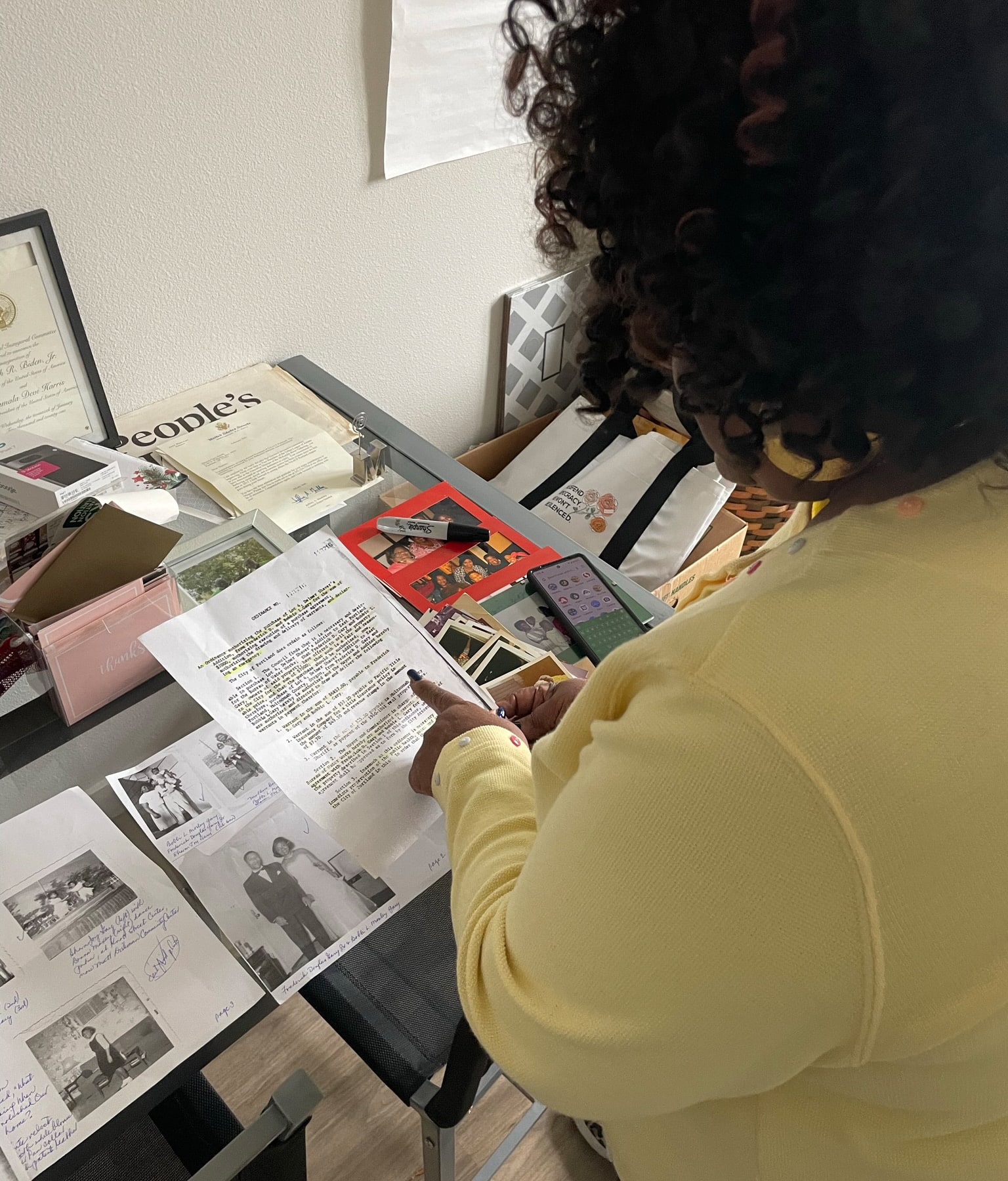
After living in other cities, Gary-Smith returned to her old neighborhood by securing a spot in a below-market-rate apartment complex. Her unit looks out on a condo building with “five or six Teslas behind the gate.” Though she found an affordable place to live, she knows many others are still priced out. Community leaders told ODOT planners they had to fix what they broke, stitching the neighborhood together with a freeway cap strong enough to support housing. For a long time, they wouldn’t listen, she said. “They really fought, fought, fought this idea of making it more habitable.” 26
‘They really fought, fought, fought this idea of making it more habitable,’ Sharon Gary-Smith said.
But that would change with the emergence of a new organization, the Albina Vision Trust, dedicated to revitalizing the neighborhood as a hub of Black cultural life while also building wealth for Black people. Co-founded in 2017 by Rukaiyah Adams, a former Wall Street fund manager, the Trust commissioned a study to calculate the home equity lost through urban renewal foreclosures. The answer? Nearly $1.5 billion dollars. 27
“These are the material circumstances that impact the wealth gap between White Portlanders and Black Portlanders today,” said JT Flowers, the group’s communications and policy director. “There’s still a really deep spiritual connection to this area of the city for Black Portland. It’s an area that we’ve been really intentionally trying to reclaim and come back to for decades.” Flowers, now in his early 30s, grew up nearby, raised by a mom who worked in community development. She “would bring me into meetings and just set me in the corner. So the people who have been fighting to see this work happen are the people that raised me. … Miss Sharon has known me since I was literally an infant.”
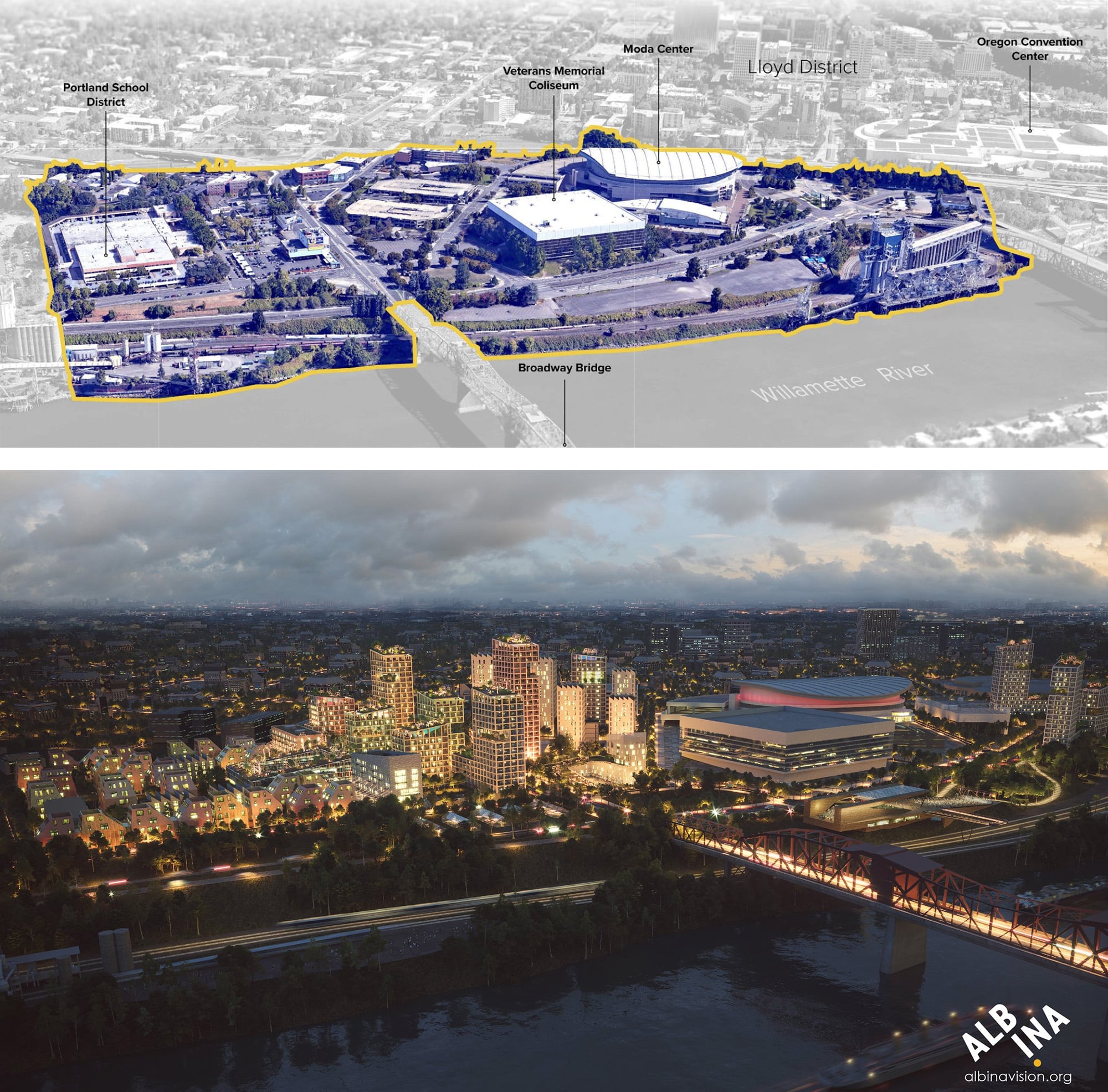
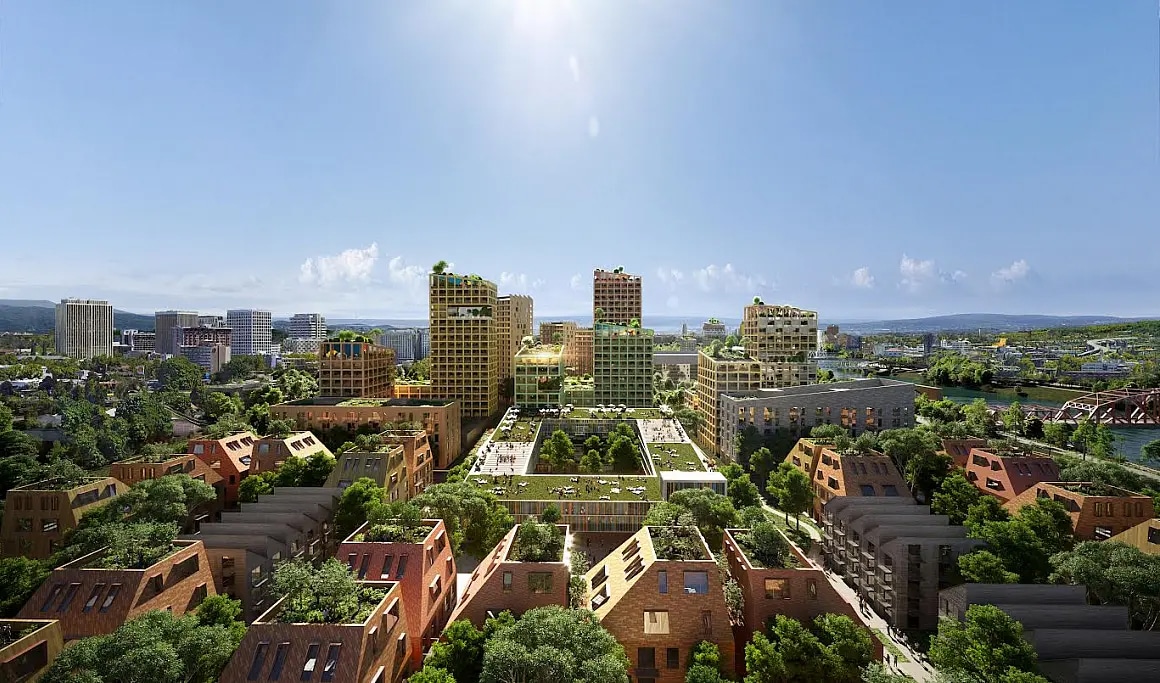
Much of the land in Lower Albina is still owned by the public agencies and large institutions that wielded eminent domain powers decades ago. Through years of community meetings, the Trust has sketched out a redevelopment plan that, in effect, seeks to recapture the high value of this real estate and distribute it among the community pushed off that land. Their architectural renderings show an Afro-futurist city-within-a-city, punctuated by high-rises and threaded with green spaces, on 94 acres between the freeway and the river. When they started their work, there was almost no housing left in this area. Over the next two decades, they plan to build approximately 3,000 “climate positive” homes, roughly half designated as affordable. They have proposed creative forms of housing tenure, including nonprofit community land trusts and for-profit real estate investment trusts, as well as more traditional rental and ownership housing. There will be schools and offices and waterfront recreational access. 28 Affordable units will have an eligibility preference for people displaced from North and Northeast Portland and their descendants, through the same program that helped Gary-Smith and Hunter come back to the neighborhood where they grew up. 29
Albina Vision Trust seeks to recapture the high value of this real estate and distribute it among the community pushed off that land.
Led since 2020 by Winta Yohannes, a veteran of Portland City Hall, the Albina Vision Trust has evolved from a traditional advocacy group into a nonprofit real estate developer. In the process, it has built the kind of business and political relationships needed to make its vision a reality. The group has an agreement to acquire and redevelop the ten-acre school district headquarters on the north side of the project area, where Gary-Smith once lived. On that site, Lewis & Clark College has pledged to construct a satellite campus that would be an “education and economic empowerment hub.” The Trust also has a formal partnership with the Trail Blazers, which owns properties to the south, to coordinate development strategies, communications, and lobbying efforts. 30
Most significantly to date, the Trust has built 94 affordable housing units at Albina One, which opens this summer. At the community’s suggestion, the design by Chandra Robinson of Lever Architects provides each floor a large shared outdoor space with skyline views, a “front porch” recalling the old neighborhood houses. 31 And with the help of a $400 million grant from the Knight Foundation to Adams’s 1803 Fund, the Trust has purchased a historic 66-unit brick apartment building next door, which they plan to convert to affordable housing. 32
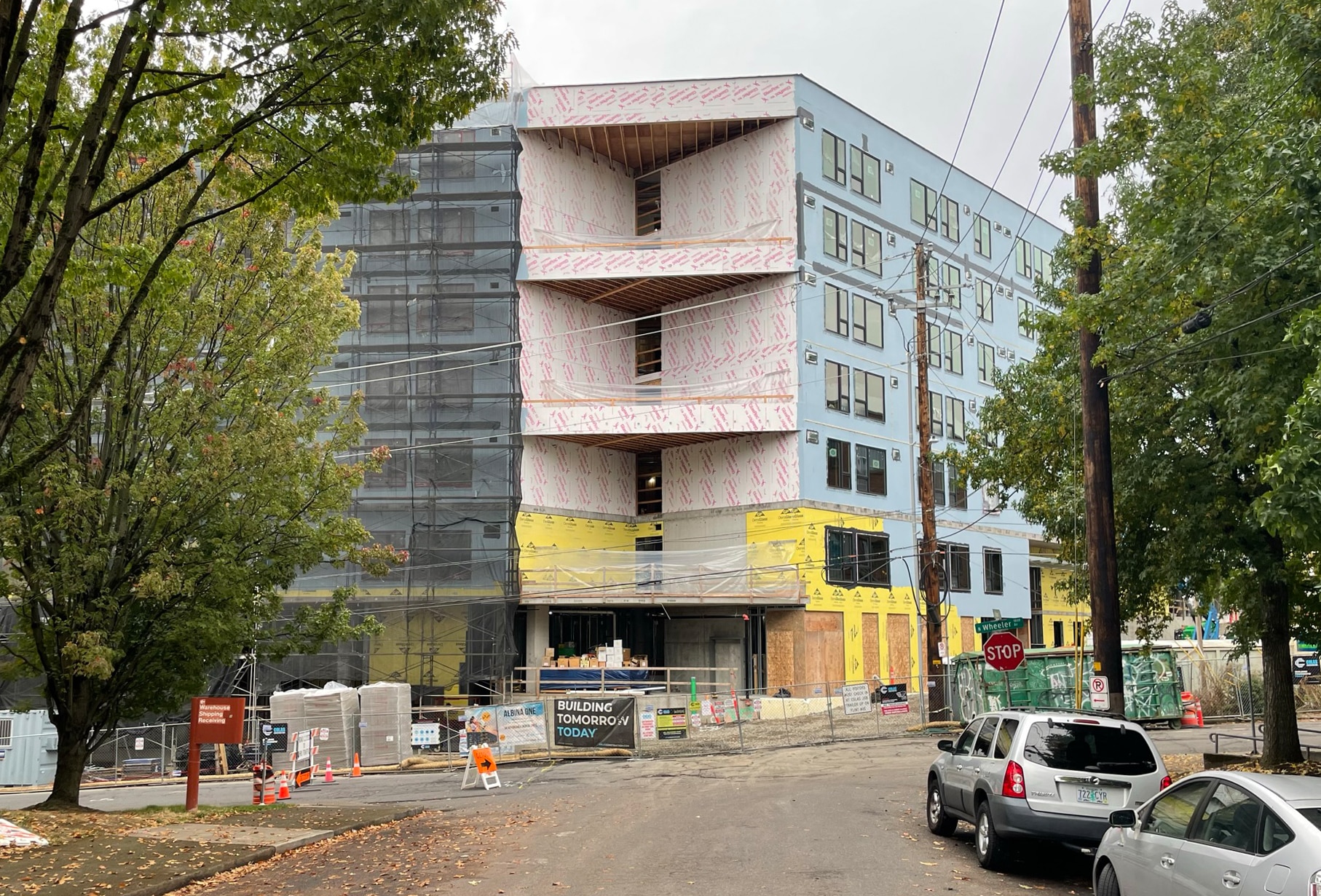

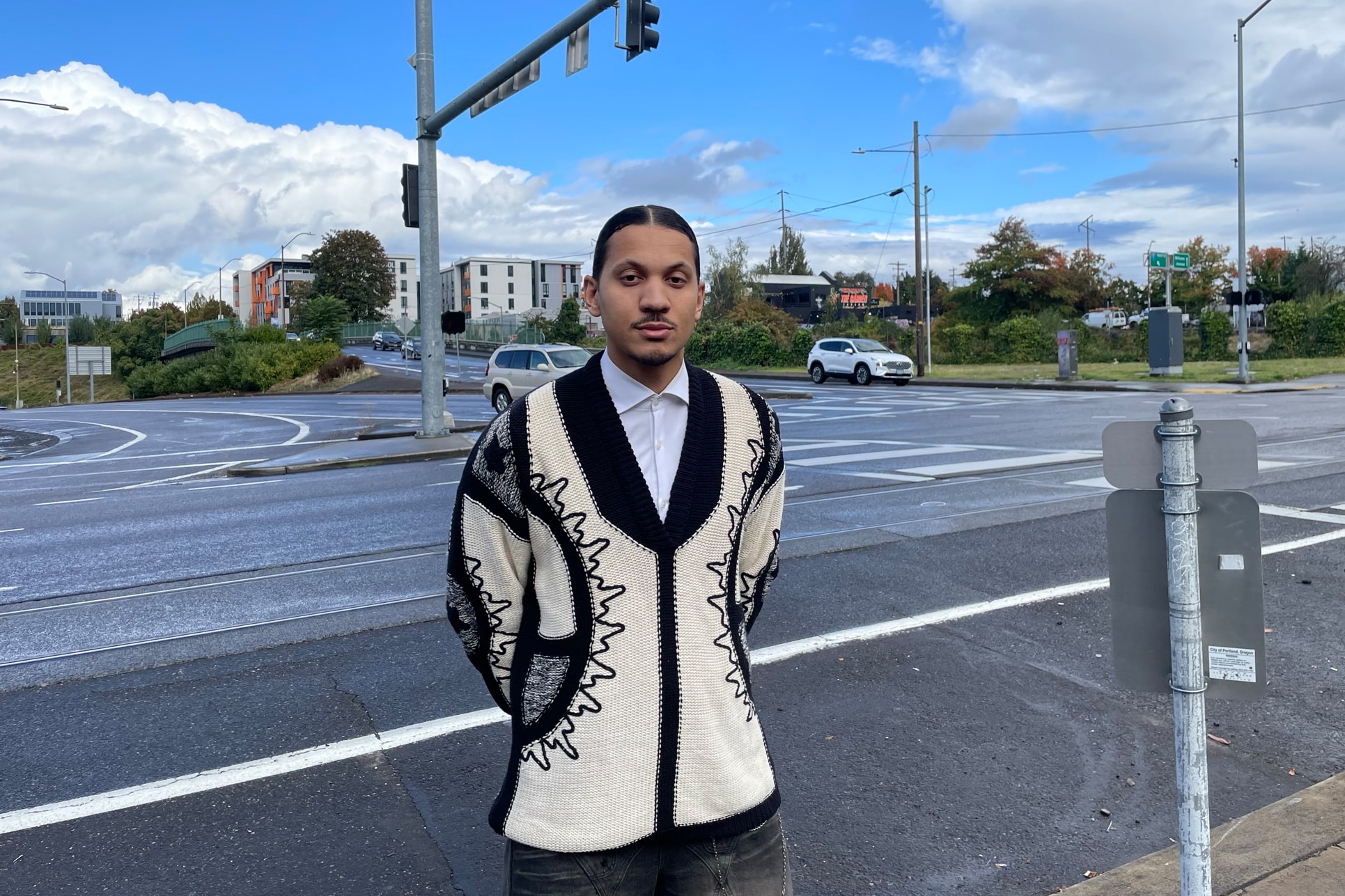
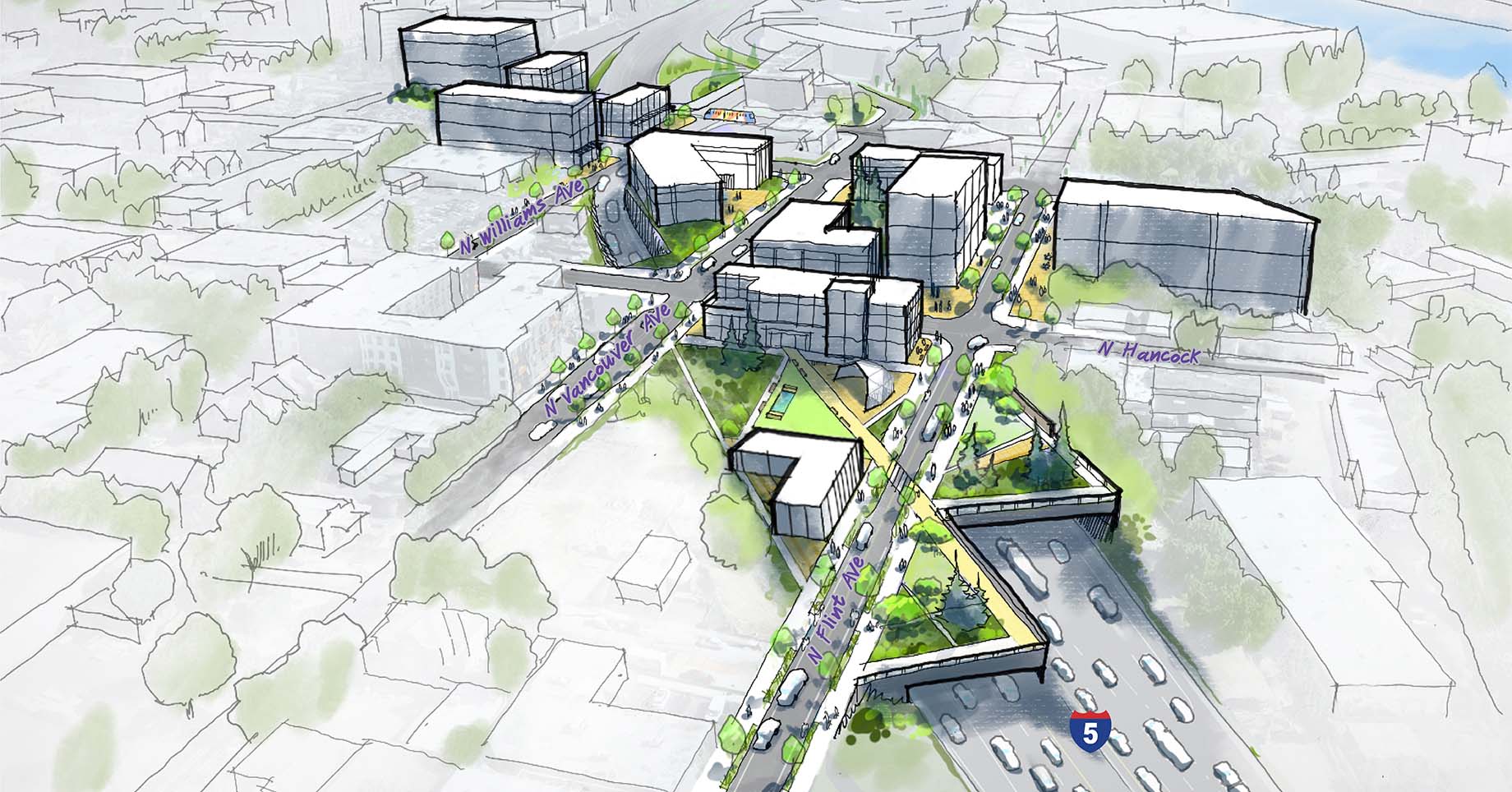
These two apartment buildings, old and new, stand on Flint Avenue near a chaotic five-way junction where freeway drivers exit onto busy arterials. “There is no way in hell we can talk about moving thousands of families back into this area,” Flowers said, “without addressing the danger of this intersection.” In 2020, after learning that ODOT wanted to widen the freeway without fixing the surface streets, the Trust went public with its opposition to the Rose Quarter project. Mayor Ted Wheeler and other public officials followed suit. The transportation agency was forced back to the drawing board, working with community groups to design a new plan that eliminated the freeway ramp and reconnected several blocks of the historic street grid. Crucially, the revised plan also included a four-acre freeway cap that would be strong enough to support apartment buildings. When Buttigieg visited Portland in 2023, Gary-Smith and other board members of the Albina Vision Trust conveyed their support for the new plan at a breakfast meeting.
The state will own the new land created by the freeway cap, while Albina Vision Trust will have the right to develop it.
Months later, in March 2024, the Rose Quarter Project won its $450 million Reconnecting Communities grant, becoming the poster-child for the federal program, alongside an additional $38 million for a makeover of nearby surface streets. 33 ODOT’s Megan Channell gave credit to the Trust: “I see us being the steward of delivering what the community helped win.” While the state agency will own the new land created by the freeway cap, Albina Vision Trust will have rights to develop four acres above the freeway and four more acres used during construction. 34
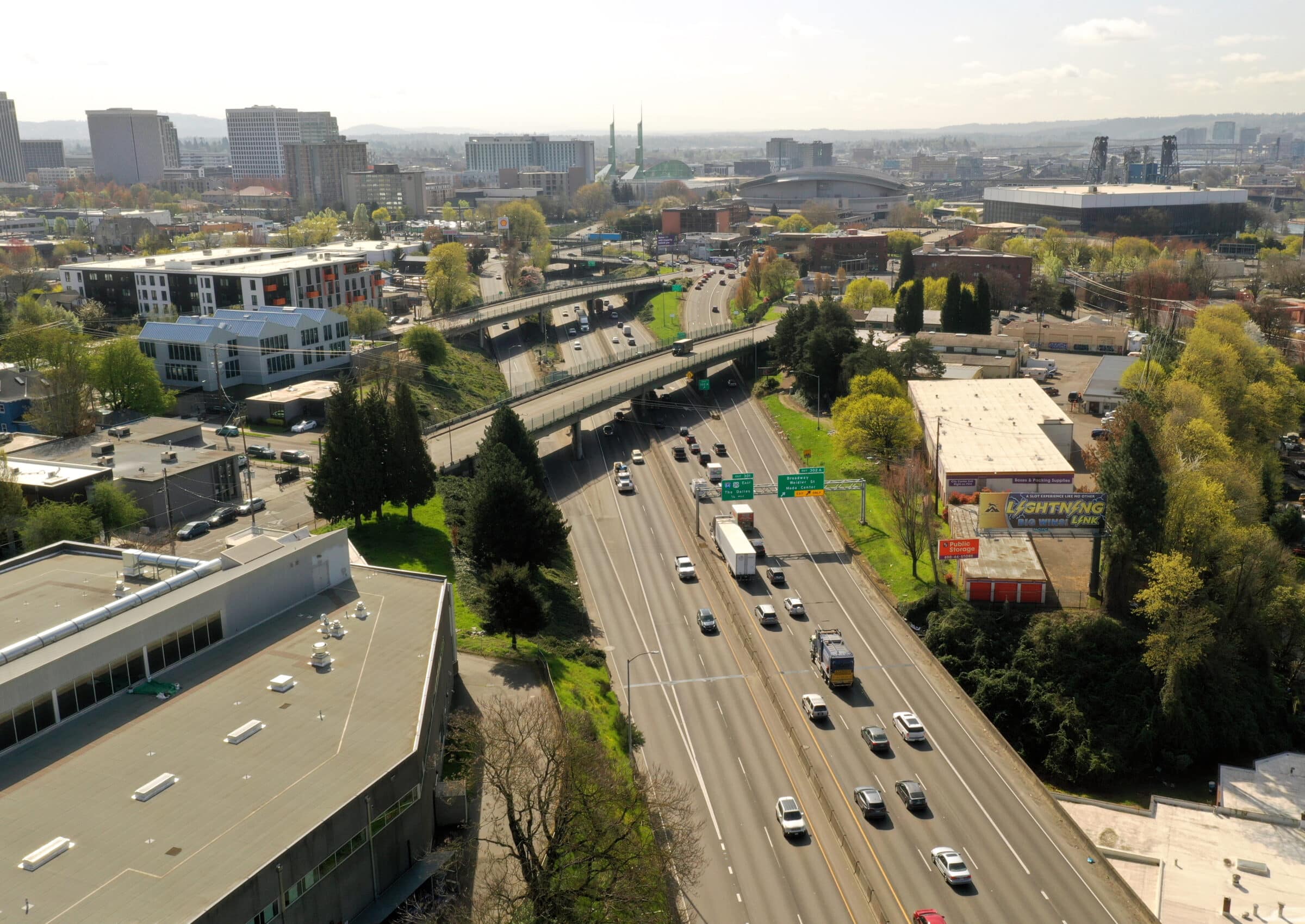
What didn’t change with the redesign was ODOT’s insistence on widening the freeway. For environmental advocates in Portland, the grant announcement felt like one step forward, two steps back. Adah Crandall attended Harriet Tubman Middle School, overlooking the freeway, on the same site where Gary-Smith went to school half a century earlier. “You would walk outside to recess, and there would be a field and a playground, and then right next to it are these giant diesel trucks on the highway,” said Crandall, who now works as an organizer for the Sunrise Movement in Washington, DC. “Our windows were sealed to keep the pollution out. There was this massive dystopian-looking HVAC system installed on the top of the building.”
Environmental advocates support the freeway cap, while opposing a widening of the roadbed from 89 to 185 feet.
In high school, Crandall led students in biweekly protests outside ODOT’s regional headquarters, demanding a moratorium on all freeway expansion in the Portland area and a stronger environmental impact report for the Rose Quarter Project. Some days as many as 100 students showed up, she said. The protests garnered national media coverage and, eventually, the attention of Governor Kate Brown, who met with the group. 35 Their efforts were matched by an adult coalition, No More Freeways, whose leaders include urban planning consultant Joe Cortright and former Portland planning commissioner Chris Smith.
These activists say they support the cap, spanning those six blocks of I‑5, while opposing an expansion of the Rose Quarter Freeway beneath it. Plans show the roadbed at one point widened from 89 to 185 feet. ODOT says there will be six lanes, in place of the current four. But Cortright claims the agency has been lying about its intentions: “Their plan is plainly to engineer a 160-foot roadway, and then when the project is opened, to simply re-stripe this much wider space for eight or ten lanes of travel.” 36 The project’s environmental impact statement foresees a neutral to slightly positive effect on air pollution and a neutral to slightly negative effect on carbon emissions. 37 However, No More Freeways disputes these figures, claiming they don’t account for new vehicle trips that an expanded highway would make possible. The activists also have concerns about the “piston effect” of unfiltered exhaust being pushed out of the tunnel portals, potentially worsening pollution impacts for those nearby.
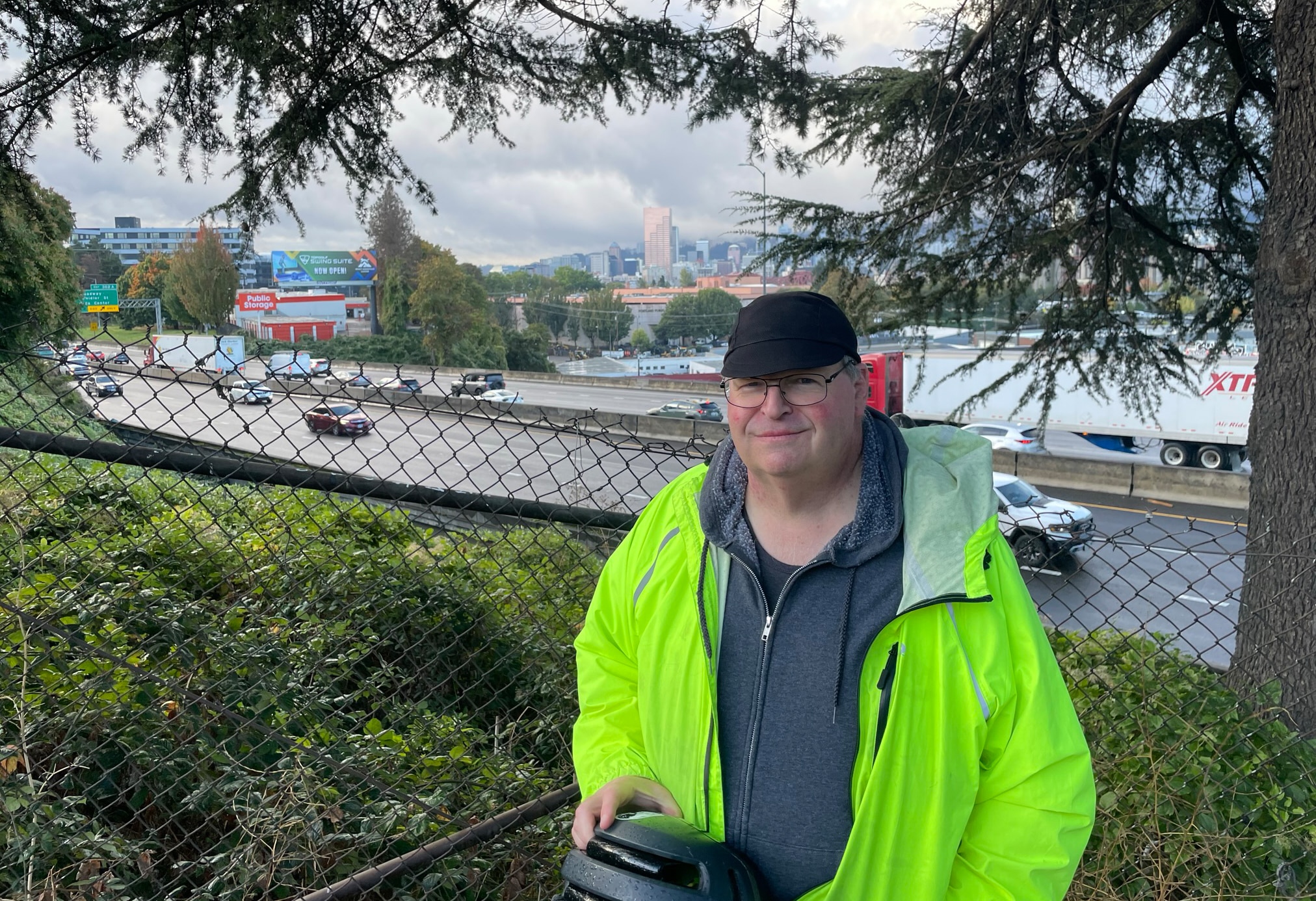
This group represents another side of the anti-freeway movement. In addition to the social costs of freeways, they’re motivated by environmental and urban planning issues like “induced demand,” the congestion that results from adding lanes that attract more drivers. 38 In the 2024 book City Limits: Infrastructure, Inequality, and the Future of America’s Highways, journalist Megan Kimble showed how this phenomenon has reshaped American cities: “As we built bigger and faster roads, we increased the sheer volume of land available for settlement. So we sprawled … assuming that speed would always be available to us.” But that wasn’t the case. Housing developers and drivers adapted to the infrastructure, and soon the new roads were even more congested than before. “Researcher after researcher would replicate these findings: more lanes meant more traffic,” Kimble wrote. 39
New lanes added under the Bipartisan Infrastructure Law could generate 190 million metric tons of carbon emissions by 2040.
As sprawl has lengthened commutes, it has also increased pollution and carbon emissions, outweighing gains in vehicle fuel efficiency. 40 The Bipartisan Infrastructure Law, the centerpiece of Biden’s Big Deal, largely ignored that reality. To environmentalists, that makes the Reconnecting Communities program a garland on a belching smokestack. One study found that new lanes added under the infrastructure law could generate 190 million metric tons of carbon emissions by 2040 — the equivalent of running 50 coal power plants for a year. 41
On the environmental front, the Oregon Department of Transportation is better than many of its peers. That same study identified Oregon as one of a few states whose BIL-funded works would lower net greenhouse gas emissions, and the Rose Quarter Project pales in comparison to the 20-lane freeways Kimble investigated in Texas. Asked about pollution and traffic impacts, ODOT’s Channell said, “we’re talking about a targeted improvement to a system that has longstanding safety and operational needs.” She insists the freeway cap and expansion are a package deal. “We have a commitment to deliver the project in full,” she said. “That is what the community, locally, regionally, and at a state level, is asking for.”
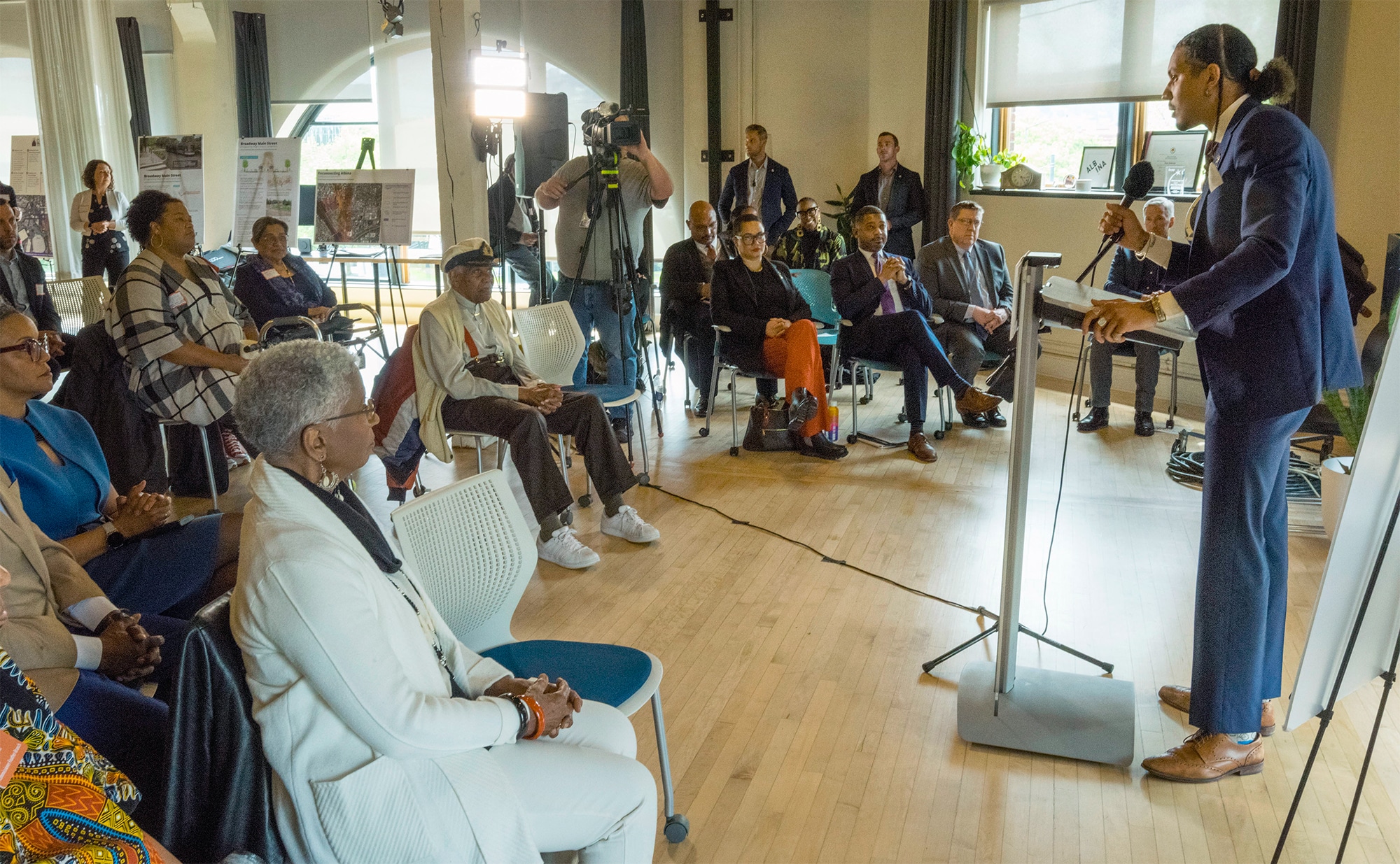
Flowers told me the Albina Vision Trust has always been “agnostic” on the freeway expansion. Their priority is using the new land above the cap to rebuild the neighborhood. But some community members have concerns. “What is the impact on all of these people of all of this freeway traffic if they stick with their extra lane plan?” said Gary-Smith, who lives two blocks from I‑5. “The fumes, the environmental issues around that freeway,” have led to “higher rates of everything.” She is also worried about the “tax on young minds” at Harriett Tubman Middle School, which would be a few hundred feet from the end of the tunnel. (Earlier plans to move the school are paused indefinitely.) 42
‘It is pretty wild … to claim that expanding this highway is restorative justice when the highway is what began causing harm in the first place,’ Adah Crandall said.
To Crandall, the environmental impacts of the project undermine ODOT’s lofty rhetoric. “It is pretty wild … to claim that expanding this highway is restorative justice when the highway is what began causing harm in the first place.” She sees a lost opportunity to create better public works. “For the money that we’re putting into this highway, we could build crosswalks and sidewalks,” she said. “We could make the bus come every ten minutes.” Complete Portland’s bike network. Put the light rail underground. Plan for high-speed rail to Seattle and British Columbia. “There are so many better and more popular things that we could be doing with these billions of dollars.”
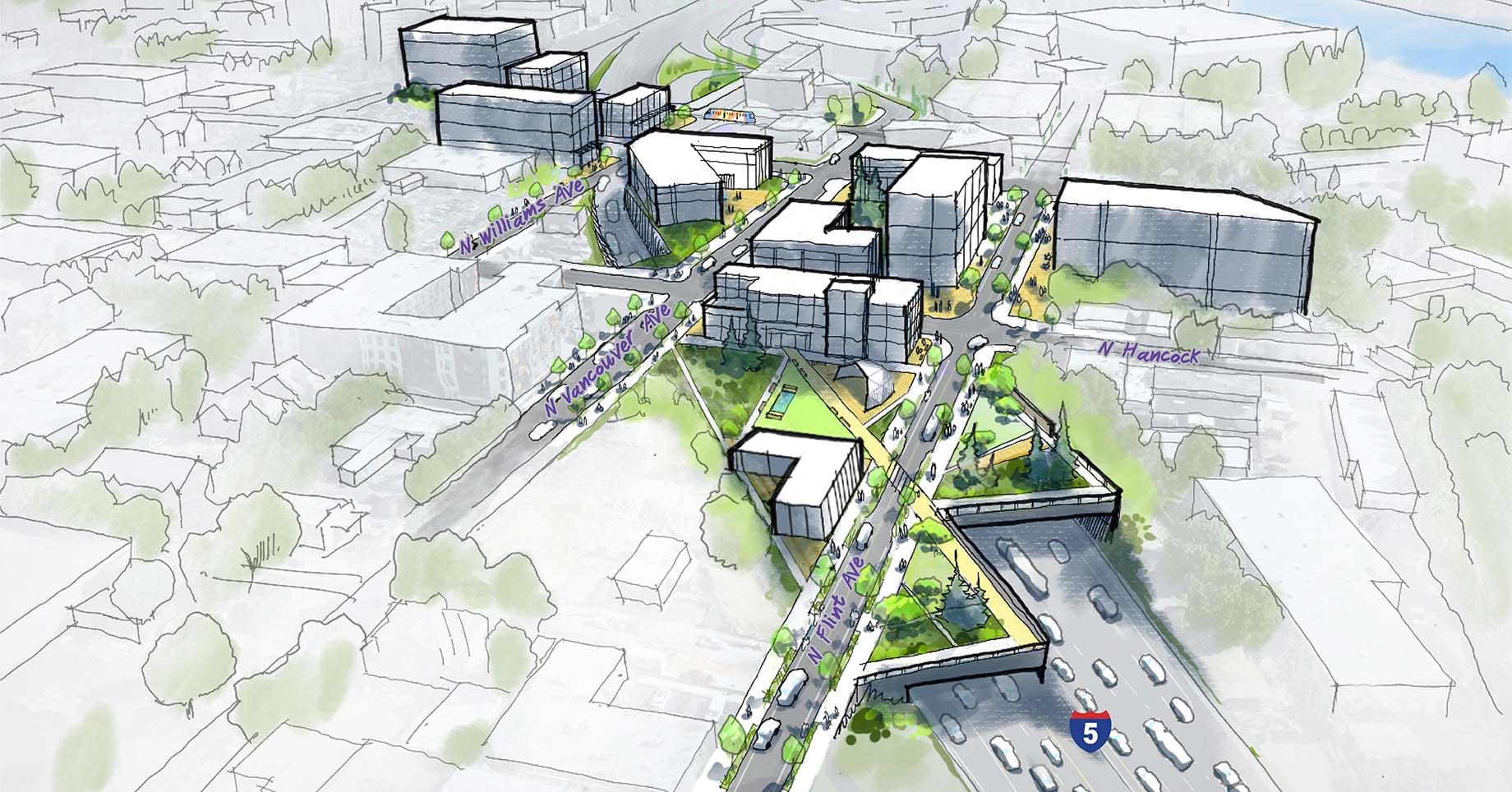
Then there is the question of what can be built on the freeway cap. ODOT’s current plan calls for a platform supported by precast concrete BT60 girders, which would allow for three-story buildings. However, some of the renderings appear to show taller buildings, up to five stories. 43 The advocates at No More Freeways say it’s another way the agency is trying to mislead the public.
And so the Bidenesque logic of the Big Deal loops back on itself.
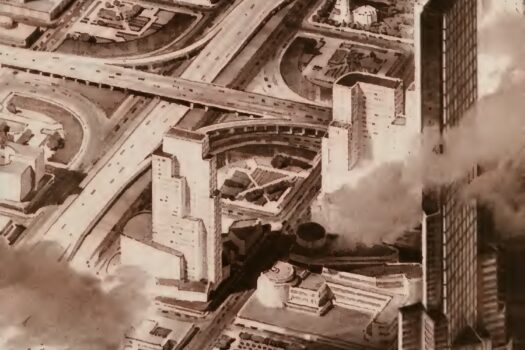
One reason freeway caps are typically topped with green space rather than buildings is that the engineering requirements are simpler. But another reason is that it might not be so pleasant to live there. In the United States, the largest precedent is the Bridge Apartments complex on I‑95 in Upper Manhattan. Shortly after the four-tower, 960-unit development was completed, in 1967, Senator Robert F. Kennedy remarked that “the choice of this location for these apartments, astride one of the most heavily traveled highways in New York City, shows a total disregard for environmental factors on the part of our city planners.” A 2004 New York Times article subtitled “Learning to Sleep as Trucks Roar Through Basement” describes the noise inside the apartments as “deafening” and notes the vibrations and odors emanating from below. 44
Despite the drawbacks of living on top of a freeway, there is an appealing logic in tying Interstate retrofits to affordable housing. Hundreds of homes were destroyed along this corridor in the 1960s. Then, as the neighborhood gentrified, more Black and working-class residents were priced out. In Portland and other expensive cities across the country, people use freeways to commute from cheaper suburbs to jobs in the city center, further perpetuating segregation. Building a mixed-income neighborhood, just steps from transit stations and within walking distance of office towers and hospitals, could break the cycle of car dependence for thousands of people.
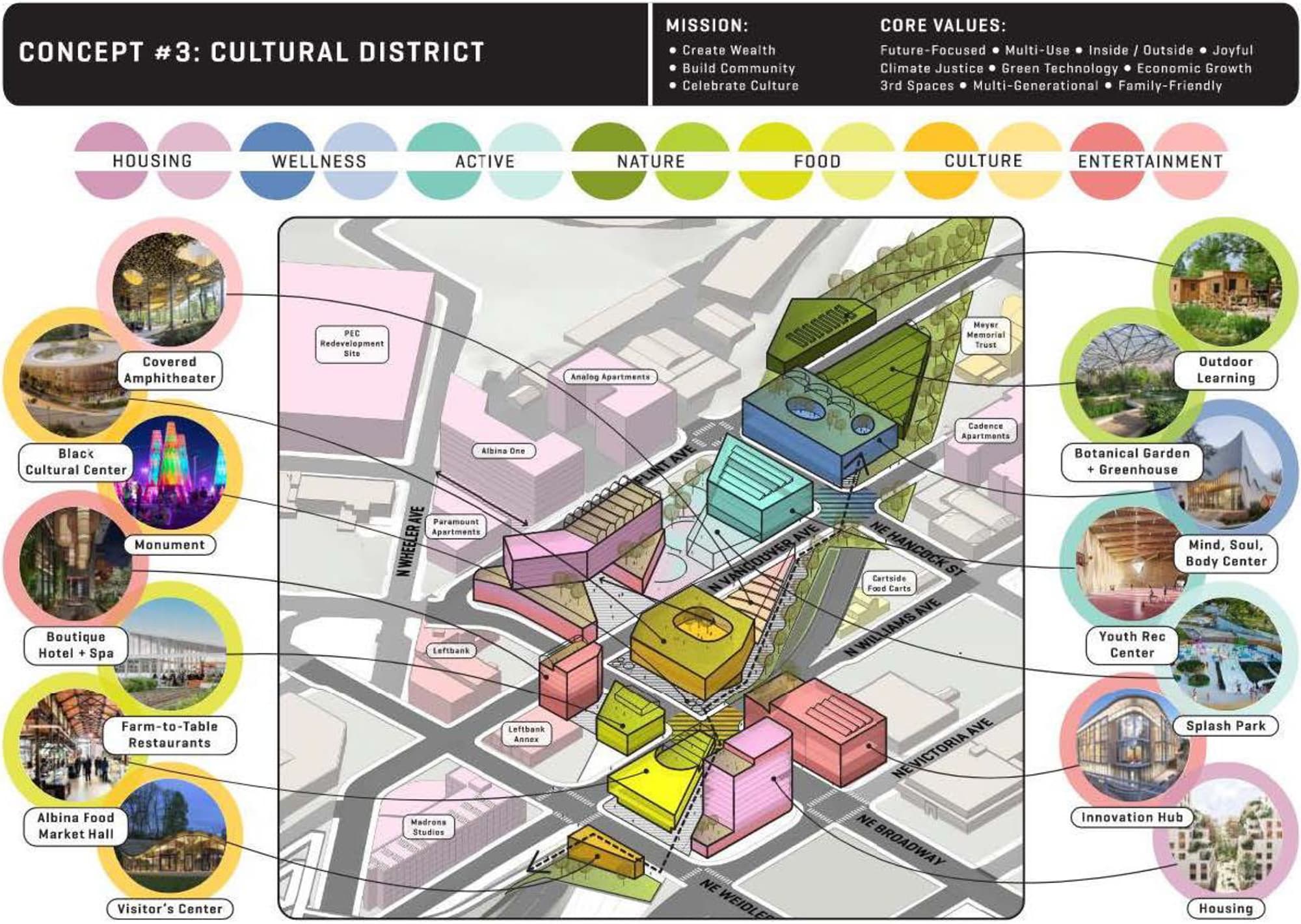
And so the Bidenesque logic of the Big Deal loops back on itself. The signature project for a federal grant program that emerged from the freeway removal movement will be used to justify a freeway widening. The contradictory objectives make for a uniquely difficult undertaking. From a certain angle, the Rose Quarter project looks like an “everything bagel,” to use Ezra Klein’s term for infrastructure projects made near-impossible because they are trying to serve so many constituencies. Drawn up in 2017 as a $500 million project, the current budget is an estimated $2 billion. By the end of last year, ODOT had spent $127 million on design work and community outreach, with nary a construction crew in sight. 45
The signature project for a federal grant program that emerged from the freeway removal movement will be used to justify a freeway widening.
As costs escalate, ODOT has decided to break the project into phases. Roughly half of the first $850 million phase would be funded by the Reconnecting Communities grant, with the rest coming from funds previously dedicated to the project or redirected from the agency’s other works. This would be enough to deliver the central section of the freeway cap, the entire southbound auxiliary lane, and part of the northbound auxiliary lane. At the December 2024 meeting where this pivot was announced, Flowers testified that if ODOT builds a “widened Interstate accompanied by a fractional central portion of an otherwise unfunded highway cover, we will have failed ourselves, our community, and the state of Oregon.” 46
In an interview the next month, he changed his tune, saying he had a better understanding of the state’s strategy. “The $450 million was only ever meant to cover that central cap, which is the most structurally complicated and expensive portion,” Flowers said. The highway has to be made wider and deeper before it can accommodate structural supports for the rest of the tunnel. However, Chris Smith of No More Freeways said the phased approach was another example of ODOT’s skewed priorities. “Personally, I think the ratio of covers to lanes is not very good,” he told me. “They get at least half of the freeway harms, while building less than a third of the cover.” 47
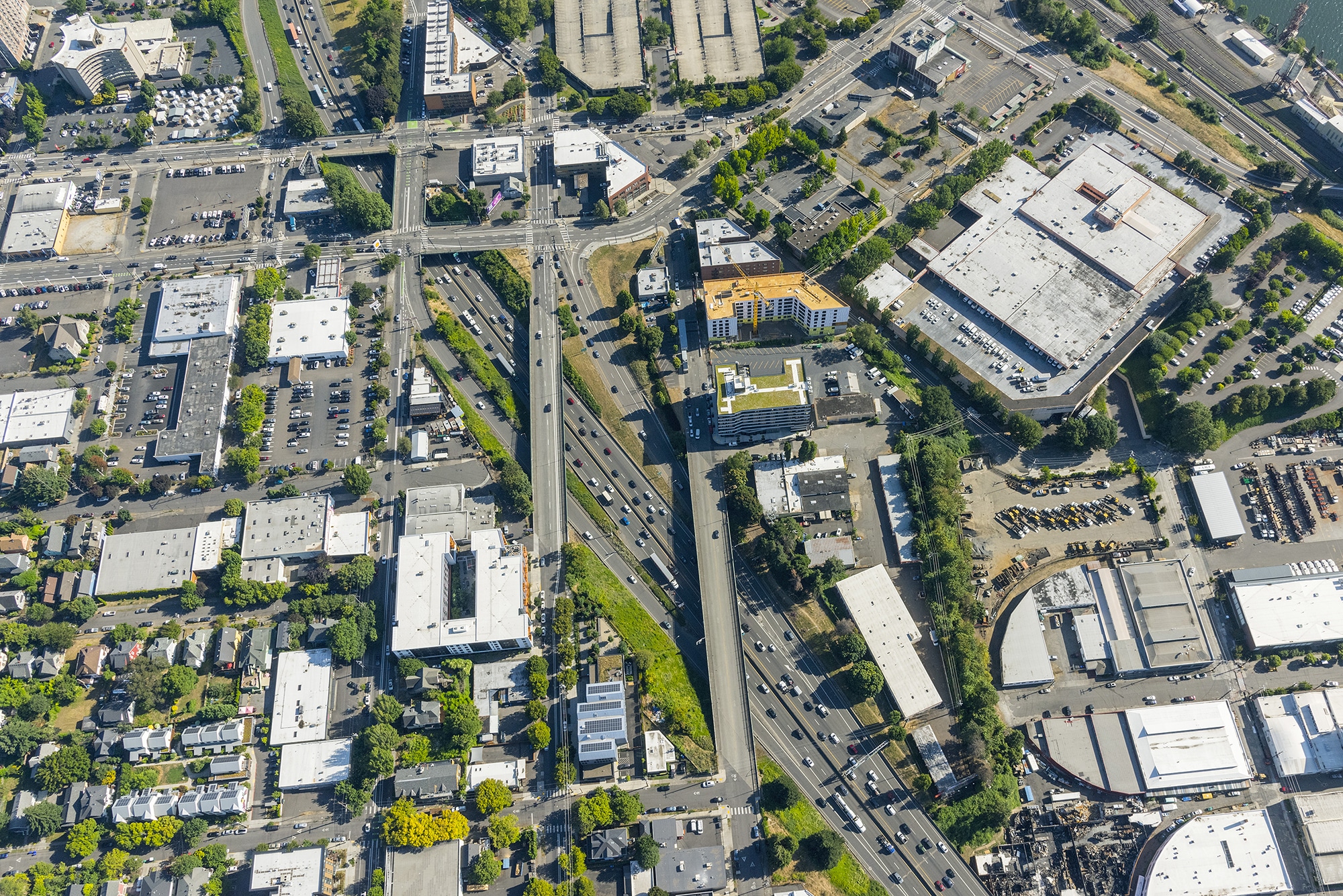
And now we will see what happens to the Big Deal when one of the parties — the federal government — reneges. On the first day of his second term, President Trump issued an executive order pausing all spending under the Bipartisan Infrastructure Law and Inflation Reduction Act: “Terminating the Green New Deal,” as he called it. 48 Later, a U.S. Department of Transportation memo instructed staff to “eliminate” all programs and rules related to subjects such as “climate change” and “racial equity.” 49
Now we will see what happens to the Big Deal when one of the parties — the federal government — reneges.
These legally dubious moves were the opening salvos in a more sophisticated assault. House and Senate Republicans are negotiating a budget reconciliation bill — “The One Big, Beautiful Bill,” in Trump’s parlance — that would terminate large parts of the Inflation Reduction Act. The version that passed the House in May would “permanently rescind” all unobligated dollars in the Reconnecting Communities program, which would include most federal funding for the Rose Quarter Project. 50 An ODOT spokesperson said $37 million has been obligated to date, and another $22 million requested. The remaining $400 million could evaporate overnight.
ODOT has the funding to begin the preliminary work of drainage and pavement improvements this summer. But the heavy construction that was supposed to start in 2027 is in jeopardy. And the second phase of the project — including items crucial in securing Albina Vision Trust’s support, like the completion of the freeway cap, the re-routing of the offramp in front of Albina One, and a pedestrian and bike bridge — would require additional funding in any case.
State legislators, who are currently negotiating their own budget bill, are wary of ODOT’s failure to execute projects funded through the last transportation package in 2017. A proposal by the Democratic majority would dedicate $1.7 billion for highway maintenance every biennium but only $250 million for highway expansion. 51 With this progressive turn toward maintenance, the state package is a model of “fix it first” principles, largely paid for by increases in gas taxes and vehicle registration fees. It would also make Oregon the first state to charge per mile for the extra wear caused by heavy electric vehicles. 52 However, it remains unclear whether the Rose Quarter Project will be able to secure enough state funding to chart a path toward completion, especially given the Trump administration’s eagerness to undo Biden’s legacy.
The uncertainty will not halt the work of the Albina Vision Trust, but it makes achieving that vision harder. The area’s livability matters to current and future residents, and also to the Trust’s fundraising efforts. “The existence of the freeway has been the key development challenge for a long time,” Yohannes said at a Portland Metro Council meeting this spring. “Being able to provide evidence that the project with the caps is moving forward attracts the kinds of partnerships that are necessary for the vision to move forward.” 53
The Albina Vision Trust hopes to show that local organizations can lead transformative projects under a hostile federal regime.
Flowers emphasized that the highway cover and additional land provided by ODOT represent “an eight-acre piece of a 94-acre puzzle.” Whatever the fate of the freeway cap, the Trust is looking ahead to the transformation of the school district headquarters site, where homes, businesses, public spaces, and the college hub will enliven a moribund, closed-off campus. According to the Trust, it will be the largest “restorative redevelopment” ever attempted in the U.S., the most advanced effort yet to rebuild neighborhoods destroyed by midcentury planners in a way that benefits those harmed. Gary-Smith said community leaders across the country have been reaching out to learn more. The Albina Vision Trust hopes to show that local organizations can lead transformative projects under a hostile federal regime. And, when political winds shift, their work could inspire a bigger, better deal than the one Biden managed. High-density, mixed-income projects in city centers can help build a constituency for freeway removals and generational investments in transit that the infrastructure bill could not deliver.
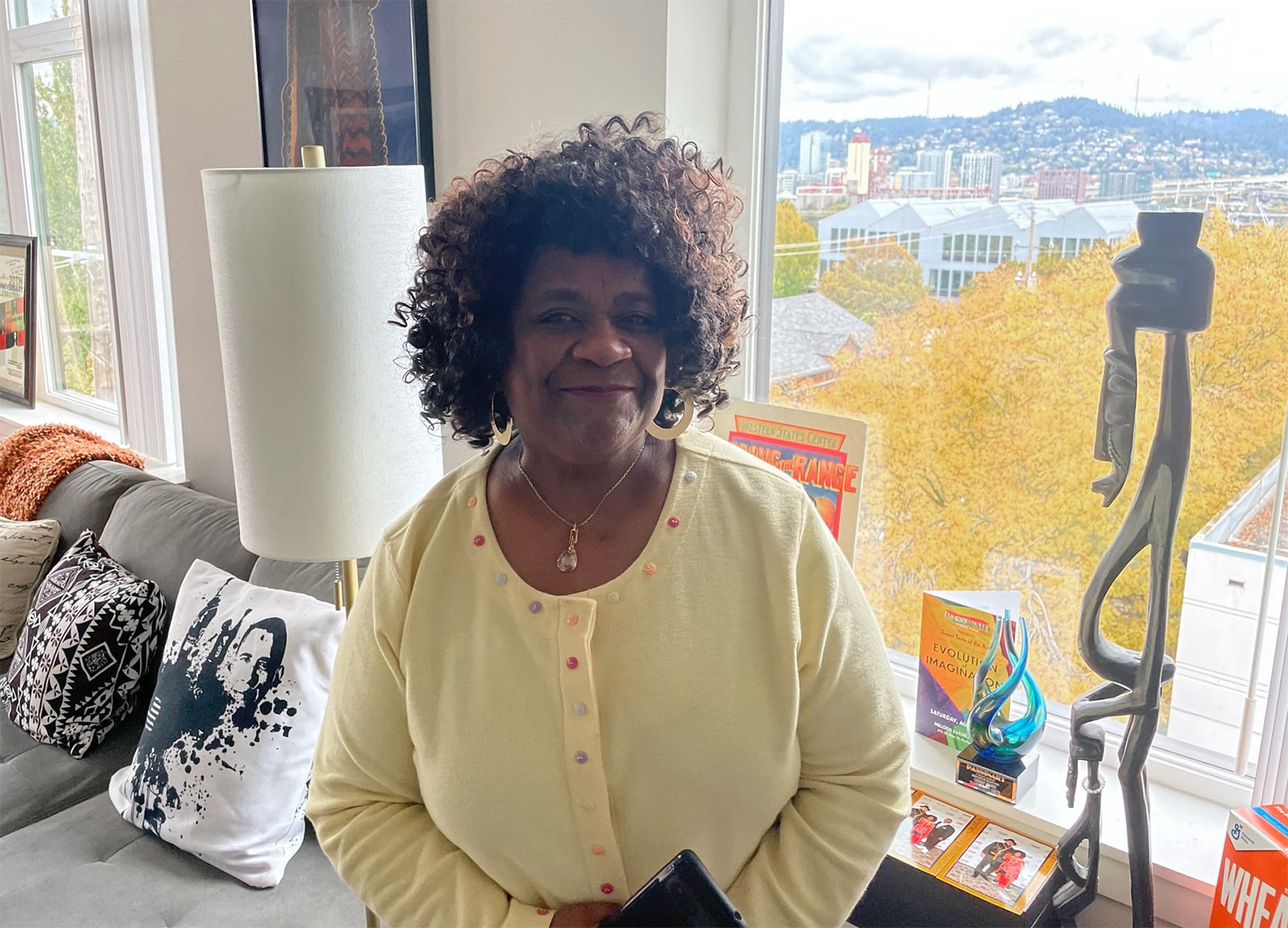
“I’m viewing all the destructive changes that pushed us out,” said Gary-Smith, looking out on the Albina District from her apartment on the fifth floor. “But I’m also present for the reclamation and rejuvenation.” When Albina One opens this month, she will watch from that window as families move in. Sometime in the next few years, she will see apartment buildings rise on the land where her childhood home once stood. “It’s coming full circle in an interesting way for me.”


If you would like to comment on this article, or anything else on Places Journal, visit our Facebook page or send us a message on Twitter.