Extralibrary Loan

Amid a war on public knowledge, libraries are pushing outward, enlarging the commons through new configurations of civic and creative life.

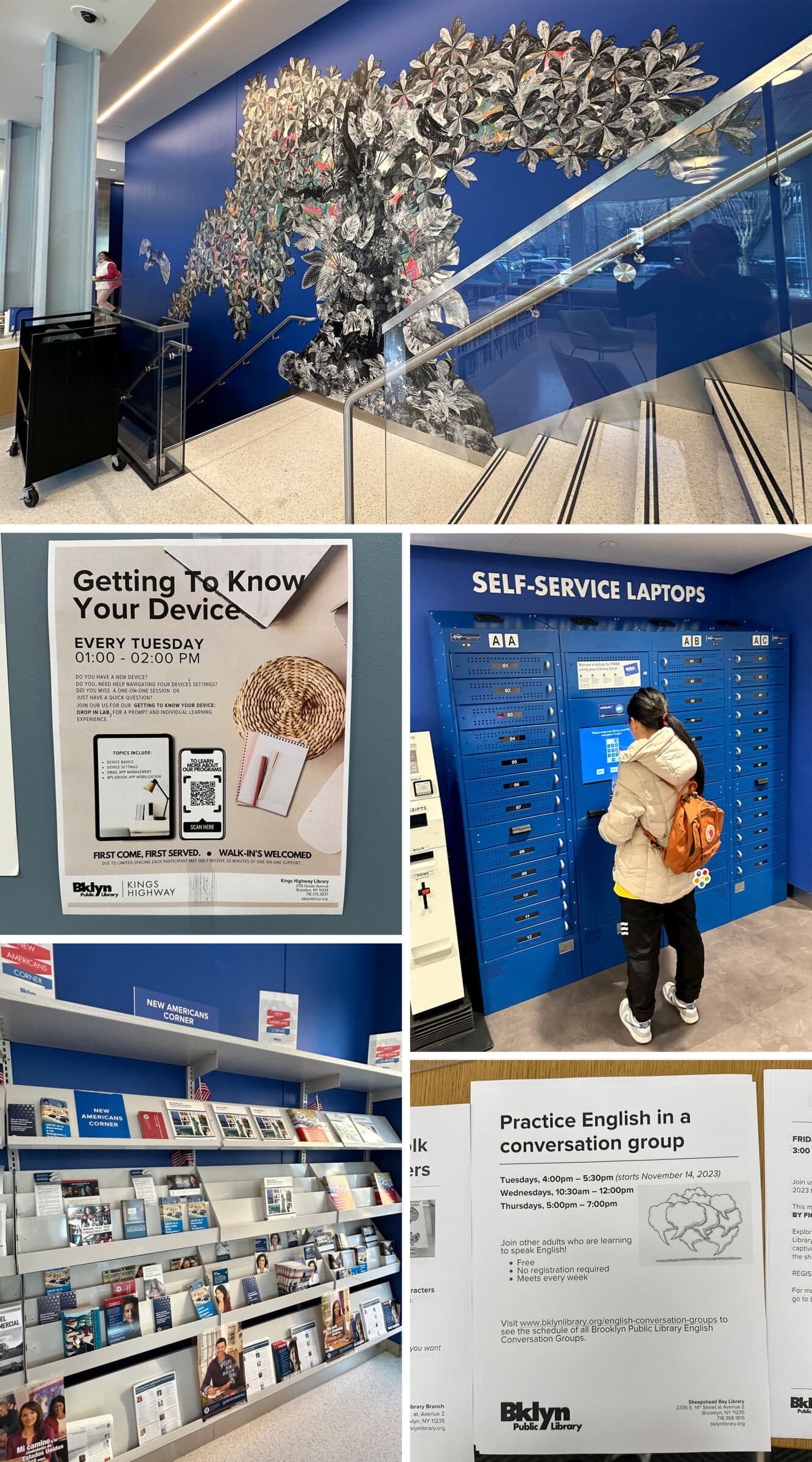
Library Newsroom Project, Sunset Park branch, Brooklyn Public Library, New York, 2025. [Arpan Somani]

Twice a month, they gather over Chinese food at the Sunset Park branch of the Brooklyn Public Library: a romance book editor, a photographer, an environmental activist, tech workers, high school students, retirees. They are the co-creators of the Library Newsroom. Teens bring their friends. Parents invite their adult children. Some days more than twenty people show up. Drawing inspiration from tenant newsletters and community noticeboards, they assess the neighborhood’s needs, map its landmarks, study its governing bodies and civic institutions, and discuss journalistic ethics and skills. 1 They ask, what are we curious about? Then, how can we learn more?

At the Library Newsroom, neighbors ask, what are we curious about? Then, how can we learn more?

Soon they publish the first issue of the Sunset Park Sun, with a welcome message in English, Spanish, and Chinese. Judith C.’s investigative piece on renovations to the local rec center is accompanied by a list of resources she used in her reporting. There is an explainer on ranked-choice voting, a summary of new trash and composting rules, a guide to the Newsroom’s methods and standards, and an invitation to attend future meetings. 2 In later issues, Diana M. recounts childhood memories of the library, and Ciel J.P. introduces a community archive initiative. Other writers profile local businesses, compile resources for immigrants, and review a photo exhibit on the lives of street vendors.

It’s a “social project” as much as a newspaper, said organizer Terry Parris, Jr., a veteran of nonprofit newsrooms at ProPublica and The City, now an editor on the solutions journalism desk at The New York Times. He helped start the first “Open Newsroom,” six years ago, in an effort to “understand how information finds its way to and through a community” in an age of epistemological collapse. 3 People want to know what’s going on in the world, but how do they decide what news is important or useful or trustworthy? 4 The library — where “meaning is made,” where “information is both generated and shared,” according to Brooklyn’s former chief librarian, Nick Higgins — seems like a good place to sort that out. 5
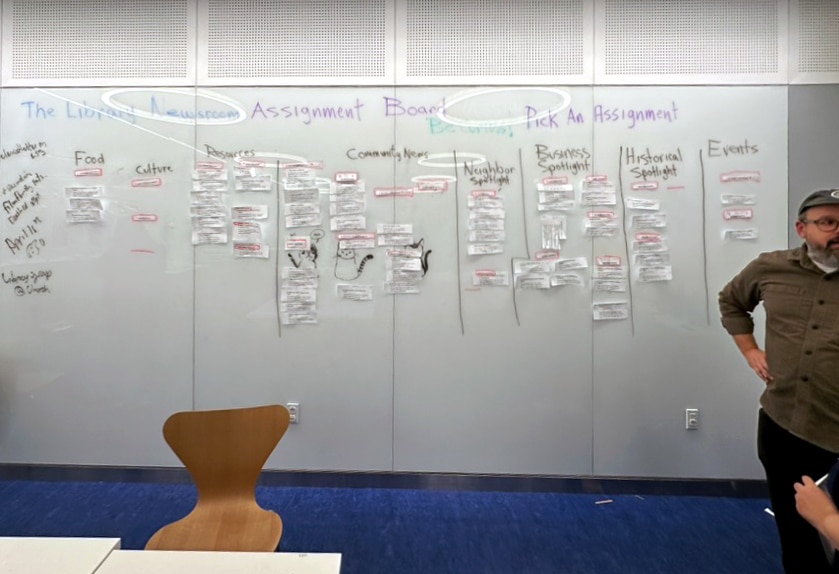
Library Newsroom assignment board with Terry Parris, Jr., at the edge of the frame, 2025. [Shannon Mattern]

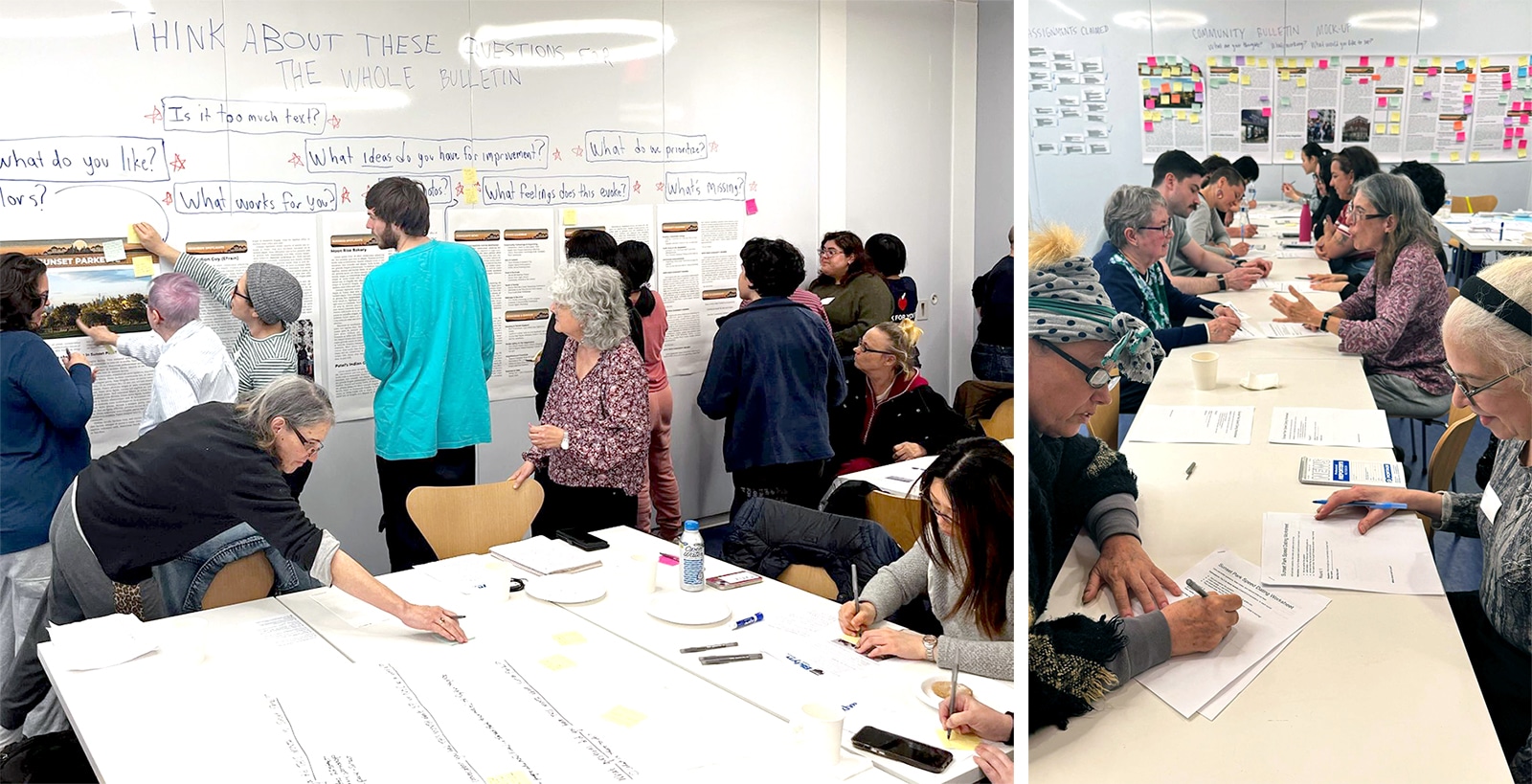
Library Newsroom staffers discuss layout and rehearse interview skills, 2025. [Terry Parris, Jr.]

It’s not the only place, of course. Heather Chaplin, director of the Journalism + Design lab at The New School, studies communities that lack “formal news infrastructure,” where information flows through nail techs, barbers, and WhatsApp groups. 6 “Wherever you look, there are people doing the work of journalism, but in informal ways,” Chaplin said. They are collecting news, framing it, amplifying it. So, she wondered, “Could we identify these people and provide them with tools and training to increase their reach and formalize their roles?” Community colleges, faith groups, youth centers, and libraries are “anchors” to build around: “If we could connect all these organizations and people and spaces together and support the ways they share information about what’s happening locally, we’d have something overflowing with potential.” 7

Information flows through nail techs, barbers, WhatsApp groups. People are collecting news, amplifying it, framing it.

That’s an optimistic response to a real crisis. In the past two decades, nearly a third of the newspapers in the United States have folded, and most of the rest have lost subscribers and influence. More than 3.5 million people live in counties that do not have a single professional news outlet. Researchers have identified many causes (shifts in advertising, corporate consolidation, strangulation by hedge funds like Alden Global Capital) and effects (declining civic engagement and public trust). And as the industry contracts, the void is filled by a political cult that seeks to replace truth with spectacle and propaganda. In the 2024 presidential election, Donald Trump won 91 percent of those counties. 8
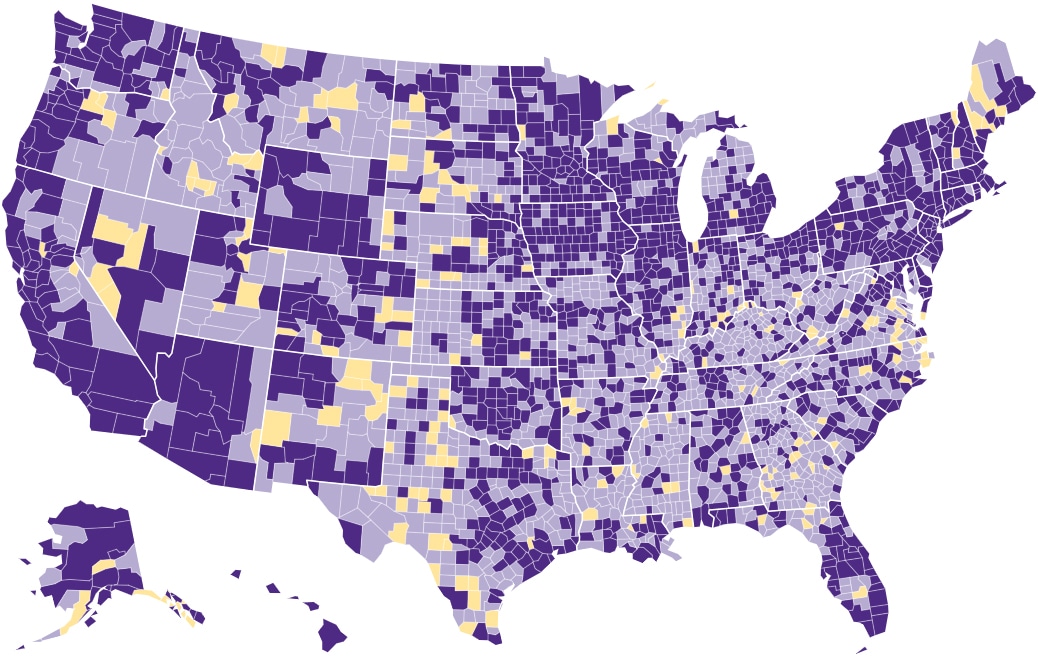
In 2025, there are 213 counties (yellow) with no professional news outlets and 1,524 counties (lavender) with only one. [Medill Local News Initiative]

Yet the void also inspires efforts to revitalize local media. 9 In urban, suburban, and rural areas across the country, nonprofit and worker-owned newsrooms are rising to the challenge. The basic tools of journalism are simple and accessible: the notepad, the phone, the search bar. And, sure, it’s not hard to start a newsletter or stream video on social media. But sustained, deep investigations take skill, experience, time, and resources — often a whole team of people to develop sources, vet documents, deal with fabrication and obfuscation, fend off legal threats, and build trust with readers. Healthy media ecosystems include an engaged public that values that work.

With more than 17,000 U.S. locations open to the public, libraries are (almost) everywhere we need them to be.

One way to promote the critical use of information media is to teach people how it’s made.  “It’s a new kind of grassroots infrastructure,” Chaplin said. “If things get better, great, we’ve just created pipelines for more diverse voices to get involved with traditional newsrooms. If things don’t get better, we’re creating underground networks to keep reliable news and information flowing … [and] keep the sparks of democracy alive.” 10

Here civic infrastructures — especially libraries — can play an important, stabilizing role. Libraries are founded on the core journalistic values of openness and truth, and they’re widely accessible. With more than 17,000 U.S. locations open to the public, and another 100,000 in schools and universities, they are (almost) everywhere we need them to be. 11
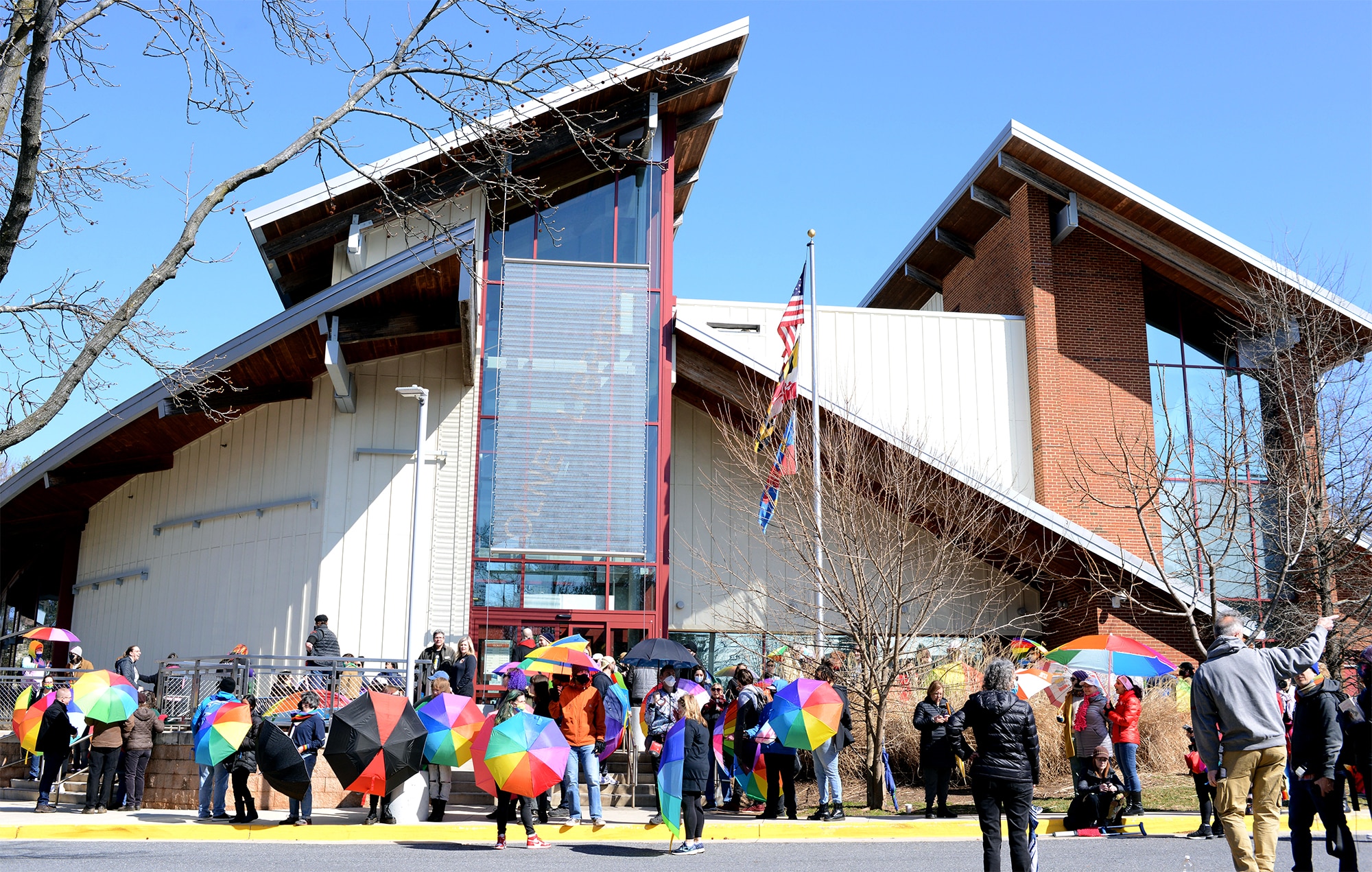
The “parasol patrol” defends Drag Queen Story Hour at Olney Public Library, Maryland, after Proud Boys attacked a similar event at a nearby branch, 2023. [Stephen Melkisethian via Flickr under license CC BY-NC-ND 2.0]

The War on Public Knowledge

Yes, libraries don’t always live up to those professed ideals. They can be places of exclusion and injustice, not impervious to market forces. 12 As Susan Orlean wrote, “Every problem that society has, the library has, too, because the boundary between society and the library is porous; nothing good is kept out of the library, and nothing bad.” 13 But in a world of competitive individualism, rapacious profiteering, and AI slop, libraries might be our best hope. They index and care for what we hold in common.

Libraries index and care for what we hold in common.

Perhaps inevitably, they are asked to hold too much. Libraries backstop child and elder care, public health and education, job training, legal assistance — “everything that a robust, socialist public good system could have,” according to librarian Luke Sutherland. “I think that’s why libraries live in the imagination of leftists … because all parts of our life could be like this.” 14 In a 2014 article on Places, I celebrated the capaciousness, creativity, and versatility that make libraries an essential public infrastructure. I also questioned whether it was feasible to expect them to do so much. “Should we welcome the ‘design challenge’ to engineer technical and architectural infrastructures to accommodate an ever-diversifying program,” I asked. “Or should we consider that we might have stretched this program to its limit?” 15

Perhaps inevitably, they are asked to hold too much.

But libraries never stopped stretching. They opened food pantries and vaccine stations at the height of the pandemic. They hosted book talks in the face of armed protests and bomb threats. And for their efforts, they were heralded as saviors of civil society, as antidotes to poverty and homelessness and addiction and gun violence, as civic sponges for trauma and injustice. 16 In my decade on the board of the Metropolitan New York Library Council, I have been constantly reminded of how flattering — and unfair — these expectations are. 17
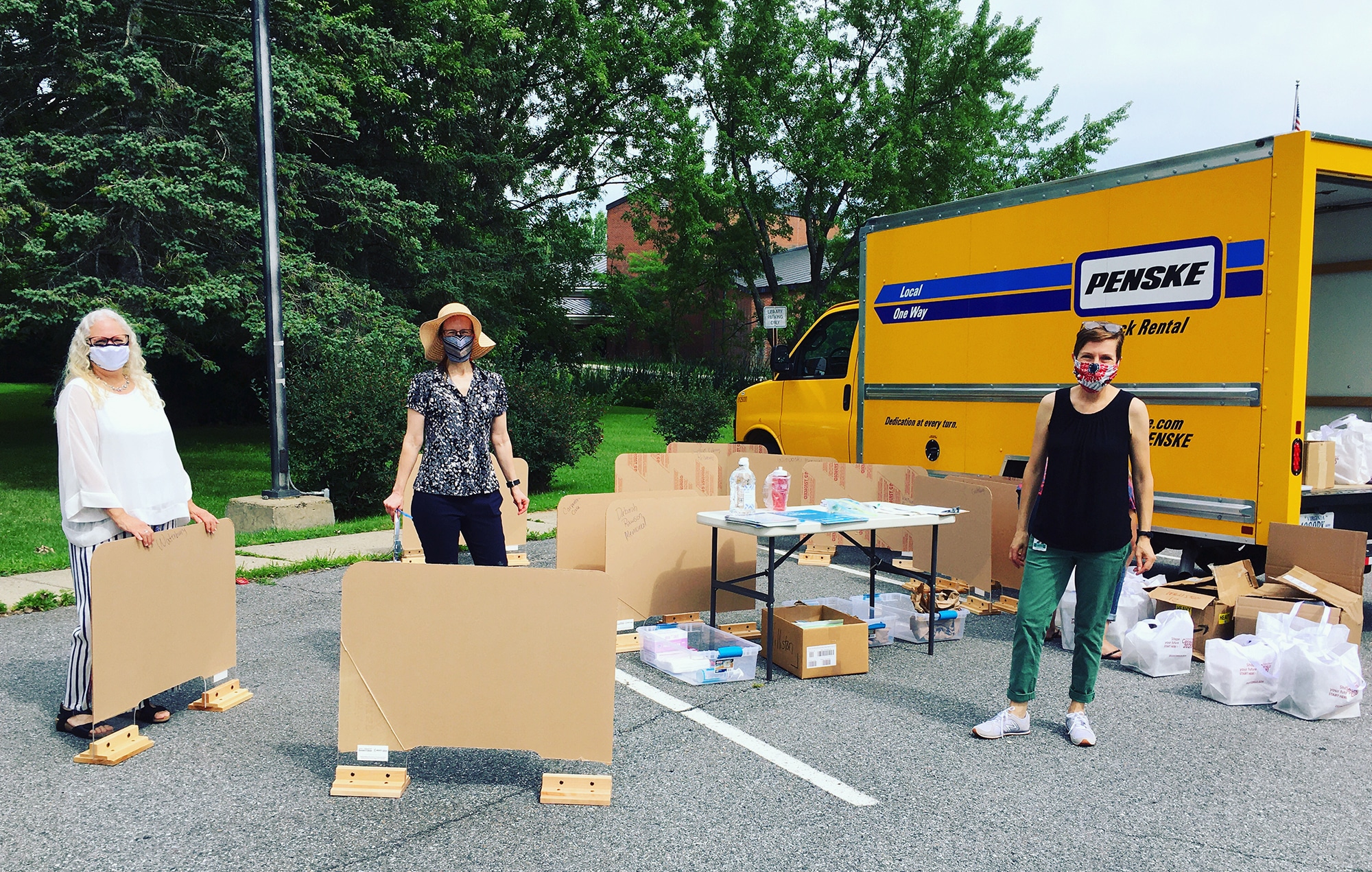
Dorothy Alling Memorial Library, Williston, Vermont, 2020. Librarians pose with Covid supplies provided by the state library and Institute of Museum and Library Services. Five years later, Donald Trump is dismantling the IMLS. [Vermont Library Association/Susan U. Larson via Flickr under license CC BY-NC-ND 2.0]

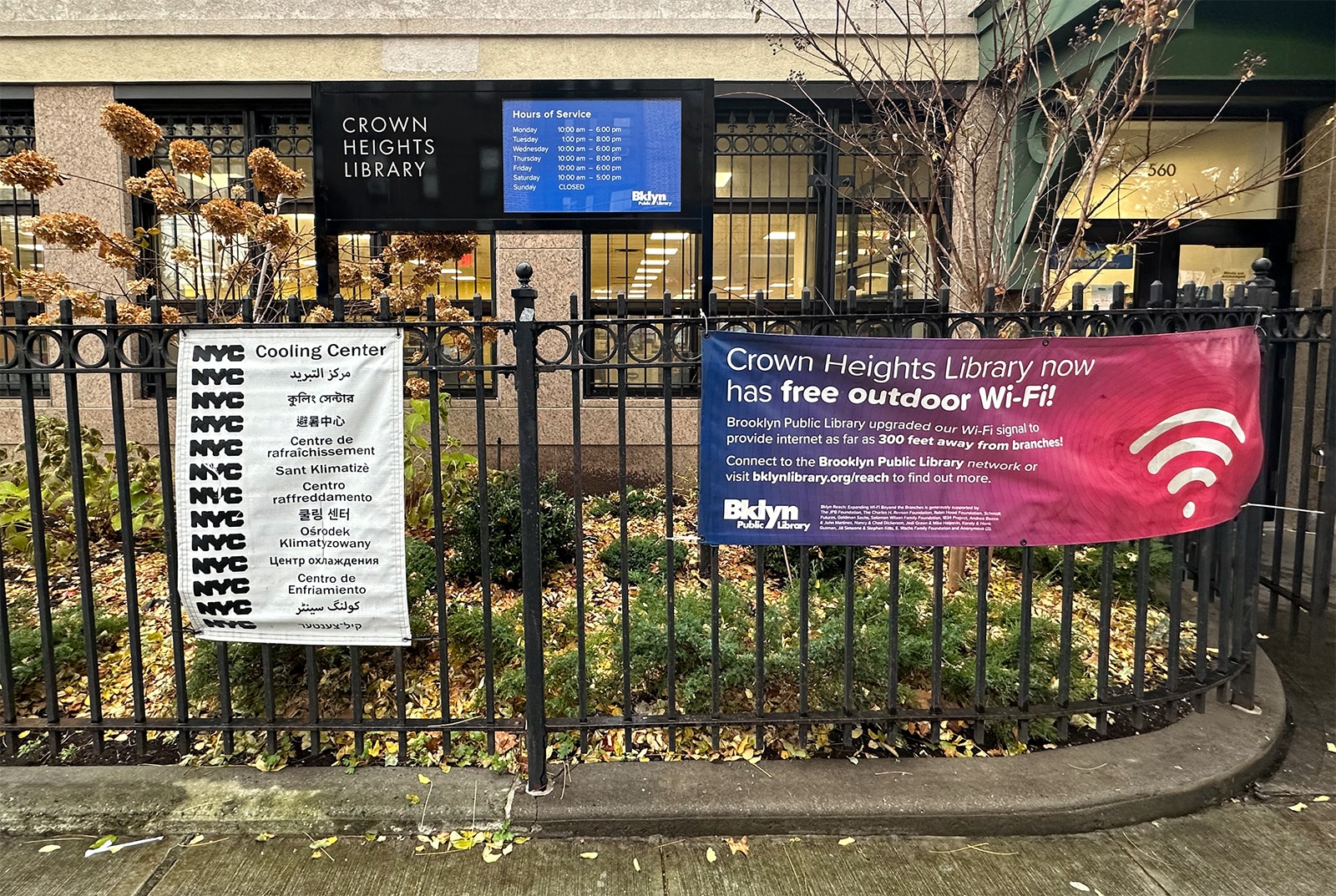
Cooling center and wi-fi provider. Crown Heights branch, Brooklyn Public Library, New York, 2024. [Shannon Mattern]

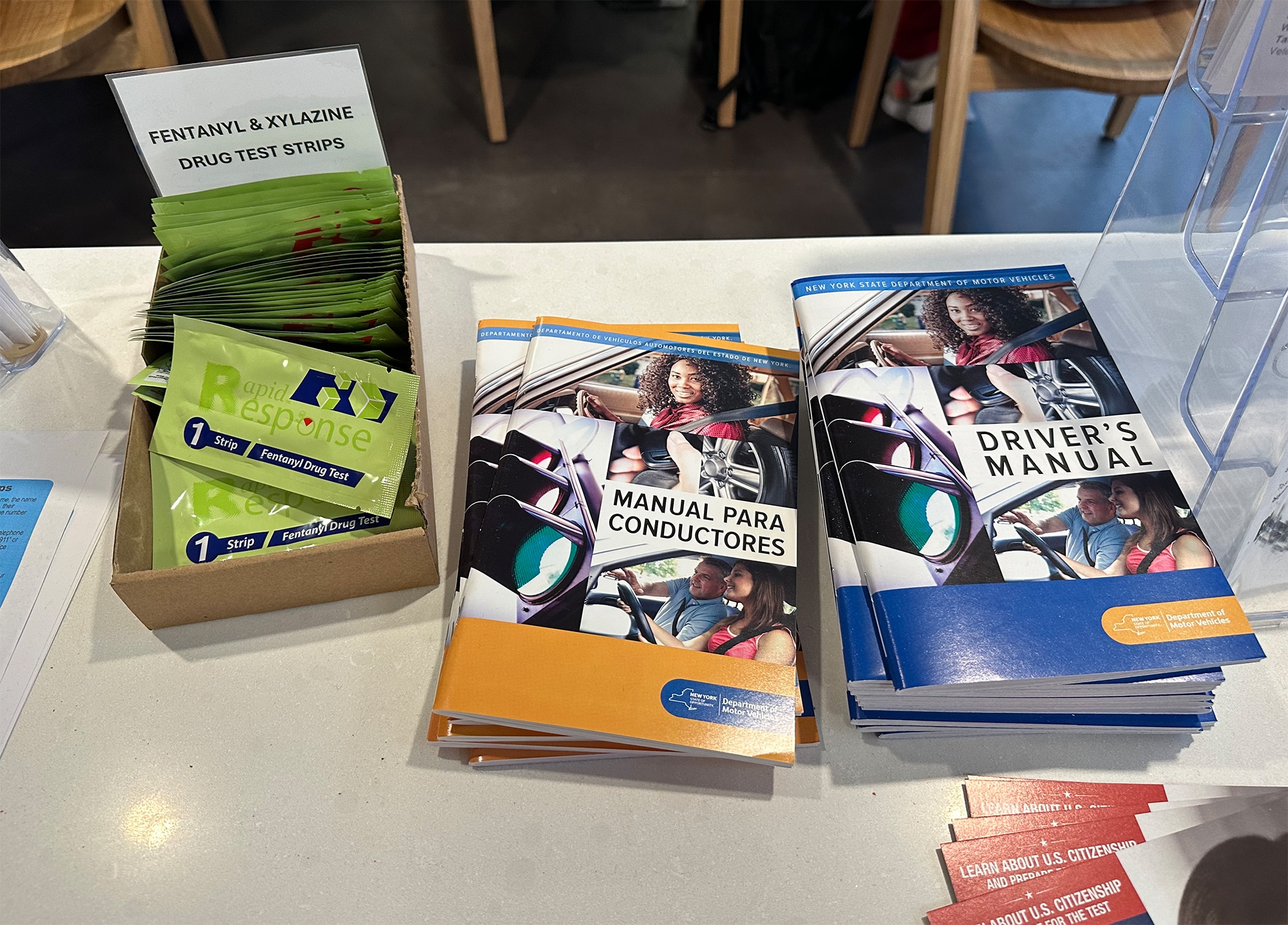
Drug test strips, driver’s manuals, citizenship test materials. Sunset Park branch, Brooklyn Public Library, New York, 2024. [Shannon Mattern]

“Increasing poverty? You’re going to feel it at the desk,” said Emily Drabinski, a former president of the American Library Association. “Limited access to mental health resources can walk through the door in your library. Opioid addiction devastating your community is going to walk through the door and want to use the printer.” 18 Some libraries now have social workers on the floor, helping people in distress, making referrals. 19 I’ve had heartrending discussions with staff who say the compounding crises demand resolve and improvisation, transforming their jobs and the institution as a whole — and taking a toll on their own minds and bodies. 20 Many want to get back to basics.

As Book Riot’s Kelly Jensen affirmed:

Public libraries are not play places. They are not cooling centers or warming centers or mental health clinics. Public libraries are not bars, nor are they essential services. Public libraries are places of information and access to information. They are places that ardently defend the rights of every person to seek out that information. This is fundamental and yet not highlighted or underlined enough. Public libraries are cornerstones of democratic and civic engagement, not safety nets for broken systems elsewhere. They might take on those roles, but that’s not their purpose. 21

And that core mission, being a place of information, is getting harder. In 2025, librarians worry about rampant book bans, access restrictions, militarized immigration officers patrolling the aisles. 22 They are targeted by hostile boards who seek to privatize knowledge and politicians ideologically opposed to public things. 23

Librarians worry about book bans, access restrictions, militarized immigration officers. And now MAGA is coming for interlibrary loan.

On top of everything, MAGA is coming for interlibrary loan. Two months after retaking office, Donald Trump issued an executive order to dismantle the Institute for Museum and Library Services, a federal agency that provides vital support to state libraries (which in turn filter money to city, county, and tribal libraries; and resource-sharing programs like interlibrary loan). 24 This is a direct attack on a service that exemplifies the best, most generous inclinations of humankind. Even before the printing press, books were being passed between European monastery and cathedral collections, and between different parts of the Islamic world. Early U.S. libraries had casual exchanges, and in the late 19th century, state consortia formalized the practice. In 1919, the ALA approved codes for interlibrary loan, so that rural libraries could benefit from the collections of larger urban institutions, small colleges could share the wealth of research universities, and readers everywhere could access specialized collections.

“No library, regardless of its size or budget, is completely self-sufficient,” the ALA states. Some are “net borrowers” and others “net lenders,” but “all libraries have something to contribute and should be willing to lend if they are willing to borrow.” From each according to their ability, to each according to their need. The International Federation of Library Associations extends this obligation across political borders. 25
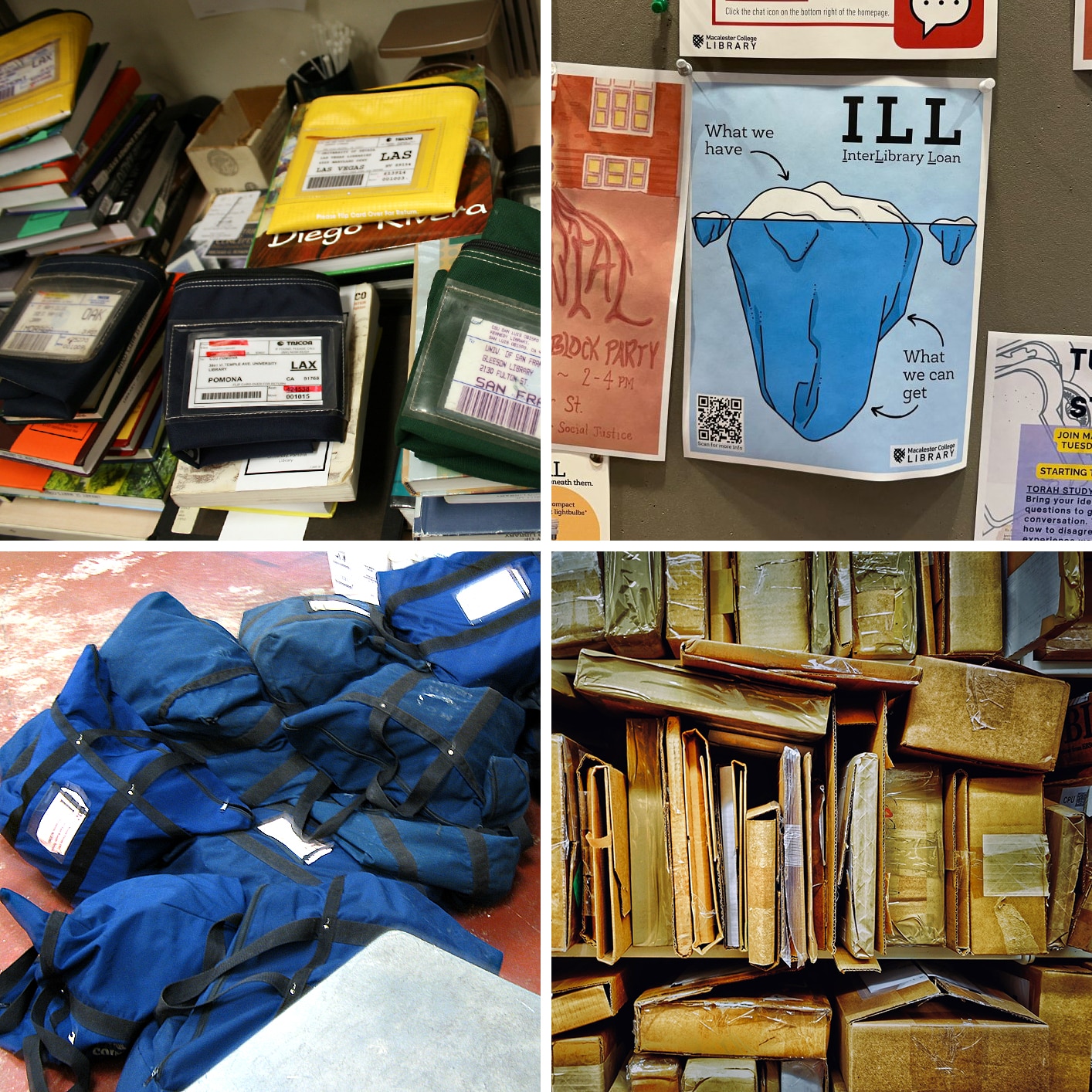
Infrastructure of interlibrary loan. Clockwise from top left: Robert E. Kennedy Library, Cal Poly, San Luis Obispo, California; flyer by Connie Karlen and Kate Roarty, Macalester College Library, St. Paul, Minnesota; University of British Columbia Library, Vancouver; Morris County Library, New Jersey. [Flyer photographed by Shannon Mattern; other photos by Kennedy Library, Edna Winti, and Morris County Library via Flickr under Creative Commons licenses]

Importantly, these are not ad hoc exchanges but robust sociotechnical infrastructures, with nation-building effects. Hannah Wiemer has shown how interlibrary loan contributed to Germany’s postwar reconstruction, as new catalogs and logistical models structured an “interconnected system” dependent on “ongoing works of preservation, maintenance, and stabilization.” 26 In the U.S. these interstitial, coalitional services depend on the IMLS funding that Trump has cut. We are only beginning to see the consequences. North Idaho has dissolved its Cooperative Information Network, and interlibrary loan is currently shut down in the entire state of Florida. Tariffs have also stranded internationally loaned books — a revealing example of how Trump’s politics of chaos chips away at public systems. The dysfunction is the point. 27

The arcane, technical architecture of interlibrary loan needs our defense. But so, too, does the social architecture of extralibrary loan.

And let’s be clear about the larger stakes. 28 The Trump regime doesn’t want people sharing books (and other resources) through public institutions for the same reason they don’t want state health experts coordinating on vaccines or attorneys general comparing notes on civil rights. The mutualism enacted through organized, open exchange between communities wealthy and poor, small and large, across borders, beyond walls, is an existential threat to Trump’s doctrine of stupidity and control. The advocacy group EveryLibrary has made an urgent plea for “library sector solidarity” in response to legislative threats, since an attack on one is an attack on all. 29 But if we take that idea a step further, we find that the “library sector” includes the reading public — you, me, all of us.

The library is not meant to be an on-demand service provider, a node in the just-in-time-economy that puts a rights-restricted copy of Abundance in our AirPods. It’s meant to be an accessible portal to our government, our collective holdings, the place we go to access shared information, knowledge, wisdom, and to contribute our own resources to that pool, to make meaning with others. We loan books from the local library, or we loan books through it from a library far away. But we also lend ourselves to the library — committing our attention, our time, our presence at board meetings, our tax dollars and donations — enlarging the commons and participating in the political project of making an informed society. The arcane, technical architecture of interlibrary loan needs our defense. But so, too, does the social architecture of extralibrary loan. 30
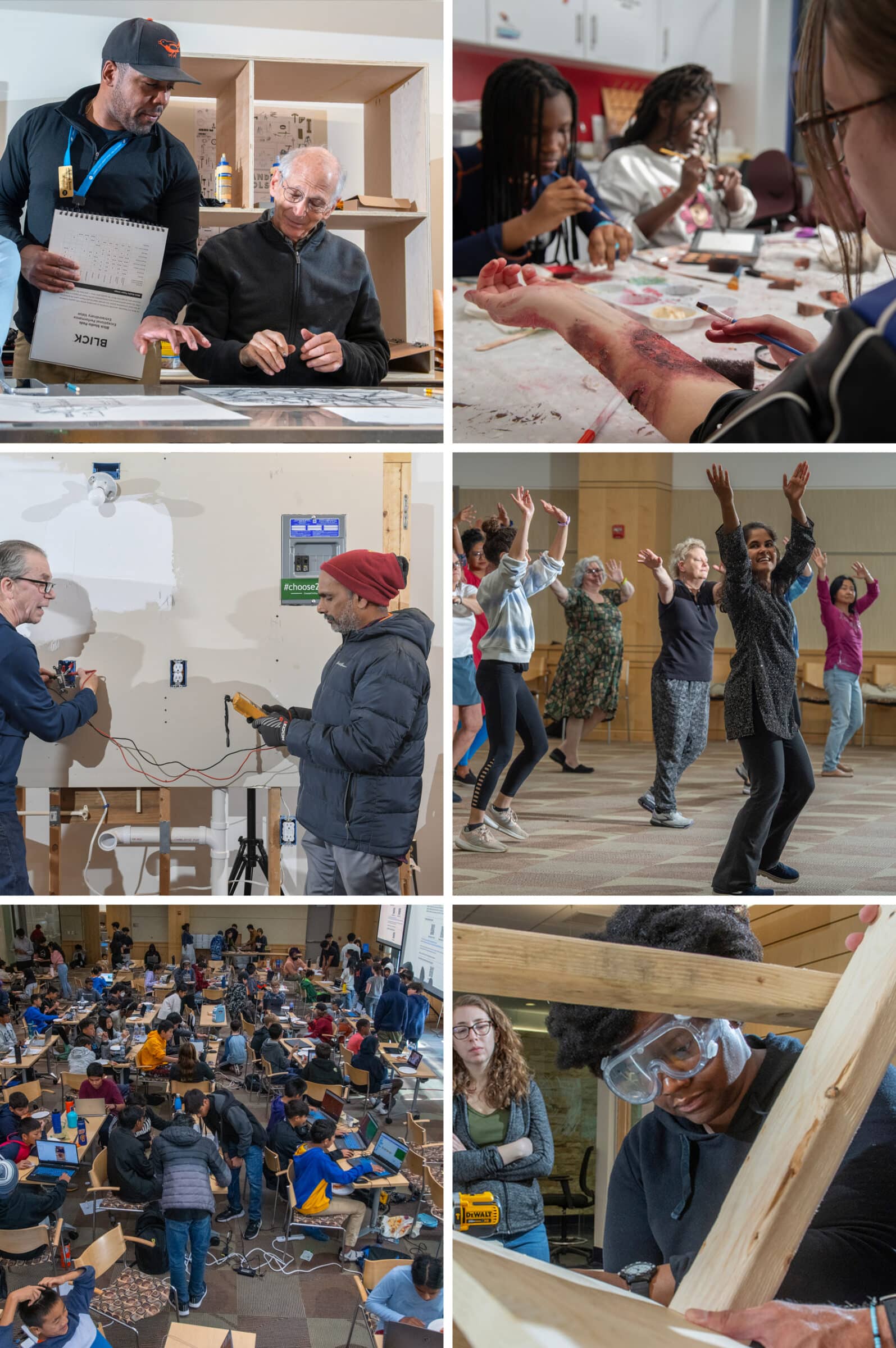
Public programs at various branches of Howard County Library, Maryland. Top row: observational drawing, 2024; movie special effects workshop, 2023. Middle row: home wiring basics, 2025; Rock on with Bollywood, 2025. Bottom row: Hacking tournament, 2024; DIY furniture workshop, 2025. [Howard County Library System via Flickr under license CC BY-NC-ND 2.0]

The Future of Media

The seeds of the Sunset Park Sun were planted in late 2019, when The City’s Open Newsroom — in collaboration with interns from the Engagement Journalism program at the City University of New York — held meetings at library branches in Bedford-Stuyvesant, Red Hook, and East New York. Prompted by questions like “What’s your favorite thing about your community?” and “What does good news mean to you?” participants identified topics important to them: affordable housing, tenants’ rights, access to transportation and fresh food, education, block associations. 31

This vibrant exchange recalls an earlier era of collaborative public education and civic dialogue: the Federal Forums of the New Deal.

These listening sessions shaped The City’s coverage and inspired plans to create art and theater that would reflect insights back to the neighborhoods. But when Covid erupted, the Open Newsroom moved to Zoom. Advocates on those calls encouraged the paper to focus on crisis resources: how to navigate unemployment, secure emergency rental assistance, find mutual aid. 32 As quarantines eased, The City pushed out into the world again, launching a Civic Newsroom that held Voterfests at parks and branch libraries. And it partnered with other nonprofit newsrooms — including ProPublica and Chalkbeat — to host library events that matched journalists with experts on topics like mental health in public schools, climate change, and environmental cleanup. 33

This vibrant exchange recalls an earlier era of collaborative public education and civic dialogue: the Federal Forums of the New Deal. As a school superintendent in Des Moines in the early 1930s, John Studebaker organized free, public discussions on topical issues, bolstered by coverage at the city’s two daily newspapers, a weekly radio program, and reading lists at the public library. 34 Then, as federal Commissioner of Education, Studebaker used the Works Progress Administration to spread this model across the country, convening forums in schools, churches, synagogues, labor halls, museums, parks, broadcasting studios, settlement houses, hotels, private homes — and, again, libraries. 35
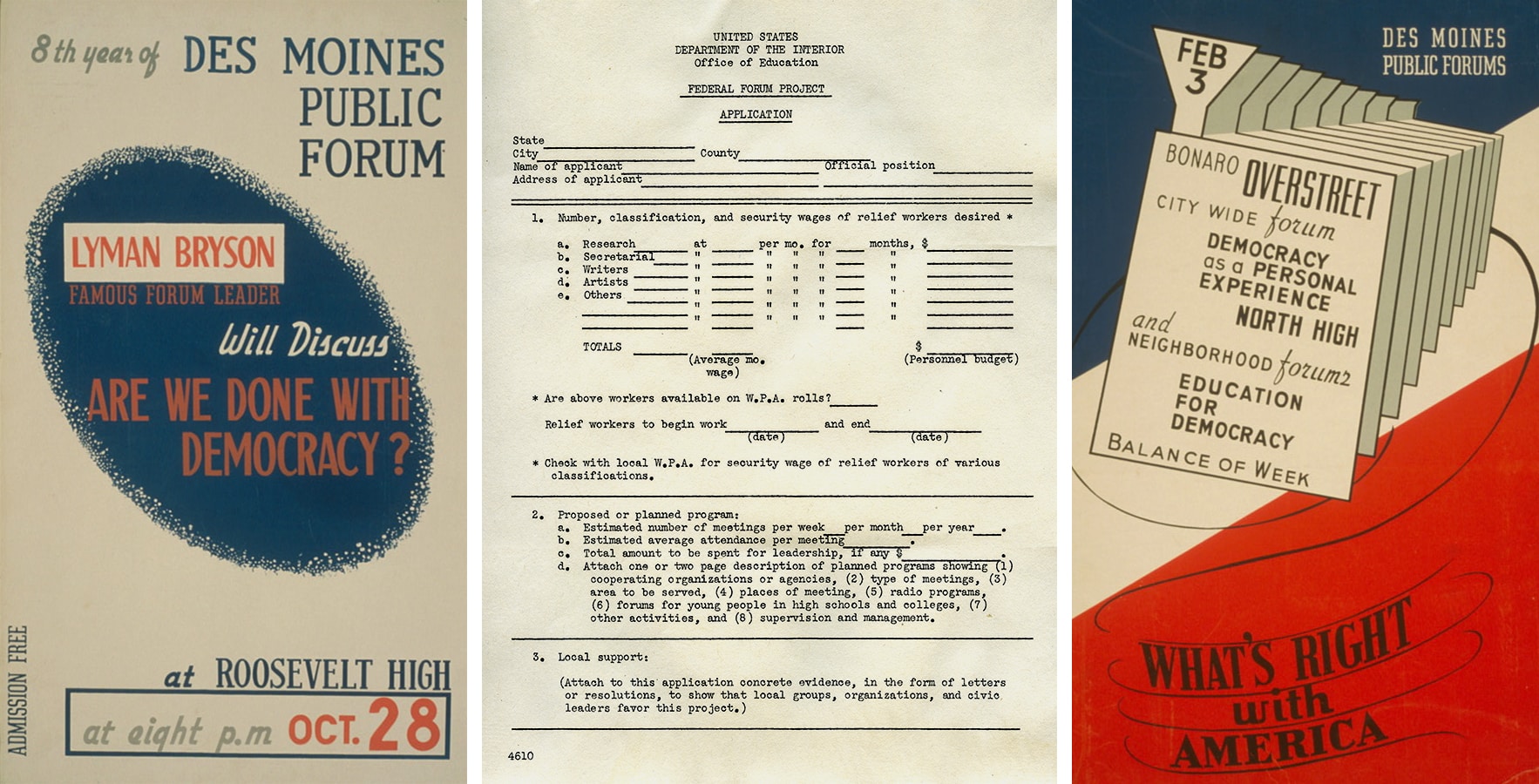
Federal Forum Project Application, 1937, with flyers designed by the Works Project Administration for public events in Des Moines, Iowa, 1940 and 1941. [Library of Congress]

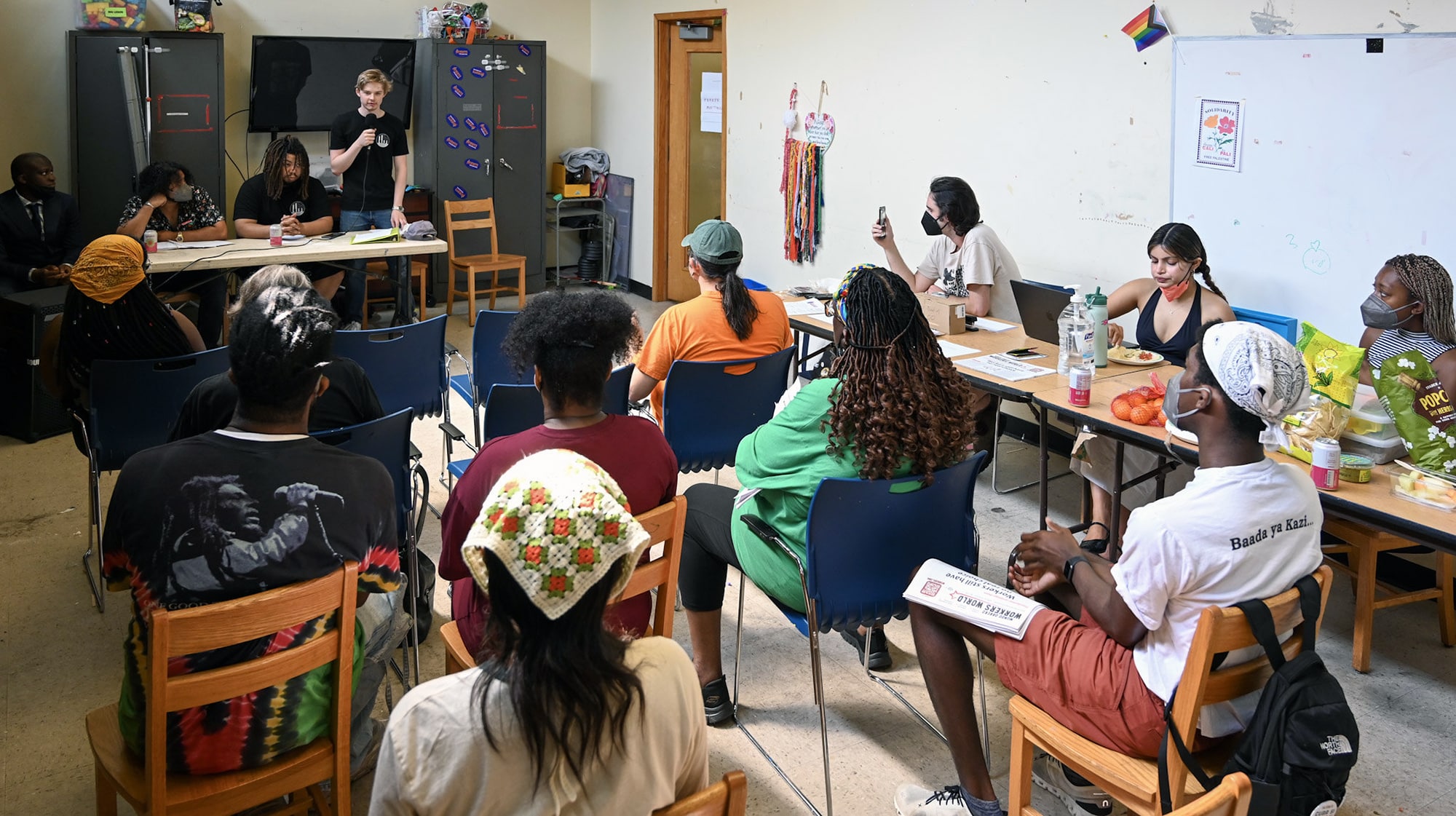
The Philadelphia Alliance Against Racist and Political Repression meets at the Cecil B. Moore branch, Free Library of Philadelphia, 2024. [Joe Piette via Flickr under license CC BY-NC-SA 2.0]

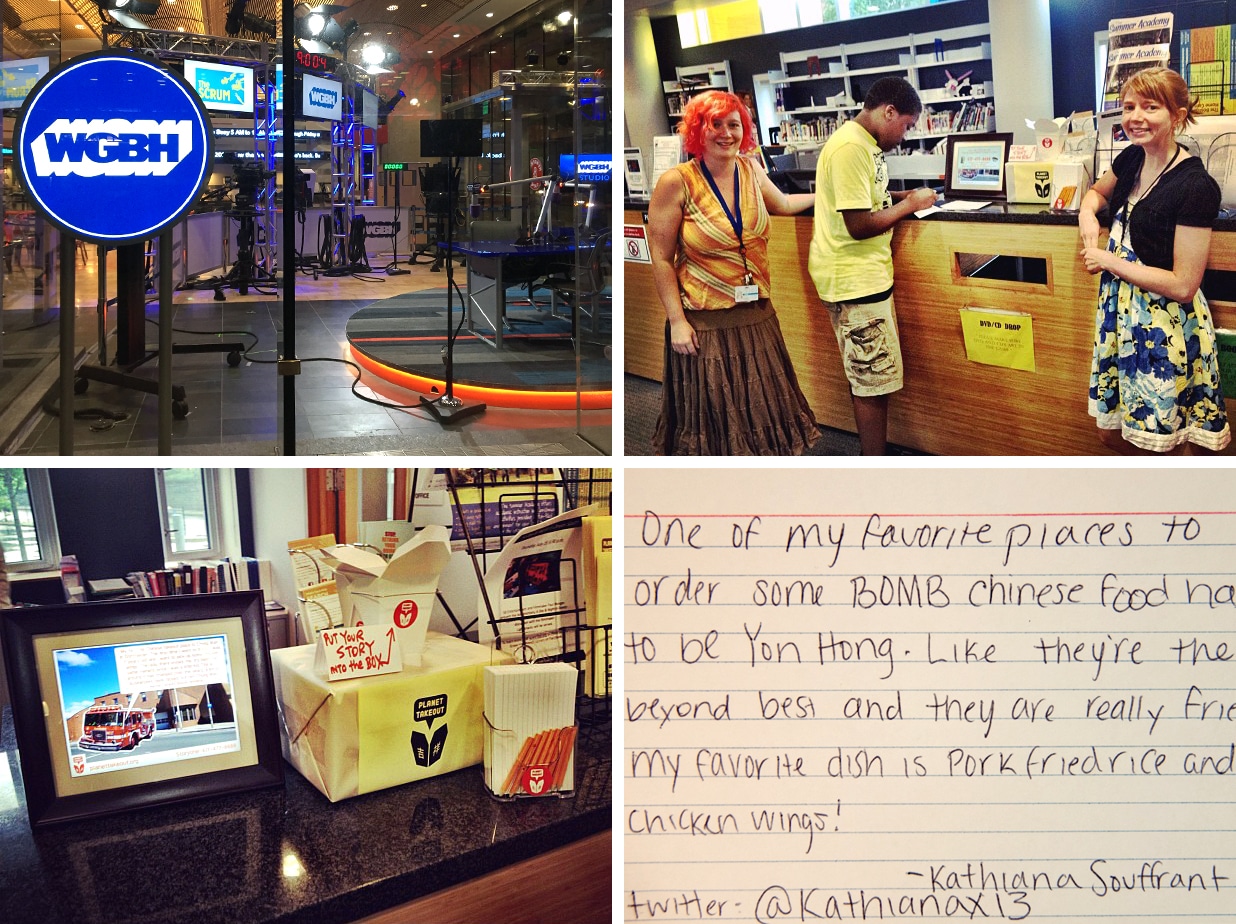
Librarians at the Grove Hall branch, Boston Public Library, collected community tips and stories for the multimedia documentary Planet Takeout. The segment aired in 2012 on WGBH, which has a studio at the Central Library. [Todd Van Hoosear and Planet Takeout/Kelly Creedon via Flickr under license CC BY-NC-SA 2.0]

Library newsrooms go further. Instead of gathering communities to talk about news of the day, they invite people to make the news. Or, rather — and this is an important distinction — to make public knowledge. Neighbors decide together how research is done, how statistics are derived, how knowledge is framed and shared. The models here include citizen journalism workshops and public access television. Newsroom projects have popped up in libraries across the country, in Albany, Cleveland, Madison, Kansas City, and Houston, and smaller towns like McKeesport, Pennsylvania, and Weare, New Hampshire. In San Antonio, the news channel NowCastSA broadcasted government meetings from the library; and in Boston, the public radio station WGBH has a studio at the library. In Dallas, the library connects teen journalists with the Dallas Morning News and public radio station KERA to produce equity-focused coverage of the North Texas art scene. 36

Neighbors decide together how research is done, how statistics are derived, how knowledge is framed and shared.

Many libraries, though, have struggled to sustain newsrooms when grant funding expires. The Albany project was started by Library Futures, a think tank embedded in the law school at New York University, which won a grant from the Google News Initiative to collaborate with the social impact consultancy Hearken and design consultancy MakeWith. It was apparently a successful pilot, funding the co-production of eight articles with Albany’s Times Union. But “it still feels a little unfinished,” said Erica Smith, an editor at the daily newspaper. “It feels like we did the thing, we talked about it, and then stopped — which I think is something we often do as an industry.” (It’s also characteristic of Google’s philanthropy.) Smith’s comment was reported by Kate Harloe, in a story that asked, “Are Libraries the Future of Media?” 37

Harloe concludes:

These varied experiments suggest the glimmering possibility of something larger. In their imprints, it’s possible to see a different world: one in which the collective resources that people love are protected and expanded, and in which people might actually own the stories produced about them and their communities. … What these humble, imperfect, but very cool partnerships suggest is that an entirely different way of sharing stories and information — and thus understanding our world — is possible, and that pieces of that possible future are already here.

For their part, the organizers of the Brooklyn Library Newsroom are creating a toolkit to share what they’ve learned. They emphasize the importance of having cross-institutional buy-in and paid staff, while relying on the stable infrastructure of branch libraries for meeting space and resources. Ultimately, communities need to take the project into their own hands. Parris was so inspired by the partnership, he decided to get a library degree and dedicate himself to coalition-building work. 38
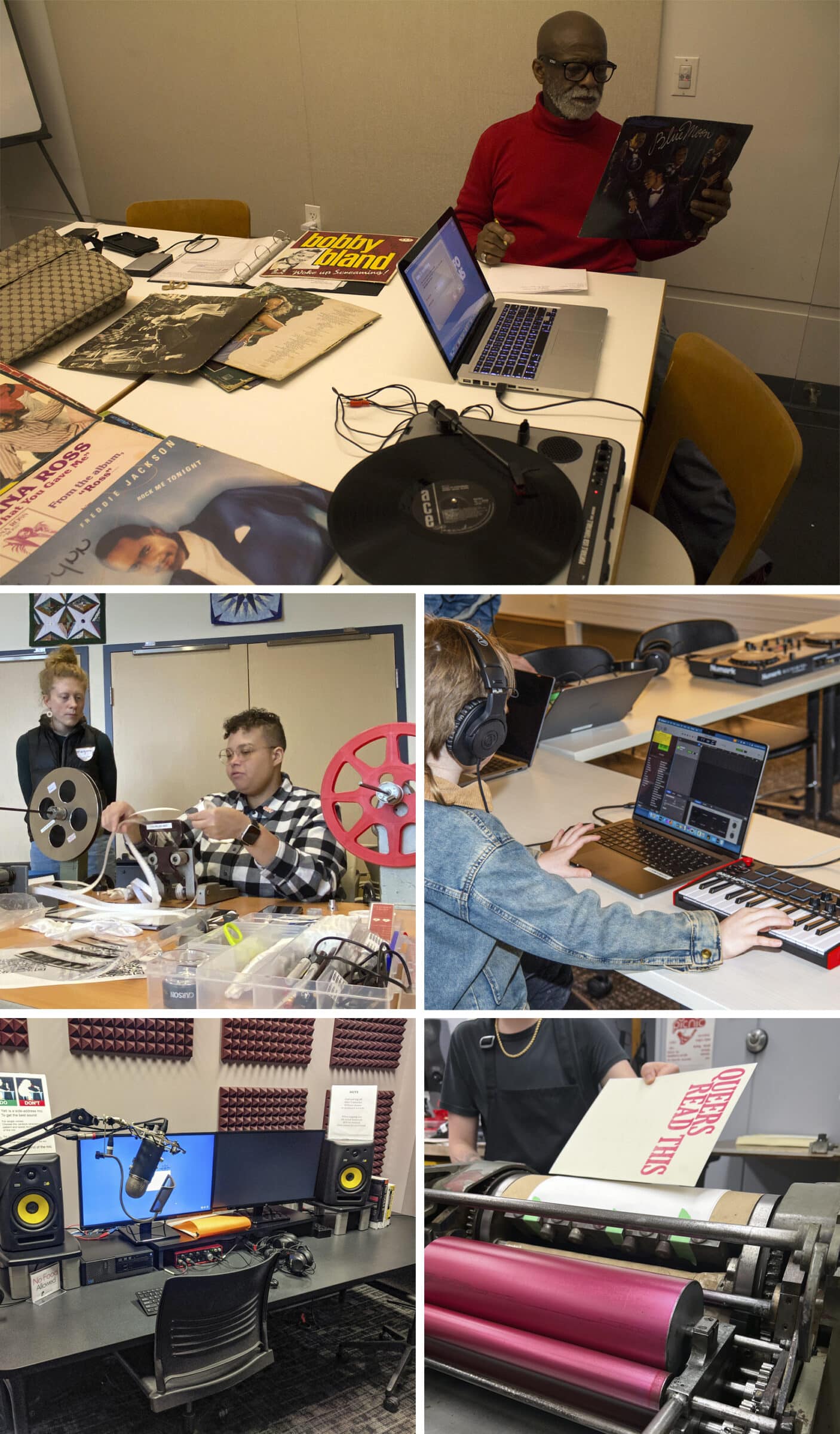
Media production facilities. Top row: digitizing vinyl records, Brooklyn Public Library, New York. Middle row: community archiving workshop, Kodiak Public Library, Alaska; beatmaking, Multnomah County Library, Oregon. Bottom row: recording studio, St. Louis Public Library, Missouri; letterpress, John M. Kelly Library, University of Toronto, Ontario. [Photos by Brooklyn Public Library, Community Archiving Workshop, Multnomah County Library, Nick Normal, and Sarah Severson, all via Flickr under Creative Commons licenses]

Libraries in Local Media Ecosystems

Libraries are engines of cultural production. Music critic, poet, and essayist Hanif Abdurraqib has described the wonders of the Livingston branch library in East Columbus, Ohio, where as a child in the 1990s he discovered bands like The Clash through CD shuffles loaded in spaceship-like listening pods. 39 Now libraries are creating their own streaming platforms to compete with Spotify. In Mood Machine, Liz Pelly reveals how the commercial music industry shortchanges artists and flattens culture through playlists of algorithmically tuned “content” that promote passive, uncritical listening. But she also presents an alternative: librarians and others in Iowa City, Seattle, Austin, Pittsburgh, Minneapolis, Copenhagen, Eau Claire, Chapel Hill, Madison, Edmonton, Salt Lake City, Denver, and Ann Arbor who are building streaming services that celebrate and validate local musicians and scenes, pay a fair licensing fee, and commit to preserving the work. These platforms are rooted in discovery, thoughtful and attentive engagement, privacy, integrity, and sustainability, rather than surveillance, extraction, distraction, and monetization. 40

We need to build and care for infrastructures that scaffold the production, storage, preservation, and distribution of cultural works.

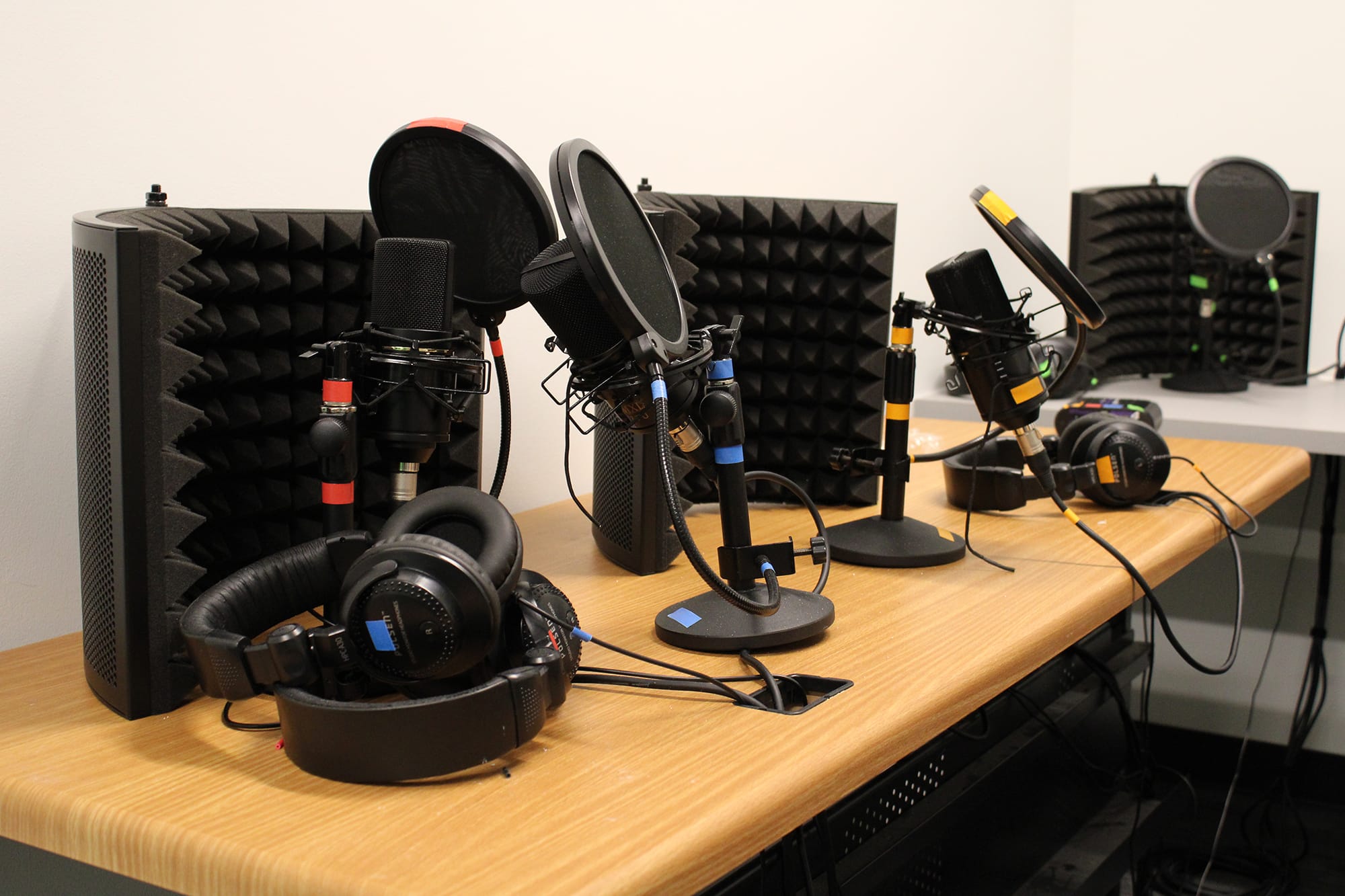
Media-making programs and tools are a big draw for public libraries. The Info Commons at Brooklyn’s Central Library hosts classes on music production, street photography, coding, and more. There is a recording studio; workstations with video, audio, and design software; equipment to digitize audio cassettes, vinyl records, and VHS tapes. And the library has partnered with BRIC (Brooklyn Information & Culture) to host media education programs with illustrious local creators. Across the country, many libraries have created podcasts connecting their collections and services to the community. At least one library, in Westport, Connecticut, runs its own record label. 41

Can libraries afford to stretch their mandate in this way? Can they afford not to? “On a collective level, we have to be active participants in the cultural economies we want to see flourish,” Pelly writes. “We have to validate the culture we want to see in the world.” 42 If we appreciate information and media as public goods, we need to build and care for infrastructures that scaffold the production, storage, preservation, and distribution of cultural works. Libraries are uniquely positioned to help — sometimes by making those infrastructures and sometimes by hosting them, drawing in local partners and cultivating coalitions.
Annie Gotwald Makerspace and STEM Lab, Westfield Washington Library, Indiana, 2025. [Tom Britt via Flickr under license CC BY-NC-ND 2.0]

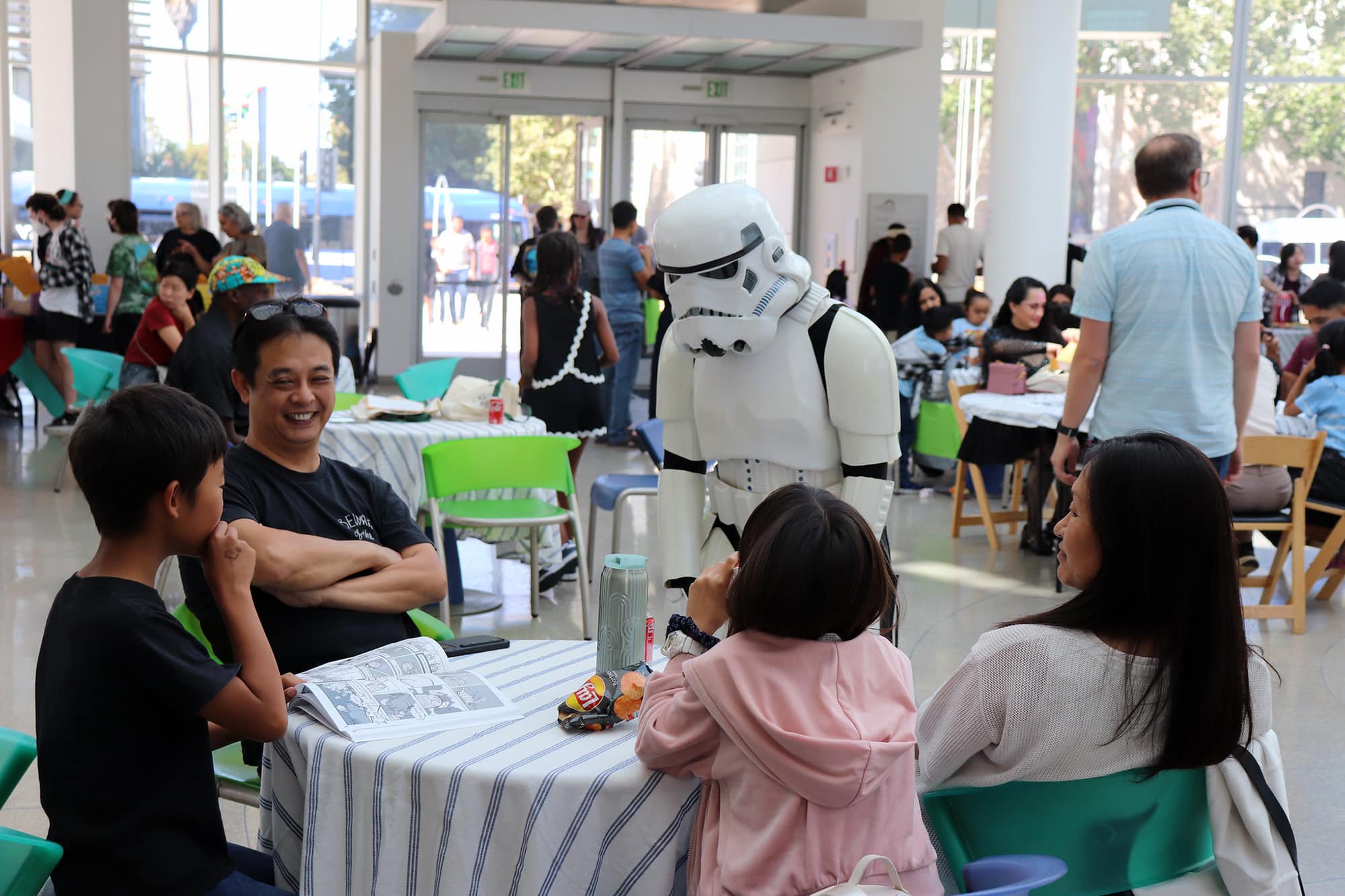
Graphic Novel Making Contest awards, City Hall, sponsored by by the San José Public Library, California, 2025. [San José Public Library via Flickr under license CC BY-NC-SA 4.0]

That includes applying public values and resources to information technology. 43 Many libraries have digital equity programs that provide internet access to marginalized communities and teach skills like recovering passwords, finding reliable sources, and avoiding scams. This essential public service is now at risk, especially in red states and rural areas, as the Trump regime cancels equity programs and siphons resources to donors. Underserved communities will get a glitchy Starlink connection controlled by Elon Musk. 44 But libraries that have strong local funding can broaden their commitment to technology access and privacy; the Info Commons has “Burner Phone 101” classes for people who want to stay safe when attending protests or crossing a border. 45

Libraries must also reject false claims about the ‘inevitability’ of AI and hold open the possibility of principled refusal.

And, of course, our embattled public libraries are now compelled to develop public literacy and critical frameworks around “artificial intelligence” and its effects on cultures, politics, economies, environments, and human psychology. 46 Here, too, we see libraries extending themselves through partnerships with colleges and civic groups. The Boston Public Library joined with the Mayor’s Office of New Urban Mechanics to host an AI workshop for teens; the Queens Public Library and New York University’s Center for Responsible AI launched a five-week course; and LibraryLinkNJ, in New Jersey, recruited 20 librarians to be AI Ambassadors who could train and advise their colleagues and patrons. 47

Although collaborations bring new resources, skills, and community relationships, libraries need to be wary of partnering with tech firms eager to capture users and their data, or sanitize reputations. 48 Libraries must also reject false claims about the “inevitability” of AI and hold open the possibility (for themselves and their patrons) of principled refusal. Given the infuriating disrespect for the skills and sensibilities of cultural producers, the dismissal of creators’ and subjects’ rights, the relentless crawling that overwhelms archival collections, the environmental harms, the lying and hallucination, the founders’ egomaniacal delusions and eugenicist commitments — for all those reasons and more — many people are opting out of AI. (I’m one.) What better place than the public library to have an inclusive, intergenerational discussion about it? 49
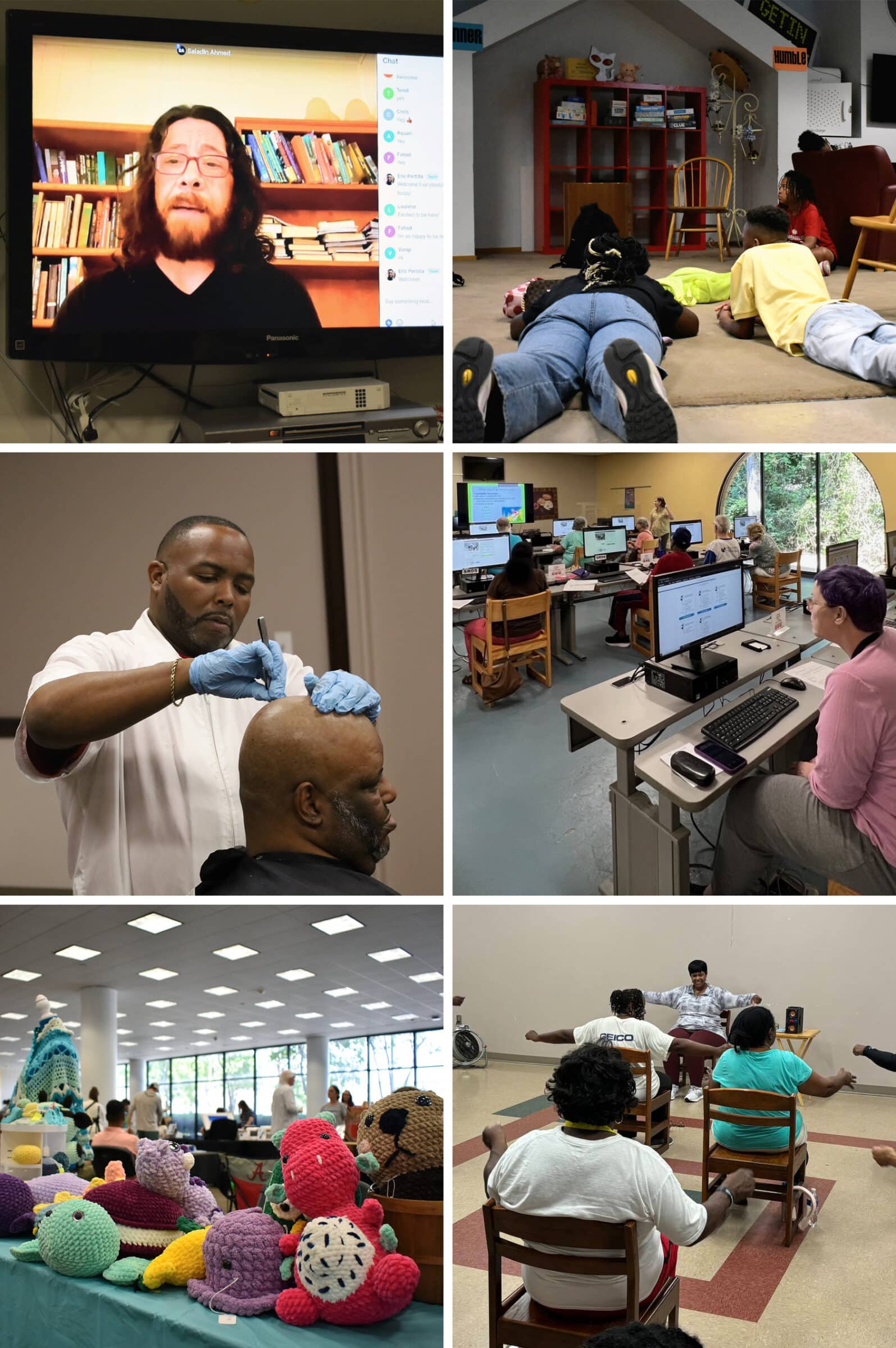
Public programs at various branches of Birmingham Public Library, Alabama. Top row: remote session with Saladin Ahmed, writer of Spider-Man: Miles Morales, and youth at the Central Library, 2022. Middle row: “Barbershop Talk,” a space for men to discuss social issues, with free haircuts, 2024; genealogy class using Ancestry.com, 2023. Bottom row: art market with vendors selling books, zines, prints, and crafts, 2024; Slide City Chair Aerobics, 2024. [Birmingham Public Library via Flickr under license CC BY 2.0]

Distributed Collections and Solidarity

More than half the U.S. population has a library card, and the way people use the library is changing, with e-readers like Libby drawing in members who love the convenience of borrowing digital books. But Libby is run by a commercial vendor owned by a private equity firm. Libraries that have leaned into this software (that is, most of them) now struggle to cover the ballooning costs. They are forced to license, rather than own, much of their collection, and they don’t always control what’s in the subscription packages. 50 Progressive technologists are working to develop alternatives — Briet, for example, allows publishers to “sell their e-books to libraries outright, providing universal, perpetual access” — though those systems are not yet deployed at scale. 51

Books Unbanned provides free digital library cards to teens anywhere in the country, allowing them to access censored resources.

Still, digital collections allow libraries to encompass larger publics, beyond borders and paywalls. 52 As organized book banning campaigns fan out from Texas and Florida across the United States — blocking access to thousands of titles that examine race, racism, gender identity, and sexuality — well-resourced libraries in politically safe areas can step in as the “defenders of an open pluralist society, the hidden but essential infrastructure of democracy itself.” 53 The Books Unbanned program — started by the Brooklyn Public Library, and now including libraries in Boston, Seattle, Los Angeles, Long Beach, and San Diego — provides free digital library cards to teens anywhere in the country, allowing them to access resources censored in their own communities. In the first three years, 10,000 young people from 52 states and territories checked out over 330,000 books. 54

Year after year, libraries keep stretching and stretching. Their publics expand through digital lending and online talks and workshops. Their mandate grows. Libraries create a commons of conviviality and solidarity, and when you make available something that is uplifting and enlightening, more people want in. All those new people engaging with that commons — here, taking from is a means of contributing to — demonstrate a demand that signals the need for generous support to keep it going. It’s a virtuous cycle. As Emily Drabinski puts it, “The public goods that survive are the public goods that everybody uses.” 55

When you make available something that is uplifting and enlightening, more people want in.

This spring, I had the great honor of serving as Kluge Chair of Modern Culture at the U.S. Library of Congress. My time on Capitol Hill coincided with the first few months of Trump’s reign, and I befriended library staff who watched in horror as federal colleagues were fired — first workers at the National Archives; then their own beloved leader, the Librarian of Congress, Dr. Carla Hayden. Inexperienced, ignorant, reckless tech bros wreaked havoc across the government through information management practices (and sheer malevolence) that are antithetical to library work. Still, these librarians were committed to their mission, stewarding the largest collection of public knowledge in the world.

I was reminded of an idea shared with me years earlier, a vision of the Library of Congress as a D.C.-based branch library of all the nation’s other library systems. Early steps in that direction can be seen in LOCal, a new collaboration between the Library of Congress and library systems in Eastern Oklahoma and Cleveland to curate digital installations that will connect local communities with materials in the federal collection. 56
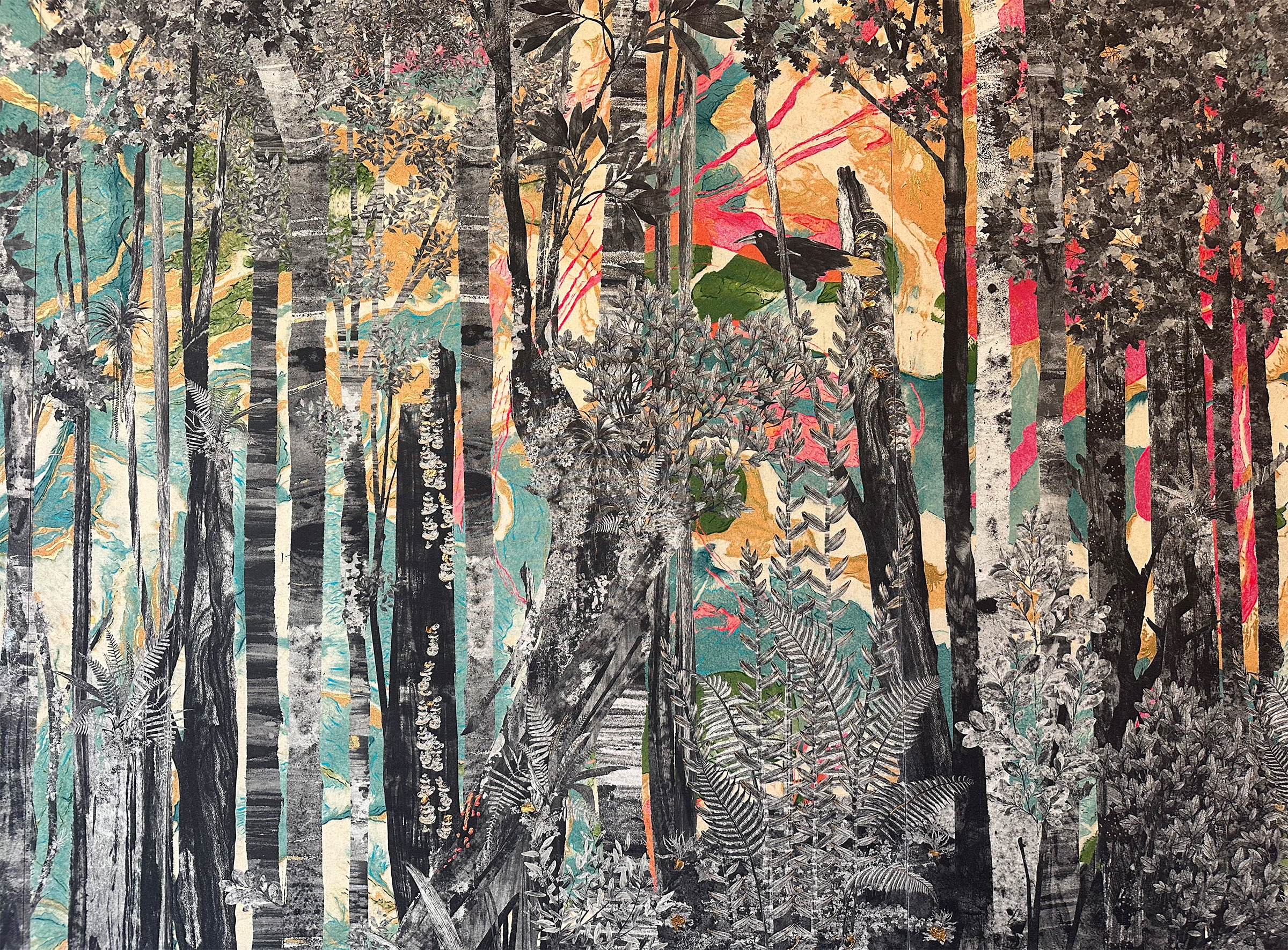
Detail, destellos naranjas en la copa de los árboles, by Tatiana Arocha, mural at the Sunset Park branch, Brooklyn Public Library, New York, installed in 2023. [Photo by Shannon Mattern]

New Architectures for the Civic Turn

I don’t think it’s much of an exaggeration to say that societies are defined by their libraries — by what we hold, what we lend, what we borrow and return, the knowledge we create, the values we defend. Many U.S. libraries today are deepening their roots, even amid the stresses of the political environment. But lone trees will not survive. Trunk-and-branch was never an accurate image of the library’s physical presence, let alone its digital activities. And in times of drought and conflagration, the metaphor is fatal. 57 The institutions and resources that have sustained this beautiful forest — from the IMLS to the First Amendment — are breaking. To survive, libraries are making new infrastructures: symbiotic, mycorrhizal, mossy. 58 Call it a mesh network. 59 Or call it extralibrary loan.

Societies are defined by their libraries — by what we hold, what we lend, what we borrow and return, the knowledge we create, the values we defend.

Public programs like newsrooms and media commons are not a distraction from the library’s core mission but a restatement of it. At each step in the library’s evolution — from the private collection, to the reading room, to the lending card, to interlibrary loan — the library becomes more open and more useful. Tactically, the next move is not a retreat but another push outward, exploring new configurations and solidarities with other public bodies and creative communities. In my book The City Is Not a Computer, I asked readers to “imagine a network of public infrastructures for the creation, storage, and dissemination of public knowledge: universities, libraries, broadcasting, print media, the postal service, telecommunications, local data intermediaries, and digital infrastructures working together, as a public epistemological ecology.” 60 There are many precedents for the clustering of civic resources, from the Athenian acropolis to Frederick Law Olmsted’s Pittsburgh to the feminist communal kitchen. In a talk about “civic adjacencies,” the week after the 2024 election, I spoke about the spatial, programmatic, and political bonds that form between like-minded civic institutions. 61 The role of libraries here is an old one: cross-referencing.

Public programs like newsrooms and media commons are not a distraction from the library’s core mission but a restatement of it.

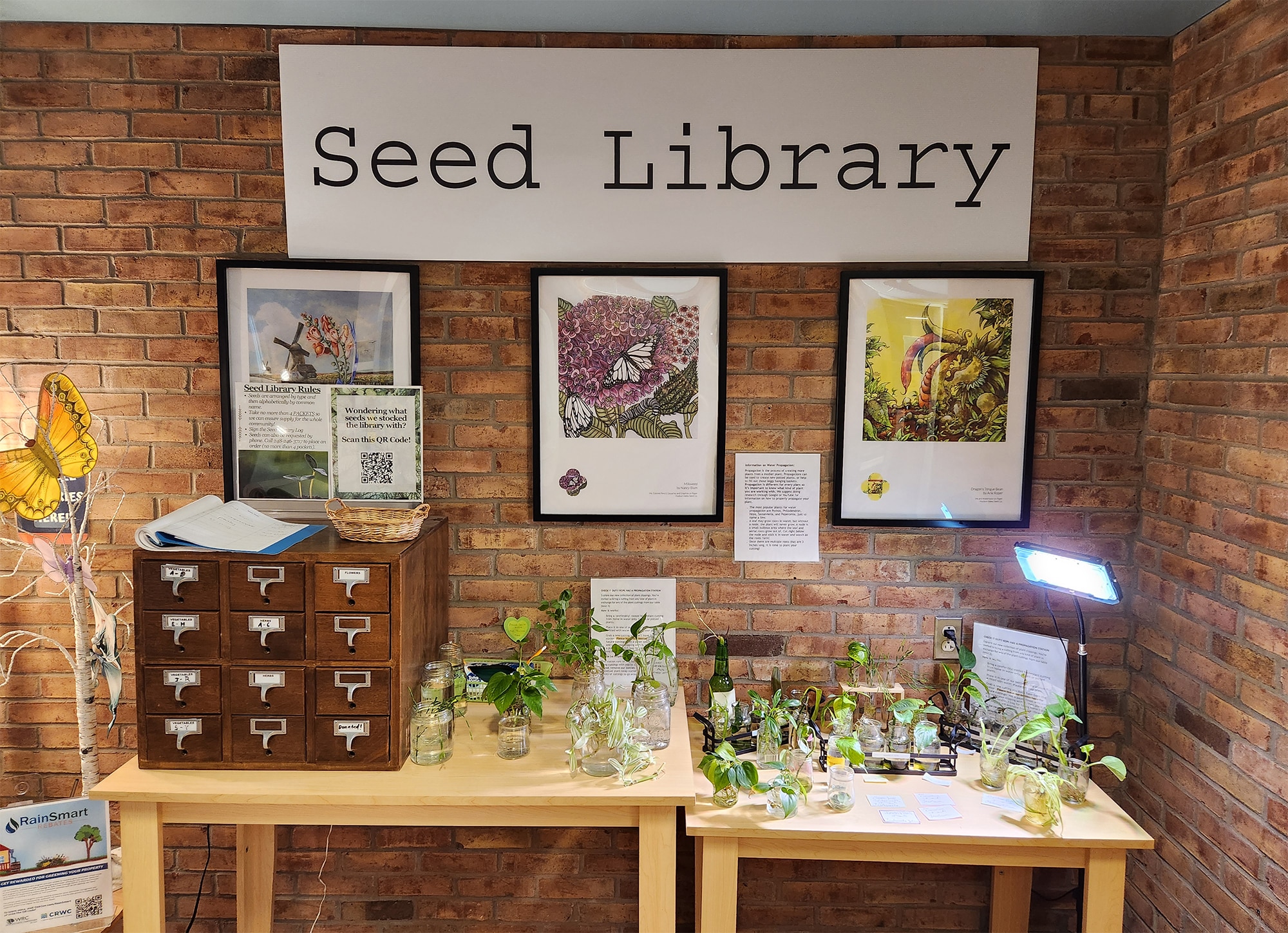
Communication scholar Victor Pickard has called for public media centers that would integrate libraries, newsrooms, and municipal broadband programs. 62 Why not add community colleges, seed libraries, community kitchens, tool exchanges, and makerspaces? The U.S. post office, which once acted as a nonprofit bank, could be liberated from its impoverished role delivering physical mail and parcels and reconceived as a logistics hub for public communication in all forms. Katherine Victoria Coffield, in a master’s thesis in historic preservation, calls for the creative rehabilitation of thousands of deaccessioned post office facilities. 63 One intriguing case study is the Urbana-Champaign Independent Media Center, which encompasses a radio station, community newspaper, makerspace, zine library, and other activist and arts programs in an old downtown post office building. In Istanbul, a former British post office has been transformed into a collectively designed and maintained community space with a library, podcast booth, co-working studio, event venue, rooftop garden, café, and fair trade shop. 64
Royal Oak Public Library, Michigan, 2025. [Corey Seeman via Flickr under license CC BY-NC-SA 4.0]

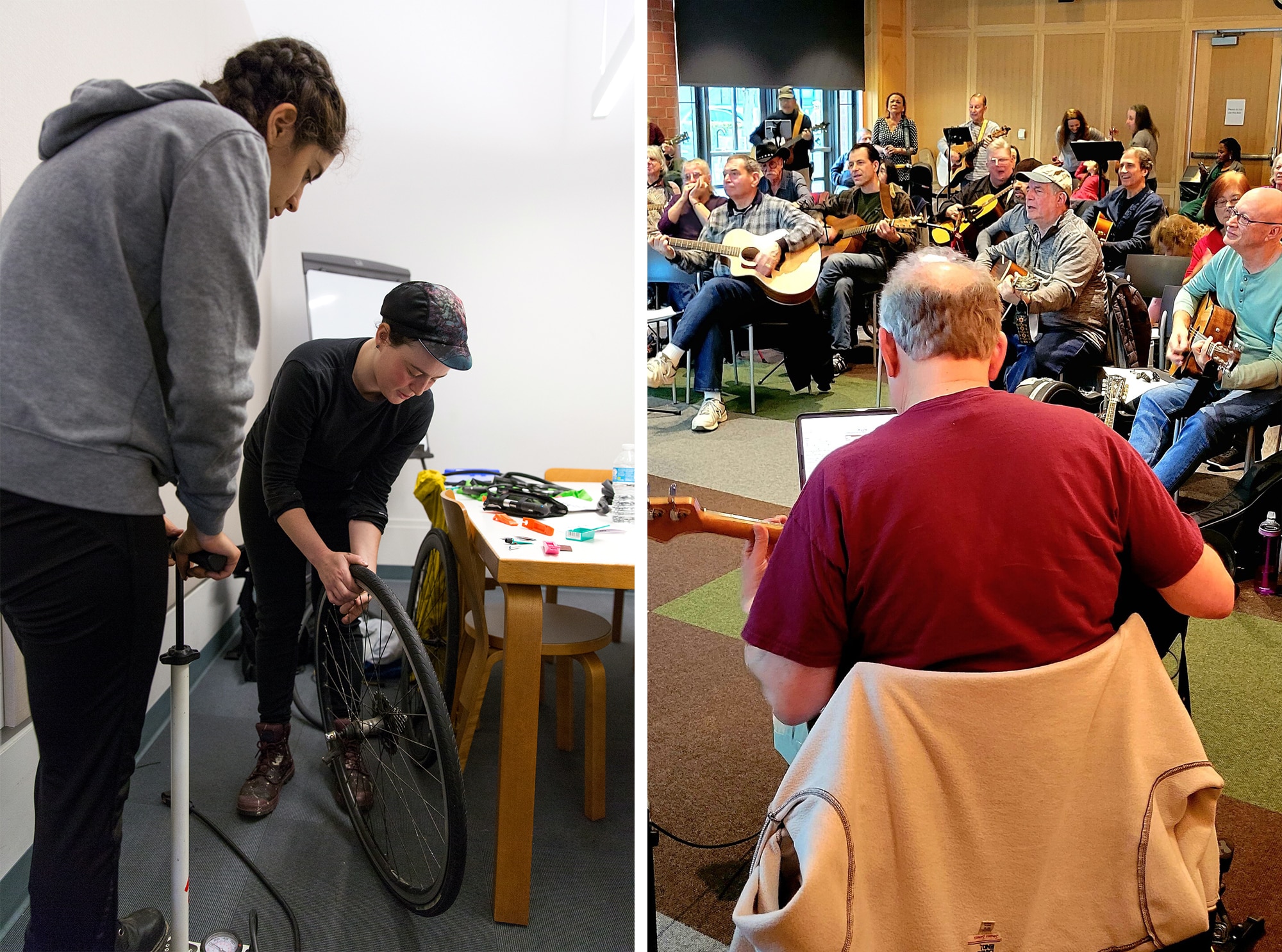
Bike repair skillshare, Brooklyn Public Library, New York, 2017; open jam with New Jersey Acoustic Music in the Park, Princeton Public Library, New Jersey, 2023. [Brooklyn Info Commons/Gregg Richards and Princeton Public Library via Flickr under Creative Commons licenses]

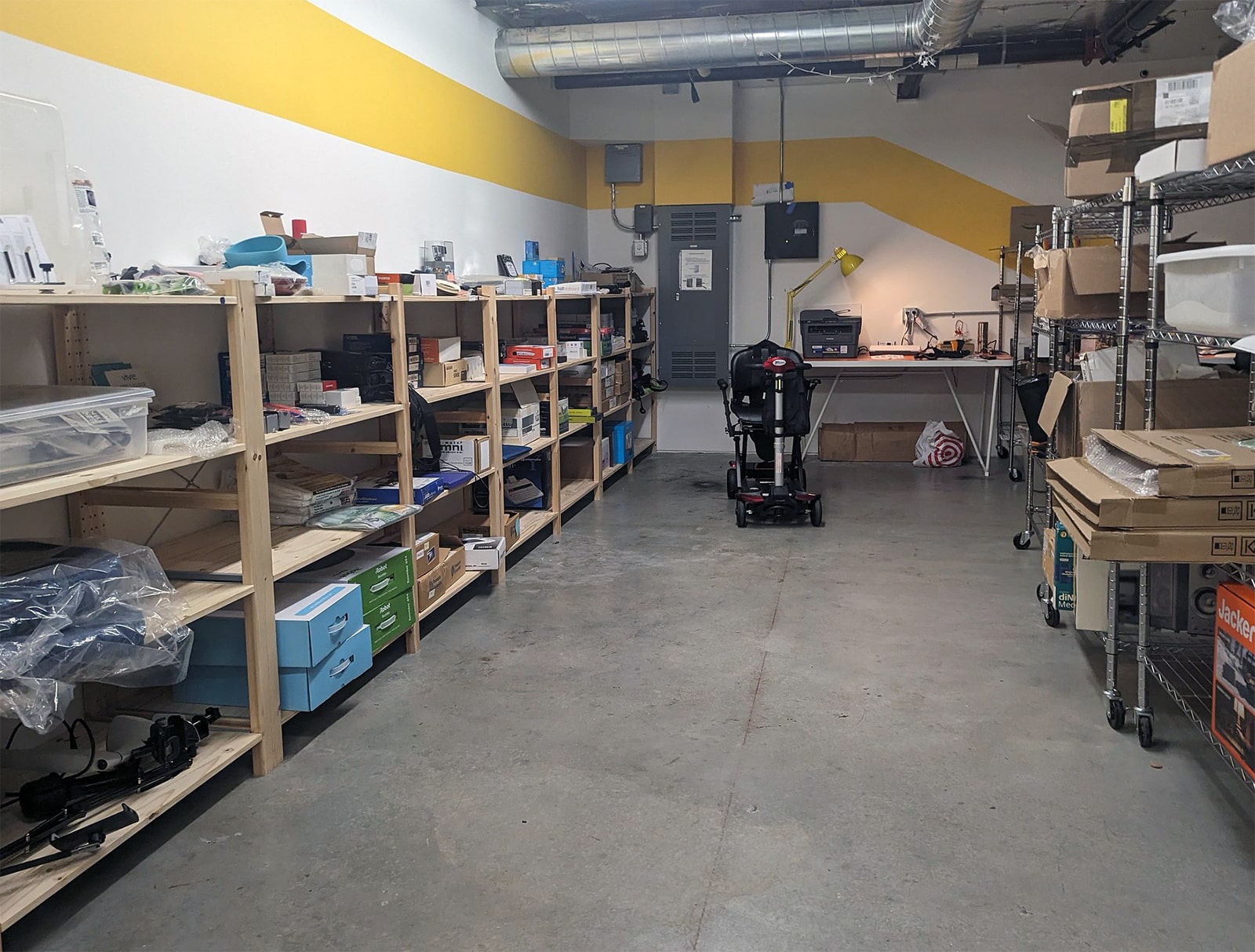
Lending library for assistive technology, Independent Living Resource Center of San Francisco, 2023. ILRCSF is a disability rights advocacy and support organization near Yerba Buena Gardens, surrounded by supportive housing, museums, and arts organizations. [Liz Henry via Flickr under license CC BY-ND 2.0]

Top: Antes del amanecer, by Tatiana Arocha, mural at the Sunset Park branch, Brooklyn Public Library, New York installed in 2023. Below: Resources at the Sunset Park and Sheepshead Bay branches, Brooklyn Public Library, New York, 2024. [Shannon Mattern]

Last year I dreamed about what somebody could do with the Bronx General Post Office at 558 Grand Concourse, which was for sale. The popular Cuban restaurant on the building’s roof and small postal facility could be joined by a public library, public access television, college radio, a stationery shop, a mail-art studio, media production facilities, a digital infrastructure and digital equity lab, a solar network hub. Well … it’s fun to dream. The property finally sold to Madd Equities, and there are plans to incorporate a community college campus. This same group is redeveloping the Kingsbridge Armory, farther north, as a multipurpose community center, in collaboration with the Northwest Bronx Community & Clergy Coalition. 65 These sites already include cultural anchors that could be the base for entire ecosystems of local public knowledge. 66

Thinking about civic adjacencies can help us imagine how public institutions and programs can be more deeply rooted in their communities and less vulnerable to attack.

Two decades ago, the Ballard branch library in Seattle was built next to a “little city hall,” where people can “get pet licenses, pay utility bills, and apply for passports and city jobs.” In 2021, a new library opened in Missoula, Montana, including a family education center, science center, university research lab, demonstration kitchen, makerspace, and media resource room with tools for producing programs for public access television. Coming soon in Taichung, Taiwan, the Green Museumbrary, designed by SANAA, will combine an art museum and public library. And just last year, the New York Public Library opened the Inwood branch in a fourteen-story building with 174 units of permanently affordable housing; an Activities, Culture, and Training Center; a STEM center; universal pre-K and childcare; a teaching kitchen; and a rooftop garden. 67

We don’t need fancy, new buildings to create civic synergies or build community news networks. But thinking spatially and programmatically can help us imagine what’s possible, which partners should be invited in, how the logistics of sharing are structured, what spaces of exception and refuge will be carved out. We should think, too, about topologies of fortification: how these allied institutions and partnered programs can be more deeply rooted in their communities, and, through their entanglement and embeddedness, less vulnerable to isolated attack. Banding together, they demonstrate the value of civic adjacencies. And scaling up — to an urban or regional-logistical scale — they form new networks of solidarity: improvisatory extra-institutional loans, systems of sharing, fugitive infrastructures, shadow libraries, joint trusts, collective practices of hope, expansive undercommons necessary in this dark era.
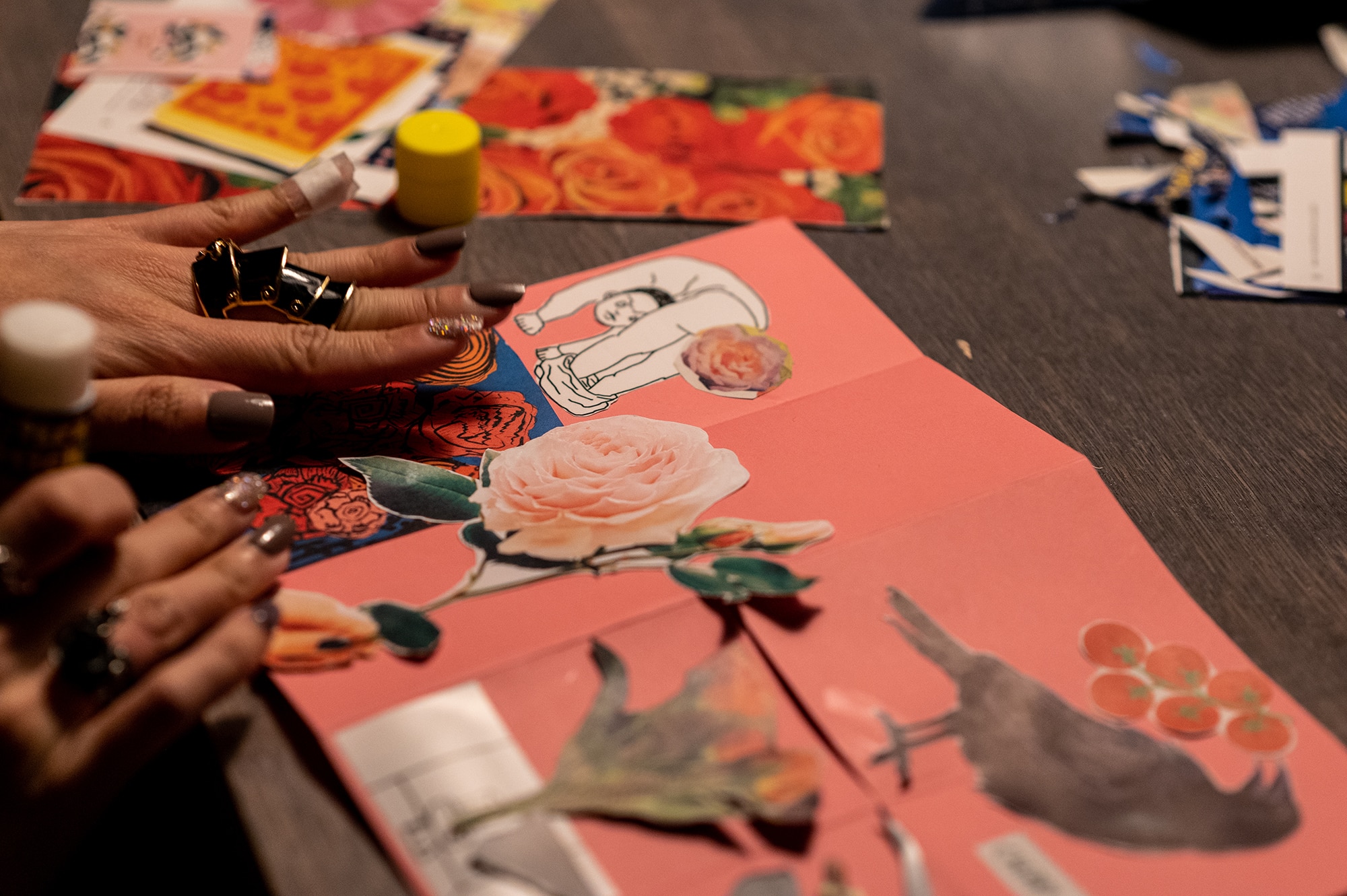
LGBTQ+ History Month Identity & Independence Zine Workshop, co-hosted by University of the Arts London Libraries at Darkroom Bar, 2023. [Sophia Nasif via Flickr under license CC BY-ND 2.0]

Author’s Note

Thanks to Josh Wallaert and Nancy Levinson for patient and astute edits; to David Giles, Jessica Harwick, Nick Higgins, Tambe-Tysha John, Rakisha Kearns-White, Eliana Miller, Alex Mouyios, Alicia Pritchard, Lisa Shankweiler of the Brooklyn Public Library; to Antonia Bruno in the New York State Education Department; and to the board and staff of the Metropolitan New York Library Council, with whom I observed the importance of library solidarity during my decade of service.

Notes
  1. This account of the Brooklyn Library Newsroom’s activities is drawn from personal communication with Nick Higgins, Eliana Miller, and Terry Parris, Jr., April 8, 2025; and from my own observations at several Newsroom meetings this spring at Sunset Park. We were joined by branch manager Roxana Benavides, who’s been an enthusiastic supporter of the project, and her colleagues. Also present at those meetings was Miller, the Brooklyn Public Library’s manager of executive projects, who told me the program helps the library build stronger connections to its community.
  2. The issue included a field guide that encourages others to adopt the Newsroom’s observational and investigative methods: mapping local places that matter, striking up conversations at bus stops and laundromats, attending community board meetings, chatting with local shop owners, and conducting ethnography in public spaces.
  3. See Mekdela Maskal and Terry Parris, Jr., “How Can News Better Serve You? Join the Open Newsroom,” The City, June 28, 2019. In addition to his current role as public square editor for the Headway initiative at The New York Times, Parris, Jr., is a John S. Knight Journalism fellow at Stanford University.
  4. The Newsroom organizers discovered that “most people were not learning primarily from news outlets, but from an informal network of local information sources and personal connections,” according to Elise Czajkowski, who reported on the project in a post shared by Melissa DiPento, coordinator for the Engagement Journalism program at The City University of New York. “More official news sources were often inaccessible, in either form of delivery or language.” See Czajokowski, “Rethinking Local News in New York City by Collaborating with Residents and Libraries,” Engagement Journalism, Medium, March 30, 2021.
  5. Personal communication, April 8, 2025.
  6. Miles Kohrman, interview with Heather Chaplin, “How Informal Networks Can Strengthen Local News,” Journalism + Design Lab blog, May 12, 2025. My former students at the University of Pennsylvania, Madison Gordon and MaTaeya McFadden, examined the role of barbers and nail techs as embodied forms of local media and shared their work in our Philadelphia Local Media Field Guide (2024).
  7. Kohrman, op cit. See also J + D Lab, “Community News Networks.” The lab was recently awarded a $1.5 million grant from Press Forward to connect community colleges in New Jersey, New Mexico, and Ohio with local news networks. For similar efforts, see the Institute for Local News, at the State University of New York, a new program that empowers students and faculty advisors at a dozen colleges to work with local media partners (Ashley Mowreader, “SUNY Expands Local News Collaborations for Student Learning,” Inside Higher Ed, August 28, 2025); and the Center for Community News, at the University of Vermont.
  8. Paul Farhi and John Volk, “In News Deserts, Trump Won in a Landslide,” The State of Local News Project, Northwestern Medill Local News Initiative, December 5, 2024. See also the 2024 and 2025 editions of Medill’s “The State of Local News Report.” In the 2024 edition, the researchers identify 206 counties that lack a source of professional news, where 3.5 million people live. In the more recent edition, that number rises to 213 and the researchers further emphasize the 1,524 counties “with only one local news source remaining, usually a weekly newspaper,” where nearly 50 million people live. For more, see Diana Moscovitz, “We Need a New Deal to Save Local Journalism,” Defector, January 17, 2025; and ongoing coverage of “news deserts” in NiemanLab. I would like to see the industry move away from that term, which conveys negative stereotypes of deserts and does not recognize the ways that news is collected, framed, and shared in areas that lack formal news infrastructure. See Ed. Samia Henni, Deserts Are Not Empty (Columbia UP, 2022).
  9. See resources collected for my Spring 2024 class on “Local Media,” including especially the work of Christopher Ali, and this collection of local media advocacy organizations.
  10. Kohrman, op cit.
  11. American Library Association, “Library Statistics and Figures: Number of Libraries in the United States.”
  12. Shannon Mattern, “Fugitive Libraries,” Places Journal, October 2019, https://doi.org/10.22269/191022.
  13. Susan Orlean, The Library Book (Simon & Schuster, 2019), 244.
  14. Quoted in Ellie Brown, “What the White House Doesn’t Understand About Libraries,” Advanced Reporting: The City, Medium, May 11, 2025.
  15. Shannon Mattern, “Library as Infrastructure,” Places Journal, June 2014, https://doi.org/10.22269/140609/.
  16. See Eric Klinenberg, Palaces for the People: How Social Infrastructure Can Help Fight Inequality, Polarization, and the Decline of Civic Life (Crown, 2018) and California Library Services Board, “The Value of Libraries,” April 2021; as well as more critical approaches, John Buschman, “Libraries, Democracy, and Citizenship: Twenty Years After 9/11,” The Library Quarterly 93:2 (April 2023), 181-201; Hanna Carlsson, Fredrik Hanell, and Lisa Engström, “Revisiting the Notion of the Public Library as a Meeting Place: Challenges to the Mission of Promoting Democracy in Times of Political Turmoil,” Journal of Documentation 79:7 (2023), 178-96, https://doi.org/10.1108/JD-03-2023-0061; Ed. Nancy Kranich, “Reimagining the Civic Roles of Libraries,” Special Issue, The Library Quarterly 94:1 (January 2024), https://doi.org/10.1086/727813; Shannon Mattern, “Public Knowledge” chapter, A City Is Not a Computer: Other Urban Intelligences (Princeton University Press, 2021), 73-105; Anne Helen Petersen, “Vocational Awe,” Culture Study newsletter, September 6, 2020; and Urban Libraries Council, “Leadership Brief: Effective Strategies and Models for Urban Libraries Addressing Homelessness,” October 16, 2024.
  17. My views here also build on my research on and with public libraries, as well as ongoing research at the Center for an Urban Future, in New York City, examining libraries’ service as “branches of opportunity,” despite their aging facilities. See David Giles, et al., “Branches of Opportunity,” Center for an Urban Future, January 2013; and David Giles, Jeanette Estima, and Noelle Francois, “Re-Envisioning New York’s Branch Libraries,” Center for an Urban Future, September 2014. After a quarter-century of researching and writing about libraries from an academic position, I have recently resigned my professorship to take up a new role championing New York City’s libraries and archives, as Director of Creative Research at the Metropolitan New York Library Council.
  18. Quoted in Brown, op. cit.
  19. See Jessica Leigh Hester, “Helping Homeless New Yorkers by the Books,” CityLab, June 28, 2017; Alanna Kelley, Kara Riggleman, Ingrid Clara, and Adria E. Navarro, “Determining the Need for Social Work Practice in a Public Library,” Journal of Community Practice 25:1 (2017), https://doi.org/10.1080/10705422.2016.1269380; Michael Lambert, “We’re Keeping San Francisco Libraries Safe and Inclusive, Despite the Surroundings,” The San Francisco Standard, May 3, 2024; “Library Social Worker Helps Homeless Seeking Quiet Refuge,” PBS News Hour, January 28, 2015; Patrick Lloyd, “The Public Library as a Protective Factor: An Introduction to Library Social Work,” Public Library Quarterly 39:1 (2020), https://doi.org/10.1080/01616846.2019.1581872; Megan Martenyi, “Promoting Dignity, Compassion and a Community Living Room,” Public Knowledge, SFMOMA, June 9, 2018; Emily Nonko, “Library Systems Embracing Their New Roles as Social Service Hubs,” Next City, January 22, 2019; Rachel D. Williams, “Performing Boundary Work: An Exploration of Public Library Workers’ Provision of Health and Social Services Information to People Experiencing Homelessness,” dissertation, University of Wisconsin–Madison, 2017. Thanks also to Antonia Bruno, personal communication, September 26, 2024.
  20. I’m deeply indebted to Brooklyn Public Library staff David Giles, Jessica Harwick, Nick Higgins, Tambe-Tysha John, Rakisha Kearns-White, Alex Mouyios, Alicia Pritchard, and Lisa Shankweiler, who spoke with me about these issues, July 24, 2024; and I’d like to share excerpts from our conversation here. Kearns-White explained that in the early years of the Covid pandemic, “We became almost like a lifeline because of kids doing remote [school], people doing remote work. Covid revealed problems with the infrastructure, the disparities, the digital divide: that it still exists. … What Covid forced us to do is to expand what it means to be a public library and offer public service to people. … For every disaster, we are the required safety net.” Everyone discussed the widespread digitization of city services. Mouyios said, “Some [government] agency flyers just have a QR code” that sends you to a dreaded portal. “Every government agency wants you to be online,” Harwick concurred, describing “the number of people who want help getting social security benefits.” Kearns-White mentioned the non-English-speaking patrons who sought tax assistance. Pritchard explained that many of the city’s digital systems “noticed that [library patrons were logging in] on a public computer, so it wouldn’t work.” Mouyios said that security protocols often required two-factor authentication, which stymied patrons without cell phones. “We like to clear the path for people,” said Higgins, “but there are now five doors you need to get in.” Harwick agreed: “When people come in, they have less patience, but they’ve also maybe been through so many layers of trying to find help. We are the last resource.” Mouyios said, “we pick up the phone and find a solution.” Every librarian shared knowledge of other city services explicitly referring clients to the library — the apparent provider of digital access, tech support, and civic orienteering — for help with all manner of vital social services and benefits. Shankweiler noted that “doing away with walk-ins for social services,” and moving nearly all interactions online, “has been a huge challenge” for the library. When new Section 8 housing became available, librarians fielded countless requests for applications. Why? “They heard on the news” that the library could help.
  21. Kelly Jensen, “Be Your Own Library Advocate,” Book Riot, January 19, 2024.
  22. On book bans and other censorship efforts, see notes 53 and 54. For recent interactions with Immigrations and Customs Enforcement, see Tony Barboza, “Where Can L.A. Immigrants Go for Help Under Trump? Try the Public Library,” The Los Angeles Times, February 27, 2025; and Carey L. Biron, “Amid Trump Deportation Threats, U.S. Communities Prepare,” Context, March 11, 2025. For more on librarians’ interactions with police and other law enforcement bodies over the last several years, see Nicholas Hune-Brown, “Have You Been to the Library Lately?,” The Walrus, June 2023; Cass Balzer, “Rethinking Police Presence,” American Libraries, July 8, 2020, Jason Christian, “Abolitionist Library Workers Want Library Access for All. That Begins with Getting Cops Out,” In These Times, August 23, 2021; “Criminalization 101 for Information Workers,” Building Your Abolitionist Toolbox; Sarah Cuk and Mariame Kaba, “Criminalization and Libraries,” October 2023; Ella Fassler and Anya Ventura, “Police in Libraries: What the Cop-Free Library Movement Wants,” Teen Vogue, February 3, 2021; Gina Nicoll, “Why Police Shouldn’t Be in Libraries (And How to Help Change That),” Book Riot, December 2, 2021; Holly Randell-Moon, et. al., “‘You’re Not the Police. You’re Providing a Library Service,’” Journal of Critical Library and Information Studies 4 (2023); Ben Robinson, “No Holds Barred: Policing and Security in the Public Library,” In the Library With the Lead Pipe, December 11, 2019; Sarah Rahman, “What Are the Library Freedom Project and Abolitionist Library Association?,” Book Riot October 7 2021; Mary Retta, “Getting Police Out of Libraries Is the Aim of the Abolitionist Library Association,” Teen Vogue, August 9, 2021; and websites for the Abolitionist Library Association and Library Freedom Project.
  23. Boards in Alabama, Michigan, Virginia, and elsewhere have voted to oust librarians and defund entire institutions, as Kelly Jensen documents at Book Riot. On the political importance of public things, see Bonnie Honig, Public Things: Democracy in Disrepair (Fordham UP, 2017).
  24. See “ALA Statement on White House Assault on the Institute of Museum and Library Service,” press release, March 15, 2025; “IMLS Destruction feat. Kelly Jensen,” podcast episode, librarypunk, May 23, 2025; Kelly Jensen, “A Timeline of IMLS Cuts, Lawsuits, Impacts to Libraries, and More,” collaborative Google Doc updated October 15, 2025; and Kelly Jensen, “We Can Still Save the Institute for Museum and Library Services,” Book Riot, July 8, 2025. For more on what the value of state libraries, which depend heavily on IMLS funding, see Sarah D. Wire, “Libraries Under Siege: How Trump’s Cuts Put Community Hubs in Peril,” USA Today, April 3, 2025: “Often states use it to offer services to every library that would be difficult for individual libraries to purchase, like access to a pool of eBooks, subscriptions to research databases or materials for summer reading programs. … Illinois spends about $2.5 million of its funding on one of the country’s largest intralibrary loaning systems, which allow libraries to keep their collections small and borrow from one another. … The state library pays to offer eBooks and a research database to every library in the state as well as books for the blind, the summer reading program and access to federal document repositories. … Adam Webb, executive director of the Garland County Library, said if every library in Arkansas had to pay for the state-offered research database separately it would cost about $47 million, rather than the $800,000 the state currently pays.”
  25. This paragraph draws on Teresa M. Miguel, “Exchanging Books in Western Europe: A Brief History of International Interlibrary Loan,” International Journal of Legal Information 35:3 (2007), 499-513, https://doi.org/10.1086/735653; Margaret W. Ellingson and Susan D. Morris, “Interlibrary Loan; Evolution to Revolution,” in Eds. Cherié L. Wieble and Karen L. Janke, Interlibrary Loan Practices Handbook, 3rd ed. (American Library Association, 2011), 1-6; Kurt Munson, “User-Centered Provisioning of Interlibrary Loan: A Framework,” In the Library with the Lead Pipe, March 21, 2018; Interlibrary Loan Committee, Reference and User Services Association, of the American Library Association, “Interlibrary Loan Code for the United States with Explanatory Text,” (1994, revised 2023); and International Federation of Library Associations, “International Resource Sharing and Document Delivery: Principles and Guidelines for Procedure” (1954; revised 2009). IFLA acknowledges that any loans are subject to the copyright laws of the supplying country.
  26. Hannah Wiemer, “Libraries as ‘Academic Traffic Facilities’: Interlibrary Loan Imaginations After 1945,” Critical Inquiry 51:4 (2025): 674, 689.
  27. See Nick Ripatrazone, “InterLibrary Loan Will Change Your Life,” LitHub, August 7, 2019; EveryLibrary, “IMLS Makes InterLibrary Loan Possible”; Karen Fischer, “It May Be Too Late for Rural Libraries to Weather the IMLS Story,” Publishers Weekly, May 16, 2025; Kara Yorio, “The Cost of Losing IMLA Funding,” School Library Journal, April 4, 2025; Corbin Vanderby, “In Response to Moves by Post Falls Library, Consortium for Interlibrary Loans in North Idaho Dissolves,” Bellingham Herald, July 17, 2025; Dylan Gentile, “Interlibrary Loan Program for Bay, Gulf, Liberty Counties Ends Because of Federal Funding Loss,” Panama City News Herald, September 10, 2025; Kelly Jensen, “The Current State of the Institute of Museum and Library Services,” Well Sourced newsletter, October 11, 2025; Kelly Jensen, “The IMLS’s Freedom Trucks Project Is Propaganda in Support of Historical Erasure,” Book Riot, September 12, 2025; Kelly Jensen, “More Details Emerge About IMLS Dismantling; Plaintiffs in Rhode Island Lawsuit Seek Permanent Injunction,” Book Riot, August 26, 2025; and Emanuel Maiberg, “Libraries Can’t Get Their Loaned Books Back Because of Trump’s Tariffs,” 404 Media, October 6, 2025.
  28. As Mariame Kaba puts it, “Public libraries are communal goods — under capitalism those goods are always at risk of being privatized or plundered and extracted. THIS is precisely why they are under attack by reactionary Rightwing forces.” See Kaba, “Libraries, Criminalization and Organizing,” Prisons, Prose & Protest newsletter, May 19, 2025.
  29. EveryLibrary, “Codifying Censorship or Reclaiming Rights? The State-by-State 2025 Legislative Landscape for Libraries,” July 15, 2025. The report states, “The erosion of diversity, equity, and inclusion (DEI) initiatives in K-12 has paved the way for ideological screenings in higher ed. Budget cuts and tax caps come for us all. … Our associations must actively build coalitions across our own sectors. This means supporting one another during legislative battles over censorship, criminalization, governance, and funding. It involves coordinating positions on legislation and on budgets, even if specific proposals do not directly impact one’s own members. It requires recalibrating budget advocacy in states where the appropriations process pits public libraries against school libraries or academic libraries. Those zero-sum funding dynamics are intentional and serve those who hope to dismantle the infrastructure of public education and public institutions. It may feel unusual or even uncomfortable for your association to advocate for another sector’s budget request, oppose bills that do not target your own members, or join coalitions you have not traditionally engaged with. However, that discomfort can no longer be an excuse for inaction. It is now a test of our professional integrity” (13). See also Sarah Lippincott, Lauren Colister, Katherine E. Skinner, and Chrys Wu, “How Library Consortia Are Building Resilient Open Infrastructure in Times of Crisis,” Invest in Open Infrastructure, September 29, 2025.
  30. Because public libraries are mostly locally funded, there are many things individual patrons and collectives can do to create a line of defense. Visit libraries, get a library card, attend events, borrow materials, contribute skills and interests to the library’s intellectual and cultural commons. Join your library board. And join groups like EveryLibrary and For the People, which are committed to fighting book bans, building voter support for libraries, and getting library supporters and intellectual freedom champions onto library boards. See also Kelly Jensen, “56 Small Tasks to Be Proactive Against Book Censorship in 2025 and Beyond,” Book Riot, January 3, 2025.
  31. Mekdela Maskal and Terry Parris, Jr., “The Open Newsroom’s Second Round Is Coming. Sign Up Now,” The City, August 1, 2019.
  32. See Czajkowski, op. cit.; and many articles in The City’s archive, including Terry Parris, Jr., “The Open Newsroom is Back — Virtually. We’ve Got a Lot to Talk About,” The City, April 24, 2020; Allie Ginwala and Terry Parris, Jr., “Questions About Accessing Food, Paying Rent, Finding a Job During the Pandemic? Let’s Talk,” The City, July 8, 2020; Allie Ginwala and Terry Parris, Jr., “We’re Tackling Questions on Rent, Jobs and Food Access at the Next Open Newsroom. Join Us,” The City, August 3, 2020; Rachel Holliday Smith, “More Money? Pushy Landlord? Your Emergency Rental Assistance Program (ERAP) Questions Answered,” The City, March 7, 2022; Allison Dikanovic, “Why Zero Unemployment Benefits May Not Mean Zero Unemployment Benefits,” The City, October 20, 2020; and Allison Dikanovic, “Why Many Tenants Got Shut Out of State Rent Relief Program,” The City, November 12, 2020.
  33. See Allison Dikanovic, “The City’s Civic Newsroom Will Use Virtual Meetings, Newsletters and Stories to Help Inform NYC Voters,” The City, February 14, 2021; “See You at Voterfest: Our Civic Newsroom Is Headed Outdoors,” The City, May 24, 2021; “Want to Know More About Mental Health Resources in NYC Public Schools?,” The City, April 19, 2023; Imogen McNamara, “Open Newsroom: Preparing for Climate Change and Extreme Weather in NYC,” The City, August 9, 2023; and “Open Newsroom: A Talk on NYC’s Toxic Sites in the Age of Climate Change,” The City, March 5, 2024. The City also hosted a discussion of property fraud and deed theft at JPMorgan Chase’s Brooklyn Community Banking Branch in Bedford-Stuyvesant; and The City, Brooklyn Public Library, and Chalkbeat hosted a virtual session on challenges posed to special education amidst the pandemic.
  34. Christopher P. Loss, Between Citizens and the State: The Politics of American Higher Education in the 20th Century (Princeton University Press, 2012), 80-81. See also David Goodman, “Democracy and Public Discussion in the Progressive and New Deal Eras: From Civic Competence to the Expression of Opinion,” Studies in American Political Development 18 (Fall 2004), 81-111, https://doi.org/10.1017/S0898588X04000069; William M. Keith, Democracy as Discussion: Civic Education and the American Forum Movement (Lexington Books, 2007); John W. Studebaker, The American Way: Democracy at Work in the Des Moines Forums (McGraw-Hill, 1935); John Studebaker and Chester S. Williams, “Forum Planning Handbook, Bulletin, 1939, No. 17,” Federal Security Agency, U.S. Office of Education (1939). Meanwhile, in 1935, George Denny, Jr., launched “America’s Town Meeting of the Air,” an hour-long debate program that tackled such topics as the free press, propaganda, and the place of politics in schools. Hosted in a lecture hall, often NYC’s Town Hall, the show was broadcast via NBC’s Blue Network to listeners gathered in public libraries around the country, where, after each program, groups held their own local discussions. See Jill Lepore, “The Last Time Democracy Almost Died,” The New Yorker, January 27, 2020; and “America’s Town Meeting of the Air,” New York Public Radio Archive, WNYC.
  35. See Living New Deal, “Federal Forum Project (1936)”; and Robert Kunzman and David Tyack, “Educational Forums of the 1930s: An Experiment in Adult Civic Education,” American Journal of Education 111:3 (2005), 325, https://doi.org/10.1086/428884. We should also consider the deeper legacy of the lyceum movement and the popular lecture in the 19th century, the Chautauqua Movement and land grant universities’ cooperative extension programs in the early 20th century. See Shannon Mattern, “Public Pedagogy and the Civic Imagination,” lecture, Northern New York Library Network, May 8, 2025. And as politics has become more polarized in the 21st century, many organizations have made similar attempts to foster civic dialogue, including the Best Practices Institute, Braver Angels, Common Agency, the Front Porch Forum, Living Room Conversations, Make America Dinner Again, Microsolidarity, One Small Step, the Trust for Civic Life, Urban Rural Action, Weave: The Social Fabric Project, and Warm Cookies for the Revolution. See Joseph Bernstein, “A Republication and a Democrat Sit Across From Each Other. There’s No Punchline,” The New York Times, September 22, 2024; and Pete Davis, “The US Is a Civic Desert. To Survive, the Democratic Party Needs to Transform Itself,” The Nation, November 11, 2024. See also Shamichael Hallman, Meet Me at the Library: A Place to Foster Social Connection and Promote Democracy (Island Books, 2024).
  36. See Barbara Jones, “Is the Line Between Librarianship and Journalism Blurring?” American Libraries, July 27, 2011; Melody Kramer, “Want to Bring In Younger Audiences? Partner with Your Local Library,” Poynter, May 23, 2017; David Beard, “Welcome to Your Local Library, Which Also Happens to Be a Newsroom,” Poynter, November 20, 2017; Eryn Carlson, “Journalism and Libraries: Both Exist to Support Strong, Well-Informed Communities,” Nieman Reports, June 19, 2019; Celeste Sepessy, “6 Examples of Newsroom-Library Collaborations,” IJNET, January 3, 2020; Aria Joughin and Jennifer Brandel, “Improving Digital Access to Local News Through Library-Newsroom Collaboration,” Library Futures, July 2022; Sarah Asch, “In a New Information Age, News Outlets Are Partnering with Public Libraries,” Texas Public Radio, November 21, 2024; Sarah Asch, “Bookshelves to Bylines: When Libraries and Journalists Join Forces,” Library Journal, August 4, 2025; Glynis Board, “McKeesport Community Newsroom Teens Celebrate Their Home, Citizen Journalism,” WESA, February 10, 2025; Houston Landing Staff, “Join Us in Aldine for a Community Newsroom and to Share Your Voice with the Education Team,” Houston Landing, April 2, 2025; Isthmus Staff, “Join the Isthmus Staff in Our First Ever Community Newsroom,” Isthmus, March 11, 2025; Lauren McKeen McDonald, “Curious Library: Partnering with NPR and Chicago Collections to Uncover Local History,” Northwestern University Libraries blog, May 11, 2017; Kansas City Public Library, “What’s Your KCQ?” Asch, in “In a New Information Age,” reported that one reason journalists are “keen to partner with libraries” is the high level of trust they have with the public. See also Morgan Adle, “A Literature Review on Trust in Public Libraries, Public Librarians, and the Information They Provide,” Public Library Quarterly (2025), https://doi.org/10.1080/01616846.2025.2494479; Karin Goowtin and Rhiannon J. Davies, “Our Community Newsroom: How Holding Open Editorial Meetings Helps Rebuild Trust,” Public Interest News Foundation, September 26, 2024; and The Trust Project.
  37. Kate Harloe, “Are Libraries the Future of Media?,” Popula, August 7, 2023. On the limits of Google’s philanthropy, see Jeanne Kuang, “Google’s $125 Million Deal with California for Local News Is Already Shrinking,” CalMatters, May 16, 2025. Given that Google was among the biggest catalysts of newspapers’ decline, these grant projects are grossly insufficient atonement.
  38. Nick Higgins, Eliana Miller, and Terry Parris, Jr., personal communication, April 8, 2025; and Terry Parris, Jr., personal communication, August 6, 2025.
  39. Abdurraqib also notes the library’s proximity to the recreation center, which prompted cross-pollination between the two institutions. See, “Key Change: Hanif Abdurraqib,” podcast episode, Song Exploder, February 26, 2025.
  40. Liz Pelly, Mood Machine: The Rise of Spotify and the Costs of the Perfect Playlist (One Signal, 2025), 225, 231, 234.
  41. I recently met a prominent artist, whose work I’ve long admired, who told me she edits her videos at the Info Commons. For more on library record labels, see “The Verso Records Story” and the Teen Record Label Project at Schaumburg Library, Illinois. Thanks to Henry Meyerberg and Mimosa Shah for the references.
  42. Pelly, Mood Machine, 234.
  43. Colin Rhinesmith, director at the University of Illinois’s Digital Equity Action Research Lab (and my former colleague at the Metropolitan New York Library Council), recognizes the prismatic nature of equity, and has thus sought to understand the role public libraries play within broader, cross-institutional digital equity coalitions that integrate public libraries, academic institutions, community organizations, and other entities across a diverse infrastructural ecology. See Colin Rhinesmith, “Public Libraries, Digital Equity Coalitions, and the Public Good,” Public Library Quarterly (2015), https://doi.org/10.1080/01616846.2025.2452060.
  44. Examples include Brooklyn Public Library’s Neighborhood Tech Help Program and the Digital Navigator model developed by the National Digital Inclusion Alliance. See Karl Bode, “Pushback Mounts Over Trump Administration ‘Termination’ of Digital Equity Law,” Institute for Local Self-Reliance, May 22, 2025; Peter Gregory, “Three Takeaways from NDIA’s Net Inclusion Conference,” Public Knowledge; June 6, 2025; Justin Hendrix, “Digital Equity Advocates Rally to Restore Funds, Sustain Their Work,” Tech Policy Press, July 24, 2025; Angela Siefer, “Statement: NDIA Responds to Trump Post Calling for Immediate End of Digital Equity Act Funds,” press release, National Digital Inclusion Alliance, May 8, 2025; and Sean Gonsalves, “New Research: Starlink Unlikely to Meet BEAD Sped Needs at Scale,” Institute for Local Self-Reliance, July 18, 2025.
  45. Rebecca Williams, “Burner Phone 101,” August 16, 2025.
  46. See the press release, “White House Unveils America’s AI Action Plan,” July 23, 2025. In response, Claudia Ruiz, senior civil rights advisor for UnidosUS, said digital equity “is becoming increasingly important because of the way we are implementing AI across the board. You can’t champion ‘AI innovation’ and simultaneously keep millions of people cut off from the Internet.” Quoted in Hendrix, “Digital Equity Advocates.”
  47. These examples and more are included in Urban Libraries Council, “How ULC Members are Exploring Artificial Intelligence at the Library,” September 23, 2024; and Matt Enis, “AI and the Public,” Library Journal, November 11, 2024. See also “Understanding AI,” a four-part event series hosted by the Data and Society research institute and New York Public Library.
  48. See Dream Machine, “AI x Library Project”; Brooklyn Public Library, press release, “Google Announces $1 Million in Funding to Support Job-Relevant Digital Skills and AI Education in the Borough at Brooklyn Public Library’s Fundraising Gala,” June 11, 2025; and this Instagram post from No Tech for Apartheid.
  49. Yet civic institutions cannot simply refuse to engage with AI, argues artist and critic Eryk Salvaggio: “When the rejection of hype leads to a wholesale rejection of any related technology, it can also affirm, dangerously, the belief that public policy and deliberation have no role in shaping technology. Building movements against AI that pursue outright abandonment of technology rather than coalition building for radical regulatory oversight and participatory design is a distraction. It is a variation of the same symptom: a lack of faith that we can set the course of our collective future. …” The failure of invested coalitions to engage with AI’s development, implementation, and regulation, Salvaggio says, cedes control to industry — which is particularly dangerous when industry claims to obviate the kinds of resources, sensibilities, and values that libraries and other knowledge institutions prioritize. “Where we have lost hope for coalition building, hype declares that AI can deploy rational solutions to irrational debates. Where we have lost hope in institutions, hype declares that AI can do the work of those institutions based on their data. Where we have lost faith in experts, the hype declares that machines can simulate expertise without the pesky intervention of informed moral or ethical positions.” See Eryk Salvaggio, “Future Fatigue: How Hype Has Replaced Hope in the 21st Century,” Tech Policy Press, March 26, 2025. See also Colleen McClain, Brian Kennedy, Jeffrey Gottfried, Monica Anderson, and Giancarlo Pasquini, “How the U.S. Public and AI Experts View Artificial Intelligence,” Pew Research Center, April 3, 2025.
  50. In an interview last fall, Brooklyn Public Library’s chief strategy officer, David Giles, told me that the library is grateful for all the users who find them through Libby but “concerned about being a supplier of content for a digital interface that doesn’t even belong to us” and that it has been “investing in strategies to disrupt this trend.” A recent report found that as libraries spend more on digital and less on print resources, HarperCollins’s library e-book prices have increased at an annualized rate of 12.9 percent and Macmillan’s at 12.5 percent; Readers First, “Publisher Price Watch” (2025). See also See Maria Bustillos, “The Bigger Threat to Books Than Bans,” Columbia Journalism Review, September 16, 2025; and Maria Bustillos, “A Book Is a Book Is a Book — Except When It’s an e-Book,” The Nation, August 30, 2023; as well as Laura Crossett, “E-Books Can Subvert Book Bans, But Corporate Profit-Seeking Stands in the Way,” Truthout, March 10, 2024; Digital Public Library of America, “Groundbreaking Agreement Provides Libraries with Permanent Ownership Rights Over Tens of Thousands of Digital Titles,” August 13, 2024; Daniel A. Gross, “The Surprisingly Big Business of Library E-Books,” The New Yorker, September 2, 2021.
  51. Nathalie op de Beeck, “Library Startup Briet Wants to Revolutionize E-Book Sales, Not Licensing,” Publishers Weekly, July 30, 2025. Organizations like Library Futures, Briet (named after the germinal librarian Suzanne Briet), and the Palace Project are working to allow libraries to afford, own, and control their digital resources, yet these efforts could be set back by the recent Hachette v. Internet Archive ruling, which declared that IA violated copyright by scanning and sharing books through Controlled Digital Lending. See this September 5, 2024, BlueSky thread by librarian and archivist Alex Brown; as well as Kate Knibbs, “The Internet Archive Loses Its Appeal of a Major Copyright Case,” Wired, September 4, 2024; Kate Knibbs, “The Internet Archive’s Fight to Save Itself,” Wired, September 27, 2024; Chris Lewis, “Why A Ruling Against the Internet Archive Threatens the Future of America’s Libraries,” MIT Technology Review, September 11, 2024; and Shiva Stella, “Second Circuit Decision Limiting Book Lending Harms Libraries, Public,” Public Knowledge, September 4, 2024.
  52. The extra-institutional sharing of knowledge resources expands the “undercommons,” as theorized by Stefano Harney and Fred Moten, The Undercommons: Fugitive Planning and Black Study (Minor Compositions, 2013).
  53. This quote is from Richard Ovenden, “There Is No Political Power Without Power Over the Archive,” The Observer, July 12, 2025. For efforts to document and defend against book bans, see Sabrina Baeta, Tasslyn Magnusson, Madison Markham, Kasey Meehan, and Yuliana Tamayo Latorre, “The Normalization of Book Banning,” PEN America, October 1, 2025; American Library Association, “Book Ban Data”; Matt Miller, “Banned Metadata,” September 27, 2024; EveryLibrary Institute, “Project 2025 and Its Consequences for Libraries”; Magnusson’s public spreadsheet; and Kelly Jensen’s reporting at Book Riot and in her newsletter Well Sourced. See also the Florida and Texas Freedom to Read projects.
  54. A 17-year-old in Texas wrote, “The library closest to me is very underfunded, and it is very conservative. It has a plethora of Christian novels, but their novels surrounding people of color and [other] religions is very limited. As a person of color, it sucks to not be able to see myself in novels I read.” Another said, “I live in Oklahoma and it is very difficult for me to stay sane being a queer Latinx teen. … [O]nly until very recently I’ve been discovering more queer Latinx authors and I just, I feel so relieved that I’m not alone.” A 19-year-old wrote, “I grew up in a religious and conservative family. A lot of things I was taught and then never allowed to question. Of course, as I got older, I began to question things I once believed, and over time, began to read about the questions adults wouldn’t answer for me.” A 15-year-old from Ohio said, “My school library has been entirely cleared out and locked in a closet, and the only public libraries are outright removing every piece of LGBT… media [they] possibly can. I just want to read.” And a 13-year-old in North Carolina said, “I have been reading more than I ever have in my life since I got this card. Thank you.” See Brooklyn Public Library and Seattle Public Library, “In Their Own Words: Youth Voices on Books Unbanned” (2024). For more, see the Books Unbanned website and the Brooklyn Public Library podcast “Borrowed and Banned” (2023), which explored “America’s ideological war with its bookshelves.” See also Kelly Jensen, “Why Teens Across the Country Are Acquiring Brooklyn Public Library’s Free Digital Cards: Book Censorship News,” Book Riot, September 20, 2024; Kayla Pohl, “MLIS Students Document Young People’s Censorship Stories,” University of Washington Information School, May 14, 2024; and Brooklyn Public Library, “Brooklyn Public Library Marks Three Years of Books Unbanned Initiative With Read-In at Central Library,” April 10, 2025. The Brooklyn Public Library has also conducted research about library cardholder signup policies. See “Library Card Study” (2023).
  55. Quoted in Brown, op. cit. See also Jodi Wilson, “Libraries Will Only Exist for as Long as We Borrow from Them. Consider It Your Civic Duty,” The Guardian, September 24, 2024: “If you’re a book borrower, [you’re] tangibly supporting authors with every loan. And you’re supporting your community by using and bolstering a safe and accessible public space. … Libraries will only exist for as long as we borrow from them. Next time you check out a book, consider it your civic duty.”
  56. See Sahar Kazmi and Jamie Mears, “Co-Creating Digital Experiences with Public Libraries,” The Signal: Digital Happenings at the Library of Congress, Library of Congress Blogs, August 5, 2025; and Library of Congress Newsroom, “Library of Congress Partners with Local Libraries in Eastern Oklahoma and Cleveland to Create Digital Experiences,” July 17, 2025.
  57. On tree metaphors and infrastructural epistemologies, see Shannon Mattern, “Tree Thinking,” Places Journal, September 2021, https://doi.org/10.22269/210921; and Shannon Mattern, “Cities, Trees, and Algorithms,” the introduction to A City Is Not a Computer: Other Urban Intelligences (Princeton University Press, 2021), 1-17.
  58. On new plant and fungi metaphors, see Thinking with Moss and an interview with one of the investigators, Elaine Ayers, in Willa Köerner, “On Becoming Moss,” Ecologies of Entanglement, Are.na, January 19, 2025; Hongyu Chen, “Sphagnum Moss (Sphagnum flexuosum),” Zomia Garden, Canadian Center for Architecture, 2025; Robin Wall Kimmerer, Gathering Moss: A Natural and Cultural History of Mosses (Oregon State University Press, 2003); Anna Lowenhaupt Tsing, The Mushroom at the End of the World: On the Possibility of Life in Capitalist Ruins (Princeton University Press, 2015); and Natalie Cecire and Samuel Solomon, “Mycoaesthetics,” Critical Inquiry 50:4 (Summer 2024), 703-24, https://doi.org/10.1086/730345. Cecire and Solmon address the ubiquity of mushroom thinking, or what they call the “mycological turn — an enthusiasm for fungi in the various registers of engineering, business, art, medicine and wellness, and popular culture,” which “illuminates present impasses in the crisis of social reproduction as they relate to ecological and economic collapse. These discourses propose fungi as the material bearers of solutions to these impasses by representing fungi as themselves containing and resolving myriad antinomies” (704-75).
  59. See Rory Solomon, “Meshiness: Mesh Networks and the Politics of Connectivity,” dissertation, New York University (2020).
  60. Mattern, A City Is Not a Computer, 104. See also “Homegrown Tech, Local Knowledge: How Libraries Support, Supplement, and Subvert Smartness,” lecture, The Smartification of Everything Symposium, University of Ottawa, March 11, 2022.
  61. Shannon Mattern, “Civic Adjacencies,” e-flux Architecture Lectures, Brooklyn, November 12, 2024.
  62. Victor Pickard, “The Local Rise of Public Media Centers,” Predictions for Journalism 2022, NiemanLab, December 2021. See also Simon Galperin, “Local News’ Library Moment,” Predictions for Journalism 2024, NiemanLab, December 2023.
  63. Katherine Victoria Coffield, “Keeping Post Offices Public: Three Case Studies on the Disposal and Rehabilitation of Historic Post Offices,” MA Thesis, Cornell University (2013).
  64. For these two projects, see Urbana-Champaign Independent Media Center and Merve Bedir, “Scaffolding the Commons,” e-flux, May 19, 2024. For related projects, see Postane and Publix.
  65. See Anna Rahmanan, “You Can Buy This Legendary Post Office in the Bronx for a Cool $70 Million,” TimeOut, May 9, 2024; Rob Walsh and Jilleen Barrett, “It’s Time to Fulfil the Potential of the Bronx General Post Office,” Bronx Times, July 25, 2025; Jonathan Custodio, “Community Ownership Is Now Part of Kingsbridge Armory Revival Project,” The City, June 3, 2025; and Jonathan Custudio, “CUNY Community College Expanding Into Historic Bronx Post Office,” The City, September 3, 2025.
  66. For more inspiration, see Theaster Gates’s new project, The Land School on Chicago’s South Side, as reported in Paul Makovsky, “Theaster Gates Turns an Abandoned Catholic School into a Radical Laboratory for Black Space and Design Futures,” Architect, September 1, 2025. And see the unrealized Harlem Music Center, which Peter L’Official described for Places. The Harlem Music Center, as envisioned by architect and planner W. Joseph Black in the early 1970s, would serve as a home and “universal monument to Black Music,” with concert halls, rehearsal rooms, studios, archives, multimedia libraries, recording equipment collections, media production studios, classrooms, “an information center to provide resources on gigs, agents, managers, attorneys, publishing, and record companies,” and a museum — plus mixed-incoming housing, a hotel, a shopping mall, a childcare center and health clinic, terraces, courtyards, and pedestrian malls linking the whole thing to Central Park. L’Official argues, “This was no mere monument to someone’s vanity, or a mausoleum for a cultural form thought long past its currency, but a holistic — and wildly ambitious — institution that dared to imagine taking pastoral care of its broader communities while incubating present and future knowledge.” Poet Amiri Baraka described Black music as having “the direct expression of a place,” and L’Official notes that the Music Center “would give tangible, architectural space to an art form that [Baraka] saw as having spatial dimensions. In the face of historical displacement and dispossession, music would foster material and civic abundances for the Black community, resources commensurate with the cultural plentitudes the music itself suggested.” See Peter L’Official, “Black Builders,” Places Journal, October 2024, https://doi.org/10.22269/241021. It’s also worth noting the rise of solar-powered “community resilience hubs” in Houston and New Orleans. See Mark Byrnes, “Houston’s Alief Neighborhood Center Is a Resilience Hub for a Working-Class Melting Pot,” Bloomberg CityLab, September 6, 2025; and Boyce Upholt, “Power Shift,” Places Journal, August 2025, https://doi.org/10.22269/250826.
  67. For these projects, see Shannon Mattern, “Library as Infrastructure”; Daniel Jonas Roche, “SANAA-Designed ‘Museumbrary’ Will Open in Taiwan in December 2025,” Architect’s Newspaper, July 18, 2025; and NYC Housing Preservation and Development, “The City Cuts Ribbon in Inwood, Unveiling 174 Deeply Affordable Homes and a New State-of-the-Art Public Library,” June 26, 2024; Michael Kimmelman, “Neighbors Fight Affordable Housing, But Need Libraries. Can’t We Make a Deal?,” The New York Times, June 21, 2024; and “New Stories: Transforming Inwood’s Public Library with the Eliza Apartments,” podcast episode, Robin Hood, July 30, 2024).
Cite
Shannon Mattern, “Extralibrary Loan,” Places Journal, October 2025. Accessed 09 Jun 2026. https://doi.org/10.22269/251028

If you would like to comment on this article, or anything else on Places Journal, visit our Facebook page or send us a message on Twitter.