
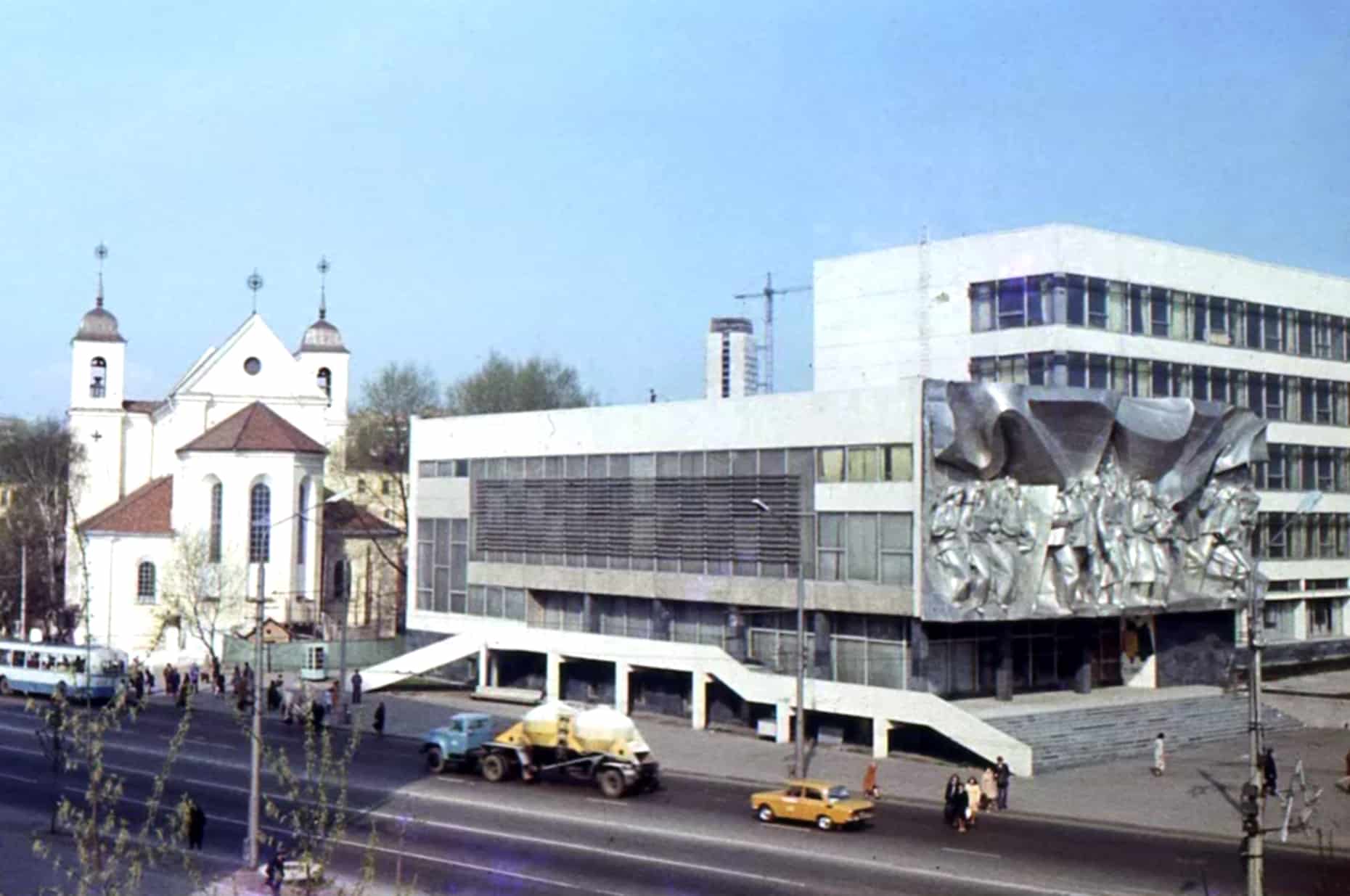
Growing up in Minsk in the 1990s, every day on my way to school I passed the state fashion design institute, the “House of Models,” a building famous for the monumental artwork covering the façade. Sculpted by Anatoliy Artsimovich in 1979, an imposing metal relief depicted nineteen people marching solemnly shoulder to shoulder — soldiers, miners, factory workers, a woman with a baby, a young pioneer — some with a raised fist or gun, others with a hand on their heart, their faces sharing an expression of fierce resolve. Above their heads, in bold, angular letters, floated a title: Solidarity.
My generation grew up thinking of the old slogans as empty signifiers.
Solidarity, of course, was the rallying cry of the global proletariat — “Workers of the world, unite!” — and a recurring theme in Soviet art. 1 Yet for my generation, the word held little meaning. The years after Belarus declared independence were full of hardship. Transitional steps toward decentralizing power and privatizing state assets led to inflation and unemployment, and the abstract promises of democracy lost their appeal in the light of everyday needs. In 1994, a wave of nostalgia carried the former Soviet bureaucrat Alexander Lukashenko to the presidency, in the first free and open election in the history of Belarus. There has not been another one since.
We watched capitalism burrow into the communist shell — KFC beneath the Solidarity monument.
Whatever meaning solidarity held for older generations was antiquated. For the next three decades, Lukashenko’s regime devoted itself to preserving and polishing symbols of the Soviet past, which are inscribed today throughout Minsk, in streets and squares named after the heroes of the October Revolution, in monuments celebrating the Great Patriotic War, and in institutions like the state security agency, the KGB, which only in Belarus still bears its Soviet name. 2 As the gap widened between an idealized past and the harsh realities of everyday life, a whole generation — mine — grew up thinking of the old slogans as empty signifiers.


We watched capitalism burrow into the communist shell, creating a monstrous chimera. Kentucky Fried Chicken moved in beneath Solidarity, occupying the ground floor of the fashion institute. At the national scale, Lukashenko maneuvered between Russia and the European Union, securing direct and indirect subsidies from both sides, and paying for the social system with rents from Russian oil and gas. 3 All the while, the quality of life was being eroded by stagnant incomes and pensions and the outflow of skilled labor. Corrupt elites manipulated the law for their own gain. 4 At the age of 20, I left home to study architecture in Vienna. I was not the first in my social circle to leave the country, nor the last. I returned home twice a year to visit family and friends, only to find each time that someone else had emigrated.
Oligarchs built their own ‘Capital Palace’ on the square, formalizing the elite capture of the state in architectural terms.
In 2019, I brought a group of architecture students to Minsk to conceive an alternate design for a new development in one of the city’s most important public spaces. Located along Independence Avenue, the five-hectare site once known as Central Square was the subject of intense public debate — with at least 20 different architectural proposals — from 1944 to 1984, when it was renamed October Square. Today it is surrounded by symbols of state power, including the Palace of the Republic, completed in Lukashenko’s first term after construction stalled during the collapse of the Soviet Union. As such, it is often a target for people vying to control those symbols.
The square was the site of large opposition protests in 2006, when Lukashenko was elected to a third term, and in 2010, when he was elected to a fourth (while several other candidates were arrested and one beaten unconscious and hospitalized). In 2017, the Serbian oligarchs known as the Brothers Karić built their own “BK Capital Palace” here, decorated with the family’s coat of arms, under a presidential decree that allowed them to bypass regulations, formalizing the elite capture of the state in architectural terms.
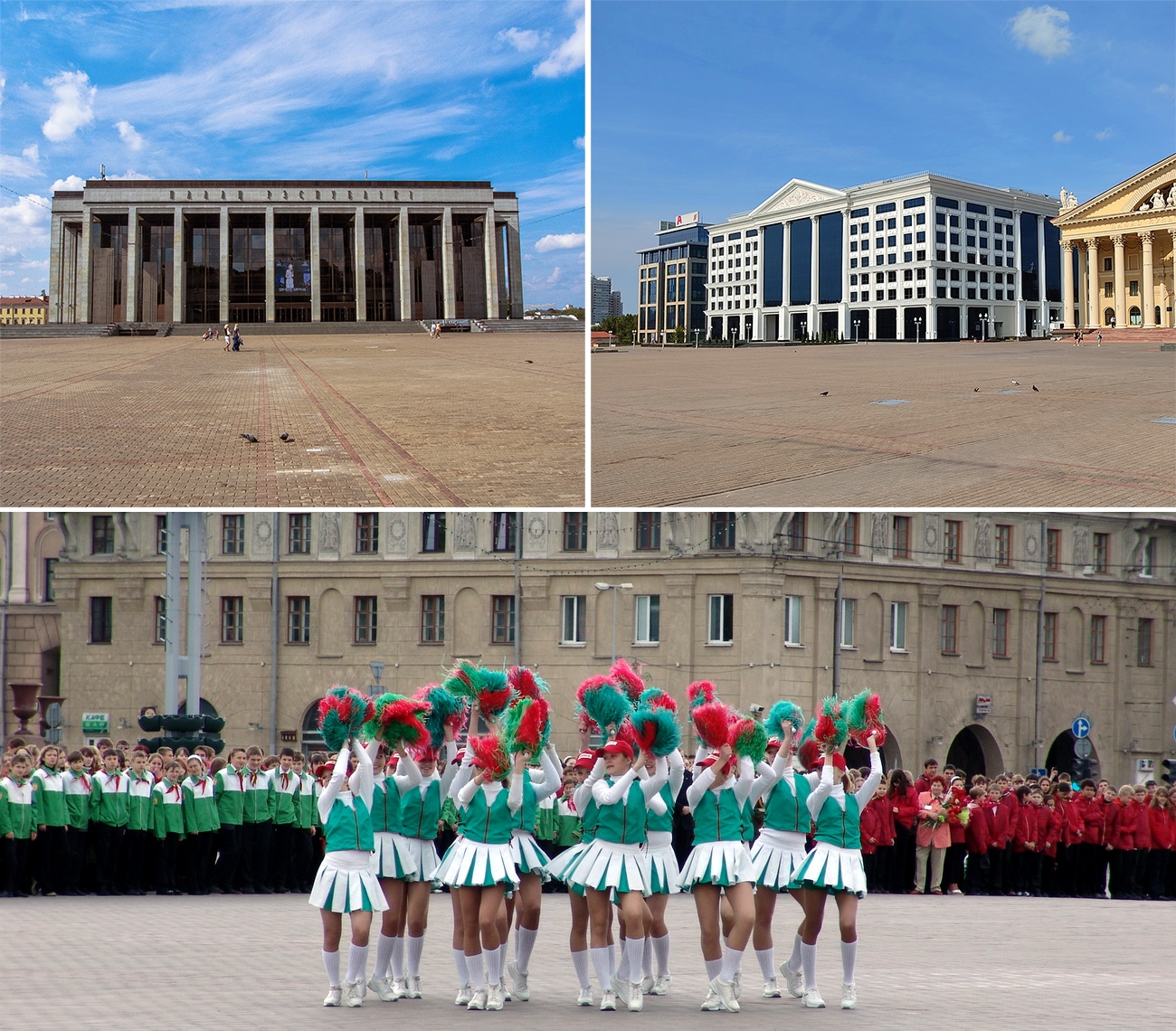
“This city is fantastic!” one of my German students declared. “Why did you ever leave?” With its political stability, relative prosperity, municipally approved street art, and well-dressed youth, Minsk must have seemed a cleaner, more orderly version of Berlin. But I saw a Potemkin village, dusted with a sugar coating that concealed an oppressive reality. I remembered a billboard slogan popular among the opposition: “This stability feels like death.” 5
For Lukashenko, solidarity meant that people should collectively defy a viral pandemic by ignoring it.
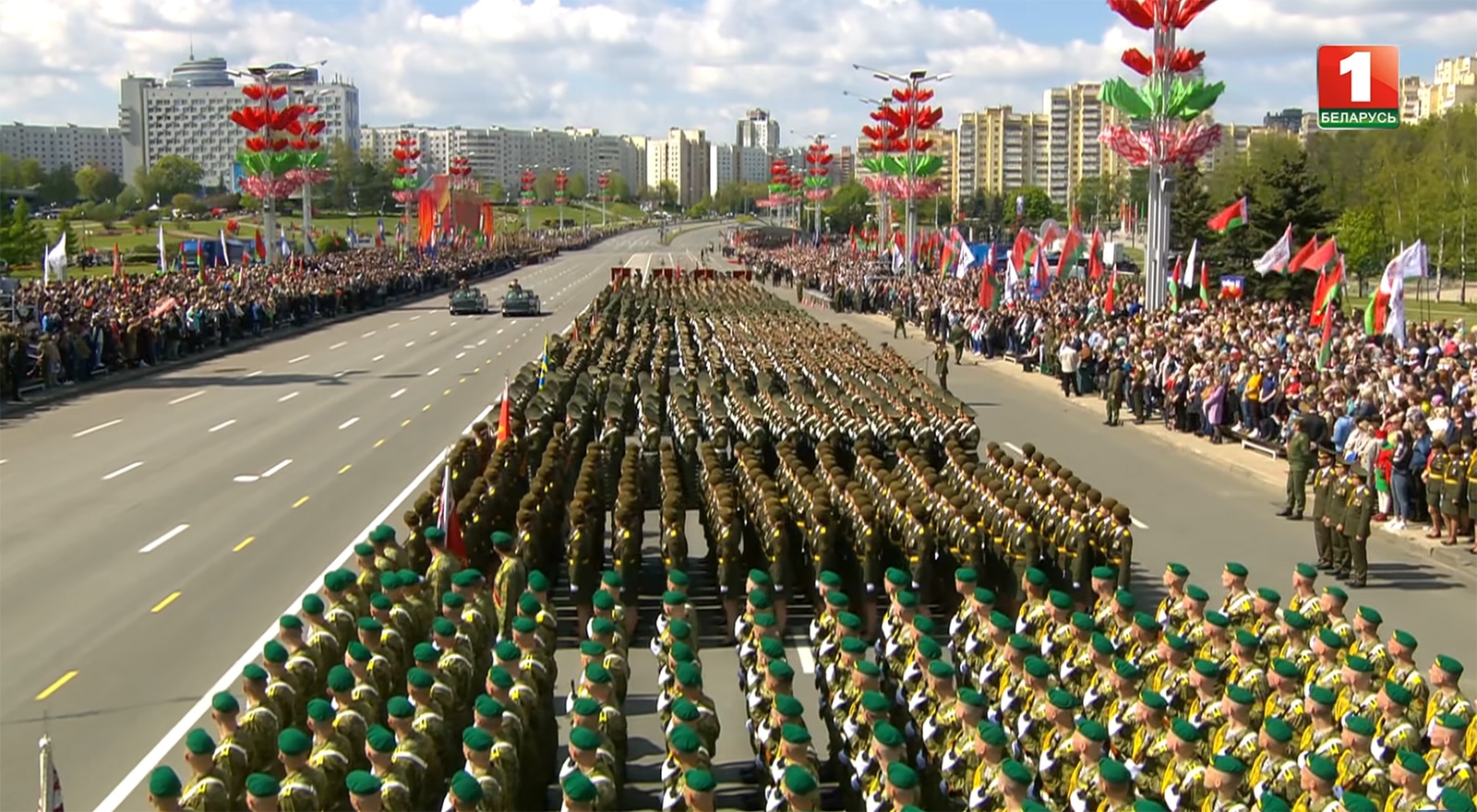
Belarus was then at the peak of its openness toward the world. Tourists from 76 countries, including most of Western Europe, could stay without a visa for up to 30 days. 6 But when Covid hit, the border-crossings slowed. As other European countries locked down, Lukashenko dismissed concerns, suggesting that Belarusians drink vodka and visit a banya to stay healthy. 7 Refusing to accept any restrictions on public life, he threatened to “deal with” the media if they spread panic and caused “psychosis” among citizens. For him, solidarity meant that people should collectively defy a viral pandemic by ignoring it. On April 25, 2020, more than two million people participated in Subbotnik, a national day of service, without masks or distancing. Then, on May 9, Belarus was the only post-Soviet state that did not cancel public celebrations honoring the victory in World War II. 8
Yet the changes sweeping the globe were a threat to Lukashenko’s hold on power. As Covid raged, the country prepared for elections. A record 55 candidates declared their candidacy for president, including three serious challengers: video blogger Sergey Tikhanovskiy, politician Valeriy Tsepkalo, and banker Viktor Babarika. But it did not take Lukashenko and his allies long to clear the field. Tikhanovskiy was arrested in May and later sentenced to eighteen years in a maximum-security camp. Babarika was arrested in June and eventually sentenced to fourteen years. Tsepkalo fled the country in July to avoid a similar fate. 9
As Covid raged, mutual aid groups were practicing small, daily acts of solidarity, defined in opposition to the state.
Meanwhile, people continued to die from Covid. (The government stopped reporting official births and deaths, but excess mortality was later shown to be about 30,000 in 2020.) 10 News spread of overcrowded hospitals lacking basic protective equipment, and people could feel the impact of the pandemic in their daily lives. Realizing that the state would do nothing in the face of disaster compelled some people to take matters into their own hands. Mutual aid initiatives mobilized small donors to crowdfund healthcare. 11 Outwardly, these groups were politically neutral. They had to be, or they would get shut down by the government. Yet their members were practicing small, daily acts of solidarity, defined in opposition to the state. Organizers were teaching skills and strategies that would prove essential to a political movement gathering strength on the horizon.
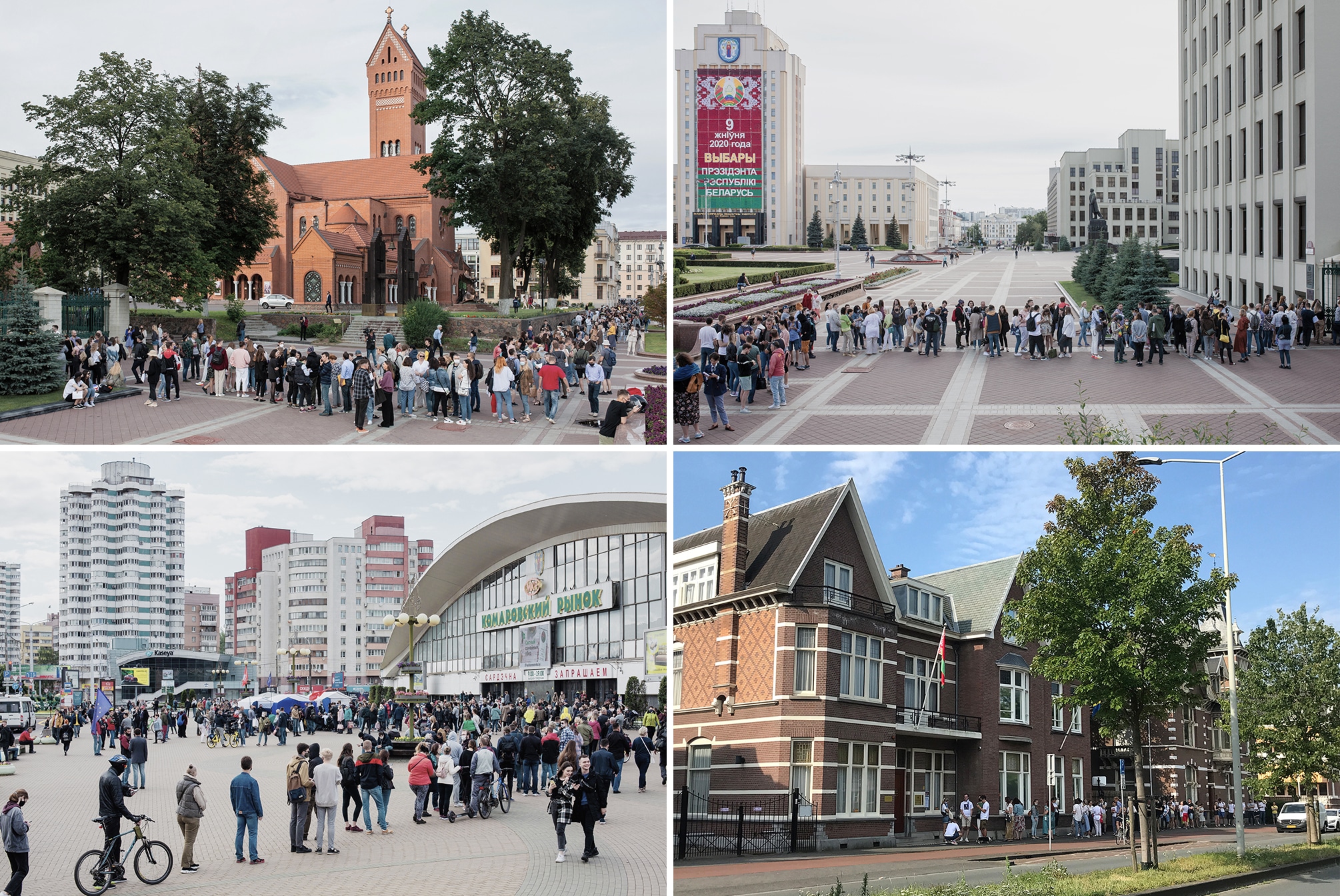
On Sunday, August 9, 2020, I awoke before dawn to drive four hours to the polling station nearest my home, the Belarusian embassy in The Hague, Netherlands. Like many in my generation, I considered elections without any real choice to be a waste of time. I’d never even cast a ballot. But this year, the opposition had a chance.
Belarus was on the front page of global newspapers. Was the ‘last dictatorship in Europe’ about to fall?
When I arrived, there was a line of people outside the embassy, amid rumors that Lukashenko had ordered polls to open slowly to suppress the vote. The atmosphere was festive, as young people wearing white and red came from across the Netherlands and Northwest Germany to vote for Svetlana Tikhanovskaya, the wife of the arrested blogger, who had emerged as the consensus candidate of the united opposition. 12 Belarus was on the front page of global newspapers. Was the “last dictatorship in Europe” about to fall?
That night, the mood shifted. I sat on the balcony of my apartment, refreshing the websites of the few independent news outlets in Belarus. An exit poll on state television said Tikhanovskaya had won less than ten percent of the vote. But the independent election monitor Golos noted many violations of protocol, reporting that Tikhanovskaya had won the majority vote at some precincts where state media had declared victory for Lukashenko. Crowds poured onto the streets of Minsk to refute the obvious fraud.
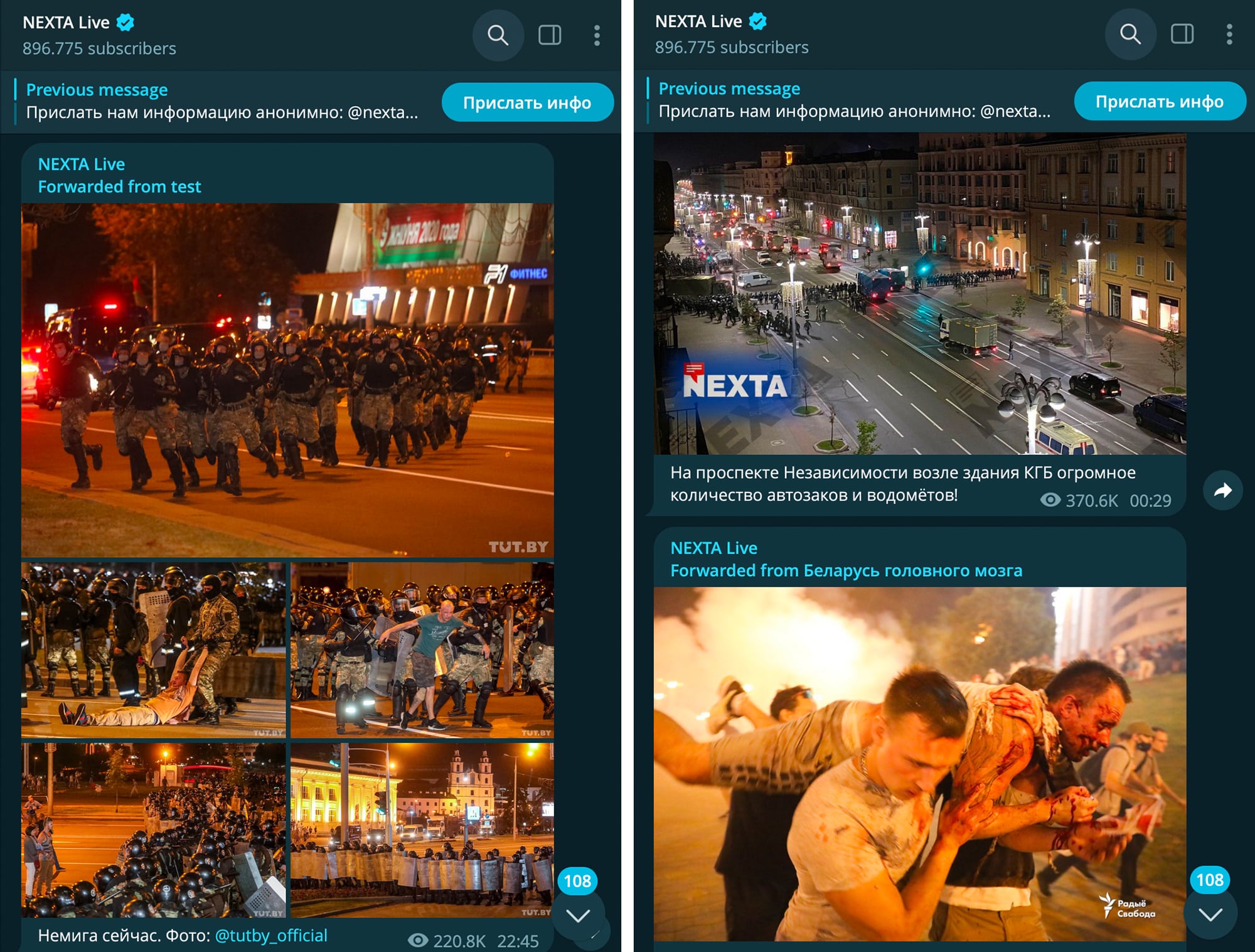
From 1,700 kilometers away, I watched riot police and soldiers turn their weapons on protestors: batons, tear gas, water cannons, flash grenades. Somebody posted a video of police dragging an unconscious body across the asphalt, near the Solidarity KFC. Was the man dead? I called a friend and heard explosions in the background. There was an internet blackout in Belarus, and people in the streets had no mobile service, so in some ways my view of events was wider than theirs, though I was missing context, too. The UN Human Rights Commission would later document beatings, torture, and rape, 13 but in the moment there was just a flood of unmoderated, unverified images that spread online, mostly through the Telegram channels used by activists. 14
From 1,700 kilometers away, I watched riot police and soldiers turn their weapons on protestors.
In the weeks to come, this uprising would be compared to the “color revolutions” in other post-Soviet states, and especially to the 2014 Ukrainian Maidan. But the people in those countries were fighting for European integration. The Belarusian movement was simply against Lukashenko. The once-diffuse opposition had united around a single goal, unshaped by any liberal, nationalist, feminist or other agenda — just a desire to take down an unpopular regime. 15
“We have to change everything first,” one protester told me. “And then we will figure it out.” 16
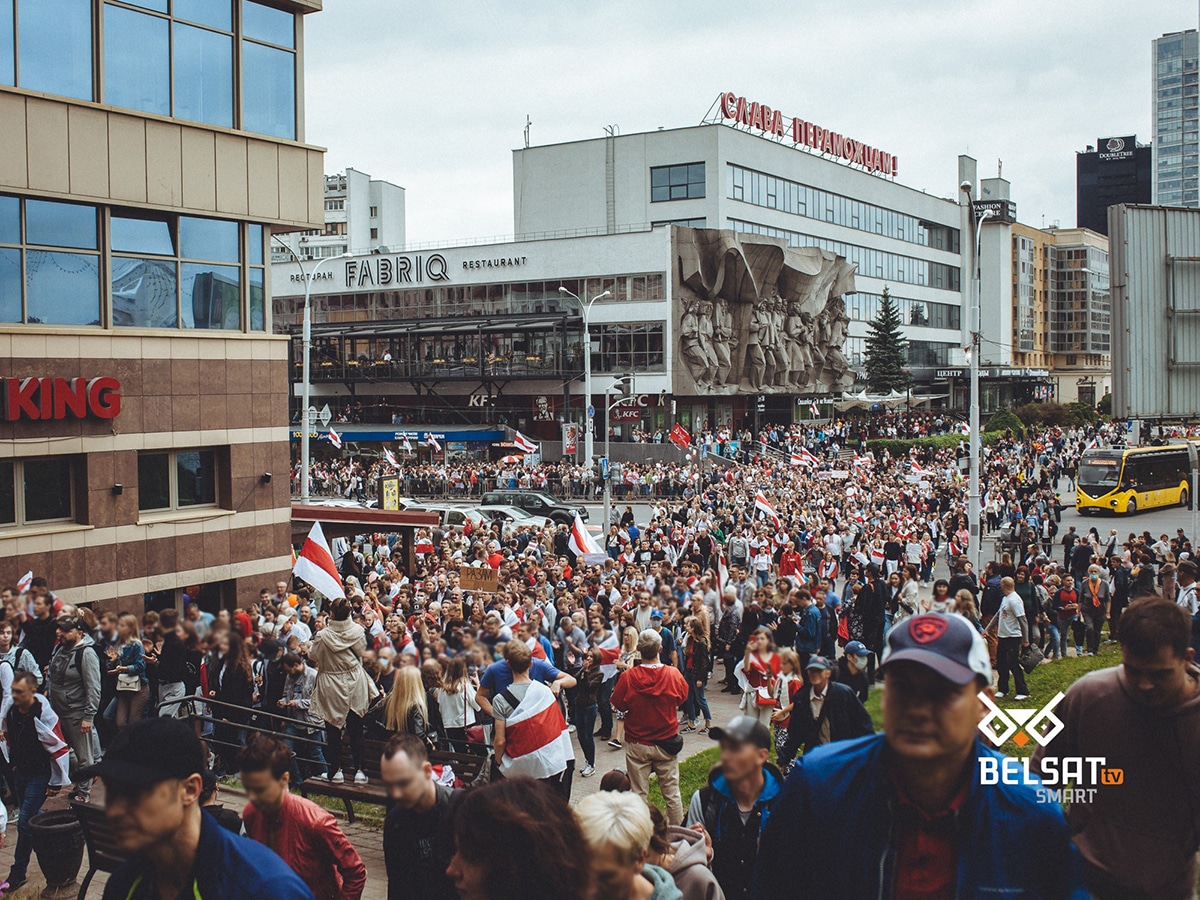
On the morning of August 11, the country awoke to news of the first death. An unarmed protestor, Aleksandr Taraykovskiy, had been shot by police. His death was captured on camera, a fact that authorities found impossible to conceal, although they could try to rewrite the circumstances.
The state newspaper SB–Belarus Segodnya issued this callous report:
On Monday, a man died in Minsk. He lost his life due to his own stupidity, having assembled on his knee an explosive device that killed him. He likely found the instructions online, as websites and Telegram channels with recipes for explosive and incendiary mixtures targeting Belarusian users had appeared before the elections. This individual evidently attempted to follow the dangerous advice, with fatal results. The consequences are apparent on his face. If there is anything left of his face. 17
The cynical lie only intensified protesters’ outrage, and a spontaneous memorial arose near the site of the shooting. Every day people brought flowers and candles, and every day authorities removed them. Somebody painted Ne zabudem (“We will not forget”) in large white letters on the pavement. City workers tried to cover the message with sand, but protestors swept the sand away. Then the authorities swabbed gray paint over the graffiti, and protestors painted red letters on top. This went back and forth for nearly a month, in a symbolic struggle that echoed the challenge of living under Lukashenko’s government, constantly fighting for narratives that define what is perceived as real.
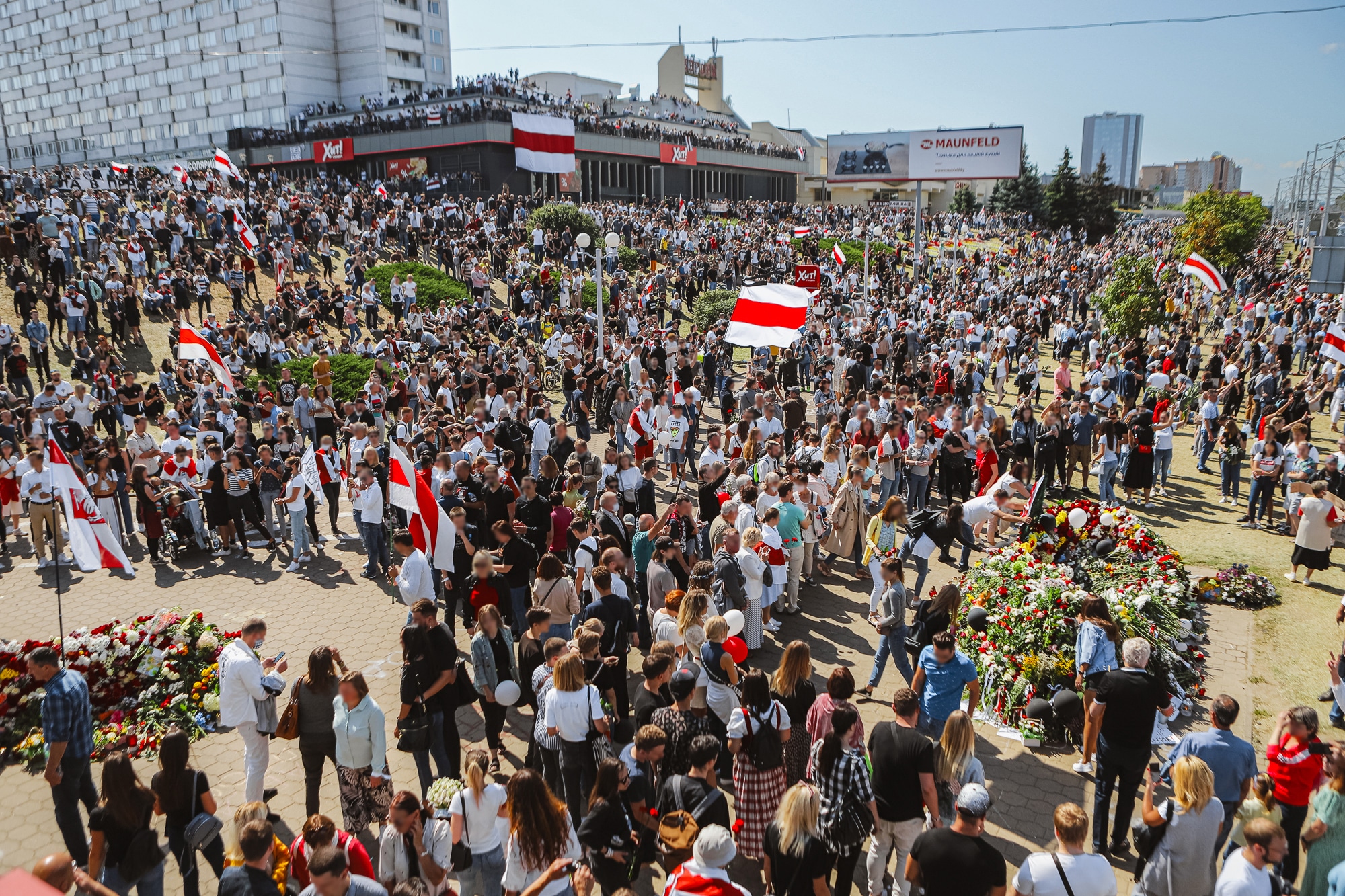
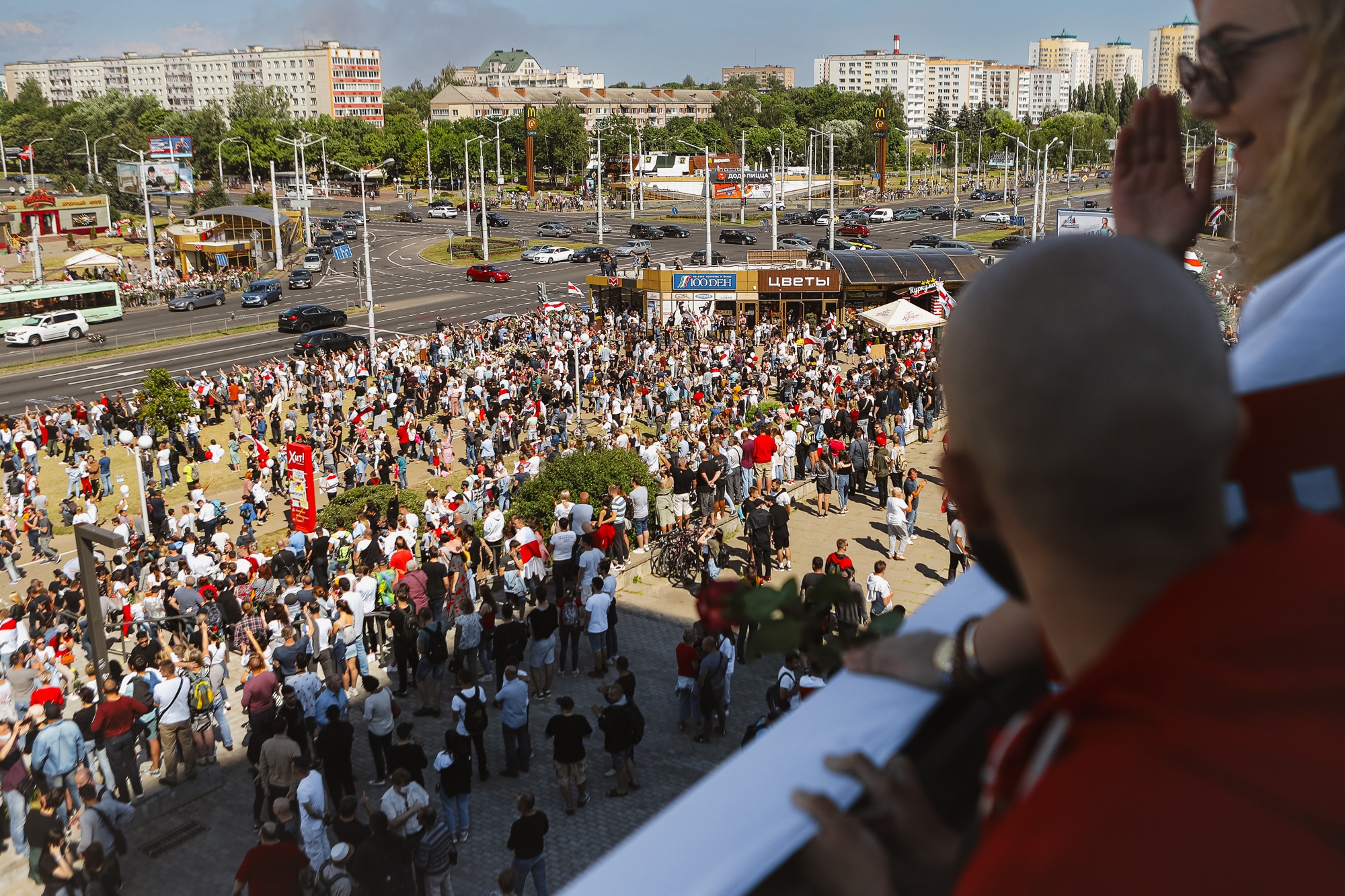
Noting that Taraykovskiy was a former criminal, police declared his death an accident; they said he had been shot with a non-lethal weapon after making aggressive threats. 18 But the People’s Tribunal, an activist group led by former government officials, collected photos and videos disproving those claims. According to their reconstruction of events, Taraykovskiy had his hands raised and posed no danger when he was shot from a distance of eleven meters by an anti-terrorist officer who fired a Saiga-12K semi-automatic shotgun at his heart. 19
City workers tried to cover the message with sand, but protestors swept the sand away.
Like other protesters, the people who created that memorial paid a serious price. In December, five individuals accused of writing Ne zabudem on the pavement were sentenced to two years of restricted freedom or penal colony time. Others, who had merely laid flowers at the memorial, faced large fines and ultimately left the country to avoid prosecution. People who donated money to Taraykovskiy’s family and other solidarity funds were questioned by the KGB and had to pay penalties disguised as “donations” to state institutions. 20
One year later, I found myself sitting on a park bench at the corner of Pushkinskaya and Pritytskogo streets. I had returned to Belarus to study housing developments proposed by the construction company of the Brothers Karić. One of my sources, a realtor, had suggested we meet here, at the intersection of two wide, eight-lane streets surrounded by prefabricated apartment complexes and greenery — a typical Minsk scene. We talked for two hours about the housing market, and then, near the end of our conversation, he turned to me: “Do you know what this place is?”
Near the end of our conversation, he turned to me: ‘Do you know what this place is?’
I pretended not to understand, feigning an expression of polite curiosity. I wasn’t comfortable talking politics with somebody I had just met, somebody whose business had ties to the government. But I understood him clearly: This was where Aleksandr Taraykovskiy was murdered, and where his memorial had been created and defended. The realtor recounted the story of the Belarusian protests, apparently assuming I would have missed them while living abroad. I was surprised by how openly he talked to me, a stranger with a microphone, when people were being harassed and threatened for saying less. At the time, it struck me as naïve, but I now see it as a gesture of solidarity.
Through the upheavals of 2020, people learned and rehearsed new ways of creating connection, signaling values, and showing up for one another. Solidarity was not just about marching for political or economic rights. The word was redefined by people who donated protective equipment for hospital workers, by volunteers who gathered signatures for presidential candidates and handed out water bottles at rallies, by officials who refused to sign falsified election records. By the medics who provided first aid to the injured and strangers who opened their doors to protestors fleeing the police. By state journalists and military officers who resigned and people in the diaspora who raised funds and pushed for international response.
At the time, it struck me as naïve, but I now see it as a gesture of solidarity.
Yet solidarity exists on the other side, too. It was also the force that inspired police to retaliate against detainees for injuries suffered by their comrades. It was the social motivation for neighbors to call in their suspicions and denunciations to the KGB. 21 It led local officials to burn ballots to cover up election fraud, and it persuaded a 22-year-old state prosecutor to push for the conviction of people who maintained Taraykovskiy’s memorial. 22 Such actions are often attributed to fear or personal gain, but that is too simple. Solidarity is a complex, ambiguous, multivalent force that can arise from the social bonds in any community.
Sometimes these multiple solidarities become inseparably knotted, as they did in Minsk, at the corner of Pushkinskaya and Pritytskogo.
I met another man, Stepan, who was arrested nearby on the night after Aleksandr Taraykovskiy was killed. An IT developer who lived off Pushkinskaya, Stepan was a careful person who never had any intention of breaking the law. 23 On the evening after the election, he walked home from the city center because authorities had shut down transit service. He told me he passed countless people marching in the opposite direction, on their way to the protests. Although he didn’t dare join them, he did take photos. When soldiers later checked his phone, they found the images and arrested him.
“They detained everyone they could catch,” he said. “From what I saw, they detained a lot of people who were not involved in anything. Someone was coming back from work; someone else was just hanging out in their courtyard. [The soldiers] didn’t make much of a distinction. People were indignant that they were detained, and for every word they said, they were beaten with a baton.”
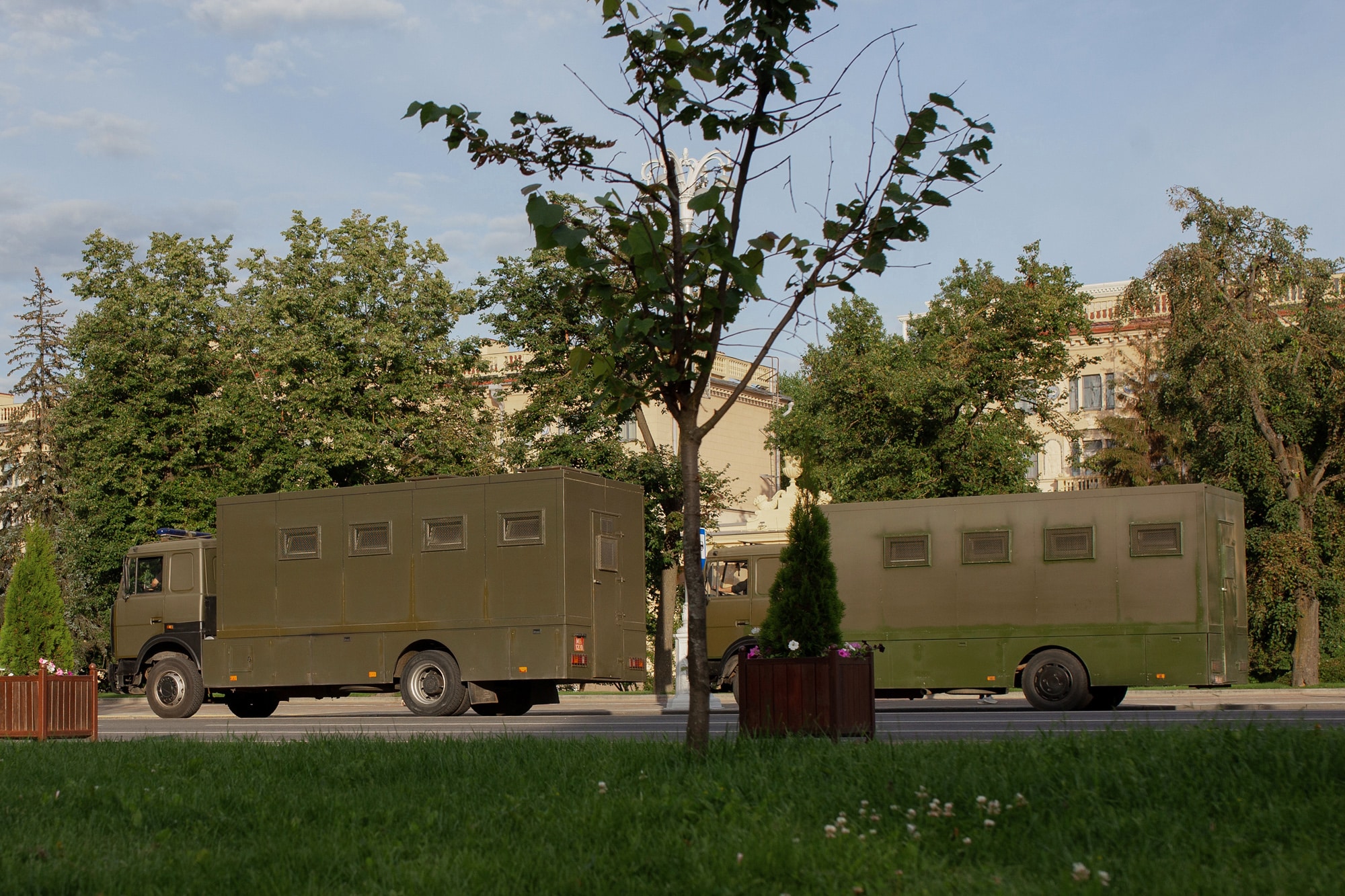
Stepan was rounded up with others and shoved into a truck. He pleaded not to be beaten. “They warned me, ‘Sit there quietly, don’t talk, that’s our advice to you.’ … So I sat there, and they didn’t bother me much. They hit me once with a baton when disembarking, that’s it. But I was instructed how to behave; the others were not.”
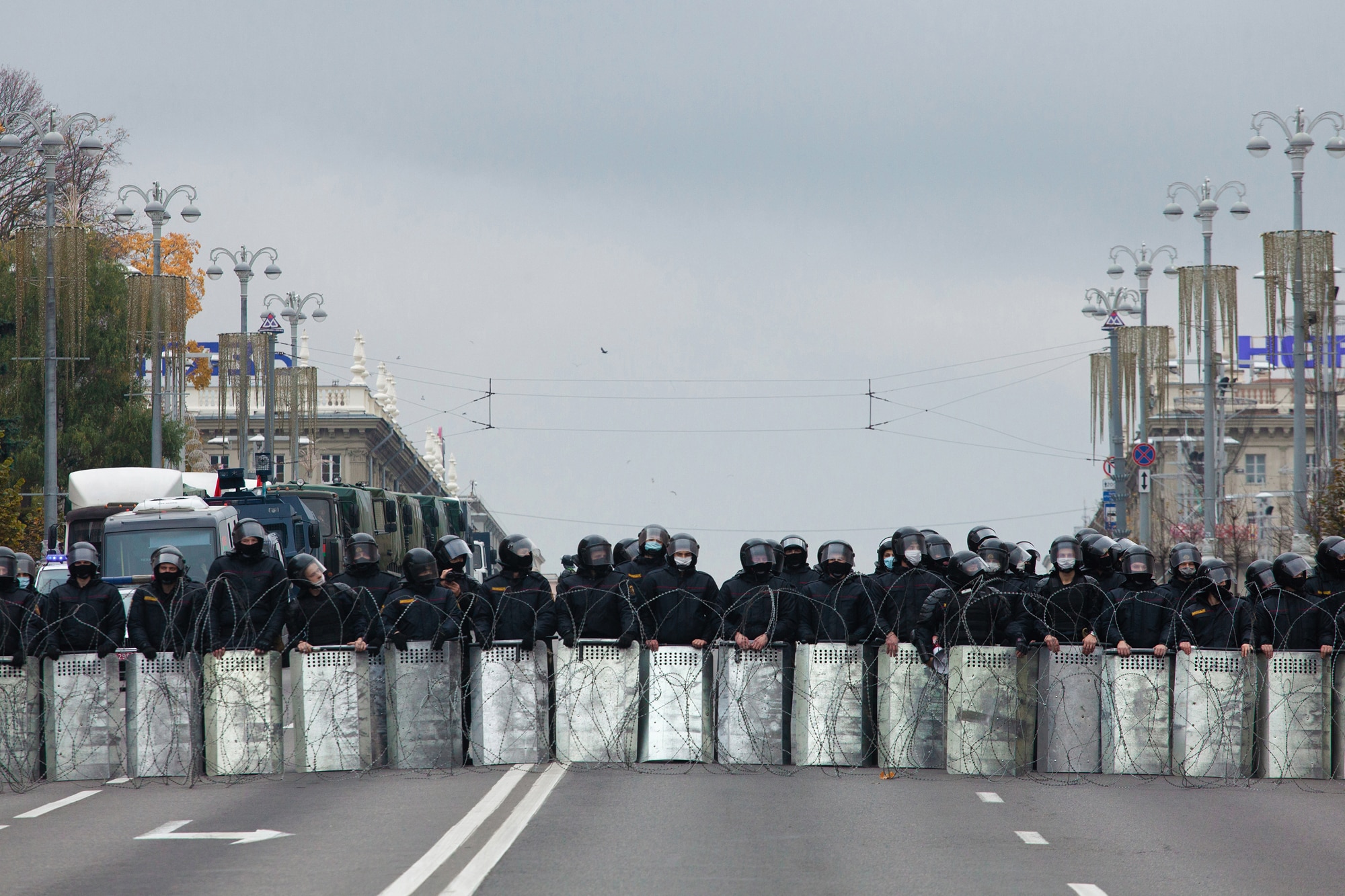
From here, his story unfolded the way many encounters with the state do — going from bad to worse to surreal. “At the end, when they had already packed the whole truck, I was at the bottom. It’s hard for me to estimate how full it was because you couldn’t look around. If you tried, you got beaten. Everyone was told to get on the floor. I had some guy lying on top of me, and I felt like he was almost unconscious. I could just feel his blood dripping down from above over my body.”
Stepan’s story unfolded the way many encounters with the state do — going from bad to worse to surreal.
Stepan told me he was dropped off at a district office for internal affairs, in the south of the city, where he stood in the courtyard all night. The ambulance medics were livid when they saw the injuries. Near dawn, a riot police unit arrived, and an officer taunted the detainees. “So, did you have fun tonight? And tomorrow will be even more fun! You fuckers broke our guys. Take away their water, let them die of thirst.” At that moment, Stepan understood how out of touch the police were. This officer was blaming them all for something they were not responsible for. After fourteen hours, Stepan was released. When he got home, he proposed to his girlfriend.
He told me that night opened his eyes to the dysfunction of the legal system. People were detained without scrutiny, and their lives were ruined regardless of their actions. He became more sympathetic to the protestors, but still he did not wish to join them. To the contrary, he was more afraid, since a repeat offense would mean harsher sanctions. The aim of brutality was to instill fear, and in Stepan’s case it worked.
As he shared this story, Stepan recalled how angry he had been after his release. He was angry at people who doubted the righteousness of the protests; angry at people who gave advice about self-protection yet had never been on the receiving end of a police baton; angry at a journalist who had exaggerated his story — “as if,” Stepan said, “it was not bad enough already.” Most of all, he was angry at the messaging platform where protests were organized. “Telegram is the greatest setup,” he said. “Users expect that when they delete a post, it is permanently removed, but it is not.”
Today he lives in Poland, but he wants to return home. To protect himself, he has deleted all evidence of the protests.
Stepan was especially concerned about the misuse of Telegram bots. In 2020, hundreds of thousands of people followed the activist bot Peramoga (Victory) to track the opposition’s plans and join the protests. 24 Many unfollowed the bot when it was added to the governmental registry of “extremist” organizations, but they must have stayed on a list, because four years later they got unsolicited messages from an opposition politician, Aleksandr Azarov, who used the bot to support his run for office. At least two people received criminal charges for messages they did not even know they had on their phones. 25 Other bots were used in phishing schemes. Stepan said he thought opposition leaders should have done more to warn users about platform risks and should have encouraged them to use a separate account for protest activity. He now sees these leaders as irresponsible and untrustworthy.
When Russia invaded Ukraine in 2022, some tech firms offered to relocate employees from Belarus, to circumvent sanctions banning their work on European and American projects. Stepan accepted. Today he lives in Poland, but he wants to return home. To protect himself, he has deleted all evidence of the protests. When I contacted him on Telegram for an interview, he replied, “Yes, but you should never send messages like that if you are not sure that the people are outside of Belarus.”
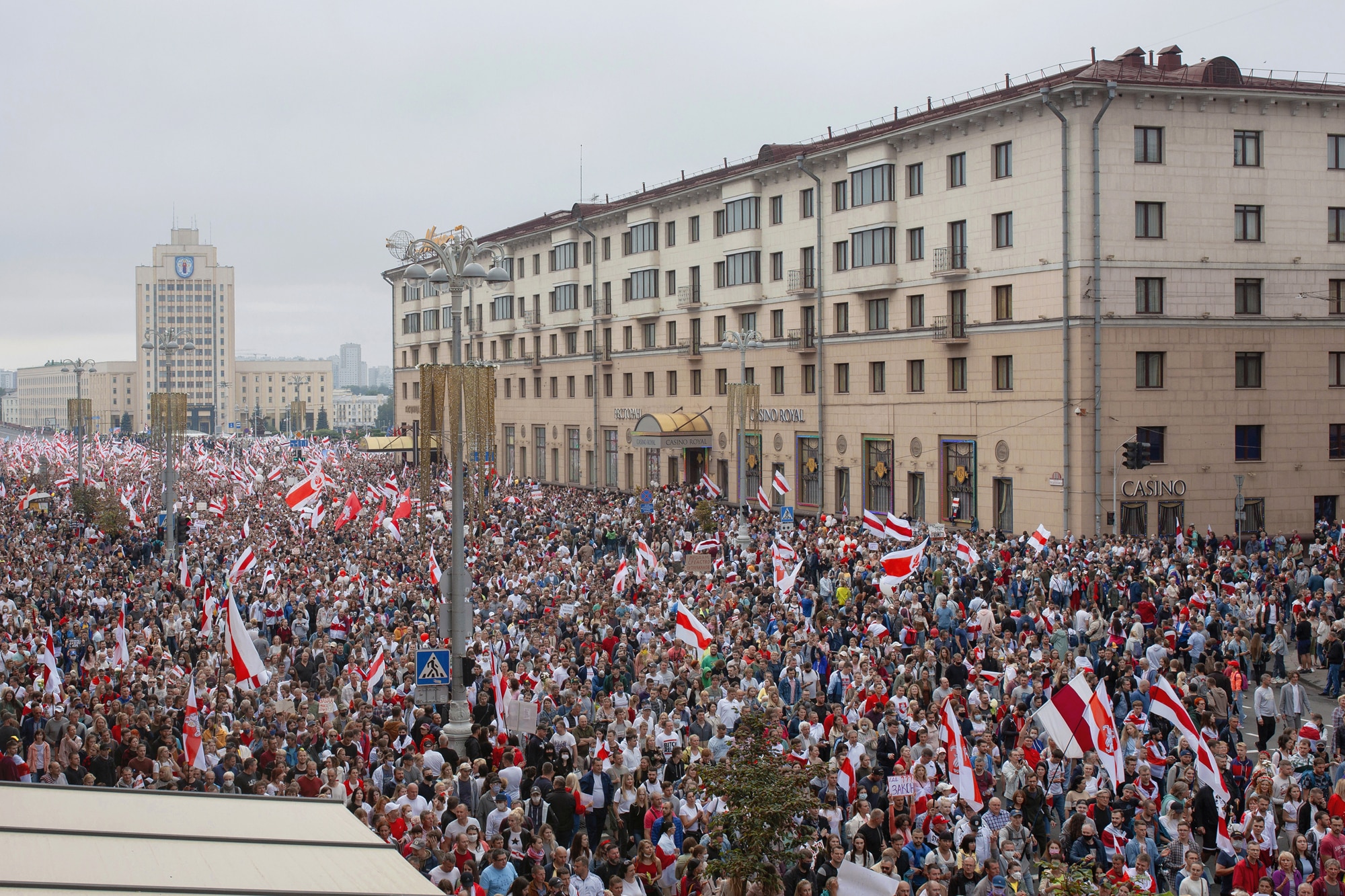
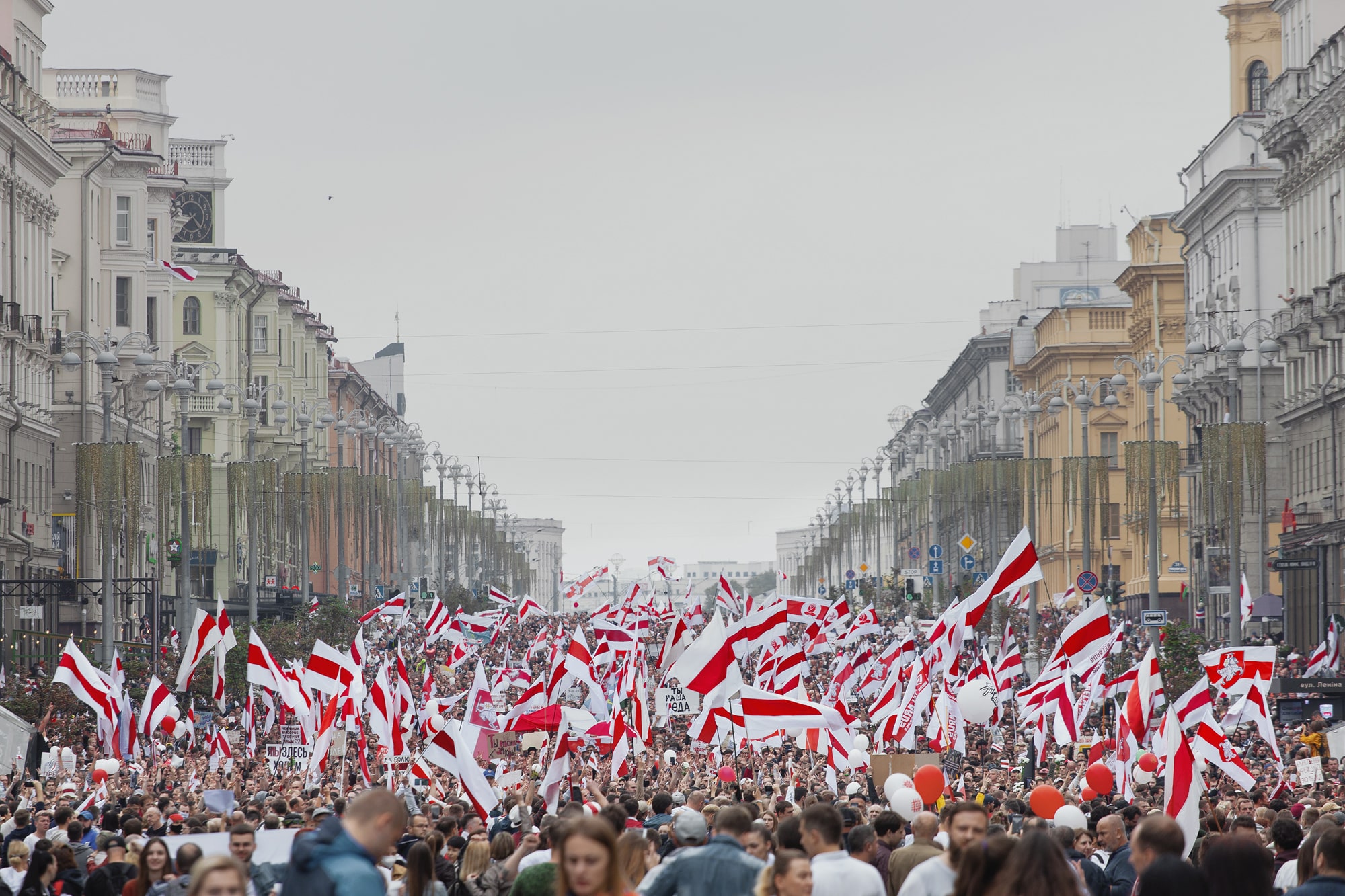
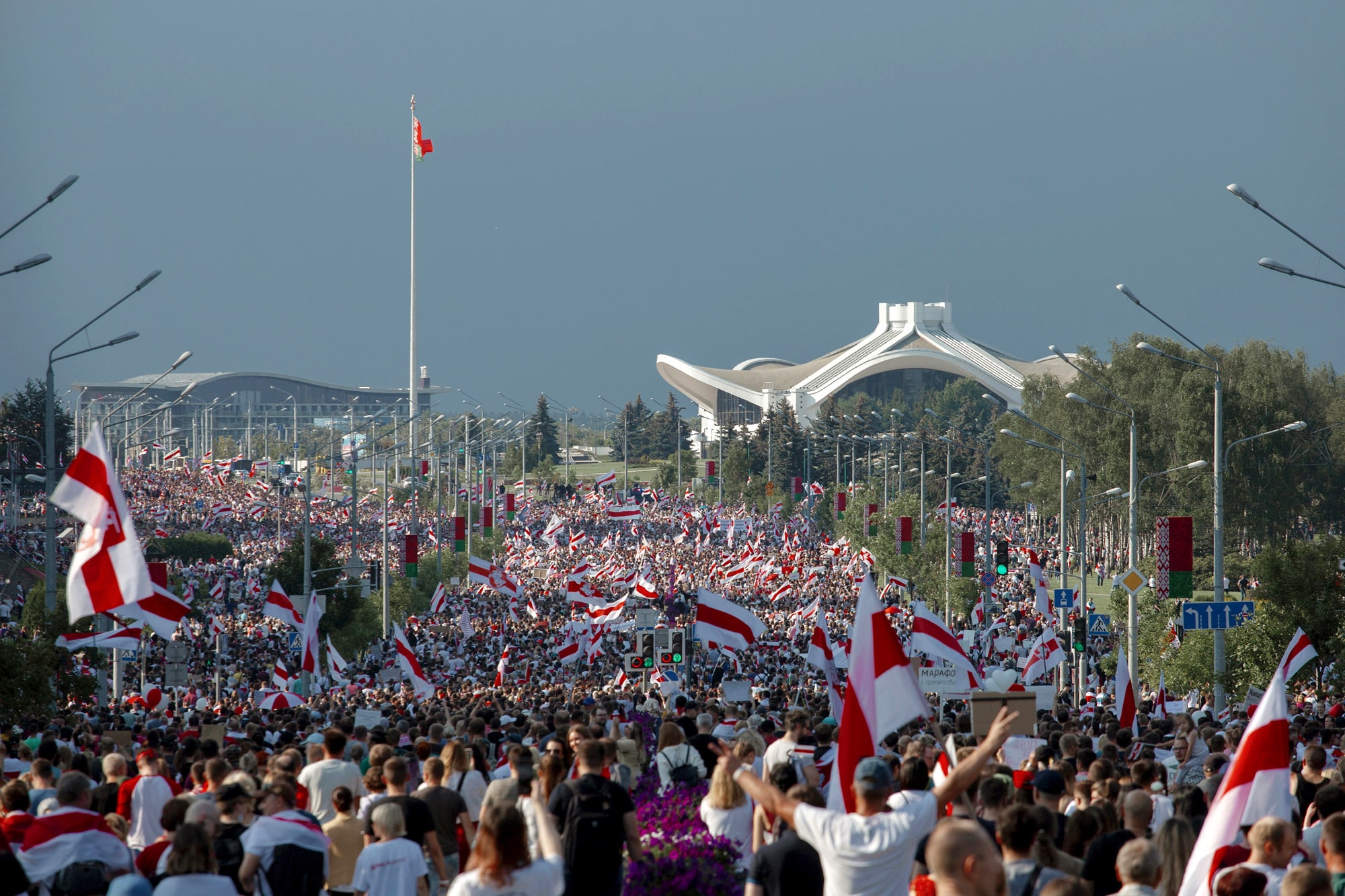
The fear and mistrust in Stepan’s story is real. But many protesters remember the summer of 2020 as a prazdnik — a feast or holiday. After the initial shock of brutal repressions, a wave of solidarity swept across the land. On August 16, the first Sunday after elections, Belarus witnessed the largest protest in its history, with at least 200,000 people joining marches in more than 80 cities and towns. 26
Lukashenko asked his assembled audience if they wanted freedom or change. The crowd shouted back, ‘No!’
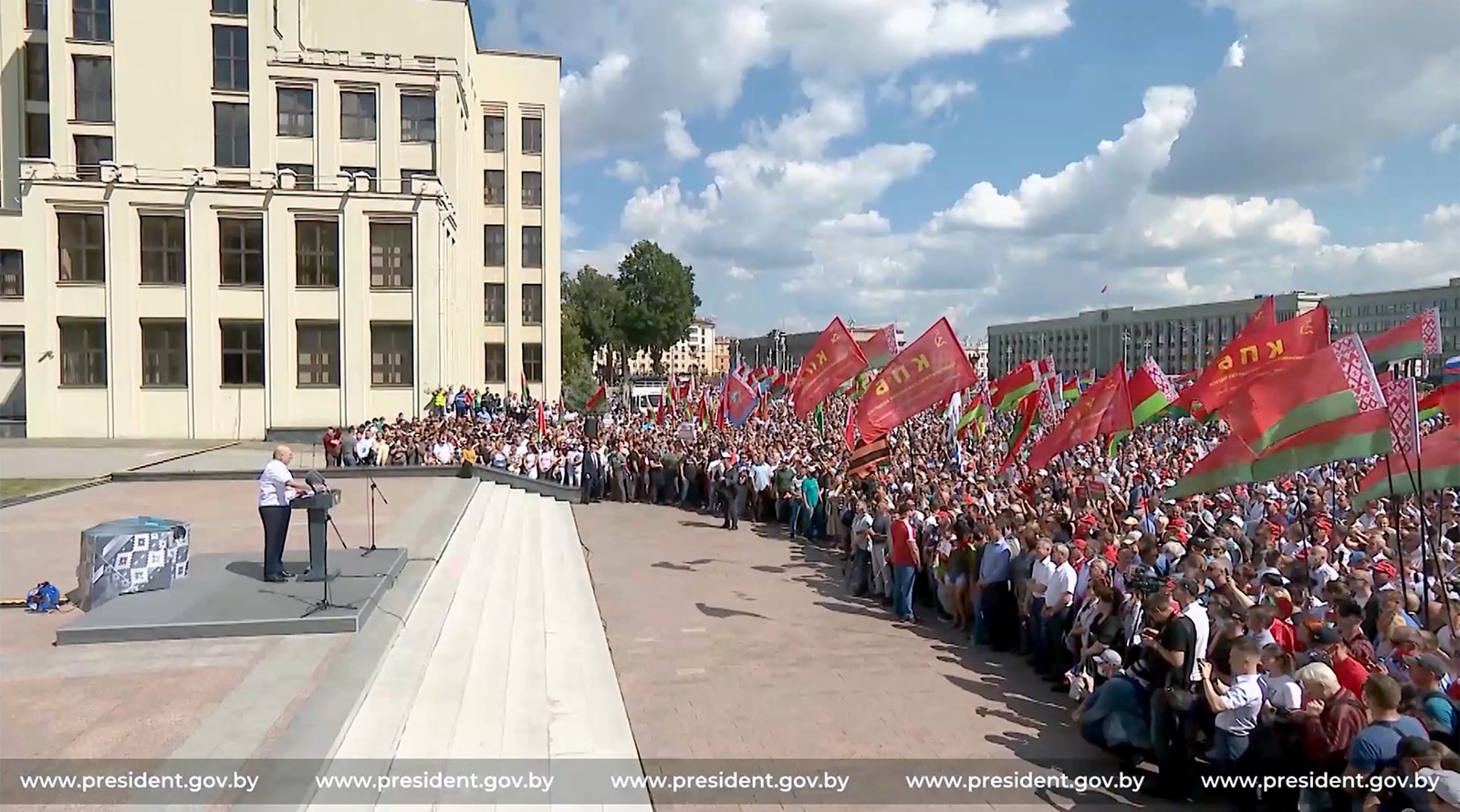
Authorities held a counterprotest, their own “Solidarity Rally,” in Independence Square. Standing just a few meters from a statue of Vladimir Lenin, Lukashenko addressed a crowd of perhaps 20,000 people, some recruited from state-owned enterprises, others bused in from villages outside the capital. They held premade signs with slogans like “Lukashenko — our president” and “We will not let the country be torn up,” and some people (accidentally or not) held those signs upside down. 27 Lukashenko portrayed NATO as an imminent threat and cast himself as the father of the nation, and then he started a peculiar call-and-response chant, asking his assembled audience if they wanted freedom or change. The crowd shouted back, “No!” 28
One observer described the scene as “comical.” When the rally was over, the village bureaucrats had to walk back to their buses along Nezavisimosti (Independence) Avenue. “And they are walking there like they’re running through the gauntlet,” the observer said — as if they were afraid of the protestors who filled adjacent streets, chanting about democracy. 29 When the bureaucrats were gone, activists erupted onto the avenue and the square, occupying public space near sites of state power across the city.
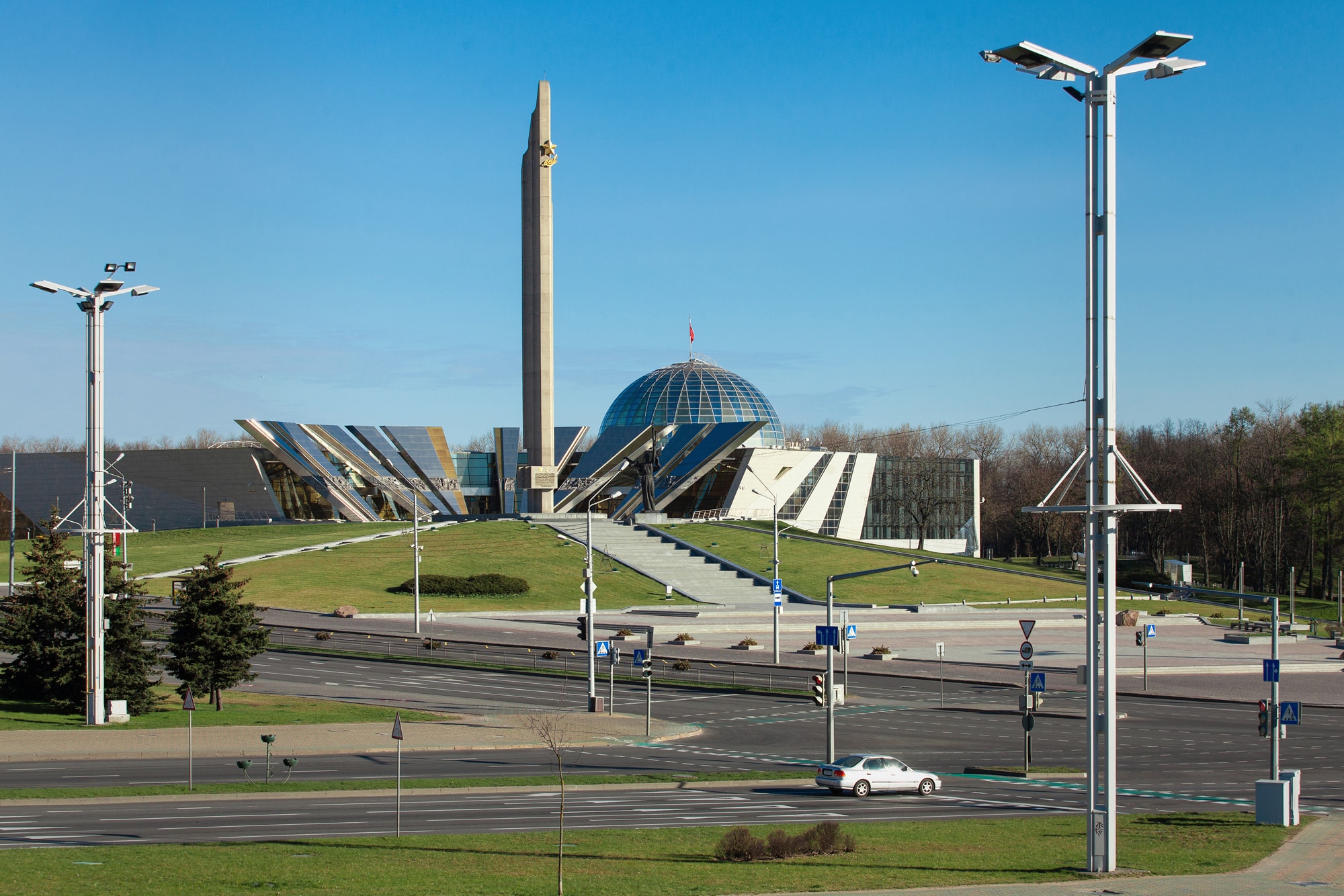
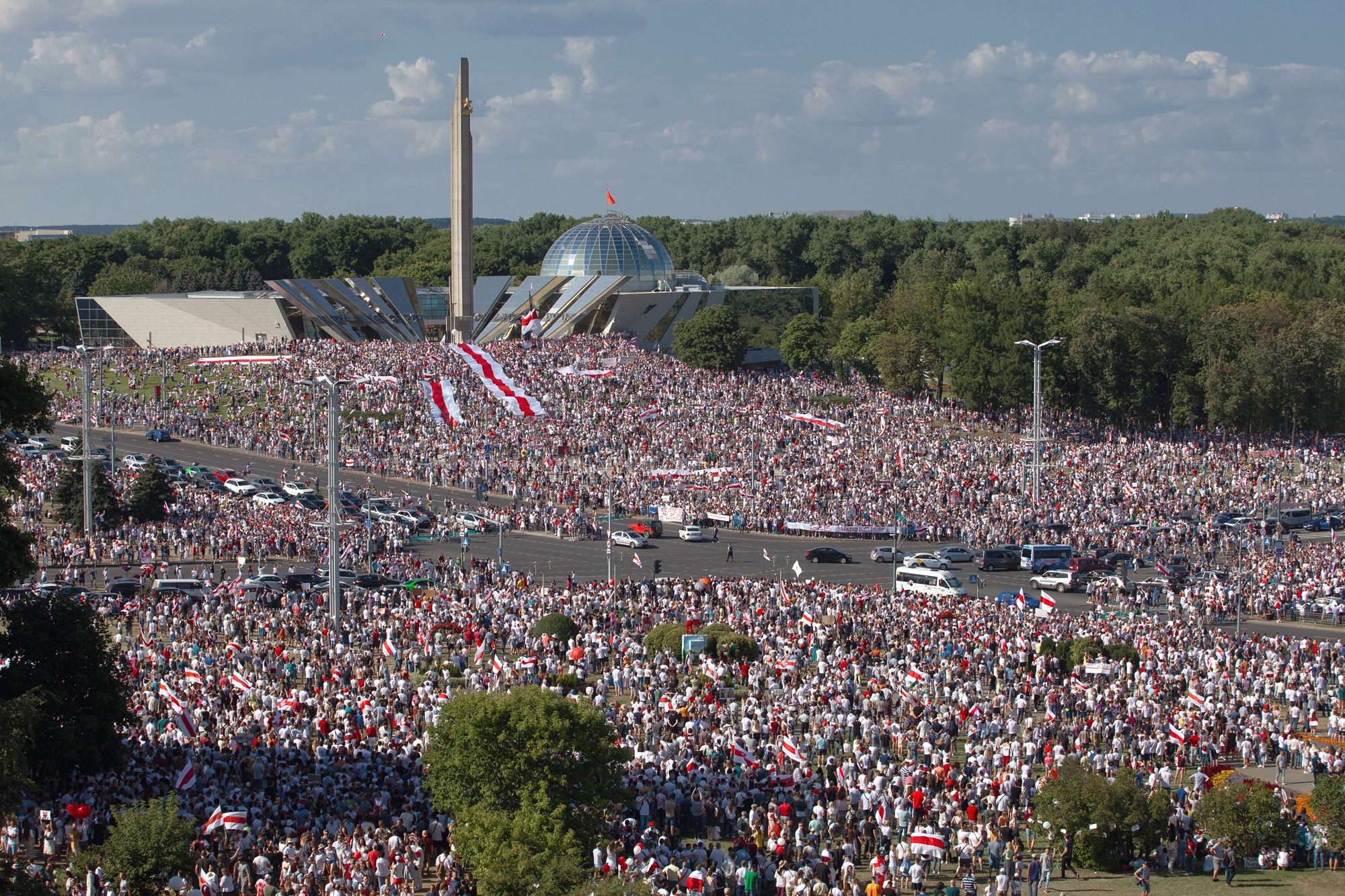
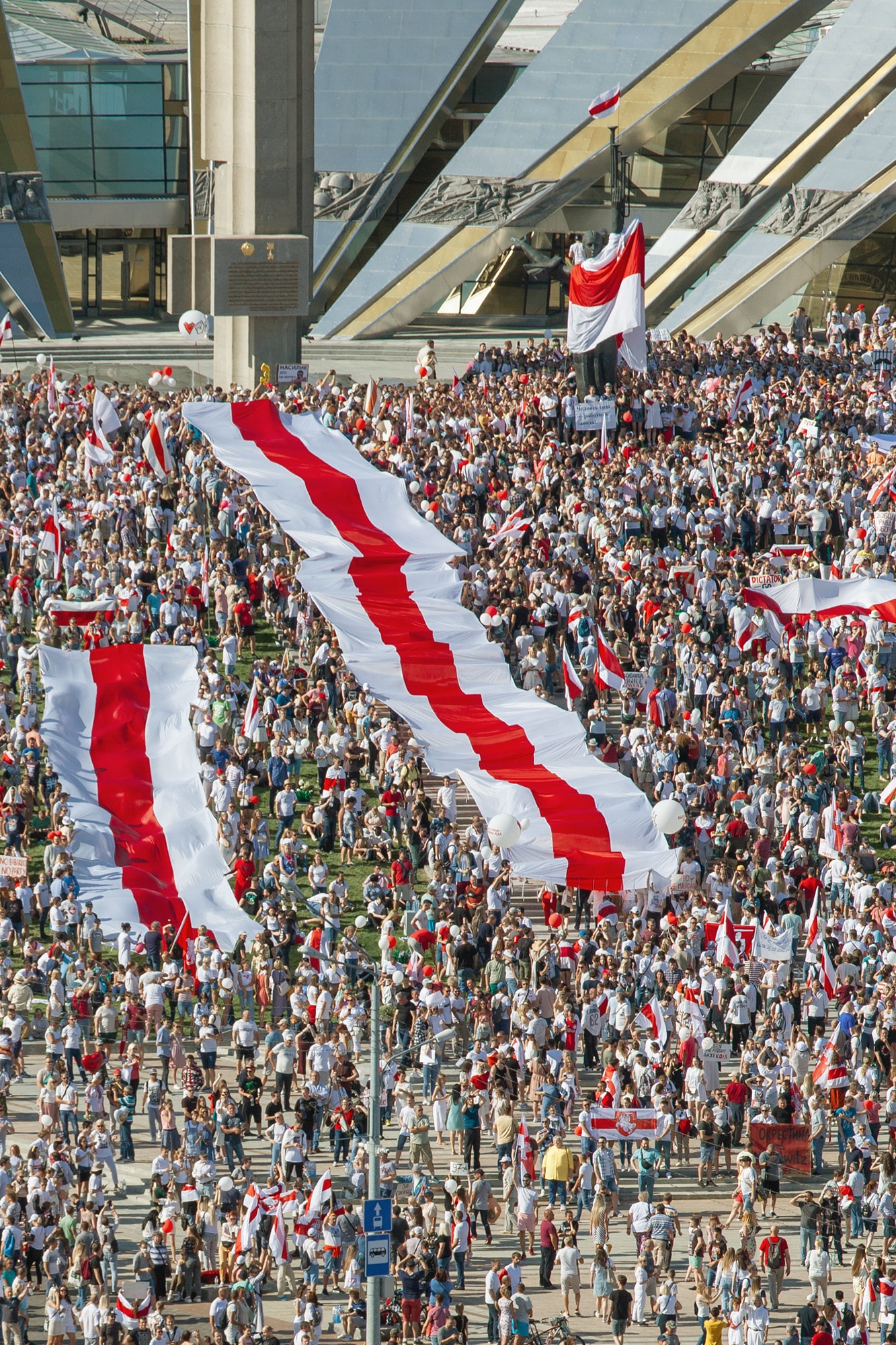
The pro-democracy “Freedom March” ended up that day at the Stella monument, officially the Minsk Hero City Obelisk, a memorial honoring the city’s underground resistance movement against the German occupation in WWII. The statue Rodina Matʹ (Mother Motherland) was draped with the white-red-white flag, a longstanding sign of opposition to Lukashenko. The symbolism here gets complicated. Mother Motherland is an icon of Soviet resistance against Germany, and yet the white-red-white flag was also used by a small group of Belarusian Nazi collaborators during the war. State media has used this fact to smear the opposition as neo-Nazis, ignoring the century-long history of the flag while focusing on a collaborationist splinter that lasted only a year. Battles over the meaning of this symbol continue. Yet, if at the beginning of 2020, these colors were associated with a fringe nationalist movement, by the end of the year, they were accepted as a symbol of civic protest attracting people with a wide spectrum of views. 30 One person I interviewed succinctly dismissed the controversy: “So what? One can do crap under any flag.”
Every Sunday people marched through the streets, reclaiming the public spaces and national symbols authorities were struggling to control.
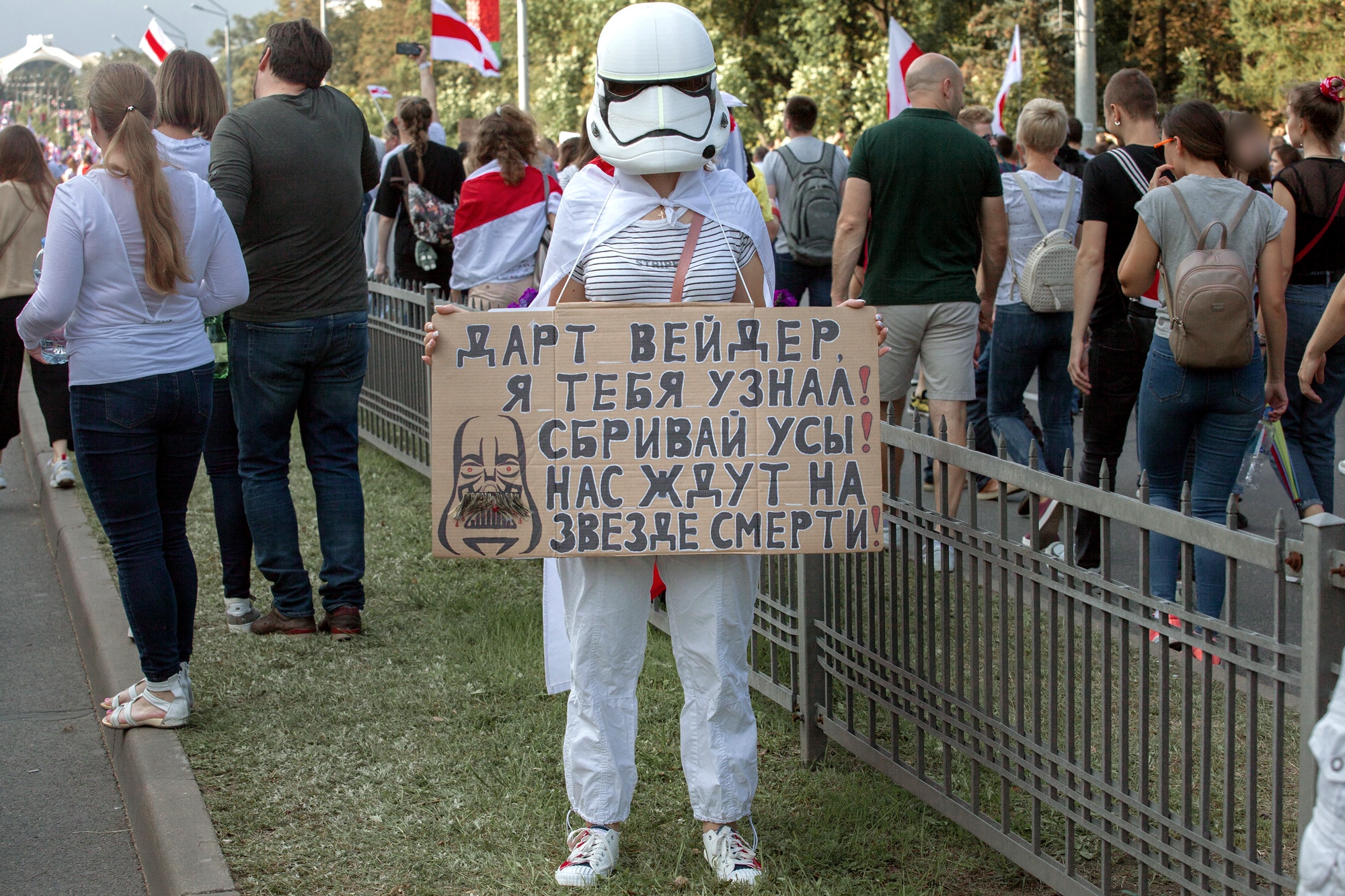
Every Sunday people marched through the streets, reclaiming the public spaces and national symbols authorities were struggling to control, conveying political demands through folk humor. Banners and slogans mocking the state and Lukashenko himself riffed on sources that ranged from the Bible, to Belarusian and Soviet classics, to Netflix series and video games. 31 Yet as summer turned to fall, the crowds dwindled. For months authorities had pushed protesters out of public spaces. So the opposition group Nexta decided to flip the script, appealing to the Soviet side of Belarusian identity: “We, the descendants of Belarusian partisans, will march peacefully along Partisan Avenue and express solidarity with the factory workers.” The October 18 march attracted only about 5,000 participants, but it was notable for how it subverted the state ideology. 32
The cult of the Great Patriotic War lies at the very heart of Belarusian identity. Some scholars, in fact, see Minsk as “nothing short of ‘a giant war memorial.’” 33 And a crucial part of the official narrative is Belarus’s self-identification as “the partisan republic.” While Minsk was indeed the center of Soviet underground resistance to the Nazis, the mythology is exaggerated in a way that is politically useful to the current regime. 34 Lukashenko’s government uses this history to legitimate its politics and disparage nationalist movements within the opposition. By conducting a “Partisan March” on Partisan Avenue and referring to the government as “fascists,” the protestors attempted to reverse and co-opt the state rhetoric.
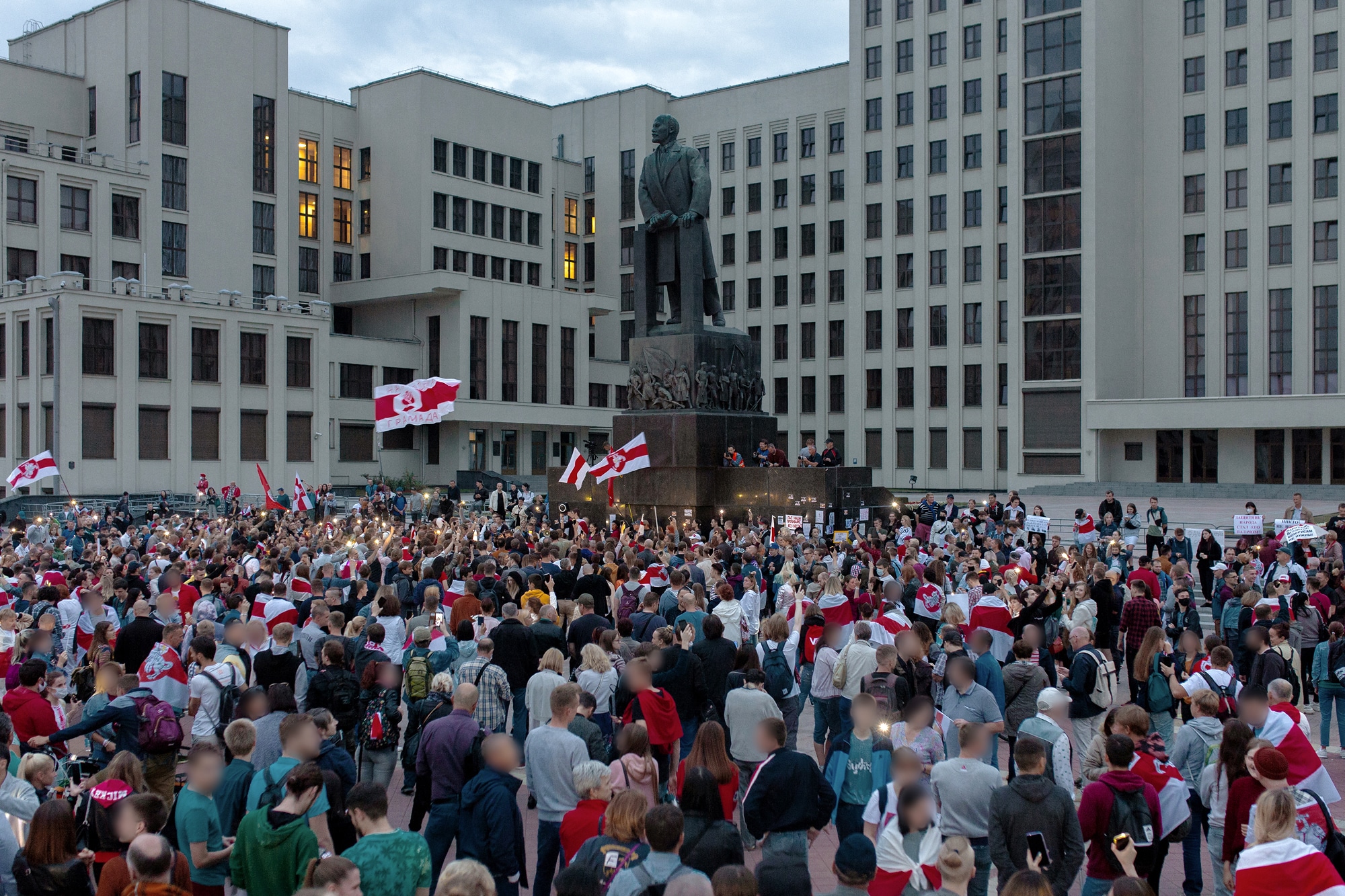
Opposition rally in front of the Council of Ministers of the Republic of Belarus, August 20, 2020. [© Yauhen Attsetski]

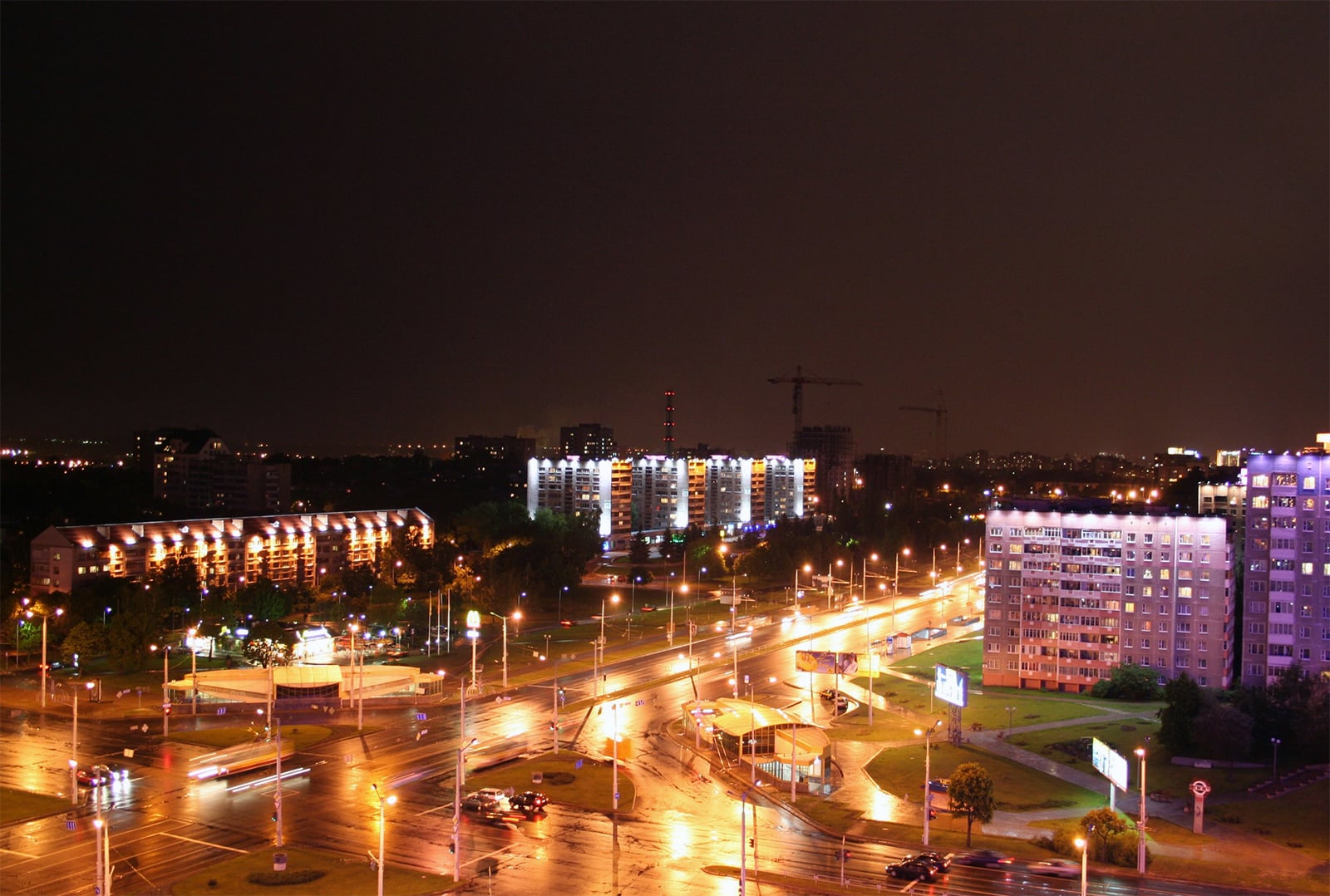
Independence Avenue, August 23, 2020. [© Yauhen Attsetski]
Independence Avenue, August 23, 2020. [© Yauhen Attsetski]
Pobediteley Avenue, August 23, 2020. [© Yauhen Attsetski]
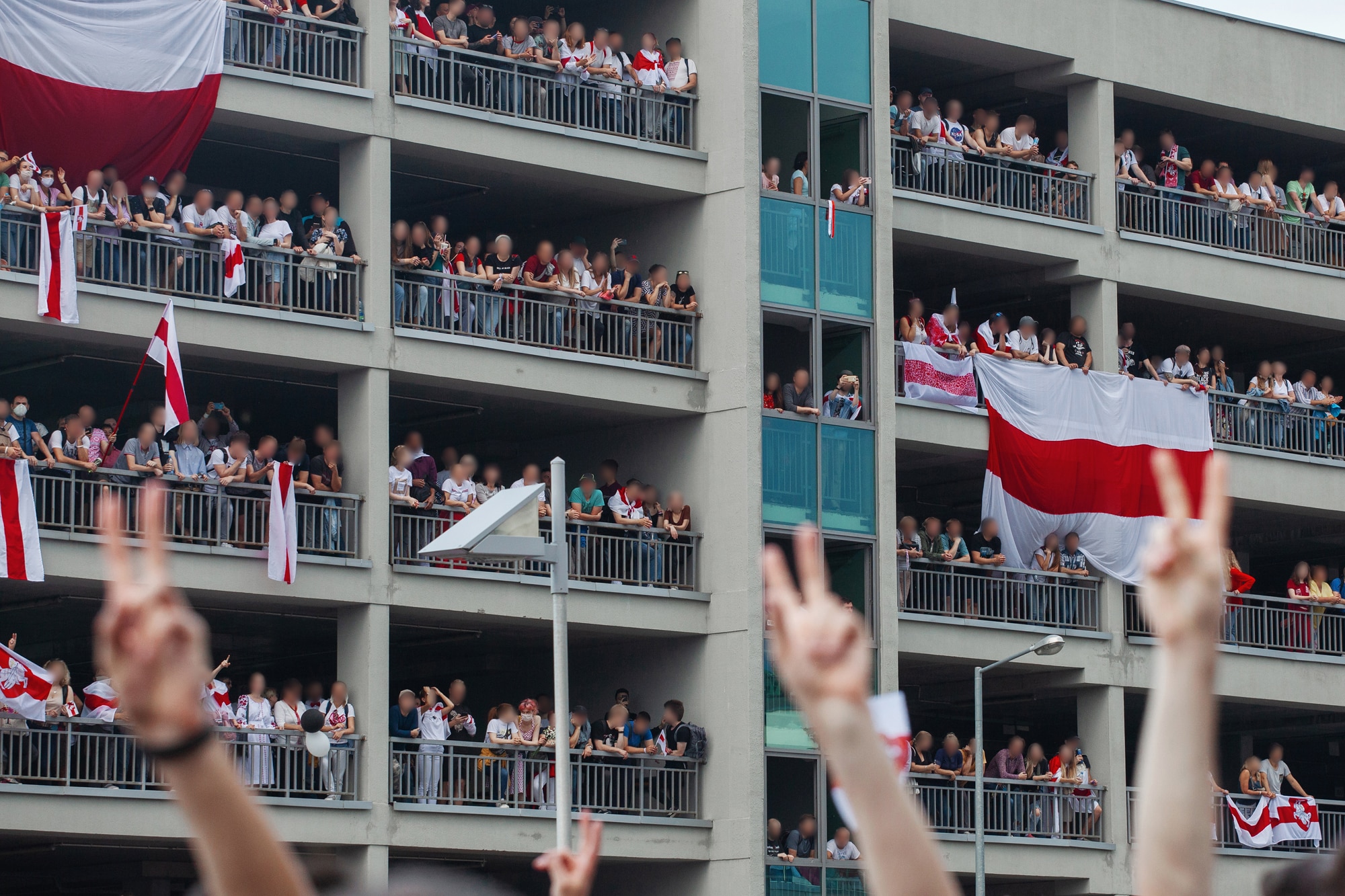
Parking garage along Pobediteley Avenue, August 30, 2020. [© Yauhen Attsetski]
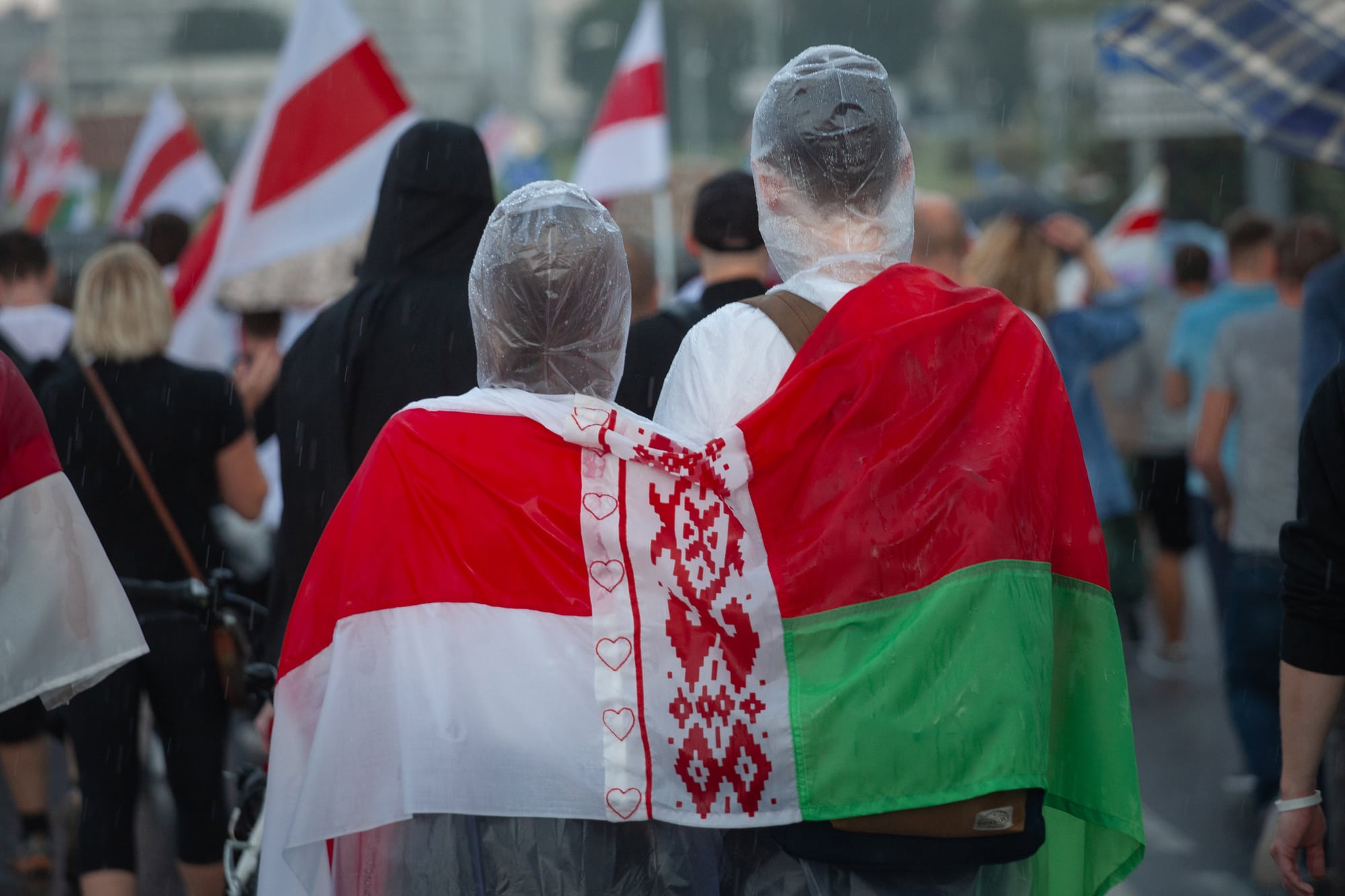
Protesters draped in a cloth combining the official state flag with the opposition colors. The red-green flag, modified from the 1951 Soviet design, was reinstated as Belarus's official flag in 1995, replacing the white-red-white flag flown after the dissolution of the Soviet Union. In the early days of the 2020 protests, the two flags were often displayed together, symbolizing unity and the broad political spectrum of the opposition. [© Yauhen Attsetski]
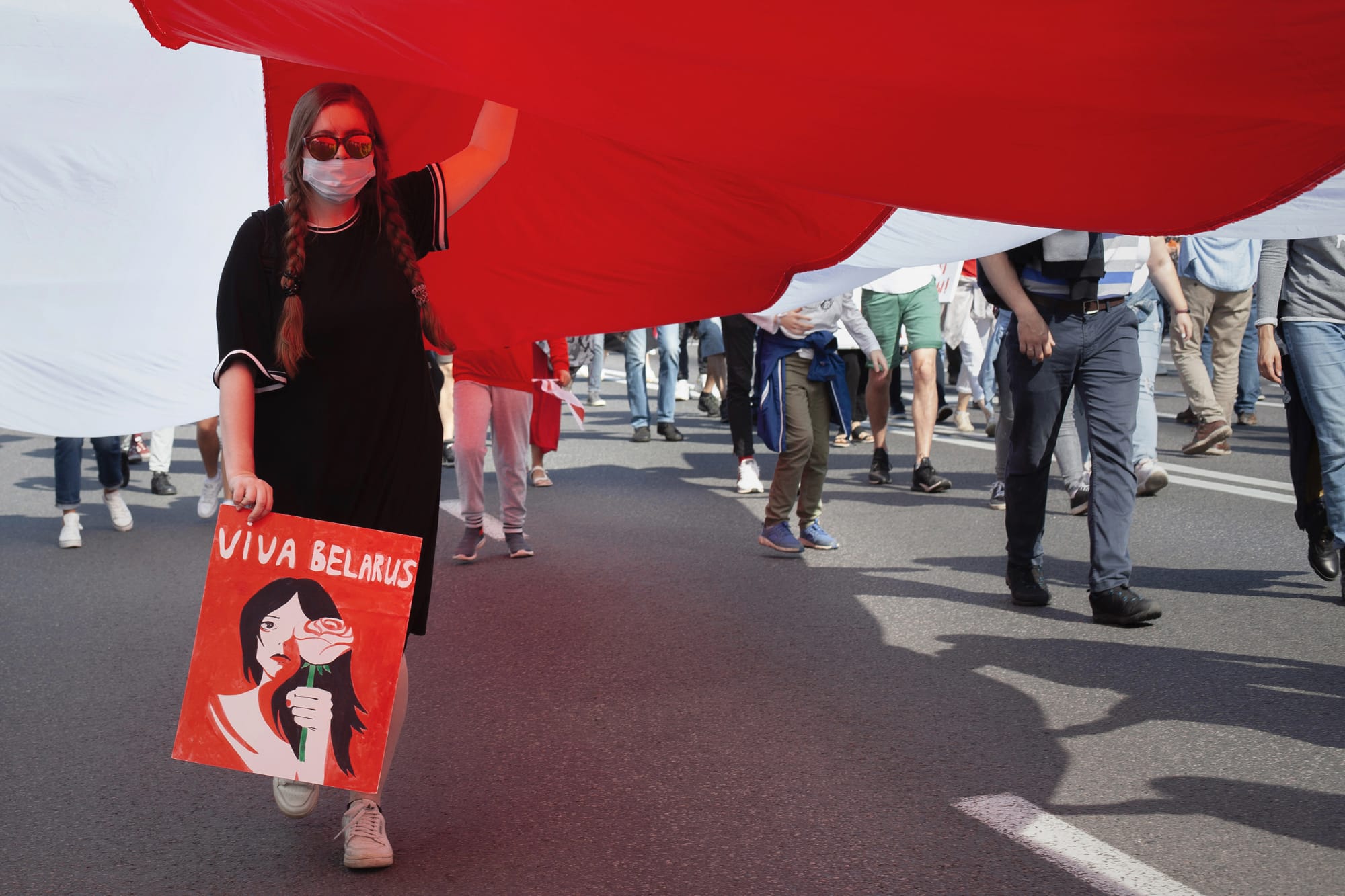
A protestor with a sign that translates the opposition slogan Zhyve Belarus! for an international audience. Both the slogan and the white-red-white flag were used by Belarusian Nazi collaborators during WWII and, prior to 2020, associated mainly with right-wing nationalist segments of the opposition. [© Yauhen Attsetski]
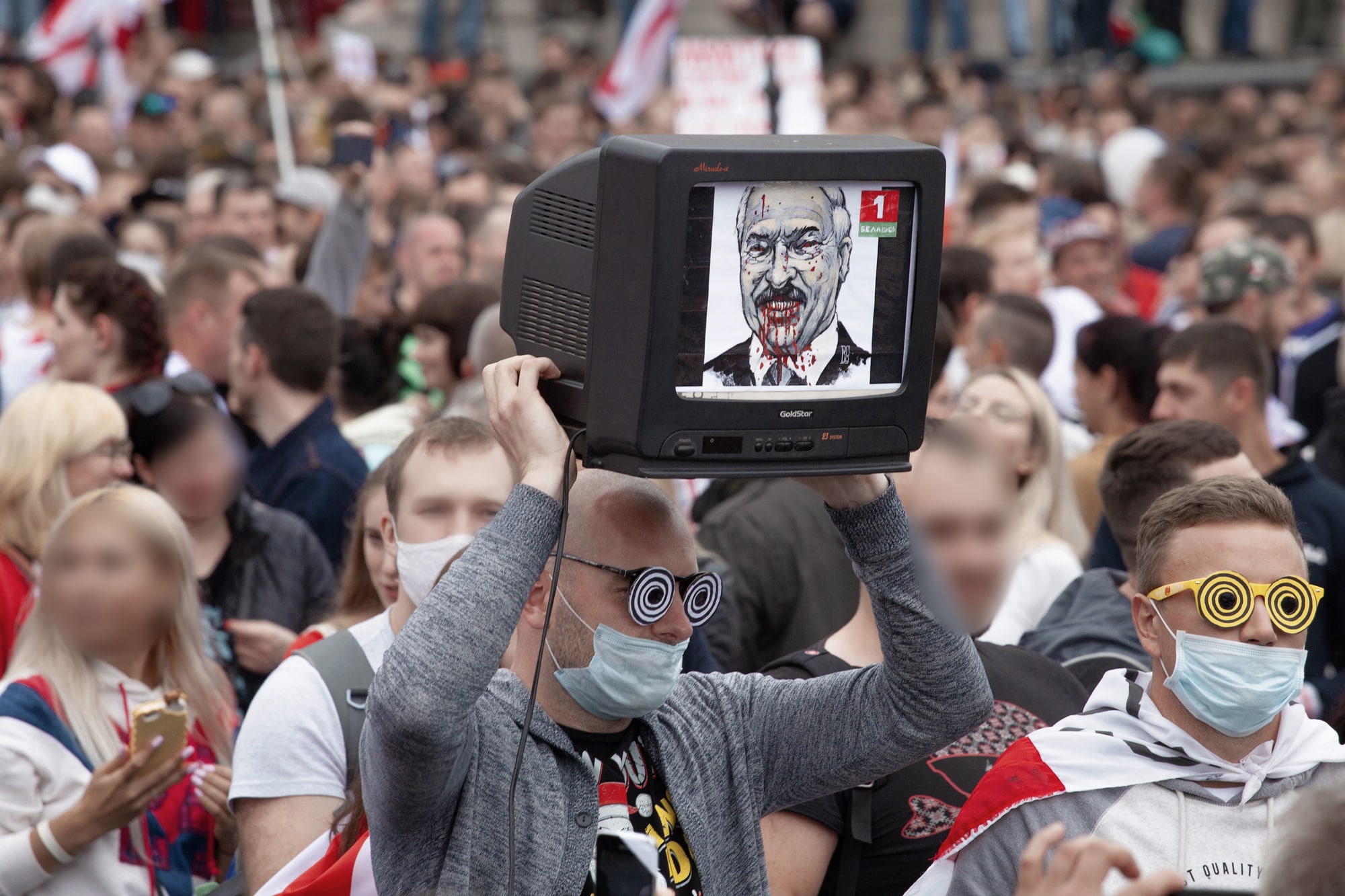
A mock TV displays Lukashenko’s face covered in blood, alongside the logo of a state-funded channel, August 23, 2020. [© Yauhen Attsetski]
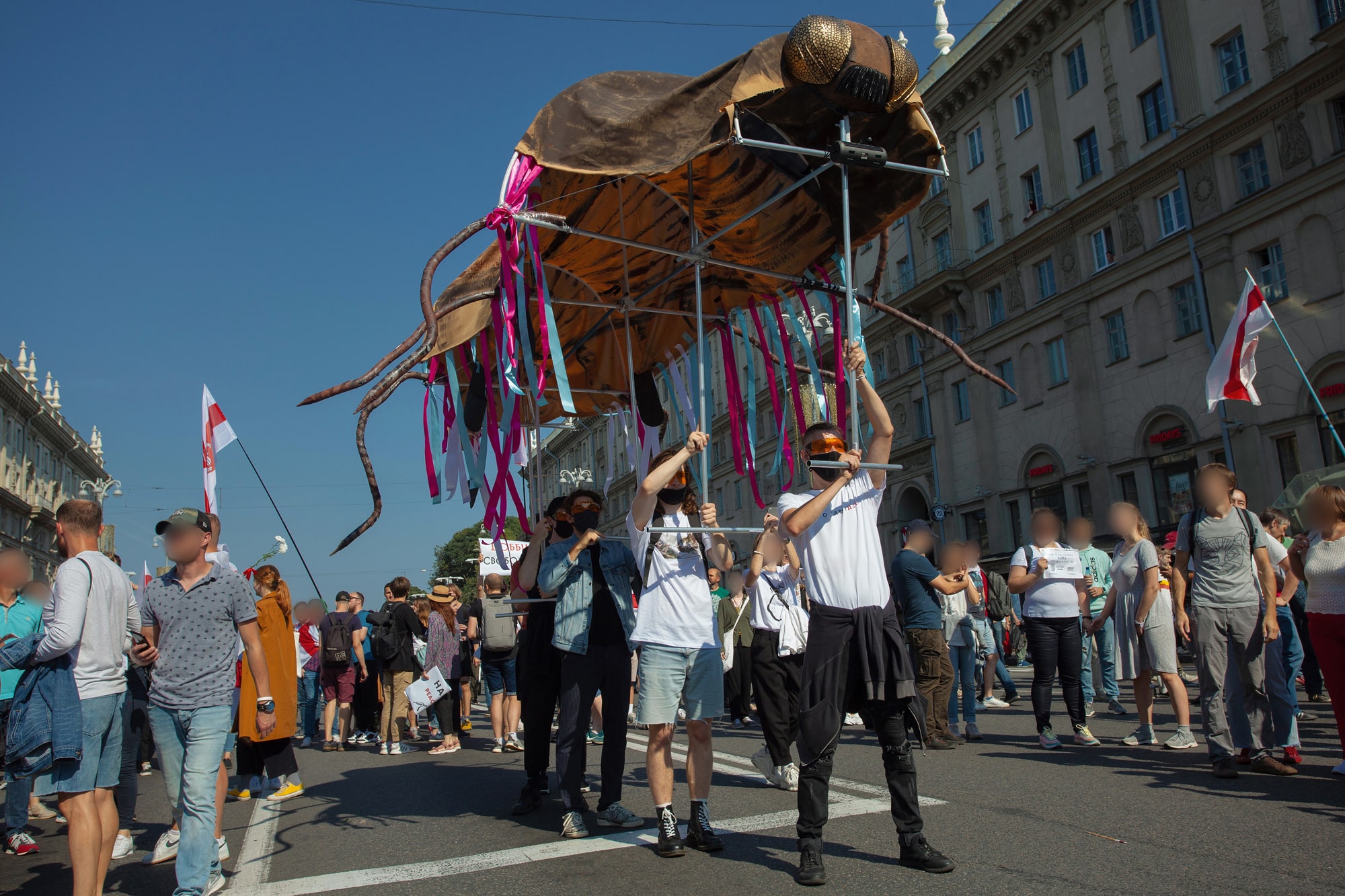
Protestors on Independence Avenue, carry a puppet symbolizing Lukashenko, referencing an opposition slogan — “Stop the Cockroach!” — popularized by Sergey Tikhanovskiy, August 30, 2020. [© Yauhen Attsetski]
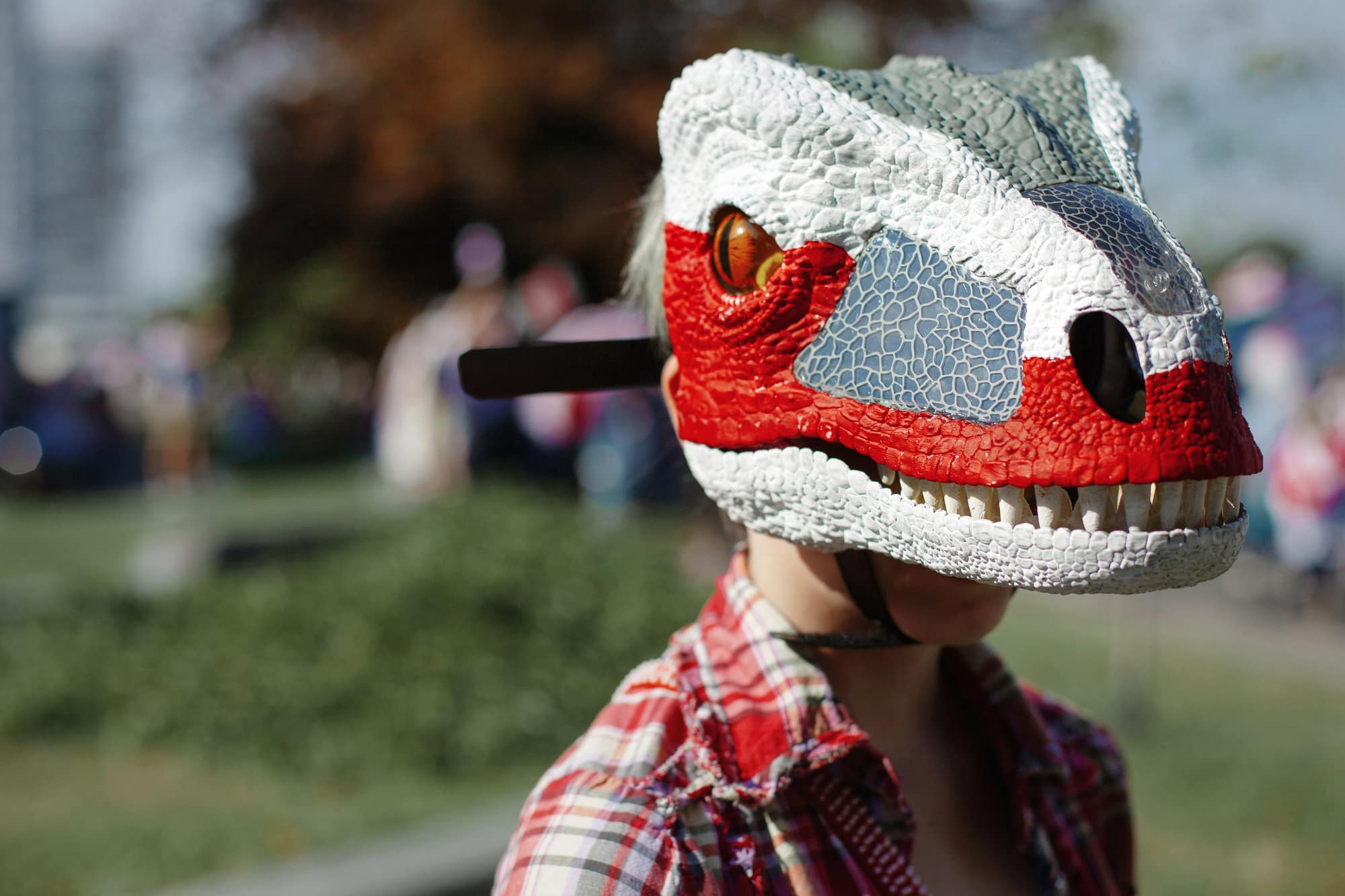
Protestor wearing the opposition colors on a dinosaur mask, August 30, 2020. [© Yauhen Attsetski]
“Darth Vader, I recognize you! Shave that mustache! They're expecting us on the Death Star!” August 30, 2020. [© Yauhen Attsetski]
A common theme in these stories from 2020 is the struggle to shape public opinion through the narrative control of symbolic spaces. Over three decades, Lukashenko’s regime has claimed (and in many cases constructed) memorials and monuments commemorating the Soviet past, while corrupting and hollowing out their meaning. Yet many of these spaces retain a deep emotional power that resonates with Belarusians, which makes them vulnerable to being occupied and reclaimed.
Every night a famous protest materialized at the Square of Changes, a children’s playground squeezed between apartment towers.
The same was true for private spaces in that first year of the Covid pandemic. Protest activities took place in residential courtyards, challenging the reputation of prefab high-rise sleeping districts as anonymous and isolating. Photographer Yauhen Attsetski documented events at the Square of Changes, a children’s playground squeezed between 21-story apartment towers, where every night a famous protest materialized: 35
It began with a roll call from the windows. Before the elections, there was tension in the air, but after the elections, when the “night terrors” started, a hunger for information and solidarity grew. Because the internet was blocked, people began exchanging information with passers-by. The accumulated sense of injustice drove people to find ways to express their grievances. A new form of protest emerged: shouting from windows. 36
This spontaneous act reverberated across the city. Videos circulated online of ordinary people shouting anonymously from the privacy of a family apartment into the common space, sharing news about matters personal and political. Their cries sparked further action:
While people shouted out of the windows, some went downstairs into the courtyard and started answering them. And then someone started setting up a chat [on Telegram]. … QR codes were posted in hallways and exchanged in the courtyard. Within a week, almost the entire courtyard had joined. Everything was spontaneous. The speed of the process essential. 37
This literal “cry and demand” erupted in a fierce battle for the courtyard and, ultimately, for the right to the whole city. 38 So, of course, the regime could not abide it. Assailants in unmarked vans came to disrupt the event and remove symbols of the opposition. On the night of November 11, an artist and shop manager named Roman Bondarenko was beaten and abducted from the Square of Changes. When it became public knowledge that he had died in police custody, the square became the new locus of outrage. 39 “The whole story is full of symbolism, like a novel,” Yauhen says. “Roman’s last words, ‘I’m going out,’ it’s literature!” 40
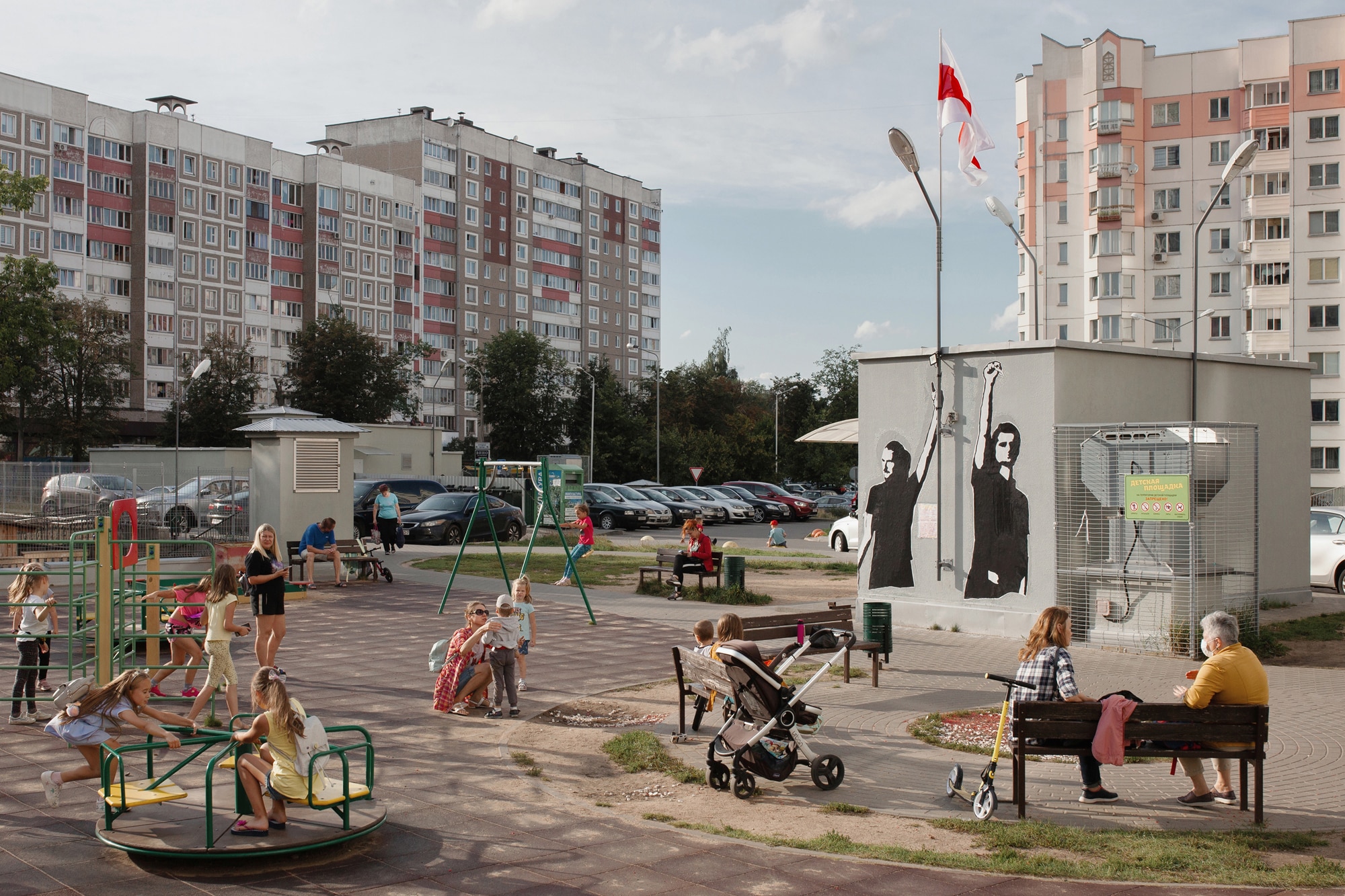
A children’s playground in a residential courtyard that became known as the “Square of Changes.” The mural DJs of Change (artist unknown) honors sound engineers Vladislav Sokolovskiy and Kirill Galanov. During a pro-government event on August 6, they played the iconic 1986 rock anthem “Change,” by Viktor Tsoi, while raising a V-sign and clenched fist — symbols of the united opposition. They were immediately arrested and spent ten days in the Okrestina detention center; shortly afterward, they emigrated, fearing re-arrest. This photo was taken August 31, 2020. [© Yauhen Attsetski]
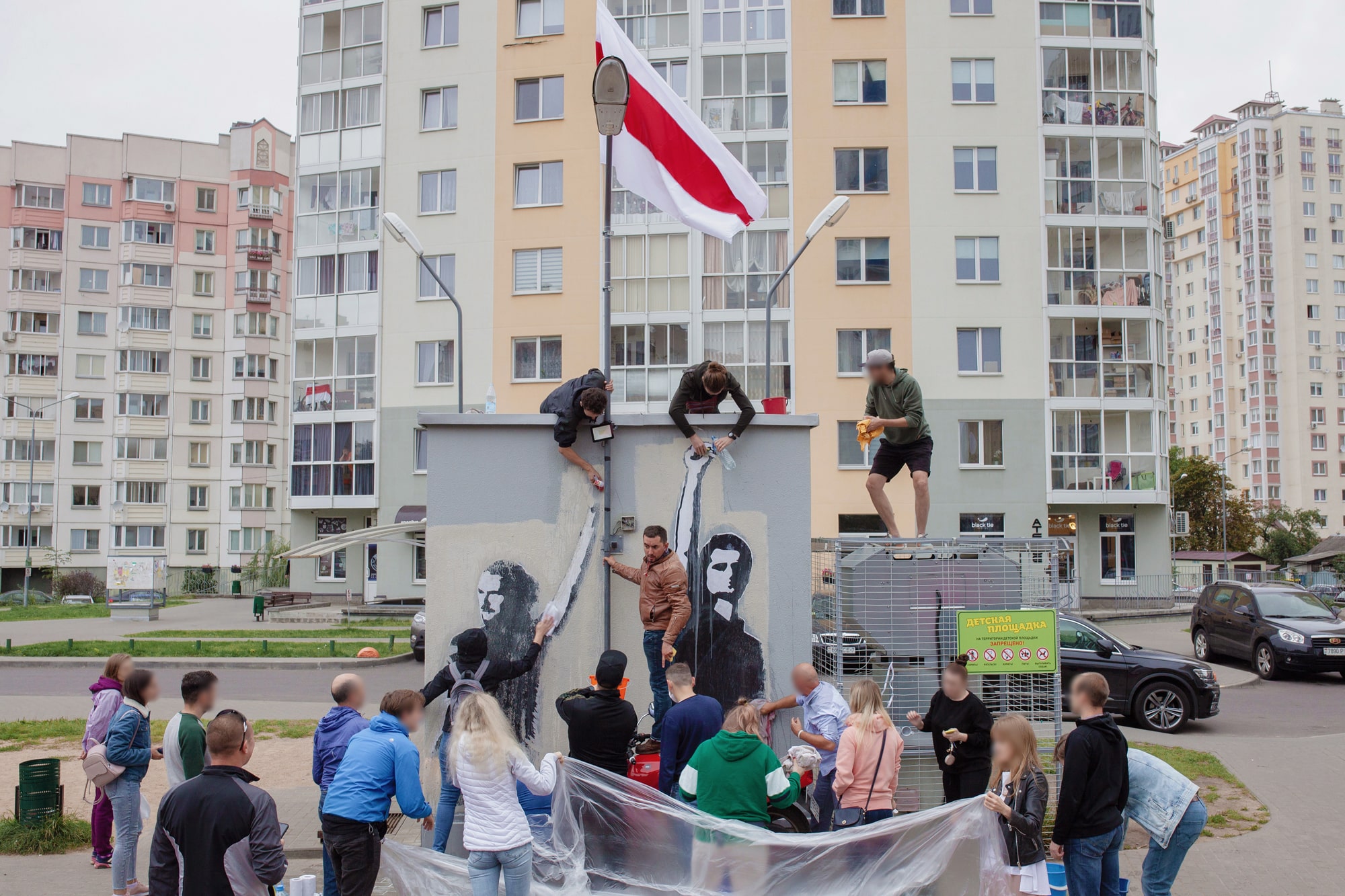
The next day, September 1, residents remove paint used by municipal authorities to cover the mural. Stepan Latypov, center, was arrested later that month and is currently serving a prison sentence of more than 8 years. He has attempted suicide multiple times while incarcerated. [© Yauhen Attsetski]
The Square of Changes, with the mural restored, on September 6, 2020. [© Yauhen Attsetski]
Residents gather on the square, September 6, 2020. [© Yauhen Attsetski]
A concert on the square, September 9, 2020. [© Yauhen Attsetski]
Later that night, the mural was covered in black paint and guarded by unidentified military. [© Yauhen Attsetski]
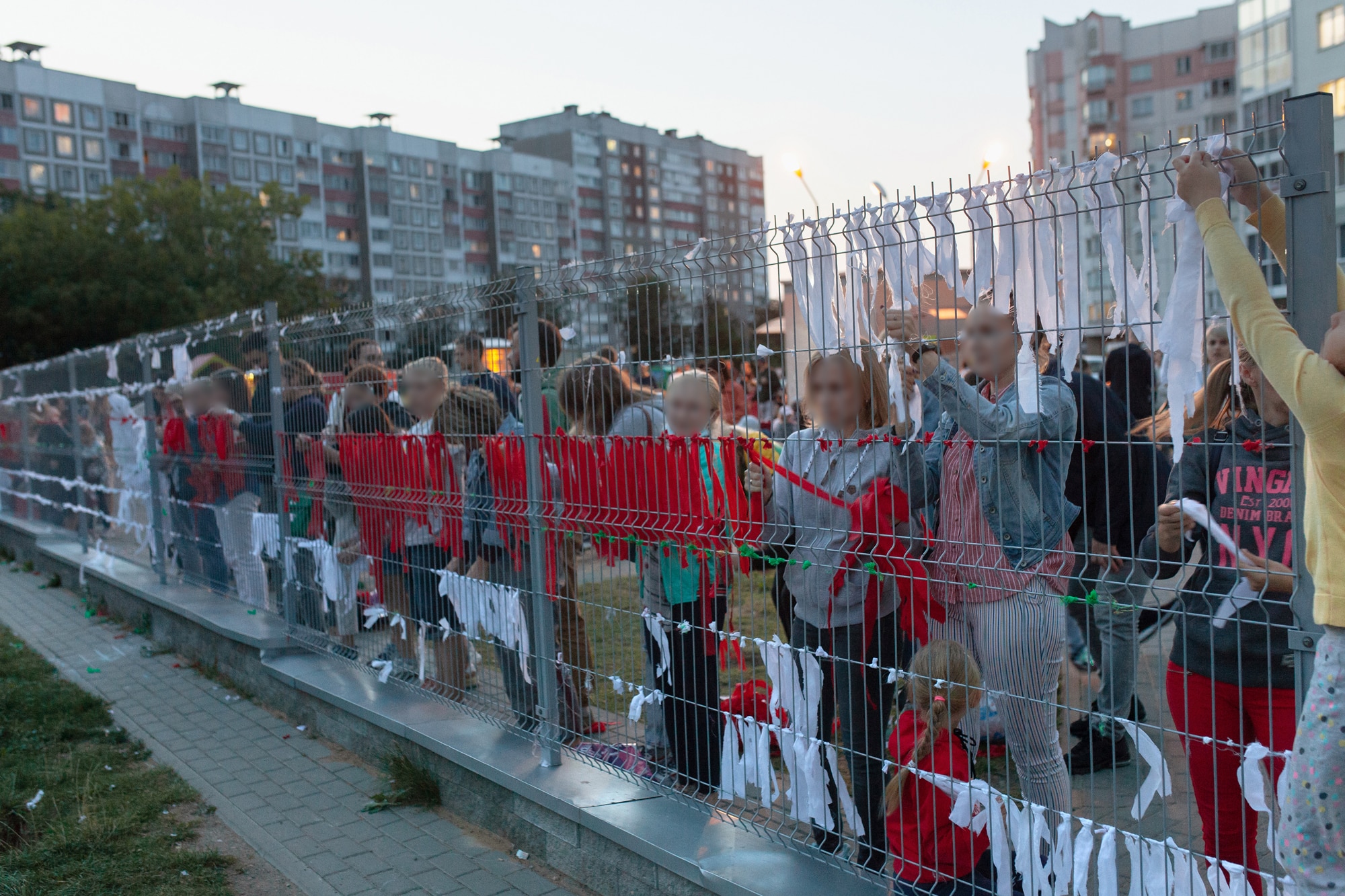
Residents decorate the playground fence with white and red ribbons. Traces of older ribbons — including the green of the official state flag — can be seen. September 15, 2020. [© Yauhen Attsetski]
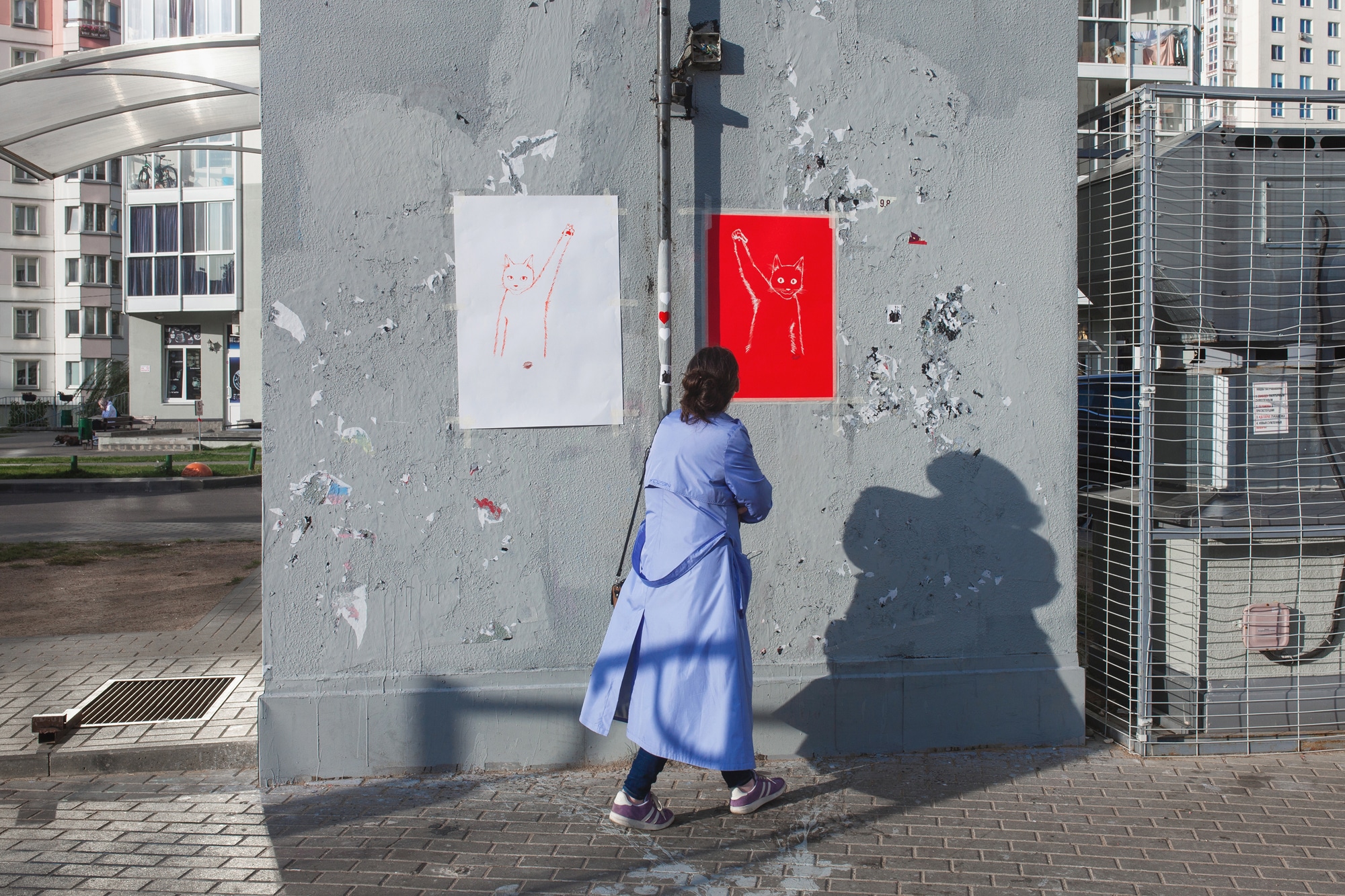
The mural, now painted over multiple times, is covered with cat posters representing the DJs, September 18, 2020. [© Yauhen Attsetski]
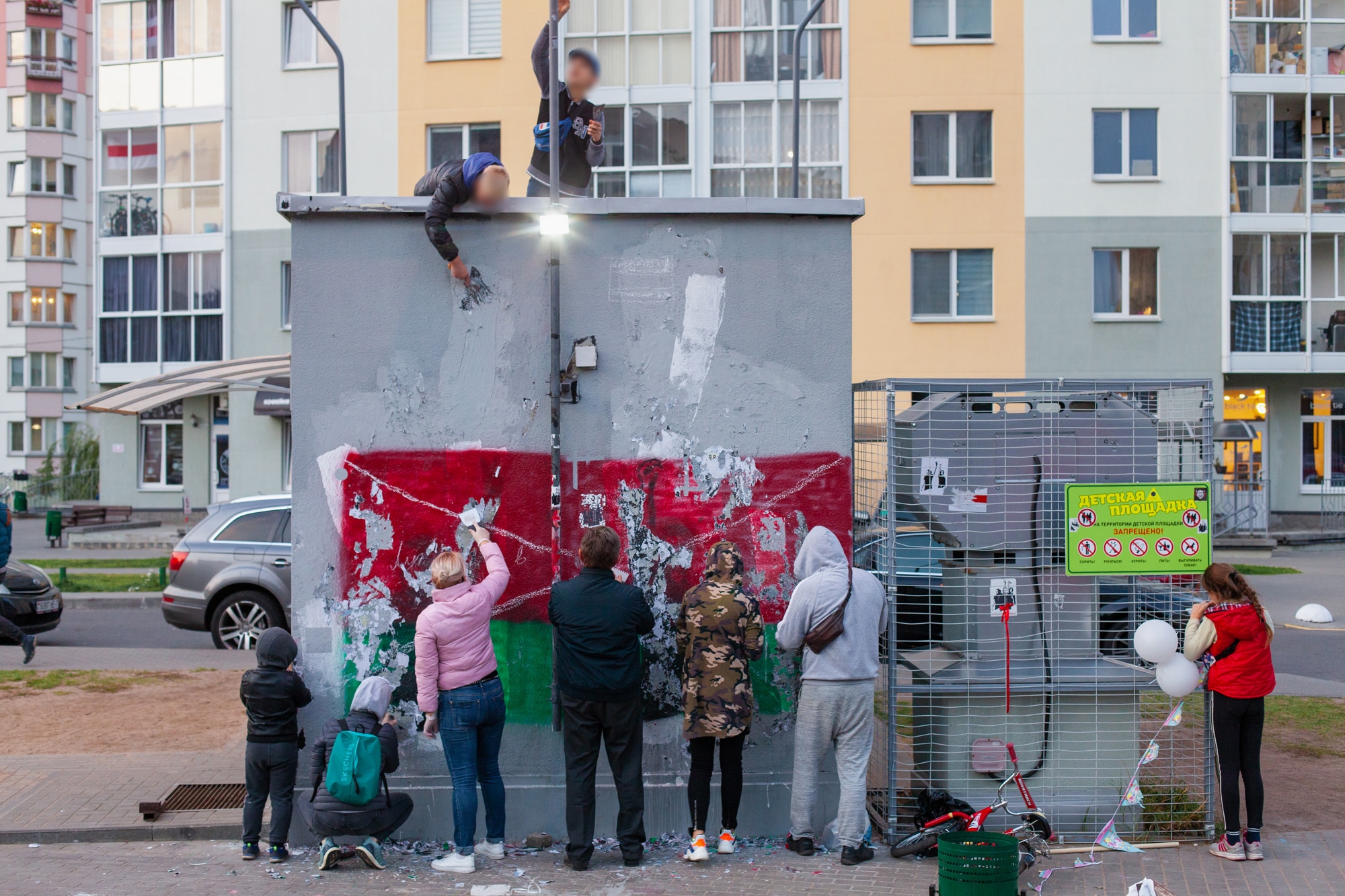
Residents remove paint representing the colors of the official flag, September 29, 2020. [© Yauhen Attsetski]
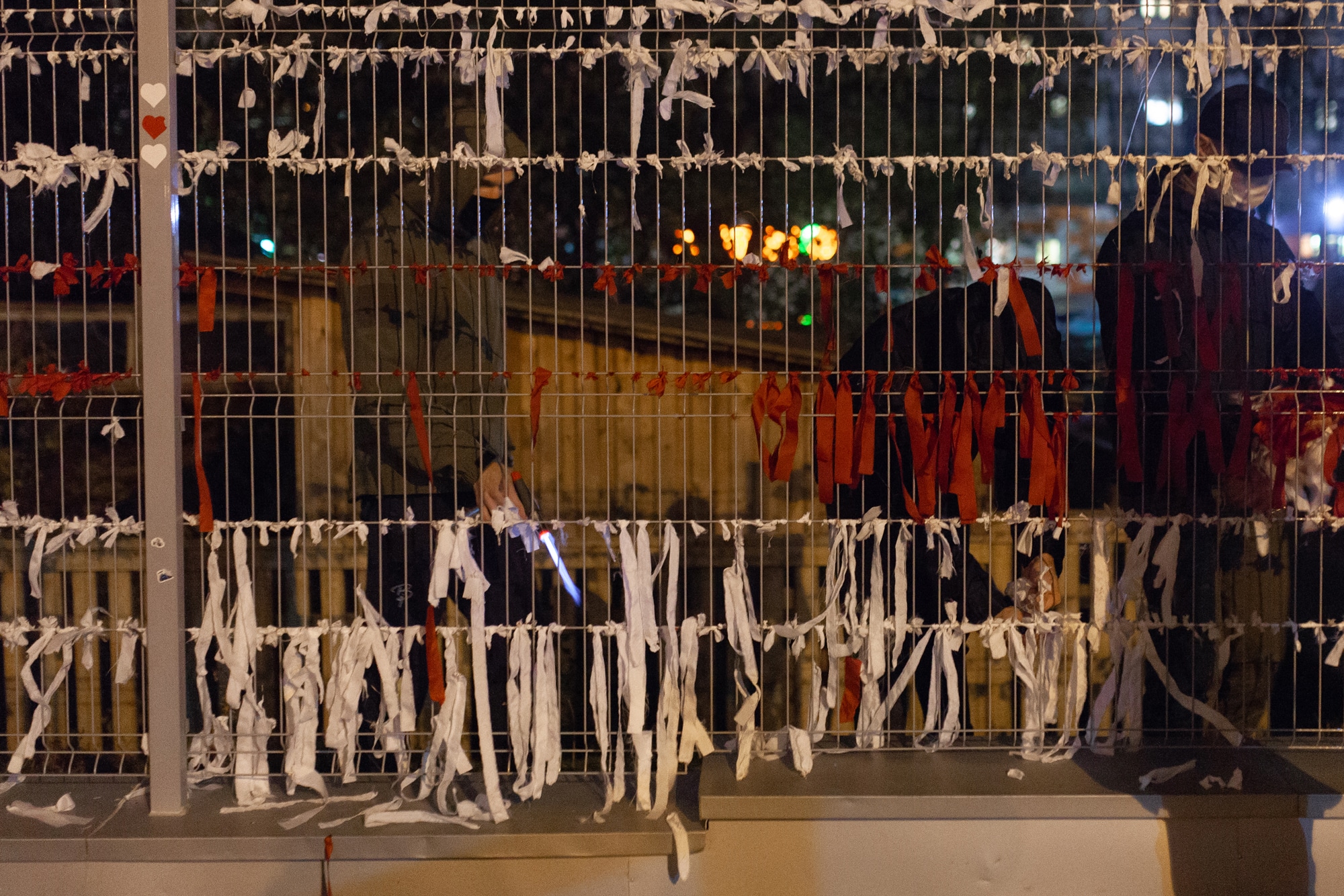
Unidentifiable people remove ribbons on the playground’s fence, October 21, 2020. [© Yauhen Attsetski]
A memorial honoring Roman Bondarenko at the mural on the Square of Changes. White text on the wall reads “Long live Belarus. We will survive. We are the best.” November 12, 2020. [© Yauhen Attsetski]
The Bondarenko memorial. “I am going out. We will never forget and never forgive. We will win.” November 14, 2020. [© Yauhen Attsetski]
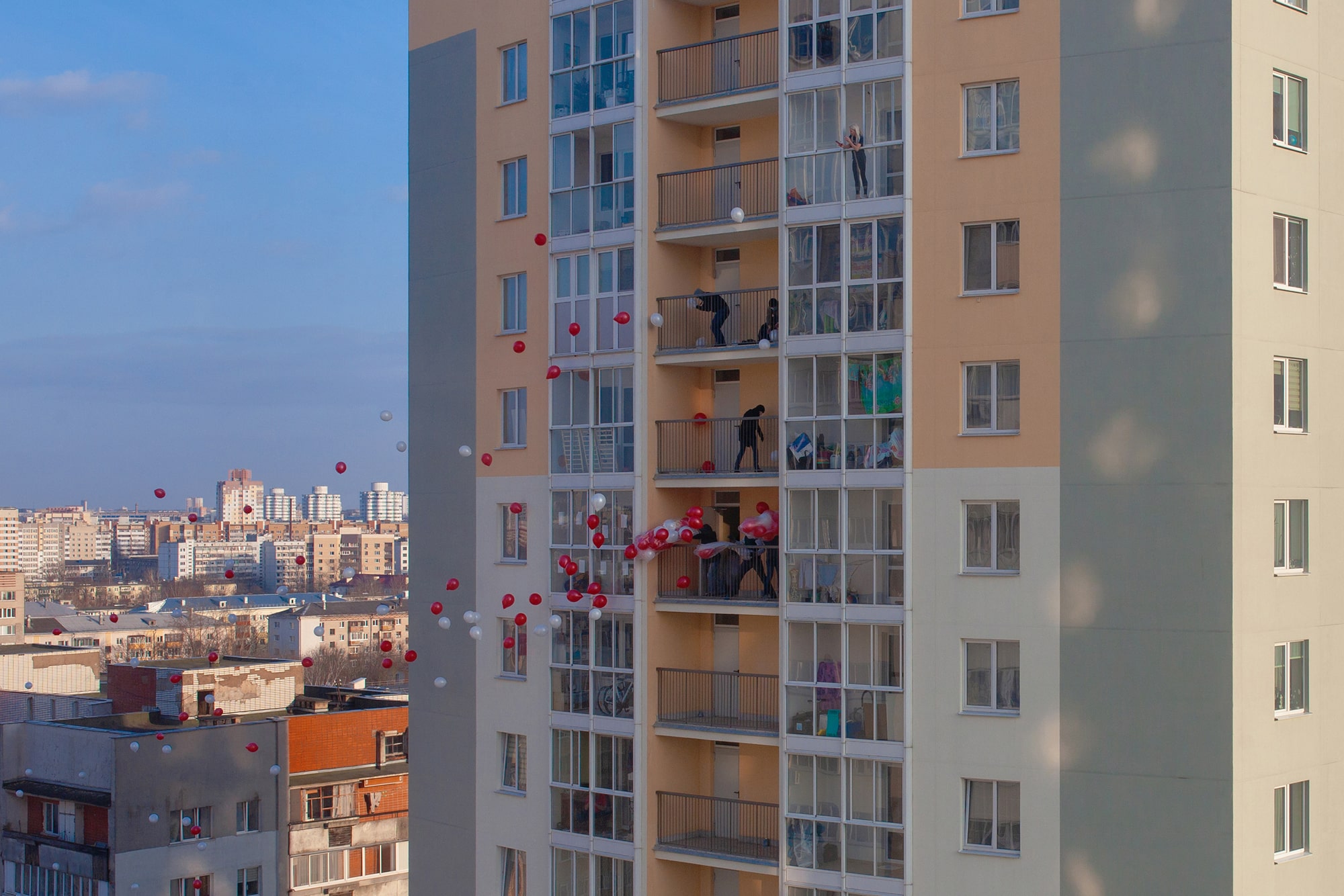
Unidentified people remove red and white balloons from the fire stairwell of one of the buildings on the Square of Changes, March 25, 2021. [© Yauhen Attsetski]
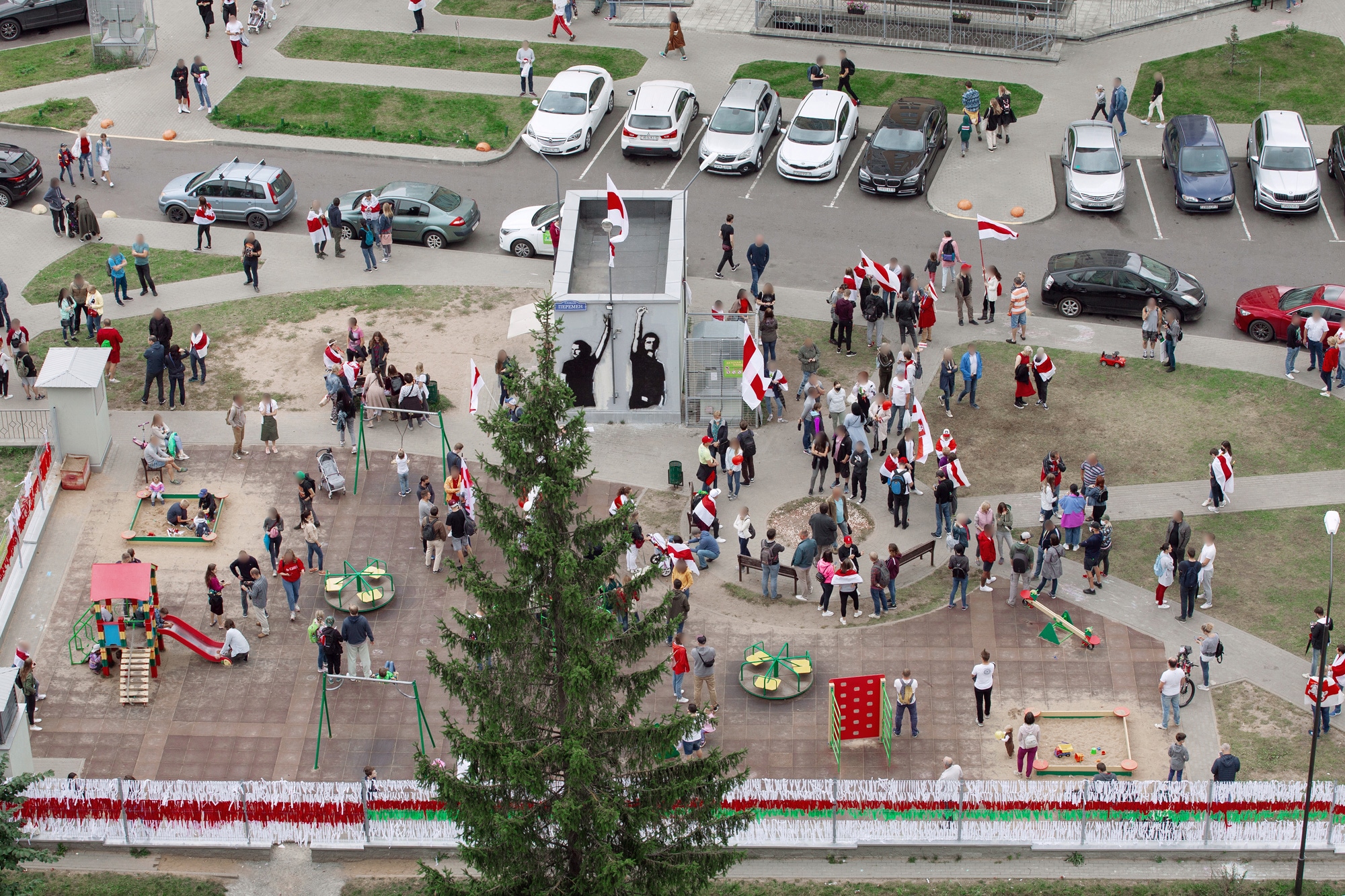
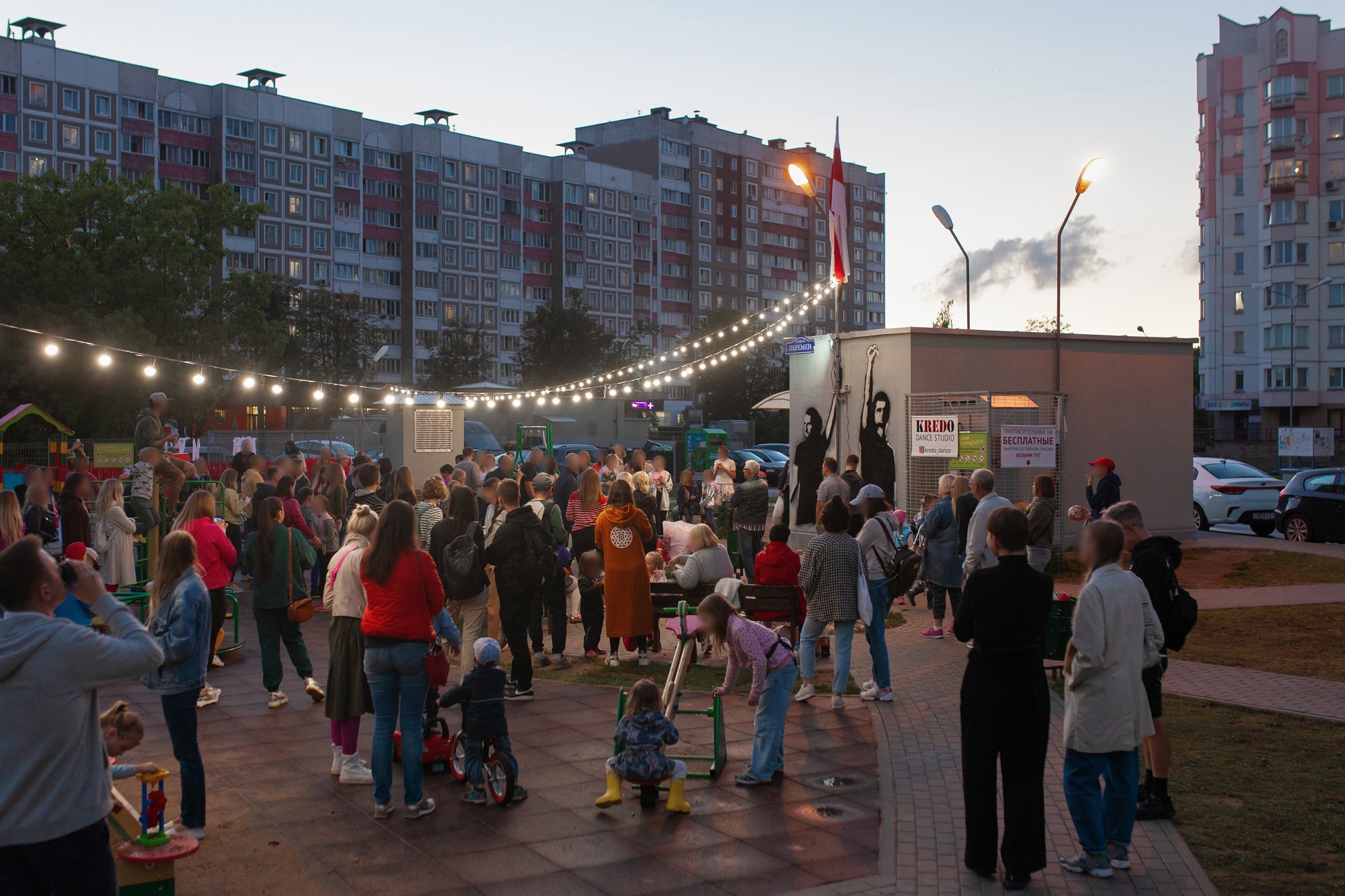
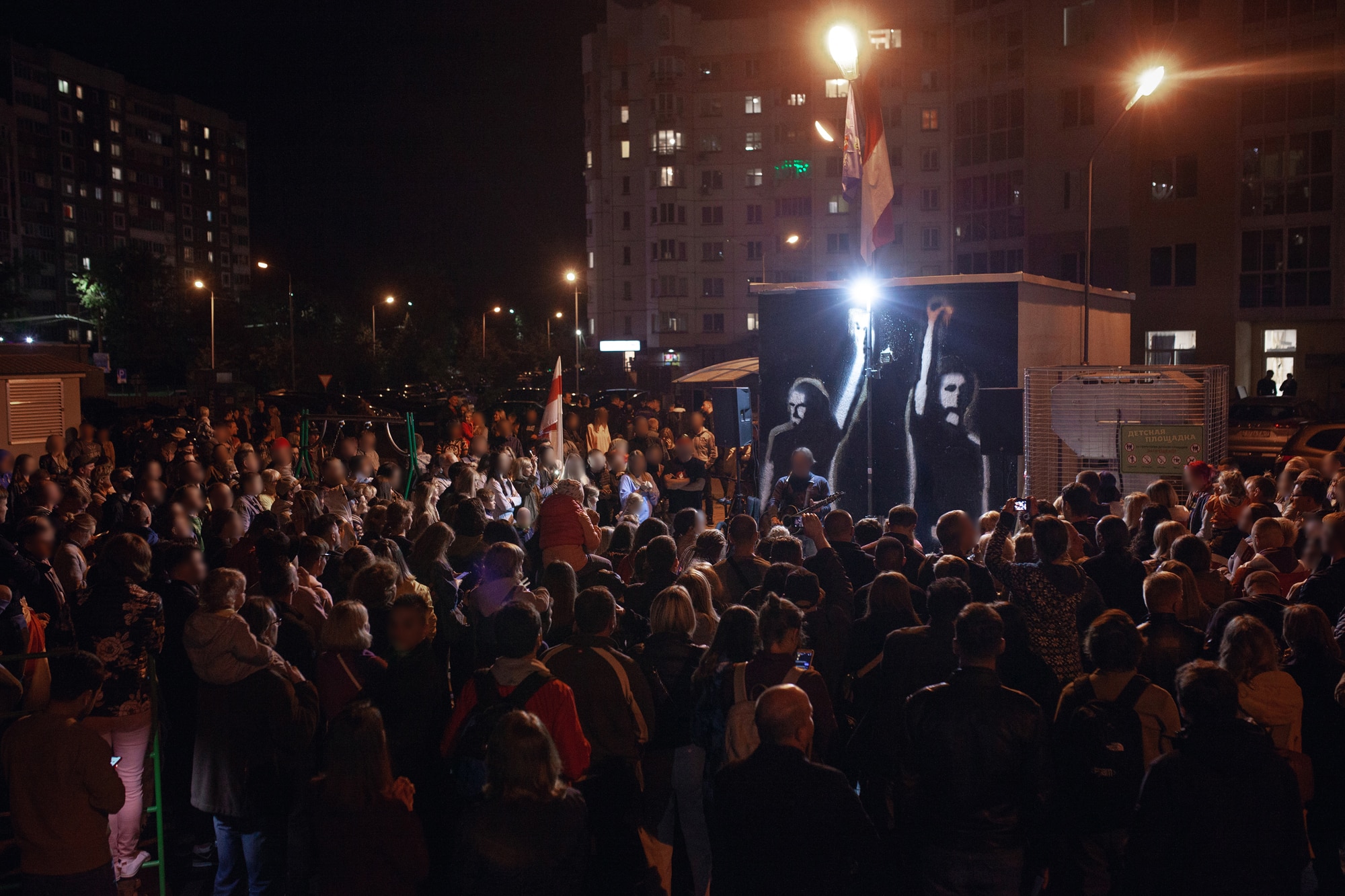
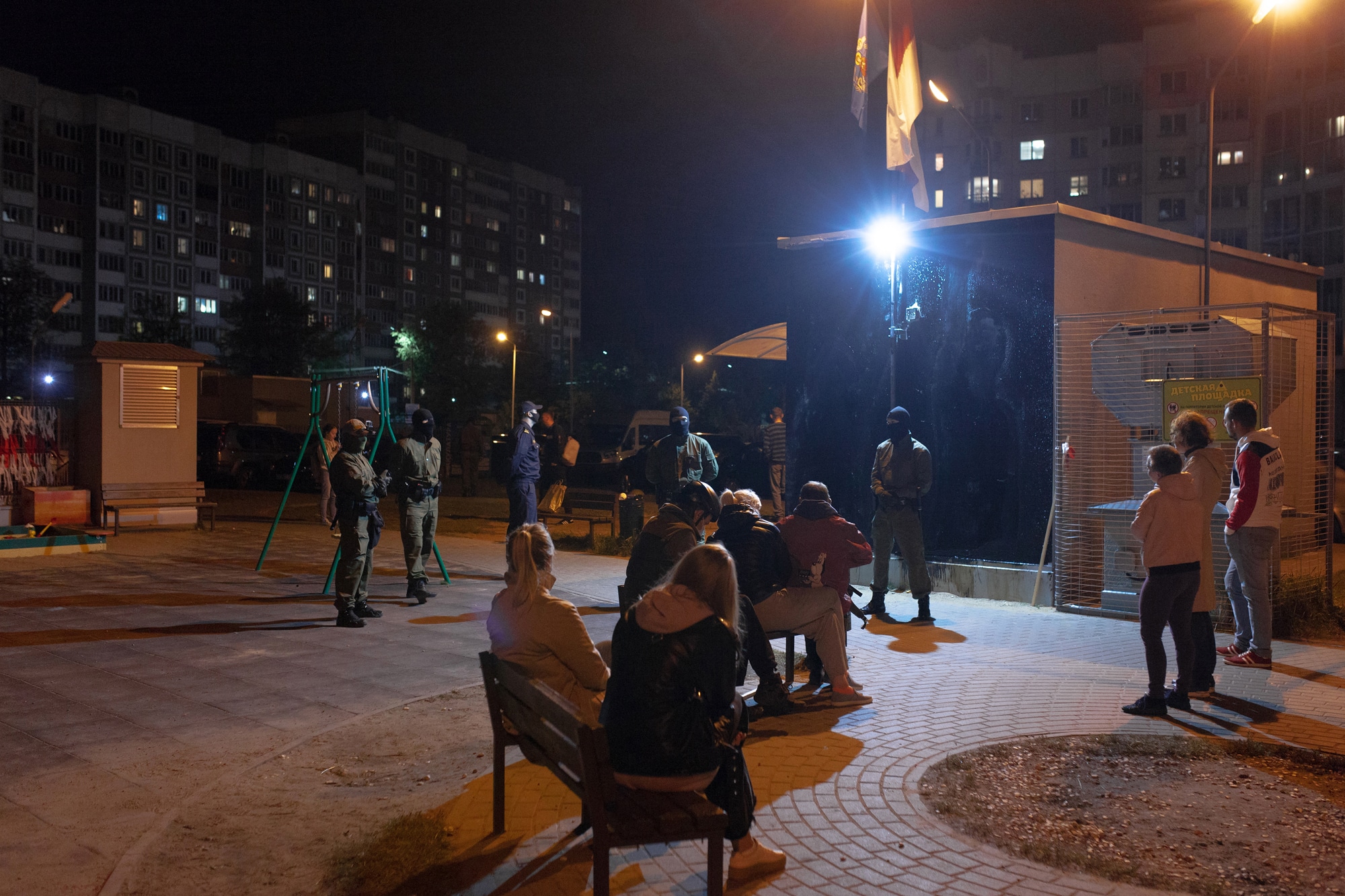
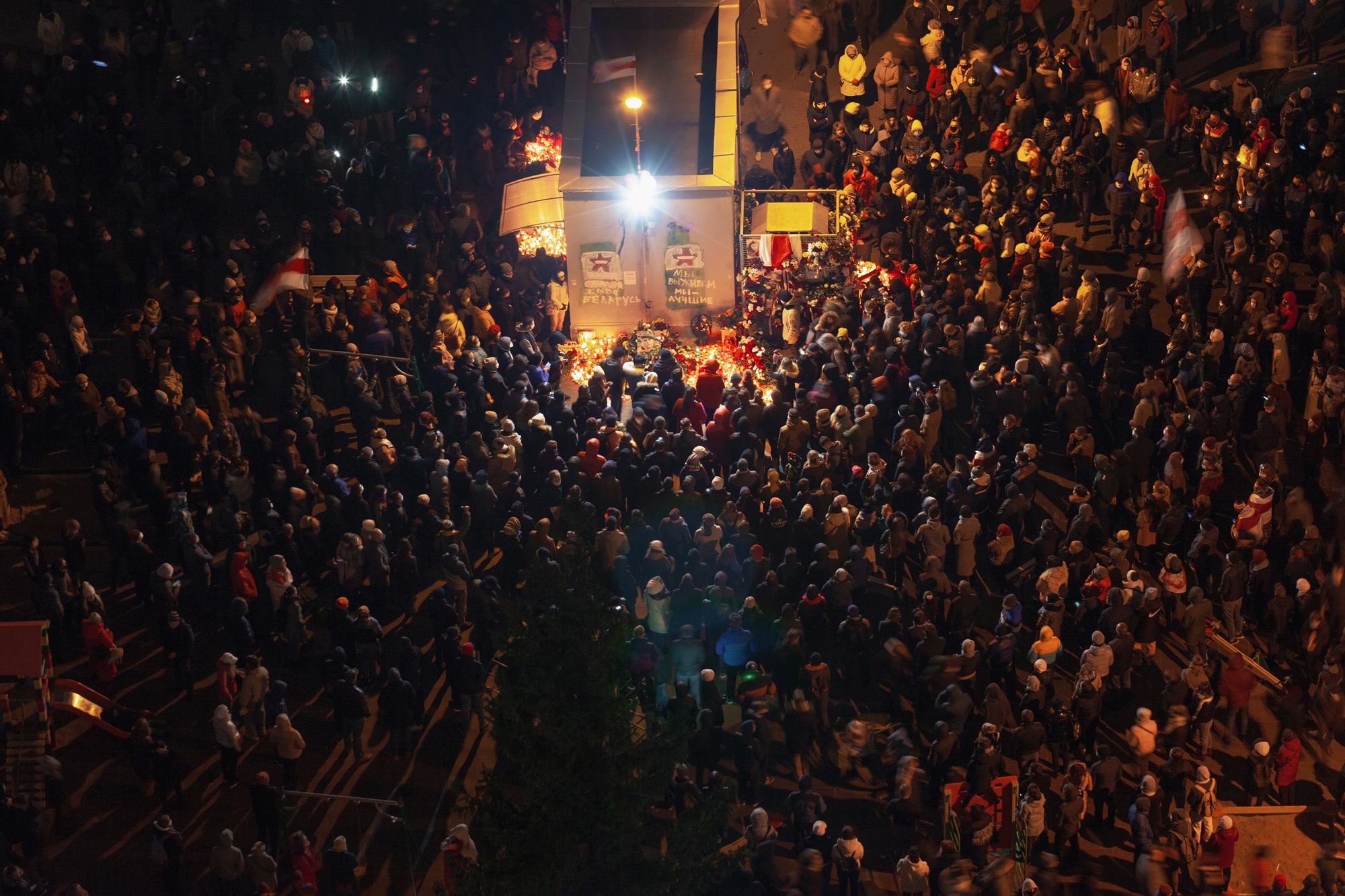
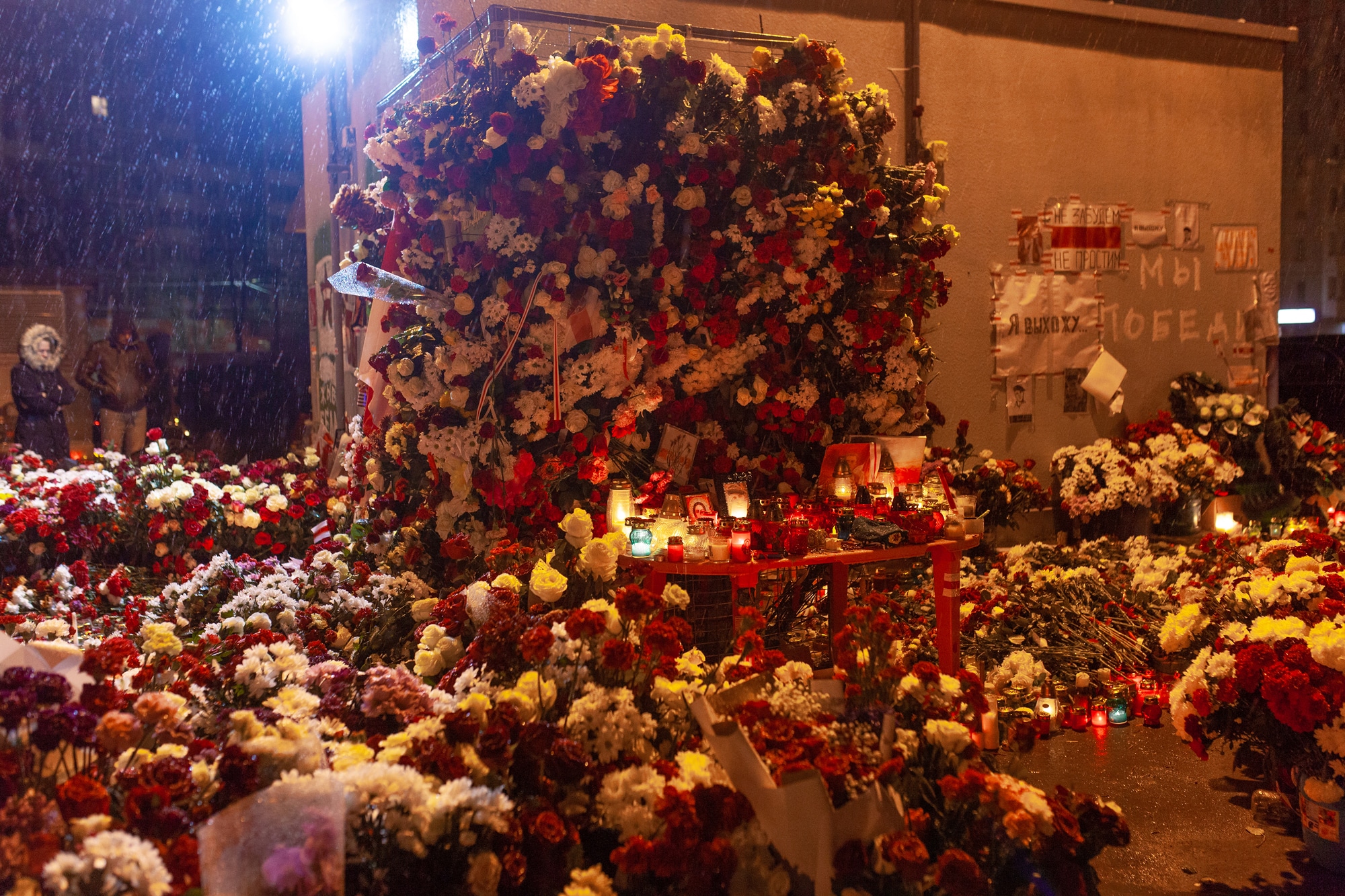
On the following Sunday, November 15, a memorial march proceeded from the place of Taraykovskiy’s death, at Pushkinskaya and Pritytskogo, to the site of Bondarenko’s disappearance, at the Square of Changes. This was the final mass march of the year, resulting in the arrest of over 1,100 people. 41
Several journalists were among them. Ekaterina Borisevich received six months of penal colony time for reporting medical evidence that showed Bondarenko had no alcohol in his blood when he died, disputing the official claim of intoxication. Katerina Andreyeva and Darya Chul’tsova were sentenced to two years each for broadcasting live from the Square of Changes, showing a brutal police crackdown on people who came to honor Bondarenko’s memory. Later, Andreyeva received another eight years for high treason. 42
This was, in retrospect, the beginning of the end. Forcing protestors out of public space while shutting down the free flow of information silenced the opposition. During and after the summer of 2020, more than 500 media workers were arrested, with 39 imprisoned and more than 400 forced into exile. 43 Independent sources like the Belarusian Union of Journalists were banned as “extremist.” The government even hijacked a Ryanair flight to arrest media executive Roman Protasevich, of Nexta. 44 Today Belarus ranks 167th on the World Press Freedom Index, near the bottom. 45
As of February 2025, human rights organizations have registered 6,610 political prisoners in Belarus, and 1,231 are still in jail. 46 Thousands more face politically motivated criminal charges. 47 Political violence has led to the deaths of at least 20 people. 48 And, according to the Council of Europe, between 200,000 and 500,000 Belarusians — as much as five percent of the population — have left the country to avoid persecution. 49
Photos and videos and posts are now evidence that can be used against anybody who created them, appeared in them, or possesses them.
Simultaneously, an avalanche of legal reforms aims to prevent protestors from challenging future elections. Polling stations no longer operate outside the country, effectively stripping the right to vote from 1.5 million people in the diaspora. 50 Authorities can now revoke the citizenship of Belarusians living abroad who participate “in extremist activities” or cause “serious harm” to national interests, and the Criminal Procedure Code has been amended to allow trials in absentia. 51 These new tools have already been applied in a row of prominent cases, including that of opposition leader Svetlana Tikhanovskaya, who has been living in exile in Lithuania since 2020; if she ever returns to Belarus, she’ll get fifteen years in a maximum-security penal colony. The death penalty is allowed for any “attempted terrorist act,” as well as for soldiers and public officials found guilty of high treason, and the KGB has asserted a right to prevent citizens from leaving the country. 52 To make things more difficult for expatriates, all administrative procedures, such as renewing a passport, must now be done in person in Belarus. Citizens face the risk of having their property confiscated, with 104 recent criminal cases based solely on images from protest activities abroad. The confiscated flats are then sold at state auctions to compensate for the alleged economic damage. 53
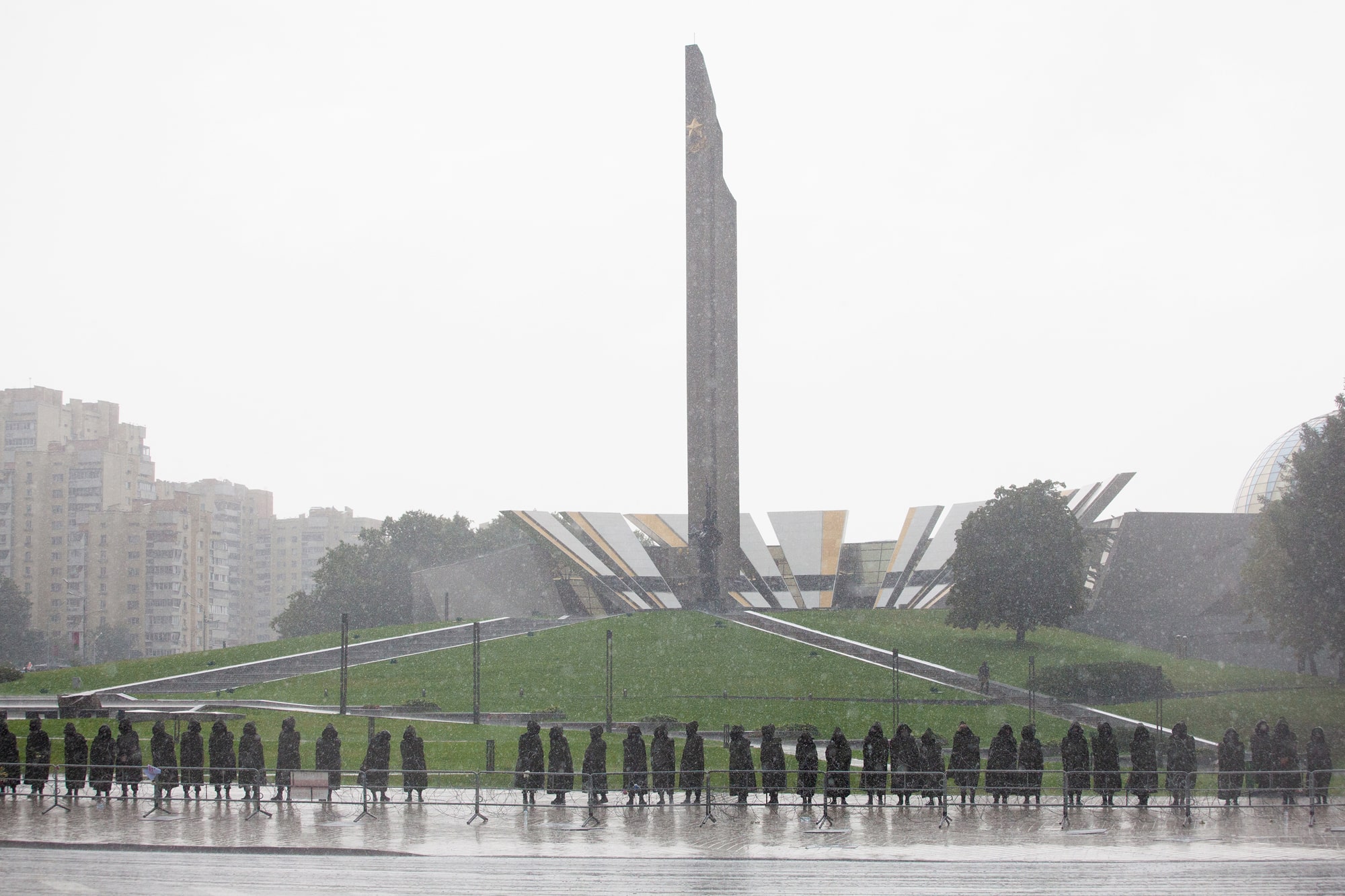
Photos and videos and social media posts— so crucial in documenting the events of 2020 and building global solidarities — are now evidence that can be used against anybody who created them, appeared in them, or possesses them. Many protestors who remained in Belarus have deleted all data that could indicate their involvement. People living abroad risk incriminating themselves or others through careless handling of information, as in the case of a recent documentary that failed to blur faces. 54 Written out of official history, the memories of 2020 are fading.
Written out of official history, the memories of 2020 are fading.
Five years later, amid multiple global crises, the struggle for democracy in Belarus has vanished from newspapers. The ascendance of far-right parties worldwide has made people in the diaspora more vulnerable in the countries where they are living now. In the United States, at least 323 Belarusians face deportation under President Trump’s anti-immigrant policies. 55 In Germany, the last coalition government passed a citizenship law easing naturalization for all migrants. Yet a backlash is coming, according to the incoming chancellor, the center-right Christian Democrat Friedrich Merz, who vows a radical change in immigration policy.
Meanwhile, the Belarus government continues its persecution of people who marched for democracy in 2020. On January 26, 2025, Lukashenko secured his seventh term in office, claiming victory with 87 percent support. I didn’t hear about a single act of public protest within the country. And I didn’t vote.




If you would like to comment on this article, or anything else on Places Journal, visit our Facebook page or send us a message on Twitter.