
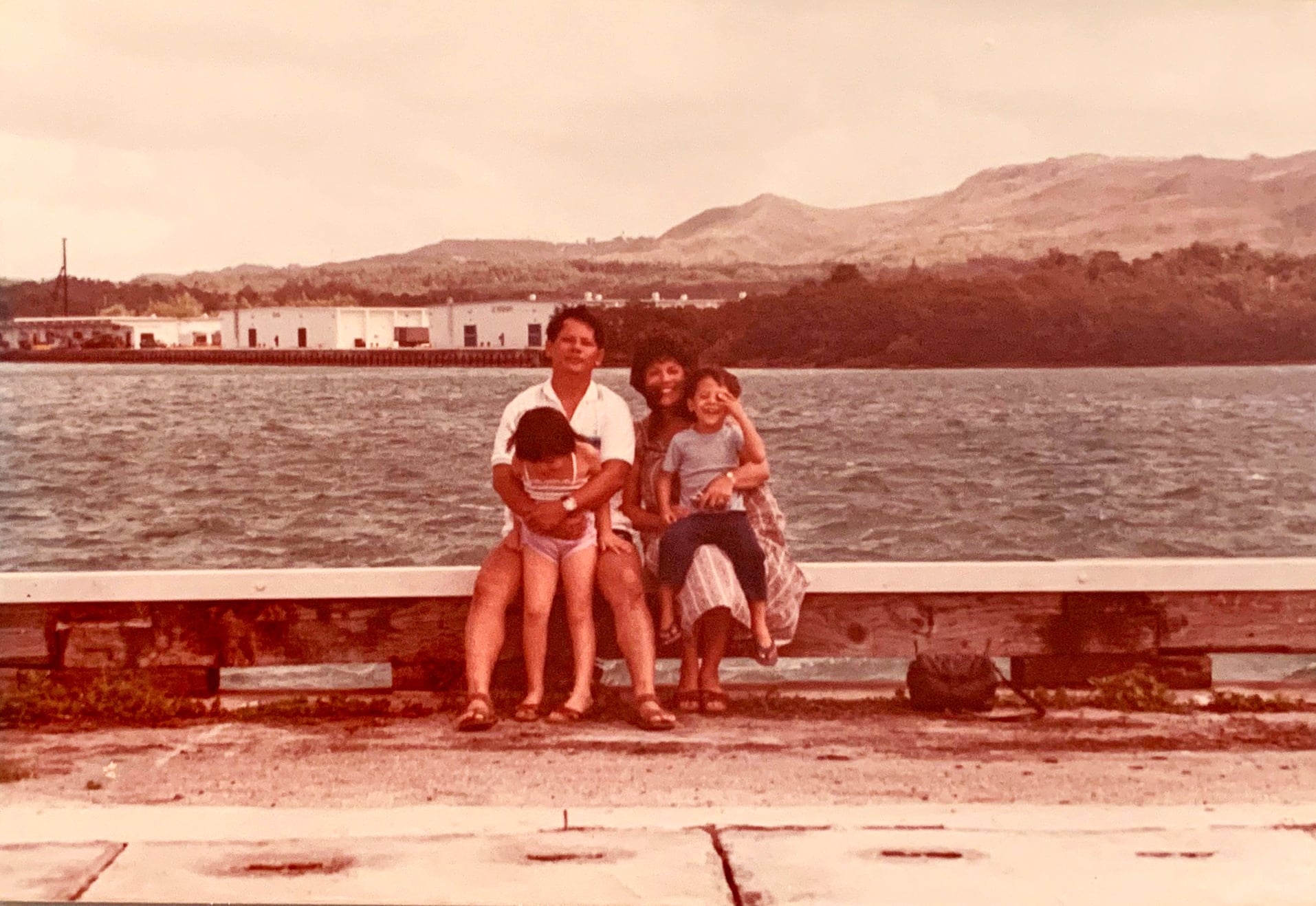
In the summer of 1991, when pancreatic cancer had stolen most of my father’s flesh, my family spent almost every weekend at a beach on the southern end of the island. Toward the end of his losing battle with the disease — after all the western and eastern medicine, after all manner of ridiculous diets — the most decent of my dad’s doctors told my mom that what he really needed was fresh air. Fresh air and the feel of sun on his face. This same doctor spoke to my mom of the therapeutic powers of the ocean, said that salt water had healing properties, and that rubbing sand on my dad’s frail body would help rejuvenate him. So, be it out of belief or desperation, that’s what we did, Sunday after Sunday. We’d wade him into the water and rub sand all over his neck, shoulders, chest, and back. As for his terribly thin legs, my sister would hold them up one by one and I would scrub. Our mother, often listless, would sit there and stare as we exfoliated our father with almost religious fervor. Although by then religion was of little comfort to her, she would later describe this small ritual as our family’s version of ablutions.
We knew so little then.
It’d be years before the federal government would come clean about how the sand and water were heavily contaminated with industrial chemicals linked to cancer.
It’d be fifteen years before the federal government would come clean about how dirty that area was, how the sand and water at the Merizo pier and in the surrounding lagoon were heavily contaminated with PCBs and other industrial chemicals linked to cancer. In 2006, the Guam Environmental Protection Agency issued its first fish-consumption advisory, warning residents of the village of Merizo to limit or avoid eating fish from those waters. Sediment tests done the year before had found PCB levels roughly 5,000 times higher than the federally recommended level. The source of contamination, we’d learn still later, was a long-range navigation station set up by the Coast Guard after World War II. According to NOAA, the PCBs came from electrical equipment the Coast Guard had improperly discarded in that same lagoon in the 1960s.
But ignorance was bliss in the spiteful summer of 1991, and, despite our devotion, my sister and I were doing more harm than good. That’s the thing you learn the hard way when you come of age in a colony: while colonization is always about the big things of racial discrimination, land dispossession, and political subordination, it’s actually the little things that hurt the most.
Guam is one of the oldest colonies in the world.
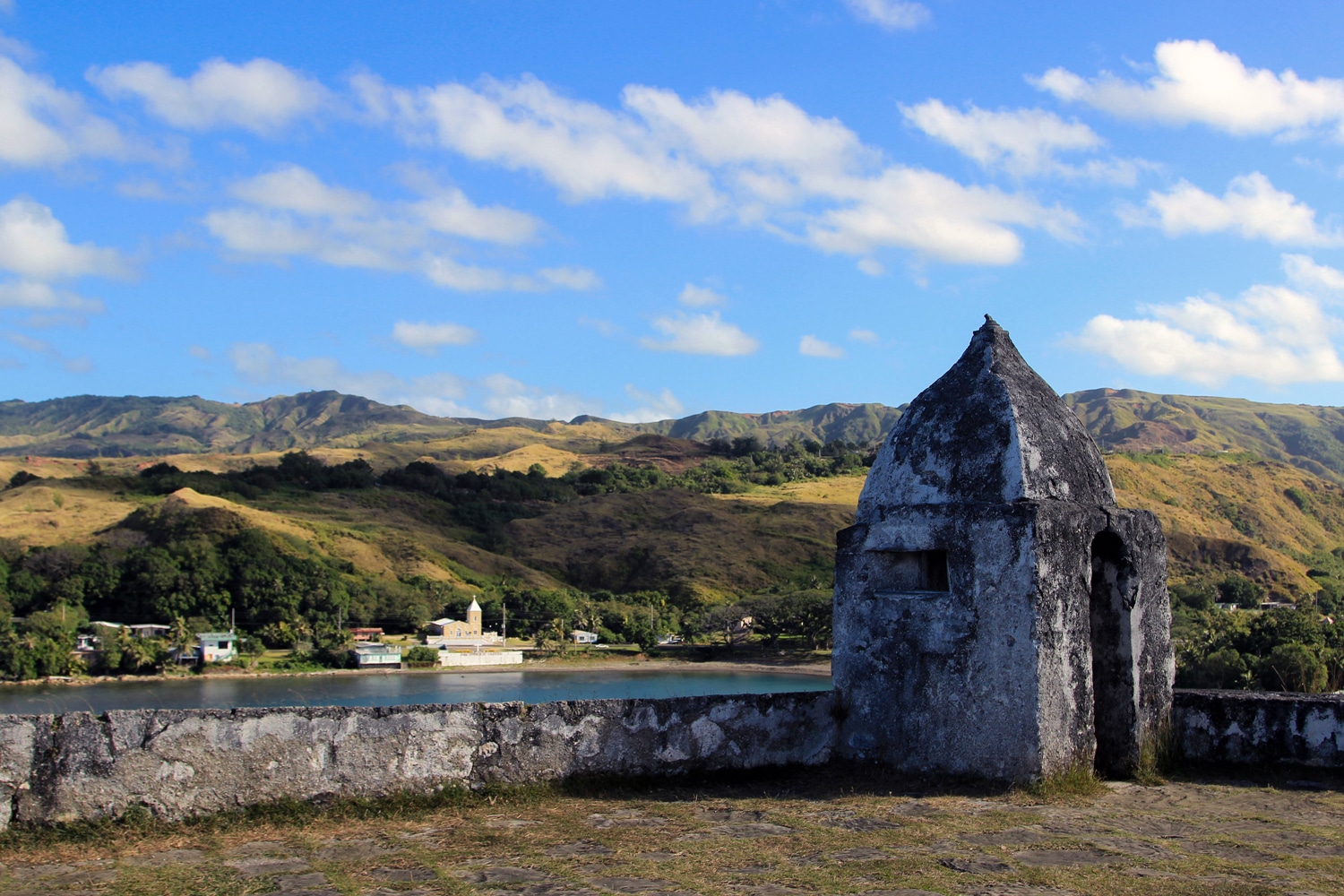
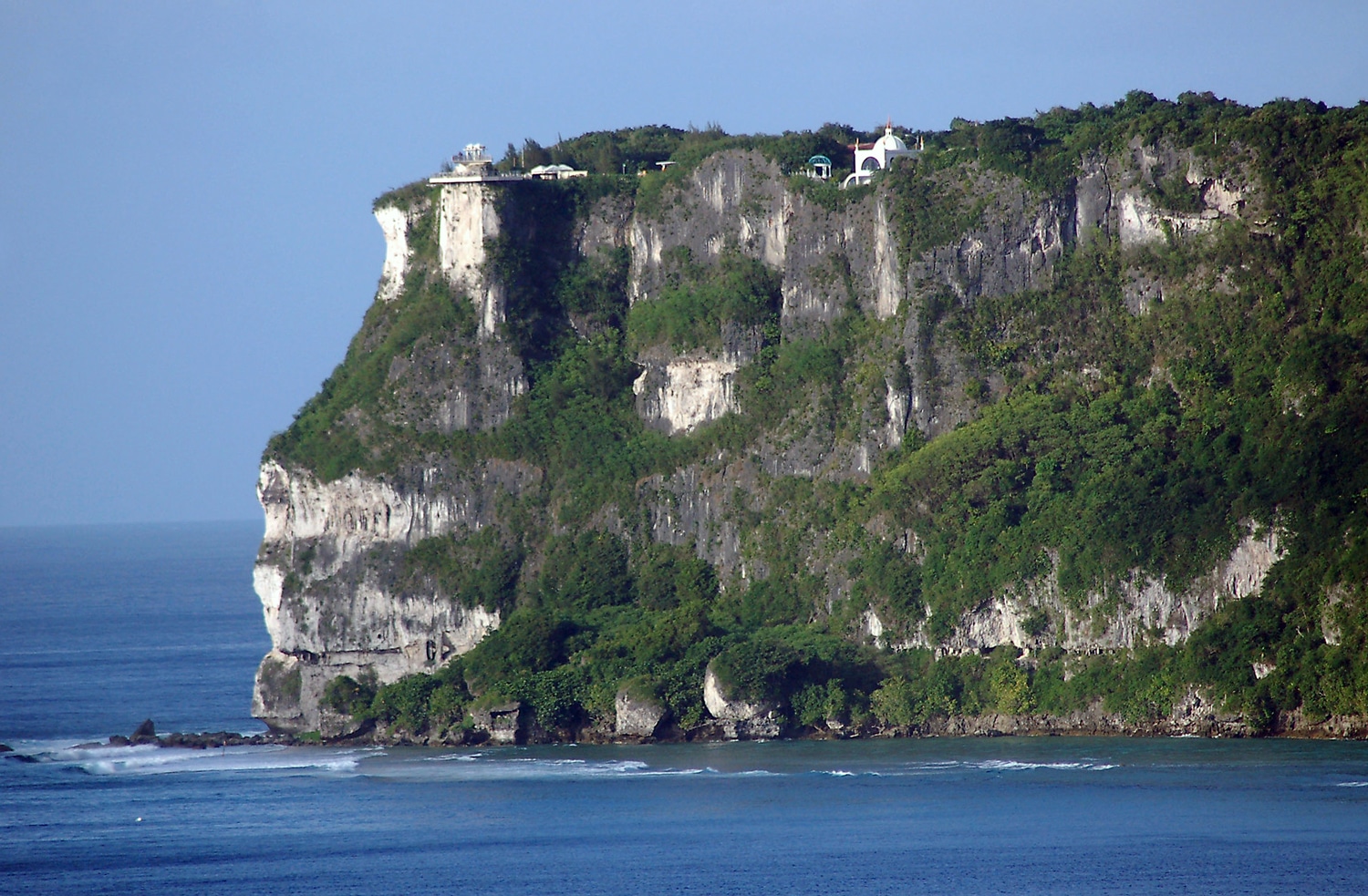

Spain colonized the island for more than 300 years. While many historians say the colonial clock started ticking in 1565, when the navigator Miguel López de Legazpi claimed Guam as a Spanish possession, many of my people — the Chamorro people, who claim the island as our ancestral home — have a quarrel with that date. We say the clock started ticking 44 years earlier, in 1521, when Ferdinand Magellan set foot on our shores. After being saved from certain death, a simple misunderstanding over a skiff returned Magellan to his true nature, and, in a matter of days, he renamed our island Isla de Ladrones (Island of Thieves), burned a village to the ground, murdered seven men, and proceeded to eat their entrails. Even if formal colonization had not by then occurred, the brutality that cleared the way for it certainly had.
To this day, 504 years and two additional colonizers later, the shenanigans continue.
That’s the thing you learn the hard way when you come of age in a colony: it’s actually the little things that hurt the most.
We cannot vote for the U.S. President. We have no U.S. Senate representation. We can elect only one non-voting member, who is called a delegate, to the U.S. House of Representatives. These are the blunt inequities, but more sophisticated ones abound. In the House, for instance, our delegate is allowed to vote on floor amendments to bills, but only when convened in what is called the Committee of the Whole, and only if the delegate’s vote does not actually make a difference. Indeed, depending on the version of House rules in force at any given time, our delegate may vote on legislation before the Committee, but should the vote prove dispositive (that is, should it affect the outcome), then the vote is retaken as a matter of course. Our delegate may be present, but only as a body — and even that’s debatable, given the fact that they are not counted for quorum purposes either.
I was born with a hole in my heart.
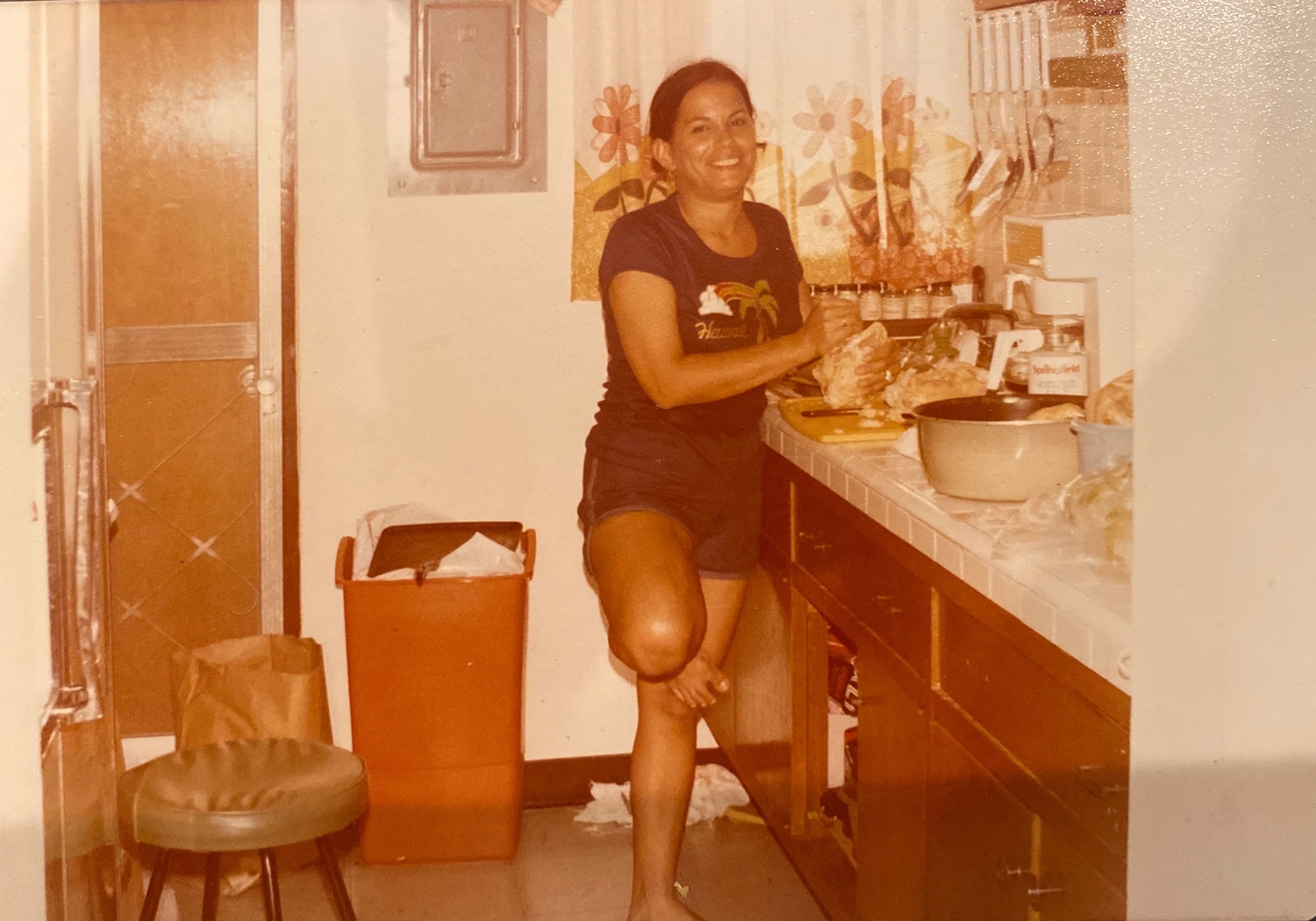
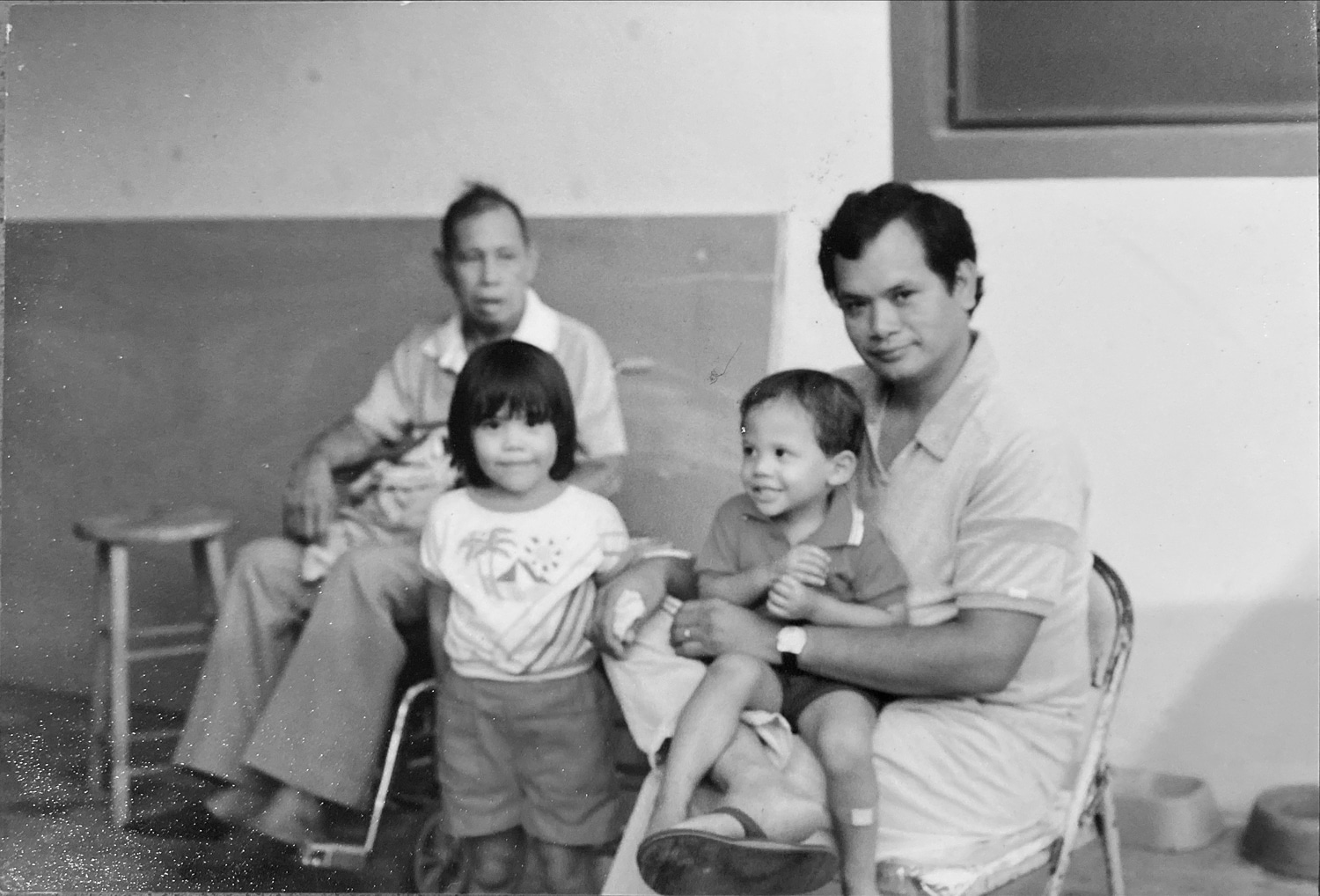
Technically, what I have is a heart murmur, but my sister says it’s why I’m so sensitive. That hole, she says, is how the outside world keeps getting in. She’s probably right. Still, to place all the blame for my broken heart on that hole would be a mistake. For brokenheartedness is a byproduct of having been born and raised in Guam, especially if you are Indigenous to this island, if you are Chamorro.
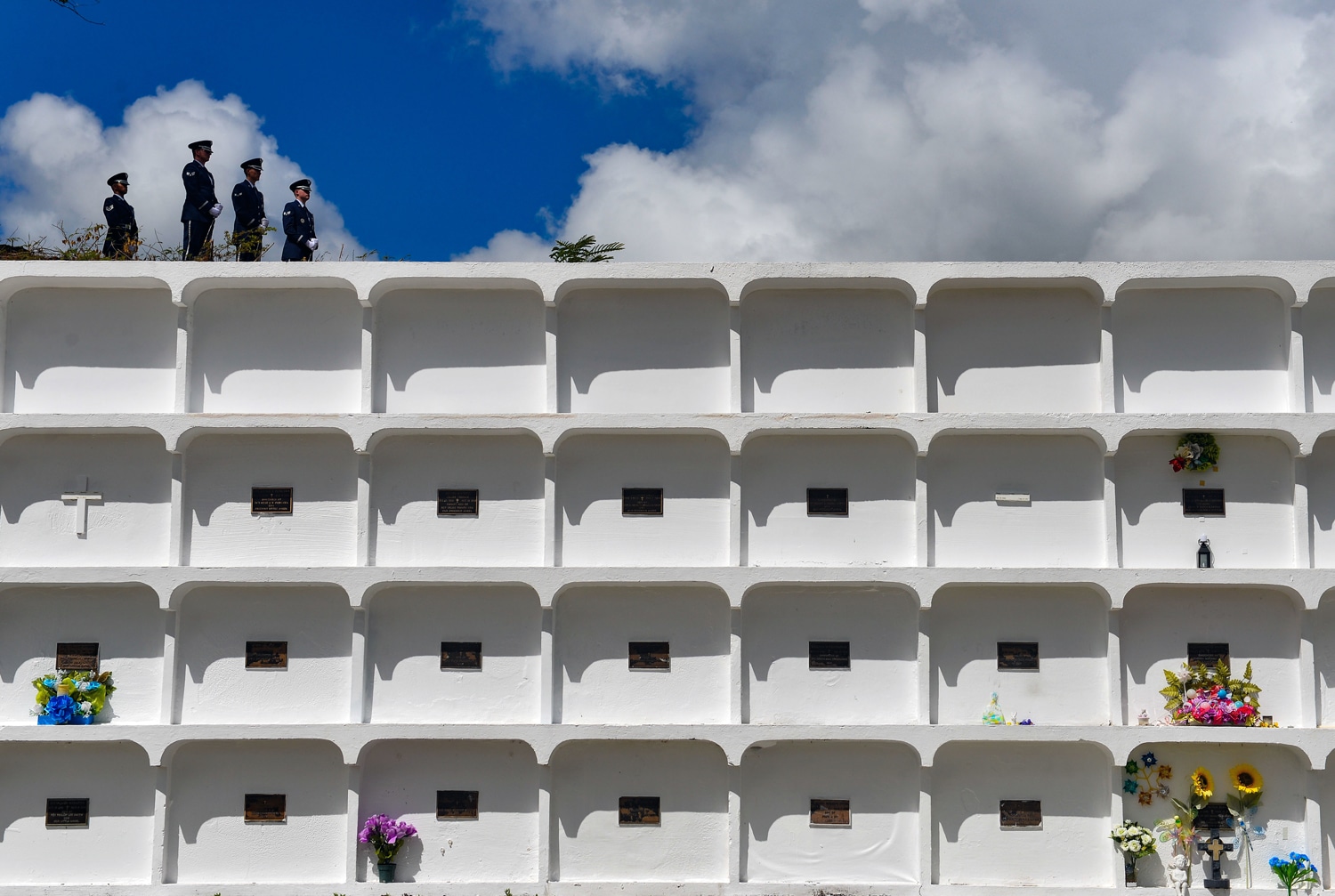
If you are Chamorro, you are always coming back from burying the dead.
In Guam, an average of one person per day is diagnosed with cancer. If you are Chamorro, you are always coming back from burying the dead.
After heart disease, cancer has put more of us in the ground than anything else. In Guam, an average of one person per day is diagnosed with cancer, while every other day, on average, one person dies of it. We die from common kinds — breast, liver, lung — and we die from rare kinds too. For example, the incidence of nasopharyngeal cancer (cancer of the top of the throat) is almost seven times higher here than in the United States in total. Controlling for ethnicity, the incidence rate for Chamorros is ten times higher, while the mortality rate is nineteen times higher. In the central village of Mongmong, this type of cancer is so common that it has claimed the lives of whole households. I know one woman, Inez Susuico Lujan, who lost all five of her siblings to this one cancer. She herself died of it last year.
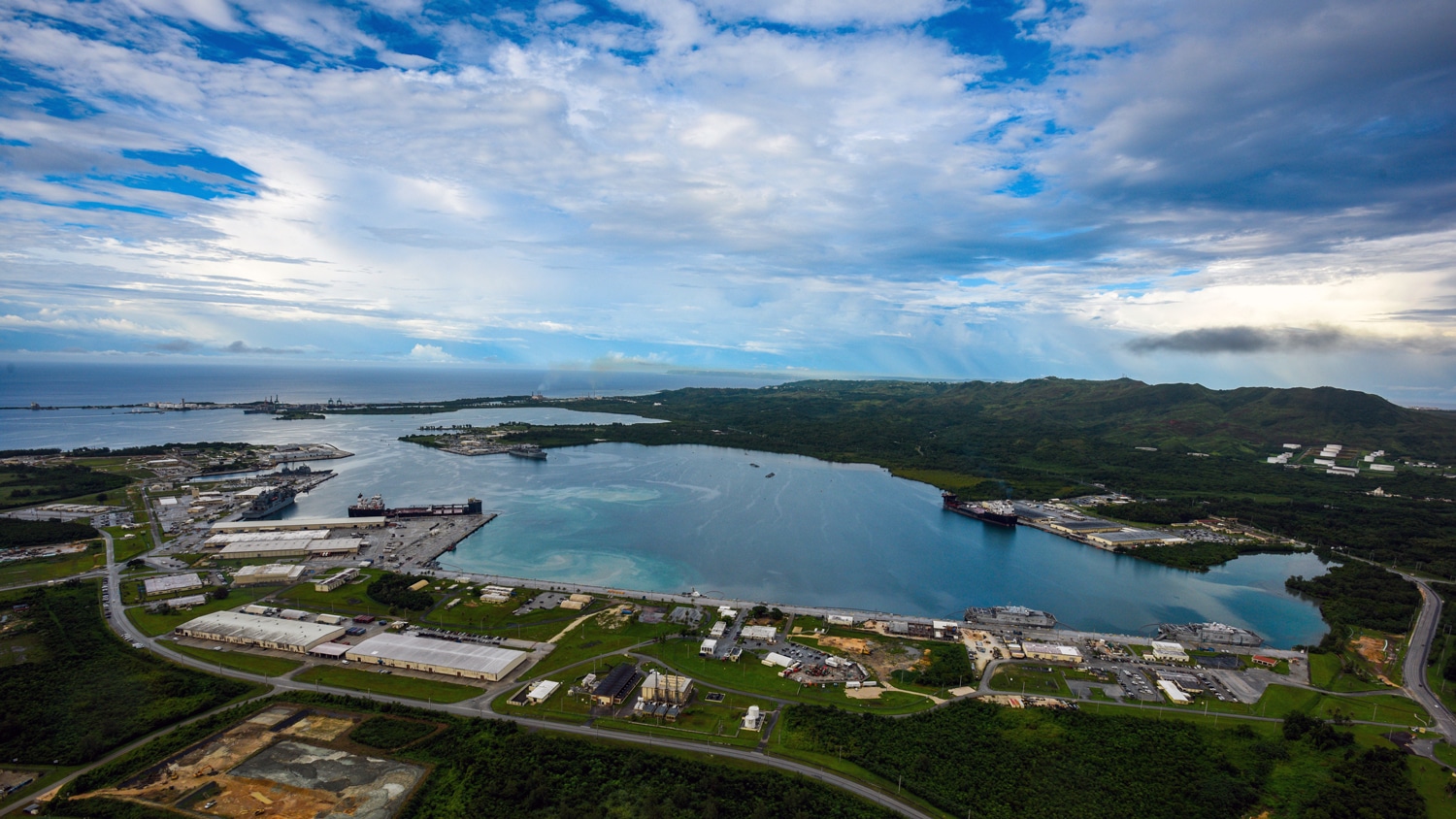
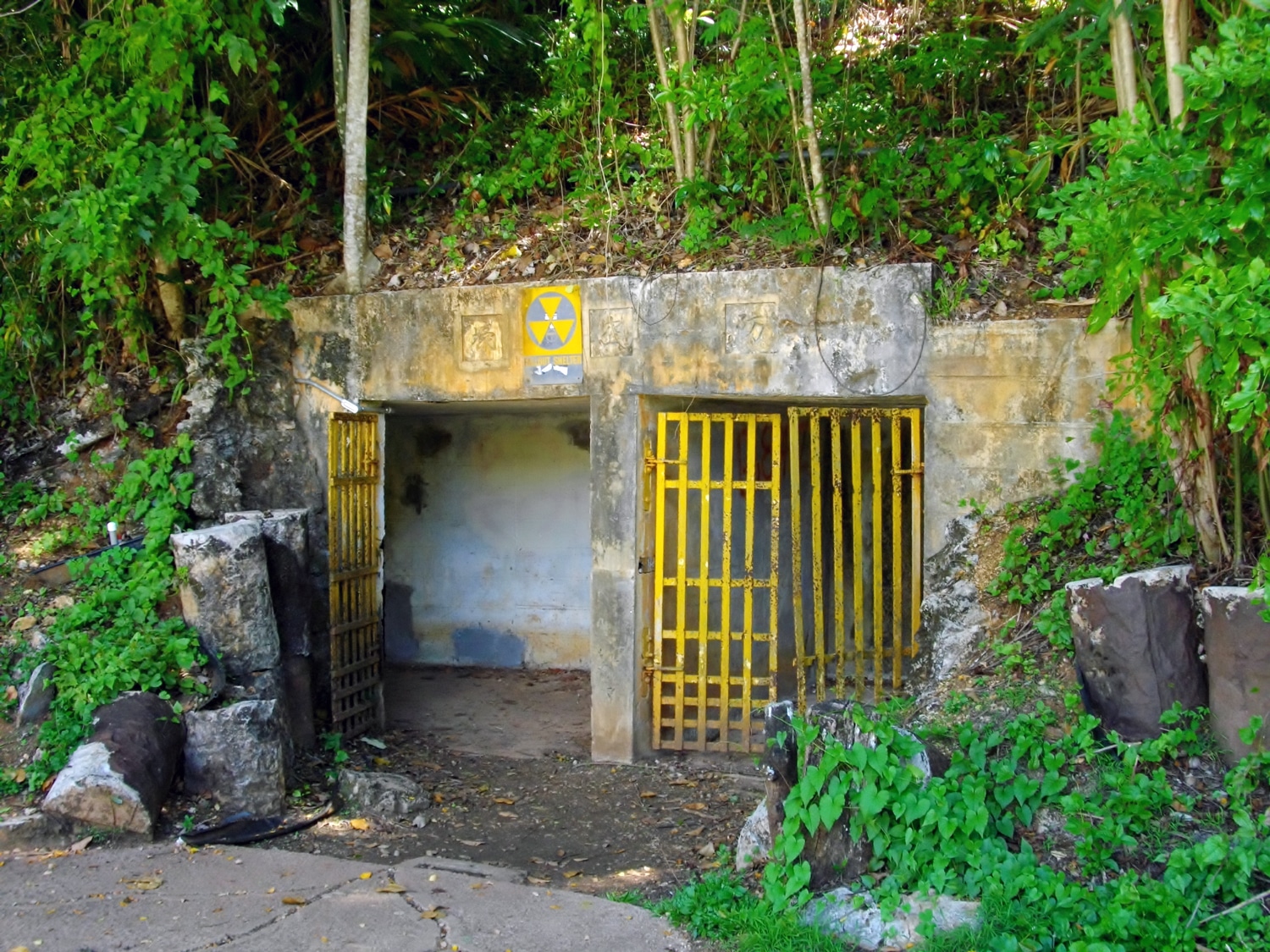
Inez could never prove it, yet believed (as we all do) that her family’s illnesses were caused by contamination from U.S. military activities. More than 70 years ago, runoff from a Navy-operated power plant in her village drained into a portion of the Hagåtña Swamp — the largest wetland on the island — contaminating the entire area with PCBs. It is no coincidence that Inez’s childhood home sits across the street from that power plant. She and her siblings spent their youth beside that swamp, playing by it, swimming in it, catching and eating eel and catfish from it. They also regularly helped their farmer father, whose small vegetable garden ran along the swamp’s edge.
Cancer clusters have arisen in other villages as well. A study done by local epidemiologists in the late 1990s found that Yigo and Santa Rita have notably high mortality rates for cancer, particularly when employing age-adjusted World Health Organization standards. The study, which consisted of a detailed review of death certificates from 1971 to 1995, also found that Merizo had the third-highest mortality rate. In fact, from the late ’70s to the late ’90s, Merizo residents were almost twice as likely to die from cancer as inhabitants of other villages.
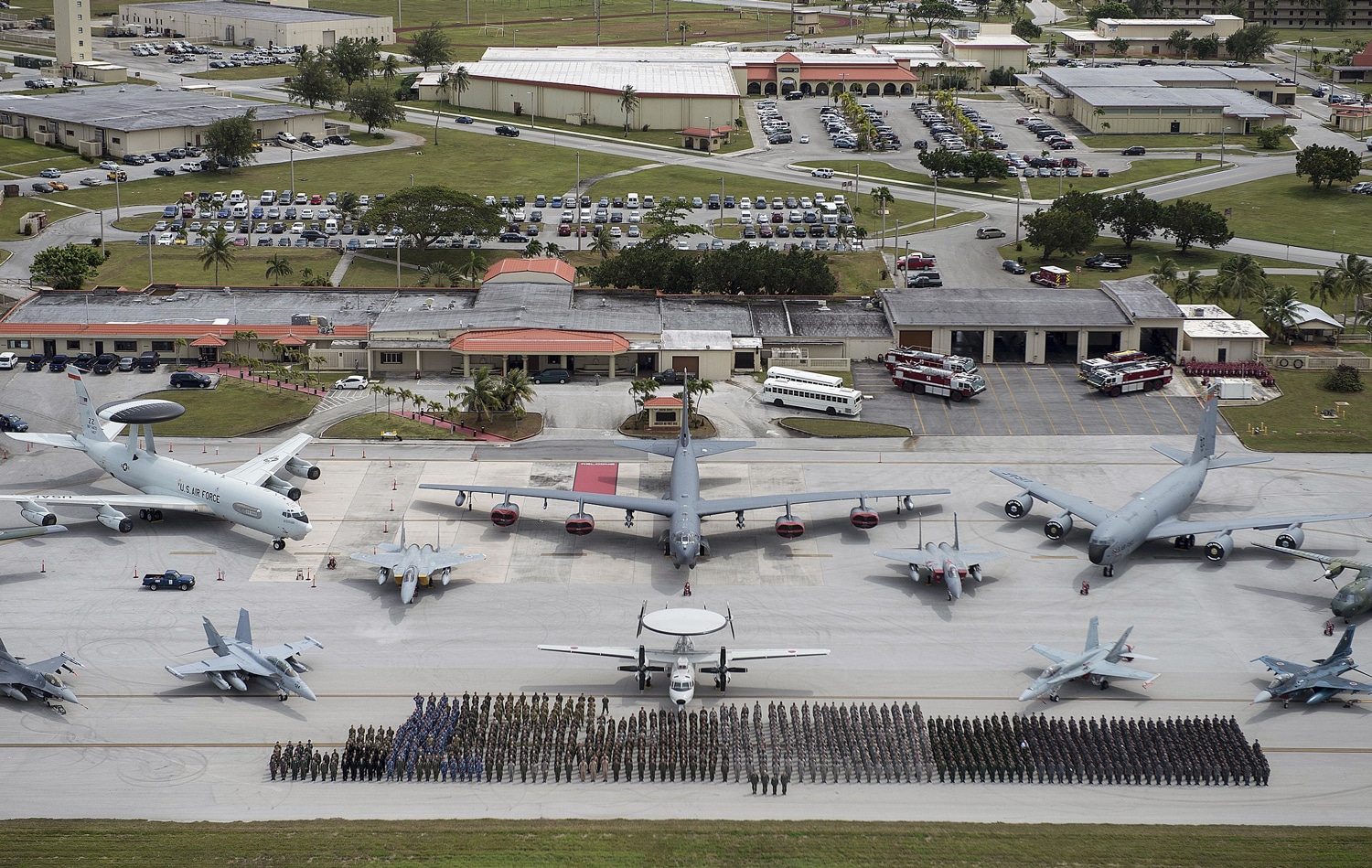
Although the study steered clear of conclusions (as they say, correlation is not causation), it cannot be coincidence that Yigo and Santa Rita are the two villages on the island sited closest to military bases; the Air Force base is in Yigo, while the Navy base is adjacent to Santa Rita. The same can be said for Merizo, whose waters were contaminated by the Coast Guard.
In a militarized colony like Guam, everything is political, even cancer.
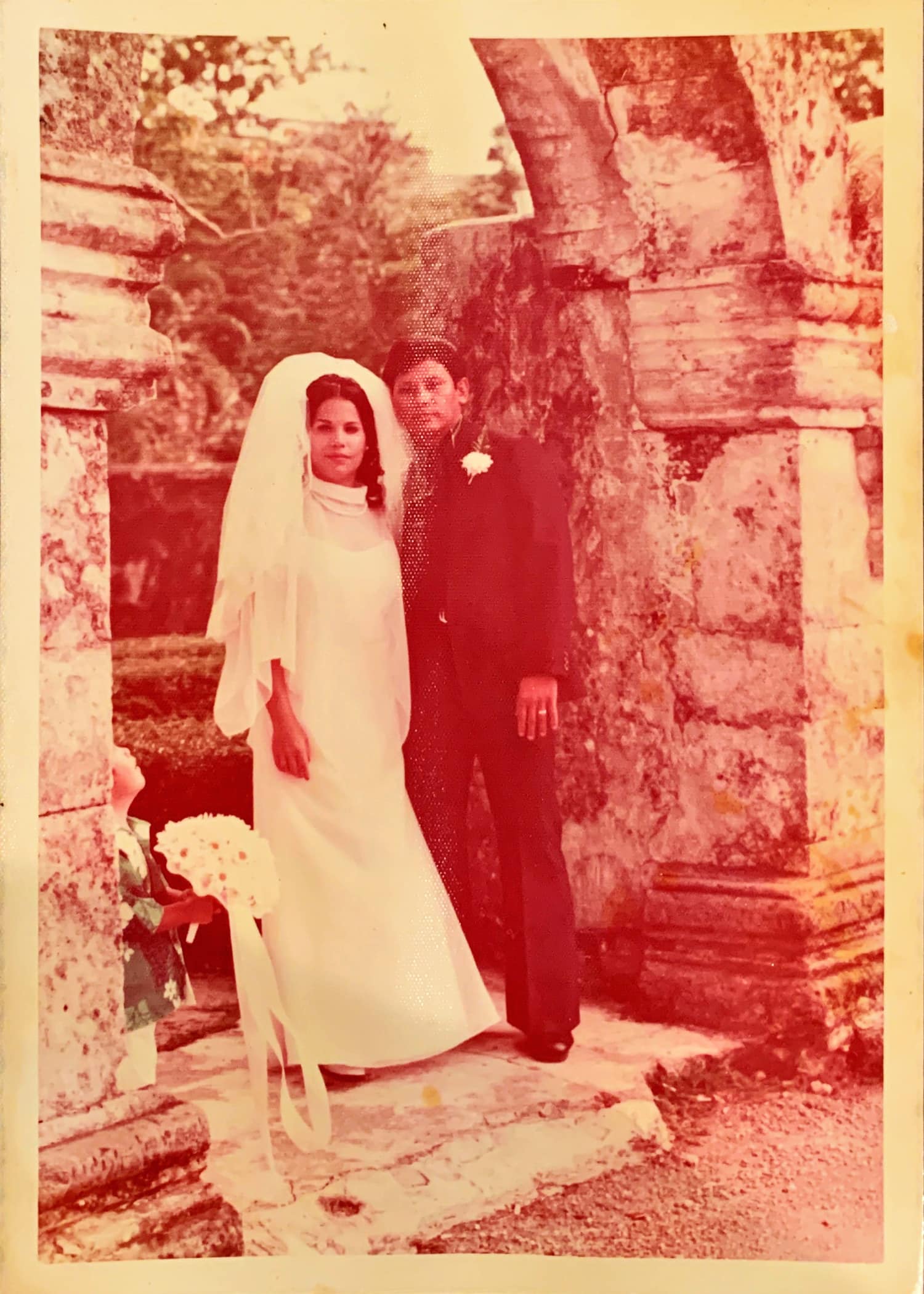
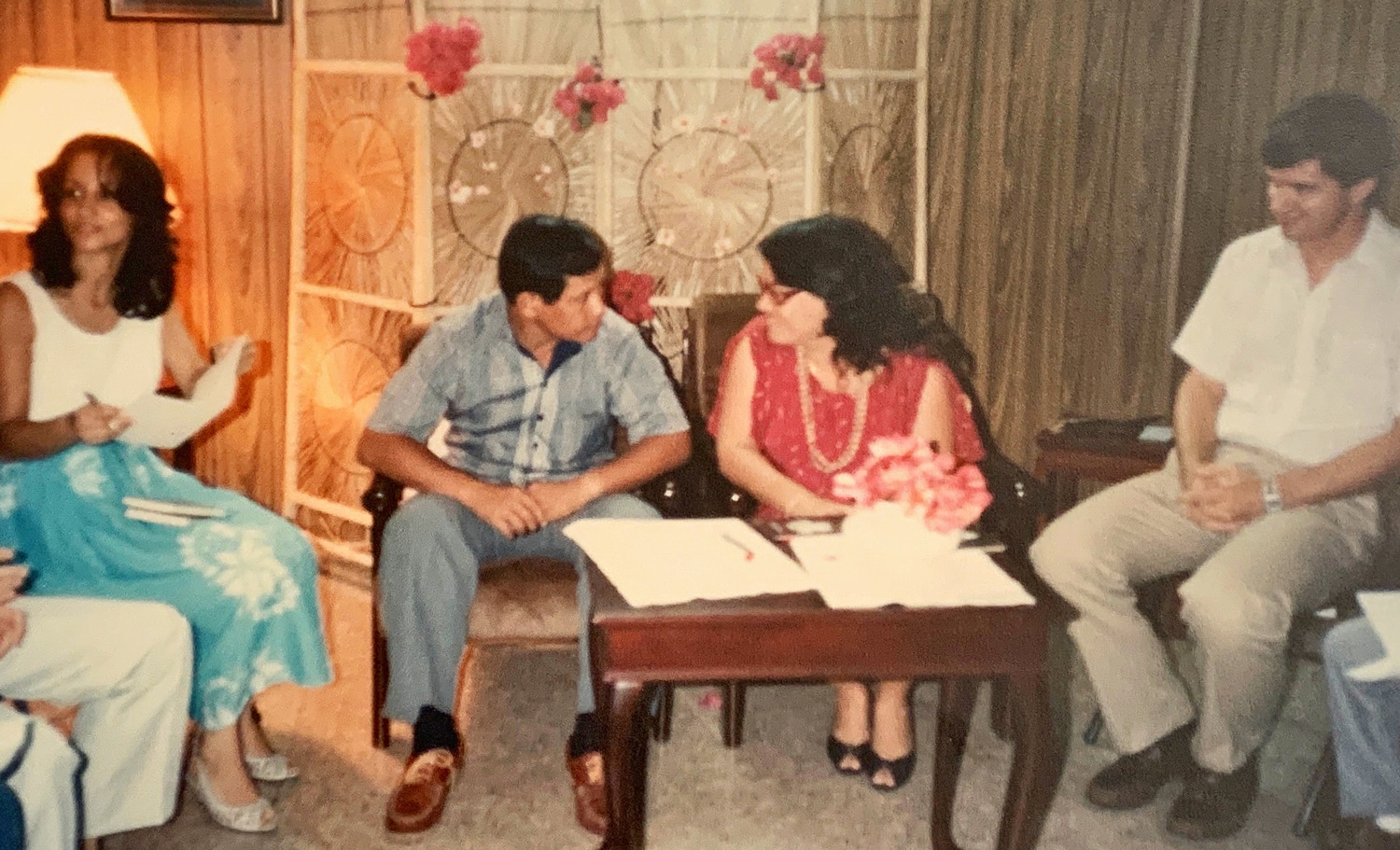
My dad was 45 when he died. Being the youngest child, I didn’t know him the way my brothers and sister did. What I’ve pieced together, from their memories and my own smaller inventory of the same, is that he was loving but stern. A father hard on his sons but never on his daughter. A husband desperately in love with his wife. He loved to run (mostly along beautiful Tumon Bay). He liked to cook (mostly breakfast) but liked eating more. By all accounts, he lived a small life. By all accounts, he liked it that way. He worked for years as a plumber. Before that, he worked as a clerk in the personnel offices of Andersen Air Force Base, the biggest of the bases the military built in the village of Yigo after the last world war.
He worked as a pipe-fitter at the naval-ship repair facility at Apra, the island’s only deep-water harbor. The same harbor where he was probably exposed to carcinogens in the first place.
My dad worked as a pipe-fitter at Apra, the island’s only deep-water harbor — where he was probably exposed to carcinogens.
After the war, the military sent several warships to Apra, all of them contaminated with radiation from nuclear weapons tests being carried out in the nearby Marshall Islands. The vessels were part of a fleet of about 80 ships subjected by the military to a pair of detonations that took place at Bikini Atoll in the summer of 1946 as part of Operation Crossroads, whose stated purpose was to study the effects of radiation on warships and other naval targets. The military gathered the target vessels in the Bikini lagoon, then attacked them with plutonium bombs — weapons not unlike the Fat Man bomb dropped on Nagasaki one year earlier.
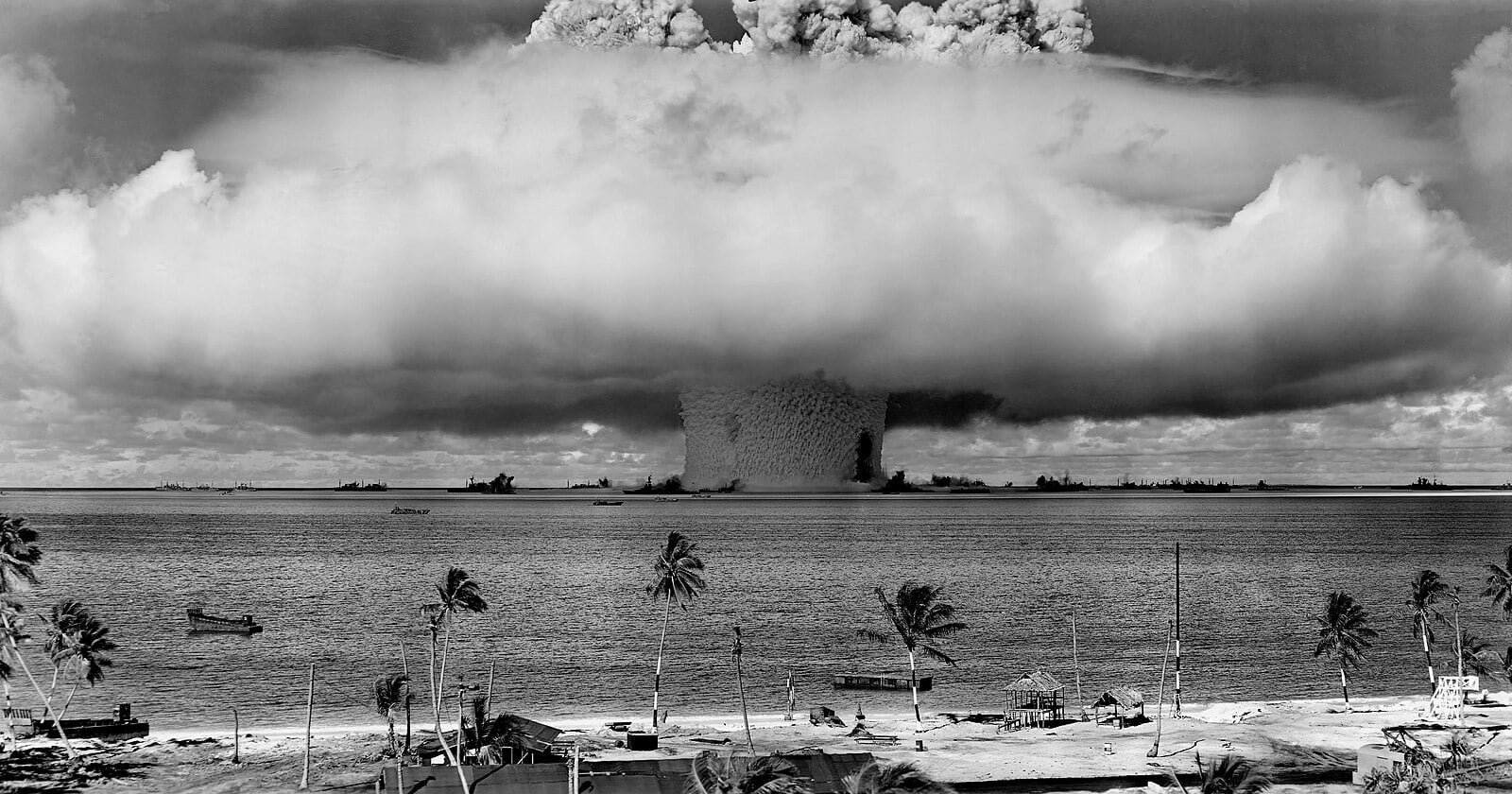

The first test (Able) was an atmospheric test, while the second (Baker) was an underwater one. A third test (Charlie) was cancelled because the Navy wasn’t able to properly decontaminate the ships after the first two. This pair inaugurated a series of 67 nuclear weapons tests that the United States would conduct in the Marshall Islands between 1946 and 1958.
The first tests, Able and Baker, inaugurated a series of 67 nuclear weapons tests that the U.S. would conduct in the Marshall Islands between 1946 and 1958.
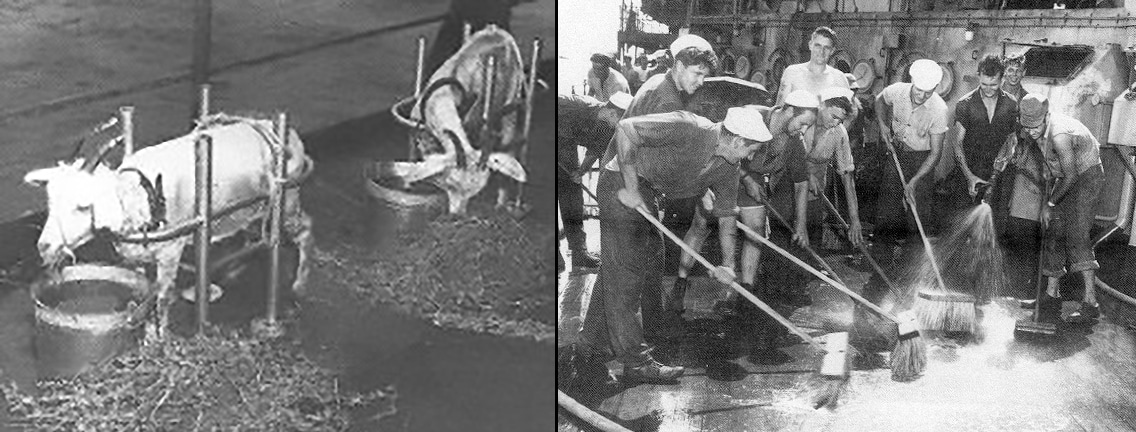
The tests were performed to great fanfare. For Able, military personnel were joined by a large contingent of the global press, who were invited as spectators and placed on nearby ships to observe the explosions. Incredibly, they were issued only dark glasses for protection. These were the early days of the atomic age, and protocol for radiation exposure was not yet a thing. Neither was decontamination protocol. Thus, in the days after the detonations, the targeted ships were cleaned using the traditional deck-scrubbing methods: soap and lye. It is no surprise that thousands of the sailors who did this work, with no protective gear, developed cancer at crazy rates.
It would seem that nothing changed between the first nuclear test and the last, at least in terms of how the U.S. government has treated these veterans. I have an uncle who took part in the cleanup of the Marshall Islands, which did not take place until nearly 20 years after the explosions. He arrived in Enewetak Atoll, some 300 kilometers from Bikini, in October 1977, with a few hundred other Army volunteers. He was nineteen years old, and his job was to drive around in a truck, scraping up contaminated soil, and dumping it into a massive crater left by one of the bombs. That crater would come to be filled with 3.1 million cubic feet of radioactive waste, capped with concrete, and called the Runit Dome.
Locals call it The Tomb.
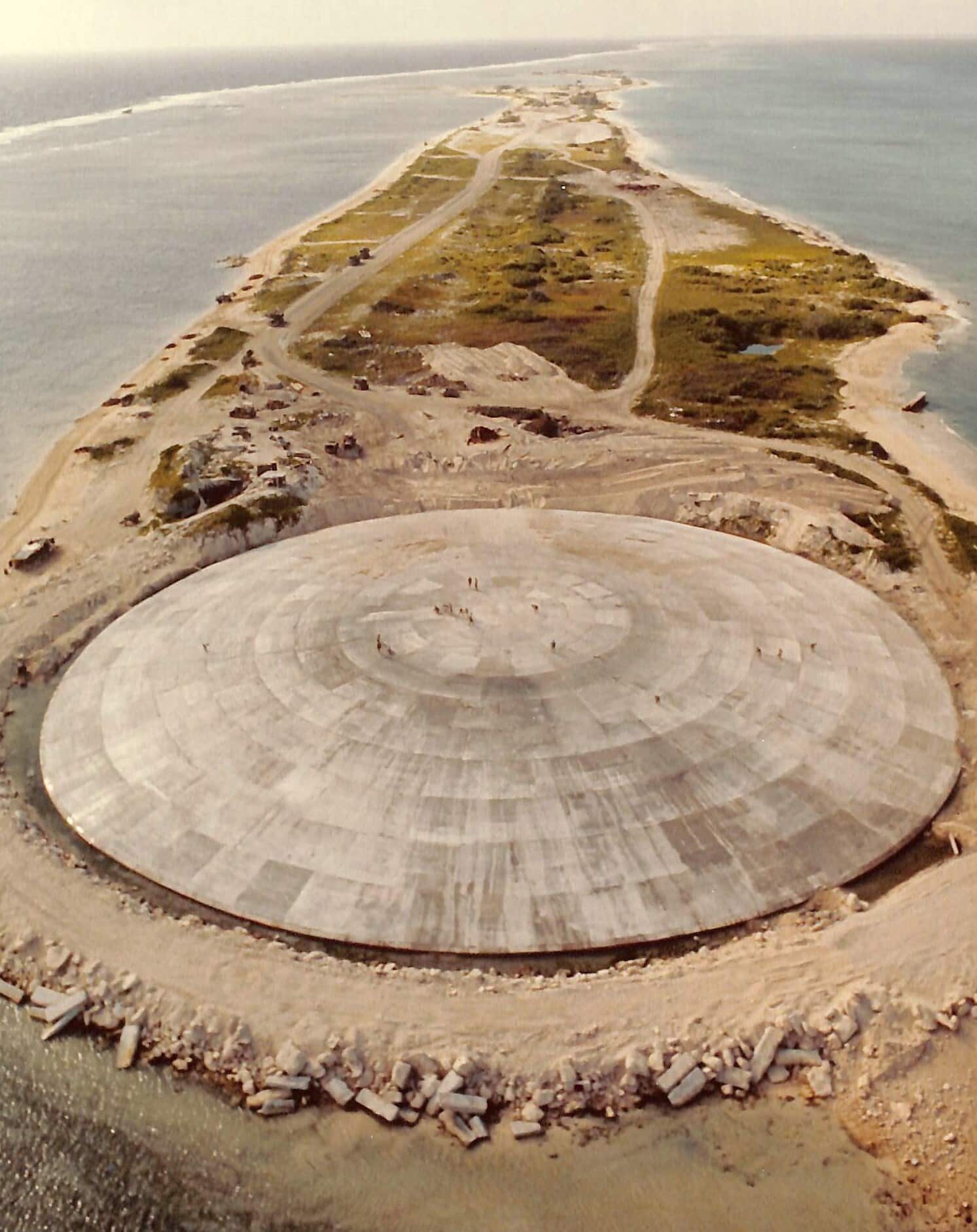
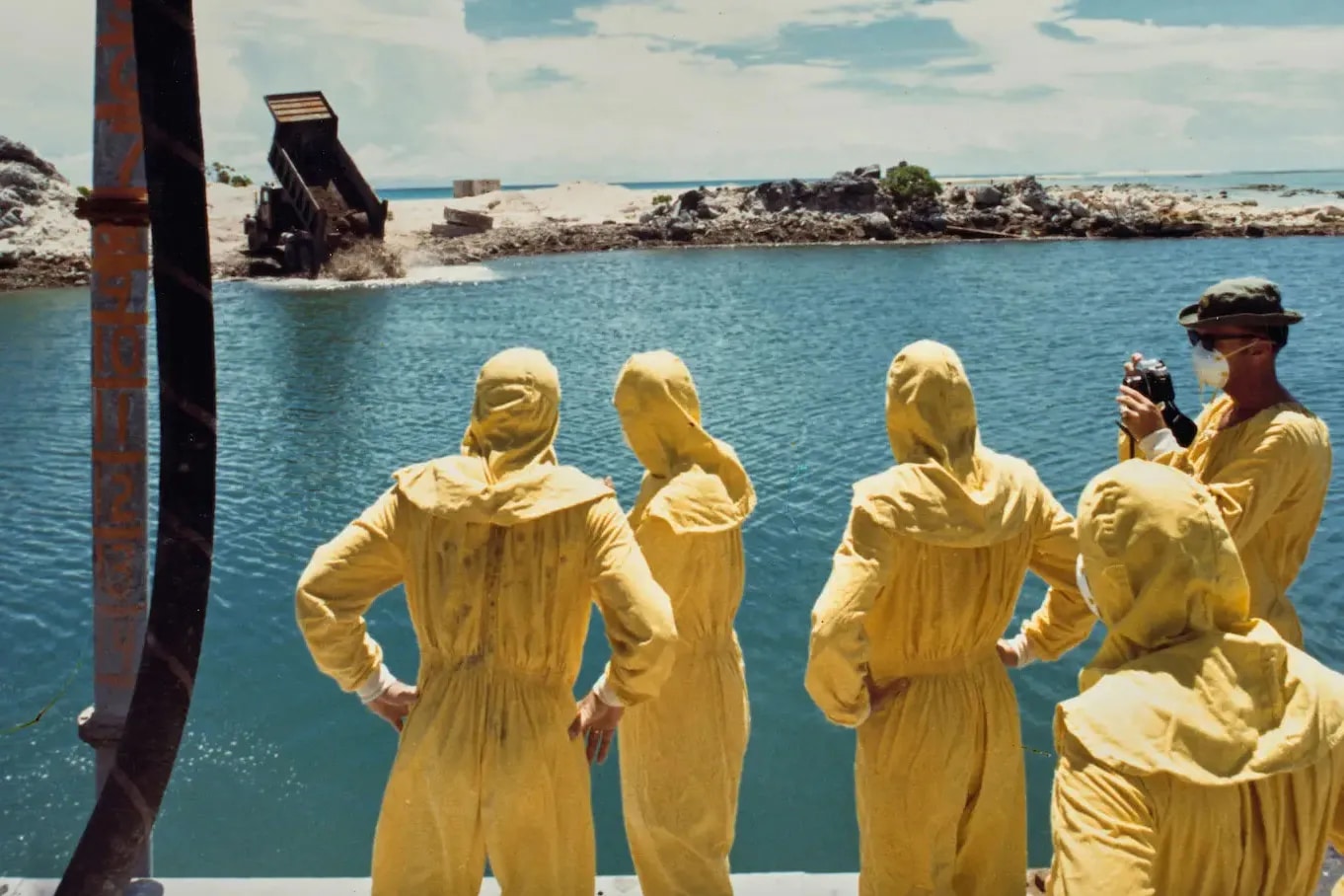
In the six months my uncle lived and worked at Enewetak, the only protective gear he was ever given was a pair of rubber boots and a painter’s mask — with one exception. One day, the exact date of which he cannot recall, a military film crew visited the site, bringing with them brand-new yellow hazmat suits. The film crew had my uncle and his co-workers don the suits, then took photos of them. As soon as the photo-op was over, the crew left, taking the suits with them.
The isotopes released at Apra Harborhave half-lives of thousands of years. Even a millionth of a gram poses a significant threat to human health.
The first time my uncle told me this, I was seventeen and shortly off to college, which is to say I knew nothing yet of American history and so had no appreciation for the cruelty of which this country is capable. I am ashamed to say that, though I believed his story in general, I did not quite believe the particulars. I recall the exact moment, years later, when I stumbled on a New York Times article confirming every surreal detail. The photos themselves show just how yellow those hazmat suits were.
They were obnoxiously yellow.
It would be years before my dad worked at Apra Harbor, yet the Navy never did clean it up. The isotopes released there from the irradiated ships have half-lives of thousands of years. Plutonium has a half-life of 24,000 years. Even a millionth of a gram poses a significant threat to human health.
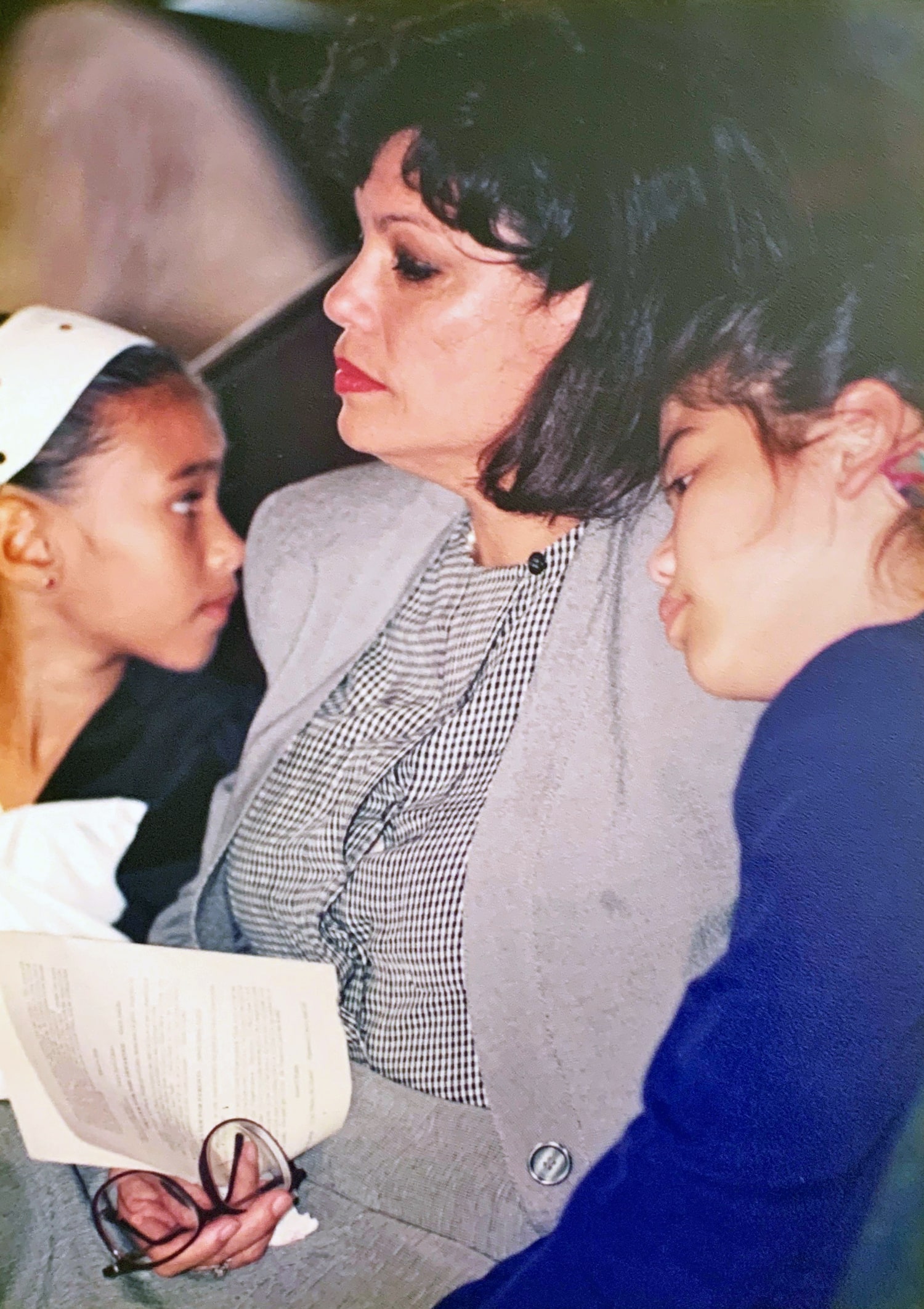
Most of my father’s funeral, held in a small white chapel in the southern village of Piti, is a blur.
I have no recollection of who was there or what was said. I do not recall a eulogy. I do not recall how many people came forward to view the body or to hug my mother. I do not recall what food our guests were served. Try as I may, I cannot remember much.
But I do remember singing. I sang exactly one song, which is really a short prayer from the Baháʼí faith titled Blessed is the Spot:
Blessed is the spot, and the house,
and the place, and the city,
and the heart, and the mountain,
and the refuge, and the cave,
and the valley, and the land,
and the sea, and the island,
and the meadow where mention
of God hath been made,
and His praise glorified.
Of all the Baháʼí prayers I learned growing up, this was never my favorite. It always felt a little lifeless to me. Like a list. Over time, however, I realized that its power lies in all the ands. And, and, and. As if to say, yes, yes, yes. As if to surrender. To a god or to the goodness of the earth, I’m still not sure. All I know is that day my sister, who was the closest to our dad, needed the power of prayer more than I did. And it was her favorite.
My father’s funeral may have been the first one I sang at, but by the time I was a freshman in high school, I had sung at more than 150 others.
I could not know then how prescient the moment would be. It was as if I had opened a can of worms in the other world. My father’s funeral may have been the first one I sang at, but by the time I was a freshman in high school, I had sung at more than 150 others. It got to the point where I was singing at the funerals of complete strangers. Once, in eighth grade, I was pulled out of school three times in one week — each time to sing over a corpse in a lowering casket.
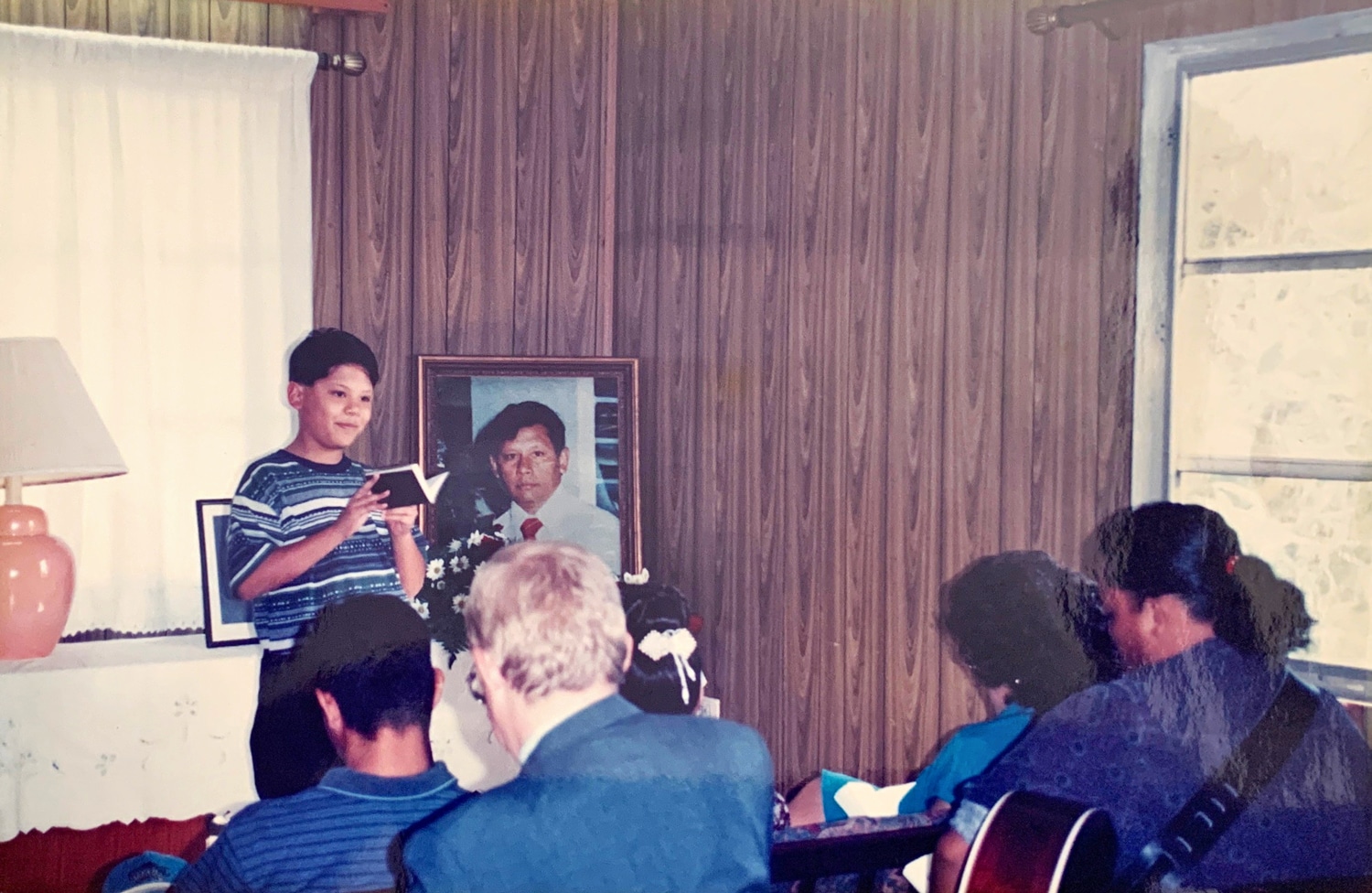
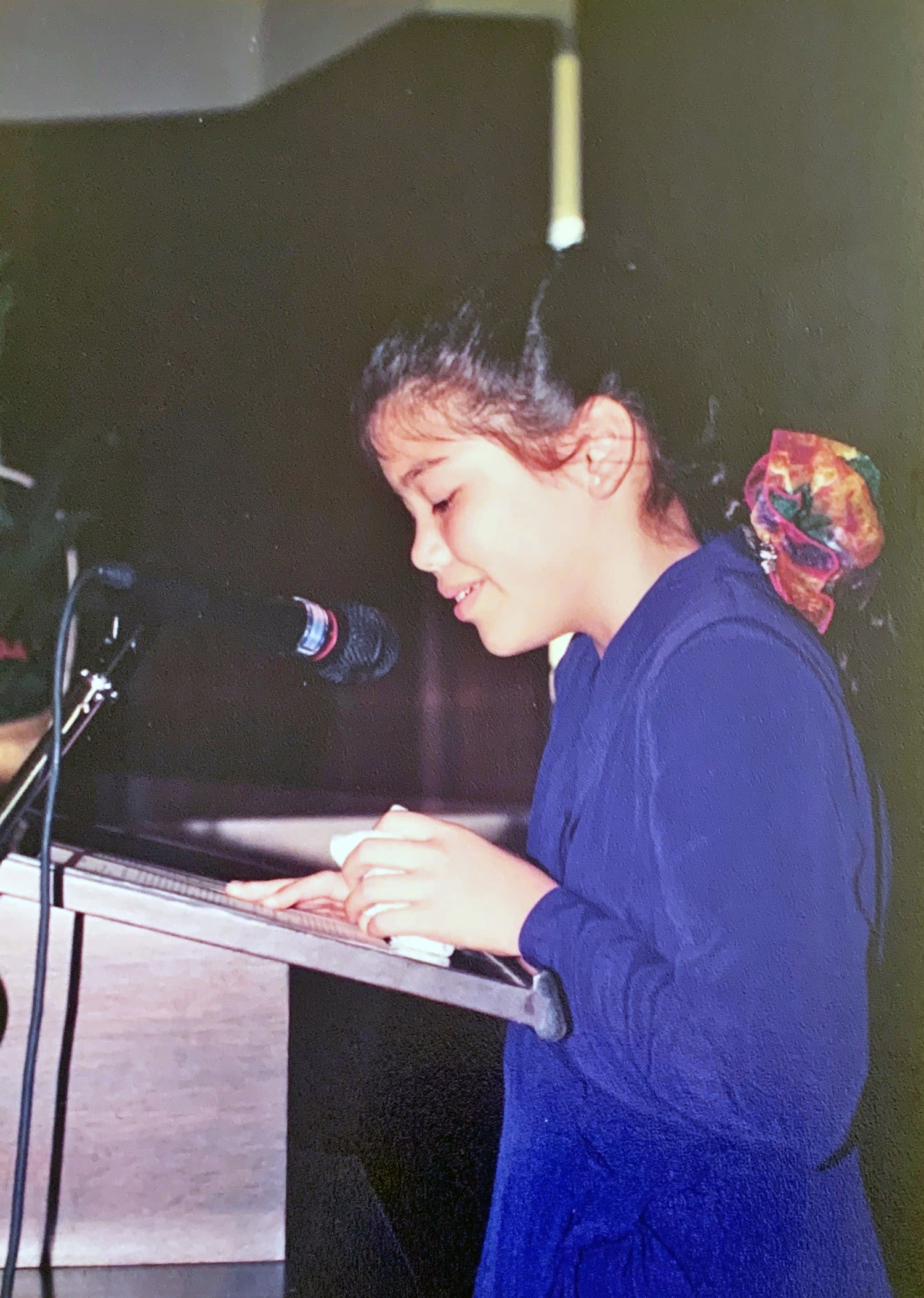
Looking back, I wonder whether my education suffered because of these choices, which, of course, were more my mother’s than mine. Perhaps it did. Perhaps if I wasn’t so busy singing for the dead, I’d be better at math. But then I would have missed out on all the other kinds of accounting necessary for living as fully as one can in a colony, which is to say without fear of death.
I fear dying, but I do not fear death.
Not because I’m a badass, but because death is so familiar it is almost banal. Burying people, when you’ve done it as much as I have, can be as banal an act as boiling eggs, or cooking rice in a rice pot. This is not to say that death is easy; it is just easier than life, or rather, life after death. The going on part. The grief. The grief that curls up like a housecat, then chases you around the house.
This is not to say that death is easy; it is just easier than life, or rather, life after death. The going on part. The grief.
I came to the Baháʼí faith as a child often comes to religion, by way of the parent — in this case, my mom, who converted from Catholicism in her 20s. She was taken by the notion of progressive revelation, one of the central tenets of the faith, which holds that all religions are inherently one and that truth is revealed by God progressively, through an unbroken chain of divine messengers going back to Abraham — and even before that, if you take into account the Indigenous messengers whose names have been lost to history.
In short, Bahá’ís believe that the 19th-century Iranian prophet Bahá’u’lláh is the last in this long line, and that his message of oneness is the antidote to all that ails us. I’ve always loved the notion of oneness, the idea of religion as a sea to which all rivers run. A room big enough for everyone. A house we can all call home.
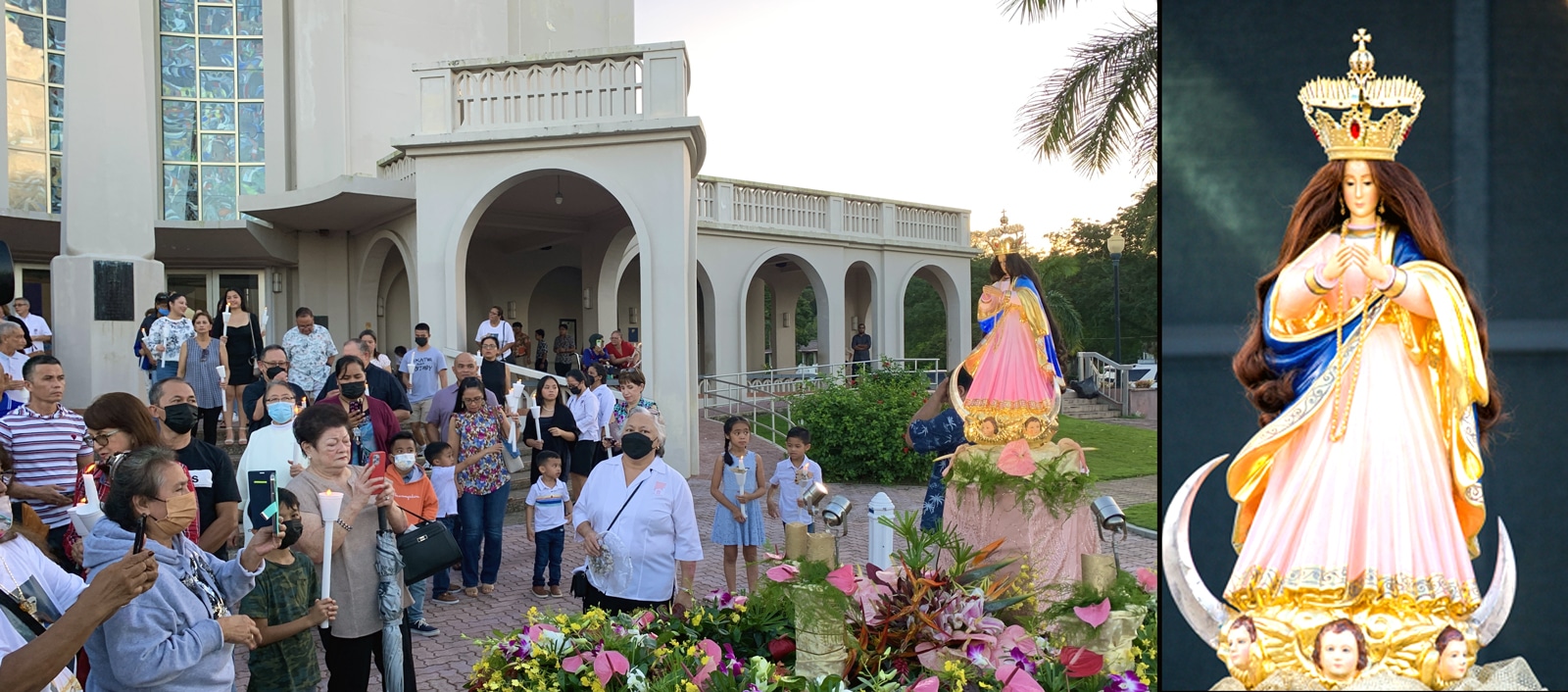
But the truth is I was never entirely at home in the Baháʼí faith. For starters, almost everyone in Guam is Catholic, almost all the Chamorros anyway. If I ever wanted to worship while also surrounded by family — that is, besieged by an army of aunts and uncles or buoyed by the great childhood joy of running amok with cousins after service — it would have to be at church. So, to church I went. And I loved it. I loved the rituals. I loved the rosary. I loved inching my fingers along its beveled beads. Something about that act soothed me, even though I didn’t know much about the mysteries, or why some of them were sorrowful.
I loved Mother Mary most of all. I loved her even though I always thought of her more as an aunt than a mother. I imagined what it must be like to be her — not as in the first home of God, but as in full of grace.
I wanted so badly to be full of grace.
Maybe then I could stop my mom’s incessant crying.
But I wasn’t and I couldn’t.
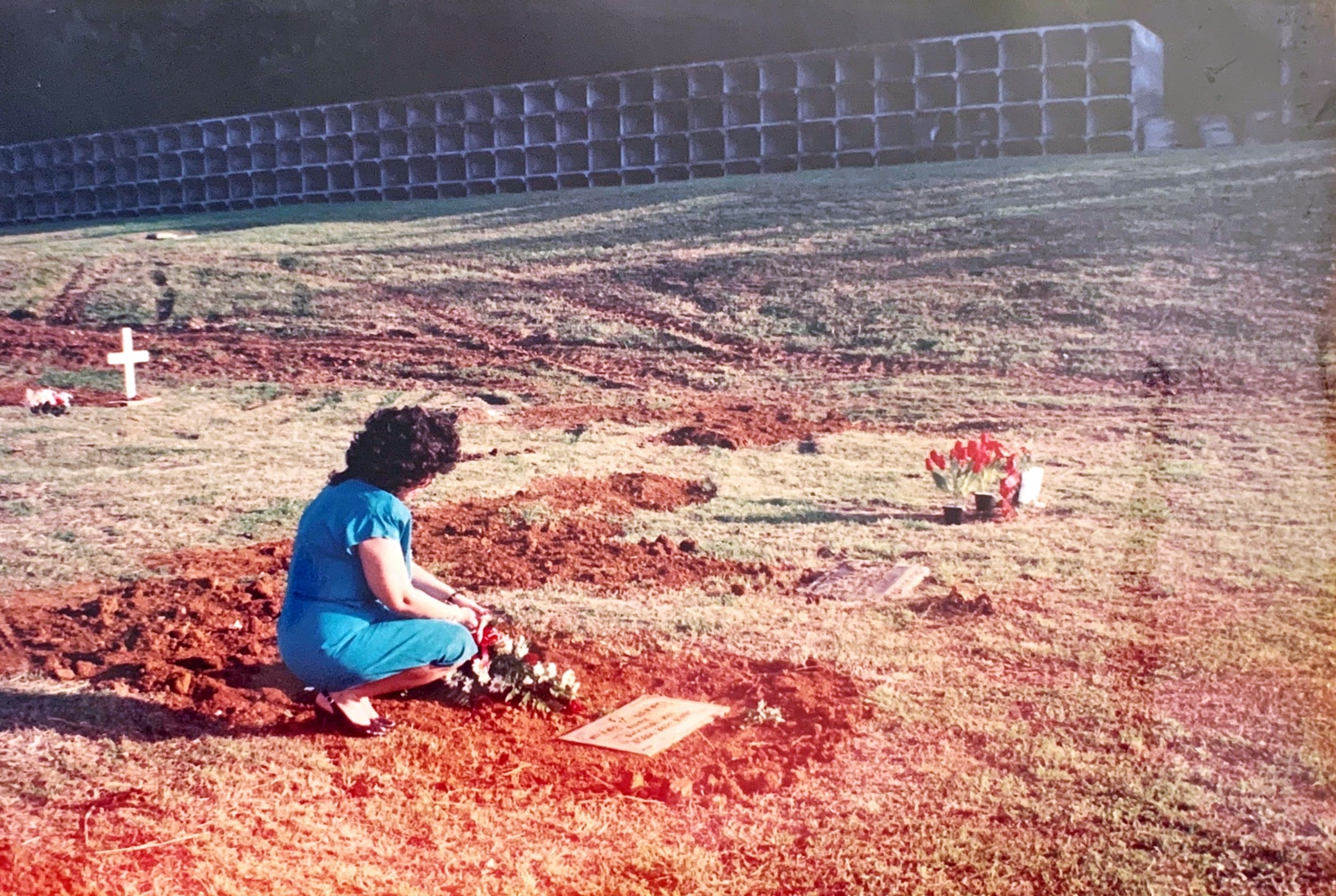
All the evidence I needed of that I got on April 1, 1992, a date I remember because it was my mom’s 41st birthday, her first since my dad died. That morning, she dropped my sister and me at the mall, with 20 bucks and two hours to shop. For a birthday gift for her. Oblivious as to how sad that was, my sister and I took our small fortune and went searching with a zeal neither of us had known before. We ran up and down, dashing in and out of every store, until we found Tabequera Gifts. A small novelty shop on the second floor filled with wondrously random trinkets. The teenage clerk asked if we needed help, and we let him in on our mission. He directed us to a section of the store filled with what he called gag gifts, which we had never heard of. We settled on a big three-dimensional card and an even bigger balloon, both of which read, “Congratulations! You’re Over the Hill!”
I wanted so badly to be full of grace. Maybe then I could stop my mom’s incessant crying. But I wasn’t and I couldn’t.
We were so excited we couldn’t contain ourselves. We presented the gifts proudly, before our mom could turn on the ignition. What happened next I’ll never forget. She smiled softly, said nothing, and put on for her favorite cassette tape, The Very Best of Anne Murray.
We sat in that parking lot for an hour. An hour that aged me more than I can ever say. I watched my mom, which is to say my world, fall apart from the passenger seat of a white Toyota Camry.
To this day, I can’t bring myself to listen to the first track of that Anne Murray album, which starts off so sweetly:
I’ll always remember the song they were playing
The first time we danced and I knew
As we swayed to the music and held to each other
I fell in love with youCould I have this dance for the rest of my life?
Could you be my partner every night?
When we’re together, it feels so right
Could I have this dance for the rest of my life?
Could I Have This Dance is a lie. It is a ghost where a song should be.
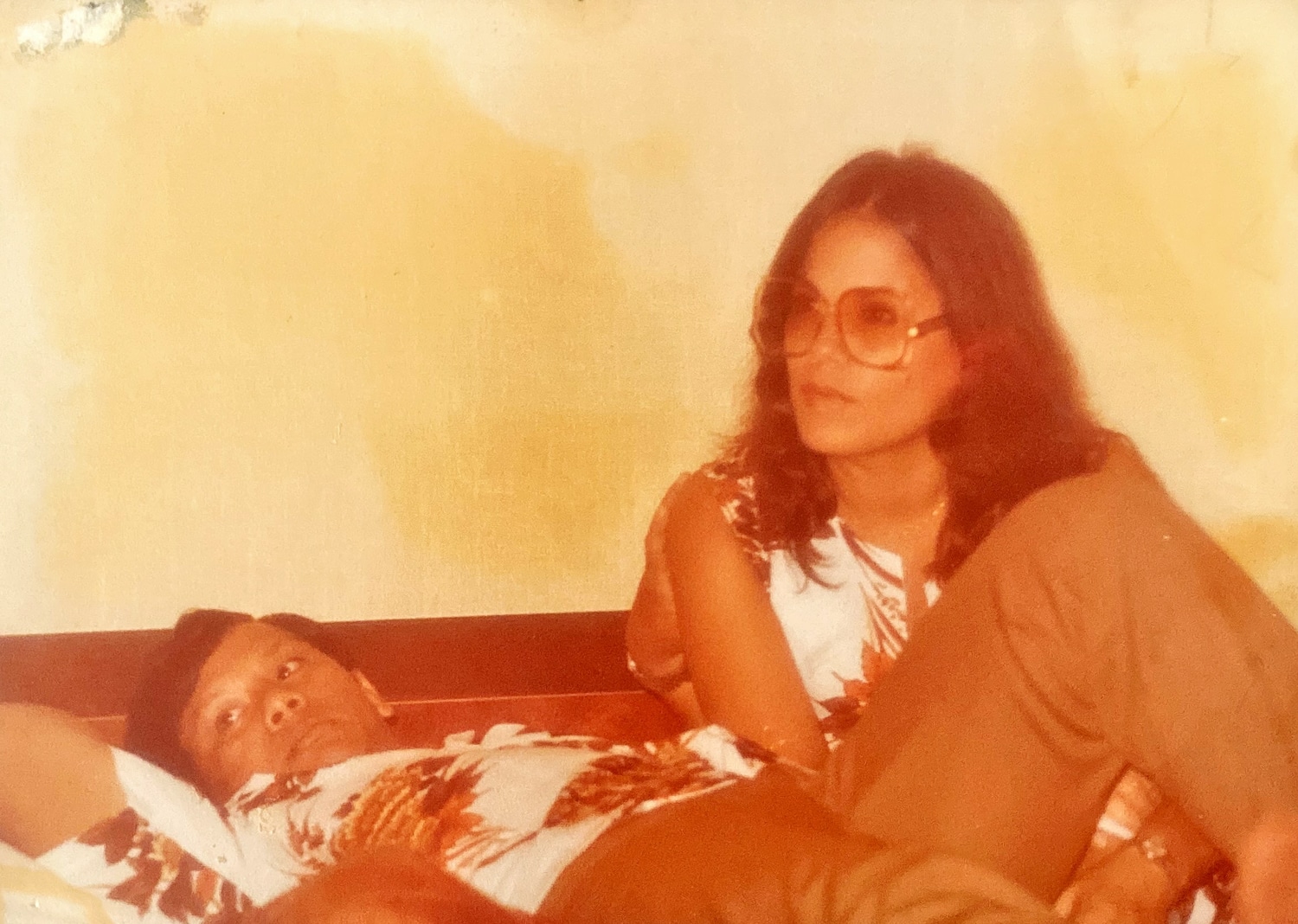
This piece is deliberately full — crowded with the big and the small, the political and the personal — because that is what life in Guam feels like. For readers, especially American readers, I wanted to offer not one story but a snapshot of many. That’s why I have moved so quickly, tugging you from one heavy subject to another: colonial history, environmental contamination, cancer rates. The pace itself is part of the point. It is a way of giving you a bird’s-eye view of what it’s like to come of age on this island, where grief and politics, intimacy and empire, are always colliding.
To write honestly about this island means admitting that mortality is not an interruption but a condition of daily life.
I could have written this differently. I could have lingered on one death, slowed the narrative to focus on a single loss. But that would have felt untrue to our experience. Here, loss is ambient, always present, always circling. To write honestly about this island means admitting that mortality is not an interruption but a condition of daily life.
At the same time, what this essay does not cover is equally important. It does not recount the many stories of resistance that run through our history, the countless ways Chamorro people have refused to be passive victims of empire. At every turn, in ways large and small, we fought back. That tradition is real and ongoing. To take but one example, the uncle I reference (who took part in the cleanup of the Marshall Islands in the 1970s) is Robert Celestial. A retired Sergeant in the U.S. Army and a disabled atomic veteran, Uncle Robert has been a lifelong campaigner for nuclear justice. Among other roles, he serves as the President of the Pacific Association for Radiation Survivors.
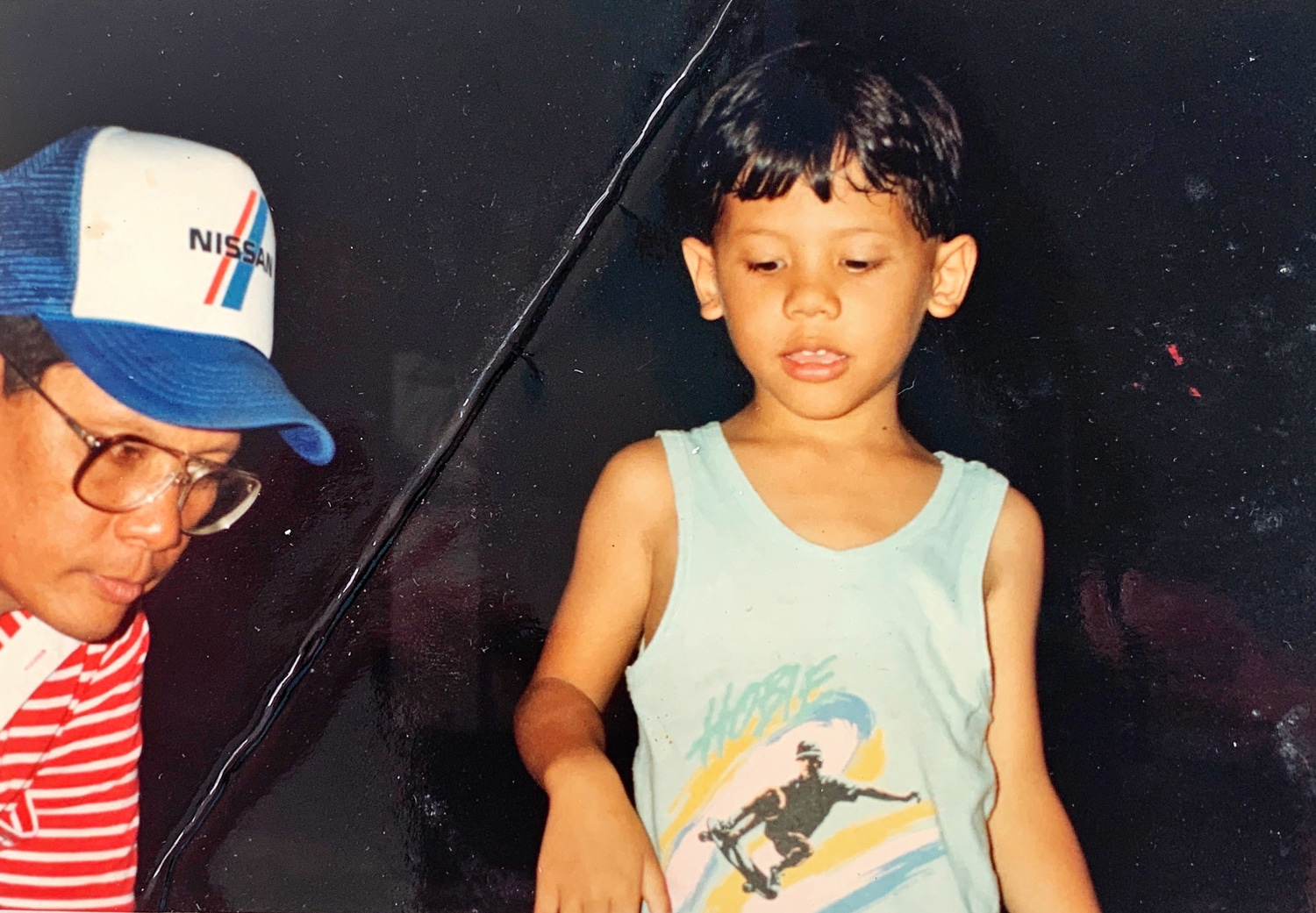
In the end, what I offer here is but a fragment of a story, a fast-moving sketch, a glimpse of an island where beauty and brutality exist side by side, and where telling the truth often means refusing to slow down.

.jpg)

.jpg)


If you would like to comment on this article, or anything else on Places Journal, visit our Facebook page or send us a message on Twitter.