

Amid confusion there was a friendly sign. A smile. An arrow. A smarrow. Stacked up between street trees along the service road behind my Manhattan apartment were thousands of cardboard boxes standing on end — Chewy, Blue Apron, Peloton — the rising stars of internet commerce in the early months of the pandemic. And, of course, Amazon. Every third box was Amazon’s, instantly recognizable, with that famous logomark connecting two letters in the company name, promising to deliver with alacrity everything from A to Z. 1 This was essential work, or legally constructed as such. Almost overnight, East 23rd Street became a curbside distribution hub, where workers unloaded trucks and moved boxes by handcart, bringing shampoo and socks, meal kits and milk-bones, stationary bikes and sourdough starter kits to the 30,000 or so humans, plus a few thousand pets, holed up in Peter Cooper Village and Stuyvesant Town. 2 We extracted our wares, carefully flattened and stacked the boxes, sent the cardboard back to the curb, ready for reincarnation at a recycling center. 3 There was comfort in this ritual — or at least familiarity, which passes for comfort in difficult times. The smarrow points the way forward.
The cardboard box brings the logistics chain to our doorstep. Packages are not just commodities; they are communications.
It was a boom time for cardboard. Amazon leased a new warehouse in Hunts Point. Another in Red Hook. One on Staten Island, at the Matrix Global Logistics Park. Nationally, the company doubled its real-estate footprint (before scaling back a bit). 4 But as delivery trucks proliferated, so did tent cities. Homelessness in the United States rose to levels not seen since the Great Depression. On any given night last year, more than 650,000 people were homeless, and more than a third of those lived outdoors, shielded by tarps and tents and cardboard sheets. 5 Here the smarrow smirks from a leaky paper roof. New York City has a new Homeless Bill of Rights affirming the right to sleep outside, but other cities have petitioned for permission to clear encampments, making little distinction between cardboard scraps and personal treasures. 6
As historian Maria Rentetzi writes, “the cardboard box — the waste of our commercial world — is recycled in such a way as to make visible the disorder in our societies, the faults of capitalism.” 7 It is an abject object that touches all parts of the city, from the granite kitchen island to the sewer grate. And for many of us, the cardboard box is our closest touchpoint to globalized trade, structuring our relations with people in distant places. 8 It brings the logistics chain to our doorstep. The magnificently ripped metal freight container may get the Economist cover shot, but the plain brown box delivers messages to our homes. 9 Its very existence in our homes, Marshall McLuhan would say, is the message. In the immortal words of Walter Paepcke, founder of the Container Corporation of America, “packages are not just commodities; they are communications.” 10
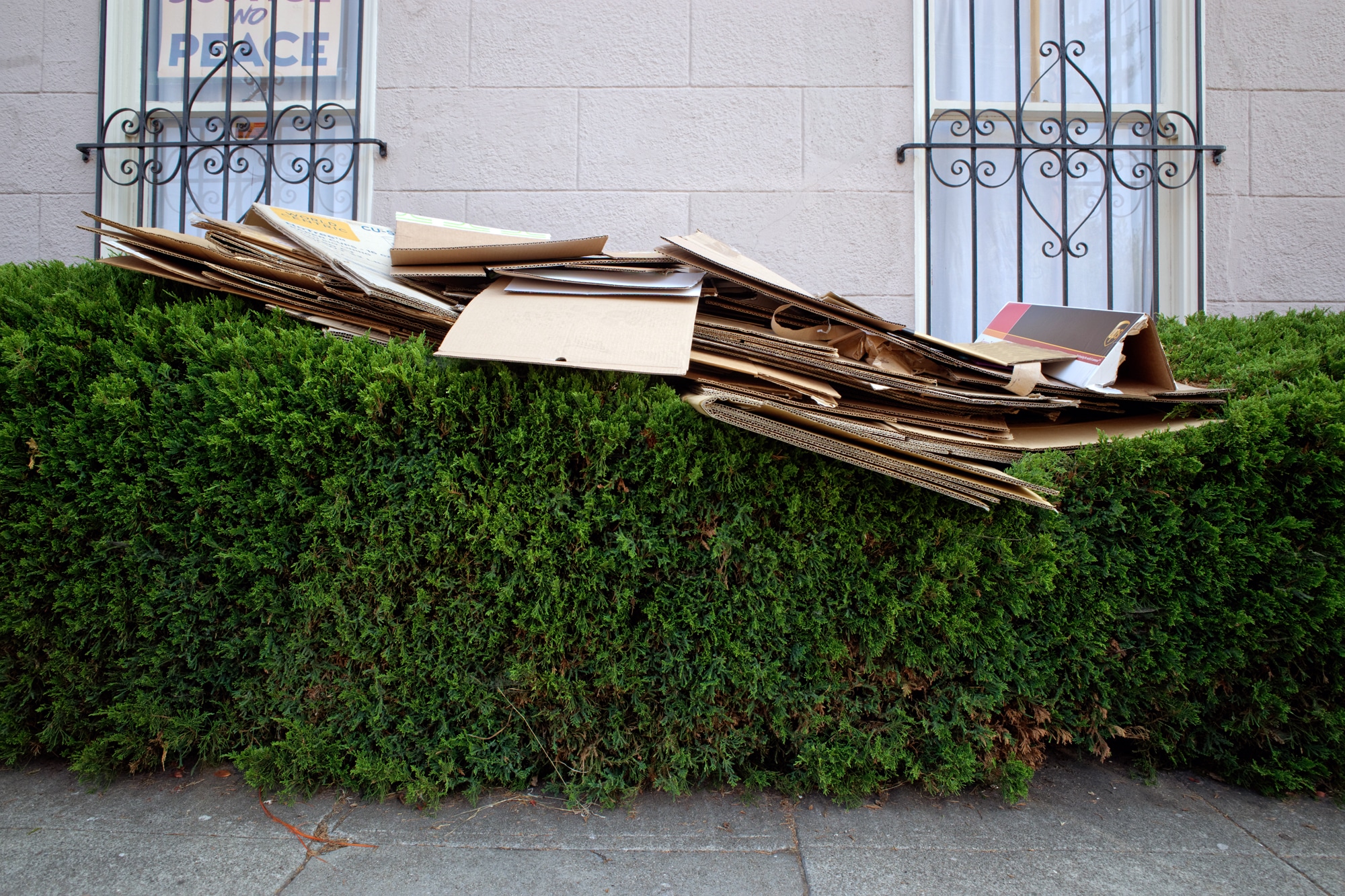

Let’s unpack that, shall we? Boxes are media in multiple senses of the word. They’re lithographed surfaces designed to be read, and they’re dimensional containers that mediate between outside and inside worlds. They’re “media of transport and information, shapers of public opinion and consumer desire, and means of targeting attention.” 11 And they’re “logistical media” that “arrange people and property into time and space,” that “coordinate and control the movement of labor, people, and things situated along and within global supply chains.” 12 The cardboard box is a minimalist form with maximalist ambitions, an arboreal apparatus made from one of the world’s most abundant renewable resources, then filled with plastic and moved around by copious quantities of oil. It doesn’t just coordinate and control landscapes; it transforms them. 13
An empire of cardboard rests on simple claims. I can hold that, and I can go there.
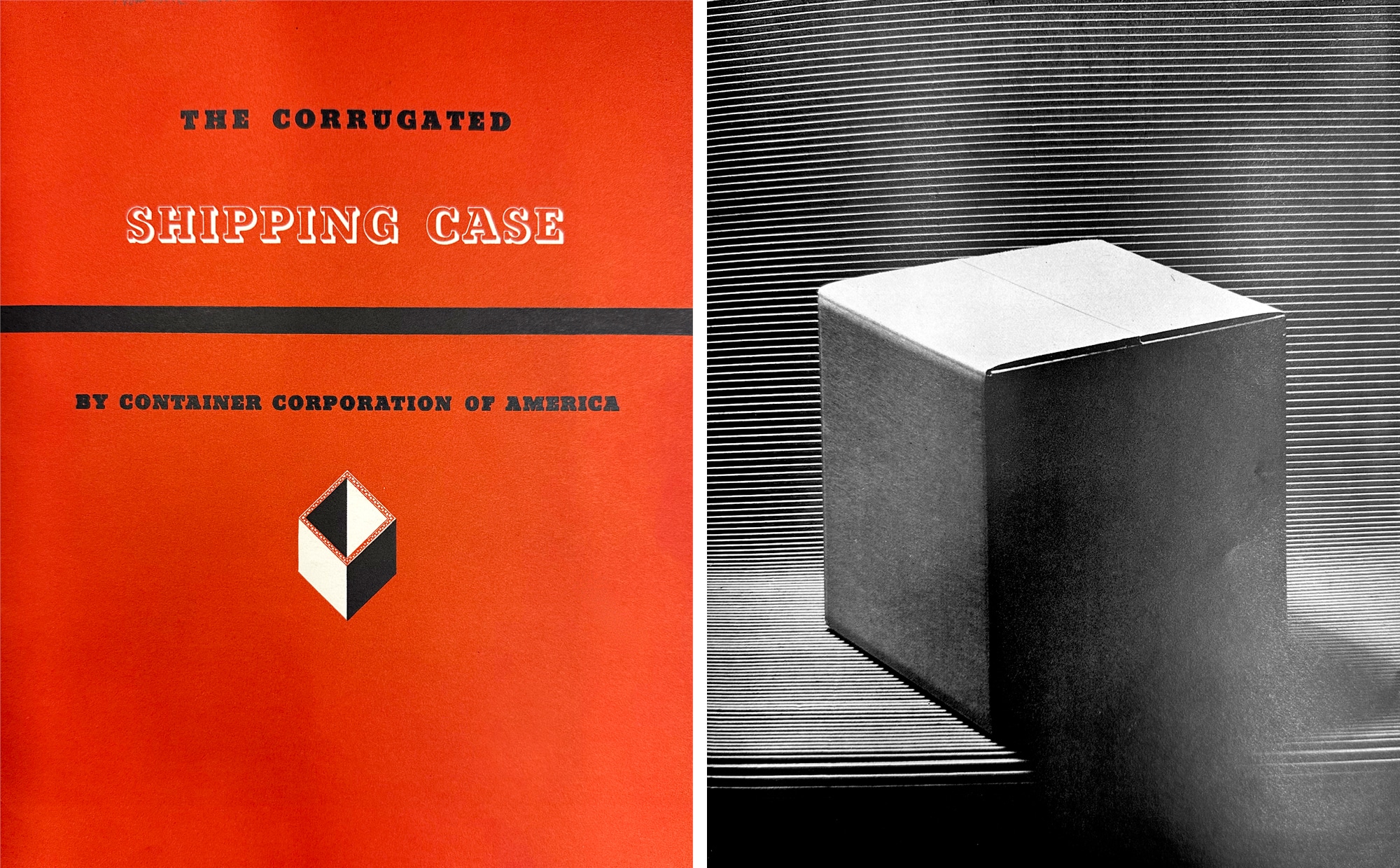
Cardboard’s ubiquity rests on simple claims: I can hold that, and I can go there. The Container Corporation of America was founded in 1926, and upon those claims it built an empire with surprising reach. The CCA made collapsible shipping boxes, and it transformed packaging into a science and an art. It advanced market research, shaped mid-century taste, and altered the chromatic universe through color standards. It employed some of the best graphic designers of the period, and as national borders shifted after the Second World War, it commissioned Herbert Bayer, author of the Universal typeface, to revise the World Geo-Graphic Atlas. Even then, the CCA was remaking that new world to meet its logistical needs, rehabbing mining towns and germinating forests, and orchestrating civic discourse about all of this. 14
How did a packaging company get into the publishing business — into the containment and distribution of information? How were geographic imaginations changed in the process? Soon we’ll dive into the Paepcke archive, to find answers to those questions. But first I want to show you how a cardboard box is made.
What’s in a Box?
Last year, the world’s largest paper company — International Paper — opened a new corrugated packaging facility in the small town of Atglen, Pennsylvania, an hour west of Philadelphia. In the 1970s the publishers of Parade magazine built a printing plant here, and then came Quad/Graphics, maker of newspaper advertising inserts. But in 2021, with e-commerce hollowing out ad markets and local newspapers dying, nobody was buying inserts. So, cruelly but fittingly, the old plant was rehabilitated to serve newsprint’s conqueror, churning out cardboard boxes for online retailers. 15 (It also makes packaging for mushroom growers in the area, and for other industrial clients.)
On a tour earlier this month, I was received in a conference room decorated with a mural of towering pines, sunlight breaking through their boughs, emblematizing a chain of operations that starts in the loblolly pine forests of the southeastern United States. That region is America’s “woodbasket,” encompassing two percent of the world’s forested land yet producing the raw material for 20 percent of its pulp and paper products. The Atglen plant is supplied by mills in Kentucky, Louisiana, Florida, and Iowa, each specialized to produce a different type of paper, for a different type of packaging.
Every day hundreds of trucks roll into these mills, carrying trees grown mostly on private land. First, the trees are stripped of their bark, which is burned to power the mill. (As International Paper tells it, the facilities make their own energy, with timber byproducts as fuel.) Then the debarked trees are chipped, and the chips are pressure-cooked in a “digester” to dissolve the lignin that binds the wood’s stringy fibers. The fibers are washed to remove chemicals and residue, and the released gases and liquor are evaporated and consolidated for recycling. Then the fresh pulp is mixed with pulp from recycled cardboard, and pressed flat by a machine that squeezes out the water. Passing through a series of driers, this mixture solidifies as paper, which is stored on massive rolls that can be several feet in diameter.

The rolls are then shipped to other facilities, where the fiber is transfigured again. Perhaps into a box. Perhaps at Atglen. Last year, International Paper made 100 million boxes a day. So, in eleven weeks, a box for every person on Earth. 16 Across the industry, cardboard production peaked in 2021 and then declined slightly, as economies worked through supply-chain shortages and cost inflation. But now we’re in another upswing. Financial analysts look to the industry as a market indicator. As Ryan Dezember of The Wall Street Journal reports, rising cardboard prices mean “production is up and consumers are spending.” 17
Last year, International Paper made 100 million boxes a day. So, in eleven weeks, a box for every person on Earth.
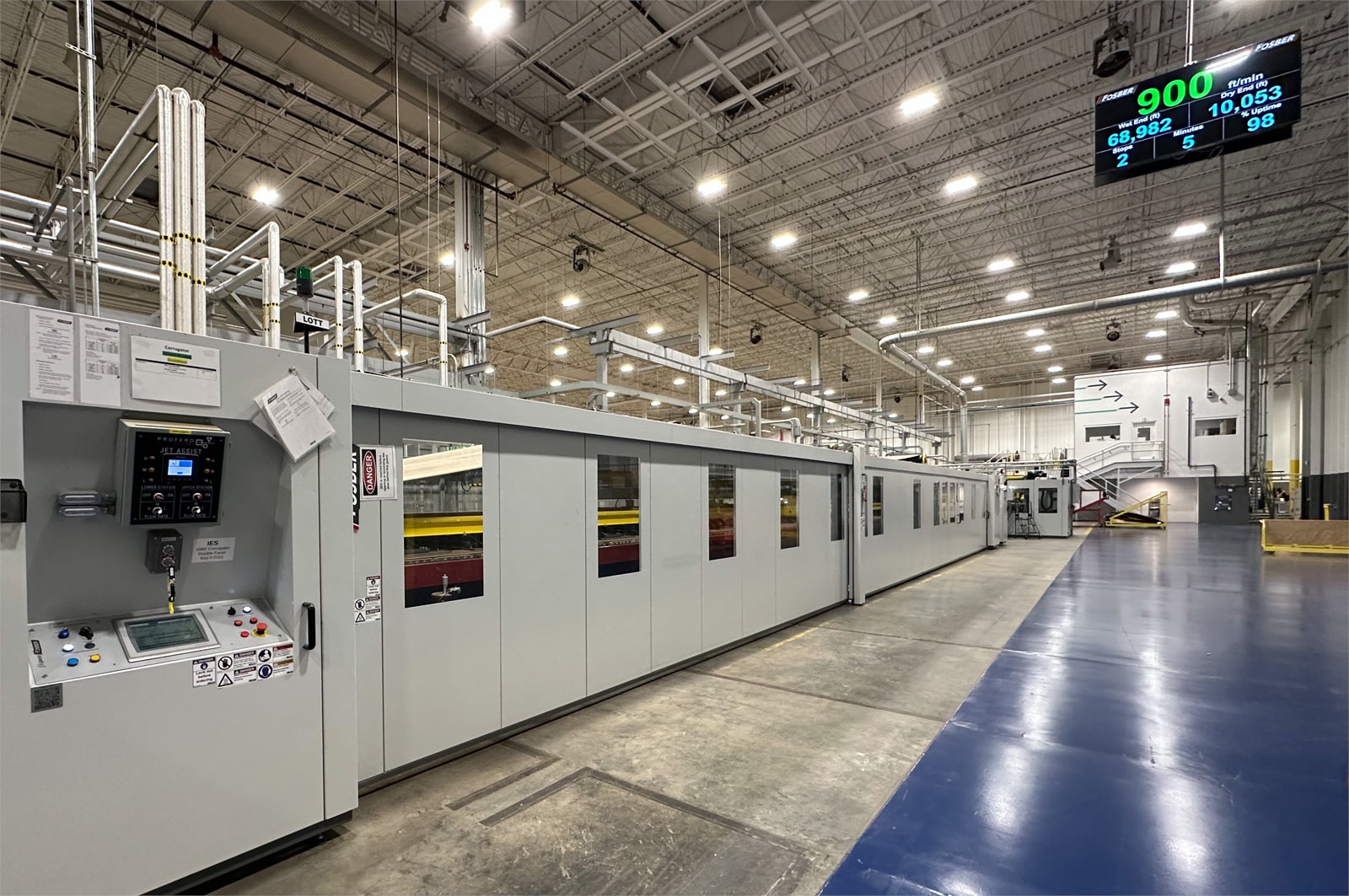
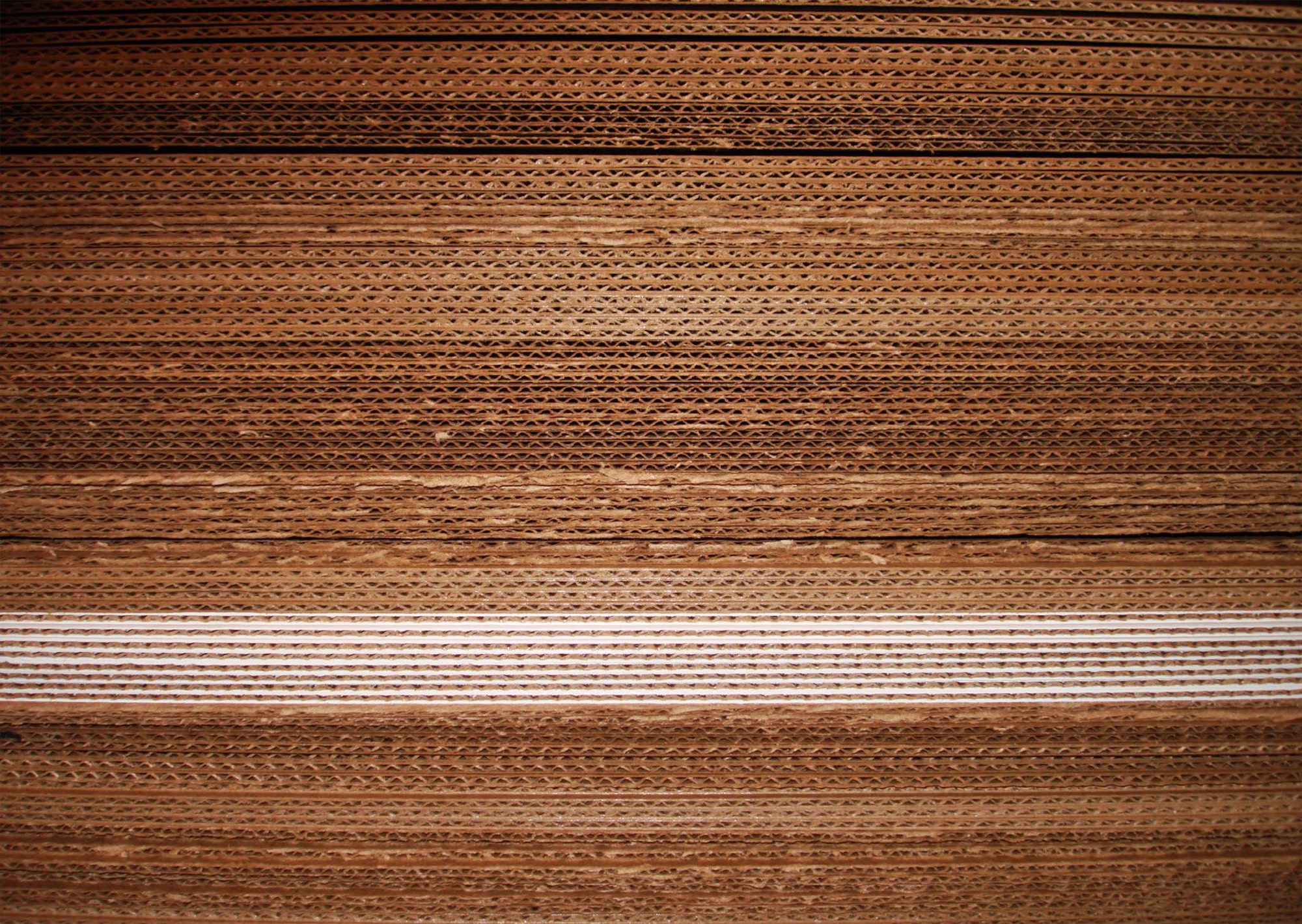
When I visited the Atglen plant, hundreds of those jumbo rolls were stacked on one side of the shop floor, in a hall about the size of a football field. 18 A chain of machines — a high-end, Italian-made “corrugator” — extended the length of this space. At one end, a technician fed the leader from a suspended spool, trimming to ensure a straight edge. Inside that machinic carapace, paper passed through corrugating rolls under high heat and pressure to produce the box’s wavy middle layer, called the “medium.” (Which thrilled this media studies professor!) My hosts explained that some packages must be made strong for stacking while others are optimized for printing; these factors require different wave geometries. Specialty boxes that hold proteins or liquids, or that can withstand supercooling, are even more complex.
In the “starch kitchen,” cornstarch, chemicals, and boiling water are mixed into glue, which is rolled onto the medium’s fluted crests. Another roll regulates the pressure used to adhere a single layer of liner to those flutes. After this “single-faced web” is heated and cured, the liner on the other side is attached. To make sturdier boxes, multiple layers are sandwiched. The combined board is then slit to the proper width and cut to size; waste pieces are recycled back into the system. High in a control tower, with views of the entire production process, a technician monitors temperatures, pressures, and speeds across the line.

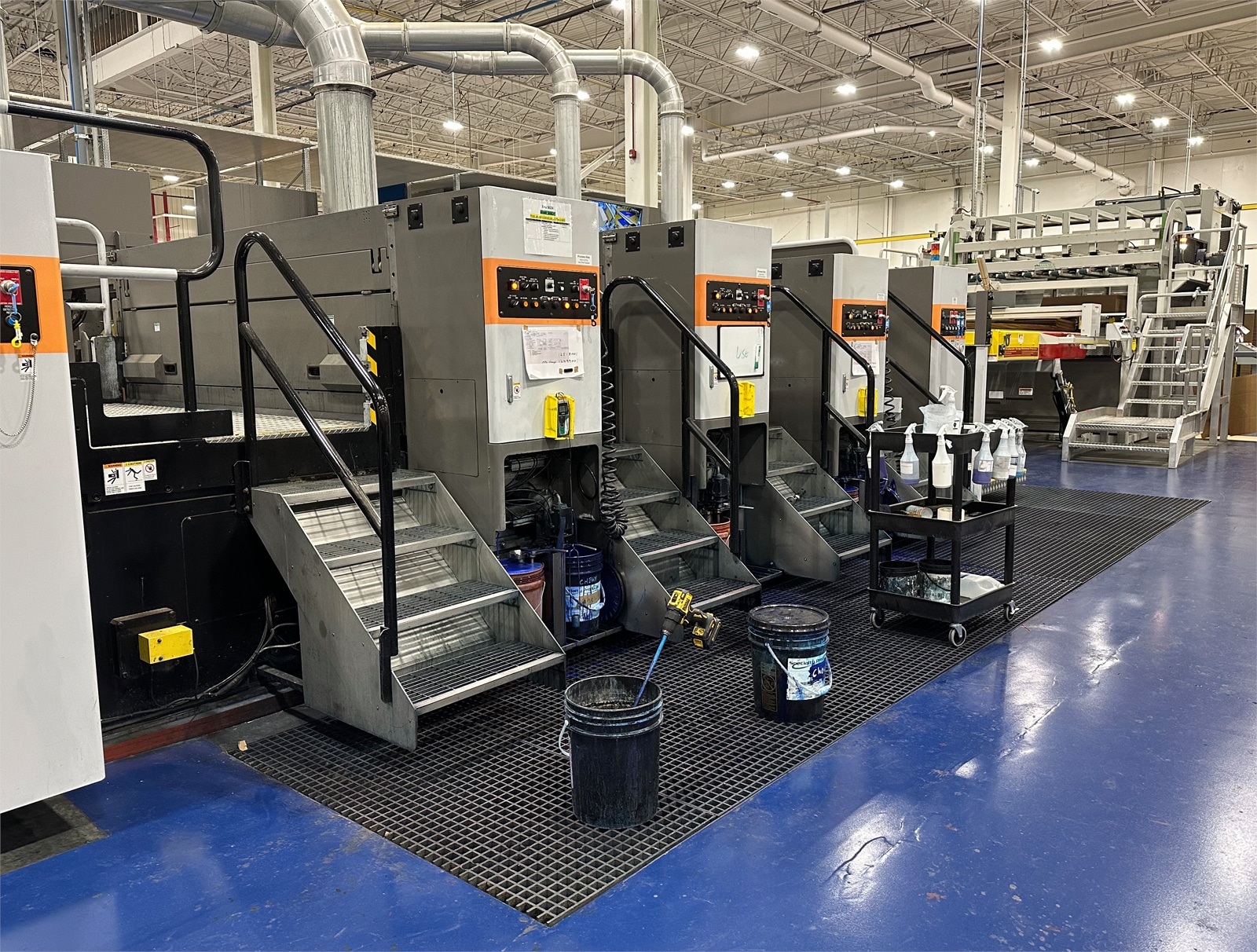
The sheets are then stacked and moved by automated carts to another area of the plant, where they are transformed into boxes by converting machines that print graphics, cut holes, make perforations, and crease folds, according to client specs. Machines like this can be configured to produce over a million unique designs. Printing plates and cutting dies for each project are stored in an open-stack library, so they can be recalled when the client places a new order. Plates outline familiar logos, and the dies register common uses, like aeration holes cut in produce boxes. 19 And here I sensed the ghosts of the building’s past tenants and media histories. A four-color press that could have inked newsprint for Parade or Quad/Graphics is now being used to print on cardboard. 19
I was impressed by the carefully engineered systems and the graphics that make them legible — from the safety signage and floor markings, to the performance dashboards and meticulously organized tool kits. The careful scripting of how paper and cardboard move through this plant suggests how the box itself moves through the world, along logistical pathways. There are special facilities for edge-crush testing, to check the vertical compression strength that determines stacking capacity; and retail test environments, to see how particular forms and graphics work on the shelf. 20 My hosts explained that corrugated paperboard is a “mature industry.” International Paper has research labs that develop new packaging architectures and materials — ClimaShield® coatings for water resistance; SpaceKraft® for bulk liquids; “bliss boxes” to prevent leaks — but “most of the innovation,” said communications manager John Carmichael, “is in graphics,” especially printing inside the box. 21
The Art of the Package
Really, though, graphic and structural design have been linked since the early days of the container industry. Before the advent of cardboard, goods were gathered, stored, and transported in barrels, wooden boxes, and other vessels, from farm or factory to merchants’ shops and then to people’s homes. 22 As Thomas Hine observes in The Total Package: The Secret History and Hidden Meanings of Boxes, Bottles, Cans, and Other Persuasive Containers, shoppers selected merchandise from open shelves and bins and carried it home in sacks and baskets. If their purchases were wrapped in paper, it was the kind made from rags, or sometimes from bark, hemp, or straw. 23 In the late 19th and early 20th century, the burgeoning field of package engineering yielded new cans, boxes, jars, bottles, tins, and tubes, as well as Du Pont’s cellophane and other polymeric films. 24 The contents were often opaque. A crate of oranges was a crate of oranges, but the shelves of the general store now held packaged goods, like patent medicines and condensed soups, whose identity needed explanation. 25
In 1878, papermaker Robert Gair realized that his machines could be modified to cut and crease simultaneously.
Meanwhile, new wood-pulp techniques enabled the mass production of paper products. And new industrial machines — fourdrinier machines, rotary cutters, and lithographic presses — automated and expedited processes such as label-making. 26 Paper, easier to print on than canvas or wood, was ideal for that purpose. 27 “Brilliant lithography,” the authors of a packaging textbook write, “was essential for selling canned food that was not visible during a purchase based on faith.” Shaker communities were among the first adopters, using printed and pasted paper packages for their plant seeds, which were displayed in a sectioned wooden box with a vibrant label. 28
Craftspeople made the first rigid “setup” boxes from wood and handmade paperboard, to protect contents in transit and storage. But it wasn’t convenient to have empty boxes sitting around. The real revolution in mass-market packaging was the invention of the paperboard folding box, which could be collapsed when empty and then re-assembled. 29 For that we can thank Scottish immigrant Robert Gair, who had a factory that printed bags and other paper goods in northwest Brooklyn, where the city was building a new bridge to Manhattan. In 1878, an operator error led Gair to realize that his machines could be modified to cut and crease simultaneously. Before that date, box-makers had to slit and score long sheets, then join them together with cloth tape and hot glue, and cut to the required length. Now they could use sharp dies to cut paper and blunt dies to crease it, all at the same time. In the coming decades, Gair and others — inventors like Albert Jones, Matthew Vierengel, and William G. Chapin — would file nearly a thousand patents for various contraptions to fabricate and fill boxes. 30

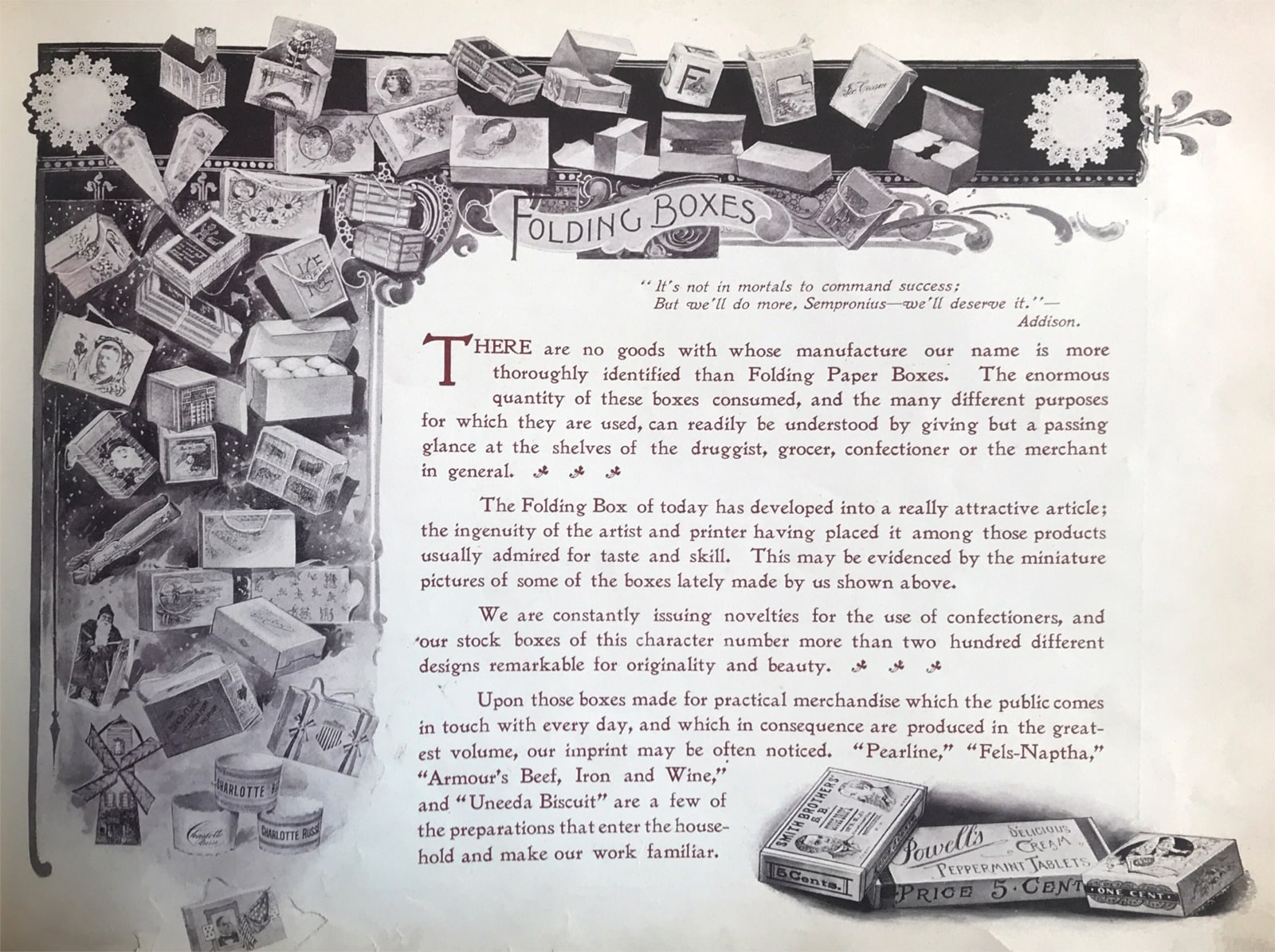

Railroad companies at this time preferred sturdy wooden crates, and they charged a premium to carry cardboard. But thanks to their extensive timber holdings, the railroads had developed a “mutually beneficial relationship” with packaging companies, and they all worked with the USDA Forest Products Laboratory to develop standards for box construction that minimized damage. Corrugated fiberboard boxes “used less material, were lighter weight, and were more economical to ship in a knocked-down fashion to the packer-filler,” so they were soon favored in some markets. Corrugated paper boxes were authorized in 1906 by the Official Freight Classification and then in 1914 by the U.S. Interstate Commerce Commission. 31
Flexographic presses printed directly onto cardboard, opening up millions of square feet for advertising.
Another advantage was marketing. Flexographic presses printed directly onto cardboard, opening up “many million square feet of free advertising space” on cartons as they moved from train to truck to doorstep. 32 Hine explains how box-makers came to appreciate “the distribution and marketing innovations” enabled by this new medium. Cardboard packaging changed how information flowed from manufacturer to distributor to consumer. Before, a product might be stamped by geographic origin, but now it was possible to communicate the address of the company’s headquarters, the location of its factories and canneries, and other details that established a brand’s reputation. (Some early labels even sought to convey authority with heraldry.) As goods circulated independently in the world, no longer attached to producers or shopkeepers, packaging helped stockists and patrons evaluate the offerings. Labels promised standard quality and purity and predictability; they ascribed character to otherwise nondescript contents; they were a “tool for simplifying and speeding decisions”; they tempted and made “the final sales pitch”; they gave people the “confidence to buy.” 33

Uneeda biscuits, branded by the agency N. W. Ayer, were distinguished by two-layer packaging that consisted of an inner seal and a vaguely Victorian purple-and-white cardboard box. In the company’s ads, a little boy in a raincoat carried that box of crackers in the rain; even a downpour couldn’t penetrate the seal and compromise the product’s crispness. Quaker oatmeal, an uncharismatic “base substance” that was once primarily horse feed, was “put in a small box, invested with personality, outfitted with recipes that increased usefulness, and turned … to something that was desirable and profitable.” Other cereal companies followed suit, deploying lithographic cartons to convey their quality and healthiness. 34
The divide began to collapse between the artists and literary types who handled advertisements and the businessmen and engineers who designed products and packaging. Researchers studied consumer responses and developed theories about the psychology of color. Advertising executive Earnest Elmo Calkins launched a package design studio within his firm. “Why shouldn’t a vegetable can look as good as its contents?” he asked. 35 Supermarkets, especially, were keen to implement the new science. When the Sainsbury franchise converted to self-service in the early 1950s, it hired designer Leonard Beaumont to create a consistent visual identity — clean, abstracted, punchy — that appealed to the postwar mood: “a feeling … of British common sense, practicality, robustness, quality” and simplicity. The package was “striking,” says food writer Ruby Tandoh, “because it had to be: because the supermarket was still establishing its place in British domestic life; because self-service was new; because hygiene needed to be seen to be improving.” 36 The chain’s geometric labels, with primary colors and clean typefaces, made a disconcerting experience intelligible. They translated well in the new medium of grayscale television, while popping on the shelf in full color.

In the emerging field of industrial design, innovators like Walter Dorwin Teague, Norman Bel Geddes, Henry Dreyfuss, and Raymond Loewy transformed products into their own advertisements: an enticing form could sell itself. But they still attended to packaging. They knew a multi-compartment aluminum tray and vividly colored box would enhance the appeal of novel frozen TV dinners. In the 1930s and ’40s, Hine writes, “the designer metamorphosed from a magician to a technician, someone who understood both the chemical reactions between shampoo and container” — or between flash-frozen peas and aluminum — “and the emotional chemistry between shampoo and shampooer.” Designers combined expertise in chemistry, material science, art and illustration, psychology, and experimental methods; and they sought a purportedly objective understanding of the consumer as they tested a product’s appeal. 37 Late to the party, in 1959, the Museum of Modern Art hosted an exhibition to “appraise packages of all sorts for their design qualities, and in so doing to re-examine and perhaps broaden our ideas of what actually does constitute a package.” 38

Although packaging design was a recognized area of expertise, with its own internal logic, designers also responded to external forces and cultural trends. Food labels evolved to satisfy regulations about the declaration of net weight and ingredients, yielding the “nutrition facts” on every box in the grocery store. 39 Environmental concerns compelled the reduction of excess packaging, or the rejection of plastics in favor of engineered paper. As Hine observes, packages today are media with many authors: “typically the work of designers, engineers, and one or more government agencies including the Department of Agriculture, the Consumer Product Safety Commission, the Environmental Protection Agency, the Federal Trade Commission, the Department of Health and Human Services, the Bureau of Alcohol, Tobacco, and Firearms, and the Customs Service.” 40 We can add trade organizations and advocacy groups, too.
Over the past century and a half, cardboard boxes have transported the fruits of the market, displayed its excesses, and embodied its lacks. They’ve modeled developments in paper production. They’ve chronicled the evolution of commercial graphic design. Cardboard boxes have circulated the icons and lexicons of local and global brands and standards of distribution: addresses, weights, dates of dispatch. And as we’ll soon see, they’ve brought many defunct paper mills (and presses) back online to support the demands of a digital economy. Their macro-scale flows, across land and sea, map and index many globalized processes.

Corrugated Terrains
Indeed, cardboard was rewriting the geography of Brooklyn long before Amazon opened its warehouses. 41 Robert Gair’s operation started in Tribeca, then moved across the East River for more space. In 1898, the National Biscuit Company ordered two million units of those iconic Uneeda boxes. To keep up with increased demand, the entrepreneur constructed an assemblage of buildings that came to be known as Gairville, with factories made from new steel-reinforced concrete, connected by a network of railways and tunnels. He added a few paper mills, too. New York was a national hub for fancy- and paper-box manufacturing, with several hundred businesses running huge die-cutting and creasing machines.
As packages moved through different geographies, they evolved in response to local conditions and drew from local resources.
As packages moved through different geographies, they evolved in response to local conditions and drew from local resources. In rugged environments and humid climates, shippers needed stronger and more water-resistant materials. The sulfate-based kraft process, deriving from the German word for “power,” depended on long, thin, flexible wood fibers capable of producing paper that could carry heavy loads and maintain integrity when recycled. And so this process favored a particular species of tree. In the 1920s, new pine mills in Southern states produced kraft paper on fourdrinier machines, “fiercely compet[ing] with the cylinder-made jute linerboard producers in the North.” 42
Founded in Chicago in 1926, the Container Corporation of America became famous for its global consciousness, worldly tastes, and planetary extraction.
But for much of the 20th century, the capital of cardboard was Chicago. 43 The city’s regional affordances — its natural resources, rail and shipping infrastructure, and its status as printing, mail-order, and advertising hub — birthed a box company that became famous for its global consciousness, worldly tastes, and planetary extraction. You already know its name: the Container Corporation of America, founded by Walter Paepcke in 1926. His father, Hermann, built the successful Chicago Mill and Lumber Company, having predicted the strong market for wooden goods and crates after the Great Fire of 1871, a history that William Cronon traces in Nature’s Metropolis. The decimation of wooded terrains cleared the way for a new economy built on wood pulp and paper mills, just as the rise of steel construction depressed the demand for timber. 44
So, after inheriting his father’s company, Walter split off the paperboard division and merged it with the Philadelphia Paper Manufacturing Company. The new CCA opened dozens of mills and fabricating plants, from Philadelphia to Los Angeles, and expanded into foreign markets, from Venezuela to Vienna. Eventually, it became the largest maker of paperboard shipping containers in the country — at least according to the ads it placed in Fortune and Time.

More than that, the company was the largest maker of what Justus Nieland calls “midcentury container culture.” Through ads, films, reports, conferences, and especially through the “distribution and communication network of the cardboard box,” the CCA instilled a distinctive “corporate humanism” and “personality.” 45 It started with modernist designers. In 1936, at his wife Elizabeth’s urging, Walter Paepcke hired Egbert Jacobson to direct the company’s new art department, which recruited prominent European and American designers such as Jean Carlu, Leo Lionni, Herbert Bayer, Herbert Matter, Fernand Léger, Man Ray, Henry Moore, Willem de Kooning, and Agnes Denes. Some were Jews who escaped the Holocaust and came to Chicago to join the New Bauhaus (1937-38) and the School of Design (1939-44), directed by László Moholy-Nagy with funding from Paepcke. 46
The Container Corporation’s approach to “integrated design” encompassed not just packaging and advertising, “but also every other area in which the company ‘meets’ the public and its own employees.” 47 As Jacobson explained:
If you improve the appearance of stationery forms, the accounting department begins to re-examine its methods and takes new pride in its efficiency; the supply room clerks become discriminating critics of typography. If you paint your trucks effectively, not only does the public become familiar with your name, but your garage men become an elite among their peers. If you make a good typographic job of your annual report, and illustrate it with the work of artist-photographers, your stockholders show a new interest. … If you engage top-notch architects to design a plant, not only do your plant managers assume new stature, but the local community is introduced to stimulating ideas in building which those in it never before imagined. If you bring your offices up-to-date with contemporary lighting, furniture, floor coverings and color, every secretary as well as every executive goes home with fresh ideas about interior decoration. Finally, all these activities are recognized in time by the public as the expression. 48
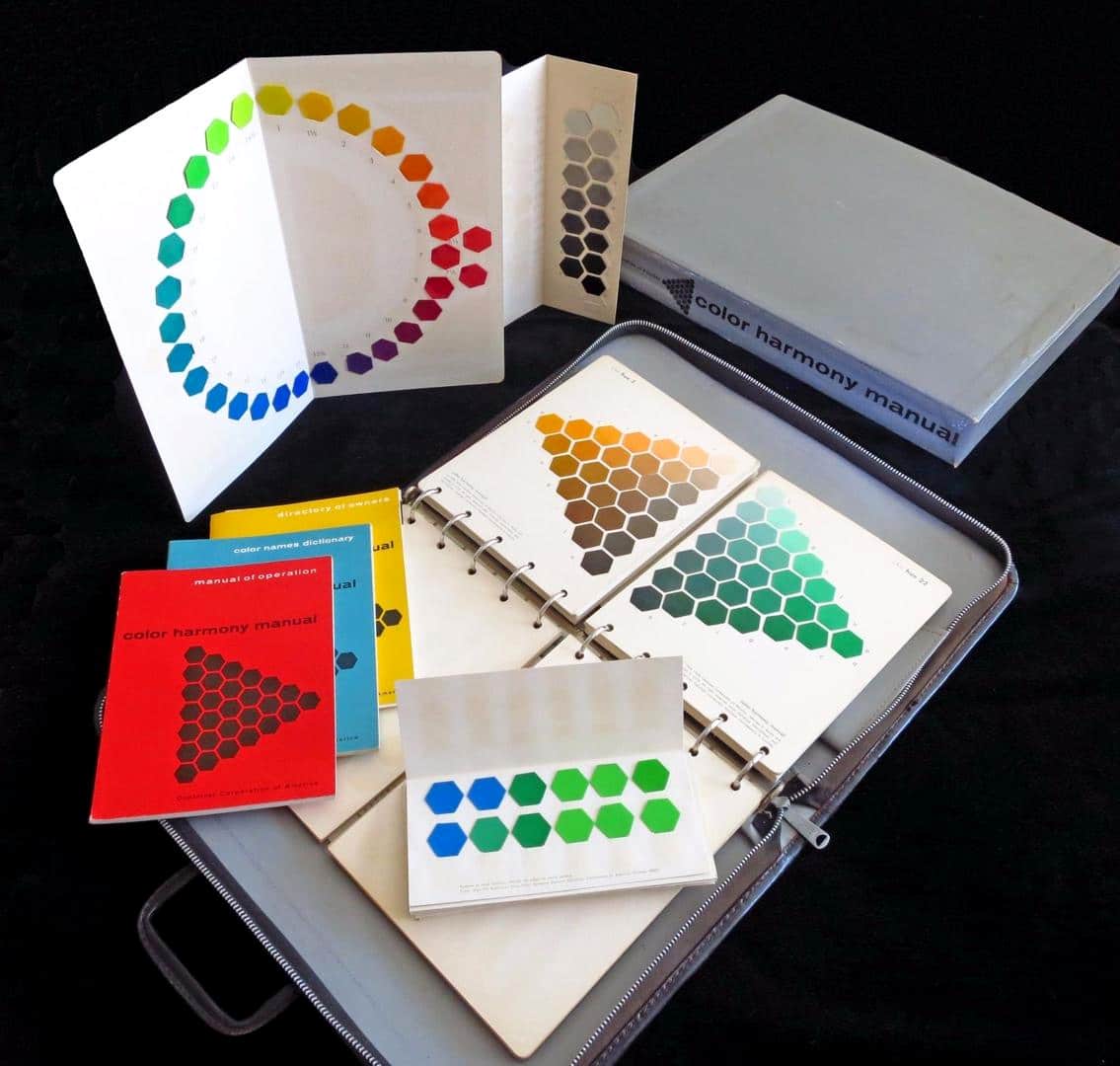
Jacobson’s department redesigned the logo on the delivery trucks, placing an isometric box and the company’s initials atop a silhouette of the contiguous United States. They created annual reports with modernist typography and maps and industrial photographs. Gropius designed factories, and Bayer curated exhibitions. A specialty division even experimented with cardboard as a medium, creating cut-out dolls, pop-up books, and cartons that could be repurposed as toys. 49 Meanwhile, the design laboratory, run by Albert Kner, refined the art and science of package engineering. “The basis for the visual appeal of the package is graphic design,” declared the narrator in The Packaging System (1963), one of the corporate training and promotional films produced by Rhodes Patterson. In perfect midcentury cadence, the script continued: “This component of the packaging system is itself a total of several elements: color, typography, illustration, design form, texture, and trademark. … The unique array of Design Laboratory instruments helps make objective evaluation of designs and design elements.” 50 Jacobson’s Color Harmony Manual circulated globally among artists, designers, and craftspeople and established cross-disciplinary standards. Paepcke understood it all as “free advertising”: wherever the boxes were seen, they had potential to imprint a vibrant brand identity. 51
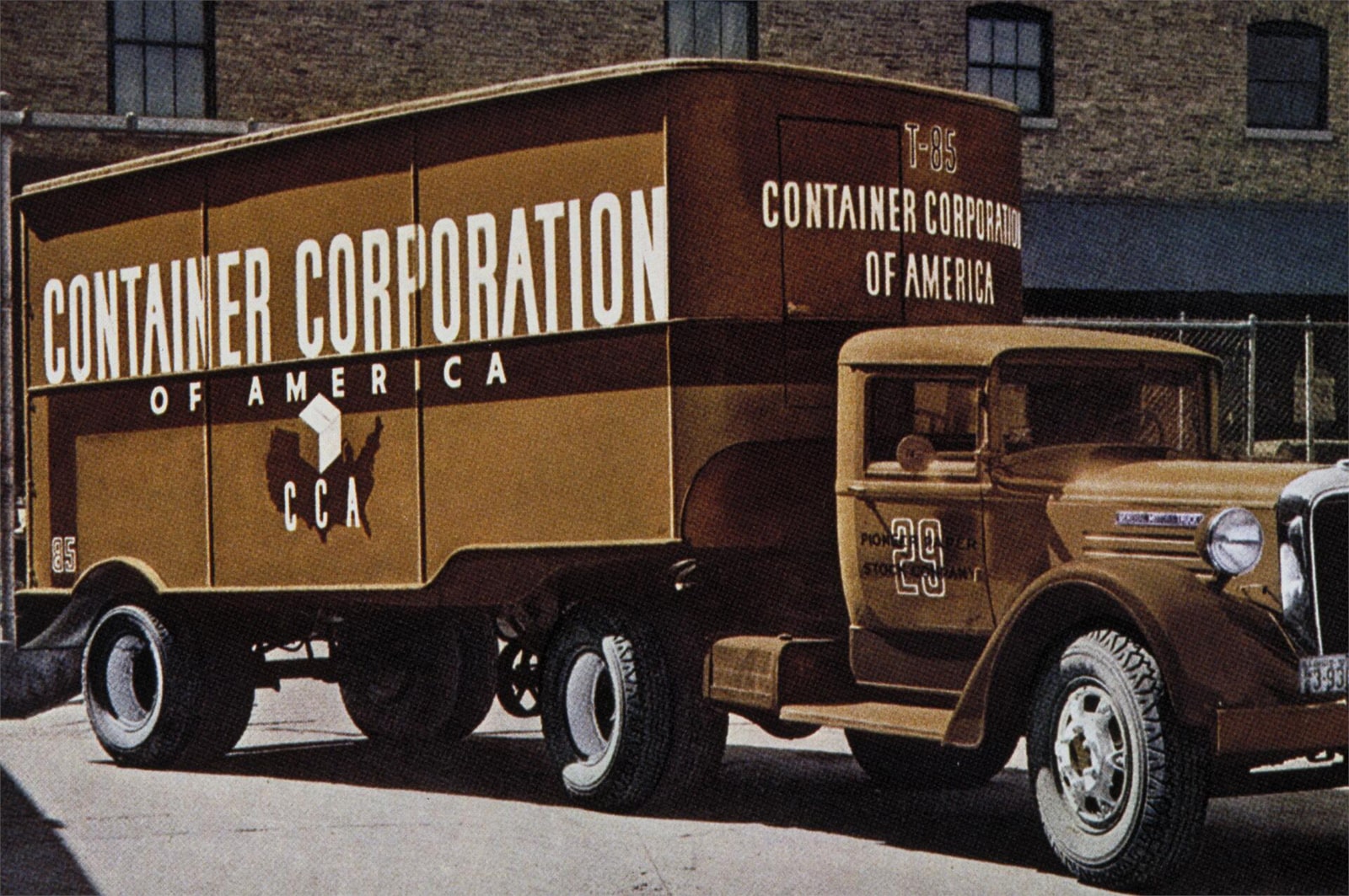
Container Corporation of America truck, with the logo designed by Egbert Jacobson. [Chicago Design Archive]

Container Corporation of America ads. Left: “One,” by Fernand Léger, 1939. Right: “Reclamation,” by Adolphe Jean-Marie Mouron Cassandre, 1937.
Container Corporation of America ads. Left: Hermann Zapf, 1938. Right: Gyorgi Kepes, 1938.
Container Corporation of America ads. Left: Adolphe Jean-Marie Mouron Cassandre, 1938. Right: Cassandre, 1937.
Container Corporation of America ads. Left: Herbert Bayer, 1939. Right: E. McKnight Kauffer, 1941.
Container Corporation of America, The Color Harmony Manual and How to Use It, fourth edition, 1958. [via Ebay]
Container Corporation of America, from the 1946 annual report. [Walter P. Paepcke Papers, Special Collections, University of Chicago Library]
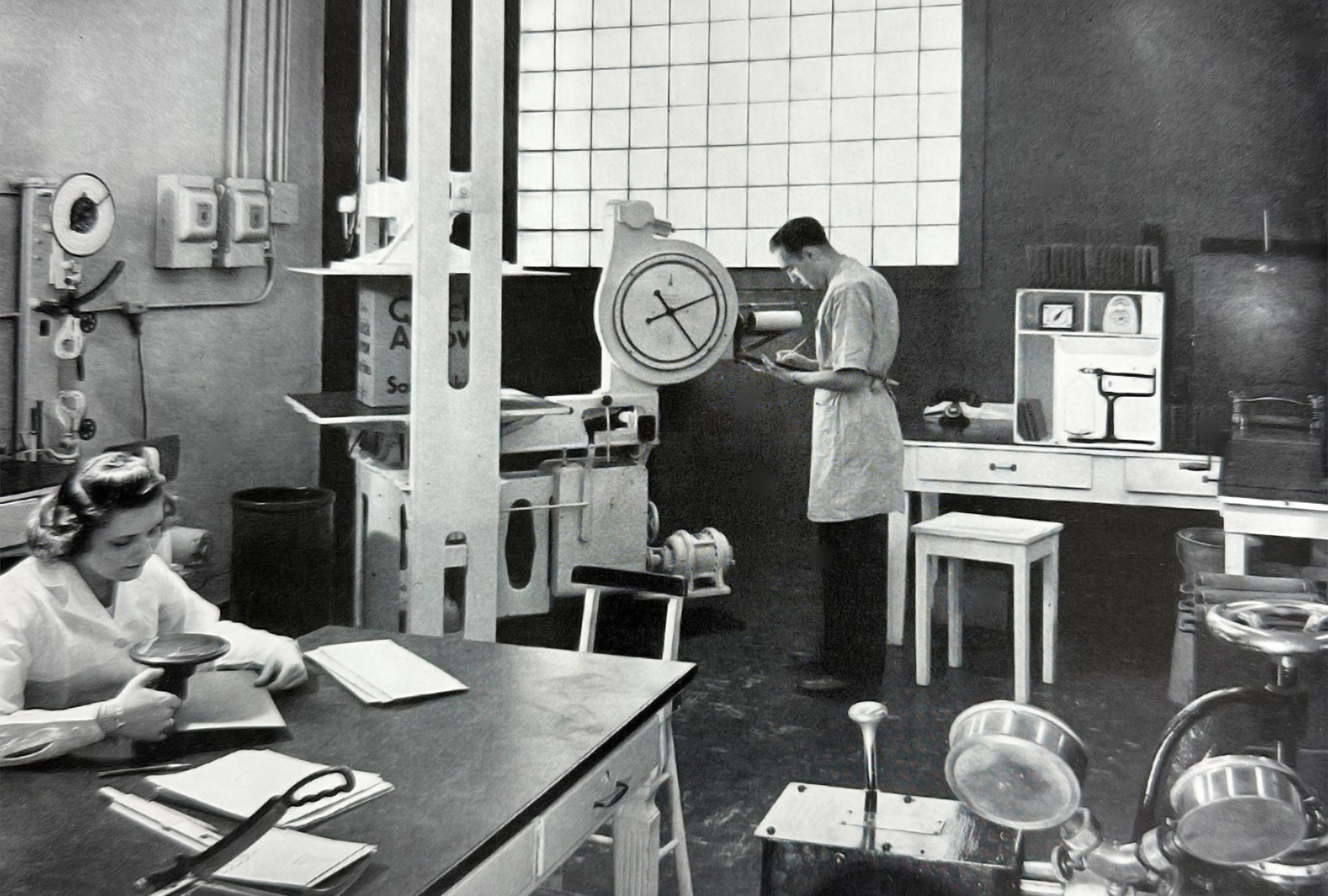
“A section of one of the Company’s completely equipped container testing laboratories operated under controlled conditions of temperature and humidity to maintain production standards.” Container Corporation of America, from the 1948 annual report. [Walter P. Paepcke Papers, Special Collections, University of Chicago Library]
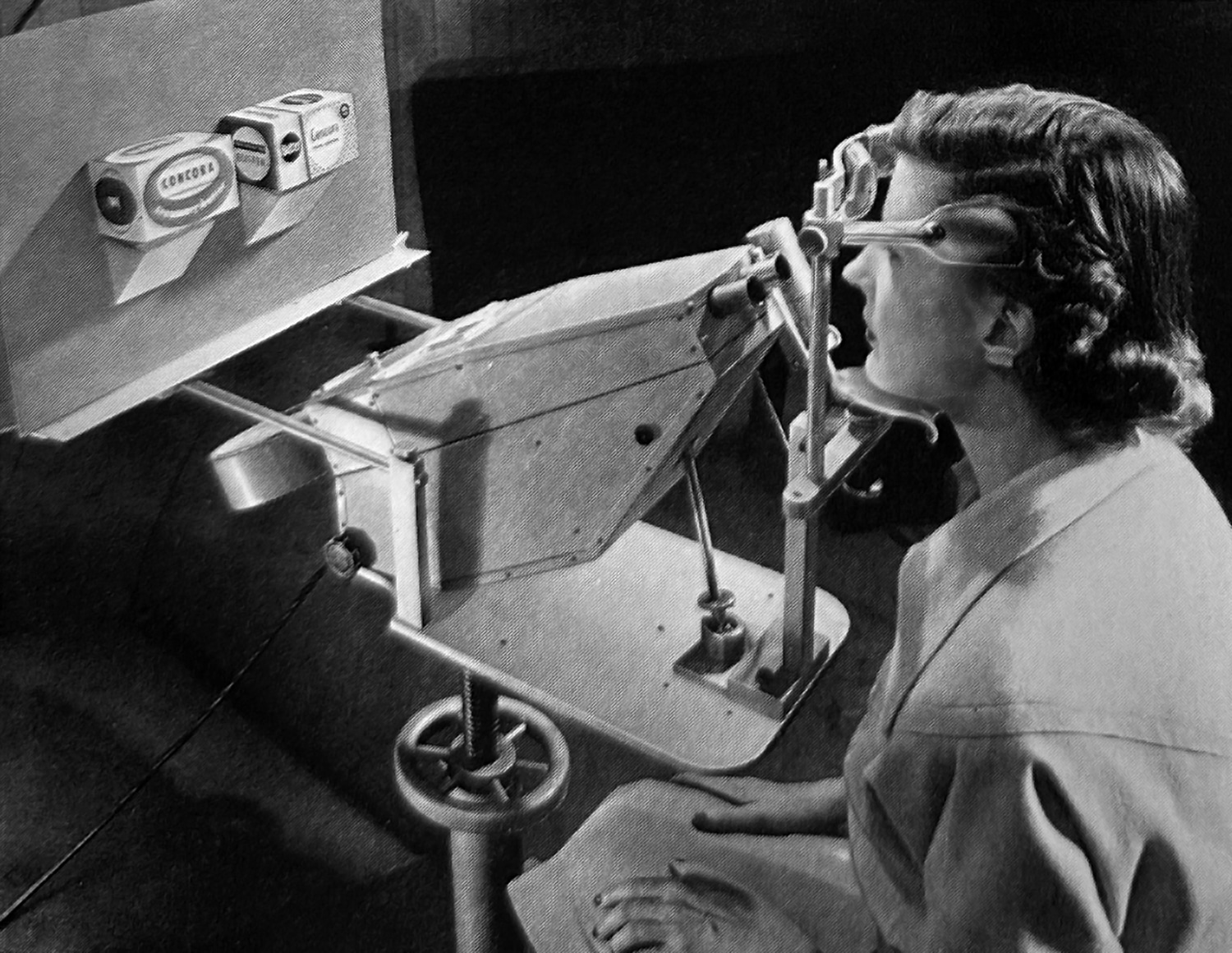
“Ocular camera used in making studies of folding carton design.” Container Corporation of America, from the 1951 report. [Walter P. Paepcke Papers, Special Collections, University of Chicago Library]
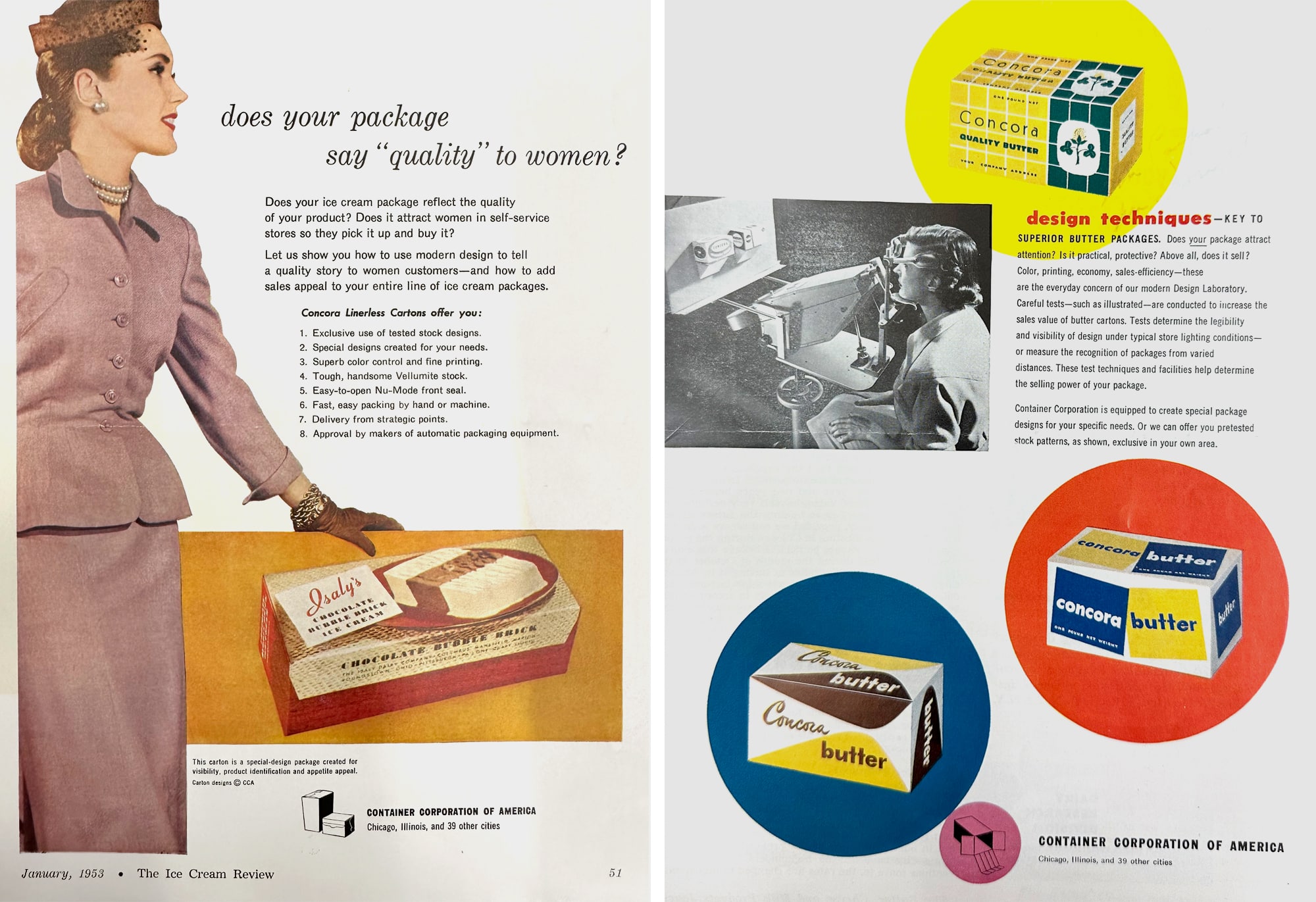
Container Corporation of America ads, 1952-53, emphasizing product design as a consumer science. [Walter P. Paepcke Papers, Special Collections, University of Chicago Library]
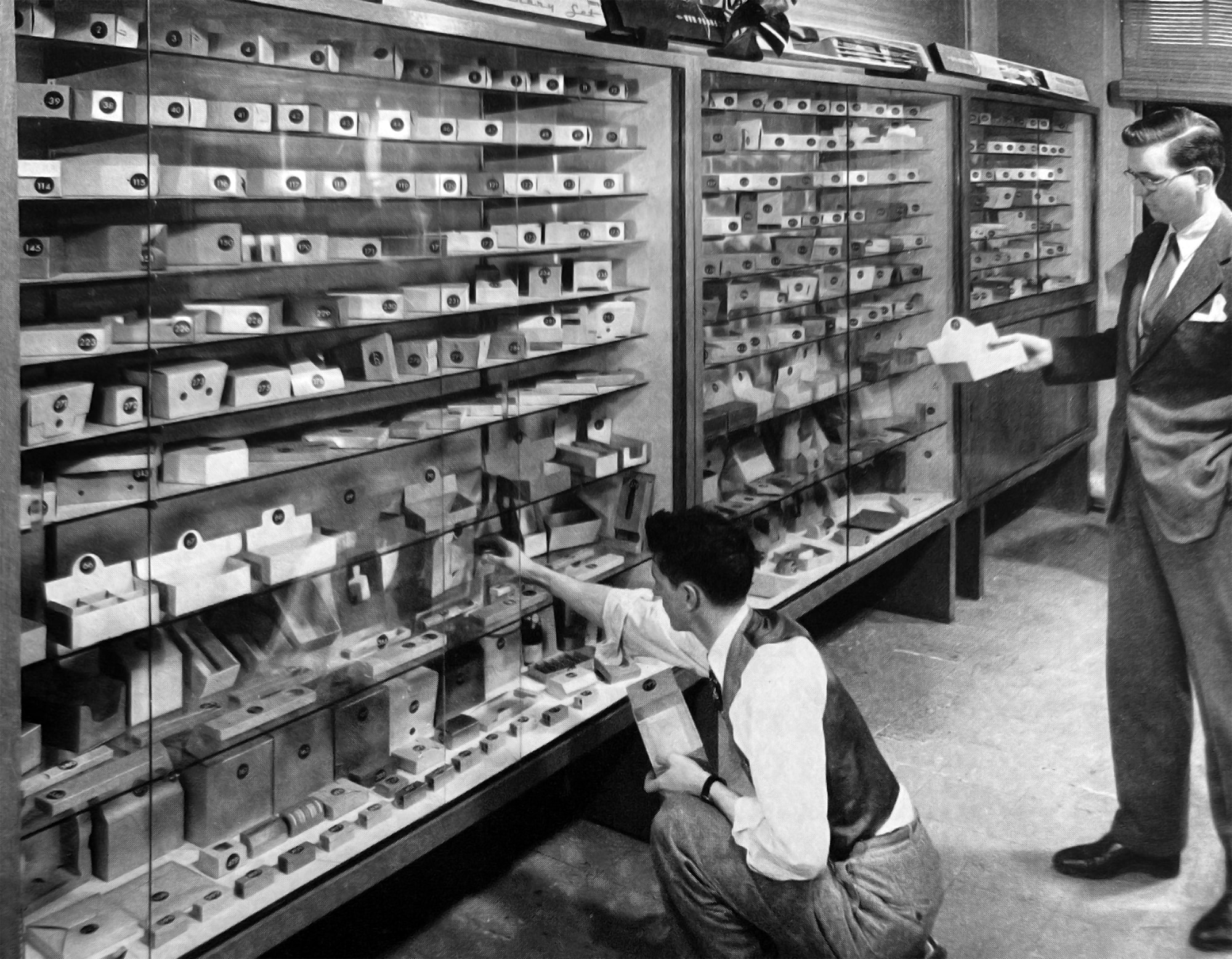
“A comprehensive display of 495 types of folding carton construction at the 35th Street, Chicago factory. Samples may be selected from this display for effective packaging by the Design Laboratory.” Container Corporation of America, from the 1950 report. [Walter P. Paepcke Papers, Special Collections, University of Chicago Library]
Container Corporation of America ads. Left: Charmion von Wiegand, 1947. Right: “Will your package really care for your product?” Artist unknown, 1963.
Left: “Special Slash Pine grown on one of the Company’s timber areas.” Container Corporation of America, from the 1952 report. Right: Artist unknown, 1941. [Walter P. Paepcke Papers, Special Collections, University of Chicago Library]
Container Corporation of America, from the 1955 report. [Walter P. Paepcke Papers, Special Collections, University of Chicago Library]
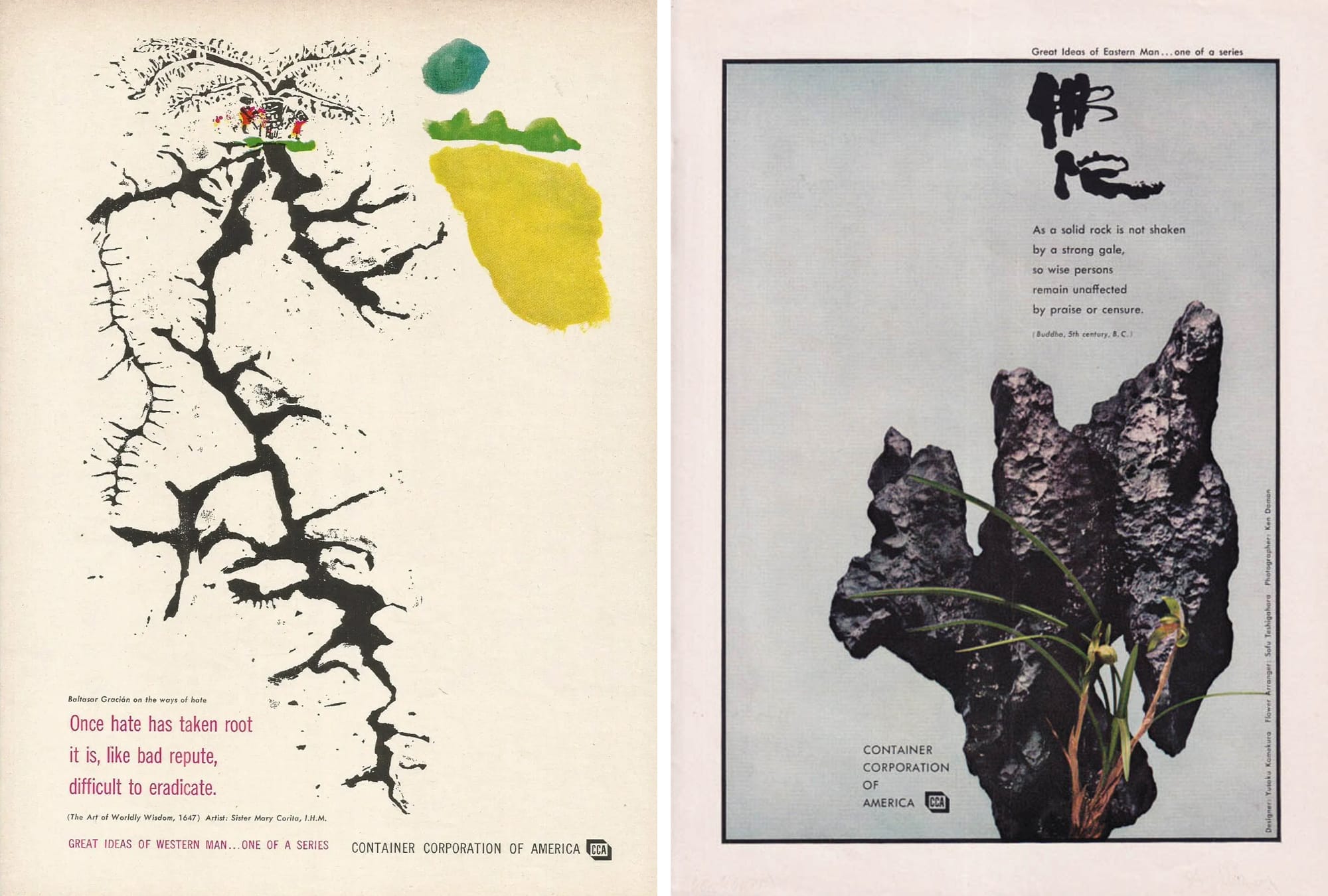
Container Corporation of America ads. Left: Corita Kent, 1958. Right: Yusaku Kamekura, 1960.
Container Corporation of America, from the 1961 annual report. [Walter P. Paepcke Papers, Special Collections, University of Chicago Library]
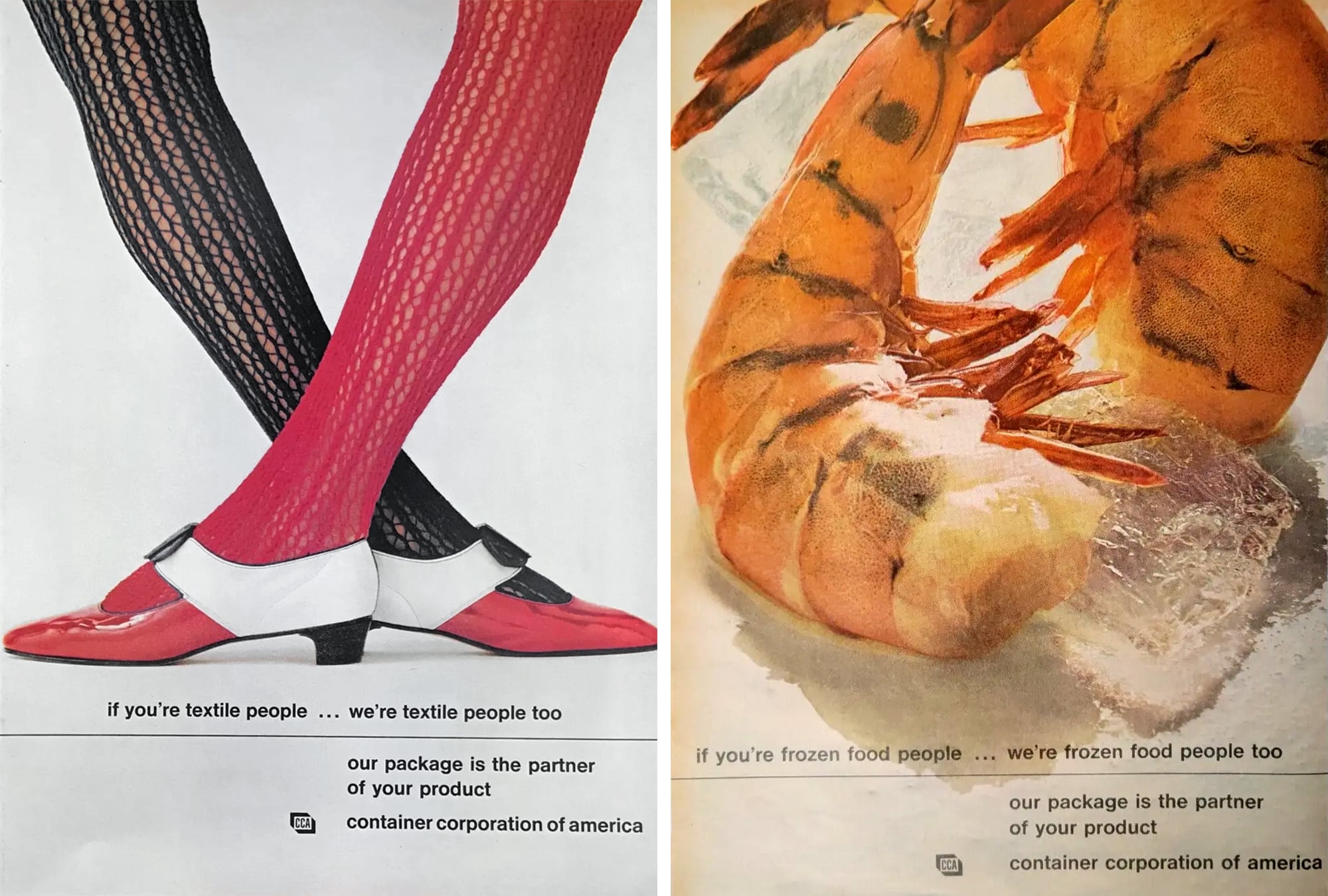
Container Corporation of America ads, ca. 1960s.
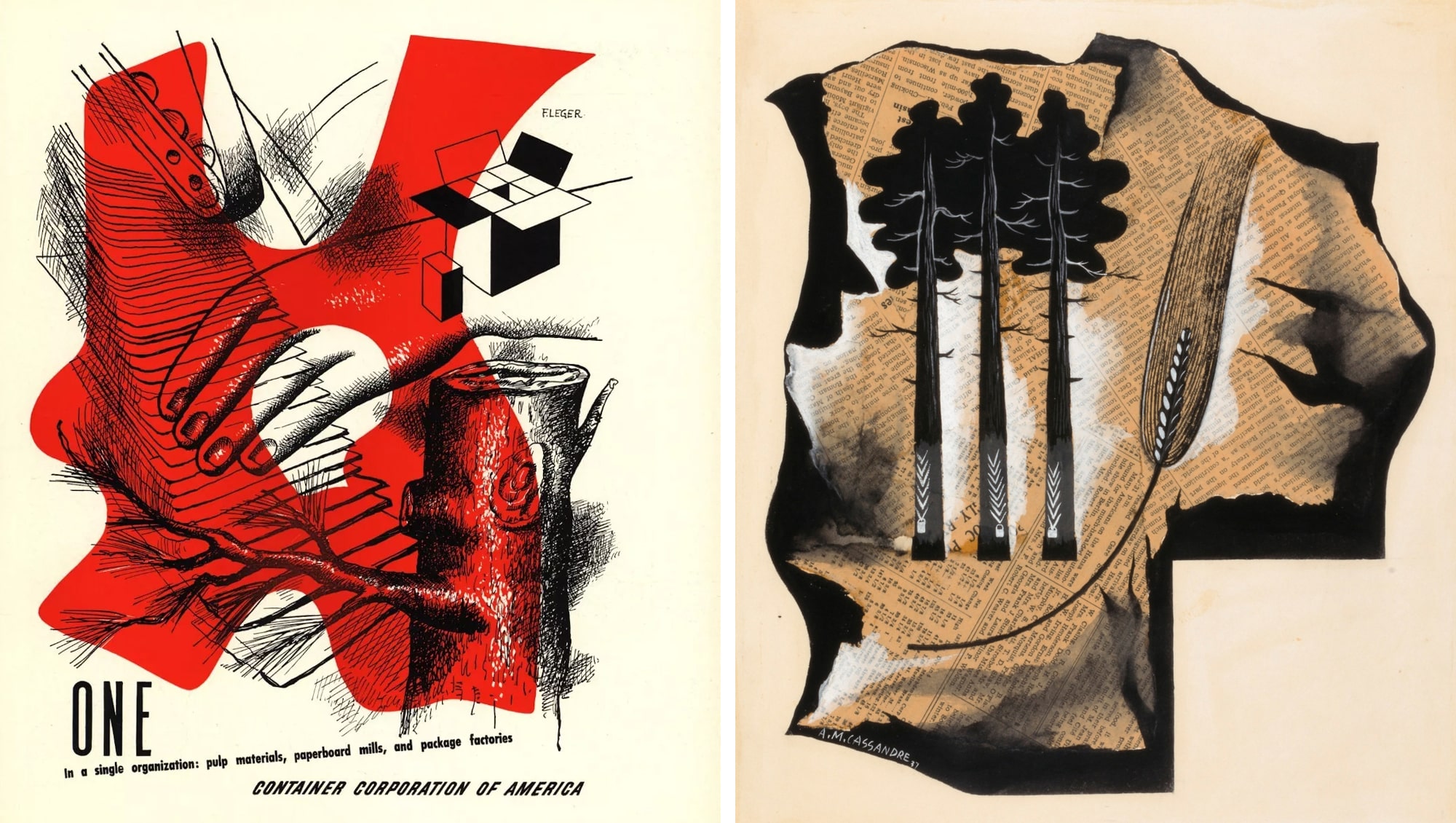
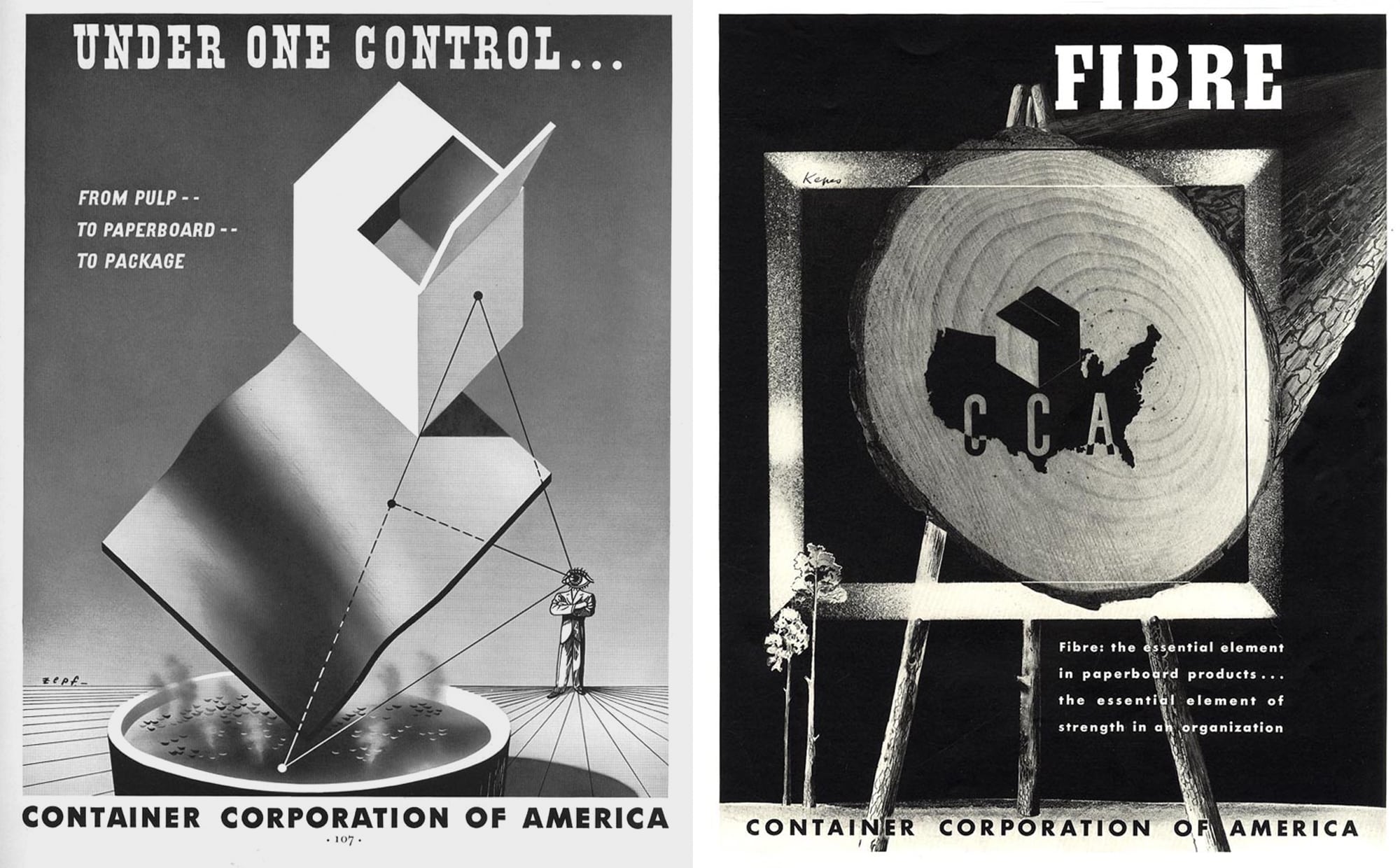
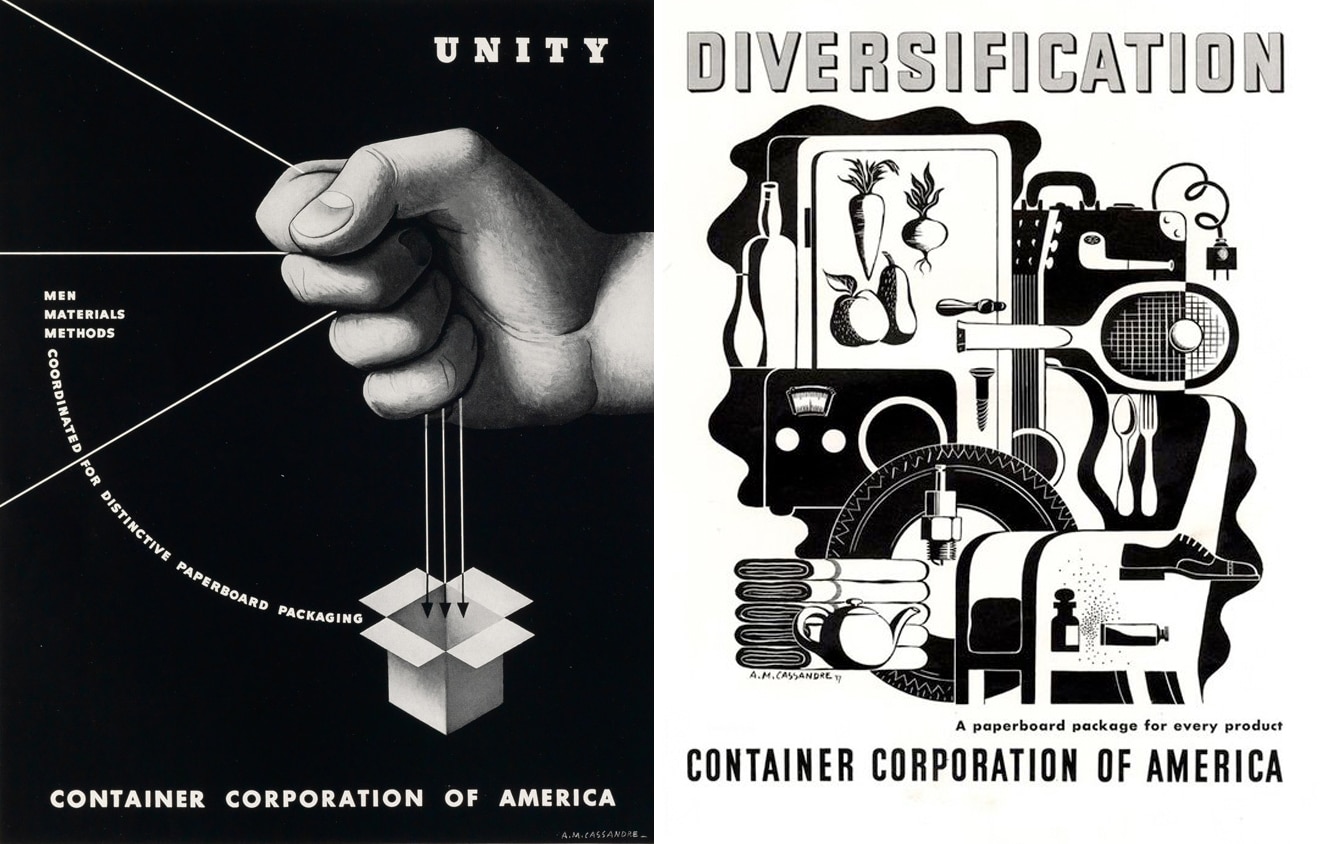
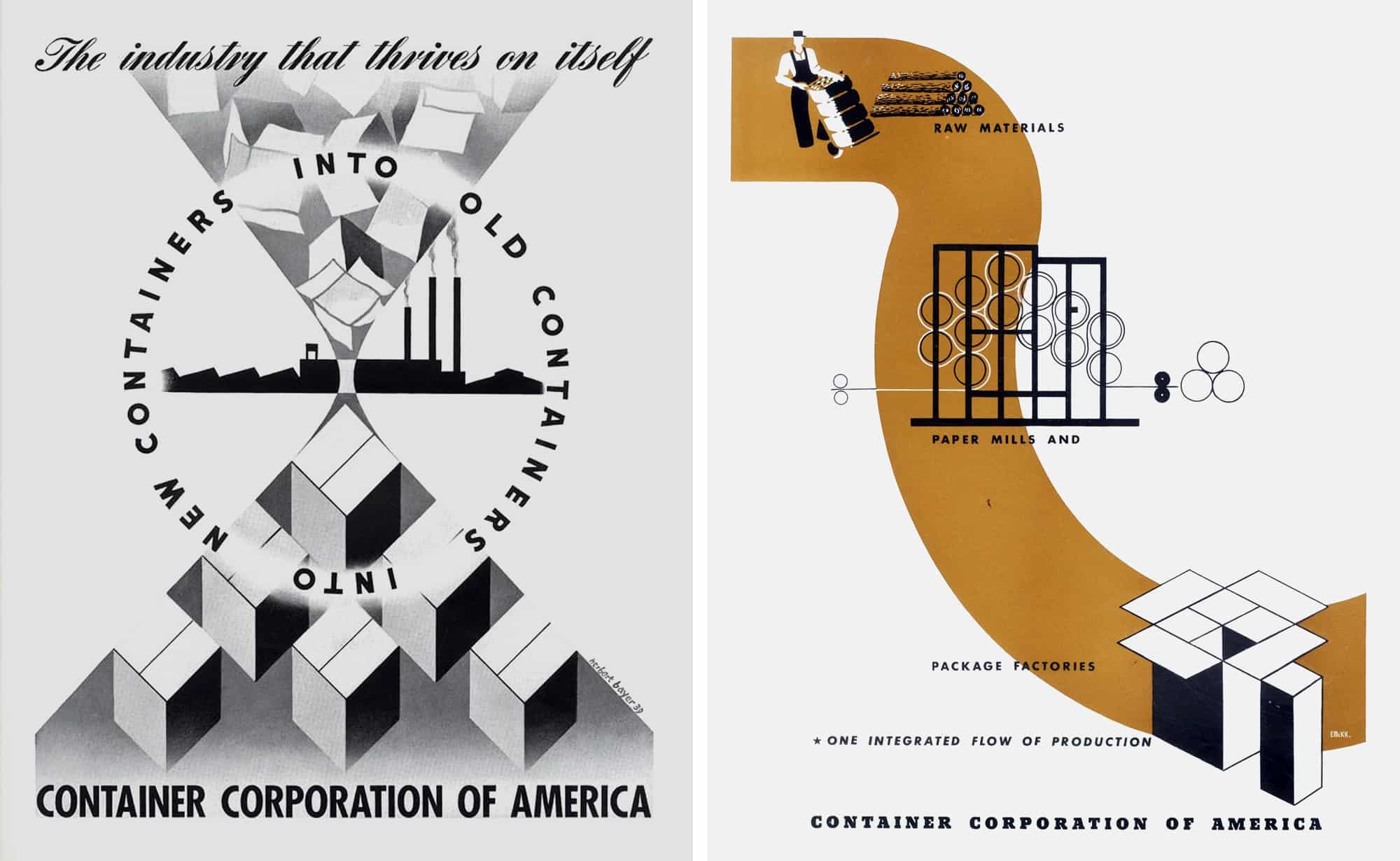
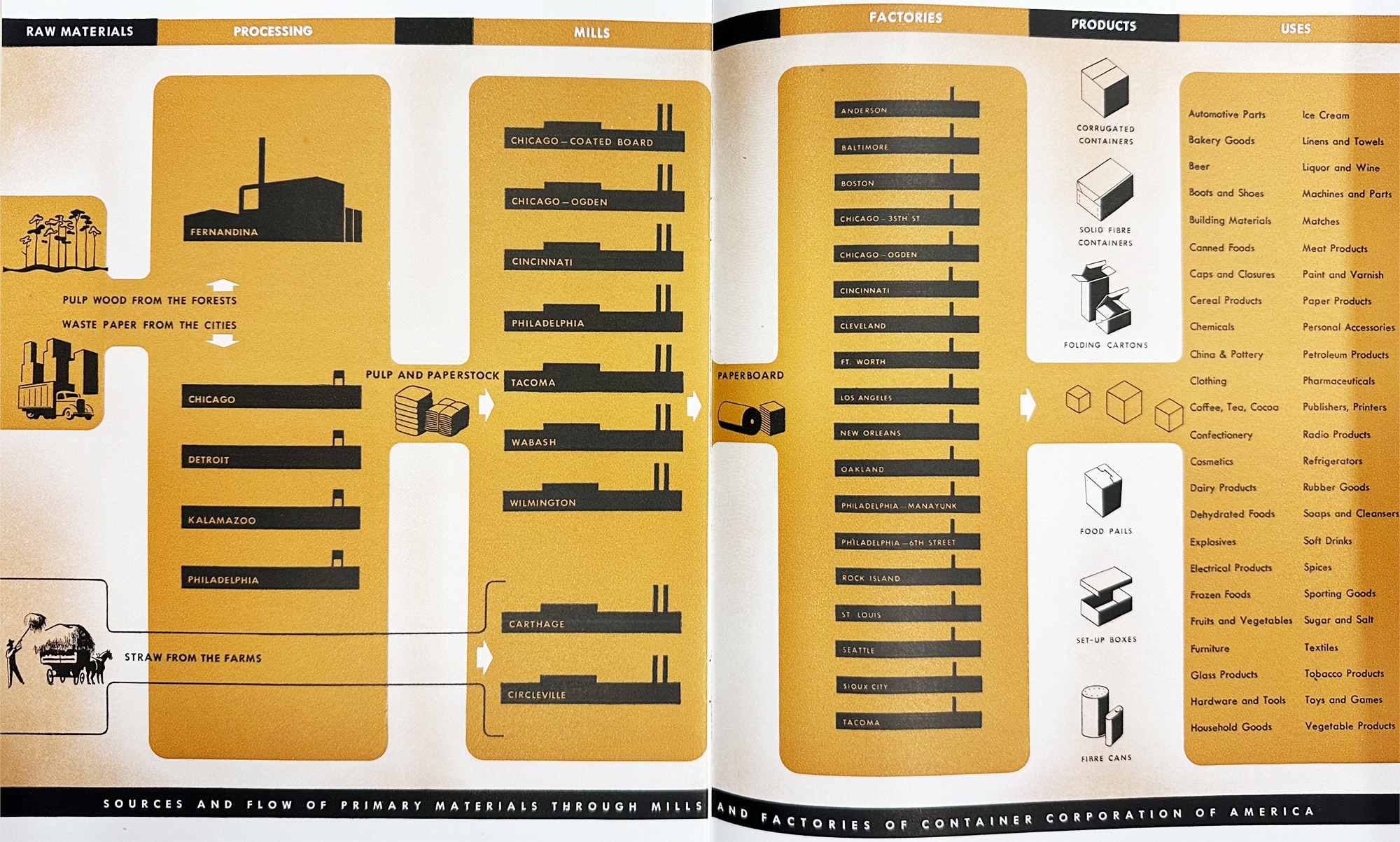
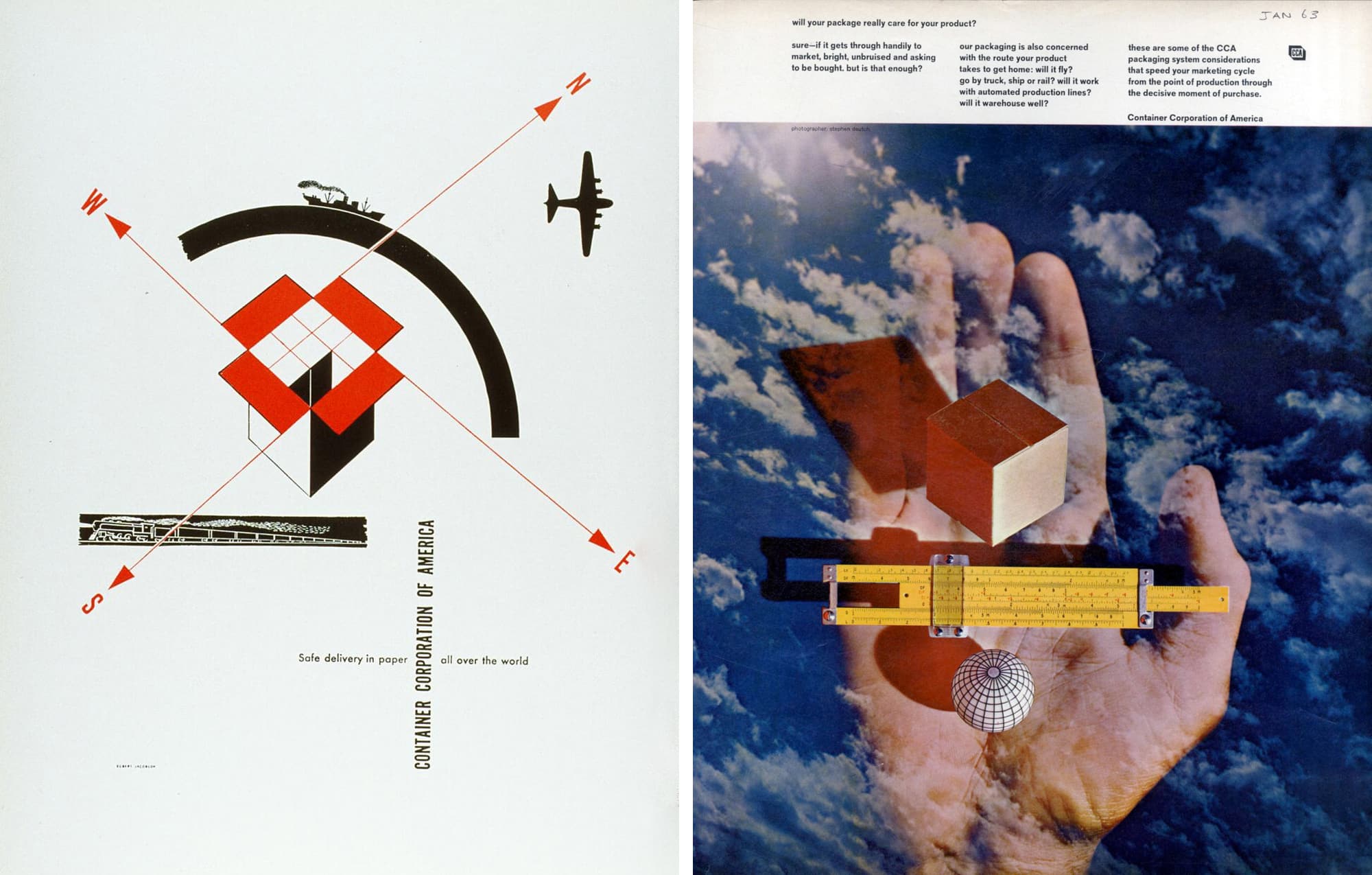
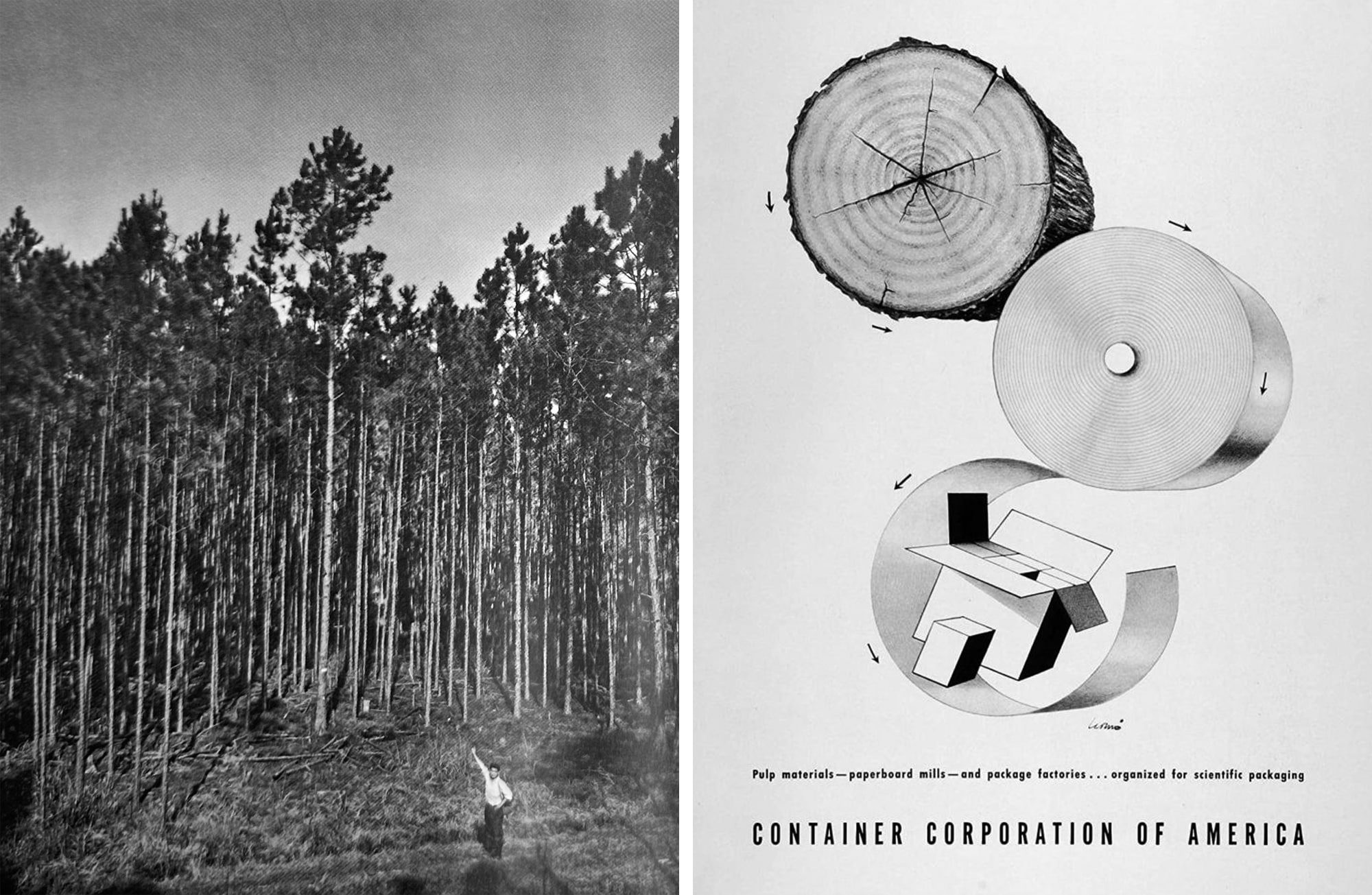
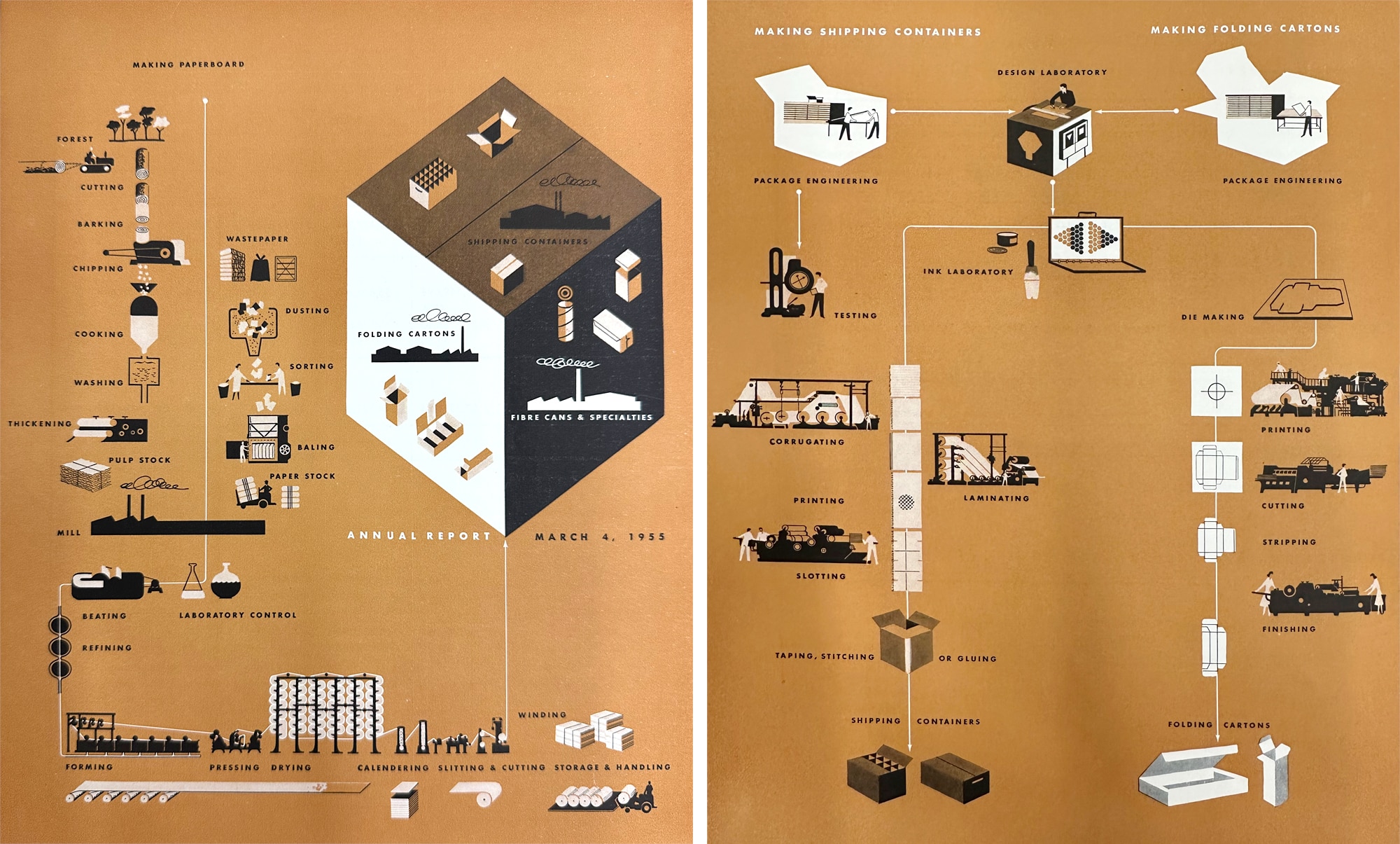
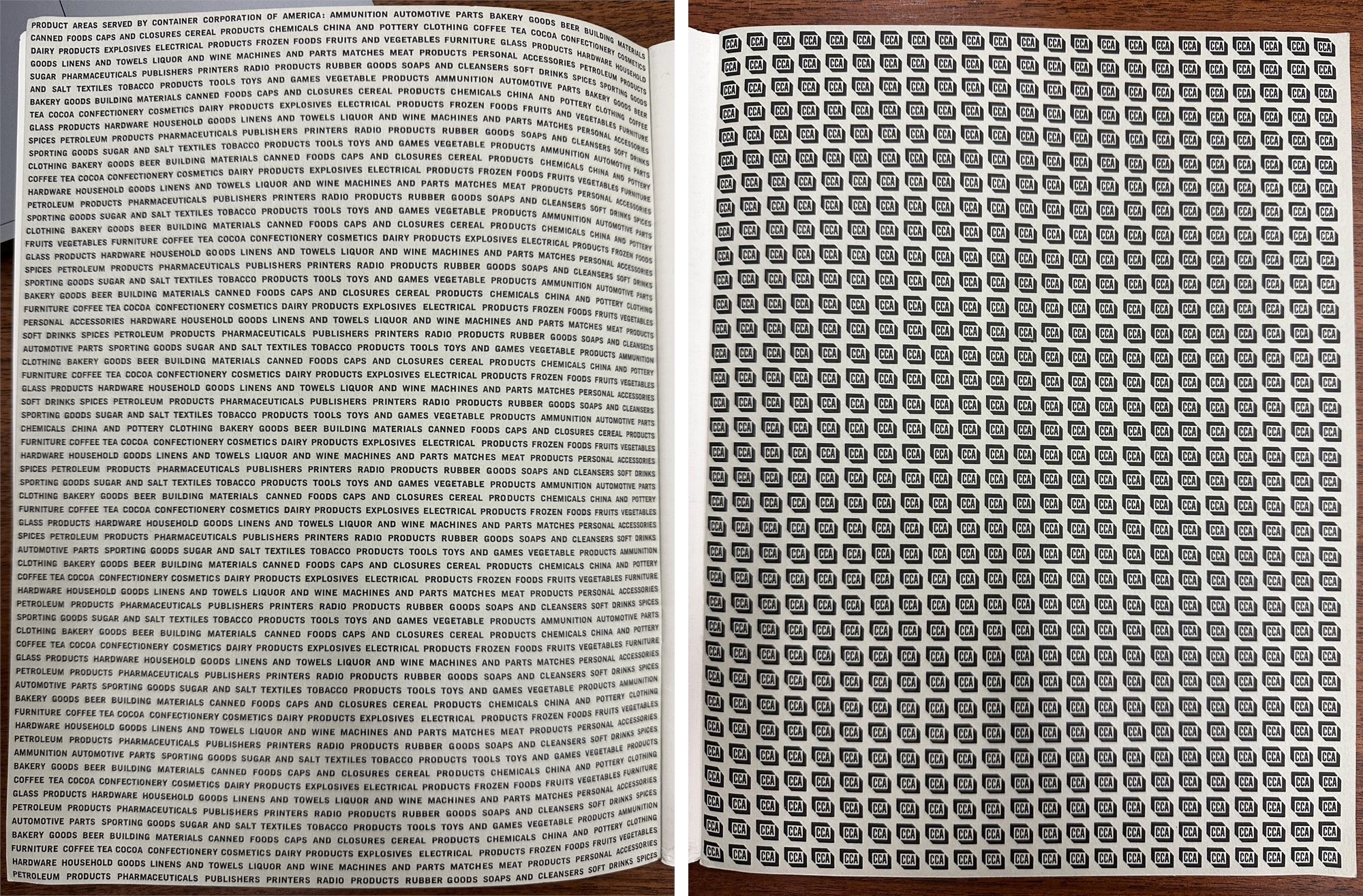
Design historian Robert Gordon-Fogelson posits that “managing a corporation of CCA’s size was also a fundamentally visual problem, a matter of conveying to customers, employees and stockholders the unity and stability of the integrated organization.” 52 As Paepcke described the company to the Society of Security Analysts in 1945, the CCA was the “most integrated unit in industry: sells containers, manufactures paper and straw board, produces its own sulphate pulp, collects waste paper, and delivers its finished containers with 300 units of its own trucks, tractors, and trailers.” 53 And the company sold that story through advertisements focused on the “mechanics and aesthetics of integrated package production.” 54 The Isotype graphics communicated globally, on the side of the cardboard box, a “frictionless, mobile medium” affording smooth circulation. 55 (Never mind that this frictionless movement depended on a denuded tree, as seen in the advertisement One.)
Herbert Bayer’s World Geo-Graphic Atlas brought the cardboard aesthetic into new settings.
This same clean, flat visual language reappeared in Bayer’s World Geo-Graphic Atlas, with maps, charts, diagrams, and illustrations that brought the cardboard aesthetic into new settings. Some 30,000 copies were distributed to the company’s customers and colleagues, as well as dignitaries, research institutions, and cultural organizations; and the impact resonated far outside this circle. 56 As art historian Courtney Schum notes, the CCA had published an earlier atlas in 1936, but the 1953 edition reflected postwar borders, presenting “a globe defined by non-militaristic and post-imperial networks,” including capitalist economic flows and communication and transportation systems. The book began by situating readers within the universe and geologic time; then it explored soil groups, climatic regions, and population density; moved on to examine continents and states, polar regions and oceans; and closed by addressing population growth, energy consumption, and natural resources. 57
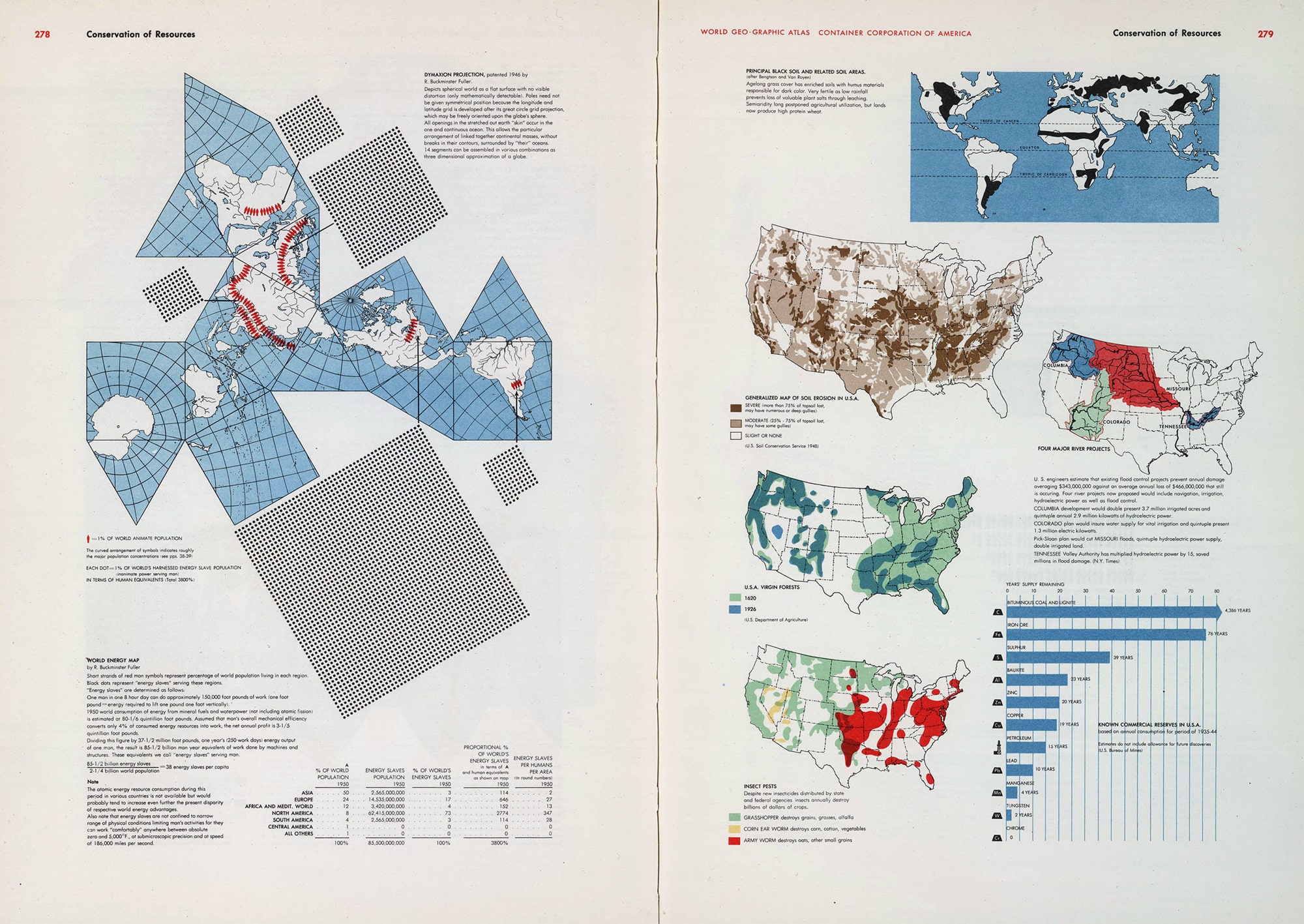
As Benjamin Benus observes, “the graphic techniques through which Bayer threaded together these shifting scales and integrated information from disparate disciplines gave the Atlas narrative a near-cinematic quality that distinguished it from its counterparts and precursors.” This was achieved by sourcing graphics from textbooks, government and scientific publications, and academic journals, and then (sometimes with little concern for copyright) redesigning or fusing them into “composite” presentations. Nearly all the pictures “had the appearance of quotation,” as if they had been pulled in from elsewhere, even if they weren’t cited, which “conveyed a certain neutrality or scientific distance.” 58 Still, the visual presentation — using modernist techniques like collage and sans serif type — elicited excitement. One recipient wrote, “Like Aspen itself, it takes you up to the top of the world, shows you how magnificent a prospect mankind has, and makes you feel the blood tingle in your veins with the desire for adventure and achievement.” 59
The CCA was also an early leader in recycling, producing more than 90 percent of its cardboard from wastepaper.
The atlas was also a prescient environmental text. Bayer wanted to show “the limited availability of land, the abuse of forests, the restricted reserves of minerals, the problem of soil erosion, and the vast abuse of energy,” hoping that this knowledge would compel powerful readers of the atlas to take action. 60 Of course the CCA itself was a major contributor to environmental problems, through the vast infrastructural networks its boxes packaged together. But the company was also an early leader in recycling. Environmental historian Peder Anker reports that Paepcke’s under-investment in timberlands led him to pursue recycling wastepaper into cardboard. This became a highly successful program: by 1940, the CCA produced more than 90 percent of its cardboard from wastepaper. 61
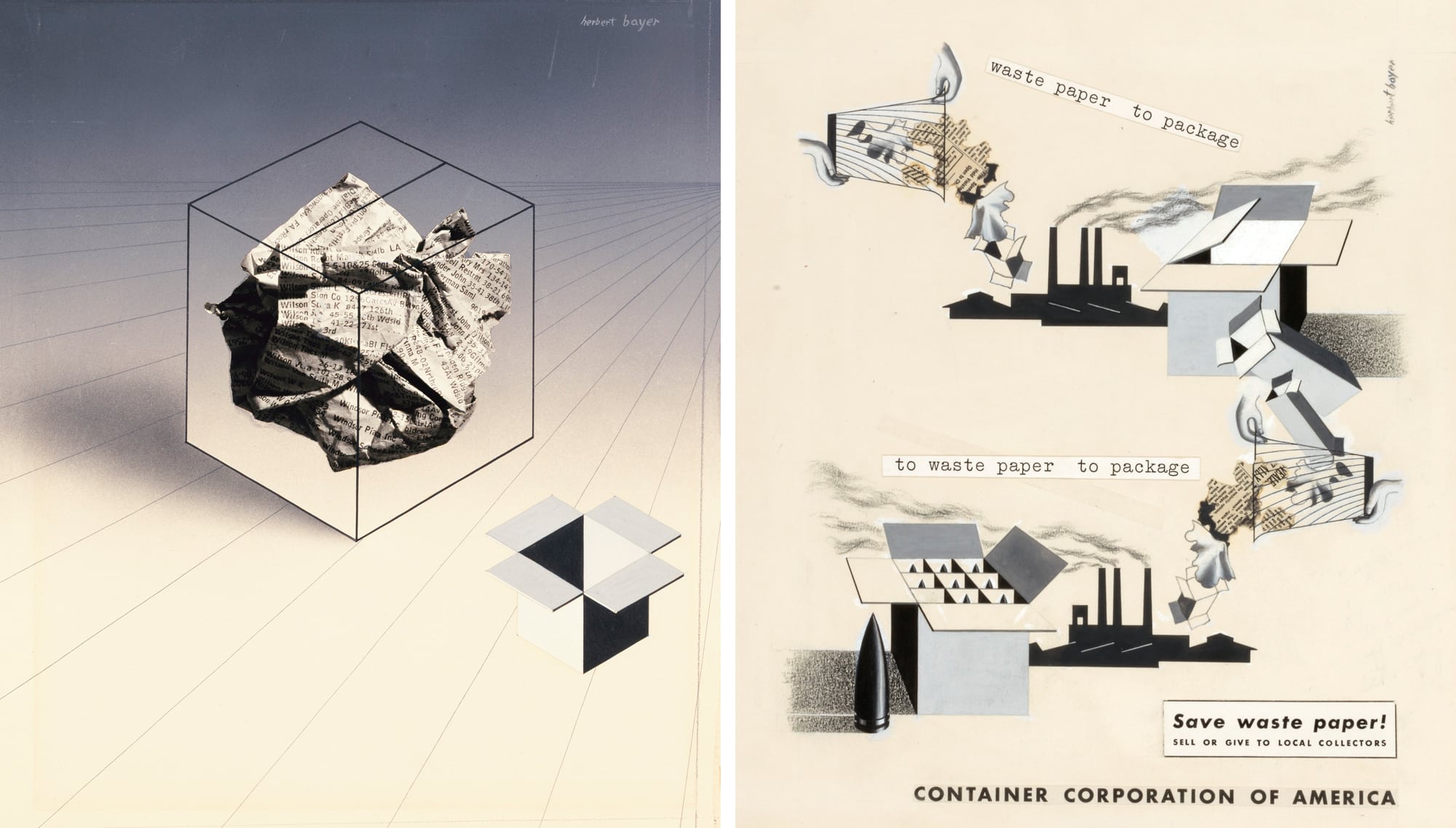
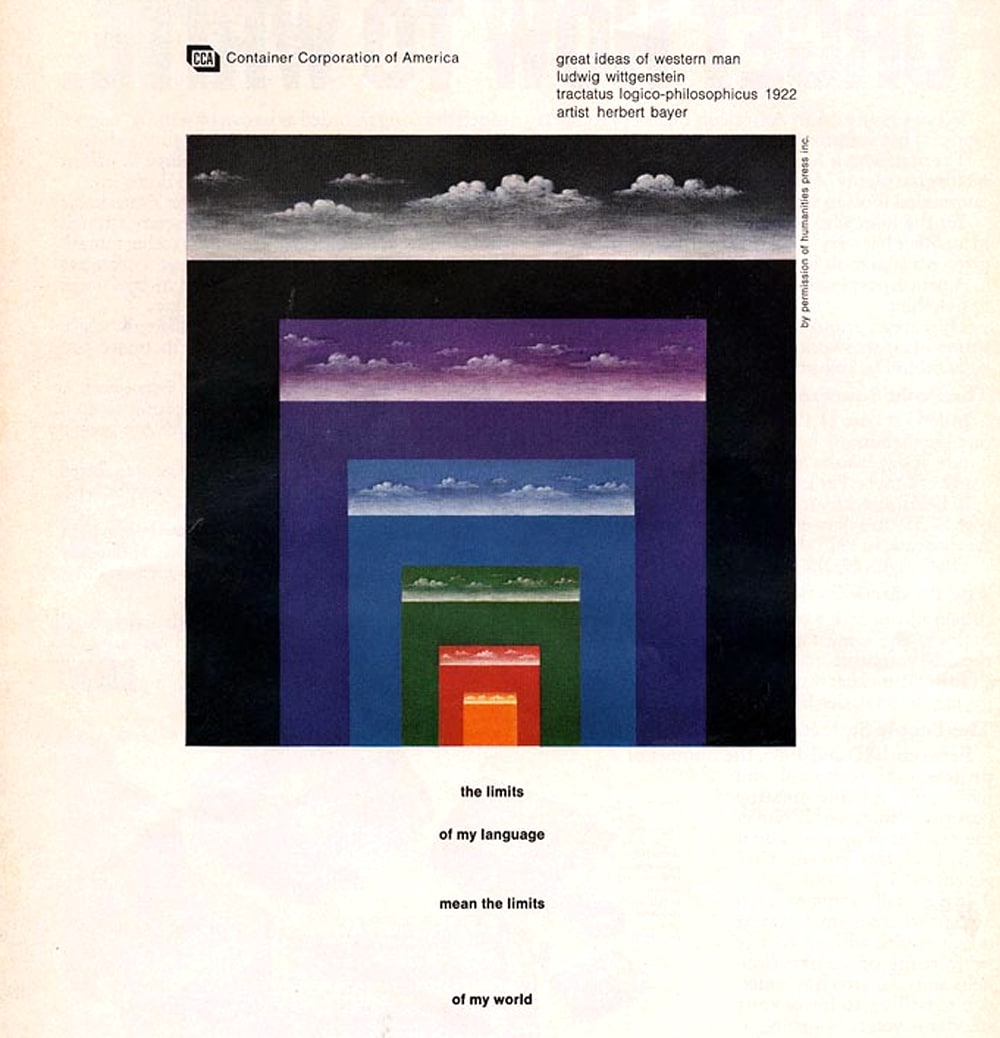
The company’s early advertisements focused on recycling, on the wartime applications of cardboard boxes, and on specific aspects of the product line. 62 But by the 1950s, the CCA was running ads that did not mention its products at all. They were about the United Nations, or about “great ideas” expressed in philosophy and literature, inspired by the Great Books series at the University of Chicago. These ads circulated in magazines like Fortune, Business Week, and Time, seeking a general readership, and Bayer later gathered them into a traveling exhibition, “Modern Art in Advertising.”
By the 1950s, the CCA was running ads that did not mention its products at all. They were about the United Nations, or about ‘great ideas’ in philosophy and literature.
The thematic campaigns exemplified Paepcke’s internationalist ambitions — as a businessman and as a public intellectual and cultural force. He declared that, once the company had completed its wartime mission to deliver supplies, it would address “many extremely important, unsolved problems in the field of education, health, and welfare, government philosophy, foreign and international policy, and cultural affairs.” 63 In 1949, and the decade the followed, he established Aspen, Colorado, as a hub for conferences and festivals to educate a social and financial elite. He commissioned Bayer to design and promote the town and worked with Jacobson to launch the International Design Conference. Aspen, a former mining town, would now be mined for its natural beauty and intellectual inspiration.
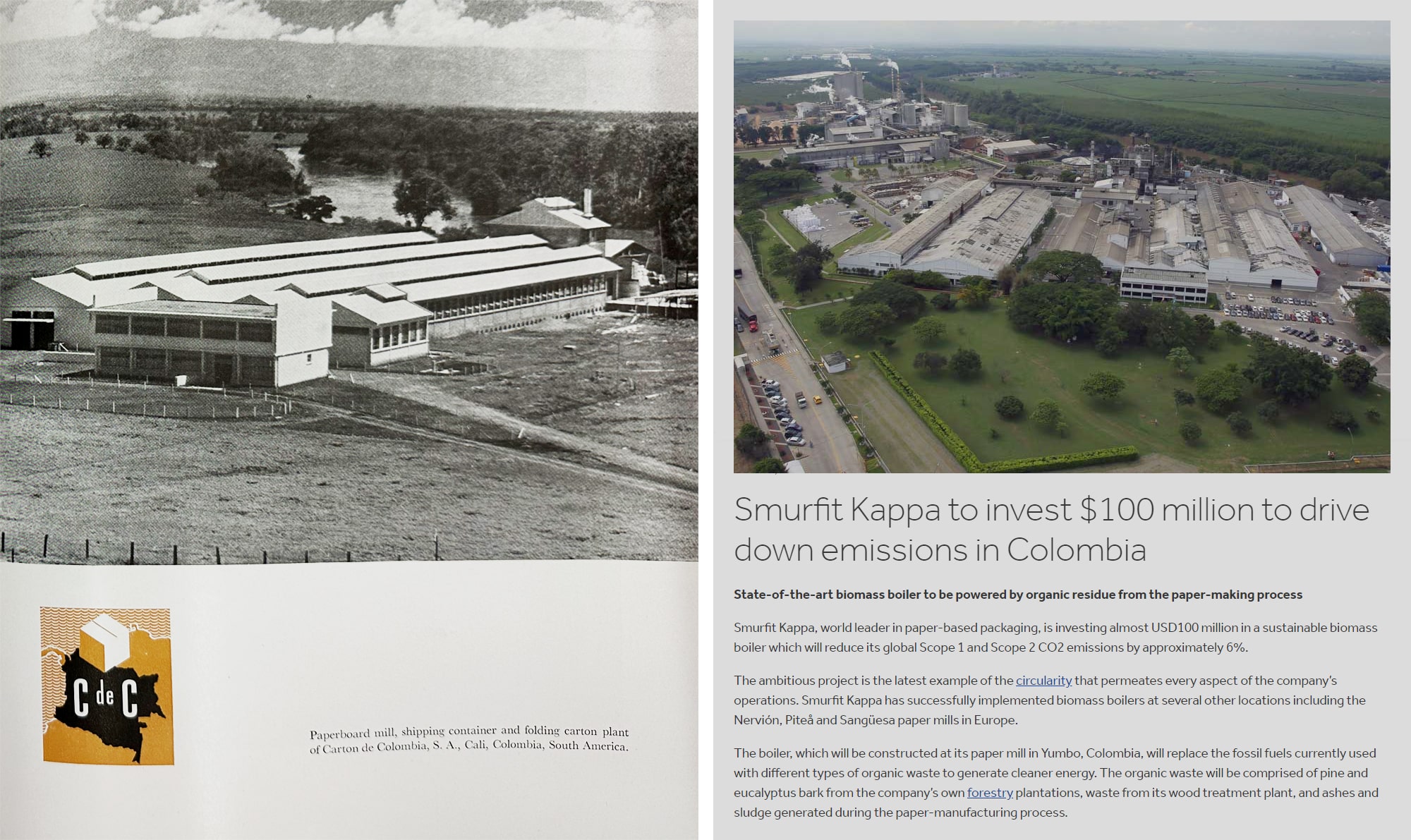
This worldly sensibility paralleled the Container Corporation’s reach into international markets, its acquisition of foreign companies, and its extraction of natural resources. When siting new mills, plants, and offices, John Massey, the company’s third design director, explained that the CCA brought “management abilities, outstanding packaging technology, and marketing know-how to developing countries, where the company could provide assets not available locally.” 64 We see him here instilling the language of corporate globalization. “We are indeed fortunate in the fact that the paperboard packaging we make is a vital and efficient vehicle which makes possible the distribution of the products of a country to its people,” Massey wrote in a 1958 missive. “The process, fortunately, is non-political.” 65 Of course, it was anything but.
The contradictions of a global corporation acting as a global citizen were on display at the 1970 Aspen conference “Environment by Design.” This was a raucous event, where activists and artists protested the superficiality of design interventions that claimed environmental benefits. But it was also a productive one: designers judged a student competition that produced the recycling graphic still widely used on cardboard boxes today. 66
An abstract design language concealed the violence of colonial extraction and uneven development.
Nieland describes the “visual idiom” of CCA publications as “free of topographic detail, in keeping with [the] modernist grammar” of Bayer’s atlas, an abstract design language that concealed the violence of colonial extraction and uneven development. 67 Exceptions prove the rule. In ads that show the slash pines grown in the southern United States, we are reminded that kraft pulp processes use tremendous amounts of water and release toxins. And as Robin Lynch notes, in some of the United Nations ads, we see landscapes ripe for extraction — lands that were in fact deforested by the CCA, which cut down tropical rainforests in South America to grow pine and eucalyptus for paperboard. 68 (Similar colonial operations are hiding today behind the flatness and false cheer of Amazon’s smarrow.) 69
In the globalized world the CCA made possible, these impacts have reverberated through decades, outlasting the corporation itself. In the tumultuous year of 1968, the CCA merged with Montgomery Ward, the mail-order business turned department store. Then, under the new name of Marcor, it became a subsidiary of Mobil Oil, which sold it to Smurfit Kappa Group, a Scottish outfit that still makes packages and paper products today, with operations around the world.

A Cardboard Society
Of course, the spiritual heir to Walter Paepcke’s CCA — the vertically-integrated, multiply-armed hegemon of packaging, shipping, branding, resource extraction, and cultural influencing — is Jeff Bezos’s Amazon. Meanwhile, the intense relationship between cardboard boxes and graphic design, fused in the art department at the CCA, has influenced a new generation of package design.
Online commerce has created a ‘packaging arms race,’ as seen in the aesthetic spectacle of unboxing videos on TikTok and Instagram.
The rise in online commerce has created what The Atlantic’s Amanda Mull calls a “packaging arms race” wherein the box is commonly designed alongside the product. “Regular people are conversant in the language of branding,” and are also branding themselves, through the aesthetic spectacle of unboxing videos on TikTok and Instagram. 70 That, in turn, has led to more telegenic boxes. As Orora Packaging Solutions’ Chris Bradley told the publication Packaging Dive: “I’m thinking about the way that a YouTuber … would unbox it when we’re in the design process, because we want to have that big ‘aha’ or ‘wow’ moment.” 71 Packaging is engineered to produce a crinkly sound, to evoke sonic memories such as the rustle of tissue paper on Christmas morning. Boxes are fit tight, anticipation building with just the right amount of friction and drag, until the lid slides off, releasing a gust of air and a subtle pop. Apple’s elegant boxes are tiny white-cube galleries showing off objets d’art. And sometimes patterns or messages are designed inside the box to cultivate interior ambience and intimacy. 72
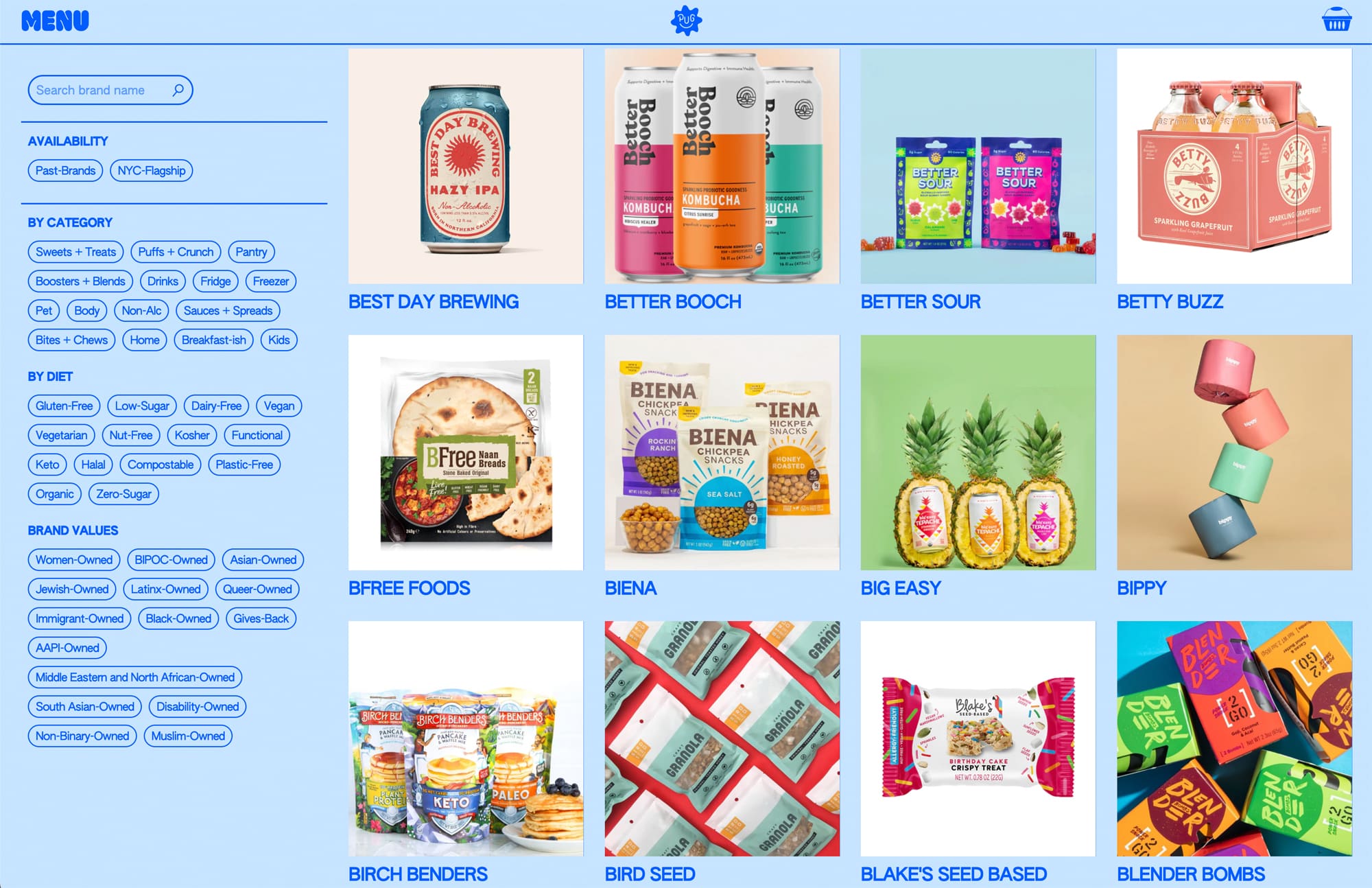
The aesthetics of Instagram — flat graphics, jewel hues mixed with pastels, sometimes vaguely psychedelic — materialize on the carefully curated shelves of charming “provisioners,” those “shoppy shops” (as designer Neil Shankar calls them) that translate e-commerce into retail outlets and are very much into their shoppe-with-an-‘e’-ness. 73 Think Greenpoint or Upstate™. Think shopkeeper as content strategist. Some of the genre’s signature brands — Fishwife tinned seafood, Diaspora spices, Minna tea, Graza olive oil, Magic Spoon cereal and Banza pasta —are supplied in bottles, cans, and boxes designed by the Brooklyn design studio Gander. They are made to feel small, artisanal, and, in the words of Grub Street’s Emily Sundberg, “local everywhere.” But they’re not necessarily locally sourced or single-origin. As design critic Kyle Chayka says, these products “don’t feel local to a place, but instead they feel local to the internet.” 74
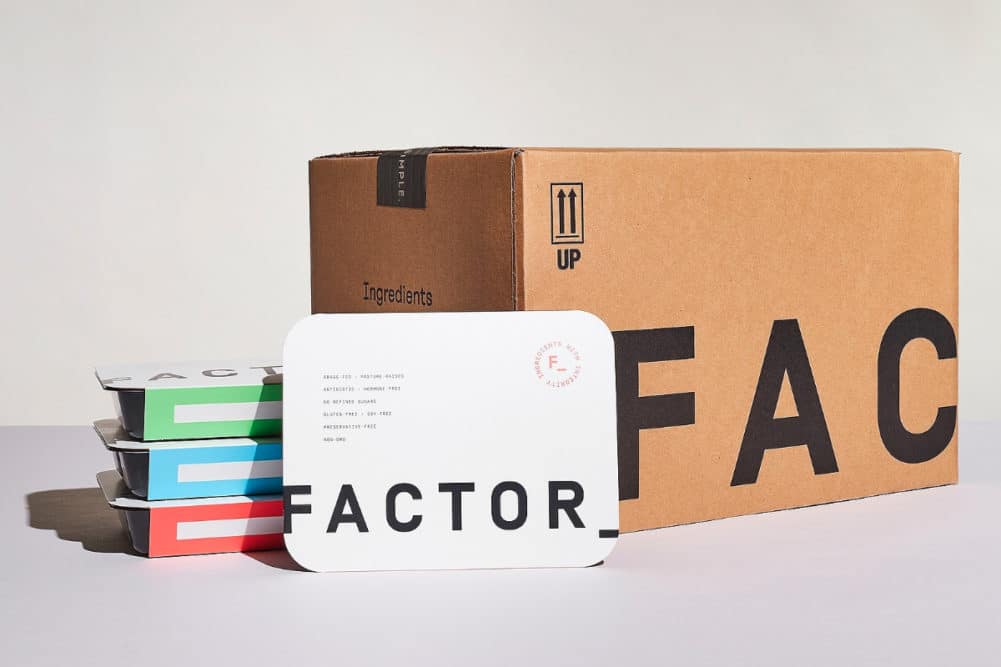
Another example is the meal kit packages that exploded in popularity among the covid convalescent. Gathering goodies from placeless farms and kitchens, these boxes are like little pantries, providing insulation and cushioning for the fruits and eggs and chops nestled within. 75 Their perishable polychromatic abundance is reflected on the cardboard exterior through vibrant colors and fonts capturing a range of personalities. Factor, a company that prioritizes “clean” eating and caters to the keto crowd, reflects its ascetic character on its cardboard face: a black panel with the brand name displayed in negative, in widely kerned (or “socially distanced”) Hurley Sans text. An underscore after the “R” hints at a missing “Y,” suggesting that your body is an energetic machine, and that Factor is the fuel. It also gestures toward the blinking cursor on a command-line, which frames this nutritional program as an executable script. 76
The mark emphasizes efficiency and systematicity. It wants us to feel plugged into the systems of global capitalism that bring this fuel to our doorstep, the logistics hubs and data centers and cardboard waystations, and the geographies and communities shaped around them. 77 All those boxes piled up on 23rd Street, whether stamped with a crass Walmart starburst or a “local everywhere” sunflower, they’re all printed somewhere, on offset presses in factories that flatten and fold the fibers from pines grown in the southeastern United States or Brazil or some new frontier. And they’ll have a life beyond their brief stay in our homes, whether they’re sent to the recycling plant or repurposed for local uses — in some cases, providing shelter for, or delivering humanitarian aid to, human beings who have little time for Instagram or fancy olive oil.
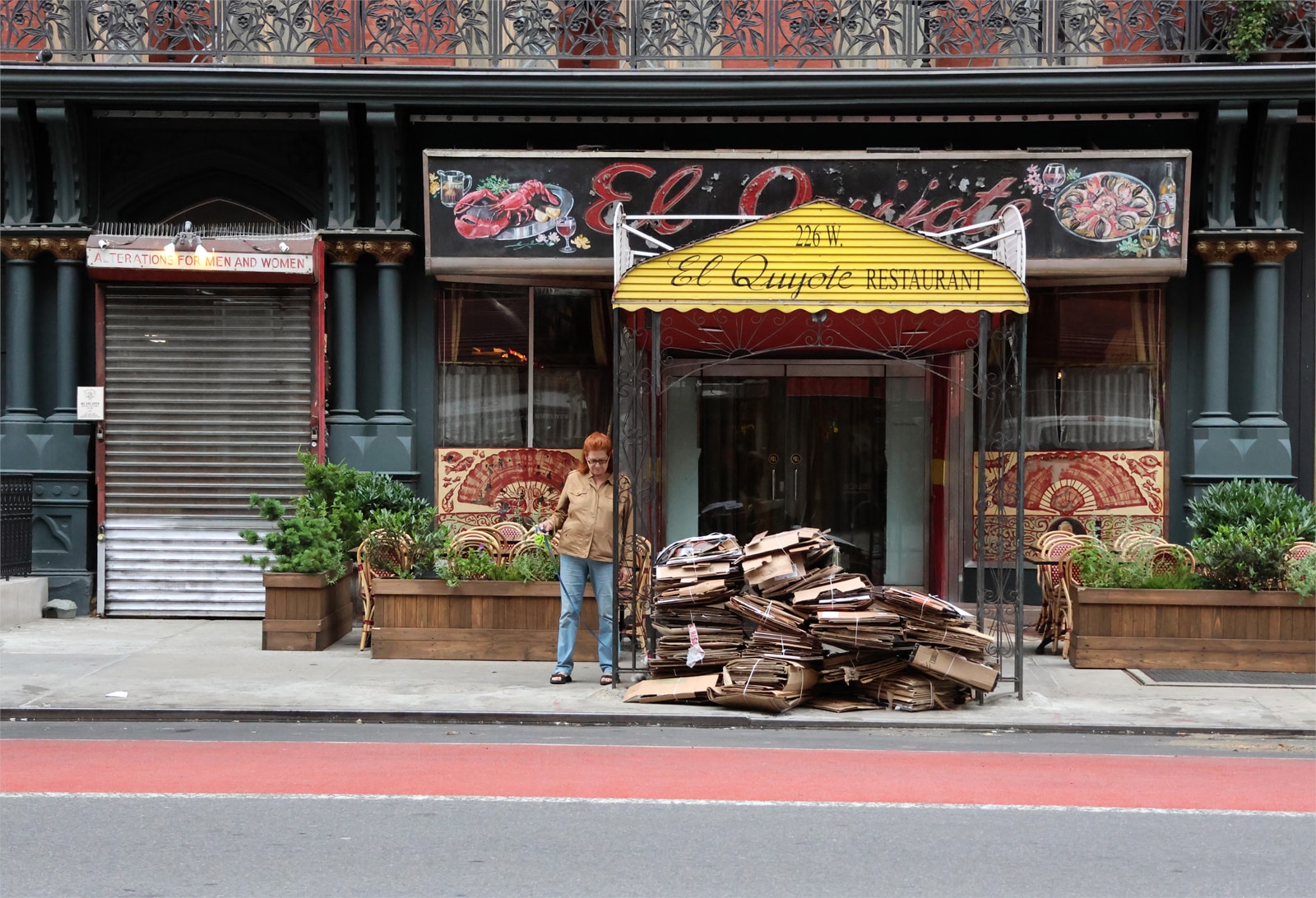

At the turn of the 21st century, corrugated cardboard accounted for just fifteen percent of the United States recycling stream. Today, it’s nearly half. Warehouses and retailers who are paid for their used cardboard tend to be “vigilant” about recycling, but in small businesses and homes, boxes are often contaminated by trash and food waste. “Americans put plastic bags and chewing gum and bowling balls and dirty diapers and everything else you can imagine into the recycling containers,” said David Biderman of the Solid Waste Association of North America. 78 Yet small contaminants — “stuff like grease and tape” — can be removed, says Katie Fries, who manages a pulp and recycle plant for International Paper. Her facility takes in used cardboard from grocers and retailers in a 300-mile radius and recycles 500 tons a day. 79 Just how much of the cardboard we use gets recycled is hard to say. One trade group claims 94 percent, but independent researchers estimate a more modest 69 percent. 81
At the turn of the 21st century, corrugated cardboard accounted for just fifteen percent of the U.S. recycling stream. Today, it’s nearly half.
In 2018, China restricted imports of American recyclables, including mixed paper, which led some municipalities to send paper waste straight to landfills or incinerators. Yet for communities with dormant paper factories, the ban was a boon. If they did the dirty work of sorting out salvageable containerboard, they could expand operations. 82 After a mid-pandemic dip in cardboard production, used materials are again scarce, so there is great demand for OCC, or “old corrugated containers.” Large new facilities like Dotmar’s, Pratt Industries, and Graphic Packaging — Kingsport, TN; Henderson, KY; and Waco, TX, respectively — transform these old boxes into new corrugated and paperboard containers. Prices for OCC have tripled in some parts of the U.S. 83
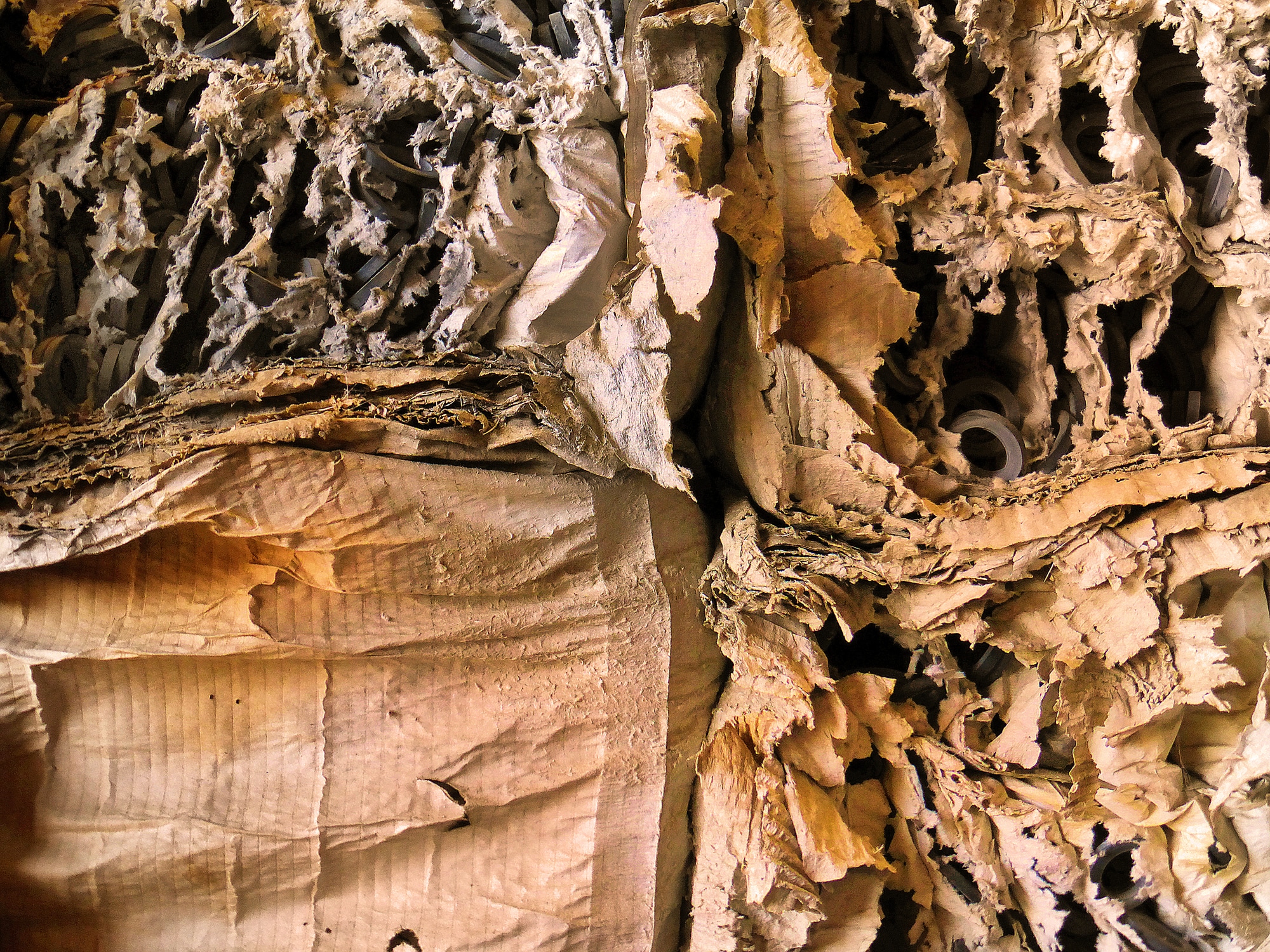
Under consumer pressure, Amazon and Walmart have also implemented “sustainable” packaging standards in an effort to cut back on all the boxes and plastic air pillows. 84 But that hasn’t worked exactly as planned. It’s spawned a new repackaging industry, which relies on intermediary contractors to unbox and re-box goods from third-party sellers so they meet Amazon rules. As Josh Dzieza explains, “Amazon only accepts goods that are packaged a certain way. Products need to be made ready for the automated gauntlet of the fulfillment center. Old barcodes and prices need to be covered up and new ones added. Glass needs to be bubble wrapped. Loose items need to be bagged.” 85 These re-boxers, who operate their own small-scale prep centers across the country, and especially in states without sales tax, are an integral, if invisible, link in Amazon’s logistical network. And that network, too, runs on cardboard.
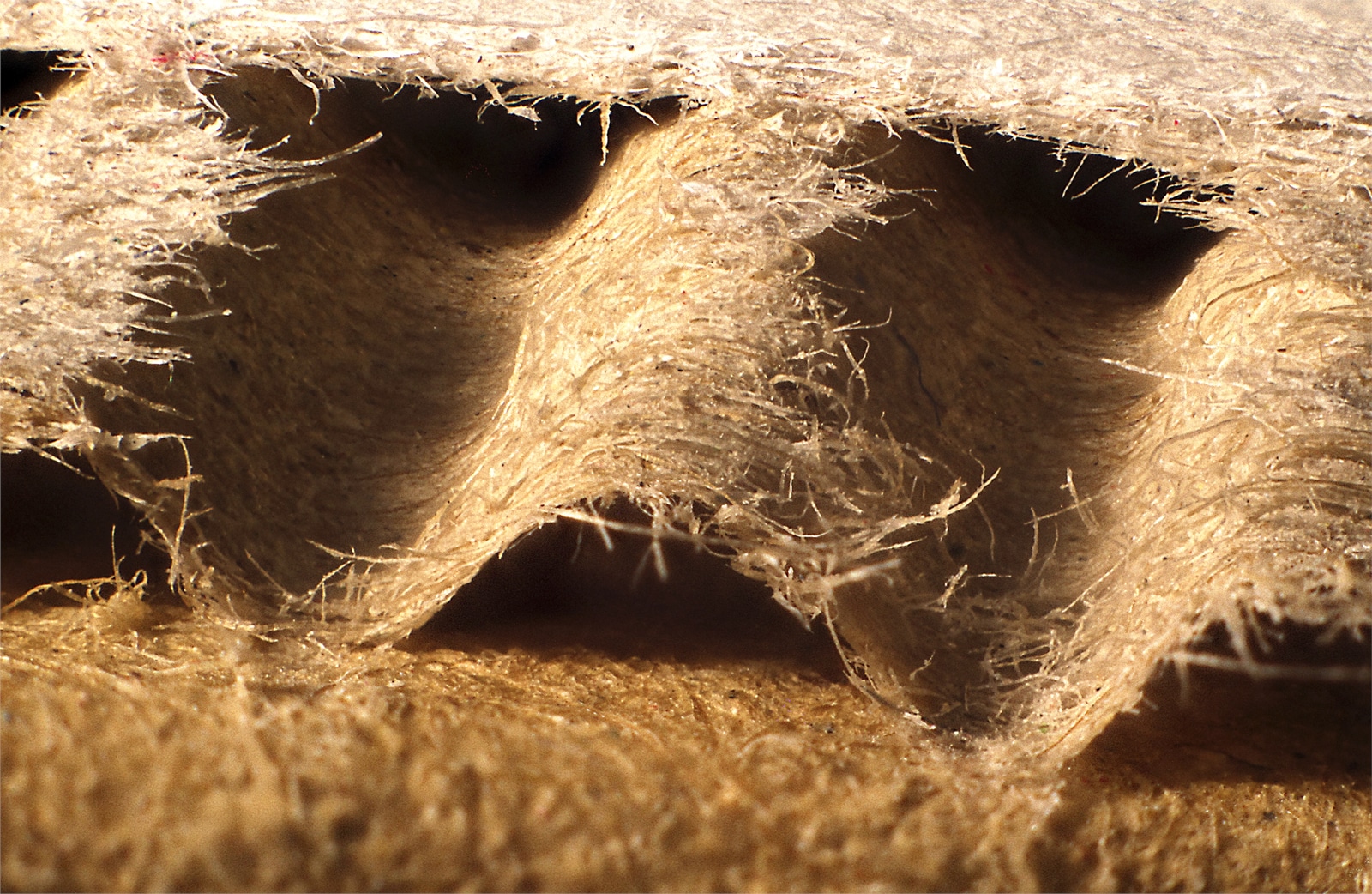
Each regenerative cycle shortens and weakens the pine fibers, pushing degraded bits through the screens. Cardboard fibers can typically be recycled only five to seven times.
Cardboard is more recyclable than other packaging materials, yet each regenerative cycle shortens and weakens the pine fibers, pushing degraded bits through the screens. Fibers can typically be recycled only five to seven times. 85 So our seemingly endless need for boxes demands new trees. In a vivid feature for The New York Times Magazine, Matthew Shaer reports, “In Georgia and Alabama, family operations have given way to small empires of tree plantations, built largely on private land, and largely by planting pines in a region where other types of trees — or other varieties of crops, like cotton — once grew.” These monocultures are less biodiverse and more poorly able to store carbon, filter drinking water, and reduce erosion. It’s “just pines, pines, as far as the eye could see.” 86 New plantation pines and old Amazon boxes feed the region’s new mega-mills.
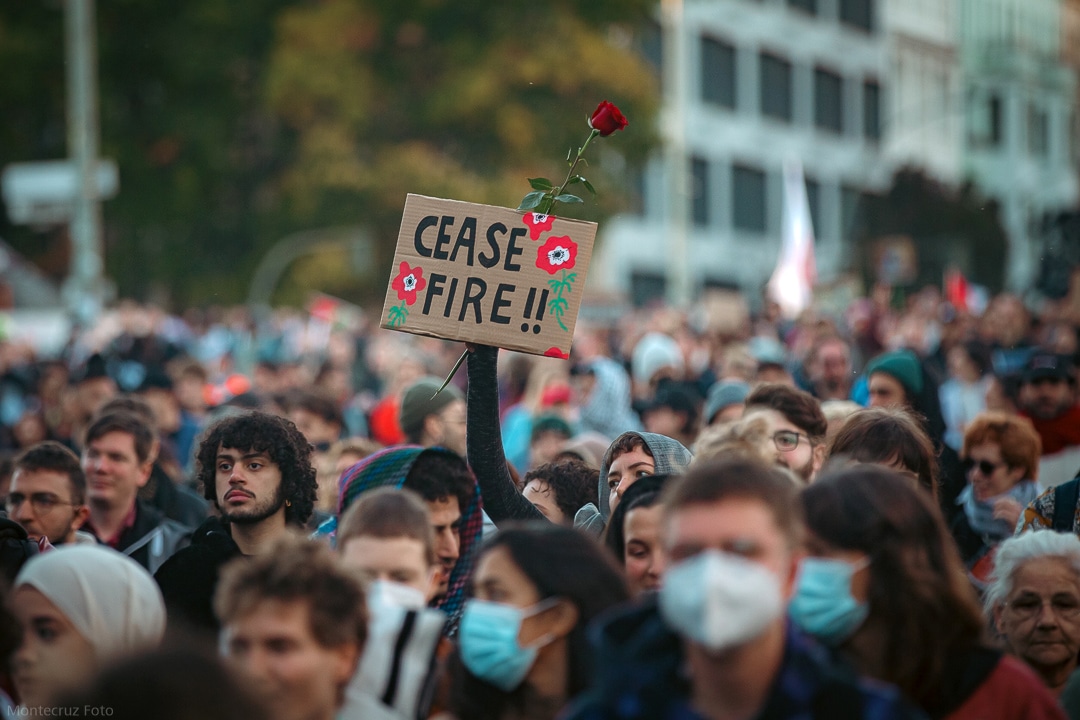
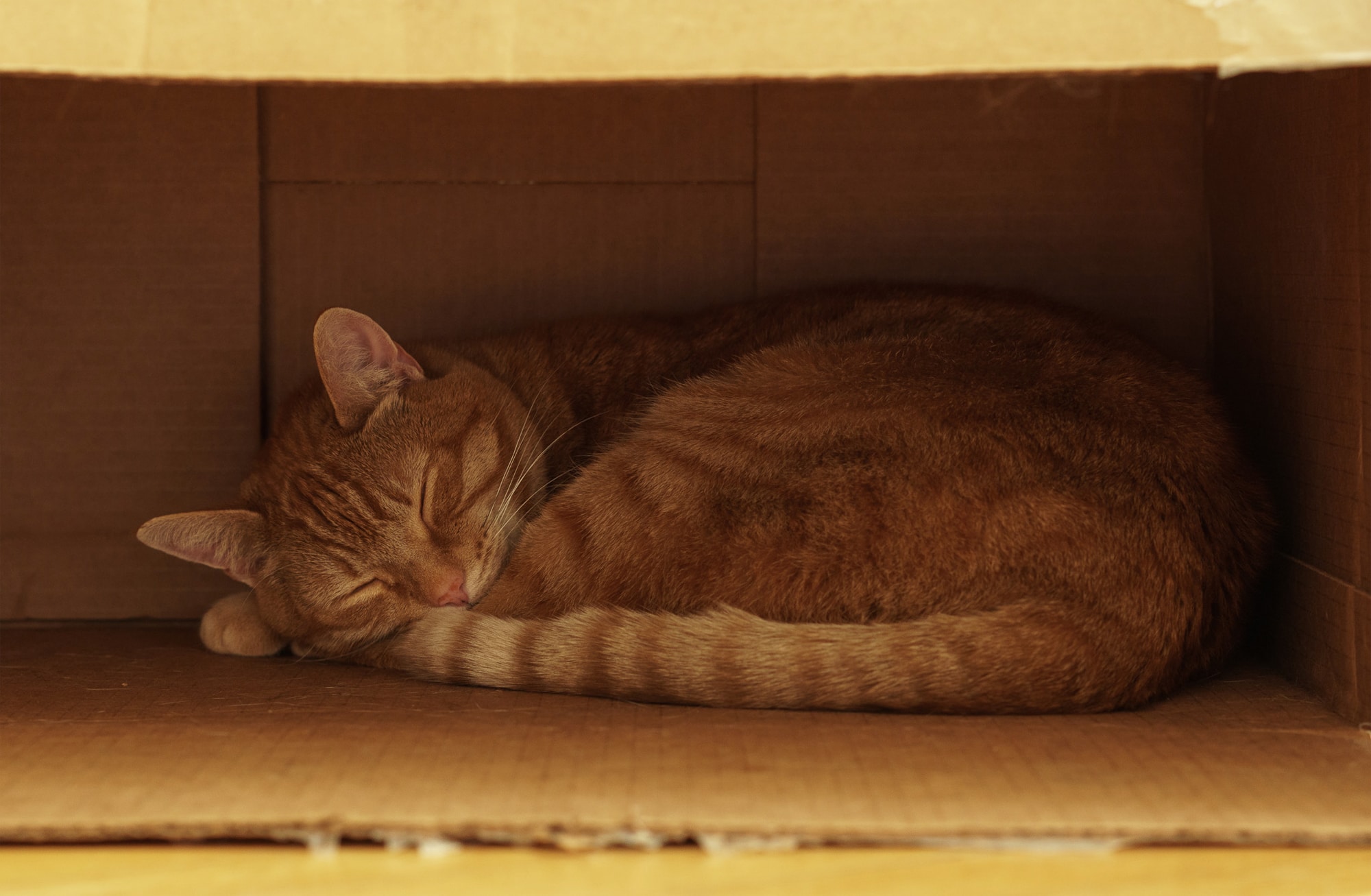
Yet formal recycling operations are only part of the picture. Cardboard is also a medium for reclaiming the disposable, for local improvisation and imagination, for prototyping other architectures and apparatuses for living. To a cat, a cardboard box is sanctuary. To the characters in the children’s book series The Cardboard Kingdom, boxes are the raw material for new costumes and fantasy worlds. 87 Protestors make cardboard placards, repurposing waste scraps to broadcast their visions for a more just world.
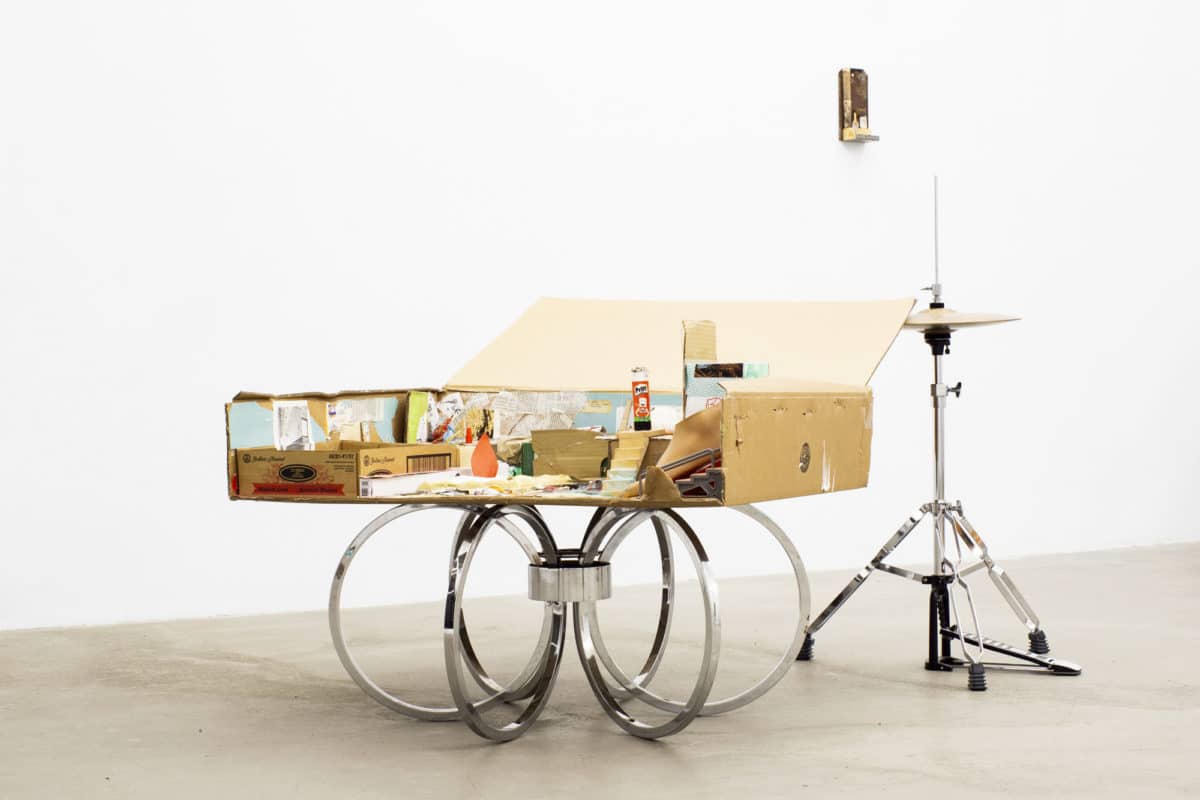
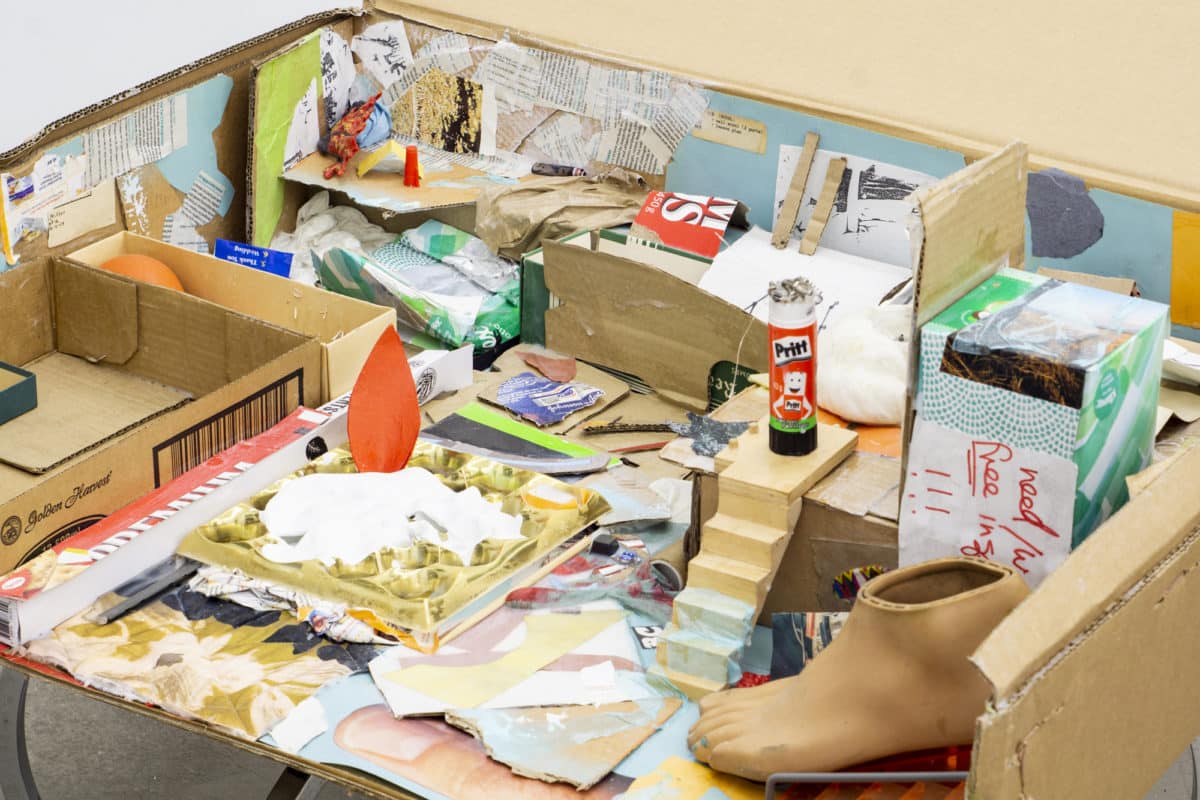
Artist Georgia Dickie, in Maquette for Dream Home, uses a large, open-lidded cardboard box as a “platform for the playful planning of ‘dream’ interiors,” which are furnished with other small, nested containers — boxes and bags and tubes — and gleaned material. Her aspirational environment evokes competing themes of disposal and care, environmental desecration and conservation: all inherent in the cardboard lifecycle. 88 Sculptor Ruth Hardinger casts concrete in cardboard molds that can’t bear their contents’ weight. Her “Conundrums” exemplify provisional form. 89 The Latin American cartonera publishing movement generates cardboard-bound books as a way to democratize and decommodify knowledge production and sharing. 90 And the Catalan artist Antoni Tàpies makes collages and assemblages that integrate torn, folded, weathered materials, including paper and cardboard, to evoke degradation, fragility, and humility. He also casts bronze sculptures that look like cardboard boxes. 91 These engagements with the already-spent box compel us to think about the limits of containment and distribution and the infrastructures on which they depend.
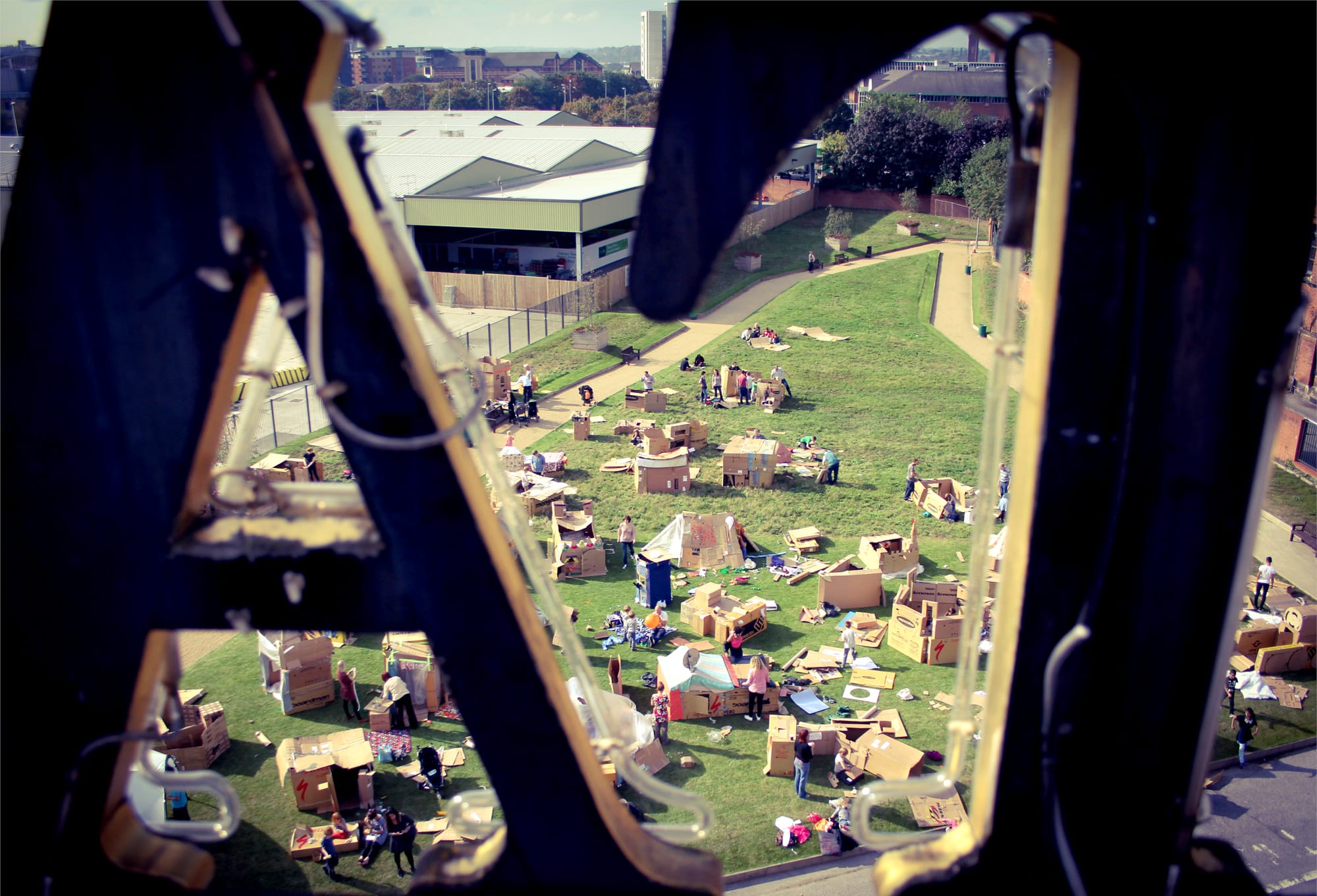
In his 1946 book Paperboard and Paper Containers, Harry J. Bettendorf extolled the civilizational gifts of the cardboard box: “Out of the piles, confusion and dirt of the earlier period came the cleanliness, order, precision and efficiency of mass production goods through the employment of mass production packages of paperboard.” 92 In this moment, in the pause after World War II, after the Container Corporation had sent its boxes into battle, but before it endeavored to shape civic discourse through Aspen elites, here is a historian who believed cardboard boxes could deliver us to a better future. Little did he know what piles of waste, ideological confusion, and environmental destruction would be generated by the whole box-powered system of mass production and hyper-capitalism. Bettendorf’s box was a Trojan horse. A smarrow. A promise of progress that delivered not only order, precision, and prosperity, but also waste and exploitation.
This medium, in its most rudimentary form, has six faces, with two liners — an inside and an outside surface — each of which tells a different story about its journey, and ours. A package appears on our doorstep. Its printed exterior graphics identify and emblematize the sender. Its interior graphics constitute an intimate form of address. The mailing label on top documents, in terms intelligible to the humans and machines that constitute a delivery service, the route by which which its contents have reached us. What terrains and portals has it passed through? Who has scanned its barcode, and where? The seal on the bottom chronicles the box’s journey from paper roll through three-dimensional form awaiting fulfillment and activation. That seal, a story, has an unwritten preface, too: it tells of trees and forests, of land as yet another subject of mass production. It also has a tacit postscript: reincarnation as a placard, a plea, as cartonera, as a wish that its own future conditions of production and distribution express and enact a world better than the one we have now. A box that treads more lightly on the landscapes from which it derives and through which it travels.


.jpg)
If you would like to comment on this article, or anything else on Places Journal, visit our Facebook page or send us a message on Twitter.