

Floyd Earhart, a 55-year-old WWI veteran, was already tired of death when he picked up the September 2, 1952, morning edition of the Daily Missoulian. On the front page was an accounting of carnage on western Montana roads over the Labor Day weekend:
The dead: Richard Weiskof, 26, Seattle; his wife Mrs. Joan Weiskof, 24; Robert Buck, 17, Missoula; S Sgt. Millan Dudukovich, 24 of the Great Falls Air Force Base; Ray I. Butts, 22, San Francisco airman assigned to the 778th A.C. & W. Squadron, Hill County; William B. Lester, 62, Somers, trucker; Joseph W. Mills, 65, Great Falls; George Palin, 36, Missoula.
Though Labor Day represented a peak in the state’s roadway fatalities, the statistics were not unusual. George Palin, the last of the Labor Day dead, was the 141st person to die on a Montana road that year. Earhart was so moved by the number of losses that he determined to do something to reduce it. He came up with a plan to mark locations of fatal accidents in Missoula County with white welded-steel crosses that he hoped would save lives by exhorting drivers to slow down and pay better attention. Earhart told his friends at the Hellgate American Legion Post #27 about the plan, and they offered to help. In time, other posts joined the effort and spread the white-cross program across the state. Today, some 3,000 crosses mark the locations of seven decades of Montana automobile deaths.
The program’s founder told his friends at Hellgate American Legion Post #27 about the plan, and they offered to help.
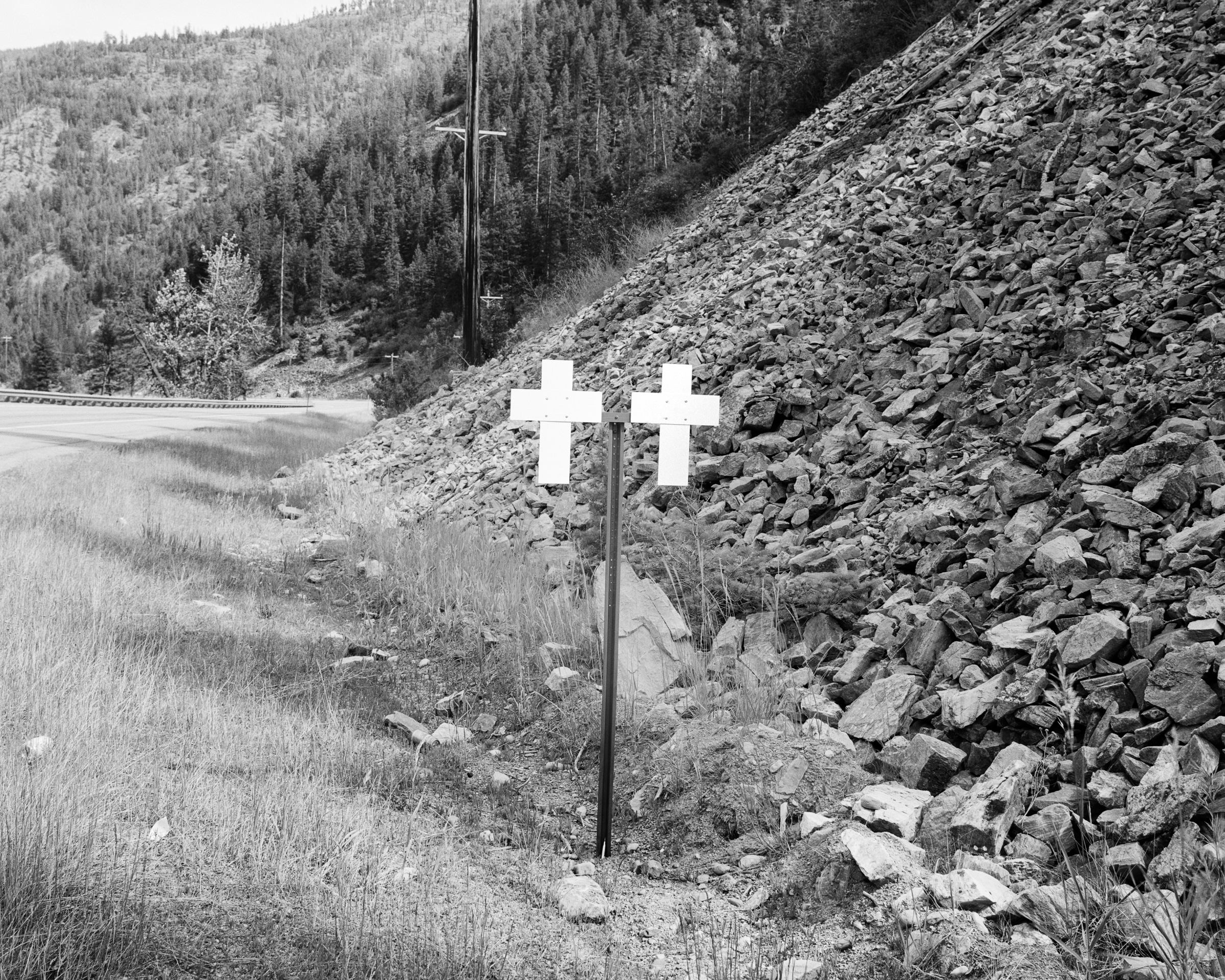
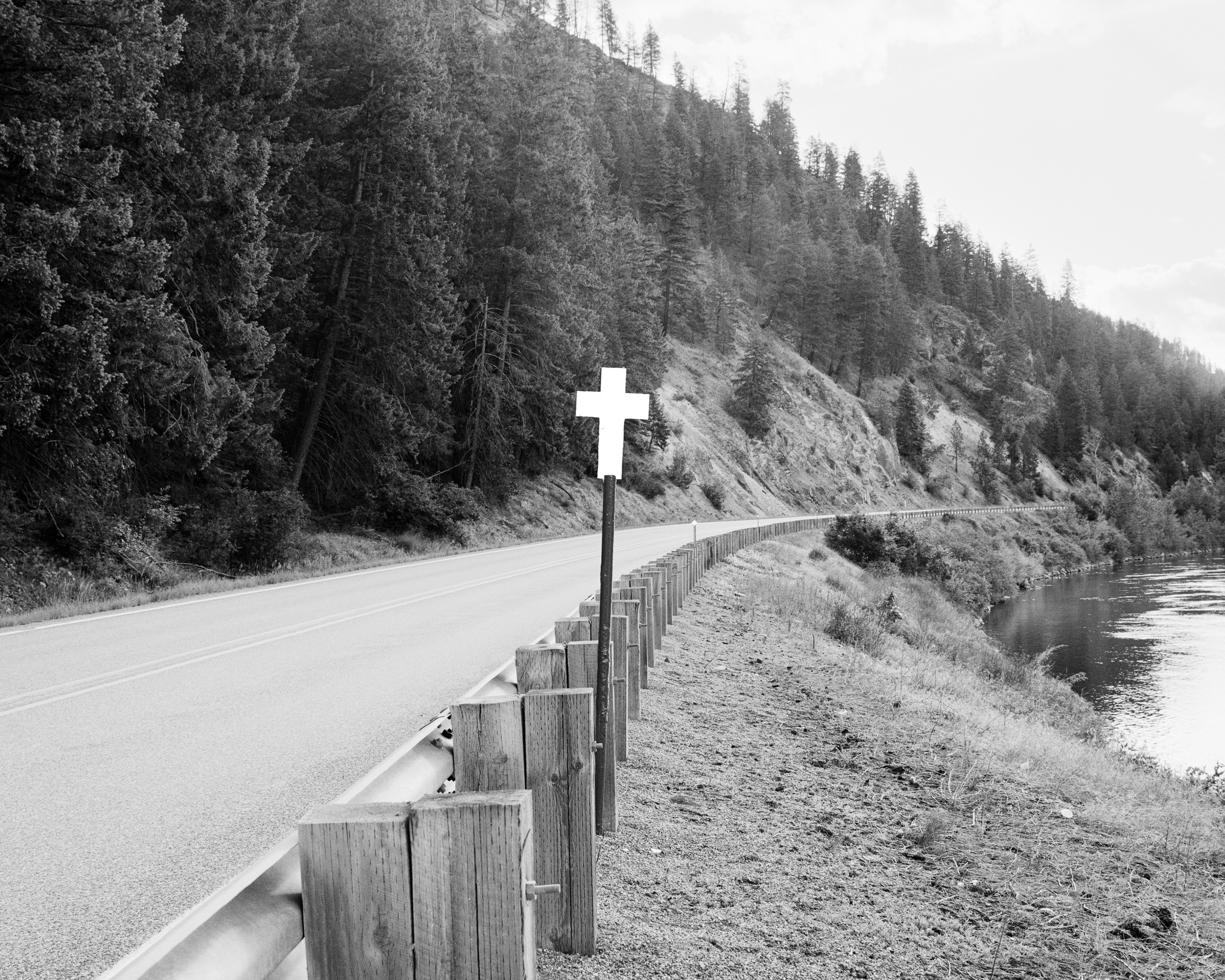
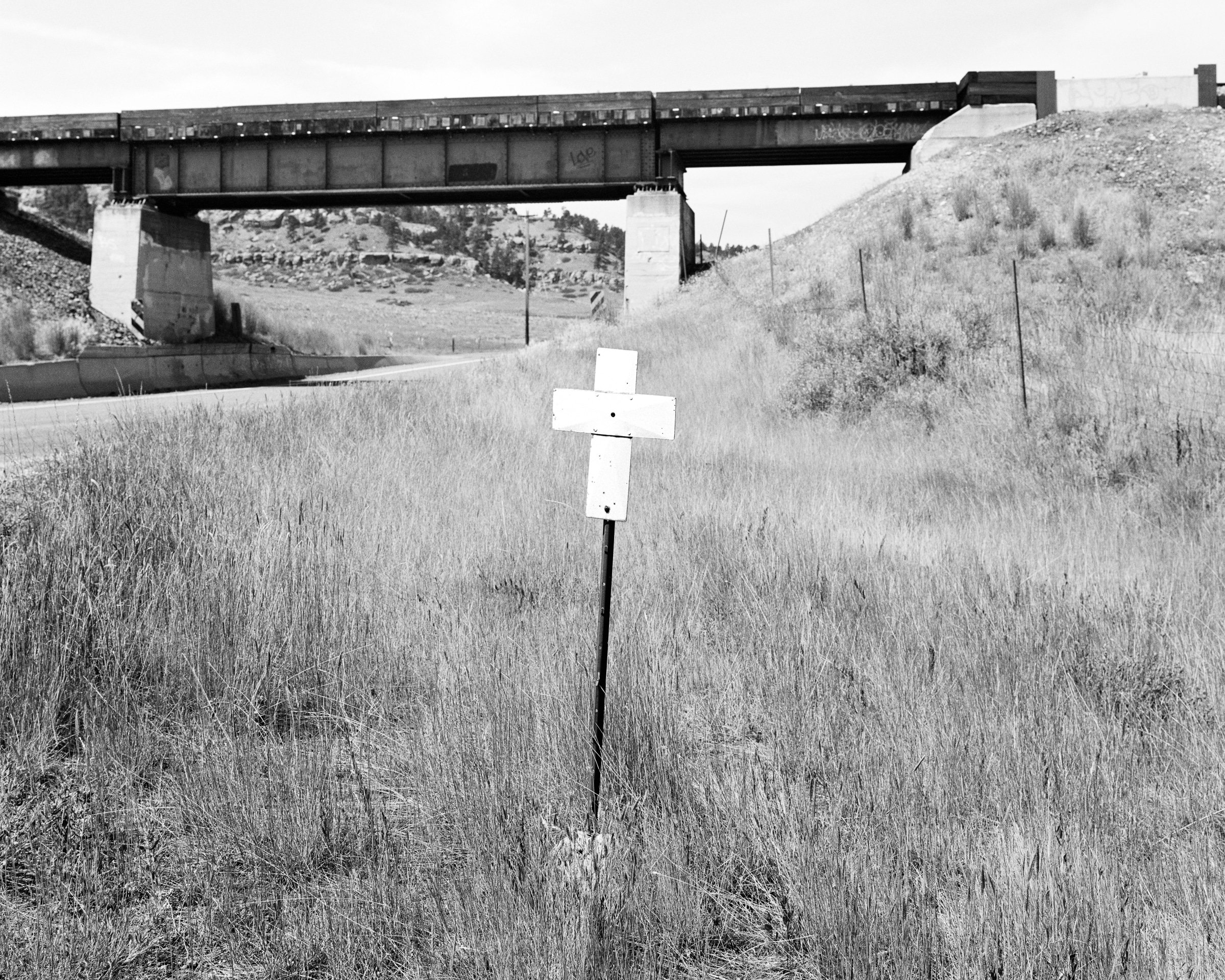
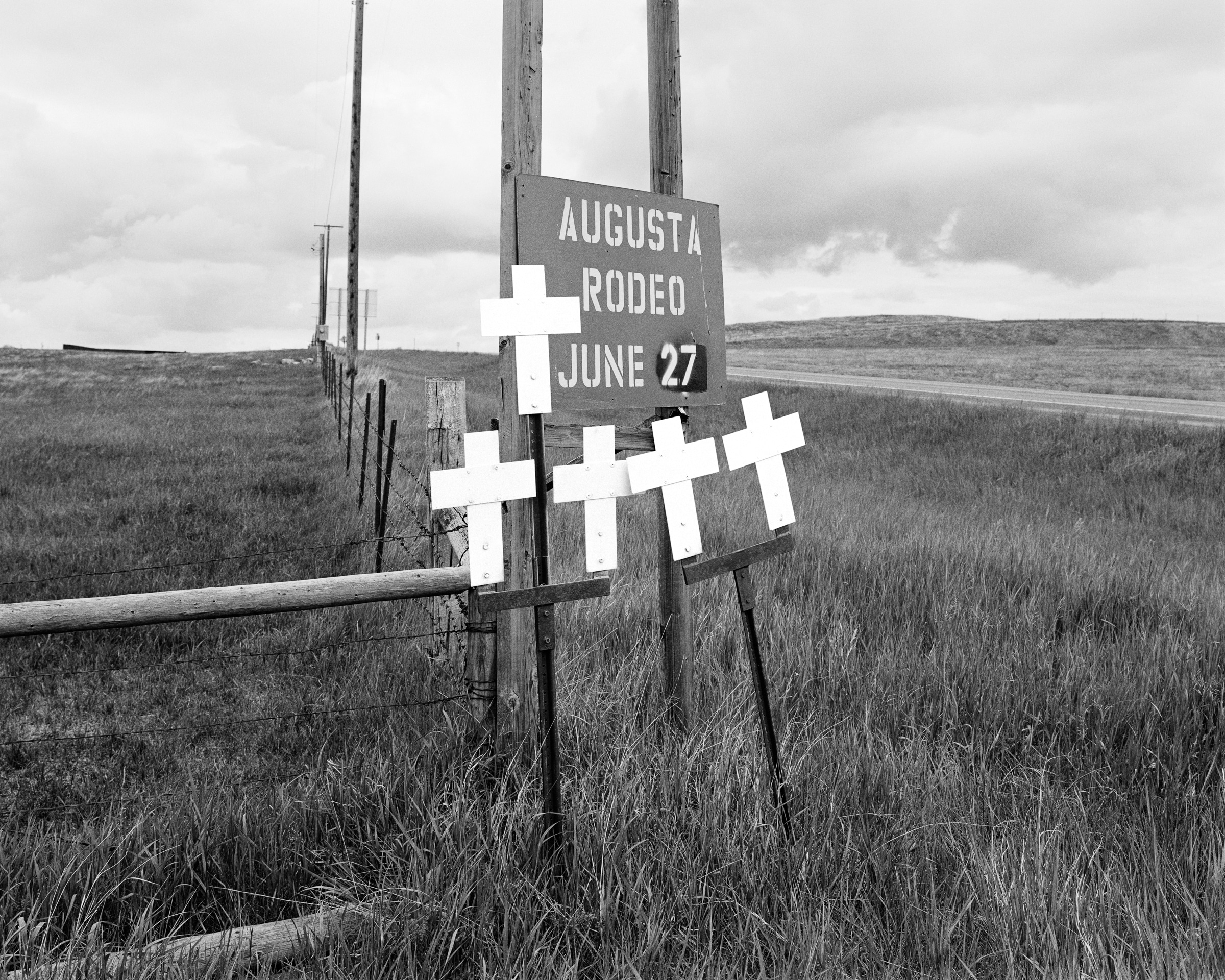
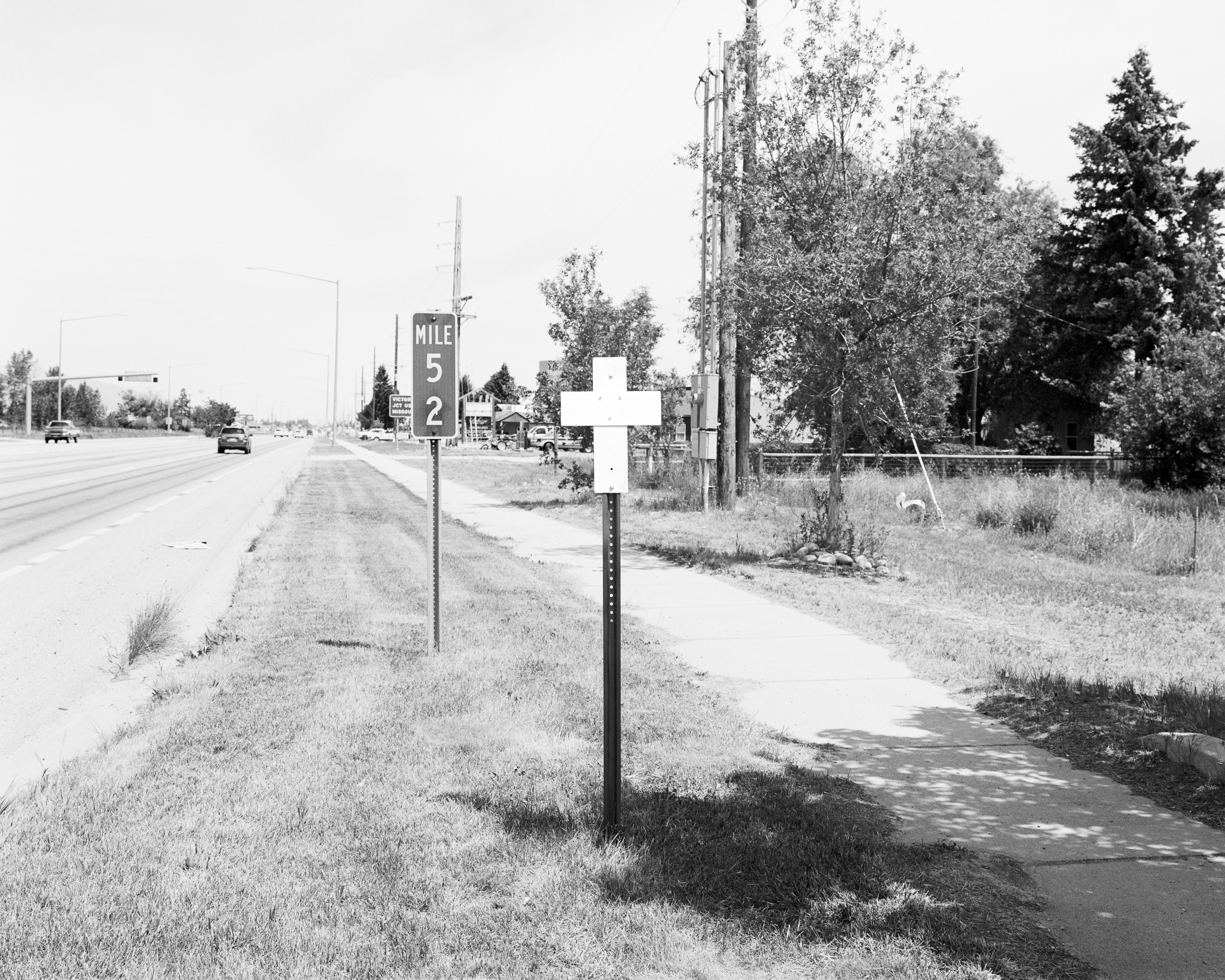
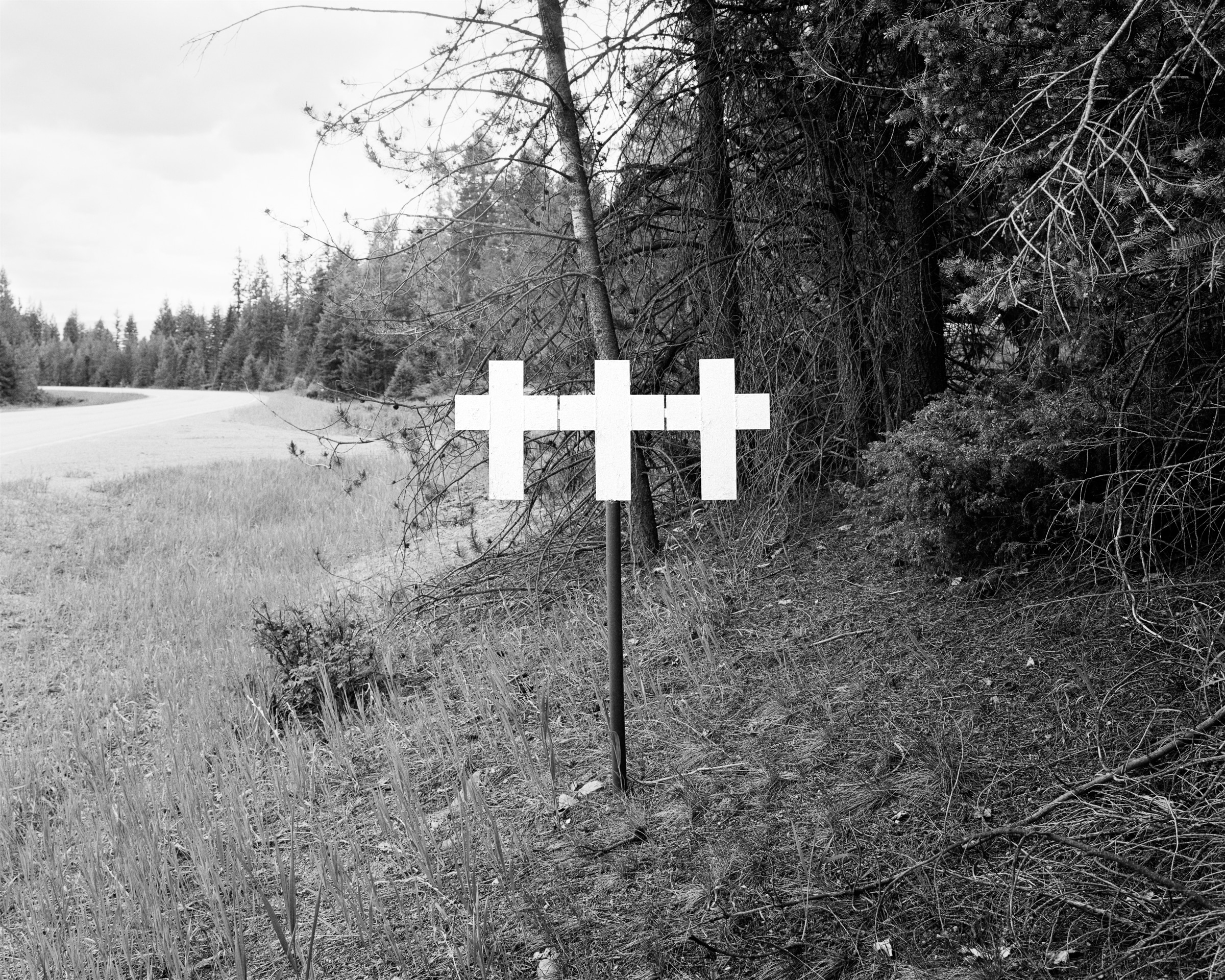
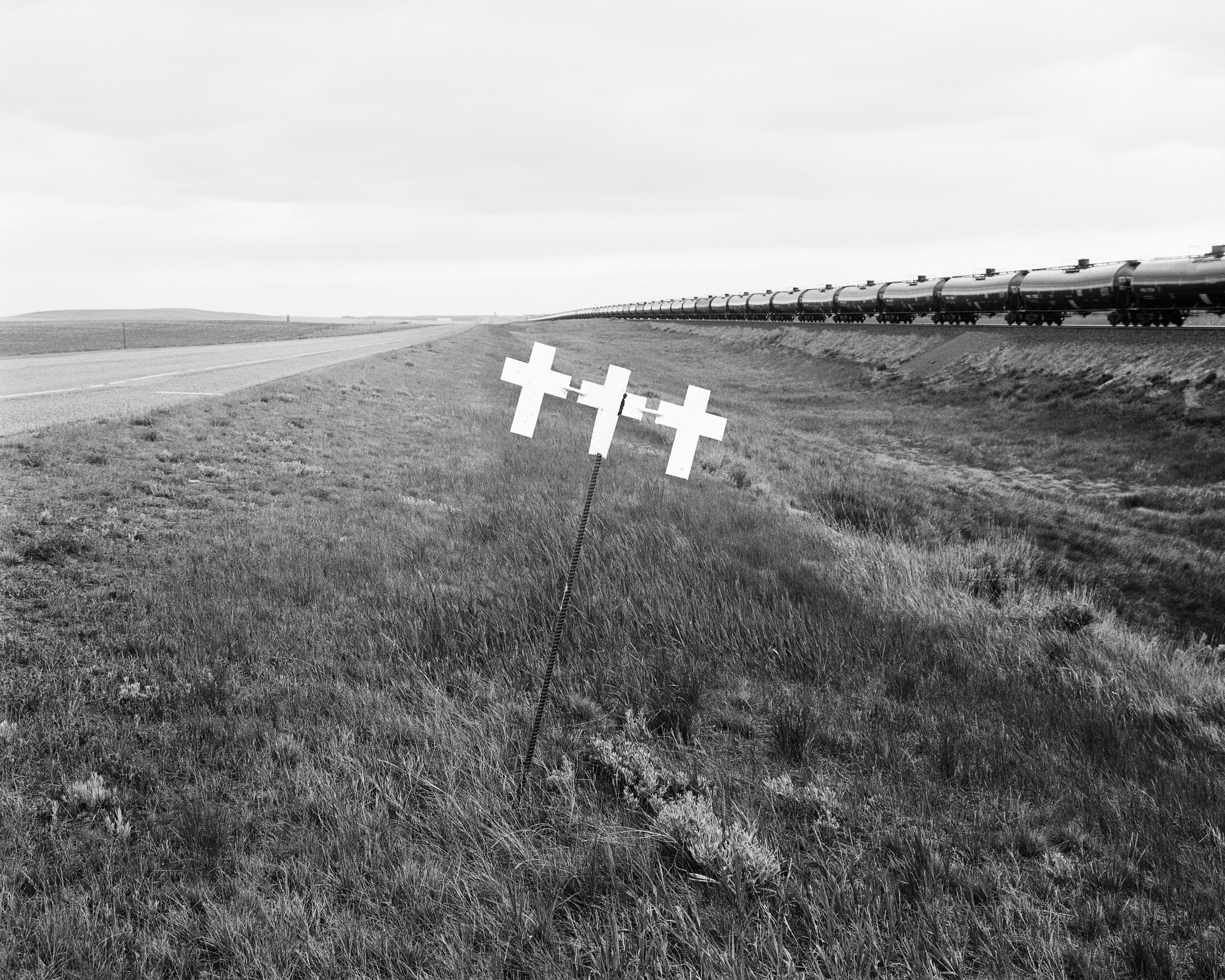
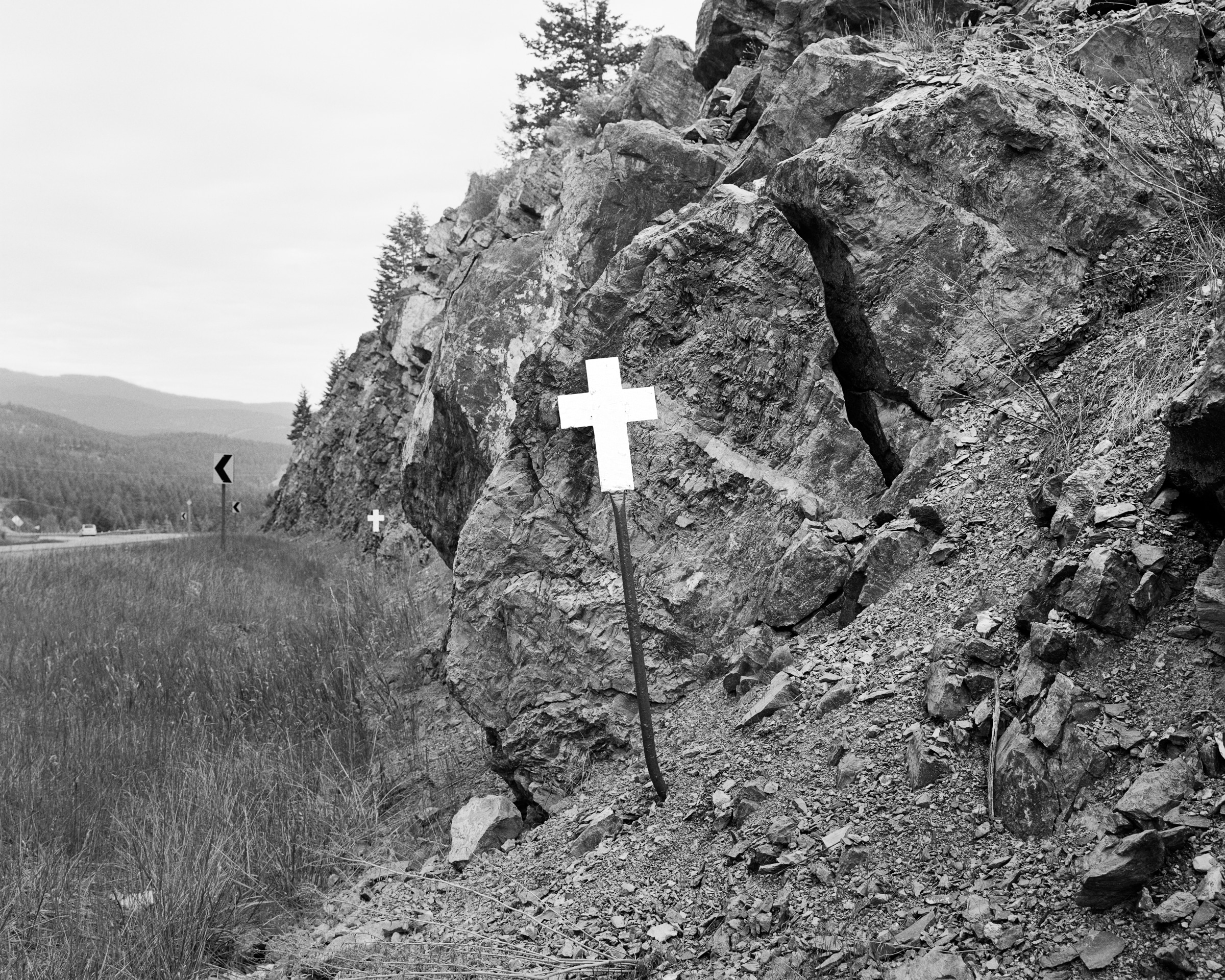
This suite of images comes from a body of work by the Montreal-based photographer Chris M. Forsyth titled Montana Road Wreck. Forsyth’s vision here is reminiscent of the New Topographics, work by 1970s American photographers who turned from grand, romanticized wilderness pictures to focus on everyday western scenes that show the effects of human imposition on the landscape. In each of Forsyth’s photographs, the cross stands dead center in the frame. There is often a visible bit of paving, a guardrail, street sign, fence, or telephone pole. Most shots were made in bright midday with a fast shutter speed and tiny aperture, freezing the few moving vehicles in synaesthetically silent sharp focus. High f-stops capture a depth of field that places every object on the same plane. The photographs are almost all slightly overexposed; Forsyth brightens up the shadows to reveal details at the cost of blowing out the skies and road-wreck markers. The crosses are so purely white — devoid of dirt, peeling paint, or rust — that they appear to have been punched out of the prints with a die cutter. They stand as striking absences at the center of the pictures.


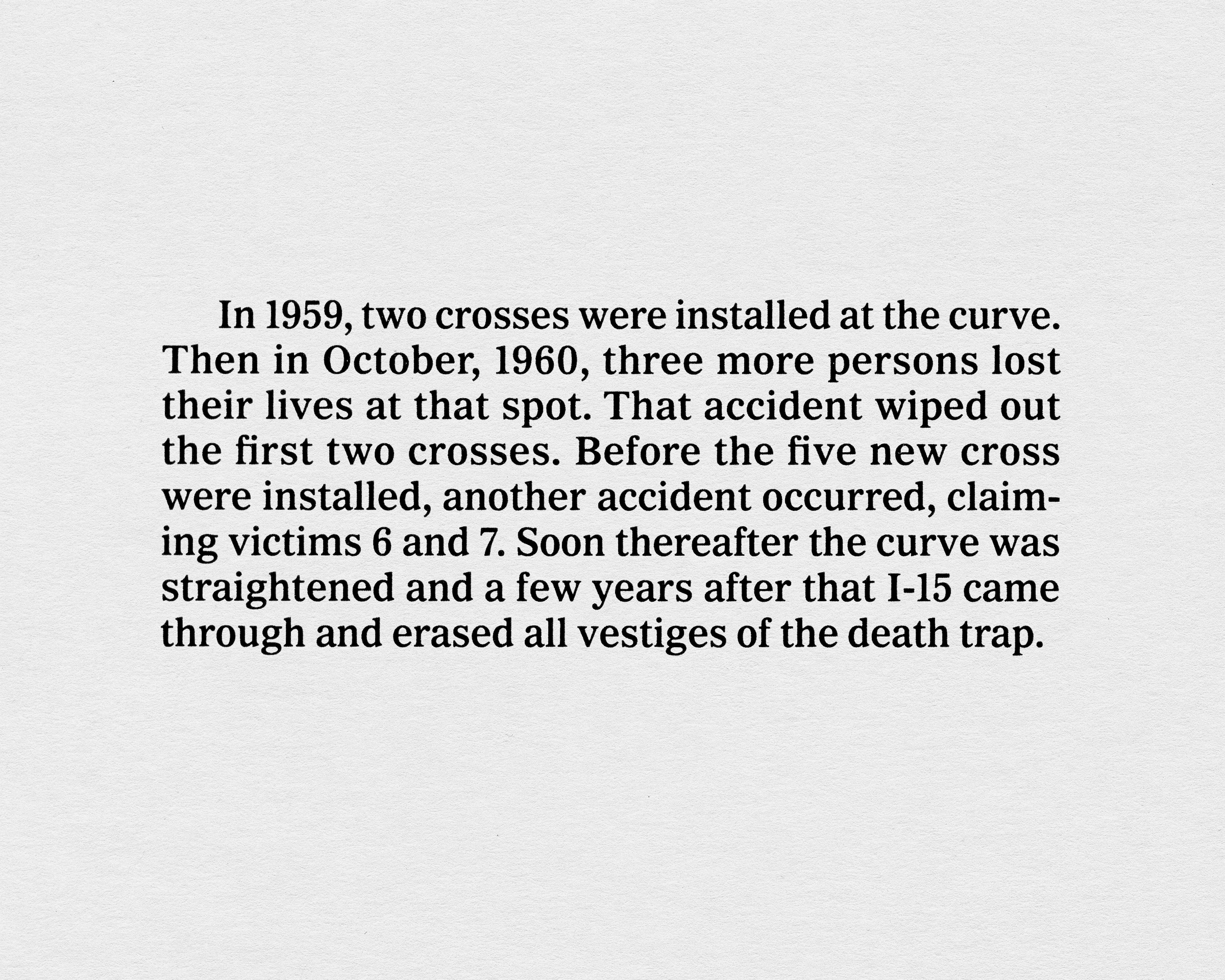
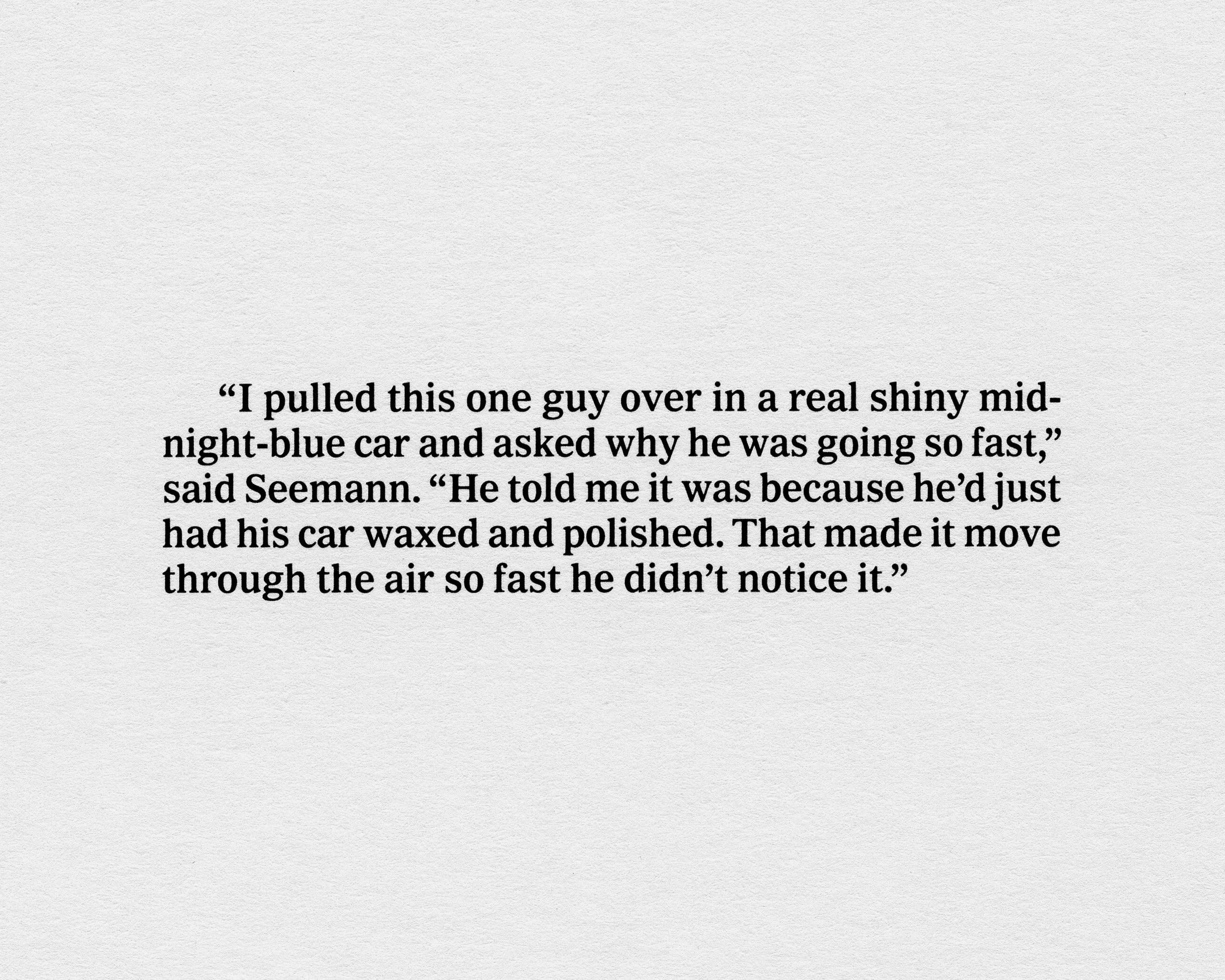
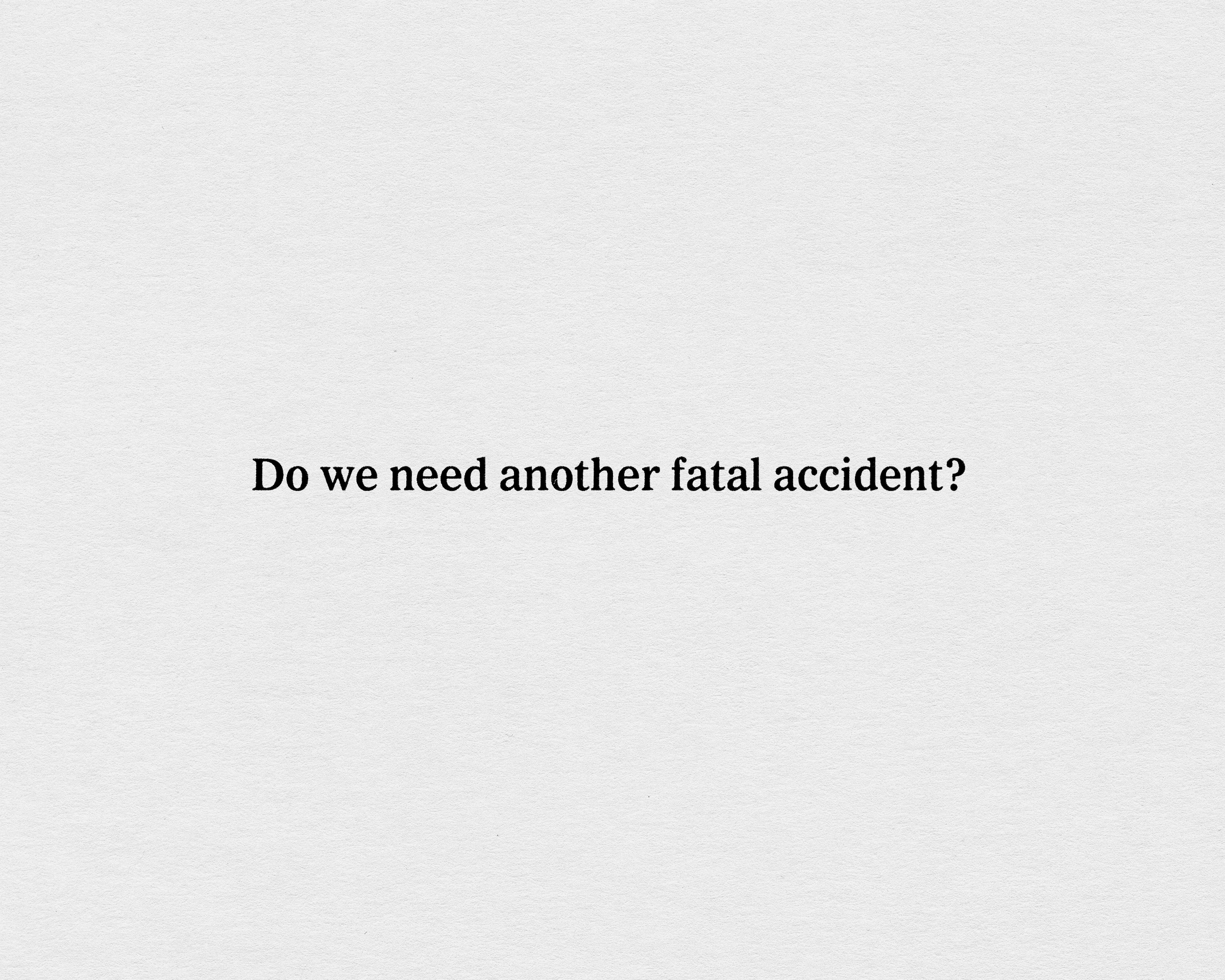
For the Montana Road Wreck project, Forsyth pairs the photographs with scraps of text, newspaper accounts of roadway incidents from 1953 to the present. In one image, a cross stands to the right of a forest highway. Morning sunlight filters through the pines and stipples the ditch. The road, like the forest, is empty. The stillness of the image contrasts sharply with the moment of screeching tires, crushing steel, and screams that the cross commemorates. The photograph is also eerily discordant with the three newspaper quotations (including a statement from Officer Richard Seerman of the Montana State Patrol) against which Forsyth juxtaposes it to make a diptych:
In 1959, two crosses were installed at the curve. Then in October, 1960 three more persons lost their lives at that spot. That accident wiped out the first two crosses. Before the five new crosses were installed, another accident occurred, claiming victims 6 and 7. Soon thereafter the curve was straightened and a few years after that I-15 came through and erased all vestiges of the death trap.
“I pulled this guy over in a real shiny midnight-blue car and asked why he was going so fast,” said Seerman. “He told me it was because he’d just had his car waxed and polished. That made it move through the air so fast he didn’t notice it.”
Do we need another fatal accident?
The quotations do not caption the photographs; nothing in the newspaper accounts and little in the photographs themselves helps us understand who died, when. Other than a mile marker (“MILE 52”) and a few road signs (“CLARK FORK RIVER,” “AUGUSTA RODEO,” “WOLF CREEK”), most Road Wreck photographs give no indication where they were taken. Like the quotations, the photographs seem to be a random assemblage, in which each cross can stand for hundreds of others. In an interview, the photographer explained that he worked geographically, moving west to east from Missoula to the North Dakota border. The project, therefore, records a kind of transect line. In his focus on ubiquity and uniformity, Forsyth mirrors the American Legion’s emphasis on cumulative effect as opposed to the detail of particular tragedies.
Today, some 3,000 crosses mark the locations of seven decades of Montana automobile deaths.
From the beginning, the Legion intended the crosses to remind “passing motorists of the dangers of the road as well as the lives that have been lost on these highways.” The organization is clear, however, that the “Fatality Markers” do not memorialize individuals. An FAQ explains that the markers “serve as part of a Highway Safety Program.” The Legion’s “Guide to Standardized Marker Hardware” mandates that each should be sixteen inches tall and twelve inches wide; Legionnaires are to bolt the cross onto a six-foot post driven eighteen inches into the soil, so that the cross stand 54 inches above the ground. When the crosses rust, Legionnaires repaint them. When they tip over, Legionnaires restore them. 1
While the Legion is “sensitive to the trauma surrounding death and the need to grieve,” they discourage any decoration of the crosses by family or friends of the deceased, because obstruction via personal effects or written messages “reduces visibility and defeats the purpose of this highway safety program.” In contrast to informal roadway memorials of plastic flowers, poster-board signs, photographs, teddy bears, and the like, all the white crosses look the same. “Decorations” are removed, and if redecoration persists, the Legion will remove the marker. 2
Despite this dedication, it’s unclear how well the program has worked. Highway fatality data is hard to reconstruct for years prior to the establishment of the National Highway Traffic Safety Administration in 1970. However, 70 years after Floyd Earhart drove the first cross into the ground, Montana still annually ranks in the bottom (i.e. deadliest) decile of states sorted by highway deaths per 100 million miles driven. In 2021, the most recent year for which the NHTSA has published data, the state’s 239 fatalities made its roads the fifth most lethal in the nation. 3
The crosses are so purely white — devoid of dirt, peeling paint, or rust — that they appear to have been punched out of the prints with a die cutter.
The crosses’ ineffectiveness as warning signs is probably due to their placement at the actual crash sites. Federal Highway Administration guidelines mandate placing signs for speed reduction, road narrowing, or sharp curves 1,200 feet before the hazard, as measured for cars moving at 60 miles per hour. 4 There are no federal guidelines for sixteen-inch cross visibility, but sixteen-inch font is only legible at 360 feet, a distance covered at 60 miles per hour in just four seconds. If drivers had more time to react to markings at dangerous intersections and narrow shoulders, they might contemplate their own mortality and slow down. As it is, a cross won’t prevent someone from entering a curve too fast, but it might be the last thing they see before they crash.
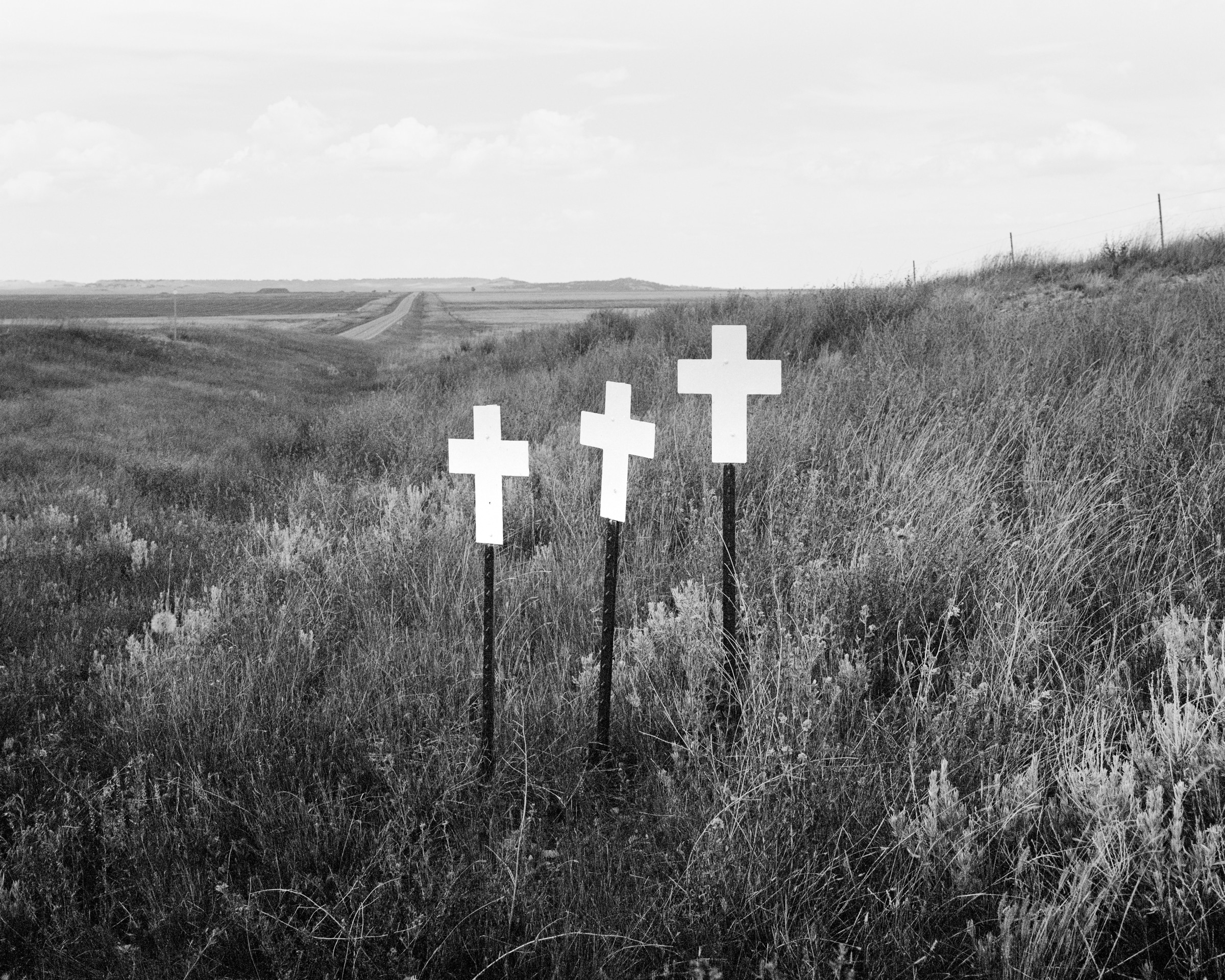
U.S. 87, Petroleum County, 2021.

MT 200, east of Missoula, 2021.
MT 37, northeast of Libby, 2021.
From The Independent-Record, July 10, 1989, page 8 – “Speeding across Montana”
From the Great Falls Tribune, August 19, 1966, page 6 – “Do We Need Another Fatal Accident?”
MT 302 (Molt Road), west of Billings, 2021.
MT 200/U.S. 287 (Bowman’s Corner), Lewis and Clark County, 2021.
U.S. 93/MT 373, Woodside, 2021.
U.S. 93, south of Olney, 2021.
U.S. 2, east of Lothair, 2021.
U.S. 93, south of Somers, 2021.
U.S. 93, south of Lakeside, 2021.
U.S. 2/Bowkers Street, White Haven, 2021.
U.S. 2/Enders Drive, Libby, 2021.
U.S. 2, east of Dodson, 2021.
U.S. 2 (Wolf Creek), west of Wolf Point, 2021.
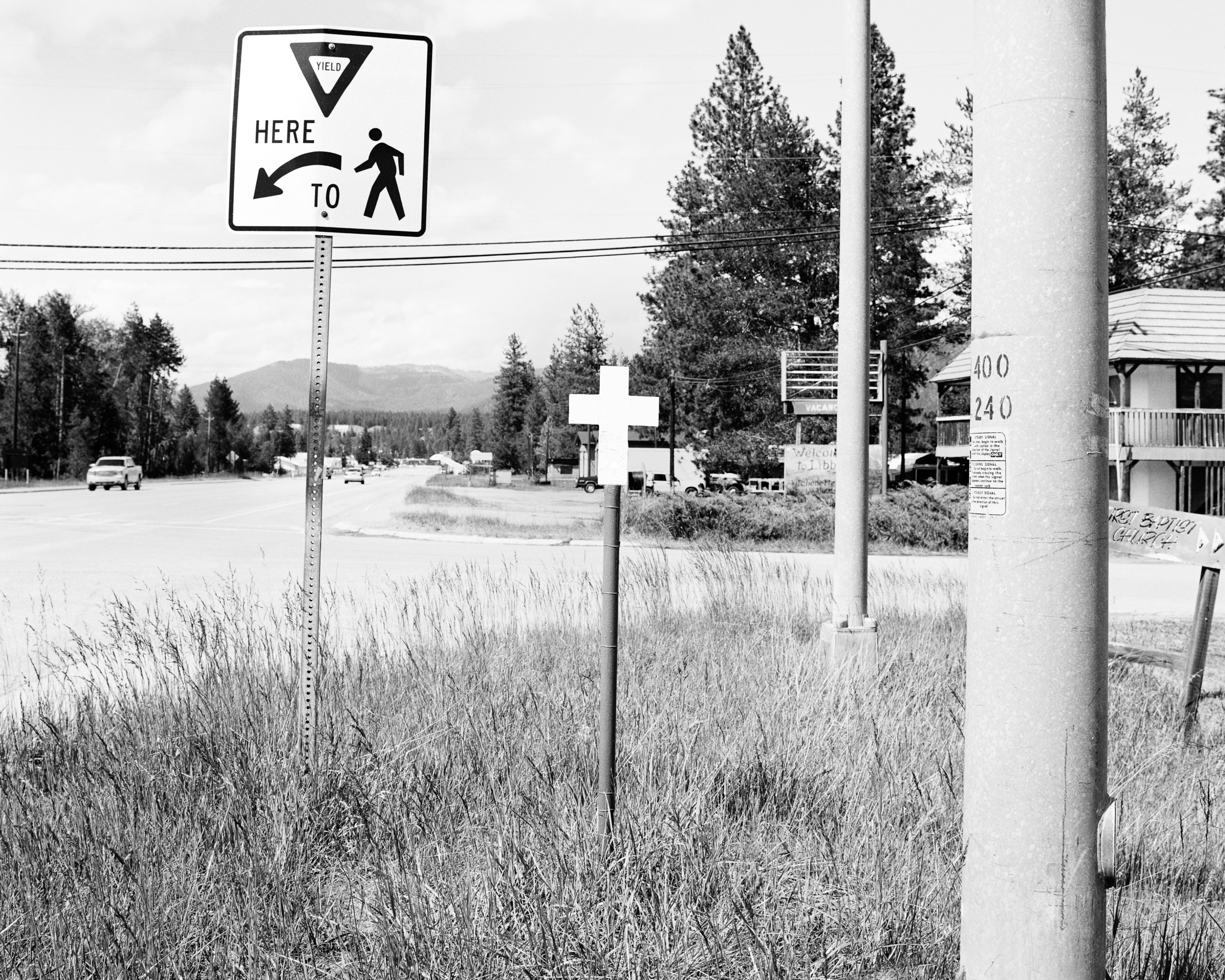
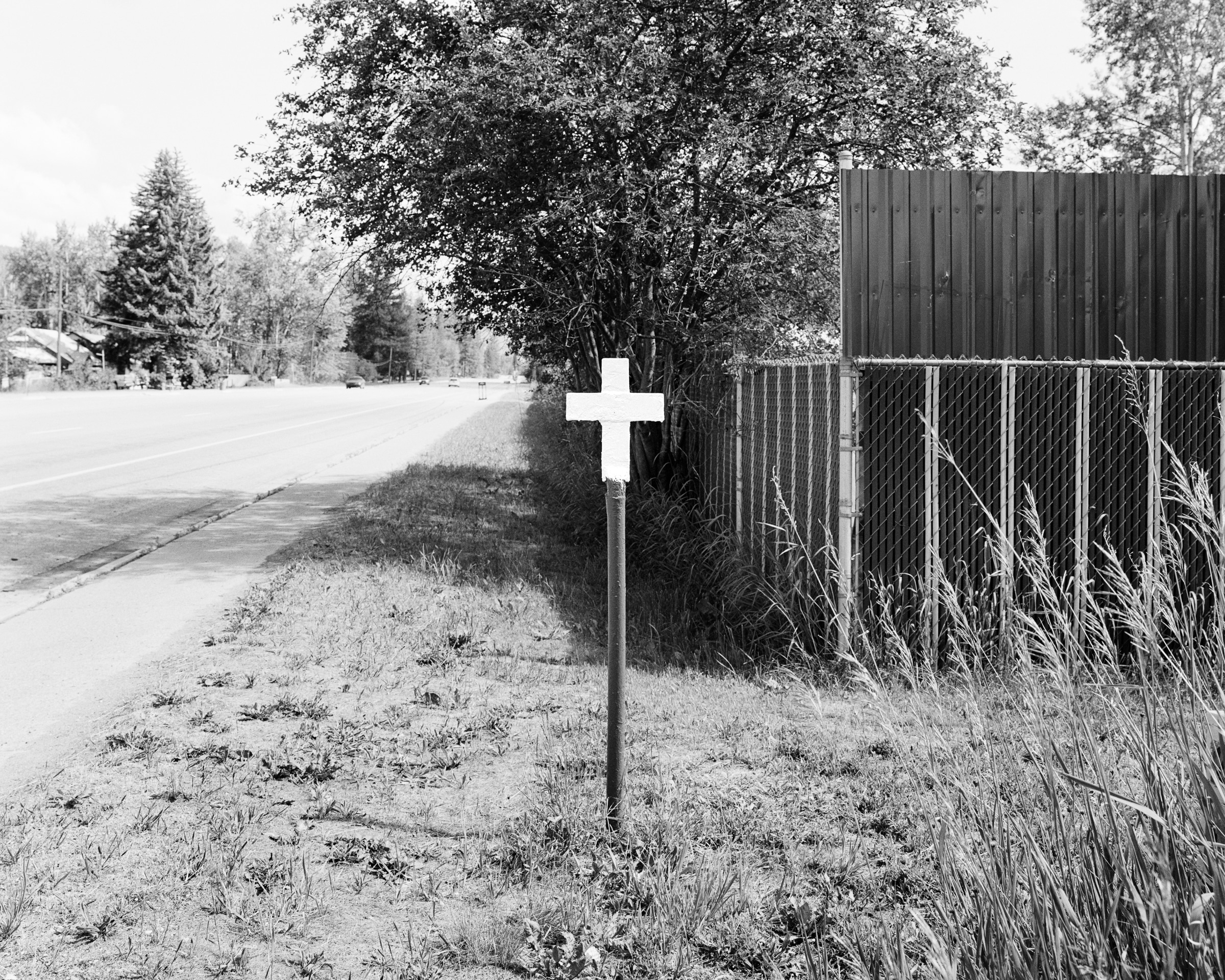
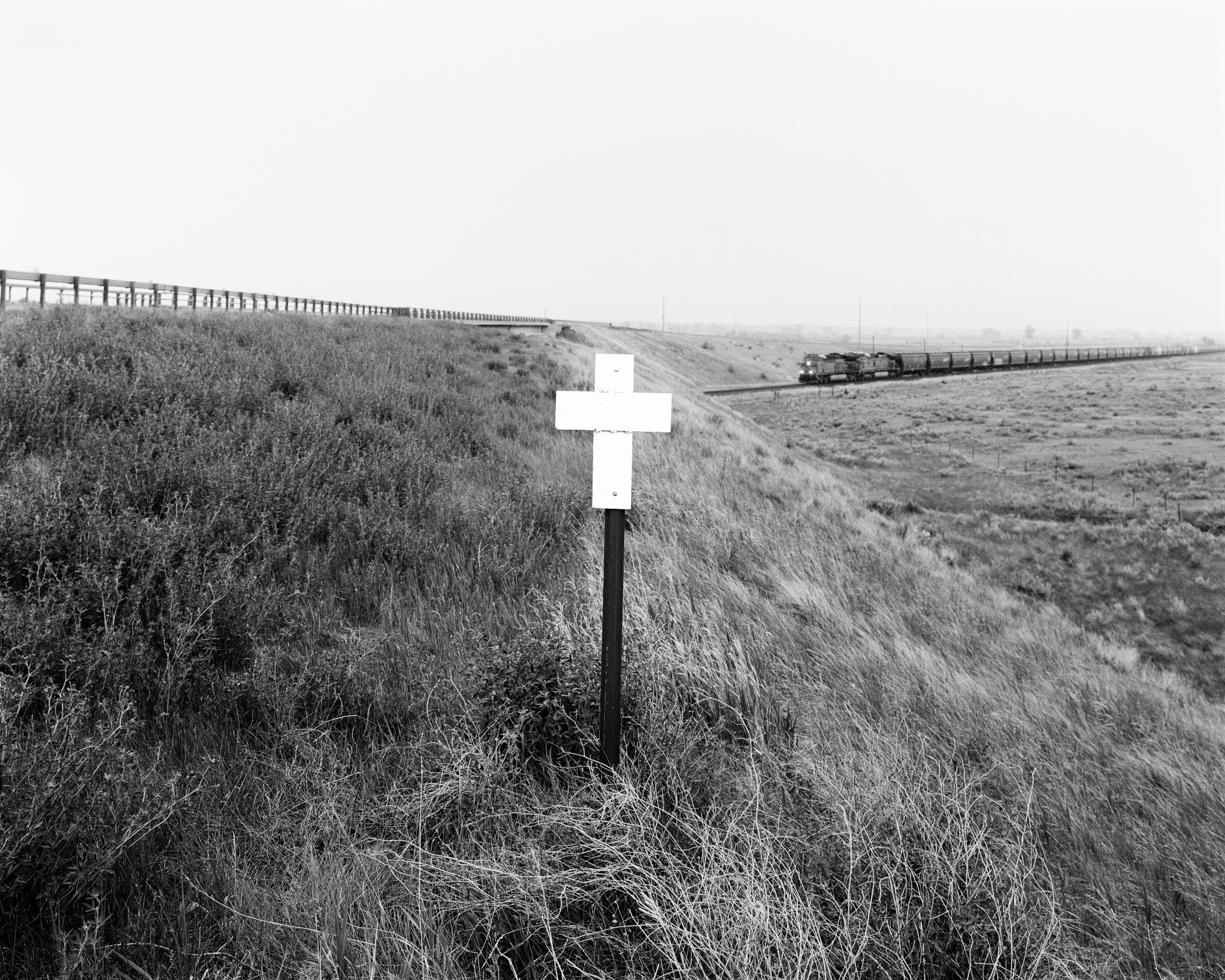
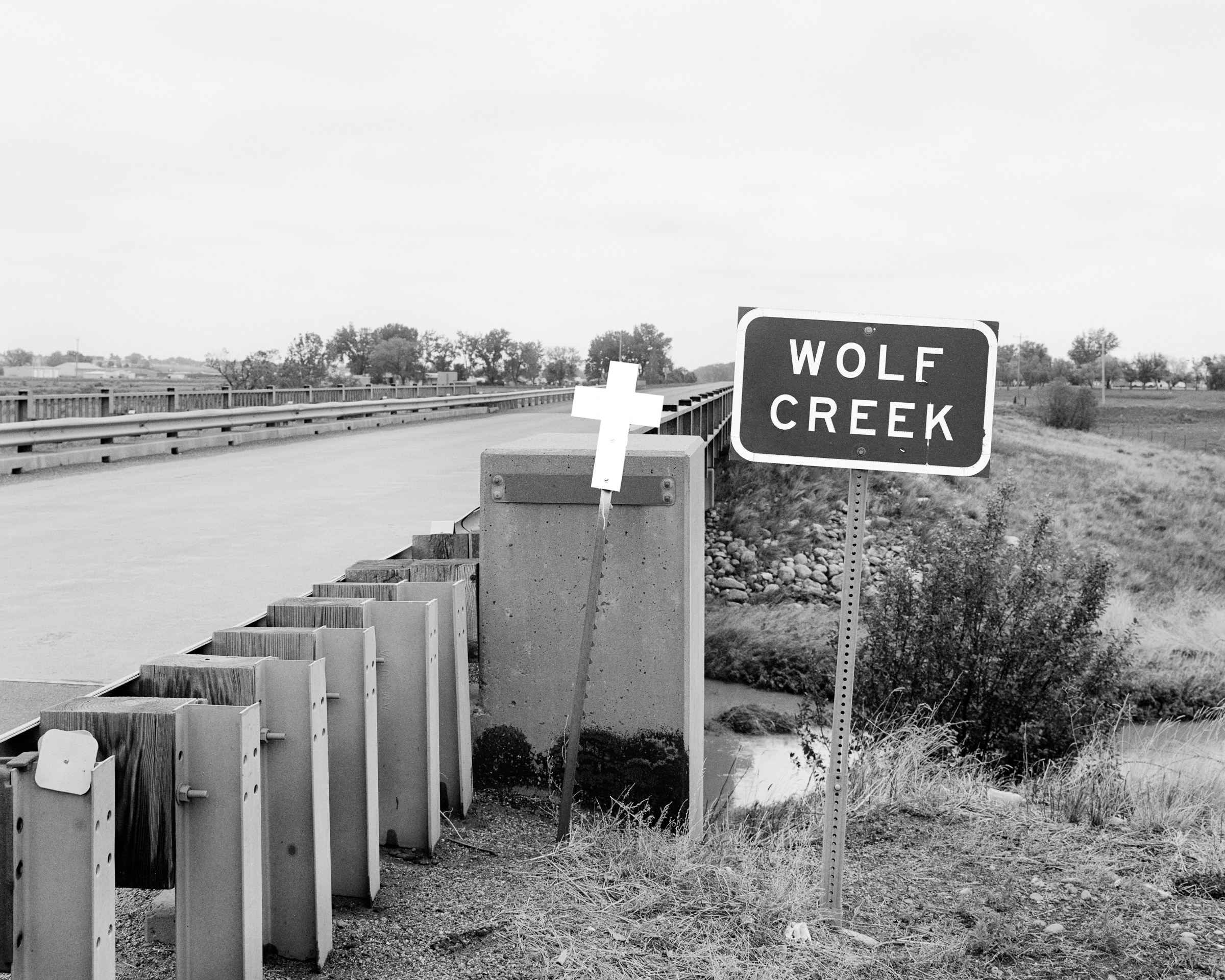
If the crosses don’t comprise an especially effective traffic-safety program, then they are primarily markers of death; that is, they are memorials after all. In 2007, a group of civil libertarians sued the state of Montana on the grounds that the white-cross program violated the First Amendment’s prohibition of established religion. The settlement ending the suit preserved the Legion’s ability to place the crosses but changed the project’s designation from “white crosses” to the “Fatality Marker Program.” The Legion also clarified, rather tendentiously, that
a “cross” isn’t just a Christian symbol. For instance, on military maps, the symbol may represent a hospital or even a graveyard; at one time it was considered a pagan symbol of fertility; to others, use of the cross was considered a subversive act. There are individuals who wear cross necklaces because of the beautiful and simple design, they wear cross jewelry for fashion not to make a religious statement. Some state buildings use the “cross” in their architecture.
After the settlement, the Montana Department of Transportation erected signs at state-line crossings that clarified this secular intent: “WHITE MARKERS REPRESENT HIGHWAY FATALITIES.”
Perhaps. Still, the cross points most directly to Christ’s crucifixion and resurrection. A cross makes sense as a marker for a body, recalling not only tombstones but the rows upon rows upon rows upon rows that mark the graves of young people cut down. The rhetorical effect, again, is in the weight of the aggregate.
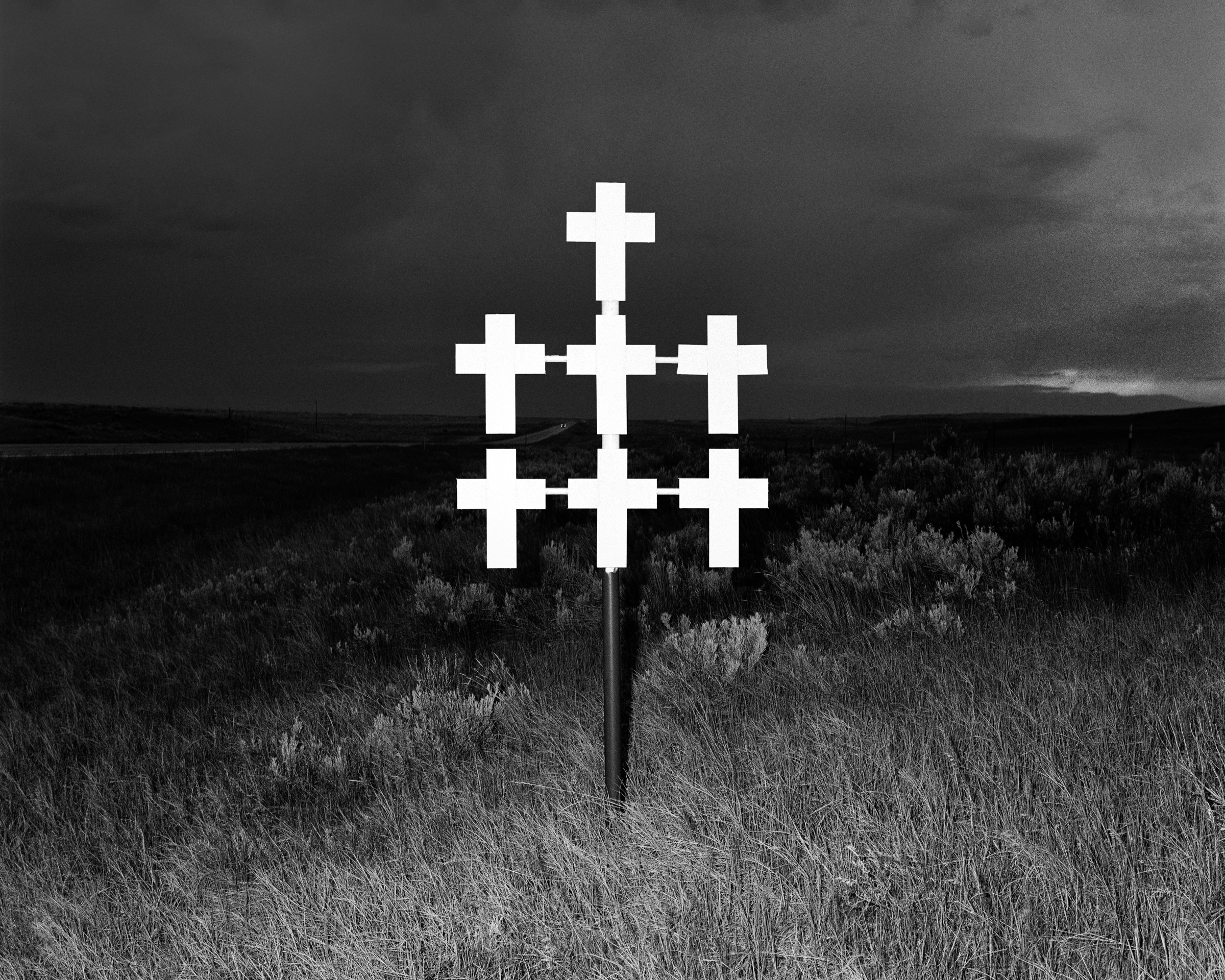
Forsyth’s Montana Road Wreck photographs stand for this tragedy, this absence. Yet, unlike the steel shapes that flash past drivers’ windows, Forsyth’s images hold the crosses before us for contemplation. In so doing, they allow us to do what the American Legion wants Montana drivers to do: to connect someone’s death to the possibility of others’ salvation.
Safe travels.


If you would like to comment on this article, or anything else on Places Journal, visit our Facebook page or send us a message on Twitter.