

She stands, an ancient priestess, sword raised over a sacrificial … chicken.
It is impossible not to laugh.
The publicity photo of Julia Child making Poulet Sauté Marengo captures everything that made her a runaway star. She seems at once powerful and naughty, a woman who always shares in the joke. She wields the sword and holds the chicken firmly, with strong arms and a conspiratorial smile.
Child’s presence is so dominant, it is hard to look beyond her. But once we do, details of the set come into focus. At the counter, an array of ingredients and saucepans stand at the ready. On a tiled back wall, we see two waist-high ovens and some of her famed batterie de cuisine. A painting by her husband, Paul, hangs above a vase of flowers.
The kitchen was Julia Child’s workplace. It was also a stage, where her show, The French Chef, was recorded. A weekly half-hour program, piloted in 1962 on Boston’s WGBH-TV and then eagerly picked up by an expanding pool of affiliates, the show was the first bona fide hit for the nascent National Education Television network. By 1966, it was being broadcast in 106 cities across the United States. Its star, unknown at the start of the decade, appeared on the cover of Time and received an Emmy. In 1973, The French Chef ended with over 200 programs under its apron.
It seemed the public could not get enough. It still can’t. Child lives on in a constant stream of biographies, novels, television series, films, and academic studies that show how The French Chef and Child’s cookbooks — notably Mastering the Art of French Cooking (1961) — stimulated Americans’ hunger for more sophisticated cuisine, and for the equipment required to produce it. 1 She is said to have created demand for the huge restaurant ranges, sauté pans, fish poachers, and casseroles that powered the growth of high-end kitchen provisioners like Williams-Sonoma.
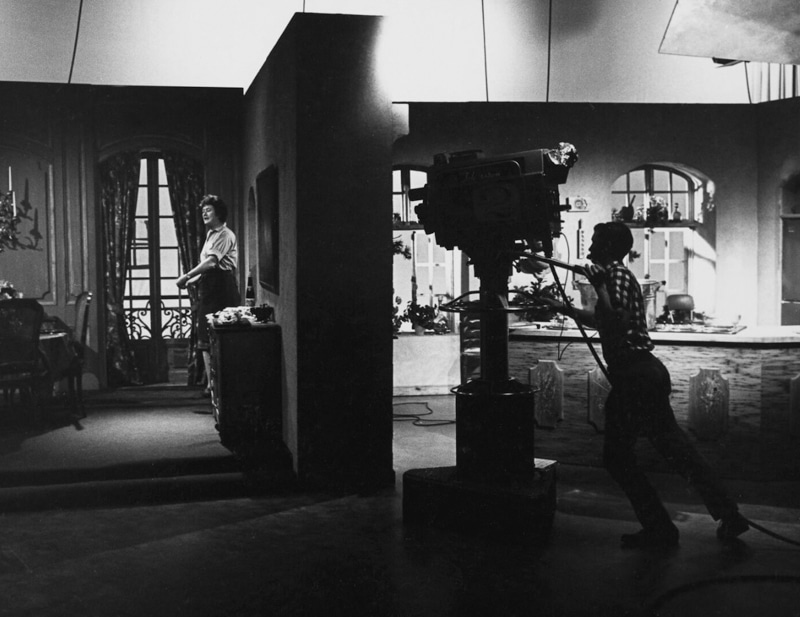
Yet there is another story to tell about Child’s influence on design, one less about the products she made desirable and more about how her ethos shaped the environments in which she worked. Her kitchens were distinctive but not glamorous or miraculous. Reflecting principles and skills Julia and Paul Child had developed in earlier careers, these were highly rational spaces, rigorously designed by the couple to support the varied activities and lives that played out there. Style was subservient to flexible functionality. It was this quality that would be picked up, starting in the late 1970s, by a group of designers who put forward a design philosophy emphasising user-centeredness and accessibility.
There is another story to tell about Child’s influence on design, one less about the products she made desirable and more about how her ethos shaped the environments in which she worked.
Indeed, it is curious how rarely Child’s centrality to this movement has been noted, given how openly it was declared. In 1977, Child’s home kitchen at 103 Irving Street in Cambridge, Massachusetts (now on permanent display at the Smithsonian Institution) inspired a remarkable piece of early design research, “Julia’s Kitchen: A Design Anatomy.” 2 In this 40-page polemic, Bill Stumpf, the industrial designer who co-invented the Aeron chair, worked with writer Nicholas Polites to claim Child’s home kitchen as a model for user-centered design. And Child was not just a passive symbol for this new movement. In the 1990s, she became an advisor to the Universal Kitchen project at the Rhode Island School of Design, which aimed to rethink the kitchen from scratch, to make it accessible for people of all ages and abilities. Child’s example, and her active cooperation and support, would help secure the commercial viability and reputation of what became known as Universal Design.

The Rational Chef
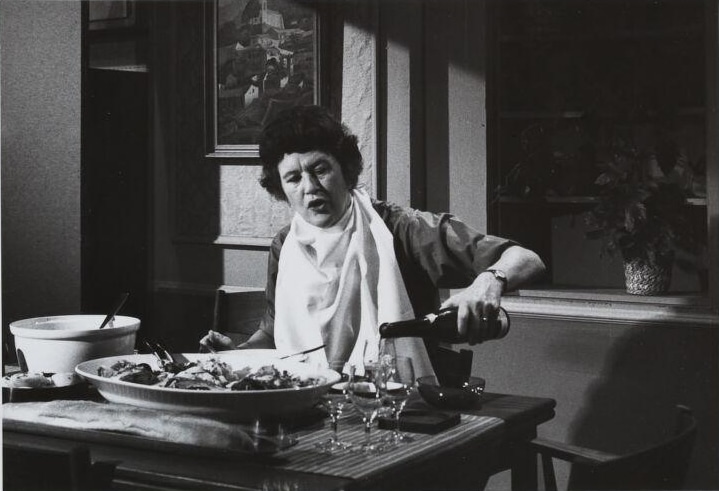
To understand how Child’s kitchen became an icon of user-centeredness, we need to recall the central aim of her work: to break down and rationalize the complexity of cooking, from selecting ingredients to organizing a prep space to serving a meal. The French Chef presented cooking expansively as an activity — or a series of activities — that could be “mastered” and, ultimately, enjoyed. For 30 unedited minutes, Child talked viewers through the fundamental tools, techniques, and steps required to prepare a dish. 3 While other shows stopped there, with the successful realization of that dish, Child moved to the dining room to discuss pairing the results with wine or champagne, leaving viewers with a cheery “Bon appétit!” — an invocation to savor the fruits of their labors.
Paul Child planned Julia’s elaborate live-cooking demonstrations as if they were foremost a logistics challenge.
As film historian Dana Polan astutely argues, The French Chef effectively mediated French cuisine for U.S. audiences by marrying the perception of high cultural value with the “can do” approach of “Americanized action.” 4 And the Childs had abundant experience in exactly this kind of mediation. Both had spent their professional lives advancing U.S. interests abroad. During World War II, Julia worked in the Department of State’s elite intelligence unit, the Office of Strategic Services, first in Washington, then in Ceylon where she was introduced to Paul by their mutual friend, the anthropologist Gregory Bateson. She ended this chapter of her career as a senior civilian intelligence officer in Kunming, China, head of the Registry in the South East Asia Command, with a high security clearance and details of all regional intelligence agents and operations. 5 The formidable research and information management skills required for that post would be evident in her project of rationalizing cooking.
It was Paul, however, who brought the design expertise to their partnership. During the war, he was part of the OSS’s famed Visual Presentation branch, along with leading designers like Henry Dreyfuss and Eero Saarinen. 6 Paul Child’s particular speciality was designing war rooms, complete with situation maps, operational charts, models, and diagrams, including one for Lord Mountbatten at the South East Asian Command. 7 In his postwar roles in the United States Information Service, Paul deployed these skills in the service of soft power and Cold War propaganda, curating exhibits showcasing American life abroad. 8 He was also an accomplished photographer and artist. Julia gave him full share in her success, calling him “the man who was always there: porter, dishwasher, official photographer, mushroom dicer and onion chopper, editor, fish illustrator, manager, taster, idea man, resident poet, and husband.” 9

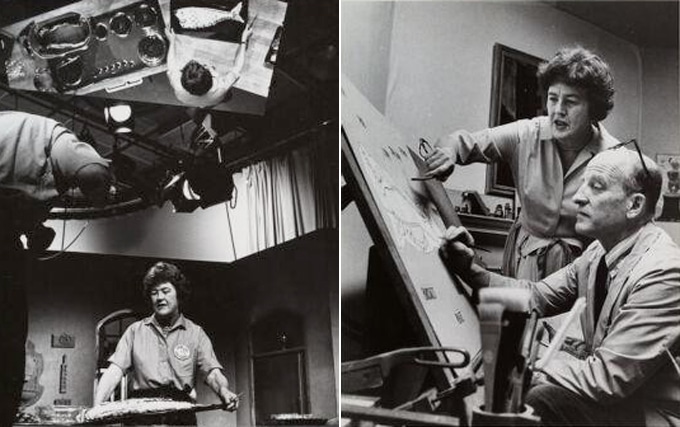


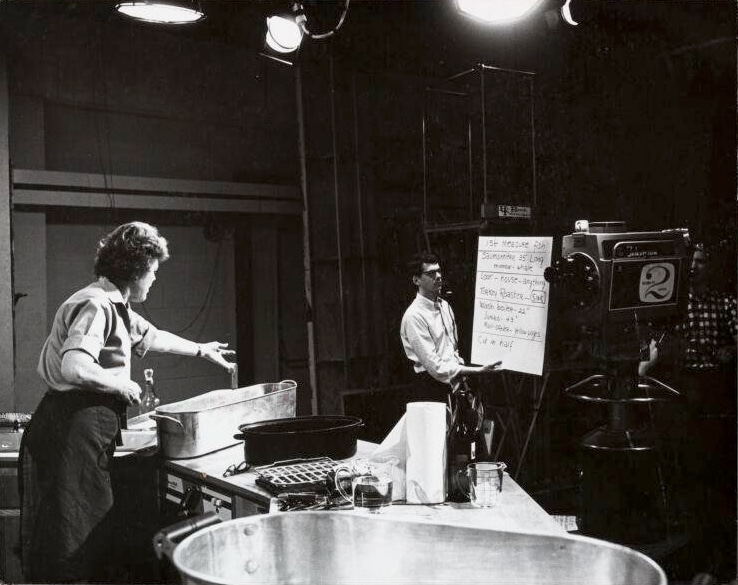
Their combined organizational and design skills would prove crucial to the success of The French Chef, especially in overcoming the show’s technical and budgetary constraints. As director Russell Morash recalled, there was “no editing, no overtime, no reliable wireless mikes, inferior cameras, no zooms, no field dollies.” 10 With producer Ruth Lockwood, the Childs developed a “masterplan,” and they organized shoots with a know-how tuned in war rooms and exhibitions. Paul called the television taping “a blitz-type operation” and noted, “We have had to lead scheduled & disciplined lives for a long time in my Foreign Service life, so this is new only in respect to Julie’s proffesion [sic] dominating it rather than mine.” 11 He planned her elaborate live-cooking demonstrations as if they were foremost a logistics challenge. 12
She did not dumb things down but broke them down, creating entry points for American cooks in their home kitchens.
Early shoots were organized by three elements: a detailed plan, notes about what to buy and bring, and spatial diagrams. Drawn from Julia’s perspective as she faced the cameras, Paul’s diagrams of the stove top and work areas orchestrated space, materials, and bodily movements. His plans followed the French principle of mise-en-place — arranging all prepped ingredients so that the chef could grab them without looking. Cue cards were annotated with equipment, ingredients, and timings, worked out in at-home rehearsals. For all the accidents that made Julia so relatable to television audiences, the show was always choreographed very precisely around her body and actions, as she moved sequentially through the steps in a dish’s preparation to the final shot in the dining room.
The point of this careful spatial choreography was not to make Americans cook exactly what the French did, but rather to teach them to approach the activity with a degree of understanding and a grasp of the basics. “Mastery” was not direct imitation but an ability to vary and adapt to circumstances. This preference for adaptation over imitation explains why Julia Child was happy to make concessions like using cuts of meat or herbs that could be found in local supermarkets. She worked with gizmos and gadgets familiar to American audiences, such as mixers and pressure cookers, even praising the bulb baster and spatula as “two of America’s great culinary contributions.” 13 She did not dumb things down but broke them down, creating entry points for American cooks in their home kitchens.
Child made few assumptions about who her viewers were or what kinds of skills or tools they had. Her teaching was not for “housewives,” she said, but for “PEOPLE who like to cook, and we don’t care who they are.” 14 Given how rapidly her show rolled across all regions of the country, any assumptions would be moot, anyway; nobody anticipated her cross-cutting appeal, which still evokes a kind of wonder today. So many people have “Julia” epiphany stories. In a recent profile, Stephen Satterfield, a television host and chronicler of Black cuisine, recalls watching The French Chef as a teenager in Georgia and being inspired to make soufflé au fromage. “It came out perfectly,” he said. “It was the first success I’d had.” 15 Building on the show’s reach, PBS even used it to trial closed captioning. Julia Child made cooking accessible in a way it had not been before.
The show, however, was filtered via a very specific class, tradition, and place: Cambridge, Massachusetts. Harvard University stood behind WGBH; its president, Ralph Lowell, had been key to getting the station funded. The influence of this cosmopolitan yet bohemian milieu can be felt in The French Chef’s kitchen sets. These were stocked with equipment from the Childs’ house, much of it acquired from Julia’s favorite provisioner, E. Dehillerin in Paris. 16 The famed homewares store Design Research (D/R), founded in Cambridge, also dressed the barren plywood sets with French and Scandinavian accessories, equipment, and fabrics, for the first few seasons. 17 As employee Elizabeth Lambert remarked, Julia Child “was showing off our innovative wares — bright cheerful cookware, sauté pans, earthy dinnerware, and even Cuisinart choppers — as if they were the norm for any American household.” Almost as an afterthought, she adds, “Which they soon became.” 18
The Kitchen Anatomized
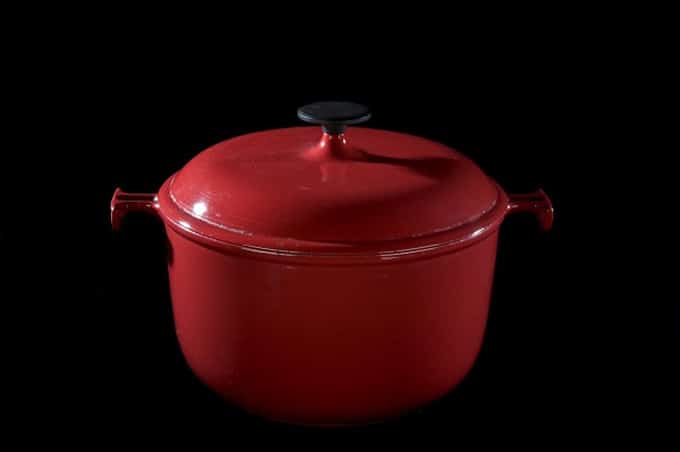
Child’s impact on design is often discussed with this air of inevitability, assuming a direct line from her kitchens to those of everyday Americans. According to this view, she supported the growth of retailers like D/R and Williams-Sonoma, who fed the public’s growing appetite for garlic presses and wine cork pulls. 19 No doubt, Child did have some impact on kitchen provisioning. But she also had an impact on the domestic mise-en-scène. Consider casseroles. Child demonstrated how beautiful enamelled cast-iron pots allowed stews to be cooked “all-in-one” at the stove and then used for serving. 20 Stove-to-table cookware reinforced the link between the making of food and its enjoyment, encouraging more social and leisurely styles of dining. 21
Colorful and densely packed, her home was a workplace, test kitchen, rehearsal space, and, later, television set — as unlikely a celebrity as Child herself.
In these scenarios, there was no gesamtkunstwerk at stake and no singular aesthetic; indeed, from season to season, The French Chef’s dining room sets would swerve between modernism and neoclassical/Georgian. 22 This lack of commitment to any particular look reflected Child’s belief that the serviceability of objects was more consequential than style. The kitchen equipment she used could not be purchased all at once from a catalog or store (not even D/R). It had to be sought out, piece by piece, and sometimes improvised. In an episode on Casserole Roast Chicken, Julia recounts how the need for a trussing needle sent her to the local five-and-ten store, where she bought wooden knitting needles and had Paul drill holes in the end. (The sequence ends with her telling viewers that, if they have no handyman about, they should try a dentist, as “They love to drill holes in things.”) Later in the same show, she praises her own imported casserole but notes that cheaper aluminium ones could be easily obtained from a hardware store, assuring viewers, “It’s the kind of thing that will last you a lifetime.” 23 She often talked about the need to care properly for utensils, especially knives.
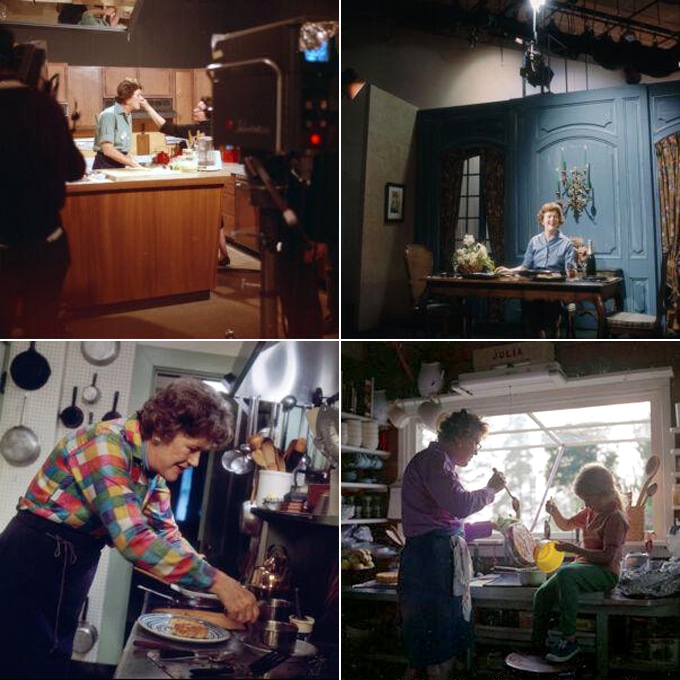
As much as any particular gadget or tool, it was this general attitude — a preference for appropriate, durable, well-maintained equipment — that would be showcased in Child’s kitchens. The primary exhibit was her own home kitchen, which served as the template for the others. It became one of the best-known kitchens in America, covered extensively in Sunday supplements and interior decorating magazines. In the age of neat, open-plan kitchens, it was as unlikely a celebrity as Child herself. Colorful and densely packed, her home was a workplace, test kitchen, rehearsal space, and, later, television set. All the while, it remained an active social space, where, on Marimekko-style vinyl tablecloths, Julia served casual meals to eminent neighbors such as John Kenneth Galbraith, all lubricated by Paul’s cocktails. Not everyone was a fan; architecture critic Paul Goldberger sniffed that the kitchen was “dowdy.” 24 Child’s collaborator, chef Nancy Verde Barr, admitted, “It was not glamorous. In fact, it was downright funky.” But, she added, “It was one of the most functional kitchens I ever worked in.” 25

This functionality caught the imagination of a new generation and led to Child’s most concrete impact on design philosophy, after Bill Stumpf hailed her home kitchen as the vanguard of a sustainable, user-centered approach. His hefty profile of its “design anatomy,” in a dedicated issue of the Walker Art Center’s influential Design Quarterly, featured 40 gorgeous and expensively produced pages. Stumpf’s team spent a day with Julia and Paul in their Cambridge home. Dick Swift took detailed photographs of Julia’s favorite tools in situ, and Jean Beirise produced overhead perspective diagrams of the kitchen and pantries that recalled Paul’s early French Chef worktop sketches. Photos and drawings were brought together in a washable poster that could be hung in one’s home, displaying the Childs’ thoughts about kitchen design. 26
In a dedicated issue of Design Quarterly, Bill Stumpf hailed her home kitchen as the vanguard of a sustainable, user-centered approach.
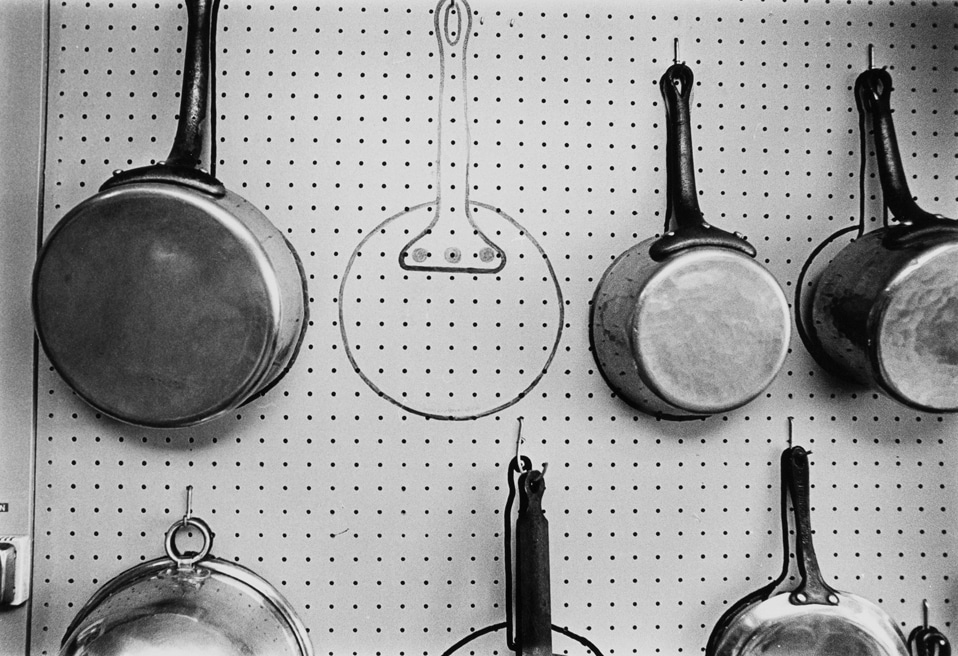
For Stumpf, the Childs’ kitchen represented an anti-consumerist position, one that resisted trophy purchases, fads, and obsolescence. It had been equipped through a rigorous process of selection and testing, as Julia and Paul began by assessing needs — physical and social —and built up the design through experiment. This resulted in well-lit work centers at different heights, with the range lower than usual to allow Julia to see into tall pots, and the counters higher to accommodate her 6′2″ frame. Evoking their rational approach to choreographing The French Chef, as well as the principle of mise-en-place, the Childs mapped out the ideal location for pots and pans by first grouping them by task, on the floor. Once they had found the most logical arrangement, Paul recreated it on the pegboard panel, a material beloved by DIYers everywhere and used extensively in E. Dehillerin. 27 Tools were visible and graspable, with silhouettes outlined. Julia remarked, “They always get home again.” 28

Stumpf’s admiration was sincere, but his treatment of the Childs’ kitchen as sui generis — a natural product of Julia’s devotion to her art and Paul’s experimental bent — was disingenuous. The Childs were hardly neophytes when it came to design. In Cambridge, they were friendly with several influential architects, not least Ben Thompson, the founder of D/R (and one of the founding partners, with Walter Gropius, of The Architects Collaborative). 29 And they took advice on the design of 103 Irving Street from another intimate friend, MIT lecturer Robert Woods Kennedy, who had previously written about home economics research that rationalized kitchen design in similar ways to Paul Child. 30
Yet Stumpf strategically suppressed any possible influences or overlaps because he was invested in claiming Child’s kitchen as unique and “artless,” unburdened by professional preconceptions. 31 Only by wiping the slate clean could he summon up a different direction for contemporary design. This direction was not only ethical, it was also commercially appealing, unlocking new markets for sustainable and accessible products. And what Stumpf thought about commercial design mattered, given his close ongoing association with the furniture company Herman Miller. The Aeron chair, the definitive icon of corporate office life, was still a few years away, but Stumpf had already designed the innovative Ergon, marketed as the first ergonomic chair. 32 If ergonomics prevailed in the office, why not the kitchen?

A Universal Way to Live
It is one thing to serve as a muse for user-centered designers and another to promote their aims actively. But when Child was offered the chance, she did not hesitate. In the early 1990s, she agreed to join the advisory board of a research project at the Rhode Island School of Design, which aimed to “recreate the kitchen, an everyday icon of poor design” so it could be used by 95 percent of the population. 33 Over five years, the Universal Kitchen was developed by a team of more than 100 students, directed by interior architects Jane Langmuir and Peter Wooding and industrial designer Marc Harrison. 34 They may have recruited Child through Nancy Verde Barr, who sat on the advisory board, or perhaps through her friend Carl Sontheimer, an inventor who had hired Harrison in the late 1970s to redesign Child’s beloved Cuisinart food processor.
She joined the advisory board of a research project at RISD that aimed to ‘recreate the kitchen’ so it could be used by 95 percent of the population.
Harrison’s redesign of the Cuisinart was guided by rehabilitation principles, though he deployed them quietly, to avoid alienating consumers. With its paddle-type controls and high-contrast lettering, it accommodated the needs of people with motor difficulties or visual impairments. 35 Scholars now regard Harrison’s Cuisinart, along with OXO Good Grips, as key milestones on the path to Universal Design, as formally articulated in the 1990s by another advisor to the Universal Kitchen, architect Ronald Mace. 36 In fact, the board Child joined constituted a virtual Who’s Who of the accessible and transgenerational design movements, then in the process of coalescing. Other members included Bill Stumpf, Niels Diffrient, and Patricia Moore. The line-up was a public statement that Universal Design had arrived — that the goal of designing products for the aged or differently abled was no longer stigmatizing, shameful or unprofitable, but rather epitomized “good design.”

As befitting a project whose end goal was to build working prototypes for Cooper-Hewitt’s groundbreaking 1998 exhibit Unlimited by Design, the RISD team sought technical expertise from an impressive number of industry advisors. And they invited in cooks besides Barr and Child, notably George Germon and Johanne Killeen of the Providence restaurant Al Forno. 37 The professional chefs acted as a reality check, ensuring the team did not neglect the activities that took place in the kitchen, or the pleasures of cooking and eating, as manufacturers were often accused of doing.
The early phases of the kitchen research were focused on activities. Reflecting Harrison’s expertise in studying human factors, the team produced time-and-motion studies of diverse people preparing meals. They found, for example, that making a spaghetti dinner took an average of 400 moves. In a laboratory setting, the team conducted equipment tests with dozens of subjects whose heights, reaches, ages, and abilities varied as widely as Julia Child’s television audiences. The researchers also understood that Child’s exceptional height for a woman gave her special value for their study. Then in her mid-eighties, she was put through her paces in the lab, establishing comfortable working levels on their adjustable equipment, while making observations and cracking jokes.

One of the researchers, Jeremy Howard, recalls that Child was totally in command of the lab from the moment she arrived. 38 And, of course, no other research subject came with three television crews in tow. Frustratingly, if comically, in the video of her lab test taken by the RISD team, it is often hard to see or hear Child through the scrum of cameras that surrounded her. 39 But that drives home another element she brought to the project: undiminished star power. Her association with the Universal Kitchen was mentioned at every turn in RISD’s publicity materials and in the copious news coverage that followed. Always hyper-aware of how her image was used, and to what end, Child knew exactly what her imprimatur meant. Not least, it helped launch the Universal Kitchen into the televisual realm. Oprah Winfrey, then at her peak with 14 million viewers per episode, devoted an admiring four-minute segment to it. 40
It was a public statement that Universal Design had arrived — that the goal of designing products for the aged or differently abled was no longer stigmatizing, shameful or unprofitable, but rather epitomized ‘good design.’
In the end, RISD produced two prototypes for Unlimited by Design: MIN, an all-in-one kitchen unit for small spaces like studios or hotels, and MAX, a larger gourmet kitchen for families to cook and socialize together. 41 Although these kitchens had different features, both followed the principle that work surfaces and equipment should be arranged in “The Comfort Zone,” within the limits of average comfortable reach. The prototypes were loaded with storage and appliances that were interchangeable and flexible. Dishwashers, for instance, could be swung outwards or popped up. A stand-out feature was MAX’s long island countertop with multiple water sources, steaming/boiling sink, sliding cutting boards, and retractable ventilation. The whole unit could be mechanically lowered from 40 to 28 inches, to suit an ambulatory person or a wheelchair user. Built-in grab rails and contrasting surfaces helped the visually impaired. And the energy-saving clincher? Preparing a spaghetti dinner in MAX required only 100 steps.
These inventions were impressive enough that Maytag bought the rights to the Universal Kitchen, securing its reputation as a milestone in Universal Design, though the company did not bring it to market. 42 And there is little doubt that Child’s involvement had some part in its success. But one wonders what she would have thought of the result. As someone whose concern was good cooking, she let it be known that she disliked MIN’s emphasis on convenience foods: “This is for people who are feeding, not dining,” she declared. 43 She also stayed loyal to her DIY ethos, hinting that people might be turned off by the price tag of a fully manufactured kitchen and would prefer their own adaptions, no doubt realized with the aid of pegboard. Her reservations were shared by many in the disability community, who noted the elaborateness and cost of these “Rube Goldberg” innovations and worried about the implications of treating accessible products as just another commodity. 44
And, finally, Child had never been a fan of time-and-motion-saving for its own sake. She claimed to appreciate the exercise that extra steps gave her, and her own kitchens allowed room for things like “putting-down space” that were banished by those who promoted compact kitchens. In cooking and in kitchens, she favored complexity over efficiency. She advised people to rehearse “complicated meals and entertainments” to figure out the best arrangements. 45 For her, the process of rationalizing cooking was never about making it simpler or automatic. From Paul’s stovetop diagrams to the elaborate mapping of Julia’s batterie de cuisine, the Childs pushed people to construct conscious enabling relationships to cooking techniques, ingredients, tools, and domestic spaces. They showed that it mattered — politically, socially, ethically — how one selected, used, and consumed things. This was the approach they hoped to put within everyone’s reach.
Stumpf identified this approach as potentially transformative for commercial design, and the Universal Kitchen provided a concrete example of what it might look like in practice. For all their research, however, the designers failed to capture the most alluring feature of Julia Child. Her cooking was always first and foremost a performance. Even if the kitchen could be planned and choreographed, the performance was created with each meal, in real time. This is why Child remains such a cultural force today. We might go out and buy the right gadgets, and they might now be designed ergonomically, but Child’s great insight is that cooking is about action. She inspired universal and accessible design, but she also transcended it, as it was realized commercially. Instead, she taught us that mastery does not reside in a set of objects; rather, it is about activating certain relationships to objects as a way to live, regardless of age, ability, or background.


If you would like to comment on this article, or anything else on Places Journal, visit our Facebook page or send us a message on Twitter.