

In the aftermath of electoral reckoning, we are reminded what a misnomer the “United States” really is. No amount of demographic nuance can deny the divisions, which are only ideological in the sense that they divide those who have successfully been interpellated — hailed, summoned — into the gravely endangered liberal order, and those who have not. Elites openly display their contempt for those outside this order; those excluded resent promises made and withheld by the order’s guardians. Among the competing sovereignties on which the liberal order rests in the U.S., the federated system of states stands out, not only for its electoral color-coding in shades of red and blue, but for the decentralization of public power that it represents. Hence the term for the networks both real and imaginary that have, since the mid-20th century, bound the nation-state together: Interstate. With this in mind, and for the purposes of discerning in the nation’s infrastructure clues to rebuilding what Alexis de Tocqueville disarmingly called “democracy in America,” we can begin with a simple axiom: to rethink the Interstate Highway System is to rethink the United States.
We can begin with a simple axiom: to rethink the Interstate Highway System is to rethink the United States.
The Interstate Highways — the “Interstates” — were conceived at the crest of the liberal era, when the mobile individual, newly forged in the automobile factories, was the model citizen whose rush into the mechanized future extended the national polity coast to coast. Following the Great Depression and despite conservative backlash, a strong federal government was ascendant and large-scale planning was the norm. In this context, and notwithstanding intermittent collectivist leanings, “liberal” does not connote a political or economic doctrine so much as it does a metaphysic, a way of being in which the individual governs. This individual is defined on the one hand by freedoms secured by the state, and on the other, by liberties secured by markets that are also secured by the state. But what is, or what was, this state?
The Tesla System: General Motors, Again?
“What’s good for General Motors is good for the country.” 1 As well as anything could, this paraphrase of a corporate dictum describes the governing ethos of the decades immediately following the midcentury world war — decades that arguably represent the central referent of the slogan “Make America Great Again.” Translated, this slogan reads: “Return America to the Age of the Interstates.” To better understand the tributaries that flow from past to present (and now, back) along this route, we need to pay attention to the adverb: again. Because when revisited, the historical road does not necessarily lead where it once did.
‘Make America Great Again.’ Translated, this slogan reads: ‘Return America to the Age of the Interstates.
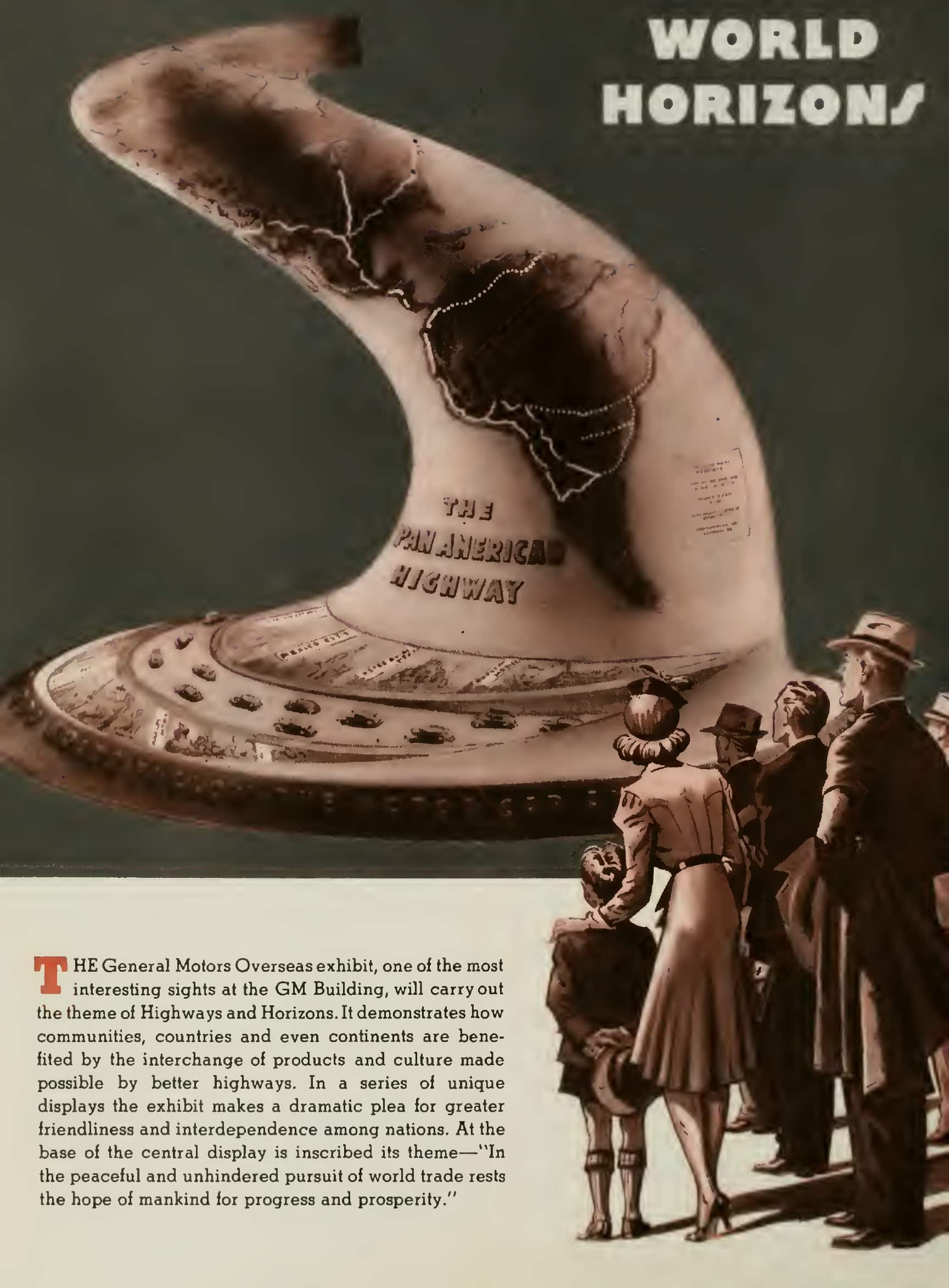
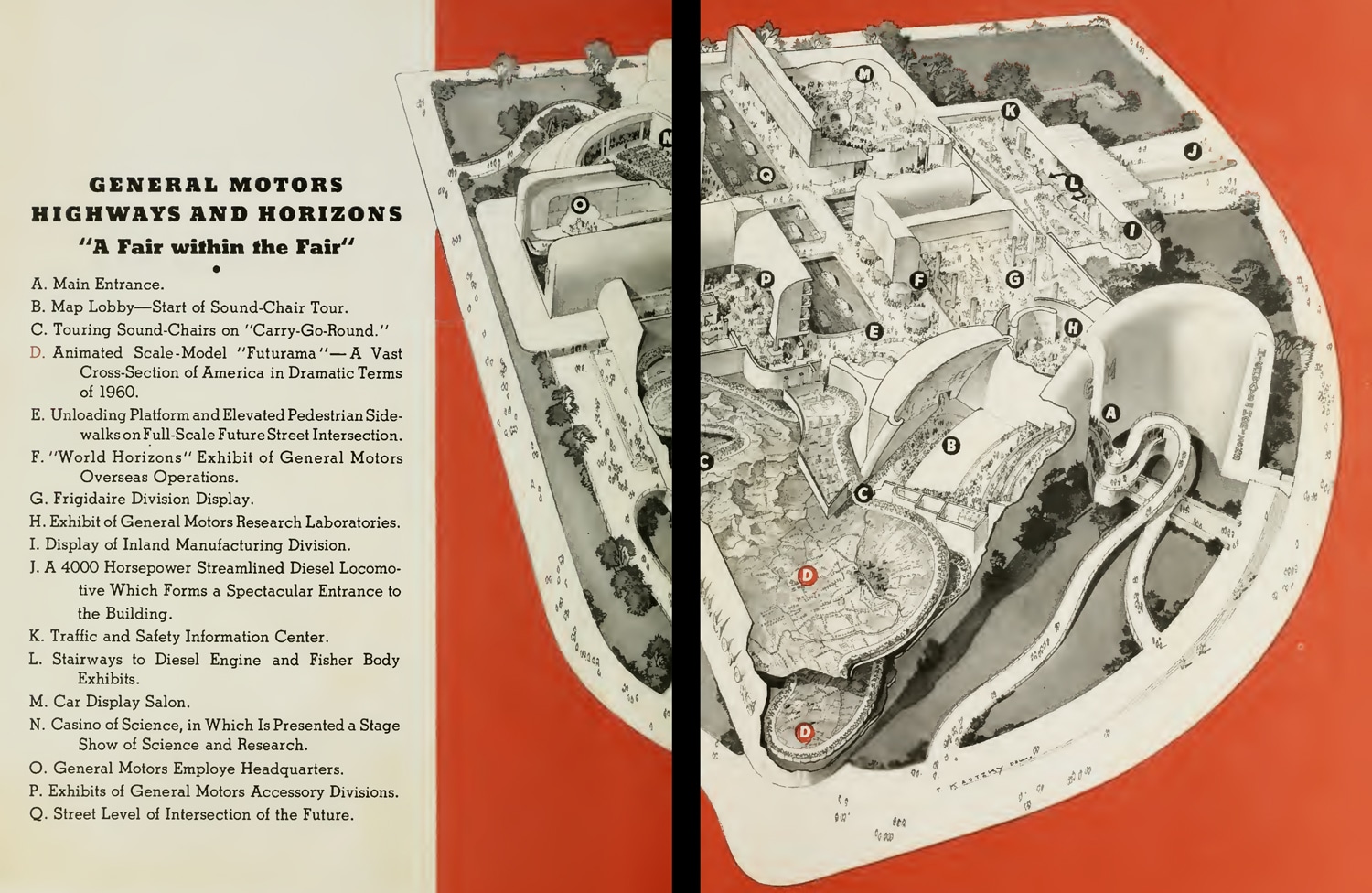
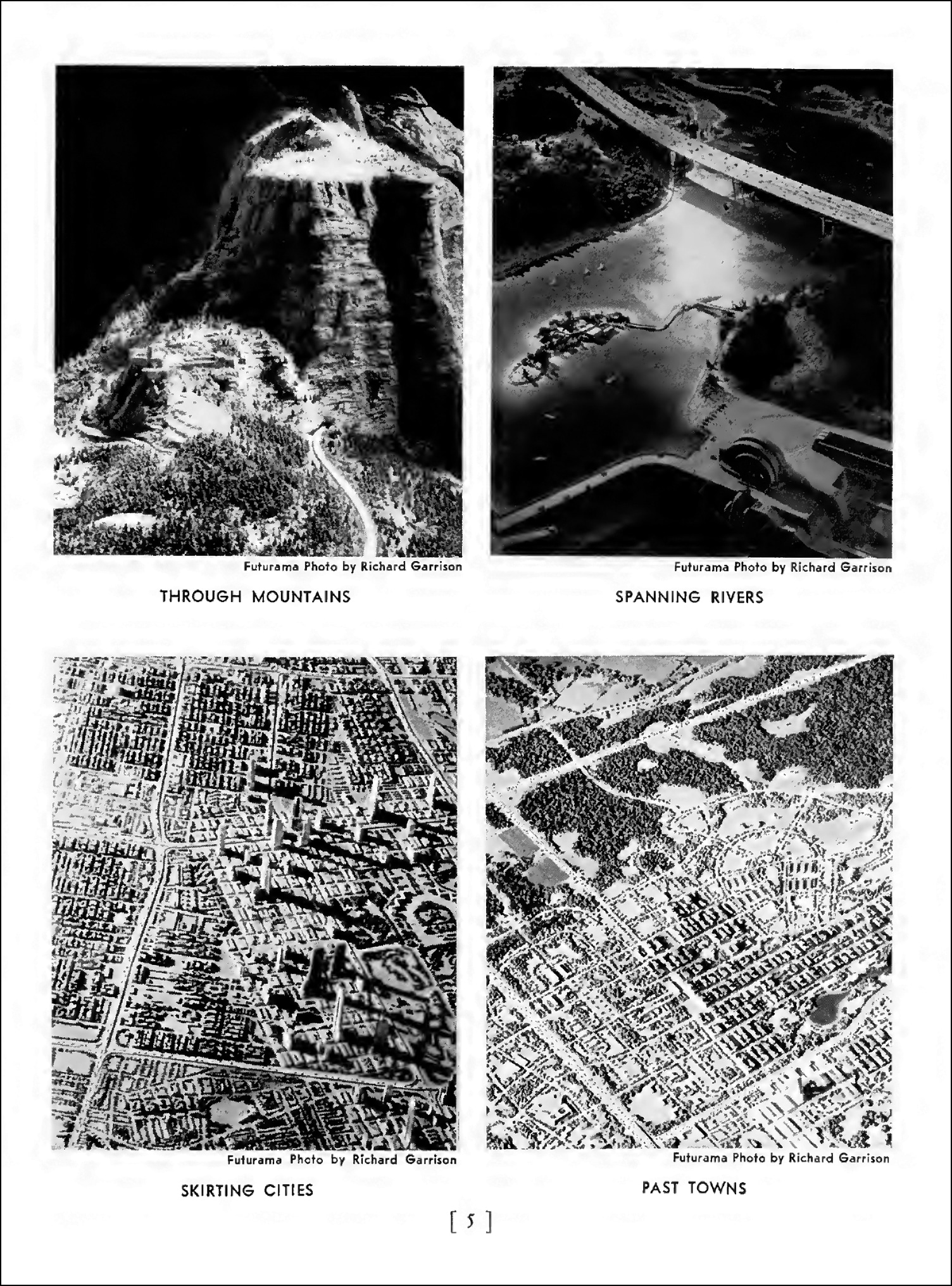
The General Motors pavilion designed by Norman Bel Geddes for the 1939 World’s Fair in New York and its centerpiece, the Futurama exhibit, anticipated a system of highways spanning the continent — a monument to the partnership between business and government established during the early New Deal. Visitors could survey an animated model sprawling over 35,000 square feet that showed a landscape both preserved and transformed by highways and interchanges, with vehicles sorted by speed driving to and from the “City of 1960,” and a patchwork of farms, villages, and towns in between. The message of Futurama was simple: the federal government would build the roads, and General Motors would supply the automobiles and the corresponding way of life.
Today, the scene replays. Another automobile company, Tesla Motors, seeks with government support to repopulate those highways with electric vehicles marketed as existentially distinct from GM’s fossil-fueled albatrosses. Laden with postmodern irony, the design of Tesla’s cars resembles the sleek and streamlined look of the machines projected by Geddes in Futurama, which is no surprise given the diffuse influence of streamlined styling in product design since the style’s heyday in the 1930s. The corresponding dictum is likewise repurposed. What’s good for Tesla is good for the country.
At first glance, Tesla’s appeal may seem counterintuitive. Long before he became an unelected “government efficiency” tsar, the company’s CEO, Elon Musk, appealed to middlebrow taste by making electric vehicles into stylish accessories rather than earnest symbols of shared sacrifice. Tesla Motors also bet on an energy supply — not necessarily decarbonized — that is decisively downstream from the solar arrays and wind farms that have recently competed with fossil-fueled power plants to supply electricity at state or regional scale.
We need to pay attention to the adverb: again. Because when revisited, the historical road does not necessarily lead where it once did.
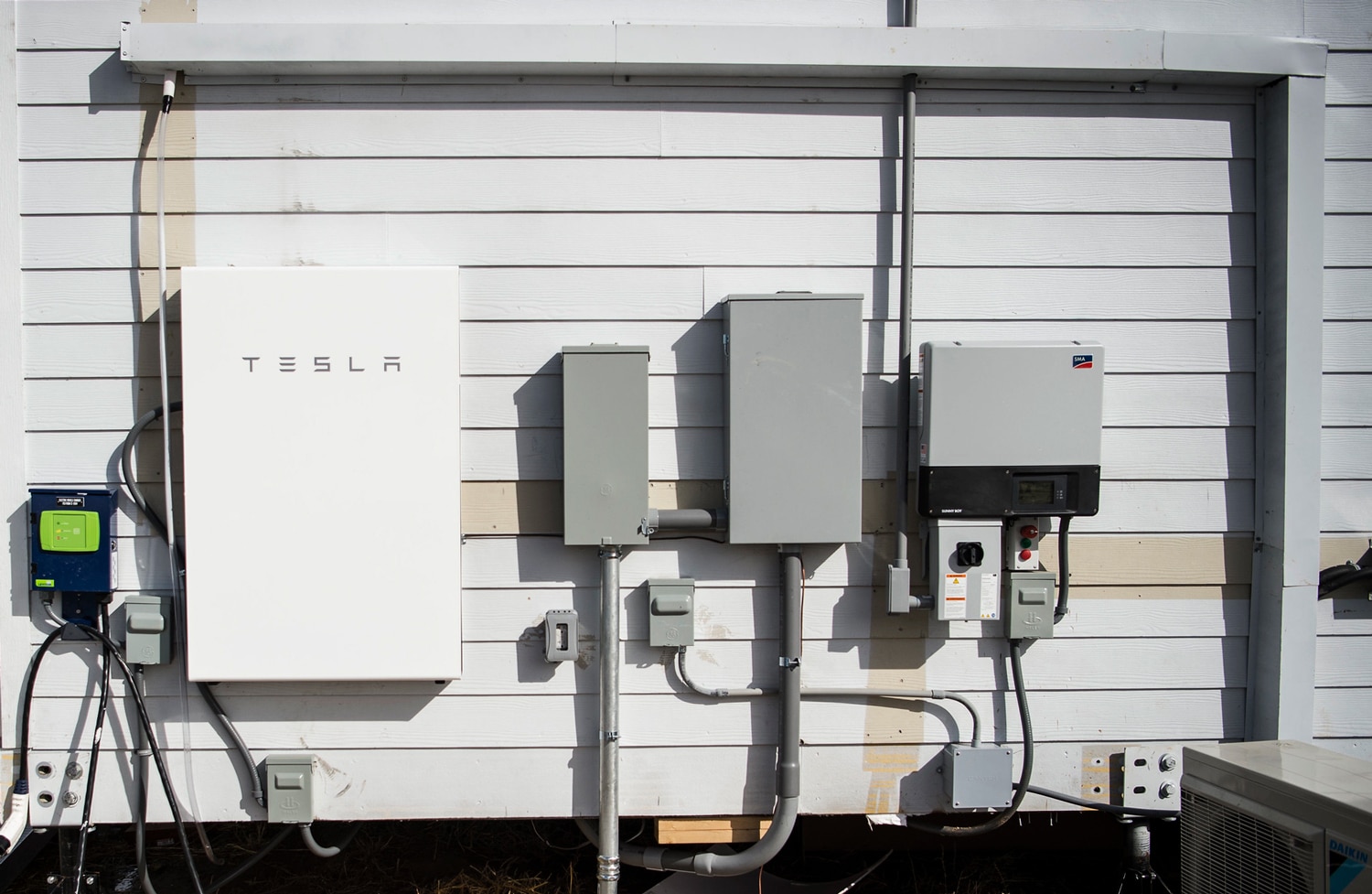
With Tesla, sustainability begins at home. Sales of Tesla’s Powerwall rechargeable battery, which stores and distributes electricity from rooftop solar units (also made by Tesla) on houses and other individual buildings, have contributed significantly to the company’s bottom line. The Tesla Megapack battery system scales this up, to provide backup storage for electricity grids subject to the vicissitudes of wind and solar sources. The Megapack’s modular design not only provides flexibility according to need; it adapts the domestic scale to municipal or regional requirements, with rows of lithium-ion battery units barely distinguishable in the exurban landscape from the modular self-storage facilities commonly found along state highways and county roads.
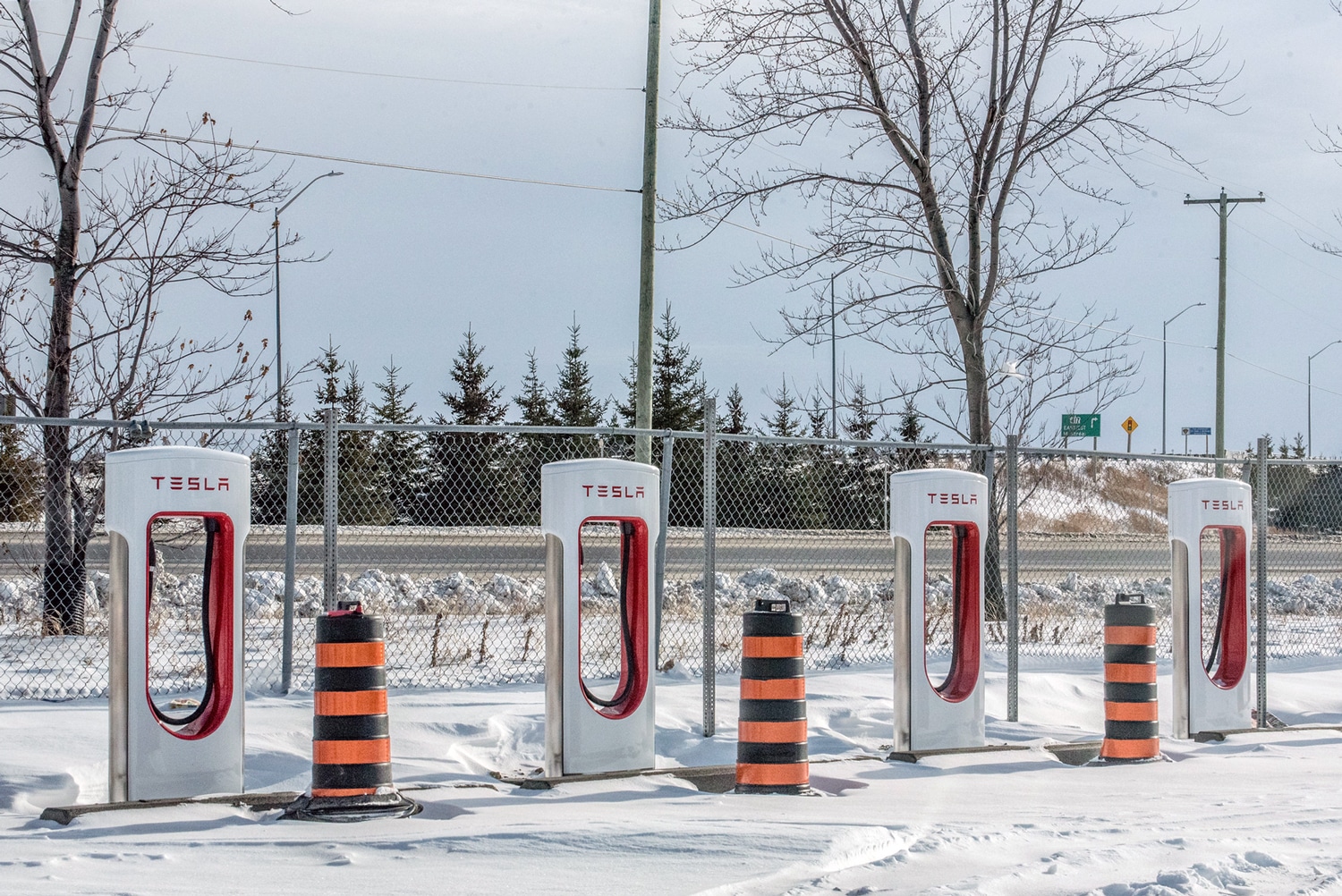
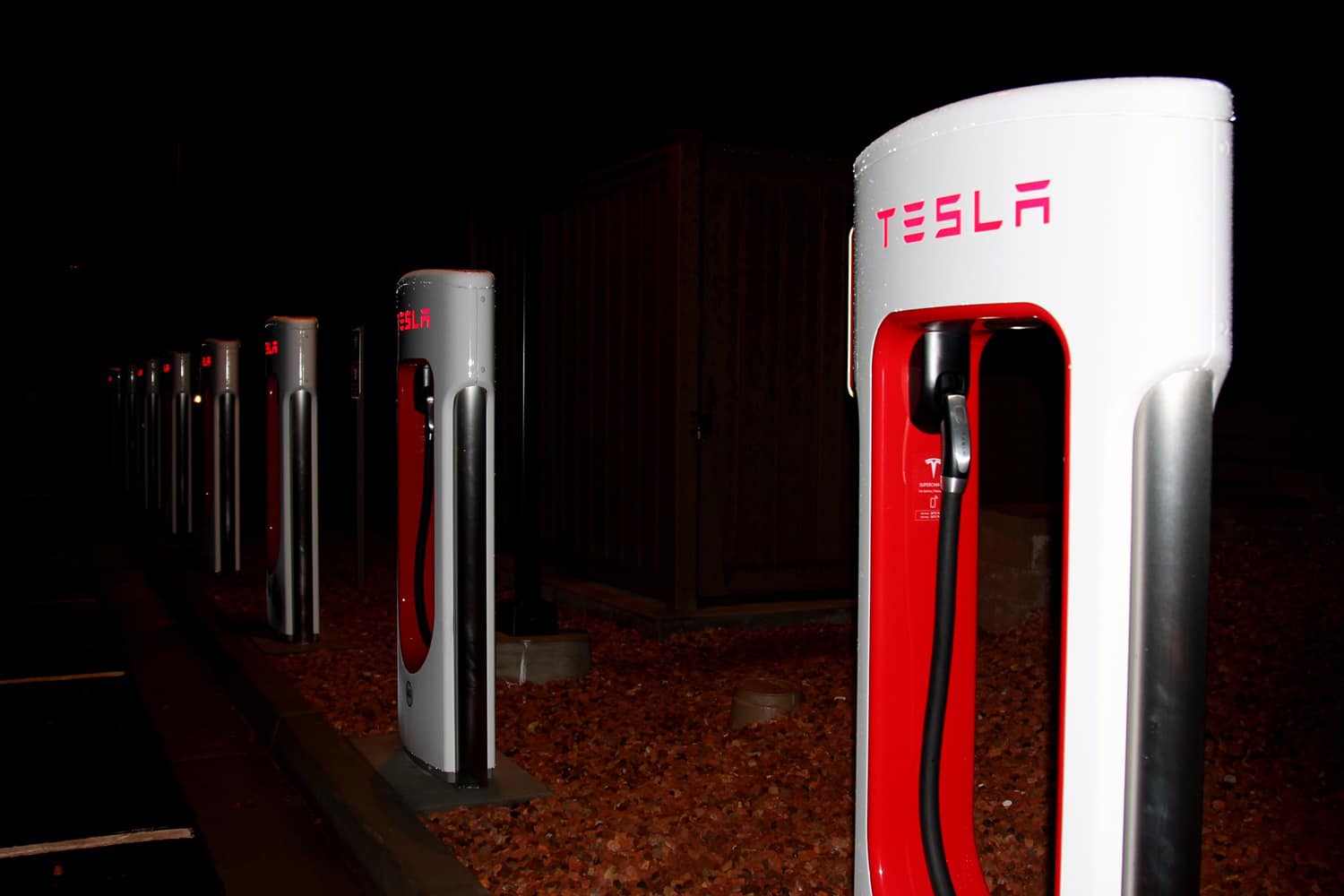
Despite the retro-futurist look of its vehicles, it is a stretch to say that Tesla possesses a fully developed design philosophy. The company comes closest to this not in Musk’s staccato musings, nor in the nonchalant elocutions of its lead automobile designer, Franz von Holzhausen, nor in the polished presentations of its director of product design, Javier Verdura. Rather, the outline of a credo appears in what we can call the Tesla System. Tesla’s design philosophy is modular; it is a philosophy of adding to a network of users one car, solar panel, or Powerwall at a time. This accreting series is backed up by network of Supercharger vehicle charging stations and — nominally — clean energy passing through as many Megapacks as possible. The approach builds outward and upward from the point of consumption.


Tesla supplies products for storing and consuming electricity rather than electricity itself. In the U.S., the retail distribution of energy by utilities is regulated at the state level, and its wholesale distribution at the federal level. Commercial electric companies, or utilities, invest heavily in centralized production facilities and are frequently “natural” monopolies within a given jurisdiction. Despite being itself subject to regulatory constraints at all levels, Tesla, which entered the energy business on the demand or consumer side, operates both beneath and beyond state sovereignty; like most product manufacturers, governed by self-interest, Tesla’s autocratically-run networks are calibrated to markets — regional, national, international — and not to political jurisdictions. The decarbonization of energy sources within any given market is irrelevant to the company’s commercial interests. Except, that is, for the installation of solar cells on individual houses, which until recently may well have been aided by government incentives that faithfully reproduce the liberal individualism on which the Tesla System is built.
Nationalize Tesla: A Thought Experiment
How, then, to decarbonize — and in the process, democratize — the Tesla System? As I have suggested elsewhere, one way to decarbonize energy production at a meaningful scale is to nationalize interstate oil and gas pipelines, and gradually decommission that infrastructure in order to accelerate the transition to renewables. Another way is to extend the logic of the Interstates to the vehicles traveling on them, and to treat these vehicles as a public good rather than a commodity.
Though built and maintained by states, the highways remain under the jurisdiction of the U.S. Department of Transportation. Musk eagerly accepted the task delegated to him by the new presidential administration (a task now scaled back) of rendering government “efficient.” 2 If, in a democratic society, the role of government is to support the well-being of the governed rather than to increase profits for the governors, then the most efficient course of action is to decarbonize now. So, perhaps Musk might still consider taking his turn toward public service all the way, by advising the new administration to nationalize Tesla.
How, then, to decarbonize — and in the process, democratize — the Tesla System? Nationalize Tesla.
Audible gasps. Not another Yugo! Volga! Trabant! Ambassador? To nationalize an automaker would be downright “un-American,” as Senator Joe McCarthy used to say. But why? Extending the economic logic of the Interstates to the vehicles that drive on them reverses the obvious motive for Musk’s newfound, if short-lived, public spiritedness. Taking electric vehicles off the market, and treating them the way we do public roads or public schools, subtracts the profits that fill Musk’s pockets and those of Tesla’s other shareholders. Doing so would make the vehicles that much more affordable, and less embarrassing — and it would make electrifying the nation’s fleet that much easier. Better still, rather than owning cars, why not rent them from a public authority, like housing, or borrow them, like a library book? Tesla, then, as a form of public transportation.

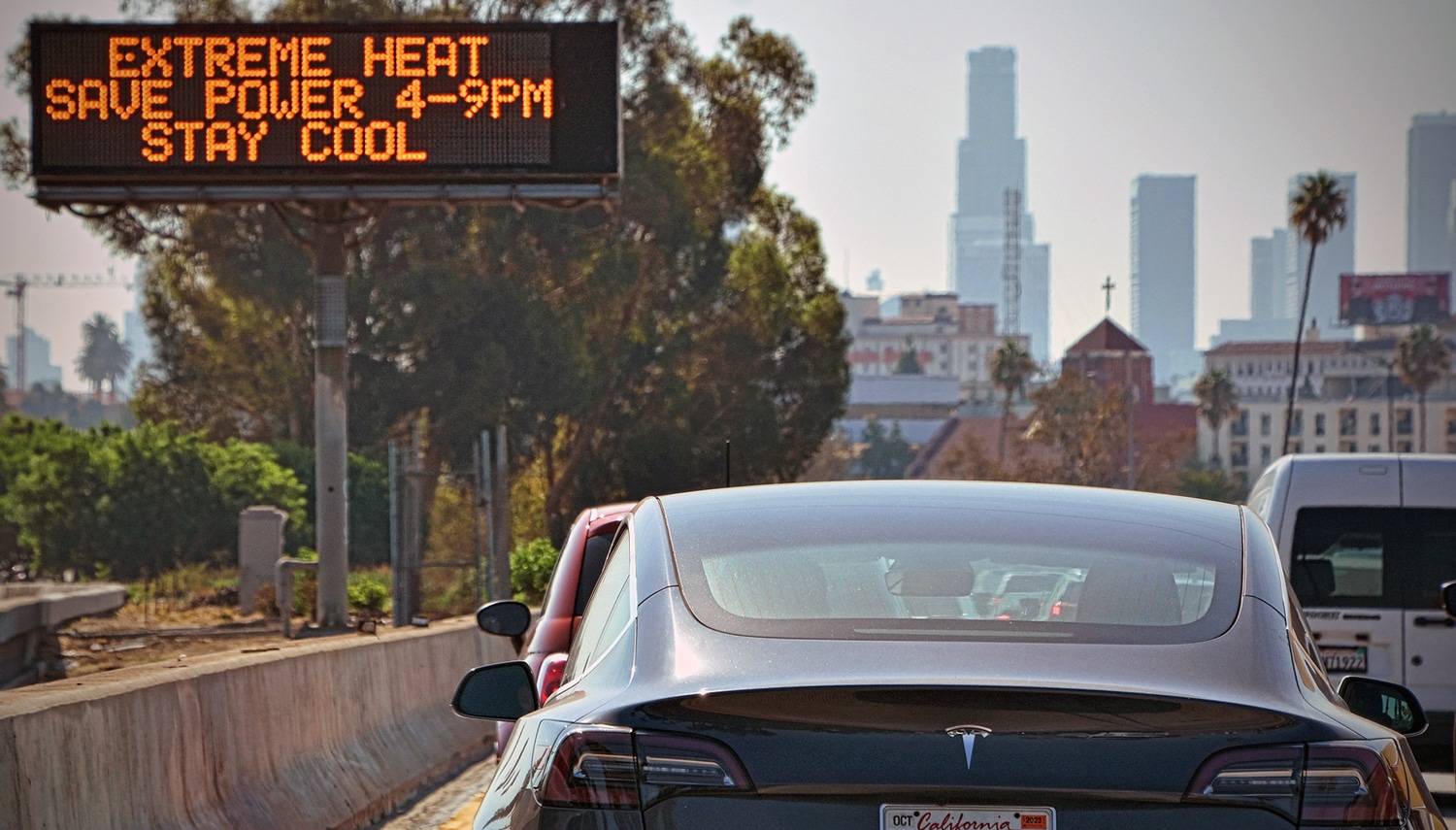
But even if socializing a sacred token of liberal individualism — the automobile — goes a long way toward reorganizing underlying social and economic relations, it does not automatically lead to decarbonization. In themselves, electric vehicles do little more than move carbon emissions from the point of consumption, the internal combustion engine, to the point of production, the power plant, which could easily be coal-fired. Yes, more efficient storage (the Megapacks) combined with (now-vanishing) government subsidies encourages transition to solar or wind. On their own, however, electric vehicles are a necessary but not sufficient condition for the decarbonization of transportation.
On their own, electric vehicles are a necessary but not sufficient condition for the decarbonization of transportation.
Even if they were, economies of scale work differently for consumer products like automobiles than they do for energy production. The capital and labor necessary to produce enough electric vehicles to replace the majority of Americans’ cars would require dramatically increased production, with global market competition — supplemented by more government subsidies? — keeping prices down. Even so, since policies of economic nationalism have come to mean, for example, tariffs on Chinese-made electric vehicles, the step from protectionism to nationalization may seem logical. From this point of view, nationalizing Tesla makes this class of vehicle more like the next Volkswagen than the next Yugo or Trabant. Granted, the promise of a “people’s car” (the Volks Wagen) inherited from dictatorship (in this case, the Third Reich) went largely unfulfilled in the postwar decades. Even so, is this aspiration not consistent with the actions of the Tesla CEO, that eager populist who wrote million-dollar checks to persuade voters to elect his candidate of choice?
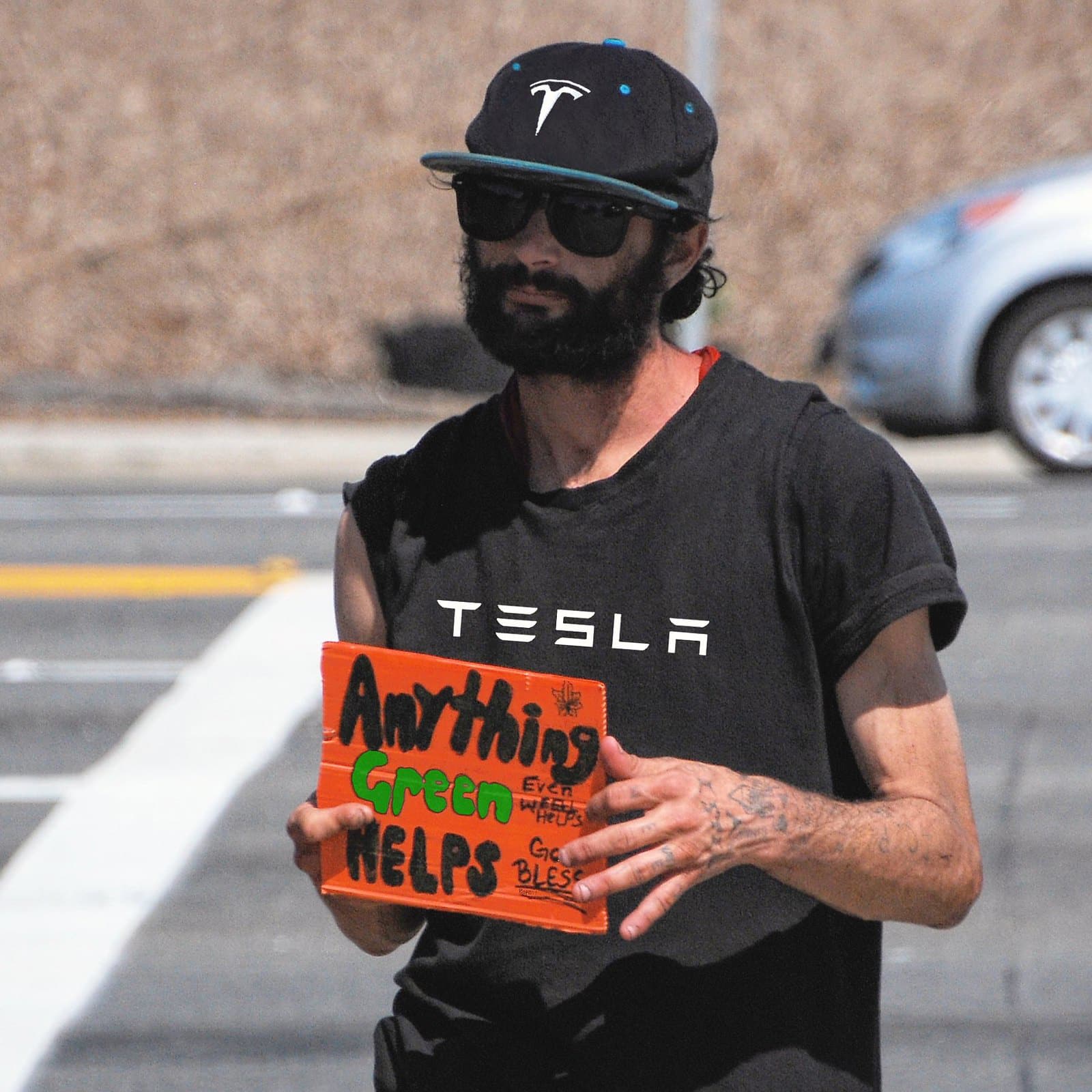
Perhaps. However, when it comes to political economy, the cries of “Fascism!” echoing from those alarmed by the current administration are accurate in the sense that the new sovereigns have shown themselves far more likely to follow their Italian and German forerunners in privatizing what remains of public property rather than converting the state into a factory owner. The new world order they abide by, inaugurated during their leader’s first term and tended by their immediate successors, entails the “onshoring” of production and the control of international resource markets through a combination of not-so-soft power and armed force, to the potential benefit of all domestic automakers.
The new sovereigns are far more likely to privatize what remains of public property rather than convert the state into a factory owner.
This type of autarky bears some resemblance to that sought by past economic nationalists. But the comparison trails off when we take into account the global reach of companies like Tesla, which like its peers may also benefit from greater government support in penetrating markets abroad as the oligarchy anoints its figurehead. By which I mean Musk, not Trump. For the time being, the two still need one another. But in the long run it will be capital, not the aging child, that will take command. Put differently, it is more likely that Tesla, not Trump, will be the brand name of the authoritarian capitalism now aborning. The global hardware-software complex — including automobiles — and not real estate development or golf courses, will likely be its avatar. The thought experiment of nationalizing Tesla interrupts this process, but only partly. Which brings us back to the highways.
Magic Motorways
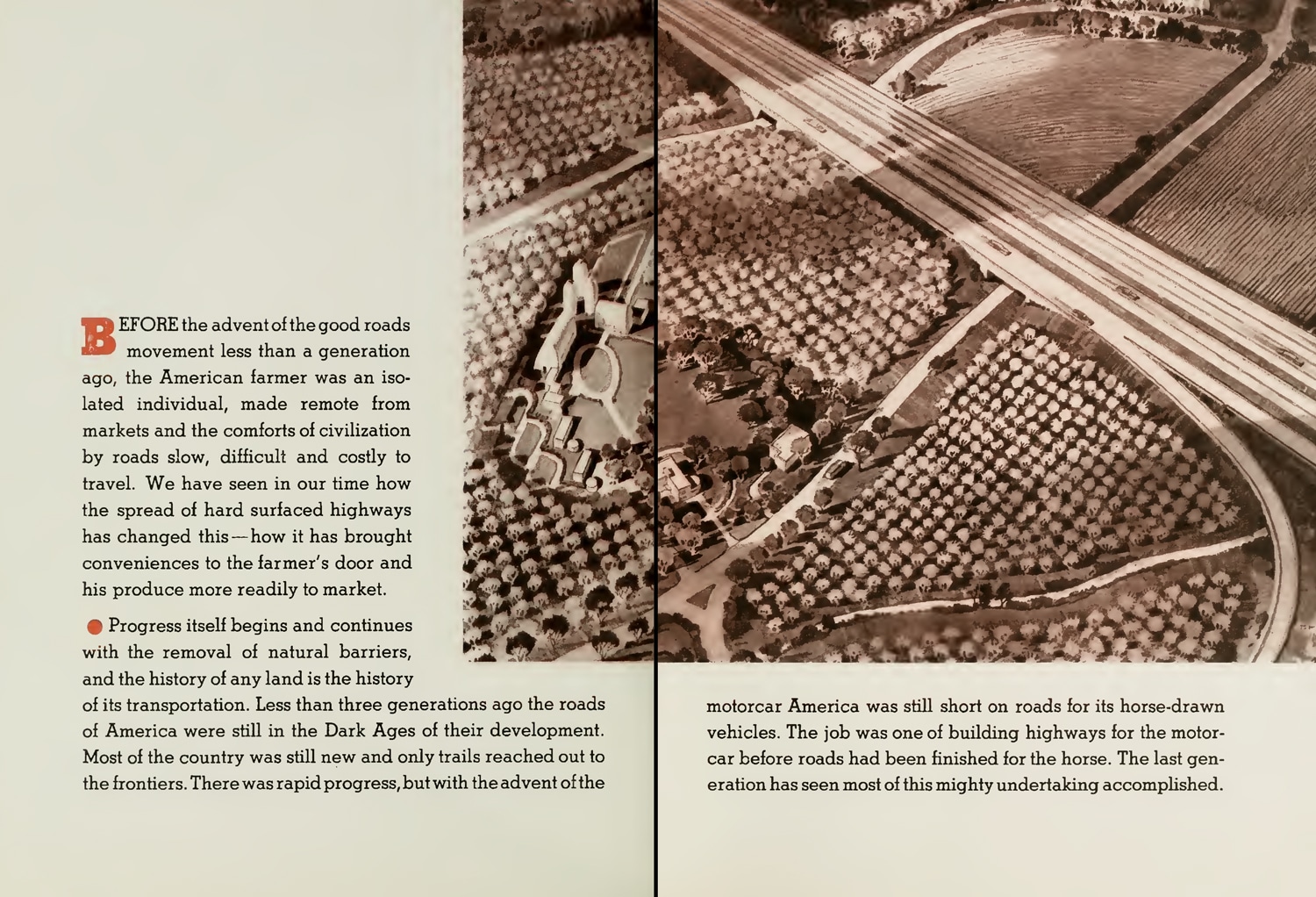
Among the promises with which Norman Bel Geddes concludes Magic Motorways, his elaboration of the proposal for a national highway system that animated the Futurama exhibit, is that such a system would result in dramatic changes in land use. 3 In fact, it has — and Geddes was sufficiently vague about what these changes would entail that his 1940 book may seem prophetic. But the point of Futurama was not to sell land; it was to sell cars. To be sure, vast profits have been made from real estate transactions underwritten by the Interstates. Many a shopping mall, condominium development, mega-farm, or corporate campus (or, yes, golf course) would have been impracticable without a highway interchange nearby. But the point of the roads is the cars; take these away and the superhighways make no sense. In Futurama, the houses themselves were extensions of the garage. But before inspecting such functional reversals, we need to take a closer look at what puts the “magic” in Magic Motorways and the cultural mythos that it represented.
Distinctions between design and execution — distinctions central to the production of the General Motors pavilion at the World’s Fair — were based on professional practices that have become common today. Broadly, they correspond with another distinction. This is the difference between the consumer fashions with which designs by Geddes and other “streamliners” had become virtually synonymous (in furniture, radios, coffee services, and the like), and a production-oriented gravitas represented by practitioners like Albert Kahn — whose firm, Albert Kahn Associates, were the pavilion’s architects of record. In this context, the pavilion and its centerpiece, the Futurama exhibit, represent a signal instance in the development of a homegrown, Hollywood-style consumer culture that would set the tone for the postwar decades, with the engines of industry grinding in the background.
A two-page memorandum (dated 1938) in the Norman Bel Geddes papers at the University of Texas, Austin, clarifies the responsibilities taken on by Geddes’s office in the design and construction of the GM pavilion. The document lists eight categories, which begin with the schematic design of the building, inside and out, and conclude with “passing on and approving detailed drawings prepared by others.” 4 The principal “others” were Kahn and his colleagues. This division of responsibilities, in which the Geddes office looked after the building’s design and the Kahn office its execution, testifies to a central feature of the liberal era.
But the point of the roads is the cars; take these away and superhighways make no sense.
What appears as a division of architectural labor, in the distinction between design and construction documents, is actually a distinction between two forms of production. Technically, both belong to what the sociologist Daniel Bell would later call “postindustrial society,” as examples of white-collar service work performed by professionals. 5 But where the Kahn firm was famously expert in the design and construction of factories, including automobile factories for General Motors, Geddes and other industrial designers — including those working at GM — gave form to the products coming off the assembly lines as they entered the marketplace. 6
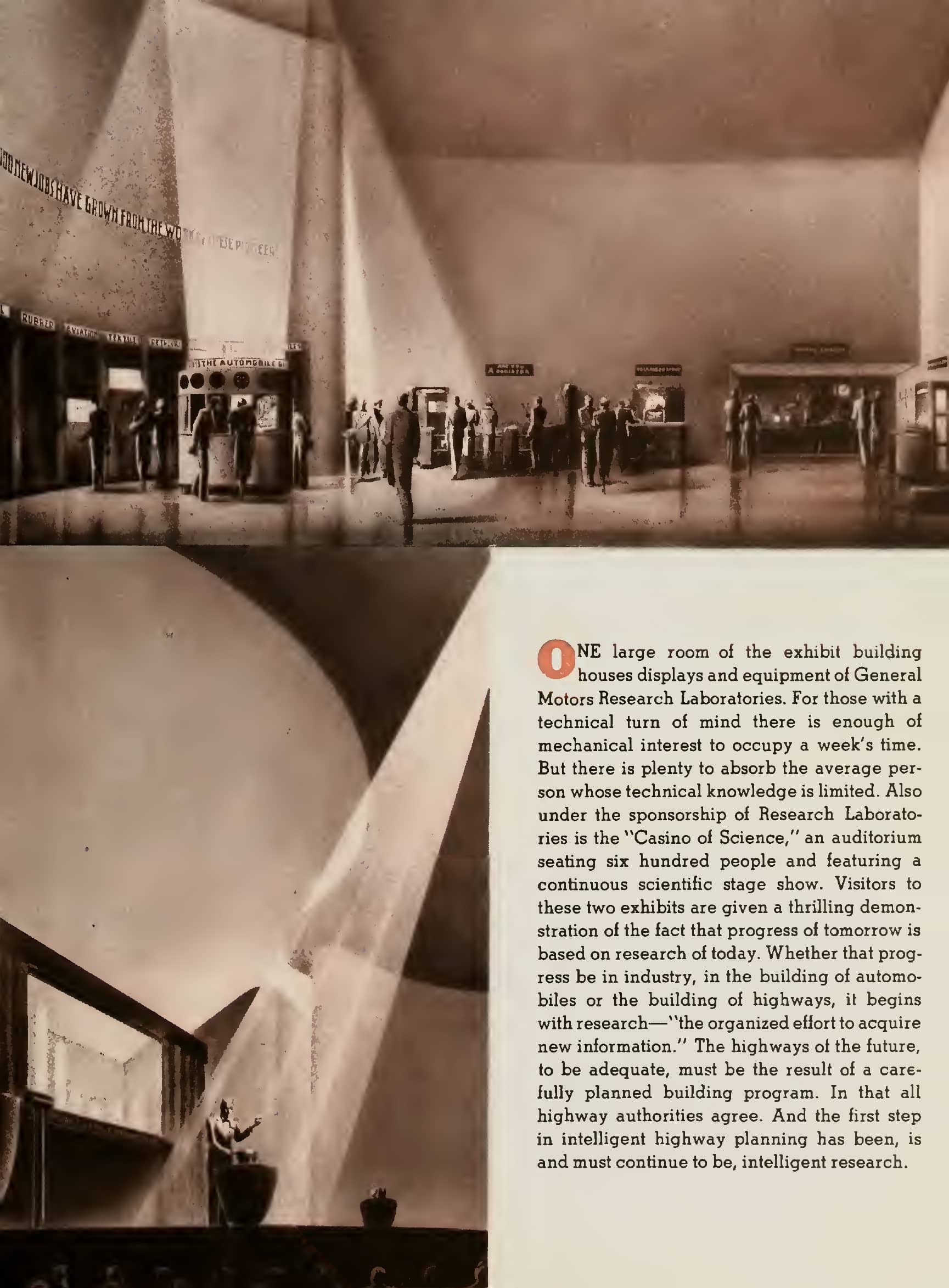
Most narrowly, this division of responsibilities between architect and designer was a matter of liability. Professional licensure made the Kahn office accountable for technical matters. Geddes — who was, next to Raymond Loewy, probably the period’s most famous industrial designer — would conceive and specify all matters pertaining to design. 7 But it was the very nebulousness of this concept — “design” — that required the clarifying memo and ensuing correspondence, until both parties were satisfied as to the key term’s meaning and the project could proceed.
Many a shopping mall, development, corporate campus, or, yes, golf course would have been impracticable without a highway interchange nearby.
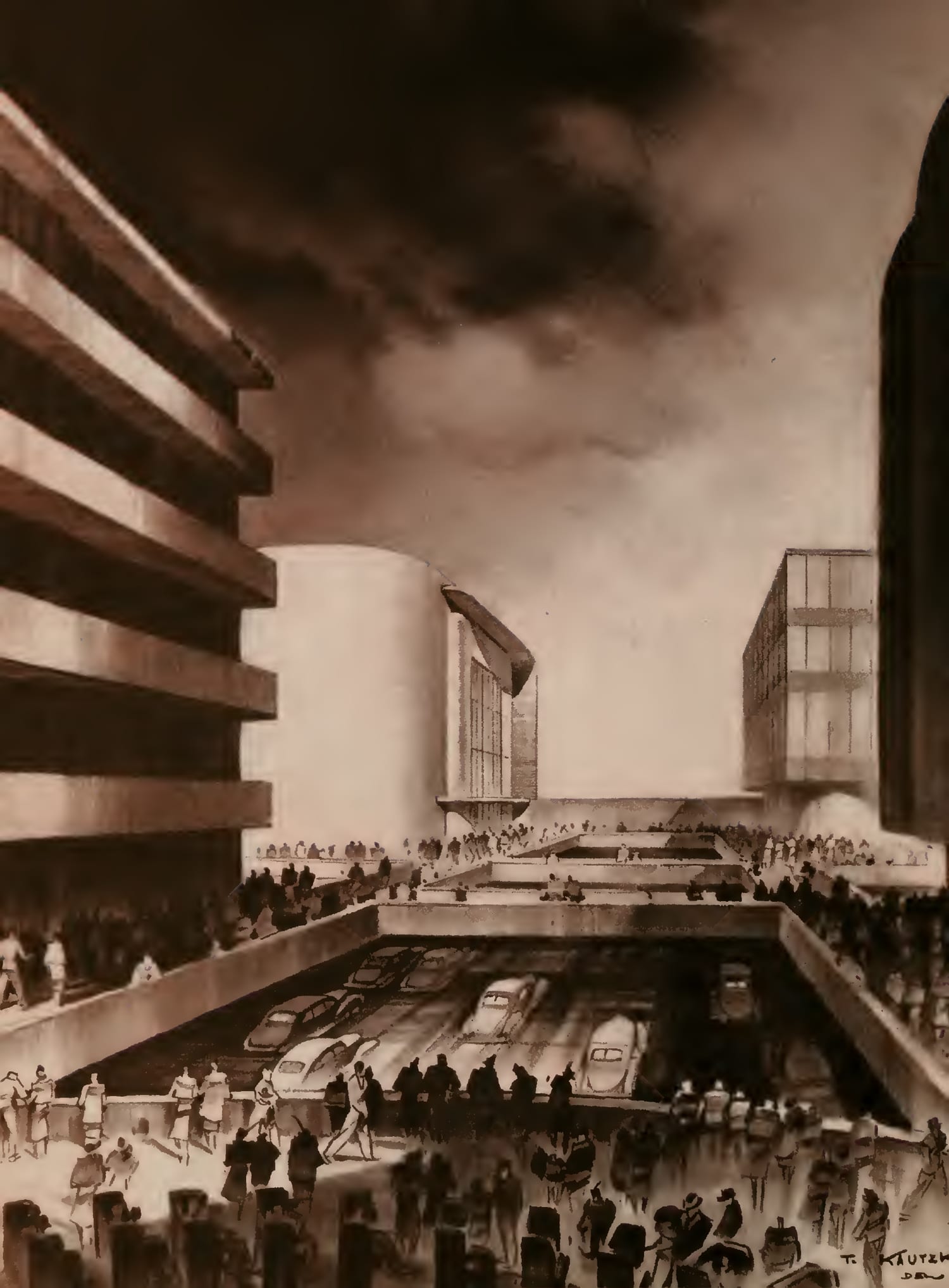
There is, however, much more to Futurama and to the rest of the pavilion than their importance to the emergent culture industry. World’s Fairs are heterotopias of a sort, places of escape in which existing societies are reflected in glimpses of others beyond, as in a fun-house mirror. Futurama was a world-within-a-world, a sprawling model of “tomorrow” envisioned as a landscape of superhighways, skyscrapers, and farms. Visitors lined up outside the pavilion on a snaking ramp, pausing in the lobby before an enormous map of the United States as they filed onto a conveyor of car seats side-by-side that took them — snaking, again — on a ride above and around the model, with synchronized sound bringing a private voiceover to each seat, explaining what each viewer was seeing at each moment. At the other end of the ride, still inside the pavilion, was a full-size urban “intersection of 1960,” with traffic and pedestrians neatly separated, and a General Motors automobile showroom on one of its corners.
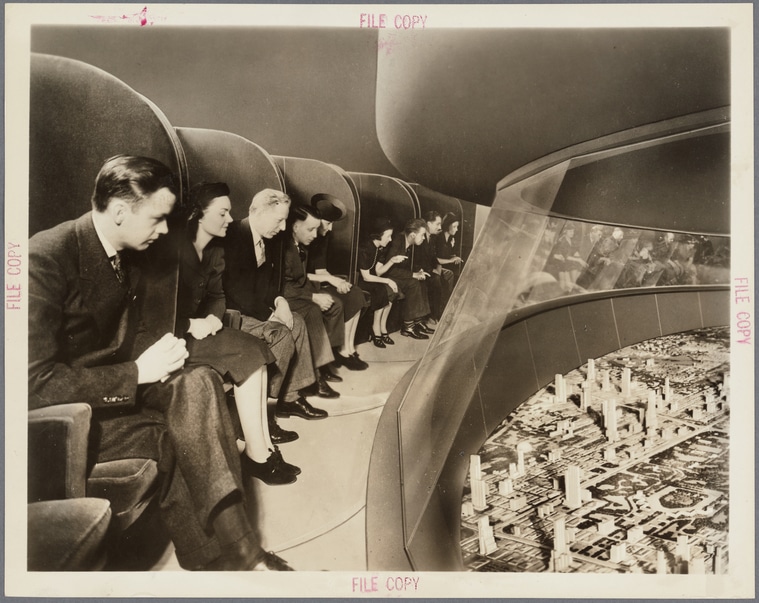

The map in the lobby depicted the country as a system of highways rather than a system of states. Futurama’s entire premise was federal. Writing the following year in Magic Motorways, Geddes celebrated the successes of the New Deal and advocated fervently for a national highway system. “There is a Federal obligation,” he enjoined, “to develop the country’s land and its facilities for transport.” 8 In addition to the economic integration that a national highway system promised, the effects of such a system would be political. The “freedom of movement” it would bring, Geddes argued, would lead to “interchange — interchange of people, places, ways of life, and therefore modes of thought.” 9 As motorists traverse the country, their new homes being supplied with goods on high-speed trucks, “horizons will be broadened, individual lives will grow.” Cities will become mainly workplaces; the countryside will be suburbanized for bucolic residential bliss; farmers will have access to national markets, and factory workers will commute from wooded glens.
‘Highways and Horizons’ was the name General Motors gave to its pavilion at the 1939 World’s Fair.
The real magic of the motorways, therefore, will be finally to overcome divisions between rural and urban life, between classes and between races, that the Great Depression had set in stark relief. A federal highway system would help to cement the confederation on which, Geddes believed, the country was founded. A nationwide interchange of diversity (“racial and geographic”) would yield nothing less than “unity based on freedom and understanding,” a political unity inaccessible on mere state and local roads, or in the local habits to which these roads belonged. 10
“Highways and Horizons” was the name General Motors gave to its pavilion. 11 Taken together with Geddes’s writings and some of his other work, the pavilion and its exhibits — principally Futurama — constitute a form of political theory that envisions a national polity defined by circulation. What Geddes called the “freedom of movement” is centered on the individual. It anticipates political life characterized by what Daniel Bell elsewhere (and rather prematurely) took to be the “end of ideology.” 12


The irony of General Motors sponsoring such a vision is evident. The division of labor in the exhibit’s design encapsulates the prevailing logic of a mature industrial capitalism, whereby the staging of images, experiences, and narratives of unconstrained circulation demanded expertise of the sort concentrated in the Geddes office, distinct from the expertise required for the design and construction of the pavilion/stage itself. The line between these two can fluctuate; in the case of the pavilion, it required legal clarification during the early design stages. But most importantly the distinction, which a supplement to the professional contract for the pavilion further reinforced, reproduced a social and economic order in which circulation and production — driving a car and manufacturing it, say — appear as separate spheres. 13
Within this order, due to innovations in the “styling” and marketing of their products and despite their industrial character, General Motors and other automobile companies might appear primarily on the side of circulation. 14 Geddes, whose name (with Loewy’s) is virtually synonymous with streamlined design, was a theorist of circulation’s “magic,” a designer of commodities animated not so much by the organicism of their forms, but by an organicist theory of circulation — the automobile as lifeblood — transposed onto the nation’s body politic. 15
The pavilion and its exhibits constitute a form of political theory that envisions a national polity defined by circulation.
Futurama demonstrated this theory in microcosm. Every detail of the exhibit, down to the travelator of individual automobile-like seats that took spectators on a breathless ride around the model, positioned its audience as passengers on history’s highway, swept into a near-future world (the “America of 1960”) as if propelled, like a living organism, by a self-driving engine. What Geddes’s theory sought to explain was how that engine, its highways, and the energy fueling them were to be produced. Not so much the cars, roads, landscapes, and buildings shown in the model, nor the gasoline and electricity that all implied, but motion itself, history’s high-speed forward thrust.
This circulation was the principal product on display. Futurama advertised the sense of going somewhere, toward “tomorrow,” as a consequence of the realignment of cars, trucks, and highways that it proposed. The vehicles were the new means of production, made in factories but now constituting a kind of shop floor in their own right, a factory in which “freedom” was made. The future-as-product made and offered for sale by Futurama consisted mainly of this forward thrust. The circularity implied in circulation makes even greater sense when we recognize that, once made, such a future must be constantly remade, refreshed, and recirculated, like the make of a car updated in an annual model change. Or a commuter leaving home, arriving at work, returning home, and leaving again.
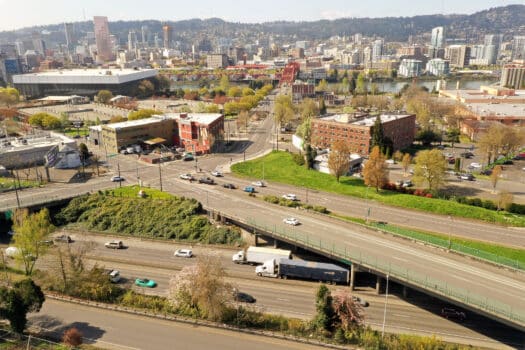
To recognize streamlined as things that magically circulate is to reveal the governing logic of the Interstates: circulation as a product.
As a theater of circulation, then, Futurama was also a circulation factory. In Geddes’s vision, high-speed circulation would knit the states together into a single organism. His version of the Interstate System, diagrammed in Magic Motorways, connected the nation’s cities with a triangular lattice of highways in a manner reminiscent of Buckminster Fuller’s Dymaxion maps. 16 For Fuller, the triangular lattice conveyed both organic efficiency and modular flexibility; applied by Geddes to highways, it added redundancy by connecting each nodal point to seven or eight others. For both designers, and despite Fuller’s parallel use of triangular lattices as structural frames, this latticed geometry replaced the relative stasis of the Cartesian grid with a dynamism in which equilibrium derived from a balance of vectors — incoming and outgoing circulatory forces — takes the place of the grid’s bilateral symmetries.
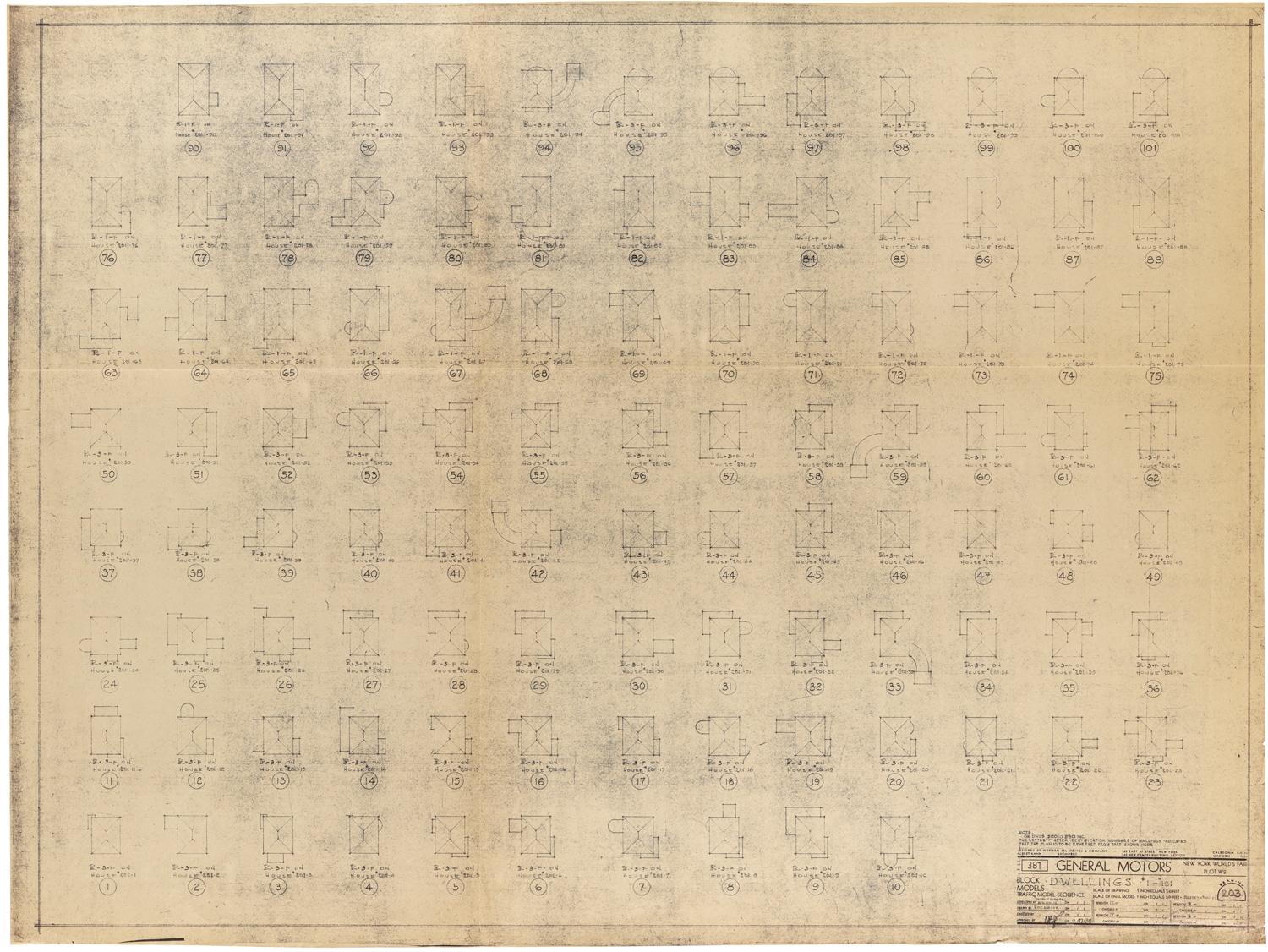
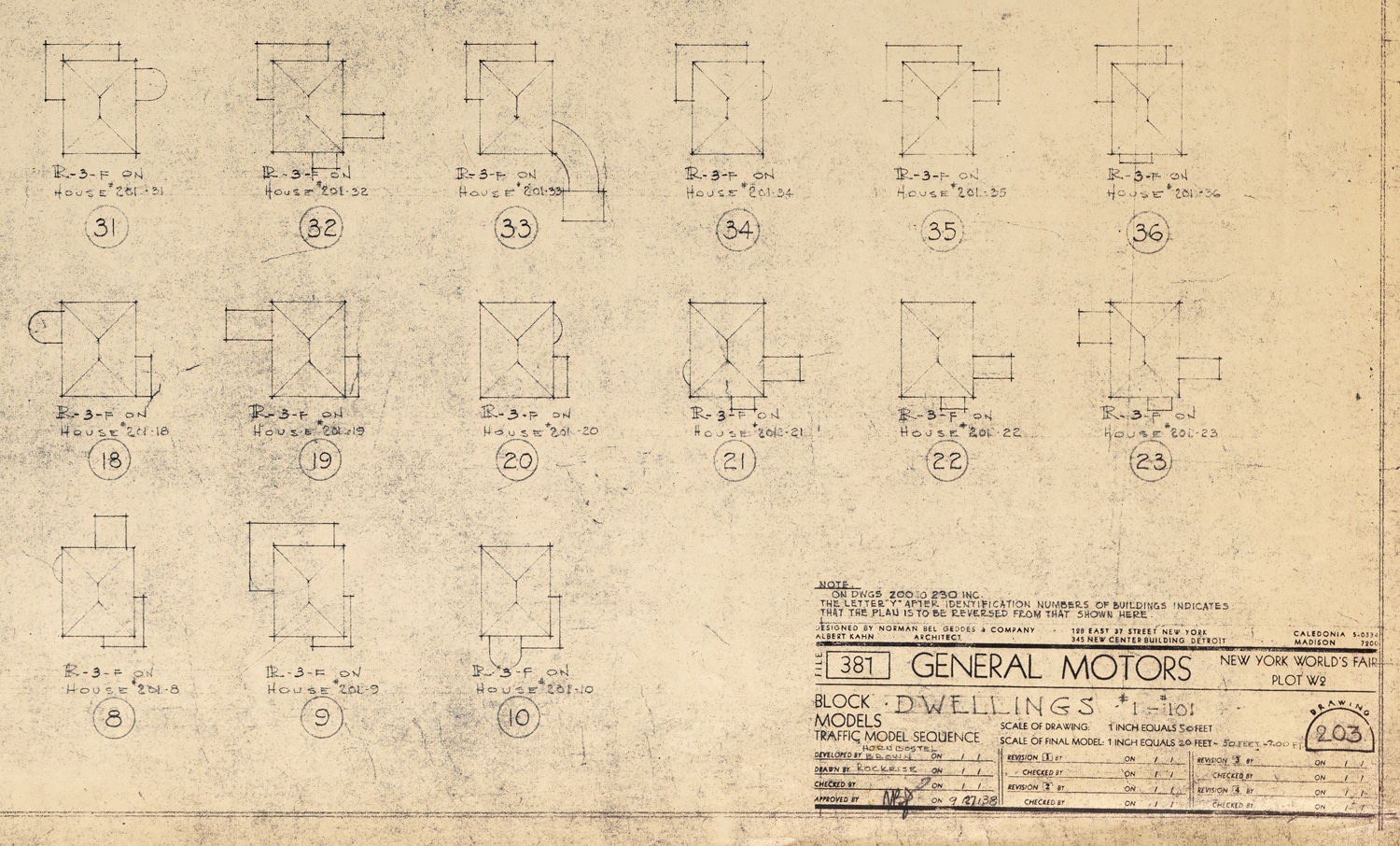
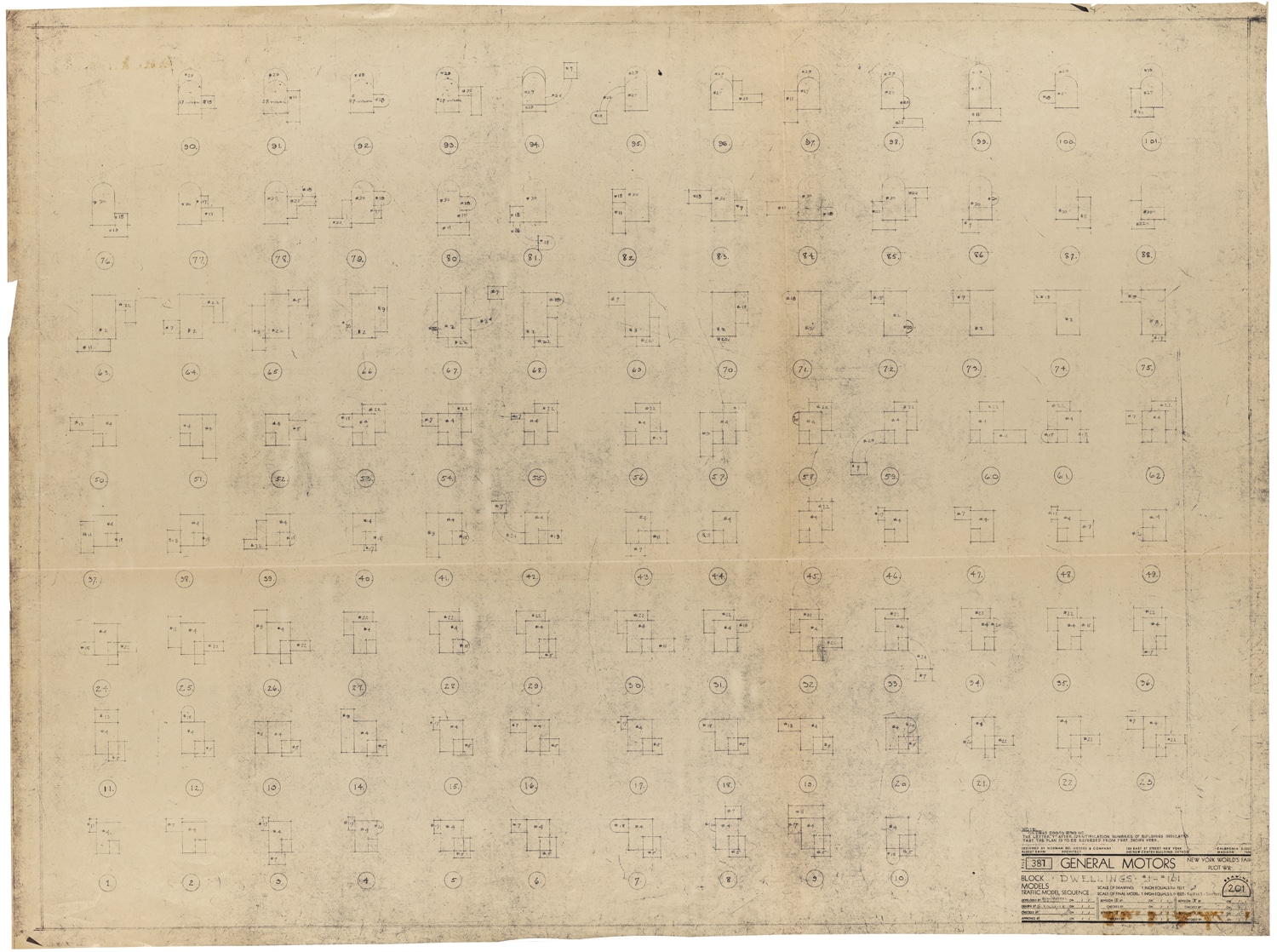
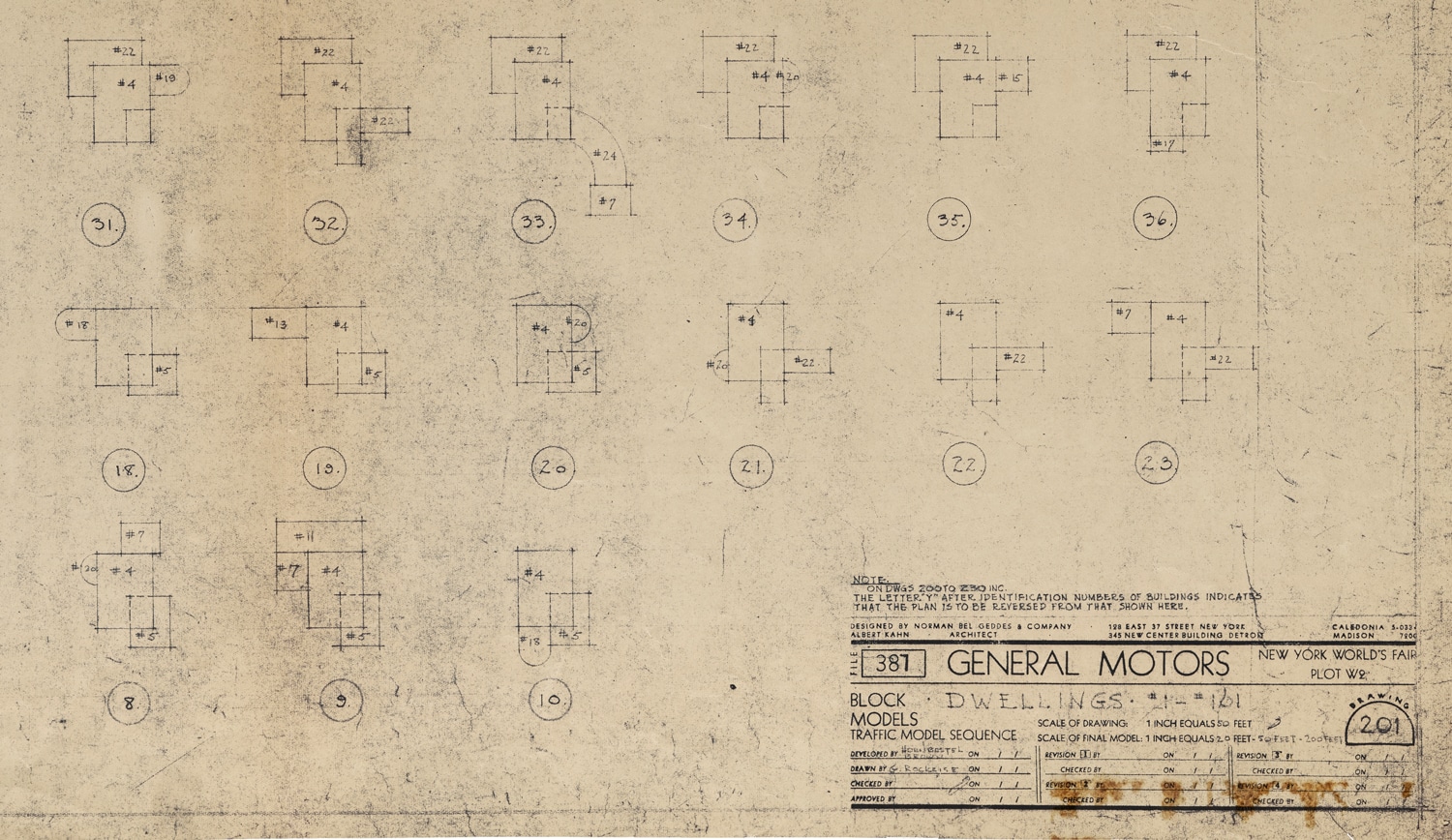
Few if any such idealizations, however, were visible in Futurama. Instead, the exhibit directed attention to fragments of superhighways cutting dramatically across landscapes, with complex interchanges stepping down speeds like an engine’s gears as motorists approached a regional city. Mountains and skyscrapers punctuated the scene, with industrial works, farms, and pastoral townscapes in-between. Less pronounced but modeled in meticulous detail were the houses in which the streamlined cars would park. The Geddes firm designed several dozen variants of these houses, with relatively conventional rectilinear volumes and shallow pitched roofs. The variation lay in how each accommodated the automobile, with a single-story garage attached in different permutations. In some, the attachment was semicircular in plan, a feature that had been hinted at in an earlier Geddes design, the “House of Tomorrow” (1931), with a semicircular garage in which were parked two conventional automobiles. 17
It is circulation itself that secures the social contract as a dynamic bond: the real and imagined movement of people and things.
Rather than read these details as modifications of a standard type (the house) to accommodate new needs (the automobile), we ought to reverse perspective and take the automobile as the central element — housed with architectural flair in the 1931 design — with the rest of the house as accessory. This is in keeping with the commercial penetration of streamlined domestic goods — from table lamps to cocktail service — designed by Geddes and his contemporaries for middle-class households across the country. However, to recognize such commodities as being, like the cars in the Futurama garages, not mere accessories but things that circulate magically, is to reveal the governing logic of the Interstates: again, circulation as a product.
Streamlined products were also among the means of production not because they actually moved (even if they did), or because their design gave the impression that they are moving. What they helped to produce were relationships between one place and another, and between one user and one owner and another, at a distance. Industrial design in general works this way. It builds dynamic relationships between owners of the same object, not through older social categories like taste, but through newer ones like choice. Two individuals have chosen to buy the same type of car, a decision that establishes a social relation between them regardless of their avowed tastes.
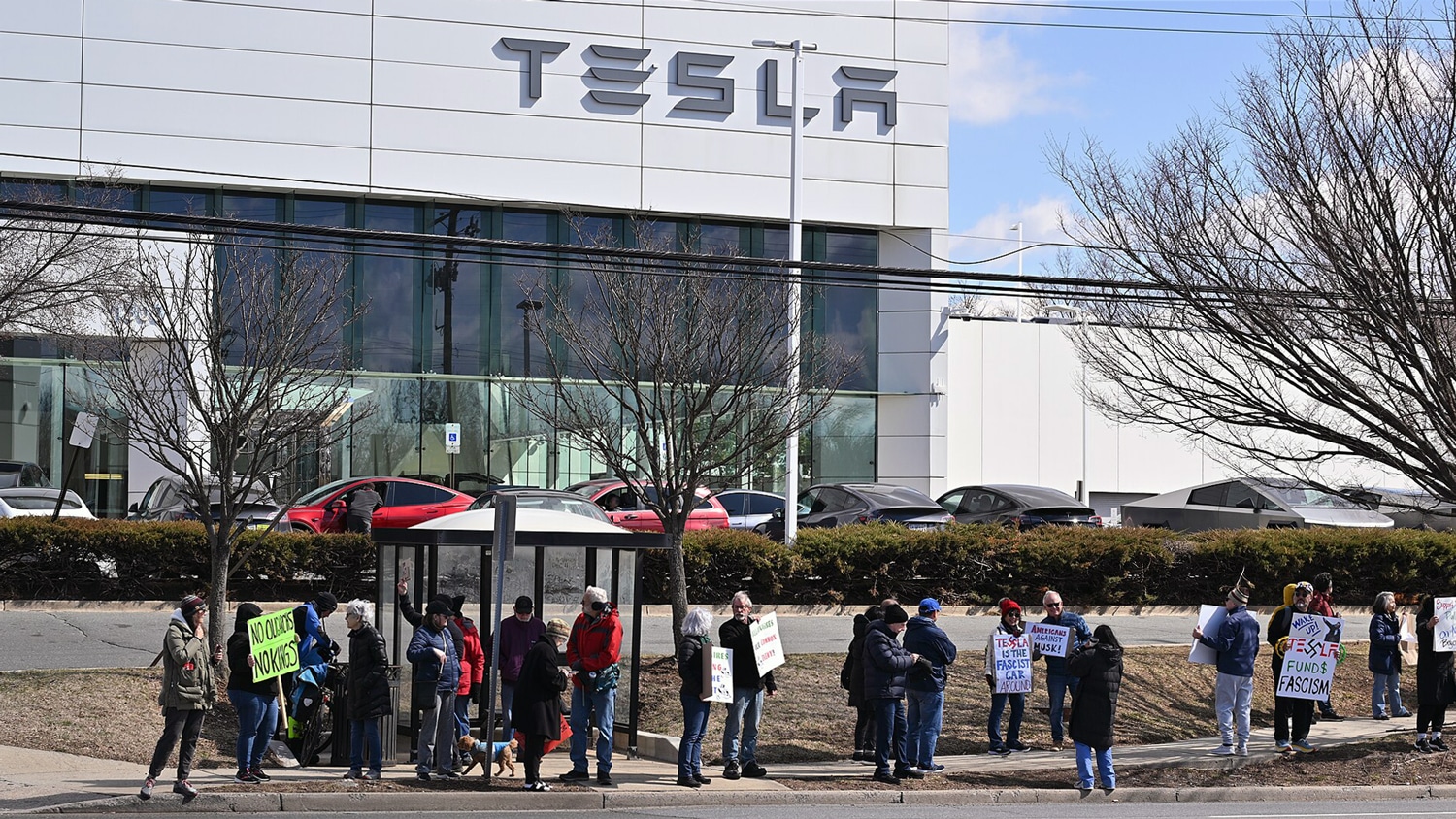
So too for the homeowners in Futurama, for whom Geddes provides enough variation — enough makes and models — to preserve social differentiation, while binding putative inhabitants together in a dynamic system of ownership centered on the car rather than on the home. Driving around or parked in the garage, the cars are produced by this system, even as the system is produced by the cars. The circulation of commodities and of freely choosing individuals was the point. This was true in 1939, and it remains true today. It explains the embarrassment now felt by many Tesla owners at being identified, via their choice of automobile, with Elon Musk.
Choice: After Liberalism?
All this also explains why nationalizing Tesla and making its vehicles universally available at low cost in order to advance decarbonization is unthinkable within the current order. With respect to a crucial commodity, the automobile, nationalization eliminates the metaphysics of choice that dynamically binds individuals together in liberal society. Like the lines denoting highways in Geddes’s idealized map, choice is a vector; it places the individual in a relation of dynamic equilibrium with others who have made that particular choice and not another. Such choices, themselves products of the commodity system, accumulate to produce a society of consumers. In such a society, far from being sovereign, the consumer is the output of a system of production, understood as a system of circulation.
For Geddes, this consumer is also a political subject able to enter into a new social contract that governs her or his relations with the state. The relevant institutions by which that contract is secured are not, however, city halls or courthouses; nor does Futurama’s body politic come into focus through civil society, in institutions like schools or houses of worship, which play only a minor role in the overall scene. It is the circulation itself that secures the social contract as a dynamic, metastable bond: the real and imagined movement of people and things, coupled with a pattern of choices among modes of circulation — then mainly cars; today personal electronics and personal communication devices — from which consumers are built by the accumulation of such choices.
This is what it means to be a Tesla owner today. And, at this level, choices made in the voting booth have become no different. Musk’s electoral theatrics confirm that, despite the dissonance among first-order symbolic associations, and despite expressions of dismay by some, the “Tesla owner” and “Trump voter” are not incompatible.
This nation of consumers is at odds with that portrayed by Tocqueville a century earlier in his treatise Democracy in America (1835-1840). Paying due homage to the growing presence of turnpikes, steamboats, and other means of speedily traversing state lines in the still young republic, Tocqueville ultimately directed his search for the soul of the American polis inward, toward the village green. There he found a kind of primordial political stasis. Democracy was founded, he argued, not on the pluralism of the cities, but on the argumentative yet ultimately fraternal bonds of the New England township. Equality of social status was democracy’s guiding principle, face-to-face debate its lifeblood. Individual expression was frowned upon, and the “tyranny of the majority” was an abiding threat. 18
The status of motorists as free individuals relied on evidence presented on the highways that they — and they alone — chose the vehicles that conveyed them.
Geddes, in contrast, devoted his career in every detail to bypassing Tocquevillian small towns with highways populated by consumers speeding from the point of production (the factory, farm, or workplace) to the point of consumption (the home) and back. The status of these motorists as free individuals relied on the evidence presented on the highways that they — and they alone — had chosen the vehicles that conveyed them. That, after all, was the purpose of the General Motors pavilion: to persuade consumers to buy GM’s cars and other products. This purpose was confirmed with Futurama’s climactic “intersection of 1960” through which visitors could stroll, with real-life showrooms for General Motors products (automobiles, appliances, accessories) on three of its four corners. No matter that the cars streaming along the “magic motorways” in the Futurama model were relatively homogeneous in design. Visitors could still feel that choices made from the variety of makes and models offered by GM reflected their individuality. Less obvious was that their individuality also reflected their choices.

Is Tesla a choice? From the perspective of Futurama, yes. Shortly before designing for General Motors, Geddes had designed another imaginary automotive landscape, a “City of Tomorrow” for the Shell Oil Company. Also presented in a massive model, the advertising campaign for Shell had only to be transferred from upstream (the fuel) to downstream (the machine) and repurposed for the automobile manufacturer. The elements of an Interstate system were already there: nodal cities, express highways, complex overpasses, and even a feature that anticipated self-driving cars. The product to be sold was a type of gasoline, Super-Shell, designed for stop-and-go driving “while traffic authorities are planning the ‘City of Tomorrow.’” Even in cities, where congestion was a deterrent, the choice presented to individuals who sought to be regarded as such was not whether to drive, but which gas to purchase.
None of this, however, guarantees oil’s obsolescence. Electricity stored in lithium-ion batteries can still derive from fossil fuels.
Today, that choice has been rescaled to one between gasoline-powered and electric vehicles. In the United States, Tesla, with its limited but highly optimized product line, has come to represent a new dynamic equilibrium, in which the obsolescence — rather than the abolition — of Shell Oil and its descendants is (potentially) implied but not required. In its most optimistic form, this theory of decarbonization seeks to increase the demand for electric vehicles through consumer persuasion; the same holds true for the house, with sleek Tesla solar panels and Powerwalls added to Futurama’s house types so as to take both houses and vehicles “off the grid”; the same, too, for a system of Superchargers along the highways and rows of Megapacks in between.
None of this, however, guarantees oil’s obsolescence. The electricity stored in lithium-ion batteries can still derive from fossil fuels. In the current dispensation, in fact, it could well mean the opposite, as regulatory restrictions on oil production are lifted under the informal aegis of Musk, the nation’s shadow deregulator-in-chief. To the extent, then, that the 2024 national election was a referendum, it was a contradictory one: an illiberal vote driven by a mass movement against the liberal individualism celebrated by Futurama, and an endorsement of the freedoms to choose (in all matters of life, it seems, except women’s bodily autonomy and anything else outside the new political order) represented by Tesla and shouted from the social-media mountaintop by Musk.
The truth told by nationalizing Tesla would be that profit, including the vast inequalities it requires, is not necessary. It is a political choice.
In its unthinkability, the hypothetical alternative — nationalize Tesla — at least has the virtue of telling the truth. That truth is that Tesla is not a choice; it is a necessity. But what kind of necessity is it? For those now in power, it represents the necessity to profit above all else, plain and simple. This is the Tesla System, dedicated not to the production of cars or even of individual lifestyles, but rather, of a community of consumers, speeding to-and-fro — great, “again” — in the real-life Futurama that is the Interstate Highway System: a self-driving panorama of circulation, lifeblood of the nation. If a few solar arrays and wind farms take the place of power plants along the way, so be it. In the long run, these offer opportunities to profit as well. For the rest, unwilling to accept the terms of this arrangement, electric mobility is a necessary but not sufficient precondition for the abolition of oil and other fossil fuels, and their replacement with renewable energy sources.
The other truth told by nationalizing Tesla is that profit, including the vast inequalities it requires, and the consequently vast numbers of south-to-north climate migrants now poised to be herded into camps or deported, is not necessary. It is a political choice. If electric vehicles are, at this point, an element in any technologically plausible decarbonization strategy, the question is whether their production, advertising, and purchase en masse will “again” build a national organism of mobile consumers, or extend the rights of mobility on which the liberal order was built to all of its subjects — and, in the process, render the planet that much more survivable for the majority of its inhabitants.
The purpose of the camps, should they rise, will be to differentiate personalized consumers — understood as organic, freely choosing subjects of the Tesla System — from depersonalized non-consumers. Even so, many of those who have voted to accept this path know well that, like the streamlined reading lamps and cocktail service designed by Norman Bel Geddes, Tesla in its current form is an expensive bauble, an accessory. Perhaps they feel they have been given no choice.




If you would like to comment on this article, or anything else on Places Journal, visit our Facebook page or send us a message on Twitter.