
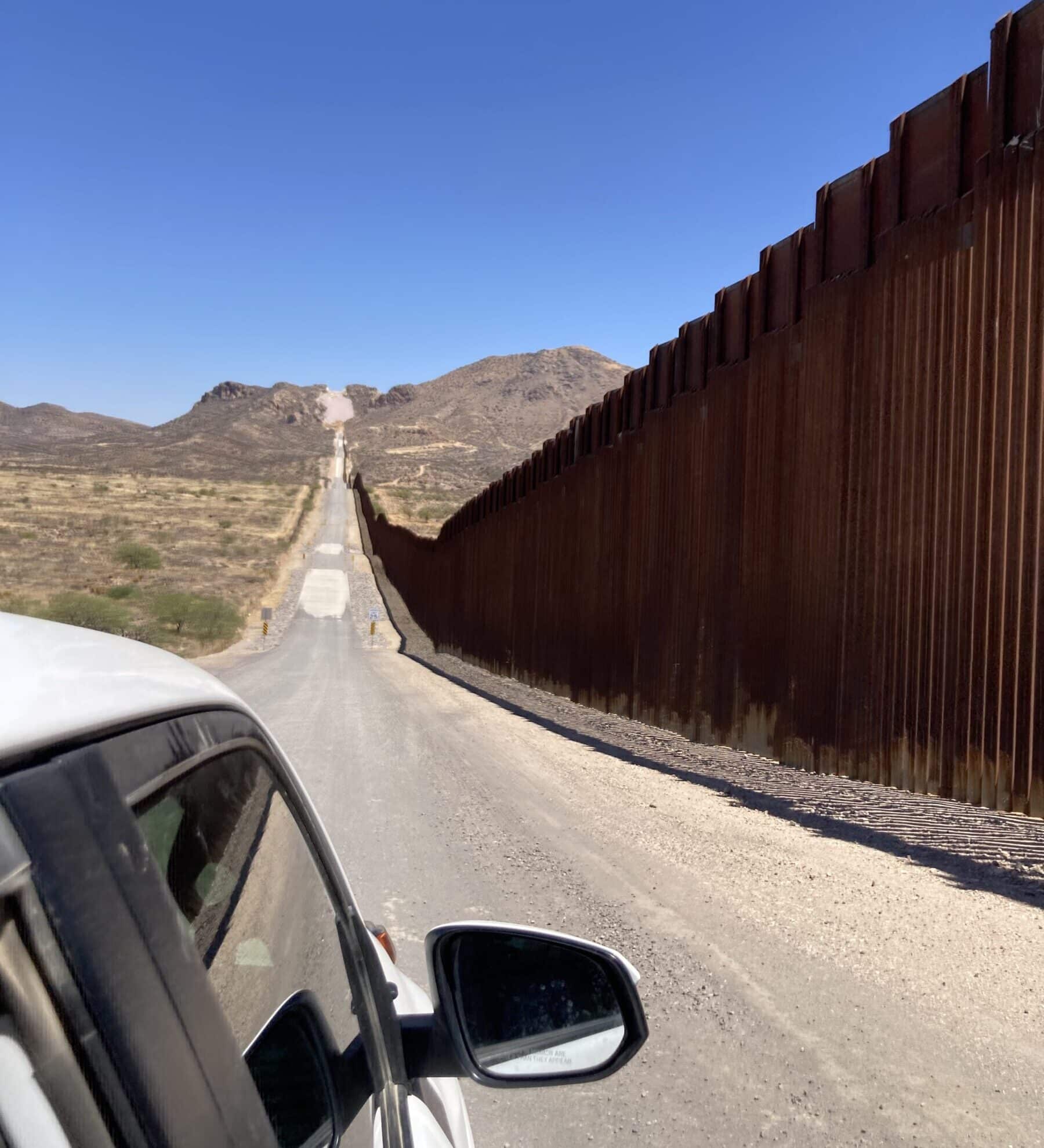
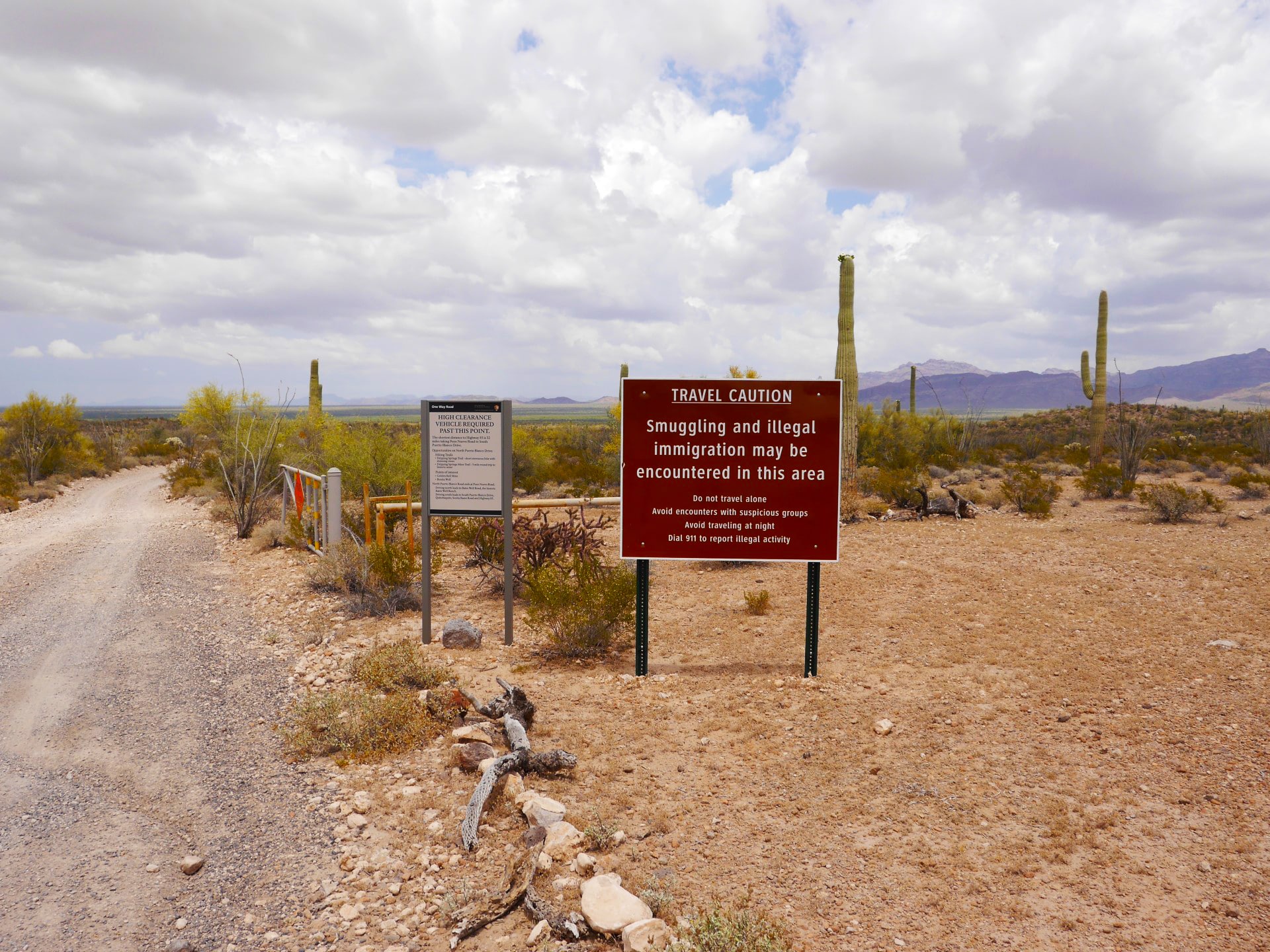
On a hot morning in May 2025, I biked to Tucson’s Barrio Viejo to meet Gail Kocourek, a volunteer with the organization Tucson Samaritans. The Samaritans make daily trips into the desert to look for migrants in distress and human remains, and to provide anyone they encounter with food and water. Kocourek, who is 72, and I packed supplies — water, food, shovels, a satellite phone — into a Toyota 4Runner SR5 that belonged to the nonprofit and was decorated with large door magnets, each with a green first-aid cross.
It was nearly one hundred degrees. It didn’t seem possible anyone could be hidden nearby.
We headed south, toward the tiny border town of Sasabe. From Sasabe, we turned east onto the gravel road that runs along the border wall. As it traverses the desert, the road goes up and down hills — some of which have more than a 20 percent grade. The bollards of the 30-foot-high steel wall flicked by the car window so that the desert on the Sonora side flashed between the four-inch gaps like a flip-book. Eventually, seven-and-a-half miles east of Sasabe, the geology becomes more complicated, and a mountain rises in the path of the border wall. When the road turns to the north to go around the mountain, the wall abruptly ends. 1 A blast scar on the mountain indicates there was once an intention to dynamite the rock and continue the wall, but those plans were evidently abandoned, leaving an open segment where a human can easily cross into the United States.
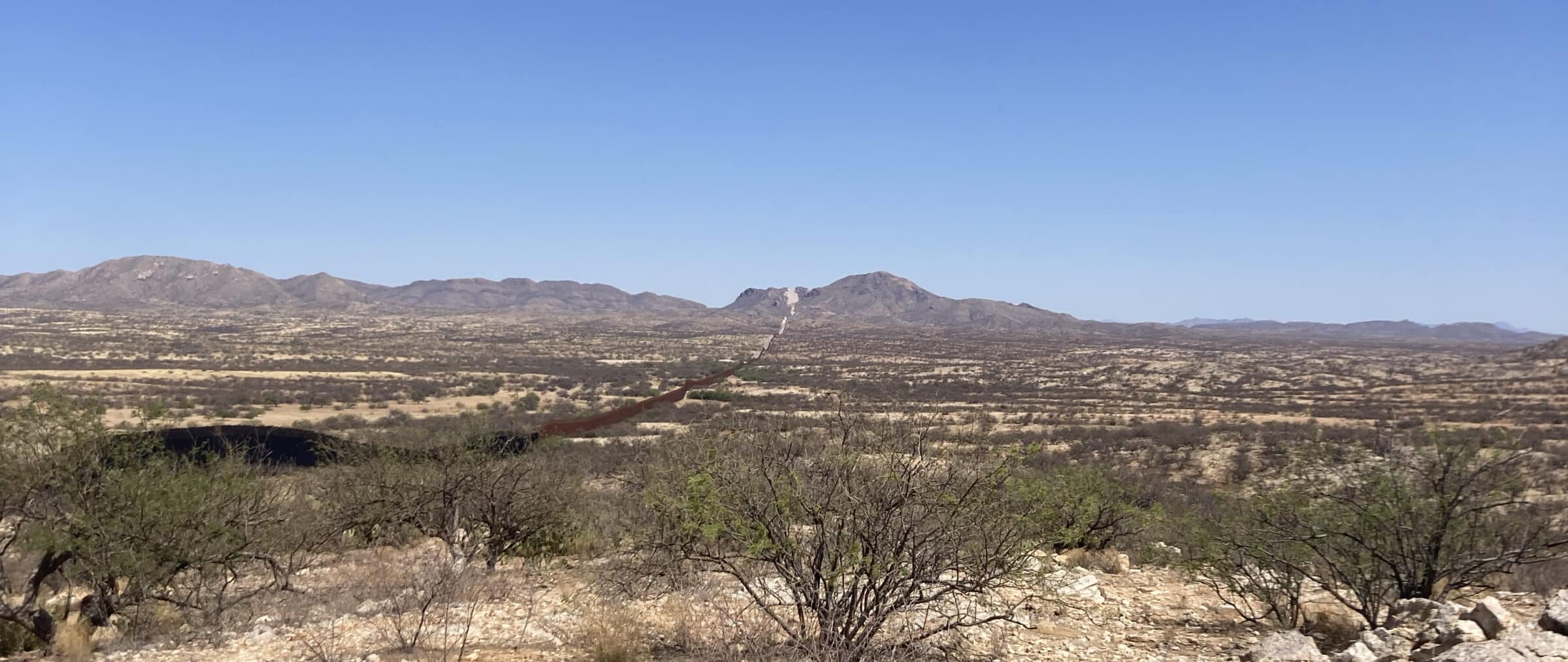
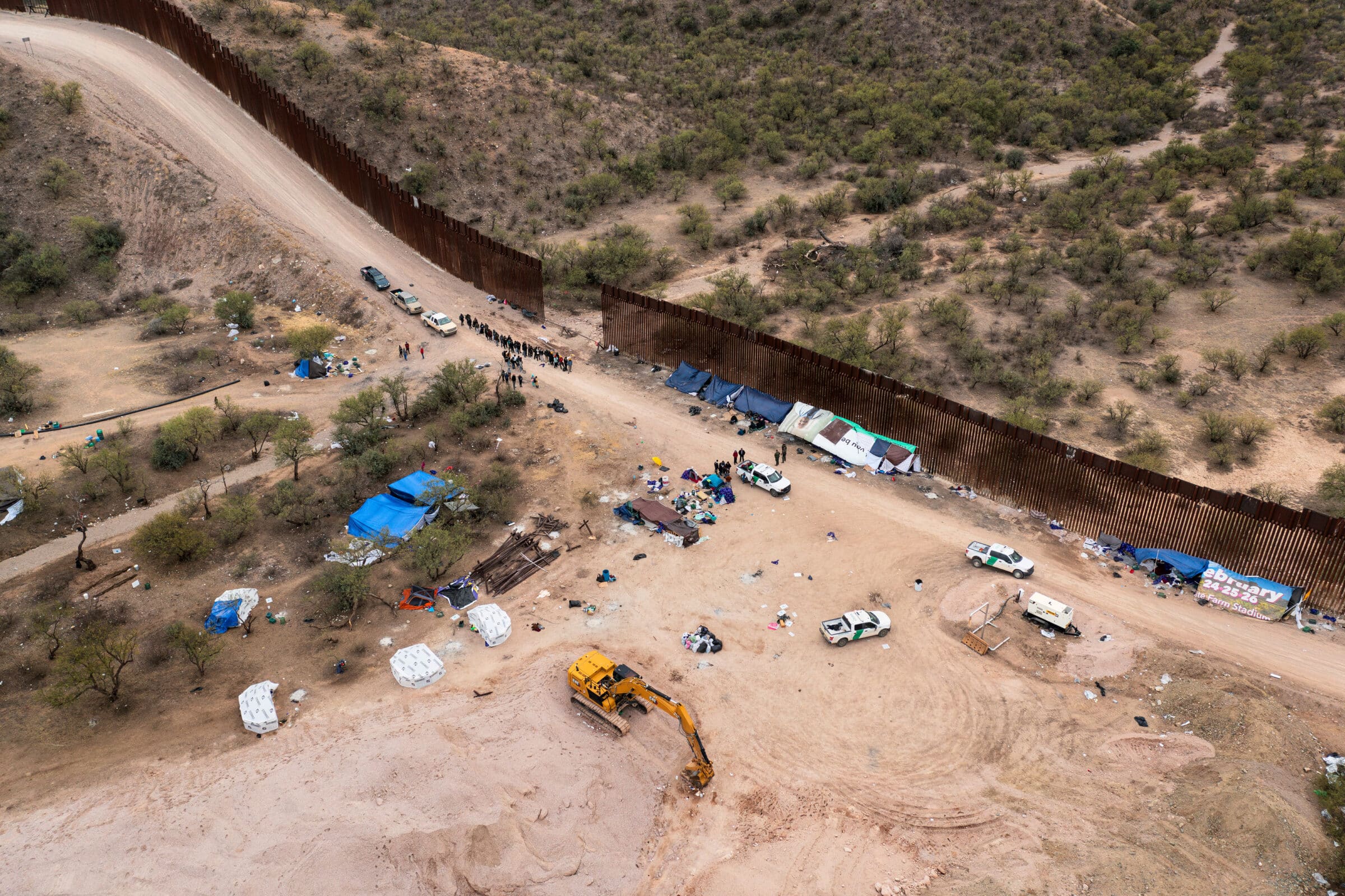
From spring 2023 to early 2025, over 10,000 individuals arrived to this point, by foot or by truck, and crossed the U.S.-Mexico border through this specific breach. 2 The Samaritans, in partnership with the humanitarian groups Humane Borders and No More Deaths, operated a camp near this spot where people who had recently crossed could wait to request asylum from Border Patrol agents. For a period of time, Sasabe — a desolate outpost with a population of 51 — figured prominently in international news coverage.
In early 2025, however, Border Patrol obligated the humanitarian organizations to close their camp. 3 Since the U.S. wouldn’t be processing asylum claims under Trump, the agents wouldn’t let the humanitarians run a camp for those awaiting claims. But that hardly meant there was no migration. As they have done for decades, people continue to cross clandestinely, living undocumented instead of going through the asylum system.
Kocourek turned the SUV around and rolled down the window, trying to see if anyone was there, on either side of the wall. It was nearly 100 degrees, and the light was harsh. It didn’t seem possible that anyone could be hidden nearby.
From spring 2023 to early 2025, more than 10,000 people crossed the border through this breach.
“I saw two people,” she said suddenly. Kocourek began to drive the car slowly back along the hilly road, looking through the gaps in the wall’s bollards. “Somos amigos! Somos Samaritanos!” she yelled out the window. After a few moments, two waving hands appeared. She stopped the car. From the other side of the wall, two young men dressed in camouflage explained that they had been camping out, waiting to cross through the unwalled area, hoping to make it to Tucson, Arizona. But there had always been Border Patrol stationed too close to make a run for it, and they had run out of food. Kocourek checked to make sure that no patrol agents were watching, explaining that they scolded volunteers for passing supplies through the wall, and pulled two gallons of water from the car. She poured a paper cup’s worth from each, and passed the cups through.
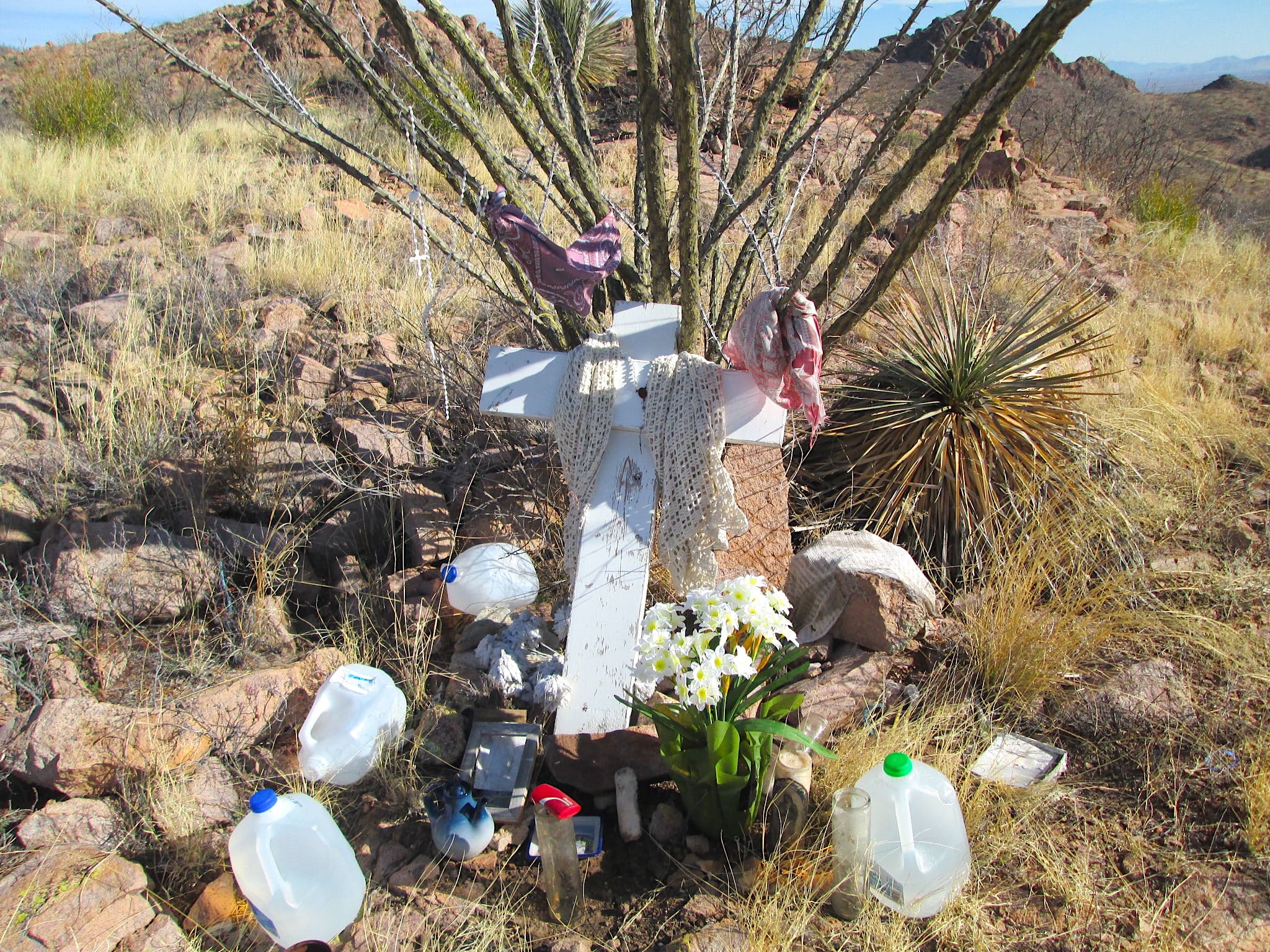
“Just wait,” she said, holding up her hand to communicate that she understood that they wanted more. She put the caps back onto the jugs, and then squeezed the soft plastic. With slightly less water, the containers could be stuffed through the steel posts. “Otherwise, they don’t fit,” she explained.
The Samaritans’ mission is expressly humanitarian and apolitical, but as U.S. border enforcement has ramped up in recent years, the group’s work has attracted the ire of enforcement authorities, who seem to feel that their turf is being invaded. In March 2025, while Kocourek was driving the Samaritans’ clearly marked 4Runner, two plainclothes officers from Homeland Security Investigations — ICE’s special agents — blocked her path with an SUV and pointed rifles at the vehicle. 4
The push-and-pull of federal escalation and citizen resistance has a long history.
Though border enforcement has become draconian in novel ways during the second term of Donald Trump, the push-and-pull of federal escalation and citizen resistance in the borderlands has a long history. To prevent people from dying, volunteers and activists in Tucson have been defying the government for over 40 years. Their work is anchored and justified by the concept of civil initiative, the conviction that the government is breaking international and federal laws when it detains and deports individuals fleeing violence in their home countries.
The robust humanitarian network that exists today, along the border and with nodes throughout the U.S., was seeded four decades ago, in the 1970s and ’80s. It’s a story of unlikely confluence. Three disparate forces — a civil rights movement, a mission church, and a cowboy-philosopher — came together with an unstoppable resolve to act.
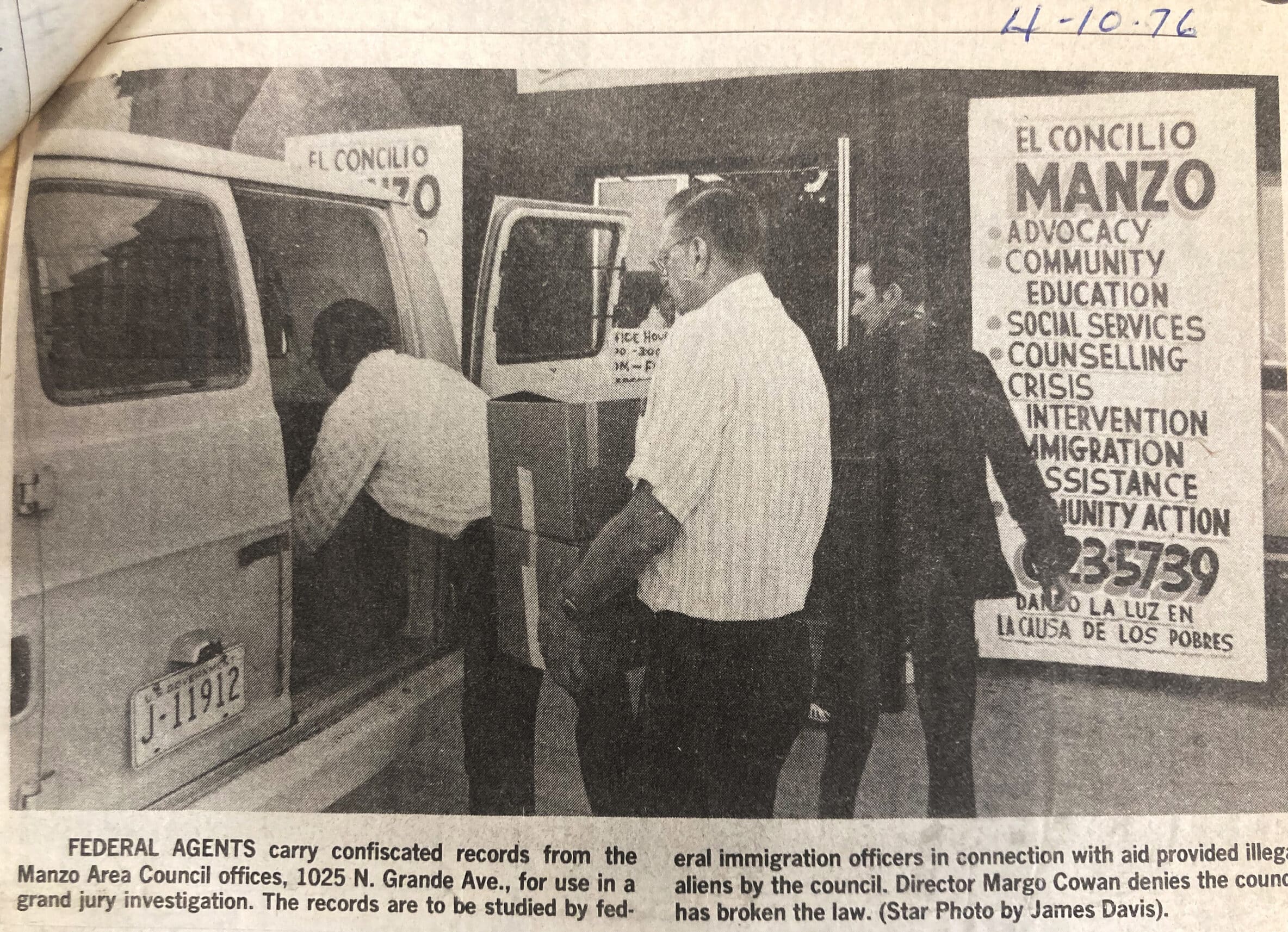
The 1960s activism of Tucson’s Chicano Movement centered on an informal community center called Chicano House, which had been created by community members working to fight school segregation and police brutality. When the federal government began to channel funds into underserved areas as part of its War on Poverty, Chicano House members and affiliates created the Manzo Area Council to receive and distribute the funds. At its helm was Margo Cowan, an activist in her late 20s who had cut her political teeth in César Chávez’s farmworker movement. The hand-lettered sign on Manzo’s modest storefront — a former grocery store — promised “advocacy, community education, counseling, crisis intervention, community action,” followed by Manzo’s motto: dando la luz en la causa de los pobres (giving the light in the cause of the poor).
Initially, the organization ran youth programs and services for the elderly. But in the late 1970s, it was obvious that its mission needed to broaden. After a series of Border Patrol raids in the neighborhood — at churches, schools, laundromats, pickup soccer games — Manzo began offering know-your-rights trainings and helping residents navigate the immigration system. There was a clear need; many of the people affected by the raids were either U.S. citizens who didn’t have the documents to prove their status, or relatives of citizens who qualified for legal residency. The federal government agreed, and gave Manzo a grant specifically for these services.
But soon, the attitude of federal authorities shifted. In early 1976, the Department of Justice claimed that Manzo was using their federal funds for purposes other than immigration support — that the organization was helping immigrants apply for welfare and food stamps. On April 9, 1976, ten Border Patrol agents, a federal prosecutor, and a local police officer raided Manzo’s office. They confiscated 800 client files, loading them into a Ford Econoline van. “They just stormed into the office and took all the files,” recalled Manzo employee Lupe Castillo. 5 Deportations began that very night. During the coming months, between 150 and 200 Manzo clients were removed to Mexico. Meanwhile, Cowan and three other staff members were charged with felonies.
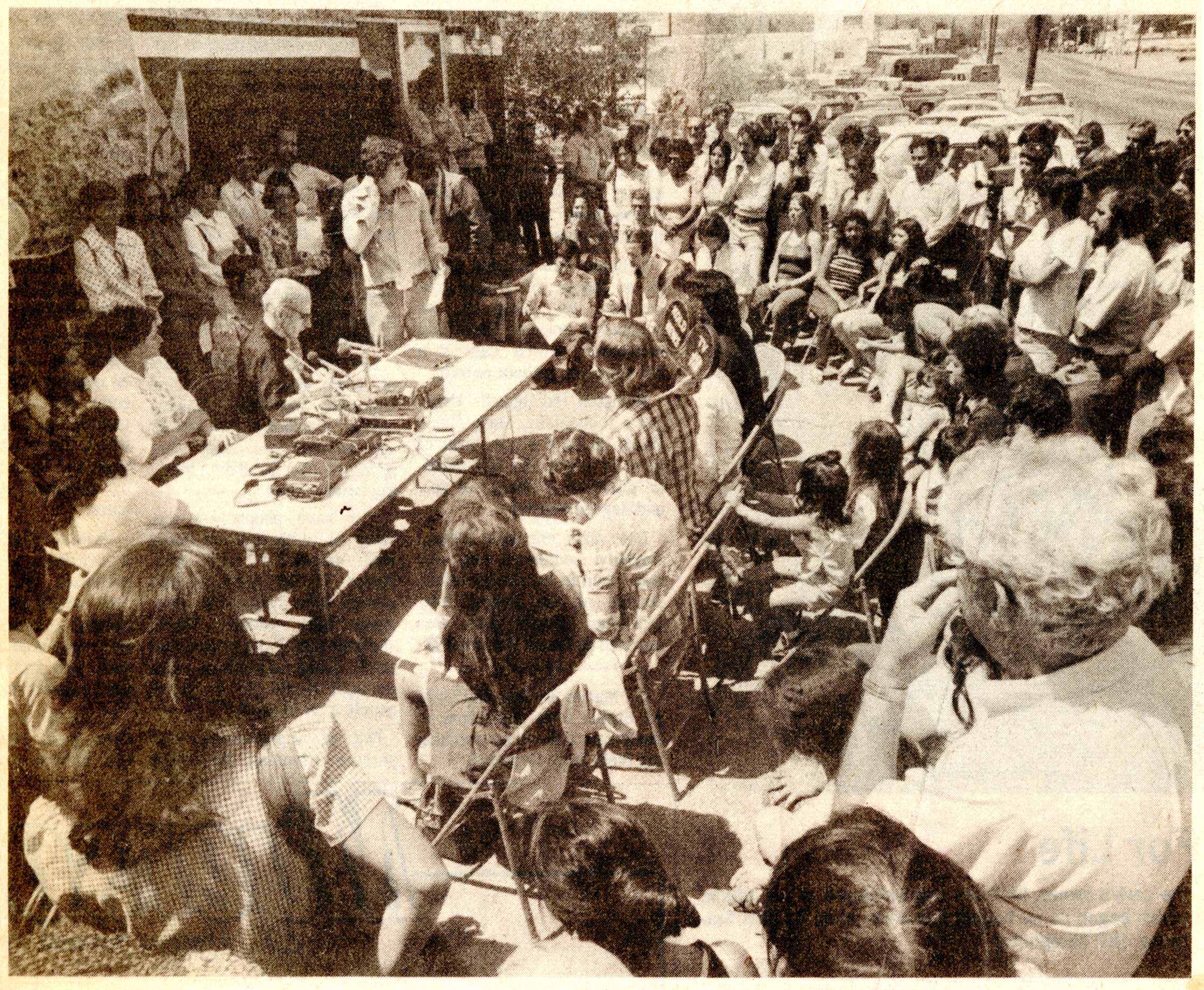
A few days after the raid, Manzo held a press conference at a folding table in their parking lot, with a mural of the Virgen de Guadalupe as backdrop. About 100 people gathered. One of those in the audience was a lanky, 36-year-old pastor named John Fife. Fife had moved to Tucson seven years earlier, freshly graduated from the Pittsburg Theological Seminary. His church, Southside Presbyterian, was located a few miles away in another Mexican and Mexican American neighborhood.
Fife was attracted to the job at Southside because of the church’s reputation for activism. Its previous pastor, Casper Glenn, was a Black man originally from South Carolina. Glenn had been hired in 1956, eight years before the Presbyterian Church’s General Assembly officially prohibited segregation in worship, making Southside one of the denomination’s most anomalous and most progressive congregations.
Glenn was head of the local NAACP. After Sunday services, the congregation would picket segregated restaurants.
Glenn was also head of the local NAACP, and led the church in civil rights activism, spurring the congregation to write letters and march. After Sunday services, members would picket segregated restaurants. When Martin Luther King, Jr. came to speak at the University of Arizona, he was introduced to Glenn, who proudly showed King photos of the congregation: Tohono O’odham, Pima, Mexican, Mexican American, Black, White. When King said he’d never been to a reservation, they traveled together to the Tohono O’odham nation.
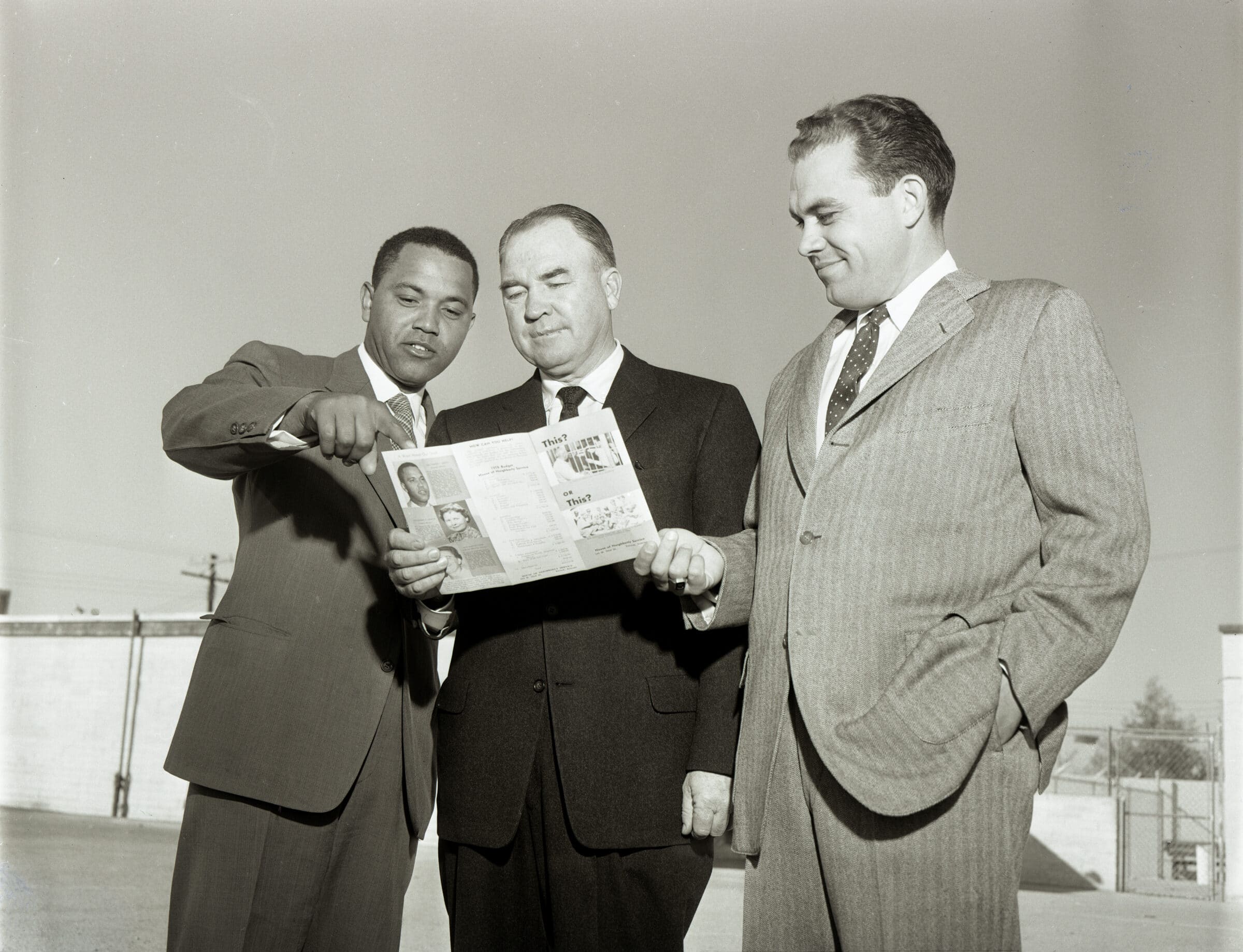
Fife was eager to continue Glenn’s legacy. He immediately met and joined forces with a group of young activists, including the leaders of Manzo, who were “hell-bent on changing South and West Tucson.” 6 His first major fight was to protest the construction of a private golf course in the middle of the city’s majority-Mexican and Mexican American West side. 7 Later, he accompanied Native American activists to the U.S. Attorney General’s office in Tucson as part of their Wounded Knee protests, and ended up spending a night in jail. His congregation deepened its reputation as multicultural and progressive. In 1979, Tucson Citizen reporter Tony Davis wrote of Southside: “Blonde-haired girls in blue jeans and tennis shoes [sit] next to Mexican-Americans with goatees, guayabera shirts and slickly polished shoes, and … blacks, dressed in suits and ties, [are] seated next to whites in plaid sport shirts.” 8
Southside’s social justice orientation was unusual, and doubly so given its history.
Southside Presbyterian’s social justice orientation was unusual, and doubly so given its history. The church began as a mission, an outpost of the national Presbyterian church; its intention was to convert what it defined as “exceptional populations.” 9 In 1867, President Ulysses S. Grant’s Peace Policy attempted to quell the violence of the Indian Wars by trying a new approach to colonizing the frontier: putting churches in charge of tribes. To the Quakers — who had given him the idea — Grant assigned Kansas, Nebraska, and the Indian Territory (the area we now know as Oklahoma). The following year, he invited other denominations to join, assigning them other tribes and territories.
The churches in turn appointed Indian Agents, whose responsibility was to “convert and teach Indians, thereby halting frontier war and eradicating difference in culture.” 10 Most Indian Agents were married, middle-aged men, and not clergy members. 11 The goal, according to the church, was that these “upright and benevolent men” would usher in “new hope” for “our poor, depraved, degraded, perishing neighbors,” and that they would do so without resorting to the violence of the Army officers they were replacing. 12 (Needless to say, things did not always go to plan. 13)
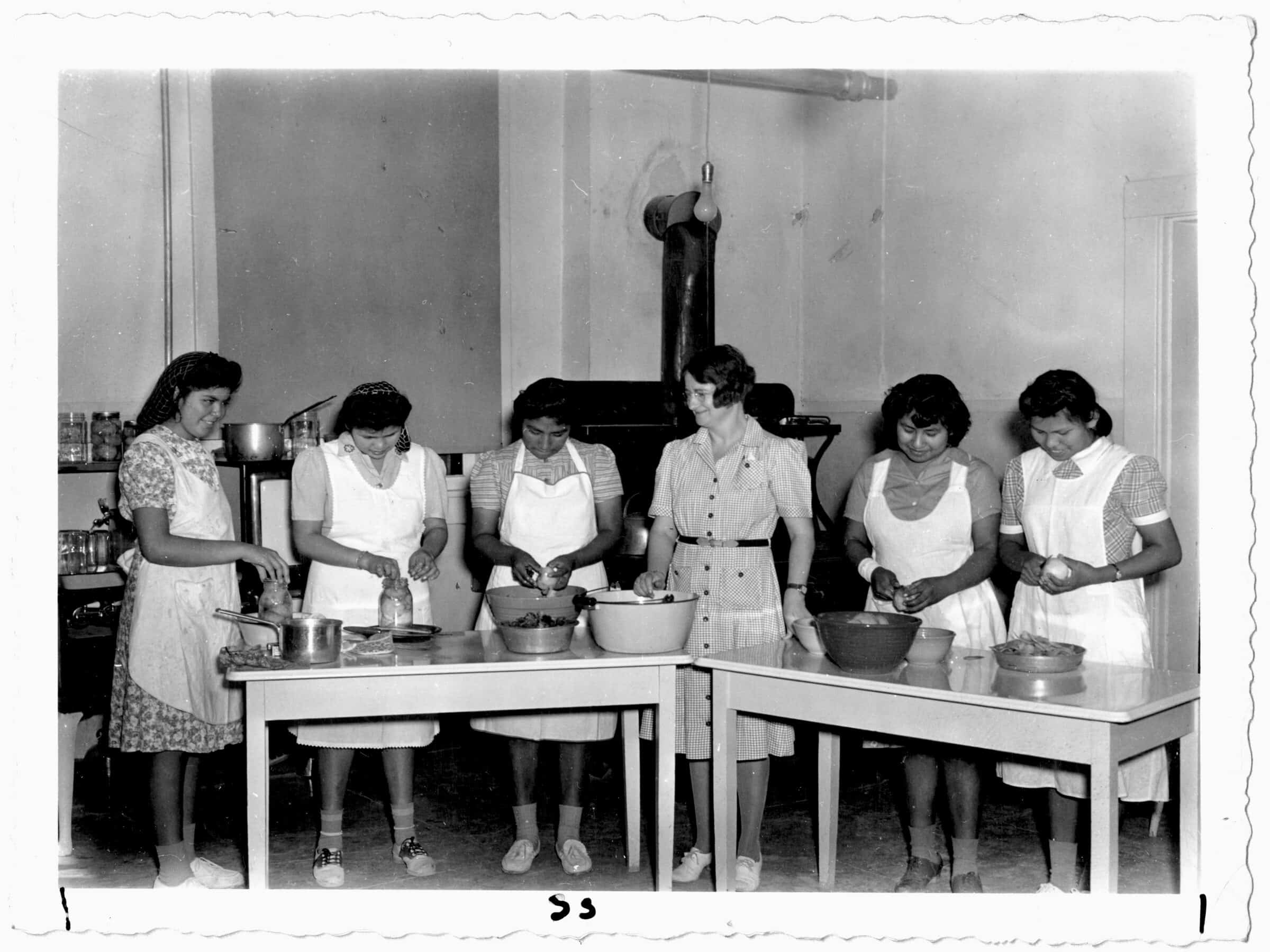
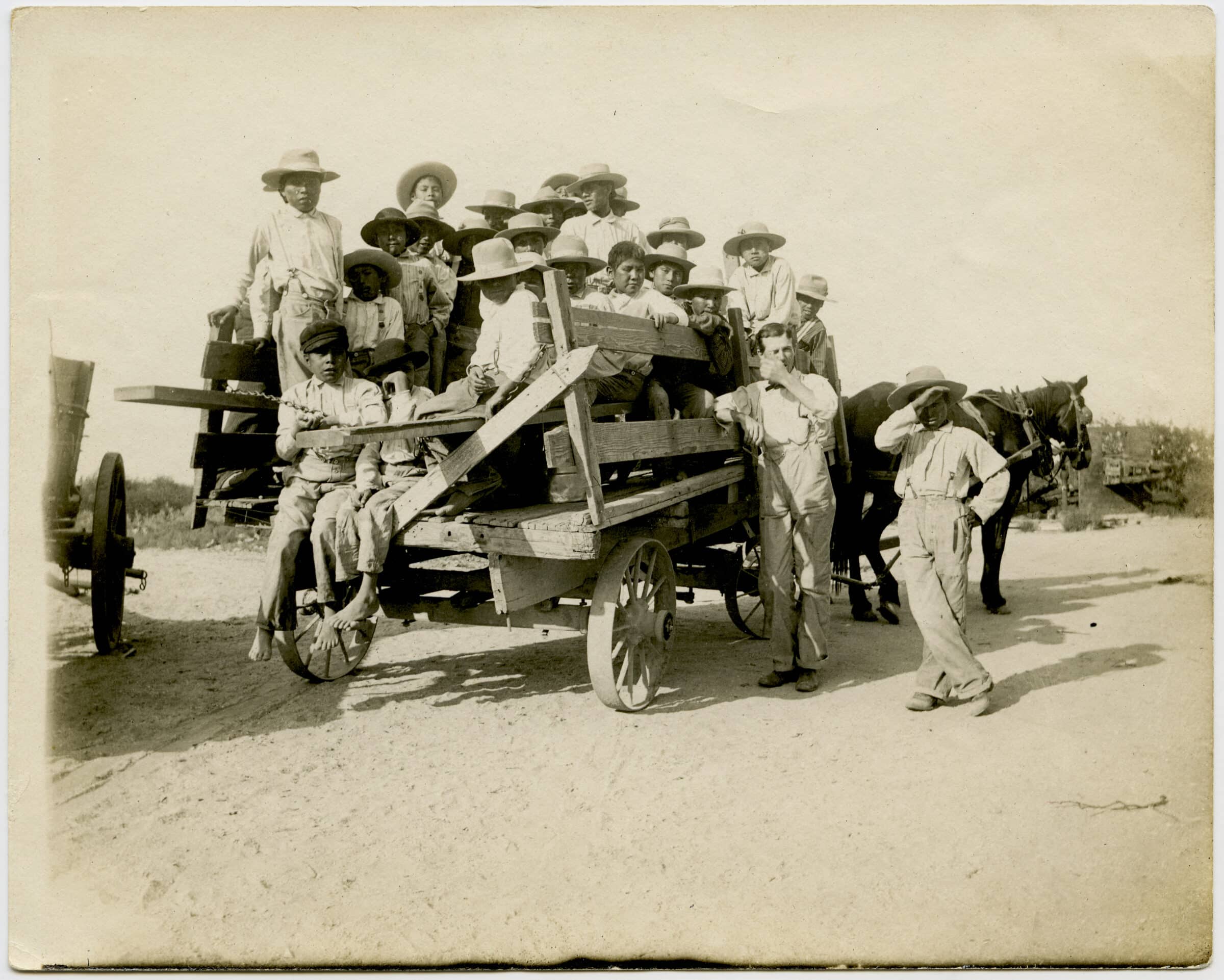
At Tucson Indian Training School, girls were taught to cook, sew, and launder clothing; boys learned carpentry and farming.
In the 1880s, the government transferred Arizona’s Pima mission to the Presbyterian Church, requesting that they open a boarding school. By that time, there were more than a hundred religious boarding schools around the country, often funded by government contracts. The Tucson Indian Training School opened in 1888. The curriculum was traditional and Christian. Girls were taught to cook, sew, and launder clothing; boys learned carpentry and farming. At one point, the school submitted the winning bid for Tucson’s street maintenance, and students completed the work — sweeping, trash collection — as part of their coursework. All teaching was in English, and students were punished for speaking their native tongues.
In 1895, a new school superintendent named Frazier Herndon arrived in Tucson. He soon married one of the school’s teachers, Elise Pugh. The student body was majority Pima, but the Herndons took an interest in the small number of students from a different tribe, the Tohono O’odham — pronounced THAW-naw AW-thum — then referred to as “Pagago.” President Grant’s Peace Policy had combined oversight of the Tohono O’odham with that of the Pima, placing control of both tribes under an agency that was located over a hundred miles away from where most Tohono O’odham lived. In effect, the tribe had eluded the oversight of government authorities. The Herndons saw this as a missionary opportunity.
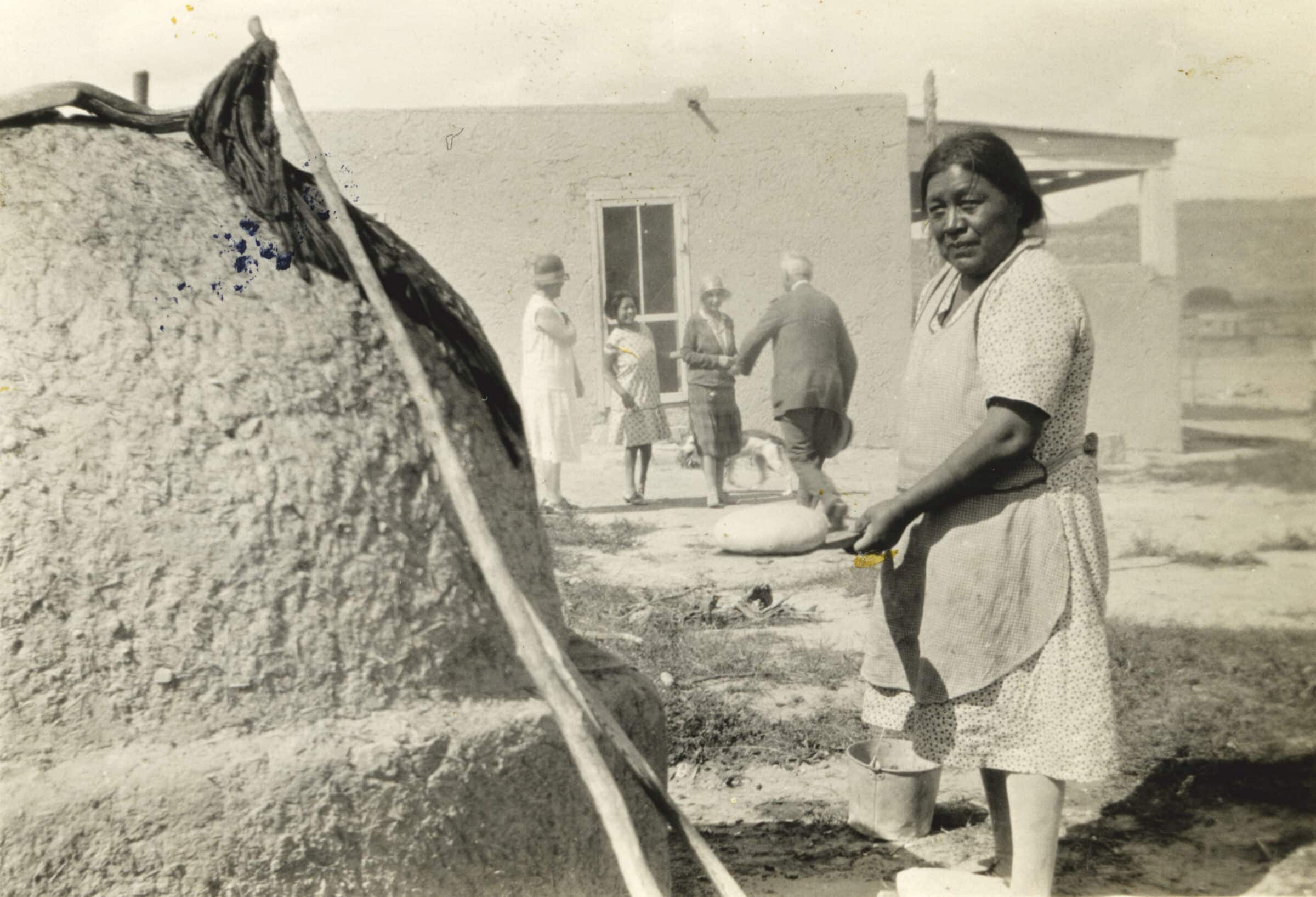
At the time, many Tohono O’odham were squatting around the railroad yards at the southern end of Tucson, having been displaced from their traditional lands along the banks of the Santa Cruz River by Hispanic and Anglo settlement. Herndon decided to begin a ministry in this so-called “Indian Village.” He and Elise left their positions at the Tucson Indian Training School, and held their first service as a tent meeting in September 1903. Ten community members attended. In 1906, with the backing of the national Presbyterian Church, Rev. Herndon opened the Papago Presbyterian Church, which would eventually become Southside.
Although their official mandate focused on ministering to and “civilizing” the region’s Native inhabitants, the Herndons took an interest in Tohono O’odham culture. They collected stories and handicrafts, and learned about tribal history and belief systems. Their approach retained a strong paternalism, but it also reflected a larger shift in the Presbyterian church, as missionaries pushed the institution away from reform and assimilation and towards what came to be known as the “social gospel” — using religious belief to combat poverty. All around the Southwest, the church opened “Houses of Neighborly Service,” which provided community resources like baby formula, “well-being clinics,” and childhood and adult education to needy locals. 14
The approach reflected a shift in the Presbyterian church, away from reform and towards what became known as the ‘social gospel.’
In 1945, when the Presbyterian Board of Home Missions needed to call a new reverend for Papago Presbyterian Church, they tapped Peter V. Samano, a Mexican American whose previous position had been at the House of Neighborly Service in the mining town of Bisbee, Arizona. When Rev. Samano traveled to Tucson and canvassed the church’s surrounding neighborhoods, he discovered that the area was no longer the “Indian Village” it had once been. The area was now home to many Mexican and Mexican Americans as well. Samano made a request to the church board that the church’s mission be widened — allowing him to minister not only to the Tohono O’odham, but to parishioners of other races too.
It was an unprecedented request. Bound up in the very idea of a “mission church,” and in the name “Papago Presbyterian,” was the intention to target a specific population. And although some mission churches were informally interracial (with people of different ethnic groups attending services), Papago would be the first church officially designated as such. The Board of Home Missions took a month to consider Samano’s proposal. Eventually, the board agreed, and the church was given a new name to mark the change. On January 26, 1947, Papago Presbyterian was re-dedicated as Southside Presbyterian.
Samano’s tenure was followed by Glenn’s and then by Fife’s. Together, these pastors formed a chain of religious leadership that successively responded to the realities of their community and transformed their own beliefs in the process, slowly pushing the Presbyterian Church to follow in their wake.
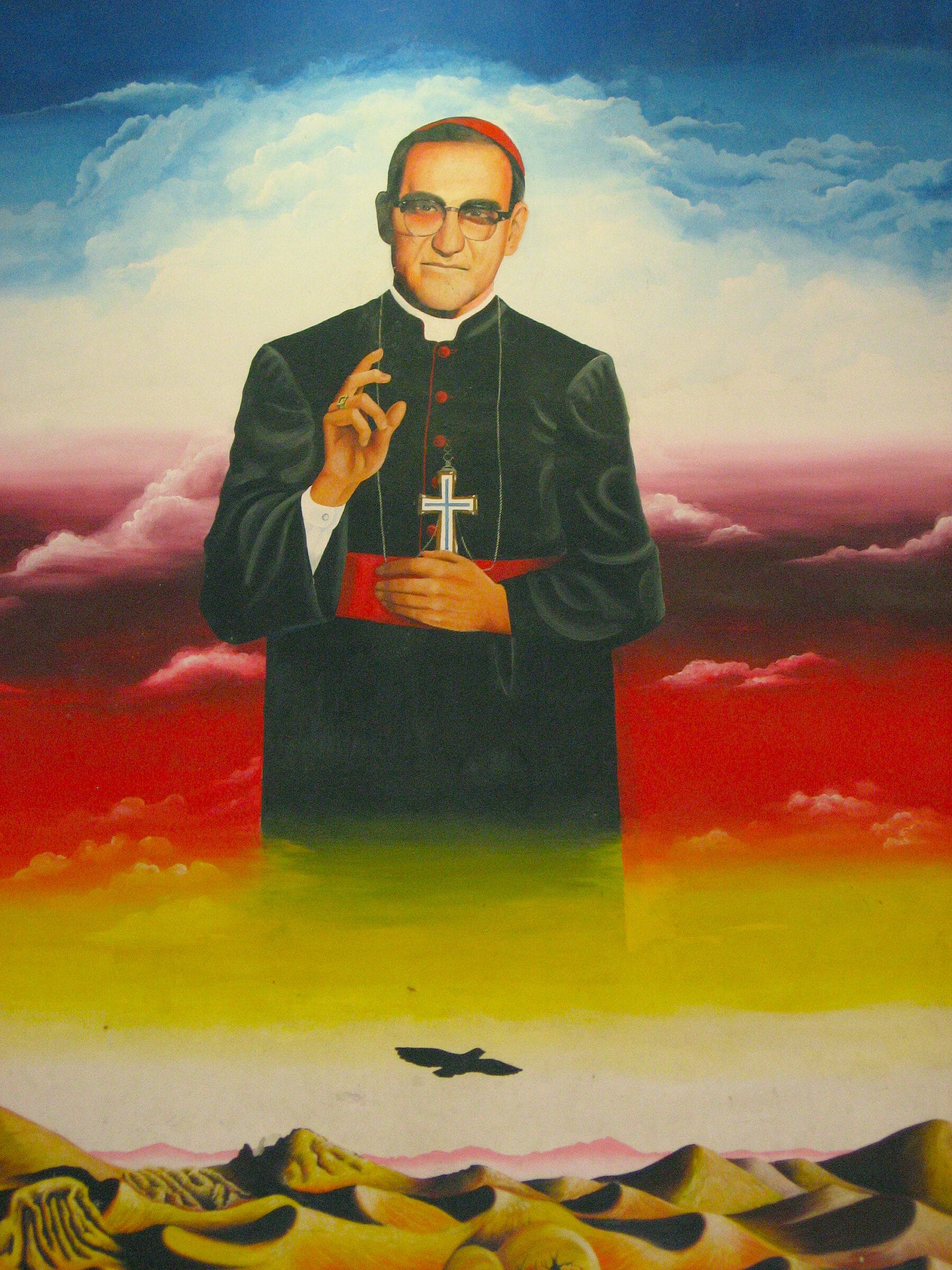
Fife’s plan for 1980 was that Southside would focus their community service efforts on constructing low-income housing for Native Americans in Tucson. The congregation had voted to make this their priority, and Fife was busy laying the groundwork. Then, something unexpected happened. Thirteen citizens of El Salvador, including three adolescent sisters, were found dead in the surrounding desert. The group had been traveling on foot through Organ Pipe National Monument in July, where summer temperatures regularly approach 110 degrees. Although they had started the trek with a guide, he had abandoned them. Five survivors were transported to a Tucson hospital, where they requested pastoral care. 15 The chaplain summoned was Fife.
Fife expected the visit to be short and simple: a prayer and some words of comfort. Instead, at their bedsides he listened to stories of a brutal civil war waged by a military government determined to suppress left-wing dissent. Since March 1977, multiple members of the Catholic clergy had been murdered, and starting in 1979, when the country’s president was overthrown by a military coup, numerous student leaders and labor activists had been disappeared and killed by right-wing paramilitary groups referred to as “death squads.” 16 On March 24, 1980, the country’s archbishop, Óscar Romero, had been murdered while giving mass in a hospital chapel days after calling upon the government to curtail its repressive violence. At Romero’s funeral, paramilitary squads opened fire, killing over 40 people and wounding many more.
The visit to the hospital moved Fife. He left thinking about what Southside might do in response. Along with Ricardo Elford, a local Catholic priest, Fife began holding weekly prayer vigils for the victims of violence in El Salvador. He also reached out to faith institutions across Tucson, brainstorming about how they could help the refugees.
While Fife was holding vigils, Jim Corbett was in Mulegé, Baja California. At night he was sleeping in a field of weeds under the stars and during the day he was irrigating the fields — “the old-fashioned dirt-ditch irrigating I did in Wyoming in my teens,” he wrote in his journal — alongside local farmers who raised cattle and grew dates. 17 Corbett was in Mulegé to help those farmers develop a goat-raising program.
Corbett was born in Wyoming in 1933. His parents were teachers; his father also had a law degree. He was precocious, earning a bachelor’s degree at Colgate University in three years and then a master’s in philosophy from Harvard in one year. Later he worked on ranches in Wyoming and Arizona. After developing a degenerative form of arthritis that made physical work impossible, Corbett became a librarian. Along the way, he also became a Quaker. He and his wife, Pat, lived on a dirt road at the north end of Tucson.
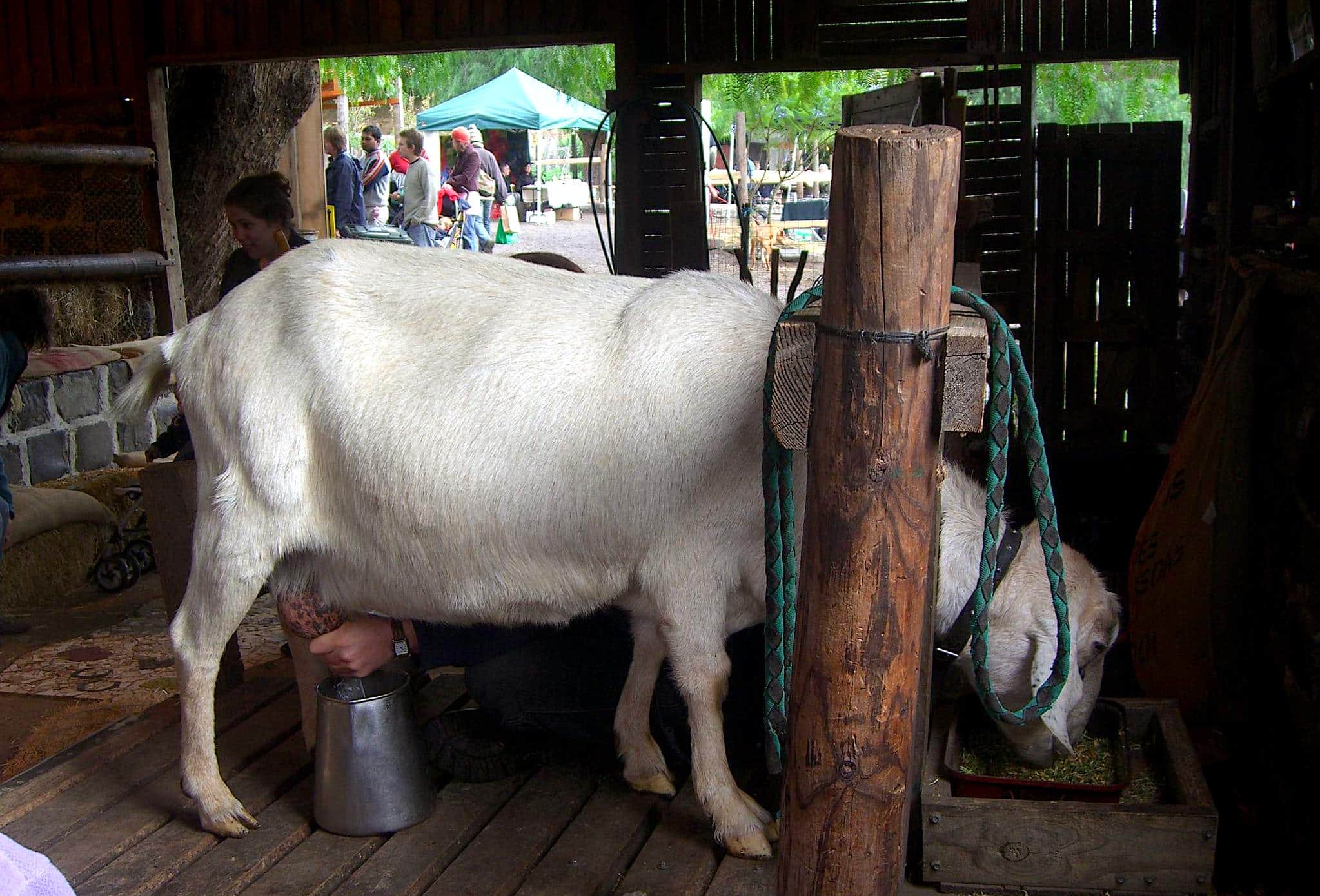
Jim Corbett — rancher, philosopher, librarian, Quaker — ran a goat milk collective.
Corbett kept a herd of goats, and had organized a cluster of neighbors into a milking cooperative that he called Los Cabreros Andantes — The Errant Goatherds, a reference to the “knight errantry” of Don Quixote. “My hands are so weakened and deformed by arthritis that I’m unable to hold most water glasses and often have trouble turning doorknobs,” he wrote, “yet I can still milk two-handed and fairly fast.” 18 Soon, much like Fife and Southside’s housing program, Corbett’s goat milk collective would be pushed to the back burner.
Back in Tucson in May of 1981, Corbett was waiting for a friend who had borrowed his van to visit a Quaker community in Sonora, Mexico. When the friend arrived, he was shaken. He recounted the story: he had picked up a hitchhiker shortly after crossing the border, assuming he was a Mexican ranch hand. It turned out that he wasn’t from Mexico, but El Salvador. And when they were stopped at a Border Patrol checkpoint, the traveler had been taken from the van and arrested.
The friend didn’t understand what had happened, and neither did Corbett. Like most other people in the U.S. at the time, he had only the faintest awareness of what was happening in El Salvador. “Before hearing about the Salvadoran hitchhiker who’d been taken from my friend by the Border Patrol, I couldn’t have named Oscar [sic] Romero,” he later wrote. 19
Corbett decided he wanted to find the hitchhiker and offer him help. This wasn’t an easy task. The arresting Border Patrol agents had refused to tell his friend where they were taking the Salvadoran man, and when Corbett called, they refused again. So Corbett contacted Manzo. By the time of the deaths at Organ Pipe, Manzo had begun receiving walk-in clients from El Salvador. A trickle became an undeniable trend, and the organization’s staff were savvy to the suffering in the country. Manzo didn’t know how to locate the hitchhiker either, but they did know that if he could be found, then a form called G-28, signed by legal counsel, would get him bonded out of detention. This they could offer.
Frustrated by the Border Patrol’s unwillingness to share information, Corbett decided to play dirty. He called back, and took advantage of the fact that he had the same name as a former Tucson mayor. As he recalled later:
[U]sing a strictly business, Alpha-male voice, [I] said, “This is Jim Corbett, here in Tucson. I need the name, A-number, and current location of a Salvadoran male you picked up at the Peck Canyon roadblock yesterday afternoon.” He checked his records and told me, and I was soon on my way to the Santa Cruz County Jail with the G-28. 20
The jail was located in Nogales, the border city an hour south of Tucson. When Corbett arrived, with the signed G-28 in hand, he learned that the hitchhiker was not alone: there were several other Salvadoran men being held at the jail, too. To be released, each would need his own G-28 form, so Corbett went to the nearby Border Patrol office to retrieve more forms. When he returned, the Salvadorans were gone. In the brief period between Corbett meeting the men and gathering paperwork for their release, they had been deported to Mexico. The hitchhiker was never located or heard from again.
Angry and in disbelief, Corbett realized that there must be many more Salvadorans being held in detention without legal representation. He returned to Tucson in the same state of mind as Fife had returned from the hospital — determined to do something about it.
Fife, Corbett, and the Manzo team sat down together for the first time in July 1981 at a Catholic retreat center in the desert northwest of Tucson. Though Fife and Corbett knew of Manzo’s work, they had not yet all met one another. Surrounded by saguaros and greasewood, in the shadow of the nearby Tucson Mountains, the group came to the agreement that their shared priority would be bonding people out of detention. In fact, since visiting the jail in Nogales, Corbett had continued to seek out detainees whom he could free with G-28s signed by Cowan; he was often accompanied by a member of Manzo’s team. Now, they planned to formalize that process. Manzo would continue to provide legal representation, as well as to bolster Corbett’s efforts with additional volunteers.
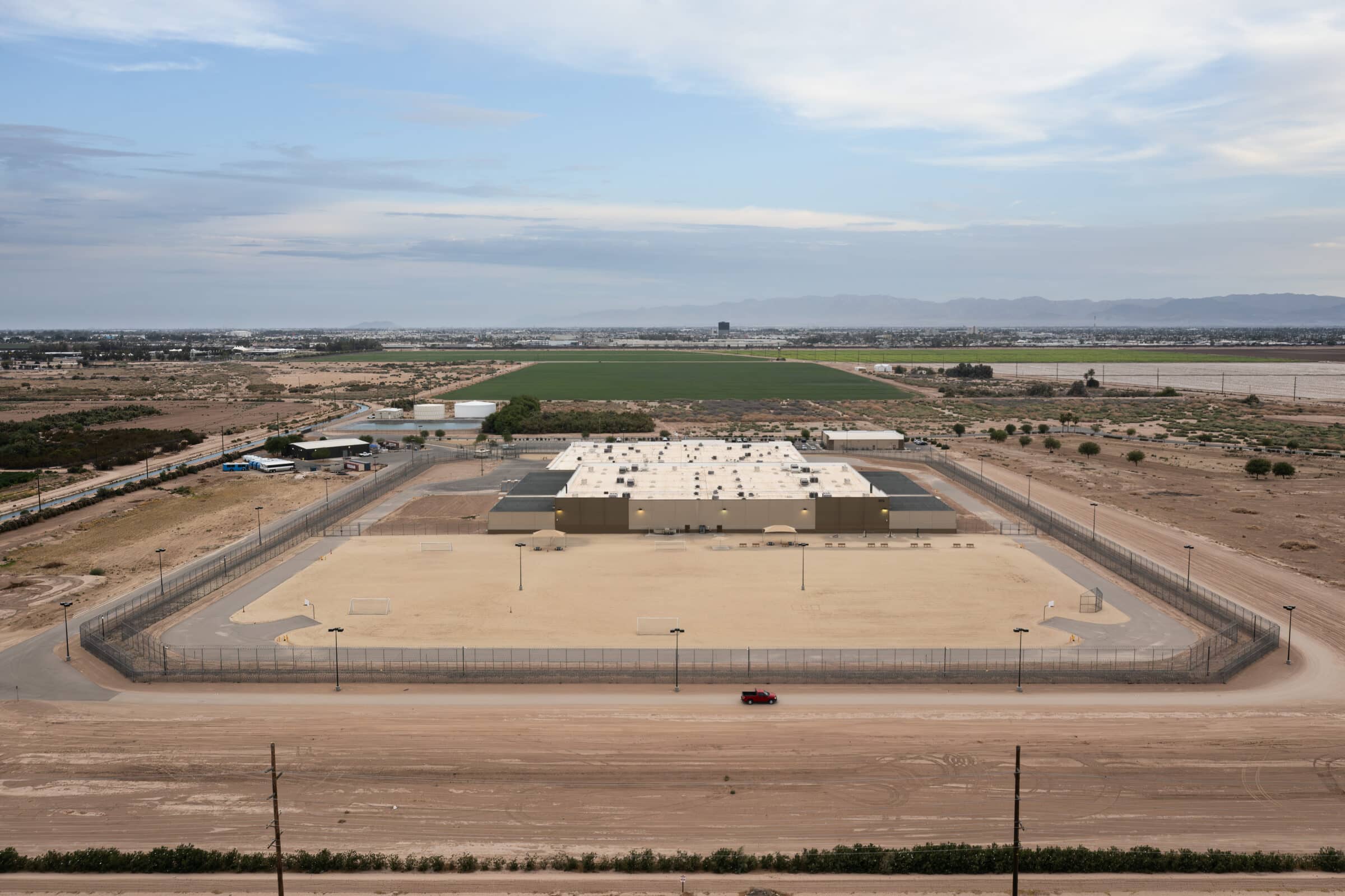
In the shadow of the Tucson Mountains, the group agreed that their priority would be bonding people out of detention.
To bail out the Salvadorans, the activists had to travel to California’s Imperial Valley, about 300 miles away. Migrants at the time tended to be arrested near the border, then delivered to local county jails, and then transferred to the El Centro Immigration Detention Camp, in California, for longer-term holding. 21 The volunteers began a series of trips, leaving Tucson on Sundays at midnight, arriving at a drab motel early Monday, setting up their typewriters and cranking out as many asylum applications as they could. “We set up the first in-detention defense project ever,” Cowan recalled. 22
El Centro’s inhumane conditions rattled the activists. On their first visit, they found about 200 Salvadorans, some of whom had been there for as long as nine months. The detainees spent their days in the prison courtyard, and were only allowed into their barracks to sleep. “It was ramadas out on an open stretch of dirt,” Cowan recalled. “Extremely hot … a terrible, terrible place.” 23
Those held in detention were neither informed of their rights nor offered legal representation. The protocol of the immigration authorities was to pressure detainees to sign “voluntary departure” papers that would allow them to be deported. Those who refused to sign remained in detention, indefinitely. The activists’ strategy was to file asylum applications for as many detainees as possible, after which they could be freed on bond. All the applications used the address of the detention center and named Cowan as legal representation. Corbett had already convinced the director of the local Immigration and Naturalization Service office to agree to release Central Americans into the custody of Southside Presbyterian, though not all ended up staying there.
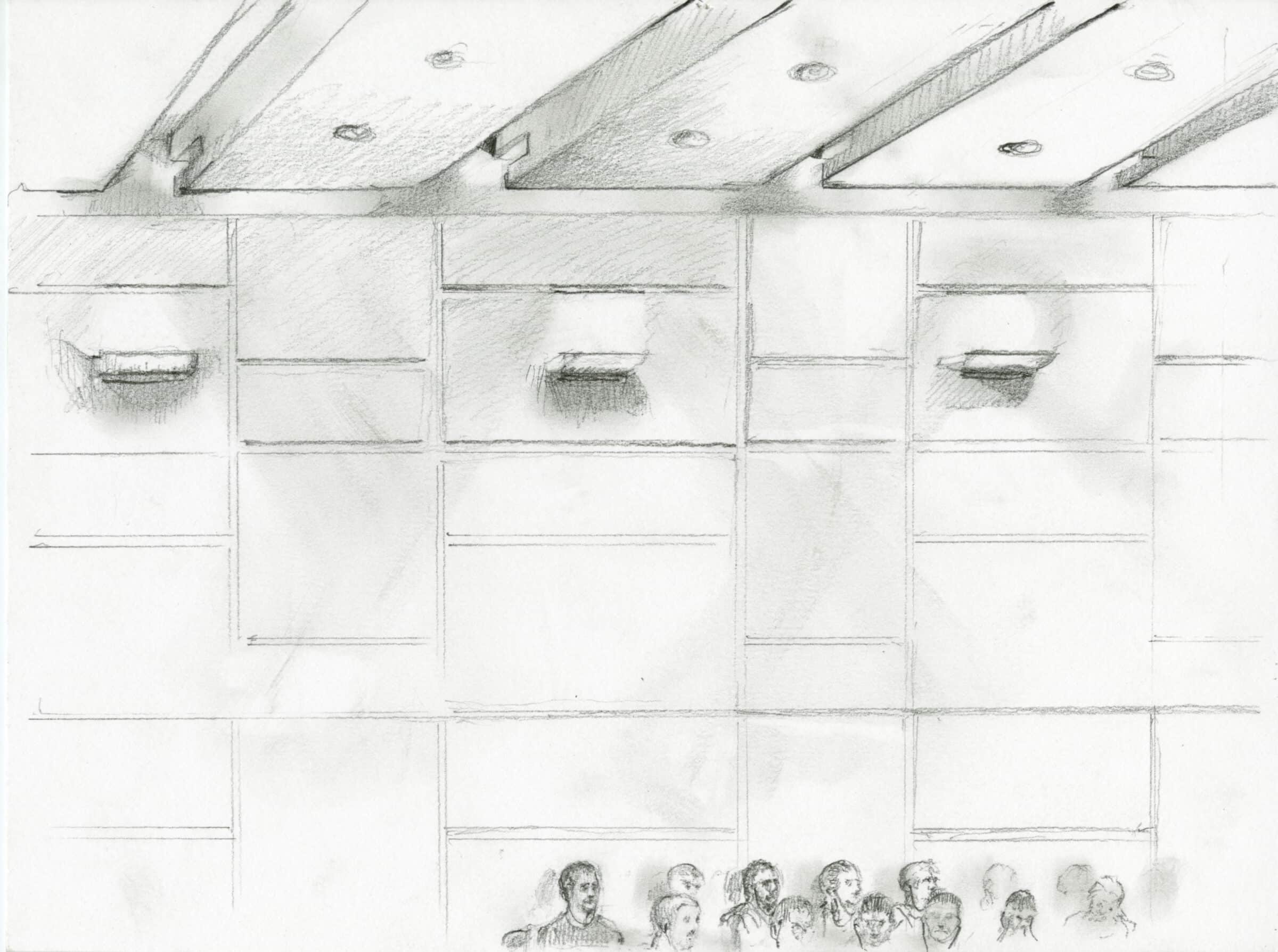
The asylum claims had no chance of success, except insofar as the number of claims gummed up the detention machinery.
No one expected the applicants to actually receive asylum, or even for the claims to be given fair consideration. The U.S. refugee program was created after World War II to admit immigrants from Communist countries as a Cold War-era political statement. In contrast, the violence in El Salvador was supported by the U.S., which was backing the Salvadoran government’s repressive regime. Accepting Salvadoran asylum seekers would be tantamount to admitting not only that there was a problem in El Salvador, but also that the United States had some culpability. So, with every application filed, Manzo received a form letter explaining that the applicant didn’t qualify under asylum regulations. “There was no way of winning an asylum case no matter how well you did it,” Lupe Castillo, the Manzo staffer, explained. “It was impossible; it was a political decision.” 24
Manzo couldn’t win an asylum case, but they could gum up the machinery. The more applications they filed, the slower the court would process the cases; since Cowan was always the designated lawyer, the court couldn’t hold simultaneous hearings. The payment of bond meant that the applicants were released during the waiting period for their hearing, which could be months if not years away. Moreover, the court system did not track the asylum applicants who bonded out. “They didn’t have any idea how to transfer a case to, like, Baltimore or San Francisco,” said Cowan. 25 In practice, this meant that the bonded-out Salvadorans were undocumented, but free to live their lives.
The bonded-out Salvadorans were undocumented, but they were free to live their lives.
By the end of that summer, about 3,000 people were bonded out; at the same time, the volunteers were drained and short on funds. Though Fife had reached out to a nationwide network of churches to raise bond monies, there wasn’t enough for everyone who needed to be released. Some detainees got fed up waiting at El Centro and allowed themselves to be deported; others committed suicide. The midnight drives, too, took their toll. “Emotionally, it was really taxing,” recalled former Manzo volunteer Raquel Rubio-Goldsmith. 26 The program was finally undone when the INS office in Tucson said it would no longer allow detainees to be bonded out to Southside’s custody.
Yet the situation in El Salvador continued to worsen, and Manzo, Fife, and Corbett remained committed. Soon, Corbett approached Fife with a novel, and illegal, idea. “Jim came to me and said, ‘John, we don’t have any choice under the circumstances but to start smuggling people across the border,’” recalled Fife. 27 Not only was the bonding strategy taxing, the asylum applications were pointless, the detention facility inhumane, and the number of people who needed assistance ever greater. Corbett had realized that it would be better if the migrants were never arrested and sent to jail in the first place. He had begun to piece together an underground railroad, with the intention of putting himself on the line so as to help people cross into the United States undetected.
For the plan to work, he needed to recruit others. In making the case to Fife, Corbett referenced two precedents, one heroic and one damning: the Abolition movement’s underground railroad, and Nazi Germany, in which Christian churches declined to protect Jewish refugees. Fife was reeled in. As he recalled it: “[Corbett] looked me right in the eye, the bastard, and said, ‘I don’t think we can let that happen on our border in our time.’” 28
As the summer heat gave way to fall, Corbett made nearly daily trips to Nogales in his green 1961 Chevrolet truck. 29 Passing for a rancher, he would pick up migrants who had spent the night at the Nuestra Señora de Guadalupe Cathedral across the border in Sonora. Corbett had persuaded a handful of his fellow Cabreros Andantes to participate in the clandestine carpools as well. They brought the migrants to Southside church to rest. Some would apply for asylum at the local INS office while others preferred to remain in the shadows.
It was a dilemma: either stop the work, or face criminal charges.
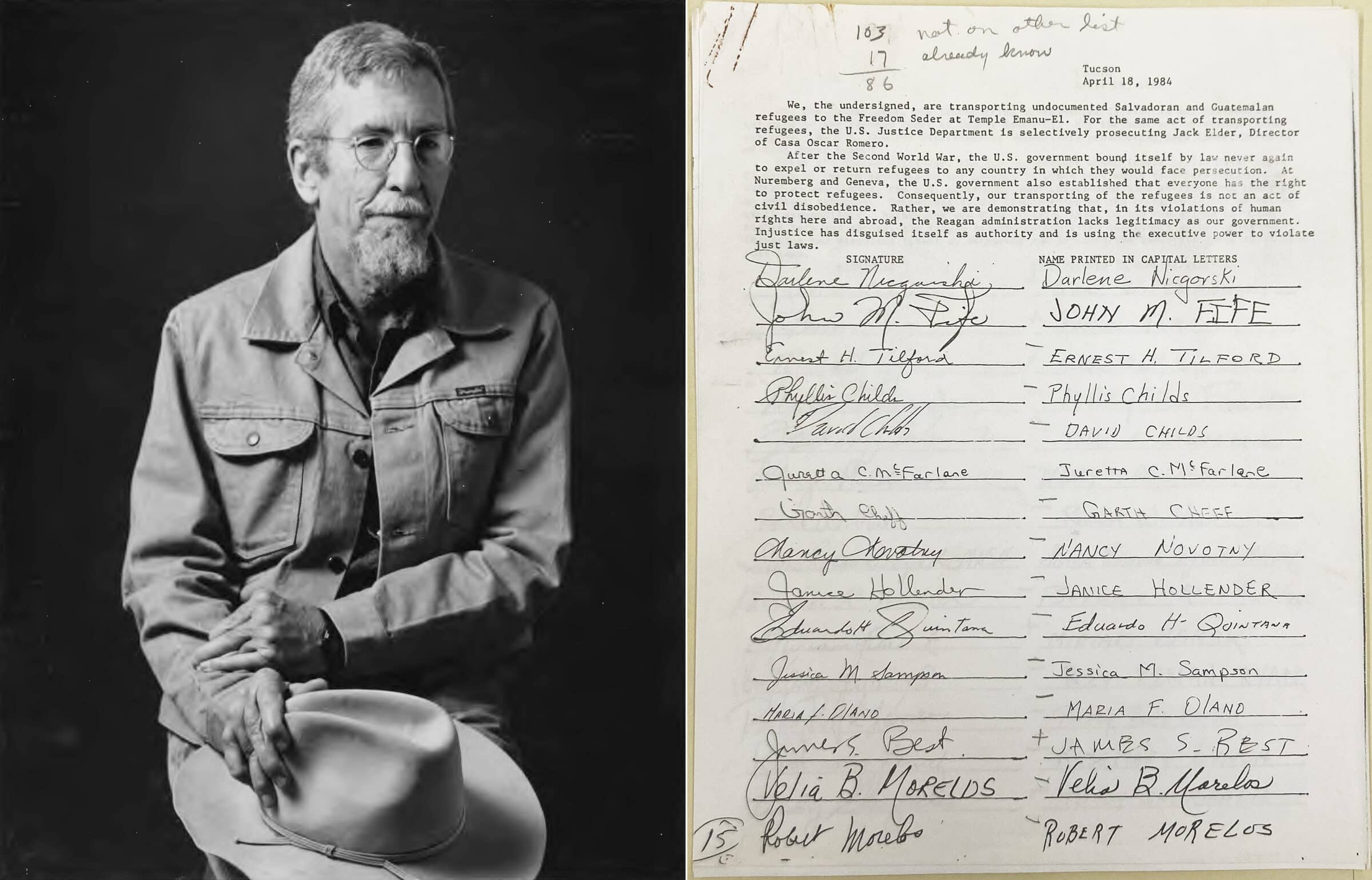
The scheme worked for a couple of months, until the government started to catch on. In November, an INS attorney who had found Corbett’s phone number written on papers in migrants’ pockets warned Cowan that the agency knew that she, Fife, and Corbett were up to something. The three of them met once again, this time in Fife’s living room, to decide how to respond. It was a dilemma they’d seen coming: either stop the work, or face criminal charges for smuggling.
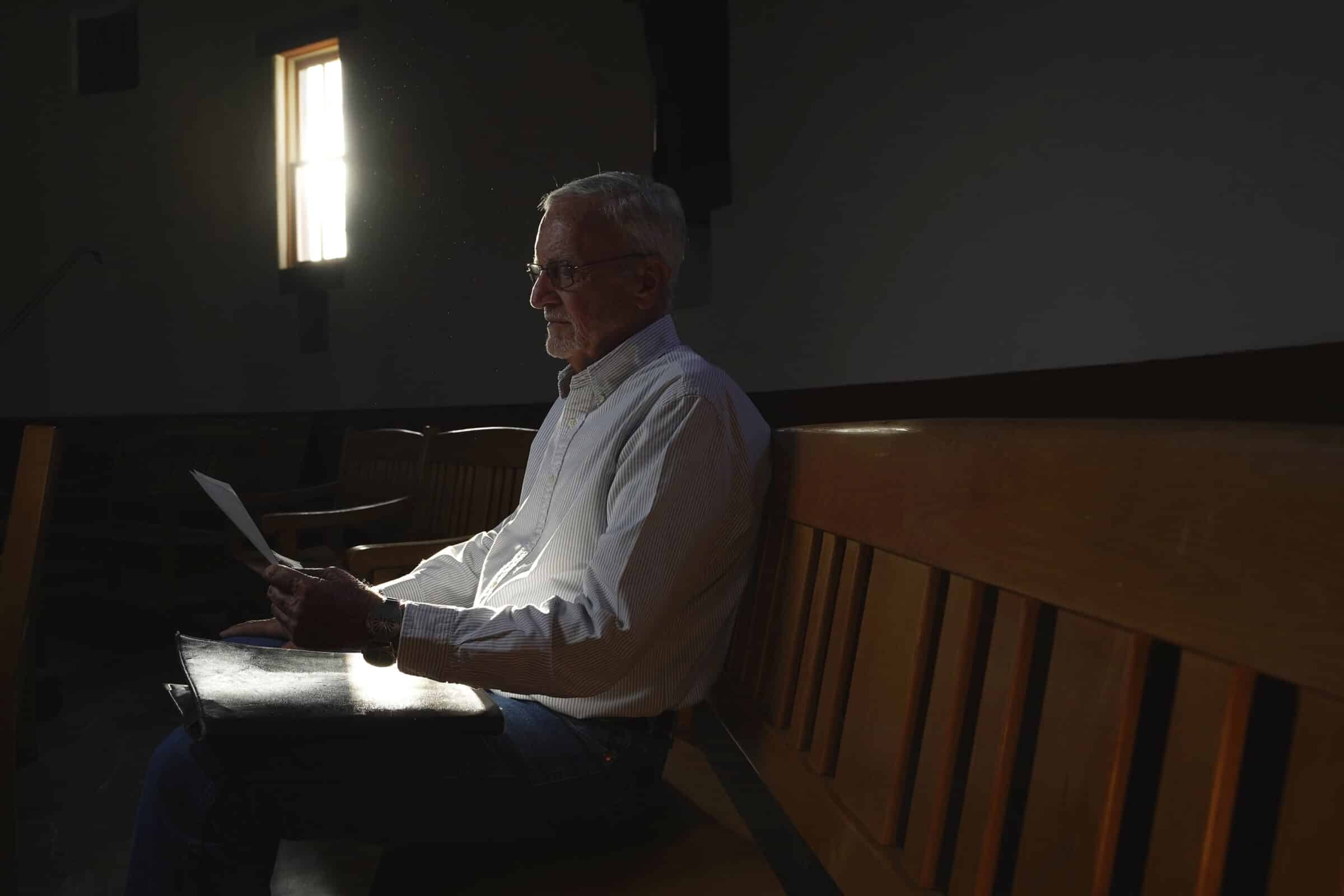
At the meeting, Fife had an idea for a third option. He had recently received a letter from a Lutheran pastor in Los Angeles that recounted the story of a fourteen-year-old Salvadoran boy who had been chased by immigration officers in East LA. When the boy had run into a church to take cover, the agents had followed him in and dragged him out. Onlookers and members of the congregation were shocked — the church was supposed to be a sacred place.
As Fife recalled, the last part of the letter asked, “Why can’t the church be a sanctuary for refugees like it was in the Middle Ages?” The question initially struck him as naïve — “We weren’t going to go back to medieval Europe,” he thought — and he had thrown the letter in the wastebasket. 30 But as he brainstormed with Cowan and Corbett, he remembered it. Southside was already being used as a sanctuary. Perhaps the best course of action was to simply go public with what they were already doing. By going public, they’d have opportunity to explain their faith-based justification, and any subsequent government prosecution would seem anti-church, and anti-Christian. Perhaps their movement might win over hearts and minds in such a way as to forestall government prosecution.
We have no middle ground between collaborating and resistance, Corbett told the church.
Since the idea centered on Southside in a way that previous activism had not, everyone agreed that Fife’s congregation would have to lead the charge. Fife asked Corbett to make a proposal that Sunday from the pulpit. “Because the U.S. government takes a position that aiding undocumented Salvadoran and Guatemalan refugees in this country is a felony, we have no middle ground between collaborating and resistance,” Corbett told the church. “We can take our stand with the oppressed, or we can take our stand with organized oppression. We can serve the Kingdom, or we can serve the kingdoms of this world — but we cannot do both.” 31
The plan was that the congregation would vote on the proposal to break the law and shelter refugees at their annual meeting in January. That left the rest of the fall for debate and discussion. During the coming weeks, the congregation invited law professors to lecture about immigration and refugee policy, and centered their Bible study on questions of compassion and aid.
Then, at Southside’s Christmas Eve service, Fife introduced before the gathered church members a family from El Salvador that had been separated in their migration journey and reunited that day, at the church. “There is no doubt that we have seen the gospel tonight,” he told the crowd, connecting the uniting of this immigrant family to the birth of Jesus Christ. “This is what the Bible calls a sign. Christ is present in the refugees and in sanctuary.” 32 The official vote by secret ballot wasn’t for several more weeks, but Fife read the crowd and knew in his heart that his congregation would vote yes. They would go public with their sanctuary work.
On March 24, 1982, the two-year anniversary of the assassination of El Salvador Archbishop Óscar Romero, banners flanked the entrance of Southside Presbyterian Church and framed a long table set up with microphones. The banners read, “La Migra no Profana el Santuario” (Border Patrol doesn’t Profane the Sanctuary) and “Este es el Santuario de Dios para lo Oprimidos de Centro América” (This is the Sanctuary of God for the Oppressed of Central America). At the table sat the key figures: Fife, Cowan, Corbett, Father Ricardo, and other members of the Tucson Ecumenical Council. They were joined by a Salvadoran refugee they called “Alfredo,” whose identity was masked with a bandana and wide-brimmed cowboy hat.
Before the TV cameras, Alfredo offered testimony about the conditions in El Salvador that had caused him and others to flee. Corbett and Fife spoke about the work that volunteers had been doing to help the refugees and the decision to make it public. The press conference ended with a procession through downtown Tucson led by Fife and Elford.
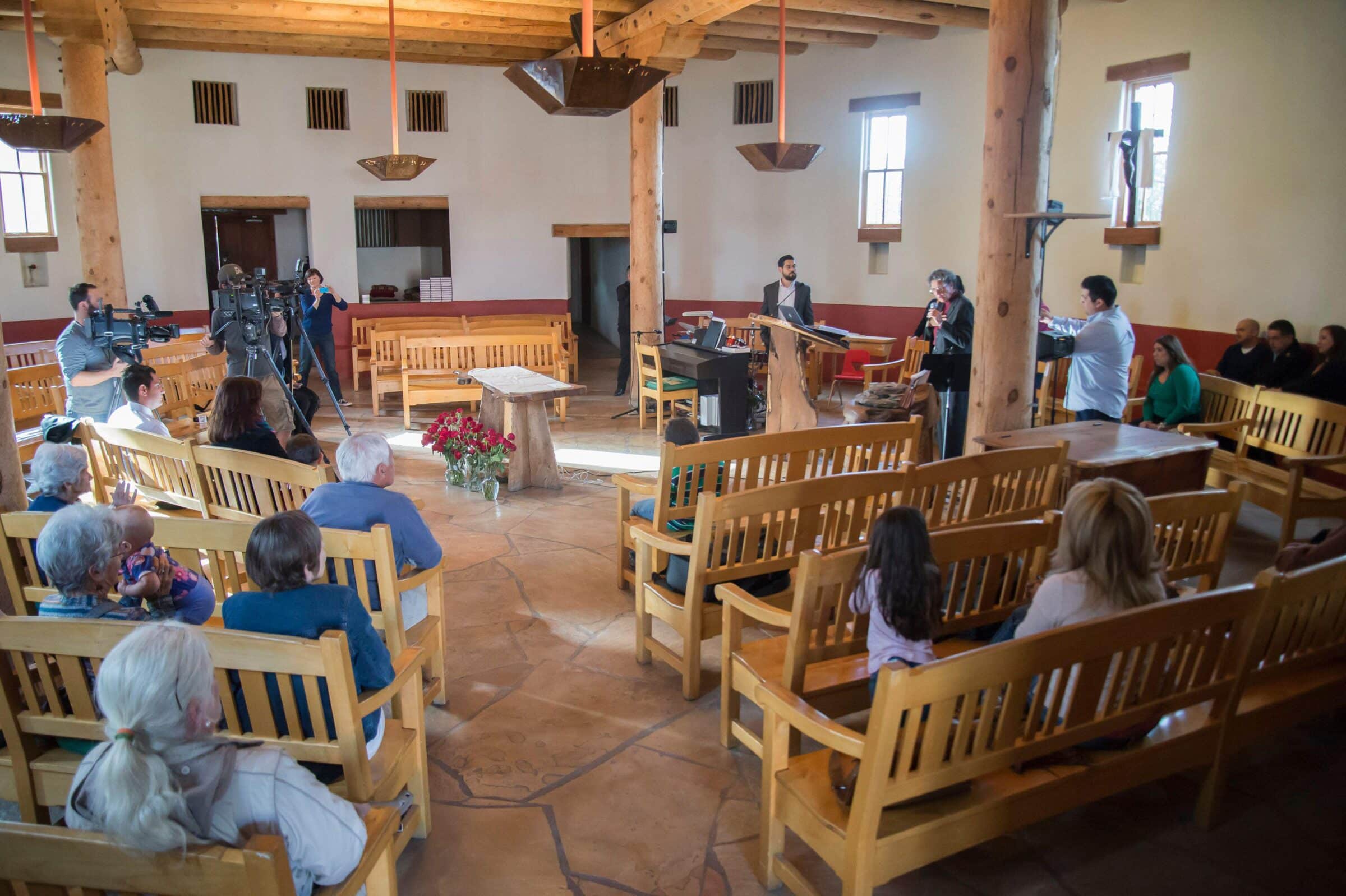
On the same day that Southside held its press conference, so did churches in California, New York, and Washington, D.C., all recruited to the cause through Fife’s efforts. 33 While Tucson activists handled the border crossings, church members around the country were expanding the nodes in the underground railroad, helping refugees travel to safe harbor.
A journalist described the group as ‘a brigade of middle-class housewives, students, professional men, and retirees.’
Many of the Tucson border activists were members of Fife’s congregation, but not all. Journalist Ann Crittenden described the group as “a brigade of middle-class housewives, students, professional men, and retirees.” 34 They often carried binoculars, so that if they were questioned by Border Patrol, they could claim to be birdwatching. One of the smuggler-activists was Peggy Hutchison, who had come to Tucson several years earlier as a borderlands Methodist service worker. Hutchison took care of logistics. As she explained to me, there were three main ways to help refugees cross the border in the 1980s.
The first was to cross at an official port of entry. Volunteers could drive babies or toddlers through very easily, with the pretense that they were their own children. To cross the children’s parents and other adults, they borrowed documents. “People from Padre Quiñones’s church would loan their micas [border crossing cards] and we’d see if someone looked similar,” Hutchison explained, adding that members of the church helped the Salvadorans primp themselves with styles of hair, clothing, and makeup common to northern Mexico. 35
A second route was through holes in the border fence in Nogales, especially one well-known hole near McDonald’s that was often used by local children to cross to panhandle. Since the volunteers had limited capacity, they’d often prioritize helping children, women, and individuals whom they knew to have been specifically targeted. To others, they simply gave instructions about how to get through the fence themselves, so they could be picked up in the McDonald’s parking lot for the drive north.
The activists would leave in the evening, in the dark, walking with a group of Central Americans.
The most convoluted crossing method involved walking through the desert — something the volunteers started to do with more frequency as their faces became familiar to border agents. The activists would leave in the evening to avoid being seen, walking with a group of four or five, or ten, Central Americans. Corbett knew the borderlands terrain well from his years working as a cowboy in the Coronado National Forest — much of the national forest land in Arizona is leased to ranchers for grazing — and enjoyed the hikes as a form of errant, spiritual pilgrimage. Hutchison, on the other hand, found them nerve-wracking. “There weren’t many fences, so you didn’t know if you were going on a rancher’s land and they could have guns and stop you and turn you in,” she said. “It could be someone who pretends not to see you, or it could be a conservative who holds you up with their gun.”
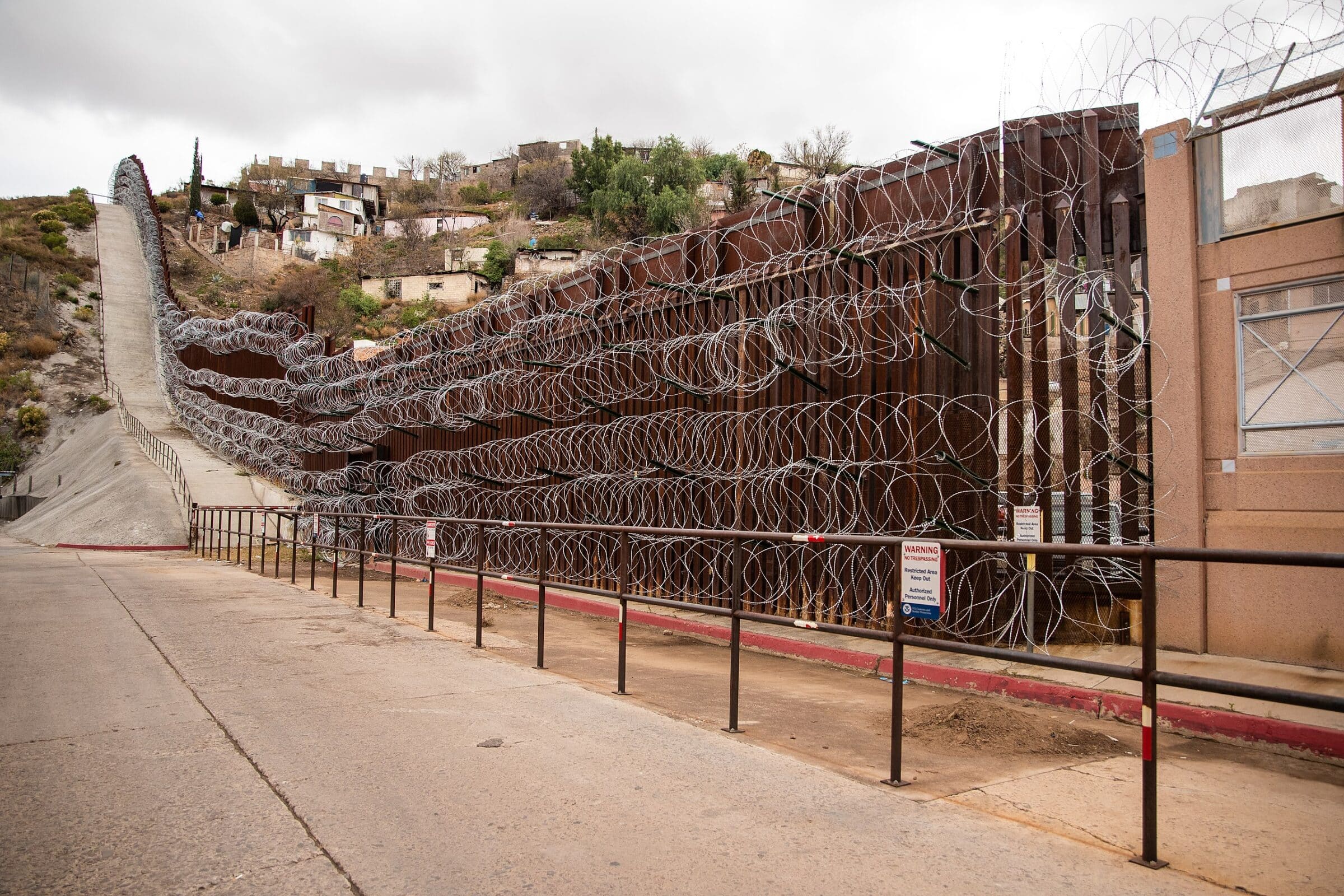
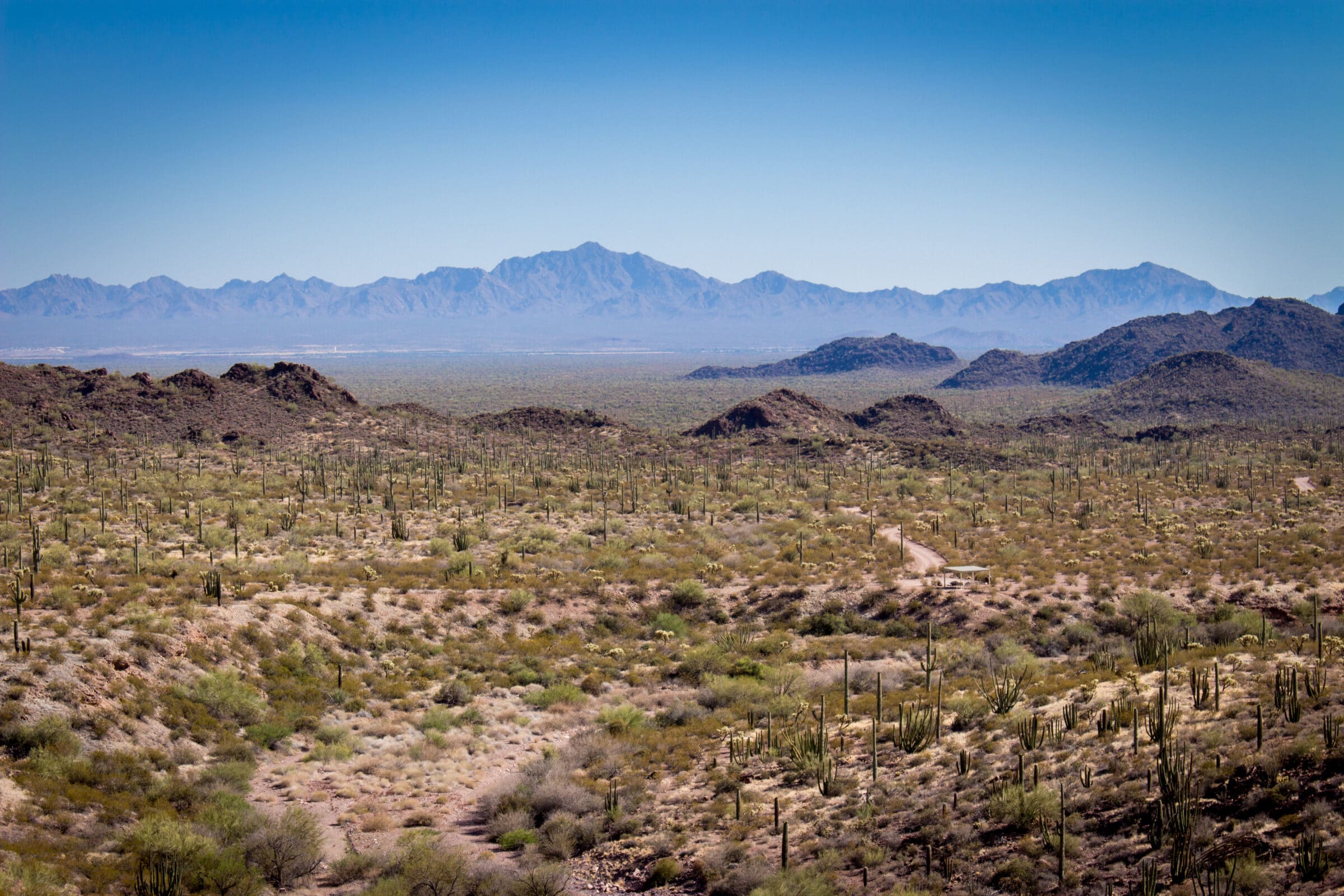
The challenge really began, explained Hutchison, after the border, on the 70-mile drive to Tucson. The safest course was to avoid all Border Patrol checkpoints, taking long detours as necessary. There needed to be two drivers on the route, one traveling ahead, and then confirming from a pay phone — there were no cell phones — that the coast was clear. Small caravans worked their way north, phone booth by phone booth. The method wasn’t foolproof. Once, Hutchison remembered, she was driving with a Salvadoran woman when she came to an unexpected checkpoint.
Small caravans worked their way north, phone booth to phone booth.
“I said to the woman, ‘just slide down as much as you can in the seat,’” recalled Hutchison, “and I just slowed down and waved. I was doing a lot of breathing exercises.” The officers turned out to be changing shifts, so their attention was diverted. They waved her through. “There were a lot of those close calls,” said Hutchison. By the end of 1982, the Sanctuary Movement had helped some 350 people cross the U.S.-Mexico border, and some fifteen churches had joined. In the coming three years those numbers would increase tenfold or more. Still, it was only a tiny fraction of the estimated 500,000 Central Americans who entered the United States undocumented during the 1980s. 36
As Fife, Corbett, Manzo, and hundreds of volunteers continued to aid people, the work evolved as the circumstances changed. Whereas the activists had initially supported middle-class Salvadorans — students, labor union members, and members of the country’s left wing — by 1984, they were assisting rural campesinos, many of them Indigenous, from both El Salvador and Guatemala. The two countries were both escalating their campaigns to eradicate dissent, and had begun using scorched-earth methods in rural areas, killing entire villages and forcing survivors to flee.
The work evolved, while the internal politics of the movement got more complicated.
Manzo had continued to pursue various legal means by which Central Americans could receive asylum or another legal status. One of Manzo’s targets was the practice of asking detainees to sign voluntary departure statements without informing them of their legal rights. In April 1982, a class action lawsuit including Manzo, Orantes-Hernandez v. Meese, ordered detention center officials to inform detainees of their rights. The number of people signing voluntary departure statements abruptly dropped by 70 percent, and the number of asylum applications increased by more than 50 percent. Though the vast majority of petitions were still unsuccessful, Cowan had increasing faith that the system was slowly becoming fairer.
The internal politics of the movement also got more complicated. Starting in 1982, the “underground railroad” was coordinated not out of Tucson, which retained a focus on the border itself and an apolitical humanitarian posture, but by the Chicago Religious Task Force on Central America, which bore its criticisms of the U.S. role in Central America loudly. The Tucson and Chicago groups butted heads over whom to assist, over what receiving sanctuary should entail, and over public messaging.
Federal authorities had begun spying on the activists. The INS recruited former smugglers and planted them as moles.
Most ill-boding of all, federal authorities had begun spying on the Tucson activists. The INS recruited two informants, former smugglers who they had previously arrested, and planted them as moles in the movement. They began attending meetings and volunteering to transport travelers, as well as taking notes on movement participants and secretly recording conversations. Many in the group suspected the men to be spies, but Fife and Corbett downplayed the risk. “I was hyper-aware of the government’s access to information and the possibility that they were spying,” recalled Peggy Hutchison. “But Jim Corbett wasn’t worried. He just said, ‘Maybe we’ll convert them.’” 37
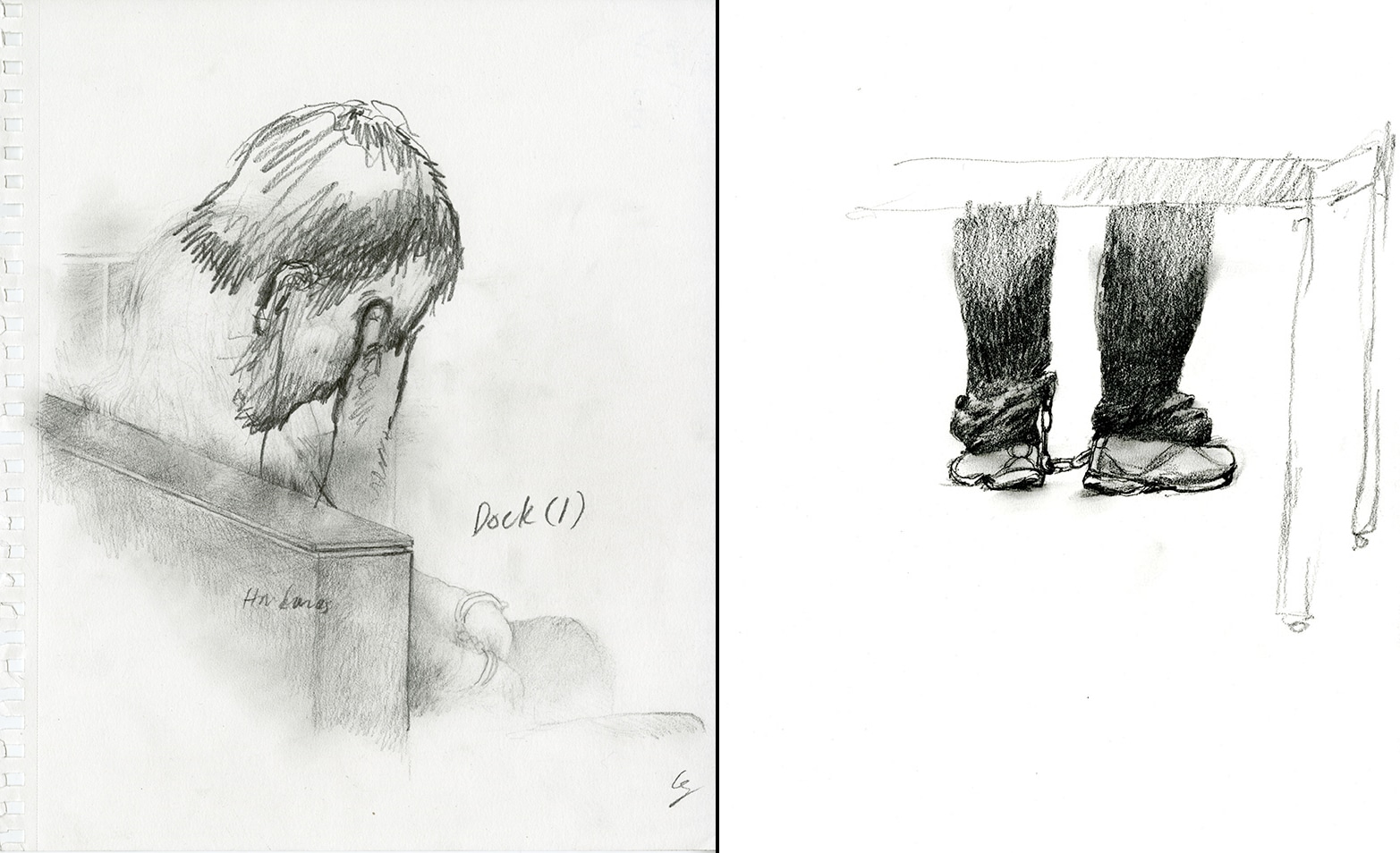
The threat was not to be underestimated. On Thursday, January 10, 1985, a federal grand jury in Phoenix voted to indict sixteen Sanctuary Movement activists, based in part on material supplied by the informants. Those indicted included Fife, Quiñones, Corbett, and Hutchison, along with activists in Phoenix that, ironically, the Southern Arizona volunteers did not know. “This supposed big conspiracy was between people who had never met,” said Hutchison. 38
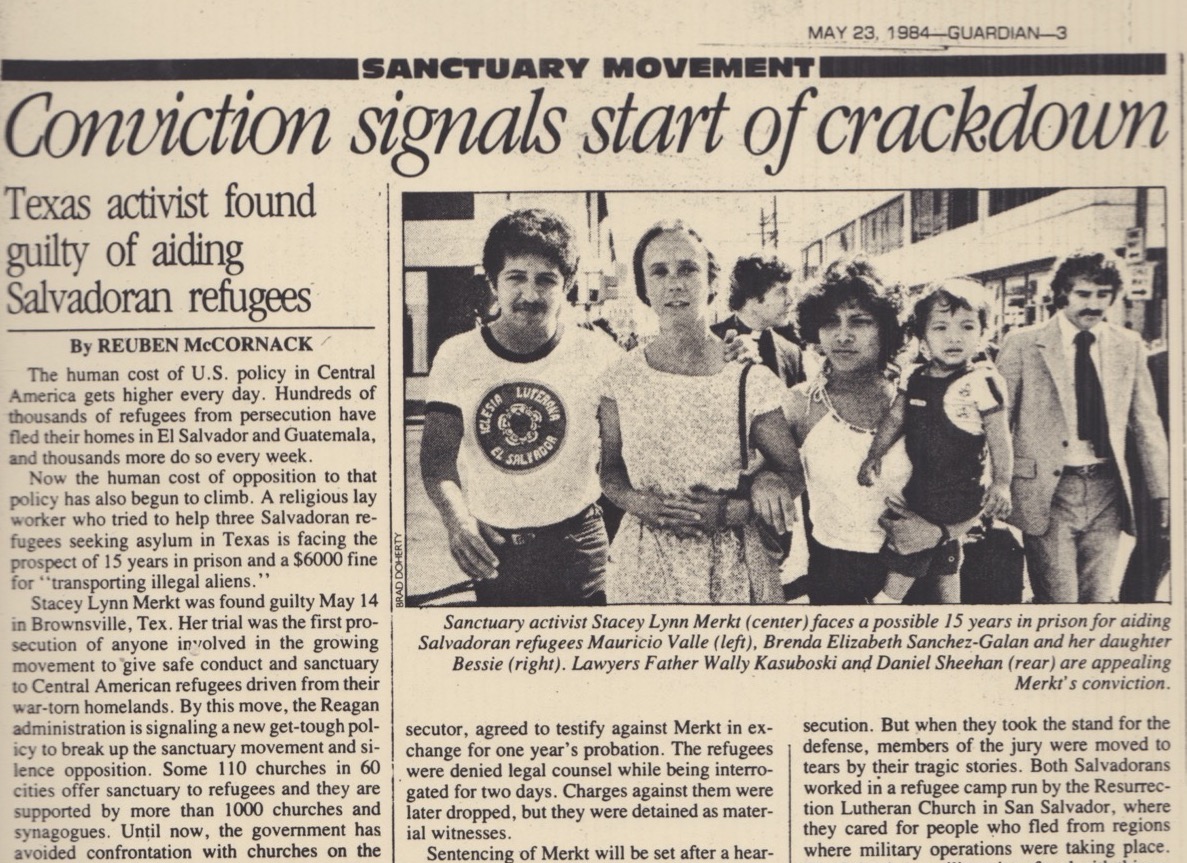

Supporters rallied to the defendants’ cause, and the mood was optimistic. They had closely tracked another case in Texas, the ruling of which boded well for their own. Stacey Merkt had been arrested for Sanctuary activism, but had her conviction overturned on the grounds that she was transporting the undocumented migrants to a location where they could apply for legal asylum. Because there was no way to apply for asylum at the border itself, that necessary transport had to be protected. 39 The ruling was based on expert testimony about the violent situation in El Salvador and Guatemala, along with the defendants’ accounts of their own motivations. The judge had been persuaded that the activists had been acting out of a sense of justice and duty, rather than a desire to break the law, and ruled accordingly. The sanctuary activists planned a defense along similar lines.
But authorities in Arizona had also tracked the Merkt case, and wanted to avoid such a sympathetic ruling. Optimism faded at the start of the hearings, when the prosecutor filed a motion that restricted the defense from entering any evidence regarding the Refugee Act of 1980, international refugee law, U.S. policy in Central America, the ongoing civil war in El Salvador or Guatemala, asylum statistics, or any justification suggesting that “the defendants were compelled to violate the law out of necessity.” 40
The ensuing trial framed the activists as nothing more than smugglers.
These sweeping limitations were damning to a trial in which activists saw themselves as enforcing international laws to which the United States was a signatory. Though the defense had a motion written by a lawyer from the American Civil Liberties Union about how international law prohibited repatriating people to countries of origin where they would face persecution, it could not be entered into evidence. Though they had flown in the vice-chairman of the human rights organization Americas Watch, he could not testify. The defense hoped that the case might even be dismissed, based on the First Amendment’s protection of freedom of religion, but the judge was hostile to that point of view, and rejected their motion. The ensuing trial framed the activists as nothing more than smugglers.
The trial was so biased that the defendants decided there was no point in calling a single witness. The trial ended, and they returned to the activist work of cultivating public sympathy. In fact, public opinion was more mixed than the prosecutorial strategy suggested, and many activists were mobilized by the court’s intransigence.
Many activists were mobilized by the court’s intransigence.
Susan Bibler Coutin, an anthropologist who conducted her dissertation fieldwork alongside Tucson activists, wrote, “in the eight weeks between verdicts and sentencing, sanctuary supporters held a caravan to the border, an all-night vigil at the U.S. Border Patrol Headquarters in Tucson, a march for freedom, and a conference attended by 500 to 600 people where the call and response, ‘If they are guilty … SO AM I!!’ rang out repeatedly.” 41 When the verdict was returned, eight of those on trial were found guilty, and three were acquitted. (The charges against the five other indicted activists had been dropped earlier.) Corbett, on whom the informants had struggled to collect evidence, was let off. Fife was charged with three counts — a felony for conspiracy, a felony for smuggling, and a misdemeanor for aiding and abetting the presence of an illegal alien. Hutchison was found guilty only on the charge of conspiracy. 42 Though each count could have carried five years of jail time, all of the activists received probation or suspended sentences.
Fife’s guilty verdict didn’t stop Southside in aiding the crossings. In fact, having seen the federal government’s heartlessness to the refugees’ plight, church members made the concept of sanctuary even more central to their understanding of Christianity. “[A]lmost every church service, in one way or another, referred to the congregation’s sanctuary activities,” wrote Coutin. 43 They re-interpreted the oft-repeated Lord’s Prayer — “forgive us our debts as we forgive our debtors” — to explicitly refer to the debt of harm done by U.S. actions in Central America.
And they held close Bible passages from Leviticus and Matthew that sanctioned the work: “When a stranger sojourns with you in your land, you shall … love him as yourself; for you were strangers in the land of Egypt” and “Whatever you did for the least of these brothers of mine, you did for me.” Over time, however, due to a mixture of volunteer fatigue and changing political circumstances, the movement slowed and fizzled. The Manzo Area Council disbanded in 1986, the same year that the Immigration Reform and Control Act allowed qualifying undocumented immigrants who had been in the United States since before January 1, 1982 to obtain a legal immigration status.
In 1990, the U.S. cut military aid to El Salvador and granted Temporary Protected Status to Salvadoran immigrants.
In 1990, after the brazen assassination of six Jesuit priests, the U.S. finally cut military aid to El Salvador and granted Temporary Protected Status to Salvadorans in the United States. A lawsuit brought against the federal government by the American Baptist Church and other religious and refugee-rights groups over discrimination against Central Americans in asylum rulings forced the INS to change its procedures and re-open some 150,000 Salvadoran and Guatemalan cases. Fewer refugees needed help, and U.S. immigration policy changed to accommodate more of those who had already come. 44
The story might have ended there, except that in May 2001, history repeated itself. Fourteen people were found dead in the desert southeast of Yuma, Arizona, more than 50 miles from the nearest highway. They had been missing for days during a stretch of early summer when temperatures reached 115 degrees. The deaths mirrored those of 1980, except the bodies were more remote. In 1994, through a program called Prevention Through Deterrence, the federal government had begun placing Border Patrol agents at common urban crossing sites, which pushed migrants to cross through ever more isolated desert trails.
The bodies were found in extremely remote locations; migrants were crossing through ever more isolated trails.
Just as the 1980 deaths sent shockwaves through Tucson, so did those in 2001. Father Ricardo Elford began to lead weekly vigils for deceased migrants just as he once led vigils for the dead in El Salvador. “There were meetings all over town,” recalled Raquel Rubio-Goldsmith, a former Manzo volunteer whose later initiative at the University of Arizona, the Binational Migration Institute, undertook the first effort to systematically count the deaths caused by Prevention Through Deterrence. 45

Out of the tragedy and the foment that followed, three sister organizations were created: No More Deaths, Humane Borders, and Tucson Samaritans. John Fife, then in his fifth decade as reverend of Southside Presbyterian, helped found all three. As he described it to me, each group represents a different answer to the question asked at the outset. “We said consciously, ‘How do we take what we’ve learned in sanctuary out to the desert?’” 46
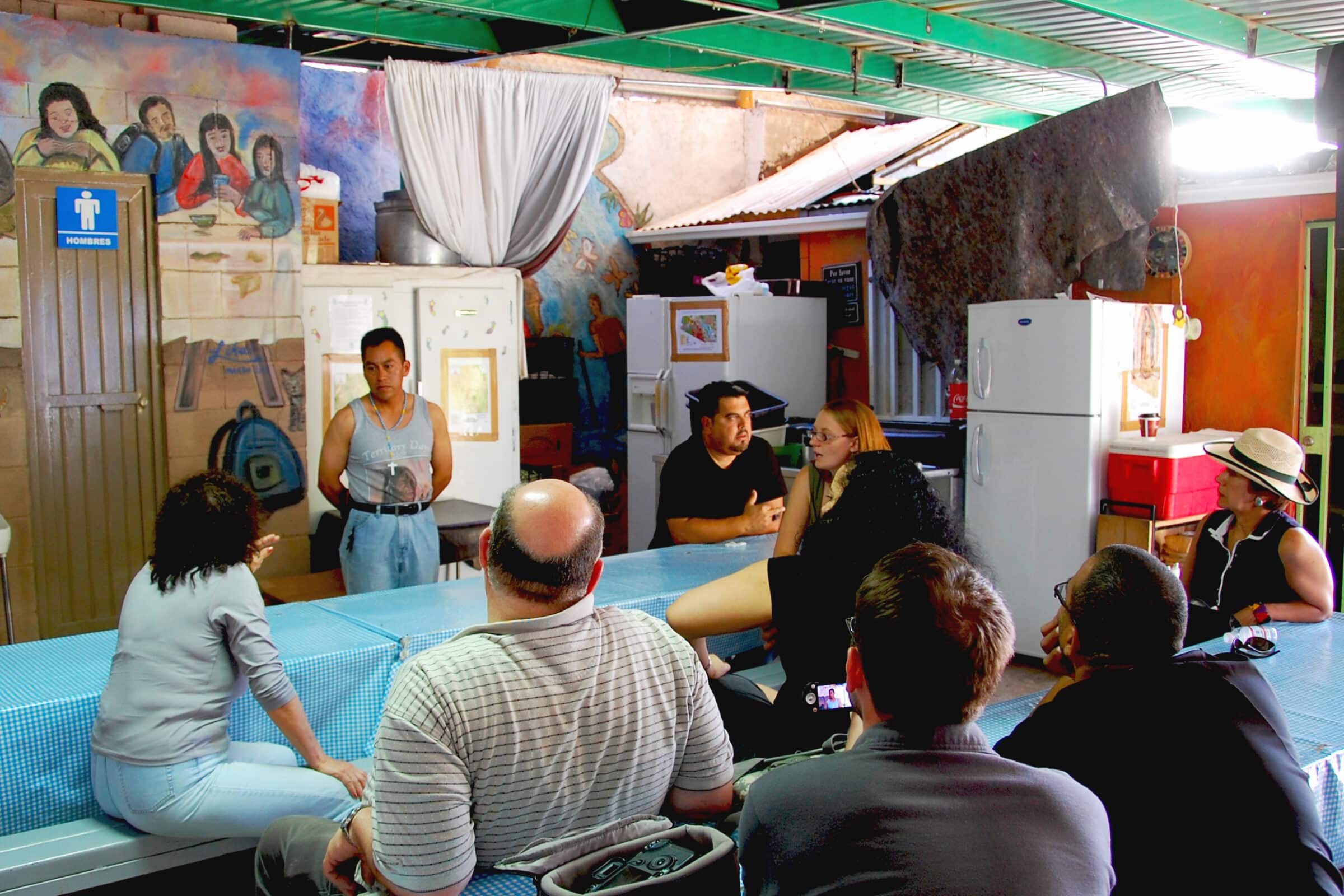
Today, these groups are a crucial part of the borderlands landscape. No More Deaths operates a camp southeast of Tucson where migrants receive food and first aid, and leads hikes into public lands to leave water and conduct search and rescue. Its members tend to be young and able-bodied. Human Borders places and maintains water stations on public lands. The Tucson Samaritans also provide direct assistance to migrants in the desert, but they do so by vehicle, on roving “patrols.” Their membership is mostly retirees.
Tucson remains a place where citizens and authorities negotiate immigration policy — sometimes in heated and daring ways.
All three organizations, according to Fife, are based on “the same founding philosophy”: “[I]t’s not us breaking the law and international law, but the government.” 47 The activists of contemporary Tucson have ensured that the city remains a place where citizens and authorities negotiate immigration policy and its limitations — sometimes in heated and daring ways. In 2010, five undocumented students — soon to be known as the “DREAM Act 5” — occupied Senator John McCain’s Tucson office to demand immigration reform that would offer individuals brought to the U.S. as minors a pathway to citizenship. When they were arrested, their volunteer lawyer was Margo Cowan, formerly of Manzo. In 2013, activists chained themselves to one another in front of Tucson’s federal courthouse together to block buses associated with the Obama-era fast-track deportation program called Operation Streamline, while a dozen members of the clergy interrupted the court proceedings inside. Cowan represented these arrested activists as well.
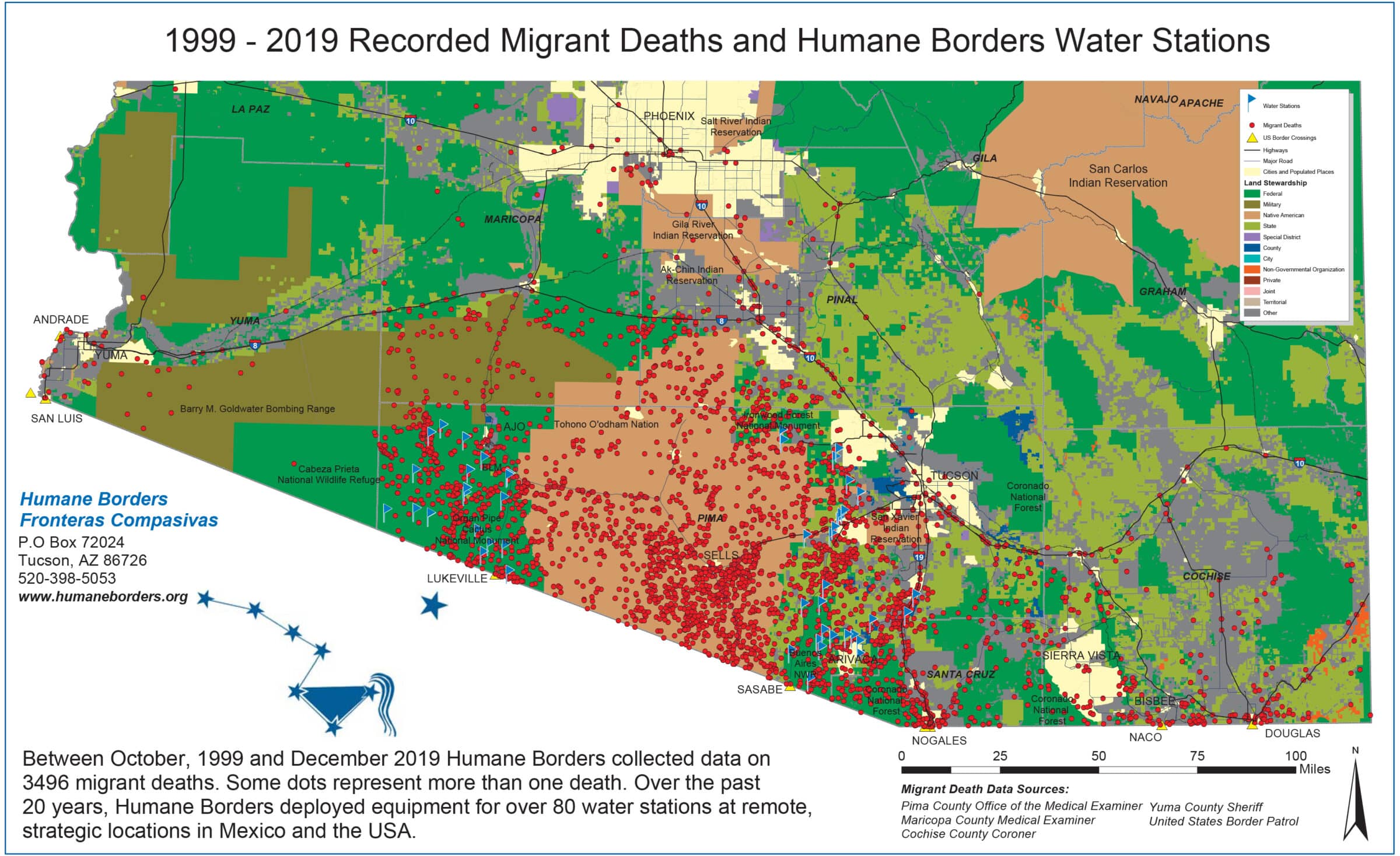
Opposition from Southern Arizona activism has made the Tucson Sector the only region in the borderlands without a permanent inland checkpoint, and also spurred the creation of the Missing Migrants Program, the Border Patrol’s humanitarian arm. Recently, activists from No More Deaths created the first complete database of migrant deaths along the entirety of the border, a herculean task that showed the Border Patrol’s numbers to be a marked undercount. The region’s humanitarian volunteers are the frontline witnesses and whistleblowers against government cruelty and neglect at the border.
In some ways the role of church in this story is unlikely and surprising, and in other ways, it makes perfect sense. Perhaps only an entity that sees itself as larger and more consequential than nation-states could root a movement whose raison d’être is to hamper the most brutal nationalistic impulses of the state. Today, Southside Church’s congregation is explicitly oriented toward social justice, even as it follows the Presbyterian Church’s traditional liturgy. Its sermons reference Óscar Romero and Martin Luther King, Jr., and suggest how the week’s Bible readings can be applied to activist fights.
Religious institutions have changed the borderlands, and the borderlands have changed religion.
Hand-in-hand with the activist work that surrounds and sprouts from its walls, Southside has developed an orientation to religious texts that would have been unthinkable to former incarnations of the church, and perhaps remains unthinkable in other cities less touched by the border crisis. Religious institutions have changed the borderlands, and the borderlands have changed religion. For Corbett, Fife, and the Sanctuary Movement activists, religion offered a moral compass to guide them in moments when the law failed. Perhaps theology is similarly useful today, in our increasingly hostile and chaotic political climate. Corbett expressed the way that activism and theology coalesce in his 1991 memoir Goatwalking: “Covenanting across the divisions that separate ‘the people’ from ‘the aliens’ is the way to establish universal human rights, which national governments will then, eventually, have to recognize.” 48




If you would like to comment on this article, or anything else on Places Journal, visit our Facebook page or send us a message on Twitter.