

“A special set of historical circumstances has enabled American architects to operate on an ‘Alice in Wonderland’ set of assumptions: namely the assumptions that energy is, first, cheap and second, inexhaustible. With these two fundamental misconceptions of experiential reality, it has been possible for the architects of the western metropolis, especially American architects, to behave in a fashion that will soon be seen as authentically hallucinatory.”
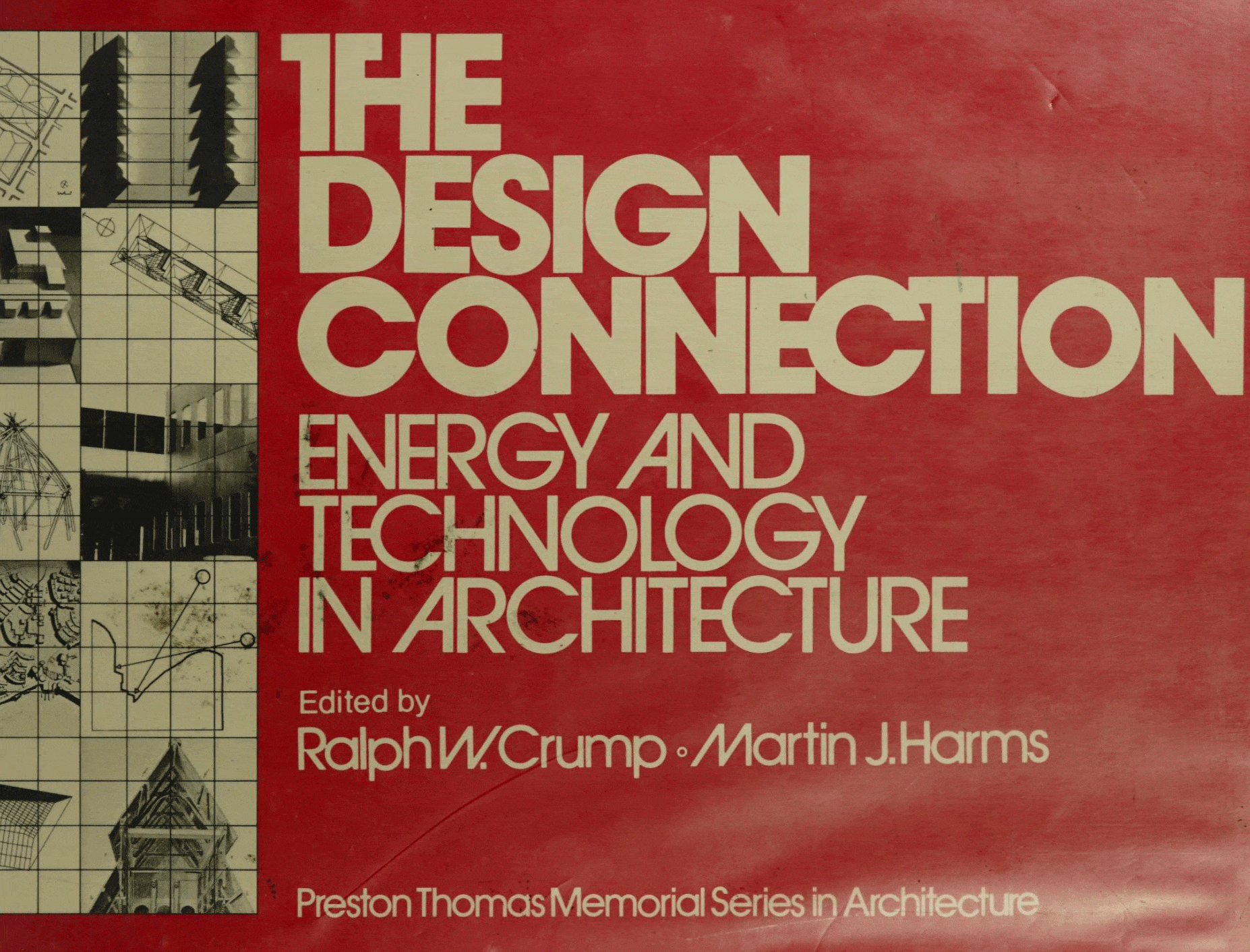
These were the opening words of a blunt and powerful talk given by James Marston Fitch in November 1978, at a Cornell symposium called The Design Connection: Energy and Technology in Architecture. The campus event was a response to the growing consensus that the energy system of the United States was in crisis; in particular, that overreliance on fossil fuels was polluting our environment, disfiguring our cities and landscapes, undermining our foreign policy, and enabling a profligate consumer culture embodied not only in countless material options but also in noxious over-capacity landfills.
The conference, and the book that followed, brought together half a dozen prominent academics and practitioners, including Ralph Erskine, Ralph Knowles, Cesar Pelli, Richard Stein, and Sim Van der Ryn. Fitch’s talk was the keynote, a reflection of his contemporaneous stature as “the keeper of the environmental conscience of American architecture through three decades,” in the words of the book’s introduction. 1
Fitch had one of those remarkable, right-time and right-place 20th-century lives in which individual promise and talent are nurtured through multiple providential opportunities and encounters.
In fact, Fitch, then nearing 70, was still in the thick of a long and polymathic career as architect, writer, editor, historian, professor, preservationist, activist. Born in 1909, he had one of those remarkable, right-time and right-place 20th-century lives in which individual promise and talent are nurtured through multiple providential opportunities and encounters. Raised in eastern Tennessee in a household of modest means, he studied architecture at Tulane, but left after a year when he could no longer afford tuition. In the peak years of the Roaring Twenties, he took a job at an architecture office in Nashville that specialized in historicist houses; he quickly became, as he put it, “an accomplished copyist.” 2 A few years later, in the depths of the Great Depression, as private commissions became scarce, he lucked into public sector jobs at the Tennessee Valley Authority, one of the newly created agencies of F.D.R.’s New Deal, where he worked with the visionary conservationist Benton MacKaye, and at the Tennessee State Planning Board, where he did statistical population studies involving transportation and tenant farming.
Along the way he spent a summer in New York and New Jersey, where he studied with the regional planner Henry Wright, who introduced him to the progressive thinking of close colleagues Clarence Stein, Lewis Mumford, and Catherine Bauer. Fitch’s association with Wright led to a brief stint in Washington, D.C., at the Federal Housing Administration, another new agency of the New Deal. “He worked in the low-cost housing division with other progressive-minded architects,” according to an (unsigned) biographical sketch that accompanies a book of Fitch’s essays. “The New Deal was in full swing and, along with it, optimism about the government’s role in providing decent housing for the economically disadvantaged.” 3
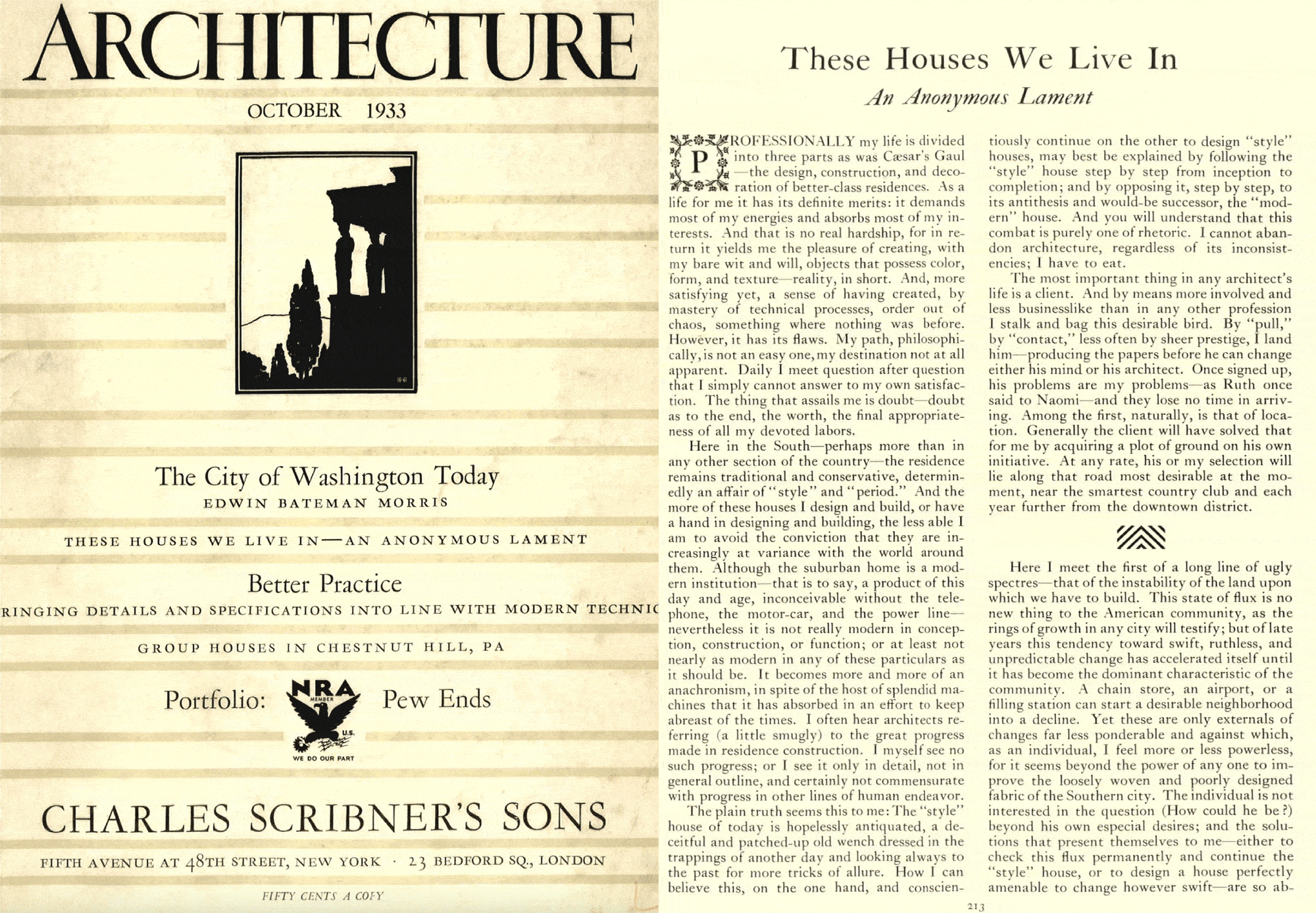
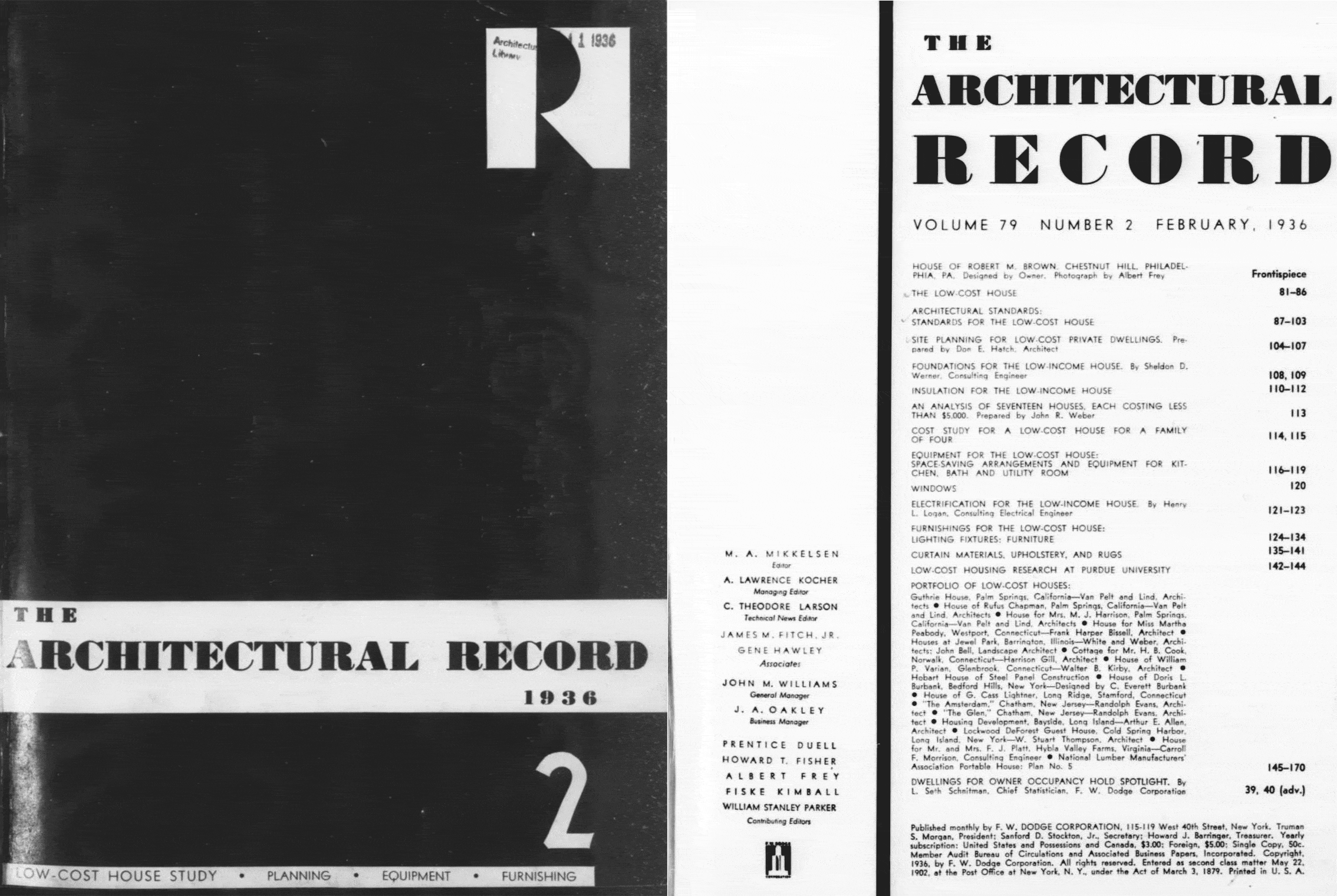
Meanwhile Fitch had started to write, and in 1933 he published “These Houses We Live In: An Anonymous Lament,” a precocious essay in which the young architect confessed his doubts about “the worth, the final appropriateness,” of creating ersatz estates for a well-heeled clientele. “The more of these houses that I design and build,” he wrote, “the less I am able to avoid the conviction that they are at variance with the world around them … not really modern in conception, construction, or functions.” 4 The unsigned essay attracted the attention of Architectural Record, which offered him a staff job, and in early 1936, still in his 20s, Fitch moved to New York City. By now an ardent modernist, his first issue as associate editor was dedicated to “the low-cost house.” He remained on the magazine’s masthead for several years, until the U.S. entry into World War II. Drafted into the military, he was assigned to weather forecasting. “They made a meteorologist out of me in the Air Force,” he later said. “That was the first time I was both compelled and permitted to examine this phenomenon and its relationship to architecture.” 5
His first issue as associate editor of Architectural Record was dedicated to ‘the low-cost house.’
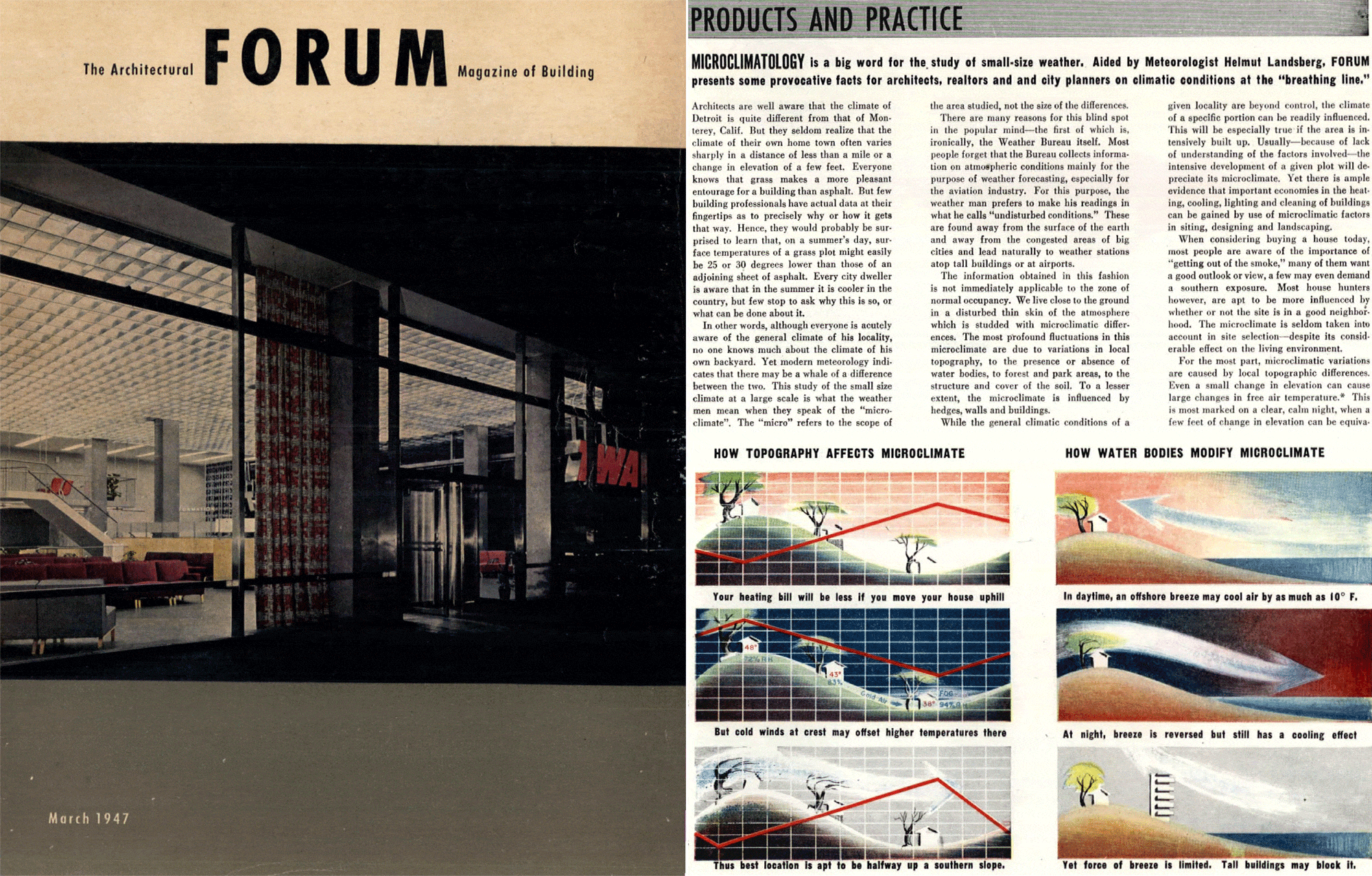
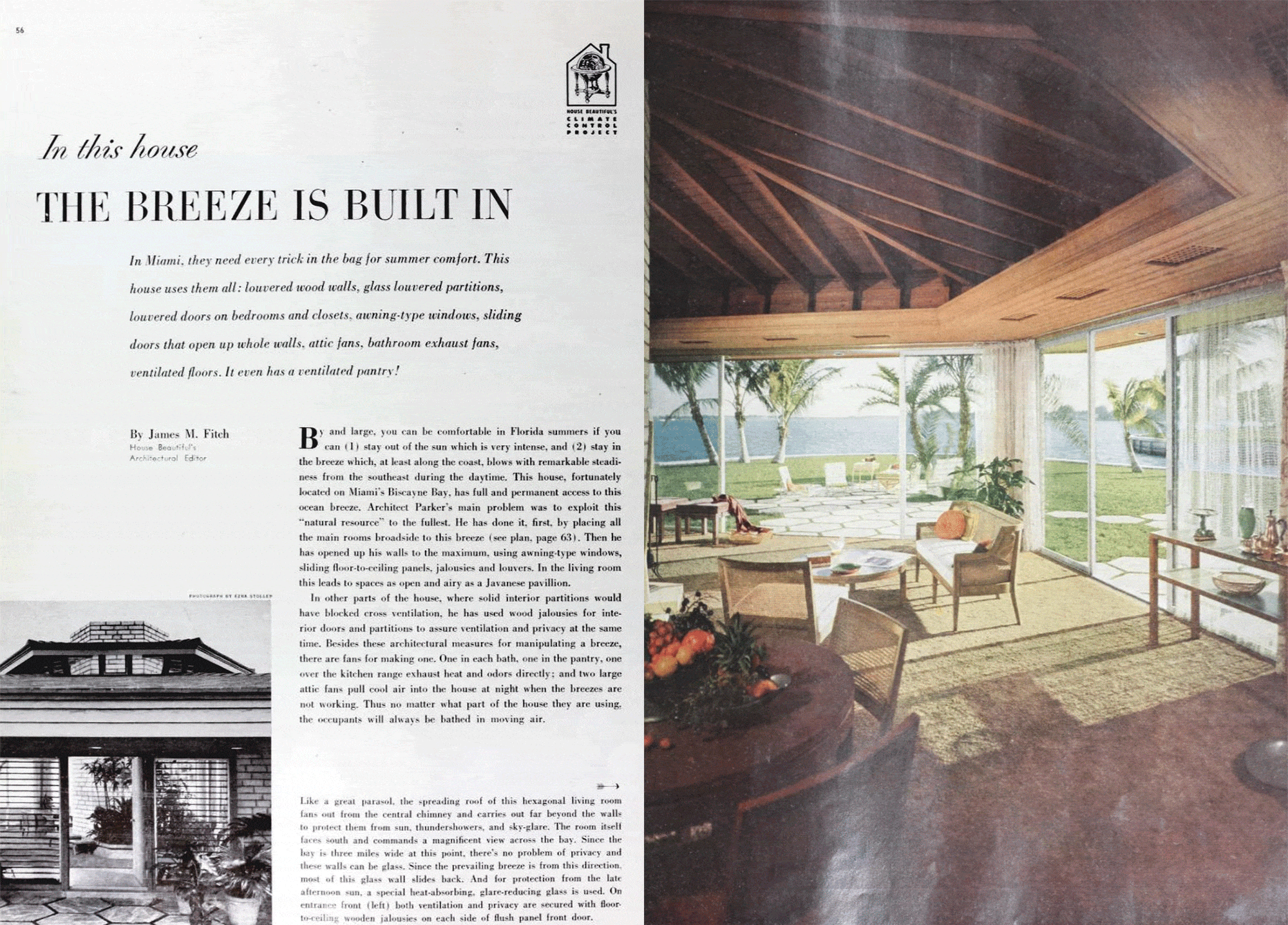
After the war he returned to New York and to editorial work, now at Architectural Forum, where his first major article was on “microclimatology,” and where one of his office mates was Jane Jacobs, who became a close friend. From Forum he moved to House Beautiful, an influential shelter magazine; there he helped launch the Climate Control Project, a feature series that applied climatological analysis to residential design. The project was popular, and in its early years, as historian Daniel A. Barber writes, “they examined everything from window curtain material, to urban planning and site selection, to a capsule history of American architecture according to climate innovations.” 6
By the mid-1950s, however, the magazine’s editorial policies were shifting in response to the rise of Joseph McCarthy and his political persecution of “un-American activities.” In a notorious essay from spring 1953, its chief editor denounced the work of European émigré architects as a “threat” to “home-grown” modern design and to the “greater good” of what she called the “Next America.” 7 Fitch, a longtime proponent of the Bauhaus, resigned in protest; and more, he and his wife, distraught by the demagoguery and xenophobia of McCarthyism, decided to uproot themselves and leave the country, sailing for Europe in June 1953, “on the very day,” he wrote, “that the Rosenbergs were executed for alleged conspiracy.” 8
The exile would prove brief; a year later the eminent historian Talbot Hamlin invited Fitch to join the architecture faculty at Columbia. He remained there for the next quarter-century, co-founding the first program in preservation education in the U.S. When he reached the university’s retirement age, Fitch left teaching and took up a partnership at the New York firm Beyer Blinder Belle, where he directed a series of major projects, including the restorations of Grand Central Terminal and Ellis Island. Over the years he received numerous awards and honorary degrees, including from Tulane, and he set up a charitable foundation to give grants “to further his commitment to training professionals to protect and curate our built environment.” When he died, in 2000, his New York Times obituary praised him as “an architect whose writings and teaching helped transform historic preservation from a dilettante’s pastime into a vigorous, broadly based cultural movement.” 9
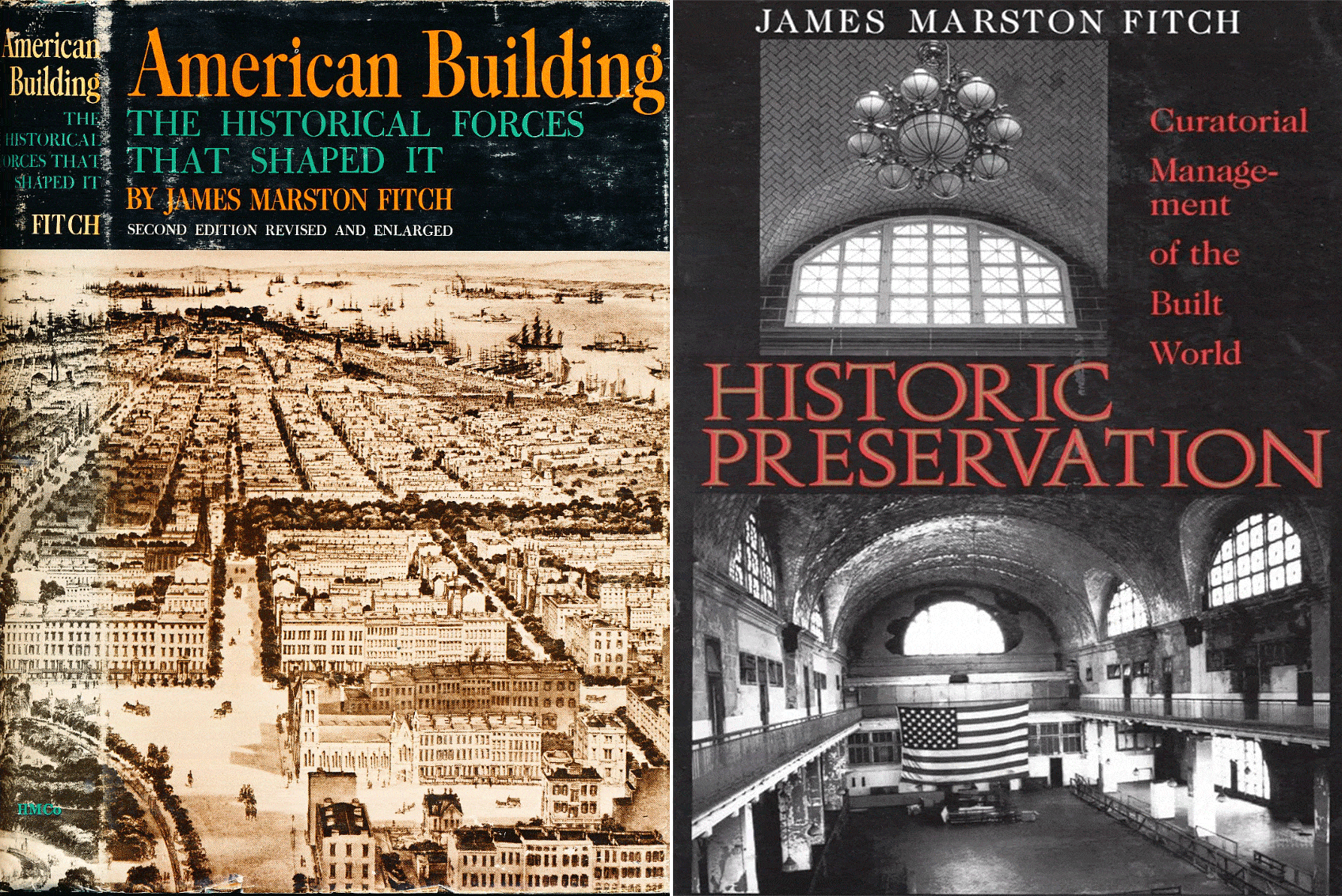
In his lifetime Fitch’s reputation was rooted, to a significant degree, in his prolific literary output. An autodidact without a college degree, he wrote many articles and books, most notably a trio of sprawling histories: American Building: The Forces That Shape It, appeared in 1948 and was expanded in 1966; American Building: The Environmental Forces That Shape It, followed in 1972; and Historic Preservation: Curatorial Management of the Built World, in 1982. 10
‘In architecture,’ Fitch wrote, ‘there are no spectators: there are only participants.’
To read these hefty books today is to be impressed by their outsized ambition, unaffected erudition, and not least, up-front democratic politics. What’s especially striking is the continuing insistence that buildings are not just artifacts to be designed and constructed, but environments to be inhabited and experienced. “It is from this point of view, the consumer’s, that building may be most fruitfully analyzed,” Fitch wrote in the first edition of American Building. 11 Throughout his career he would do precisely that. He argued against the tendency of designers and critics alike to treat architecture mainly in terms of visual perception, to concentrate on a building’s formal or plastic qualities and ignore its multisensorial realities. Architecture, he contended, “can never be felt, perceived, experienced in anything less than a multidimensional totality.” In an essay from 1970, he assesses what he considers a “conceptual limitation” of much architectural criticism:
Far from being based narrowly on any single sense of perception like vision, architectural esthetics actually derives from the body’s total response to, and perception of, the environmental conditions which that building affords. It is literally impossible to experience architecture in any “simpler” way. In architecture there are no spectators: there are only participants. The body of critical literature which pretends otherwise is based on photographs of buildings rather than on experience of the actual buildings. 12
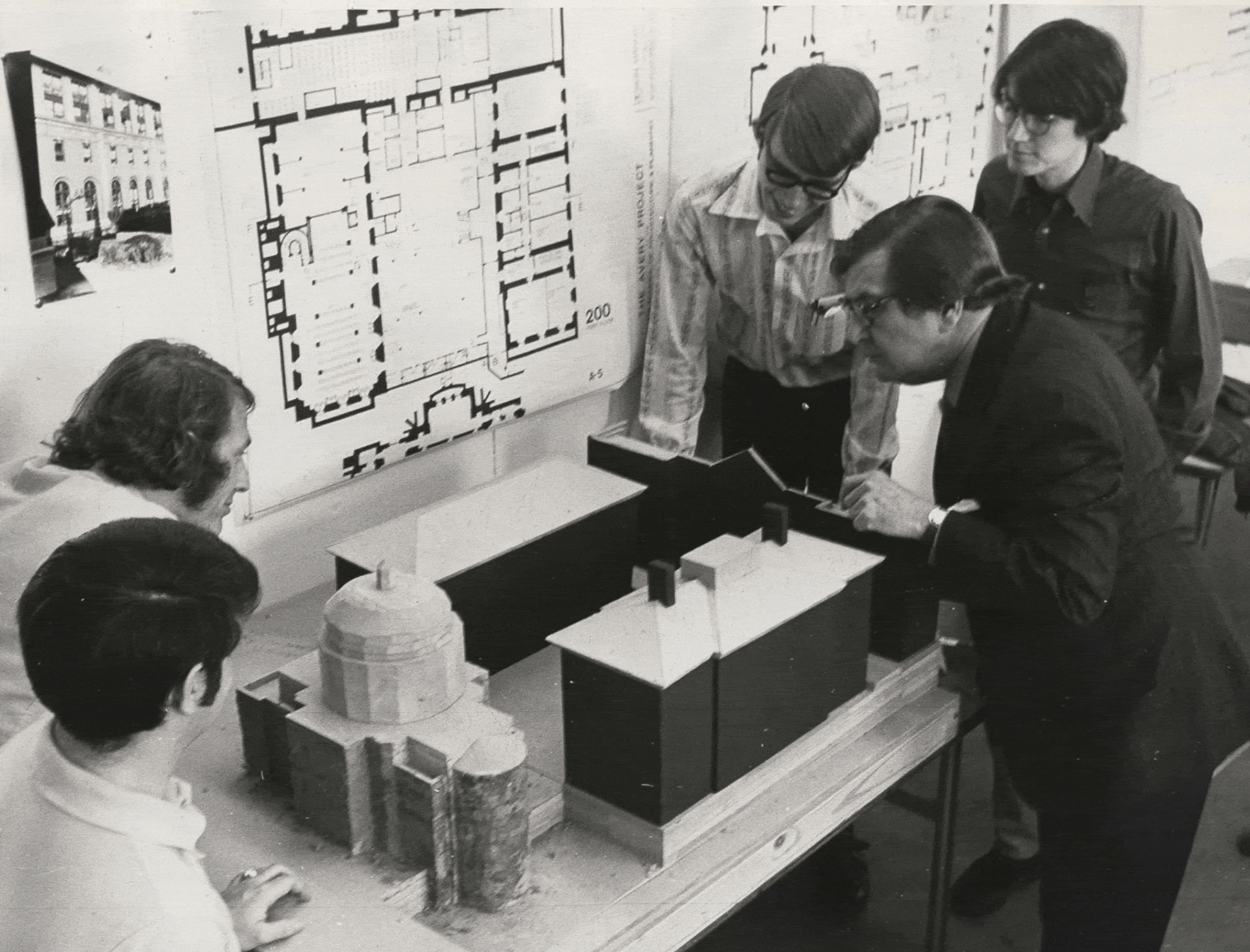
Fitch’s writings on urban planning are equally expansive; they are also unflinchingly polemical. In the mid-1960s, he identified the socioeconomic dysfunction that plagues us still: “The most disturbing aspect of life in the United States today is the widening discrepancy between privatized luxury and public amenity.” He called out the “decline in public facilities of all sorts,” and the “falling levels of maintenance of public transportation, parks and playgrounds, water and sanitation systems.” 13 Likewise, in that same postwar decade, as the Interstates were being constructed from coast to coast, Fitch deplored the dismantling of the country’s networks of urban transit and regional rail, and the resulting over-dependence on what he described, with unnerving foresight, as “an inconceivably fragile, inefficient, and expensive system of highways and airlines.” 14 He observed with dismay the unfolding programs of “urban renewal,” and the gentrification that so often accompanied these programs. Urban neighborhoods, he wrote, “should be restored for their original population and not for a new population which has historically no right to be there in the first place.” 15
He countered the facile narrative that cities had become too messy and unmanageable (read: poor and Black), and that the city itself was doomed to disappear.
Fitch was a steadfast champion of cities. In a chapter of the 1966 edition of American Building titled “The Paradox of Abundance,” he conceded the appeal of the burgeoning suburbs, their “beauty, privacy, safety, and material comfort.” Yet he criticized the society that was emerging in the suburbs as “parochial … one-dimensional, mono-colored, politically alienated; in a word, parasitical.” 16 He countered the facile narrative that cities had become too messy, crowded, unmanageable (read: poor and Black), and that the city itself was doomed to disappear. In a gorgeous essay from 1961, he rooted his case in history. Cities were not merely statistical containers of population, not simply accidents of convenience or proximity. “As the etymology of the word suggests,” Fitch wrote, “the city has always been not merely the vessel but the actual generator of civilization.” To this point, the overlapping energies of metropolitan life were qualitative as well as quantitative phenomena, and urban center not merely a spatial metaphor but an actual social reality.
Such a center represents a unique concentration of cultural forces. Personal face-to-face contact; daily exposure to the friction of competitive ideas; continual exchange of information and opinion within related fields — these are the essential properties of the center. And this, precisely, is why the center cannot be decentralized. Modern technology may permit the dispersal of this or that phase of production. Modern telecommunications may make it possible for a single national center to control a national industry. But the creativity of the urban center will no more survive subdivision and dispersion across the countryside than would the human brain survive a similar distribution across the nervous system. 17
I first read Fitch’s Cornell talk while doing editorial research for our series on repair, and was struck immediately by the contemporary relevance of this almost half-century-old text, which we are republishing here. 18 Fitch was writing in a decade that had seen, on the one hand, a series of destabilizing crises in the price and availability of oil, and on the other, the rise of a powerful environmental movement and a new ethos of energy conservation. In a 1973 issue of Architectural Forum on “Architecture and Energy,” Richard Stein, who would be one of the speakers at Cornell, recapitulated what had by then become a familiar critique when he decried the “excessive energy use” and “really poor performance” of many buildings. 19
Fitch was making a holistic argument about the comprehensive value of existing buildings.
At Cornell, Fitch’s main concern was not whether any particular building might or might not be efficient; he was making a more holistic argument about the comprehensive value of existing buildings. His thesis is at once simple and radical. Because a work of architecture requires an enormous amount of energy to construct and maintain, these works need to be valued and conserved as cultural and economic assets, “part of the fundamental resources of society.” And more: they need not only to be conserved but prioritized over new works.
Before we decide to construct a single new building, we must re-evaluate all existing building stock around us. Before we destroy old buildings in favor of new structures we must understand that this not only involves the expenditure of a great deal of energy, but might very well be less efficient.
Fitch presents this proposition — an existential challenge to a discipline long centered on new construction and novel form — as if it were an obvious guideline for professional practice. American architects may have been operating on false assumptions about the cheapness and abundance of energy, but change is imminent; a new era is coming into view. “What is becoming clear to all of us, even to architects,” he writes, “is that this Alice in Wonderland period is ending. This is going to force upon all aspects of American society, especially on the construction industry, a radical revision of attitudes toward the built world which we inhabit.”
Today it can feel unsettling, to say the least, to read these optimistic predictions for a better future, a “radical revision of attitudes”; and just as unsettling to realize that back then the optimism could be justified. A few years before the Cornell symposium, in 1969, Congress passed the National Environmental Policy Act, or NEPA, with a set of ambitious goals: “to declare a national policy which will encourage productive and enjoyable harmony between man and his environment; to promote efforts which will prevent or eliminate damage to the environment and biosphere and stimulate the health and welfare of man; to enrich the understanding of the ecological systems and natural resources important to the Nation.” And not only did the landmark law pass — the Senate vote was unanimous. 20
Fitch presents this proposition — an existential challenge to a discipline centered on new construction — as if it were an obvious guideline for practice.
A few months later, in April 1970, the first Earth Day rallies attracted an estimated 20 million protestors — ten percent of the population at the time, and still one of the largest mass mobilizations in American history. Later that year a Republican president established the Environmental Protection Agency, and over the next few years Congress passed the Clean Air Act, the Clean Water Act, and the Endangered Species Act. A year before Fitch spoke at Cornell, Jimmy Carter delivered an address from the Oval Office in which he declared the energy crisis to be “the greatest challenge” facing the United States. “We must start now to develop the new, unconventional sources of energy that we will rely on in the next century,” Carter said. “We’ve always been proud of our leadership in the world. And now we have a chance again to give the world a positive example.” 21
In a short essay published in The New Yorker on the day of Jimmy Carter’s death, last December, Bill McKibben eulogizes the former president as a “green visionary,” and mournfully encapsulates what happened next, when the election of Ronald Reagan in 1980 ended not only Carter’s political career but also the nascent national commitment to clean energy (among so many other public goods). “That election was the hinge point in our national political life,” McKibben writes, “when we turned our back on the idea of America as a group project that we’d been pursuing since F.D.R., and instead embraced the vision that government was the problem, that markets took care of all ills, that our job was to look after our own individual selves. Reagan had no qualms about drilling everywhere: the price of gas dropped, cars turned into S.U.V.s, and we started driving the Earth toward the edge of the cliff.” 22
In his last published work, the 1999 reissue of American Building, Fitch registered the sociopolitical shifts of the late millennium. In an elegiac chapter titled “Prospects for the Democratic Esthetic,” he acknowledged the waning of “the tradition of the socially conscious, intellectually committed architect,” and the growing allegiance, over the decades of his lifetime, to private enterprise, and to an “aristocratic esthetic” that he described as “the outward evidence of an internal involution: the abdication by the profession of its claim to be the architect of the whole people, to become instead the agent and spokesperson for the elite.” 23 At the same time he was warily optimistic that the “utopian element in architectural thinking is alive … spurred largely by the environmental movement.” 24 Yet again Fitch made a hopeful case for a new era of energy conservation, now empowered by digital computation. “This new ability to quantify the energy in manmade artifacts gives us an awesome tool for establishing new attitudes toward evaluating the build world.” 25
Today those “new attitudes” are still in formation. In a conversation in this journal, Jorge Otero-Pailos, director of the preservation program at Columbia, discusses the legacy of his predecessor: “Clearly Fitch was ahead of his time. He’s still ahead of our time!” But now there are many who share what Otero-Pailos describes as Fitch’s vision of a “pedagogical revolution” that would instill “a new architectural imagination centered on care.” “Imagine,” Otero-Pailos asks, “if every architecture school were to re-orient towards solving the massive problem of how to care for the built environment we already have?”
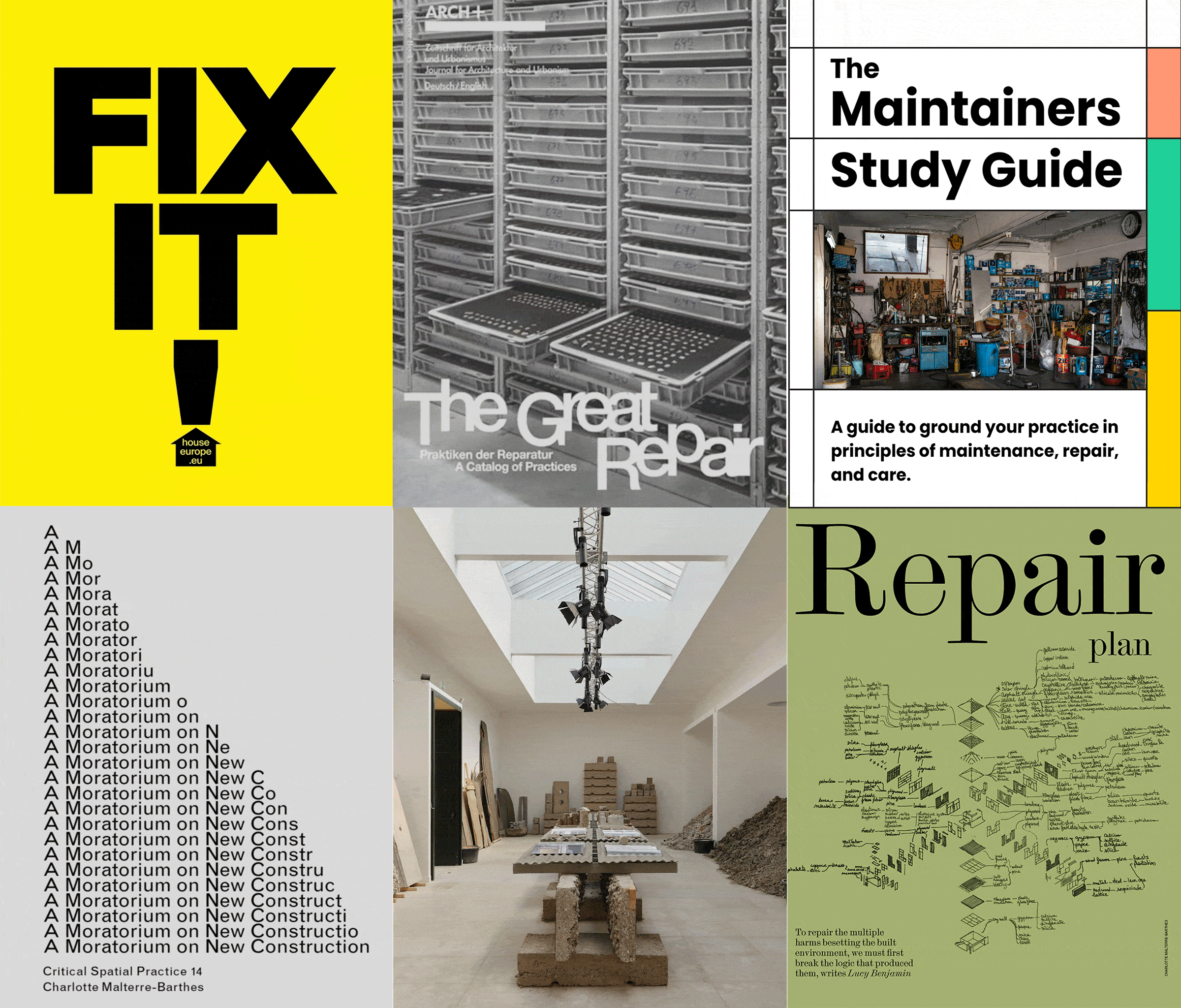
This new imagination is animating recent books including A Moratorium on New Construction, by the French architect Charlotte Malterre-Barthes, and The Great Repair, a reader organized by the editors of Arch+ and a consortium of European academics, and it is inspiring journals — including Places — to dedicate series and whole issues to repair. It’s evident in the theme of the Danish Pavilion at this year’s Venice Architecture Biennale, which explores “how we can discover new value in existing buildings,” and in what technology scholar Steven J. Jackson describes as “a growing substrate of repair studies … across fields too numerous to list, from geography to computing, sociology to architecture, design to (post)development.” It’s motivating interdisciplinary initiatives such as The Maintainers, which focuses on “maintenance, infrastructure, repair, and the myriad forms of labor and expertise that sustain our human-built world,” and HouseEurope!, which seeks “to create incentives that make renovation the new norm … and give new value to what is already there.” 26 The list could go on. It’s a list on which the wise and prescient writings of James Marston Fitch deserve a preeminent place.
We might yet make our way out of Wonderland.
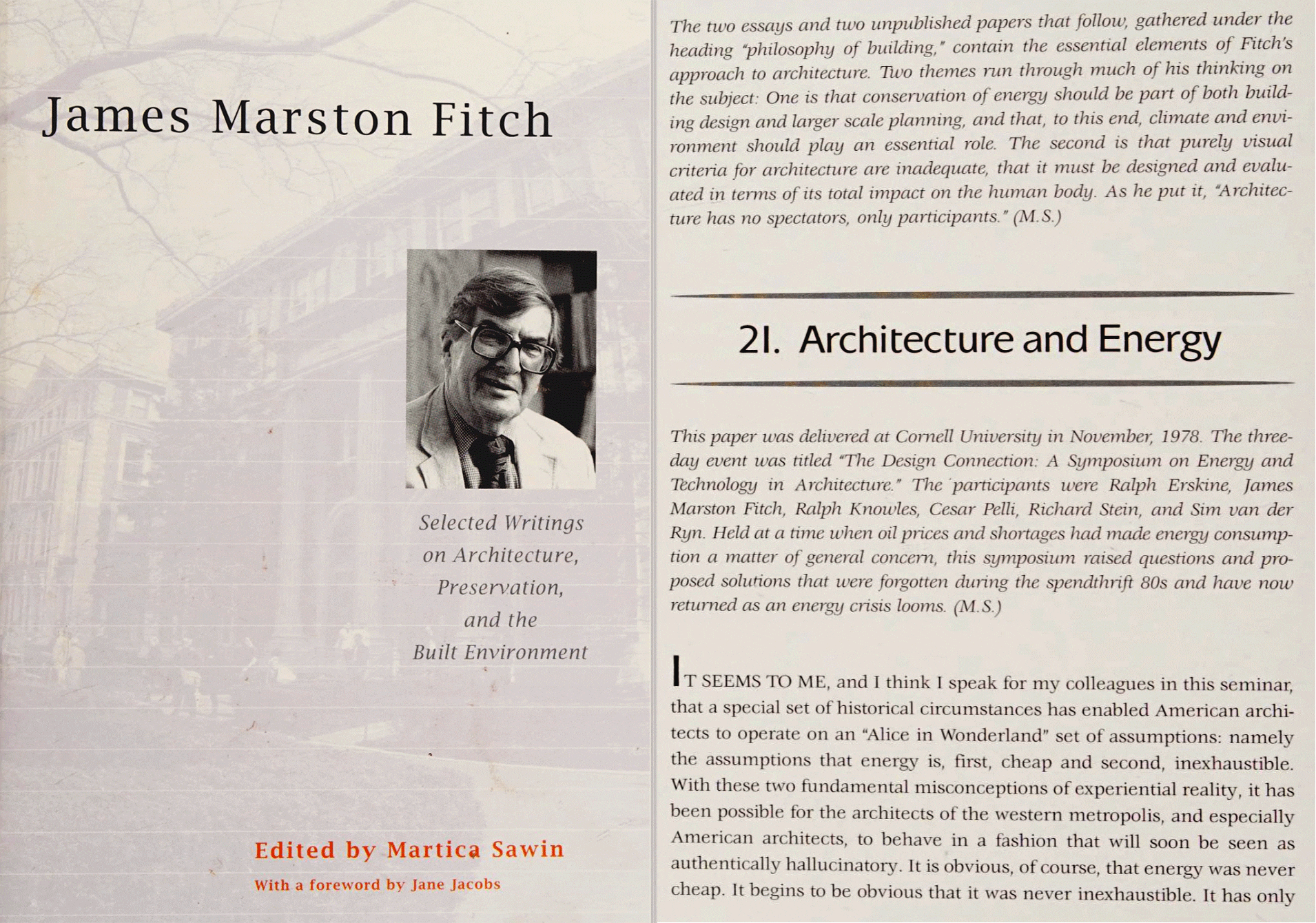
Architecture and Energy
by James Marston Fitch
It seems to me, and I think I speak for my colleagues in this seminar, that a special set of historical circumstances has enabled American architects to operate on an “Alice in Wonderland” set of assumptions: namely the assumptions that energy is, first, cheap and second, inexhaustible. With these two fundamental misconceptions of experiential reality, it has been possible for the architects of the western metropolis, especially American architects, to behave in a fashion that will soon be seen as authentically hallucinatory. It is obvious, of course, that energy was never cheap. It begins to be obvious that it was never inexhaustible. It has only seemed cheap to Americans because of a very peculiar set of circumstances. We fell heir to a fantastically rich primeval patrimony possessing all kinds of resources: wood, coal, steel, waterpower, iron, bauxite — all the raw materials of architecture. Because of this legacy it is easy to understand how the misconception that our energy resources were inexhaustible could have been propagated most ferociously in America.
The scale of our waste of energy, our profligate use of energy, actually has the curve of a logarithmic, not arithmetic, scale.
But the scale of our waste of energy, our profligate use of energy, actually has the curve of a logarithmic, not arithmetic, scale, especially since World War IL The illusion that energy in all forms that go into architecture was cheap was based on several factors. In addition to continental resources, we have had access to those of the rest of the world. In short, the true cost of energy was being absorbed by what we now call the Third World. If aluminum was cheap enough to replace glass, it was because it was produced by underpaid people in the Caribbean. Or if oil and gas could be sold for 11 cents a gallon as recently as five or six years ago, it was because the real cost was being absorbed by underpaid Venezuelans and Arabians. If we analyze raw materials from this point of view, we will see that the cost was never cheap. It was only cheap to Americans because they occupied this unique position in Wonderland.
Another reason energy has seemed cheap to us is that we have not yet had to face the consequences of our obscene misuse of it, the true costs of which are going to be absorbed by our children and grandchildren. It is they who will handle the question of so called “disposable” cartons and packaging, most of which, of course, are not biodegradable or chemically disposable at all. The larger, more terrifying prospect of what we are handing on to the future is atomic energy, the question of how wastes from this process are going to be handled. If atomic energy can be described as cheaper than hydroelectric energy today, it is exclusively because the true societal costs of atomic energy are not being faced today.
We’ve built great cities, and then proceeded to discard them, moving further and further out into the countryside.
One could go on with this catalogue of horrors indefinitely. What is becoming clear to all of us, even to architects, is that this Alice in Wonderland period is ending. This is going to force upon all aspects of American society, especially on the construction industry, a radical revision of attitudes toward the built world which we inhabit. It is going to compel us to realize that this built world which we handle with such profligacy, those great cities like Chicago, Cleveland, New York, every big city in the United States, has enormous areas of urban tissue which we have discarded in much the same way we discard milk bottles or Kleenex. We’ve built these great cities; we’ve lived in them briefly; and then we have proceeded to discard them, moving further and further out into the countryside. Among other forms of waste, we have despoiled critically valuable agricultural land in this process.
If my understanding of the situation is correct, we are going to be compelled to reevaluate these used, so-called obsolete artifacts of our culture, whether it is a milk bottle or a St. Louis suburb. We are going to have to realize that our present attitudes represent a grotesquely inaccurate understanding of the long range, societal value of these artifacts.
The concept of technological obsolescence is an invention of the last fifty years — an American invention, based on miscalculations of the availability of energy.
The whole concept of technological obsolescence is an invention of the last fifty years. Fundamentally, it is an American invention, based on miscalculations of the availability of energy. There are certain areas of American technology in which there has, indeed, been very rapid and accelerating progress. This would be true in science and the higher technologies, particularly in space exploration, whereby the Sputnik of 1956 is made quickly obsolete by advances in rocket science. However, this concept, which applies only to very special and discrete areas of activity, has been extended to cover the whole range of human artifacts. Detroit is the most bizarre example of this incorrect application, with its constant insistence that we purchase the newest model automobile. For half a century Detroit has been hard at work trying to convince us that change is identical with progress, and that anybody who dared to challenge this concept is automatically a reactionary.
This criterion of technological obsolescence has also been accepted by architects and planners, indeed the whole construction industry. We’ve uncritically accepted the proposition that anything new is automatically better than what preceded it. This has led to the situation I speak of — millions of acres of expensively developed urban tissue which have been briefly used and then discarded in favor of new and reputedly better construction.
Until the last century, people recognized the enormous amount of energy required to build anything, whether it was a quilt or a pair of shoes or a house or a town.
Historically, this is an unprecedented attitude. Until the last century, possibly until just the last fifty years, people recognized the enormous amount of energy that was required to build anything, whether it was a quilt or a pair of shoes or a house or a town. It was commonly understood that these artifacts were deposits of what Richard Stein has called “embodied energy.” As a consequence, they were assets, those old shoes and houses. They were not obstacles to progress, but part of the fundamental resources of the society. This meant that no artifact was thrown away until the last possible ounce of energy had been extracted from it. A typical American artifact like a quilt is a quintessential demonstration of this process. Any American with his wits about him in 1850 knew how much energy it took to produce a yard of cloth: to grow the cotton, beat the hemp, raise the indigo, spin the twine, weave the fabric, cut and sew it. Everybody understood that implicit in this yard of cloth was a great deal of energy, both human and mechanical. As a consequence it was handled with care, even by the prosperous. A pair of pants was worn by Johnny, then Johnny’s younger brothers, until they started to disintegrate. Then grandmother cut the pants into pieces and used them in a quilt. Finally, the fabric was either made into felt or converted into first-class paper, and thus recycled again.
This acknowledgment of the costs of energy was true for the rich and powerful as well as the peasant. That Roman emperors recycled their resources is obvious from the recycled building materials and reuse of carved reliefs on later structures in the Forum. A careful examination of the base of the Acropolis reveals that most of the retaining walls are constructed with the drums of columns from earlier buildings, which also were used in paving the surrounding streets.
Historically it is perfectly clear that the human race was not able to make the fundamental errors of our time. It’s only within the past fifty years, mainly in North America and to some extent in Western Europe, that this attitude toward energy has been possible. It wasn’t that our ancestors were smarter than us, it was merely that there were parameters, insuperable limitation, to what was technically possible for them. This is what kept our ancestors “in shape” and made their attitude toward the built world more rational and sane than ours.
I think the coming shortage of energy will prove to be a very healthy development, one which will compel us to examine the real world in a way we haven’t done for decades.
Far from being distressed by the coming shortage of energy, I think it’s going to prove to be a very healthy, therapeutic development, one which will compel us to examine the real world in a way that we haven’t done for decades. The members of this panel have long been concerned with establishing sensible economic parameters for the use of energy. Whether it is Knowles’ long exploration of the architectural consequences of sunlight, the solar energy that falls on all buildings, or Erskine’s theoretical investigations of technology and the Arctic way of life, all of us have in one way or another been dealing with the architectural and urbanistic utilization of energy. Knowles has pioneered most recently in his work in solar access zoning, i.e., establishing design criteria whereby the whole fabric of a city can be zoned in such a way that every square meter of that city would get an equal share of the sun that fell upon it. Erskine’s work demonstrates the special ways in which energy can be applied to make life not merely possible in the far north, but also more amenable. As Erskine has long pointed out, the north of Sweden and Norway has been populated by the Laps quite successfully for millennia. Lapland culture is of a more primitive level than that required by modern culture. Though it is not possible for modern Swedes to live in igloos, he argues that it is also not possible for modern Swedes to ignore the fundamental precision, the brilliant lucidity of the igloo as a means of exploiting the natural environment.
I had considered myself an avant-garde theoretician of energy conservation. At a recent conference organized by the distinguished physiologist and environmentalist Rene Dubos, I learned that whole circles of specialists are far more advanced than I in this area. It is a matter of bridging the information gap between the work of these specialists and the designers responsible for energy-consuming products such as buildings and automobiles, not to mention stimulating public demand. If we architects try to be more precise about this problem, we must realize that we are talking about two forms of energy: animal, especially human, and mechanical.
Both forms are involved at three levels: construction, maintenance, and habitation of built space. The first is the energy required to fabricate the building, not just that required for construction in the conventional sense, but all the energy required, right back to the extraction of raw materials. It is now possible to quantify this total, to understand for the first time in terms of B.T.U.s how much energy is embodied in any building. The second, more familiar level is the use of energy in the maintenance of buildings, that is, once the buildings are constructed, how much energy will be required to keep them in operating order? My own special interest has been concentrated in the third level, on the amount of energy it takes to occupy space and to perform effective work in that space, on how to analyze the role of the building in which the work takes place, how it conserves our own physical and psychic energy in performing that work.
Compared to the igloo, the great glass tower of the Hancock Building is a primitive construction, if one takes as a criterion the wise application of energy.
In his primal state man is catapulted into a raw environment. A single interface exists between himself and nature, his skin. In most parts of the world this places a great load on him. In fact, there are very few climates in which man could survive without the mediation of clothing or buildings. Hawaii would be one of them, but even in that genial environment, libraries, schools, hospitals, and all the apparatus of civilization require buildings. As a consequence of this necessity, man has invented architecture. Whatever higher levels of satisfaction architecture may afford us, its fundamental task is to create a new environment, a middle scale between the micro-environment of our bodies and the macro-environment of the world: to manipulate the flow of energy in our favor.
If we begin to apply criteria like this to the critical analysis of architecture, we begin to see how often modern technology permits us to err. Many very sophisticated contemporary architectural constructions perform with grossly less efficiency than the Eskimo’s igloo. One could say with complete confidence that compared to the igloo, the great glass tower of the Hancock Building in Boston is a primitive construction, if one takes as a criterion of architecture the wise and sane application of energy for human purposes.
It is in such a context that we will have to discuss energy in the future. Thanks to the work of men like Stein, we have the means of re-evaluating the built world. Before we decide to construct a single new building, we must re-evaluate all existing building stock around us. Before we destroy old buildings in favor of new structures we must understand that this not only involves the expenditure of a great deal of energy, but might very well be less efficient. It is in this context that the historic preservation movement seems to me the most encouraging development on the American scene today. The average person, without the assistance of professionals, has come to the conclusion that the built world can and must be conserved.
We can see right here in Ithaca in the last decade, the way in which the slide of downtown Ithaca towards oblivion has been altered and reversed, largely by citizen activity. This activity can be seen all over the country. Here, the citizens are ahead of architects and planners and engineers. The citizens’ motivations may not always be scientific; they may decide to save an old street because their grandmother lived there, or an old house because George Washington slept there. Motives are often mixed. But the fact is, the public is often ahead of us in understanding the problems of conservation of energy.
Young architects may tend to see my description of the future as a dismal one, as though I am suggesting that they have no future except to knit and repair and patch obsolete fabrics. This is wrong in two respects: first, a surgeon would not consider it as a waste of time to knit and patch damaged parts of a patient’s body. A surgeon would consider it a noble and creative function. Would a comparable level of activity be demeaning for architects? The whole history of architecture, including the noblest buildings, indicates that the reverse is the case.
Men like Ralph Knowles try to convince young architects of the critical necessity of paying attention to the solar energy that, whether they like it or not, will fall upon their buildings. They tend to think that Knowles is trying to box them in, that he is giving them a limited range of mechanistic parameters that will restrict or cripple their creative ability. This is a profound misunderstanding of the thrust of his work. In analyzing even one problem, such as how to manipulate the flow of solar energy between outside and inside, Knowles offers a palette of esthetic choices incomparably wider than current formalist architects enjoy today.
If young architects with artistic ambition responded with wisdom to the force of the sun, they would see an infinite range of possibilities.
If young architects with artistic ambition really responded with wisdom to the force of the sun, they would see an infinite range of possibilities opening up before them. They would understand that the architect doesn’t have to invent avant-garde geometries; the sun itself would dictate those shapes. Rather than suggesting that I am imposing a brutal limitation on creative potential, I think I am suggesting the only real avenue for it. Stravinsky, who was an authentic avant-garde in his field, an innovator who changed the course of modern music, said at the very beginning of his artistic career, “When all things are possible, nothing is possible.” I think that is profoundly true for architects and the built world. It is not our task to invent novel forms that merely titillate our egos for the moment. It is our task to respond with wisdom and discretion, using all the resources of modern science and technology, to real human experiential needs. If we do this, architecture will not be impoverished, but incredibly enriched.


If you would like to comment on this article, or anything else on Places Journal, visit our Facebook page or send us a message on Twitter.