
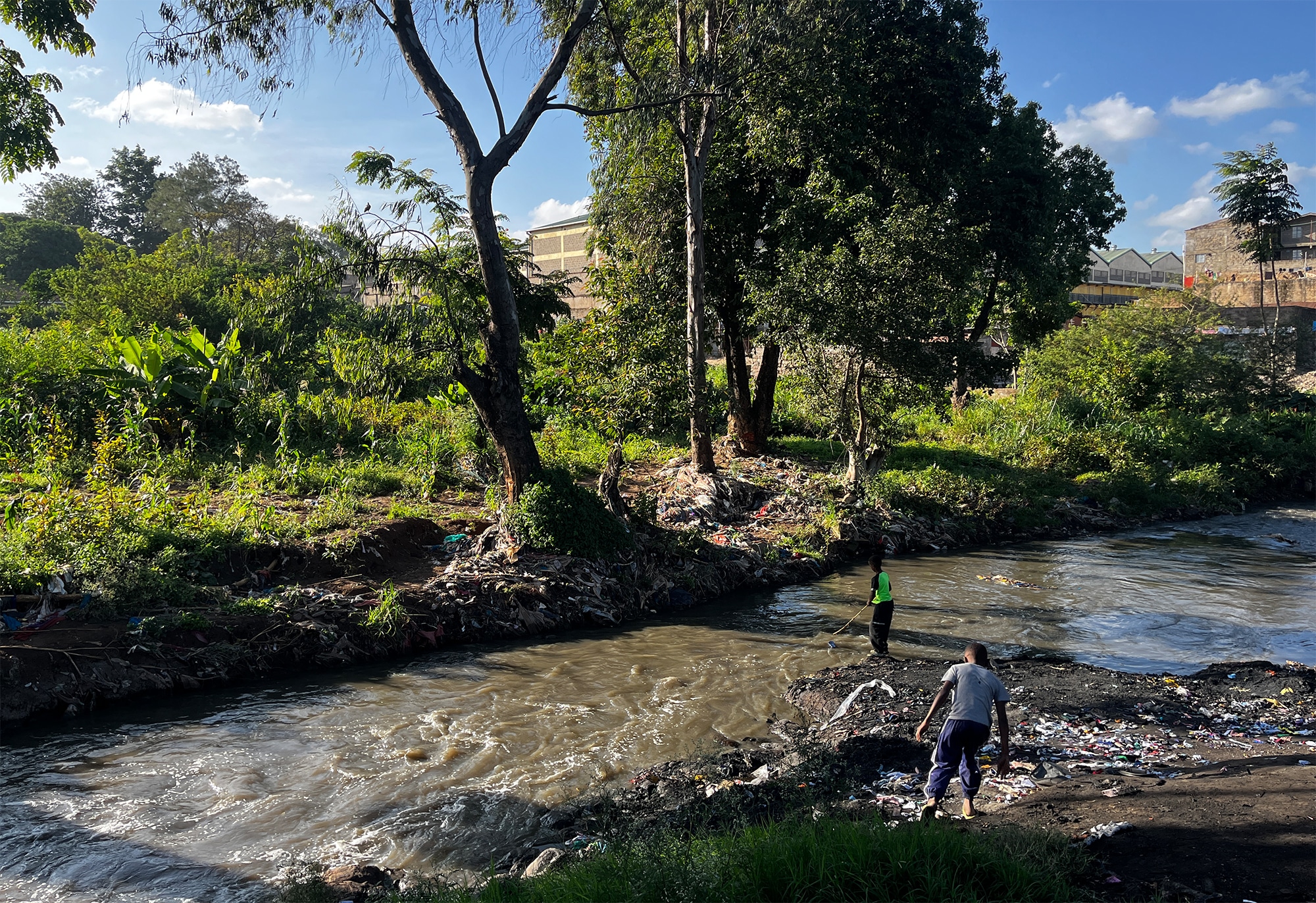
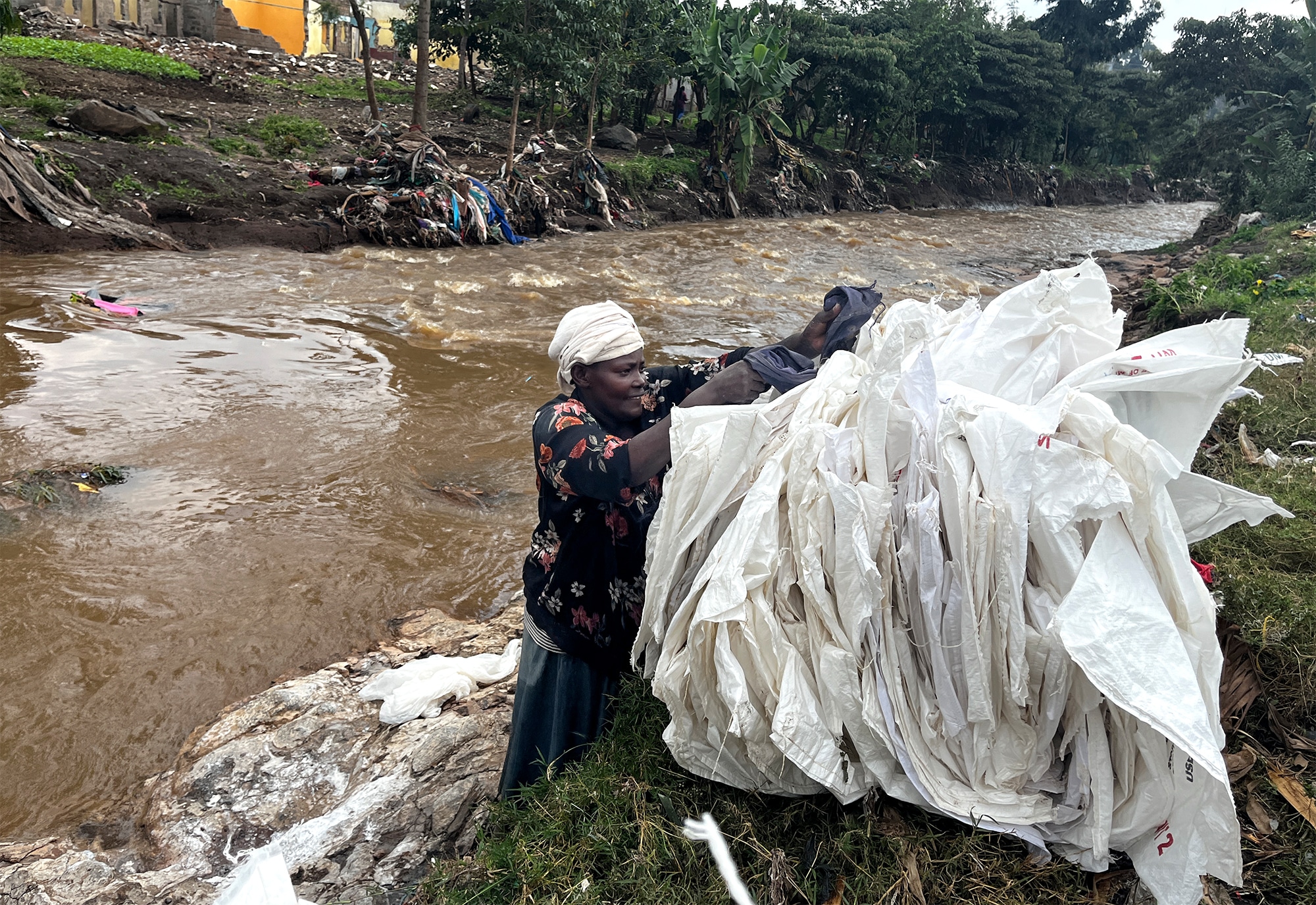
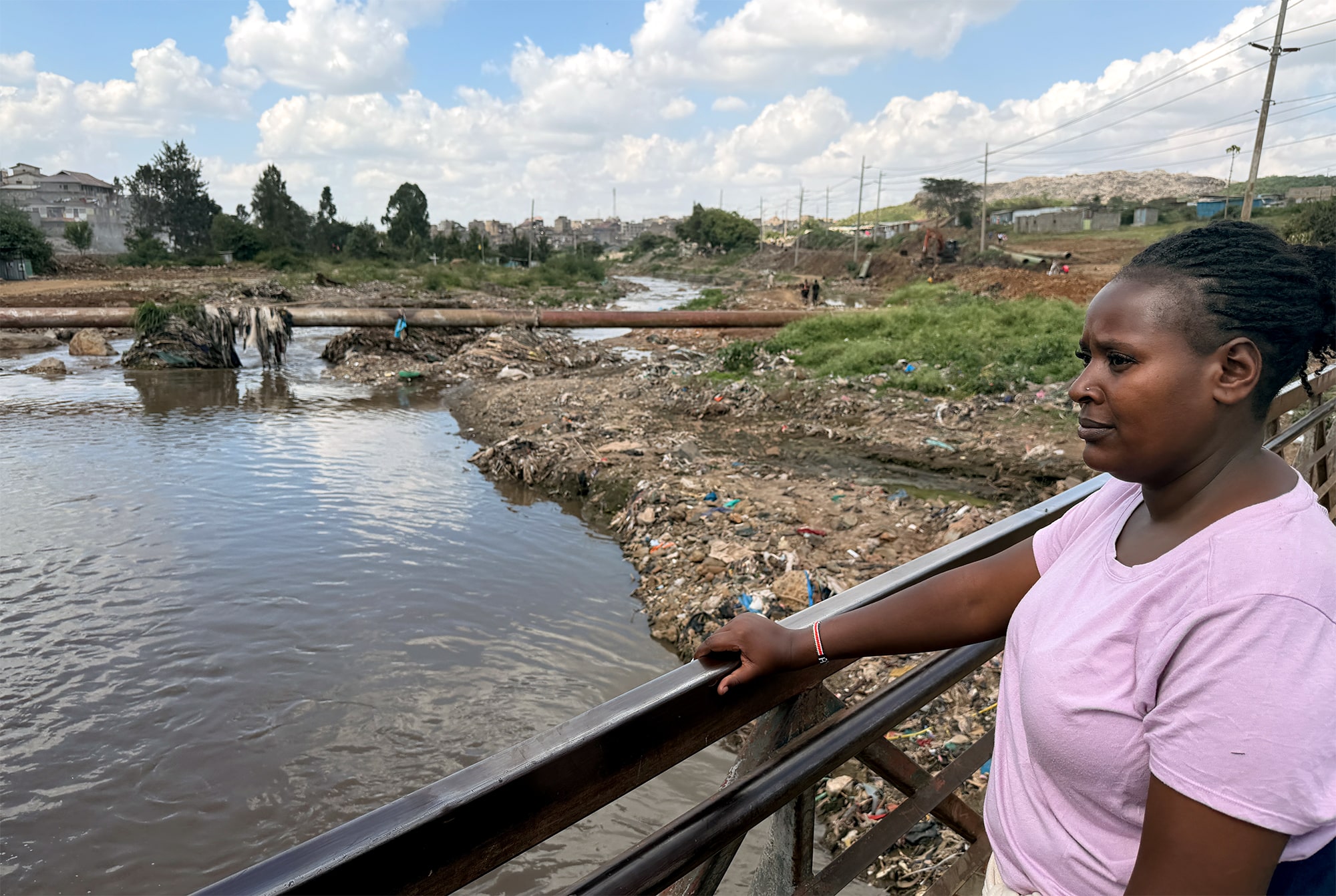
Most of the time, the water that flows past Jane Kalekye’s farm on the outskirts of Nairobi is a brown trickle contaminated with chemicals, sewage, and trash. But on the night of April 23, 2024, she awoke to find the river running straight through her home. When she put her feet down beside her bed, they splashed. Her husband fetched her walking stick and helped her escape. Outside, through the dark, she could see mattresses floating by.
For nearly half a century, the Kalekyes have lived in Korogocho, an informal settlement adjacent to a garbage dump in the Nairobi River basin, about ten kilometers northeast of downtown. Jane remembered the water being this high once before, in late 1997 or early 1998. The long rains were heavy that year, but when the water receded, the roots of her potatoes and cassava were still in the ground, so she continued farming.
On the night of April 23, 2024, Jane Kalekye awoke to find the river running straight through her home.
The 2024 flood was more violent. By daybreak, “most of my crops were swept away,” Kalekye said. “Avocado trees and banana trees had fallen. Maize and beans.” Far worse, two of her neighbors died while trying to rescue a pregnant girl trapped on the opposite bank. “They slipped,” said another resident, and then they were gone.
That same night, a few kilometers upriver in Mathare, Milton Onyango was awakened by banging on his door. “The water is rising!” someone shouted. Inside Onyango’s shack, the river was up to his knees. Tall and round, with a deep voice, he ran out and joined the warning calls, searching in the dark for people who were still asleep. He saw parents carrying their children up the hill to safety, and a house floating downstream with people riding on top.
“So many people died in the flood,” said Jennifer Omae, a volunteer with the Mathare Social Justice Center — at least 40 on the first night in this one settlement alone. 1 But the rains didn’t stop. By the middle of June, across Kenya, 300,000 people were displaced, 65,000 acres of crops destroyed, and 11,000 livestock lost, according to estimates by the government and the Red Cross. Some 315 people were dead and another 162 were missing. 2
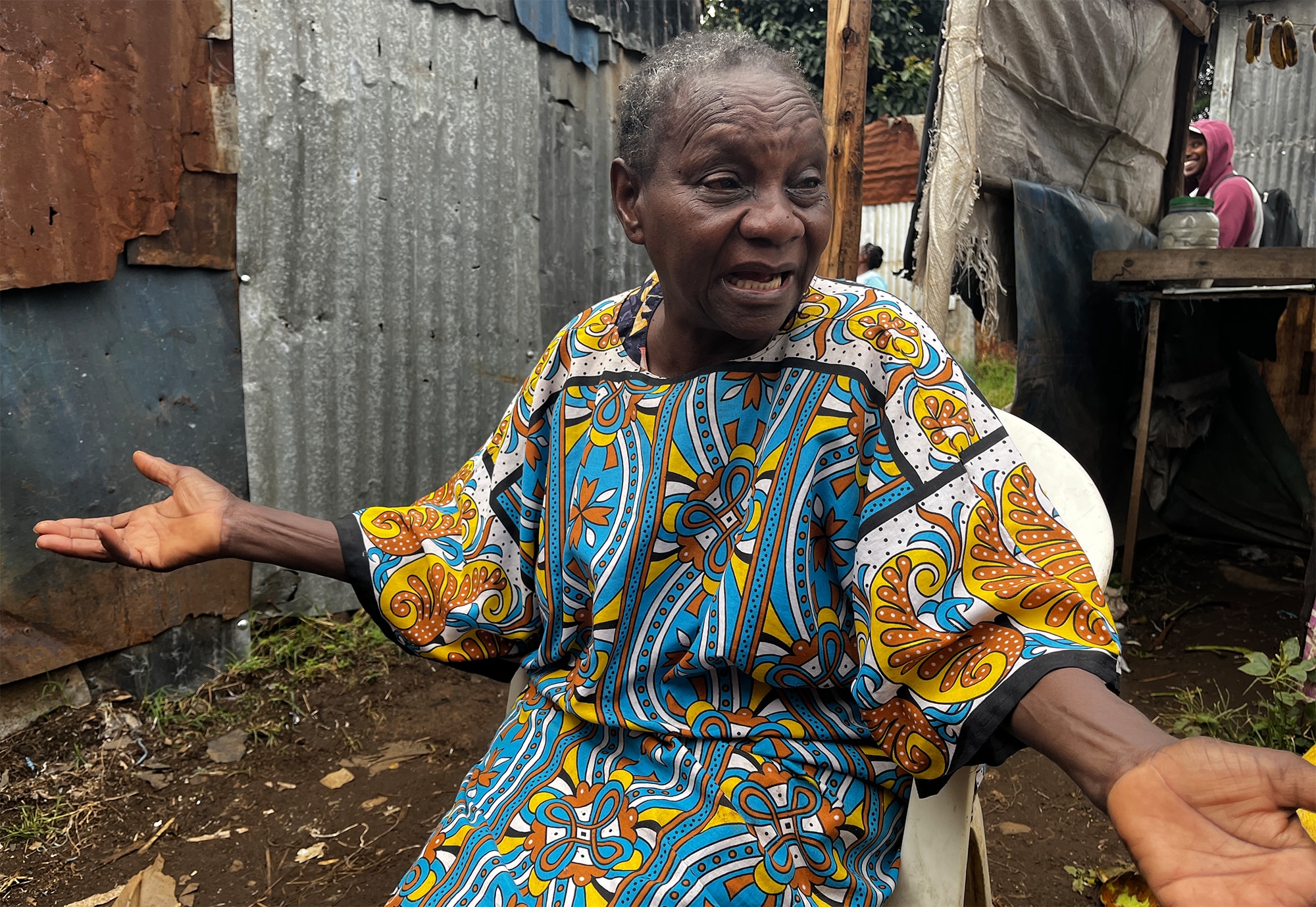
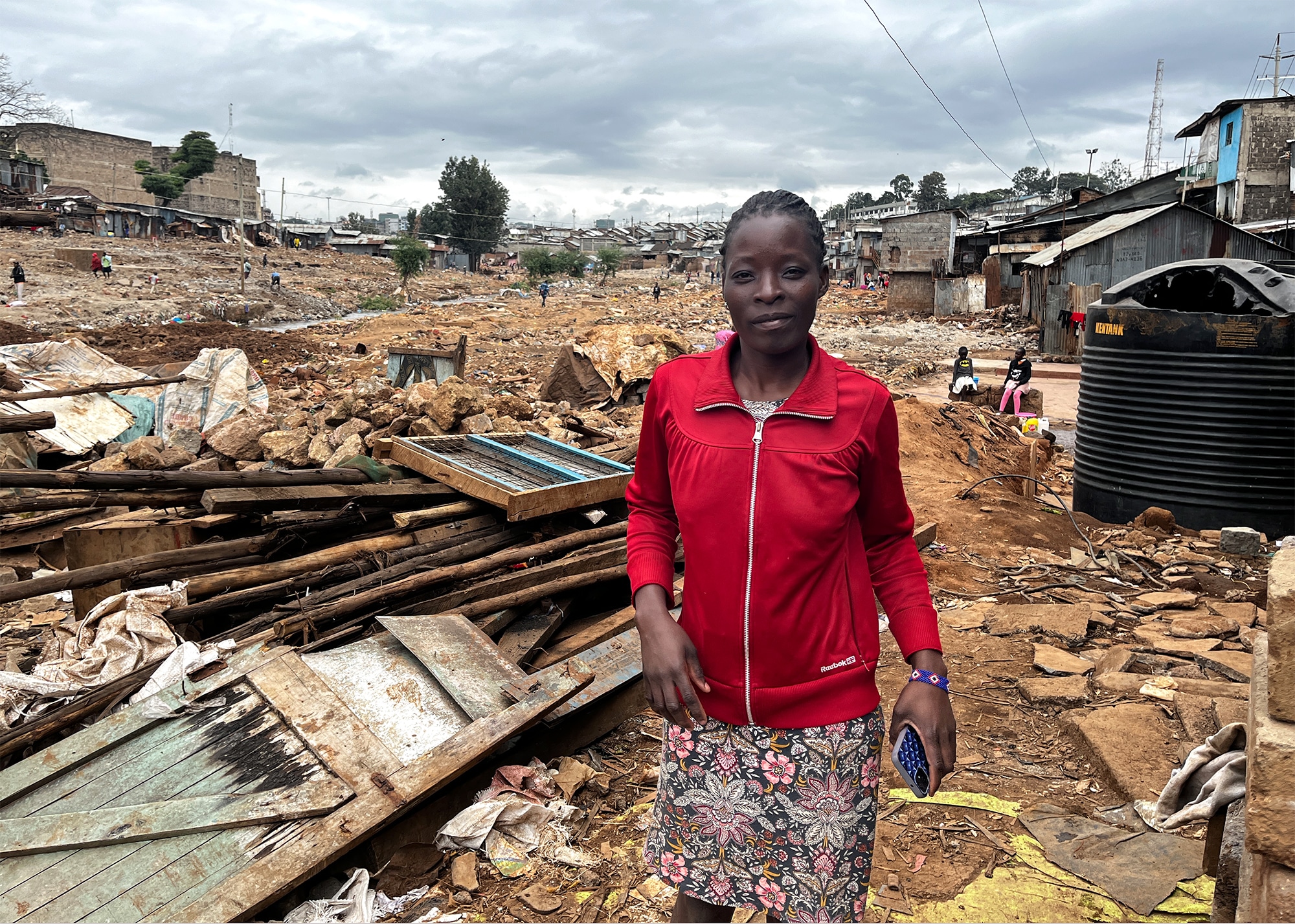
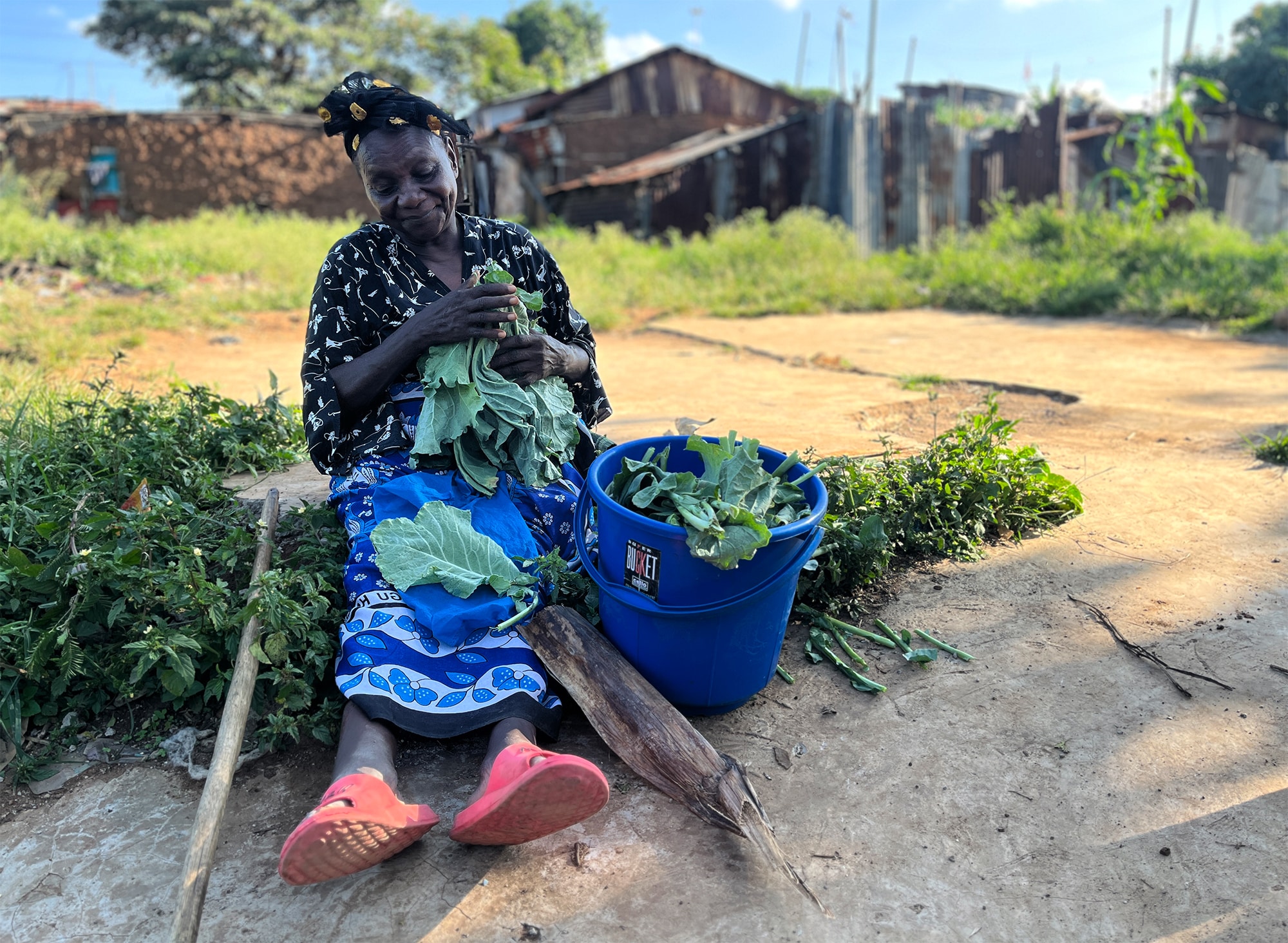
When I first met Jane Kalekye, soon after the rains ended, she shuffled along in flipflops and a colorful kanga dress. Her skin was wrinkled thick, and she had light blue rings around the pupils of her eyes. At 67, she was older than nearly everyone in Korogocho. 3
For nearly half a century, she has farmed land in Korogocho, an informal settlement adjacent to a garbage dump in the Nairobi River basin.
She told me she was born in Machakos, about 60 kilometers southeast of Nairobi. Rain was plentiful, and there was enough grass for her grandparents’ cows and goats to graze on the hill. But the rain brought hazards, too: “People below us would get flooded,” Kalekye recalled.
As a teenager, she found work cleaning and gardening for a wealthy family in Nairobi, where she met her husband, who washed and ironed the family’s clothes. Each day she would walk her employers’ kids to school, but soon she had two babies of her own, and she knew she couldn’t afford the school fees as they grew older. Jane and her husband decided to make the 400-kilometer journey to his home village in western Kenya so the children could get an education.
“Life was very difficult upcountry,” Kalekye said. The rain was intense, and the lightning killed cows and started fires. “The climate wasn’t good. I would get sick.” Tragically, their young son died from pneumonia. So, in 1977, they moved back to Nairobi, settling on open land near the river in Korogocho.
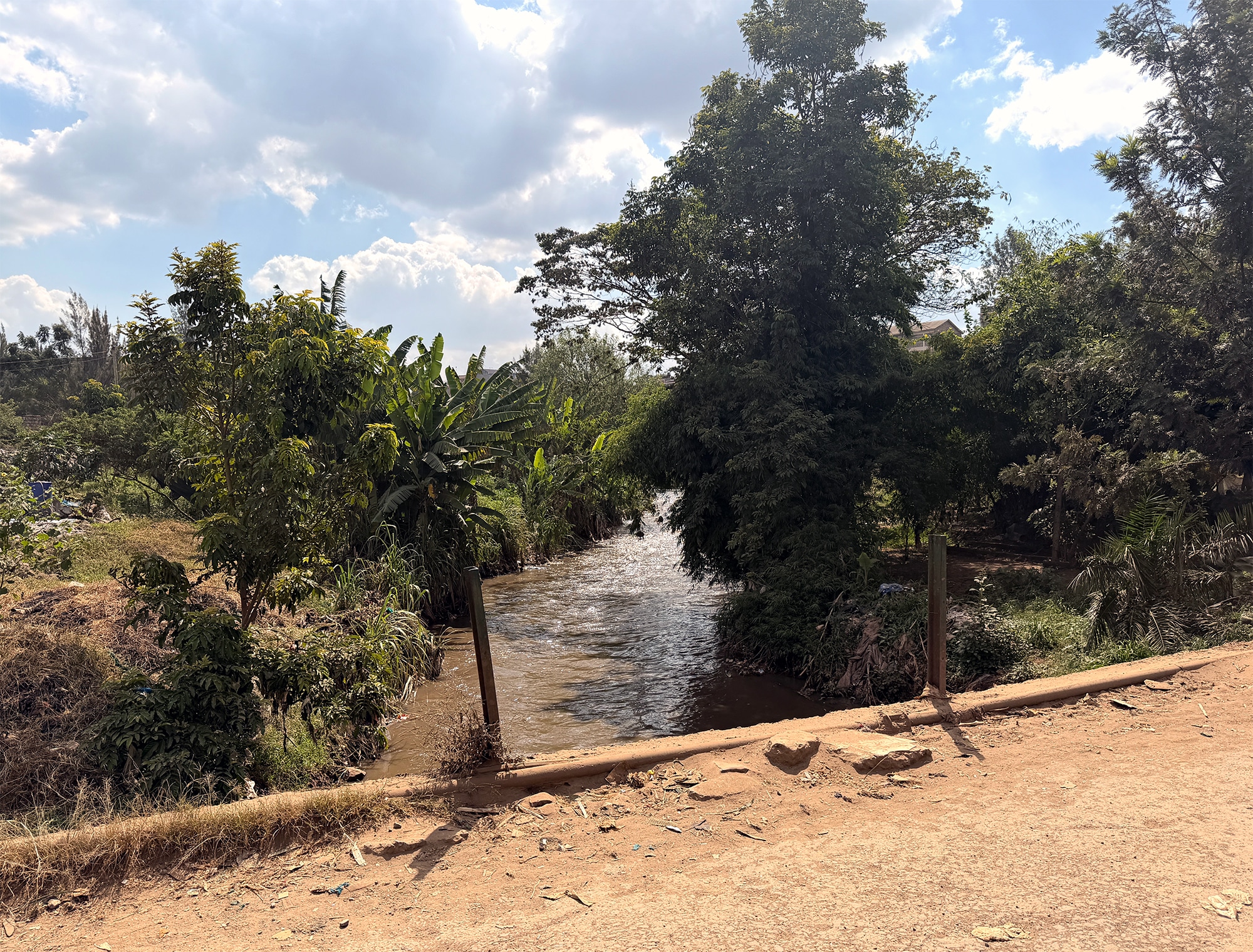
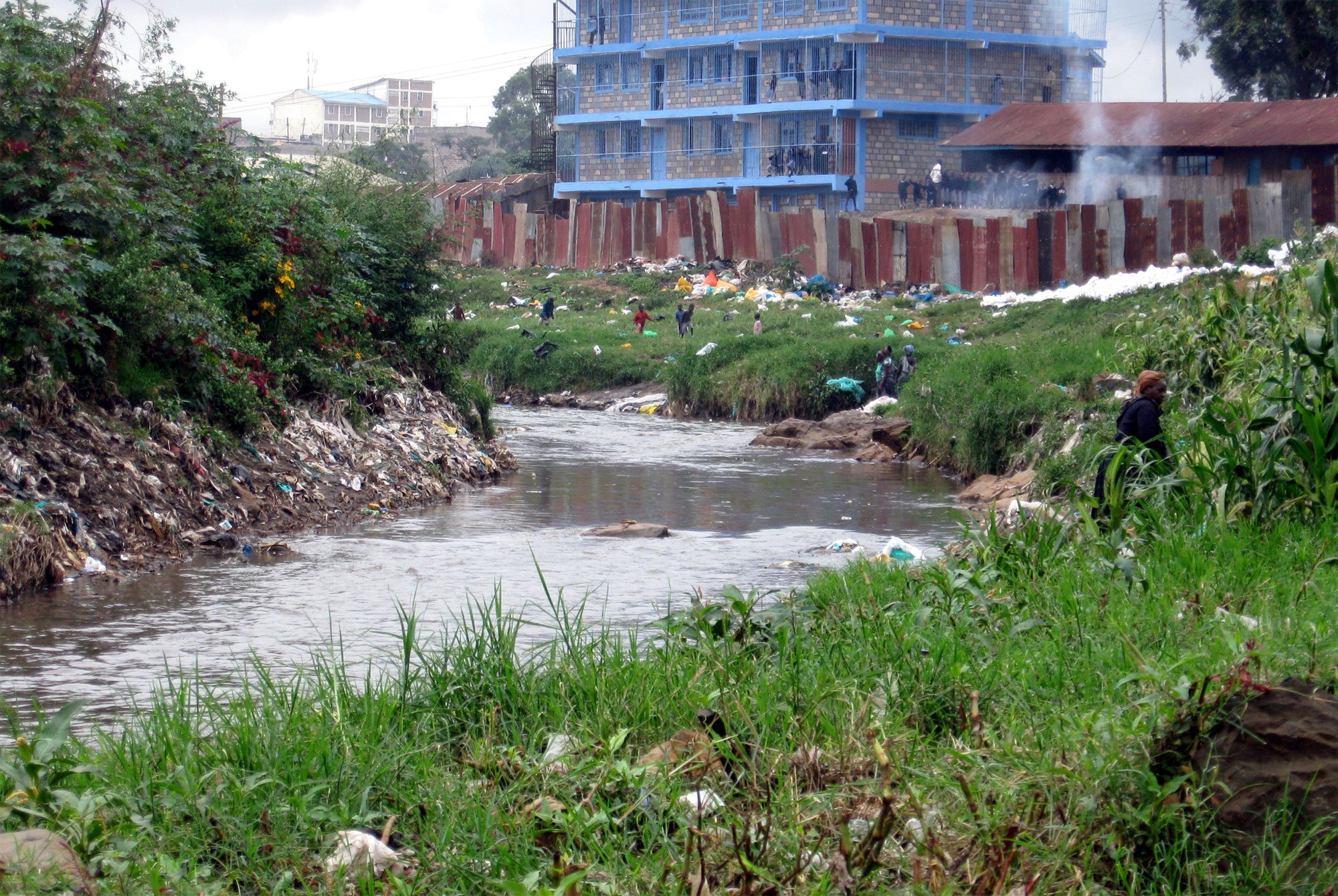
Fifteen years after Kenya won independence from British colonial rule, the capital was home to 350,000 people and growing fast, as rural migrants streamed into the city. “The so-called uncontrolled settlements … Mathare Valley, Kibra, Dagoretti … Korogocho … and Dandora,” were growing at twelve percent per year, according to historians Bethwell Ogot and Madara Ogot. Rivers and hills segregated the city by race. “This was not by accident. The green space was used as a planning tool to separate the Europeans from other inhabitants.” 4
Eviction after eviction, Korogocho grew to become one of the country’s largest and most crowded slums.
In 1978, the year after the Kalekyes moved to Korogocho, thousands of people who had been evicted to make way for a market were resettled in the same small valley — temporarily, said Nairobi’s mayor, until the city could find them a more permanent home. That promise was never fulfilled. This became a familiar pattern. Eviction after eviction, Korogocho grew to become one of the country’s largest and most crowded slums. 5
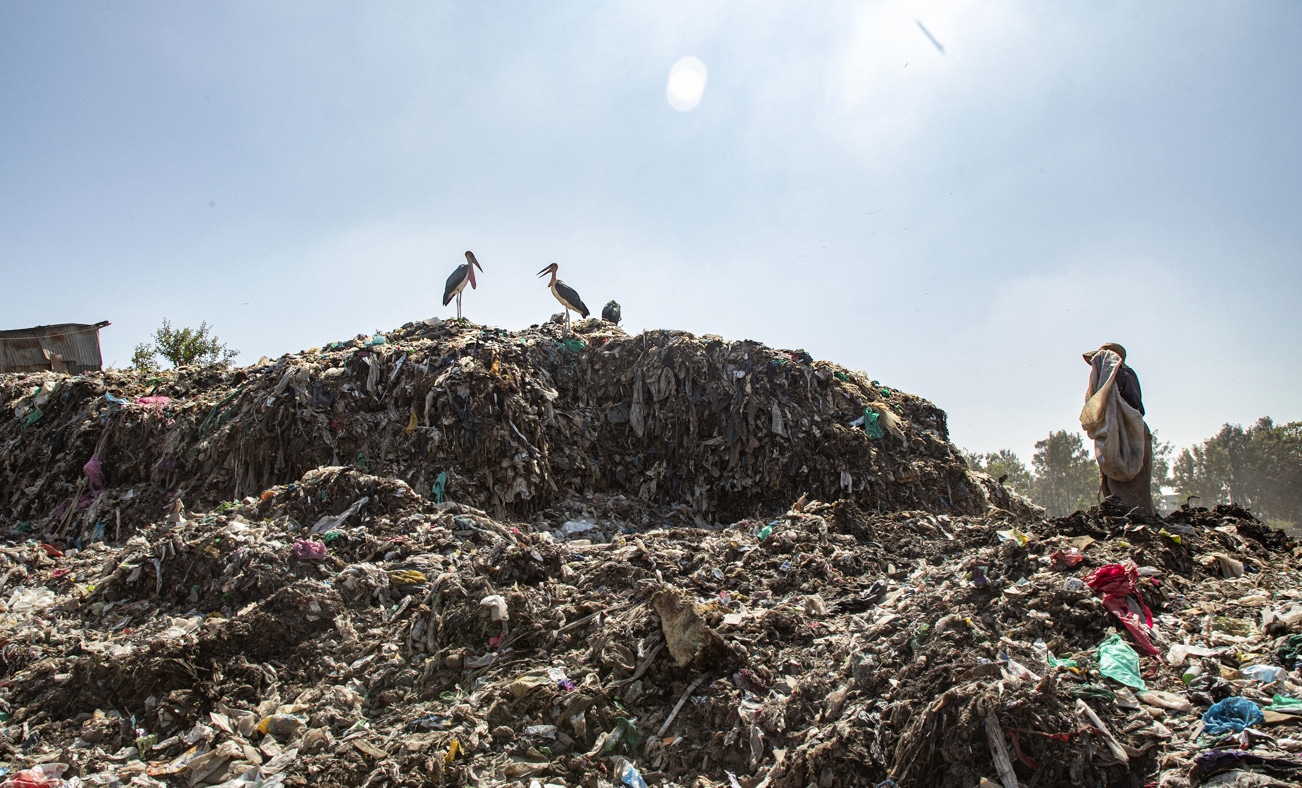
Today its economy centers around an infamous dump, Dandora. Residents pay fees to the cartels that control the site for the right to scavenge through it. Plastic containers are sorted and piled as high as a house. Paper is laid in the sun to dry, then compressed into stacks. Scrap metal and cans, twisted tangles of wires, color-coded glass — everything is sorted and preserved. Waste pickers suffer chemical burns and cuts as they process the city’s trash.
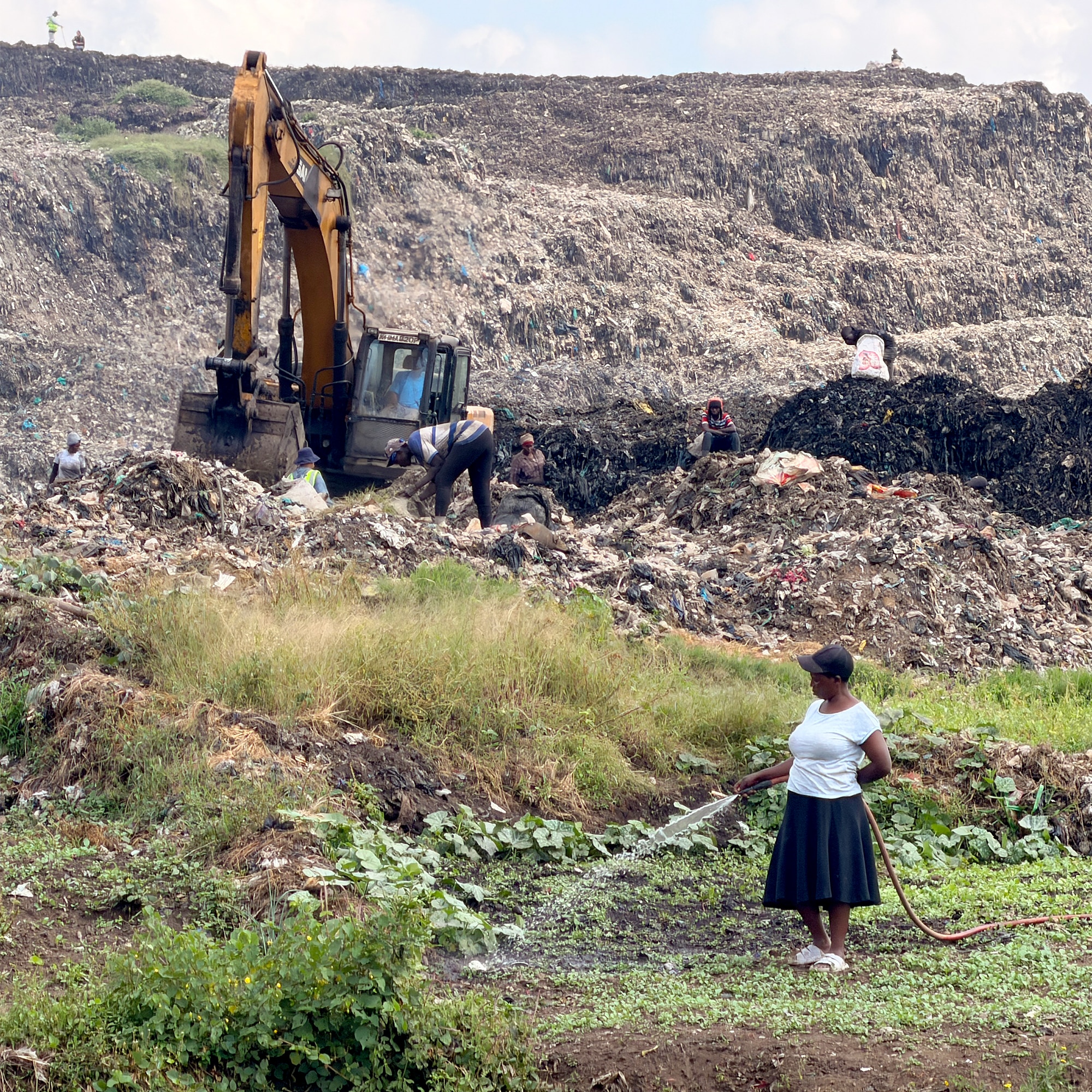
But when the Kalekyes first arrived, the area looked similar to the countryside where Jane had grown up. “It was bush and forest. There were big snakes. I used to walk to get firewood, to burn into charcoal or sell,” she said. “Here, there were no people.” The couple worked as farmhands, earning ten shillings a day. Five years later, a government program gave them some land on which to farm, and they received a second small plot from a local church. At last, they had land of their own.
“I used to plant kale, bananas, potatoes, maize — everything,” she said. “I raised my kids from the money from those crops.” They had eleven avocado trees, and countless bananas, which would shake loose in the breeze and fall to the ground. When it got hot, she’d sit in the shade. Some years the river rose higher than others, but then it would recede, and the Kalekyes would continue on with their lives.
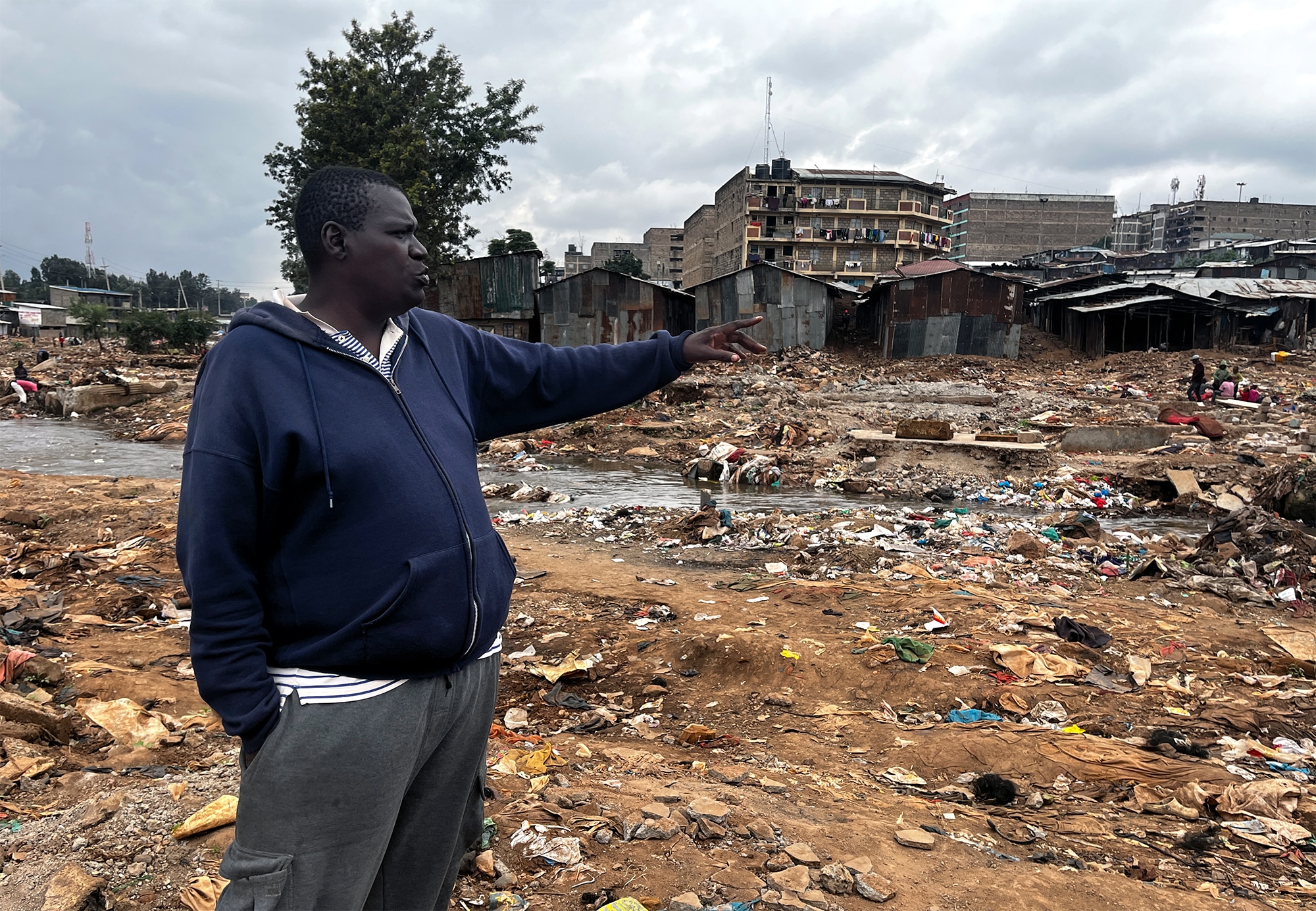
Milton Onyango is a more recent arrival to the Nairobi River basin. He was born to a family of sugarcane farmers in the village of Kano, on Lake Victoria, where his mother was a teacher and his grandfather built the local church. Faith didn’t shield them from the weather in western Kenya, and flooding was a regular occurrence. “Even if you pray, the rains are heavier than your prayer,” Onyango said.
‘Even if you pray, the rains are heavier than your prayer,’ said Milton Onyango.
When a fish farm flooded upstream from his village, he took down the mosquito net that hung over his bed and used it to catch catfish. As he grew older, many of his neighbors moved to Kisumu or Nairobi, “to find greener pastures,” he said. In 2023, he followed them to the capital, finding work as a day laborer at a construction site and renting a small lot near the Mathare River.
Around the world, intense storms are just one factor motivating people to leave agrarian lifeways for the city, according to a Habitat for Humanity report on “overlooked links between climate migration and informal settlements.” In recent years, sudden weather events like hurricanes and floods have displaced an average of 20 million people per year within their own countries, and that number is rising; it spiked to 46 million in 2024. In the next quarter century, 1.6 billion people will be “exposed to severe and extreme droughts.” Less visible are the slow-onset effects of climate change, like erosion, desertification, and altered rainfall patterns that make it hard to know what and when to plant. 6
In the next few decades, slow-onset climate effects could cause the internal displacement of 8 million Kenyans.
In interviews with Kenyan refugees, researchers found that nearly one in five identified environmental factors as a reason for their move. 7 And an influential study by the World Bank projects that in the next few decades, slow-onset climate effects in the Lake Victoria Basin could force as many as 38 million people to move within their own national borders, including nearly 8 million Kenyans. 8 Most will settle in cities, in the margins, in slums that provide the only housing they can afford. Places like Mathare and Korogocho receive the most vulnerable migrants. Globally, UN-Habitat estimates that the number of people living in informal settlements will nearly double, from 1.1 to 2 billion people, in the next few decades. This poses an enormous challenge for cities across the developing world. 9
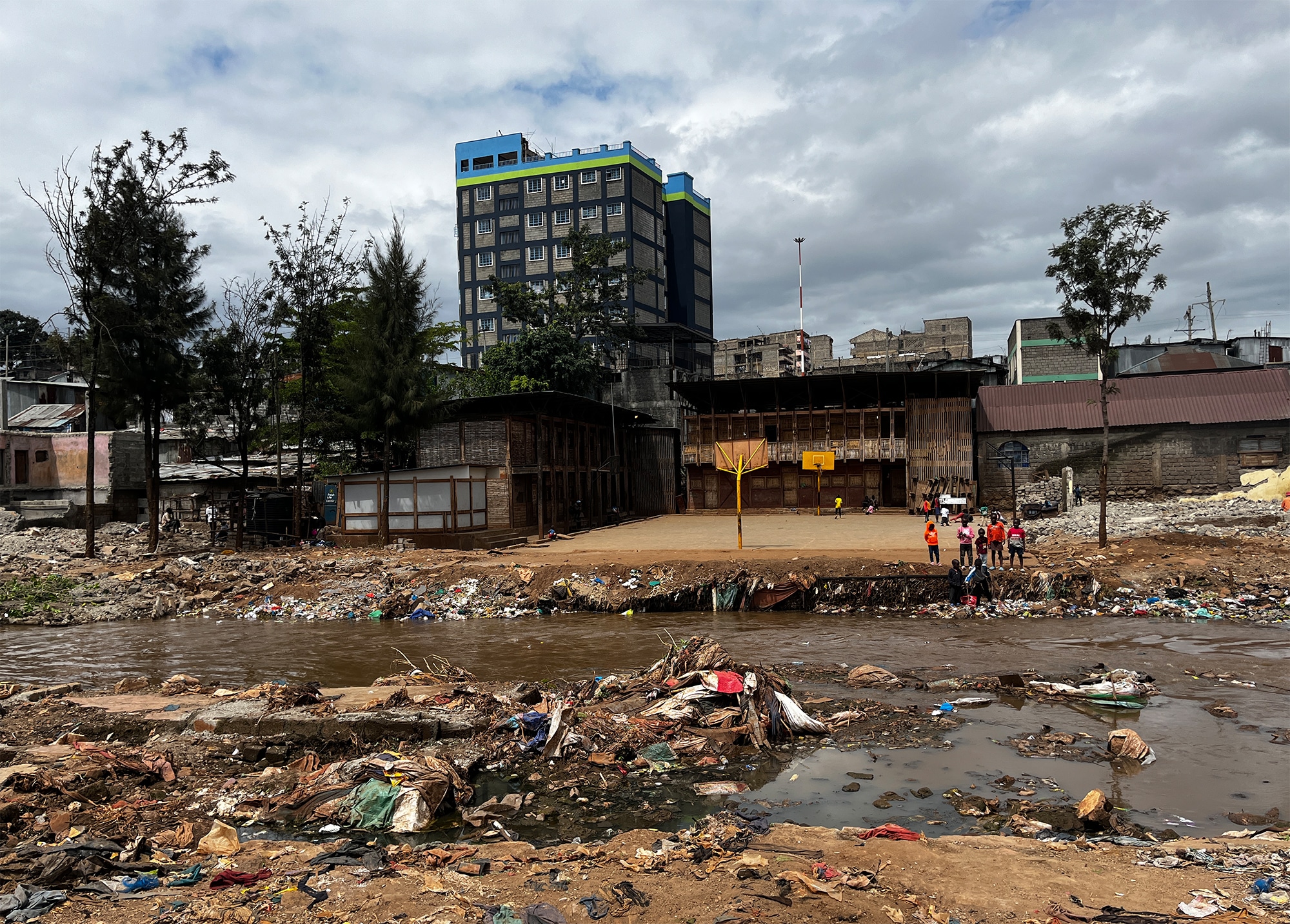
Nairobi’s Climate Action Plan, adopted in 2022, the year before the city hosted the first Africa Climate Summit, recognizes the problem: “Informal settlements are often located in Nairobi’s most physically vulnerable areas — flood plains, steep slopes, river valleys or adjacent to sewers and dump sites. … This situation exposes slum residents to floods, fires, landslides, and health risks from contaminants.” 10 Migrants are effectively trapped, trading one environmentally precarious situation for another.
Migrants are effectively trapped, trading one environmentally precarious situation for another.
Mollencer Anyango moved to Mathare from Kenya’s far west, where her family grew maize, beans, and peanuts in sandy soil. “There was a lot of hunger at home,” she told me. “There was no water.” In Nairobi, she found occasional, low-paid work as a tailor, scraping by. Then came the flood that washed away her house. “That night if you had a child, you saved your children. But if you had things, you just left them.” Two months later, she had no work, no home, and didn’t know where to turn. She didn’t feel she could go back to her family’s farm, where she’d be a burden to her parents. “Here we struggle, back home we struggle. I wish for my son to grow up in a better place.”
Researchers have a term for this: “Doubly displaced.” Just a day or two after the Mathare flood, Milton Onyango’s family home in Kano was destroyed. “I’ve been flooded in Nairobi,” he said. “And back at home … the house was also flooded. So, where do I go?”
A robust climate plan could answer that question, connecting people who are recovering from disaster — or escaping risky environments — with housing, jobs, transit, utilities, sanitation, and other forms of public support. But it would need to be backed by substantial funding, channeled through responsible agencies that are largely free of corruption, and in Kenya that isn’t the case.
The $400 million Nairobi River Regeneration Initiative is one of the most ambitious environmental projects in the nation’s history.
In February 2023, President William Ruto chose Korogocho as the backdrop to introduce one of the most ambitious environmental projects in the nation’s history: a $400 million effort to clean up the Nairobi River basin, which is heavily contaminated by industrial pollution and sewage from middle-class suburbs and informal dwellings flowing directly into waterways. As announced, the Nairobi River Regeneration Initiative would hire 40,000 workers to remove waste, widen the channels, reinforce the banks, build 60 kilometers of trunk sewer lines, and construct 50,000 affordable apartments to resettle people living in flood zones. 11
Ruto noted that the United Nations Environment Programme had been trying to clean up the river for more than a generation, but “today no one, not even the most reckless among us, can dare so much as taste the water in any stream.” Invoking the Maasai name for the river basin, engore nyarobe, the place of cool waters, he assured his audience that they would see progress within two years. But when that time passed, the government hadn’t even completed the first step in the project, an environmental sustainability assessment.

And a cleaner river was not all Ruto promised. “We will banish impunity,” he told the residents of Korogocho. “We want the whole of government, the whole of society, the whole of community involved in this process,” he said. “Kenya,” he proclaimed, “is going to be a country run under the rule of law.” These were loaded words, from a leader who had been charged in the International Criminal Court with crimes against humanity for his role in stoking political violence in 2007. (That case was dismissed in a mistrial, after witnesses disappeared or withdrew their testimony under duress.) 12
Like many problems in Kenya, the degradation of river corridors can be traced back to colonization.
Like many problems in Kenya, the degradation of river corridors can be traced back to colonization. In the 1890s, the British built a railway from the port of Mombasa to the forested highlands of Nairobi, which was chosen as the colonial capital for its favorable climate. 13 The place was not too hot, not too cold, had just enough rain, and was mostly free of diseases like malaria. (That’s changing today, as global warming brings mosquitoes to higher elevation.) 14 The British converted grasslands and forests to tea and coffee plantations. “They set entire native forests on fire so that they could plant new, nonindigenous species,” wrote researchers Garima Rawat and Vivek Kumar Gaurav. “Groundwater levels decreased and rivers and streams either dried up or declined.” 15
The British also forbade Black Kenyans from living in the Nairobi center or traveling there at night. However, the 2,000 indentured laborers brought from India to build the railroad were allowed to settle in town, and in time they became security guards and municipal employees. Their descendants filled the northern suburbs of Westlands and Parklands. When the nearby district of Pangani was demolished in 1938 to make way for Indians, the Black people who lived there were forced to move elsewhere, some to the area known today as Kibera, often described as Africa’s largest slum, on the banks of the Nairobi River. The name comes from the Nubian word kibra — forest — because at that time it was still covered in trees. 16
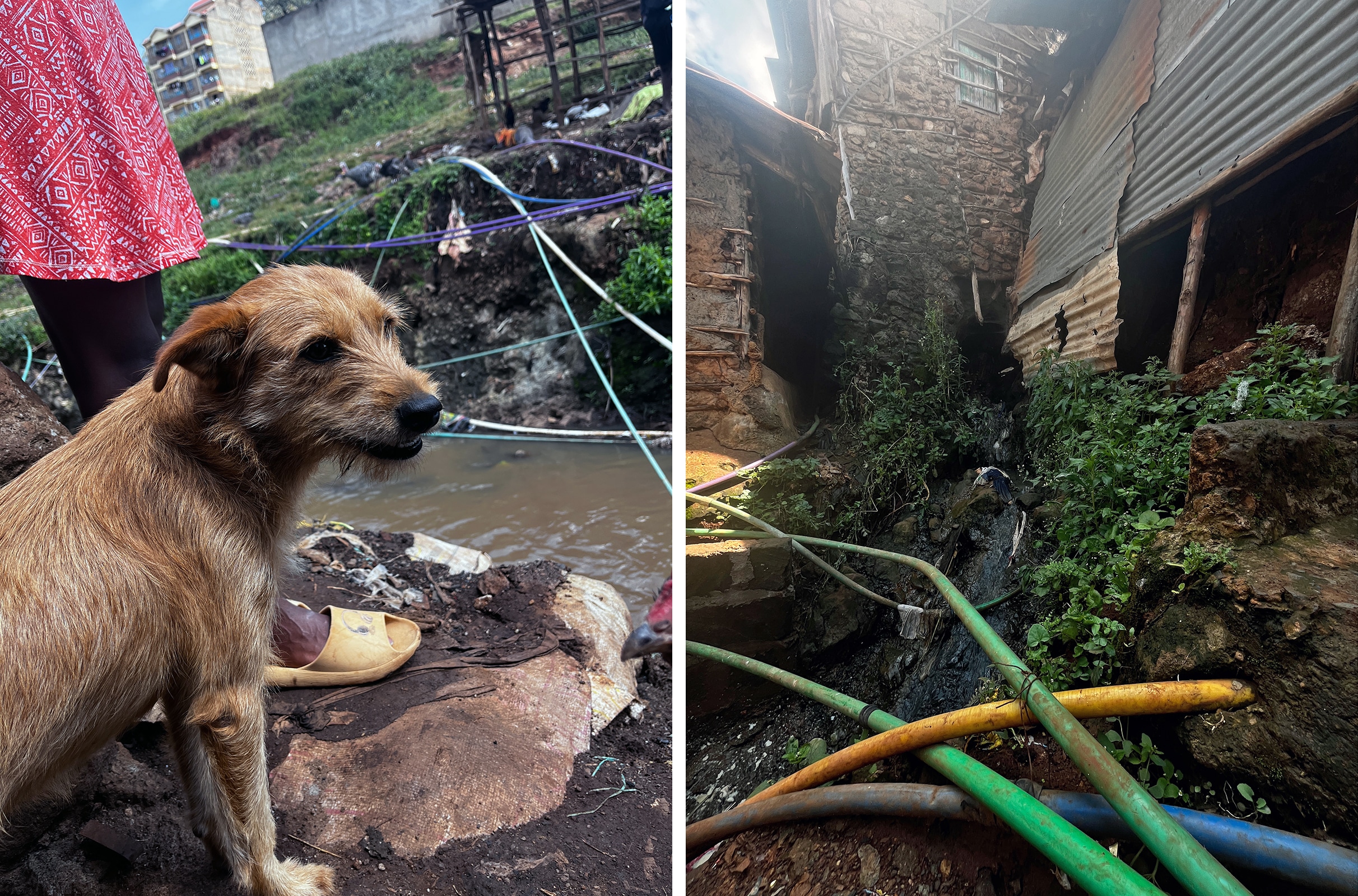
This colonial geography has shaped the city ever since, as the poorest and most marginalized residents crowd into degraded and dangerous river valleys. In 1977, heavy rains flooded the city, “bringing untold misery to those who lived in informal settlements,” according to Ogot and Ogot. “Many of the dwellings were made from wood and cardboard and had no foundations. They were washed away, leaving more than 7,500 families homeless.” Nairobi’s City Council saw the disaster as an opportunity, bulldozing another 10,000 homes over the course of two days. A city committee was tasked with planting trees and establishing parks along the river, to prevent residents from moving back. But before long, desperate people with nowhere else to go squatted on the land. 17
Sixty percent of Nairobi residents live on just five percent of the land.
In the 1980s, Kenya’s government and international donors embarked on half-hearted “community upgrading” schemes in Kibera, Mathare, and Korogocho, issuing formal titles, digging drainage ditches and latrines, laying water pipes, and stringing electric wires. But as people were drawn to these newly-livable areas, they grew more crowded. By the turn of the century, Nairobi was home to more than two million people, but 60 percent of them lived on just five percent of the land. 18
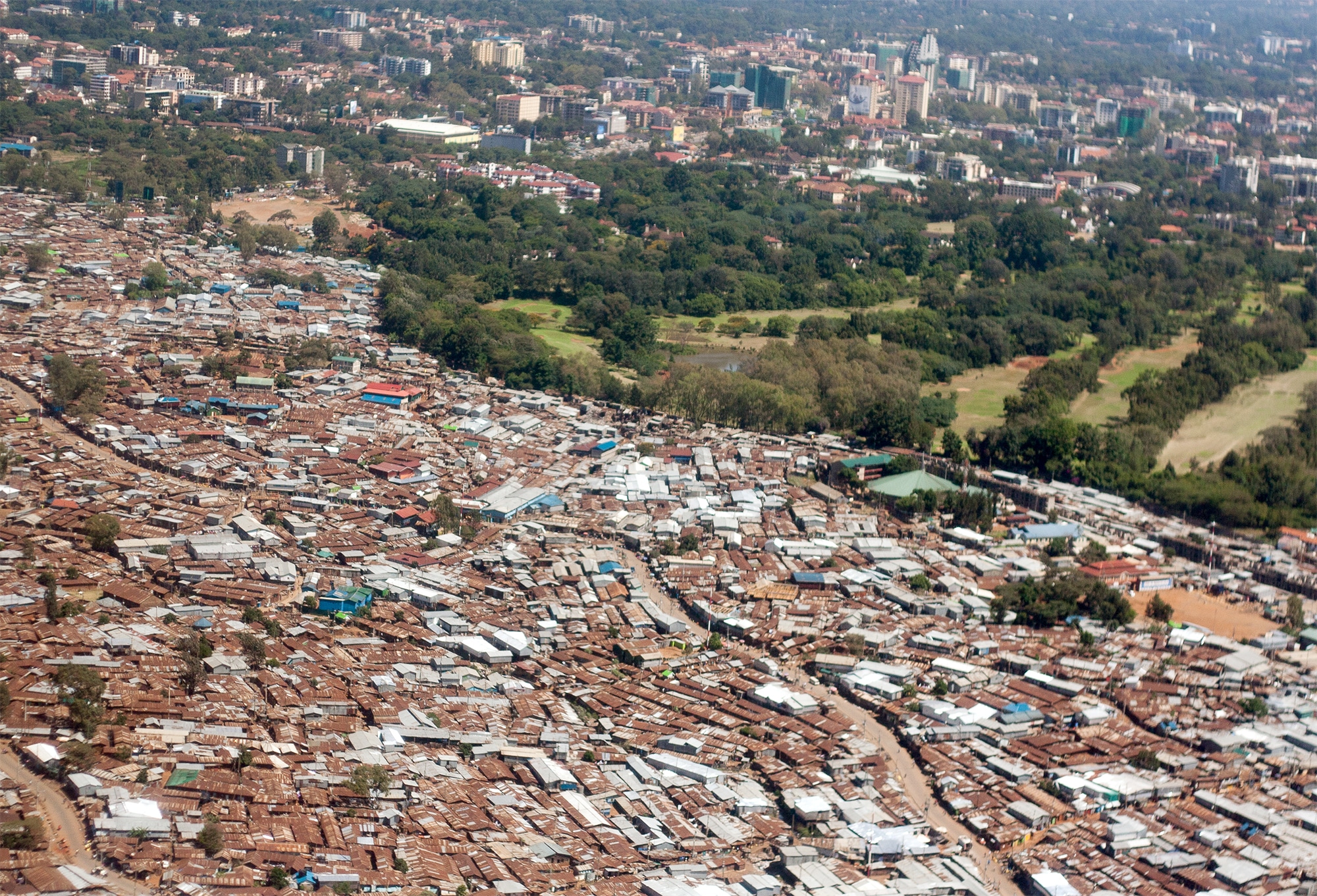
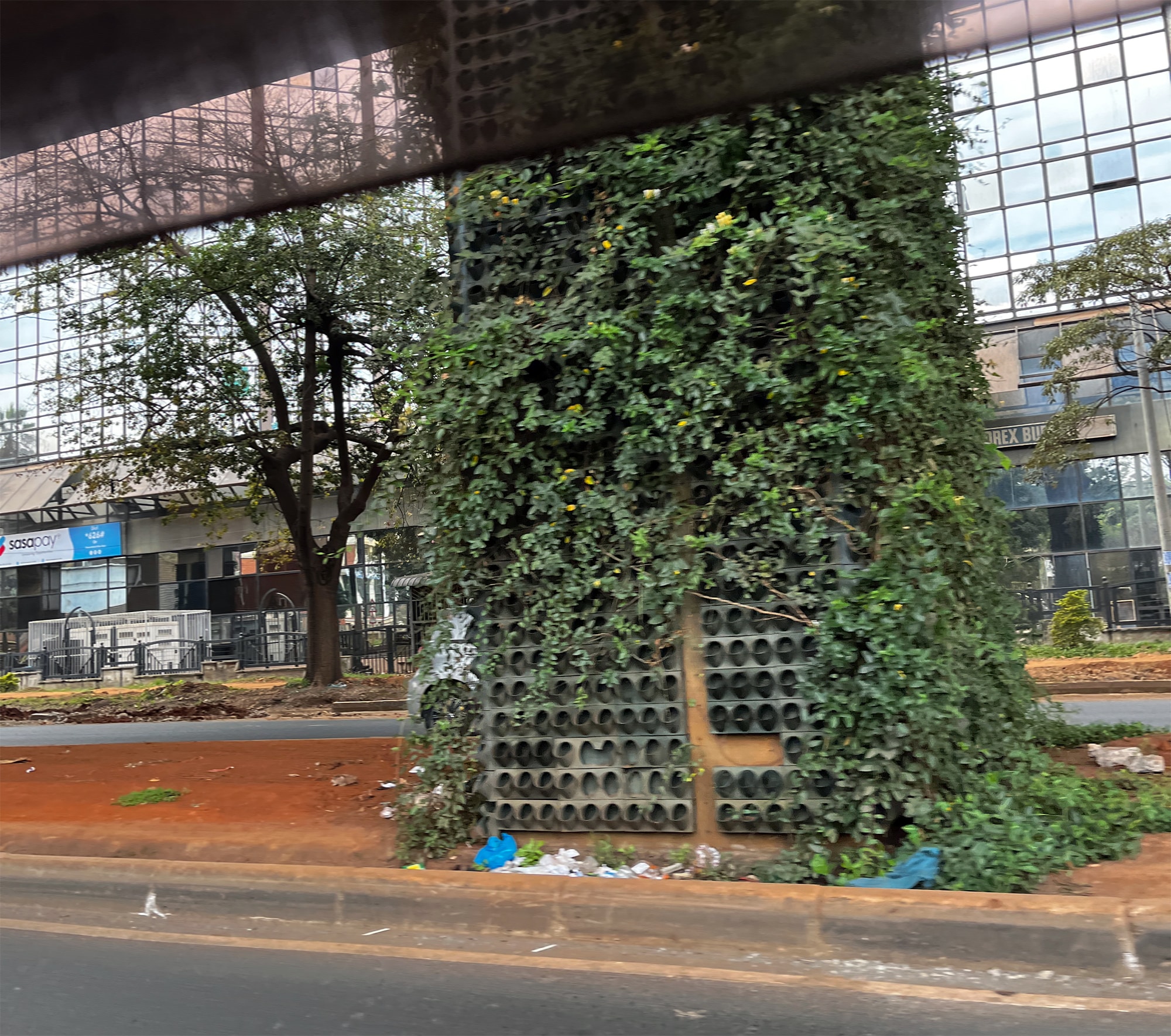
Foreign aid and development funds shape the infrastructures that get built, like the Nairobi Expressway, completed in 2022 by the China Road and Bridge Corporation at a cost of $668 million. Tourists, expats, and upper-middle-class Kenyans zoom above the slums on a private tollway through the sky. Trees were planted along the side of the road, and marigolds and other seedlings on the concrete pillars, ostensibly to make the project more environmentally friendly. “These plants are creating a carbon sink in the fight against climate change, as they absorb carbon dioxide generated by the vehicles and clean the air,” said Julia Ondeyo, a deputy director at the Kenya National Highways Authority. 19 Within weeks, most of the plants had shriveled and died.
That “sad effort to green the city” is symbolic of other failures, said environmental activist and filmmaker Paula Kahumbu. Blue water trucks line the streets where the municipal water runs dry. “Most people don’t have enough water to drink or bathe, let alone grow food or trees.” With sunlight reflecting off iron sheets, temperatures in the slums can be six degrees Celsius warmer than surrounding areas, according to research by Angela Abascal, an architect and urban planner. 20 There is little natural shade, and during heat waves the homes are sometimes hotter inside than out. Banana trees provided respite for Jane Kalekye, until the day her city came to knock them down.
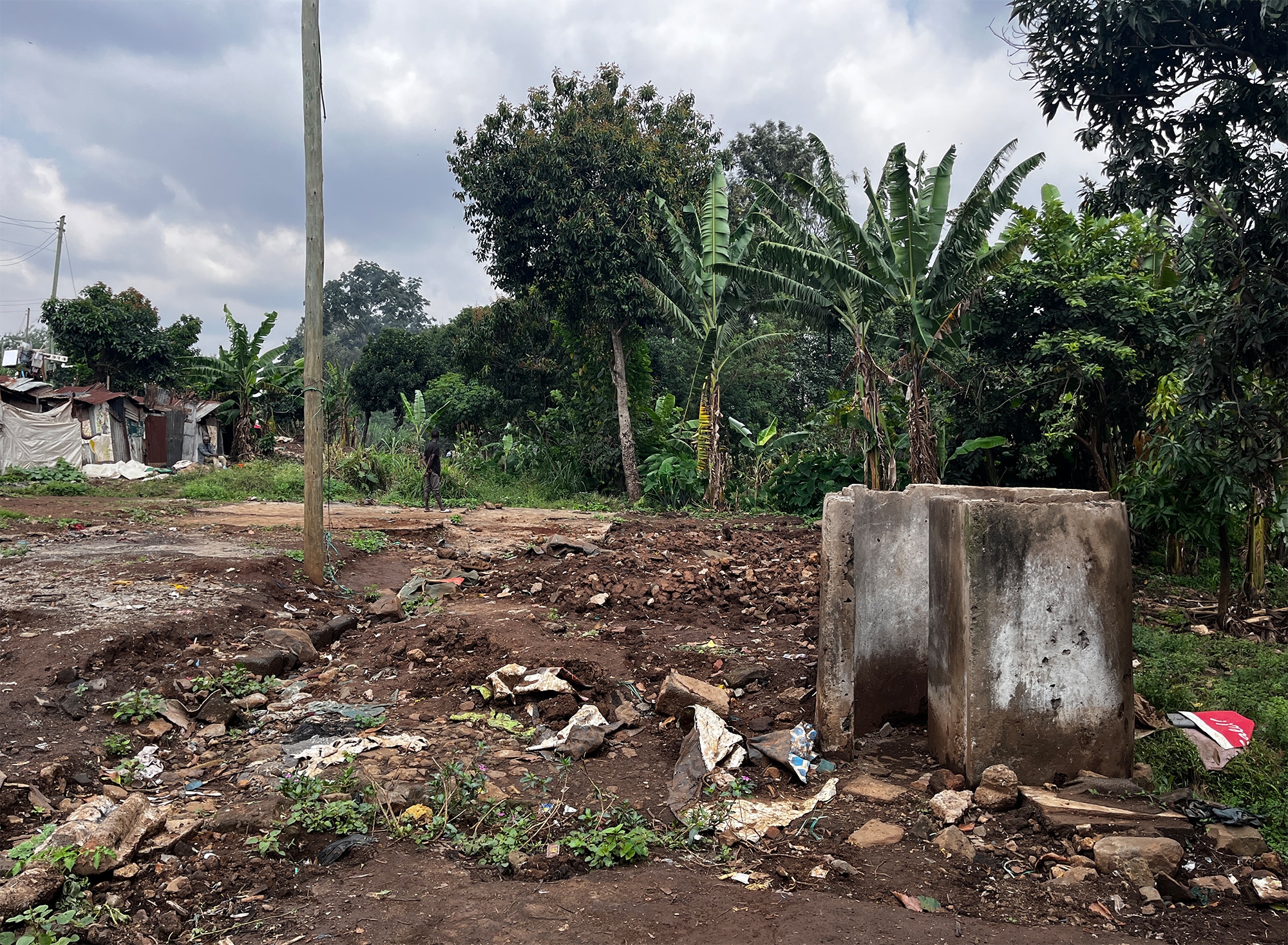
For thousands of people whose homes were flooded in 2024, their troubles didn’t end when the water receded. The government came for them next.
‘We thought the government would come to our rescue,’ Onyango said. ‘Instead, they came demolishing the house.’
In the first week of May, authorities ordered the immediate evacuation of flood zones in slums throughout Nairobi, using the crisis as a pretext for evicting the city’s poorest residents. 21 “We thought the government would come to our rescue,” Onyango said. “Instead, they came demolishing the house.”
The Kalekyes had just finished building a new shelter farther from the water’s edge when police arrived, escorting a demolition crew. A bulldozer, known in Swahili as a tinga tinga, knocked down the three structures on their land. “It destroyed all my things,” Jane said, including the medicine for her high blood pressure, diabetes, arthritis, and ulcers. In the days that followed, “I had no strength. I even vomited blood.”
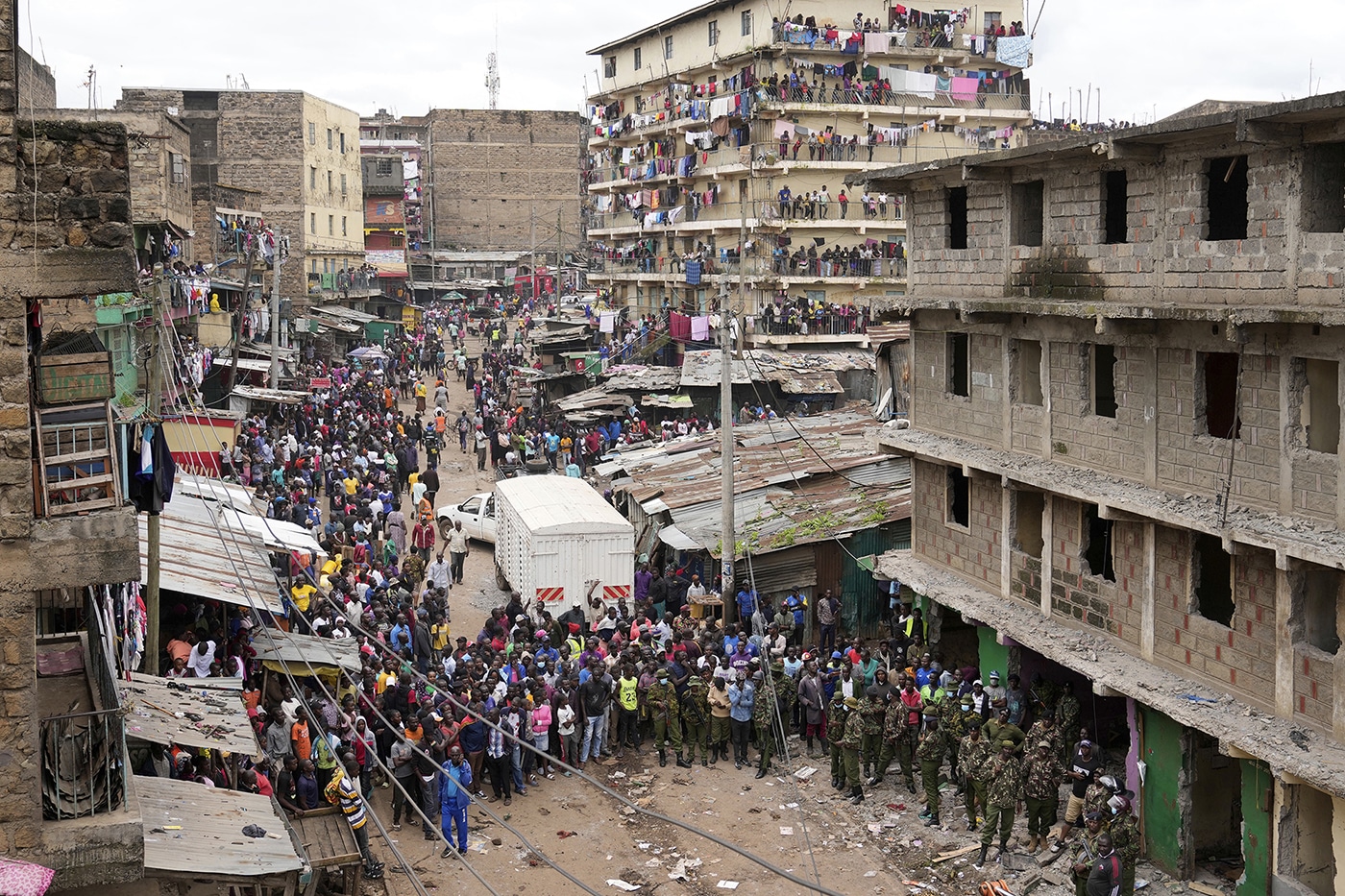
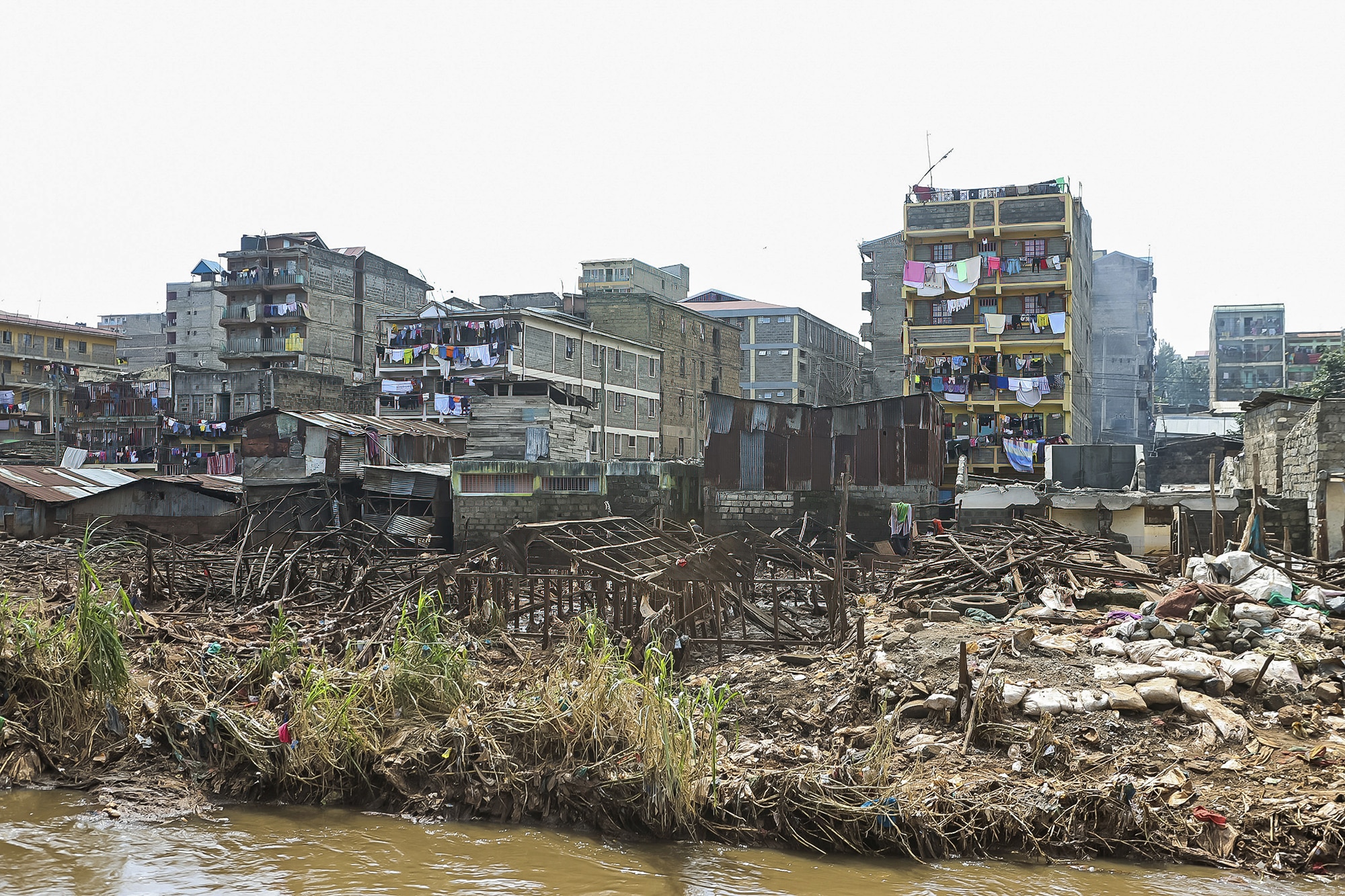
In slums across the city, families scrambled to leave with little or no notice. In Mukuru, a settlement on the Ngong River, government workers killed a young boy, Joseph Ombata, who was inside his family’s home when a bulldozer brought it crashing down.
Authorities ordered the immediate evacuation of flood zones in slums throughout Nairobi, using the crisis as a pretext for evicting the city’s poorest residents.
Local rights groups demanded the authorities stop “arbitrary evictions disguised as ‘evacuation,’” noting that other, more affluent districts on waterways — some with more extensive flooding — were left alone. But their demands were ignored. Protestors who took to the streets were arrested. At the end of the week, Ruto declared a public holiday to mourn the dead. As Nairobi’s most marginalized residents struggled to rebuild their lives, bureaucrats took the day off. 22
“The government has abandoned us completely,” Jane Kalekye told me, two months later. She was squatting in a dark, leaky shack the size of a storage closet, with her two daughters and two grandkids. President Ruto promised that 40,000 displaced families would receive 10,000 shillings each, about $75. But Kalekye said she never received the money. 23
In any case, it wouldn’t be enough. Shortly before the floods, she had borrowed 100,000 shillings to reinforce her home with timber and metal siding and poles. Now the government had destroyed it and prohibited farming along the river, so she couldn’t repay the loan. “There’s no more floods now,” Kalekye said. But she didn’t dare replant, because “the tinga tinga demolitions could come again.”
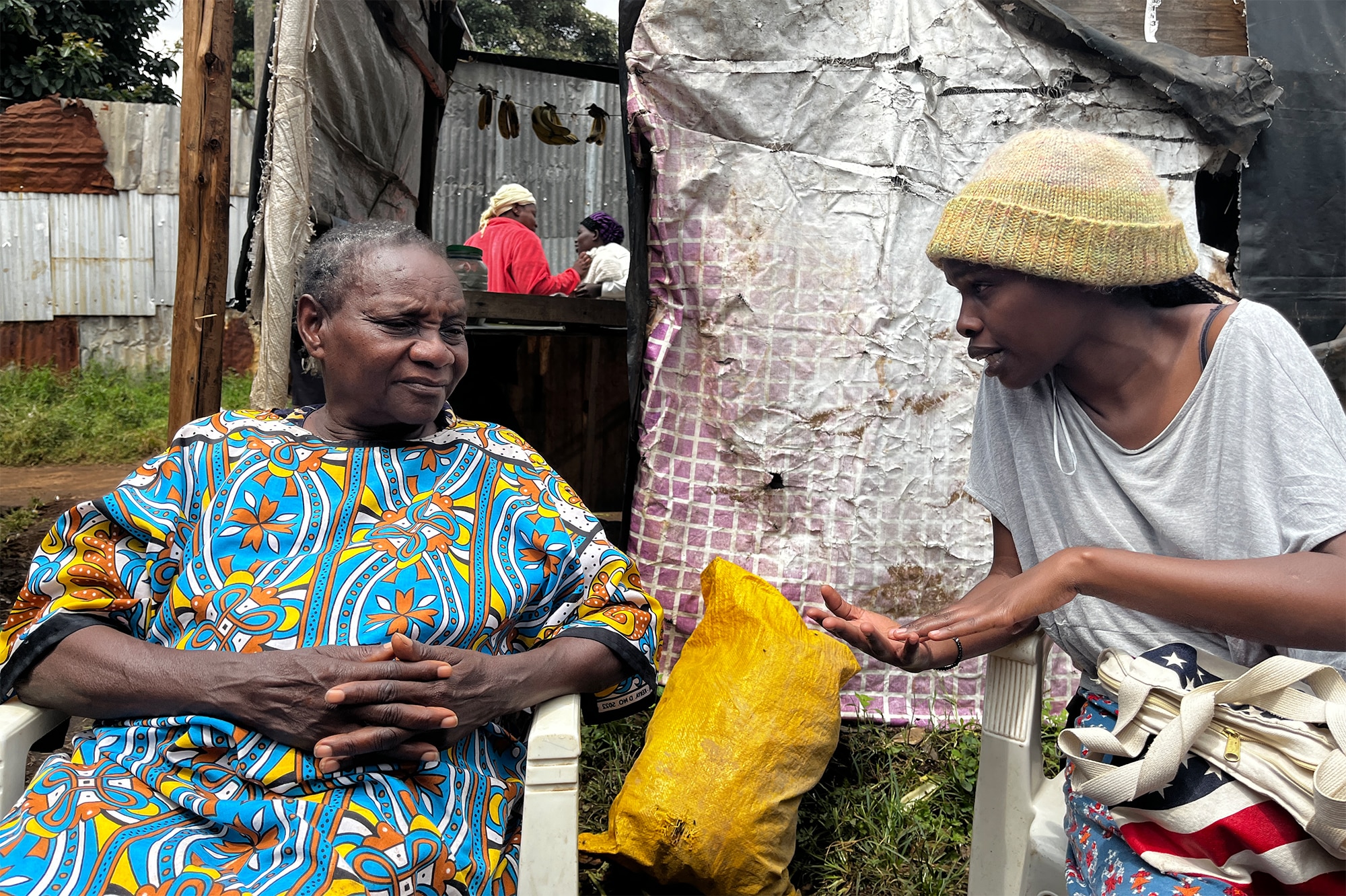
In 2023, Ali Nobil Ahmad, a social scientist at the African Migration Hub, published interviews with more than a dozen displaced people living in Nairobi. 24 Their stories paint a complex picture of where and how people migrate, moving between rural villages and mid-size cities and the capital, seeking safety and opportunity and not finding it. “You don’t want to glorify staying in the countryside — people should have the choice to do what they want,” Ahmad said. But in Kenya, “you find this sort of double injustice where people are not able to stay put in a rural setting, and then they come to Nairobi only to be displaced by development projects.”
Many infrastructure projects pitched as ‘climate resilient’ serve commuters in leafy suburbs with indoor plumbing who own cars.
Many infrastructure projects pitched as “climate resilient” — say, a bypass road circumventing a valley that frequently floods, or channels and pipes that convey wastewater — serve commuters in leafy suburbs with indoor plumbing who own cars. And this often means bulldozing the homes of lower-income residents who receive no benefit. “All of these developments are anti-poor,” Ahmad said. “And they’re not sustainable.” The Nairobi Climate Action Plan identifies areas where the city’s powers overlap with the greatest need, prioritizing drinking water, waste management, and mobility. But “sometimes plans are the problem,” Ahmad said. “The UN Habitat folks love to say it’s just a matter of interesting ideas and putting the right people to work,” Ahmad told me. “But there’s a much darker side to this, and that’s all the elite interests.”
Nairobi’s Climate Action Plan is weaponized against the very people who are most vulnerable today.
In this way, a “national strategic objective” in the Climate Action Plan — “improve the resilience and adaptive capacities of urban areas, by enforcing standards for housing in anticipation of climate change impacts” — is weaponized against the very people who are most vulnerable today. 25 Viviane Clement, author of the World Bank report Groundswell, told me that governments “need to manage risks” by “making sure people have access to climate resilient housing.” But while it’s easy to understand the case for building new apartment buildings outside flood zones, it’s hard to square that with destroying thousands of shelters on less than 24-hour notice, leaving residents homeless at the height of the rainy season. The Habitat for Humanity report on climate migration calls for planning to “be done in inclusive ways, co-produced and co-designed with diverse and marginalized communities.” 26 Yet the planners and developers who are the intended audience for that report don’t seem to have taken its lessons to heart.
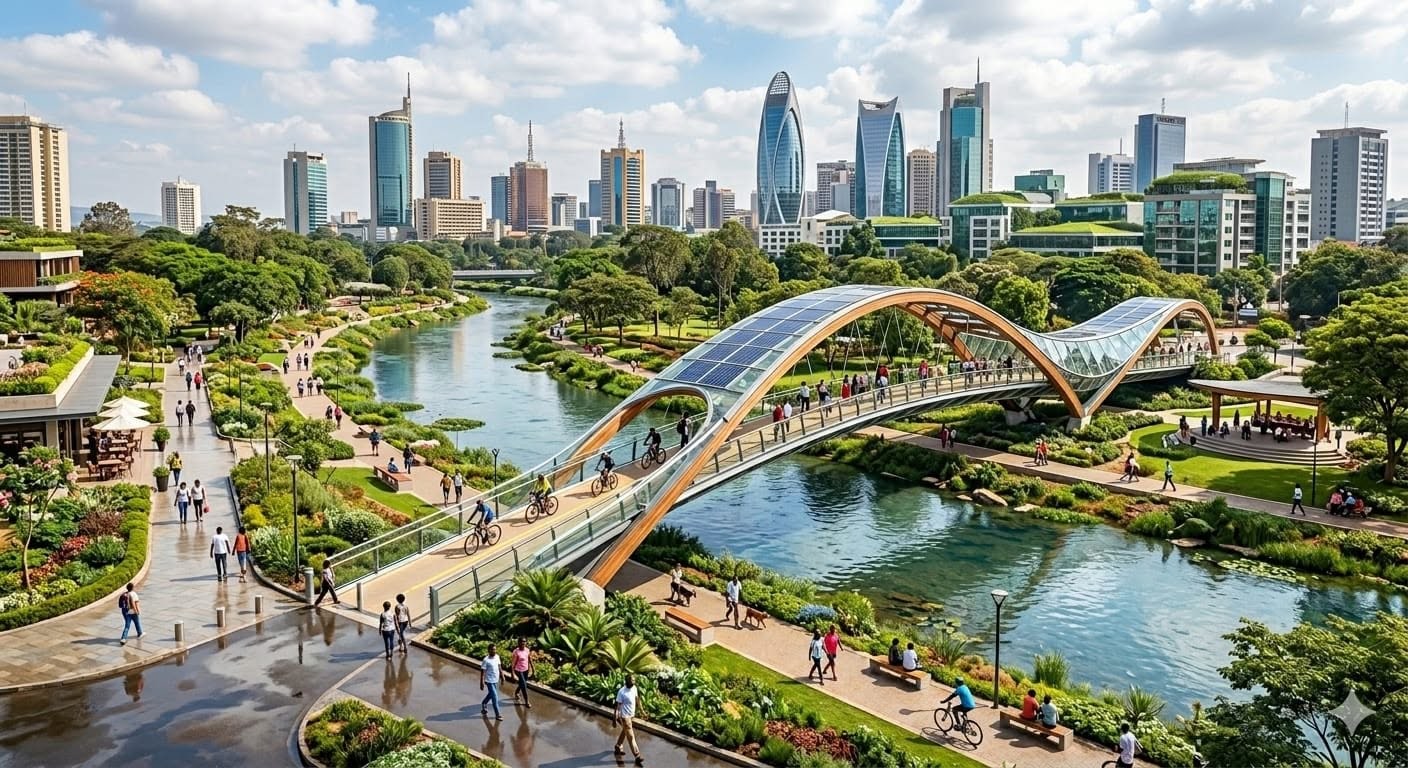
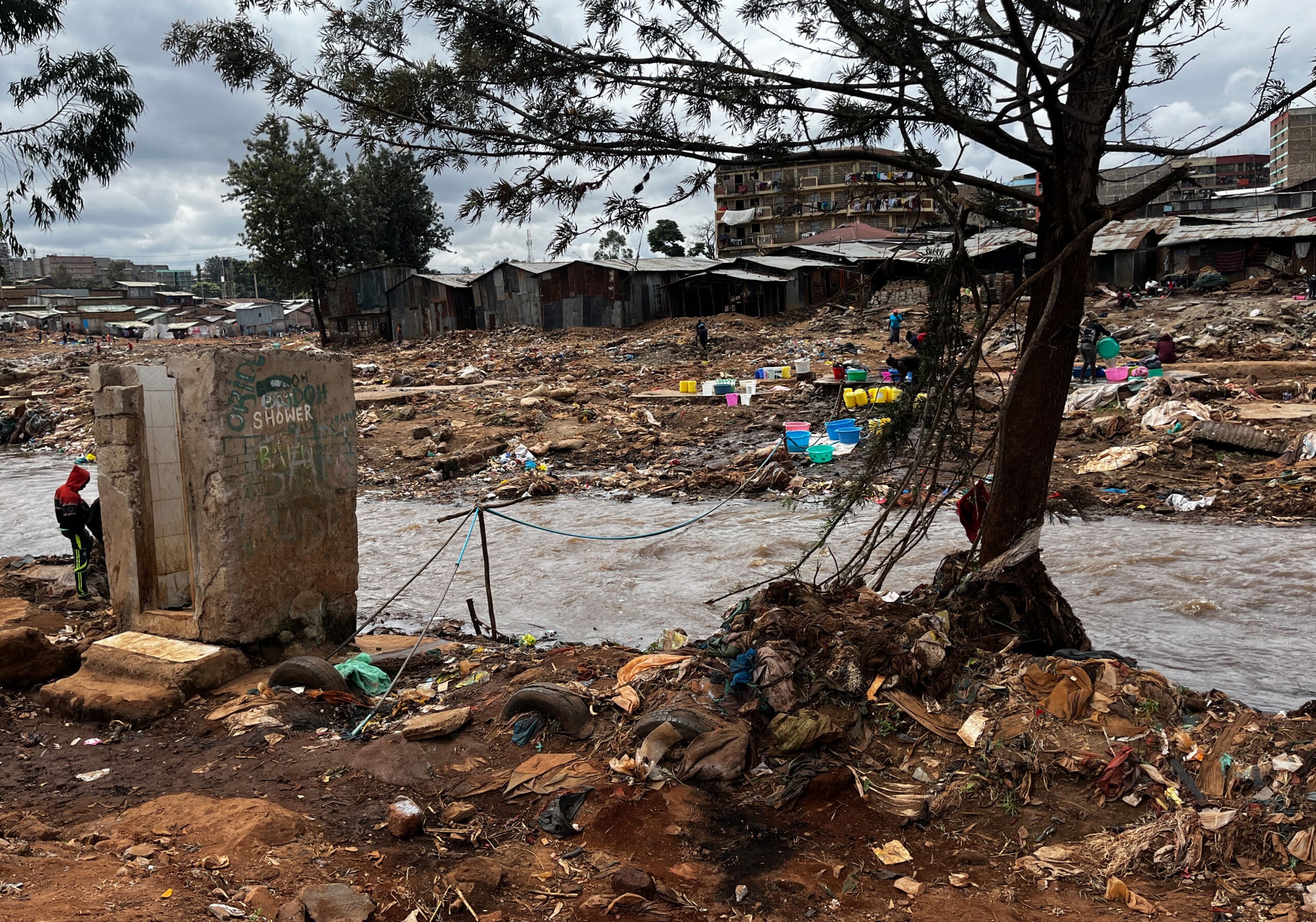
As an advisor for C40, the global network of mayors “united in action to confront the climate crisis,” Njenga Muchekehu spent three years working with Nairobi officials on climate policy. So when he says the city “is not fit for delivering climate action,” he speaks from experience. “It’s not unique to Nairobi. That’s true for governments around the world,” he said. “We are very much in a climate emergency, and we need to act like it. We need a systemic overhaul of government … organized for the purpose of climate.”
People in informal settlements are more united in confronting climate change, said Njenga Muchekehu.
But the notion that Kenya’s leaders want to overhaul a system that keeps them in power — and, in many cases, makes them rich — is absurd. “We know there’s widespread corruption, collusion. We’re expecting good outcomes out of an organization that isn’t really designed to give us good outcomes.” Frankly, Muchekehu said, the “government isn’t in the business of public good. They’re in the business of public rhetoric. The floods came. Then there were evictions in the name of the Nairobi River regeneration. … The question we need to be asking is, regeneration for what purpose? For flood mitigation, or for business?”
‘They already know the government is not coming to help.’
He pointed to the Nairobi City County Climate Change Act, passed in late 2024, as a step in the right direction. 27 “We’re one of the only cities in Africa that has specific climate legislation,” he said. Two percent of the funding for climate development projects is now allocated to local wards. As a result, “You see public space transformation. The building of footpaths.” It’s a start. “If we really focus … Kenya could be a world leader in climate action,” Muchekehu said. He contrasted Kenya with the United States, where Republican leaders dismiss the science. “In the circles I work, there’s no opposition to climate change, no climate denial,” but “it gets bogged down by an old system of governance that doesn’t treat the environment as a public good.” The problem, he said, is corruption. “It’s much bigger than just climate. We need to hold people accountable. We need to send people to jail.”
President Ruto often treats climate adaptation like a joke. He once promised to plant 15 billion trees, in what was later reported to be a conspiracy to siphon away public funds. 28 For others, adaptation is a buzzword that attracts international investment and accolades, regardless of whether projects are effective or just or timely, or indeed whether they are ever built. Muchekehu wryly noted that people living in informal settlements “seem to be more united” in confronting climate change. “They already know the government is not coming to help.”
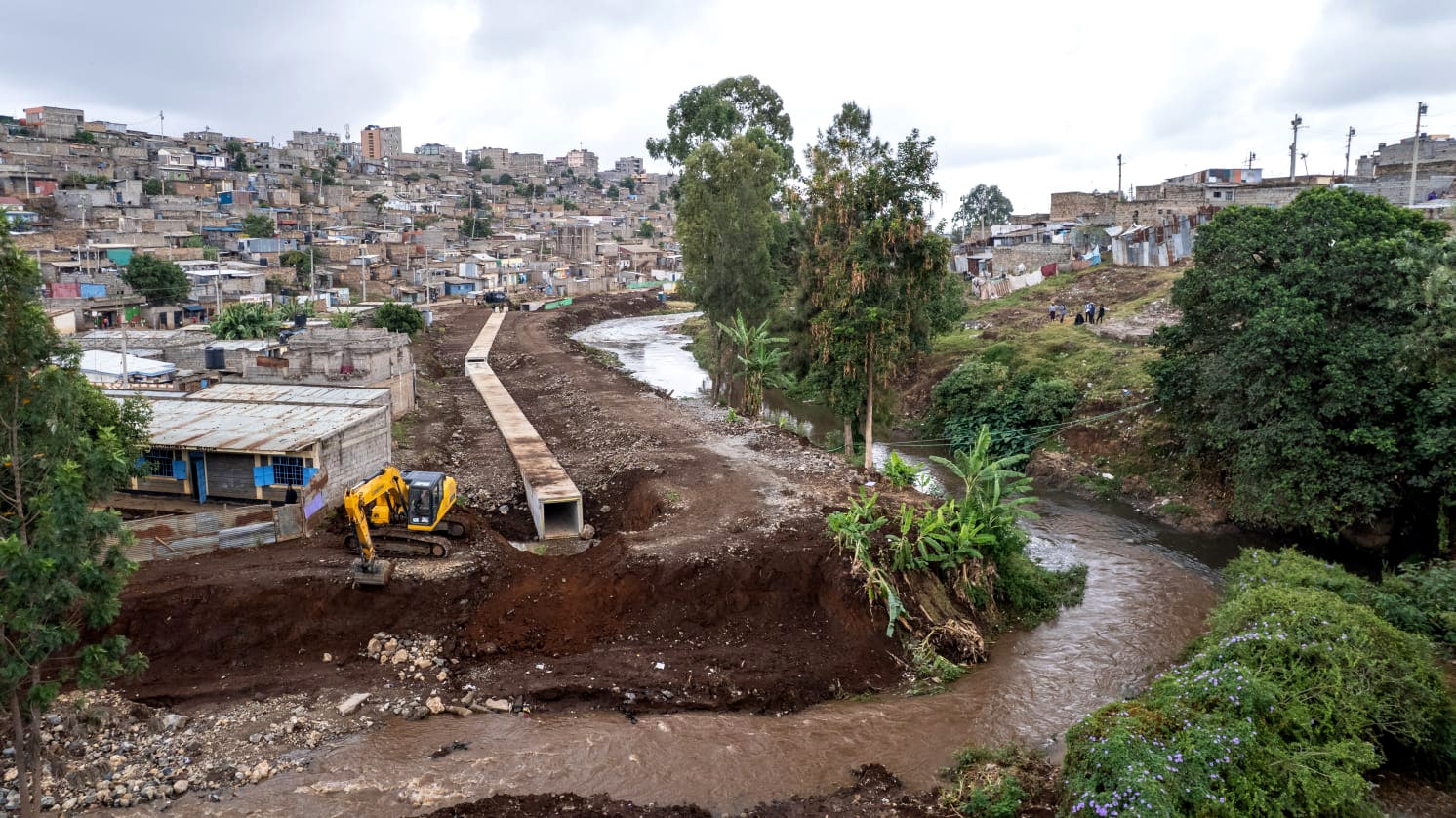
Eva Muhia, of the Nairobi Rivers Commission, said that’s not true. “What the government is doing right now, it’s climate action. Not just climate resilience, adaptation, mitigation — but action,” she said.
‘What the government is doing right now, it’s climate action,’ said Eva Muhia of the Nairobi Rivers Commission. ‘Not just climate resilience, adaptation, mitigation — but action.’
She emphasized that Nairobi’s flood problem is caused by people. “Climate change, it’s a safety issue. It’s more of a safety issue than anything.” She said many Korogocho residents were living on artificial embankments formed by trash and sediment buildup. “The issue is encroachment. The water cannot pass because there are houses.” Soil from construction sites “is taken to the informal settlements where it builds up and becomes hard ground that people can build on.” As she explained, “The more they occupy the riparian [land], the more they divert the river. When it starts raining, that encroachment really affects the waterway. It starts collapsing.”
To address that, the government is bulldozing houses in the riparian zone, defined as 30 meters from the river’s “original” boundaries on historical maps. When we spoke two months ago, Muhia confirmed that demolitions were ongoing. Residents report with their titles and deeds, she said, and if they are determined to be “fake,” their homes are “automatically demolished.”
Muhia said the restoration project will bring dignity to people living in informal settlements. She told me the commission surveyed schoolchildren about the climate, asking what happens when it rains where they live, and the kids drew pictures of people drowning. “We can’t continue this way. There’s no dignity. There’s no sanitation. There’s no water.”
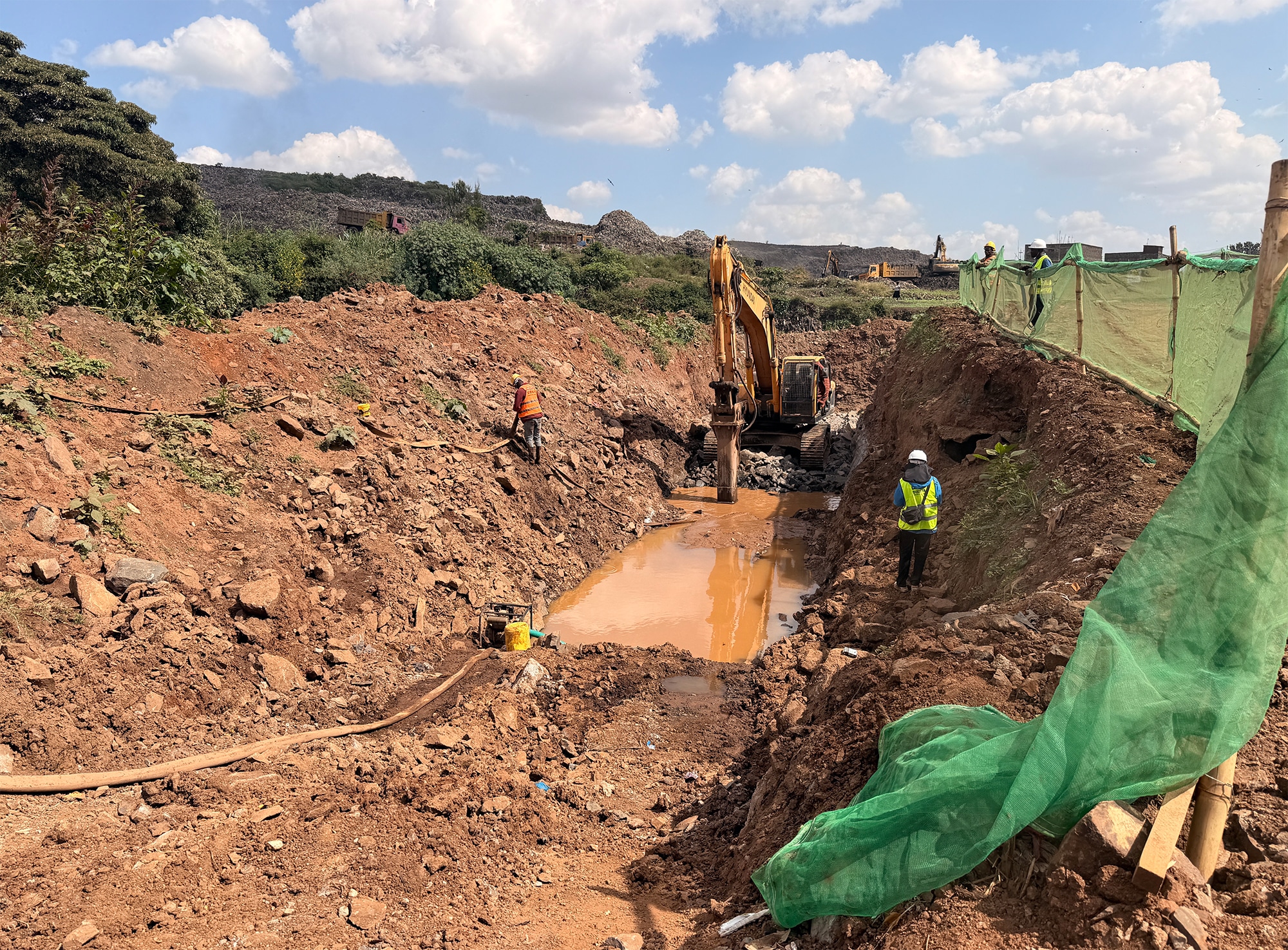
Along the river, there will be new sewers and lighting. “There’s a lot of community parks being developed, sports facilities,” she said. “All this infrastructure is to assist those who are living in informal settlements to have a dignified life.” She said the development would reflect “whatever the community would want” and denied that anybody would be evicted outside the 30-meter riparian zone. 29
But Selina Atieno, a fish seller and day laborer in Mathare, told me she was wary of initiatives that improve some residents’ lives at the expense of others. A few years ago, she was displaced by a sanitation project funded by the World Bank. She told me she was not compensated for the $1,000 she had spent for her home and land, nor was she resettled. Not a single Mathare home was connected to that sewer line: It was designed to serve a different neighborhood. Mathare was merely in its path.
Kenya’s 2010 Constitution is supposed to guarantee the economic rights and property of all citizens. But legislation to protect people without a clear title to their land — the Evictions and Resettlement Procedures Bill, first introduced in Parliament in 2012 — was never passed. “There are those who want life in Nairobi to remain informal so they can charge the vendors, tax free,” said urban planner Constant Cap. “There are people who benefit from the chaos.”
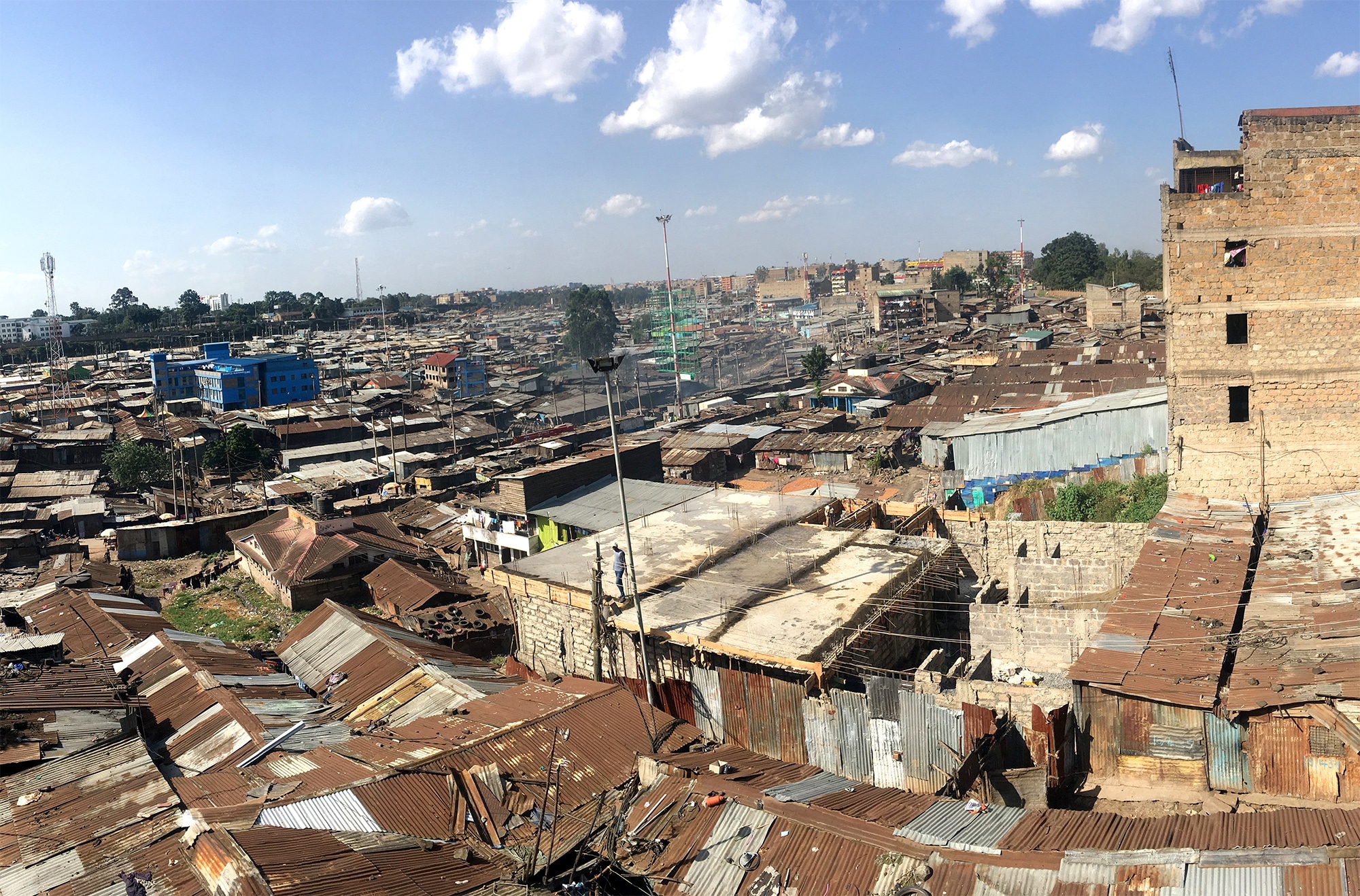
Together with anthropologist Wangui Kimari, Cap interviewed community members who believe landlords and developers set fires in poor neighborhoods to drive people out. “‘Formal evictions’— in which official involvement is often signaled by the presence of bulldozers flanked by various police forces — are just part of the story,” they write. Kimari and Cap found the rumors hard to prove, but they passed on the observations of one activist: “In almost all places where there is a fire, a high-rise building will come up.” 30
Community members believe landlords and developers set fires in poor neighborhoods to drive people out.
Many residents try to protect their holdings by paying fees to secure a lease or title, but they are working against a corrupt system. An investigative commission found that between 1962 and 2002, more than 200,000 titles had been illegally created, for the benefit of politically connected elites. 31 And a title does not prevent the government from taking residents’ land under the auspices of environmental protection.
Lawrence Otieno Auma, a volunteer with the nonprofit Foundation of Hope in Kibera, spent months mapping the distance between residents’ shacks and the Nairobi River, to identify homes that should be safe, outside the 30-meter riparian zone. He didn’t expect police to respect the law, but he hoped that some displaced residents might be able to challenge their evictions in court. “When they were demolishing Mathare, they were not showing it on TV,” Auma said. “In Mathare it happened. In Mukuru it happened. We don’t want that same thing to happen in Kibera.” When we spoke, a few months after the flood, the volunteers had mapped about 420 homes, but Auma estimated there were still 6,000 to go.
On the final day of 2024, I stood near Jane Kalekye’s land in Korogocho as Marabou storks circled overhead. High in the sky, these scavenger birds, known locally as Bong’au, look about the same size as sparrows, but in reality they are “huge — bigger than a young kid,” said Janet Maina, a respected community volunteer. “Where you see them, that is the dump site. In Dandora, there are thousands of them.”
‘I’m happy, but scared,’ Jane Kalekye said. ‘I don’t know when they’re going to clear this area.’
Near the riverbank, some neighborhood kids pushed a cloth toy caterpillar toward my feet, sending dust into the air. Through the haze, I could see Kalekye’s maize stalks and banana trees. To my surprise, her farm was growing again. She was doing much better than the last time I’d seen her. In September, an NGO had offered temporary work to people cleaning up rubble from the houses the police had knocked down. After two weeks of work, she had enough money to buy seeds and to plant. “I’m happy, but scared,” she told me. “I don’t know when they’re going to clear this area.” She knew she could be evicted again.
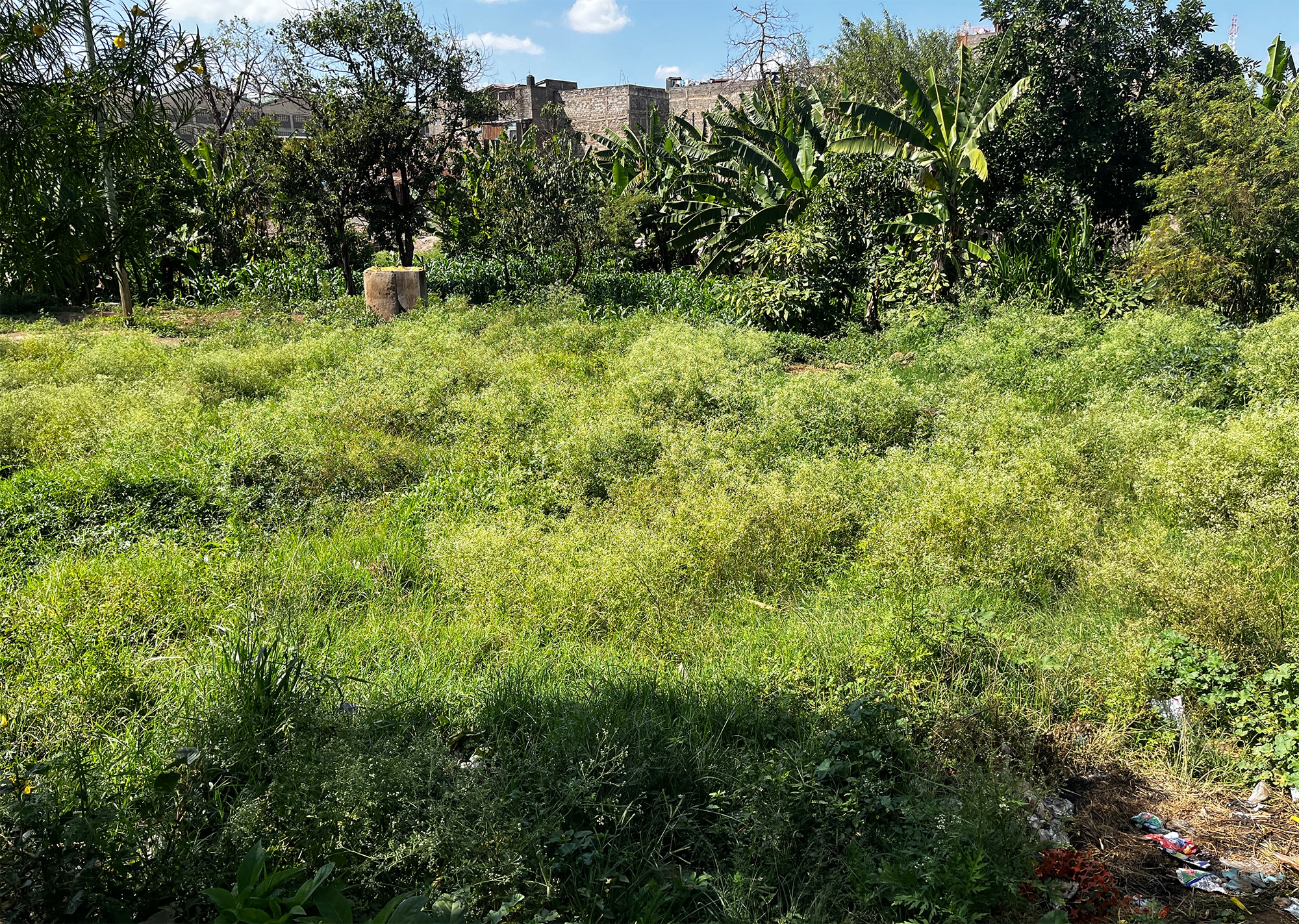
Rumors were circulating that the city wanted to build “affordable” housing by the river — ten-story apartments — on the very land they had cleared because it was too dangerous to live. Kalekye’s neighbor, community activist Rosemary Wairimu, saw surveyors taking measurements along the river. Wairimu said they started from the highest point the water had reached during the flood, then measured 60 meters farther — well outside the riparian zone, in an area where existing homes were supposed to be left alone. She said she confronted them, but they told her to mind her own business.
“They say the government is building affordable housing … but who is it for?” said Omae, the community volunteer in Mathare. “Why don’t they give it to these people?” she asked, referring to residents who had been evicted, like Milton Onyango. “You go to Runda and you see houses along the river flooding, and yet they are not being demolished. In Pangani Heights they are not being demolished.” But in Mathare “people are sleeping outside because they have nowhere else to go.”
Several weeks later, Maina texted me to say that Kalekye’s farm was to be bulldozed again. “They are saying that they are preparing to start planting trees on that side,” she wrote. “Have a lovely day.” Kenya’s leading newspaper, The Nation, published a county notice declaring the Nairobi River corridor a “special planning area” for “flood hazard mitigation, riparian land-use and redevelopment,” a nice bit of Orwellian newspeak, given that riparian land is meant to be protected, not developed. 32
‘I am just hanging in the air,’ Kalekye said. ‘My feet cannot touch the ground, but my hands cannot touch the roof.’
In an interview, Muhia clarified that this designation is meant to stop new construction between 30 and 60 meters from the river, until buildings in that zone can be connected to the future sewer line. In practice, a ban on development means that residents whose homes were destroyed in the flood or the demolitions cannot put their lives back together.
“The government should show us somewhere else to live, and assist us to rebuild,” Kalekye said. She told me the hardest part is not knowing what comes next. “I am just hanging in the air, like someone who has committed suicide. My feet cannot touch the ground, but my hands cannot touch the roof. … I don’t know what is going to happen after this.”
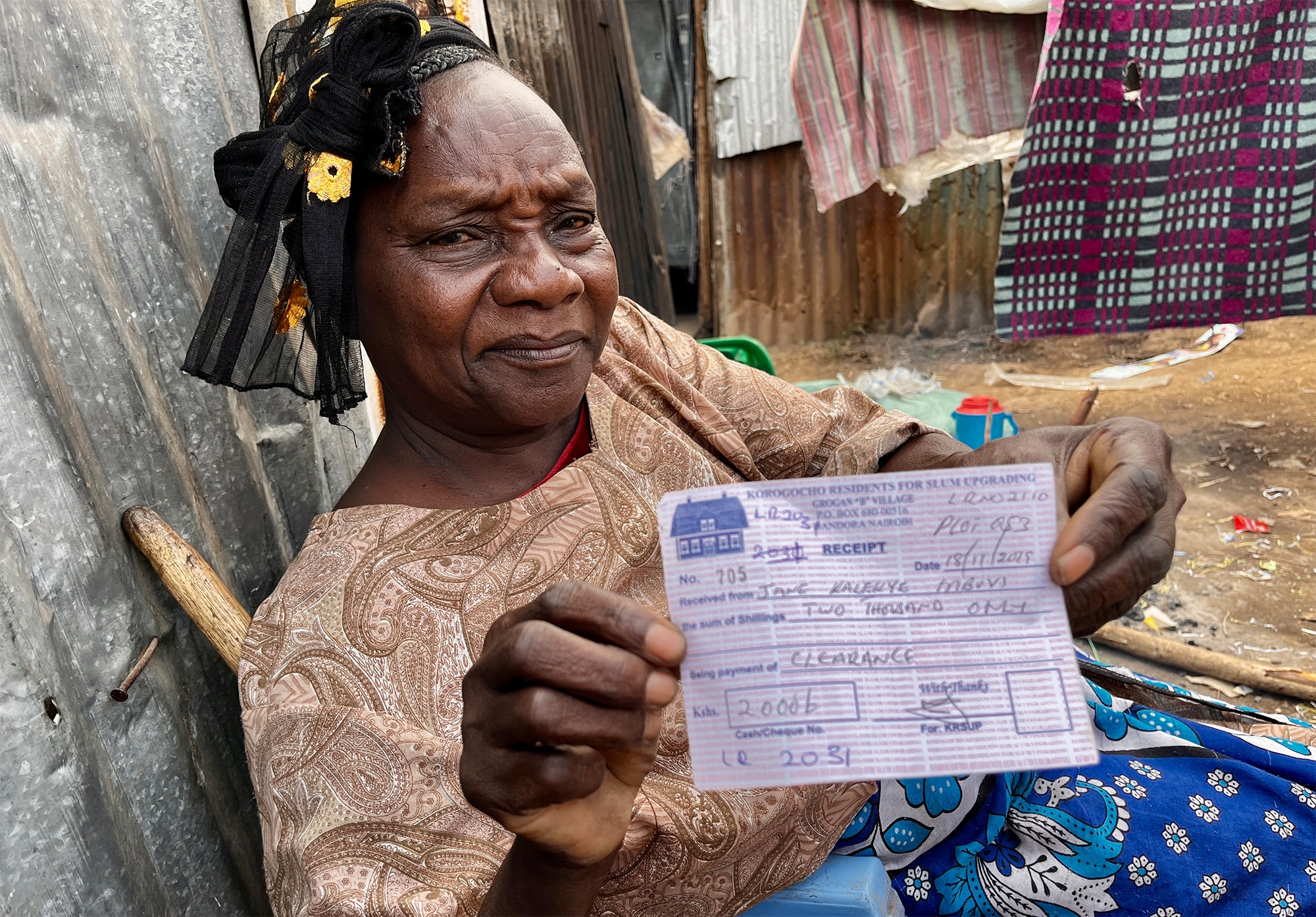
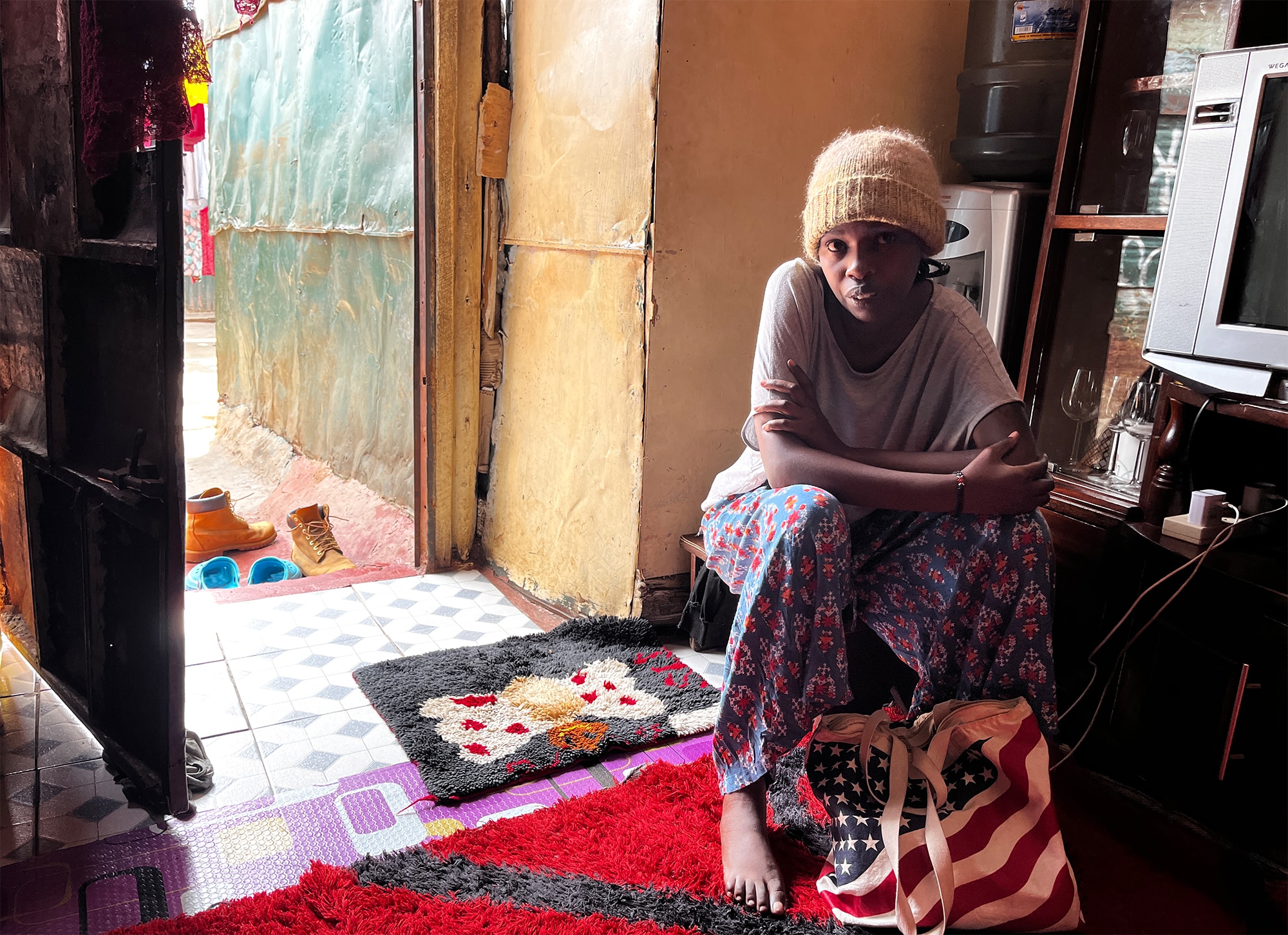
Soon I got another message from Maina. She had seen a notice indicating that 60 meters would be cleared along the river, including her own family’s house, where she was born three decades ago. “My mother was crying, saying, Where will I go?” Maina wrote. “It’s scary.” She sent me video from a community meeting in Korogocho, which overflowed into the street. Hundreds of people chanted angrily. Then came a second video of the local leaders’ office in flames. Residents accused their leaders of being paid off, colluding with the national government to enable evictions — and putting their own friends and family members on the list for resettlement housing, even those who had not lost property. (The leaders I spoke to denied these claims; others didn’t reply.) 33
Residents accused their leaders of being paid off, colluding with the national government to enable evictions.
A map of the special planning area was supposed to be available at the county office, but Nairobi planner Patrick Analo refused to provide it when asked. After promising to check with colleagues, because “the situation is so sensitive,” he went silent. A year later, Muhia told me she did not have a copy of the map, but she again denied that any homes would be demolished beyond 30 meters from the river.
Maina’s family home is still standing, and recently she told me that her neighbors don’t anticipate any imminent evictions. Kenya will vote for a new president next year, and contenders will need to win, buy, or steal people’s votes. “Because the elections are approaching, the politicians need to be good to us.”
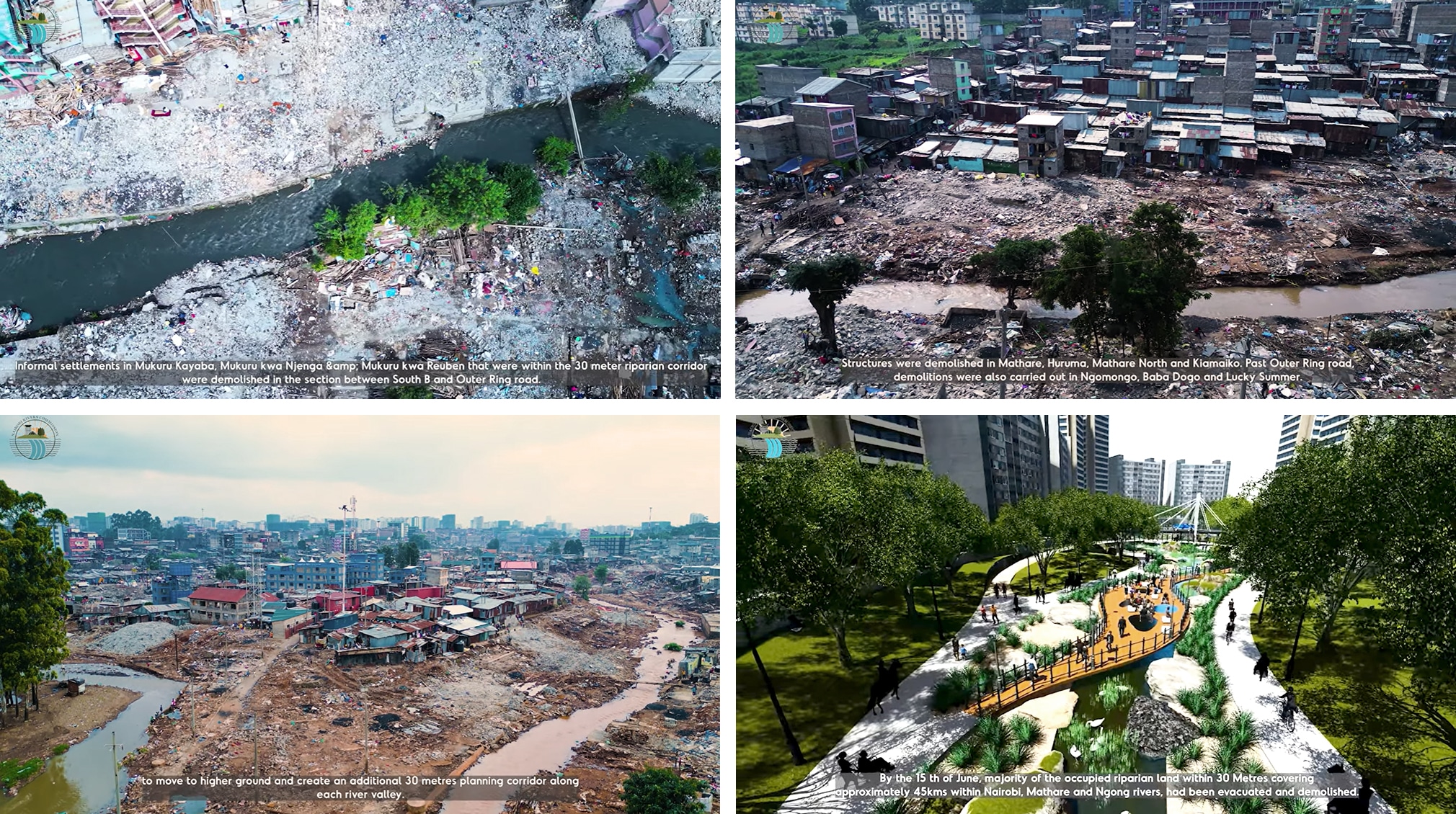
As Nairobi cleans up its waterways, there will be winners and losers. “Cities are getting climate adaptation money, but they’re spending on the middle class,” said Anna Konotchick of Habitat for Humanity. The environmental impact assessment for the Nairobi River Basin Project focuses largely on the new sewers and treatment plant that will increase capacity for the waste that flows from wealthy estates far from the river. In Korogocho and Mathare, there will be pedestrian paths and bridges and “scenic, flower-lined riverbanks.” But what displaced residents really need is still parenthetical: “the provision of affordable and social housing (to be implemented separately at a later stage).” 34
‘It’s disaster capitalism,’ said Parijat Chakrabarti. ‘The flood isn’t just a flood.’
John Kuloba, whose company Earthcare prepared that report, said he empathized with people like Jane Kalekye, who had already lost her home and feared losing her land for good. “I feel sorry for her, being disturbed all the time,” he said. But he said community meetings like the one that ended in protest and fire were intended for residents to express community needs and desires. Theirs are “the opinions we wanted to collect.”
‘It’s an opportunity for NGOs to make money. For the government to give friends contracts to build houses. … Nobody knows if police demolished with that in mind.’
That may be the case, but the public consultation section of the report includes only six comments, including one questioning the entire process: “As someone who was forcibly evicted under distressing and inhumane circumstances, I find it deeply concerning that we are now being asked to participate in the same process that disregarded our dignity and rights.” That commenter said each evicted family should receive compensation of 5 million shillings — about $39,000 — before any development proceeds. 35
In June 2025, a year after the flood, I found Jane Kalekye living by the river, sitting outside on a plastic chair, batting flies. “Boys raided the farm and stole all the maize,” she said. When Maina checked in on her several months later, Kalekye had replanted some crops, but heavy rains had already washed the seedlings away. Unable to afford her medicine, she could no longer walk the few hundred meters down the hill to her farm. When I visited Korogocho in May 2026, after a new round of flooding, Kalekye had replanted again, but the shack where she was living was set to be demolished as a fire hazard because it was located beneath electricity lines. Her neighbor, Wairimu, said that was a pretext. “I think the government is just trying to create a way to vacate us.”
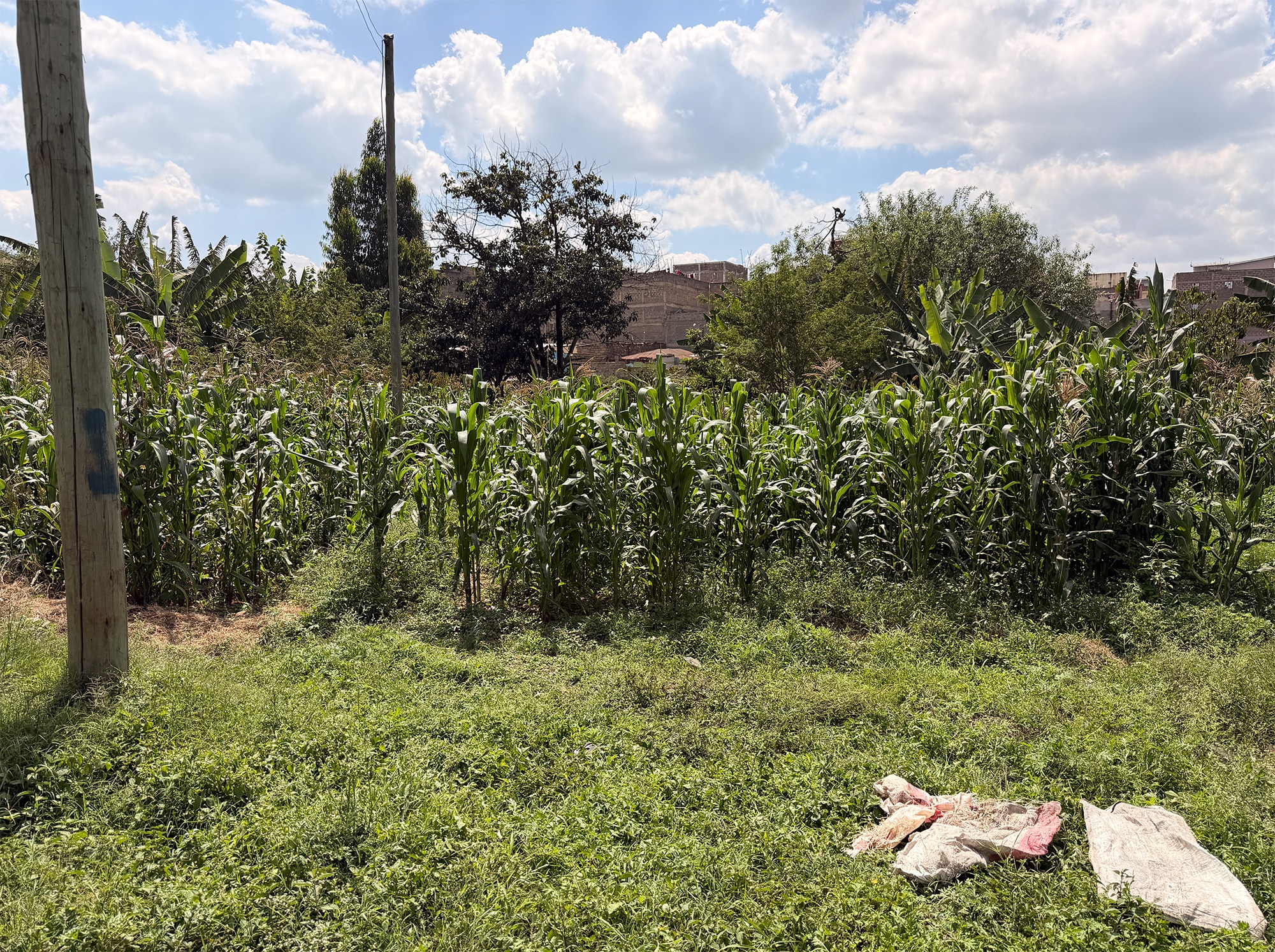
Kalekye said she didn’t believe the city’s promises to build new housing, and she couldn’t afford the rent if they did. Rumor had it that the “affordable” units would be 3,000 shillings, about $25, per month. Maina told me that was three or four times the typical rent for people living by the river.
“It’s disaster capitalism,” said sociologist Parijat Chakrabarti. “The flood isn’t just a flood. It’s an opportunity for NGOs to make money. For the government to give friends contracts to build houses. It’s so opaque. All you see is the end results. Nobody knows if police demolished with that in mind.” 36
And nobody knows if the Nairobi Basin cleanup will ever be more than a joke to Kenya’s president. Maina remembered his promise that the contaminated river would soon be transformed into fish farms. 37 “Ruto said there would be fishing here. But the river is fill of sewage.” Laughing, she said, “How would the fish survive?”




If you would like to comment on this article, or anything else on Places Journal, visit our Facebook page or send us a message on Twitter.