
Southern Lebanon, May 2025
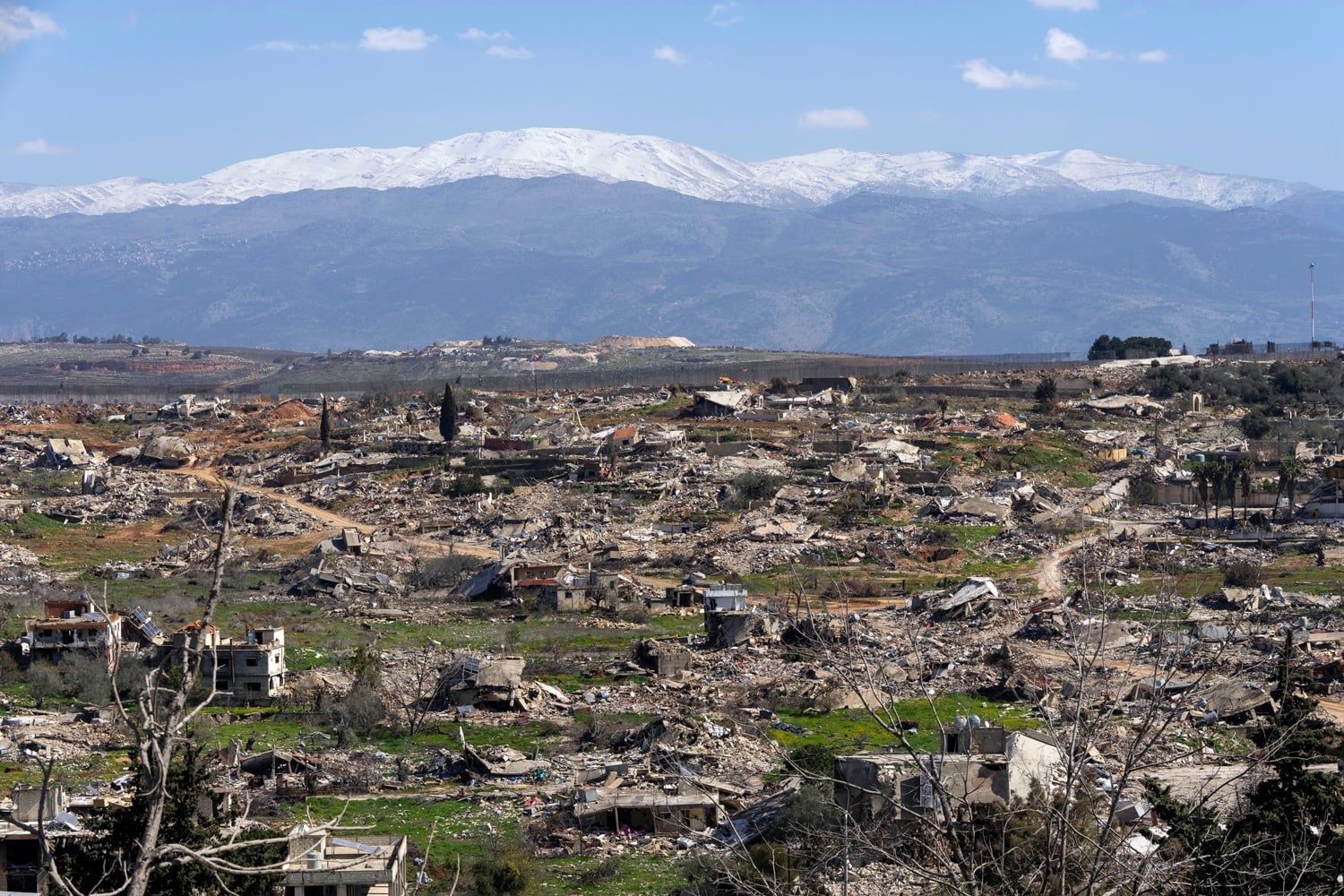
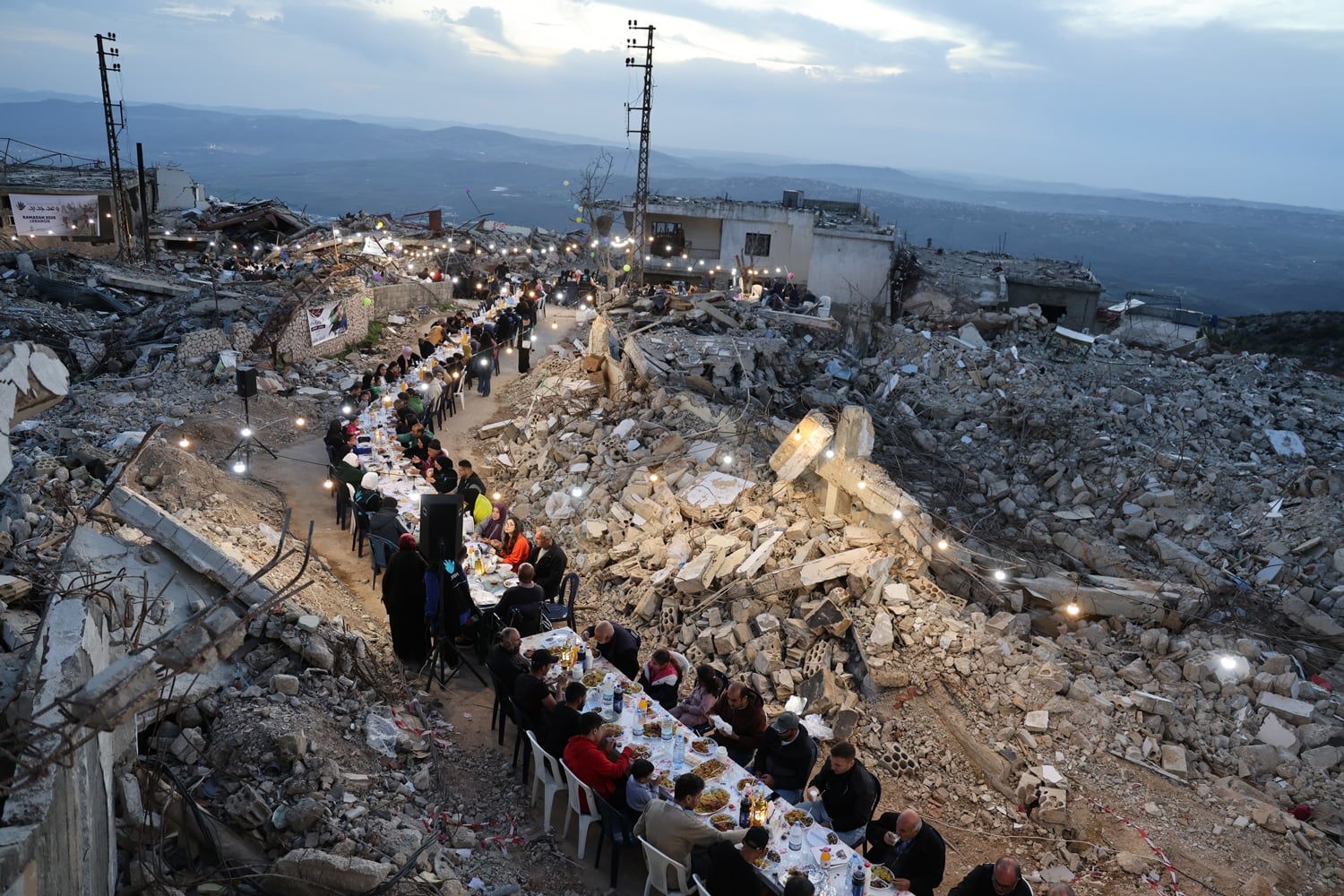
Afternoon light varnished the coastal highway as we joined the caravan of return. Vehicles sagged under the weight of mattresses, window frames, tiles, and sacks of cement. My niece and nephew flattened their faces against the glass, witnesses to a homeland reassembling itself after war. Six months had passed since Israel’s 2024 invasion of Lebanon was brought to a halt, yet return was still in motion, and rebuilding surged ahead in full force.
Astronomers remind us that to look at the sky is to look into the past, since light arrives late, carrying the traces of what has already occurred.
Hunger stirred before we reached Nabatieh, and we pulled into one of the few restaurants that had reopened, Bullseye BBQ, a Texas-style smokery blazing defiantly against a street still flanked by hollowed-out facades. Its promise was extravagant: brisket smoked for hours, ribs sealed in lacquered glaze, chicken thighs sheened like bronze. It was a southern hospitality doubled, Texas meeting South Lebanon in a theater of abundance amid ruin. The children ordered with the solemn daring of explorers. Meat arrived on a wooden board, smoke rising in fragrant spirals. They savored it without noticing the other Texas that was roaring overhead — the Texas of Lockheed Martin assembly lines, where jets are built to scatter worlds like the one we were driving south to piece back together.
I could not tell whether the jet breaking the sound barrier above us was an F-16 or an F-35, though for those who still live here, that distinction is as obvious as a change in the weather. Either way, like all such aircraft, it began as parts on the production lines of Air Force Plant 4 in Fort Worth, where it was assembled before being transferred to Israel. 1 Astronomers remind us that to look at the sky is to look into the past, since light arrives late, carrying the traces of what has already occurred. The contrails hanging above Nabatieh seemed to follow the same logic: an afterimage of imperial industry extended across time. Seeing them here at dusk, when the workday in Air Force Plant 4 was just beginning, I wondered whether the jet being assembled at that moment would one day draw us into a new cycle of destruction and repair.
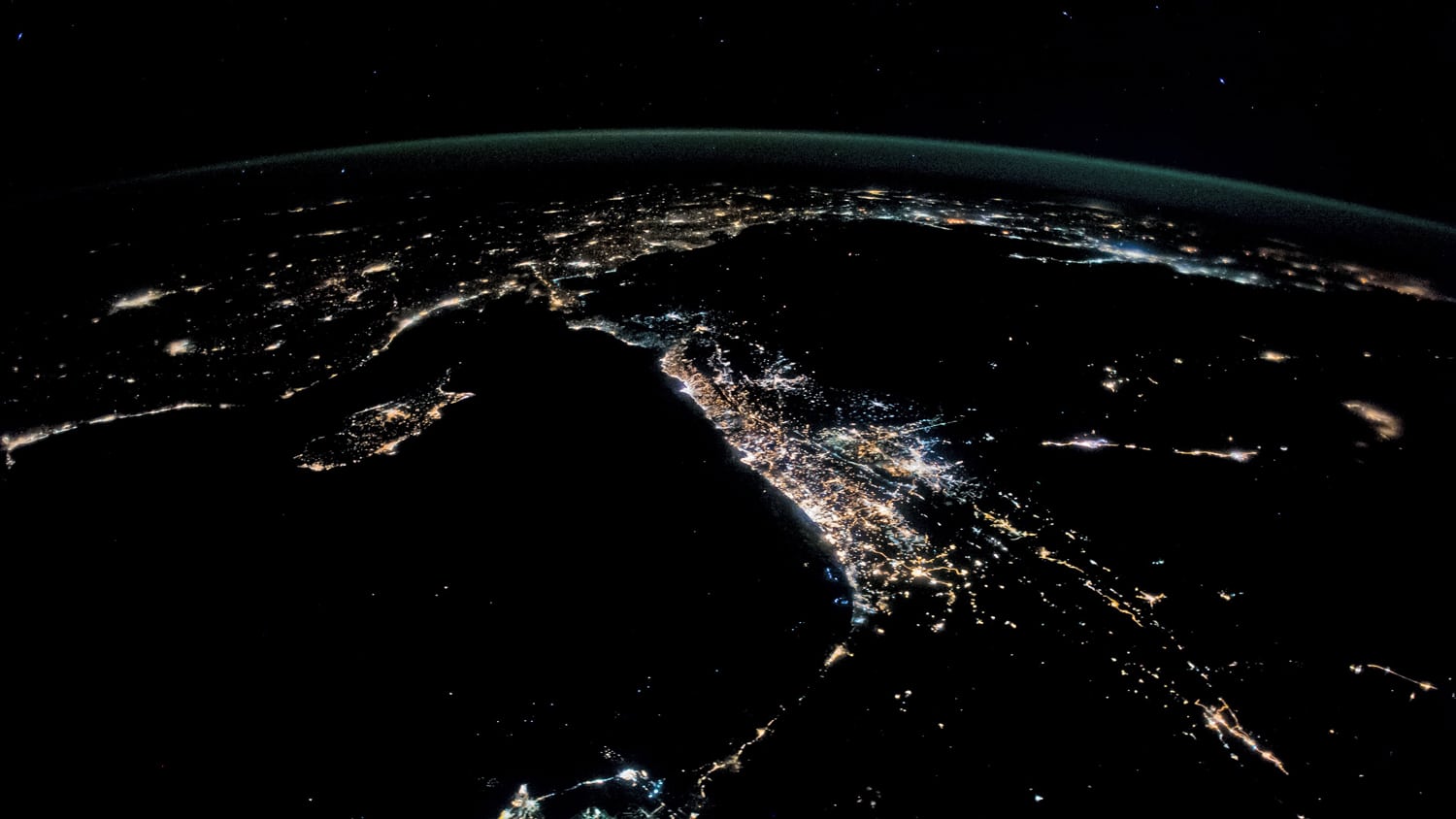
Agrarian life, like that still practiced in southern Lebanon, requires careful attention to the ledger of the sky, whose patterns register most clearly at night. 2 Mastery of these nocturnal readings promises a steadier harvest and, by extension, a more secure future. The moon enacts its own language: its phases, its clarity or lack thereof, the halo that sometimes gathers around it — each a signal of rain or its absence. Constellations rise and recede in cycles that guide the timing of irrigation and harvest. Thunder carries meaning in its duration; a long rolling sound signals harsher conditions, a sharp one suggests milder weather. Lightning along known ridgelines indicates whether a storm is nearing or passing, guiding decisions about the safety of livestock. Even distant phenomena, comets and shooting stars, are deciphered according to the directions of their movement, each pointing toward fortune or calamity. The skills required to read the sky in this way are an inheritance shaped by necessity, a means of seeing and hearing the seasons before they arrive.
In the place I come from, such practices have not disappeared into the long shadow of surveillance and militarization, nor yielded to the devastation that engulfs us periodically. They have adapted, evolving within a new ecological order where attention to the sky is recalibrated through exposure to armed conflict. In A Landscape of War, anthropologist Munira Khayyat writes that, in southern Lebanon, “agriculturally-based livelihoods premised on known and predictable agricultural seasons and harvests, mawasim zira’iyi, are sustained across and through seasons and harvests of war, mawasim harb.” 3 From this convergence arises a renewed kind of sky-reading, one that reckons with the trajectories and taxonomies of military objects, along with the futures they portend.
In the cool nights of southern Lebanon when I was a child, the Black Hawk helicopter inhabited my thoughts alongside other predators.
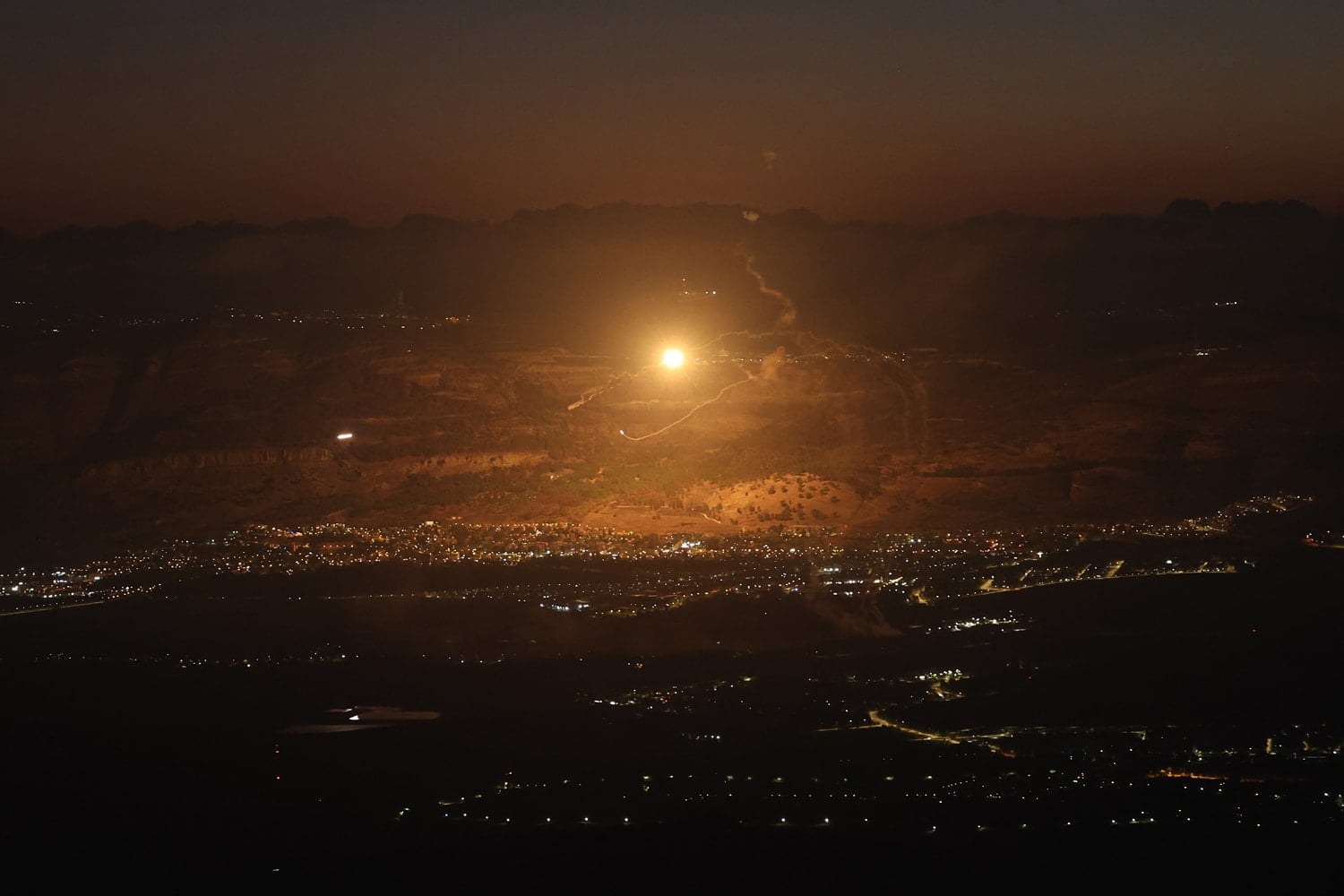
Two weeks after we returned to our village, on June 13, 2025, Israel launched an attack on Iran that came to be known as the Twelve Day War. That same evening, Iran answered with 150 ballistic missiles aimed toward Israel, their flight illuminating the night sky over southern Lebanon. After a day spent repairing a stone wall unsettled by earlier destruction, my niece and nephew lifted their eyes in amazement. “Shooting stars, shooting stars,” they shouted, convinced that the heavens had arranged a spectacle just for them. They joined hands, closed their eyes, and offered wishes to the burning trails above. Seconds later, from the opposite direction, more sharp lines of light climbed into the sky, intercepting some of the shooting stars in sudden flashes and thunderous bursts. Adults stood in silence as the little ones turned to one another in shock. In those violent flares, all read the outline of what would soon unsettle their lives again.
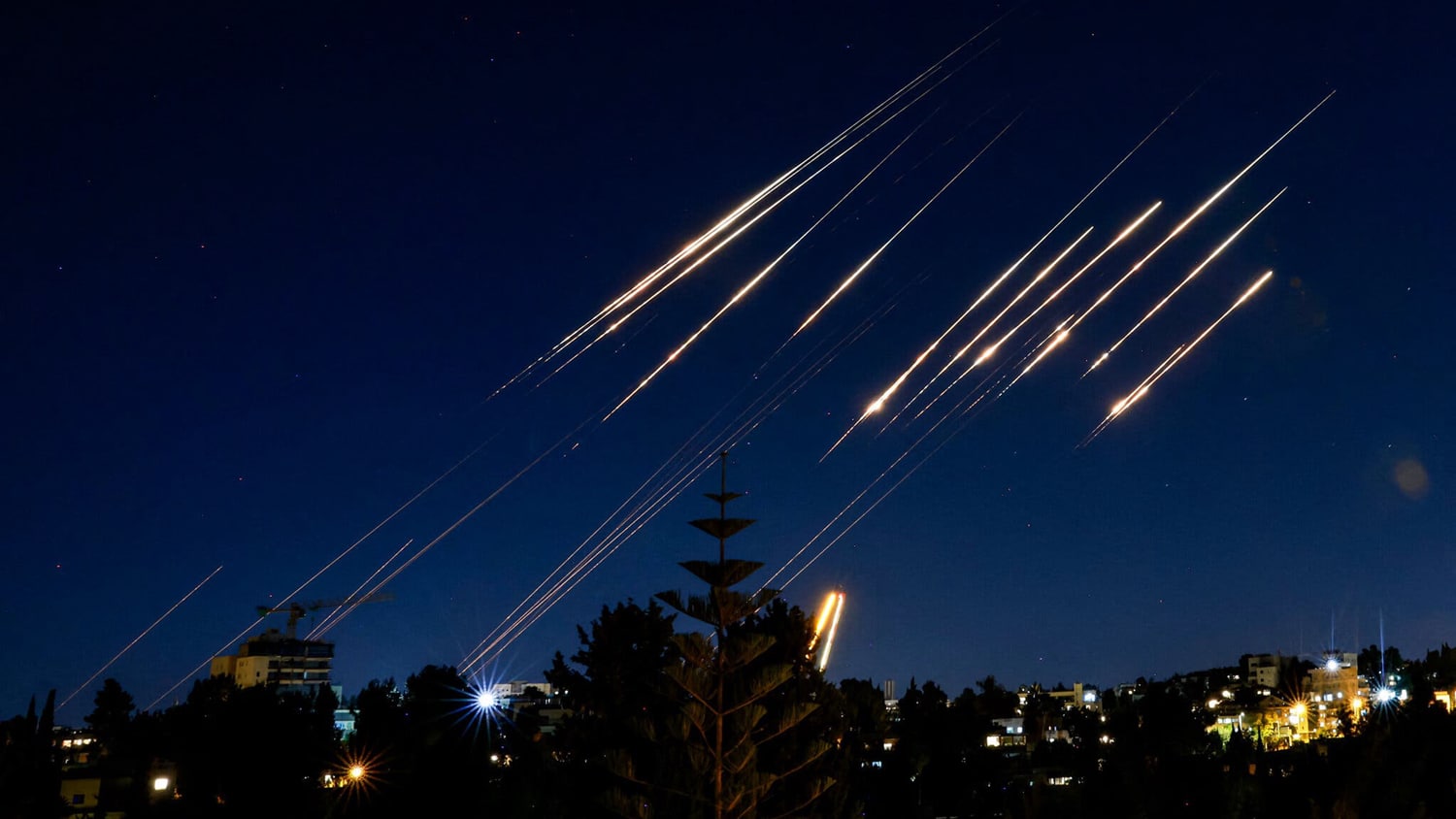
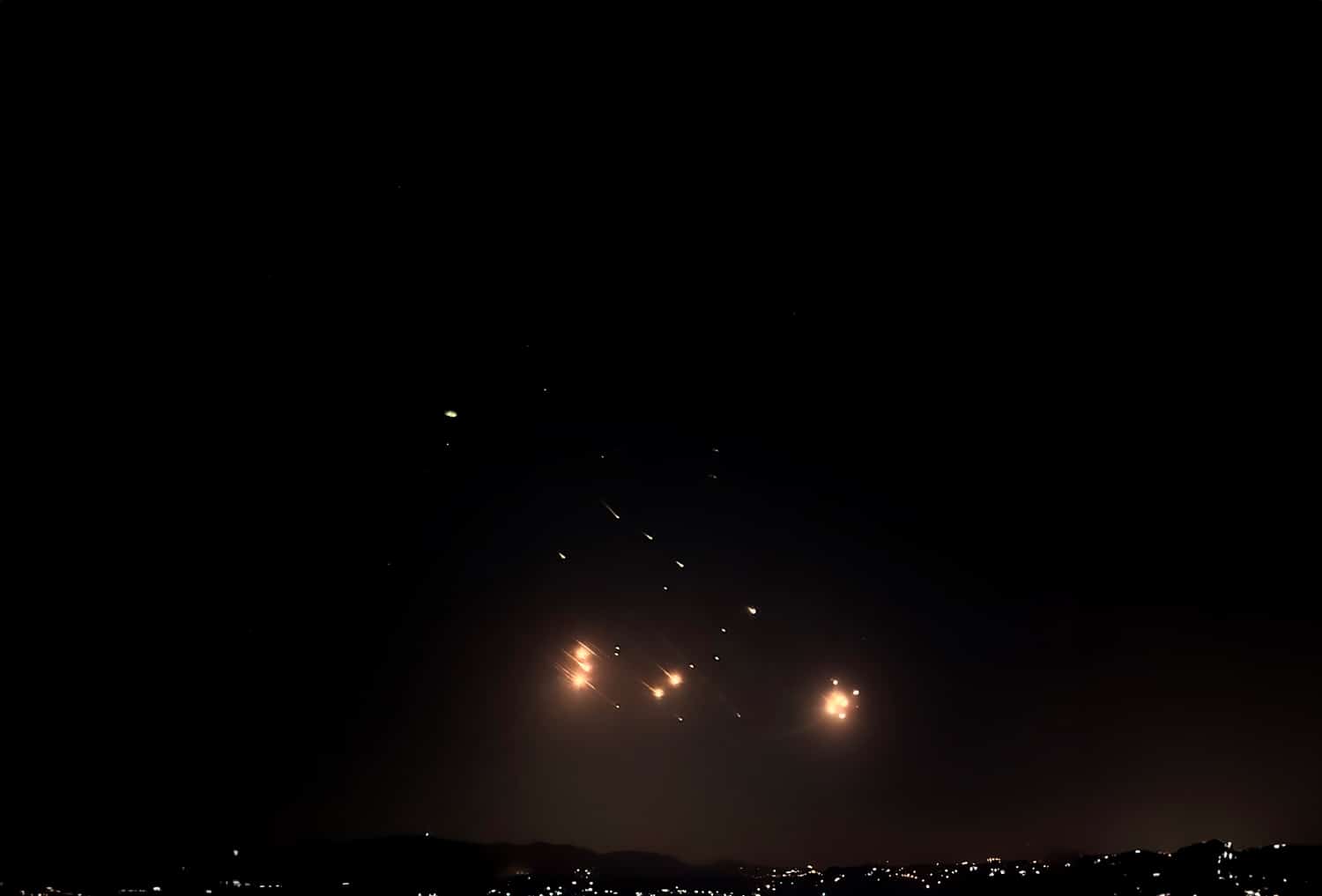
If children in southern Lebanon first struggled to parse this cosmic clash of Iranian stars and Israeli interceptors, they track it now — in the wake of the United States and Israel’s ongoing attacks on Iran — as seasoned observers. That fluency follows a deep history, as generations here have learned to interpret the sky in synergy with the expansion of the U.S. arsenal. I was born in the same year that the U.S. Sikorsky UH-60 Black Hawk helicopter began to be used by the Israeli military. 4 In the cool nights of our hometown of Taybeh when I was a child, the Black Hawk inhabited my thoughts alongside other predators. I had never seen one. But I heard them often, and they lived in the stories elders told by the hearth, which gave form to the new dangers spreading across the borderland.
In those tales, the Black Hawk appeared as a raptor with glowing eyes and a fiery throat that could devastate entire villages. We were told never to look for it, and to return indoors the moment its thumping rotors sounded overhead. Known among us as al-sakr al-aswad (the black hawk, or falcon), the helicopter belonged to the same night world as Umm Kamel, the ever-watchful Israeli drone named after an Ottoman-era matriarch famous for her network of informants. 5 Together, they filled the sky while jackals and restless spirits roamed the land, so that at sunset, children slipped indoors as though yielding the night to those darker forces.
I remember one evening on our balcony, shortly after the liberation of southern Lebanon in May 2000 (after 22 years of Israeli occupation), asking my grandfather why the Black Hawk bore that name. I was old enough that the raptor had begun to transform in my mind from a living creature into a machine, though it still retained a glimmer of wonder. I asked out loud, but I was certain of the answer: the aircraft operated at night, so its name followed from the color of darkness itself. The explanation I received was far more intricate, and, to my younger self, less satisfying. The Black Hawk, my grandfather said, was named after a Native American war leader who had resisted U.S. colonization of Indigenous lands.
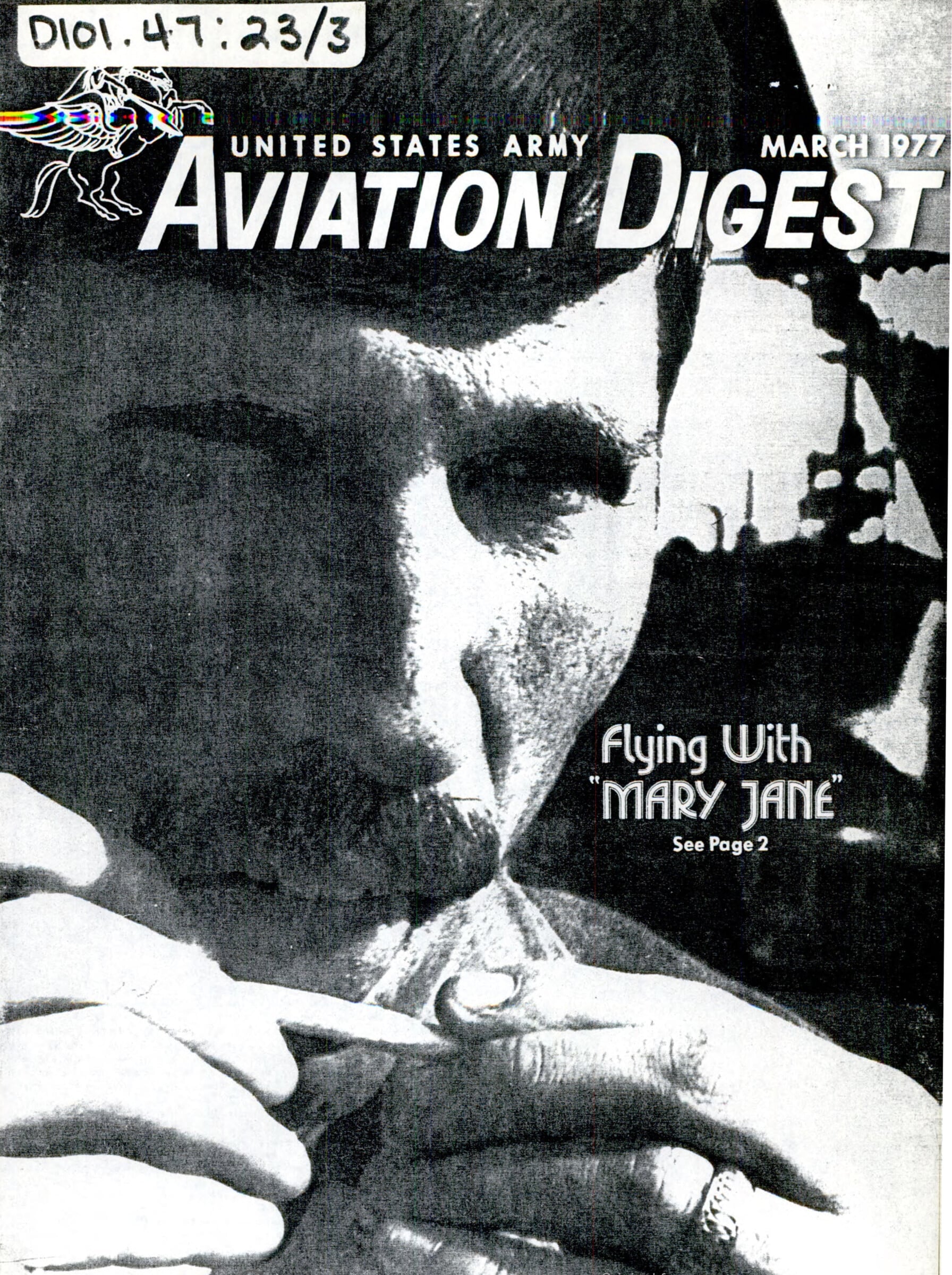
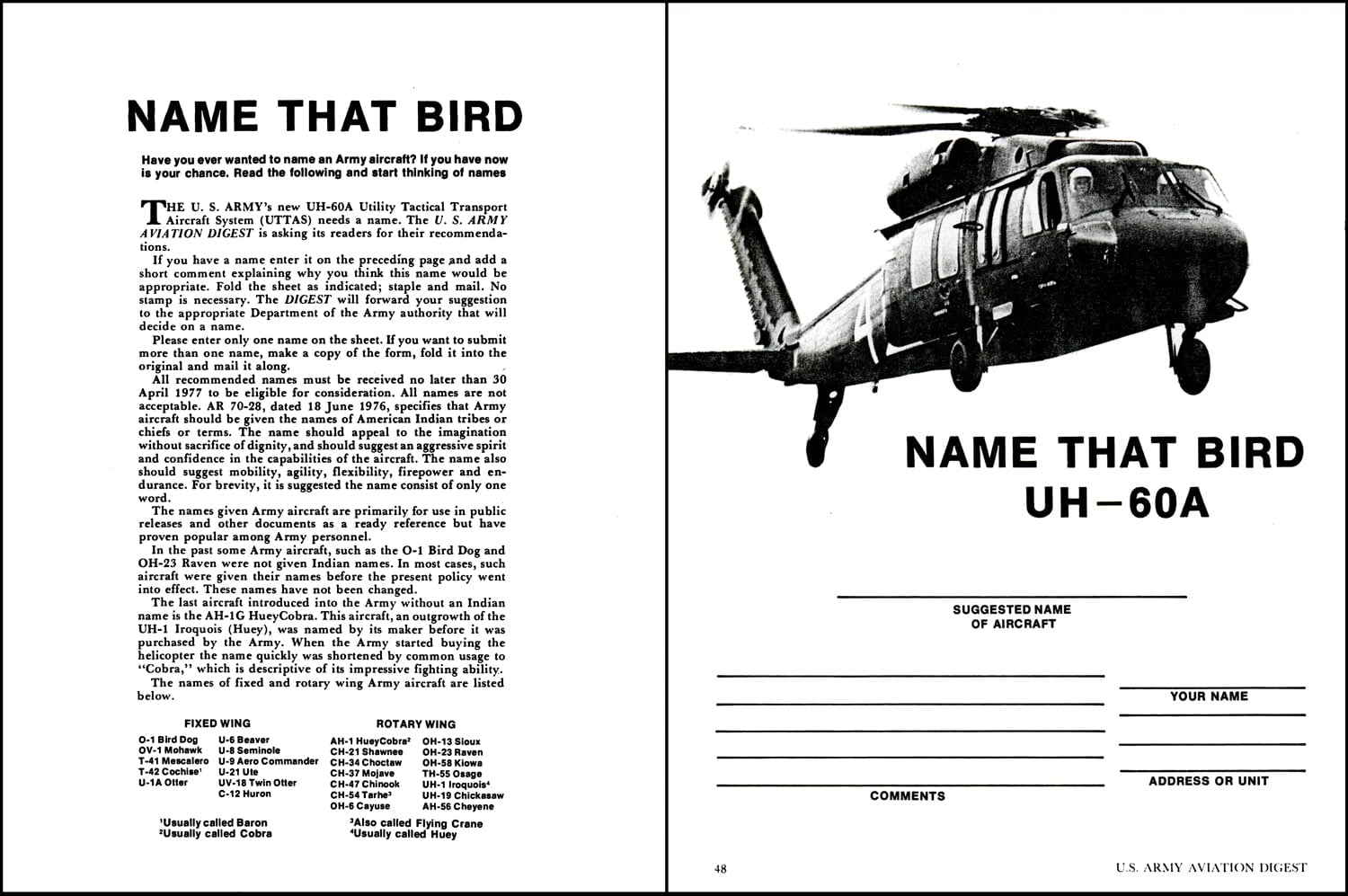
Of all the memories stirred by the current period of unabashed U.S. imperial posturing, this one has returned to me with particular force in recent weeks. It has led me, among other responses, to read about how the “Black Hawk” designation had actually been chosen. In the March 1977 issue of the United States Army’s Aviation Digest, readers were invited to participate in a contest titled “Name that Bird,” created to select a moniker for the new UH-60A. The announcement stated: “All names are not acceptable. AR 70-28, dated 18 June 1976, specifies that Army aircraft should be given the names of American Indian tribes or chiefs or terms. The name should appeal to the imagination, and should suggest an aggressive spirit and confidence in the capabilities of the aircraft.” 6 Thus the Sauk leader Ma-ka-tai-me-she-kia-kiak, who had resisted U.S. conquest, was absorbed into the language of empire, his name transferred to armaments that the United States would later place in Israeli hands to command our sky. 7
The name gestures toward another politics of the sky, one in which looking upward becomes a practice of solidarity in an age of ruin.
The epithet al-sakr al-aswad, then, marks a double conversion, entering the ecology of southern Lebanon only after an early (de)formation via distant U.S. military bases. The darkness that names it and the darkness that trains it reflect competing attitudes toward the contemporary sky, whose saturation with celestial objects — military and natural — generates new strategies for preservation on the ground. What the Arabic version accomplishes, despite its apparently direct rendering of the English, is to detach the helicopter from the proprietary idiom of U.S. military branding and resituate it within the agrarian legacy of the south. It does so by stripping the aircraft of its corporate aura and returning it to the classificatory world of the region, where predatory birds, seasonal winds, shooting stars, storms, and machines alike are apprehended through their relation to village life. At the same time, al-sakr al-aswad preserves a memory of struggle through an oblique alliance between two geographies of native resistance: Indigenous refusal in North America, and anticolonial endurance in South Lebanon. The name gestures toward another politics of the sky, one in which looking upward becomes a practice of solidarity in an age of ruin. These politics reject, at once, the imperial drive to organize the sky as battlespace; the liberal fantasy of preserving it as untouched scenery; and the scientific impulse to flatten it into data — projects far more entangled than they first appear.
South Texas, August 2025
As I drove toward Joint Base San Antonio, the largest seat of the rebranded Department of War, I recalled a well-known Arab proverb: yas’alu ‘an al-bayda man badaha, “he asks about who laid the egg,” a reminder of the futility of excessive curiosity. Nearing Lackland Air Force Base — part of JBSA — I caught myself laughing, picturing my grandfather’s dismay at the thought of me traveling intentionally toward the very birds he had once invoked in dread. Yet I wanted to see them in their lair, at the hour when their technocratic vision is disciplined to watch people like us on the far side of the globe.
Lackland, after all, is a nocturnal proving ground where crews train on UH-60 Black Hawks under lightless skies. These exercises, for which JBSA is well known, replicate the operational environment under which U.S. military conducts its attacks overseas. 8 Contemporary Air Force doctrine holds that aviation missions should generally be executed at night, when low visibility reduces the likelihood of detection, while pilots and other personnel rely on infrared systems and sensor-based imaging. Darkness, then, is the condition that renders the Black Hawk most effectively deadly against those on the ground: people it reads as interchangeable thermal gradients. The helicopter’s instrumentation does not need to “see” detail. Its calibration aims toward a more generalized objective, to empty “enemy” environments of humanity. As one civil law advisor at JBSA has remarked, “we have here the effective training to continue saying, ‘we own the night.’” 9
Darkness renders the Black Hawk most deadly against those on the ground: people it reads as interchangeable thermal gradients.
The road to the airbase stretched through the San Antonio suburbs, and glare emitted in various intensities by electric globes ebbed successively, as though an entire artificially luminous ecosystem were entering managed decline. In its place rose a standardized rank of hooded streetlight fixtures, compressing illumination into narrow cones on the asphalt. Nothing else announced a transition. Yet on the seat beside me lay a guide to the transformation: the City of San Antonio’s Military Lighting Overlay District map. I stopped where one such district abutted the road and stepped out, standing at the edge of an invisible zone encircling Lackland AFB. On paper the zone resembles a halo, a ring of jurisdiction proclaiming the state’s right to regulate and preserve night as a strategic resource. Codified in December 2008 through amendments to Chapter 35 of the San Antonio municipal code, MLODs extended an extant dark-sky ordinance, further reducing light interference by establishing five-mile buffers around military installations. 10 The ordinance fused rhetorics of national security and urban development, safeguarding the atmospheric conditions necessary for night training while affirming San Antonio’s dependence on the military installations that underwrite its economy. 11
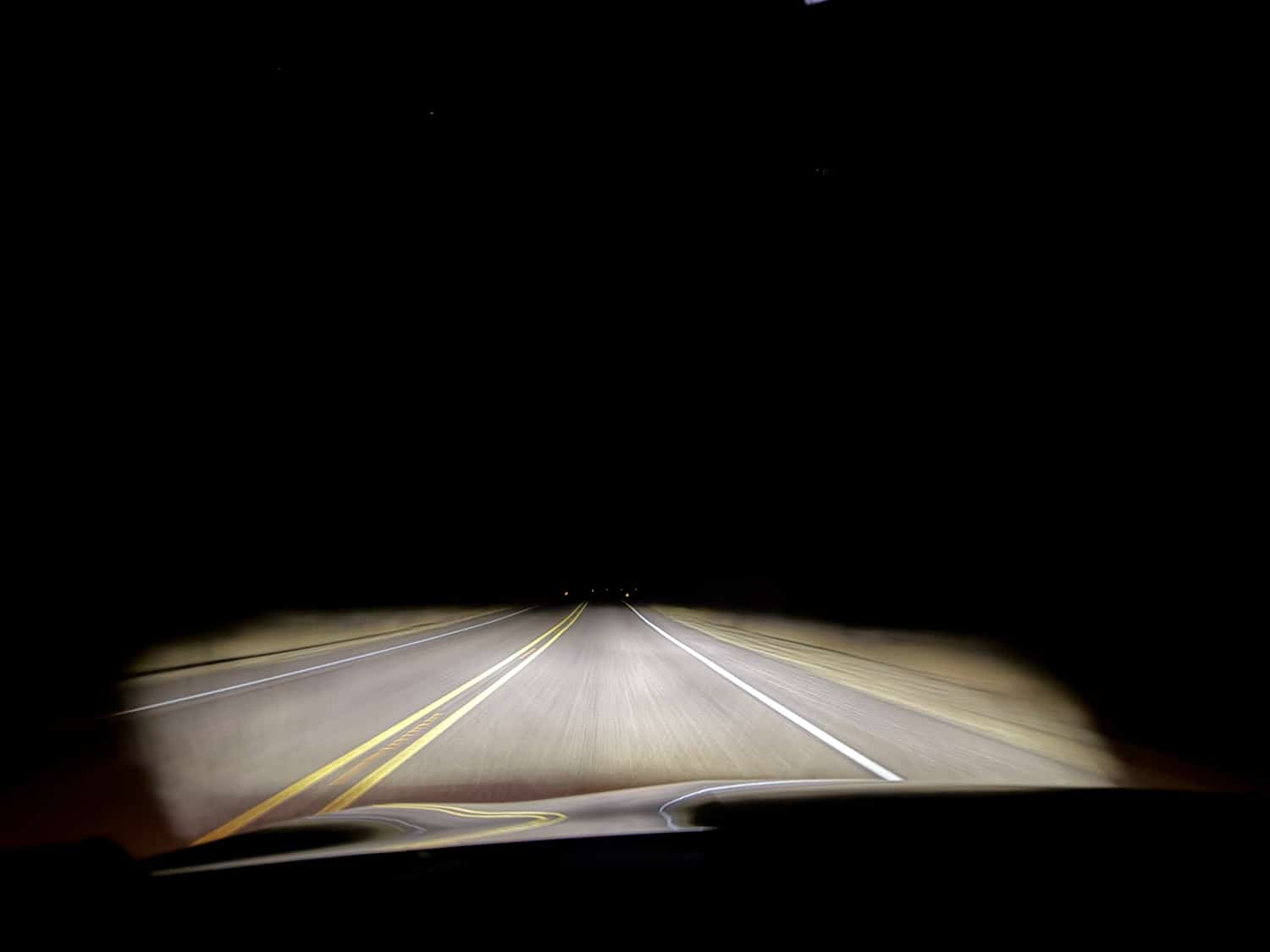
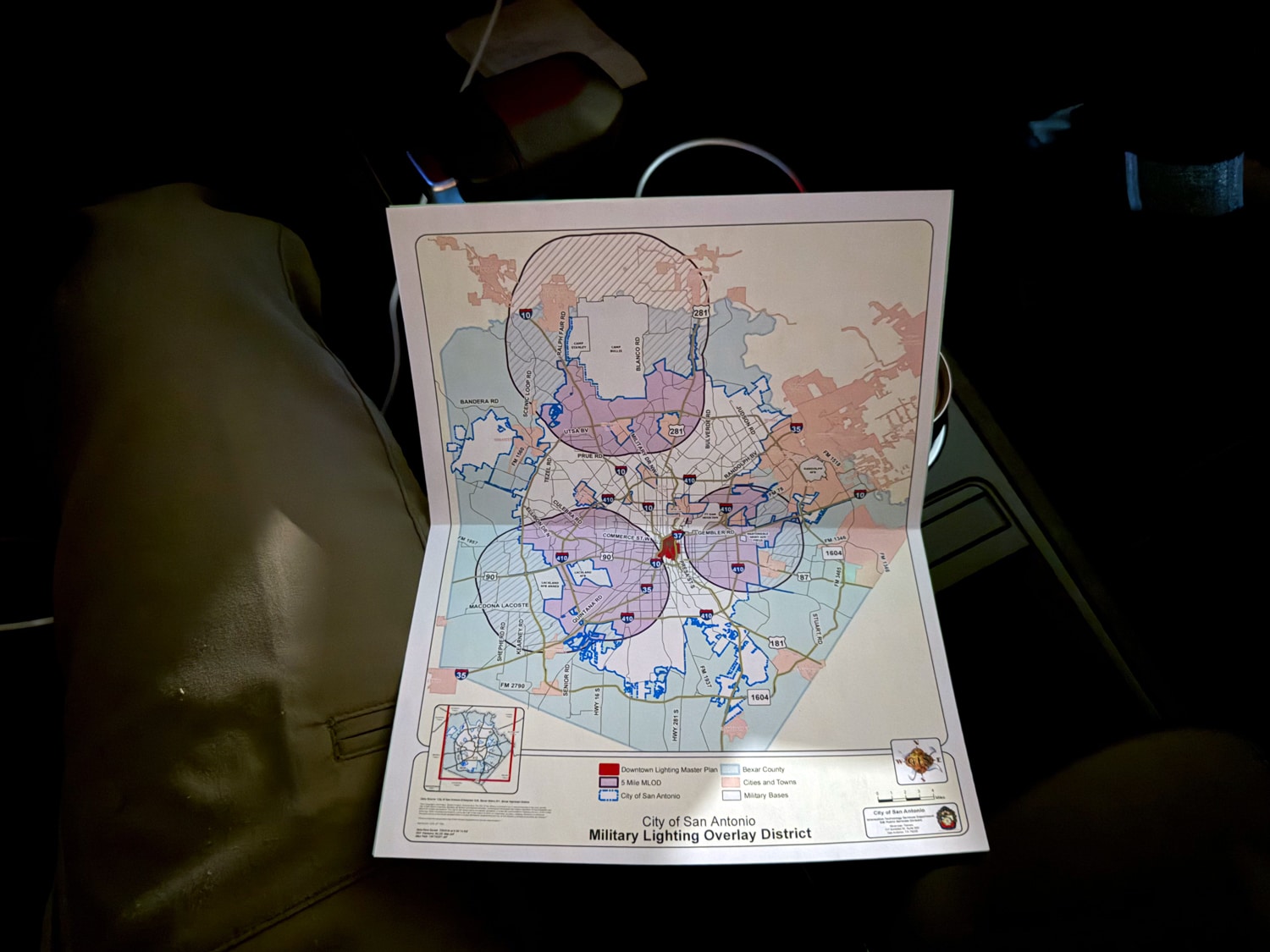
I lingered on the roadside at the edge of the overlay zone, imagining how one step too far might stir the Black Hawks in their berths, their rotors quaking awake. What if they could sense, despite the new American passport resting on my dashboard, that no oath will eclipse the warmth of my homeland?
Inside the terror and strange freedom of that question, I got back into the car, released the brake, and let the car roll beyond the invisible edge. Ahead, ranch-style homes appeared at measured intervals, each held in its narrow pool of light. Signs reading “Dark Sky Approved,” “Shield a Light,” “Keep Texas Dark,” and “Save Our Stars” adorned porches, gates, and utility poles; bumper stickers echoed the appeals. Soon, another set of messages was added: “Thank You for Your Service,” “Support Our Troops,” “Aim High … Fly-Fight-Win.” Air Force insignia shared the same domestic surfaces as dark-sky endorsements in the expression of a coherent strategy. Through this local regime, darkness is defended as an ecological commons even while it is fortified as a strategic asset; atmospheric integrity is presented as a matter of civic duty twice over. War machines that have long desolated distant landscapes and societies help to cultivate, at home, a public ethic devoted to preserving an apparently pristine night. Dark-sky activism functions here in concert with military necessity, as the local protection of stars sustains the environmental conditions through which night may be mastered elsewhere beneath the 50-starred flag.
War machines that desolate distant landscapes help to preserve, at home, an apparently pristine night.
Eventually I found myself on Growdon Road, skirting Kelly Field Annex, another part of JBSA. A low wire fence paralleled the road, leaving the Kelly runway fully exposed to view. At regular intervals, barely legible signs forbade photography, filming, parking, and loitering, but no one seemed on hand to enforce the prohibitions. Indeed, when the road curved, I was surprised to see a small congregation of cars parked along the shoulder, figures seated on mats nearby, all patiently facing into the darkness. My hesitant approach was met by a cheerful explanation from a stranger: “ten more minutes until the F-16.” When the jet emerged, descending with a violent rush that ruptured the night, the crowd rose in unison. The aircraft touched down and vanished again into the unlit expanse of the airfield. Applause followed, brief and sincere. Later I would learn that these were student pilots concluding night exercises. Their gathering swiftly dispersed, the same stranger wishing me good night. I remained by the roadside, suspended between the shared experience of anticipation and the disquieting recognition that I had witnessed the celebration of an instrument of war. How strange that the F-16 greeted with applause here becomes, elsewhere, a condition for life precisely when it is absent.
I remained alone by the fence, facing the dark interior of Kelly Field. I waited for the Black Hawk I had come to seek — for the low, percussive beating that had belonged to my childhood. No Black Hawk appeared. Yet merely standing near their training ground, looking eastward, I felt the Texan night drawn into relation with that other familiar night more than seven thousand miles away. For all that distance, San Antonio and southern Lebanon lie at nearly the same latitude, connected, loosely, by this imaginary belt drawn around the Earth. 12 They incline toward the cosmos at approximately the same angle, so that the same constellations rise and set above them, and stars travel through their skies along kindred arcs. Beneath those stars, each place has, for decades, watched for the return of other objects, of human manufacture — F-16 and F-35 fighter jets, Black Hawk helicopters, and military UAVs or unmanned aerial vehicles. The reappearances of these airborne entities have made them legible to civilian eyes and ears in both locations, albeit for different reasons. One sky, and the machines moving through it, solicit admiration. The other sky is scanned for threats to survival.
San Antonio and southern Lebanon lie at nearly the same latitude, connected by this imaginary belt around the Earth.
To hold these two nights together is to see how conservation and devastation are connected, co-produced; how visibility in one place generates vulnerability in another. Starlight seems to intensify precisely at the place where the annihilation of distant people and their villages and cities is rehearsed; in this relational field, the privilege of wonder granted to some assigns the burden of exposure to others. Such a logistical and ethical relation lays bare the limits of ecological consciousness scaled to the municipality, a claim to virtue resting on the transnational redistribution of impunity and danger.
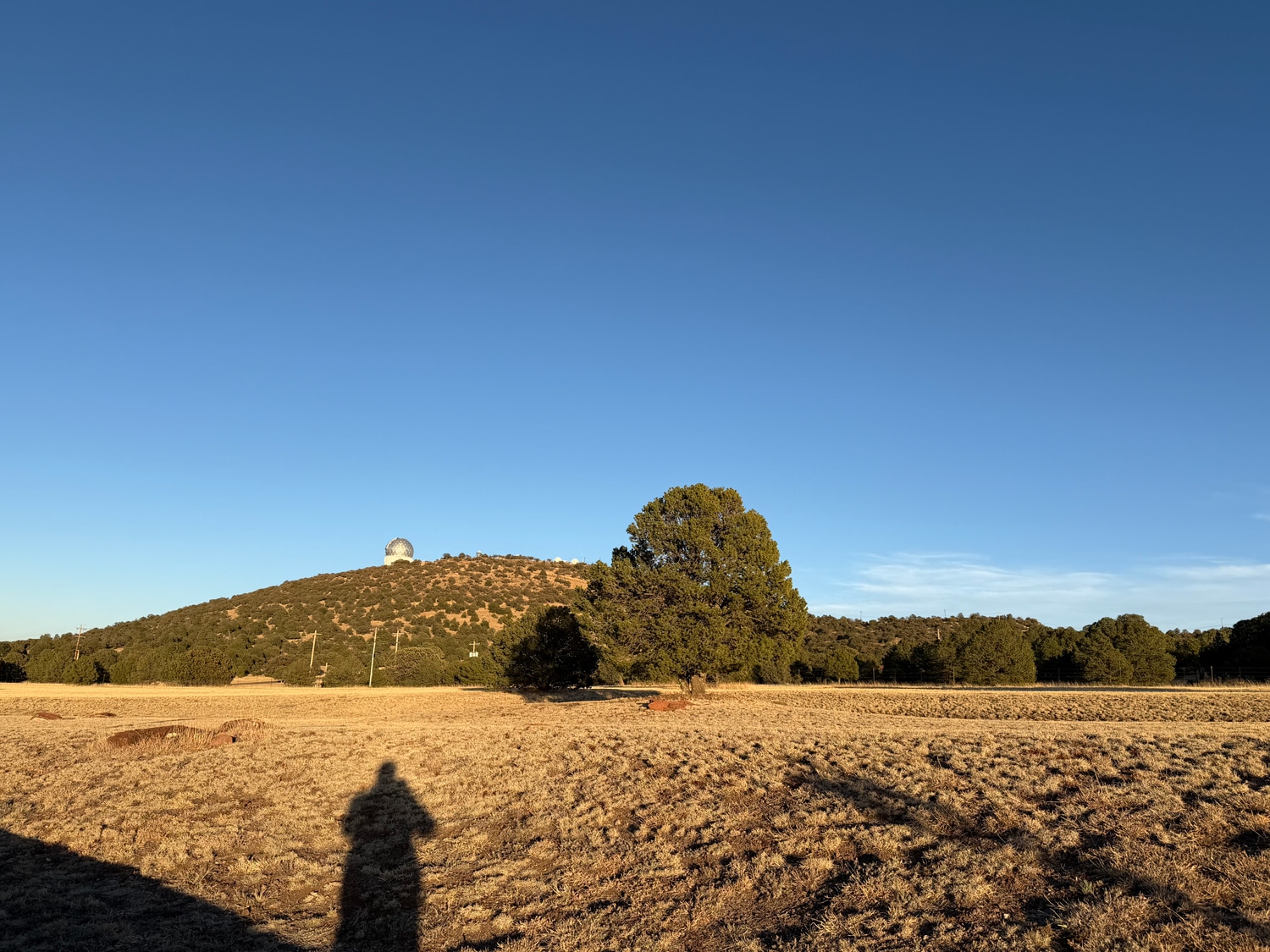
After an hour at the base, I returned to my car and retraced the road, passing the same houses, the same disciplined puddles of light on apparently colorless lawns. The city gathered itself ahead, a low electric glow, and I felt the evening seeking its symmetry. If that day a few months ago had ended in South Lebanon with smoke and brisket, then this night in Texas required its own closing ritual. I parked at Zaatar Lebanese Grill, 20 minutes from Lackland AFB, beneath a bright vinyl banner that declared, “Taste of Lebanon.” On the window of the vehicle parked beside mine, I noticed a Lebanese flag, an oblong of cloth fastened to the glass with stickers, each of which announced, in primary colors, “I Love Texas.” Below them, completing the diplomatic trifecta, was a decal of the state bird, the Northern Mockingbird, wings spread. Still no Black Hawk in sight. Inside, I ordered something that claimed ancestry, paid in dollars stamped with mottos about trust, and took my seat beneath a mural of arches, rugs, and palm trees. The homeland arrived pre-plated and compliant with state health codes. Around me, families ate hummus. I overheard a child ask whether Lebanon had cowboys. His father, without looking up from his phone, said yes, everywhere has cowboys.
West Texas, February 2026
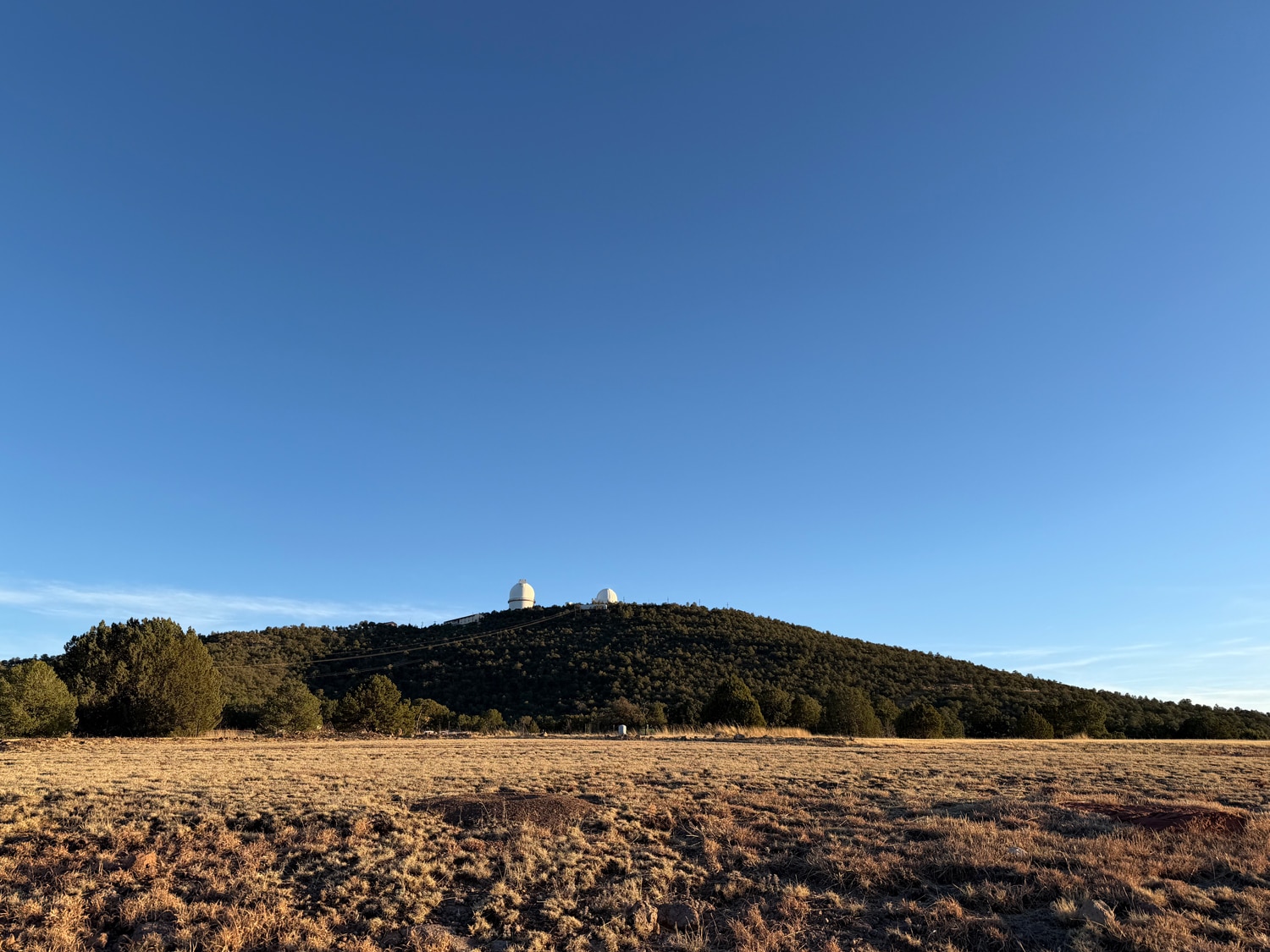
Military installations are not the only Texas infrastructures that expend massive resources to “preserve” the night sky. Three hundred miles or so to the west of Joint Base San Antonio, on a summit in the Davis Mountains, rises the McDonald Observatory. A facility of the University of Texas at Austin, the observatory houses the Hobby-Eberly Telescope, which is among the largest optical instruments on the planet — a giant mirror that gathers the faintest radiance of ancient epochs as it travels toward earth. In 2022, the Greater Big Bend International Dark Sky Reserve was designated, with the McDonald Observatory at its core. Managed by a nonprofit, Dark Sky International, it is the largest expanse of protected night sky on earth, spanning more than 15,000 square miles across West Texas and northern Mexico. 13 It is also the first International Dark Sky Reserve to span an international border, linking protected lands in Texas with Coahuila and Chihuahua, across one of the most heavily policed frontiers in North America.
To hold these two nights together is to see how conservation and devastation are connected, co-produced.
The carefully regulated night of the military bases lies over the horizon to the east. But the observatory stands almost at the center of the vast Permian Basin, the highest-producing oil-and-gas field in the United States. 14 The Hobby-Eberley Telescope, like the oil rigs of ExxonMobil, Chevron, and their competitor producers, is an engine of deep-time extraction, immense in purpose. These installations are, however, opposite in their modes of operation. The telescope monitors the light of distant celestial bodies, demanding a darkness complete enough to enable the detection of photons arriving from across more than 70 percent of the earth’s sky, the expanse visible to observatory’s instruments. 15 The petroleum rigs wrest the ancient darkness of crude oil from the earth, in the process blazing with the unremitting artificial lighting required for workers to drill, flare, and process hydrocarbons around the clock. Across this shared terrain, obscurity and illumination function as dialectical forces, each created and enforced so that the depths, above and below, might yield up evidence of their deep pasts.

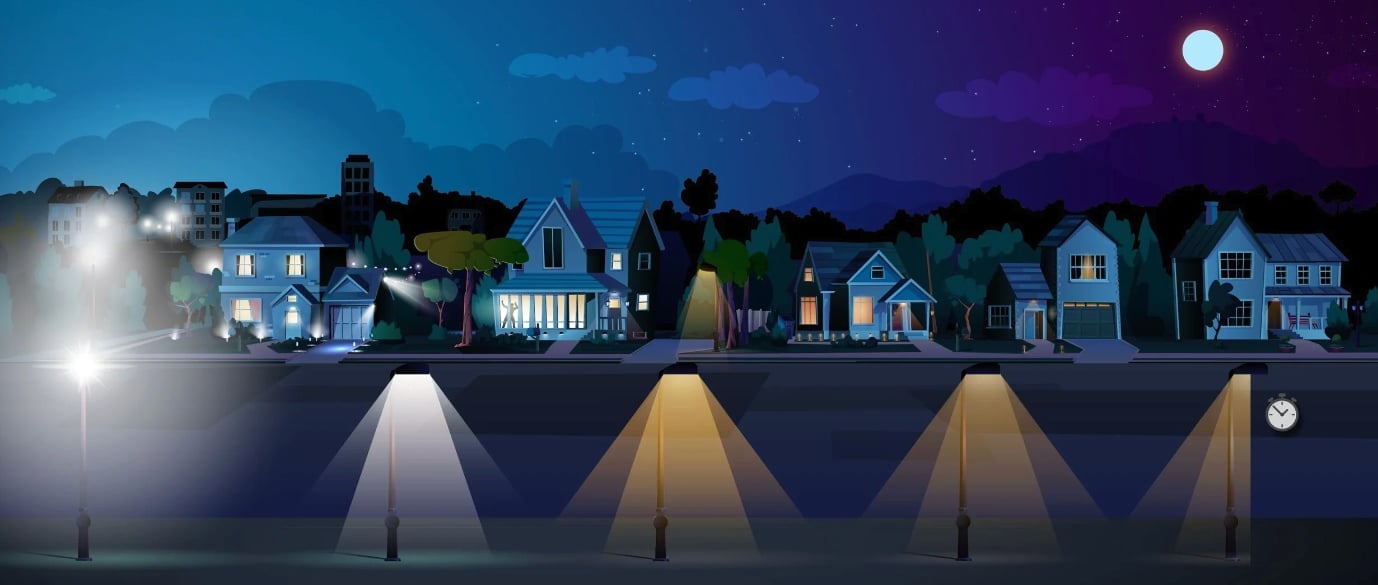
I arrived in mid-February at Midland International Air and Space Port, and as I struggled to orient myself, I was guided by a helpful stranger, an oil-field technician from the nearby town of Iraan. (The place was not named after the oil-rich nation adjacent to Iraq, but in honor of the Texas ranchers who founded it in 1926, Ira and Ann Yates. 16 ) Mr. Flores walked me to the rental-car parking area, and noticed me noticing his Lord of the Rings t-shirt. With evident pride, he declared that his donkeys are named Shadowfax, Hasufel, and Arod, after three noble horses from Tolkien’s Middle Earth. The fantasy dissolved when he added that each yielded about half a barrel of oil per day, at which point I realized that the “donkeys” were pumpjacks.
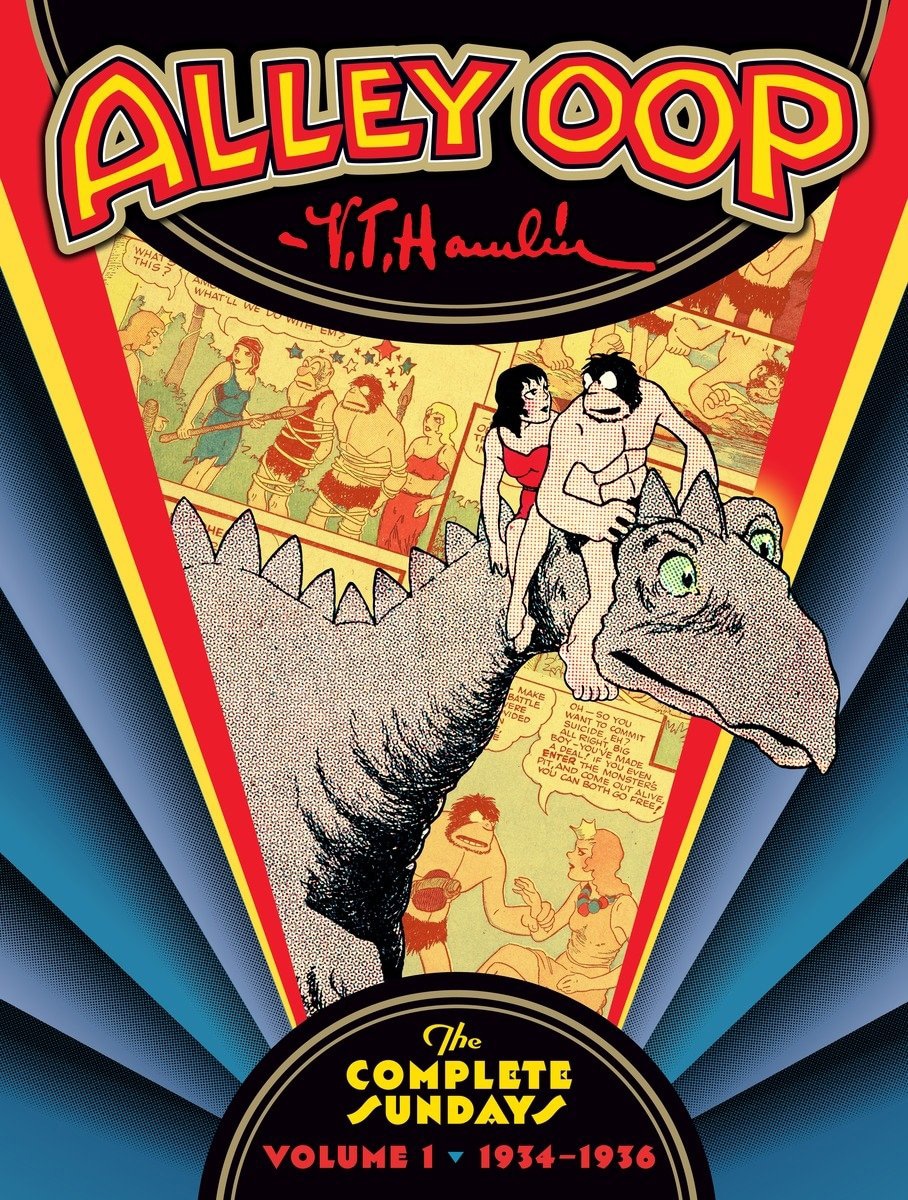
When I explained that I had come to learn more about oil production and its effects on light pollution, Mr. Flores invited me to meet him at the field where he works. That afternoon, I stood beside him near the town of Crane, about an hour from Iraan, watching Hasufel incline his corroded head at five strokes per minute. Around us on the ground gathered a sluggish stream of oil and water, a meager output in which only a trace was petroleum. Hasufel’s well was nearing the end of its productive life, Mr. Flores explained; it was a mature “stripper.” This is a classification used by the federal EPA and the Railroad Commission of Texas for wells producing ten barrels per day or less. 17 “See the dinosaur juice?” he asked with a smile, before retrieving from his truck a worn volume collecting strips from the comic Alley Oop. Its creator, V. T. Hamlin, had worked as an oil cartographer in the Yates Oil Field near Iraan during the boom of the 1920s, watching steam shovels unearth truckloads of fossilized bones. Central to the comic is a time-traveling caveman and his dinosaur companion, Dinny.
Obscurity and illumination function as dialectical forces, the depths, above and below, yielding evidence of their deep pasts.
The spectacle of subterranean Paleozoic matter arriving at the surface invited me to metaphysical reflection: ancient hydrocarbons summoned into the circuits of history and industry. But the fiscal life of stripper wells remains prosaic. As a small-time private producer, Mr. Flores purchases and maintains these depleted assets, often divested by multinational firms; they yield scant and irregular returns. He persists, by his own account, out of nostalgia and an abiding sense of emplacement, the wells linking him to a family past rooted in his grandfather’s arrival from Mexico as an oil worker. Today, apart from managing his own wells, his principal occupation lies in independent maintenance work, where, under the self-conferred title of “oil equestrian,” he oversees a modest string of pumpjacks drawn from the many thousands that punctuate the surface of the Permian Basin.
In recent years, in addition, Mr. Flores has found unexpected profitability in the installation of dark-sky compliant lighting systems, a niche market that expanded in 2023 after Pecos County, where Crane and Iraan are located, enacted its own “Orders for Regulation of Outdoor Lighting.” 18 The ordinance requires that all new or replacement fixtures be fully shielded, prohibiting any light emission above the horizontal plane (an imaginary line extending straight outward in all directions from a lamp at the height where it is mounted), while imposing limits on lumen output and color temperature. Pecos County is far enough from JBSA that its light spill would not affect Air Force night-training missions. This ordinance serves a different purpose. Pecos belongs to a consortium of West Texas counties that, in accordance with state-level statutes, have assembled a patchwork of protected darknesses around McDonald Observatory. 19
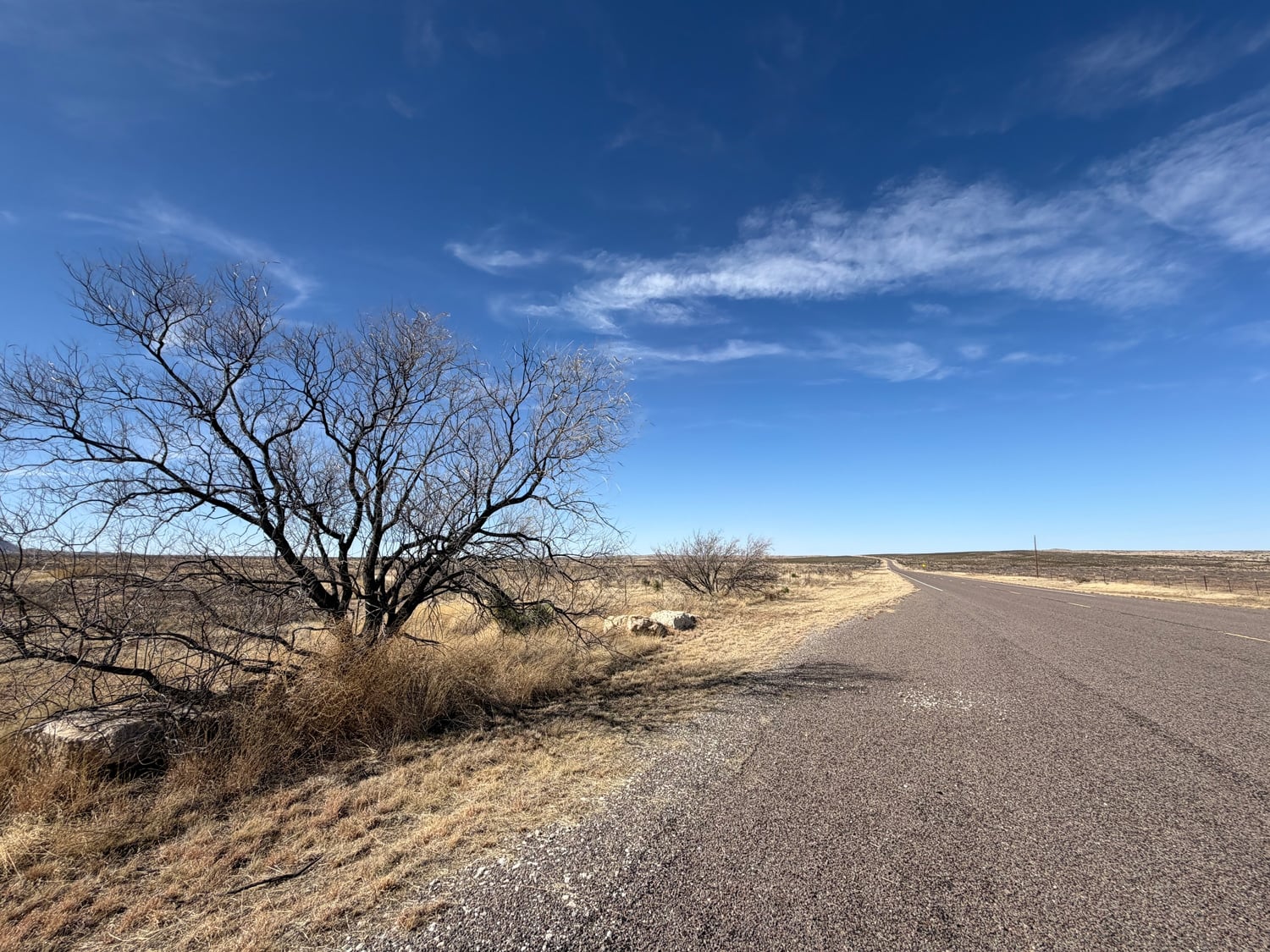
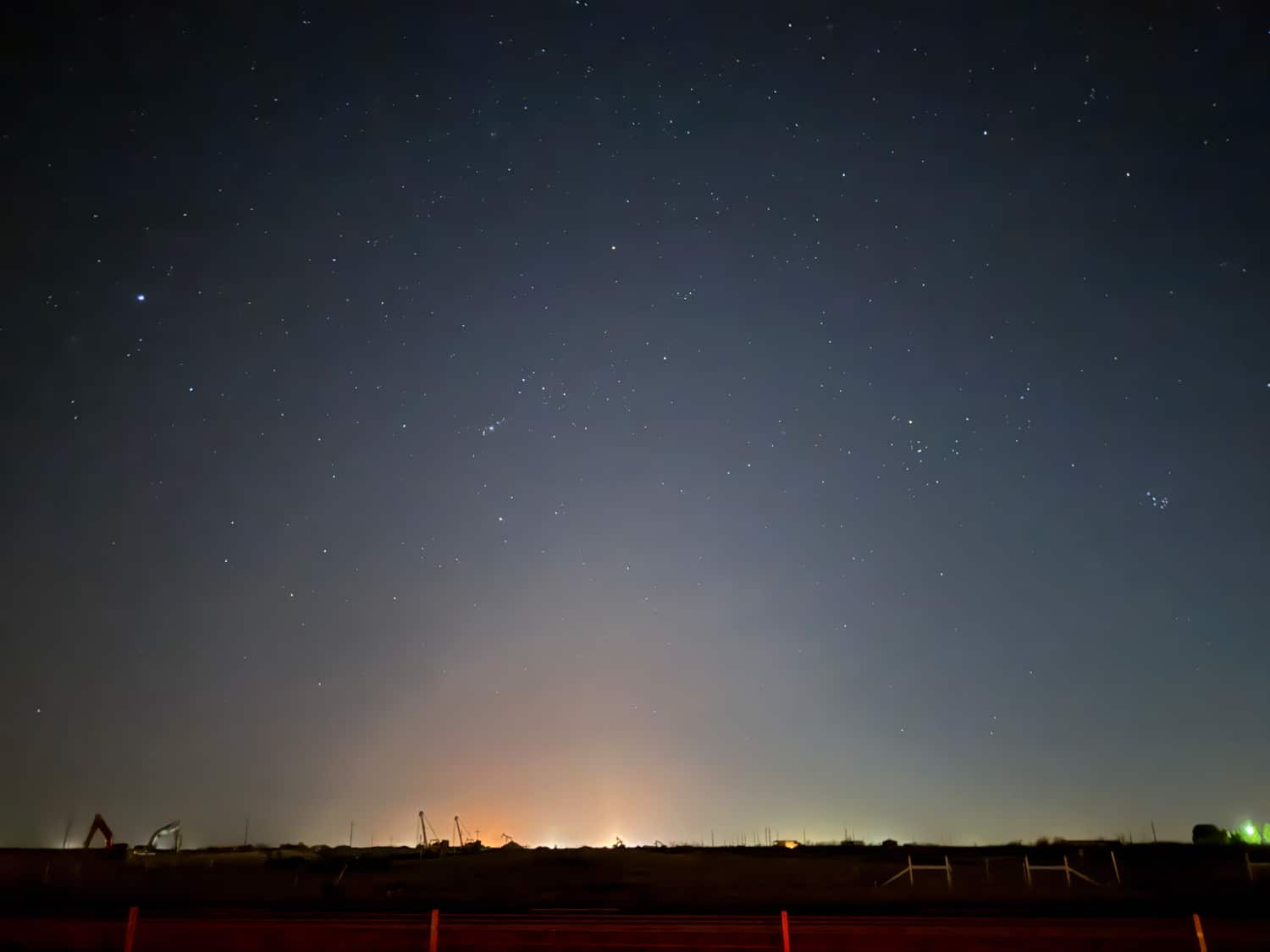
Leaving the field of Mr. Flores and Hasufel, I drove along U.S. Highway 385 toward the observatory. The last bands of sunset withdrew from the horizon. Soon my headlights delineated only a pale, seemingly suspended strip of asphalt, beyond which the terrain dissolved into unarticulated night. To my left and right, islands of light marked the dispersed infrastructure of extraction: compressor stations glaring behind chain link, storage tanks blasted with floodlights, drilling rigs glowing. With roughly 259 rigs active in the Permian in 2025, even a modest allotment of four light-towers per rig would keep more than 750 acres of West Texas — more than a square mile — illuminated each night. 20 Above, stars emerged. A sharp petroleum tang lingered in the air, mingling with the mineral scent of caliche soil and the residual aroma of sunbaked creosote. The topography disclosed itself at irregular intervals, ridgelines silhouetted where gas flares burned. As one flare surged behind a distant hill, an orange halo erased the stars along the horizon. The Railroad Commission of Texas says flare exceptions are typically issued for 45 days at a time, and can extend to 180 days. That means a single persistent flame can remain on the horizon for roughly 1,080 to 4,320 hours. 21
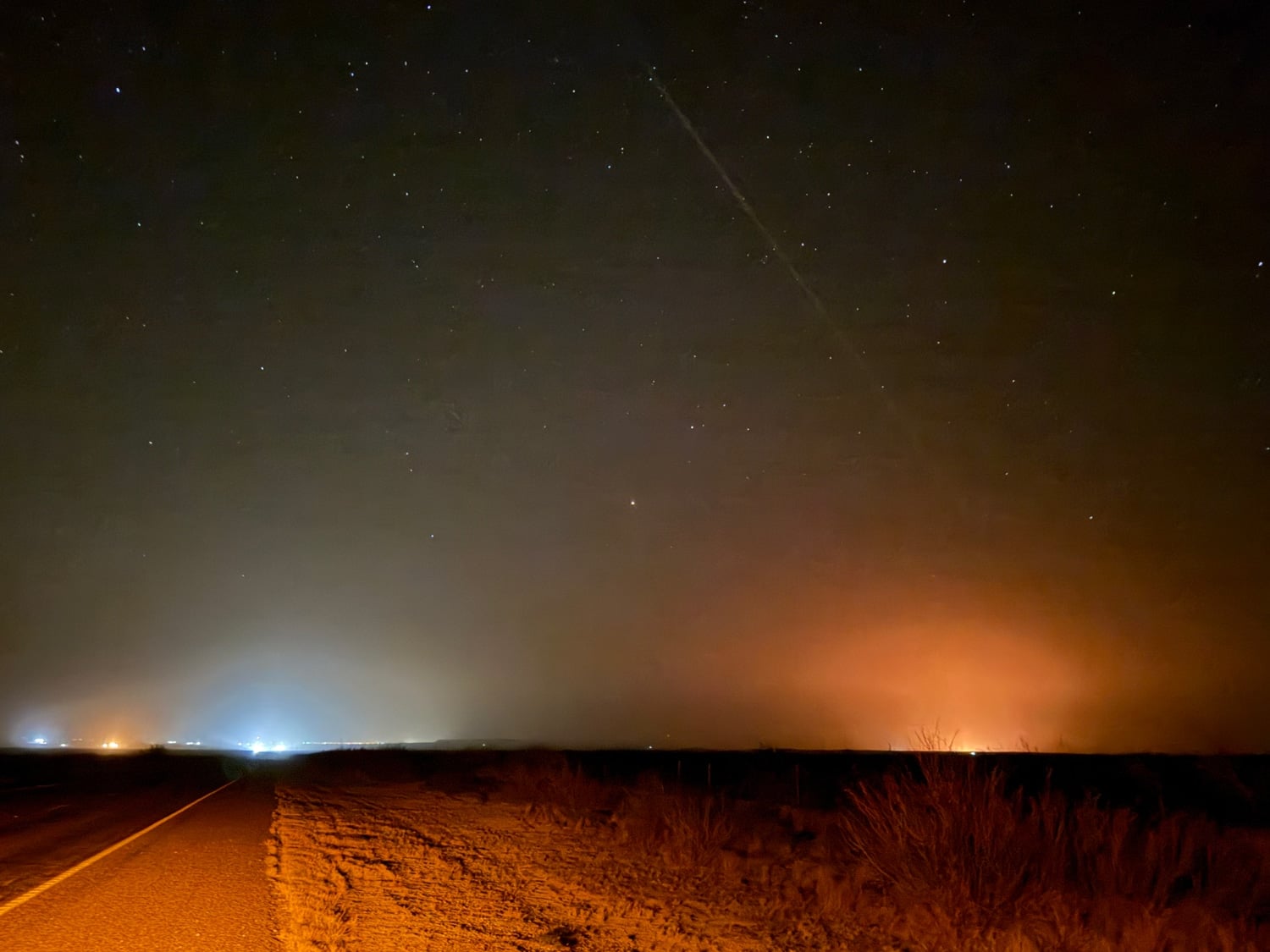
In this context, it may seem surprising that, in 2015, the president of the Permian Basin Petroleum Association urged its operators to recognize the McDonald Observatory as a “true Texas treasure.” 22 The gesture capped off a decade of tension between the oil producers and the astronomers. While concerns over light pollution near the Davis Mountains go back to the 1980s, a decisive shift occurred in the late 2000s, as horizontal drilling and hydraulic fracturing unlocked deeper formations in the Permian Basin. By 2010, rapid industrialization had established drilling pads and flaring sites across the desert, prompting leadership at McDonald to formalize their own Dark Skies Initiative. 23
From the peaks of Mount Locke and Mount Fowlkes in the Davis range, astronomers were recording an intensifying skyglow along the northeastern horizon, the axis of the oilfields’ most significant expansion. Photometric baselines in the mid-2010s revealed a sky already markedly brighter than under natural conditions, with artificial brightness measuring about fifteen percent above natural background levels in 2015, and in some sectors nearing a 43 percent increase by 2018. 24 Despite the conflict in light-and-dark requirements, the observatory avoided casting the issue as adversarial. Scientists and outreach staff visited oilfield sites to demonstrate lighting practices that could preserve productivity and worker safety while reducing skyglow — measures that, as a bonus, often lowered energy costs. Dark-sky protection was thus reframed in the Permian less as a regulatory burden than as a mode for improving operational efficiency.
I had come to the Permian Basin envisioning a mythic battle between two colossal orders, a galaxy-hunting telescope and a perpetually illuminated oilfield.
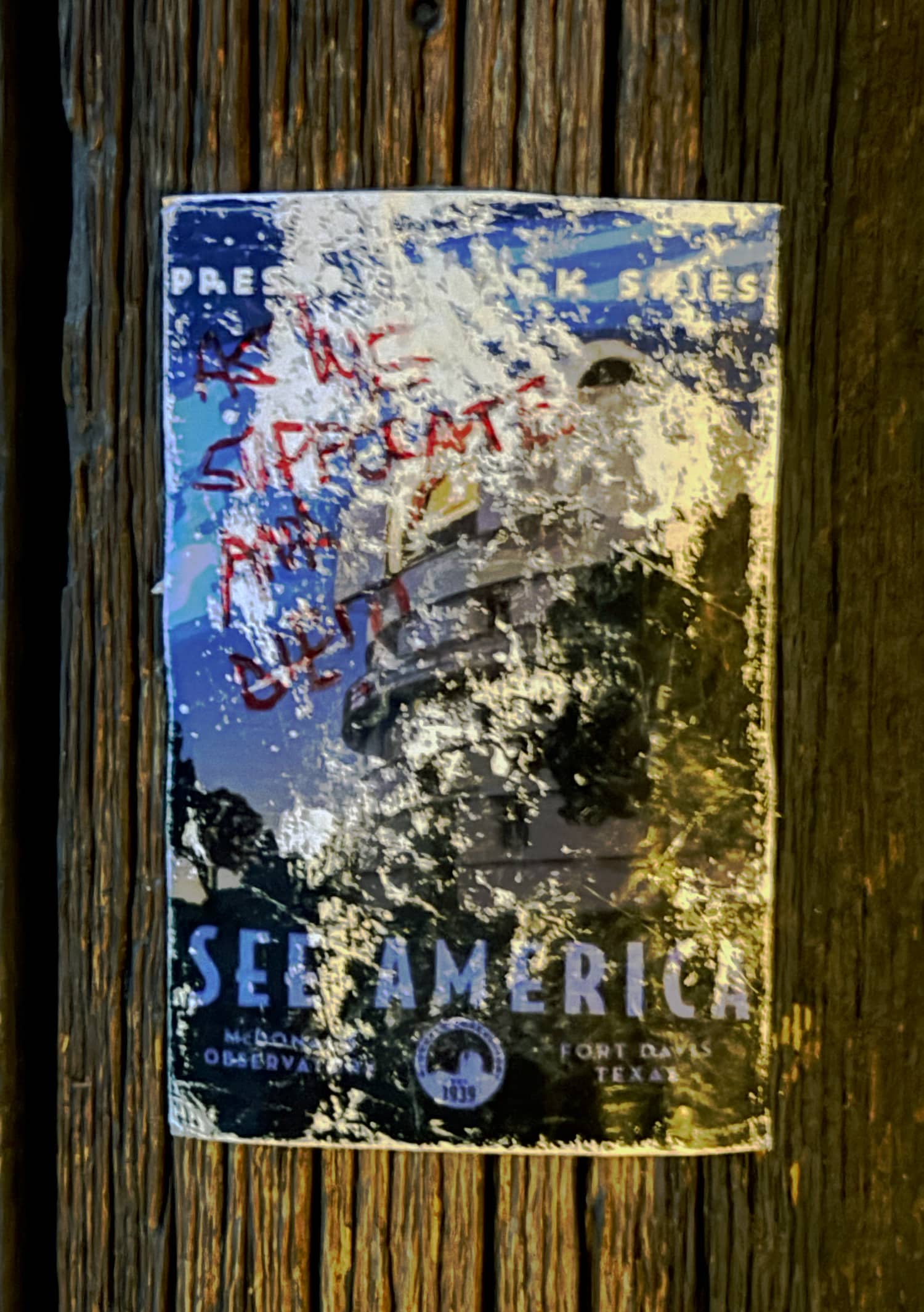
The road from the basin floor climbed almost imperceptibly into the mountains. When Fort Davis appeared, its lights were sparse and disciplined. Established in 1854 and named for Jefferson Davis, then U.S. Secretary of War, the post was part of a frontier system of forts designed to open corridors for White settlement through lands long inhabited by Mescalero Apache and Comanche.25 I pulled into a gas station on State Street and filled the tank with a refined distillate of the very strata that lay compressed beneath the landscape all around me. Near the pumps, a light pole leaned over the forecourt, its head angled downward. Affixed to the wooden shaft was a weathered blue sticker. Across its top, in fading white letters: “Preserve Dark Skies”; along the bottom, in bold capitals: “SEE AMERICA,” flanked by the names “McDonald Observatory” and “Fort Davis, Texas.” Between the slogans was an illustration of the Hobby-Eberly Telescope with its dome opened, a bright yellow beam projecting into a field of stars. In red marker, scrawled across this miniature starry sky, someone had written: “AS WE SUFFOCATE AND DIE!!!”
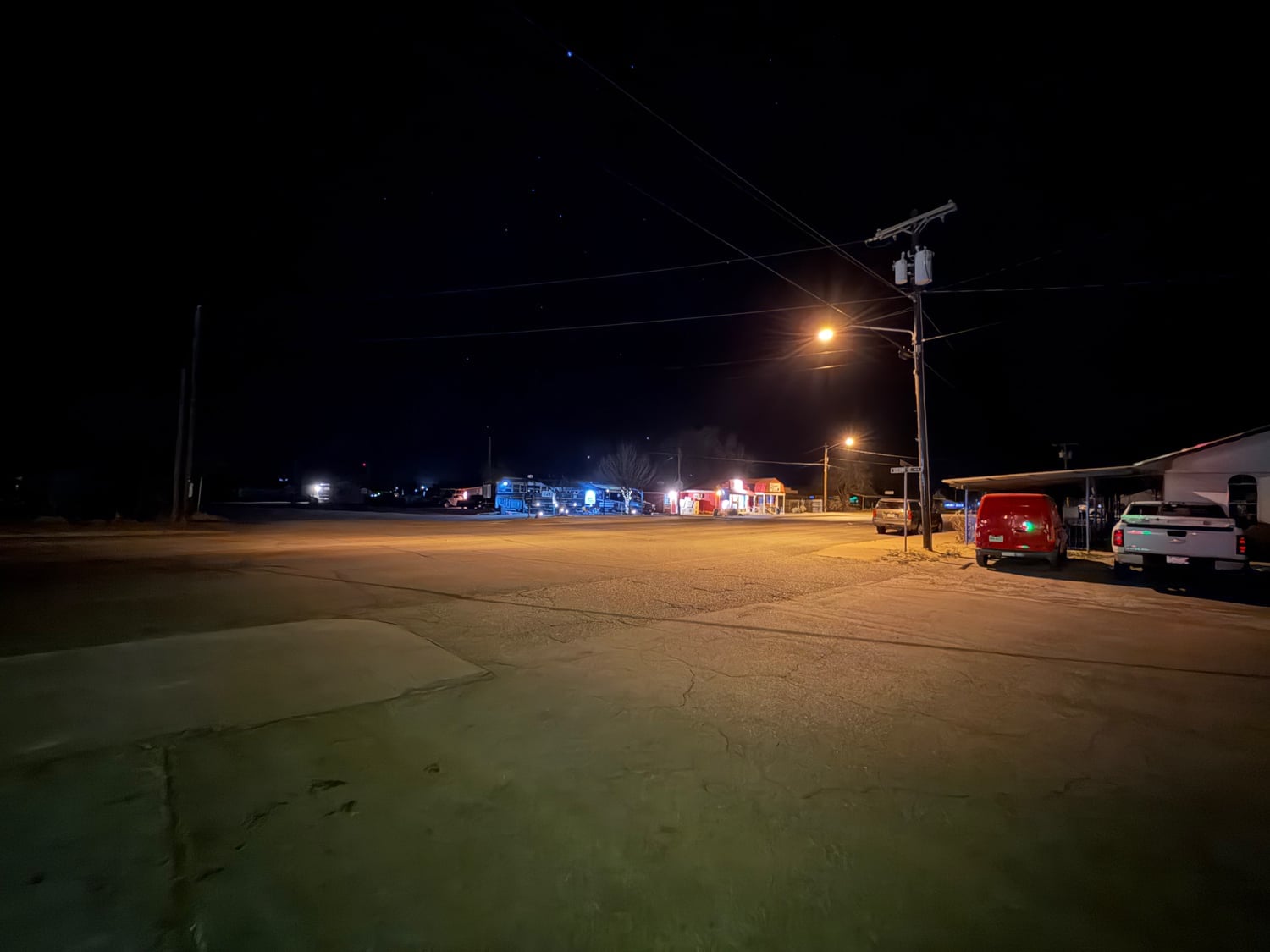
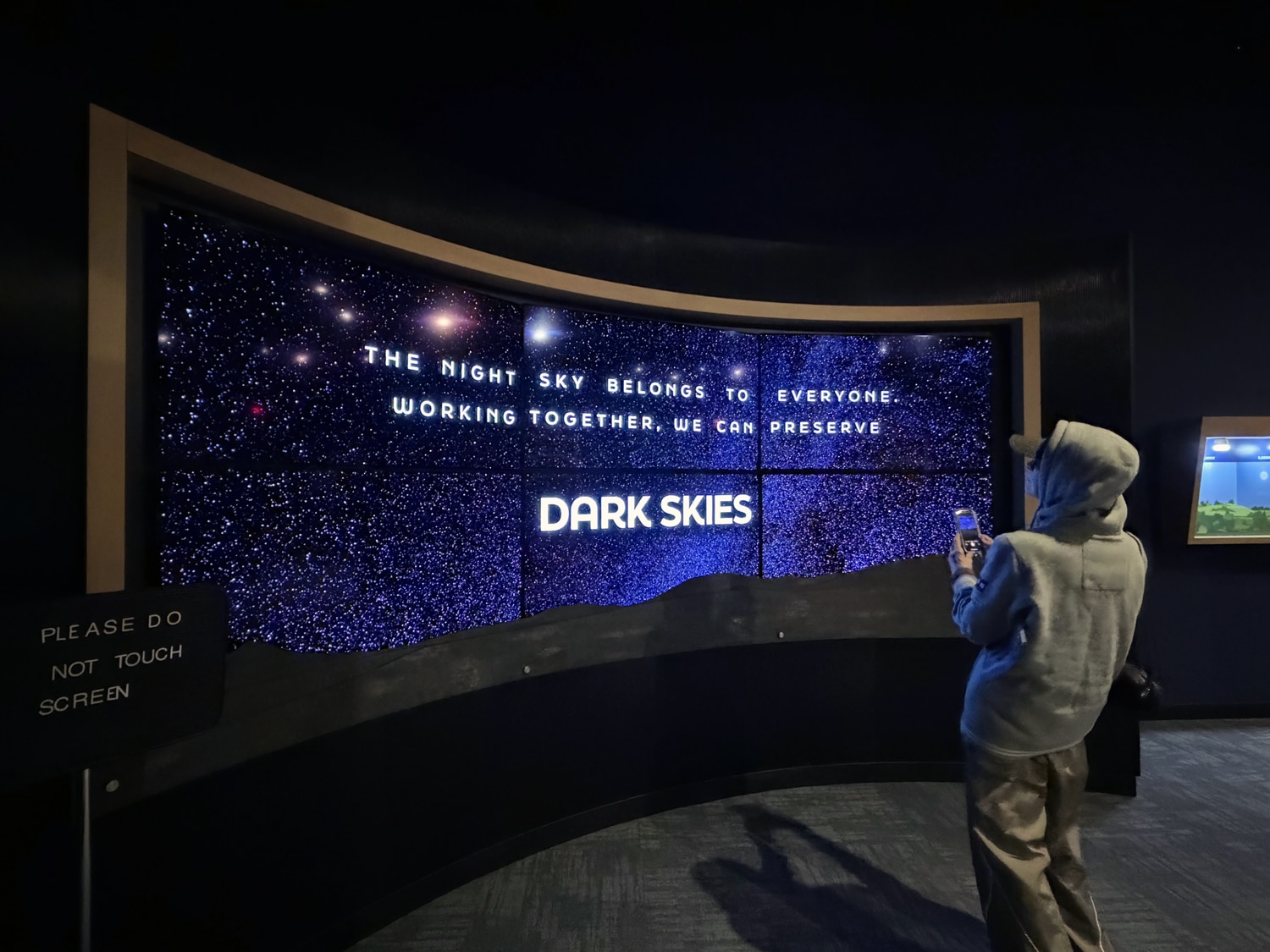
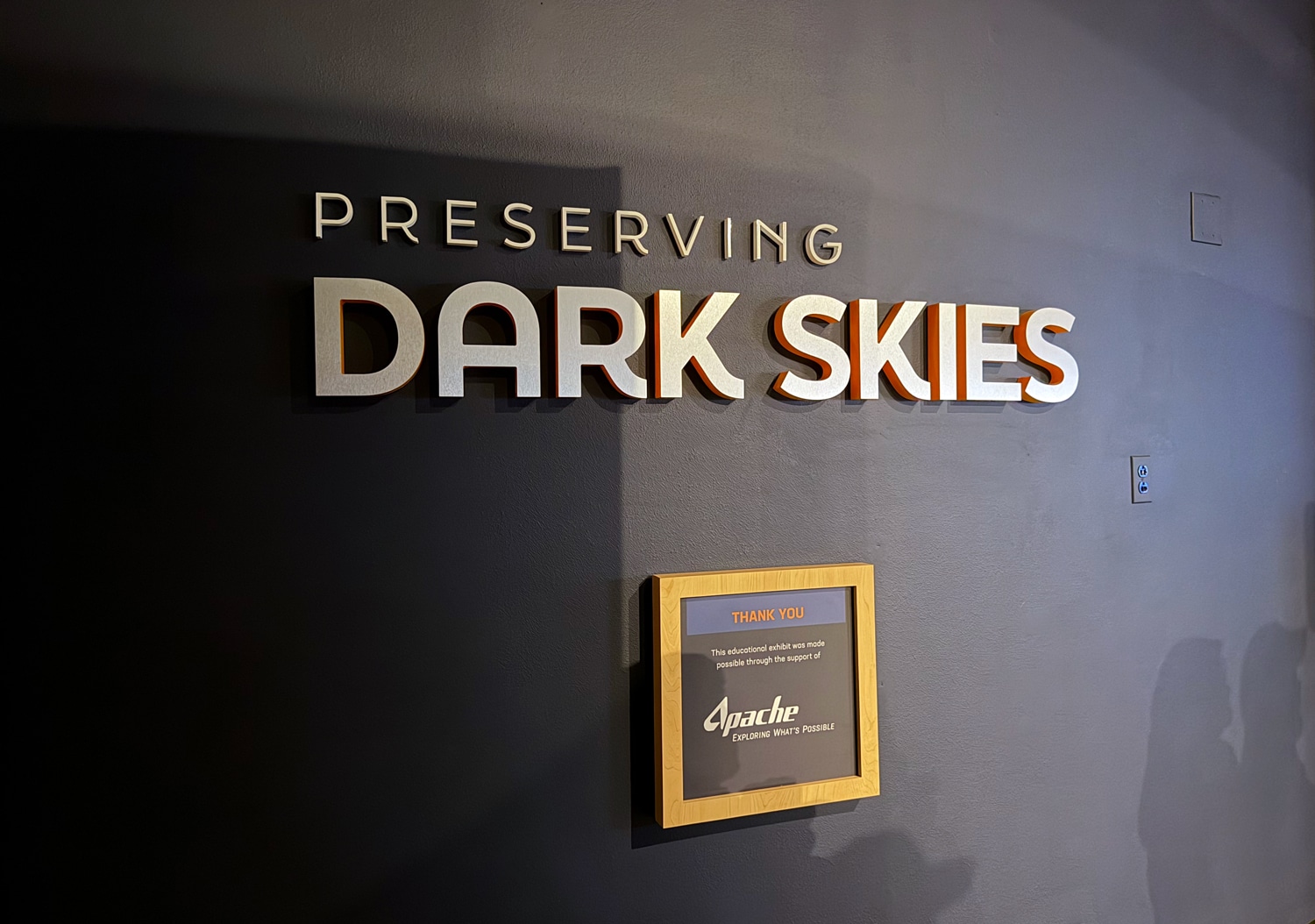
In the observatory’s gift shop, I searched for another such sticker and there it was, absorbed in a dense retail universe. Stars on magnets, on blankets, printed on books, pens, shirts, mugs, postcards, puzzles, and science kits. Visitors waited in orderly lines for the evening’s public “Star Party” — a stargazing program held several nights each week. Elsewhere in the visitor center, an exhibition narrated the history of the observatory, including the biography of its benefactor (Texas banker William Johnson McDonald), the chronology of its astronomical discoveries, and the succession of instruments that had extended its reach into cosmic time. An exhibit titled “Preserving Dark Skies” chronicled the rise of light pollution in the region and the campaign to contain it, culminating in soothing declarations that the sky belongs to everyone, and that collective stewardship will secure the future of untroubled night. Responsible lighting, the text insisted, is good for business: it improves visibility, enhances safety, and reduces costs. Dark skies are “Win–Win Solutions.” My attention fell, next, on a large placard crediting the installation’s sponsors: “This educational exhibit was made possible through the support of Apache: Exploring What’s Possible.”
What emerges is a contest over who dictates the terms of environmental responsibility, and which communities are made to absorb the costs.
The distance is vast between crude oil compressed beneath the rock of the Permian Basin and light arriving across time and space from the earliest galaxies, to be gathered by the eleven-meter mirror of the Hobby-Eberly Telescope. Another yawning gulf separates the Mescalero Apache from the corporation that bears their name — a chasm as unbridgeable as that between Ma-ka-tai-me-she-kia-kiak and the U.S. Sikorsky UH-60 Black Hawk. (Or for that matter, between the helicopter and the experience, by those on the ground, of al-sakr al-aswad.) The Mescalero understand the night sky as a field of reciprocal obligation and relational accountability, as demonstrated, for example, in the girls’ coming-of-age ceremony Kádá’idąą’e’, timed to sunrise and the setting of Náhaakus, the Big Dipper. 26
Construction of the McDonald Observatory marked a different covenant altogether, one in which mountains were graded into access routes and darkness preserved chiefly so that distant light could be harvested by machines. Contemporary dark-sky discourse funded by the oil industry secures darkness as an atmospheric resource optimized for military and scientific access. Under this framework, preservation yields to assurances that improved illumination can reconcile industrial growth with celestial visibility. Extraction continues unabated — indeed, with cost reductions. Gas flaring persists along the edges of regulatory oversight, while petrochemical infrastructures maim environments through diffuse and cumulative forms of violence that do not imperil the telescope’s gaze, and hence remain unaddressed. Such injuries, as the defaced sticker at the gas station reminds us, are still more completely erased through technical and promotional language that conflates extraction with exploration. In short, the restoration of darkness appears to require the cloaking of violence.
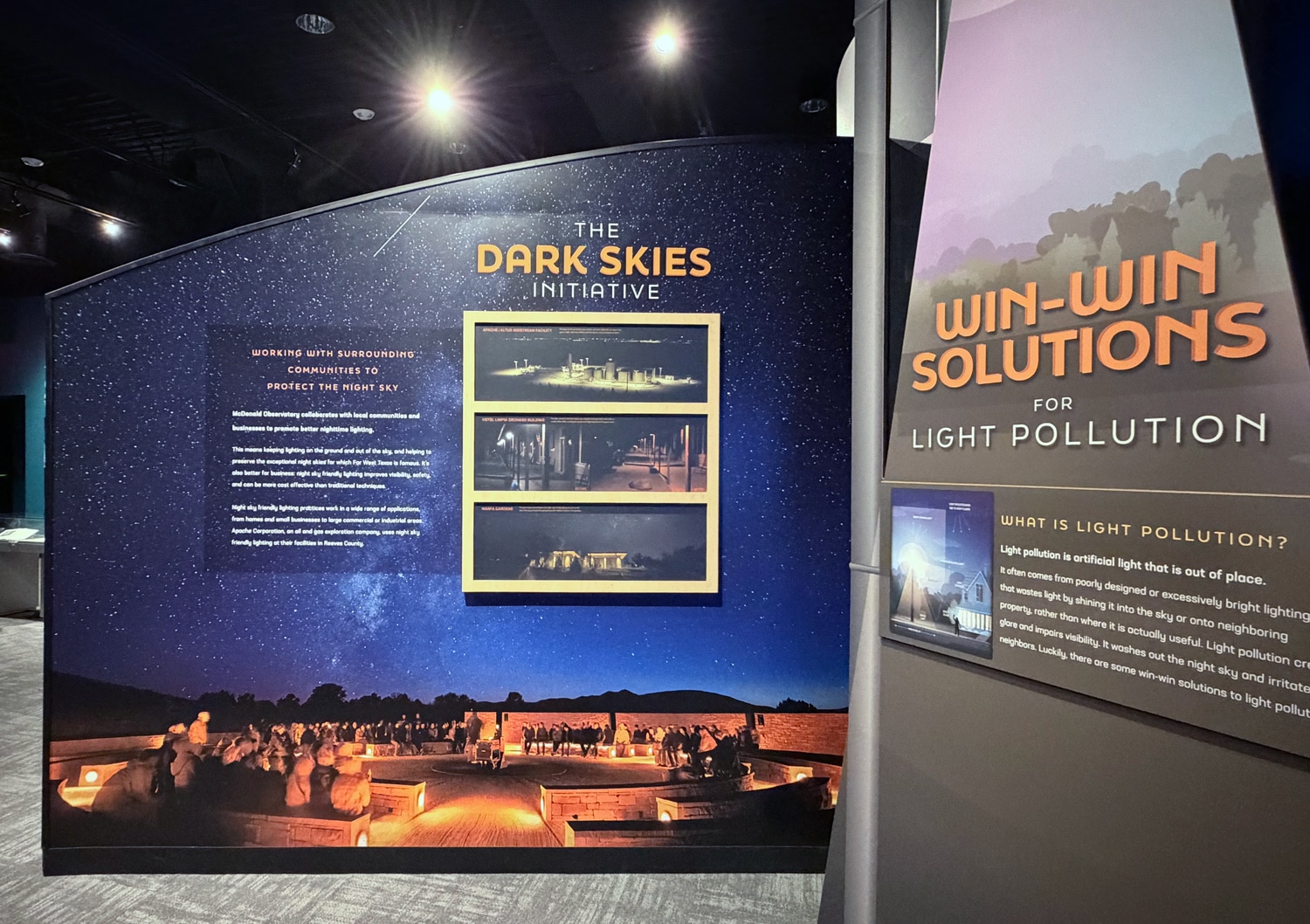
I had come to the Permian Basin envisioning a mythic battle between two colossal orders, a galaxy-hunting telescope and a perpetually illuminated oilfield. I found a more disquieting situation, in which apparent antagonists have achieved procedural compatibility. The spectacle of opposition dissolves into a technocratic partnership that projects harmony while preserving extractive imperatives. I had felt, I see now, a strange reassurance in imagining this battle between light and darkness, for such a confrontation promised that a petro-industrial economy grounded in atmospheric destabilization, and a scientific gaze predicated on cultural and epistemic erasure might, at least in this instance, be forced into conflict.
Had each carried its demands to the limit, the collision might have foreclosed both regimes and disrupted the militarized night stabilized by their alliance, opening space for futures ordered around other ways of preserving the earth and sky. The “win–win” resolves this contradiction through incremental modifications, recasting the sky as a neutral fact rather than a field of contested relations. A compliant light fixture becomes evidence of virtue; dark-sky certification circulates as moral currency; industry earns its gold star for performing responsibility. In this exchange, the observatory’s pursuit of immaculate seeing risks incorporation into a greenwashed economy in which stellar visibility functions as both metric and alibi. What emerges is a contest over who dictates the terms of environmental responsibility, and which communities are made to absorb the atmospheric and bodily costs of that all-too-specific and all-too-local care. The giants needed only to agree on terms.


If you would like to comment on this article, or anything else on Places Journal, visit our Facebook page or send us a message on Twitter.