
A Place I’ve Never Been
There’s a type of recognition that opens rather than confirms, piercing your attention and bringing you somewhere new.
This kind of recognition happened to me while sitting in a dark seminar room in May 2025, where, one after another, graduate students from the department of geography at Memorial University carefully, intelligently, often charmingly, presented their research. I’d been lulled into an academic meditative state through the rhythm of methods sections, smiling applause, polite transitions.
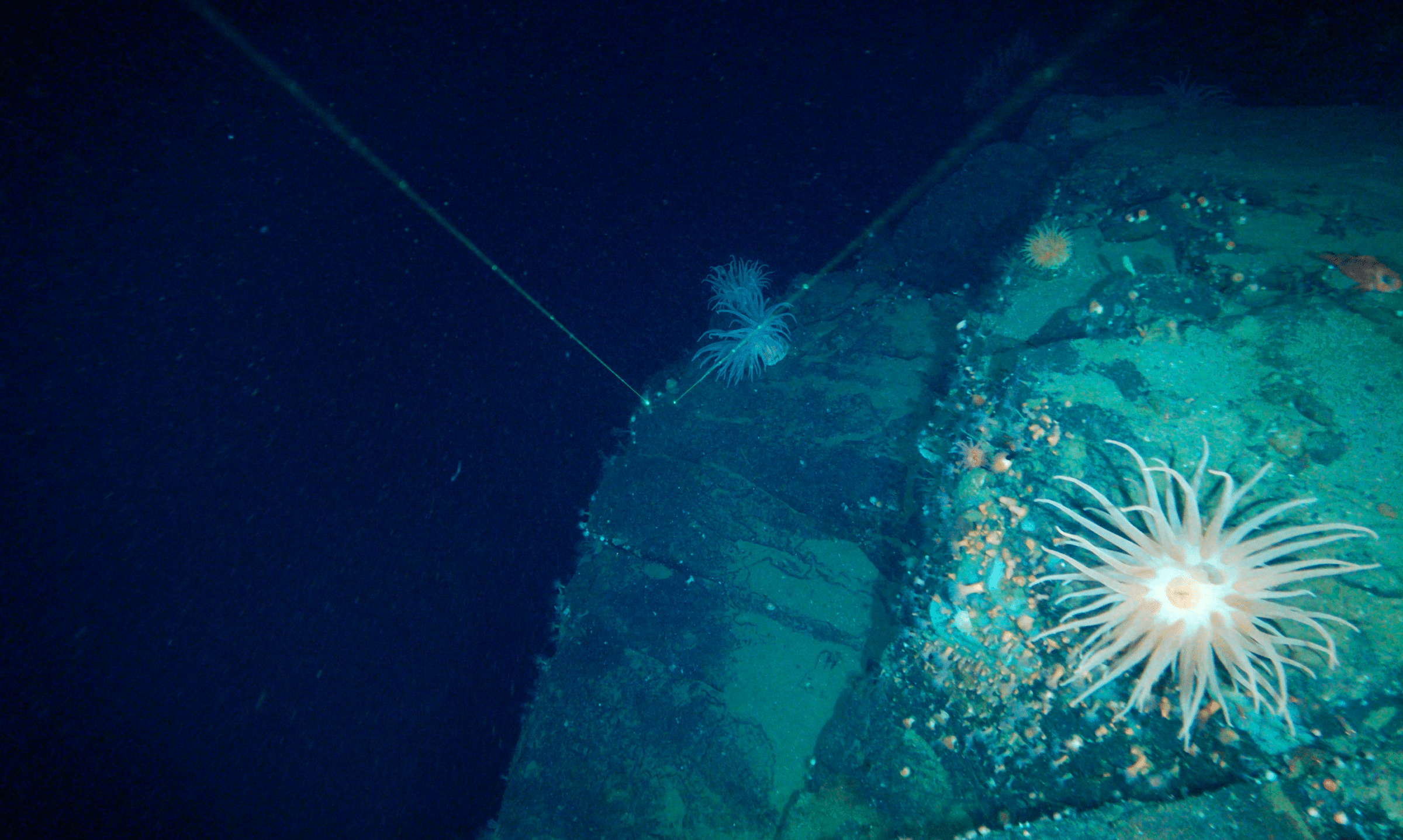
Then, on the screen, Sami Elsayed showed an underwater drop camera video of the corals that he is cataloguing to map marine biodiversity. In the video, the floor of the ocean is completely dark, but there’s a spotlight starkly illuminating the path of the camera.
I’d met that place one piece at a time, through the guts of animals.
The image drifts, revealing a scatter of sand and shell hash — and then, a fan-shaped pink coral. The coral gave me a jolt. My spine straightened and I lifted my chin to get a better view and confirm: yes! I know that coral and the sand around it. I’ve been there. I hadn’t actually been there. Not physically, not even digitally. I’ve never seen this particular underwater landscape. And yet, I knew its parts: the edge of the coral, the color of the sand, the gleam of shell hash. I’d met that place one piece at a time, through the guts of animals.
The Smallest Periscope
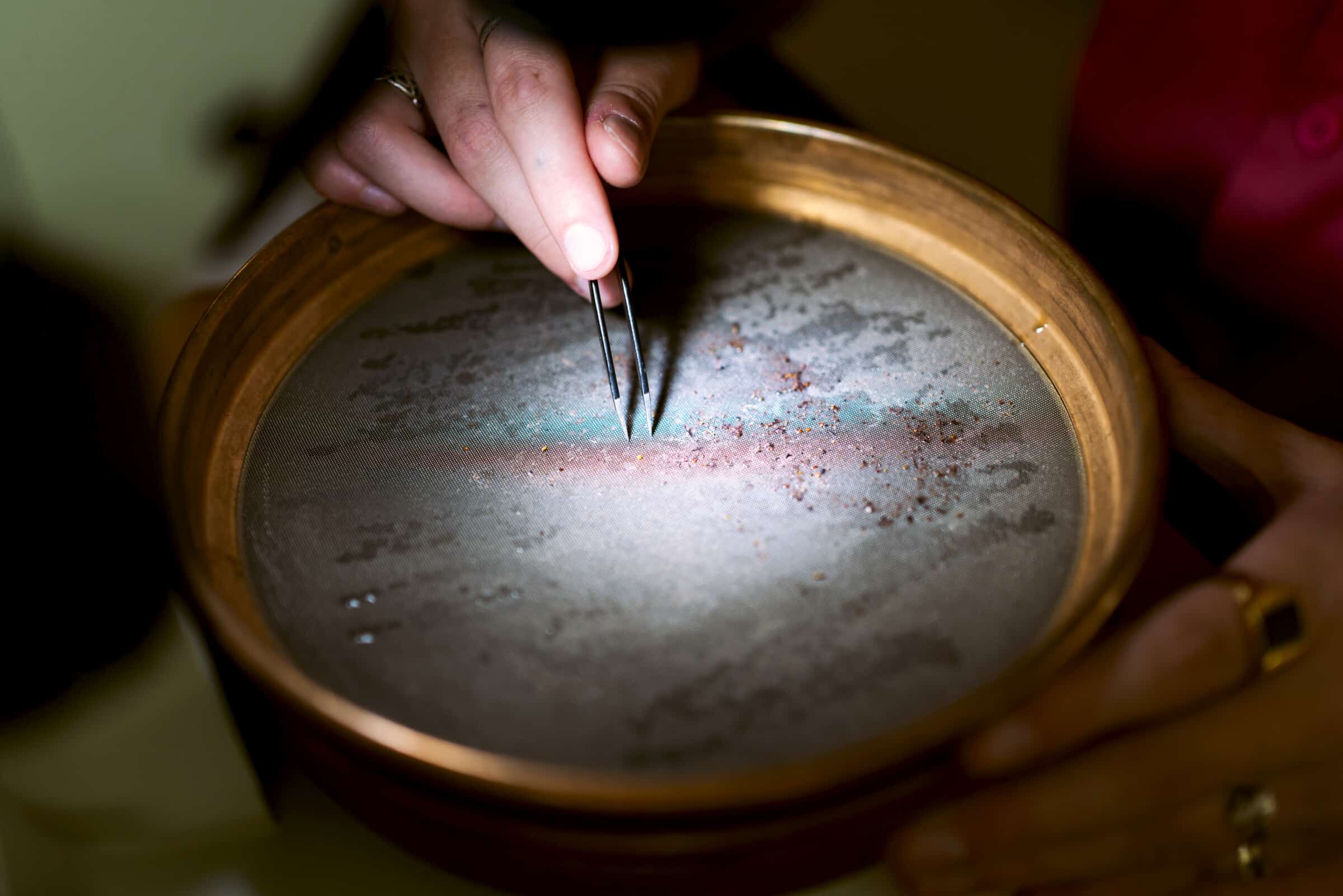
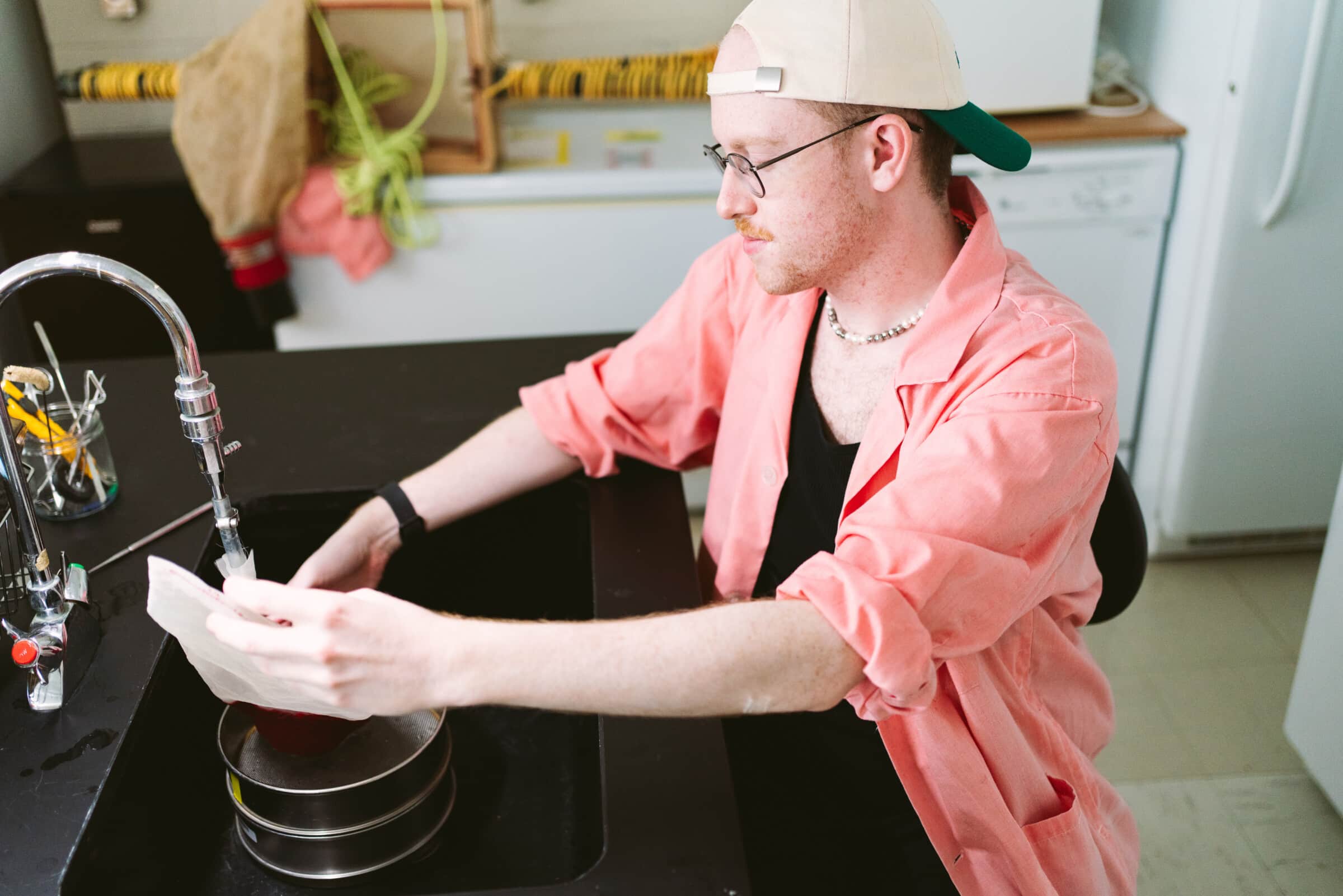
The first animal innards I inspected under a microscope were dovekies’, in 2014. Locals call them “bully birds.” These particular dovekies had been wrecked in a storm near St. John’s, Newfoundland and Labrador. A colleague collected the carcasses and brought them to me so I could look inside for plastics. I emptied each part of the bird’s gastrointestinal tract into a nested set of sieves: the esophagus, proventriculus, gizzard, intestine, and cloaca. Collectively, “the guts.”
Peering through the lens of the microscope, I shifted soft furls of organic brown material and shiny black snail shells, teasing each with the point of my tweezers to make sure nothing was hiding underneath.
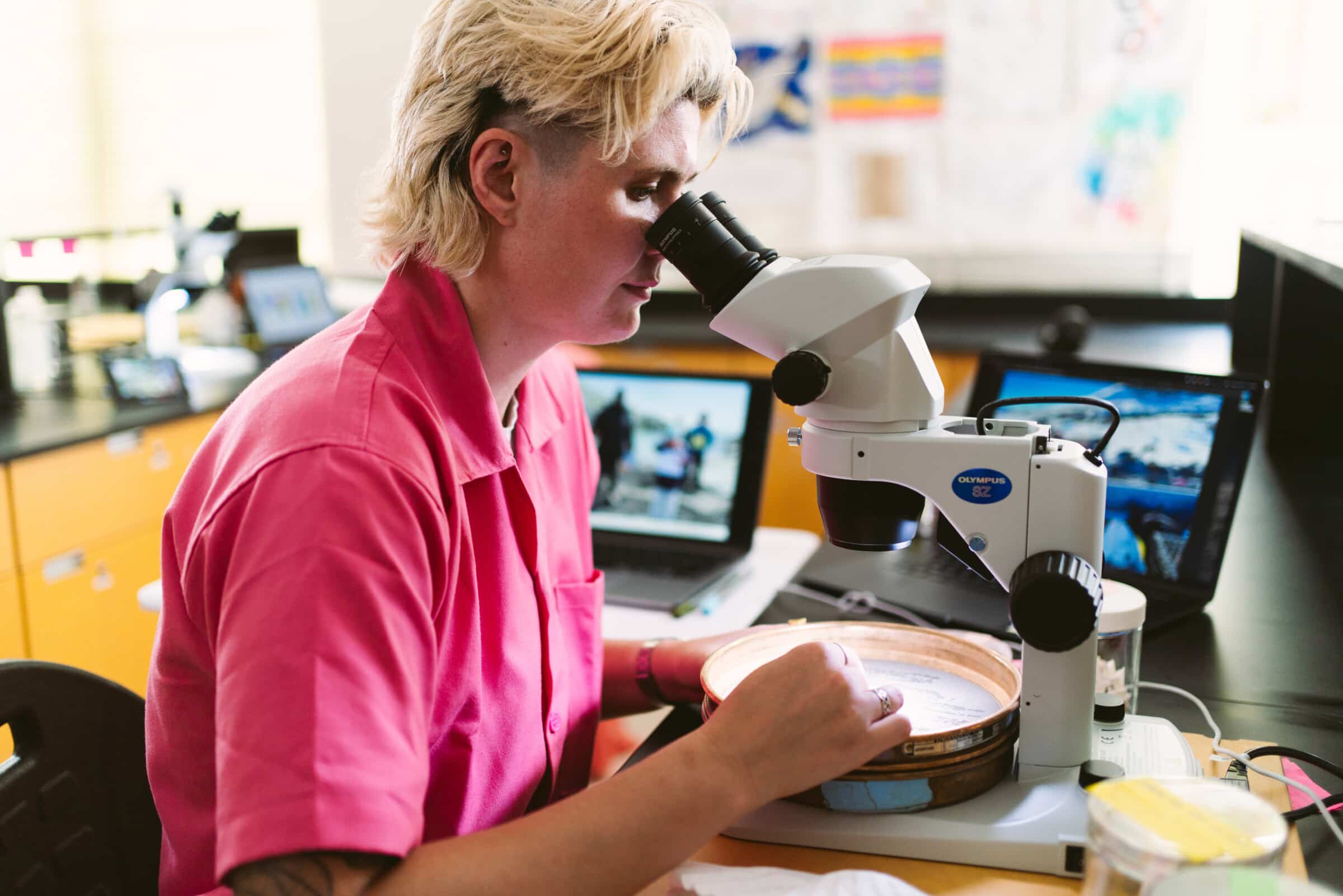
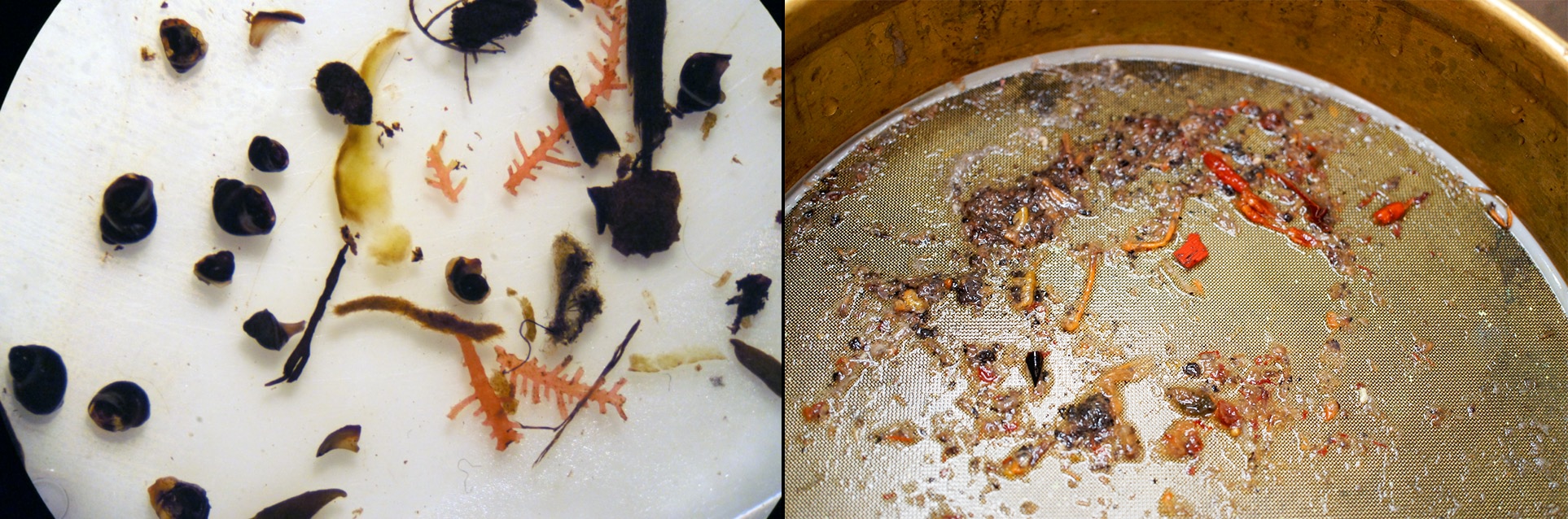
As I dragged more of the sample into view, I found a bright pink fragment. Obviously, a plastic. I put it aside to dry, certain I’d found what I was looking for, and continued to search. In the next sample, a shred of pink appeared again, but larger this time, and bent like the crook of a V — an odd shape for a plastic. A few birds later, another pink bit: a perfect, miniature branch. Not a plastic. Apparently, there are tiny pink trees in the ocean.
Sometimes it’s enough as a scientist to say something that isn’t untrue.
Across the digestive tracts of 171 dovekies, a landscape began to assemble. The elements were ground down, fragmented, and partially digested, but the landscape was still legible. It cohered, slowly, in the space between my eyes, the microscope, the birds’ bodies, and their feeding area. The microscope offers the smallest of views into that underwater world, but each close-range snapshot can be arranged and assembled, retroactively, through the mind’s eye, until suddenly, I’m imagining a place I’ve never seen. Sami’s drop camera showed the same environment, all at once. The coherence was shocking.
Poem Logic Is Lab Logic
I know a poet who says that every line of his poems is a slice of life rearranged and condensed into a smaller but deeper whole. The gestalt effect of these lines assembled together is always more than the sum of its parts. Looking under the microscope might be like that, where sieves serve up a shell, a coral, a plastic, each a line of poetry, layering towards gradual lucidity. If I extend the analogy, the scientific study is the poem.
I don’t always understand poetry, and the same is true of what I see in the sieve. But that’s acceptable in science, as it is in poetry. Sometimes it’s enough as a scientist to say something that isn’t untrue.
The tiny pink sea-tree that first taught me about underwater landscapes does not show up in the published dovekie study. True to scientific form, the paper I eventually co-authored is highly specific, and focused exclusively on plastics. But the logic of assembling a landscape from fragments of observation impacted the paper nonetheless, through the inclusion of D-156. D-156 is the 156th dovekie we looked inside, and she had ingested many, many more plastics than any other bird in the study. She ate 50 plastics, likely all from the same place judging by their similarities, compared to zero to three plastics in the rest of the birds.
D-156 ate plastics as part of her flock. The way I saw it, she was not an outlier.
The senior colleague on the project argued that D-156 should be removed from the study as an outlier, as her big number disputed the study’s truthiness (not his actual words). Some studies do remove such outliers, but I argued against it. I don’t remember exactly what I said, but it was a technical point about the statistical nature of outliers. That argument was a beard for what I actually wanted to argue, which is that D-156 belonged in the study because her plastics looked like the plastics from other birds. The rest of her gut contents were from the same composite landscape as her peers, such that she was, through the lens of her guts, very much part of her flock. To classify this bird as an outlier was to ignore all the other information we had about her plastics: their similarity to each other, in shape, size, and erosion patterns, and to the other plastics in the study. All of which indicated that these were plastics from the same place, ingested around the same time. D-156 ate plastics as part of her flock. The way I saw it, she was not an outlier. “Look, see? Look: see?!” makes a weaker case than I’d like.
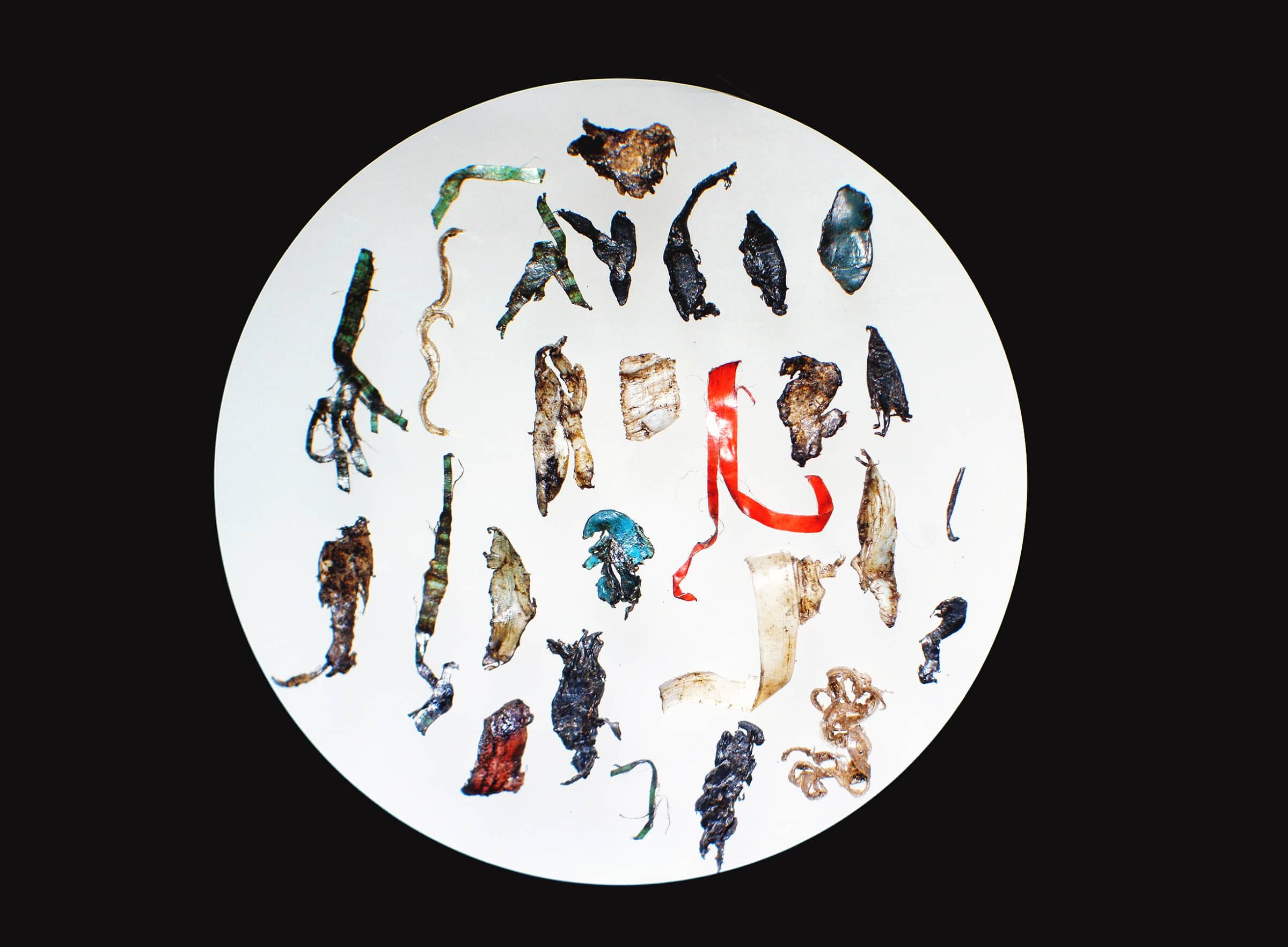
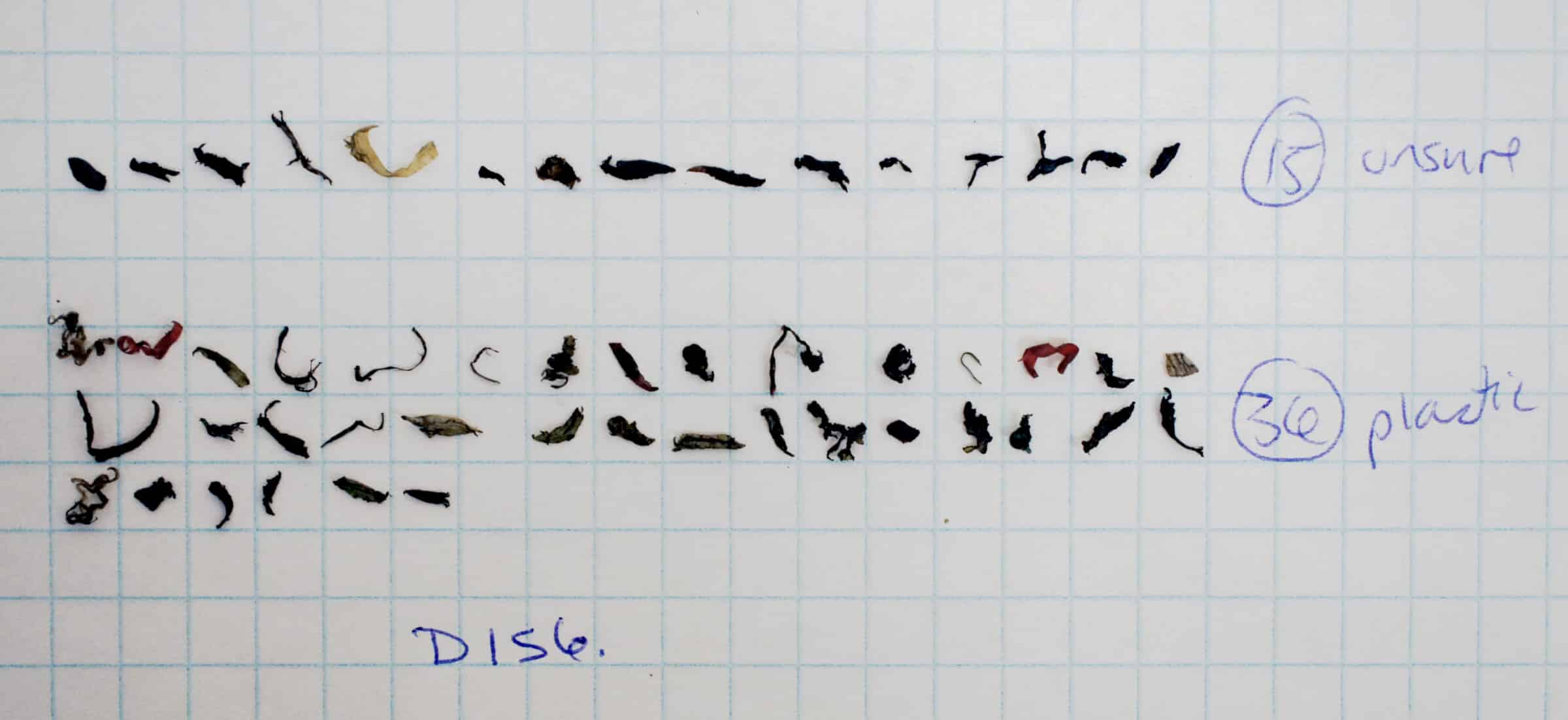
And anyway, my colleague had seen. We were just looking differently. He hadn’t spent time at the microscope, hadn’t seen the pink branches, hadn’t labored over describing every individual plastic and its erosion patterns. He hadn’t seen like that. Microscope work and statistics are both ways of seeing in science, but they don’t see the same things.
Arguing over which imperfect clarity fits best is a core scientific activity.
Each offer orientations to the world that are deep, true, and bend toward greater wholeness, and yet are very different from each other. Neither can claim perfect, final clarity. Arguing over which imperfect clarity fits the situation best is a core scientific activity. In the end, I won. We agreed that even though D-156 skewed some of the statistics, we would run our numbers both with and without and report the difference. D-156 shows up in a single line: “However, this relationship was not robust to the removal of one outlier, a bird that had ingested 50 pieces of plastic (χ2 1=1.82, p=0.18, n=102).” 1 Perhaps it’s not poetry, but it still has a measure.
Training to See
Since the dovekie study, I’ve started my own lab, called CLEAR. We work with a shifting collection of stakeholders, rightsholders, partners, collaborators, and funders, all of whom have separate research questions about the plastics in their region and specific context. It’s never the same question, so we process samples in such a way that we can potentially answer many different questions, drawing from a wide range of what we call “environmental matrices”: surface water, sediment, shorelines, drinking water, ice, snow, and of course, animal guts. Different matrices matter for each landscape we study, from across Canada and even within the province of Newfoundland and Labrador.
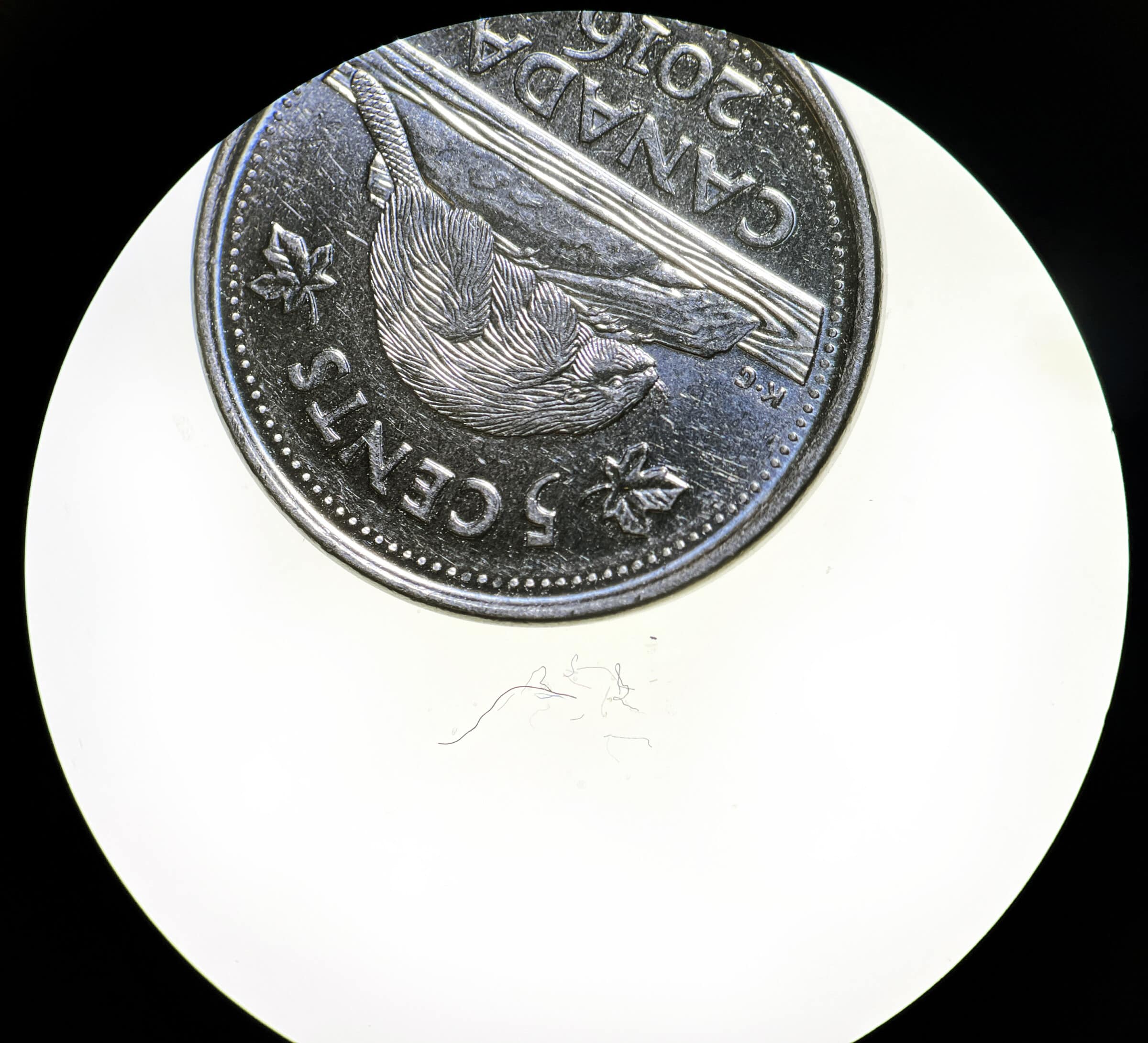
The students who work at CLEAR, my trainees, are in a constant state of reorientation. Even when someone has extensive experience with the guts of one animal, a new species or the same species from a new place causes confusion. What are those black things? What’s this hard bit? Is that a hair? What an animal eats is based on where it eats, so it’s as if we dropped a researcher in a new place without a map. A perfectly round white sphere? It might be a microbead from a face scrub, but it’s more likely the hard eye lens from a fish. Tiny straight black sticks? Insect legs from the surface of the water. A bright red thread with frayed edges?
That one’s a plastic, but it almost certainly came from a life jacket when someone was bagging the sample on the water. (We keep an old life jacket in the cupboard for comparison.) Fish scales can look like contact lenses; seaweed like filmy plastic; a fragment of a fishing line like the hair of a seal. Most of our training is about learning to distinguish things that first appear identical, even when one is natural and the other industrial.
A white sphere? It might be a microbead from a face scrub, or the eye lens of a fish.
Only after new students spend about forty hours at the microscope does the story assemble, and they begin to build their own map. They come to understand the constellation of the sample’s environment, where “environment” is never just nature, but also the hunter’s clothing, the animal’s prey, the weather on the day it was caught. 2 Each new species, each new place, requires a different forensic sensibility. Teaching philosophies might claim that a microbead is a microbead, and once you’ve learned what a microbead looks like you can successfully make an identification no matter the context. I’ve found that not to be the case. Context is everything. The heart of gut forensics is not classification, but learning how to see.
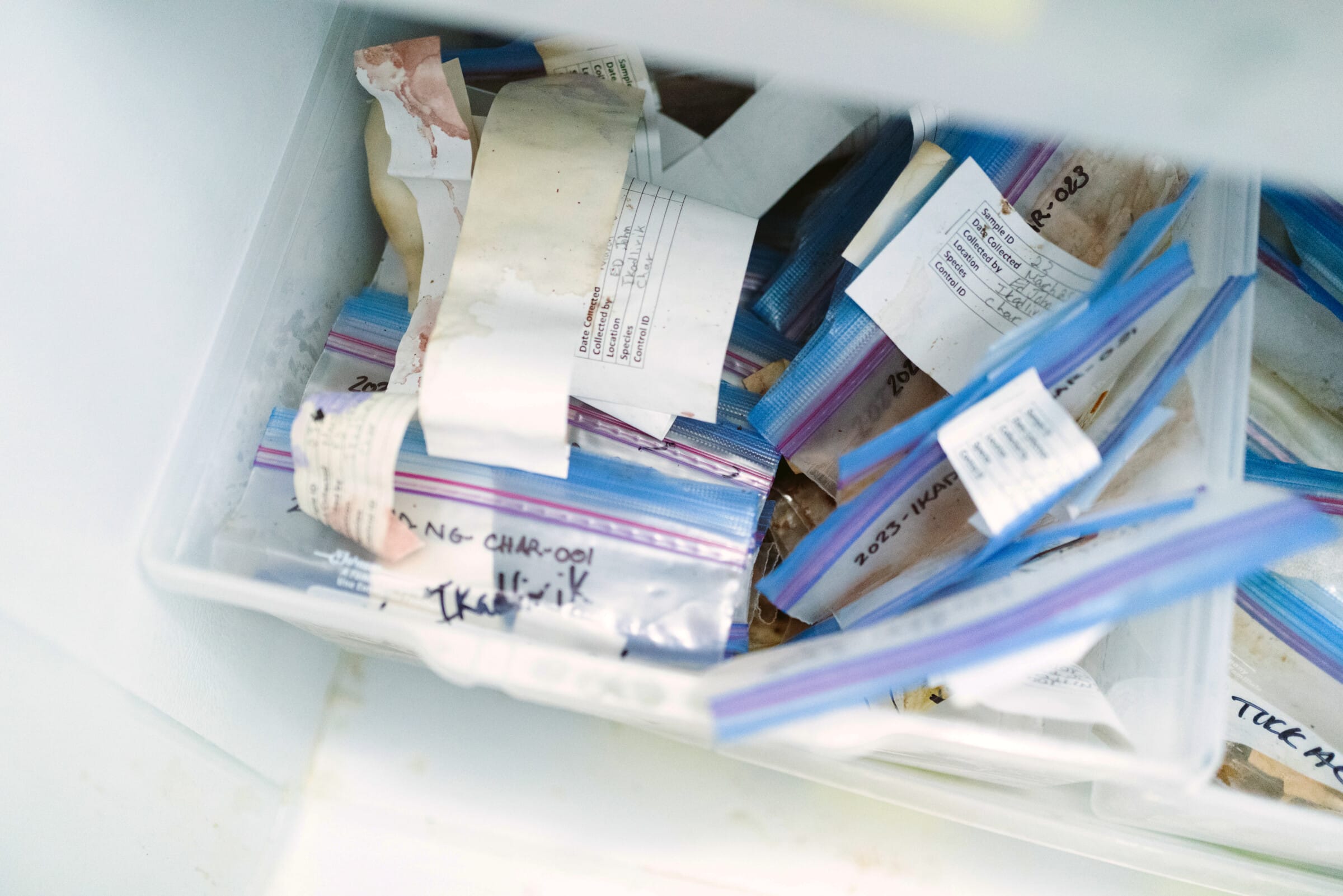
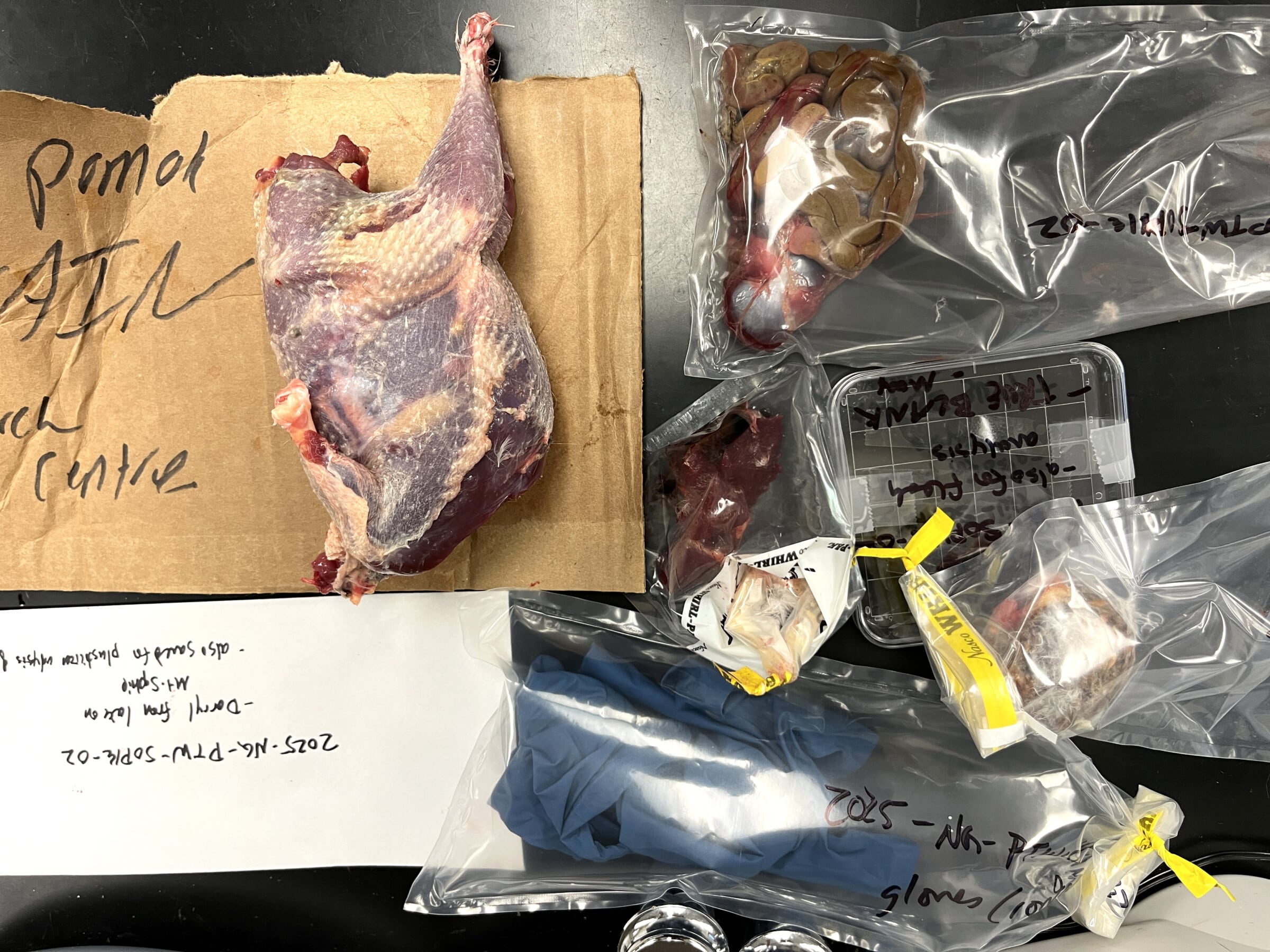
In the CLEAR lab, seeing well, seeing clearly, entails not only training the eye, but comporting the entire body. Early in that first study of dovekies, I laughed while I was looking under the microscope. The gust of my breath caught the microplastic I was looking at, whisking it out of the Petri dish and onto the floor, which, on very close inspection, was covered in tiny fragments of similar size and shape. We lost that plastic. I now breathe out of the corner of my mouth in the lab. Longtime lab technicians gesticulate without making a breeze, wear clothes that don’t shed lint, open containers slowly and always check the lid. Someone once wore a red fuzzy sweater and we found its tiny fibers in our samples for months afterward.
The world we’re piecing together includes the placeness of the lab.
The composite world we’re piecing together includes the placeness of the lab. Samples speak not just of animals and their natural environments but of coolers and airplane cargo holds, of permanent-ish markers on cold plastic bags, of thawing trays, and the static electricity of someone putting on or taking off their lab coat in the dry winter air. Our breathing, movements, and wardrobes are attuned to the integrity of the sample: in place, free of static, free of dust.
“Quality assurance” means accounting for these laboratory environments, and reducing their impact on the sample. When we can’t eliminate that impact, we need to be able to account for it, to parse which flecks of lint came from the animal’s guts and which landed on the animal’s guts as indoor dust. The lab is a place we can read through plastic signatures, too. Not just guts.
Ingestion?
There is a mild scientific debate about how to characterize the knowledge we gain from counting plastics in animal guts. Are we measuring “plastic accumulation,” “ingestion rate,” “frequency of occurrence,” or something else? Spoiler: they’re all right and they’re all wrong in different contexts. “Frequency of occurrence” treats the presence of plastics as a yes/no binary and doesn’t differentiate between the number or size of plastics ingested. “Ingestion rate” erroneously suggests that feeding and digestion happen at a predictable, even rate. Measuring “plastic accumulation” is to imply that the gut is storing plastics, like an archive. What really matters — really — is that you’re precise in communicating what you’re measuring and what it means.
Guts are a collaboration between animal, land, and the logistics of bodies.
The knowledge we get from a gut is a glimpse of a process at one moment in time. The length of that moment varies by species. Animals, after all, poop. What we see under the microscope is only the material between one mouthful and the next evacuation. For a ringed seal that might be as little as four hours. Ringed seals are super-poopers, with digestion like a bullet train. Fish are slightly less quick; their digestion progresses the way toothpaste is squeezed through a tube — all in one go. For birds, digestion can take months or even years, as plastics and other hard bits like bones wedge themselves into the twisty, winding, often constricted corners of a bird’s gastrointestinal tract.
A migratory bird will carry plastics across continents. Birds have even been theorized (not by us) as “vectors” of plastic contaminants. Plastics in a bird’s guts likely don’t represent a single place but an accumulation of many places, stretched across time and flight path. The geography of the guts of a migratory goose will extend many more miles than that of a cold-water fish. Even when guts conjure a specific geography, the coordinates are not static. It’s a collaboration between animal, land, and the logistics of their bodies. And, of course, the scientists that piece them together.
Even when guts conjure a specific geography, the coordinates are not static.
When scientific research on plastic ingestion first started in the early 2010s, scientists used to combine data from all the species in one region to produce a single number, a figure representing the average ingestion for that region. We quickly learned the inadequacies of that metric. Each species feeds differently, moves differently, lives differently. Their techniques of foraging, their ecological niches, their specific habitats all shape what ends up in their guts. A single “average” not only smooths over differences but erases them entirely: the animals that never ate plastics disappear alongside those that ate a lot. To design effective interventions, it’s essential that we know about both.
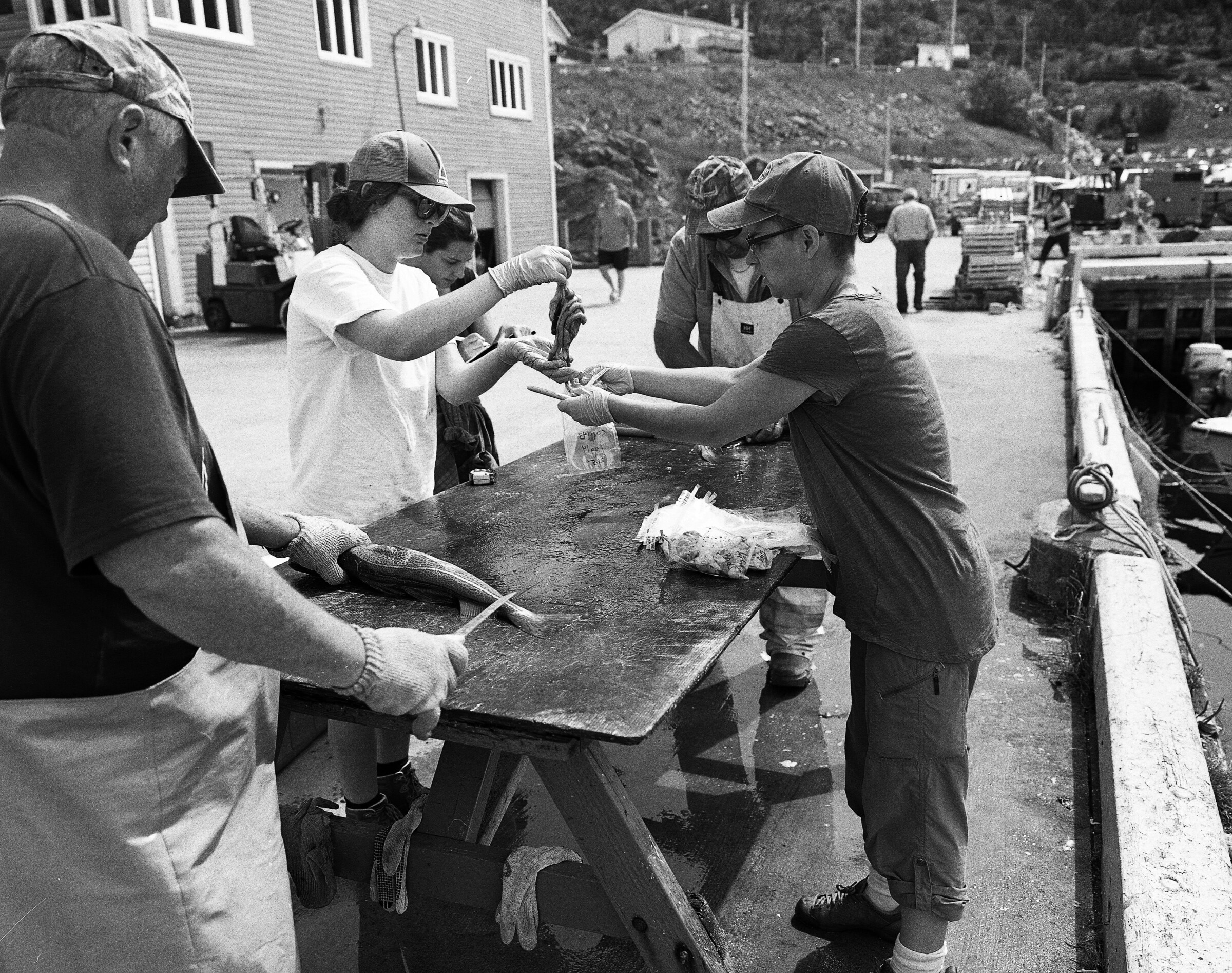
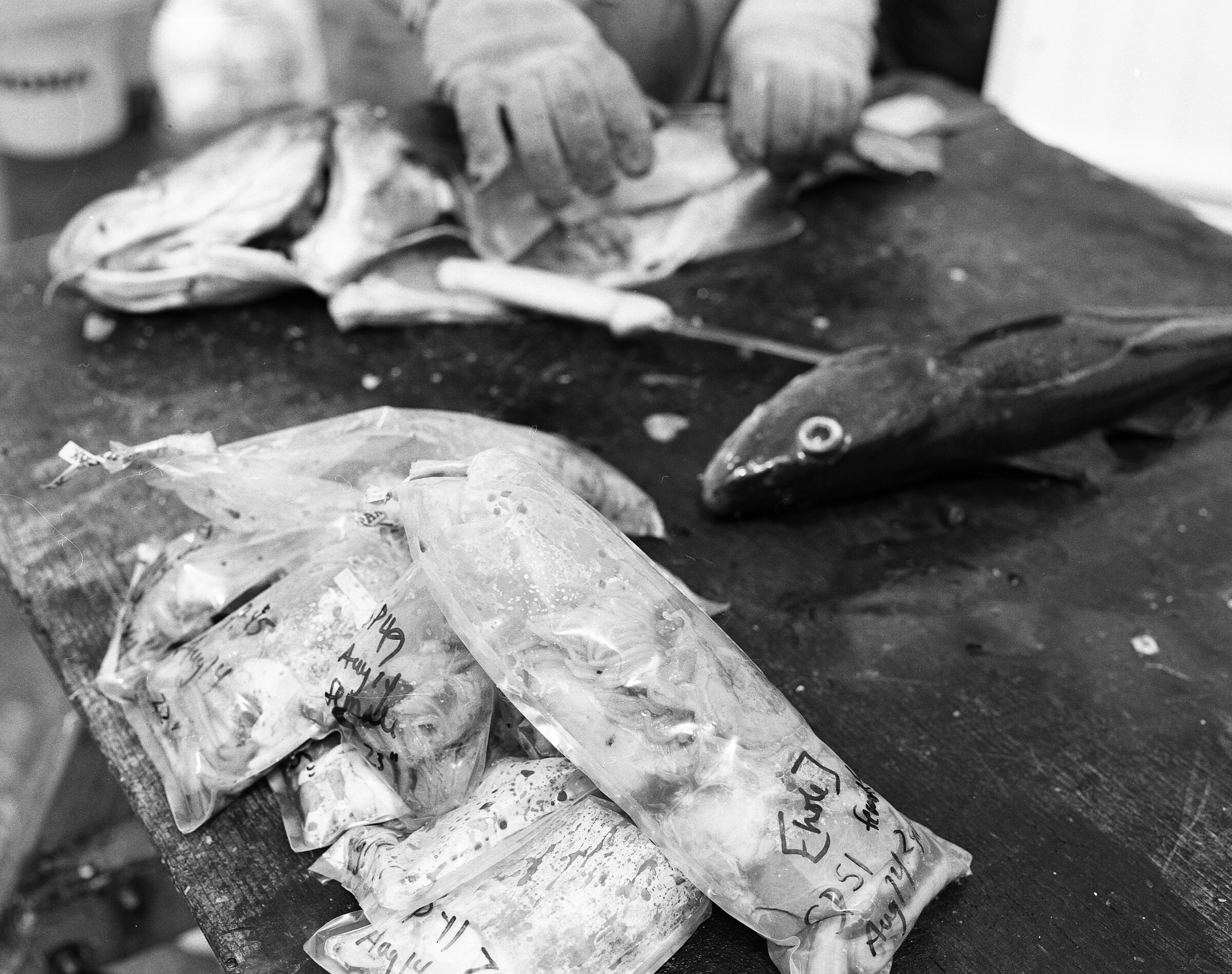
This, to me, is one of the quiet but most acute responsibilities of scientific expertise: learning how to prioritize amid the constant static of environmental collapse. When the world is falling apart in many directions at once, what information matters most? So, we do not conflate guts. We do not average numbers and animals into a polished regional statistic.
Maintaining the specificity of place requires work. When an animal is caught, what is in its mouth and throat is from the location of capture. What is in its stomach is from nearby. What is in the rest of its guts is from farther away, by varying degrees depending on species. This is why we process the esophagus separately from the stomach, and separately from the intestines. We log everything else the animal ate, too, not just the plastic. Other studies only look at stomachs, or only look at plastics, or otherwise dissolve specificities. Our method takes roughly ten times longer. Since most technicians are paid by the hour, this makes our science ten times as expensive. I think it’s worth it.
Other studies only look at stomachs, or only look at plastics, or otherwise dissolve specificities.
Through this way of thinking, science becomes a more subtle and nuanced act of interpretation, of reading plastics in and through the guts, not just analyzing plastics that happen to come from guts. Can this gut-place be read as local, or is it a geography that spans two continents? Is it the same place in Fall as it is in Summer? Is it the sea of the ringed seal gut, or the sea of a bottom feeding fish gut? Is it a place that only female seals occupy when they are weaning, or a place shared by all seals? The answers to these questions each propose a different geography. Animal bodies reveal a different world through their movement and appetites. The task of science is not to collapse variability into a single truth, but to trace how, where, and if gut geographies overlap.
Refusing the Average
At CLEAR lab, we use statistics as a form of relational decision-making. I have heard so many people say that statistics create a kind of abstraction that shucks off relations and decontextualizes. They must know shit statisticians. Math should extend and complicate our understanding of place and positionality. Statistics and Indigenous knowledge are the two most relational forms of knowledge I know, where knowing is a contextual consideration, a negotiation, and a partial distillation. The ethics of statistics is about communicating the decisions that led to that partiality.
In one of our projects in Nunatsiavut, for instance, we have largely abandoned using frequency of occurrence because it’s a number that looks solely at the percentage of animals that ate plastics or not. But what if you care about fish and not populations of fish? What if you care about the number or weight or size of the plastics they ate, and if the fish are okay? Then frequency of occurrence can’t help you. A median count might.
Indigenous knowledge and statistics are the most relational forms of knowledge I know.
My colleague Riley Cotter did a master’s thesis on plastics floating on Nunatsiavut surface waters. At each site, we skimmed the water at least three times to get representative samples. Scientists usually (exclusively?) describe plastics in water in terms of concentration: “1.34 plastics per square kilometer of water.” But Riley noticed that while the number of plastics shifted from place to place, what really mattered were changes in the types of plastic. At one site, the plastics were mostly from fishing lines. In another, they were unusual orange fragments we couldn’t identify. Where the plastics came from, and what land activities might have put them there, were questions of more significance than, How many? Riley called this a place-based analysis. Riley is very smart.
Science is the story we tell about a meeting between environments and instruments. It’s a practice of noticing and stitching, and signposting.
Letters from Home
Everyone in the lab has place relations that also enter this matrix. We expect this to happen; in fact, we protocol it. In the CLEAR Lab Book, a guide that we continually and collaboratively revise, the instructions for “Processing Wet Samples in the Lab (Sample Slinging),” begin with tying back your hair, defrosting a sample, and setting out the datasheet for new entries. Then there’s step 2h:
Think about the sample. Where is it from? Who collected it? What relations does it have? You are now part of these relations as well. From this step on, be sure to treat the sample with respect, which in turn treats all of its other relations with respect. 3
Science is less a method for extracting knowledge than a practice of entering into relationships, and our lab protocols reflect that fact. Each act of observation and each measurement is another way of asking what kind of place we’re in, and how we belong within it, or not. Each lab member finds their own way into these questions. Each has a specific connection to the land.
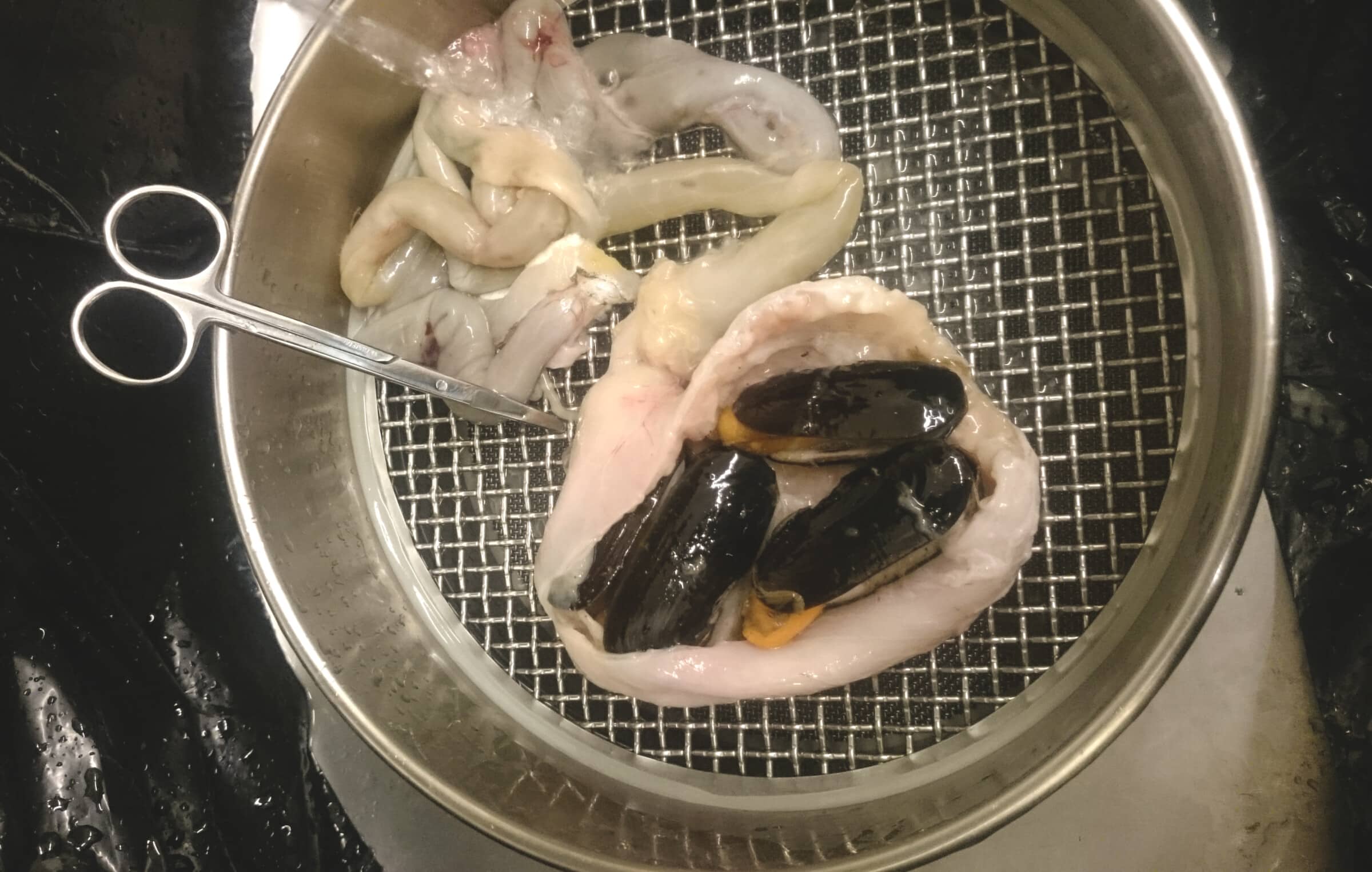
Jess Melvin is particularly good at gut interpretation. During her master’s research years ago, she noticed that when plastics appeared in the guts of Atlantic cod, they were often alongside brittle stars (star fish), mussel shell hash, and small stones. She felt a tug in her own gut, followed it with samples and spreadsheets, and concluded that Atlantic cod ingest more plastics when they feed along the ocean floor, and fewer when they’re hunting in the pelagic zone near the surface.
Jess happened to know that cod feed like vacuum cleaners, sucking in everything around their prey. Perhaps cod weren’t “mistaking” plastics for food, as we’d assumed, but incidentally scooping up plastics as they trawled for food. I deeply admire Jess’s periscope game. It’s not a coincidence that Jess is the daughter in a long line of fishing families. The act of seeing, metaphorical or literal, is situated in the existing knowledge and relations of the seer, even in science. Especially in science.
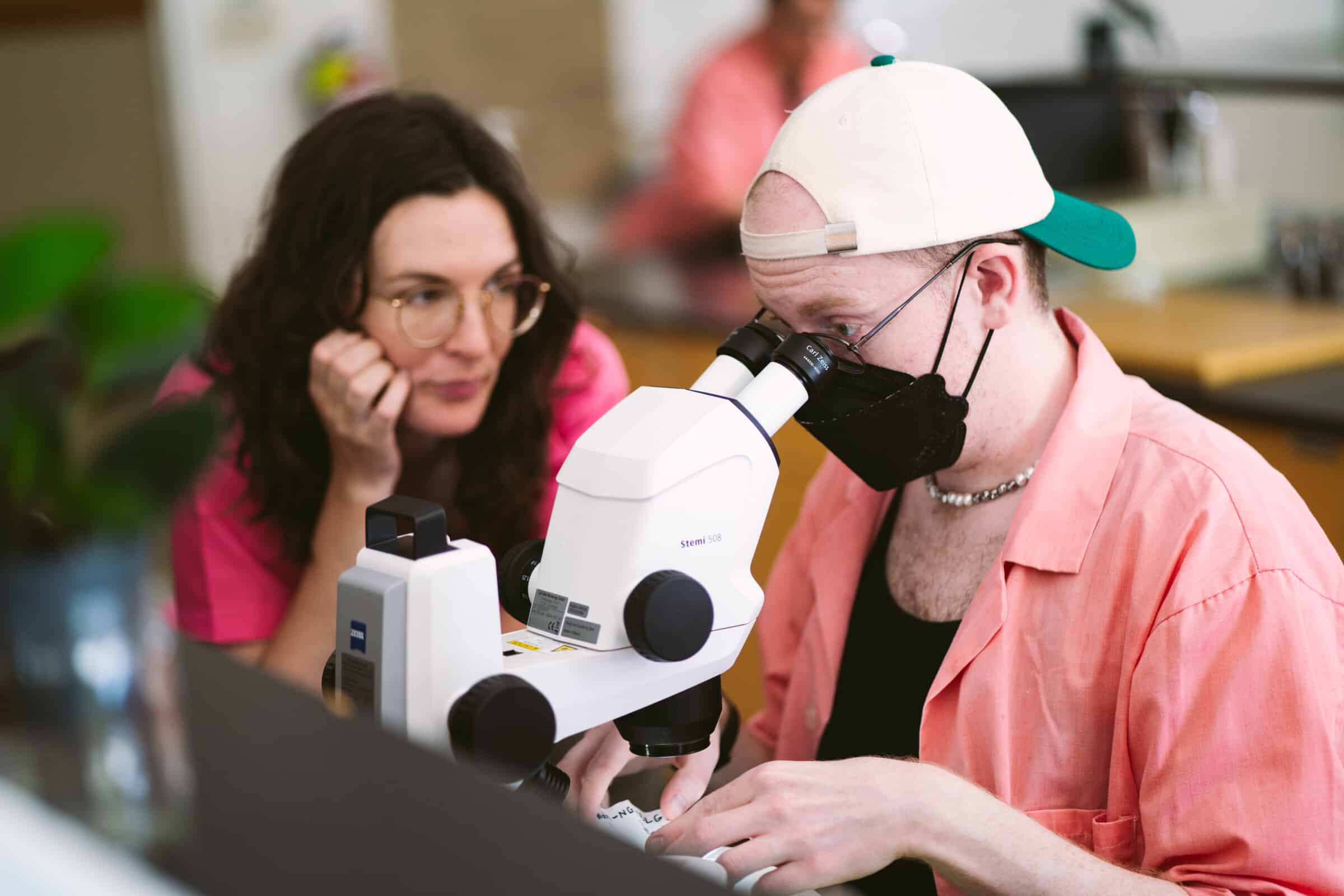
One of our contracts is with the NunatuKavut Community Council. They send us samples from the south coast of Labrador, which we give to Alex Flynn to process. Alex is a long-time CLEAR lab technician, but he is also from the south coast. He appreciates pouring over sieves that contain the fractured landscapes of his home. Sometimes he shares stories of growing up in Labrador: how, every winter and spring when the lakes froze, he and his father would go ice fishing for trout with tools made by his grandfather. If they had a catch, the first fish would be fried for dinner and the others given to his grandparents next door. Experiences like these, he says, drew him to ecology and natural science in the first place. 4 Dissecting the guts of familiar fish isn’t the same as going home, but it is like receiving a letter from home — a letter that arrives quietly under the microscope’s light.
The sample became a note from a season he’d never experienced, proof of a place he knew only through family voices.
Riley also has family from Labrador. He recounts an unusual set of surface water samples from Saglek, Nunatsiavut, one of the most northern places we’ve studied. When he lifted a sample bag from the freezer, it was suspiciously heavy. He shifted the thawed contents into a sieve, and the bag appeared to contain a great deal of fine brown sediment, as if the trawl had scraped the seafloor instead of the surface water. This would have been the height of instrument malfunction, and Riley was mystified. Then he moved the sample under the microscope. What looked like sediment was in fact thousands of tiny flies, with distinctive black eyes, looking back at him.
The flies didn’t alter our analysis or dataset, except that the sample took longer to process. But the presence of the flies did shift Riley. He had grown up hearing family stories about Labrador’s infamous flies, how they rose in clouds thick enough to drive fishermen mad, how his grandfather would be “eat alive” trying to cast a line in summer. The sample became a note from a season he’d never experienced, proof of a place he knew only through family voices. A reminder that in scientific work, evidence can arrive not just as data, but as recognition.
Pelagic Doesn’t Place
No matter how good I become at plastic forensics, there are some places, and some aspects of places, that guts will never convey, paradigms that I’ll never understand. A few years ago, for instance, I realized that despite a lot of time looking at the contents of the bellies of arctic char, my mental picture of their landscapes was distorted by my own biases. I was visiting Nunatsiavut community member Reuben Flowers in his shed in Hopedale. He was making a fishing net by hand. Green twine looped around Reuben’s fingers as he knotted diamond after diamond. I looked at the thread closely, wondering if I had ever seen its fibers in a sample. I hadn’t.
As I stood there, Reuben gestured to the width of the net and said he would stop in another row.
“Why so narrow?” I asked. The net would only go into the water about three feet.
“Because that’s where char swim,” he said.
How could I have not known that? One reason is that I never see char alive and swimming. Even when I fish, I only see char on the end of my line. It struck me that I hadn’t thought carefully about the water column as a place. If char are feeding only in the top few feet, what kind of landscape is that? Buggy, full of little black exoskeletons? Foamy, with traces of dried white pollen stuck on seed pods? Even if we catch an arctic char at the exact same location as a Greenland halibut, the halibut are feeding in the benthic environment, which is a different place entirely from the char’s pelagic environment.
Perhaps the finer points of a water column landscape are beyond a land mammal’s understanding.
I can imagine a seabed more easily than a water column — coral, crab shells, stones, plants — so that’s where I’d built my mental picture. The seabed is a solid, earthy grammar of a place familiar to a land animal like me. I made a mental note to try to see this surface-water world more clearly, to learn more about reading pelagic environments. But I also realized that perhaps the finer points of the water column landscape are beyond what can be understood by a land mammal. It’s not my paradigm. This is fine. Even good. All forms of knowledge have limits. Better to know and acknowledge than pretend there are none.
Going North, Losing Footing
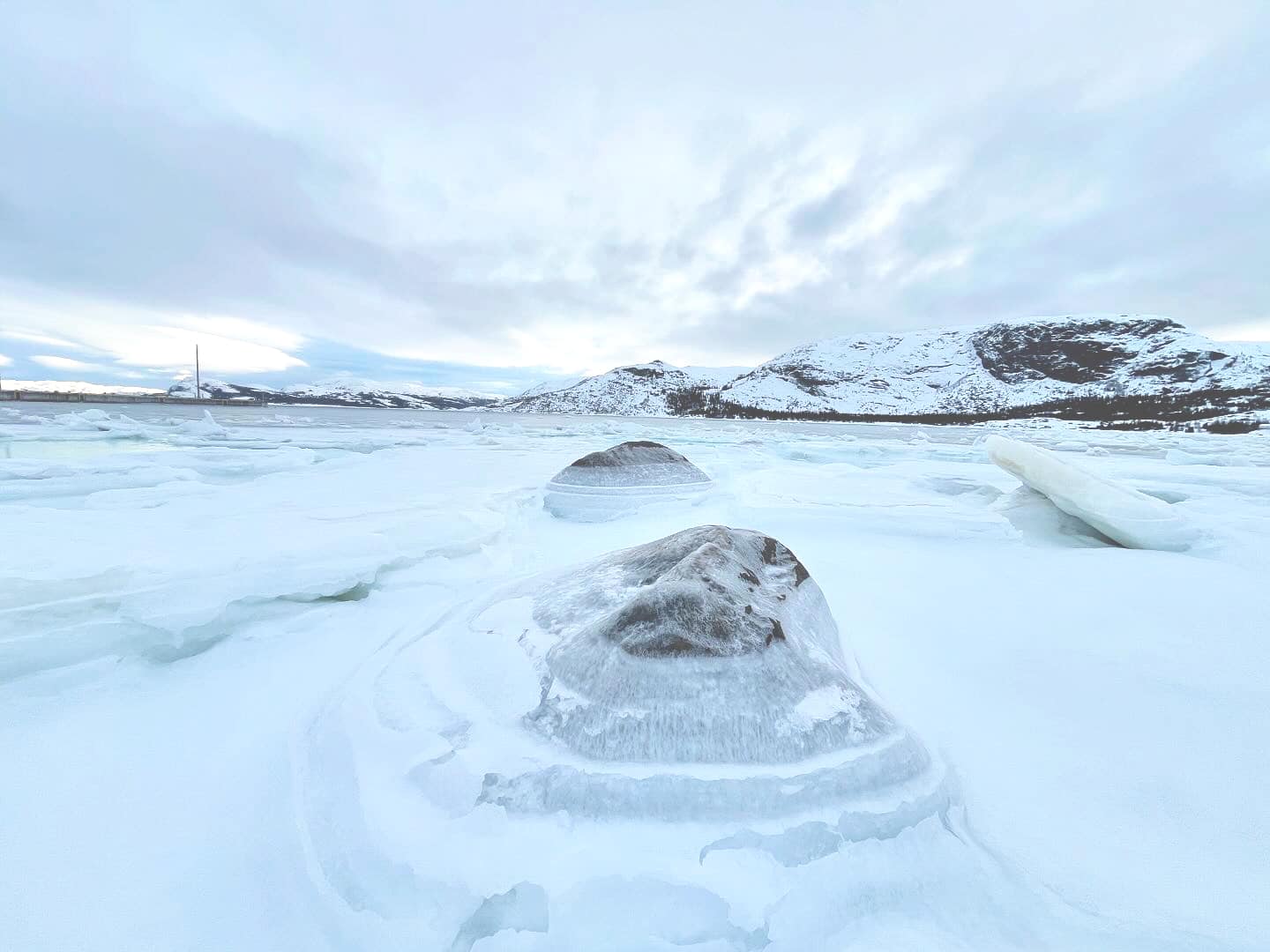
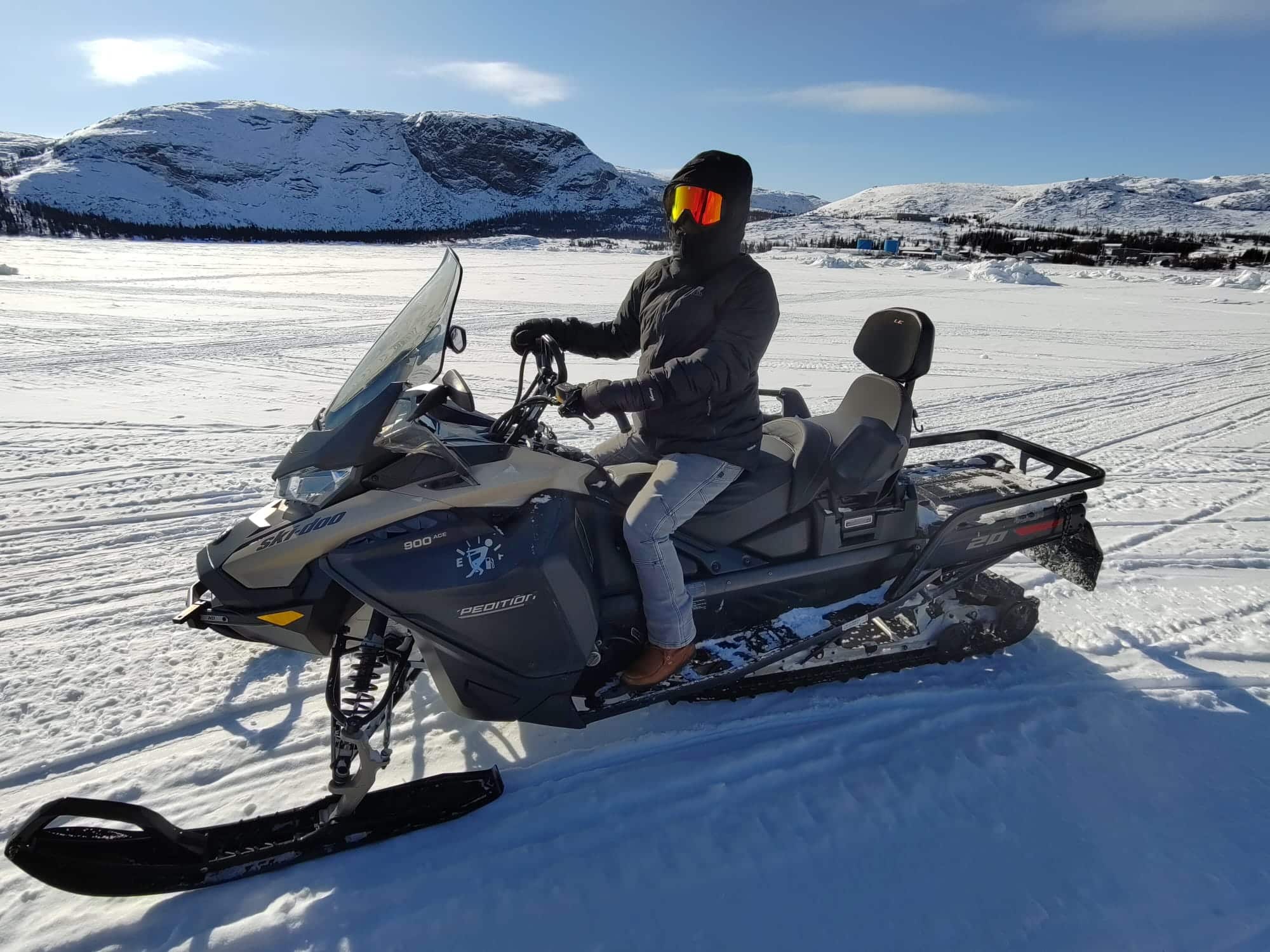
As everyone who’s tried to look through the wrong end knows, a periscope doesn’t work in reverse. When I travel to Nunatsiavut to do research, I don’t recognize a thing. From the boat or skidoo, the landscape is vast. They call Labrador the Big Land for a reason. The sky seems somehow larger than what is delineated by the horizon. Mountains rise from an ocean that shifts through black, white, turquoise, and in summer, dark blues. In winter, the sea hardens into a topography of icy textures, none of which I can read.
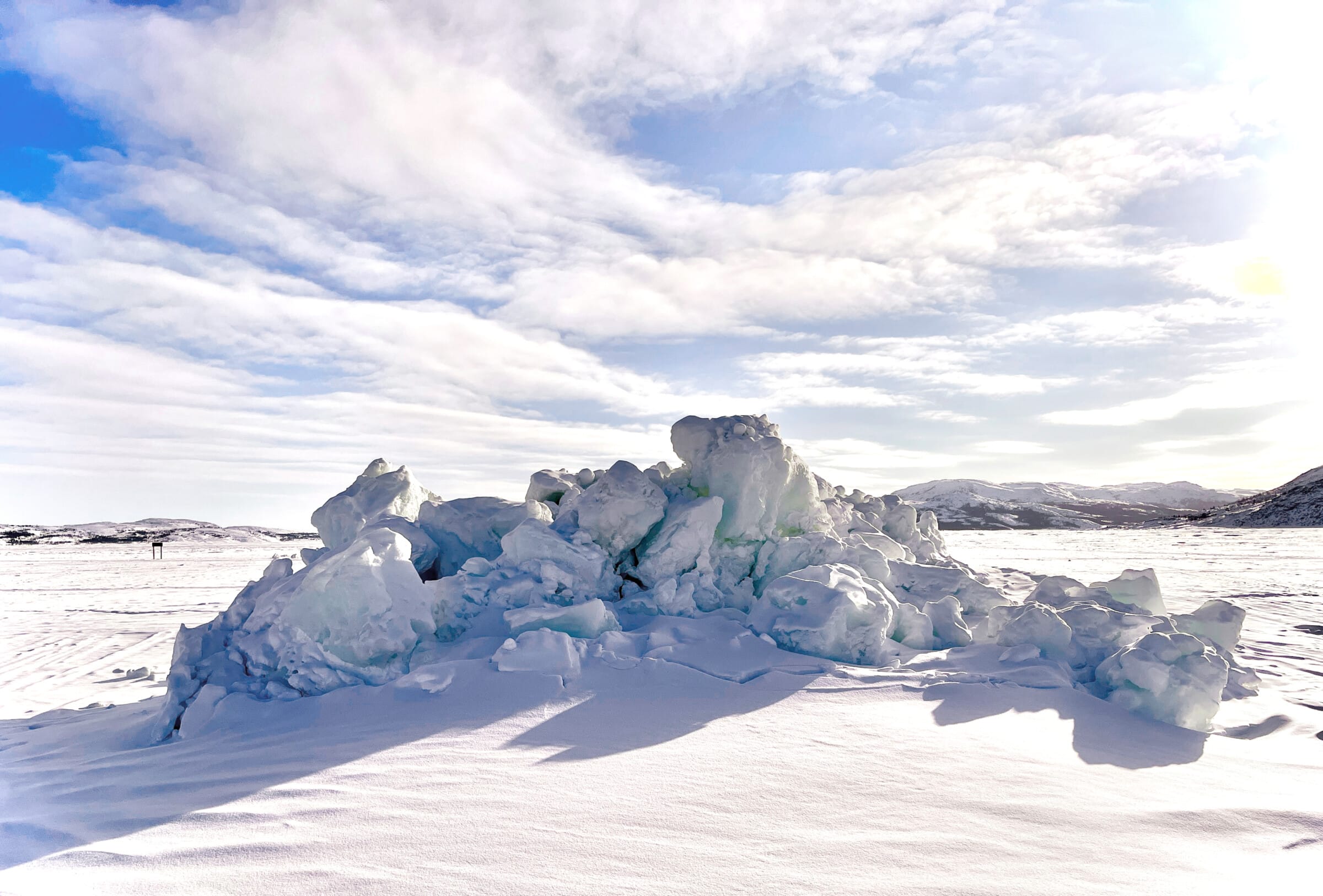
Every way of knowing builds its own world, and no two align exactly.
This is not the inland, lake-filled, forested North where I grew up. So much of what I encounter is foreign — like bellycatters, tall ridges of ice that thrust upward near the shore and fracture into clusters. I tootle towards them for a closer look, and Liz, my Inuk research partner, warns me the surrounding ice can be unstable. Or the way the tides freeze saltwater in nested layers, so that shoreline rocks mark each time the ocean hesitated before giving in to winter. The places I know through guts and microscopes and the places I see when I visit might share longitude and latitude coordinates, but they are not the same place. The only places in Nunatsiavut that I recognize are the ones that have passed through another body.
On one trip north, I peek inside the guts of a Nunatsiavut ptarmigan, and all is familiar: the stubby white fragments of what I call reindeer moss, the red smears of partridgeberry, tiny twigs from willow or aster trees. I know these things, and I know what they look like in their unfragmented form; I even know the taste of partridgeberry. And yet, the place this bird was caught remains strange and unfamiliar.
That night, the research team shares ptarmigan stew. The air is thick with laughter and steam, and the grounding sweetness of wild food and company. These relations, too, are a place. Every way of knowing builds its own world, and no two align exactly. There are always many places at once: the one in the gut, the one on the ice, the one on the tongue. What seems like one landscape is in truth many.
Touch Points and Foodways
There are many reasons that we eat samples. First, because wild food is delicious. Second, because it affirms one of our core findings, that wild food is safe to eat — “See, even the researchers eat it!” Third, it reminds us that what passes through our lab is sustenance, not merely data, and that our work is implicated in Indigenous food sovereignty and local food security. And finally, we eat samples because eating reminds us that there are many forms of knowledge apart from science, including taste.
Some scientists work with the notion that more knowledge is always better, and that scientific learning can be applied to everything. I don’t buy it. To my mind, science is one way of knowing among many. Our study has no business talking about the sensual knowledge of taste.
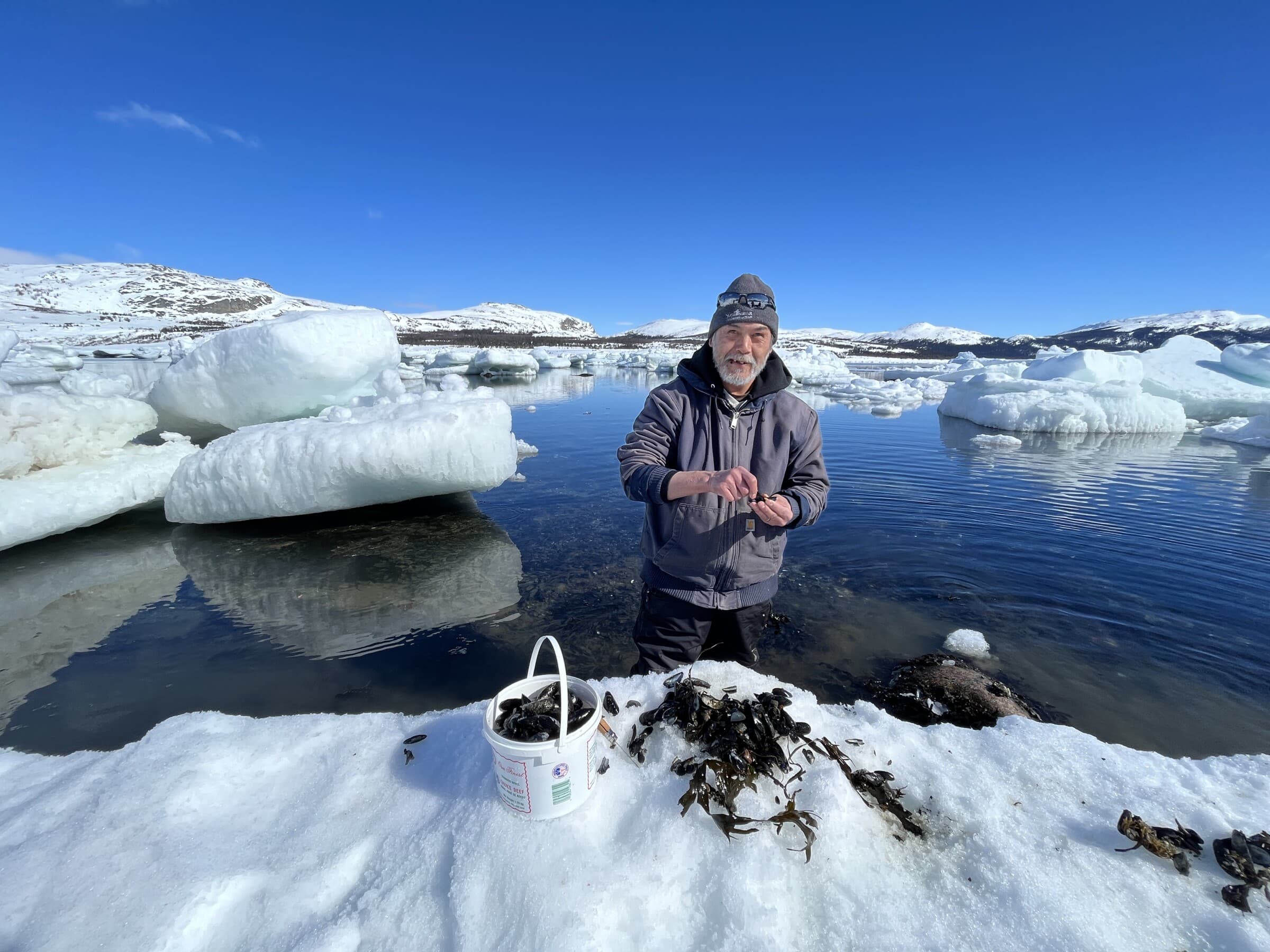
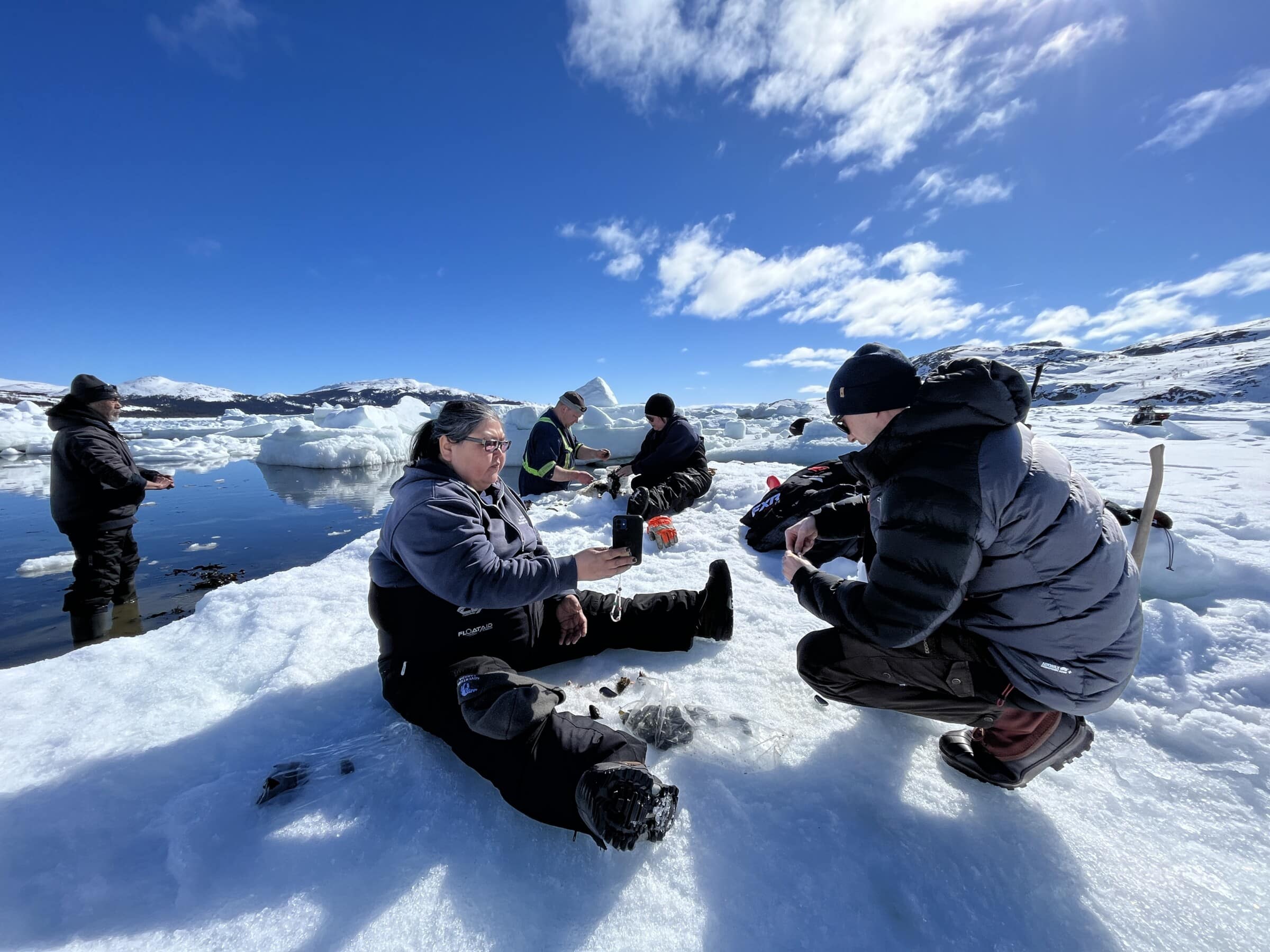
Hunters often tell us they gather seals or char from specific places, ages, or seasons because they taste better. They’ve long noted that environmental stress changes the taste of animals. This is cumulative, place-based local knowledge, something to be respected. Perhaps the presence of plastics links to the flavor profiles of animal flesh. We’ve never designed a study to investigate. We could, but instead we share our data and findings, and hunters and fisherman can make the connections if they wish. Some things are not our place.
We share our findings, and hunters and fisherman can make the connections if they wish. Some things are not our place.
When we eat, it’s to enjoy food not do science, though sometimes the two overlap. One day in Nunatsiavut, Liz guided us through the ice on a detour to pick mussels. I put my hand into the coldest water I’d ever experienced and came away clutching a handful of shellfish. I know mussel shells as fragments — how they look under the microscope, how their pale pink, blue, and purple iridescence can fool students into thinking they’re plastic, how their edges are sharp, but we never find punctures or scrapes in the guts of animals that eat them. (Animals are tough enough to eat what’s theirs, which lets us propose, carefully, that they are tough enough to eat plastics, too.)
But these whole mussels, clinging to black rocks, were something new. Liz passed me some mussel meat, freshly obtained with her pocketknife. I ate it. It was salty and cold.
Participatory Endings
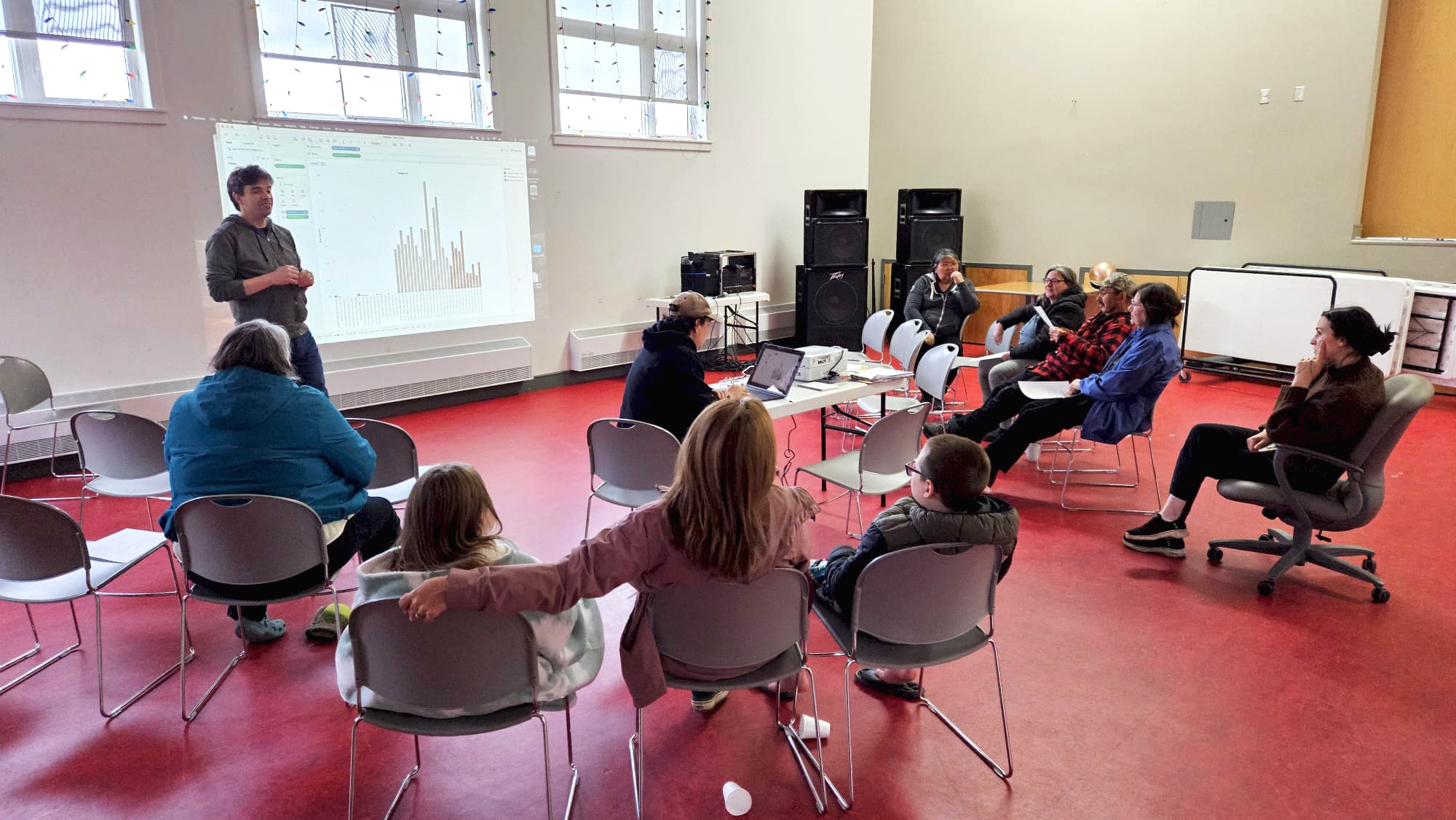
We’ve completed nearly a decade of research in Nunatsiavut, and the plastic monitoring project is now in the hands of the Nunatsiavut Government. We’ve done the science collaboratively, with the people the science impacts. We ran statistical analysis not in labs, but in community halls with dart boards (always dart boards!). We met with the hunters who caught the animals, with the cooks who made them into food, and we worked through the data together in real time. We asked the data questions and demonstrated how answers arose (or didn’t). Community members asked questions too, and we saw how and if our categories and columns let us answer those questions (or not).
When the statistics said something, we checked to see if it rang true with what the community knew, or if we’d missed a relationship (we often had). This is called participatory statistics. There was always food involved.
I admit that when I see the phrase “co-production” in an academic study, I get a little judgy. The term is often used to describe a research team that covered two different parts of a study and spent a couple of meetings writing it up together. That is not how we work.
‘Are these levels safe?’ someone asked. The million-dollar question.
At our final participatory statistics session in Rigolet, in 2025, we presented numbers about heavy metals and plastics in birds so that we could interpret the numbers together. “Are the levels unsafe?” someone asked. The million-dollar question. We expected it. We pulled up the data and overlaid the most conservative level of “safety,” which is the amount of contaminant that would make an individual bird sick. We talked a little about how that level was created and who created it, and decided by consensus that it was a trustworthy number. All the birds we’d studied were far, far below that level.
Everyone was happy.
“Okay,” we scientists said, cracking our knuckles to crunch more data. “What do you want to know next?”
“Nothing,” replied Dave Wolfrey. Wolfrey had been the conservation officer in Rigolet for twenty years and had retired earlier that week. “You said it’s safe. You’re done.”
Shortest research meeting of my life. And the best.



If you would like to comment on this article, or anything else on Places Journal, visit our Facebook page or send us a message on Twitter.