
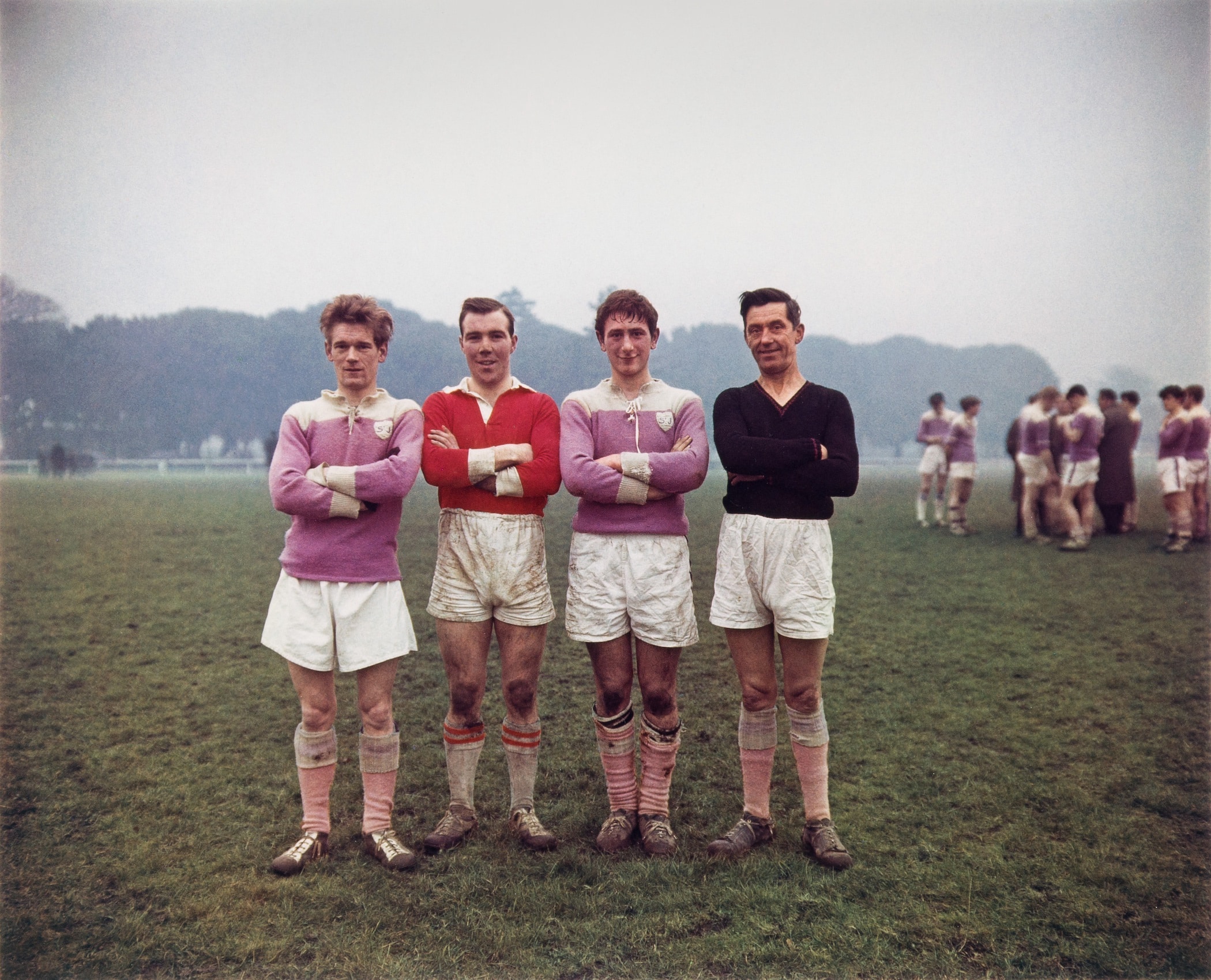
I came to [the] Phoenix Park in Dublin on a Sunday. I knew that they played ball there. They all came running because they liked to have their picture taken. I first took a Polaroid. They really liked it, and then I took another picture in color. The pink in their socks; they are too funny! This chubby one with the red shirt. The colors in the picture are very important. The weather also looks very typical, the dull gray sky, a bit foggy. But it looks beautiful in the colors. If the sun had been shining, it wouldn’t have looked as good.
– Evelyn Hofer on Evelyn Hofer 1
As Evelyn Hofer recalls taking what has become one of her best-known photographs, it’s perhaps not surprising that she focuses as much on pictorial properties as on the circumstances of this day in 1966. Even decades later, she had a fond sense of the faintly comic aspect of her subjects, and the particular conditions of the setting. But above all, she knew why the picture works.
There is no mention of the subjects in the title. Only the place and time are registered: Phoenix Park, Sunday.
Hofer’s modus operandi was considered and deliberate; she took time to get things right. (“With you, it’s just click, click, click,” someone once said to her, disparaging the merit of photography in general. “No, with me it’s just click,” she replied.) In contrast to the speed and spontaneity of contemporaries such as Garry Winogrand, her idiom was, in the words of curator Gregory J. Harris, “spare, slow and still.” 2
Born in Germany in 1922, Hofer left with her family in 1933 with the advent of Nazism, arriving in the U.S. following sojourns in Spain, Switzerland, and Mexico. Initially working predominantly in fashion photography, in 1955 she received a decisive commission for pictures to accompany a text by Mary McCarthy on the city of Florence. For this assignment, published as The Stones of Florence in 1959, Hofer moved from her usual Rolleiflex to a 4 x 5 camera which slowed the image-making process and allowed her to render the formal beauties of Italian architecture.
It was a method she continued in a series of commissions for city books with essays by British literary critic V.S. Pritchett, of which the book on Dublin, published in 1967, is widely regarded as the most successful. Previous volumes — London Perceived; New York Proclaimed — spoke in their titles of careful study and confident revelation. This final volume in the series was called Dublin: A Portrait, implying something altogether more singular and more intimate.
There is a productive ambiguity to this title, of course — suggesting that the city has gathered its buildings and open spaces before the camera, or, on the other hand, that through careful portrayal of its citizens, the character of the city itself could emerge. Certainly Hofer was drawn to the latter strategy. She did not respond to local architecture, writing to Pritchett that “you and so many others say that Dublin is one of the most beautiful cities in Europe — this, from the very beginning, I never felt …. I cannot show [the buildings] to their advantage.” 3
The final volume in the series by Evelyn Hofer and V.S. Pritchett was called Dublin: A Portrait, implying something singular and intimate.
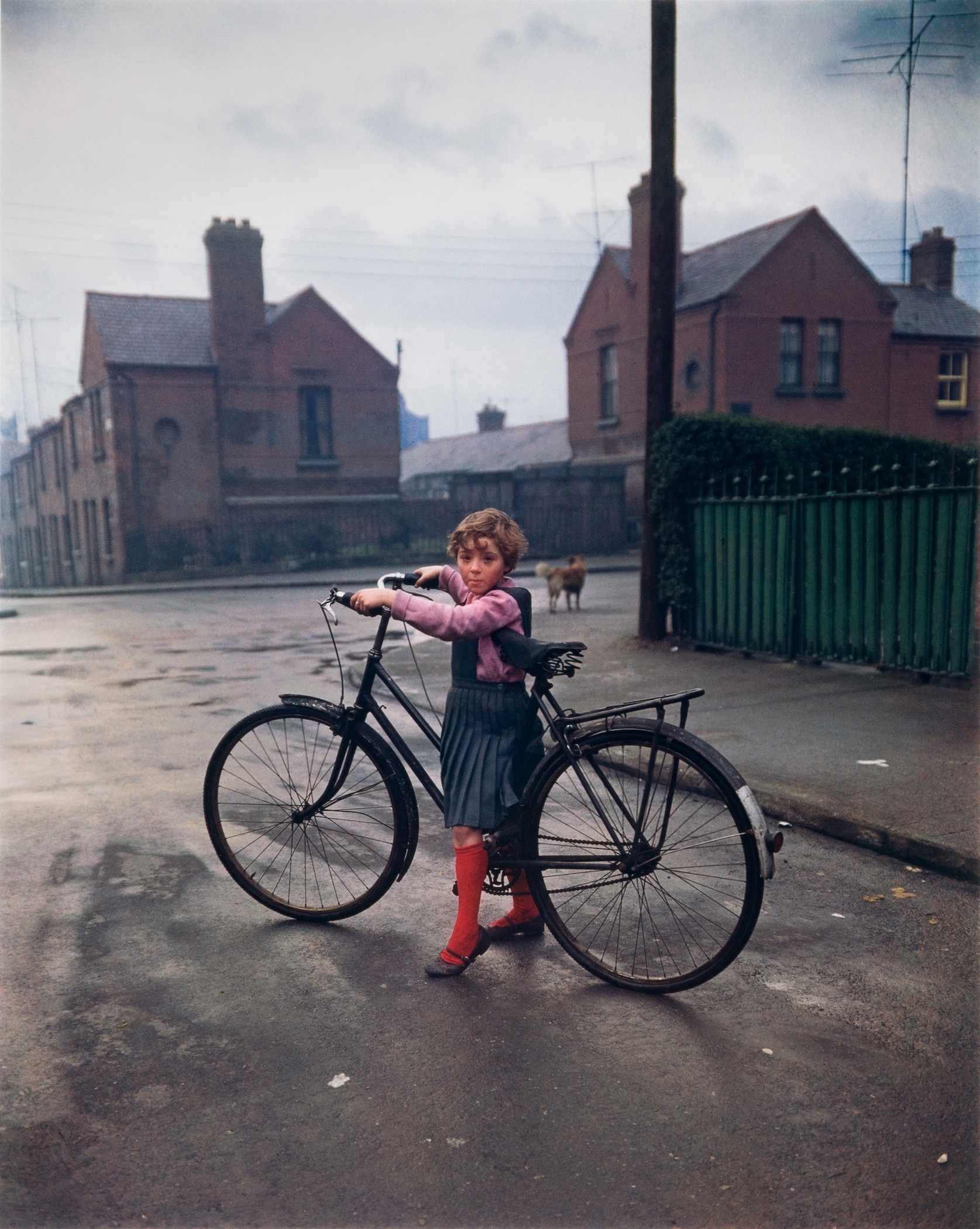
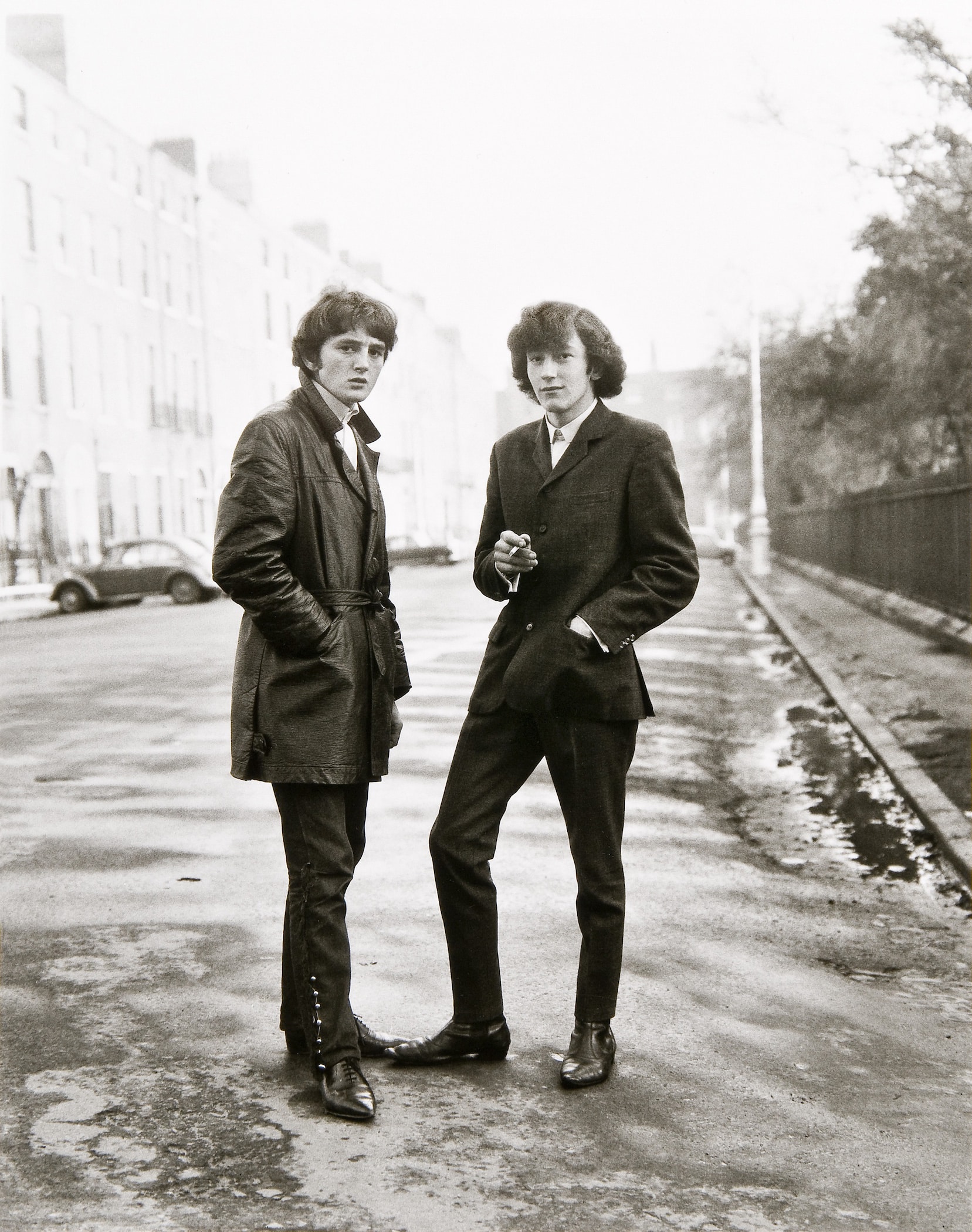
The people she found “much more fascinating … [I] have taken a great deal more portraits and have perhaps come closer to them [the city’s inhabitants] than in any other books.” 4 Accordingly, many of the Dublin portraits say as much about settings as they do about sitters; or certainly about the relationship between those two. Sometimes, the surroundings speak of an individual life — look, for instance, at the writer Mary Lavin, host of regular artistic gatherings, in her study. Just as often, public spaces rhyme with figures, as in the photograph of two mods in Fitzwilliam Square, their sharp suits in harmony with the clean lines of the Georgian terrace. If this sense of balance between people and place was often consciously constructed, it was just as regularly a result of happy accident. Of her famous photograph of a young girl on a bicycle in the area of Dublin known as Coombe, Hofer writes, “I didn’t have to change anything or compose anything …. It is all just right the way it is: the clouds and the sadness.” 5
Combining as it does such elements of serendipity and design, the Phoenix Park photograph became emblematic of the project as a whole. And although it can undoubtedly be considered a group portrait, there is no mention of the subjects in the original published title. Only the place and time are registered: Phoenix Park, Sunday.
It is sometimes assumed that Hofer’s subjects are soccer or even rugby players. In fact, they are playing Gaelic football.
The Phoenix Park is a vast enclosed green space at the city’s western edge; roughly oval in shape, at 1,752 acres, it is more than twice the size of Central Park in New York City. Originally a hunting park, it also housed the residence of the viceroy, representative of the British crown in Ireland, and served as a field for military maneuvers. By the 20th century, it had become a leisure ground for Dubliners, with a zoo, gardens, and areas for cricket, polo, soccer, and Gaelic games. Most ball sports are played on an elevated plain at the park’s center, known as the Fifteen Acres; at the eastern end of this zone, where Hofer’s picture was taken, pitches for Gaelic games — football and hurling — were set out in the late 19th century. The Gaelic Athletic Association, established in 1884 to support the popularization of Irish sports, availed itself extensively of the plain in its early years, but by midcentury most GAA clubs had their own pitches, and it was soccer that dominated Sunday schedules at the Fifteen Acres. Perhaps for this reason, it is sometimes assumed that Hofer’s subjects are soccer players, or even (as Hugo Hamilton has it in the 2022 Steidl remake of Dublin: A Portrait) rugby players. 6 In fact, they are playing Gaelic football.
Thanks to research for a 2012 exhibition of Hofer’s Dublin photographs at the city’s Gallery of Photography, and to subsequent study of Hofer’s diaries, the occasion is now known: it was a match held on Sunday, January 23rd, 1966, between two clubs — St. Joseph’s from the North Strand neighborhood of Dublin, and Banba, from the town of Cavan, about 100 kilometers away. 7 The four footballers are, from left to right, Sean McDermott, Patsy Reilly, Martin Doyle, and Peter Reid. 8 A social-media post on the occasion of McDermott’s death in 2021 states that the photograph was taken at half-time. The young men certainly look as if they have already been in action, and are prepared for more. 9
Half-time in the Phoenix Park, and the players pose side by side, arms folded, looking towards Hofer’s camera. They stand in a grassy expanse, curtailed by distant trees. Behind them, to the right in the middle distance, St. Joseph’s teammates gather. It is the stuff of countless matchday snapshots — but, as Hofer knew, the colors make the picture. The St. Joseph’s kit comprises a jersey in opera mauve with a white band across the top and white cuffs, white shorts, and faded pink socks with white tops. Their goalkeeper wears a black jersey with red-stitched V-neck collar and cuffs. The single member of the Banba team, companionably sandwiched between his opponents, wears a bright crimson jersey with white shorts, and socks with two red stripes.
It is the stuff of countless matchday snapshots — but, as Hofer knew, the colors make the picture.
When the photograph was printed using Hofer’s preferred dye-transfer technique, in which layers of dye are added to a single emulsion, the colors gained an additional synergistic vibrancy, reciprocally enriched by the accumulation of detail. The mauve jerseys are of wool, with laced openings at the collars, and crests reading “S.J.” According to one source, they were knitted by local nuns from St. Agatha’s. 10 Though evidently cared for, they show signs of wear and repair. McDermott wears odd gloves, one dark, one light. The socks are disheveled, and Doyle’s have slipped enough to reveal a second pair beneath, worn in lieu of shinpads. The lineup of shorts varies from fresh and unsullied to muddied and worn, alternately hanging loose and hoiked high enough to gather rather revealingly at the groin; the white shapes form an undergirding rhythm to the play of colors above.
As much as the specifics of the outfits, it is the knobbly knees and the open demeanor of this fab four that make the photograph a portrait. Recalling August Sander, whose typological portraits of German citizens Hofer was fond of citing as a reference, she often depicted small groups who shared a purpose or profession. The challenge was to find compositions that combined close focus on her subjects in all their specificity with eloquence about their common activity and what it signified.
This took time to achieve. Alongside Polaroids that day, Hofer made a number of other images with her 4 x 5 camera, in which the friendly tumult of the match is more evident — a long, ragged line of players; boys and men posing; a group of three gathered on the sideline, watching the action on a field half-obscured by mist. As the chosen four try various poses — arms draped around each other in one — other red-clad Banba players and a curious boy look on from the edges. 11 They are watching the picture being taken, unaware that they are in it. The cumbersomeness of the process — the large camera on its tripod, Hofer ducking beneath the black cloth to check the composition reversed and inverted on the viewfinder — would make it difficult for participants to know exactly what was being captured, even as it encouraged Hofer to clear her frame of extraneous activity (“the process of elimination happens before I begin”). 12
Furthermore, Hofer was using a wide-angle lens which, although her camera was quite near her subjects, allowed her to encompass the surroundings. She favored a “Meyer Plasmat set, made in prewar Germany. It came in a black, velvet-lined box and had three parts to it which could be combined into five focal lengths — 11, 12, 15, 22 and 27cm.” 13 The vignetting at the corners of the photograph, more evident in recent prints and reproductions than in the original 1967 publication, resulted from use of this lens with an open aperture, so that light entered the frame’s extreme edges at an oblique angle. 14 Subliminally, these darkening corners reveal the apparatus being pushed to its limit in order to achieve a seemingly effortless balance of closeness to the subjects and openness to the setting. 15
The Dublin that Pritchett and Hofer encountered was in transition, opening itself, culturally and economically, to modernity.
The Fifteen Acres is difficult to photograph in a way that conveys its size. In Hofer’s picture, the players serve to structure and scale the space. Their side-by-side verticals establish a base line relative to which other layers recede: to the right, the cluster of St. Joseph’s players and their manager; further back, on the left, a blurred group of opposition players close to the low white fence bordering the pitch. Beyond that again, a stand of trees, their tops aligning — in a manner which cannot be accidental — with the heads of the foursome in the foreground. Above it all, pale gray and softly luminous, as it often is in Dublin, is the sky.
“It is the sky that rules Irish life,” writes V.S. Pritchett in his Dublin text; “you are liable to feel that you are not anywhere on earth but are being whirled about in Time and Light and strangeness.” The sky loomed largest where the city opened up, over Dublin Bay to the east, and over the park to the west: “The extraordinary size of Phoenix Park on its cliff up the Liffey leads one to think one is a new country rather than a park.” 16
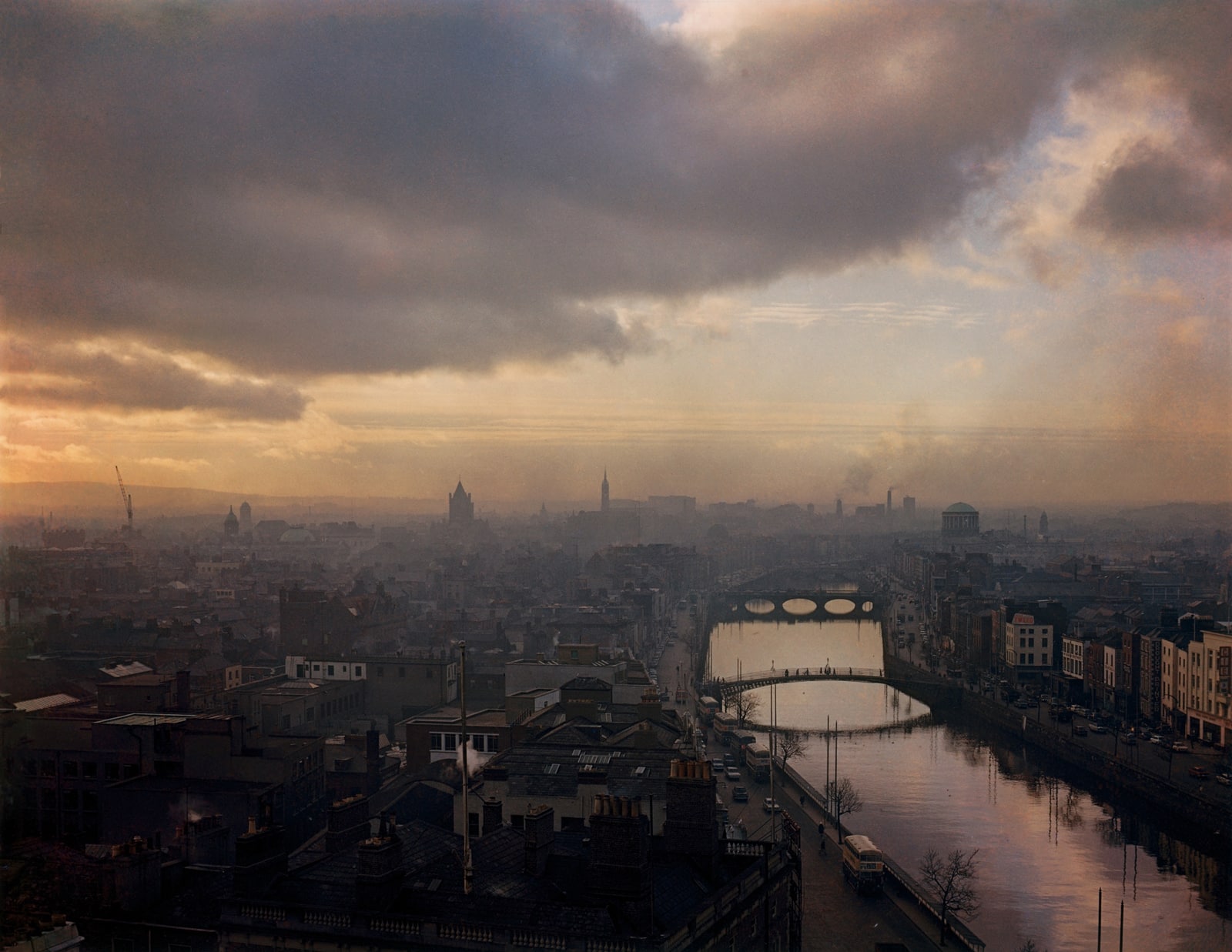
What kind of new country? The Dublin that Pritchett and Hofer encountered was in transition, emerging from the inward-looking nationalism following independence after 1922 and opening itself, culturally and economically, to modernity. If there is a fondness, in Dublin: A Portrait, for enduring lineaments of the old city, there is equal regard for forces and voices of change — the young artists and poets, the politicians and PR men. Another celebrated photograph from the book looks west down the river, under a lively sky, at the long-established skyline. But the vantage point suggests that the photograph must have been taken from the roof of O’Connell Bridge House, a modernist office tower completed in 1965, which has often been seen as a rude interruption into its historic context. “The fact is,” writes Pritchett, that Dublin “is very much a city caught by anxieties, for it is half way between an old way of life and a new one.” 17 His own response to the place was filtered through an experience of staying there in the early 1930s, soon after independence. To read his text interwoven with Hofer’s photographs is thus to assimilate several time registers at once.
Is it too much to think that, almost 60 years later, something of the reticence and pensiveness captured in this magical picture persists?
Nowhere was the long transition from “first colony” to nation more evident than on the Fifteen Acres, where military maneuvers had been supplanted by sports, the figures in the landscape now young GAA players on the weekend rather than soldiers at drills. The former viceregal lodge became Aras an Uachtaráin, home to the Irish President. Nearby, the Chief Secretary’s lodge became the U.S. Ambassador’s Residence. The Catholic Church superseded the British Empire as the dominant force in Irish culture. Thirteen years after Hofer took her photograph, in 1979, the plain hosted a crowd of almost 1.25 million for a mass led by Pope John Paul II. The event, still commemorated by the low mound and tall steel cross erected for the occasion, probably marked the apogee of Catholic Ireland: when Pope Francis visited the same location in 2018, the crowd numbered 150,000.
Even between Pritchett’s 1930s sojourn and the late 1960s, the country had changed significantly. Yet, essential qualities endured. On January 29, 1966, six days after photographing in the Phoenix Park, Hofer wrote perceptively to her coauthor:
I never forget that I am on an island, stuck away, timeless and with no contact to the “other” world — crowded with people who seem to live a life full of fantasies, imagination, talk — yet lonely, suspicious of each other, on the defensive — and yet more able to remain within themselves. 18
Is it too much to suppose that Hofer had her photograph of football players in mind? Too much to see defensiveness in their folded-arm stances; to infer loneliness despite their physical closeness? Too much to think that, notwithstanding the immediate excitement of the game and the unexpected invitation to be photographed, these young men might remain lost, at least in part, in their own imaginations? And is it too much to think that, almost 60 years later, something of the reticence and pensiveness captured in this magical picture persists? It is still half-time in the Phoenix Park.


If you would like to comment on this article, or anything else on Places Journal, visit our Facebook page or send us a message on Twitter.