
![Clockwise from top left: Mended sweater, courtesy of Repair Shop. Las Armas Social Housing, Zaragoza, aldayjover architecture and landscape. Edmund de Waal, Meissen plates from the von Klemperer Collection, 2024. Kintsugi repair by Maiko Tsutsumi. Reforestation at Bosque Opyta N’em Jê, Instituto Federal do Pará, Marabá, Pará, Brazil. [Nate Millington]](https://placesjournal.org/wp-content/uploads/2024/11/Field-Notes-Repair-6-composite-lead.gif)
An anti-caste ethos of repair
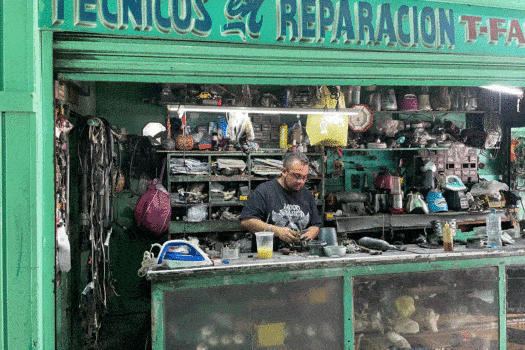
I spotted him across my balcony on a mid-July afternoon in post-Covid Delhi. He dangled precariously from a bosun’s chair, trying to reach the condenser unit of an air-conditioner in the darkest corner of the building, tucked away with the electric cables, and the sewage and wastewater pipes. Hanging by a thread in the sweltering heat, he was cleaning out the dust generated by an ever-expanding megacity from a technology without which middle-class living in urban India is becoming unimaginable.
In urban India, repair is often implicated in risk.
To adapt a concept put forward by anthropologists in the 1990s to explain institutionalized exploitation, our built environments are “castified.” They have evolved to segregate and make life comfortable for upper-caste residents, and difficult for those who repair. Borrowing from Steven J. Jackson’s 2014 essay “Rethinking Repair,” in this binary world of designer (i.e. architect and planner) and user (i.e. resident), the fixer is unaccommodated, yet indispensable. It is the act of repair that conjoins the realms of designers and users — ensconced in corporate offices and gated enclaves — with those of the fixers, living in informal settlements.
The moment of intersection between the two worlds, therefore, is forensic.
Gurgaon, a satellite city of Delhi, desperately seeks to escape what Dipesh Chakrabarty has called the “imaginary waiting-room” of history, by wrapping its buildings in glass facades. On a rapidly warming planet, the coal needed to cool these overheated buildings is mined from the lush forests of central and eastern India, displacing Adivasi communities and erasing their sacred landscapes. The glass facades are cleaned by uninsured Dalit and Adivasi workers hanging from the edges of rooftops. The water they use is extracted from exhausted aquifers and purified by membrane technologies. The cleaners will be unable to access clean water for drinking, bathing, or cooking when they return to underserved settlements in the evening.
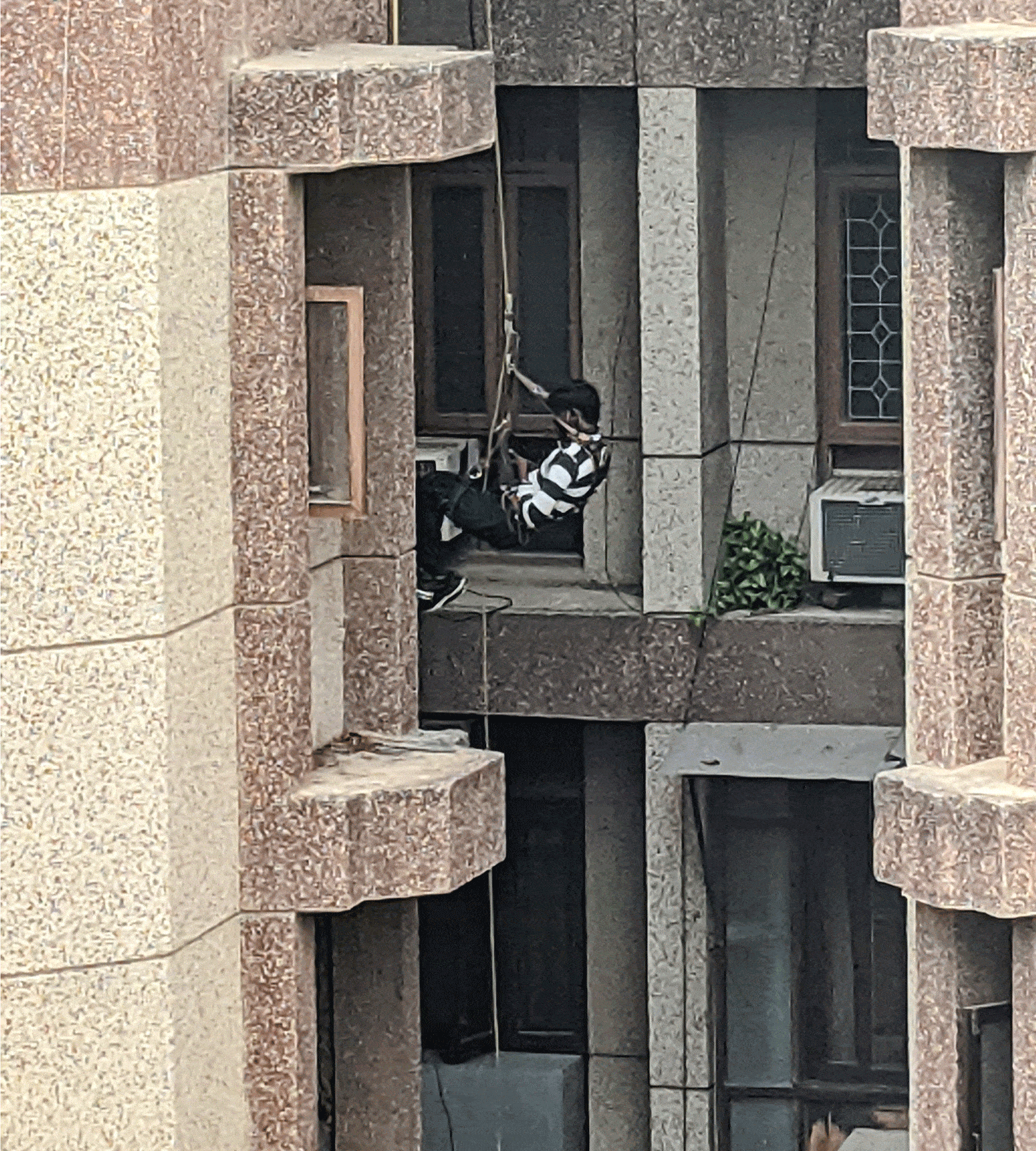
If we layer rooftops with solar panels, will the precarity of caste-based labor disappear?
What ethics of care do such technologies of urban “development” illustrate? Who is cared for in “climate controlled” indoors? Who is left outside in the climate chaos? If we layer rooftops with solar panels, will the precarity of caste-based labor disappear? The climate crisis engenders ceaseless repair, from air-conditioners bursting into flames — as many did this year at 50° Celsius — to subterranean pipes and drains clogging in flooded streets. Every five days in India, a sanitation worker dies from asphyxiation due to toxic gases, as they are made to enter sewage lines and latrine pits to unclog them.
The crisis and the breakdowns are visible. The caste-based labor that goes into their (temporary) repair is not.
We need an anti-caste ethos of repair. The disciplines of architecture, design, and urban planning need to produce an inclusive and emancipatory spatiality. Unless repair engages questions of justice, it will reify and reproduce what Malini Ranganathan describes as environmental unfreedoms, the “fundamentally humanity- and dignity-robbing traits of socioecological harms.”
But in recent years I have witnessed the ways in which our longstanding ideal of “innovation” has assimilated “care” and “repair” into platform capitalism, through apps connecting service workers to consumers. One was initially called Urban Clap, recalling the feudal and colonial practice in India of summoning a servant by clapping. Renamed Urban Company (to avoid associations with “clap” as a euphemism for gonorrhea), the app connects urban middle classes to a marketplace of plumbers, electricians, internet technicians, carpenters, beauticians, and so forth. Within a few years, the startup faced demonstrations and strikes for locking workers into subscriptions, low wages, and unfair labor practices. In response, Urban Company sued its workers to prevent them from holding demonstrations near its offices.
The city doesn’t care for its carers, a fact that sparked incandescent rage in the 1975 poem Now, Now by Dalit poet Namdeo Dhasal:
Our blood was spilled for this glorious city
And what we got to eat was the right to eat stones.
Now, now, we must explode that building which kisses the
Sky!
Innovation, then, will have to explore material and design choices that can enable repair without reproducing — indeed, amplifying — precarity and risk. We must ask: what kind of “innovations” can be repaired without dehumanized labor?
— Amitangshu Acharya
John Ruskin wrote this impassioned plea 147 years ago in The Seven Lamps of Architecture:
Take proper care of your monuments, and you will not need to restore them. A few sheets of lead put in time upon the roof, a few dead leaves and sticks swept in time out of a water-course, will save both roof and walls from ruin. Watch an old building with an anxious care; guard it as best you may, and at any cost, from every influence of dilapidation.
Almost two decades later, in 1877, William Morris wrote in the Society for the Protection of Ancient Buildings Manifesto:
It is for all these buildings, therefore, of all times and styles, that we plead, and call upon those who have to deal with them, to put Protection in the place of Restoration, to stave off decay by daily care, to prop a perilous wall or mend a leaky roof by such means as are obviously meant for support or covering, and show no pretence of other art, and otherwise to resist all tampering with either the fabric or ornament of the building as it stands.
These were 19th-century responses to the dilemma then being posed by the emerging discipline of preservation. Such references within the contentious discourse on restoration helped to establish “repair” as a concept central to the built environment. Yet Ruskin and Morris would likely be surprised at the contemporary resurgence of repair as an architectural idea, in a context of resource scarcity and a glut of not-so-old buildings. They would be unfamiliar with what Reyner Banham described as a throw-away aesthetic, within which buildings are expendable commodities.
Tied to real-estate development and economic value, contemporary decisions regarding the preservation or demolition of buildings are premised on performance. Adaptive reuse can facilitate new functions and stay that economic death sentence. Even so, despite decades of awareness regarding the impact of new construction on the global carbon equation, new construction prevails over adaptive reuse. Paradigm shifts do not occur in a vacuum and, in a capitalist economy, the profit motive prevails.
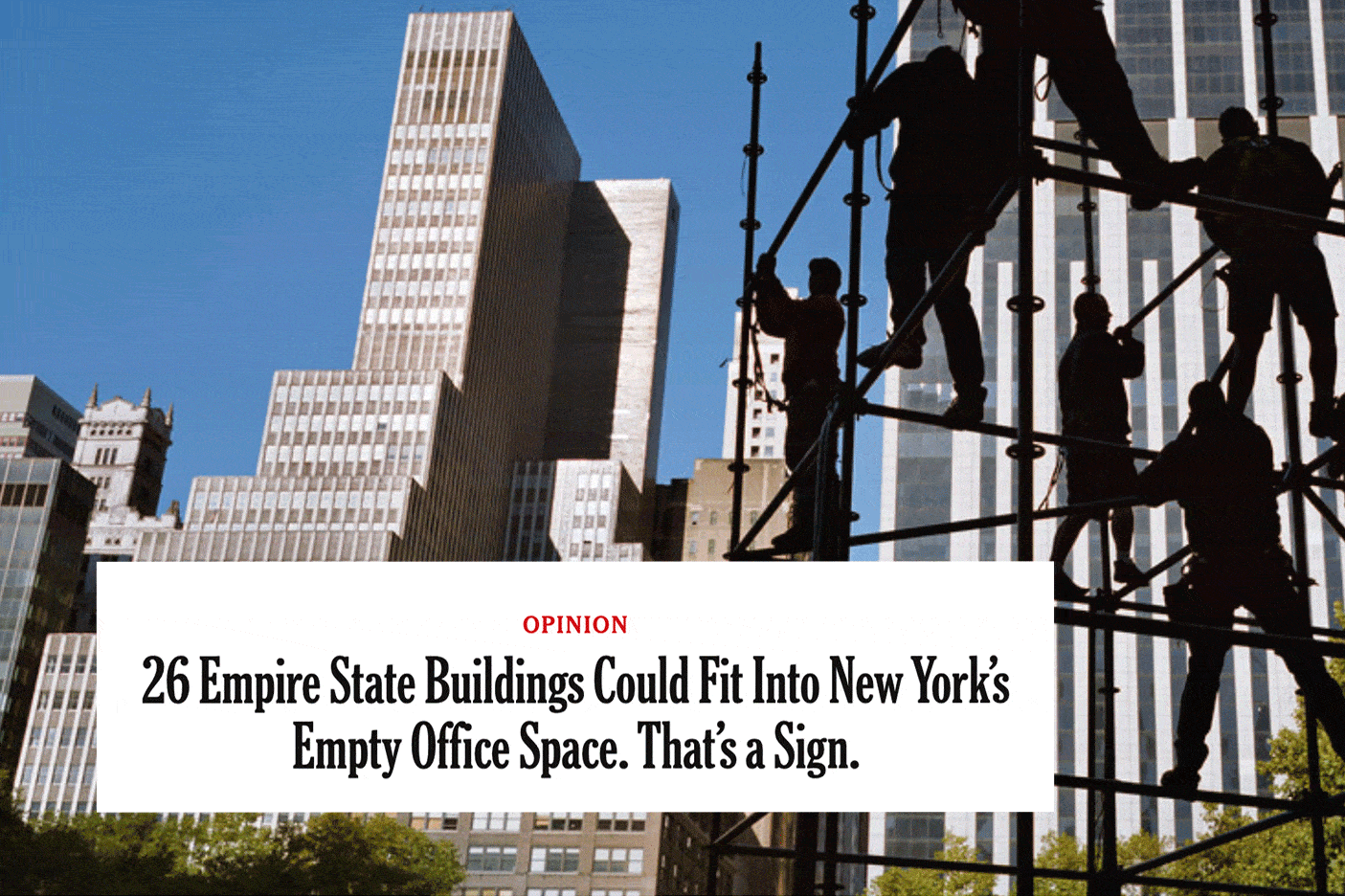
Paradigm shifts do not occur in a vacuum. The profit motive prevails.
With this in mind, the pandemic may have provided a test opportunity for the discipline’s re-emergent inclination towards repair. Four years since the arrival of the coronavirus and the pivot to remote work, major cities around the world are rife with high-rise vacancies. In 2023, Harvard economist Edward Glaeser and MIT professor Carlo Ratti calculated that New York City’s vacant office spaces could fill 26.6 Empire State Buildings. Class A office towers are still in high demand. But Class B and Class C towers languish, with low occupancy rates and lagging rental income. The great hope of residential conversion through adaptive reuse has been stalled by prohibitive costs. On August 1, 2024, a 23-story semi-vacant high-rise in midtown Manhattan sold at a 97.5 percent discount. With few options for new functions, these high-rise structures might simply have to become better versions of themselves through reuse and repair.
— Liliane Wong
And he shall rule them with a rod of iron; as the vessels of a potter shall they be broken to shivers. — Revelations 2:27
More broken pots. More pots to break.
I am drawn to fragments. I make them and I write them and I collect them. I have a box of 12th-century shards picked up on a hillside near Jingdezhen, the Chinese city of porcelain. They are warped and fused, dunted, shivered, cracked, broken.
In 2011, I bought eighteen plates at auction from a Meissen dinner service of 1760. Each plate has two birds perched on a branch. Insects and butterflies are scattered. They have gently scalloped gilded rims. Each plate has the two cobalt crossed rapiers of Meissen on the base. They are lyrical. And they are all broken, chipped, and cracked. There are burnt shadows. There are losses.

They come from the collection of the Dresden banker, Gustav von Klemperer (1852–1926). He collected with dedication and with passion. And he lived with his collections. There are photographs of him and his family with pieces displayed on brackets high up to the ceilings, sets of plates lined up on chimneypieces, and garnitures on splendid French furniture.
The plates are all broken, chipped, and cracked. There are burnt shadows. There are losses.
And the family was Jewish. In the months after the pogrom of Kristallnacht on November 9, 1938, the family was persecuted, and their possessions arraigned. On December 22, 1938, as part of a raft of new anti-Semitic measures, this lovingly put together collection was officially confiscated, crated, and removed into storage in Dresden, where it was subject to different claims from competing authorities. There were quarrels within the hierarchy that were only resolved in 1942 by personal decree of Hitler. All record of the family was effaced and the objects became the property of the state of Saxony. By the end of 1943, the collection had been moved outside of the city to Rammenau Castle for safekeeping. As the Russians approached, it was decided that these masterpieces were too near to the Front and they were moved again. The collection was in transit through the city of Dresden on the night of February 13, 1945. The crates were on the back of a lorry in the castle’s courtyard. It was the night of the fiercest bombing. Very little of Dresden survived.
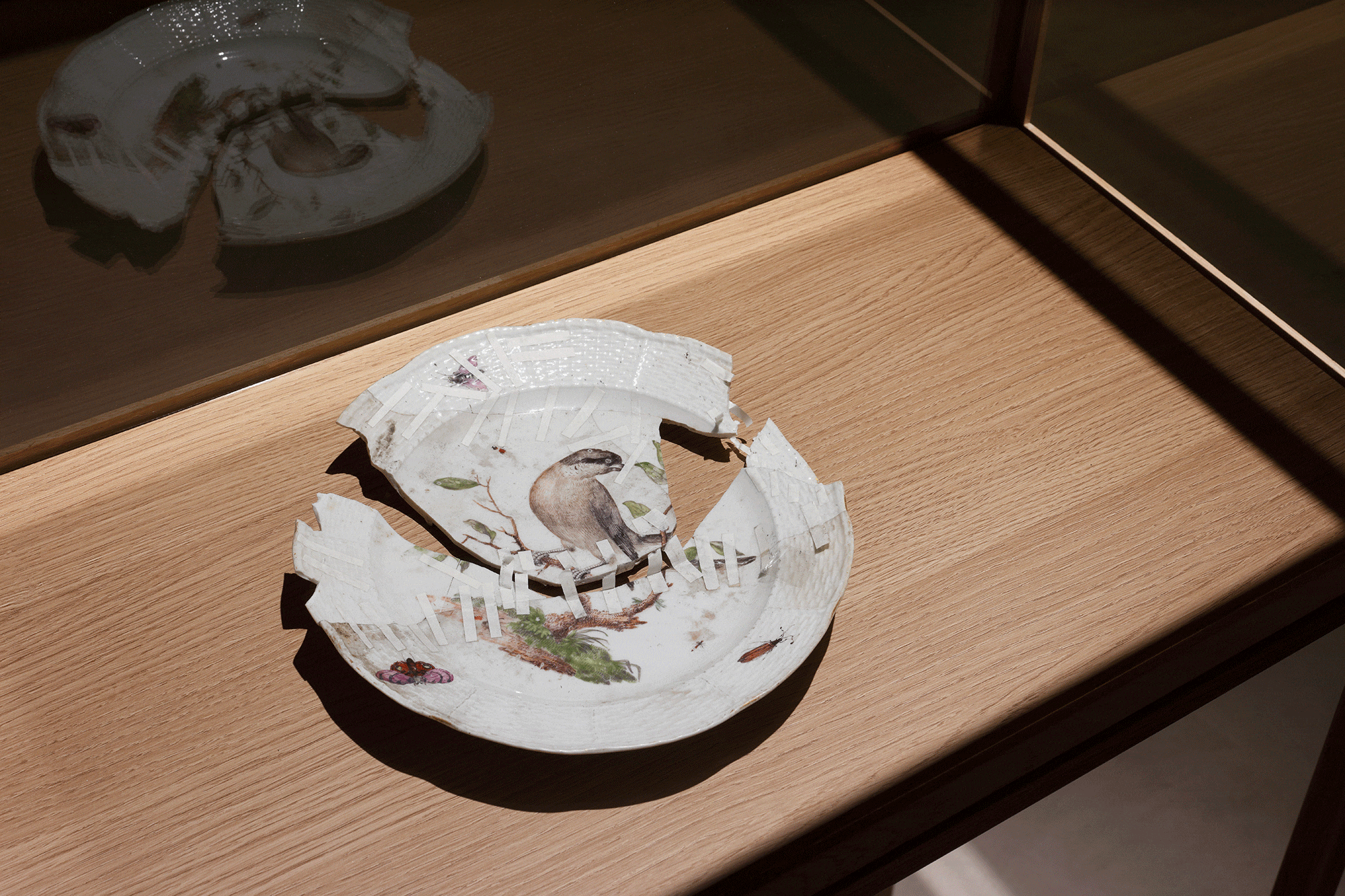

After the war, some complete pieces and numerous fragments were recovered, discovered in the rubble in a ruined city. Some of the porcelain figures were restored, other shards were boxed and placed in the Dresden State porcelain collections. The remnants of this great Jewish collection were quietly absorbed by the new East German state, yet another appropriation. And when the family inquired if there was any knowledge of their property, they were brushed off. It was not until 1991 that the case was resolved. And then the Klemperers, with great generosity, gave 63 pieces of porcelain to the city where they had lived. Some of the restituted fragments were sold. I bought these plates. I wanted another family to live with them, use them.
Kintsugi is the Japanese art of mending with golden lacquer the fault-lines of a break. I remember being handed a tea bowl at a tea ceremony 40 years ago in Kyoto, feeling the slight raise in contour of the gold, knowing that this bowl had been known and handled, passed on, loved more with its histories revealed. The Japanese artist Maiko Tsutsumi has worked with these plates in my London studio, adding to them without restoring them, threading golden lines across places of fracture.
You cannot restore. To restore is to efface.
— Edmund de Waal
Learning Through Leftovers
During a recent lecture for University College Dublin, Anne Femmer and Florian Summa of the German practice summacumfemmer explained their creation of a door for the dry toilet they had added to the German Pavilion as part of their “Open for Maintenance” project at last year’s Venice Biennale.
Slicing a donated door once vertically and once horizontally, they inserted a new strip in each direction, making a wider door with a lower handle, perfect for their needs. The efficiency of this simple piece of adaptation did not compromise its aesthetic appeal (flag-like, white bands on black — “we liked how it looked,” they enthused) nor, importantly, did it restrict the resonance with larger themes — of universal access, of rethinking attitudes toward waste (in their slideshow, extracts from Mary Douglas’s classic Purity and Danger from 1966 appeared alongside images of the toilet door).
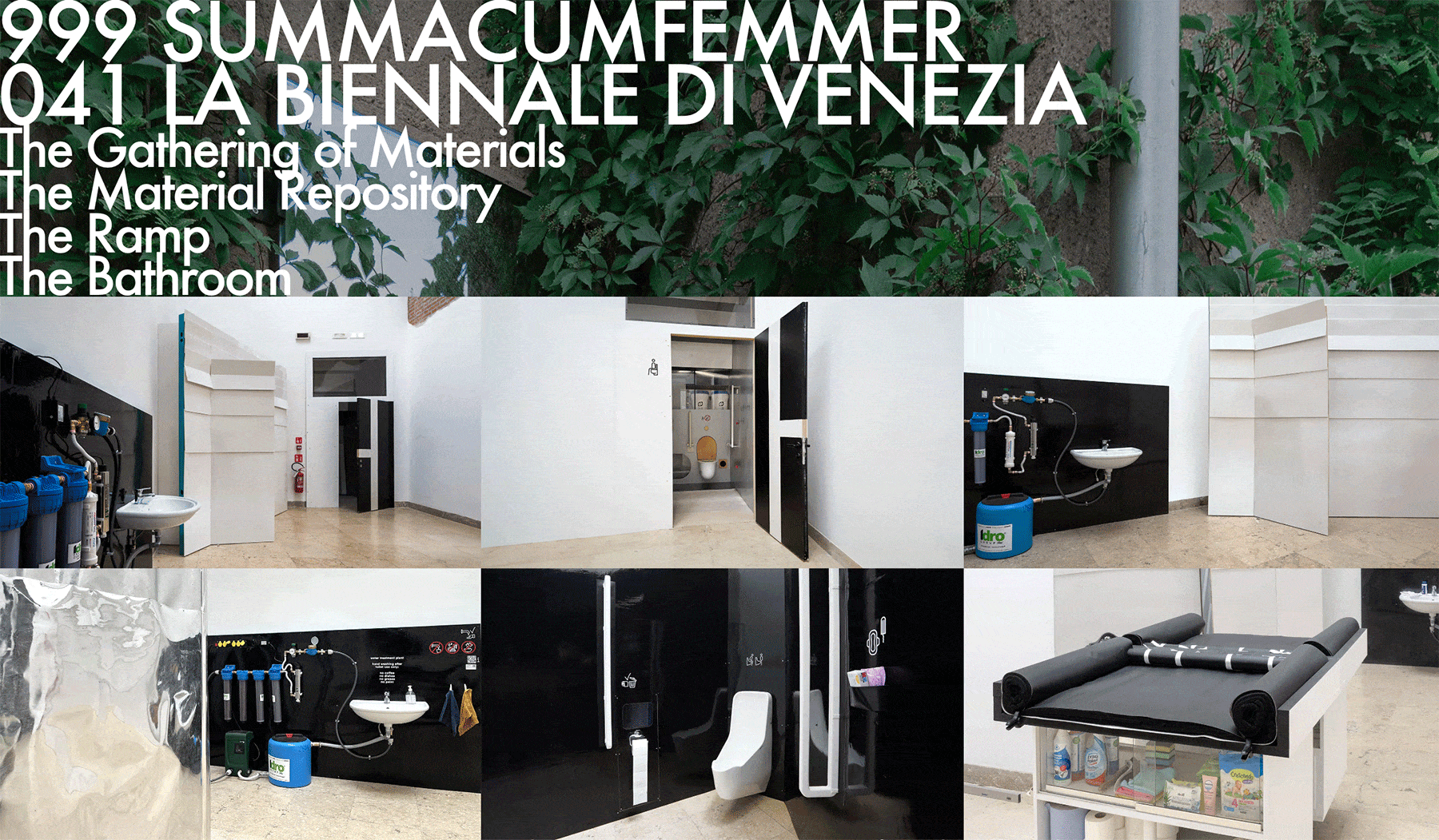
Small, specific, inventive acts, achieved with minimal means, but exerting considerable impact — so much of the most interesting architecture currently happening worldwide is in this vein. Adaptive reuse is everywhere, transforming everything from office complexes and industrial structures to single spaces and individual components. And the logic of working with what’s given can extend to new-build projects. Look, for instance, at the HORTUS office building in Basel, by Herzog and DeMeuron and ZPF Engineers, where the timber-and-rammed-earth structure, optimized for reduced carbon, provides a radically different starting point — small spans, lower ceilings — from which to meet the functional demands of contemporary office space.
Contrary to the fears of some, working with what’s given does not curb inventiveness or creativity; rather it opens up new possibilities, new aesthetics. It re-energizes the discipline. This is exciting territory to explore with students at all levels. In Ireland, all six architecture programs are working in tandem to reinvent their curricula and teaching to meet the challenges of climate change and biodiversity loss. Teaching adaptive reuse, foregrounding ideas of maintenance and repair, highlighting the paradigm of care: all are central. For the most part, the experience is positive. But, obviously, there are challenges.
Small inventive acts, achieved with minimal means, but exerting impact — much of the most interesting architecture is now in this vein.
Firstly, there is the question of whether, given the great continuing need for built space worldwide, an overriding focus on repair and care, and a consequent avoidance of large-scale thinking is appropriate. Secondly, relatedly, an entirely reasonable resentment sometimes arises on the part of students who are being asked to deal exclusively with the leftovers of a defunct, discredited model of development. You call it “mining the Anthropocene”; we call it “having to clean up your mess.” Thirdly, there is the question of whether teaching adaptive reuse is effective within the familiar studio model. Certainly summacumfemmer would argue that this approach needs to be taught on site, working with real situations, spaces, and materials — real doors, in their case. At UCD, our own recent experiences of hands-on projects and full-scale interventions bear this out. But how best to enshrine such new methods and settings for teaching, within a curriculum that is already being stretched in many directions? Of course, there are exemplary live projects, of which the Rural Studio in Alabama remains perhaps the most compelling. But those often operate outside of, or as exceptions to, the curricular norm. Can such teaching become mainstream in architectural education?
You call it ‘mining the Anthropocene’; we call it ‘having to clean up your mess.’
Finally, there is the question of what is missing and presumed lost. In cultivating students’ capacity to (first) attend to and (then) respond to what’s already there, do we reduce their ability to generate ideas and develop proposals, to originate something? Femmer and Summa are at pains to recognize their rigorous training at ETH Zürich and practice experience at De Vylder Vinck Taillieu and Caruso St John, which underpins their current explorations. Is the grammar of design still a prerequisite for the urgent business of carbon-emissions reduction through inventive reuse? Or is the new paradigm of repair and care in fact the foundation for the future? No going back now…
— Hugh Campbell
Muted Space and Remembrance
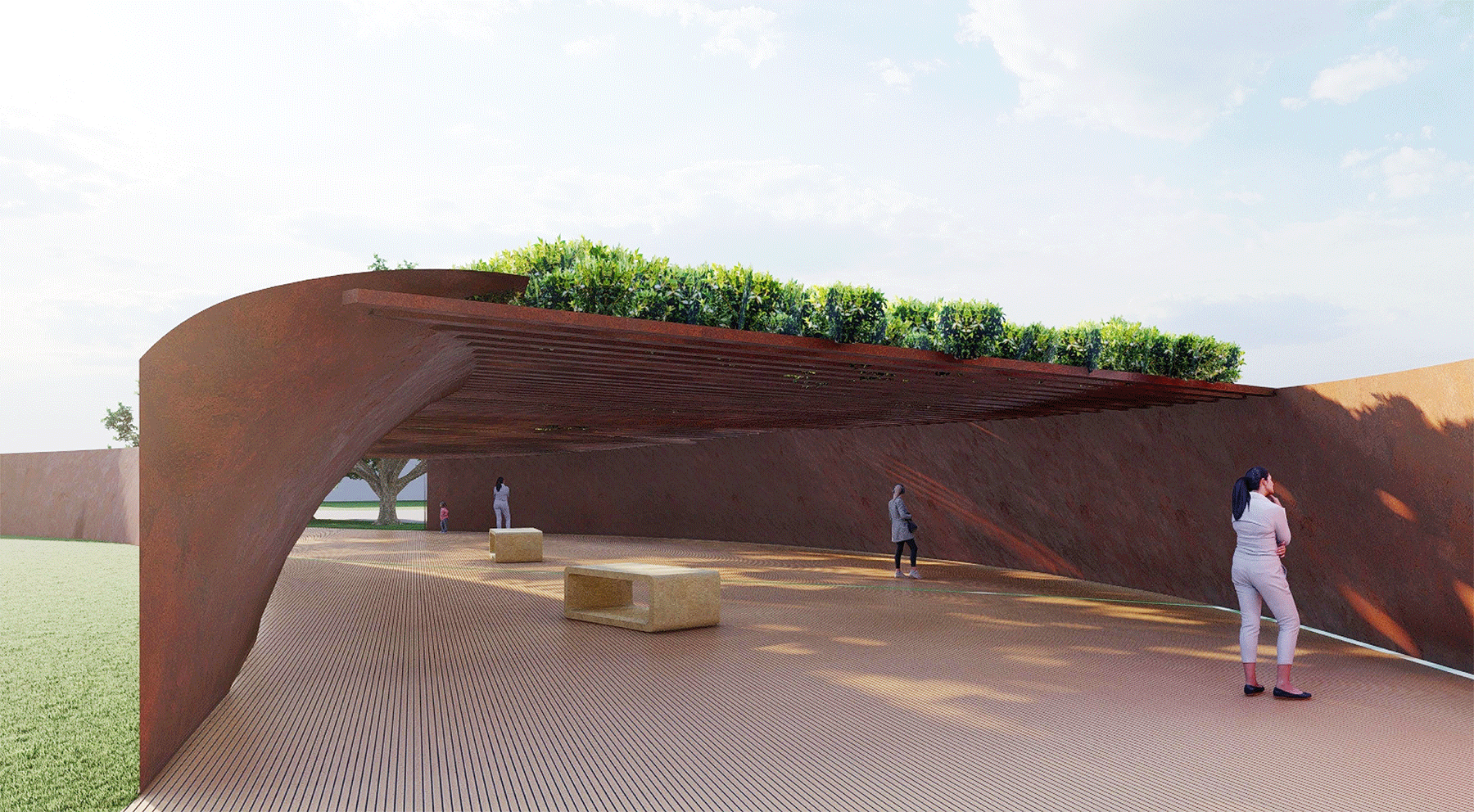
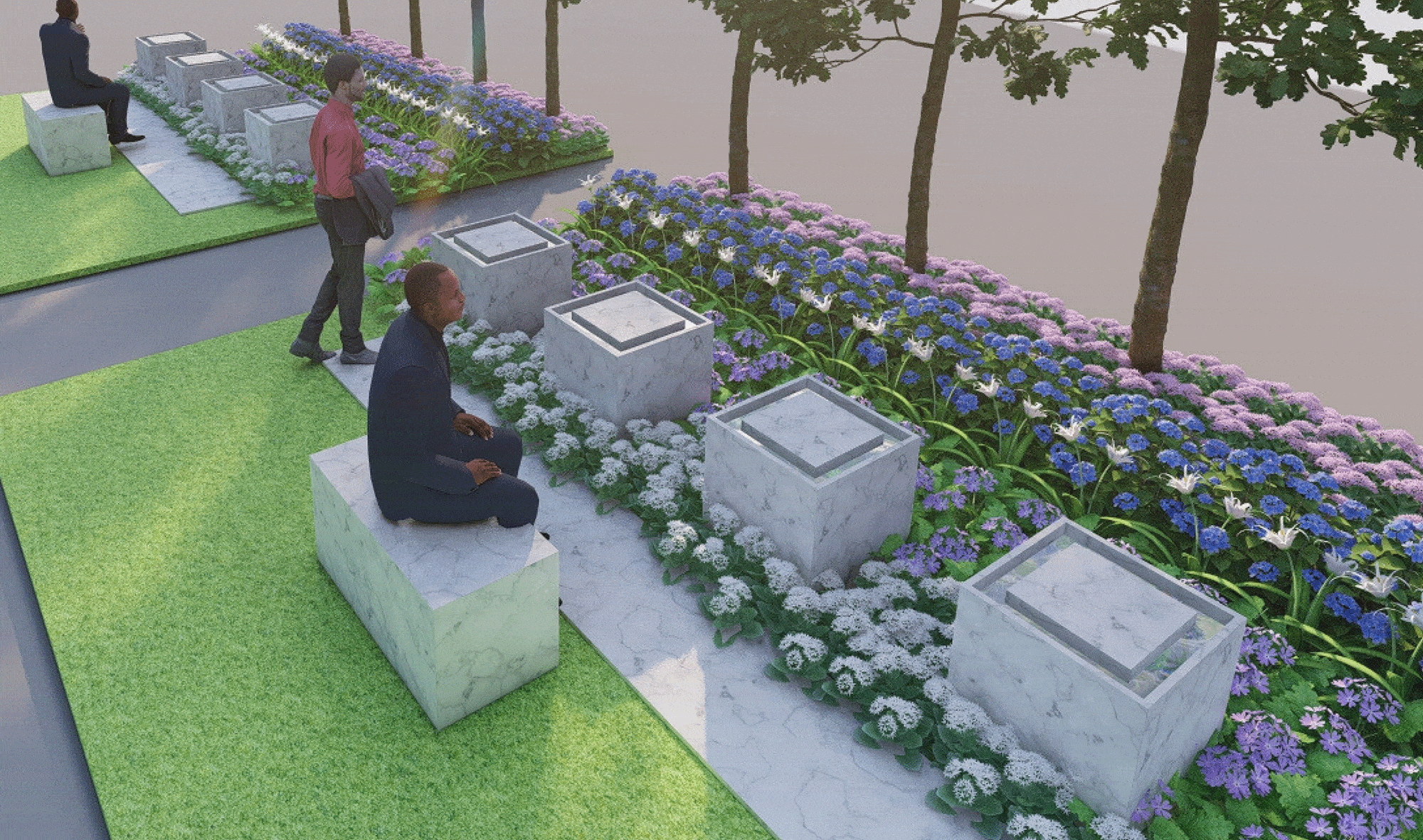
Recently, students at the Robert R. Taylor School of Architecture and Construction Science at Tuskegee University were invited to provide designs for a proposed memorial park for the city of Hamilton, Georgia. The park would commemorate eight known victims of racial lynching in Harris County, as well as any unknown victims. The effort is being led by the Harris County Community Remembrance Project, a remarkable, racially diverse organization composed of residents and civic officials, as well as descendants of both the victims and perpetrators of the lynchings. The organization is working collaboratively with the Equal Justice Initiative, which has been at the forefront of raising awareness for this and related histories through its advocacy, museum, and memorial parks in Montgomery, Alabama.
The HCCRP wanted the memorial park to be a “small, quiet, respectful, contemplative space with a water feature,” where the names of the victims would be displayed. The site for the park is a prominent sliver of open land along Hamilton Square Street, near the county jail where at least one lynching occurred in 1912. Architectural historian Dell Upton offers this thought on such design challenges:
As the Southern monuments have evolved, their makers have continually confronted a central question: What can and can’t be said in this medium? By this I mean, first, what is it possible to say using the inherited visual conventions of the Western monumental tradition that most monument builders prefer? Second, what is permitted to be said in contemporary American public discourse?
The projects seek to further the work of repairing our frayed relations, inherited from past transgressions.
In preparing their proposals, students needed to achieve the serenity desired by the HCCRP within a constricting and yet active lot, the site of a former train depot. One side is bounded by a busy thoroughfare; the other by a bike trail where a railway once ran. The student designers also expressed their own interest in the individual lives lost and the generational and communal impact, as opposed to the events themselves. Their solutions ranged from the lyrical and enveloping to the tranquil and delicate. The HCCRP site, in its physical character, new and former uses, and shared marshalling by the city of Hamilton and the HCCRP itself, embodies the ambivalence felt by many communities grappling with such complex histories. These overlaps occur (once again) at a time of intense cultural upheaval and the acceleration of public efforts to diminish or erase uncomfortable facts. In this way, the students’ projects seek to further the work of repairing our frayed relations and giving voice to our muted spaces, inherited from transgressions of the past.
— Roderick D. Fluker
Only a few generations ago, repair know-how was essential. Belongings were expensive and tedious to replace. If you ripped your one dress — handmade by your mother — you fixed it. When mass-produced consumer goods took hold in the mid-20th century, repair skills became increasingly scarce. In tandem, we also lost the mending mindset — the instinct to envision a life for something past its prime, and the willingness to give time and attention to help it on its way.
Today, most of us not only lack the know-how to fix the holes in our sweaters, we also lack the instinct to do so. We’re oblivious to the ongoing-ness of material things — the fact that the socks we throw in the trash don’t evaporate; that they end up somewhere else (most likely a landfill, where they might spend hundreds of years releasing greenhouse gasses). With a bit of yarn and care, they might have lived on.

The near-obsolescence of the mending mindset should come as no surprise.
The near-obsolescence of the mending mindset should come as no surprise. Reflecting on our own time as design students during a climate crisis, it’s unsettling how little attention was paid to examining, embracing, and fixing the existing world. Maintenance and repair remain largely invisible, even in learning spaces dedicated to the built environment. We believe repair can be just as creative and challenging as building something shiny and new. Through our work as Repair Shop, we aim to revive mending skills and mindsets by making repair conspicuous, both through visible mending projects and accessible repair workshops.
Most of us are playing catch up, having never even learned how to sew on a button. But what if we had all been taught, alongside our multiplication tables, how to mend? How to see material things as ongoing, and full of potential? And how to ask simple questions: What is this made of, and by whom, and how? The world, not just our sweaters, would look different.
We believe it’s critical to integrate repair thinking not only into collegiate design curriculum, but general K-12 public education. By exposing students from a young age to Steven J. Jackson’s notion of “broken world thinking” — how to draw inspiration from the natural processes of erosion and decay — they might more easily embrace concepts like circularity and degrowth. They can begin to approach the existing as an occasion for collaboration.
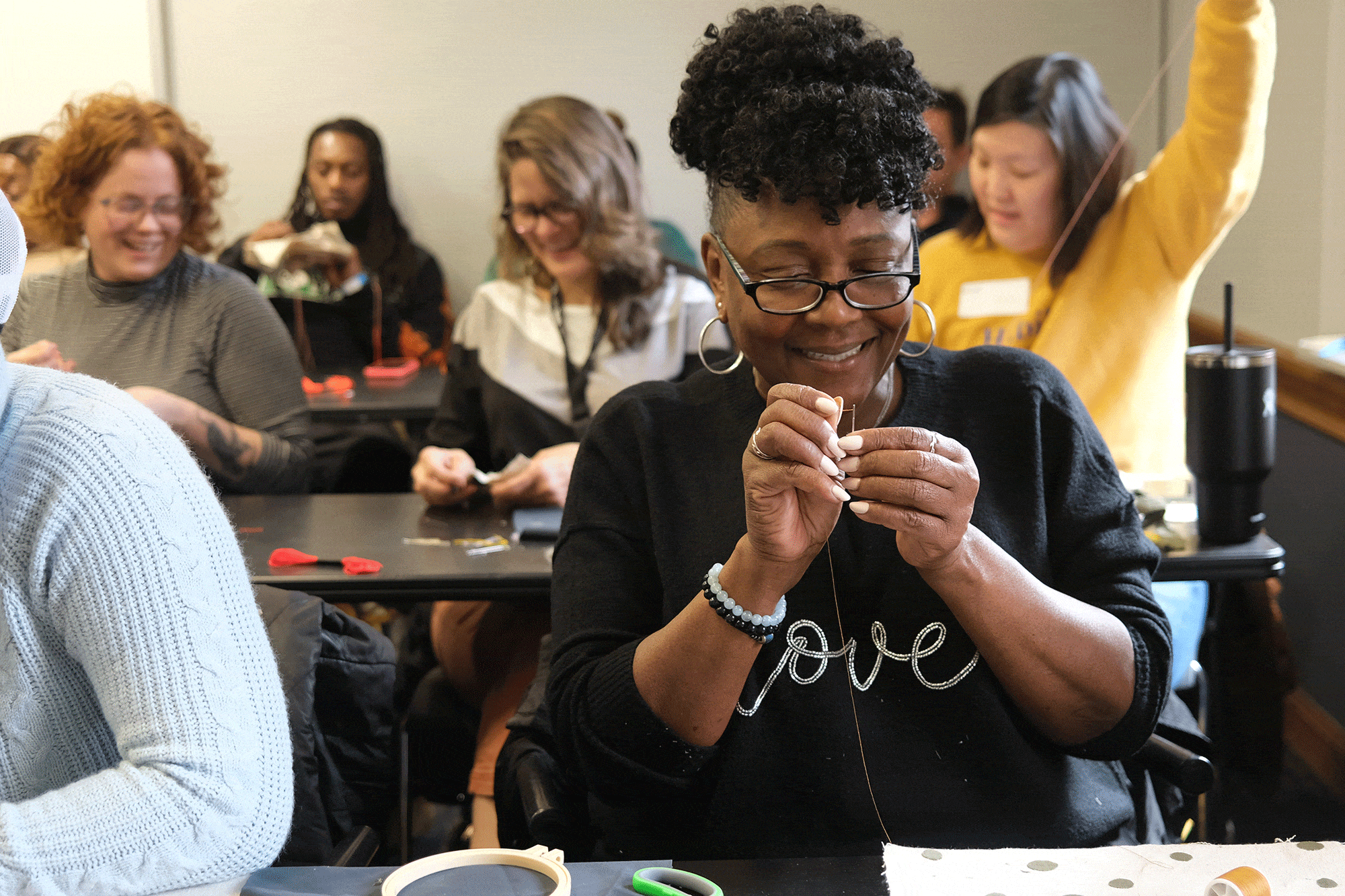
Teaching young people to mend clothing is a perfect place to start. When we teach middle school, high school, and undergraduate students mending, we begin with our eyes and hands, intimately examining a sweater’s moth holes, the thinning at the elbows, the weight and drape, how the stitches are knit together, the stories this piece of clothing might hold. Wool or cotton? Woven or knit? Gauzy or dense? Asking these questions honors the sweater’s full history — from growing and harvesting fiber, to making, to wearing — and helps students plan their repairs. It also builds a material intelligence that can be applied to future repairs, and to creating more resilient designs in the first place. Students proceed slowly, sometimes focusing intently for half an hour on a hole the size of a fingernail. They emerge with a revived garment, a new skill, and the seed of a mending mindset.
New menders often report feeling empowered. This is because repair skills grant agency. Saving something is gratifying at any age, but especially for young people, who control so little. It starts small, with an old sweater. But up next might be the dilapidated building next door. Then, the Great Pacific Garbage Patch.
Those of us who grew up saying, Why bother when you can just buy new? must work to unlearn the lessons of thoughtless capitalist consumption. Kids haven’t learned these lessons quite yet. Give them a needle and thread, and maybe they never will.
— Repair Shop
(Re)Pairing with Life
Wounded landscapes, traumatized bodies, unbreathable air, disappearing grounds, murky waters, lost species, fractured societies, dysfunctional infrastructures. We are living in a world of disequilibrium, an anxious world teetering on the edge of collapse, in constant need of repair. If the work of repair is about restoring equilibrium, what does a repaired world look like? What imaginaries are constructed by the work of repair and what materials, details, structures, and tools are required to make that vision a reality?
Repair frees things from the frictionless ideal of innovation, allowing us to imagine the obsolescence of capitalist modernity itself.
The necessity of repair points towards the failure of a system — be it physical, social, institutional, structural, or political — that was meant to provide support. In capitalist modernity, the promises of commodities are designed to be broken, perpetuating a cycle of resource exploitation and consumption, driven by the ideology of innovation and pursuit of endless growth. When these promises are broken, new ones emerge: that “everything is replaceable,” the old can be swapped for the new, imperfections can be traded in for perfection, mess can be replaced with order, and dirty ecologies can be replaced by pristine territories. Everything is commissioned to be disposable in this system, destined to be discarded to keep the market machine running.

To repair, then, is to decommission this system, to dismantle this cycle. Repair frees things from the frictionless ideal of innovation, allowing us to imagine the obsolescence of capitalist modernity itself; to dare to disrupt the lifecycle of objects it prescribes, and to shift the focus from disparate, individual items to larger ecological concerns. In this process of repair, to recommission is to construct active agents in a counter-narrative. This counter-vision of a repaired world does not resemble the “innovative” utopia fixed by techno-solutions. It is a world that embraces messiness, a world that grows from traumatized environments and wounded bodies; from catastrophes. Things cannot always be fixed. When they remain broken forever, the work becomes to (re)pair them with a new life.
Repair is about making broken places habitable, visible, protected, and held. To repair is to cultivate resources, to harvest life. Rather than erasing dirt or hiding scars, the act of repairing works with them, remembering the violence that destroyed in the first place. In this way, repair is a defiant stance against the forgetfulness that allows for continued exploitation. Driven by a sense of outrage at the violence of exploitation, repair emerges from radical hopelessness, but it carves life-giving imaginaries out of damaged landscapes, rusted rods, broken glass, collapsed bridges, and war-torn homes.
— Sepideh Karami
When welcoming new architecture students to our school, I speak of sheltering as a fundamental human instinct: to build a roof over our heads, and a horizontal plane on which to balance our two legs. Architects have the privilege and responsibility to conceive — to give form and meaning — to this essential impulse. (The other survival instincts, to eat and to reproduce, require no university degree or membership in a professional caste.)
We know that the built footprint on the planet has expanded both exponentially and disproportionately. Superfluous structures proliferate in rich countries, precarious ones in economically weaker countries. Above all, the lack of decent affordable housing is a planetary urgency.
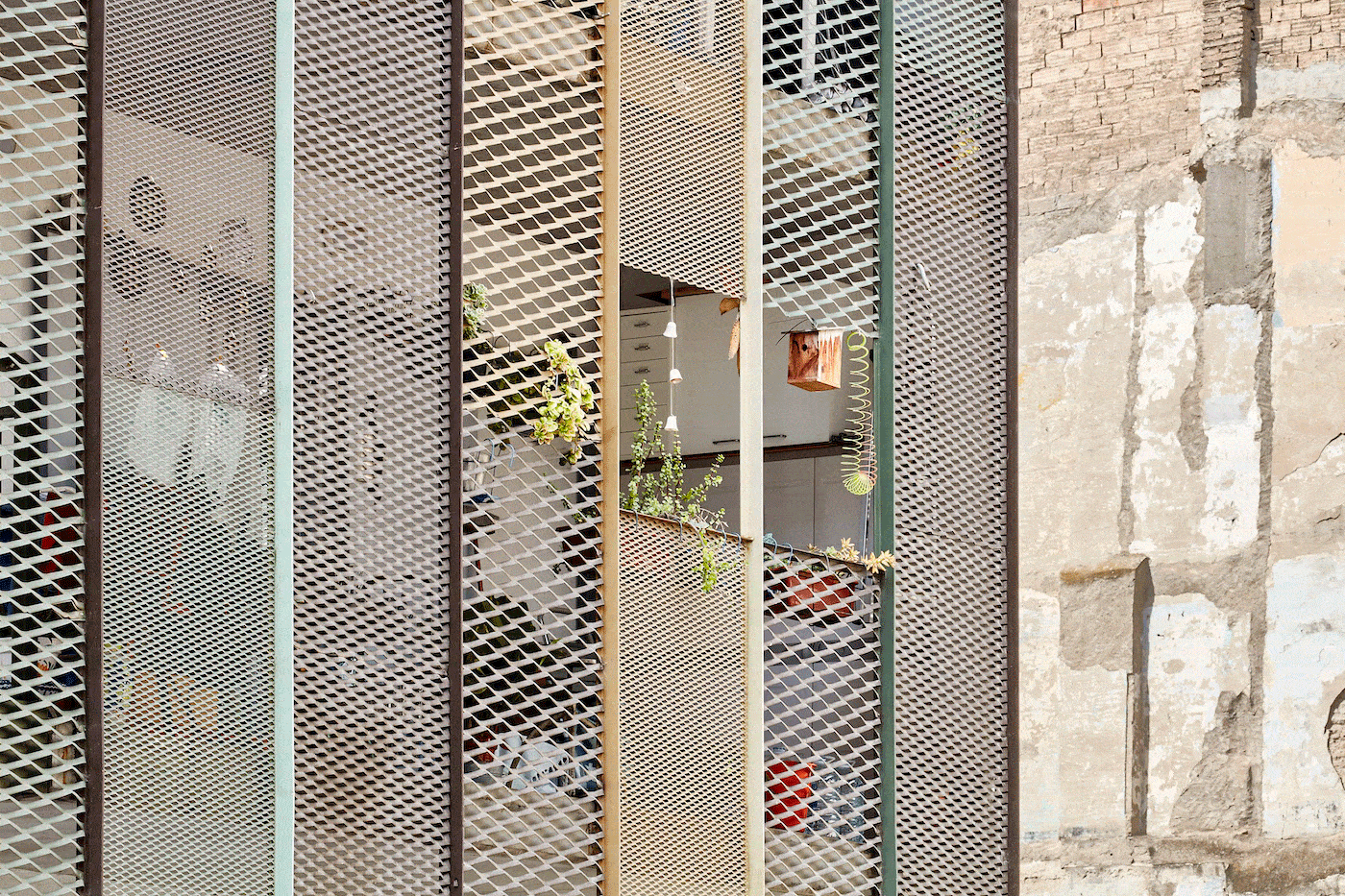
Ecological and social sustainability worldwide require addressing this contradiction: despite the ever-present need for shelter, we cannot afford to keep tearing down and building again. To rebuild with a low or positive energy-and-material budget presents a challenging and exciting opportunity for designers (a.k.a. problem solvers). We are used to talking about material, economic, and human resources. We have not yet internalized the concept of “spatial resources.” Yet, for millennia, preindustrial societies have rebuilt, adapted, and reused all available spatial resources. Even today, in old quarters (from Boston to Barcelona to Delhi), thousands of homes remain that started as one-story buildings and have now grown to five or seven floors — and many of those ground floors, along with most of their streets, are still lived in.
Our aim should not be to minimize negative impacts, but to reinvent an ecosystem in which humans are part of a planetarian life-centered framework.
For us as architects, it is urgent to repair without giving up the act of making due to a sense of guilt at contributing to the excesses of urbanization. Our role will be to build and rebuild, as it has been throughout the history of Homo faber — but we can no longer follow industrial and neoliberal models developed by Homo consumens that prioritize business over shelter. Reusing buildings and lands already occupied, working to restore social and ecological balances, cutting back the unbridled consumption of energy and materials, respecting territories still free of the stain of unnecessary construction, and rewilding ecologically strategic portions — these are among the obvious approaches. But actually, repairing is not enough.
Our aim should not be to go back, to heal or to minimize negative impacts. It should be to reinvent an ecosystem that understands humans as part of a planetarian life-centered framework. Architects and professionals in the built environment have the privilege of serving social and ecological needs for our fellow human beings and the planet as a whole. Through fulfilling this responsibility, we can work to regain a leadership position as Homo faber continues to construct, deconstruct, and reconstruct a just and sustainable planet.
— Iñaki Alday
“Building” does seem to be a powerful, sometimes irresistible, metaphor for collective action on complex problems, including environmental ones. It’s striking how much talk around dealing with anthropogenic climate change, including much of the so-called Green New Deal, focuses on the construction and implementation of new technological systems, from renewable electricity generation to increased mass transit, from heat pumps and other “green” building technologies to direct air capture and sequestration plants.
There are innumerable possible paths to the same end — radically decreasing emissions — and it’s hard to know in advance how to strike a balance between erecting new systems and decreasing the use of old ones. Of course, we can always do less of the activities that cause the emissions in the first place: relying less on fossil-fuel-driven transport, consuming less electricity at work and at home, buying fewer products, using less concrete and steel by constructing fewer new buildings. No new construction needed. Just quit.
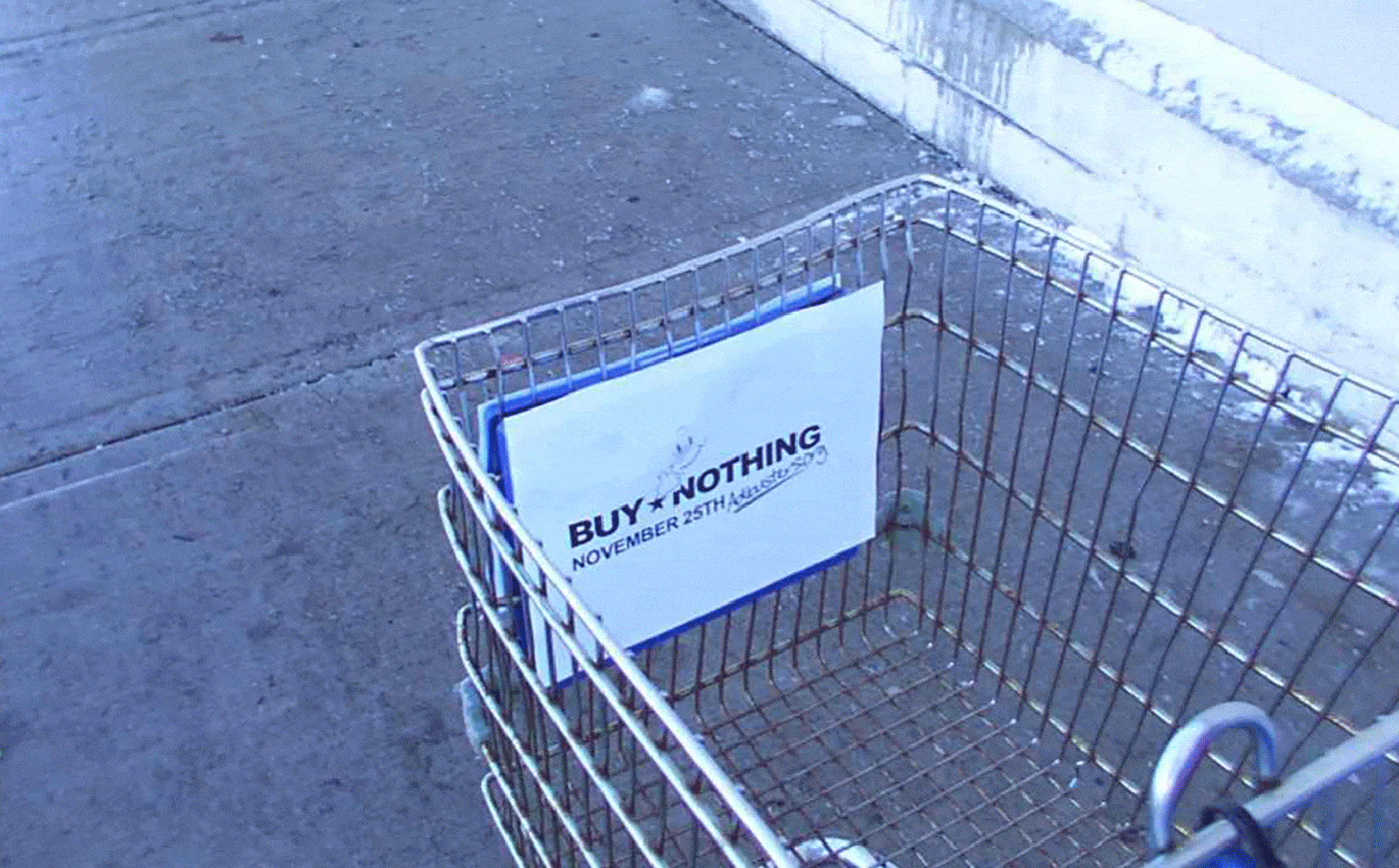
But it’s unclear how many consumerist habits democratic nations are willing to sacrifice. In the United States, any number of indicators suggest the answer is: “Not a lot.” Some policy mechanisms, like carbon taxes, embrace this uncertainty and seek to incentivize all kinds of positive actions, doing both less and more, including making adaptations that no one can foresee. But the concerns of environmental justice — how such policies will differently impact the haves and have nots — are ever present.
How many consumerist habits are we willing to sacrifice? In the U.S., the answer would seem to be: ‘Not a lot.’
In such a highly uncertain context, it may be better not to oppose “building” to “repair” (or anything else), but rather to ask how each can contribute to social formations that are sustainable in the long term. One way scholars in architecture, design, and other fields are doing this is by asking how we can make what we create more repairable and maintainable. Because one thing is clear: even if we could get something like a global Green New Deal off the ground, the possibility would remain that we do it in all kinds of foolish ways. We could erect unmaintainable systems that require quick replacements, exacting further environmental tolls, like pollution from more extraction, energy use from more production and transportation, and so on. The question then becomes how to make things, when we think making things is the right move, that minimize downstream damage.
So we need to incentivize action focused on the long term, and we need to reform institutions and ways of thinking, such as ideas about shareholder value, that have encouraged just the opposite — scoring as much in the short term as we possibly can. Repair and maintenance must be central elements in any long-term vision.
It’s hard to see how we can address profound problems of injustice and inequality, such as crises of housing affordability and rising numbers of unhoused people, without building more. But can we do so in a way that strongly encourages, perhaps even requires us to look far down the road? Wherever we go, we will find that questions of maintenance, repair, and care are always with us, and if we are to achieve a just and sustainable society, we must answer them.
— Lee Vinsel
Repair typically refers to practices of fixing and maintaining that keep damaged objects, structures, and institutions running, but the concept can refer to broader projects of remaking. At the urban scale, repairers, defined broadly, have long attempted to infuse decayed and abandoned spaces with new meanings, forestalling breakdown through creative and often politicized interventions. While these practices are sometimes framed in opposition to growth imperatives, their indeterminacy makes it clear that repair, too, can serve regressive ends.
How, then, might an ethos of repair guide new design interventions and animate some of the more radical possibilities already present in cities and damaged landscapes alike? How might an ethos of repair encourage new forms of research practice that push against institutional demands for novelty and innovation?
Repair practices are widespread, but retaining their radical edge requires that we locate them in historical geographies of racial capitalism.
These questions animate ongoing collaborative efforts toward developing reparative research and practice. Such approaches prioritize sustained relationships, while expanding our definition of who might become an active agent, and what constitutes an effective intervention. A reparative approach would further understand infrastructural upgrades or material fixes with regard to historical harm; practices of repair are constant and widespread, but retaining their radical edge requires that we locate them in historical geographies of racial capitalism and uneven development. In doing so, reparative approaches should underpin research itself.
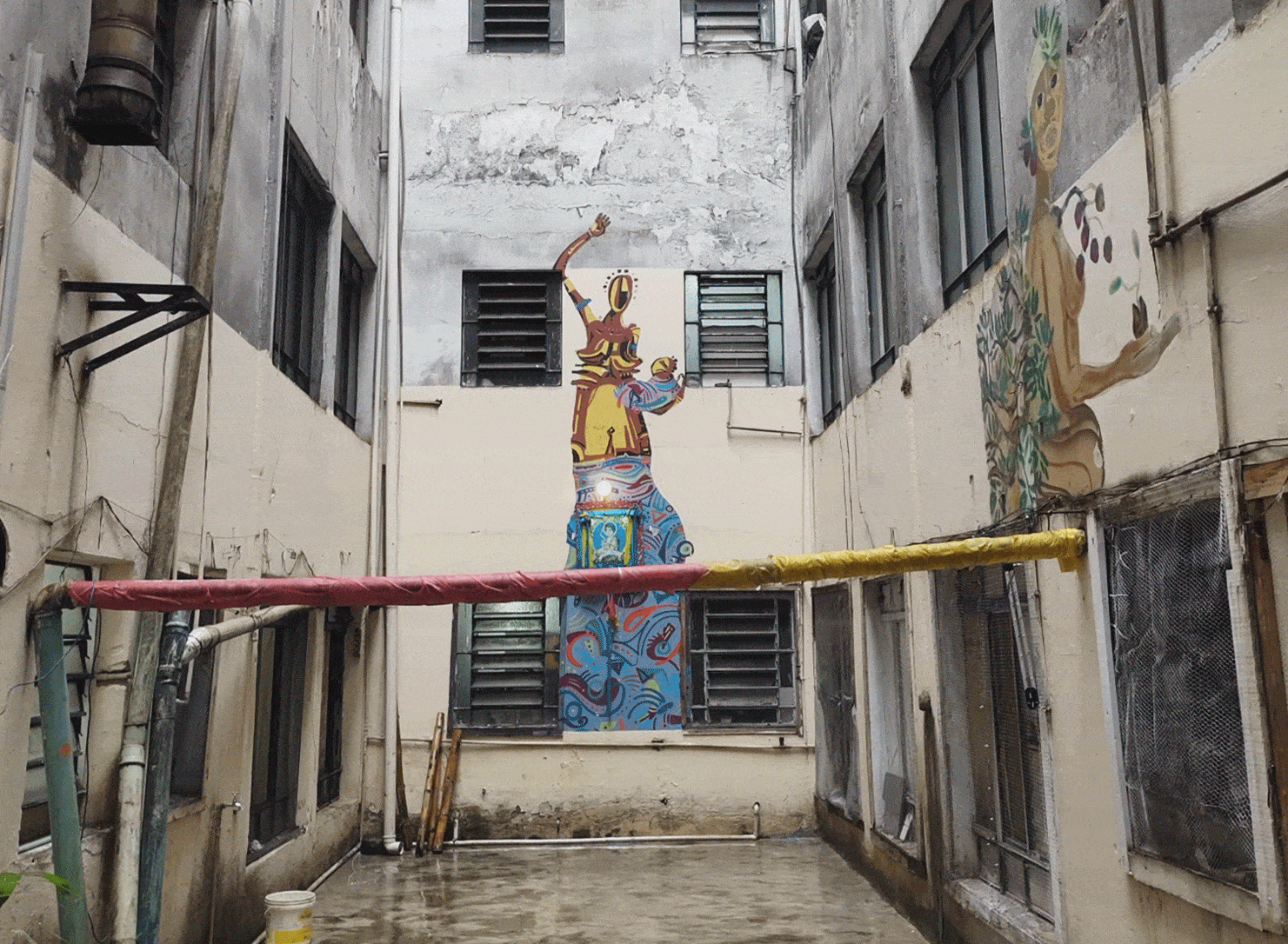
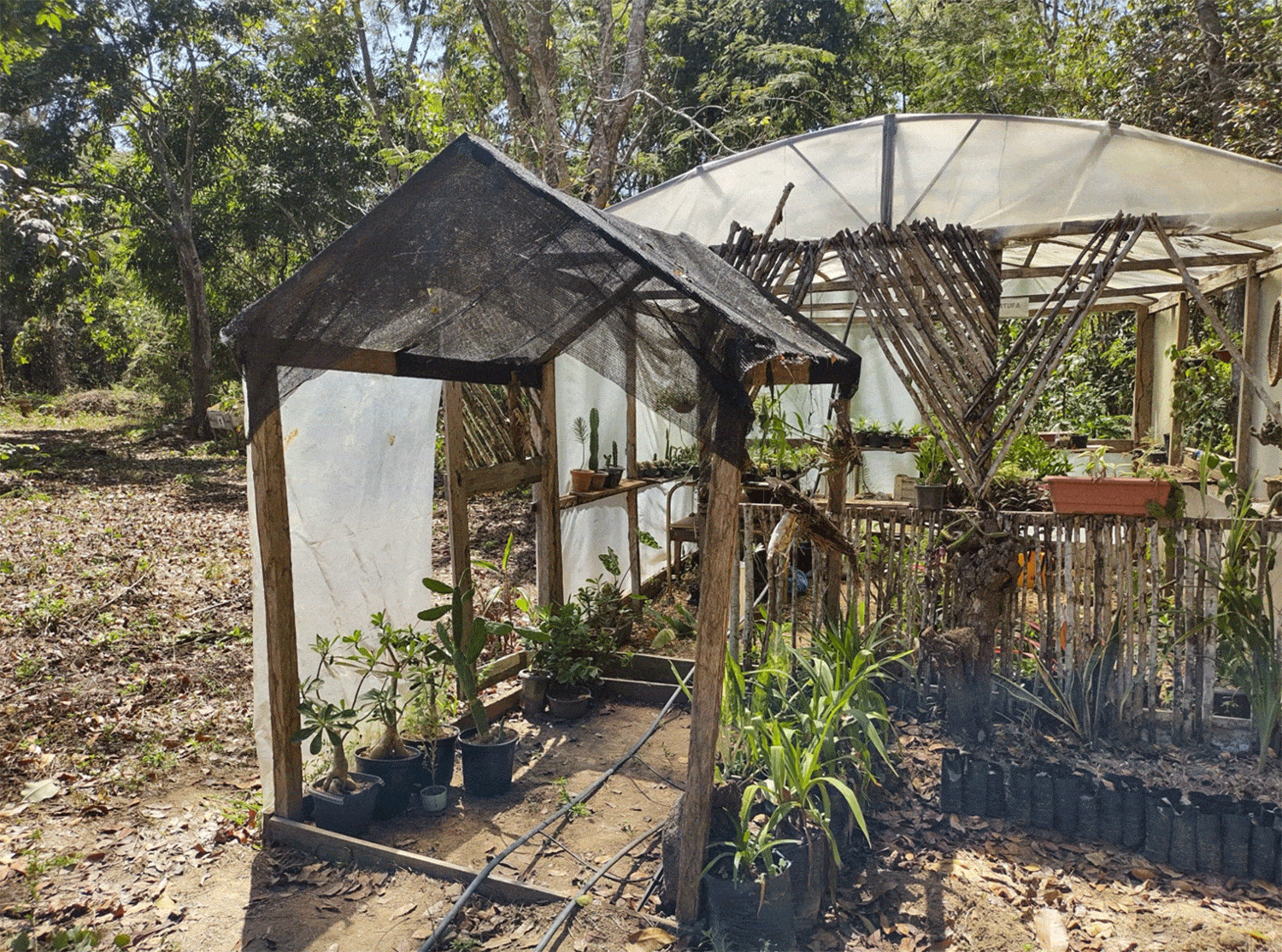
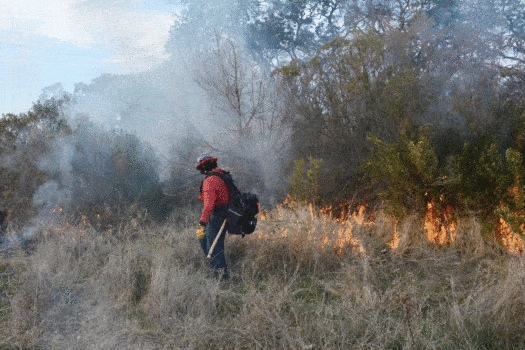
Some possibilities: in São Paulo, the conversion of some of the 600,000 abandoned properties into housing occupations by social movements. In the Brazilian Amazon, the reforestation of lands ruined by extraction, in projects led by social movements. In Barcelona, the creation of cooperative spaces in industrial ruins. Repair tends to connote the banal and everyday, and this itself can be radical. Repair fights off entropy, whether material or social. In this, it is not just reactive, but active, fostering political engagement.
In short, reparative approaches support engagement that is attentive to existing practices, open to expansive possibilities, and committed to shared experience and collaboration. Such approaches must be shaped by understanding repair not as a subject to be studied, but as a theory and a practice located in the contradictions among past, present, and future.
— Nate Millington
I often find my dual identity as a practitioner and an academic paralyzing; one of the voices in my head is always saying: “yes, but…” For instance, I buy into Steven Jackson’s “broken world thinking,” but I don’t like the term. It recasts a common sense attitude into an ideological fad diet. Yes, talking about repair, maintenance, care, is really important. But in architectural practice, repair and maintenance are already part of the conversation; a version of these issues routinely guides decision-making about design and construction, sometimes for better, sometimes for worse. A “real world” project is often judged on the ease of its maintenance, i.e. how it bears wear and tear, how successfully it avoids needing repair. And, yes, architecture is premised on growth and consumption, but it is also a field in which the passage of time renders the “new” almost meaningless. Buildings don’t come in bubble wrap. They are constructed in the open, exposed to the elements, aged before they’re completed.
This is not to say that architecture isn’t contending, increasingly seriously, with the understanding that work with existing structures — even refusing to build — can be as grand as the most audacious form-making. But that’s just one side of the story.
Repair is restorative (which doesn’t preclude violence) — to repair suggests that something is broken, that drastic one-time action is required. Maintenance is preventive, and concerned with perpetuating the status quo, in that it aims to prevent decay. Both come with price tags, and while repair might be a choice — you can repair, or tear down, or do nothing — maintenance rarely is. The environmental movement has partially succeeded in elevating preservation into a moral imperative. Yet, in the end, money talks.

So I am struck when, in “Rethinking Repair,” Jackson waits until the close to acknowledge that “repair is not always heroic or directed toward noble ends, and may function as much in defense as in resistance to antidemocratic and antihumanist projects.” He cites social infrastructures that normalized the Nazi regime, then the point is dismissed. Perhaps the disciplinary context of Jackson’s essay — media and technology studies — accounts for both this extreme example and its brief appearance.
I’ve seen ‘maintenance’ cited as a reason not to move on from gas-based systems or install natural rubber floors, because that would mean retraining the cleaners.
But there are countless more mundane examples. I am thinking of old-school building engineers and weary administrators, who are often hesitant to try something new. As a practitioner, I’ve seen “maintenance” cited as a reason not to move on from gas-based mechanical systems or install natural rubber floors, because that would require retraining the cleaners. I’ve encountered resistance when trying to specify upholstered, richly tactile furniture in schools and hospitals, because it requires more maintenance and demands more care from users. In fact, I’ve found that managers expect (and in so doing tolerate, and unintentionally perpetuate) lack of care. In this, I see parallels with teaching, where expectations often affect, if they do not determine, outcomes.
Am I equivocating? I find maintenance heroic, as Jackson does. I’m glad to see a spotlight on labor that happens behind the scenes, after a building has lost the shine of newness. But how do we change the conversation about maintenance, repair, and care with decision-makers and those who do maintenance work? How do we establish cultures of care through broad transdisciplinary and sociopolitical alliances? This is what interests me.
− Palmyra Geraki
Planets return. Since a return is not always a repair, perhaps a repair isn’t always a return. Planets wander. Wander, wend, wind. Weather isn’t a choice. Is wandering a choice? Can a repair be a release? A release from deciding? How can we help people really realize they are not only planets but galaxies? Would that not be reparative, both externally and internally? Our plural planet body wandering is happening all the time, not only through our neural pathways.

What’s the wandering for? It is to re-pair with our “wild twin,” who we forgot about before we were conscious. What has our twin been doing while they’ve been waiting for us to find them? Maybe something like nothing.
(Considering who’s who, and what’s what, we see how what looks like repair is often really just building in a misleading costume. So could destruction be repair? No, destruction always seems to lead to ever-more-reactive building.)
We wander to re-pair with our twin without going anywhere. To wander is rather opposite to travel (travail!) — traveling is wholly dependent on building and therein synonymous with building.
When the twins re-pair, the wandering is wondrous, since it is free from want.
And to mention: while wandering on course, allowing things to be broken is repair. Integrity and brokenness are not inherently in conflict. Not-fixing is not not-repairing.
Negation can be reparative; I’m not going to argue for it and this not-arguing is repair.
— Hendl Mirra
Repair As Care in Cities of the Global South
Two years ago, Karachi Urban Lab (in Pakistan) and Kounkuey Design Initiative (in Kenya) set out to ask how life is maintained in the face of mounting climate risks. In the informal settlements of Karachi and Nairobi, floods and heatwaves had devastated communities living in chronic poverty. Children were out of school, jobs had been lost, people were sick and indebted.
In climate-vulnerable and resource-scarce settlements, repair enables people to live.
In such climate-vulnerable and resource-scarce settlements, repair enables people to live. This makes it necessary for inhabitants to address, through their own resourcefulness, the daily risks of failed civic infrastructures — water, electricity, gas, health, housing, mobility. In Karachi, residents in tent settlements elevate their flooring and stockpile bamboo sticks to mend their homes in case of rainstorms and flooding. In a similar show of resilience and agency, youth groups in Nairobi’s informal settlements reinforce riverbanks and repair other damaged infrastructure before and after floods. At the same time women maintain households, enabling the social reproduction of life. Reparative community efforts often lack the resources to foster the new, but must focus on short-term fixes. Yet communal networks of borrowing and lending allow people to fund and sustain alternate structures and systems.
It was so cold. We used to sleep using curtains at night and draped ourselves with plastic sheets. We didn’t even have a glass to drink water out of. We would eat food out of plastic bags. Then I spoke to CARITAS. They gave everyone utensils and beds. Only then could we begin cooking at home.
— Woman in Kausar Niazi Colony, Karachi
When water accumulates on the road, I know that it affects the lower road. If the rain continues like this, in the near future, the road will be destroyed, and it will affect the lower road. There was a time when they brought sand, and I wondered why they brought sand instead of stones to fill this area, so that it [could be] level with the rest of the road.
— A female trader from Nairobi
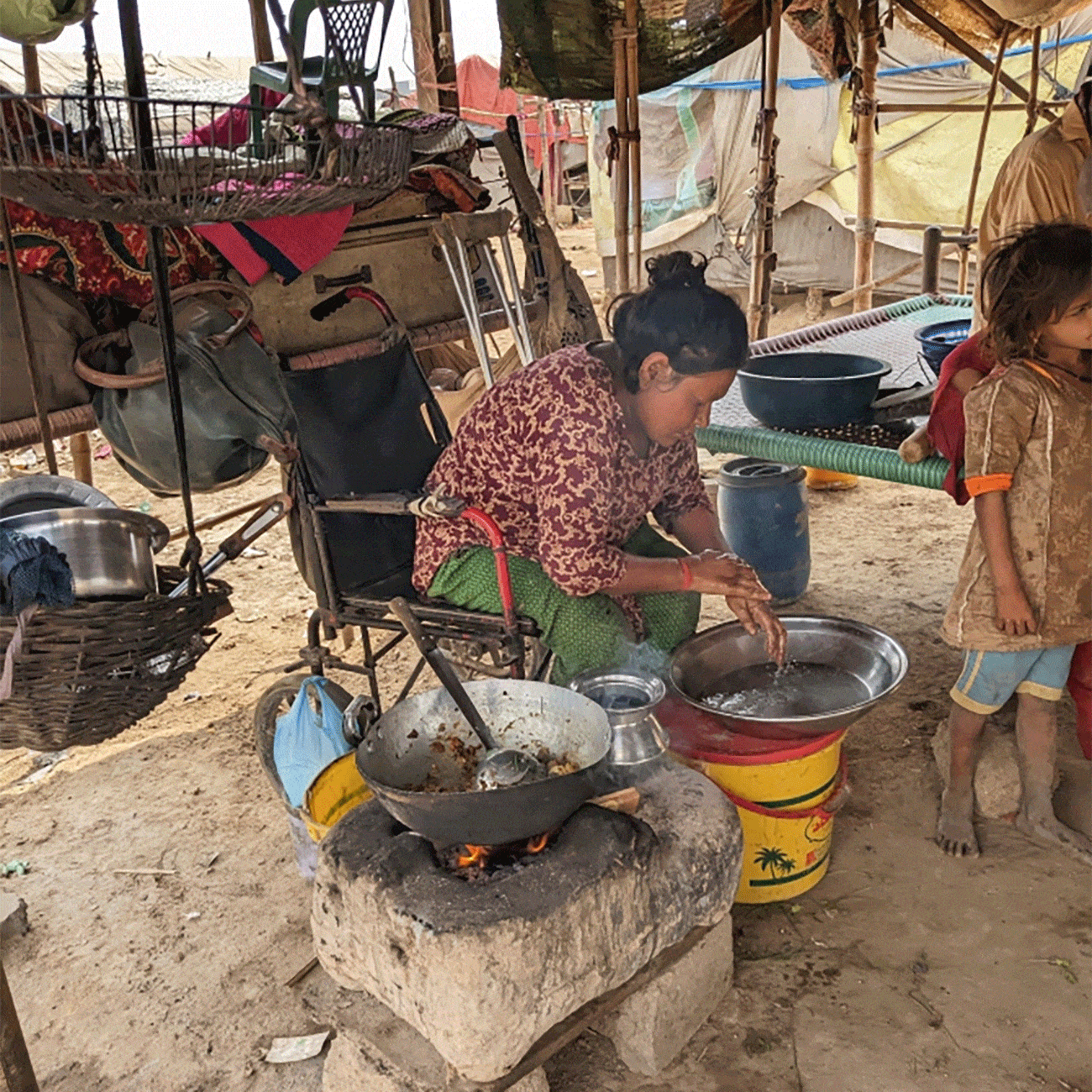
Traditionally, design disciplines have regarded “building anew” as a hallmark practice, lauding innovation and progress. In contrast, it is everyday repair that safeguards against evolving risks at the frontlines of the climate crisis. In Karachi and Nairobi, when floods hit, governmental responses were disappointingly the same: demolition-evictions that decimated people’s ability to recover. Top-down urban planning that aims to “transform” a city entrenches marginalization more often than not. Yet social infrastructures form the first line of defense against structural inequities, and make daily life tenable.
Repair in such contexts means helping people cope with climate uncertainties and urban vulnerabilities. This includes repairing health, homes, finances, and mobility by promoting skills development, job opportunities, healthcare access, school enrollments, and social protection. The labor of repair is gendered, racialized, and caste-based; thus deeply unequal. What’s needed is, first, a reframing of design thinking towards regeneration rather than building afresh. Repair understood in this way can inspire the coproduction of real and desirable visions for the future, especially for those at the margins.
— Karachi Urban Lab (Gulnaz Anjum, Nausheen H. Anwar, Duaa Sameer) and Kounkuey Design Initiative (Joe Mulligan and Mathews Wakhungu with Arabella Fraser)



.jpg)
If you would like to comment on this article, or anything else on Places Journal, visit our Facebook page or send us a message on Twitter.