

- The Great River, by Boyce Upholt
- Home, Heat, Money, God, by Kathryn O’Rourke and Ben Koush
- Fluid Geographies, by K. Maria D. Lane
- The Urban Refugee, edited by Bülent Batuman and Kivanç Kilinç
- Mapping Malcolm, edited by Najha Zigbi-Johnson
- Assembly by Design, by Olga Touloumi
- Troublesome Rising, edited by Melissa Helton
- Untimely Moderns, by Eeva-Liisa Pelkonen
- Green Lands for White Men, by Meredith McKittrick
- Things That Move, by Tim Anstey
- Periurban Cartographies, by Victoria Jane Marshall
The Great River: The Making and Unmaking of the Mississippi
Boyce Upholt (W.W. Norton, 2024)
Reviewed by Rod Barnett
In The Great River, journalist Boyce Upholt takes us down a long, wide story full of tension and contradiction, chronicling losses and recoveries in the vast Mississippi River ecosystem. Once sinuous, the river is now framed within walls and levees — yet in many places it writhes still. For ten years, Upholt quested the concrete channels and oxbow bends of the river system; the laws, regulations, and media that shape it; and the cotton, corn, mosquitos, sturgeon, and other expressions of life it fosters. He delves, probes, paddles, and floats downstream with questions, demands, and thoughtful imaginings about how the floodplains have been absorbed into wildly different narratives, constructed by everyone from the Oglala to the Army Corps of Engineers.
You can’t manage a river any more than you can manage the wind.
It’s a beautiful book, tender and tough about the politics of water, and full of airy, atmospheric flow, but also deeply critical of the geopolitical forces that have led, in one turbulent century, to the dismantling of 14,000 years of care. The river is a mysterious, heaving presence, flowing through a landscape of panthers, bears, snakes, insects … past flames flickering from water vents, piles of radioactive waste, fractional distillation columns … hedge-fund farmers and institutional investors living on government subsidy … cut-off bayous choked with weeds and Asian carp … visions of tipi spread out across the floodplain, men lounging, a smoke haze hanging over crops of maize, women and kids wading and playing at the water’s edge … flowing down to Plaquemines Parish where Rosita Philippe, an elder from a bayou tribe, lives in a village accessible only by boat. Our lives are possible, she says, because of all these other lives, flowing through the past, present, and future of a great river, perhaps the greatest river in the world, to the Dead Zone where microorganisms ride the plume out into the Gulf of Mexico.
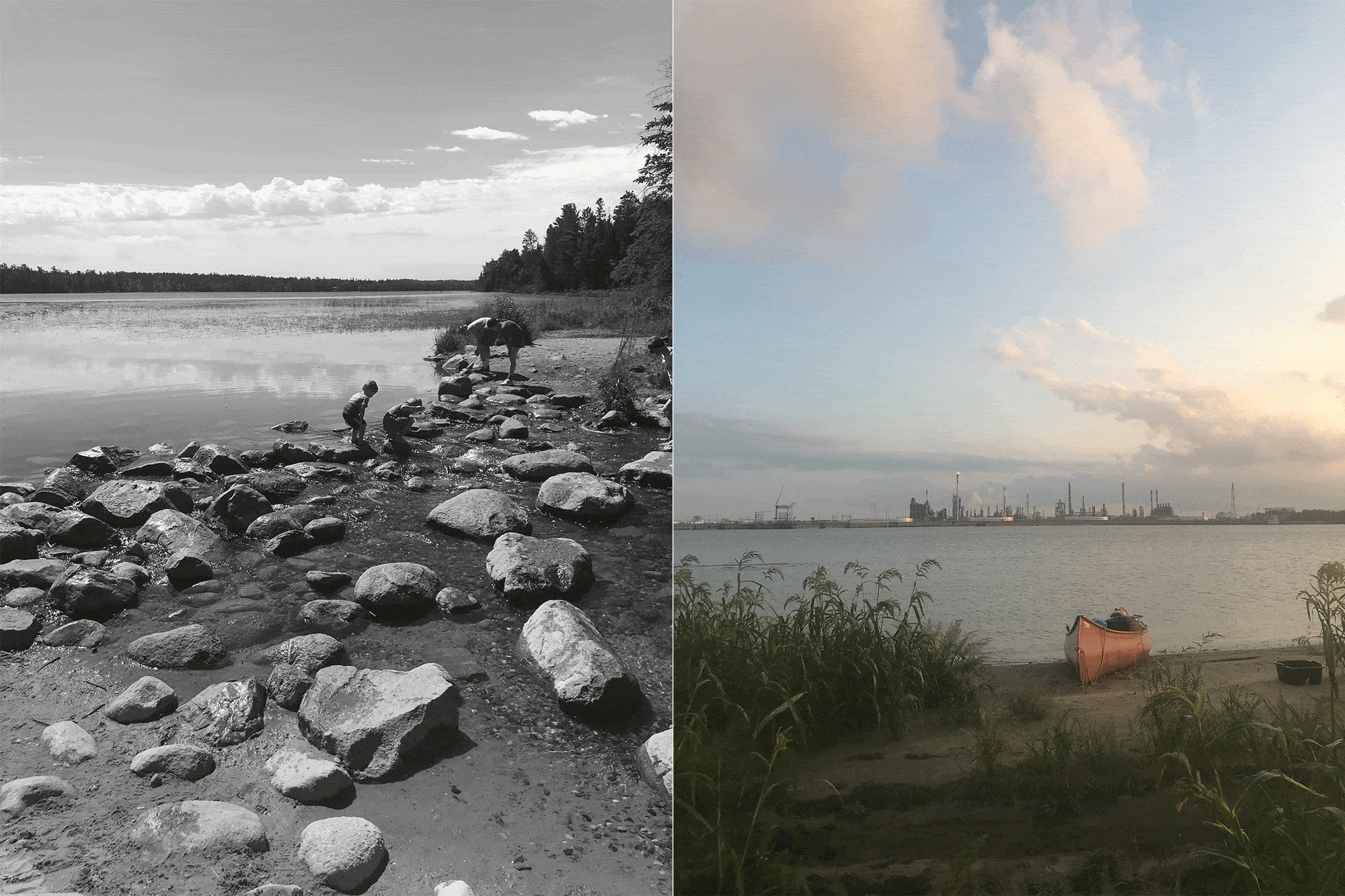
Upholt paddles through it all. It’s not just sediment we’ve lost, he says. There’s more than land we have to restore. Pointing to a former marshland, Rosita has the last word: “Any one thing you take out, its absence will be known.” Many things have been taken out in the name of controlling this landscape. Those bears and panthers, for instance. And people, people, people. The management of that extraordinary system of systems is “the largest engineering project in U.S. history.” Yet after their century-long experiment, some in the Army Corps of Engineers wonder if they should just give up. You can’t manage a river any more than you can manage the wind. Upholt’s cultural and environmental history is the best place to go to for 14,000 reasons why there is no point in fighting nature.
Home, Heat, Money, God: Texas and Modern Architecture
Kathryn O’Rourke and Ben Koush (University of Texas Press, 2024)
Reviewed by David Heymann
Home, Heat, Money, God, with a text by architectural historian Kathryn O’Rourke and photography by architect Ben Koush, is smart, broadly readable, and beautifully produced. Across almost 400 substantive pages — this is not a coffee table book — the authors trace a history of modern architecture in Texas from the 1930s to the 1980s. As O’Rourke writes, “Relentless ambition, a forward-looking attitude, and a strong sense of place combined to make Texans particularly receptive to modern architecture’s implication of newness, its future-oriented image, and its capacity to reinterpret historical forms in novel ways.” Unsurprisingly, it’s a wide-ranging history; at the end of the book there’s a helpful address list that sprawls over six pages, listing buildings from Abilene, Amarillo, and Austin to Waco, Waxahacie, and Wharton.
Koush’s photographs pull off a hard trick, capturing essential qualities of each building’s presence while mostly avoiding canonical framings. They can seem almost casual, not flattering but fair, to many kinds of buildings, from all over the state’s vast footprint (the book’s numerous photos are only a fraction of the tens of thousands Koush has taken in the past three decades: his packed Instagram feed has more). This quality refreshes the well-known: my favorites images might be of Mission Control at the Manned Space Craft Center, in which a surprising number of Texas architects were involved; and of Neuhaus and Taylor’s Campbell Centre, in Dallas (you’ll know it when you see it).

But the book is particularly endearing in bringing to light the obscure. You feel you’ve just stumbled upon Donald Barthelme’s drop-off pavilion for the West Columbia Elementary School; Tanaguchi and Croft’s House of Mo-Rose packing shed; Wilson, Morris & Crain’s Childress Optometrists in Longview; and George Dahl’s bus shelter for Houston’s first Sears store. (Speak, memory: I waited there many times as a kid.)
What was key — hard to imagine today — was that Texans wanted to be taken seriously as progressive cultural players on a national level.
O’Rourke’s insightful text manages an equally challenging feat: she attempts the quixotic task of arguing that Modernist architecture in Texas is distinct. Which it is, yet isn’t. Modernism did flourish under the Lone Star. The movement rose just as the state’s provincial players began their startling accumulation of cash, mostly through oil and related industries, but also through federal and state spending programs. What was key — and hard to imagine today — was that Texans wanted to be taken seriously as progressive cultural players on a national level. So, you find idiosyncratic modernist masterpieces throughout the state, in cities and towns, by terrific architects not well known beyond the border. I’m thinking of George Pierce and Abel Pierce, and the Keith-Weiss Geological Laboratory Building at Rice University — part of a brilliant three-building suite; Chester Nagel, and the Barton Springs Bathhouse; Norcell Haywood, and the Antioch Missionary Baptist Church; Mackie and Kamrath, and the Edna Fire and Police Department; Frank Welch, and the Forest Oil Company, in Midland. And the list goes on and on, with architects who transformed the style’s tendencies with regional concerns and local circumstances.
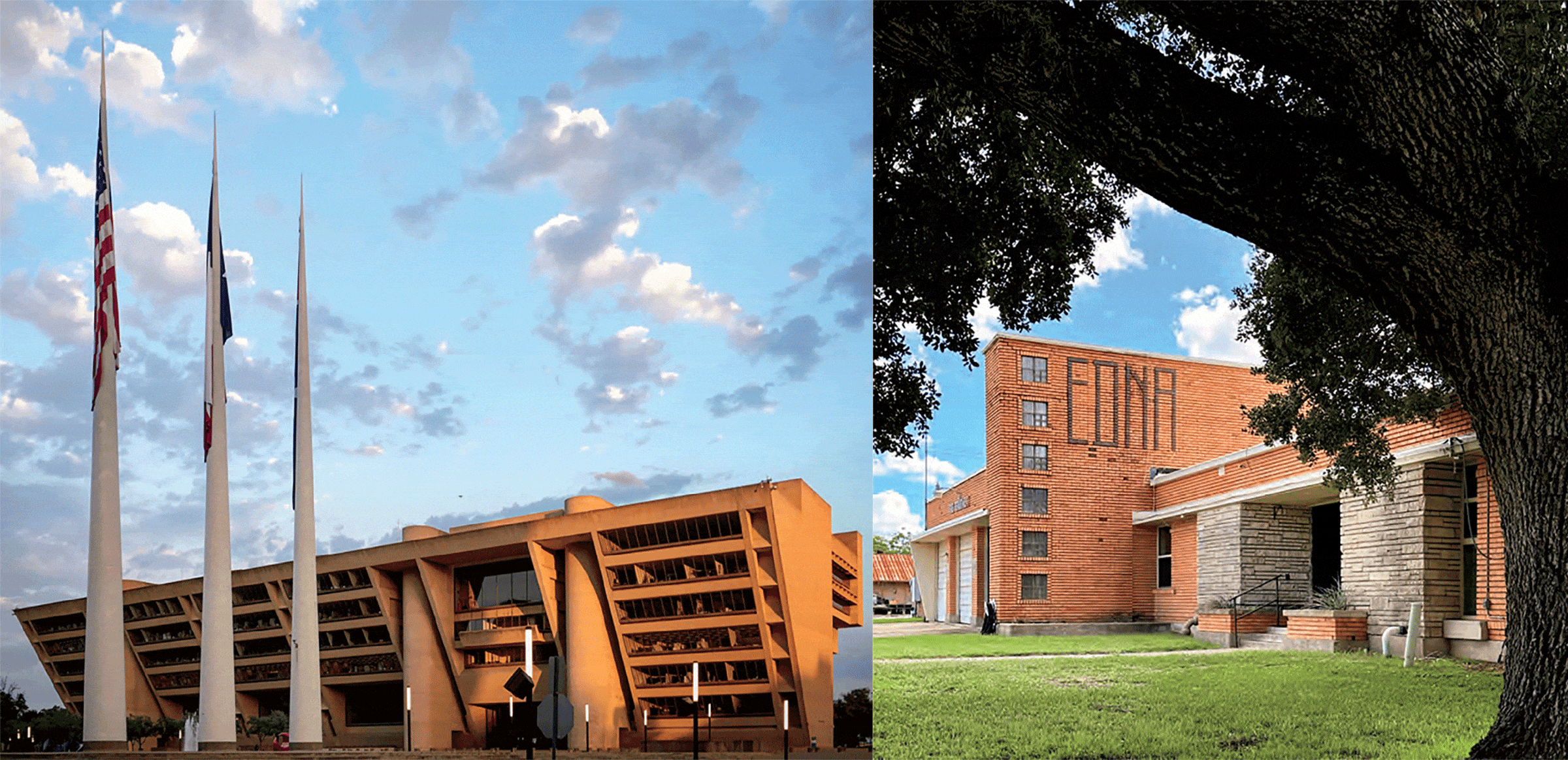
Yet the core philosophical agenda of modernism was also anti-border, or at least borderless. The famous architects brought in for prize commissions were hired because their national and international practices reflected the ongoing pretensions of a broader discourse. And so there’s Mies’s addition to Museum of Fine Arts, in Houston; the Kimbell Art Museum, by Louis Kahn; the Menil Collection, by Renzo Piano; Philip Johnson’s house for the de Menils; I.M. Pei’s Dallas City Hall … that list goes on and on too.
It only complicates matters that many Texas architects sought to bridge the aspiringly general and the definitively local. The blurry standouts are the brilliant, Saarinen-inspired optimists Caudill Rowlett Scott — CRS — who “brought a highly collaborative, research-intensive approach” to their celebrated designs for public schools; and the still under-recognized genius O’Neil Ford, to whose broad (and many-partnered) career — with buildings ranging from Denton’s Little Chapel in the Woods, to research buildings for Texas Instruments, to Trinity University — the authors are justly generous.
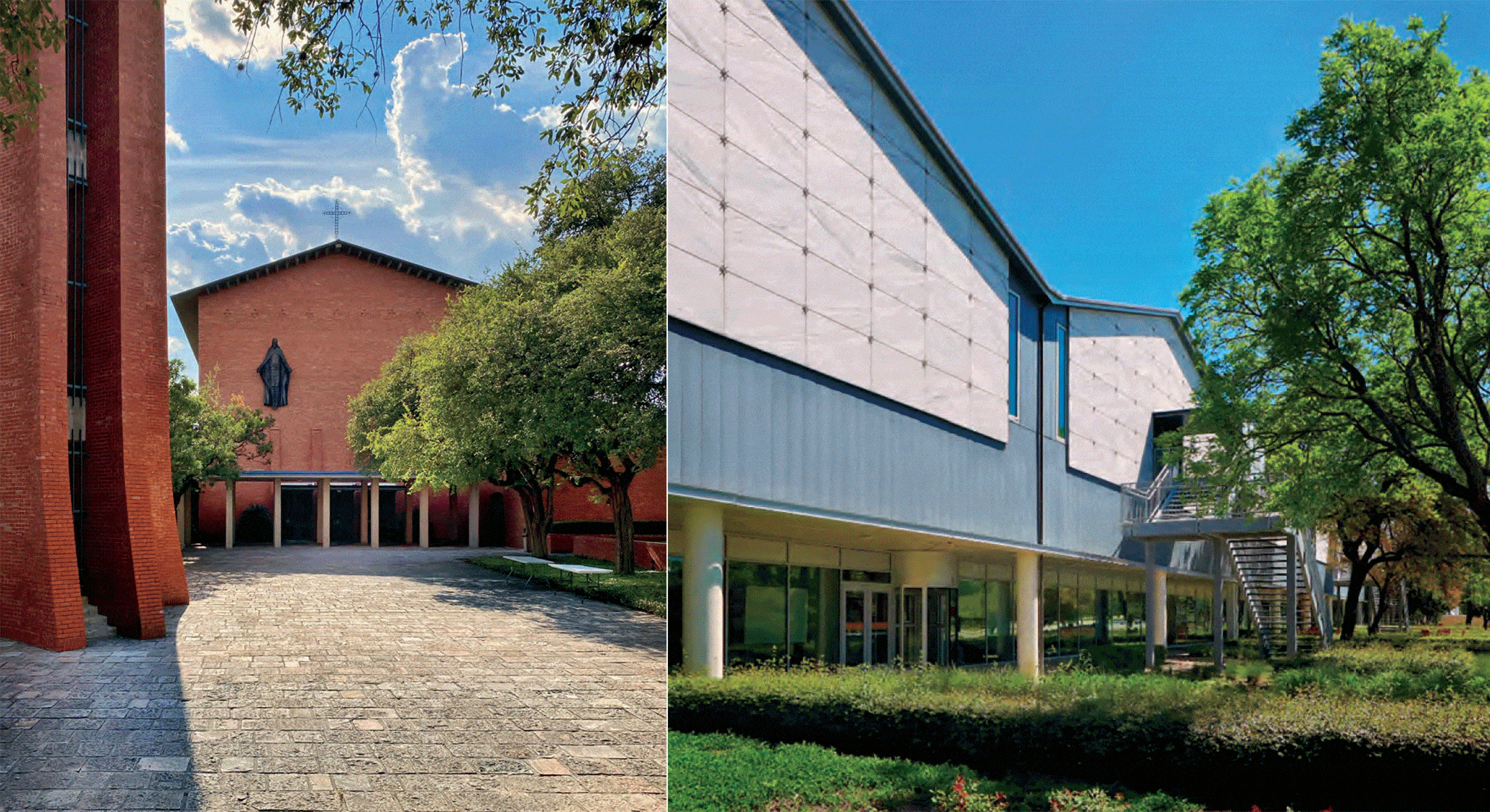
O’Rourke deals with the contradictions — again, that Texas modernist architecture is/is not distinct — by siloing a series of meta-concerns into the book’s twelve chapters; besides the titular Home, Heat, Money, and God, there’s Government, Care, Sports and Leisure, On the Road, Knowledge and Power, Precious Objects, Hearts and Minds, and Contact Zones. Rather than setting out to prove the validity of each silo, she then — and this makes the book so pleasant to read — uses the central conceptual conceit to expose the rich variety of exploration present in the many examples.
Despite that variety, O’Rourke is able to clarify how most of the architecture supports a primary sociocultural narrative: that a happy unity in modernity favors an existing social and political power hierarchy. In so doing, O’Rourke brings to light many suppressed Texas narratives: of funding priorities that favored the powerful; of neighborhoods cleared and demolished; of local, racial, and social histories and identities suppressed. O’Rourke does not shy away from the conceptual problem this brings to light. The promise of the seeming progressiveness of modernism likely meant different things for, say, an oil company CEO than for the inhabitants of low-cost housing. Yet the common formal language has meant those differences have been too easily overlooked.
Every so often it’s important to sharpen your spurs. O’Rourke and Koush are up to the task. Home, Heat, Money, God might even please those who cringe at the mention of anything Texas.
Fluid Geographies: Water, Science, and Settler Colonialism in New Mexico
K. Maria D. Lane (University of Chicago Press, 2024)
Reviewed by Nora Wendl
Settler colonialism, when it succeeds, is not a straight line — it meanders, falters, flails, adapts, and ultimately constructs its own methods of legitimacy in order to violently dispossess people over generations. In Fluid Geographies, historical geographer K. Maria D. Lane shows how this unfolded in New Mexico through water management, which Lane convincingly argues is foundational to all other forms of settlement.
What we currently call New Mexico is Indigenous land crossed by three successive colonial projects — Spain, Mexico, and the United States. Lane traces the water histories of each one in compelling detail, starting with the small, mutually dependent pueblos, with communally maintained infrastructure, that thrived in the Rio Grande watershed until the arrival of the Spanish. Each wave of colonization is revealed as parasitic: the Spanish simultaneously brutalized local populations and depended upon them for survival, imposing an acequia (ditch) system of irrigation that still exists today, sustained through exchange between Indigenous knowledge and colonial regimes of construction and maintenance.
The violence of colonizing institutions is as real and lasting as that of their armies.
However, Lane wisely focuses on what happened after Spain ceded the land to Mexico in 1821 and New Mexico’s governors began an ill-fated alliance with the young United States, setting the stage for U.S. political control after the end of the Mexican-American War in 1848. Lane’s close-grained analyses of legislative texts, district court cases, and hand-drawn maps bring vividly to life the chaotic pre-statehood period, as Anglo settlers attempted to make New Mexico “more American.” Progressive-era politics prioritized engineering as the basis of governance while exhibiting a deep ignorance of place, leading to costly, failed experiments in data collection and the disruption of environmental and human geographies. Though Nuevomexicano and Indigenous communities fought back, Anglo settlers created their own flawed infrastructure and, crucially, a bureaucratic system that justified, legalized, and expanded their power over water management decisions.
Lane’s remarkable deep reading of nearly two hundred district court cases will undoubtedly be a foundational resource to generations of future researchers. The author’s warning, that “expert-led laws, agencies, and administrative procedures thus accomplished the dirty work of settler colonialism more effectively and less noticeably than violent military action,” is a timely reminder that the violence of colonizing institutions is as real and lasting as that of their armies.
The Urban Refugee: Space, Agency, and the New Urban Condition
Bülent Batuman and Kivanç Kilinç, editors (Intellect, 2024)
Reviewed by Meena Venkataramanan
While visiting Berlin’s Pergamon Museum in April 2022, I crossed paths with a young woman from Kyiv who had arrived in the city just days earlier. She was seeking refuge from Ukraine, she told me, two months after the Russian invasion. Our chance meeting was not as random as it might seem; for years, the city’s state museum collective has offered free tours to refugees, some of which are led by refugees themselves.
The Ukrainian woman visiting the Pergamon was enacting precisely the kind of “urban informality” that Bülent Batuman and Kivanç Kilinç explore in the anthology The Urban Refugee. “In contrast to camp residents,” they write, the urban refugee “involves him or herself in the informality networks of the city and blurs the boundaries of national identities and the notion of citizenship.” The embeddedness of refugeehood in the urban sphere, and the concomitant disrupting of the “camp” narrative, is the focus of this montage of writings by fifteen scholars and practitioners from urban studies, anthropology, and architecture who are based in Europe, the Middle East, and the United States. The editors frame their anthology around urban informality, state control, and political activism, and the ways in which these forces constrain or empower refugees’ relationships with their cityscapes.
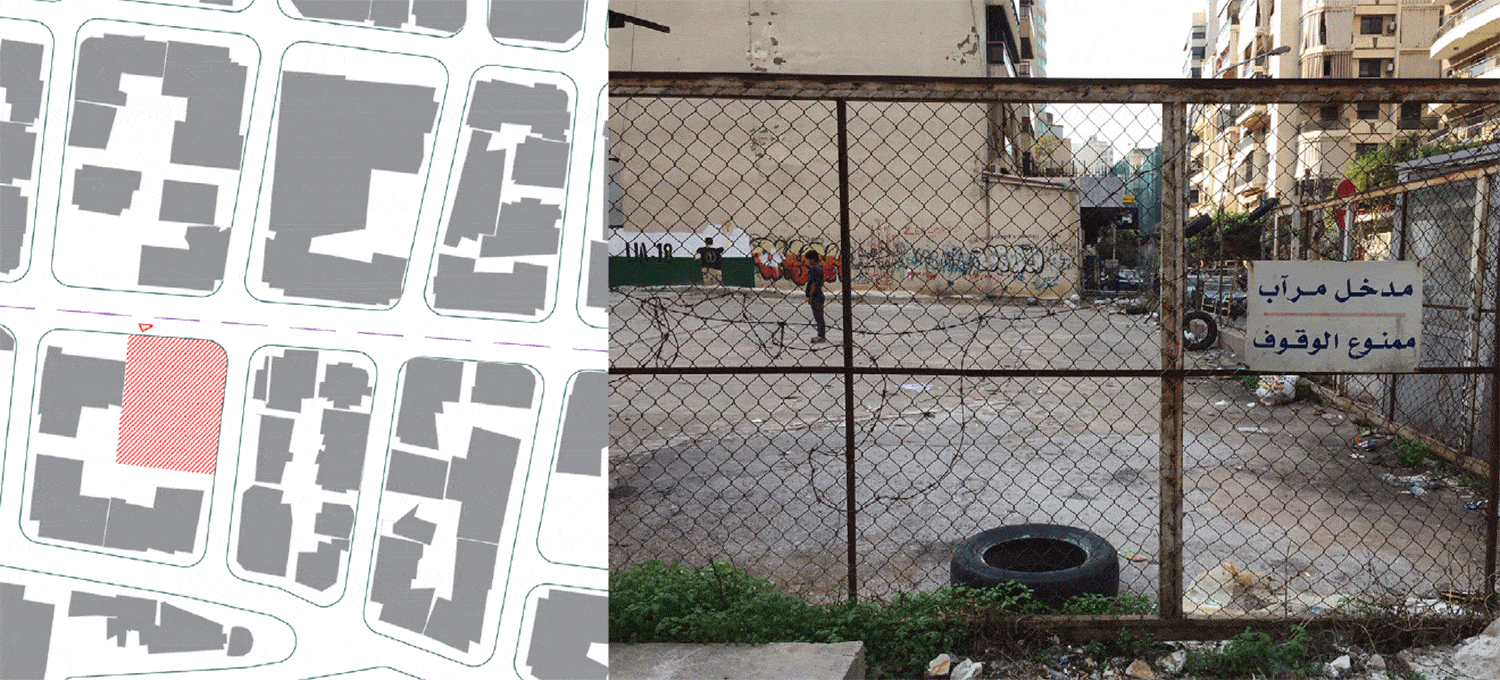

The contributors meticulously observe, critique, and theorize how refugees impact the urban spaces they inhabit, documenting the manifold ways in which these spaces are claimed and reclaimed. Maria F. Curtis focuses on the Arab American Cultural Community Center in southwest Houston; Eda Sevinin, on Islamic humanitarian networks in Denizli, Turkey; Kivanç Kilinç and Şebnem Yücel, on the hotel district of Izmir, which shelters Syrian and African refugees seeking transport to Europe; and Huda Tayob, on “Somali malls” in suburban Cape Town and Minneapolis as spaces of home and domesticity. The authors’ sources are various — floor plans, photographs, ethnographic interviews, academic literature — and so are the methods and means by which placemaking happens. Some spaces evolve endogenously; some with the aid of charities, interfaith networks, or municipal institutions. Many are created despite state efforts to contain or proscribe refugee meaning-making.
Perhaps the most radical act of urban informality is play.
Perhaps the most radical act of urban informality is play. Architectural scholars Roula El Khoury and Paola Ardizzola astutely observe how Syrian children in Beirut find places to play — empty lots, junk yards, alleys— and use play to make these spaces their own. “Through their ability to re-semanticize and colonize anonymous spaces,” El Khoury and Ardizzola write, “children recover the beauty and the warmth of distant and lost places.” A capacious and daring imagination, I would argue after reading this book, doesn’t only belong to children. The Urban Refugee shows the possibilities that exist, should institutions, communities, and individuals decide to normalize refugeehood across the urban landscape.
Mapping Malcolm
Najha Zigbi-Johnson, editor (Columbia Books on Architecture and the City, 2024)
Reviewed by Charles L. Davis II
Najha Zigbi-Johnson’s edited volume, Mapping Malcolm, re-examines the scholarship and legacy of Malcolm X using the analytical lenses of Black Geography and placemaking theory. The book is also a very personal retelling of Malcolm’s life. The radical Black tradition that Malcolm represents is anchored in 1960s Harlem, and simultaneously situated within an internationally networked context. Reading this text, one is always in Harlem, and always connected to the world.
The book upends the reductive political function of ‘mapping’ as a form of capitalist and colonial cartography.
The contributors use new interviews, experimental photography, personal reportage, and transdisciplinary spatial interpretations of sites significant in Malcolm’s biography, both domestic and international. They collectively build upon the research and methodologies of countercultural biographers such as Manning Marable; the close reading strategies of urban theorists such as Edward Soja and bell hooks; and the analytical frameworks of contemporary theorists of the Black Geographic, from Sylvia Wynter and Sadiya Hartmann to Camilla Hawthorne.
In terms of disciplinary relevance, Zigbi-Johnson’s assembled contributions comprise a form of instruction: How can architectural historians create spatial histories of architecture and place, rather than architectural histories of space? Mapping Malcolm upends the reductive political function of “mapping” as a form of capitalist and colonial cartography, and instead uses the term to refer to a synthetic interpretation of the international extents of Black diasporic thought — on freedom, religious enlightenment, political autonomy, and artistic expression.
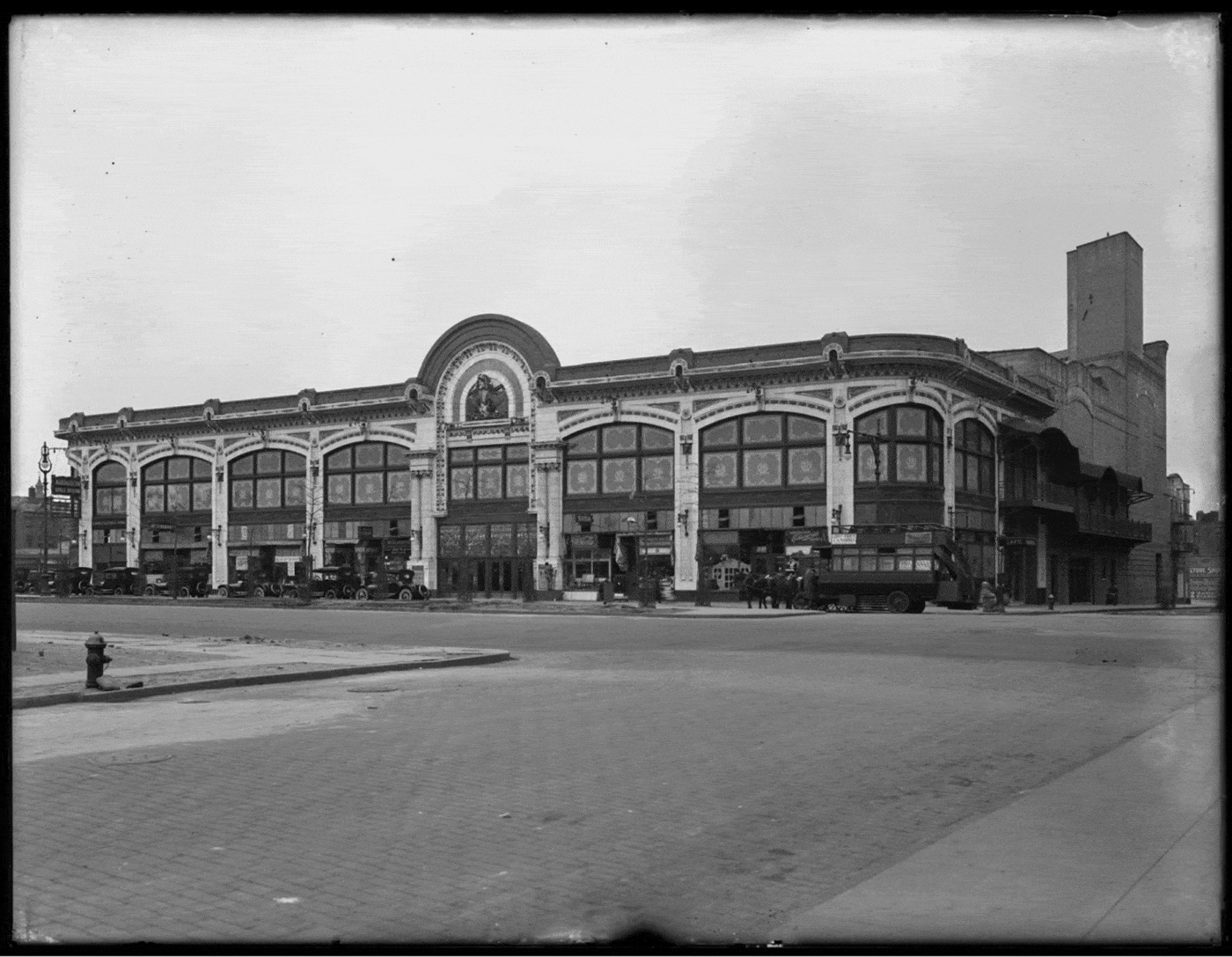
Perhaps the best example of this subversion is Ladi’Sasha Jones’s essay, which pairs maps produced by the Organization of Afro-American Unity, which Malcom launched in 1964, with maps of the African slave trade, so as to trace the global dispersion of Black prophetic thought. Zigbi-Johnson’s opening essay is similarly exemplary, in that it treats the Audubon Ballroom, the site of Malcolm X’s assassination, not as an architectural project or historic site, but as an evocative, meditative space where political commitments to radical social change materialize. Through these essays and others, Mapping Malcolm draws a map for transforming the tropes of architectural historiography.
Assembly by Design: The United Nations and Its Global Interior
Olga Touloumi (University of Minnesota Press, 2024)
Reviewed by Hubert Murray
On October 24, 1945, the United Nations was voted into existence, hard on the heels of the destruction of Hiroshima and Nagasaki by atomic bombs; the devastation of European cities in the World War; and the horrendous revelations of the Holocaust. The program was to establish the foundations of world governance as a reflection of liberal internationalism in a postwar world that was also on the threshold of decolonization.
The author examines the form-creation of the United Nations as both reflection and genesis of a new world order and its myths and ethos.
In Assembly by Design, Olga Touloumi moves “beyond establishing and analyzing the architectural value of the UN Headquarters [rather] to place the emergence of global interiors within a conversation of the ‘imaginary institution’ of a world community.” On a theoretical level, she examines the form-creation of the UN buildings and their component parts as both reflection and genesis of a new world order and its attendant myths and ethos. In a fascinating exploration of precedents, she reviews in detail the choice of location and spatial configuration for the Nuremberg tribunal, the press and the interpreters being central to the process of displaying to the world a process that represented a universal justice, transparent to victor and vanquished alike.
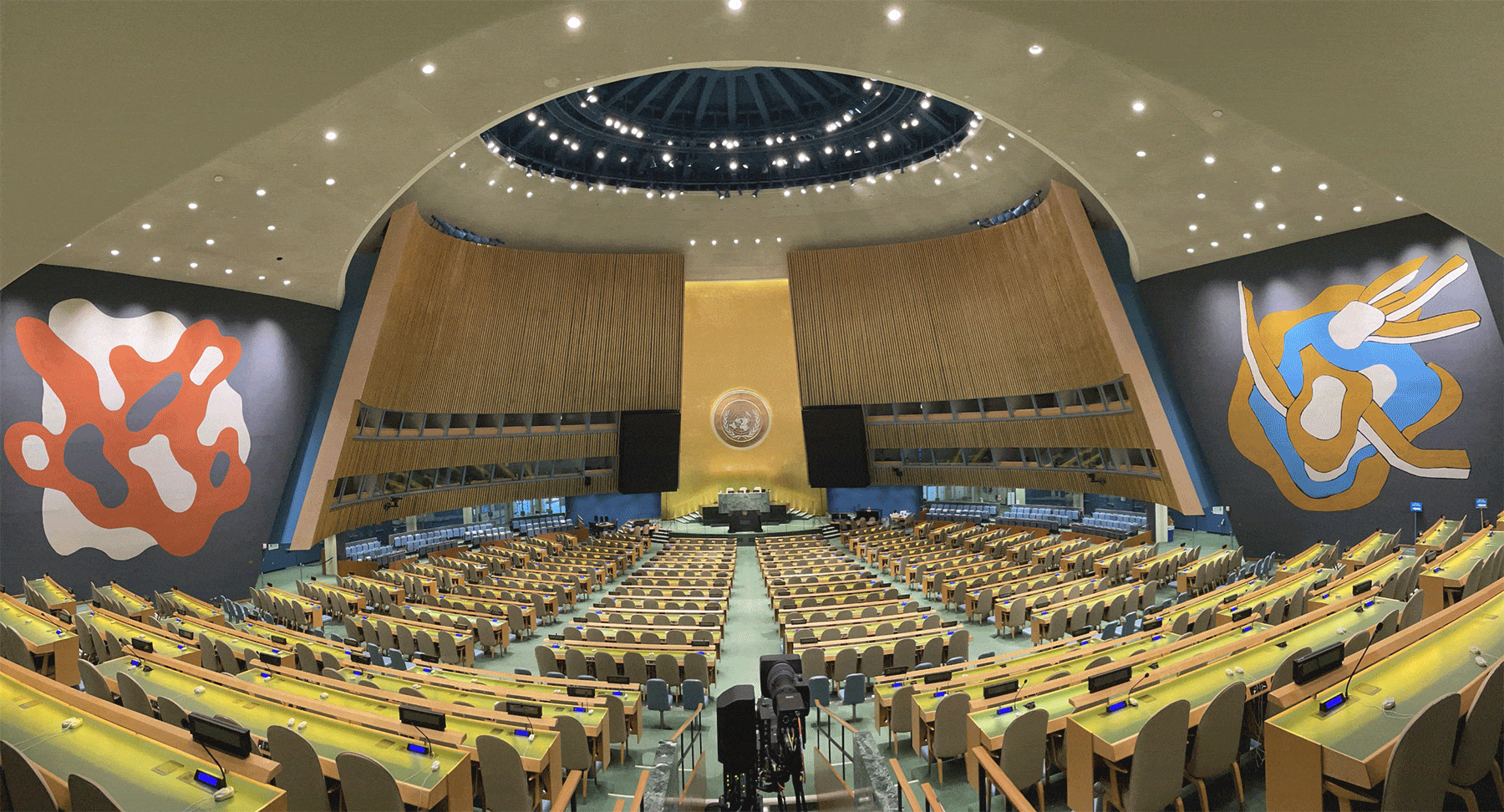
Communications and acoustics are central in Touloumi’s analysis. She examines in some depth the implications of conceiving the United Nations not as a “world capital” — implying a central monumentality — but as a “headquarters,” connoting a network of specialized satellite institutions distributed throughout the First and Third Worlds of economically developed and developing nations (but notably not in the Second World of socialist economies).
An example: the quality of sound in the General Assembly Hall was intended to reflect the humanity and authenticity of the speakers, a direct rejection of the high-reverberation acoustic environments favored by the recently defeated fascist dictators. Inevitably, a global audience, a 24-hour range of time zones, the demands of simultaneous translation, and the volume of the Assembly space itself, necessitated the introduction of loudspeakers, soft speakers, and headphones, each with various levels of alienating or individuating characteristics, all in the service of intelligible speech.
Touloumi’s book is immensely well researched and annotated, valuable as history and as a theoretical examination of the physical and metaphysical ideation of world governance. Eight decades later, at a time when the international rule of law is again being put severely to the test, it is a timely reminder of our aspirations.
Troublesome Rising: A Thousand-Year Flood in Eastern Kentucky
Melissa Helton, editor (University Press of Kentucky, 2024)
Reviewed by Elizabeth Dodd
Two years ago, thunderstorms drenched Appalachia. As Melissa Helton recounts in the introduction to this anthology, sixteen inches of rain fell over five days, causing severe floods with one-in-a-thousand odds. This coincided with the annual gathering of dozens of authors at the Appalachian Writers’ Workshop, on Troublesome Creek in southeastern Kentucky. In poems, essays, and short stories, the writers chronicle their experience: the terror of being evacuated at night from guest housing, the grief over witnessing disaster (45 people died, including four local children), and the heartbreak of contemplating the cultural loss of the campus archives and the environmental destruction that is everywhere, centuries in the making.
I was deep into reading their words when Hurricane Helene roiled inland, wreaking calamitous floods in Tennessee and North Carolina before petering out in Kentucky. The environmental writer Barry Lopez said that in the age of climate change, narrative has these important goals: to remember and to help. This book pursues those aims.
The environmental writer Barry Lopez said that in the age of climate change, narrative has these important goals: to remember and to help.
The collection extols community. The Hindman Settlement School, home to the Writers’ Workshop for nearly half a century, was constructed in 1902 as part of the settlement movement in rural Appalachia, which sought to bring education, healthcare, and opportunity to an impoverished area and evolved to celebrate and preserve local culture. Leah Kendrick notes the school’s “power out of proportion to its remote location and humble facilities.” Erin Miller Reid describes efforts to save library materials after the water receded. “We will tell our story,” she says. “For we are the children of these mountains, the folks of these hills, and the stewards of our history.” Ouita Michel writes about organizing out-of-town chefs to bring food when Hindman was without water or power. Months later, the school continued to serve community meals.

Some who fled the campus were both insiders — having attended the Workshop for decades — and outsiders, whose presence strained the small town’s fragile, provisional infrastructure. Annette Saunooke Clapsaddle returned home to North Carolina with the intention of being an ally, to “return to our own communities carrying their stories, and be poised to move in the directions they would choose or need in the coming days, weeks, and, it now appears, years.”
While the flood and its aftermath are documented in personal essays, some of the most powerful explorations of its significance lie in the poems and brief works of fiction. Savannah Sipple’s “Ain’t No Grave” follows a young woman living in the holler where she grew up yet drawn to the queer community of the city. When floods strike, she escapes on foot with elderly neighbors; heading up the mountain, she pauses to see “her world get washed out.” Maurice Manning’s “Planting Trees in God’s Country” recalls settlers’ deforestation of the eastern woodlands. We must, he writes, “imagine the past / and believe we come from it, not / to undo it, but simply to imagine / and therefore belong …”
Untimely Moderns: How Twentieth-Century Architecture Reimagined the Past
Eeva-Liisa Pelkonen (Yale University Press, 2023)
Reviewed by Sandy Isenstadt
If modernism in architecture meant anything, it surely meant being of the moment of its making. Efficient in conception and plan, fabricated of industrialized materials, assembled by the most up-to-date means, it succinctly reflected a new age of machine production and accelerated social life. In becoming modern, architecture would keep pace with the other arts that were likewise transformed by contemporary pressures. Together, the arts became points along the leading edge of time itself, severing past from present to better reveal a richly imagined future.
Should architecture embrace and even accelerate the pace of change, or seek to incrementalize it? Might past styles serve as models for modernism?
Buildings endure, however, assuring modern architecture’s irrelevance once the time of its making has passed. While this paradox — to be both of a particular moment and remain meaningful beyond it — preoccupied many modernists, its exploration was nowhere more pointed or penetrating than amongst several generations of educators, students, administrators, practitioners, critics, and historians who worked at Yale University, perhaps for several years, and perhaps for their entire careers, between the early 1920s and the early 1970s. In her remarkable book, Untimely Moderns, Eeva-Liisa Pelkonen describes these decades of debate about the relationship of architecture — its teaching, practice, and social significance — to times past, present and future. Should architecture embrace and even accelerate the pace of change, or seek to incrementalize it? Might past styles, especially the Gothic, serve as models for modernism? Was aesthetic merit a transcendent value to be discovered, or was it epiphenomenal to rational design? How could architecture account for emotional or spiritual needs with industrialized methods?
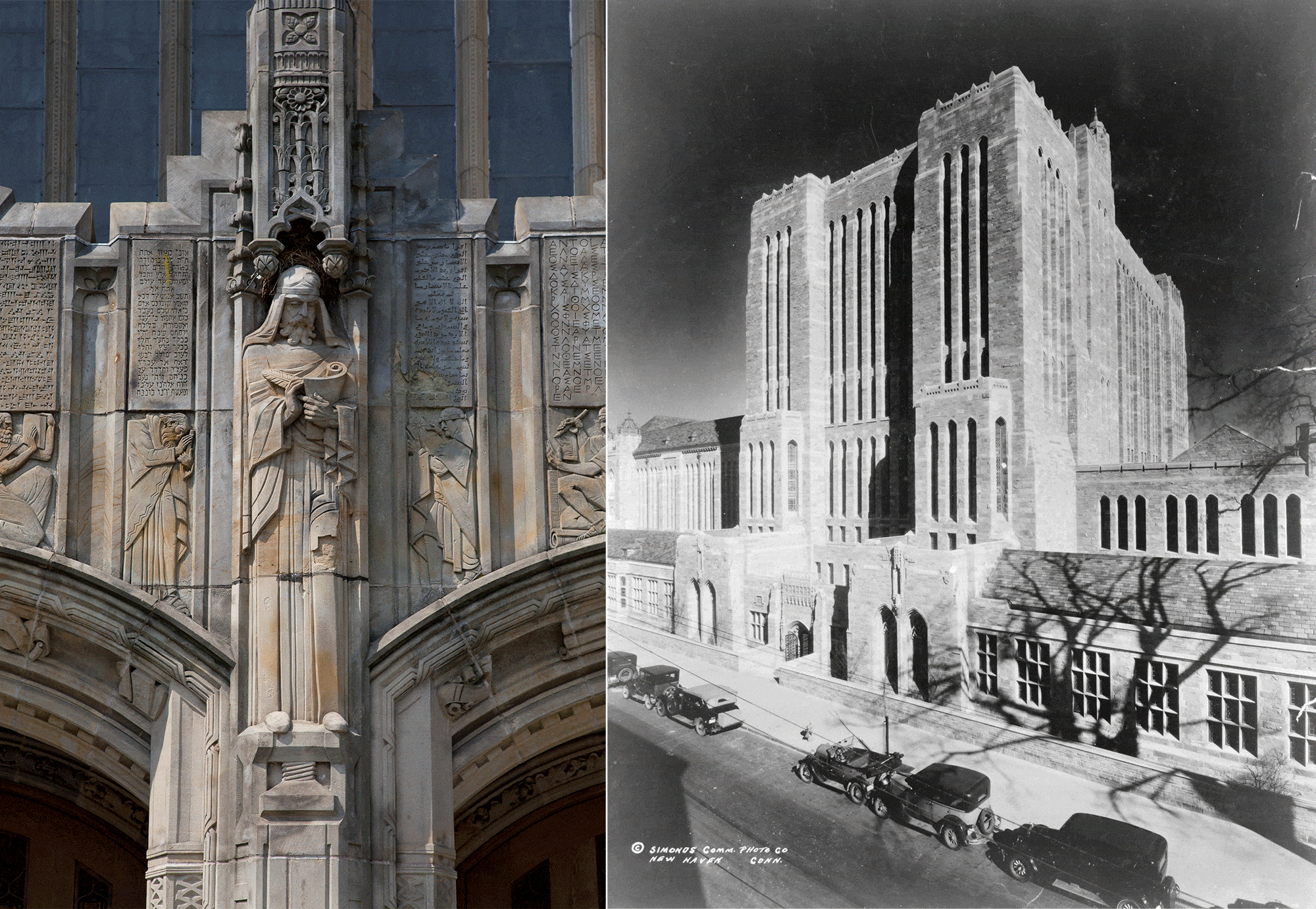
Why Yale? Pelkonen names several factors, including the school’s slowness, relative to peer institutions, to discard Beaux-Arts design principles. Also crucial was the campus itself, which emerges as an active agent in these discussions. Unabashedly transhistorical, the campus was rife, architecturally, with temporal contrasts that simultaneously delighted and horrified observers, both those in situ and others more far flung. No text posed the problem more succinctly than the steel frame and stripped Gothic fabric of the university’s Sterling Memorial Library, designed by James Gamble Rogers and completed in 1931.
While tightly focused on a particular place and finite set of figures — from Rogers to Vincent Scully — Pelkonen gestures toward broad currents like the emergence of “deep time” in 19th-century geology, the discoveries of depth psychology, and changing methods of reproducing and disseminating images, to name just a few. Pelkonen is a close and incisive observer, whether discussing a book or a building, and she is a fluid and lucid writer, reliably offering succinct synopses both of fine details and grand abstractions. What comes alive in this book is the way in which one particular and even idiosyncratic physical environment fostered and, to some extent, even conditioned contemplation of the grandest and most abstract of themes.
Green Lands for White Men: Desert Dystopias and the Environmental Origins of Apartheid
Meredith McKittrick (University of Chicago Press, 2024)
Reviewed by Ozayr Saloojee
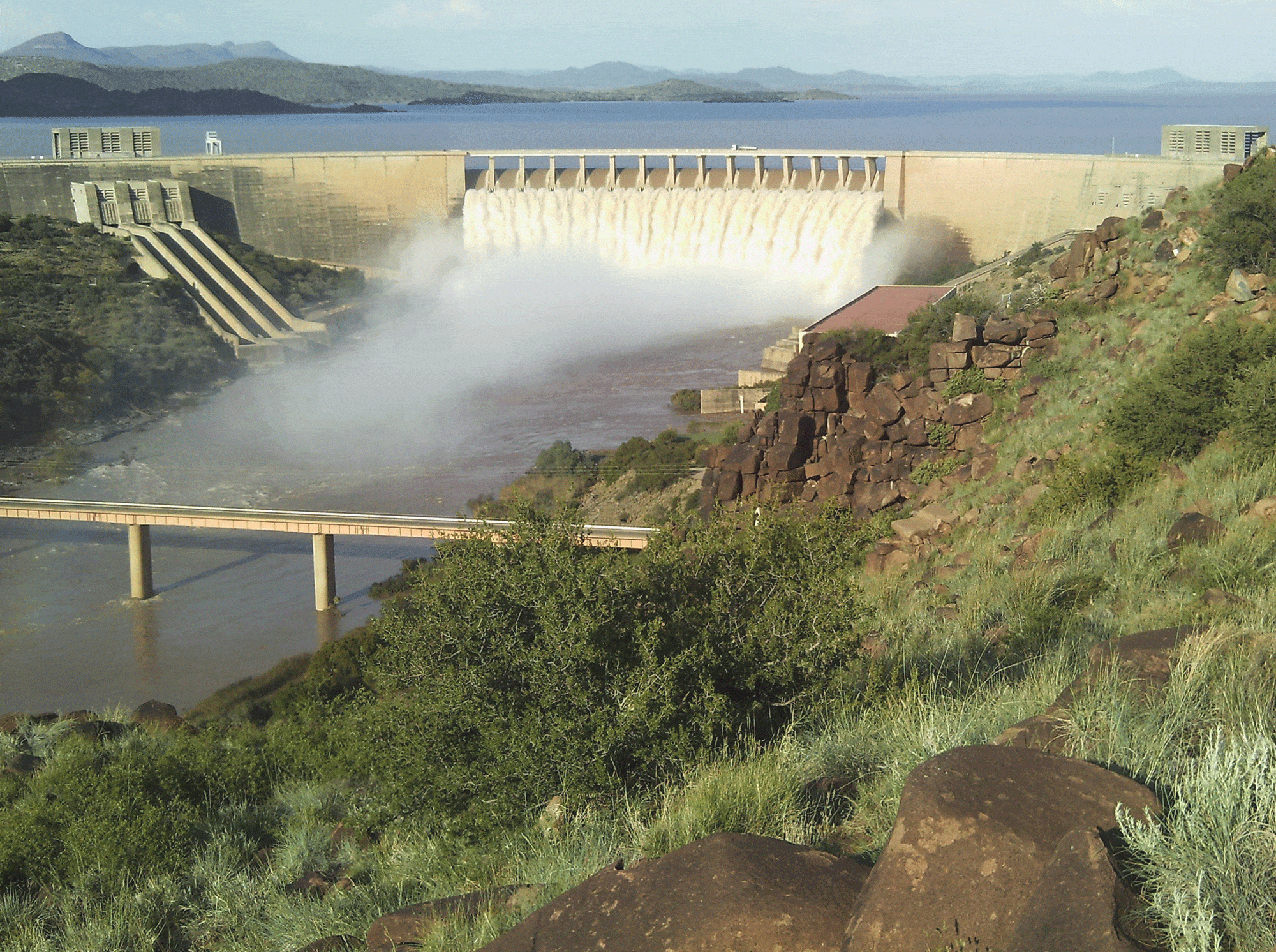
In 1920, a British-born geology professor at Rhodes University proposed a controversial infrastructural solution to the problem of “waters running to waste” in the arid lands of Southern Africa. Ernest Schwarz’s The Kalahari, Thirstland Redemption imagined weir dams redirecting the Kunene and Chobe rivers, which flow from Angola to Namibia, to create a vast new lake east of Lake Ngami, in present-day Botswana.
In the excellent environmental history Green Lands for White Men, Meredith McKittrick locates the origins of apartheid in the bureaucratic intellectual world that fostered this scheme. Schwarz’s supporters and detractors alike were driven by a techno-utopic vision of environmental saviorism, aiming to defeat drought and secure the survival of the White race through the transformation of terra nullius into arable land. Their plans and rationalizations exemplify what Eve Tuck and K. Wayne Yang describe as settler moves to innocence — including a denial of anthropogenic responsibility and the celebration of a moralizing, self-righteous Whiteness.
The author locates the origins of apartheid in a bureaucratic world driven by a techno-utopic vision of environmental saviorism.
In this engaging and exhaustively researched book, McKittrick moves thoughtfully through the local and global discourse around water and White fear, and around the environmental and political terrains of landscape transformation, romanticized agrarian life, bureaucratic paternalism, and the valorization of infrastructural solutionism (as defined by Rob Holmes in this journal). The associated ecology of McKittrick’s framing and research brings to mind examples like Mike Davis’s Late Victorian Holocausts. The book is dense but well organized, and it did not leave me thirsty, although I did wonder a little about what lies outside these pages, the broader social episteme encompassing non-White land, water, and lifeworlds, as discussed in Dilip Da Cunha’s Invention of Rivers, Jennifer Beningfield’s The Frightened Land, and uMbuso weNkosi’s These Potatoes Look Like Humans: The Contested Future of Land, Home, and Death in South Africa. On the whole, McKittrick’s text speaks carefully and critically to the larger implications of landscape and racial imaginaries, and it resonates both as an important contribution to South African environmental history and as a cautionary tale for today about the danger and power of abstract imaginations.
Things That Move: A Hinterland in Architectural History
Tim Anstey (MIT Press, 2024)
Reviewed by Will Wiles
Architecture is generally associated with fixity and permanence rather than movement, but as architectural historian Tim Anstey explores, in Things That Move, it’s always been somewhat mobile. Consider that Vitruvius’s De architectura, generally regarded as the first book of architectural theory, concerns itself as much with the moving sun and winds, and with machinery, as with as bricks and mortar.
Architecture and motion is a promising theme. Yet it becomes a moving target that this dense and divergent volume has trouble hitting. The chapters are wildly diverse. Subjects include marine architecture, told through the medium of a fascinating 18th-century Swedish treatise on ship design; Slussen, a multilevel road and rail junction in Stockholm; the ways in which colonialism changed interior design; the itinerant archive of the Warburg Institute. (Aby Warburg’s collection of documents and images is a lingering presence throughout the text.)
All of this makes for a meaty book, with almost too much to chew on. The most thematic unity is achieved in sections that examine the movement of two large obelisks: that of “Cleopatra’s Needle” from Egypt to London in 1877, and that of an ancient Egyptian obelisk from one part of the Vatican to another, in 1585. The distances and methods of relocation were very different, but both stories deliver on the book’s promise, presenting architecture as a fluid matter of processes and machinery, unfolding public spectacle, and flexible businesses shaped by a wider world of flows and infrastructure.
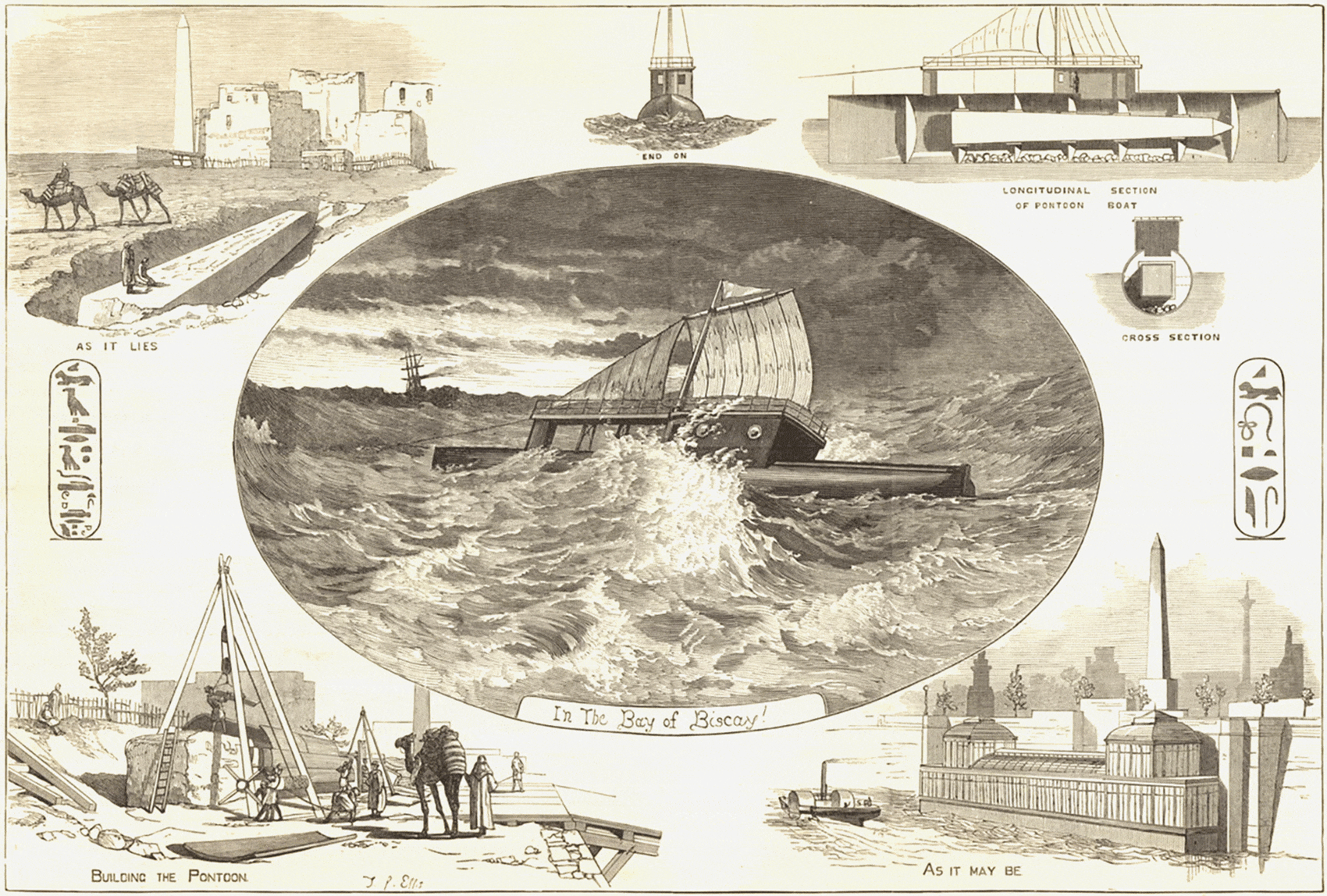
The obelisk’s relocation presents architecture as a fluid matter of processes and machinery, unfolding public spectacle, and flexible businesses.
Anstey embeds Cleopatra’s Needle in the Victorian media, particularly the illustrated magazines, which were always hungry for pictures of difficult, dangerous deeds. To analyze the Vatican relocation, he uses a book later published by the architect at the helm, Domenico Fontana. The fact such a book exists suggests Fontana believed that successfully moving a 400-ton structure was as worthy of architectural pride as the building of the 400-ton structure in the first place; but the treatise is most revelatory in “mak[ing] visible what is usually excluded from architectural representation — the temporary supports, tools, workers, and scaffolding that allows material construction to come into being.”
These chapters go a long way towards supporting Anstey’s proposed redefinition of architecture: “The art of getting things moved about from one place to another, at a rather slow speed, with the intention that they will stay for a while and create value.” The theme of Things That Move is sometimes evasive, and the material sometimes unnecessarily complicated. Nonetheless, Anstey writes evocative, well-turned prose that keeps the reader moving on.
Periurban Cartographies: Kolkata’s Ecologies and Settled Ruralities
Victoria Jane Marshall (Oro Editions, 2024)
Reviewed by Amitangshu Acharya
In the Bengal Delta, the dichotomy between urban and rural in regard to administration and planning is unsettled not only by land use, labor practices, and lived experiences, but by the transmutative presence of water. Institutions tasked with urbanizing the delta must constantly negotiate this socio-natural flux. Simultaneously, they must contend with colonial legacies underpinning “municipal” and “civic” demands for spatial reconstitution and erasure of diverse livelihood practices. The periurban, understood as a liminal space where rustic countryside awaits its tryst with neoliberal modernity, not only embodies the struggle for urban transformation in the delta, but also produces that struggle’s unique riddles.
Victoria Jane Marshall’s Periurban Cartographies attends to some of these issues by tracing entanglements between social power and nonhuman agency that permeate and subvert cartographic imaginations in (and of) a suburb of Kolkata called Maheshtala. Marshall meticulously documents the evolution of Maheshtala as rendered across state planning documents, then proceeds to map, on foot, a selected ward in the municipality. Her fieldwork reveals the agrarian character of a city at odds with the urban cartographic imagination. While municipalization seeks to regulate away the rural, Marshall reveals its obdurate persistence in paddy fields and pond gardens, and shows how administrative and locally articulated categories of untended land such as “vacant,” “fallow,” and “jungle” contribute to a “slow geography of dilapidation.” She argues that such dilapidation contradicts teleological assumptions about the periurbanization of agricultural land.
Municipalization in Kolkata seeks to regulate away the rural. Marshall reveals its obdurate persistence in paddy fields and pond gardens.
I cannot help but wonder, in this regard, if dilapidation is a speculative tactic in neoliberal urbanism. Do owners intentionally leave plots of land untended as a strategy for bypassing the legal complexities involved in converting productive agricultural land into real estate? Marshall touches on an important problem: what is often regarded as “urban nature” in the Global South in fact comprises of ecological fragments of the rural. Many such fragments survive are sites of human resistance and nonhuman obduracy. Others survive due to neglect. In Southern Urbanism scholarship, the former receives greater attention, and Marshall’s research brings much-needed attention to the latter. It also opens up new questions about how to understand such “neglect.” What is missing, perhaps, is what led Marshall to explore these questions in Maheshtala, in particular. In telling this backstory, she would have added valuable context to her research, as questions of positionality in Southern Urbanism also tend to fall “off the map.”
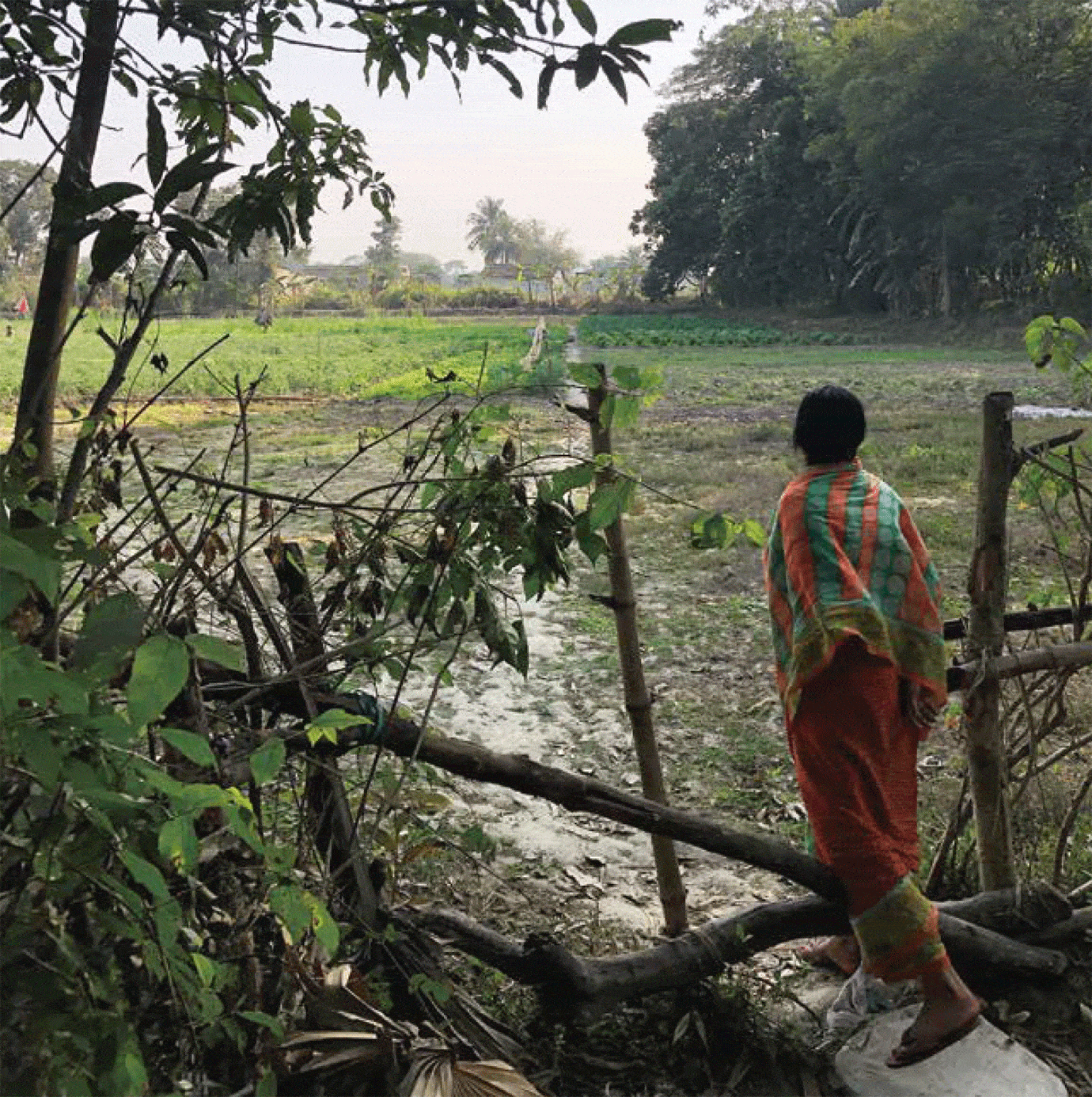
I am especially drawn to Marshall’s discussions of Maheshtala and its hydrosocial remaking as evidenced in the municipality’s longstanding struggle with waterlogging. Her methodical documentation of changing land use as it continually alters drainage networks illustrates the key aspect of what Ajaya Dixit and I have referred to as “land-centric urbanism.” The capillaries and reticulations by which waterways interconnect in a delta are impervious to the logic of concretized infrastructure, which aim to optimize revenue from private land. Waterlogging, in such a context, is forensic evidence of the slow violence engendered by urban “development.”
Periurban Cartographies illustrates an “on-the-ground periurban reality” shaped by hydrosocial uncertainty and an unsettling of postcolonial urban planning. Marshall’s investigation into periurban transformation, and her vivid descriptions of Mahestala’s struggle with waterlogging, remind me of the ghost stories that I read in my childhood about আলেয়া (Aleya). Believed in Bengali (and Bangladeshi) folklore to be resident spirits of the marshes, they drowned their victims after having mesmerized them with an eerie green light. Periurban Cartographies made me wonder, once again, about the phantasm of land speculation that entices suburbs in the Bengal Delta towards watery graves.



If you would like to comment on this article, or anything else on Places Journal, visit our Facebook page or send us a message on Twitter.