
Message in a (Plastic) Bottle to Architects
There was a time when you could reach into the pocket of a new pair of jeans or some other piece of clothing, and find a small piece of cheap paper with something like “Inspected by 14” printed on it. Less frequently it was an actual name: “Inspected by Donna.” Who was this 14? This Donna? How long ago did she put this paper in my pocket? Was she sitting at a sewing machine in a factory somewhere on the other side of the world? How many garments passed through her hands each day? Did she imagine me? How had this missive, this message in a bottle, managed to wash up in my closet?
Today, it’s usually a sewn-in label, including — in conformance with industry standards — not just fabric composition and laundry instructions but place of origin: made in China, India, Italy, Turkey, Egypt, Pakistan, Mexico, Peru, Sri Lanka, U.S.A. … It turns out that the threads in my closet, in my dresser drawer, on my back, are a veritable cat’s cradle of global trade routes. The place name on the label may be an indicator of quality and cost (if not always a reliable one); ostensibly it’s a manifestation of a country’s pride in its products. Often, less innocently, it’s also a hint about the conditions under which the garment was made.

Questions of provenance have always haunted me. They make me muse on extraction and manufacturing processes, and on chains of custody. This fork, this light bulb, this water bottle, this remote-control device, this safety pin, this used pot found its way to me — from where? Reflexive curiosity goes some distance to explain why I love flea markets, why I like buying used books with someone’s autograph scrawled inside the cover, and even why I’m an architectural historian. But scholarly histories often ignore the exotic trajectories of ordinary things. Dwelling on them, with them, holding in my hands an object made and handled by distant others, stirs a strange sense of connection, almost of friendship and community … no, that’s a bridge too far. We have to acknowledge that the world-system we inhabit is one of unequal exchanges, of asymmetries between ourselves and offshore others whose resources we’re empowered to capitalize on and appropriate, whose sweat equity we profit from.
Architects talk a lot about globalism. They mostly have in mind their foreign commissions, and the hotel nights these jobs entail.
With regard to global flows and the (out)sourcing of operations, the building industry is not so different from the garment industry (or the food industry for that matter). Architects talk a lot about globalism. They mostly have in mind the foreign commissions they compete for and the hotel nights these jobs entail; cosmopolitan encounters at international biennales and in other “contact zones”; the management of project documents and schedules across multiple time zones thanks to BIM and Zoom. But what’s truly global about architecture in our time is its outsized contribution to the planetary crisis of greenhouse gas emissions and climate change, not to mention the role played by building construction in the depletion of finite resources and exploitation of cheap labor.
Architecture is an elite practice that has long been carried out in realms of impunity, where the prerogatives of environmentally destructive production and insouciant capitalist consumption collide and collude. How to repair the harms inflicted by a building culture in thrall to the profit motive of the developer and the empty imperatives of technical and formal innovation? How to suture the breach in which material and technological fetishism flourish, oblivious to their ecological and human consequences? What methods and theories can best help us to fathom the entangled global and planetary relationships that intertwine — but too often remain indiscernible — within the narrow boundaries and discrete timescales of conventional architectural projects? From life-cycle analysis to cognitive mapping, from “terrestrial solidarity” and “deep intersubjectivity” to eco-Marxism, both green and red thinking urge us toward a new political ecology of architecture.
— Joan Ockman
Building for the 40 Percent
I am anxious about the rhetoric of degrowth and repair. I offer two examples for your consideration: 40 percent, and nursing care.
I am anxious about the rhetoric of degrowth and repair.
40 percent has been a successful rhetorical meme for the decarbonization movement. It’s in trade journals, public lectures, student papers, and grant proposals: the building and construction sector is responsible for nearly 40 percent of global carbon emissions, or 40 percent of global energy-related CO2, or 40 percent of energy-use in the USA. 40 percent is meant to sound an alarm. But why is that number the wrong number? Is the right number higher or lower? 40 percent may mean that we need to reshape the design fields; it also may mean that the design fields are irrelevant. Its power as rhetoric comes from this equivocation.
If it were, say, 10 percent, then reconfiguring the industry would have only a small effect on climate change. The CO2 challenge would (obviously) be elsewhere — in the activities making up the 90 percent. So if we want our actions in the design fields to make a difference, we have an interest in making the number that represents our carbon footprint go up. Either way, invoking the number is meant to initiate action.
This equivocation obscures alternatives. For example, as economists have argued, foregrounding the distribution of growth rather than the elimination of growth would allow us to address a different 40 percent, as described in the United Nations 2015 Sustainable Development Goal 10, target 10.1: “By 2030, progressively achieve and sustain income growth of the bottom 40 percent of the population at a rate higher than the national average.”
Surely whatever plans we make to address the CO2 40 percent, addressing inequity demands that we also promote economic growth — new landscapes, new cities — for the bottom 40 percent.
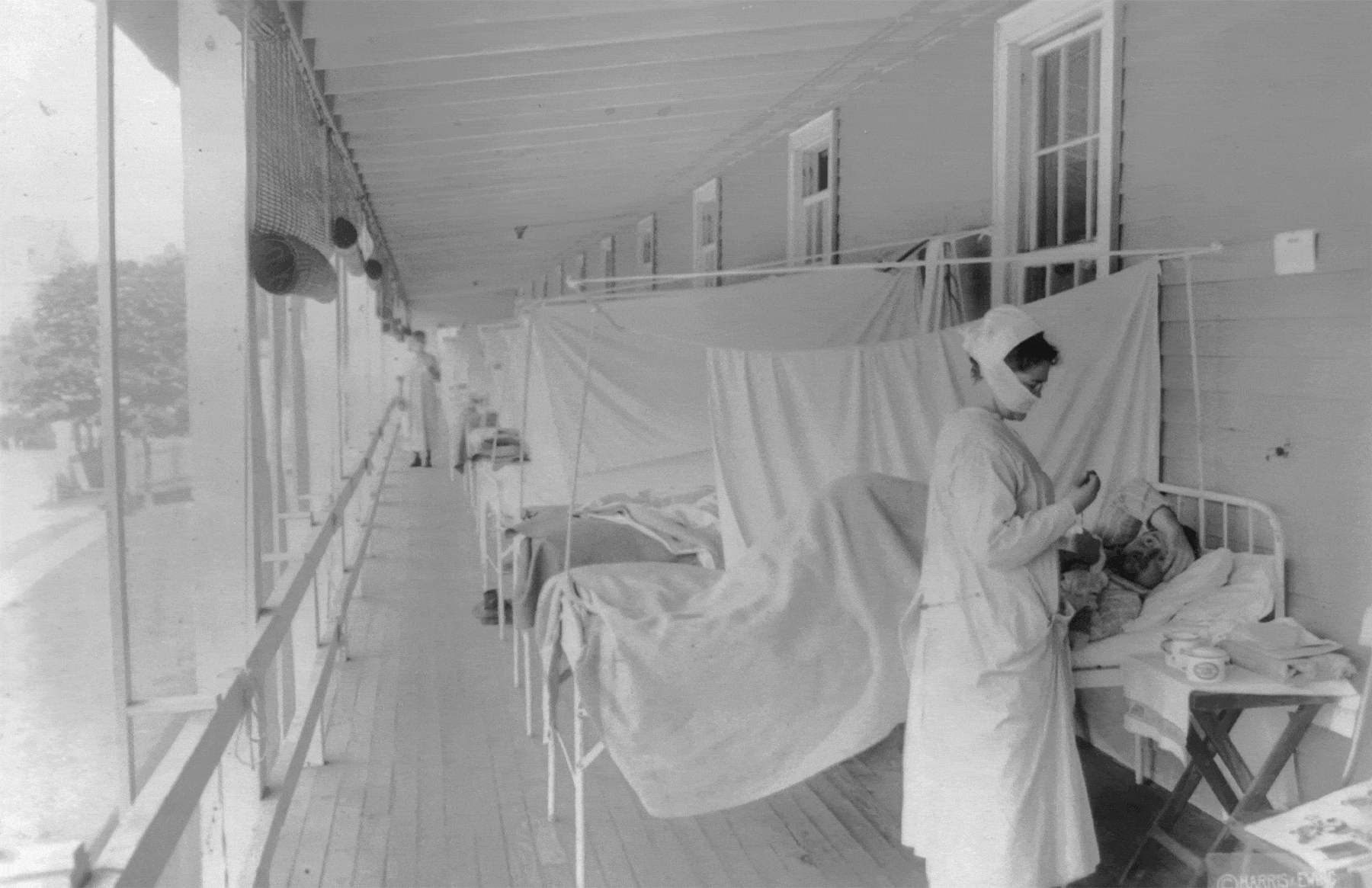
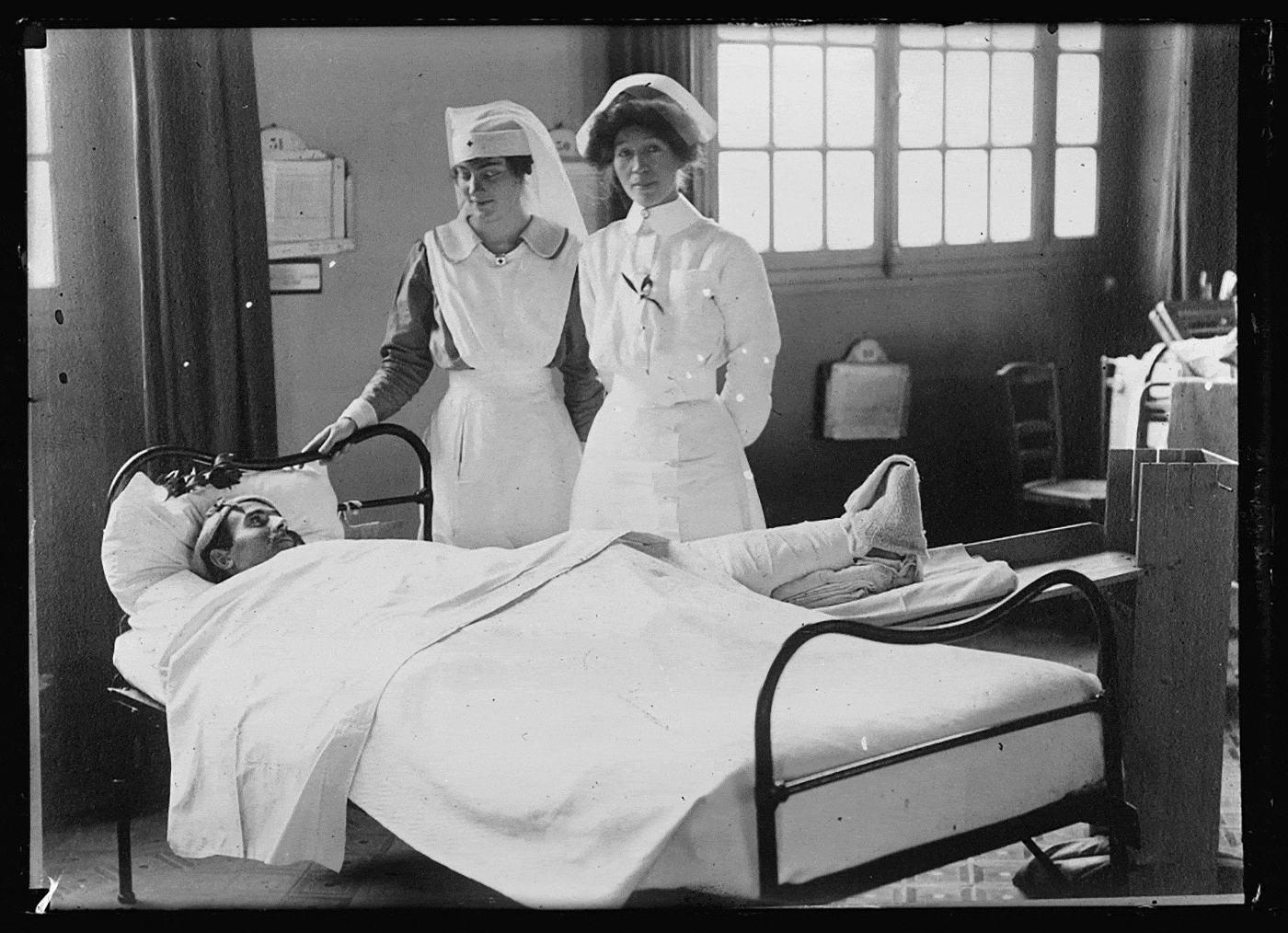
The history of nursing provides another example. The title of Susan Reverby’s percipient and influential 1987 book about American nursing, Ordered to Care, contains a triple pun. First, professional nursing has deep roots in religious orders. Second, nursing work has to be carefully ordered in space and time (architecture has been important here). Third, controversially, nurses are commanded to care — to manifest a subjective sentiment of caring for in addition to taking care of.
Reverby explores the critical difficulties that arise from ordering people to care in a world that, as she notes, “refuses to value caring.” She tells a cautionary tale about promoting care as a professional competency, noting how this expectation has made for constraints and barriers, obligations and regrets.
If I put those two examples together, you can see my anxiety: Who will order the design disciplines to care? Who should professionals care for if not the bottom 40 percent? How do we repair a world when that world is not yet built?
— David Theodore
On Collective Repair in Belgrade
My water heater flatlined this summer in Belgrade. The water here in Serbia is harder than in the U.S., and a water heater constantly churns out calcium-based sandy scales. They slowly bake onto the wiring, and then it goes. In other places I have lived — all in the U.S. — most people at this point would set off to replace the unit. But in Belgrade, with the help of local knowledge (embodied in my friends, for whom response was automatic), we opened up the water heater’s belly, and once its accumulated beach was flushed into the tub, pulled out the broken part. Hardly a block from my childhood apartment is a small store, its female shopkeeper skilled in instant part-and-model recognition. (Nearly every neighborhood in the city has a store like that.) The old wire was out, the new one in, and the heater humming before we had cleaned up the muck.
All global consumer luxuries and brands are available in Belgrade today, but reliance on them is still relatively new. Here, one knows how to make things stretch beyond their designed obsolescence. Private acts of mending, as well as small-scale making, continue, despite the entwining of (more and less legal) global supply chains, and despite the efforts over the last three decades or so to “teach” people in this corner of the world to be proper (neoliberal democratic) consumers.
Belgrade activists would prefer that clean air in EU capitals not be achieved through lithium extraction in their backyard.
Pummeled by various local instantiations of multilayered planetary crisis, the need for repair in Belgrade is everywhere apparent. From the tragic political destruction and self-destruction of Yugoslavia; to the privatization of collectively owned resources for the personal benefit of a few corrupt oligarchs, along with first-world (and increasingly, also, second-world) companies; to the intensification of global military interests in this region; to tolerance by the EU and NATO for local autocrats (following on decades of extremely consequential intolerance of same); to populism promulgated both by social media and the church; to the crumbling of social and academic infrastructures; to previously unimaginable inequalities; to brain drain; to dying bees; to the fumes of first-world trash burning nearby for the sake of private profit; to the ever-more volatile weather, people here live within tangled forms of brokenness. Brokenness has “world-disclosing properties” as Steven Jackson writes in “Rethinking Repair.” It’s an insight crucial to reorganizing our disciplines — so enamored, historically, with progress — as we seek to reshape the built environment around fragility, uncertainty, and collaboration.

Since early August of this year, people across the country have been (again) vigorously protesting the opening of a lithium mine, in the Jadar Valley. by the British-Australian corporation Rio Tinto. In 2004, large deposits of lithium (think batteries, electric cars, “smart cities”) were discovered in this part of Western Serbia, reportedly sufficient to meet 90 percent of the EU’s present demand for the mineral. Citizen protests in 2022 stopped the project. The Serbian government reinstated Rio Tinto’s license earlier this year, arguing for the value of jobs and corresponding increase in the country’s GDP. Citizens, on the other hand, are rising (again) to defend their air, their water, and the health of their soils. These advocates for future generations are fueled by commitment to the common good. They would prefer that clean air in EU capitals not be achieved through extraction in their backyard, which is certain to destroy their children’s lives regardless of any promised economic benefits.
Narratives of repair and climate crisis are being deployed to explain the EU-backed Rio Tinto effort in its own EU context. The Serbian president and his media machine spin the deal as a driver of economic repair. But the fight for repair of the planet requires political awareness of collective good, and of possibilities for collective action. For various historical reasons, the citizens of Serbia might be especially attuned to such possibilities: they have repeatedly lost their battles with the colonizing, extractive forces of capitalism both global and local, and this has inoculated them against spectacularizing ideas of repair. They know that the only kind of repair that can match the urgency of compounded environmental and political crises entails commitment to collective good at scale.
— Ana Miljački
Nature Beyond Repair
As frightened as I am by changes that I feel and see due to increased global temperatures, I am also disturbed by the visions of nature embraced by architects, landscape architects, and urban designers as a response to climate change. Throughout modern architectural history, architects addressing climate have often used language and concepts drawn from eugenic theory. Six decades ago, “bioclimatic” architects invoked the eugenicist geographer Ellsworth Huntington’s theories to arrive at the ideal environmental conditions for their building designs.
Today, designers utilize building materials, plants, and other organisms that uphold narrowly understood natural capacities and functions. Weakness and impairment — broadly defined — have frequently been negated in architects’ visions of future nature. Due to climate change, some now want to design these qualities out of natural history itself.
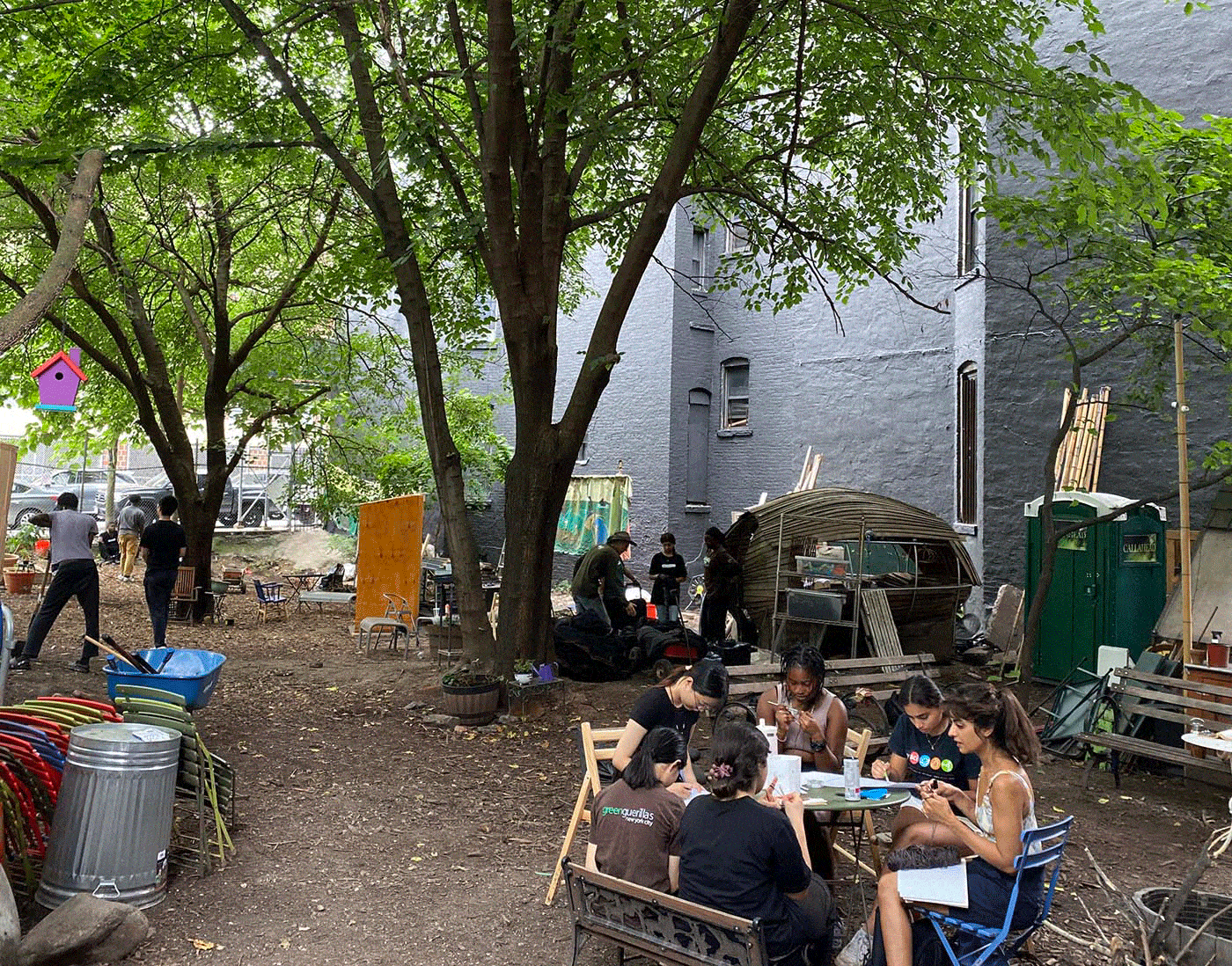
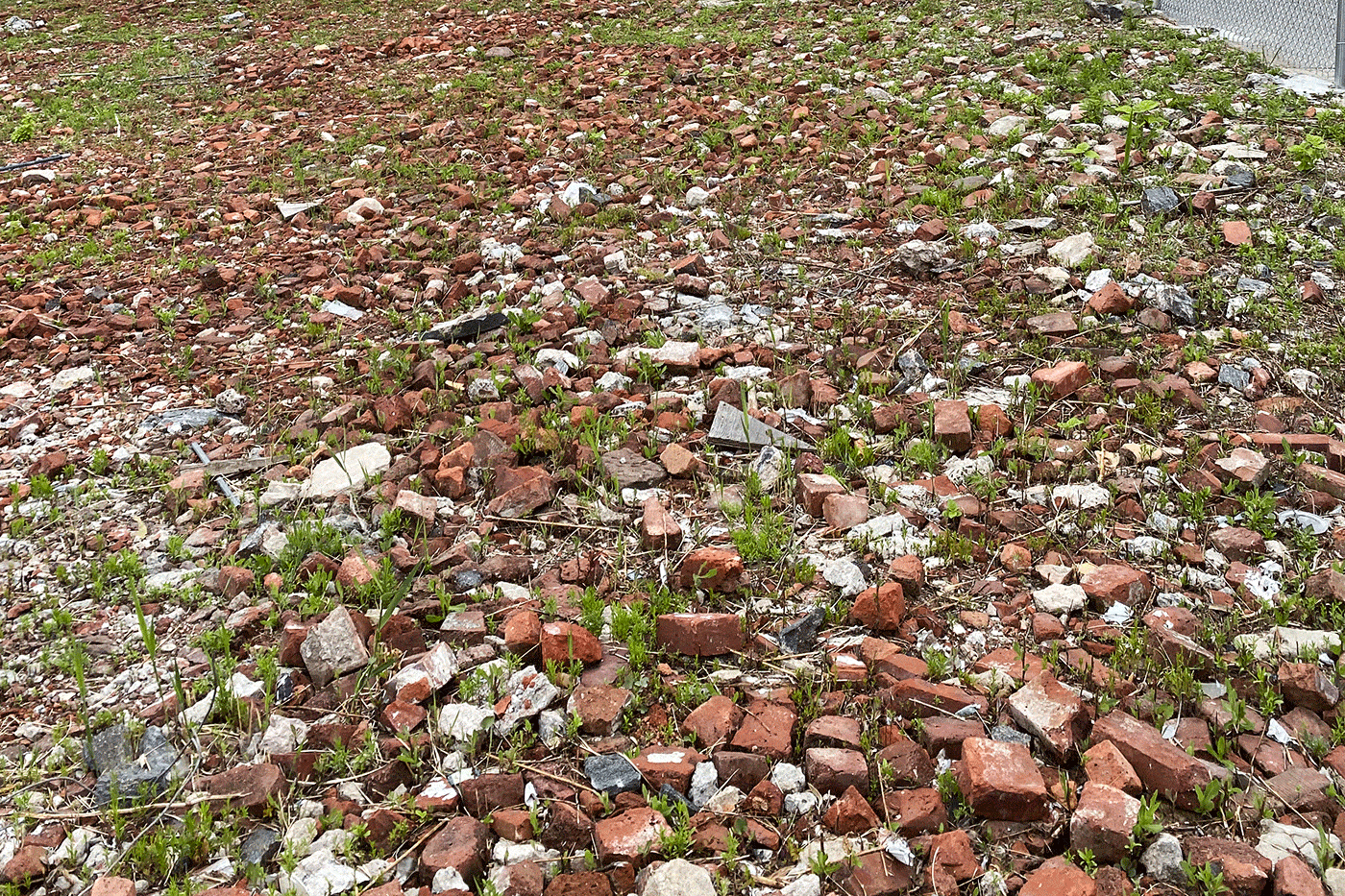
Some of the least functional-looking urban landscapes sustain a complex biodiversity that belies their wasted appearance.
Certain plants are seen as “good” because they absorb carbon; certain species of aquatic life are given habitats in which to thrive because they cleanse urban waterways; certain insects are deemed beneficial because they promote the reproductive capacities of comparably beneficial plants. This attitude — in which physiological processes are mechanized for narrow purposes, according to narrow values — extends to the design of future life in more explicit and systemic ways: scientists in Australia recently proposed to breed “super-corals” resistant to ocean acidification, while in the western United States, a group of botanists wants to reengineer the genetic structure of redwoods to create hardier species. Such strategies may promise to mitigate the worst impacts of environmental damage. Yet they devalue the very vulnerabilities in life that they attempt to protect.
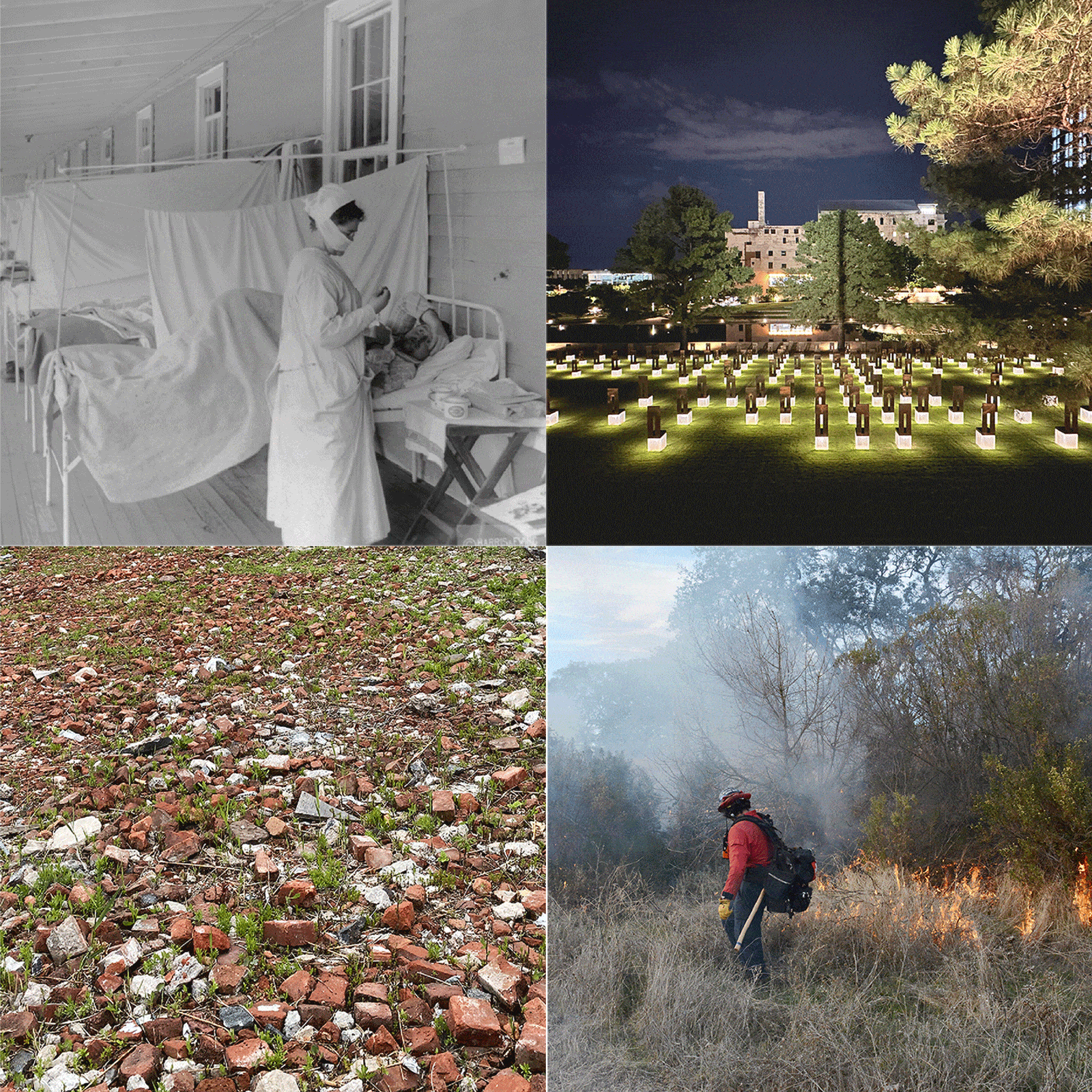
There is a place for those of us who want to steward weak or useless forms of nature. Recent discoveries in New York have shown that some of the city’s least vigorous or functional-looking urban landscapes — fields of brick debris, muddy urban lots, weed-ridden mounds — absorb heat, extend pathways for water during flooding, and sustain a complex biodiversity that belies their wasted appearance. They don’t look useful or naturalistic, but they help to address the adverse realities of climate change. For me, many of these sites represent an “anti-eugenic” response to urban landscape design: for years, people protected them from destruction despite their presumed lack of ecological and economic utility.
Because nature is understood as a basis for society, and because it is manipulated and sustained by architects and designers, the qualities that we valorize in the environments and landscapes we design lay a foundation for our politics, and even our subjectivities. For some, strength, capacity, and vigor are the most urgent values in times of crisis. For me, not so much. They are only some of the myriad physiological qualities that can be upheld and cultivated within our practices.
— David Gissen
Reparative Possibilities in Oklahoma City
Like many Oklahomans of a certain age, I remember where I was on April 19, 1995, at 9:02 am: eighth-grade keyboarding class at Summit Middle School. My school was about twelve miles from the Alfred P. Murrah Federal Building, but I had not felt the blast, which newscasters later reported was perceptible up to 40 miles away. The school was partially underground; the architects had intended it to serve as a tornado shelter. We had no exterior windows in the classroom.
When the bell rang, I stepped into the hallway to pandemonium.
I made my way to the portable trailer-style classrooms where core classes were held. Our social-studies teacher wheeled in a TV cart. A student helper pulled down the shades and turned off the lights. We sat transfixed as events following the terrorist bombing, still the deadliest domestic attack in U.S. history, unfolded in real time.
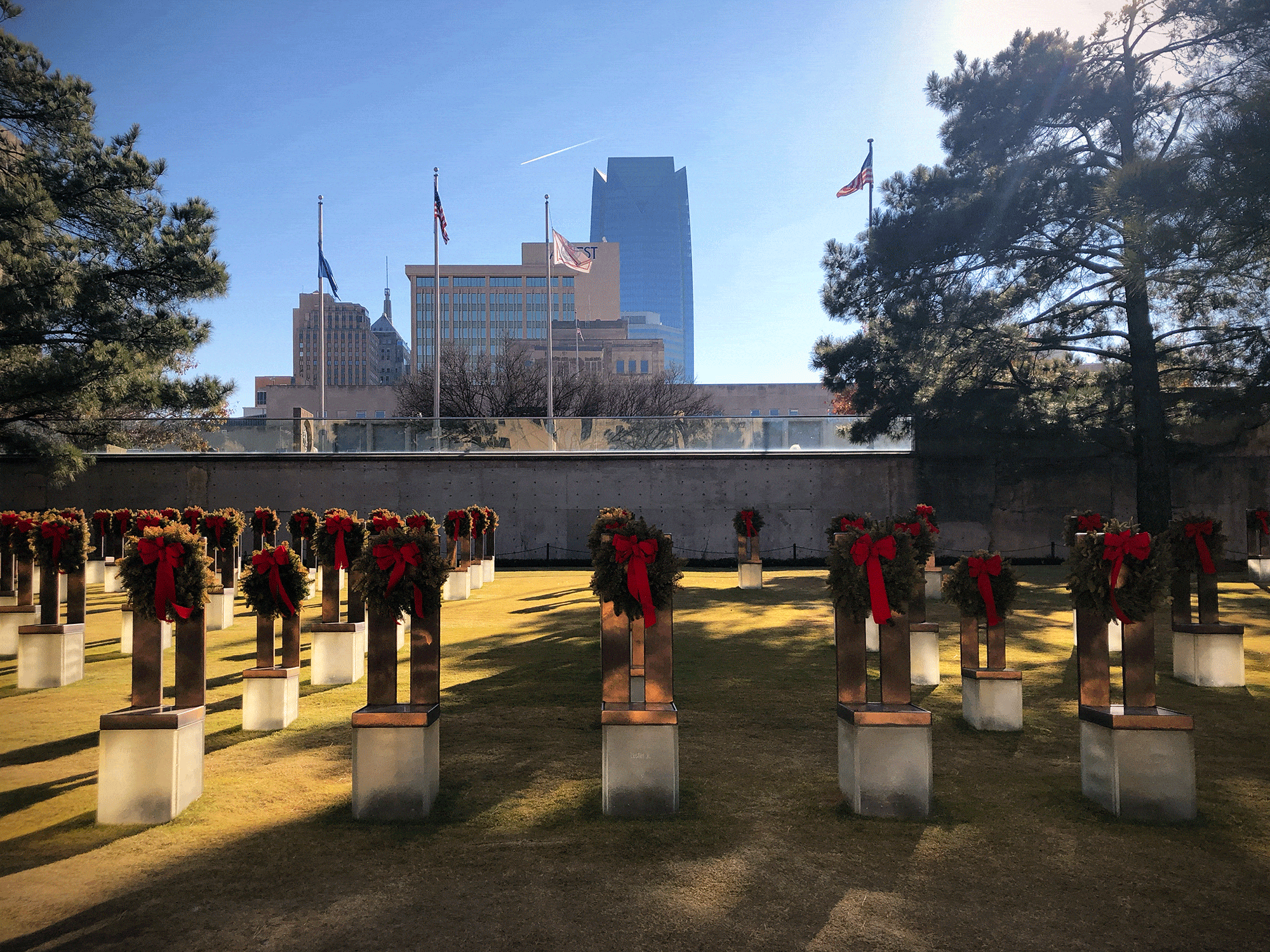
Just about every time I visit home, I return to the Oklahoma City National Memorial. It interests me as a preservationist, and as an architectural historian who has worked closely with national historic sites, landmarks, monuments, and memorials. More than that, it provides what I need — a place of refuge. Release. Repair.
It may be that I am too close to the subject to feign objectivity. Or it could be that what I gain from this memorial is the hallmark of great design. The site does exactly what it aims to do, according to its mission statement: to “offer comfort, strength, peace, hope, and serenity.” This is achieved through the memorial’s contextual materiality, its availability as a sanctuary, and the connection it facilitates with life and earth cycles.
Every time I visit home, I return to the Oklahoma City National Memorial.
Let’s consider its contextual materiality. Representing the site’s former lives, the memorial incorporates physical matter that survived the blast, including portions of granite, a concrete wall, and the building’s intact entrance plaza. A 100-year-old American elm that sustained damage in 1995, known officially as the “Survivor Tree,” is carefully stewarded in a second plaza at the northeast end of the site. It is a proof of life, a reminder of nature’s resilience in the face of manmade destruction.
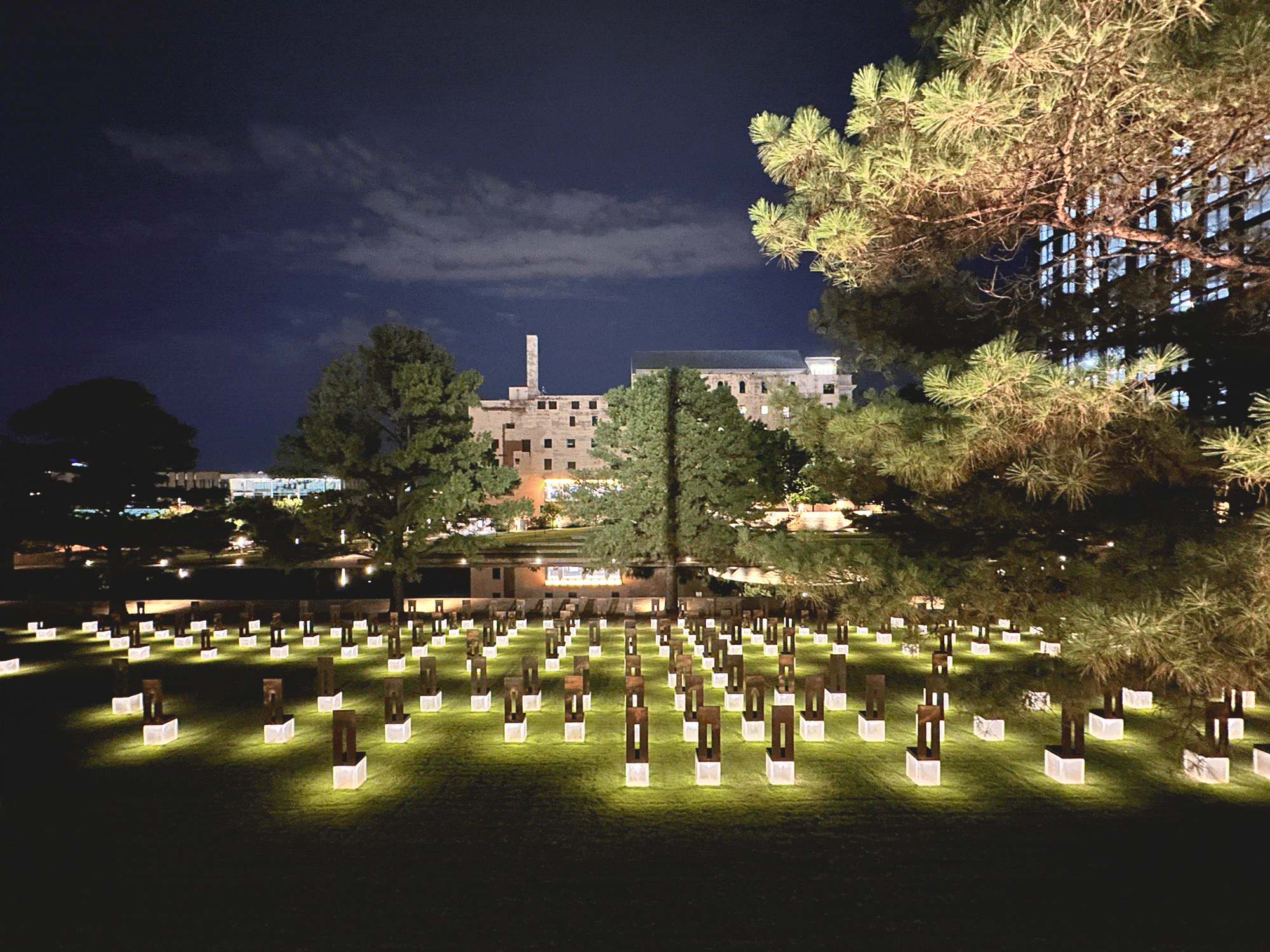
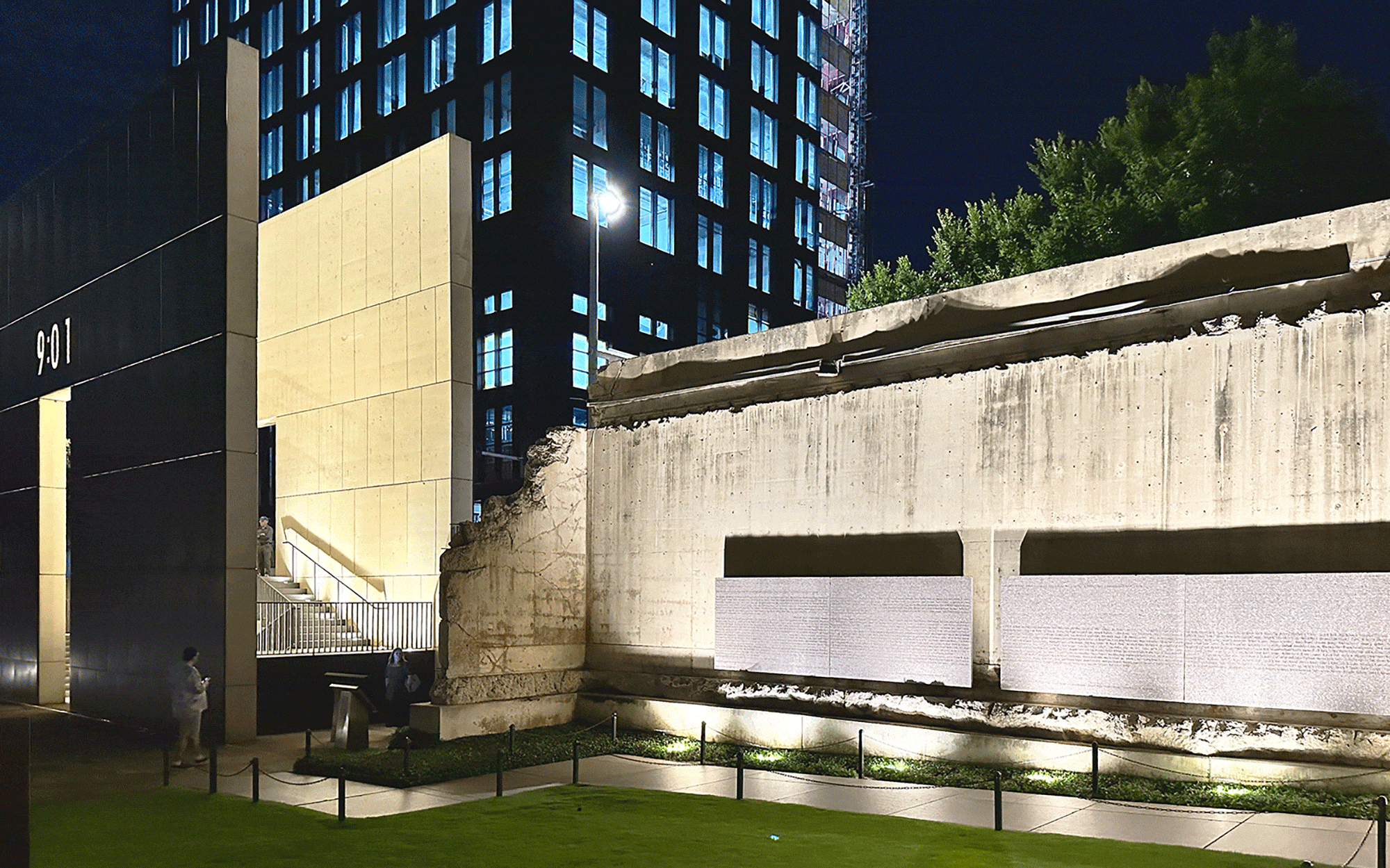
Let’s also consider its capacities for interstitial dwelling and cyclical reminding. The complex offers visitors a combination of wide-open vistas and secluded, semi-enclosed spaces. The park-like setting provides opportunities to sit and reflect, encouraging embodied awareness in a space that bridges then and now. Over the course of a year, or even a day, that space takes on different affects: bathed in the brilliant Oklahoma daylight, or haunting and peaceful in the dark; leafy and green, or dusted with snow. As the earth rotates on its axis, and travels around the sun, this combination of animate and inanimate objects provides continuously changing yet stable spatio-temporal touchpoints.
And finally, let’s consider the reparative possibilities. As visitors to the Oklahoma City National Memorial, we are granted the chance to reacquaint ourselves with a site of trauma, and at the same time to create new memories. The goal is not to erase images of devastation seared in our minds, but to develop new epistemological potential in association with the place as it now exists. This process involves not just the location itself but also the visitor’s mind, body, and soul.
We must understand that reparative design cannot deliver a one-time solution to a stated problem. Rather, it should offer ways of addressing traumas across their multiple scales, dimensions, and temporalities.
— Amber N. Wiley
Building and construction are often associated with new designs and flattened or disused sites. Yet, rather than proposing new metaphors for architecture, we should be asking what these terms could mean if we rethink how they are used, and what they might signify.
To consider reparations for Atlantic slavery as a ‘construction project’ is to propose to radically remake the world.
In Reconsidering Reparations, Olúfẹ́mi O. Táíwò suggests that we consider reparations for Atlantic slavery as a “construction project.” A proposal to radically remake the world as we know it, this vision is grounded in the importance of historical “world-building,” as well as in alternative imaginations of global institutions and infrastructures. Táíwò draws on the writings of political scientist Adom Getachew, which show how the anticolonial project has understood Atlantic slavery, colonialism, and associated structures as world-instituting systems. The only way to respond is to imagine construction of an alternative world across scales, from grassroots initiatives to trans-local and global networks. As Táíwò argues, such repair — in the face of ongoing racial capitalism and the environmental devastation that results — requires imaginations, institutions, and infrastructures that can protect against exploitation and extraction.
To build such institutions is a construction project. This is not to suggest that we can work from a tabula rasa, but instead that we must build on and with the imagination of earlier generations, thinking with chosen ancestors. For architects, the invitation is to understand building and construction not as necessarily constituted by newness, but by ongoing acts of repair and maintenance.
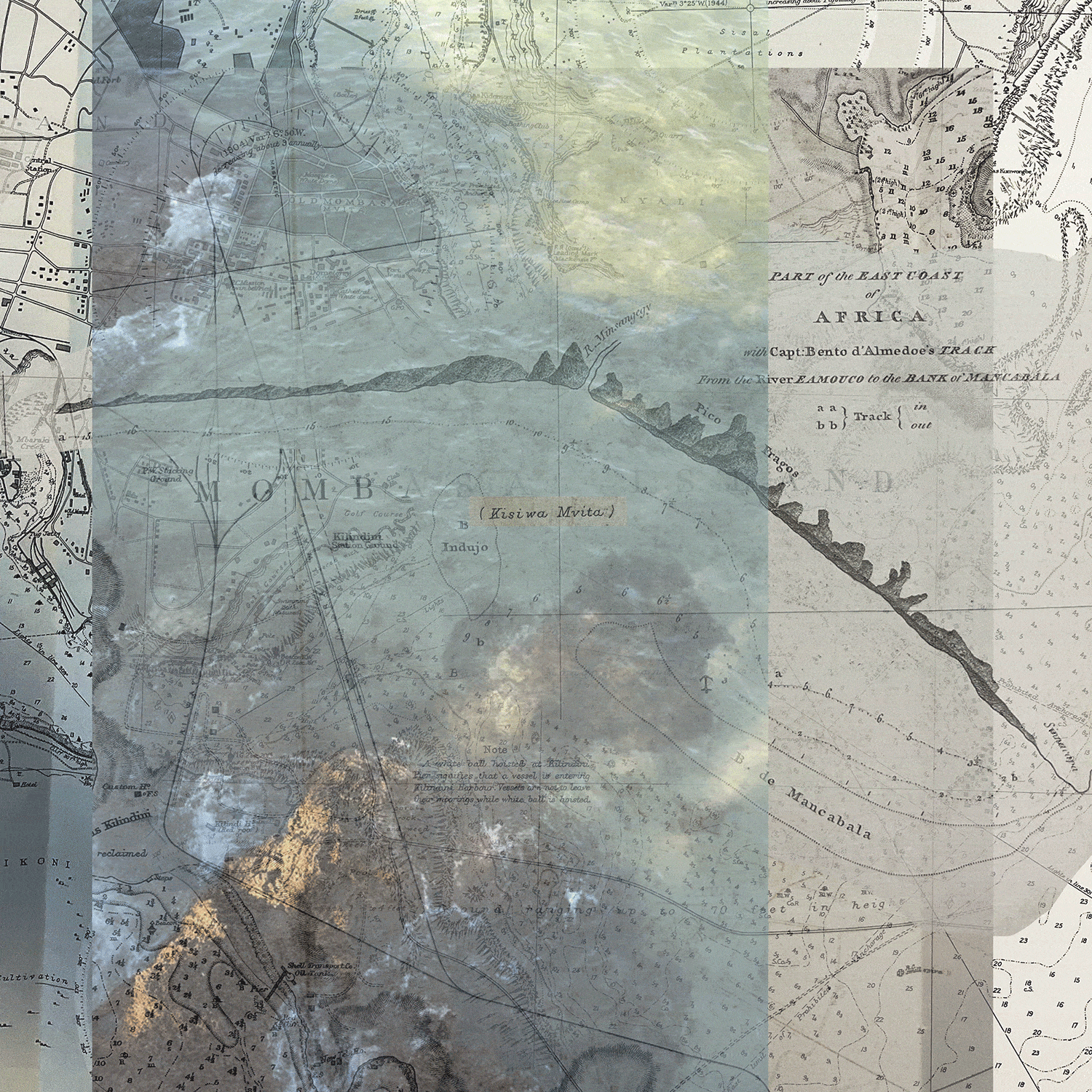
In a current research and pedagogy project, I have been asking how we might reconsider architecture from the position of oceanic and watery archives. In a third-year architectural humanities course, watery territories become a starting point for questions about modernization and development, leisure and extraction. At the same time, following watery histories requires that we remain with trans-oceanic and global currents that inform and give form to urban environments. The historian Dilip Menon, for example, rethinks the meaning of Bandung at Sea, observing that the 1955 anticolonial African and Asian Bandung conference (held in West Java, Indonesia) was preceded and succeeded by multiple Afro-Asian world-imaginaries.
Along with students and other interlocutors, we look at archives as sites from which we might build futures we have been told are impossible. One such resource is the Index of Edges, a collection of stories (curated by me for the Venice Architecture Biennale in 2023) that charts east African coasts from Cape Town to Port Said. This collection ranges from songs, to Swahili poem-maps, to histories of urban revolts that remain alive in memory, to practices of caring for (and returning to) oceans inhabited by corals, fish, and djinn, to traditions that understand construction as ongoing across generations — all pointing towards building as a practice of world-making.
— Huda Tayob
Triage of Care
One can care about almost anything. A place. A person. An imperiled fish species. Money. A good haircut. The vanishing of a (relatively) stable climate.
To choose what to care about is to determine how the world gets made, and fixed. Care (caring) is guided by values and beliefs, which in turn guide actions.
In this light, caring isn’t inherently a good thing; there are forms of caring that can cause harm. Consider, for example, wildfire suppression. As practiced in the western United States, fire suppression consists of policies and techniques premised on the belief that fire is bad and destructive. This is a belief based in ungrounded, settler-colonial understandings, and enabled by the expulsion of Indigenous people and their ways of caring for the land — which is not to suppress fire but instead to tend the land with fire, and in this way foster sustained biodiversity.
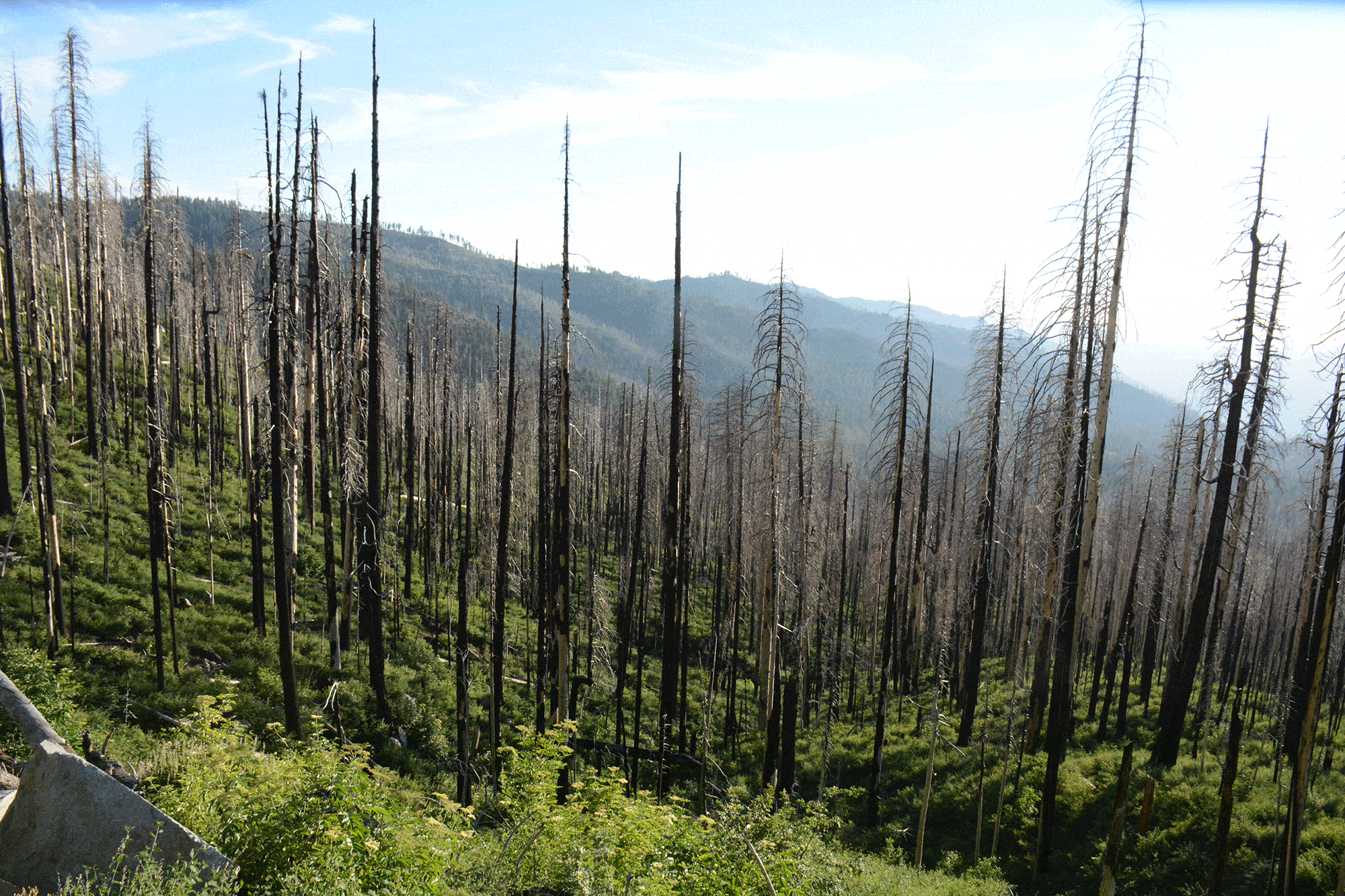
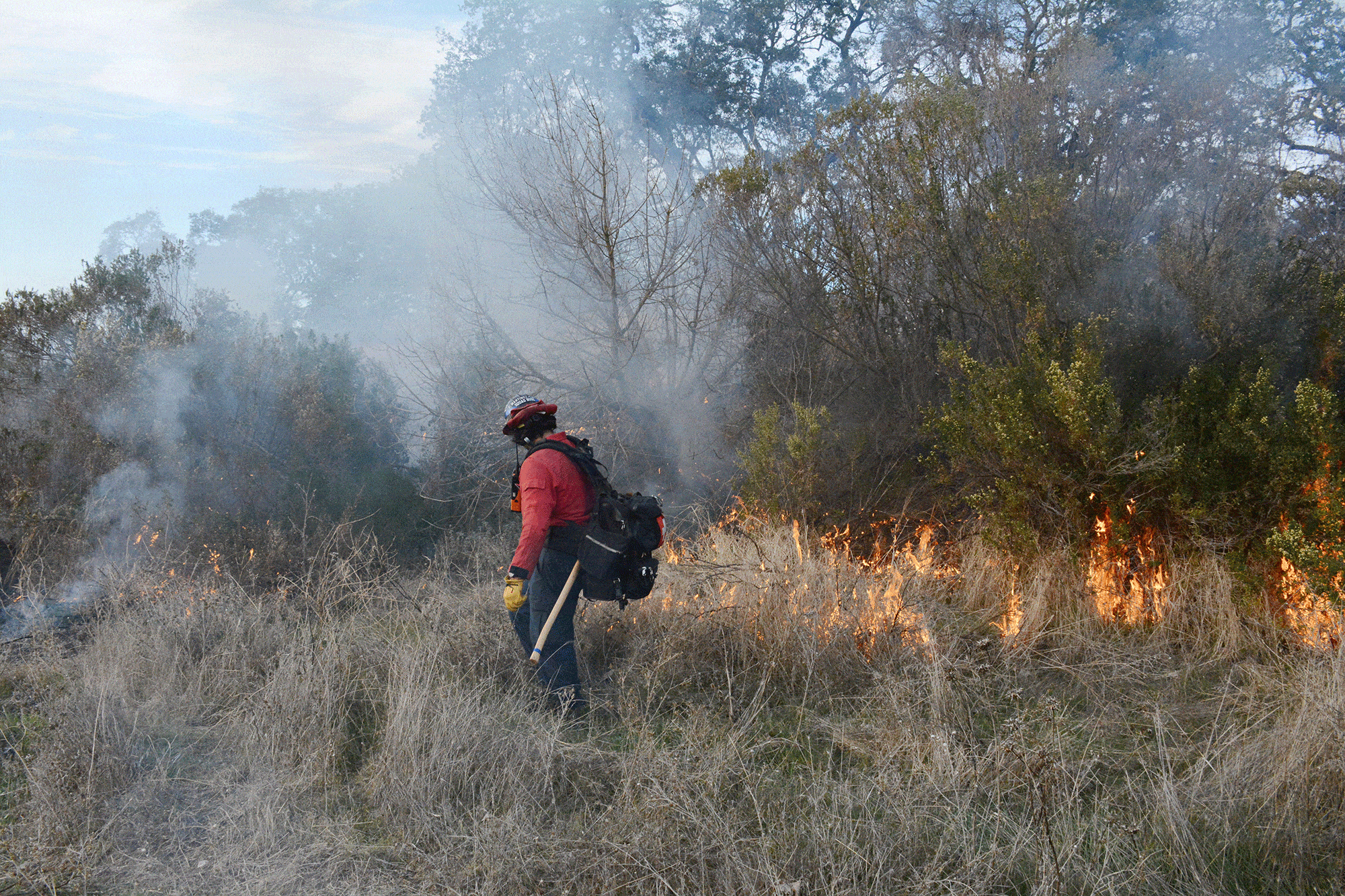
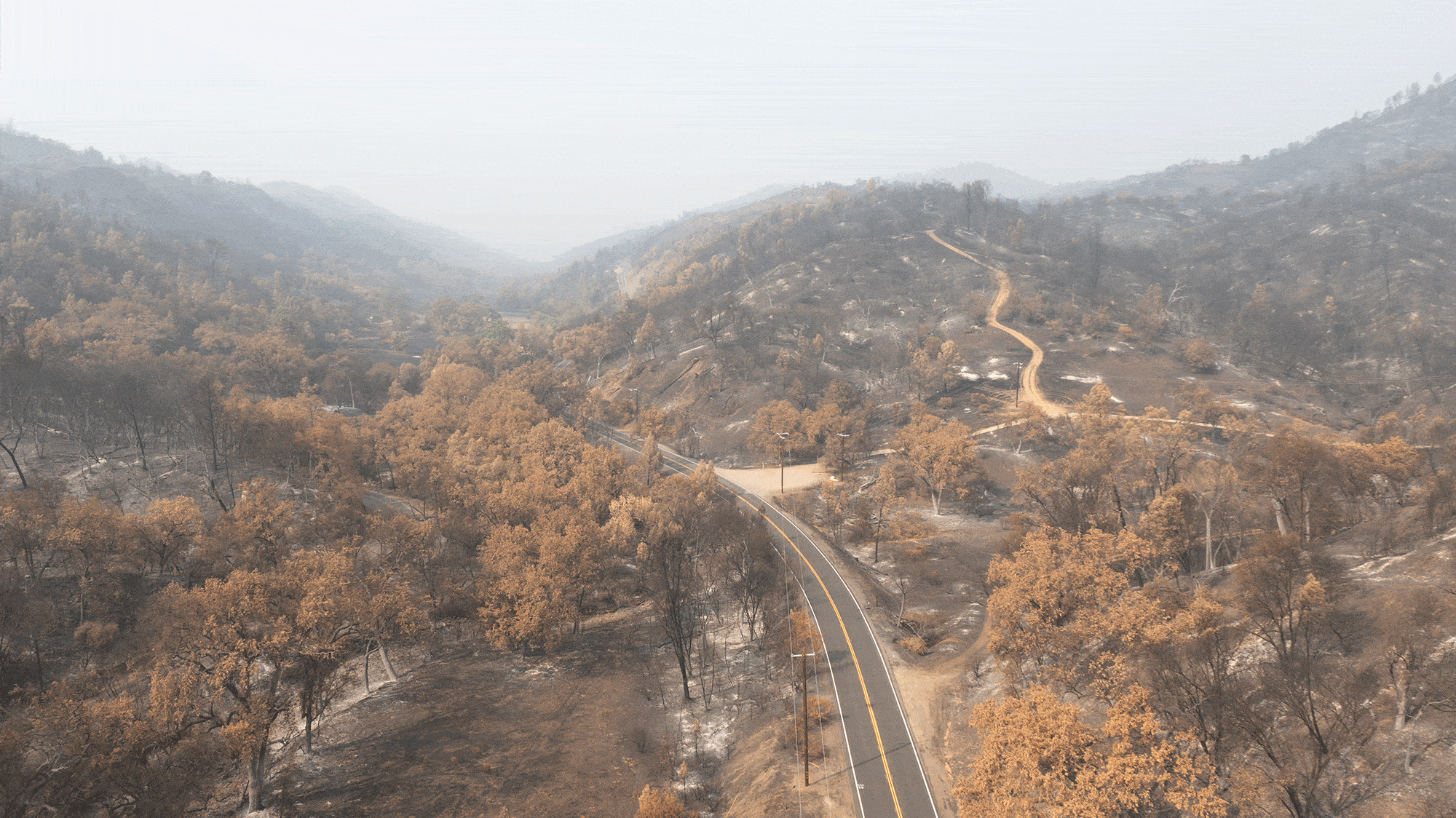
These two forms of care couldn’t be more different. Colonial practices have largely replaced Indigenous practices — and worlds have been remade (and unmade). Here in California (where I live), most landscapes are nothing like what they were a century ago. Colonial novelties, and their impacts, abound. The Sierra Nevada Mountains are a case in point. Due to fire suppression policies, the forests are densely overcrowded with trees, and what was once a diverse patchwork of meadows and chaparral has also become forest. Today much of this range is covered in an anthropogenic, gargantuan, homogenous, feral, freakish, vulnerable massing of vegetation. As a result, when these lands catch fire and burn, the fire is much larger, more severe, harder to manage. The excess fuels burn so hot and so intensely that near full immolation occurs, killing just about everything, including the soil. The landscape is thrown back into a weird state of primary succession; it becomes a vast territory of undesired and uncontrollable novelty. What will it metamorphose into next? Scientists are puzzled.
Colonial practices have largely replaced Indigenous practices — and worlds have been remade (and unmade).
Today, efforts are afoot to restore these lands through reparative techniques that include forest thinning, prescribed burns, and other methods that seek to design with fire, rather than against it. But given the scale of the problem, and the immense efforts and resource that will be required, there is no feasible way to undo what’s been done. We are living in a radically different world.
Those who are charged with stewarding these environments tell me they are struggling to make difficult decisions about which landscapes to prioritize. Whether the threat is wildfire, or coastal inundation, or habitat migration, we can’t keep or save all that has been remade, not even close. Retreat is currently a taboo topic, but it will increasingly define our future.
In the ruins of colonial capitalism, in a time of accelerating, unavoidable newness, how do we intentionally and equitably transition into … something else? How will we decide what to save and repair and what to let go? Who decides? In our damaged world, how will we create a triage of care?
— Brett Milligan
A house is a garden for living in
Every evening, I return home to a heap of fresh Amazon packages sitting in the foyer of my apartment building. Come morning, the recycling bin has overflowed with flattened parcels and empty cartons. Our dwelling strikes me as a voracious gastric system endowed with an insatiable appetite for boxes. Every morning, I, too, get spit out, sent to restock on the strength of my purchasing power. I can come home with fresh new possessions, or find them waiting for me.
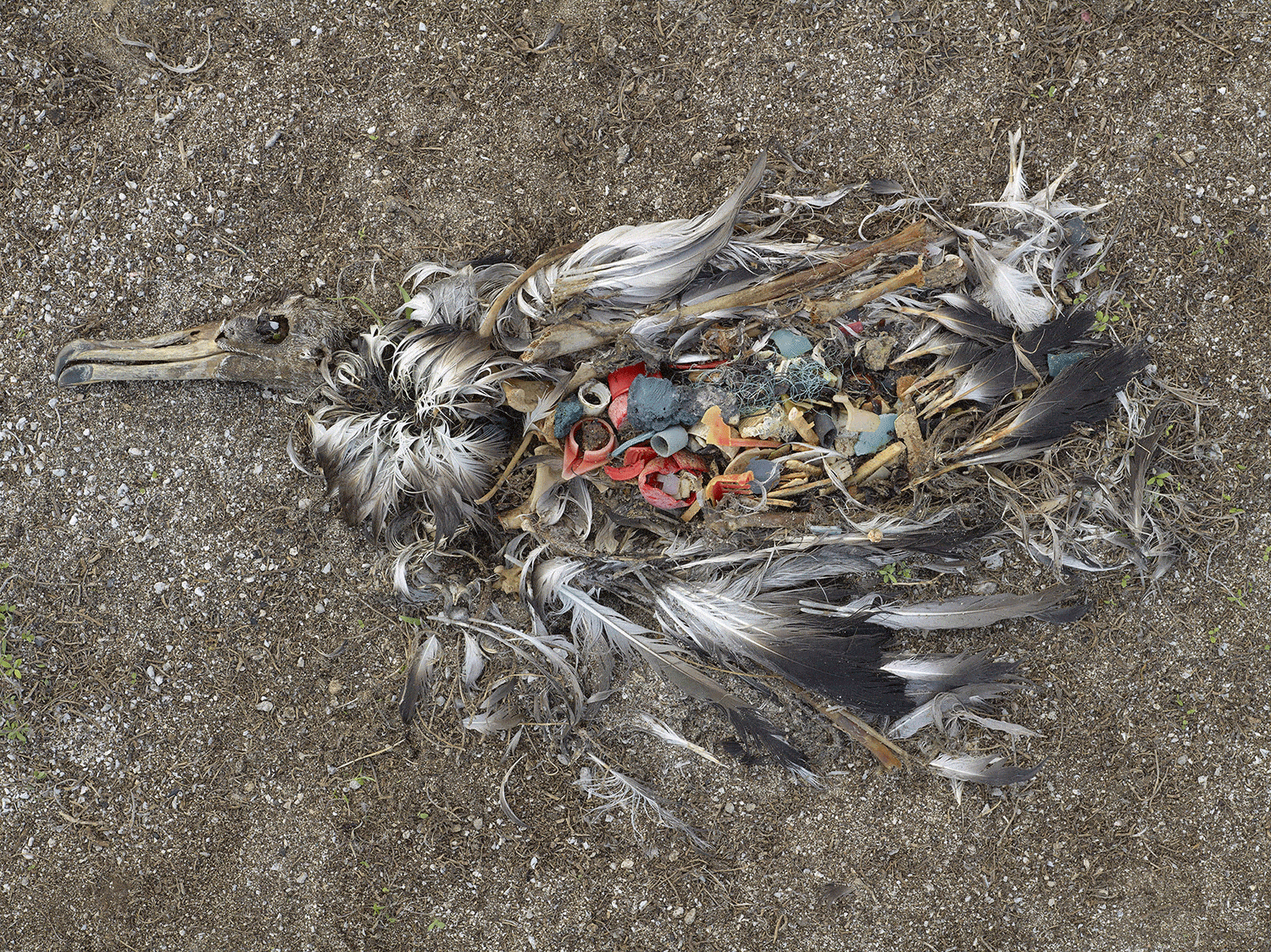
Long before houses became high-metabolism “machines for living” plugged into all sorts of circulation networks, material and energy flows were largely contained within perceivable boundaries. Generation was indissociable from regeneration. For example, before plumbing and appended appliances invisibilized the arrival and disposal of water, the art of dwelling oversaw how it was locally drawn, stocked, used, dispersed, and returned to the ground carrying useful nutrients such as natural NPK. Materials that visibly circulate between society and nature are never characterized as waste.
Commodities created trash. Running water bred sewage. Energy and matter arrive from ‘elsewhere,’ and entropic waste departs for ‘nowhere.’
Without perceivable boundaries within which materials circulate, waste is made invisible and externalized as someone else’s problem. Its erasure from sight is purchased, as is its appearance as goods. Commodities created trash. Running water bred sewage. When energy and matter arrive from “elsewhere,” entropic waste departs for “nowhere,” the no-place that institutes energy-on-tap as a utopia. The boundary of a system may be conceived at the scales of the body, household, plot, neighborhood, city, bioregion, country, or planet. The larger the scale, the greater the amount of waste externalized elsewhere — to the back alley, to the other side of the tracks, of the border, of the earth. To the ocean. To the sky. The energy cycles of high-income societies vastly exceed those of natural systems, widening a metabolic rift detrimental to both low-consumption societies and the environment. Downscaling the scope and speed of these cycles is imperative. We inhabit fragile, exhaustible ecosystems, not perpetual motion machines.
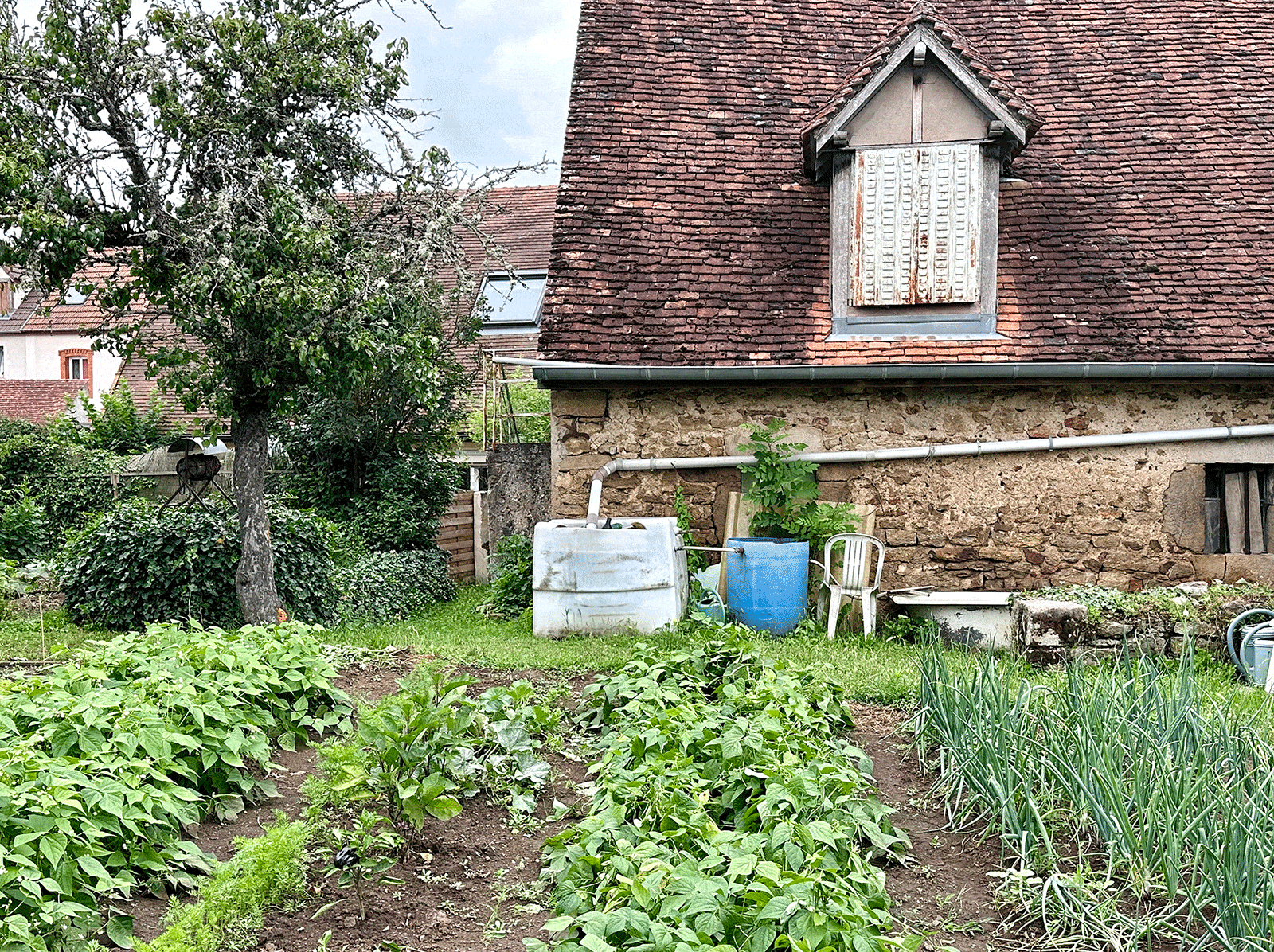
While entropy measures the degradation of “useful” energy into unusable states, it also measures a lack of knowledge about a system. In what one finds unusable, another may see a treasure, and recover its usefulness. Likewise, “disvalue” measures the degradation of (economic) worth into waste, but we do not care for what has value as much as we value that for which we care. To care for is to love is to heal is to spoil with attention. It is to mend and to tend; to nurture and feed and fix. Respect for economic value strengthens alienation; respect for affective value engenders gratitude. As the song lyric goes: “it’s not having what you want, it’s wanting what you’ve got.” To look for meaningful, creative acts of care and repair helps restore the clarity of our gaze.
The art of dwelling is a form of gardening. To engage in its practice yields pleasure and embodied know-how. Because I spent time mending the old velvet curtains, I balk at the idea of uselessly turning on the heat. Because you carefully optimized wind drafts and crafted nanoclimates throughout the house, you triumph in shunning the AC. Because they renovated the old grandmother clock, they delight in the ritual of winding its weights. Because we imaginatively collect the rainwater, we don’t pour it down the drain.
— Mireille Roddier
On the Repairing Earthquake Project
New cracks appear each time a shard of a broken plate is glued back to other parts of the object, one after another. The visible evidence makes one imagine the moment of the plate’s fragmentation and the causative factors; whether it fell from a high or low point, or was crushed under a massive object — like the wrecked cars, electrical poles, parts of houses, ships, or immense amounts of sand that the tsunami carried inland from the seabed. Repair proceeds towards a “cure,” towards the future. But in following the preserved traces of breakage, one’s mind travels back in time, to the tsunami and its aftermath. This contrast between tangible repair and the imaginative process it evokes may be the source of the special bond that these mended objects generate with their viewers. Observing an object standing on its own again gives a sense of comfort, hope, and a feeling of being connected to the actual owner to whom the plate belonged.
Such phenomena have recurred frequently during the Repairing Earthquake Project, an ongoing artwork that I initiated in 2011, centered on repairing objects destroyed by the tsunami in Tohoku, Japan, in March 2011.
Not exploiting the subject for my own merit has been central to my project, which has challenged my role as an artist in society. In the tsunami-hit areas, I strive to act with the utmost ethical consideration, hoping that the work will meet communities’ needs in one way or another. Through dialogue with locals in the initial days of the project, I discovered that some in the region were discouraged by the lack of recognition, in the media, of their intense efforts toward restoration — and of their very existence. Consequently, various aspects of my acts of repair, such as cleaning the broken objects, sorting, measuring, numbering and naming them, transporting and storing them, and gathering the objects’ stories, gained additional significance. In my work, humanity always prevails over technicality. The accumulation of these mundane actions is what constitutes the true “repair.”
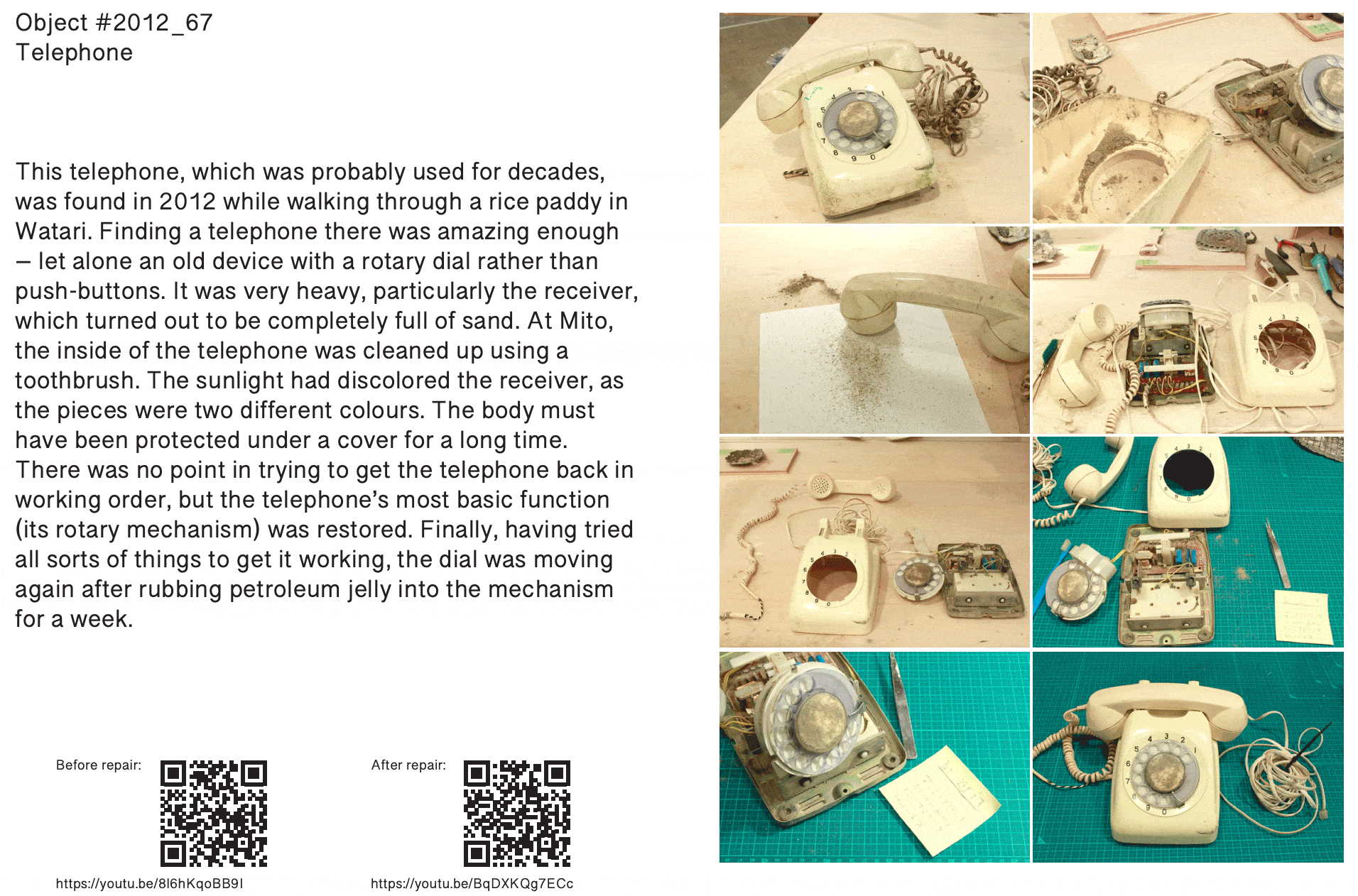
The repaired object serves as a reminder of the poignant disasters, both natural and human-made, that connect people across physical and temporal distances. Most locals in the tsunami-hit area have never seen The Repairing Earthquke Project in action. Repair at the location was impossible because of the lingering destruction. Yet I hope that their stories can be conveyed.
The repaired object serves as a reminder of poignant disasters, both natural and human-made, that connect people across physical and temporal distances.
A set of rules, developed through the repair process, reinforces this ethos: consider thoroughly to find the best approach for each object; repair semi-permanently (no easy solutions), integrating both creative and rational thinking; employ simple methods; be flexible, handling with care; do not overdo; remember that the object came from Tohoku, with all that this implies of life before, during, and after the earthquake; retain visibility of the original damage; and remember that the object always belongs to the original owner, even if it goes to a new home. I do not sell repaired objects, and ask my acquaintances to shelter them; each caretaker has signed an agreement stipulating, among other conditions, that the object must be returned to the original owner if he or she shows up. (To date, however, no original owners have been identified.)
I would like to conclude with a description of one of the repaired objects from the project. I hope you find it compelling:
Object #2012_67 (Telephone), found in a rice field in Arahama, Watari town in Miyagi Prefecture in 2012. Seawater from the tsunami still lingered in the rice field one and a half years after the disaster. The heavily rusted dial of an old telephone, filled with salty sand, regained its ability to rotate following intensive cleaning and lubrication. The telephone found its “foster parents” in Rotterdam in the Netherlands, who built a special pedestal for it. They continue to ponder whether the original owner will ever be identified. The footage of the telephone before and after the repair can be viewed here.
— Nishiko
Beyond Repair
Repair is an important term for architecture, because at a stroke it challenges the presumption that the discipline should be determined by the tenets of the modern project — of endless growth, of progress, of an addiction to the new. It is exactly the ideologies and actions of the modern project that have led to the climate crisis that we all live within. Repair in a conceptual sense thus works to redirect architectural practice in the face of climate breakdown. The repair of single buildings is a good place to begin disrupting systems of linear production and designed obsolescence, as well as confronting current aesthetic norms in architecture, bound as they are to (perceived) freshness.
There is a danger that ‘repair’ becomes too emollient an approach, easing the symptoms of breakdown but not addressing its violent causes.
However, such repair may fall into the trap of being — in a phrasing from my research collective MOULD — no more than a band-aid, a temporary patch over deep wounds. As with “sustainable architecture” (a now hopelessly compromised term), there is a danger that “repair” becomes too emollient an approach, easing the symptoms of climate breakdown but not addressing the violence of its causes in a truly effective manner. Even shifting the focus of repair from objects of architecture to underlying systems suggests that these systems, once repaired, will provide a basis for new societal, economic, and environmental formations. But it is almost certainly the case, given the depth of the current climate crisis, that the dominant systems are beyond repair. To “fix” the systems that have produced the breakdown is to maintain capitalist, colonial, and patriarchal norms, albeit with a gloss of respectability.

Without wishing to discount the excellent work being done in the field of repair, particularly that which consciously addresses systems of production, it is also worth looking beyond repair — to take some of its disruptive potential and apply this to imagining new formations, rather than fixing the old ones. This is a fundamentally architectural approach, because new spatial formations accompany all new social formations. To help us all on this journey, the word “repair” can be supplemented with the 15th-century word respair, which means “fresh hope; a recovery from despair.” We need to believe there is hope beyond.
— Jeremy Till
Whoopee Cushion Preservation
Over Zoom, an artist shows me a perfect replica of the Barcelona chair in red latex and steel. Based on the exact measurements of the original, with material advice from balloon fetishists and a button-upholstery expert, the recreation of the chair is faithful, deliberate, and bears a surprise: the entire seat is a functioning (and very loud) whoopee cushion. The artist, Lauren O’Connor-Korb, laughs as she explains the project, and we talk about her plans to position it in the Edith Farnsworth House, to film someone lowering themselves into it, and the explosive sound she imagines will bounce off the glass walls and travertine floor.
In an era of the “dupe,” O’Connor-Korb’s project, though hilarious, takes its history seriously. What Amazon and other purveyors of knockoffs sell is not the process, not the careful engagement of manufacturing or design, but an image, an iconic silhouette. O’Connor-Korb, I would argue, is practicing repair, a form of preservation — bringing history into the present, with some humor and some questions about our engagement with the past, rather than just blind worship.

The house she will film in is increasingly threatened by rising waters. The Farnsworth House was built in a known flood plain of the Fox River in Plano, Illinois, and the house flooded for the first time in 1950, during its construction. Over the past 20 years, this flooding has increased substantially. In June 2020, the highwater mark reportedly reached within eighteen inches of the finished floor. (The house stands five feet, three inches above the ground.) An initiative to repair just the lower deck — begun before this latest flood— is estimated to cost $500,000.
The certainty of future flooding has pushed the National Trust for Historic Preservation to explore three plans to save the house: 1) elevating it and re-grading the landscape; 2) relocating it to the north edge of the site; 3) building a permanent hydraulic system into the building’s foundation. (Two additional options, an amphibious, buoyant foundation and a barrier system, were judged too impractical to even be considered). At the heart of the NTHP’s study is concern that, while any of these transformations would arguably preserve the house from destruction, Mies’s original intent would be lost. The relationship to the river is the very reason the house is elevated, after all, so moving the house or re-grading the landscape throws the design and its relationship to the river into question; adding hydraulics would alter the original structure permanently.
Maybe this is okay?
The predicament of the Farnsworth House, after all, begs the question: what is it to “preserve” as our planet accelerates into unpredictable changes? What is it to “repair” under such conditions?
Why have we, as architects, tried to confer immortality onto the things we’ve made?
The Farnsworth House is a part of history. But this moment, too, is a part of history: a rising river, climate change, an uncertain future. Why have we, as architects, tried to confer immortality onto the things we’ve made? Do we think that, in some way, these structures will return the favor, make us immortal as well? Somehow, we’ve arrived at a place, professionally, in which we do not accept the inevitable, do not allow our buildings to be claimed by a rapidly changing world, do not allow them to end, just as we do. Our notion of preservation seems at odds with every natural process around and within us.
When O’Connor-Korb and I met, I was reminded that preserving can mean many things; it is the transmutation of a design into new forms, new contexts, new meanings. Elevation, relocation, and hydraulic retrofit would, each in its own way, mitigate flood damage — at least for now. If such efforts prove, in the future, to be no match for climate change, no match for future floods, I think we should take heart: if our buildings are truly worth preserving, they will be imagined anew by someone else, in some different (and possibly even humorous) way.
— Nora Wendl
Inspired by community liberation struggles in California’s Central Valley where I focus my work, as well as by specific activist designers about whom I’ve written at length, I founded the Landscape Justice Initiative at the University of Southern California, in 2020, to implement applied research in communities that design has not typically reached. Pedagogically, LJI seeks to fill the gap between academic inquiry and meaningful change on the ground. It allows students to participate in service learning and long-term projects with local and regional communities. It offers opportunities to learn from local expertise derived from lived experience, and to imagine design as a form of co-creation. It allows for the initiation of projects outside market structures, offering students the chance to discover their own agency.
Reparative design requires extended timescales, in order to build trust and listen deeply to knowledge- and culture-bearers in place. In this regard, I set “progress” in opposition to process — seeing repair as a process of building trust through building relationships and listening intently, and then translating that new knowledge into spatial form.
Reparative design requires extended timescales, in order to build trust and listen deeply to culture-bearers in place.
California’s Central Valley is a vast physiographic region entirely reshaped by colonial violence and capitalist gain. While it took millions of years to create the soils and conditions optimal for industrial-scale agriculture, it took 150 years of agribusiness to exhaust them. Yet despite these bleak facts, the Central Valley has always been a landscape of resistance. Which brings me to Allensworth, California, a town founded and financed by Black Americans in 1908 to fulfill a vision for self-determination.
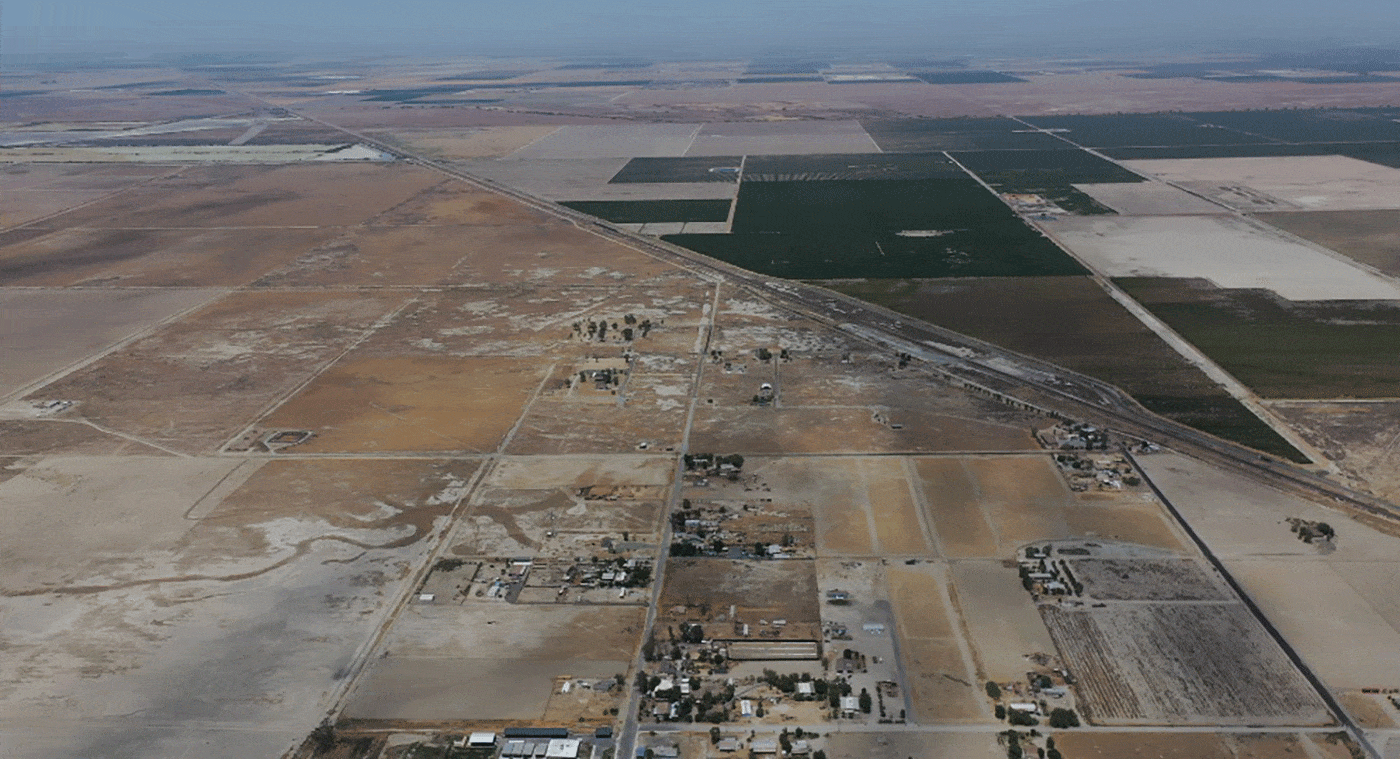

Colonel Allen Allensworth and his partners founded the town as a center for Black economic innovation, and a place for Black families to thrive. The town experienced setbacks caused by racist land developers and the Santa Fe Railroad. Finally, in 1974, the California State Parks Department purchased 240 acres now operated as Colonel Allen Allensworth State Historic Park.
Just south of the park, however, the “living community” remains emblematic of the stress on rural towns in the region. Today, Allensworth is comprised of about 600 people and is predominantly Latinx, including many farmworkers living with high levels of vulnerability related to economics, health, and immigration status. Despite such challenges, the Allensworth Progressive Association (or APA) aims to ensure Allensworth “rises again” (their phrase). Central to the vision for the future is a cooperative farm focused on the practice and education of regenerative farming — starting with repairing or healing the soil, a process that exists outside capitalist timescales.
My students and I at LJI have been working with the APA, local Native tribes, state parks, and other individuals and agencies to contribute to the future Allensworth aspires to. This work builds on Black and Indigenous practices of land stewardship, as well as strategies of mutual aid.
Such building of trust and taking care, particularly in communities that have been harmed time and again by racist spatial policies, must be “uncoupled from the timeframe of a project,” as landscape architect Kofi Boone has written. At the Landscape Justice Initiative, we aim to develop those relations of trust, to see that design practice can lead to reparative and liberatory change for the communities who require it most.
— Alison B. Hirsch




If you would like to comment on this article, or anything else on Places Journal, visit our Facebook page or send us a message on Twitter.