

A few years ago, the Pacific Blue Continent was created to unite the Pacific Ocean and its island communities. It’s a single, interconnected entity now, joined by shared geography, cultures, and challenges. There are a lot of challenges, too The notorious RIMPAC war games happen every other year, commandeered by the U.S. Navy. The Five Eyes pact of intelligence agencies has lately shilled Australia into buying three nuclear-powered submarines. The United States seems determined to draw China into conflict in a Pacific version of the Great Game. Meanwhile nations in the global north continue to extract and build in the sovereign small island states of the largest, most distant continent on Earth. (Ian Wright’s Brilliant Maps: An Atlas for Curious Minds features a curious map showing how all the continents on earth can fit snugly into the territory covered by the Blue Pacific Continent.)
It’s not just the soldiers and the spies. You have to agree that western science has not been particularly kind to the nations of the Blue pacific.
It’s not just the soldiers and the spies. You have to agree that western science has not been particularly kind to the nations of the Blue pacific. More than a century ago, the geologists and engineers arrived, hell-bent on extracting silver, gold, copper, nickel, and phosphate using bathymetry, sonar, magnetic, electromagnetic, and seismic geophysical surveys, grab surface sampling, video camera prospecting, ROVs, metallurgy testing, diamond-core drilling. You name it, mining scientists have been crawling all over the Pacific. Then there are agents of the timber industry — the plant scientists, geneticists, soil scientists, biologists, and dendrologists, ushering island trees to the construction industries of Australia and South Korea. Not to mention the hydrologists, vulcanologists, conservation biologists, ecologists, and environmental engineers, all on a mission from God. And there’s Mururoa. In the 1960s, France decided that the best place to test its nuclear defense against the threat of Soviet invasion was on a French Polynesian atoll in the central South Pacific. Boom. Yes the Pacific Islands are of interest to scientists, not only in the service of extraction industries and nuclear testing but simply in the “name of science.” Did I mention health and well-being?
All of which is to say I am feeling a little coy when I ask you to consider the possibility that small island-state social ecologies have much in common with open systems theory. Before we toss the whole proposition in the bin, consider this: Open systems research tells us that resilient buildings and infrastructures must care for the landscapes they interact with, and vice versa. The contingencies, the necessity for disturbances, the disequilibria of open systems, their very open-endedness — these totally characterize the deep imbrication of the human and nonhuman. The own game of Oceania.
Traditional communities across the huge Pacific have been rebuilding for as long as they’ve been around. They are like birds. When birds build new nests, they reappropriate bits and pieces from their umvelt. Some avian species patch up their old nests every year. It’s all about what you have at hand.

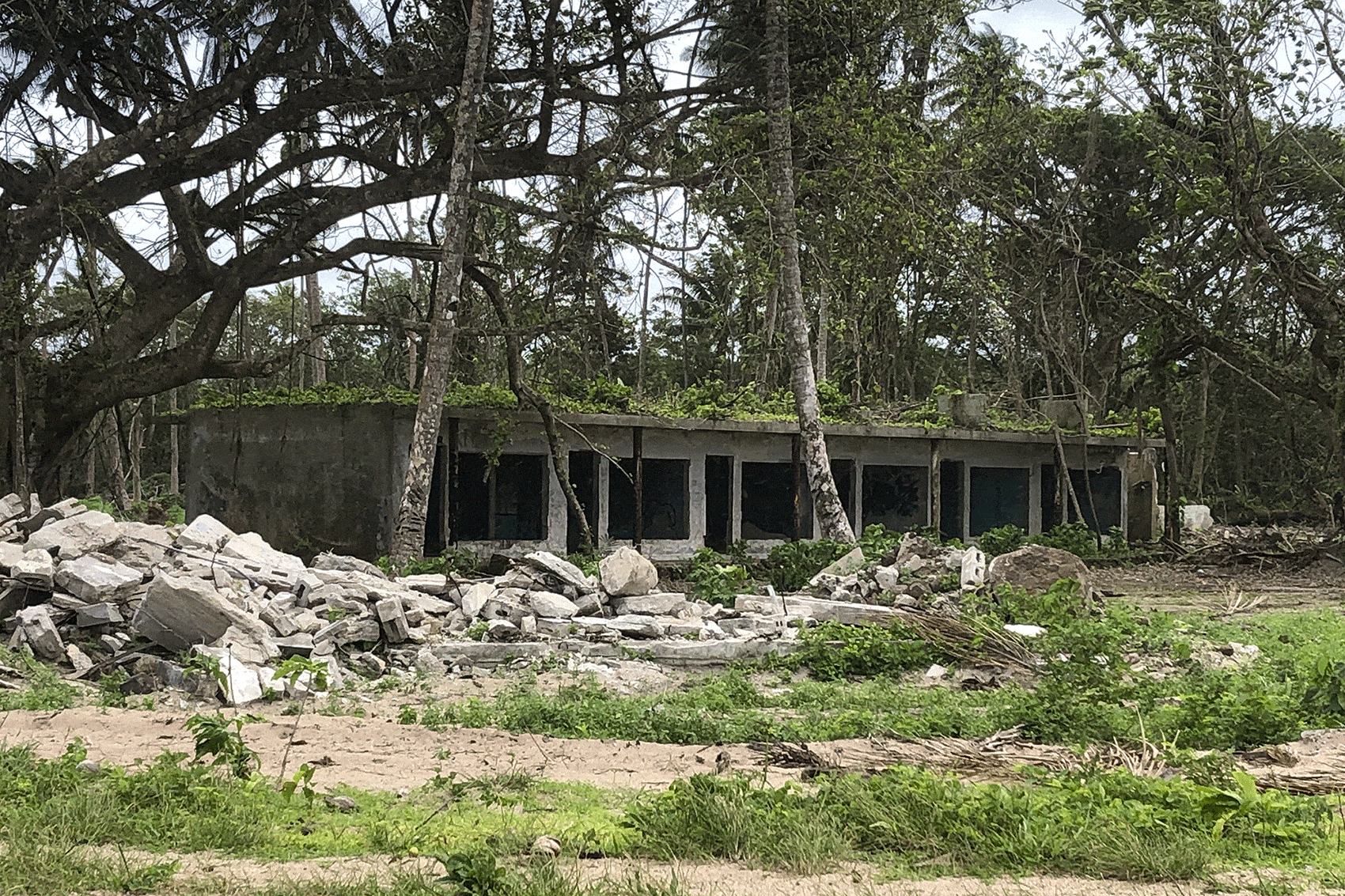
Case in point: When a cyclone hits a traditional village on an island somewhere in (let’s say) Melanesia, the palm-leaf roof and walls are whipped away. But the vertical poles still stand. Deeply embedded in the ground, they twist and sway in the hurricane winds, but they are not broken or flattened. After the cyclone, we go back into the rainforest, gather what leaves are left, and re-roof and re-clad our houses. Living in the system. When a cyclone visits modern Pacific towns, the schools, health clinics, and government buildings — made of concrete block and metal cladding — are destroyed. Flattened. Foreign aid arrives. Bulldozers are flown in. Engineers are flown in. Scientists are flown in. Mama. The co-dependence is positively Freudian.
Tankyu tumas. Right now the Blue Pacific can’t help but be part of the network of far-flung citizens of the world which, through trade, militarism and geopolitical bluster, is cast in a minoritarian role by the rules-based order. New Guinea, French Caledonia, Solomon Islands in Melanesia, and Niue, Samoa, Fiji, Rarotonga in Polynesia, are all trying to escape the universal consensus of neoliberalism. We know the Blue Pacific, even as we protest, is participating in the problem. We float on the great ocean of humanism, mixing our own autonomies with the separatism and rationalism of order and also, we hope, with the tuakana/teina relations beloved of belongingness.
We nations of the Pacific find it difficult to repair because we dwell inside the throwaway economies of trade, tourism and “development.” Difficult to be who we are. To be nonlinear. To be open.
— Rod Barnett
The climate crisis won’t be addressed simply by amassing high-level policies and global agreements because, though these are necessary, such policies and agreements depend on labor. And while we are good at representing visions for climate adaptation, what these future arrangements might reveal about the organization of labor is less clear.
Consider efforts to reforest lands in California damaged by wildfire, or to restore flooded neighborhoods in New Orleans, or ongoing efforts in the Southwestern U.S. to adapt to extreme heat. Repair involves responding to immediate climate disasters and preparing for future risks. In both cases, those most impacted — whose contributions are critical for mitigating risks yet to emerge — are often expected to perform the bulk of localized climate repair, without fair pay.
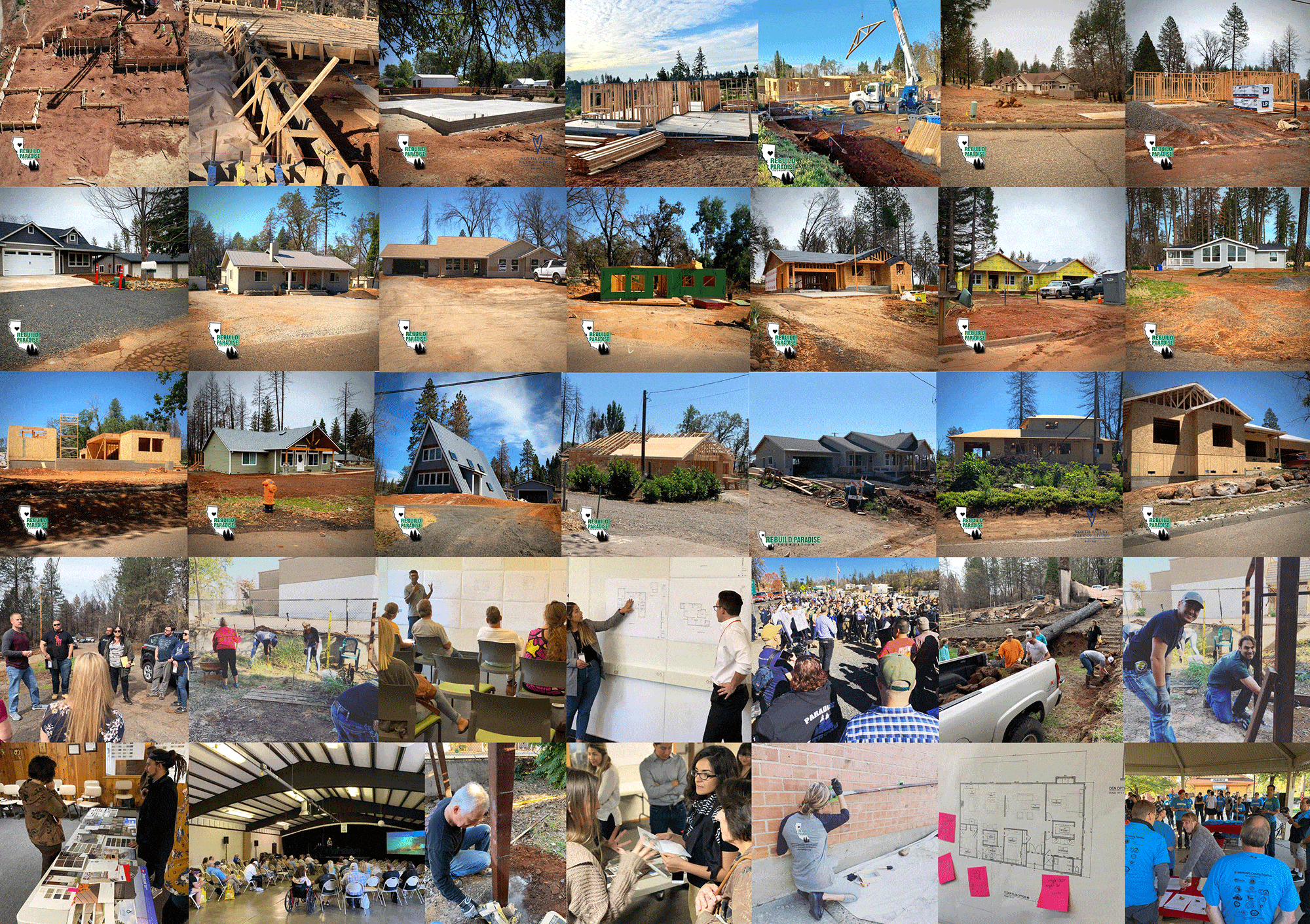
While designers continue to innovate on strategies for, and the representation of, climate adaptation, we are nearly silent on questions related to the construction and maintenance of new infrastructures, all of which rely on changing geographies of labor.
An ethos of repair calls for a thorough reevaluation of how we value labor.
In urban and architectural design, an ethos of repair thus calls for a thorough reevaluation of how we frame and value such labor. This means ensuring not only fair wages, but also benefits and career advancement opportunities for those involved in both immediate and preventive repair work, and for those who have been affected by or continue to face climate-intensified dangers. It means funding community-driven repair projects that support local skills and knowledge, and moving beyond token engagements by redistributing resources and decision-making processes to affected communities. It means focusing on the design of climate-just futures for those on the frontlines.
— Nicole Lambrou
The modern project aimed, in many ways, at separating human societies from our environments. The systems we built to do so — pipes, levees, HVAC systems — tend to be brittle technologies, forging a thin line between the realm of the “human” and the “outside” But the divide was never complete: pipes leak; levees burst; buildings breathe.In the context of climate crisis, one instinct is to further fortify such boundaries: more powerful A/Cs and higher sea walls. But these solutions are not only limited; they also further entrench the environmental problems they aim to solve. And, importantly, they redistribute them, moving around heat and flooding, often to the communities least able to bear the brunt of these risks.
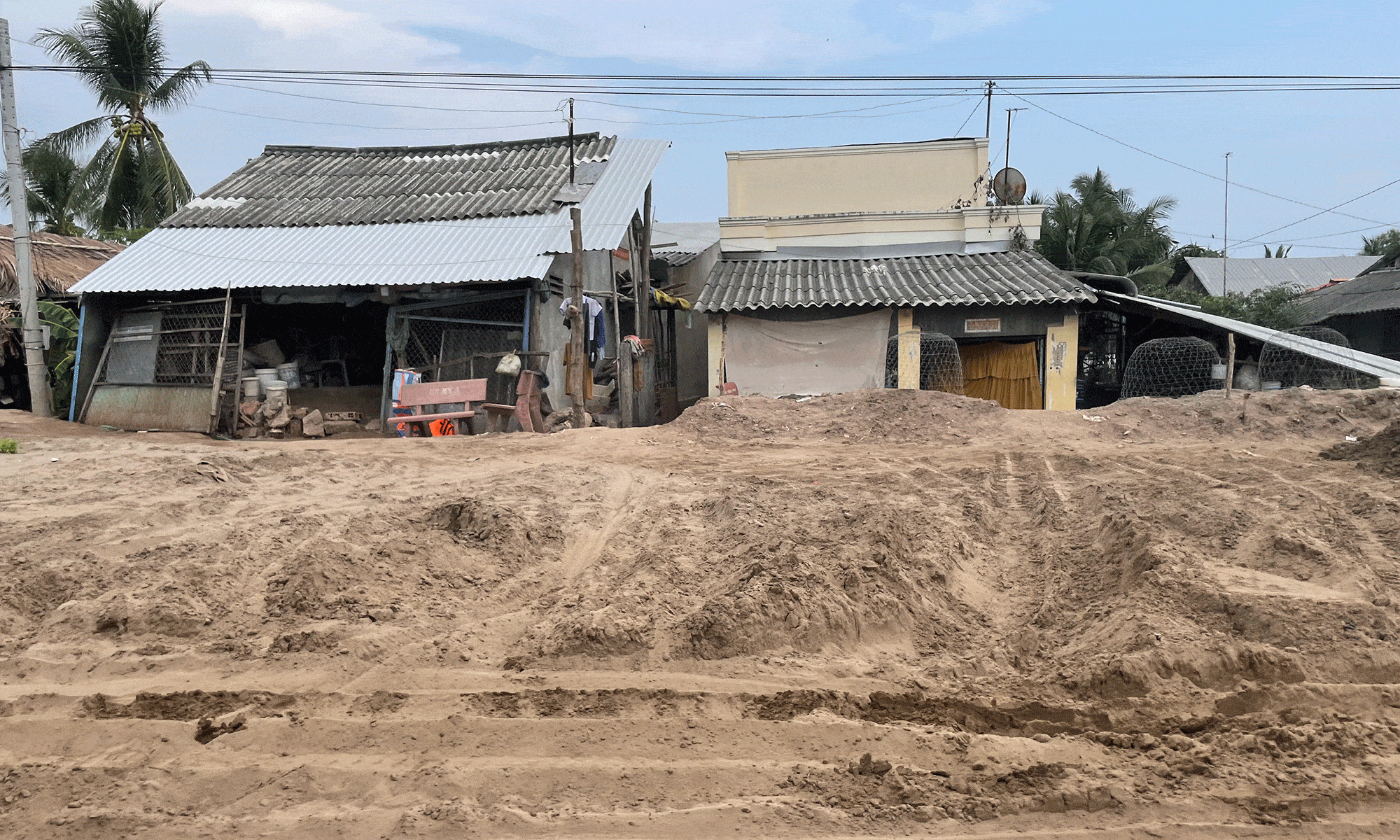
More powerful A/Cs, higher sea walls: these will only further entrench environmental problems.
If our sea walls can’t save us, can nature? In my recent research, centered on the work of adaptation experts in places spanning from the lower Rhine to the lower Mekong, I look at the movement towards “green infrastructure” and “nature-based solutions.” Ostensibly, these kinds of projects — ranging in scale from rain gardens to making Room for the River — offer the prospect of bridging the divide between nature and society. But in practice, they are enacted through the same networks of globe-trotting consultants, engineering contracts, and development banks as were the techno-modernist projects. And often the new projects only add to a rhetoric of resilience, used tofore justify displacing the urban poor to make room for water or nature. Surely, building with nature, in a world that is sinking, heating, and burning, has more potential than working against it. But if all we do is attempt to thicken the line between ourselves and our environments, or coat that line with a thin layer of sod, or use the line as a lever to push vulnerable communities out of the way, then we are unlikely to resolve the larger crisis that divides societies from our world.
— Lizzie Yarina
Repair evokes many thoughts, many emotions. From an environmental perspective, repair sounds positive. It means salvaging something rather than discarding it as “spent”; fixing something and finding a new use for it. Repair requires knowing how to repair, even when something, say a household appliance, has not been designed to be repaired. Repair requires persistence!
Repair means valuing something that was believed to have no value. To repair is to revitalize; to restore life amidst devastation. This is work that calls for powerful stories: “Without stories of progress,” writes Anna Lowenhaupt Tsing in The Mushroom at the End of the World, “the world has become a terrifying place.” Following Tsing, and also Donna J. Haraway, among others, we need stories not only of progress but also of survival on a broken planet.
Repair means valuing something that was believed to have no value. This is work that calls for powerful stories.
What can the stories and histories I write do? I can recover histories of architectural projects that are committed to survival, such as the Ducklands (1989–1991), the proposal by Cedric Price Architects to transform the Hamburg docklands into a nature preserve for migrating birds, thus resisting the pull of “regeneration” in favor of “degrowth.” I can tell stories of architecture that is designed for interspecies encounters, such as Ant Farm’s speculative research project, the Dolphin Embassy (1973–1978). Histories of repair can radically reclaim historical blind spots and bring new agency to those who have been disregarded, exploited, or oppressed. In her book Fugitive Feminism, Akwugo Emejulu explores the ways in which Black people have been excluded from the category of the “human” — and thus systematically dehumanized. Building upon the writings of Sylvia Wynter, Emejulu argues that “the ‘human” is an exclusive and excluding category bounded by whiteness — and that the ability to receive care and experience solidarity is limited only to those identified and recognised as human.”
To choose to care, and to repair, is to possess the power to decide who and what is worthy of care. Joan C. Tronto explicitly defines architecture in terms of care, repair, and responsibility: “an architecture that fulfills the basic tasks of sharing responsibilities for caring for our world, an architecture that is sensitive to the values of repair, of preservation, of maintaining all forms of life and the planet itself.” Architectural histories of repair can challenge actions and works that are uncaring; can ask us to consider who benefits from repair, and whose voices should be heard in the stories we tell. I take inspiration from Thom Van Dooren and Deborah Bird Rose’s practice of “storying,” which describes how to write stories that “give others vitality, presence, perhaps ‘thickness’ on the page and in the minds and lives of readers.”
A recent example of such “storying” is May-Britt Öhman’s essay about the devastating impact of settler colonialism and “ungreen, climate-unfriendly” solutions in northern Sweden, the home of indigenous Sámi people. Öhmann writes, unapologetically: “Over the last decade, the push for ‘greening’ has become a major threat to the livelihoods of Indigenous Sámi.” Crucially, rather than writing about the Sámi, Öhman writes with the Sámi. She concludes her essay with a long quotation from the Sámi woman Elle Eriksson that begins: “My present, past, and future. These are threatened by the planned establishment of a wind power farm on Hällberget”; and ends: “I want to thank all the Sámi and non-Sámi who stand up for us and fight on our side.”
By quoting at length from Elle Eriksson, Öhman devastates me. The words are cutting; they evoke urgency as well as gratitude. This, too, is repair work: forcing me to connect analytically, critically, and empathetically with the struggle for the rights to remember, to live well, and to survive in a damaged world.
— Isabelle Doucet
Beyond “Repair”
we lost the land we were custodians over before i was a twinkle in the eye of a twinkle in the eye of a twinkle in the eye.
When I first heard a colleague recite Nate Marshall’s poem, “Landless Acknowledgement,” I recall being struck by how — in this one line — the poet deftly managed to implicate the disciplines of Indigenous studies, Black studies, and climate justice in the hauntingly long history of the postcolonial landscape. Indeed, in the 400 years since millions of indigenous Africans were trafficked to stolen Indigenous lands in what are now called the Americas, land has become property, plants (and people) have become “invasive,” and the measuring of time has been decoupled from natural processes, favoring workdays and fiscal years. This multi-continental colonial enterprise endures as the framework that shapes the world’s increasingly volatile geopolitical and socioecological climates.
Repair has to go beyond making folks whole; beyond mitigating past and present harms.
Recent efforts toward fixing this history tend to propose strategies that, no matter how various, remain tinged with the implication that we can easily return to conditions that are pre-slavery, pre-extraction, pre-genocide, pre-capitalism. As we learned from Urban Renewal and Manifest Destiny, such “fixes” are ruthless pragmatism at best, and often deny contention with the nuances, aesthetics, and messiness of the present. “Repair,” which I see as the more virtuous cousin of fixing, has also emerged as a buzzword, and as such can preclude the development of ongoing practices of care: related tropes such as “rewilding,” for instance, suggest that the land of “before” was a “wilderness,” empty, rather than thoughtfully stewarded with Indigenous knowledge. The intent of repair is often to achieve what the etymology of the word suggests: to re-conjoin a set of ideals that have drifted (or been torn) apart. But, especially as support grows for the Land Back and reparations movements, is this definition of repair enough? What is the future of repair?
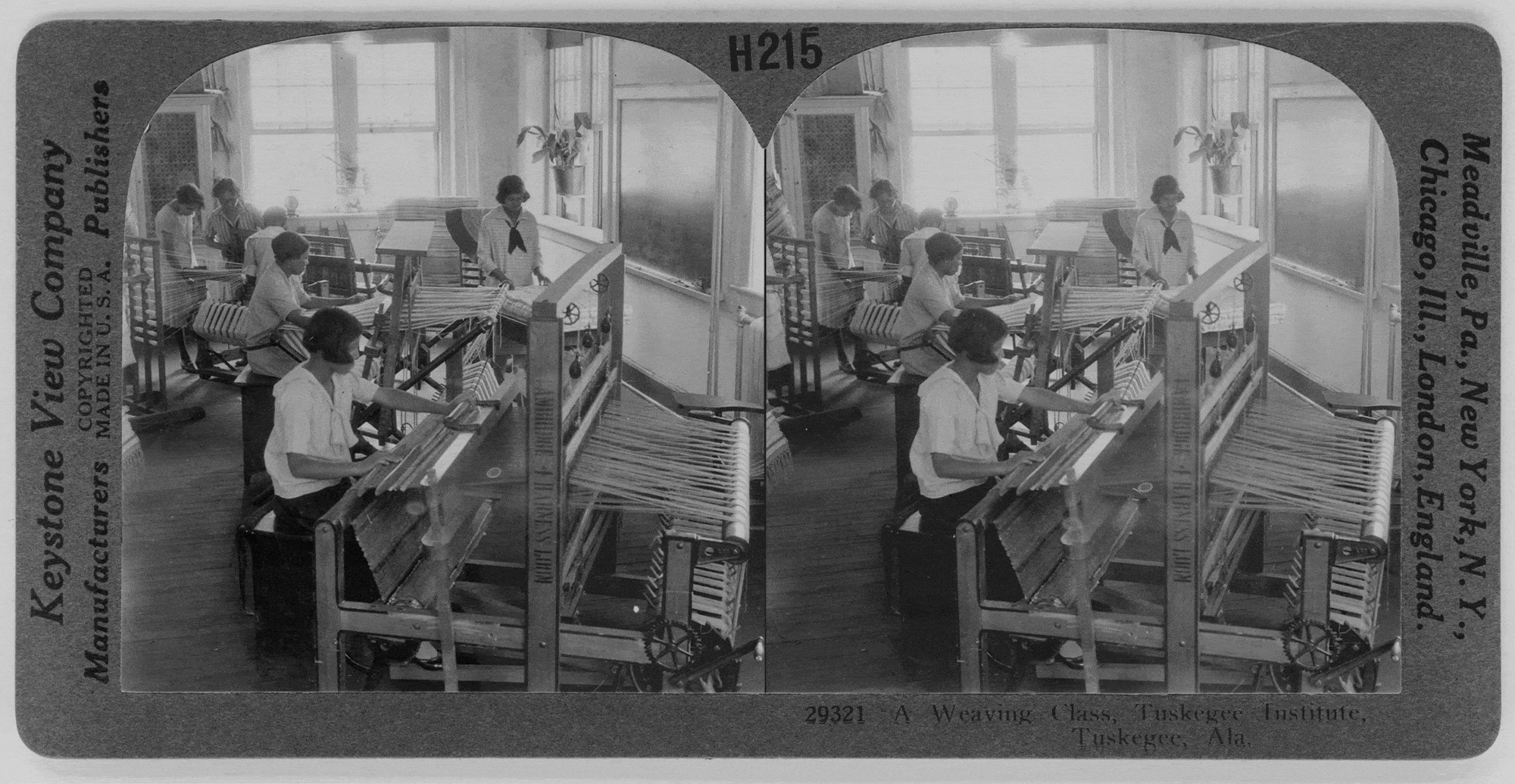
As botanist Peter Del Tredici often notes, our landscapes have been reshaped so profoundly in degree as to be different in kind, and therefore efforts to return to a facsimile of the (perhaps unknowable) past are problematically nostalgic, if not outright perverse. Repair has to go beyond making folks whole; beyond mitigating past and present harms. A sustainable mode of repair involves looking to sometimes surprising places: as climate scholars are discovering, Black and Indigenous languages, spiritual cosmologies, and gastronomies are modes of praxis for stewarding, navigating, and living in kinship with land.
I am reminded of my grandmother in southern Virginia who, without any formal training, can as easily rattle off a dozen species of pine as she can sense an oncoming storm by smelling the air. To move beyond “repair” would be to acknowledge and empower the cultural weight of Black and Indigenous land-based wisdoms in our design schools, boardrooms, field offices, and statehouses.
Nate Marshall, in his search for his people’s homeland, seems to sit with this possibility in the final line of his poem: “maybe ain’t no home except for how your beloveds cuss or pray or pronounce.”
— Curry J. Hackett
Acts of care are a critical weapon against precarity. If we understand care as providing what is necessary for the health, welfare, protection, and maintenance of something or someone, these acts operate in direct opposition to forces fomenting inequity and dispossession. Relatedly, acts of repair are integral to overcoming a culture of disposability and accumulation. Actions fostering care and repair emerge from radical forms of empathy for living and nonliving subjects.
These terms can fundamentally reframe architecture, which has so often been complicit in catalyzing precarity, focused as it is on growth, and obsessed as it remains with novelty.
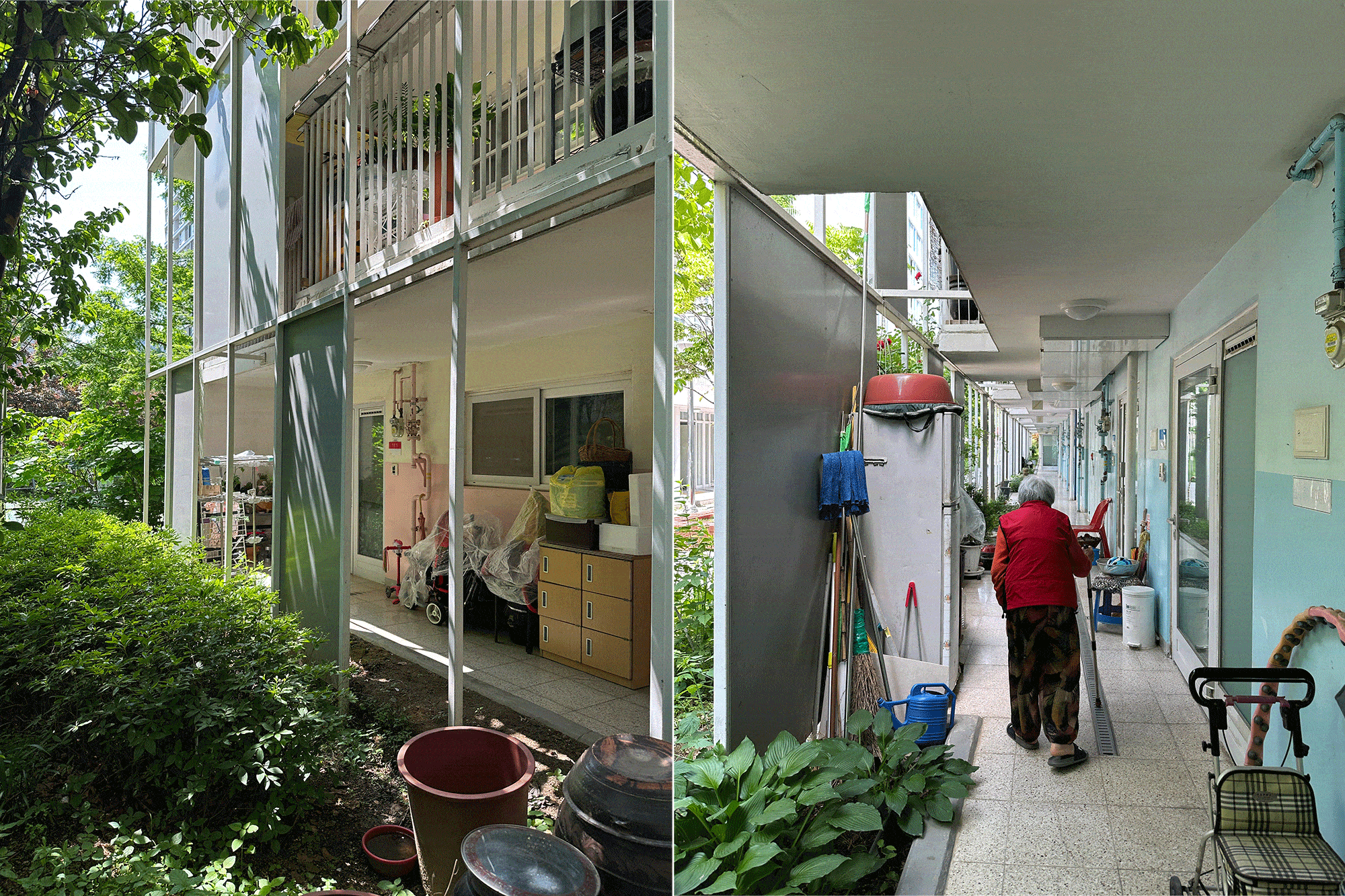
Care and repair emerge from radical forms of empathy for living and nonliving subjects.
On a recent trip to Korea and Japan, I had the fortunate opportunity to tour a series of projects by Riken Yamamoto and Junya Ishigami, in each case with an operations manager who was responsible for that project’s upkeep. I was utterly impressed by the daily rituals of maintenance. In the case of Ishigami’s projects at Kanagawa Institute of Technology, the operation manager’s daily practice was to keep the two buildings appearing as close to new as possible. At the Yamamoto projects, the Gangnam and Pangyo housing complexes, in and near Seoul, the manager was less concerned with maintaining the physical spaces as designed, but rather with accepting the evolution and transformations that occur as life itself occupies and reappropriates the architecture. This form of repair is less interested in “old versus new,” and instead understands repair as an ongoing relationship between architecture and its inhabitants.
To repair is time-consuming. To care takes commitment. These forms of time are rarely acknowledged or compensated in capitalism. But care and repair put forward new values — of slowness, of ongoing tending, of reuse, of empathy. These values mark a radical shift in what architecture can be, who it serves, and how it can become an evolving actor in our lives.
— Neeraj Bhatia
Narratives of Recognition
This publication has acknowledged the urgent need to rethink the objectives of the architectural profession in light of its complicity with fossil-fuel consumption. Yet an equally significant legacy of the modernist era are the lingering traumas of social disruption, alienation, and dislocation driven by the voracious pursuit of cultural and economic hegemony over lands and peoples. And so, another vital question arises: in an “epoch of repair,” what role can architecture play in addressing the damage wrought by insatiable colonialism?
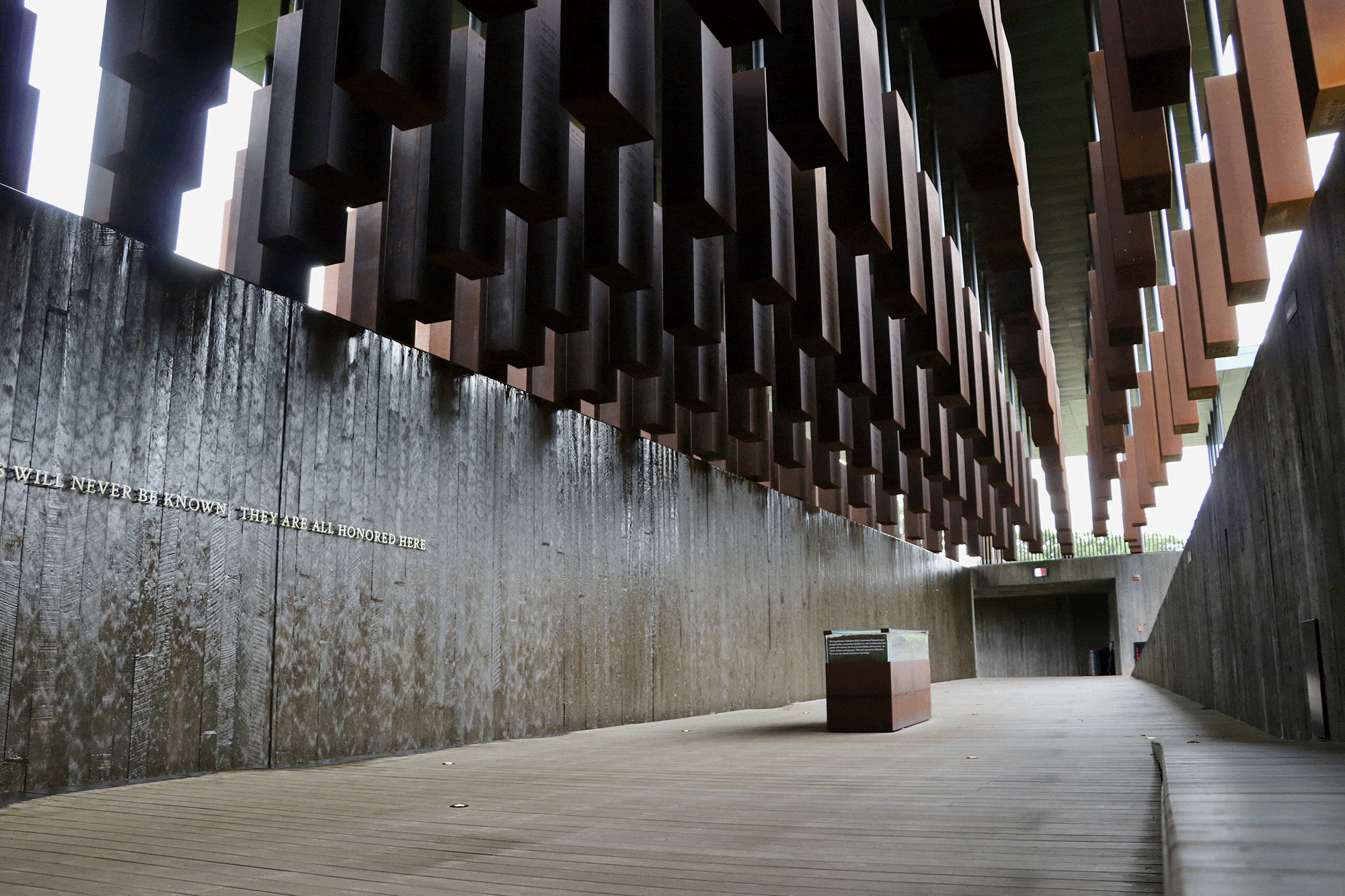
What role can architecture play in addressing the damage wrought by insatiable colonialism?
The current political moment, characterized by populist resistance to confronting narratives of trauma, instinctively reverts to a mythical past, blocking the path to public recognition. Several recent architectural works, however, have reasserted realities that we may wish to forget, but which nevertheless lie embedded in our collective psyche. The National Memorial for Peace and Justice in Montgomery, Alabama, for example, calls out the violence and bigotry that fueled the lynching of thousands of Black Americans. It is a place designed (as its website states) for “publicly confronting the truth about our history [as] the first step toward recovery and reconciliation.”
Might the architectural profession help to unearth and mark other such traumatizing ruptures?
One historical example is the genocidal Long Walk or forced removal of the Navajo people (Diné) from their homeland. Beginning in 1863, the U.S. military relocated the Navajo from Dinétah, a land demarcated by four sacred mountains in the region now known as the Four Corners on the Colorado Plateau. The horror of the 300-mile Long Walk to what is now eastern New Mexico, with the attendant illness, hunger, homesickness, and in many cases death, remains painfully rooted in Navajo consciousness.
In 1968, exactly one hundred years after the military allowed the Navajo to return home, the Navajo Nation undertook a remarkable architectural project to embody and perpetuate the core values that sustained them through the Long Walk. Diné College, founded as the tribal institution of higher learning, erected its campus on the eastern edge of the sacred Canyon de Chelly in the foothills of the Chuska Mountains. Representing Diné philosophy in three-dimensional form, campus buildings are arranged in a circle that recalls the figurative sand paintings used in traditional ceremonies. The campus is oriented to the four cardinal directions, encouraging Diné students to embrace the wisdom of their elders while envisioning a renewed future.

Diné College is an architectural response to the societal trauma of the Navajo: it is a setting that points both retrospectively toward the community’s difficult history, and prospectively toward patterns of resistance that might still be realized. Such humane concerns can move us beyond the technological and economic forces that drive much contemporary design. Architecture has a capacity to reestablish narratives of trauma and place as a restorative force in wounded communities.
— Karla Cavarra Britton
Reflecting on repair and re-use
The repair and re-use of existing sites, including buildings, cities, and systems, are integral to practice in our office. Three decades ago, we began with small interior renovations in which specific circumstances and practical constraints were completely intertwined with our design concepts. These projects nurtured our research-based process, through which our work has evolved to engage larger and more complex existing conditions. What have we learned?
Engagement: One of our early projects was the repair of a seven-story, 19th-century warehouse in New York City, to enable its reuse for residential and commercial programs. During this multi-year effort, we gained experience with the technical and administrative complexities of renovating existing buildings, such as underpinning foundations, modifications to exterior envelopes, and integrating new building systems. In these kinds of projects, the architect leads a diverse team of specialists including forensic engineers, building code consultants, and construction logistics experts, to strategically and inventively synthesize information. Through purposeful engagement with existing conditions, we become informed collaborators in the design process.
Reciprocity: For us, repair and reuse often involve adapting midcentury modern buildings, which are typically constructed of durable materials like cast-in-place concrete, but require significant modifications to meet new programmatic and accessibility requirements. Our design for the 1963 School of Architecture at Princeton University, for instance, includes a new elevator and fire-rated stairway within a transparent addition, connecting the building more effectively to the campus. In reciprocity with the proportions and materials of the existing structure, our intent is to create a layered, dynamic composite of existing and new.
Experience: Our renovations of the Rothko Chapel and Donald Judd’s Studio Home in Soho in Manhattan represent a fascinating type of repair and reuse. These sites allow visitors to encounter art in relation to its context, which encompasses not only the interior of a building but the neighborhood in which it is located. With knowledge gained from our deep research into their art, we consider Judd and Rothko to be “posthumous collaborators” in these projects. Our design interventions reconcile the artists’ visions with the ongoing missions of the cultural organizations that perpetuate their legacies. With humility, we balance necessary modifications with preservation of the specific sensory and aesthetic experiences intended by the artists.
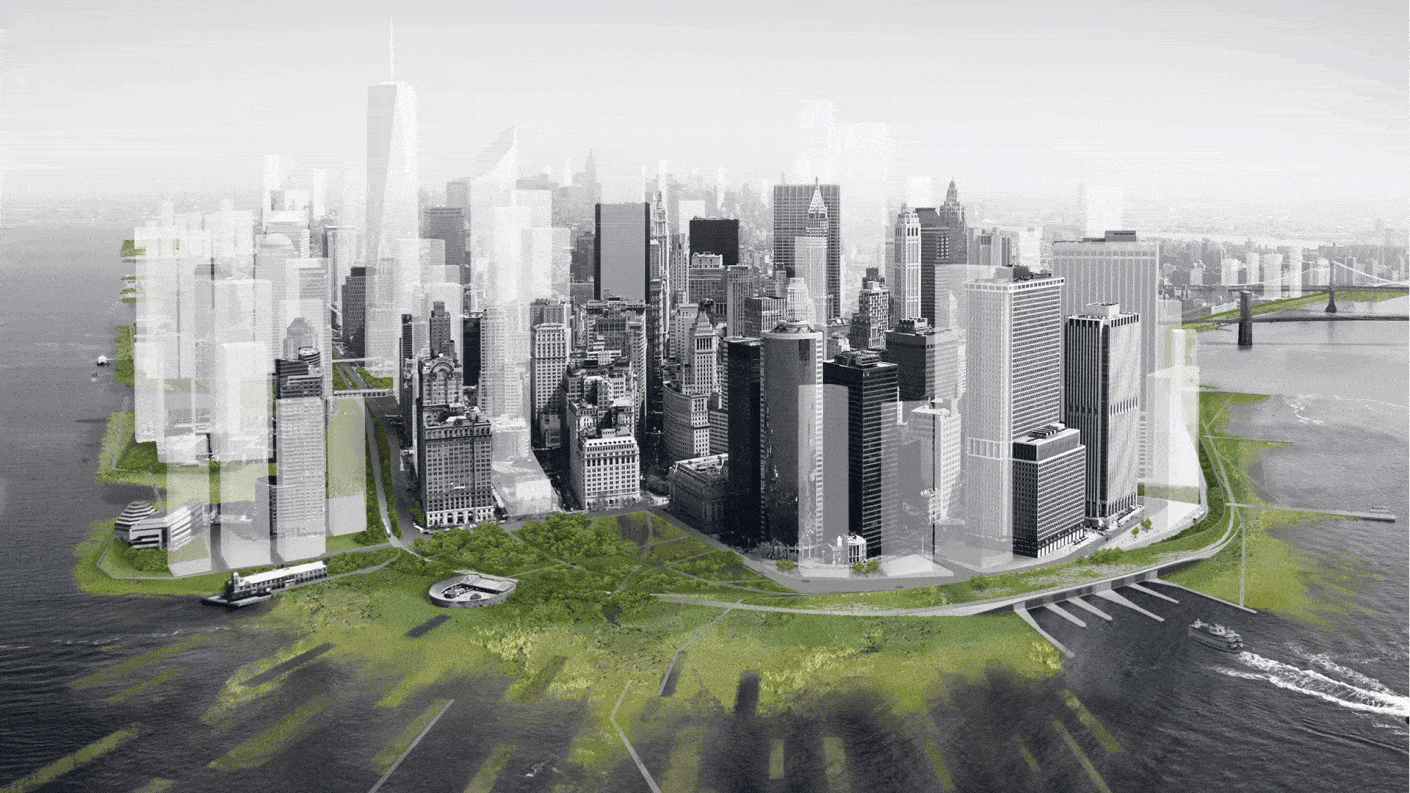
Place: Grounded in the morphology of New York City, our proposal “A New Urban Ground” demonstrates the potential of repair and reuse to transform urban space. Downtown Manhattan’s streets and shoreline are adapted into an integrated system to manage rainwater and storm surges, establishing beneficial relationships between the city and its harbor in terms of riverine and estuarial ecology, water quality, and daily life. Reconnecting people with their waterscape, this conception of infrastructure and public space links past and future.
— Adam Yarinsky
Repair and maintenance as climate action
In the coming decades, much of the work of climate action will be remarkably ordinary. In the built environment, it will likely be carried out not by architects, engineers, and planners, but rather by those whose labor remains largely overlooked: retrofit and service trades, building cleaners, janitors, and even occupants themselves. Effective adaptation and mitigation will depend to a large extent on day-to-day practices of maintenance, repair, and retrofit. Mundane tasks like patching ductwork, adjusting damper controls, or cleaning vents and filters receive far less attention than “innovative” technical solutions or media-friendly “eco-bling”; yet consistent upkeep holds the key to significant emissions reductions and improved resilience. By shifting our gaze from the novel to the necessary, we uncover pathways to substantial energy savings hiding in plain sight.
Consistent upkeep — patching ductwork, adjusting damper controls, cleaning vents — holds the key to significant emissions reductions.
Yet this potential remains untapped. Building owners — fixated on upfront costs or in many cases simply uninterested — often under-invest in retrofit and maintenance, creating an unmet future need for additional care. This short-sighted approach reduces energy efficiency and overlooks the long-term value of fit-for-purpose, well-maintained systems. In a warming world where severe weather events will increase in frequency, this becomes a self-fulfilling prophecy: a risk-laden and costly building stock rarely meeting occupants’ needs. And the implications extend beyond energy efficiency. Service trades like HVAC&R are also at the forefront of climate adaptation, providing thermal comfort for those living and working in buildings — an increasingly challenging task as temperatures rise. Such demands will further compound the global skills shortages in building trades, where there are already questions about the health and safety of doing this work into the future.
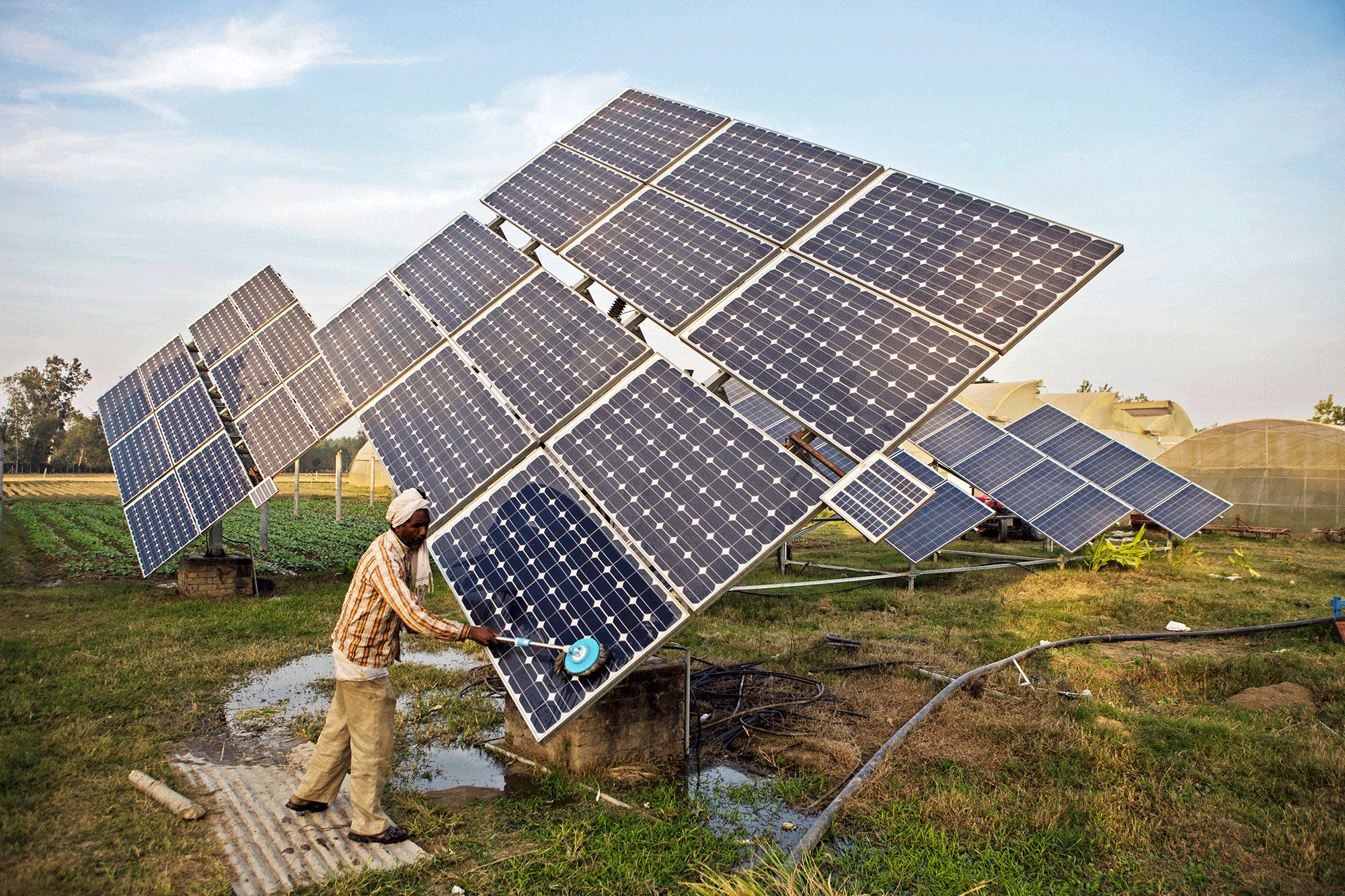
The invisibility of maintenance reflects the way it is undervalued in policy and governance spheres, in the design professions, and more broadly by society at large. Grappling with the challenges of climate mitigation and adaptation requires recalibrating our values from building the world to repairing it. Perhaps there is a reinvigorated role for architectural and design knowledge here? Certainly at the policy scale, architects understand how regulatory processes and codes shape outcomes — often in ways that are unintended. And establishing a convincing business case for deep retrofit requires a holistic understanding of buildings as integrated systems, where long-term vision and interdisciplinary collaboration are critical to better performance.
Still, the focus must remain on scaling up the workforce required to deliver tangible change. Embracing repair and maintenance as climate action not only addresses emissions reduction but cultivates a more resilient built environment. It’s time to recognize that often as not the most impactful solutions involve caring better for what we already have, rather than building anew.
— Chantel Carr
The climate crisis is intensified by three additional interlocking “end times” forces: ever-increasing digital surveillance; public health infrastructure failures in the face of disability and disease; and the drastic intensification of authoritarianism the world over. We can no longer think at the scale of the individual building or street, or even the individual city, for each of our projects needs to confront the quadruple crises of climate chaos plus ubiquitous media manipulation plus illness, disability, and creeping fascism. How do we do this? From a queer transfeminist perspective, we need to create publics that afford their members safety, connection, and respect. Such liberal world-building in the public realm is as essential as the ways in which we design private spaces.
Queer transfeminist principles ground us in the knowledge that our identities and needs are in constant flux, and that desire is central to progressive democracy. Sex, sexuality, and sensuality must be welcome in the places we build. The racialization and ableism that produce space are inextricable from the gendering and sexualization of that space, and it is mandatory that we do the critical work to understand our own perspectives. Learning from and intervening in the colonial constructs that shape our assumptions can feed into radical, anticolonial productions of space, and thus world making too. We need to read, and start our efforts at intervention from, the work of Indigenous, African, South American, and Middle Eastern scholars, along with others who have had their land taken, and, often, with their land, large parts of their cultures, languages, and families.

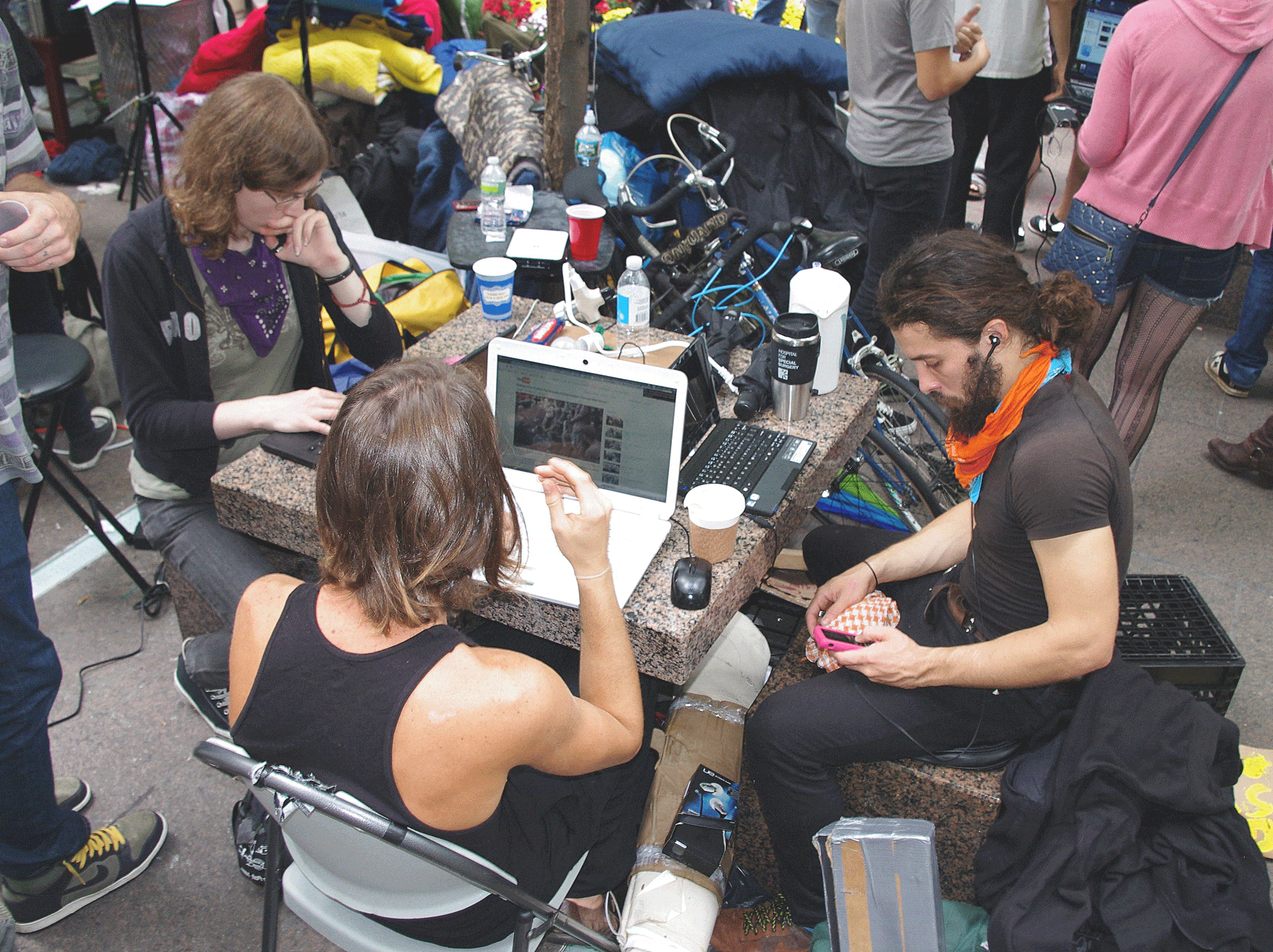
Our projects must confront the multiple crises of climate chaos plus media manipulation plus illness, disability, and creeping fascism.
All this leaves us with difficult questions to ask and challenging actions to take, but all are required. We can design spaces that afford rest and recuperation as much as they allow for organizing. We can design campuses, cities, towns, and suburbs that foster conversation and protest; that work from principles of repair and interdependence, taking inspiration from reparative justice processes and the successful mutual-aid organizing we have witnessed in the pandemic and otherwise. We can roll back the “anti-riot” spatial creations of those who came before us, refusing to produce spaces like the University of Buffalo campus in the 1960s, or Baron Haussmann’s reinvention of Paris as a barricade-proof city, and offering the inhabitants of such sites ways to understand and reconfigure them. We can reject “smart” digital control, refusing the co-optation of our data, conducting participatory design work offline and anonymously when necessary, and reproducing sociality rather than isolation and antagonism.
Each of these practices deeply affects, and shapes the others, and we need them all in order to respond to the four crises facing us.
— Jack Jen Gieseking
We live in a world where maintenance is neglected and undervalued.
In the United States, basic infrastructure, from bridges to healthcare, is fragile, falling apart, or broken. Other infrastructure critical to the future of this planet — and to our future on this planet — has yet to be realized. For too long, we have prioritized economic markets driven by speculation and greed over human and planetary flourishing. While hope for a more sustainable future is a necessary practice of imagination, repair initiatives can help ground us in the present, in what we can and need to fix right now.
At The Maintainers, we recognize that, collectively, we are not taking good care of this planet. For this reason we work with practitioners worldwide who are actively countering the systemic harms of resource depletion and planned obsolescence. Through virtual gatherings, we convene an eclectic network of repair practitioners, creating space to share skills and frustrations and to collaborate, often through humble, bottom-up initiatives. These practitioners are leading repair cafés, fixer collectives, mending circles, tool libraries, care collectives or advocacy initiatives; personally I am deeply inspired by their work and learn a lot from them, especially as someone who isn’t naturally skilled at repair.
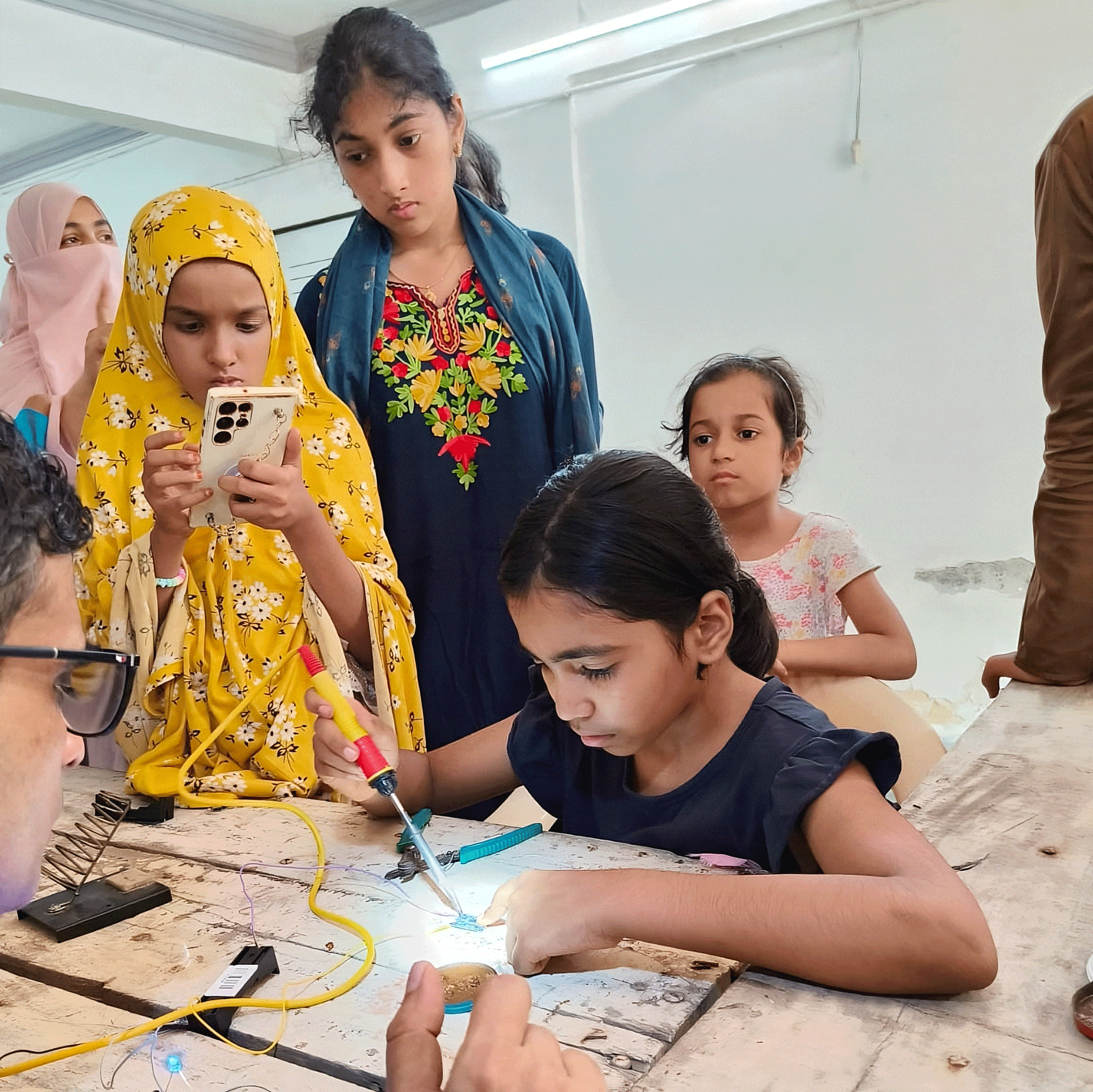
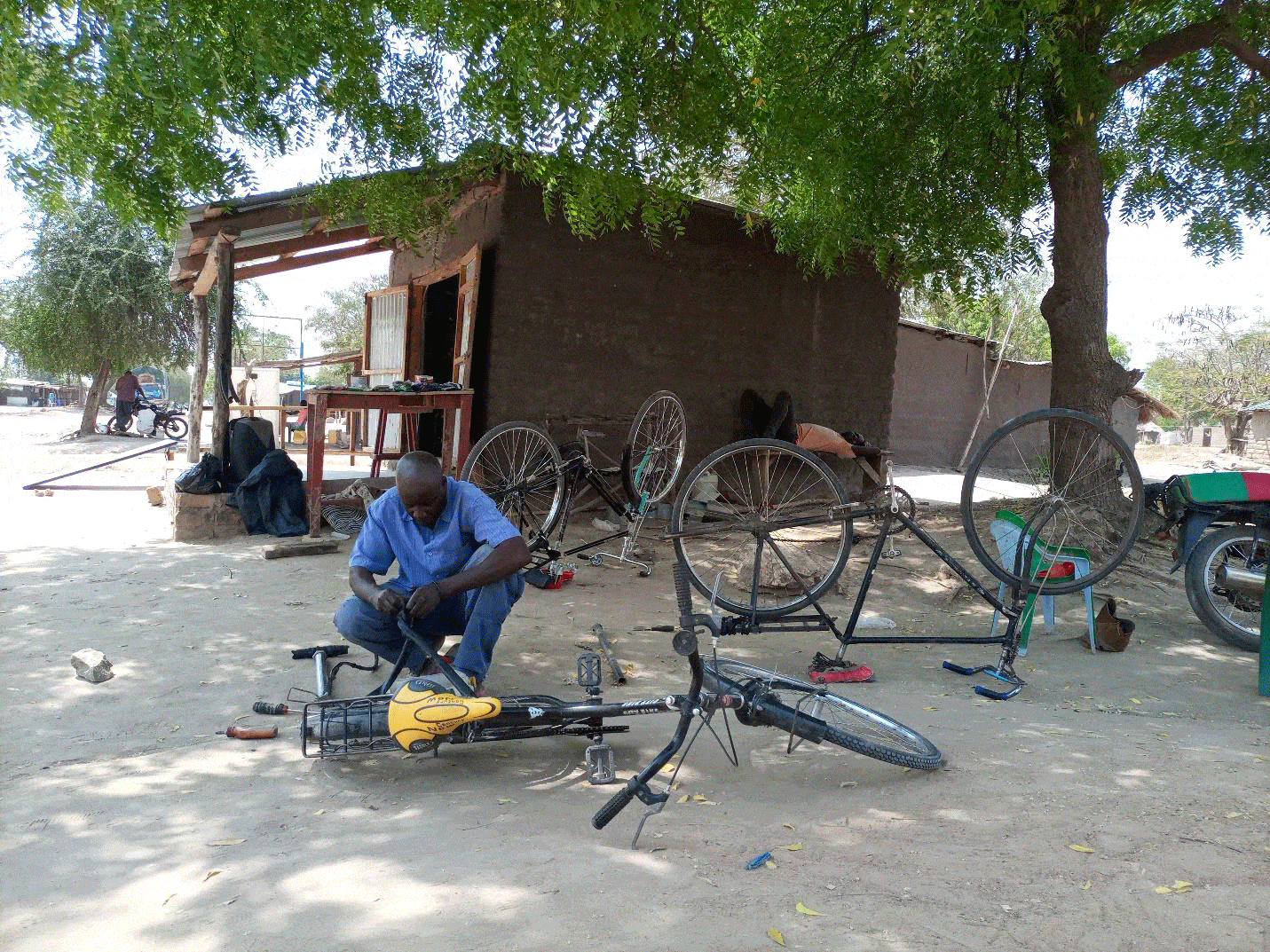
We convene an eclectic network of practitioners who share skills, and also frustrations.
In the Rhino Refugee Settlement in Uganda, Mathew Lubari leads repair workshops for refugee youth and adults, turning to repair as a means of personal and planetary survival. Repair Café India has created a digital map of local cobblers, tailors, and electrical repairers to promote dynamic fixer economies. Repair can also be an opportunity for social connection: in New York City, the Fixers Collective, Repair Shop, and the Tool Library at the Greenpoint Public Library have built engaged communities united by their desire to fill repair knowledge gaps. In Bogotá, Colombia, a bike repair shop runs a book donation program. Initiatives like these show how repair not only addresses material needs but can also encourage resilience and new modes of sharing knowledge.
Through acts of repair, we can elevate our relationships with objects and return care and meaningfulness to our damaged social systems. Repair reminds us of our own agency in the context of over-consumption; repair takes time and energy and divests attention from an ethos of disposability, replacement, or novelty.
Collectively, we need to better maintain our world. Repair offers another chance — a chance to reclaim agency and connection, and to build more caring and sustainable ways of living together.
— Lauren Dapena Fraiz
Infrastructuring
What might be called the infrastructural turn began near the end of the last century, with increasing attention paid to complexity and scale in the built environment. Influential theorizations followed, such as Keller Easterling’s “infrastructure space” and the proposition that architects modulate “active forms,” comprising routines, protocols, and standards that operate like bits of code to organize “object forms,” a.k.a. “buildings.” Infrastructural discourses in scholarship and popular culture have expanded to consider social systems of support and care — discussions that have made their way into architecture, so that today, when we speak about infrastructure, what comes to mind are not only highways and bridges, but affordances like food pantries and routines of repair.
Cultural theorist Lauren Berlant has defined infrastructure as the “living mediation of the lifeworld of structure,” arguing that “movement is what distinguishes infrastructure from institutions.” As a “living mediation,” infrastructure is like a viscous, alimentary fluid that binds structures in the social realm, holding the world together. While those structures may appear stable and unitary, it is the fluid, infra aspect of infrastructure — its place within or below structure as such — that allows for those structures’ eventual and necessary transformation.
Instead of building, I would argue that as architects we are infrastructuring.
These discussions come at a time when architecture’s relation to “object form” continues to be called into question. Buildings can no longer be understood in spatial, material, or temporal isolation; we know that they exist in networks of relations that implicate human and nonhuman lives, including the people who maintain and repair what is built; the resources extracted and shipped for its fabrication; and the potential afterlives that condition its creation. This is as true for the rural house as it is for an office block in the center city. “Building” thus feels inadequate to describe what architects do, pointing as the word does to stasis, objecthood, and an embodied relation to material and labor that very few architects can justly revindicate.
Instead of building, I would argue that as architects we are infrastructuring. This implies a shift in how we see and relate to the objects of our works. As infrastructures, the rural house or the office block are less ends in themselves, and more new modes of distribution and production.
In infrastructuring, we reimagine our role as designers within a larger relational realm. This realm does not begin and end within a project’s walls, but includes the materials that go into the project’s fabrication and could one day define its reuse; it extends into the lives that use and maintain the spaces enclosed in that physical envelope; and the finances implicated in their construction. These understandings of architecture are not unfamiliar to design studios or practices. Yet we still speak about “building” in a way that feels inadequate.
Perhaps most importantly, in infrastructuring, we undo distinctions that separate “building” from traditional forms of infrastructure. This makes possible a recognition that the spaces we move through are — like water and waste — subject to the conflict, negotiation, and political work characteristic of any commons. Perhaps such relations have always shaped architecture. But, in infrastructuring, we refigure the agency of our discipline to more directly and provocatively acknowledge its proximity to the “living mediations” that shape this lifeworld. In so doing, we rearticulate a role for architects as “infrastructuralists” of social transformation.
— Sony Devabhaktuni
For this series, Places posed this question: how might disciplines that favor novelty and innovation move towards an ethos of repair and care? In the discipline of art history, novelty and innovation are indeed paramount; but these qualities are not necessarily in opposition to repair and care. In Reparative Aesthetics: Witnessing in Contemporary Art Photography, I considered how four women photographers — Milagros de la Torre, Anne Ferran, Rosângela Rennó, and Fiona Pardington — produced work that is visually innovative while also demonstrating what I term a “reparative aesthetic.”
I use the phrase “reparative aesthetic” to describe the novel ways in which artists address shameful national histories — the harsh and unjust treatment of Indigenous peoples, the cruel institutionalization of vulnerable groups, the disappearance of dissidents, the carnage of civil war. The artists I highlighted illuminate oppression and injustice not by shaming the audience, which is the more common strategy of political art, but through visual seduction. Australian First Nations artist Judy Watson describes this tactic well:
Art as a vehicle for invention and social change can be many things, it can be soft, hard, in-your-face confrontational, or subtle and discreet. I try and choose the latter approach for much of my work, a seductive beautiful exterior with a strong message like a deadly poison dart that insinuates itself into the consciousness of the viewer without them being aware of the package until it implodes and leaks its contents.
‘Reparative aesthetic” describes the novel ways in which artists address shameful national histories.
The work of Watson, and the other artists I analyzed, addresses another question posed by this journal’s editors: How might entrenched inequities be shifted by an ethos of care and repair? The artists who interest me most balance the desire to redress inequity with that of maintaining the visibility of damage done. In this approach, they depart from some key interpretations of repair by feminist philosophers, such as Elizabeth V. Spelman and Margaret Urban Walker, which emphasize undoing, invisibly mending, and returning something to use. The work of Watson, de la Torre, Ferran, Rennó, and Pardington, on the other hand, can be understood as deliberately holding damage and repair in tension. In fact, making damage visible and recognizable is perhaps repair’s most important dimension.
— Susan Best


If you would like to comment on this article, or anything else on Places Journal, visit our Facebook page or send us a message on Twitter.