

This exchange began in 2021, when cultural geographer and environmental psychologist Jack Jen Gieseking spoke with artist and designer Ulf Treger about the work both were doing in queer mapping. Gieseking’s book A Queer New York, published in 2020, is an historical geography of lesbian-queer society and political economy in New York City, with a focus on lesbian-queer roles in contemporary processes of gentrification; the volume is accompanied by an online pair of interactive maps, jointly titled An Everyday Queer New York. 1 Treger works with the group Queer narratives, mapped to collaboratively document geographies of LGBTIQ+ people, especially in his home city of Hamburg, Germany; he helped to design the art/map/story collection Queeraspora Collective Mappings, produced as a brochure in 2022, and subsequently published online as a multilayered digital map. 2 Gieseking consulted with Queer narratives, mapped in the early pandemic as they built out their work.
For a variety of reasons, including the pandemic, the initial conversation paused. Gieseking and Treger reconnected in 2023, and the two spoke further about mapping, memory, and resistance. Finally, in 2024 they returned to their discussion via email.
By way of a greeting to you, the reader, the conversants write:
We hope this extended back-and-forth can promote additional forms of queer thinking. In these times of ever-increasing crises, it is all the more necessary to imagine new worlds and relationalities across the borders, boundaries, and barriers that are levied against LGTBIQ+ people and so many othered “others.”
Ulf Treger: We first met when you Zoomed into our Queer narratives, mapped workshop. That context was appropriate, given that, in all your writing about queer maps, you bring up the ethics of data analysis and collection, asking questions like “Should all data be analyzed? If it’s being used against us, how should we analyze our own data? What can and cannot be mapped — and maybe what should not be recorded on a queer map?” It’s great to talk about these issues, and to delve more deeply into the project of archiving and passing on queer histories.
How should we analyze our own data? What can and cannot be mapped, and maybe should not be recorded?
In the case of the working group I belong to, Queer narratives, mapped, your input in summer 2020 gave us quite an inspiration. Our group had been founded the year before. In the ensuing three years, we have done further workshops and panels. And we have produced various analogue and digital maps. For example, in 2021, as a collective effort with another group, Queeraspora, a queer BIPOC group based in Bremen, Germany, we developed a collection of narrative mappings about Queeraspora’s public activities that was published as a brochure and a digital map.
In your book, you use data visualizations — maps and graphs — to show the spatial displacements, over decades, of communities and businesses and other kinds of sites that have been important to lesbians and queers in New York City. You’ve invited participants at your talks to make mental maps. You have also collected a huge amount of chronological data regarding lesbian and queer locations and events in New York, which you’ve documented in a dedicated portion of your website.
So, with all of this in mind, especially the ethics: how do these digital maps relate to interviews collected in your book, and why did you decide to use both print and online formats?


Jack Gieseking: The online interactive maps titled An Everyday Queer New York emerged from a nine-year project involving a team of nearly ten co-researchers and coders. A Queer New York, the book, focuses primarily on multi-generational interviews I conducted with 47 lesbians and queers who had come out in New York City between 1983 and 2008 — a period that I refer to as extending from the start of the AIDS epidemic through the (first run of) the television show The L Word. They all identified or came to identify as women and/or trans and gender nonconforming people, and they have mostly continued to live in the city.
This map is the first to track activist ‘zaps’ by groups like ACT UP, the Lesbian Avengers, and Queer Nation. How had we never mapped these interventions before?
But I had also done archival research, and these findings deserved their own focus, so we created the maps. I had spent a year in the Lesbian Herstory Archives, the largest lesbian archive in the world, in Brooklyn. Right now, there are two maps, and more are in the works. For one of the maps, I recorded every organization that had focused on lesbian concerns during my period of study; for the other map, I examined 25 years of publications, from 1983 to 2008. Then I worked with research assistants and students (who were paid or got credit) to clean and build the datasets. From the publications, we collected over 1,300 addresses (for bars, business, events, services, etc.) and from the organizations’ files we gathered over 800 more addresses (related to events and actions, mentioned in mailings, etc.). We deleted personal addresses or anything else that shouldn’t be divulged — say, the location of a sex party. The results shocked me when I saw them all together on a map. They include everything from AA meetings in the 1980s to a Tribe 8 concert in the late 1990s to Bed Bath & Beyond in 2008.
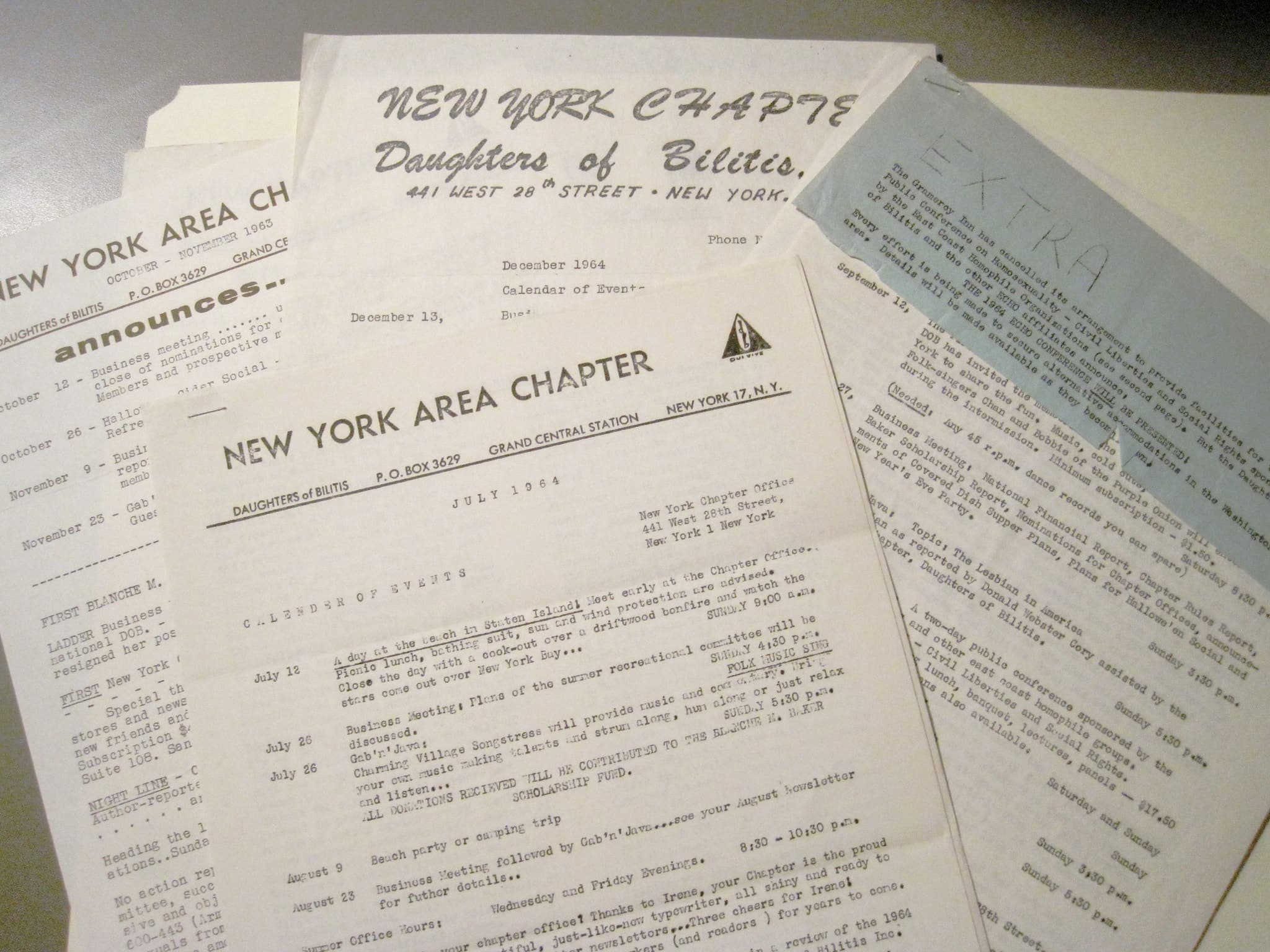
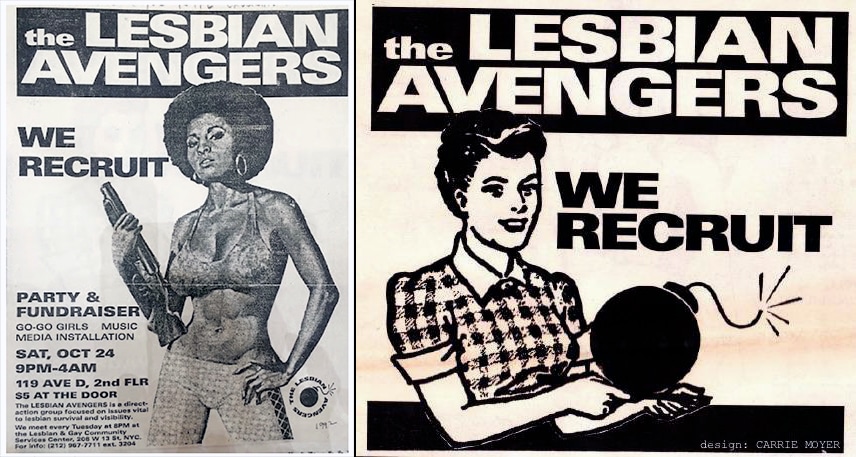
Then, finally, I was lucky enough to work with an interactive mapping guru, Rich Donohue, who built the complex digital functionality: layers of census data, timeline slides, and so forth. 3 The organizations map is the first to track activist “zaps” or targeted public interventions by groups like ACT UP, the Lesbian Avengers, and Queer Nation. How had we never mapped all this before?
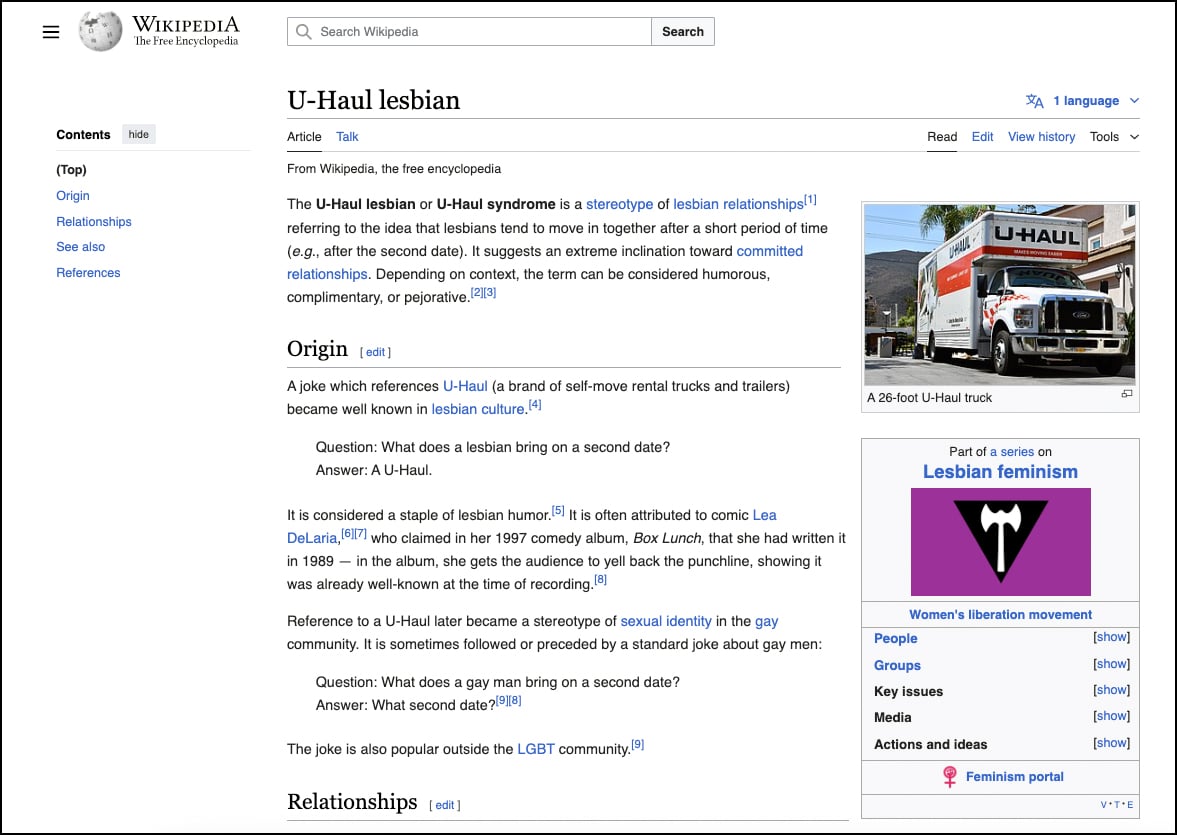
I debated including ads, like for Bed Bath & Beyond (a U.S.-based chain of discount home-goods stores that’s now filed for bankruptcy). But it occurred to me that such ads target LGBTIQ+ people. The phenomenon of “U-Hauling,” for example, means that lesbians and queers tend to move in together quickly in order to make a space for themselves, saving money by hiring trucks from the U.S.-based company U-Haul and doing their own heavy lifting. But such patterns often lead to breakups. So a store like this is a relevant cultural marker.
UT: We ask similar kinds of questions in making our documents. What belongs and what doesn’t, and why? What kinds of stories do we want to tell, for whom?
JG: Exactly! Do members of Queer narratives, mapped make collective decisions? Or was each map in your brochure an individual project that was placed into relation with the others upon publication?
UT: We have two intertwined approaches. One is practical, experimenting with how mapping (as a verb) works, in the sense of countermapping marginalized narratives. The results might be very subjective, but remain strongly contextualized by our collaborative process. The second approach revolves around these fundamental questions of which places or events should be archived, published, made accessible, and which should be kept hidden?
We experimented for our digital maps — rather naively, I confess — with methods of obfuscation, blurring, and the like. This is easier to accomplish in the analogue sphere than online; for example, when drawing a map collaboratively, on a large piece of paper, people can work without inserting geographical references or worrying about scale. In the digital sphere, crucial aspects become more difficult to manage, such as how data is stored, interpreted, and represented. You can’t rely on the user interface; you need to understand the code, the storage of the data, and its transmission via the IP stack.
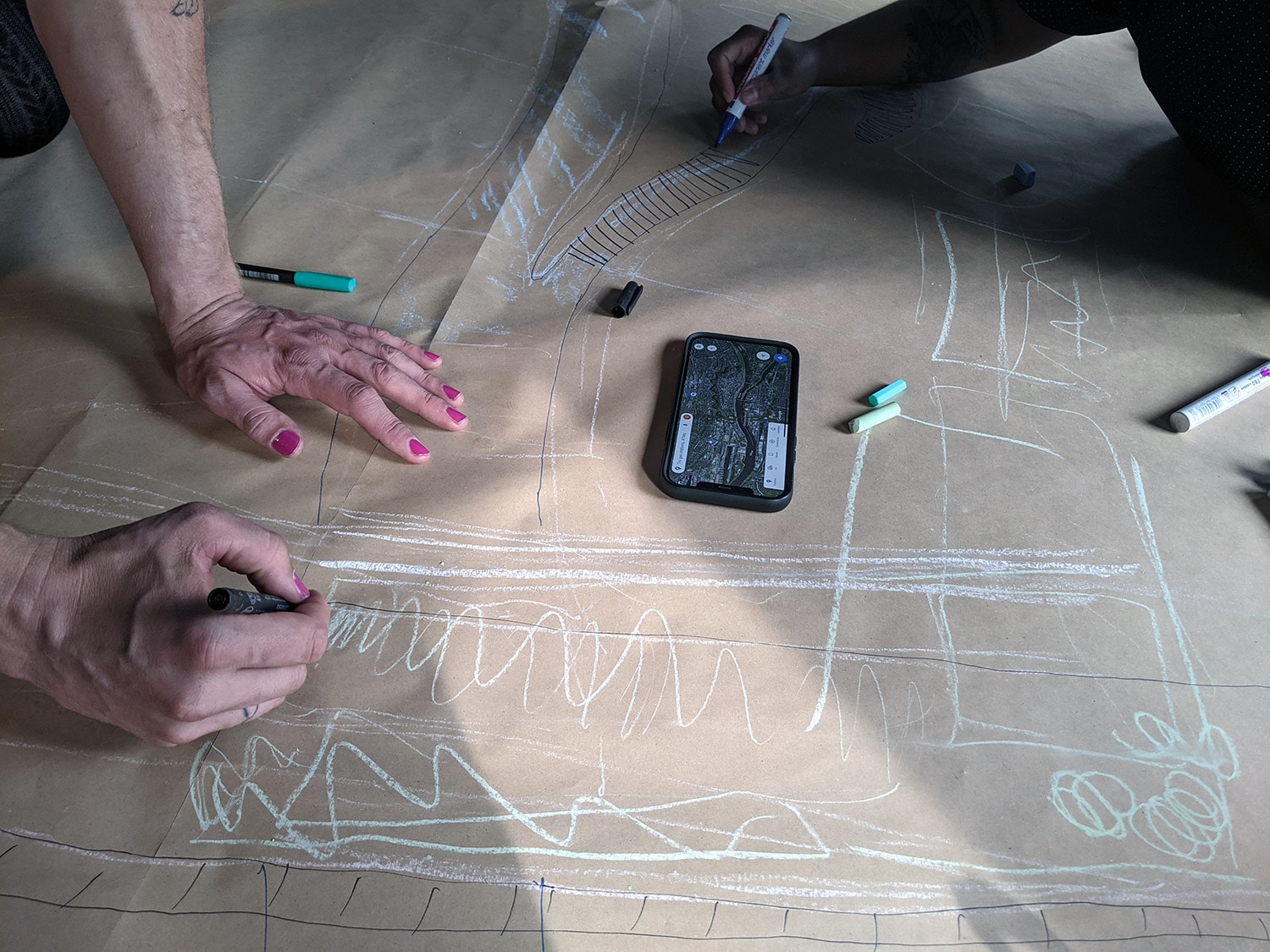
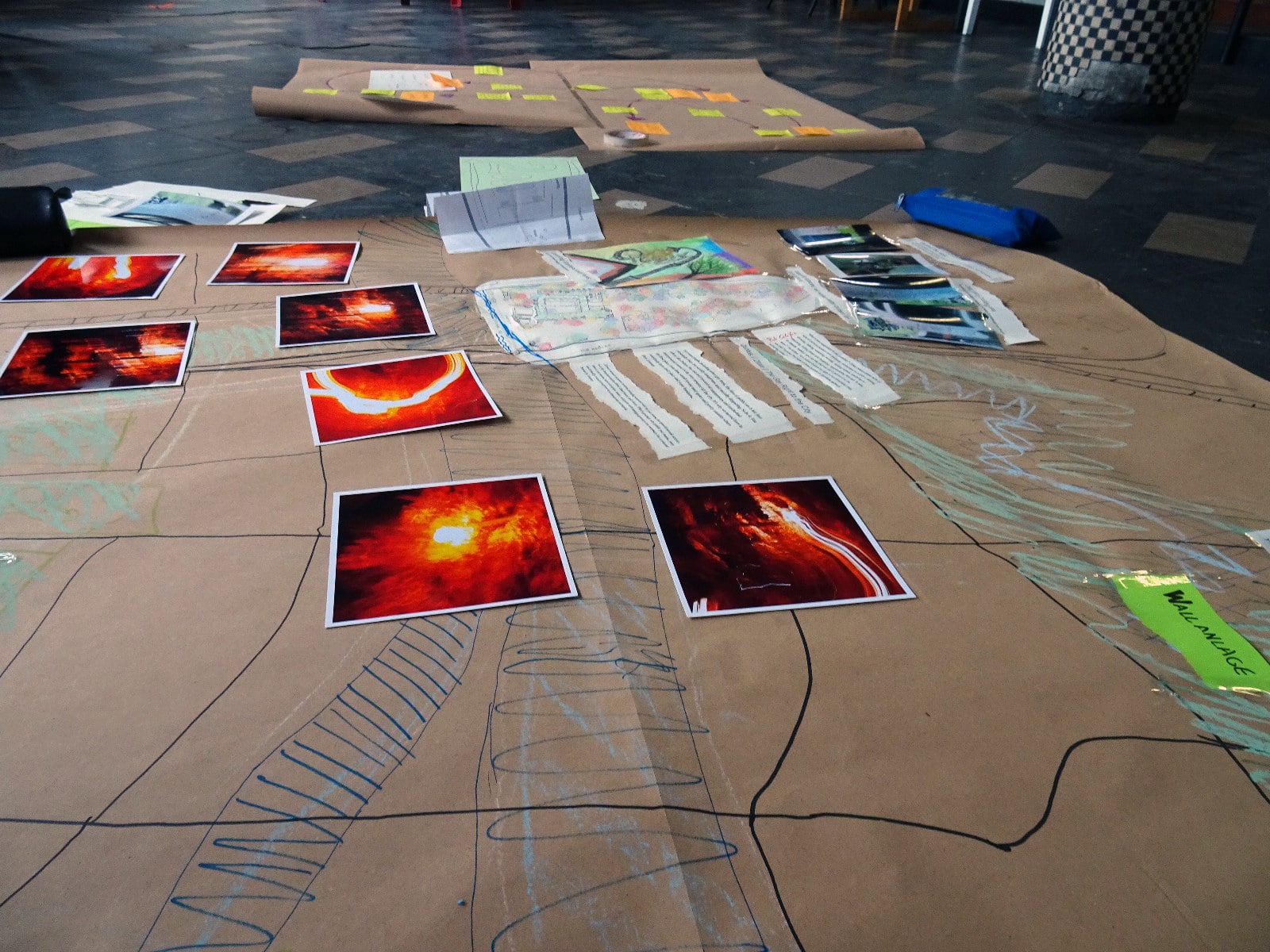
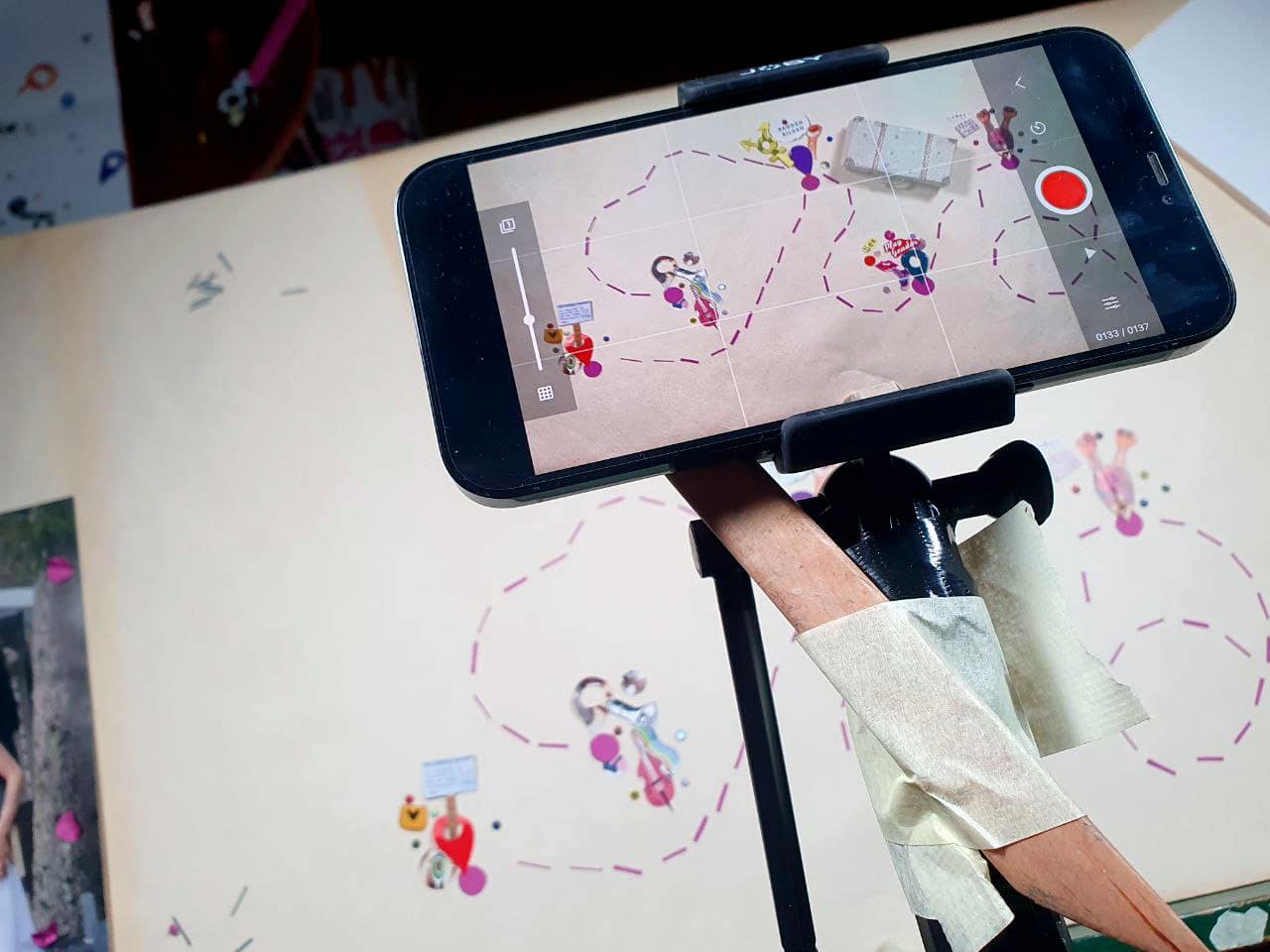
Some of us drew a collaborative map of a cruising area. This approach, hand-drawing with crayons, from memory, seemed appropriate.
To give an example: in one of our workshops, some of us drew a collaborative map, by hand, of a cruising area. The map traced the area’s connections to the larger urban environment, and included collaged-in details such as photographs of graffiti and other communication painted on walls. It was clear that this approach of hand-drawing by contributors, with crayons, from memory (rather than verifying via photographs), seemed appropriate for this site, without trying to establish spatial rigor or proportionality. We talked about how public sex should or shouldn’t, maybe better couldn’t, show up on our map, to protect — or at least not to exploit — these informal meeting places.
JG: I’ve asked myself, for instance, should — or could — places mentioned in writings by queer icons like Samuel Delany or Patrick Califia be mapped? I’ve fantasized about mapping George Chauncey’s data from the pathbreaking 1992 book Gay New York. I feel it would be ethical to map Chauncey’s data only because the documents he cites — namely arrest records — range from 1890 to 1930, and those people will have passed long ago. 4 My maps don’t go past 2008, so by the time the projects were released five years later, many of those places had closed or moved. Or, conversely, become well-known tourist sites. In other words, none were vulnerable to exposure via my work.
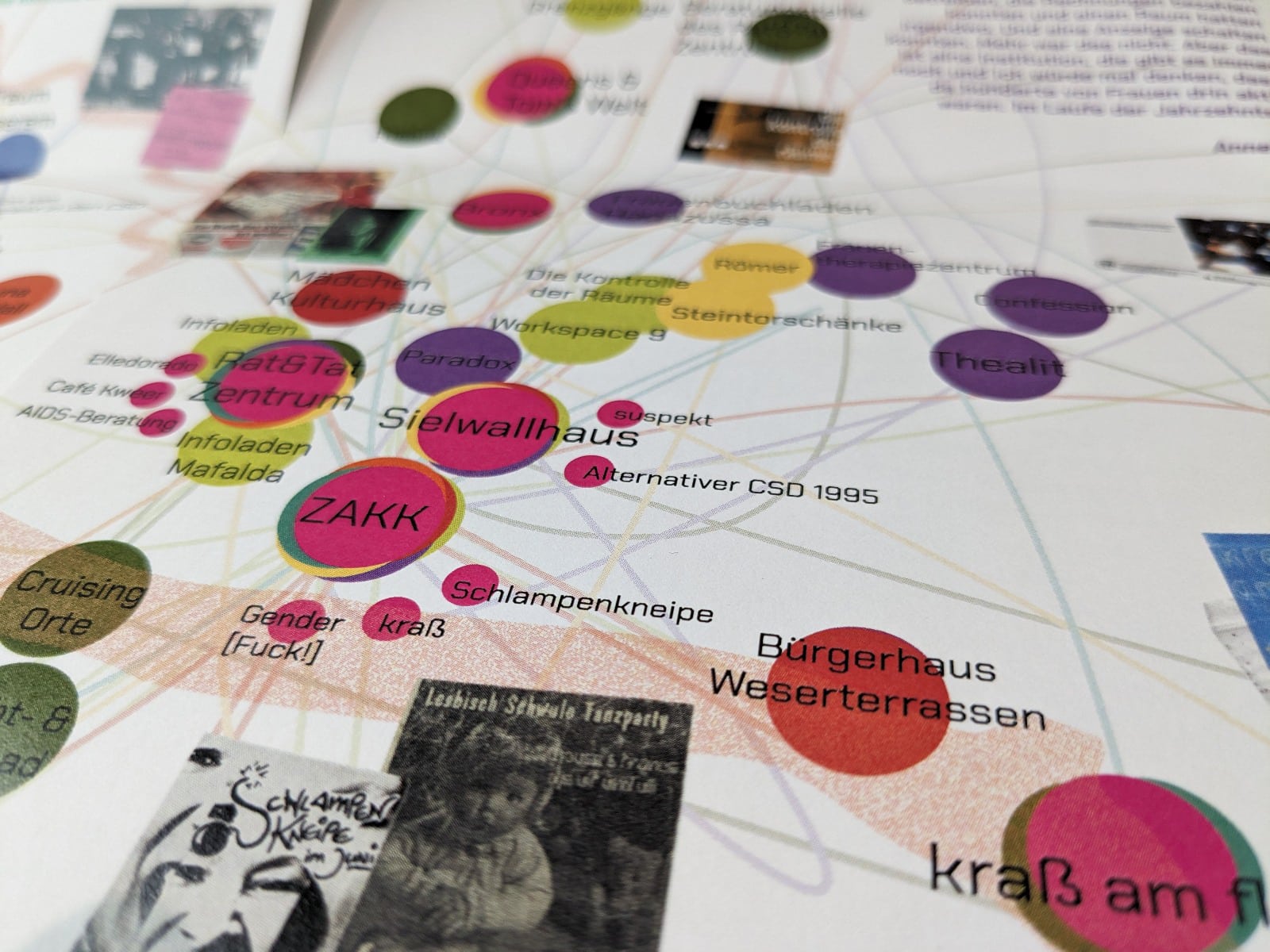
UT: Yes, and how else can we learn about places that have closed, or that were ephemeral all along? If we aren’t lucky enough to hear from someone who was there, or to have our own memories, then media and archives might be the only resources. In this context, our group has tried the following approach, in order to be able to save data while protecting certain kinds of anonymity: for the personal maps that were made for Queeraspora, we removed the base layer — the basic representation of the city. This created a certain abstraction, to help users to focus on memories of locations, and relationships among them. There was also some “spatial curvature” to the base map, so people could plot on the same sheet of paper both nearby and very distant places that were personally important. Such curvature facilitates the representation of diasporic experiences, and connectedness to places outside a specific urban context.
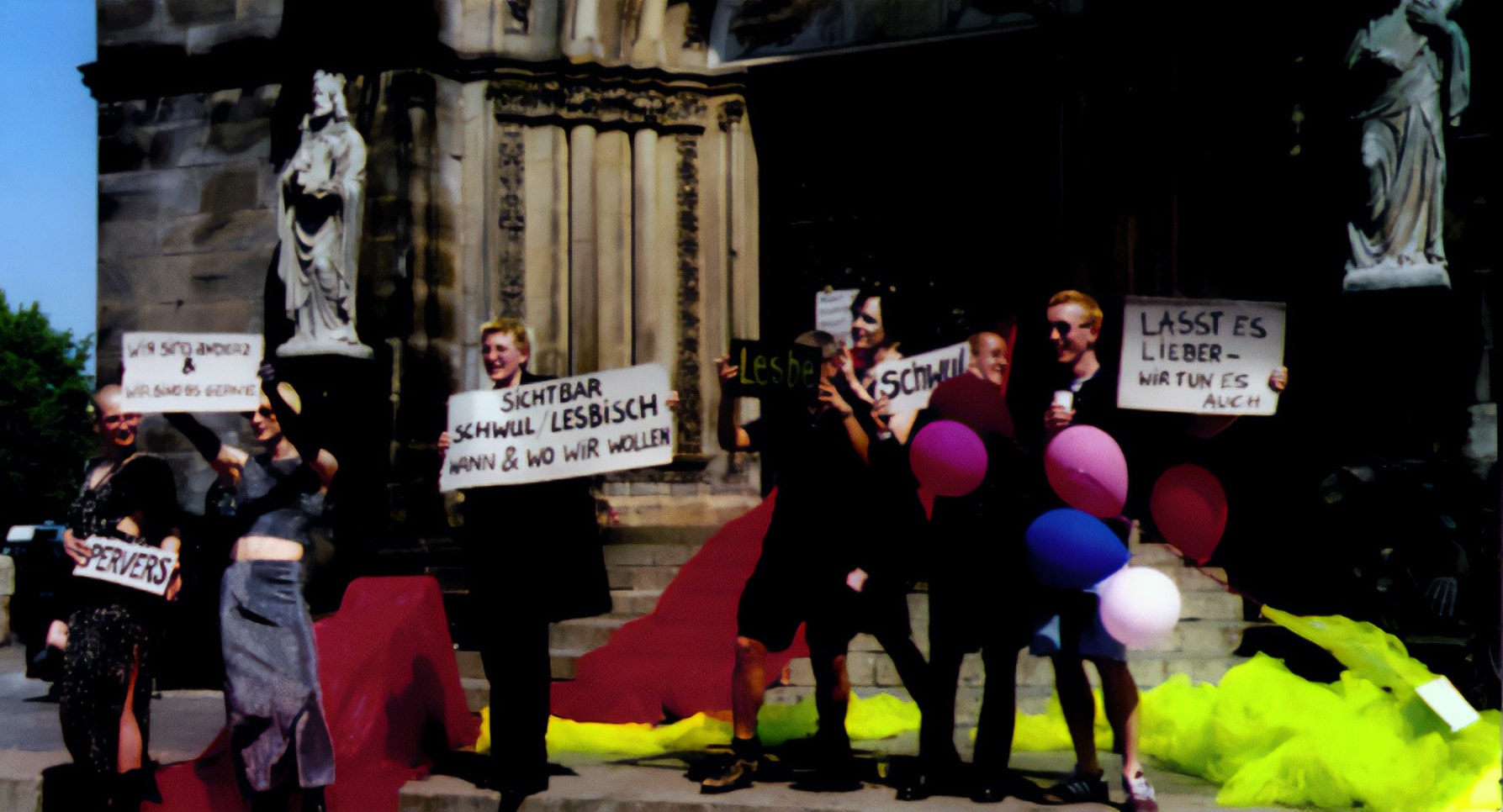
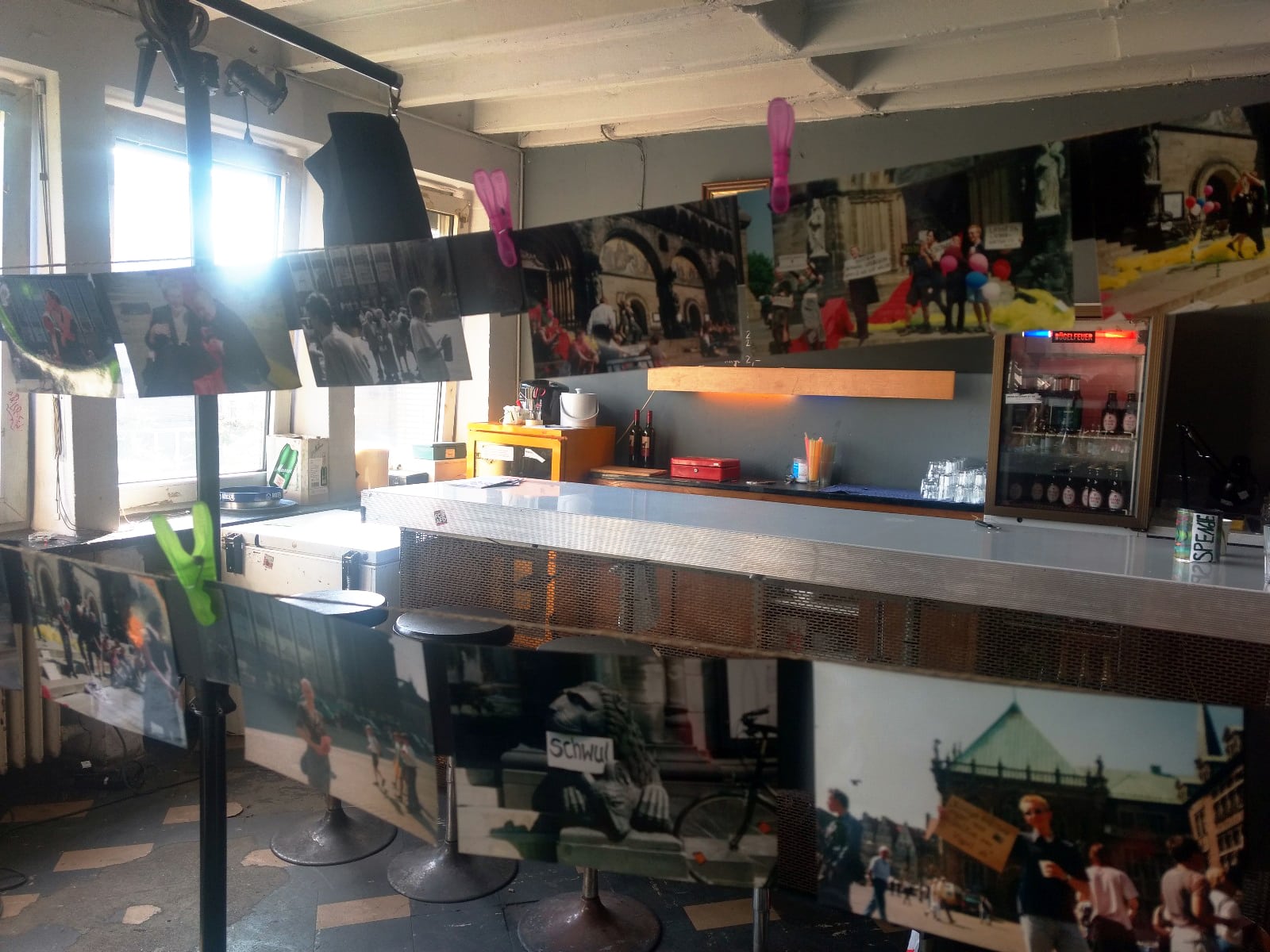
In winter 2022, we published another online map, “From Gay to Queer.” 5 This also exists as an analogue printed version (created by designer Dafne Jaramillo and editor Thomas Böker), in which places and their interrelations are mapped, on (nonvisible) x/y coordinates. Both versions, the digital map and the printed map, resulted from a six-month collaborative research project, based on interviews with people who had been active in alternative queer subcultures in the 1990s in the city of Bremen.
JG: I love this work. It feels so alive to me, so real to queer life, whether in Germany or the U.S. or many other places I’ve lived or traveled. Did you use geographic information systems?
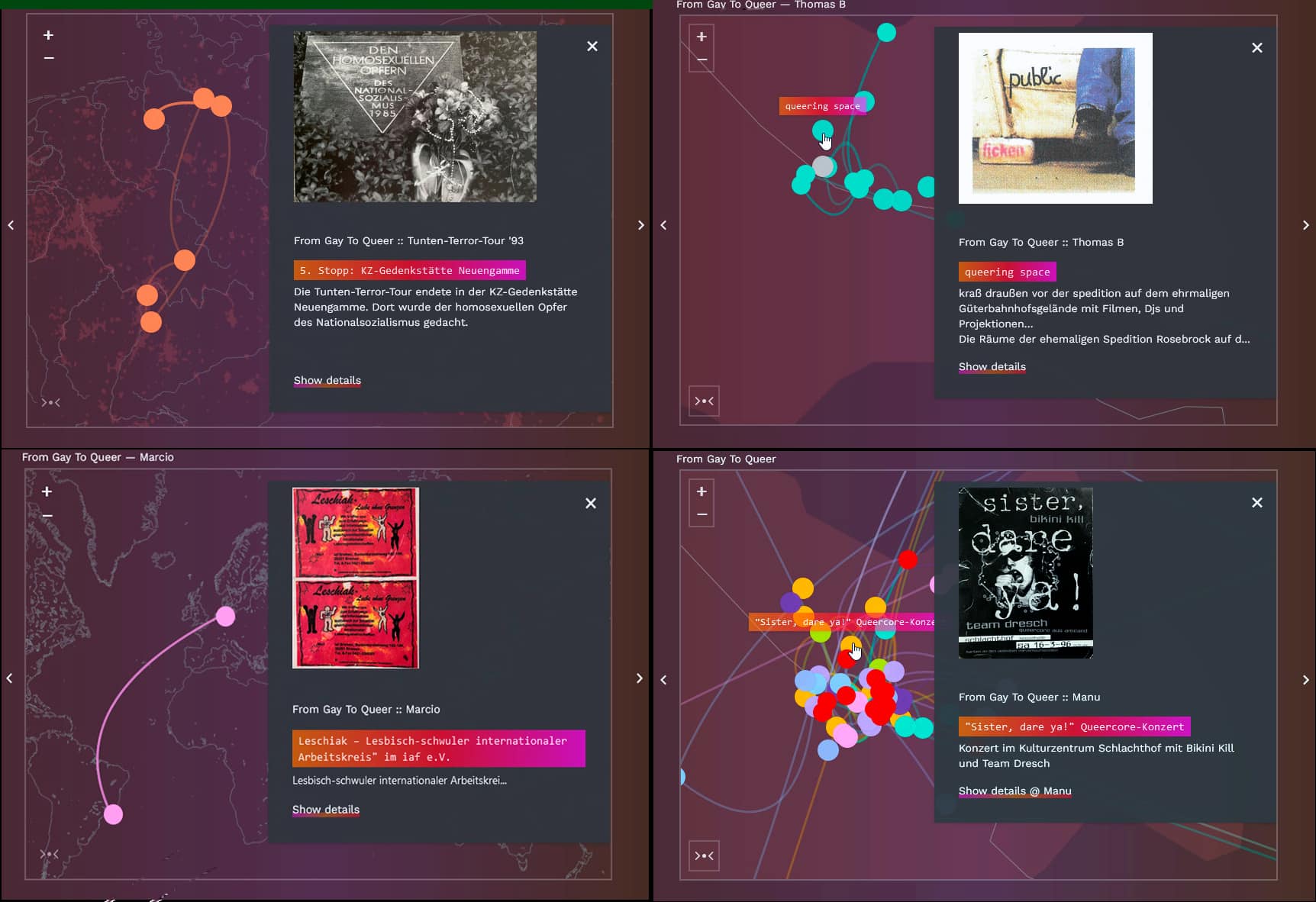
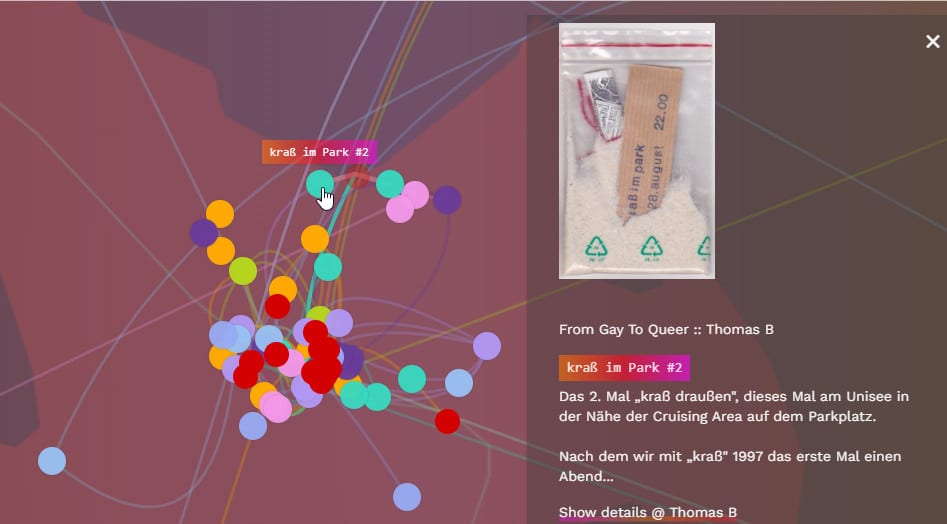
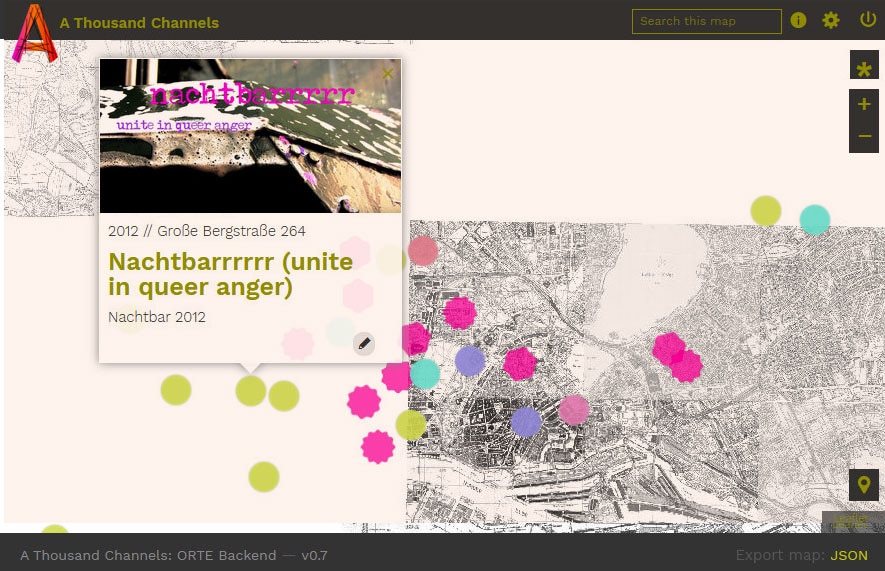
UT: Yes. From the start, for our mappings and for the mapping platform A Thousand Channels that developed out of the workshops, we used a digital mapping tool, a free software that I developed. The tool allows you to visualize places and events, and also to visualize relationships between places by drawing connecting lines. So the tool can be used to plot a narrative spatially (although, for collaborative work, digital tools may be less intuitive, more complex and time consuming than drawings on one big shared piece of paper). Equally important, with A Thousand Channels, we can avoid corporate systems, and have better control over how data generated in our workshops is interpreted and stored. We warmly invite people who want to use this platform to tell stories in LGBTIQ* contexts to get in touch with us. 6
JG: It always comes back to data, software, algorithms, and the ethics around them, doesn’t it?
UT: Yes. And far too often, important nuances are elided in a painful dualism between “tech will save us” and “tech is evil.”
People could plot on the same sheet both nearby and distant places that were personally important. Such curvature facilitates the representation of diasporic experiences.
JG: My (queer trans feminist) approach to binaries is always that we need to rip into them, or rip them apart. To queer (as a verb) is to confront either/or splits as simplifications that fail to account for actual difference, because work toward justice by definition makes room for such difference. White supremacy culture thrives on denying the possibilities (and actualities) of forms and experiences that are both/and. Misogyny, patriarchy, homophobia, and transphobia are the basis of White colonial capitalism, and vice versa — and structures of oppressive power require oppressive oversimplifications to keep us in neat categories; to administer us, as Foucault pointed out. There’s an ideology insisting “this is just the way things are” that is hard to interrupt, but we constantly create an idea of ourselves as well as our spaces.
Relatedly, data is often portrayed as magical or even mythological, as danah boyd and Kate Crawford pointed out nearly a decade ago. 7 Tech is seen as “a solution.” But to what? For whom?

UT: As activists, we collect data to make change visible, and to remember past struggles. At the same time, participants in our conversations and workshops are anonymized, and recordings of interviews are deleted after evaluation. It goes both ways: a conscious accumulation and evaluation of data sets, and the conscious avoidance or reduction of data availability. Deciding on the right way to handle this is not always easy.
JG: There are three fights in this arena that require queer attention: the uses of data collection; the biased algorithms processing that data; and what corporations call “trust and safety” work, defining who is protected and how. If you can imagine who is in a corporate board room, you probably would not want them to have your data, or control how it is read. So we need to fight for ethical modes of collection, storage, and analysis. To have power over our lives, we — all people, but especially marginalized people: queers, refugees, immigrants, disabled people, working-class and poor people, Black and Indigenous people, all people of color — must have the right to control our data, and transparent access to the algorithms that manipulate our job opportunities, profiles, and likes and dislikes (as they call them); that define who we can or cannot be connected to, and, as a result, what is visited upon us.
For example, did you know that graduates of U.S. women’s colleges — including me — have been and maybe still are less likely to be hired at Amazon, because of bias in their hiring algorithm? 8 This was a measure coded in by human beings. Groups like the Electronic Frontier Foundation, among many others, have long argued for the protection of digital civil liberties in such situations.
It always comes back to data, algorithms, and the ethics around them.
I also think data analysis needs to be part of every curriculum. I know I sound anti-tech …. It’s hard not to, when so much of the tech landscape is so corporate. I adore the communities that many of us create online. But I do think we are misled about the extent of our own agency. These softwares further White supremacy and patriarchy by sorting us (again, neat little categories) into feeds of who they think we should see — and, at the same time, disappearing posts that use “radical” words like dyke, or shadowbanning people who post too much content. Trust-and-safety workers are too few in number, and still need to go the distance to effectively teach how some kinds of language and action can be empowering. Regardless, under corporate capitalist control, we’ll never be liberated or enact true resistance to these structural oppressions simply by using the devices in our hands.
UT: How would queers find one another if we all dropped off the internet?
JG: More than worrying about whether tech is good or bad, we need to make use of it; to be unafraid to fight for policies that keep us safe and help us thrive. I’m encouraged by groups like Distributed AI Research Institute and The Integrity Institute. The former is made up of some ex-Google AI BIPOC queer-trans folx who are working for algorithmic transparency. The latter is a group of present and past trust-and-safety workers across platforms (from Meta to Grindr and Discord), who are weighing in to inform government officials and other leaders. In other words, even tech workers are organizing.
I wish we could all opt out of devices and apps, but most of us need or want them. The contact facilitated digitally supports our mental health and survival across generations in ways that were previously incalculable.
But I’m wondering what you’re thinking. Do you think we should drop off the internet?
UT: It’s a difficult and thrilling and scary topic. The infamous response, which I myself tended to give for years, is to call for using alternative, free, and federated platforms, like Diaspora or Mastodon. This plea might still be valid, but it lacks leverage. In the worst case, proposing such “alternatives” only provokes a guilty conscience, while we continue to use the commercial and centralized platforms. How can we break out of this dilemma? Could government regulation, however designed, lead to more convivial mechanisms?
If you can imagine who is in a corporate board room, you probably would not want them to have your data.
JG: I’m not convinced that governments will ever — or could ever be allowed to — catch up to big tech, when capitalism will continue to place earnings and growth above well-being. At the same time, we know that devices, apps, sites, and platforms are increasingly central to coming-out experiences for younger people. Even in 2008, more than one of my interviewees told me that Wikipedia had saved their lives by allowing them to discover evidence of our existence — evidence that was documented as knowledge. Better yet, many queers have repurposed dating and cruising platforms to support other kinds of solidarities.
UT: Can you give an example?
JG: I’m enamored with the original design of the Lex App. At its launch, the Lex App described itself as a “lo-fi, text-centered social app for women, trans, genderqueer, two spirit and non-binary ppl for meeting lovers and friends. Inspired by old school newspaper personal ads.” The posts are mostly words; you have to click through for a very tiny photo. Lex posts really range. From cat-sitting advice to someone in chronic pain finding others to hold hands with in Animal Crossing; from, say, “BDSM daddy seeks boi for masked one night encounter” to “ready for earnest love match that defies the ages.” This may be a direction this particular app was bound to take. But, during the pandemic, the need for connection — albeit at a physical distance — was amplified, and it still is for many people with long-haul Covid and other disabilities. We need the entire digital queer ecosystem to keep connections, and hence sanity, possible all of us.
UT: Their design choices alone make Lex interesting.
JG: Like all dating or hookup apps, they do have a geolocative aspect — but you can choose to search nearby, versus larger gay-lesbian-queer apps, such as Grindr, Scruff, Tinder, HER, which are based on proximity to those around you. With these apps, you have to pay to geolocate yourself elsewhere — and Lex added that feature, but you can still keyword-search worldwide. This is one of the reasons I launched the LBQT*S Dating & Hookup Apps study (for lesbian, bisexual, queer, trans*, and sapphic people), because most dating-app research has looked at presumed cis people, gay men, and straight people. I am no longer paid by a university, so I’m doing this research as an independent scholar. The study closed in June 2024, and I’ll start writing about findings later this year.
Devices, apps, sites, and platforms are increasingly central to coming-out experiences.
UT: I wonder how content- or keyword-matching would facilitate more varied, less superficial connections. Of course, I don’t mean the regulated set of body attributes. I mean content-matching in a free and unregulated way, maybe by tagging cultural topics, political discourses, or social practices. We have various curating sites and services already, of course, so this is in no way a new idea. But in terms of contact apps, I think it would be great. Plus, the matching process would be peer-to-peer, with zero information harvested by the platform provider.
JG: I’m working to commit myself to decentralized platforms like Mastodon. They more thoroughly replicate our lived geographies anyway, but they are hard to acclimate to, because (and I just audibly sighed), we’re used to platforms being simplified for us.
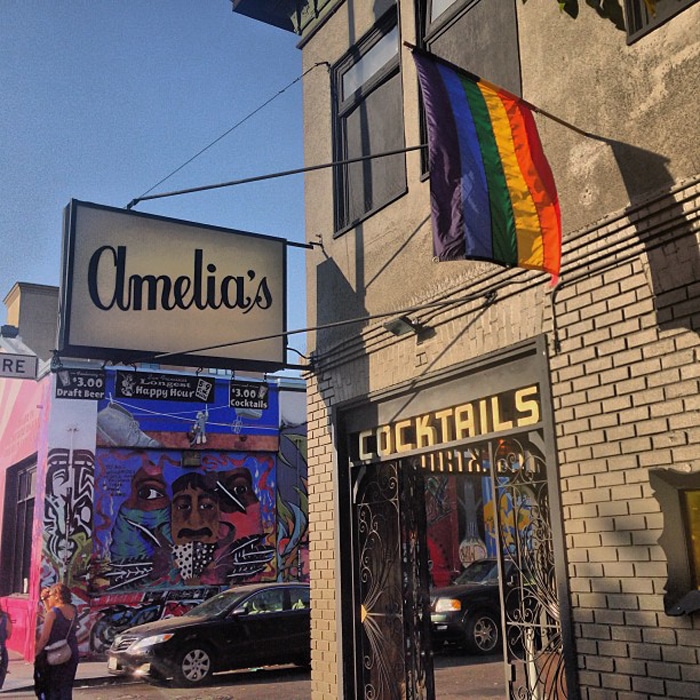
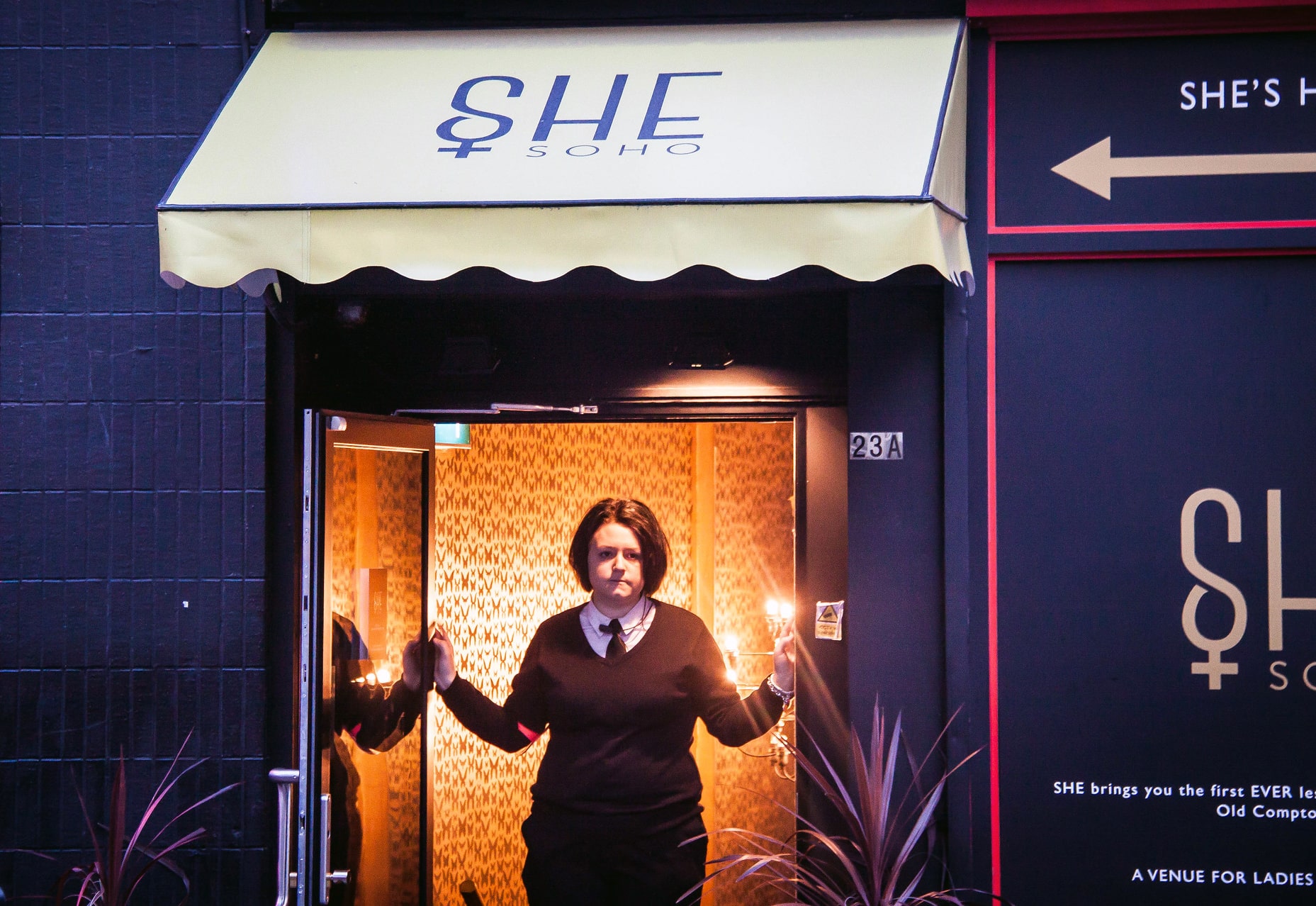
UT: This makes for a good segue to talking about face-to-face encounters. Bars, clubs, and other social venues are endangered; queer and lesbian places that had already become rare continue to close at an unprecedented rate. Is urbanity still important to queer community?
Of course, urban density versus rural isolation makes a huge difference. Metropolitan areas are special in terms of the anonymity they offer in using public space, and cultural options that make it easier to meet your (social) kin in person. Access to better healthcare and other social factors are more favorable in cities, especially for marginalized groups. Behind these facts lie questions of mobility or lack thereof, which are also questions of privilege.
At the same time, there have always been queer places that are not so visible, not so easily mappable. If queer bars and clubs are disappearing, what structures remain? What will be newly created?
JG: I stay up wondering at night about this! (Often I am wishing we were all together in a queer bar.) As of spring 2024, there were around 32 lesbian bars left in the United States per the Lesbian Bar Project, a documentary series and fundraising group for these bars. 9 What defines a “lesbian bar” is debatable; but there were well over 300 in the 1980s, as Greggor Mattson has shown in his 2023 book Who Needs Gay Bars? 10 Many gay men’s bars have closed too, especially during the pandemic. Mattson has this terrific (or is it tragic?) graph of the numbers of gay, lesbian, POC, and mixed LGBTQ bars in the U.S. They were all declining in the 2000s. 11 But Mattson shows that if you look at what has happened since Covid, some of these numbers of LGBTQ bars are increasing. At the same time, saying that the number of lesbian bars has “more than doubled” is a laughable use of statistics when there are still so few total, e.g., fifteen in 2019 and 33 in 2024. 12
Bars and clubs are endangered; queer and lesbian places that had already become rare continue to close. Is urbanity still important to queer community?
I’m contending with all this in my current book project, which is titled Where Shall We Meet to Plan the Revolution?: Dyke Bars* for the End Times. I’m using the trans asterisk to open up our thinking about what the dyke bar was, is, and yet could be. There’s a lez, bi, trans, gay, queer, and even straight obsession with lesbian bars — the rising and falling fates of lesbian bars are consistently the top “lesbian” news among lesbians and straight people alike — and we need to unpack that, to take the power the bars affect and use it for revolution. For instance, I’ve been struck, as I conducted my research, to discover that many of my participants had idealized lesbian and queer bars, only to find them disappointing. Interview participants would list myriad other places that were central to their lives as lesbians or queers, but they would never name those spaces as “lesbian” or “queer” — spaces like co-ops, soccer fields, parks, colleges, libraries, archives. Was New York City itself queer? My participants debated! They were conflicted, because so much of the city was, or had been, queer to some and not to others. Clearly this is shaped by race, class, gender, generation of coming out, age, disability, citizenship, hometown, and so on.

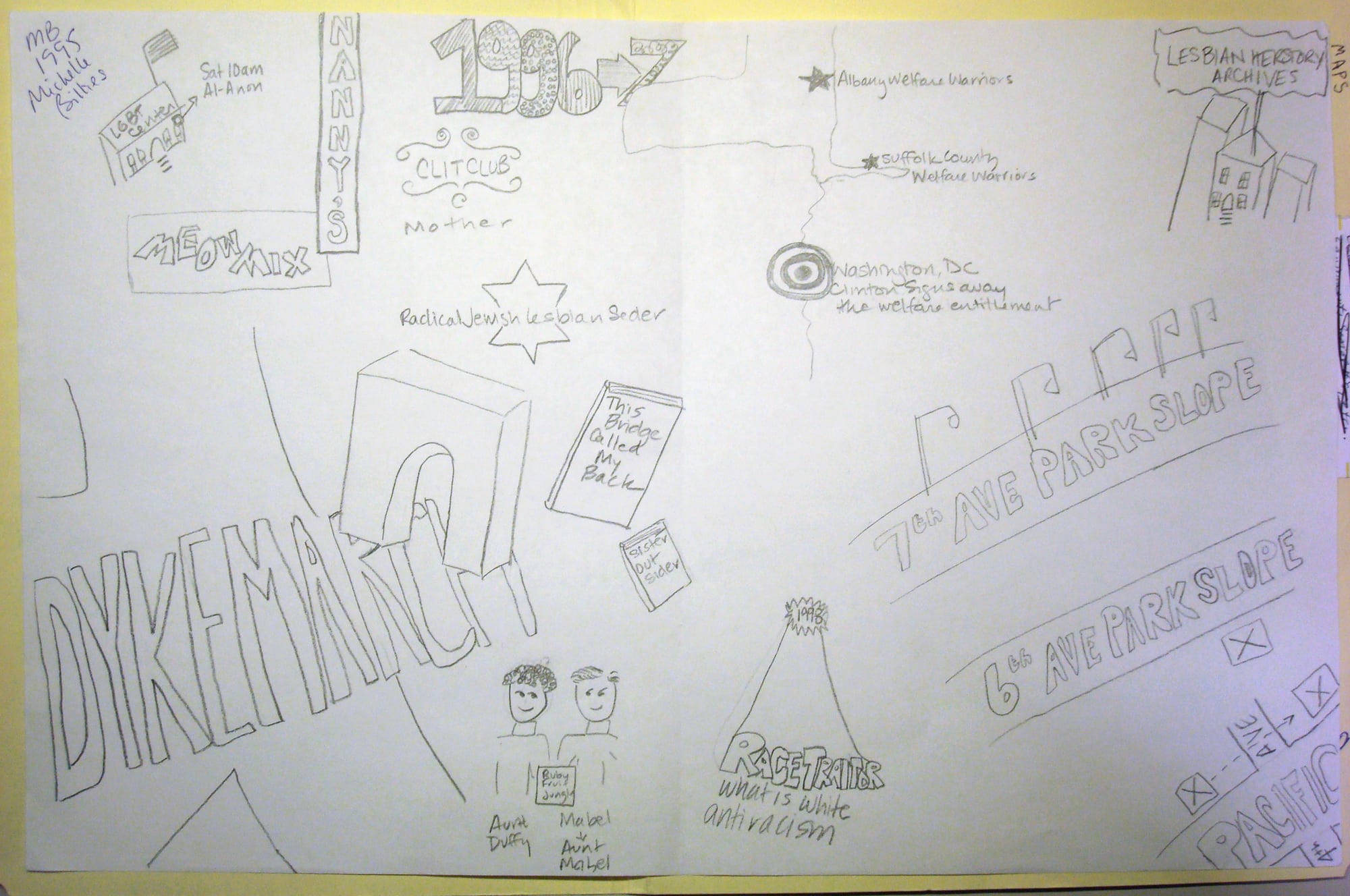
UT: We run into the same concerns about finding common ground regarding what “counts” as “queer enough.” In Queer narratives, mapped, we talk about places as queer in two senses, meaning a place more or less regularly populated with queer bodies, and/or a place that could be queered by temporary presence. Typical places made by and for LGBTIQ+ people, like the gay bar around the corner, play less of a role for most of our contributors than those places that exist only for a short time. Temporary spaces created by public gatherings or roving parties have a much higher value, in being non-static and hybrid.
Was New York City itself queer? Participants debated!
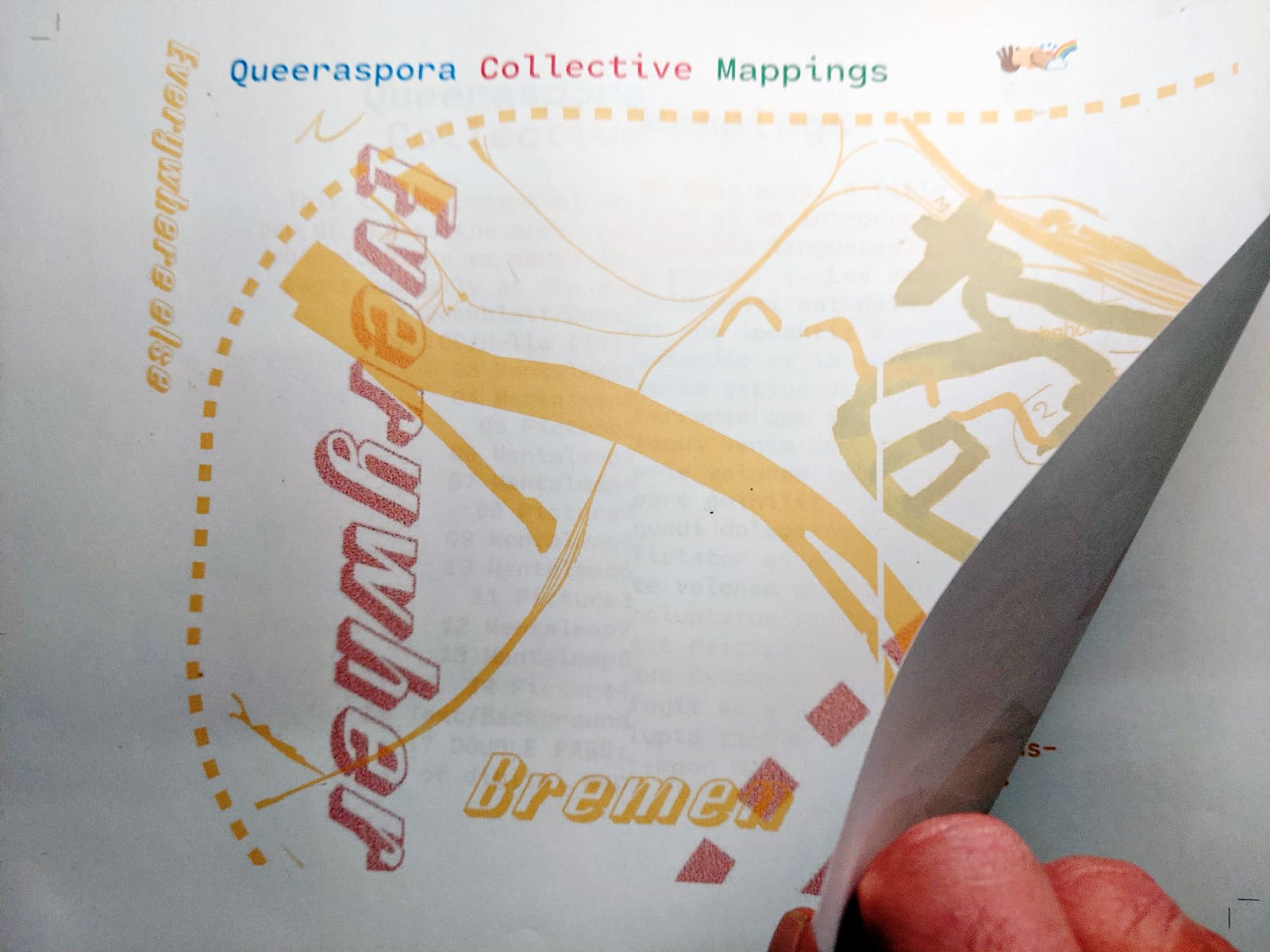
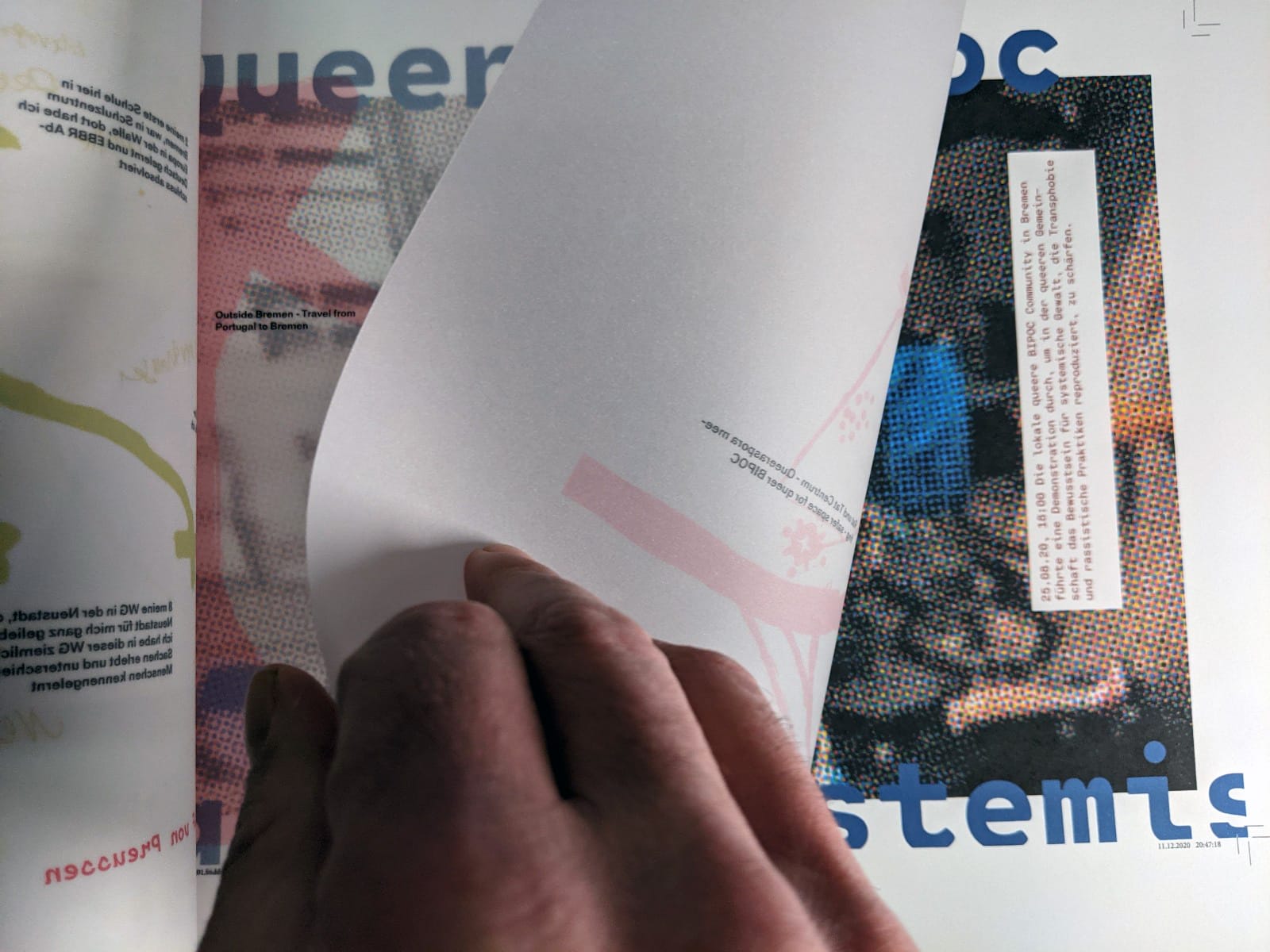
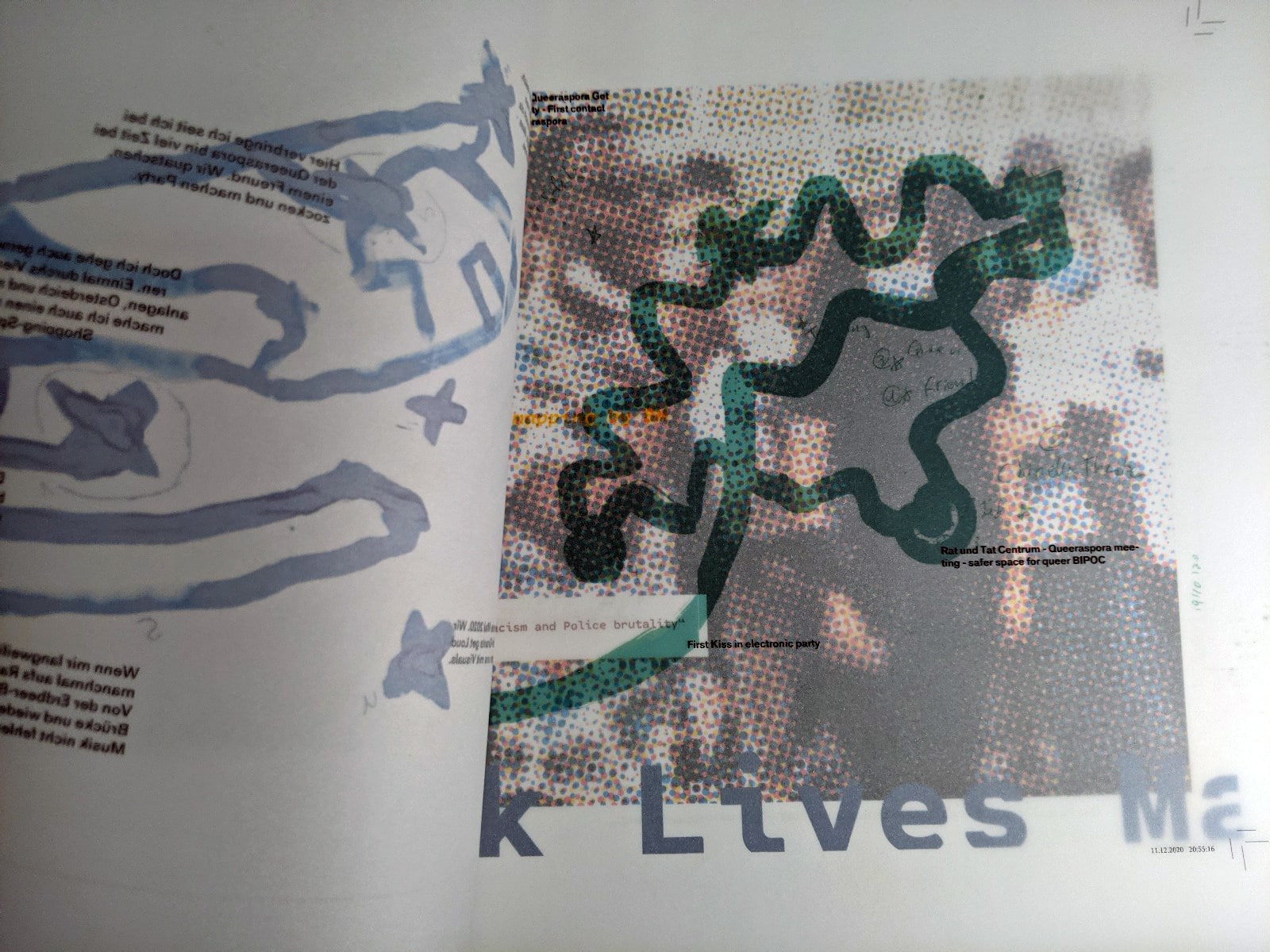
JG: Looking through the Queeraspora printed map, I was struck by the gorgeous and thoughtful design of opaque white overlays presenting individual participants’ own maps and stories of queer Bremen. Why publish these as transparent layers?
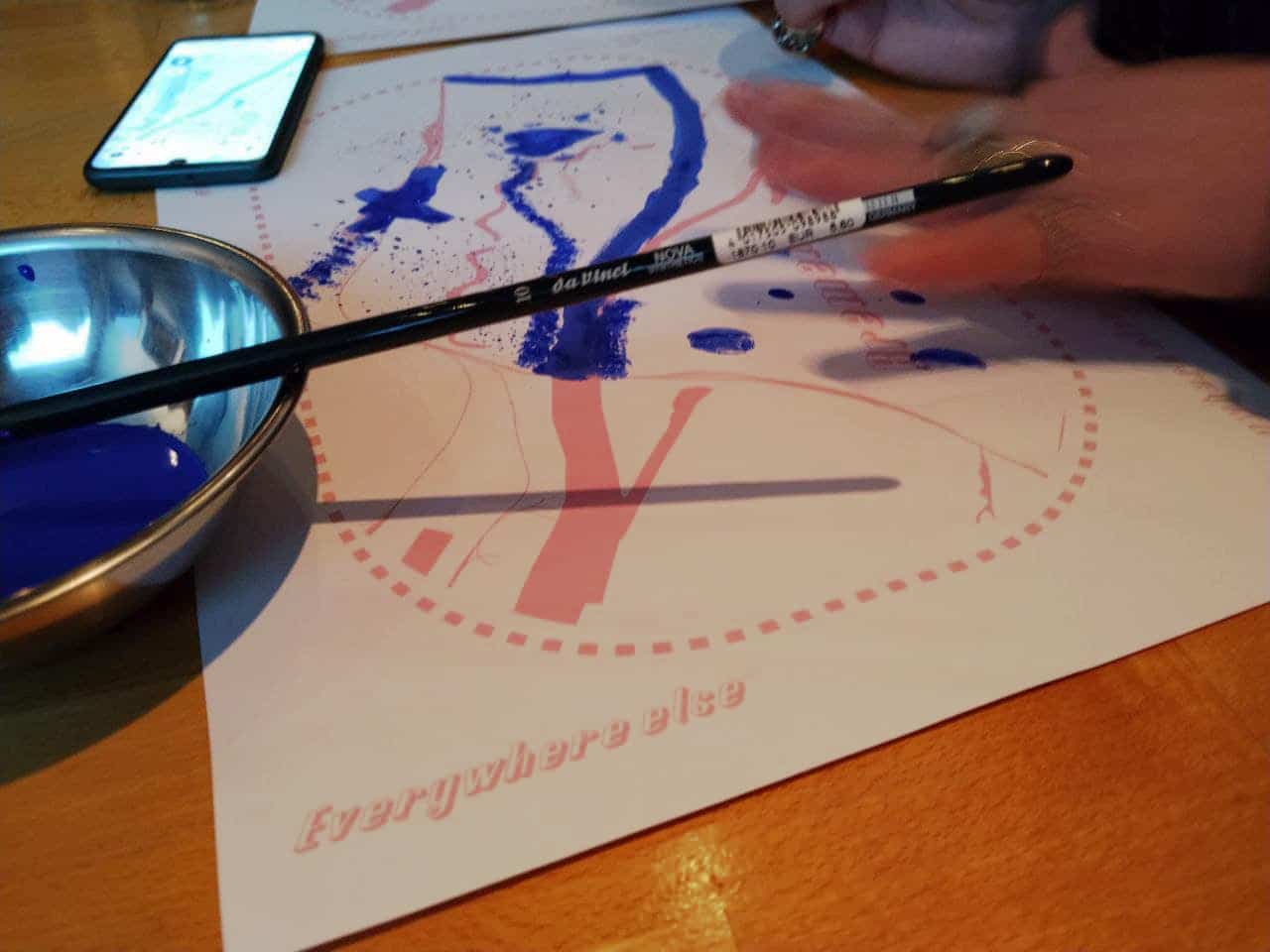
UT: Those personal maps, which were originally hand-drawn, consist of points and connection lines or trajectories on transparent paper, with each map in a different color. So that as you page through the booklet, overlays or condensations of those multiple individual geographies become visible.
The digital map was created at the same time, but with a different intention. It is basically a Cartesian map, documenting public activities like rallies and demonstrations, and temporary events like parties and workshops. The satellite imagery (provided by our GIS back end) contrasts against the more abstract, painted personal maps.
JG: Thank you and Queeraspora for this work.
UT: I am happy that you appreciate it (and I am grateful for the collaboration that resulted in these maps). Where does our profound focus on bars and clubs come from, do you think?
There’s a lez, bi, trans, gay, queer, and even straight obsession with lesbian bars. We need to take the power the bars affect and use it for revolution.
JG: Our collective imagination about “gay,” “lesbian,” “trans,” and/or “queer” urban spaces is changing, and I would argue that the most powerful driver of this change is the closure of men’s spaces (per Mattson’s research), even as the tiny number of lesbian spaces has somewhat improved — because no one thinks of gay men’s spaces as endangered. In part, the closure of women’s spaces is given less attention because women are given less attention. It’s also because the contention around who is welcomed in these spaces, namely trans people, has been a huge source of anxiety and debate. I think we’re all freaked out about the closing of our bars (me included), not only because it’s a profound loss, but also because we’ve so narrowly named the range of locations where we live our queer lives in place. What other kinds of spaces do we hear about as “gay” or “lesbian”?
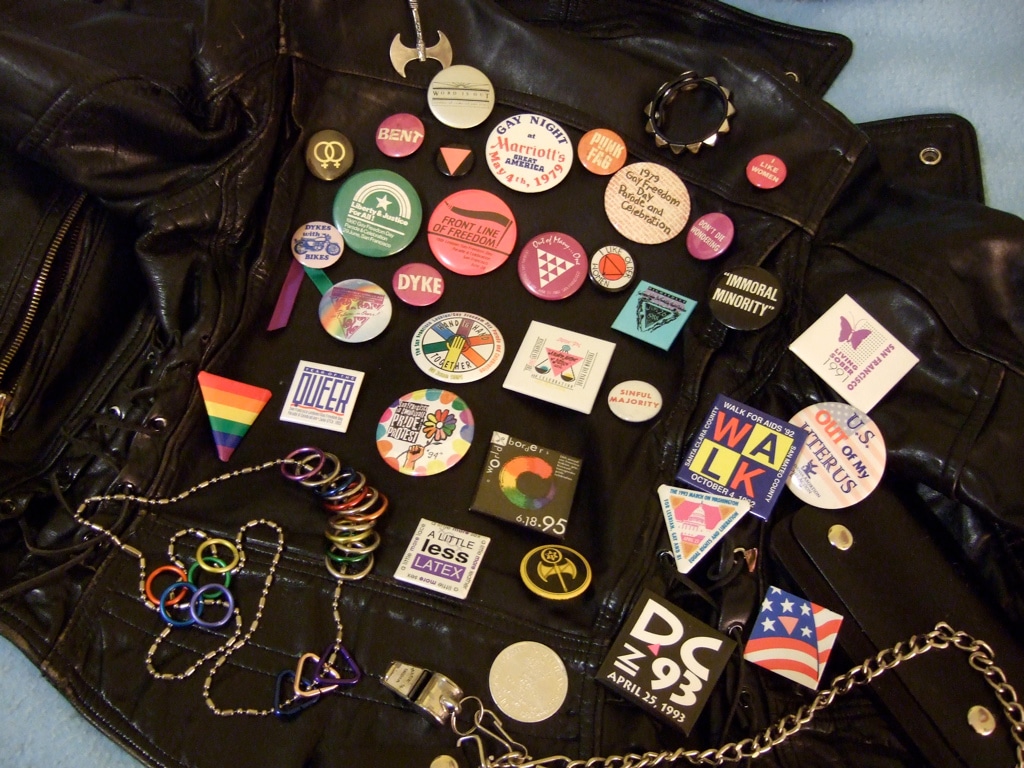
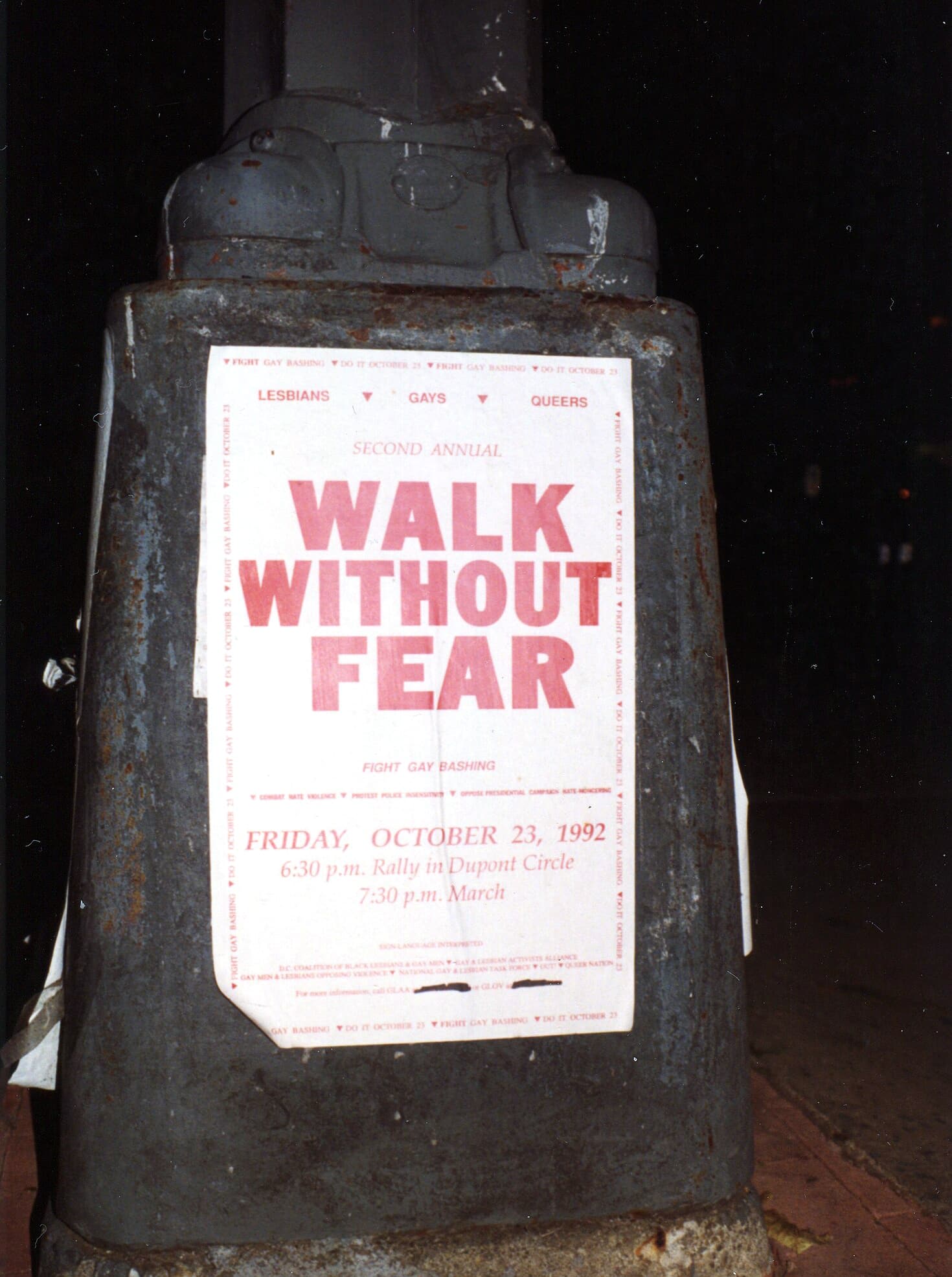
Historically, the blame of this for this oversimplification (queers = bars) goes to White cis-heteropatriarchy. When you think back to the 1950s, some queers — namely White, cisgender people — could strike out to be ourselves, typically in bars or on remote beaches, as Joan Nestle pointed out in the now-founding text of queer geography, Queers in Space. 13 But, unlike beaches, bars were in the center of a city. They were dark, and full of loud music and cigarettes and alcohol. In other words, deviants were allowed in deviant spaces. In response, we turned bars into magical places, places of sanctuary.
Seeing beyond the myth of neighborhood liberation allows us to see how sites of identification and gathering tend to be spread out across a city.
I wonder if it would be comparably magical to claim many other spaces as queer: the bookstores and basketball courts, sure — and also the baby-feeding cafes, the mutual-aid-group admin meetings, and most shelters, whether for unhoused humans, abused humans, or animals of any kind, human included. I also worry about the evil of cis-heteropatriarchal, settler-colonial, ableist, racial capitalism (or “capitalism” for short). Capitalism loves to repackage and sell who we are, what we do, and where we go as some “fabulous” experience for heterosexuals. This is especially true when it comes to the brilliance and innovation of Black and Indigenous queers and Two-Spirits, whose very lives are often defined by resilience and resistance. I wonder if claiming other kinds of spaces would further endanger those who are already at risk. But I also think we could undo some cisgender, heteronormative, and patriarchal assumptions if we were to queer more of the world, and name it as such.
All I know for sure from studying queers is that we find ways to find one another, again and again. That I have data on!
UT: You’ve talked about the “myth of neighborhood liberation.” What do you mean by this, and what kinds of production of space can be distinguished from such myths?
JG: I use that term in thinking about the ways women and trans and gender nonconforming people have claimed and created space — because it wasn’t, historically, in the form of gay neighborhoods. When I asked interviewees, “what is a ‘lesbian space’ or ‘queer space’?” they would start talking about gay neighborhoods, and then describe how they didn’t feel welcome there.
UT: Why was that?
JG: I realized there was an assumption that, after coming out, they would go to a U.S. gayborhood like Greenwich Village in New York or the Castro in San Francisco, and find others like them — in a space often imagined to be a bar. But that rarely happened. Where did that assumption, that myth, come from? Well, as Americans, especially as White Americans, we are truly attached to the notion that claiming and maintaining property is the ideal. It’s the so-called American Dream. For LGTBIQ+ people, I think this got re-versioned into making territory of our own in cities. Or, for lesbians, there was “lesbian land” in rural parts of many countries, over many decades.
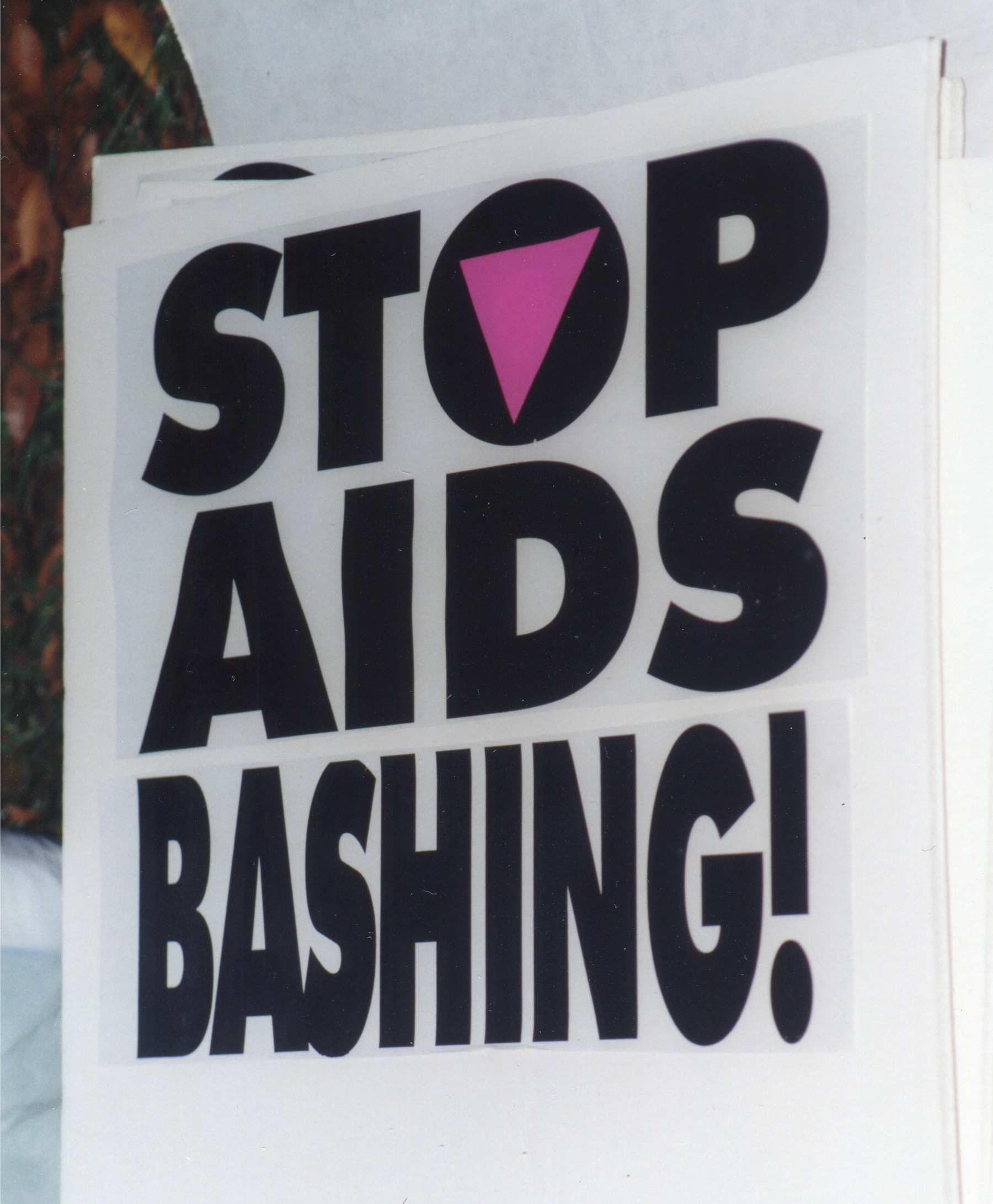
We do have territories, and territories are important. But the idea that everyone should be able to claim property is very White, male, middle- (and now usually upper-) class. Seeing beyond the myth of neighborhood liberation allows us to see how — at least for lesbians and queers and trans people — sites of identification and gathering tend to be spread out across a city. Spaces belonging to queers of color are even more atomized. More fleeting, too, because these groups typically don’t have the money or power to hold onto a building or a neighborhood for as long as White gay men do. It is our bodies that link these fragmented and fleeting scenes. In my book, I wind up describing such spaces as stars, and the ways our bodies connect them as constellations.
UT: It’s interesting how brick-and-mortar places (like the traditional gay bar) are seen by many young queer people as being of rather abstract importance. We know these sites have existed, and respect them for their role in history, and maybe still today. But we don’t see them as regular parts of our personal landscapes. Plus, for BIPOC contributors in our workshops, negative experiences of racism and exoticizing can be associated with such places.
In our mappings, as I’ve been saying, we notate memories of temporary spaces, maybe created just for one night (or into the morning). We include placemarks for infrastructures like archives, libraries, cultural and social centers. And we see movements and relations between such places, both fluid and fixed. “Constellations.” It’s such a vibrant concept.
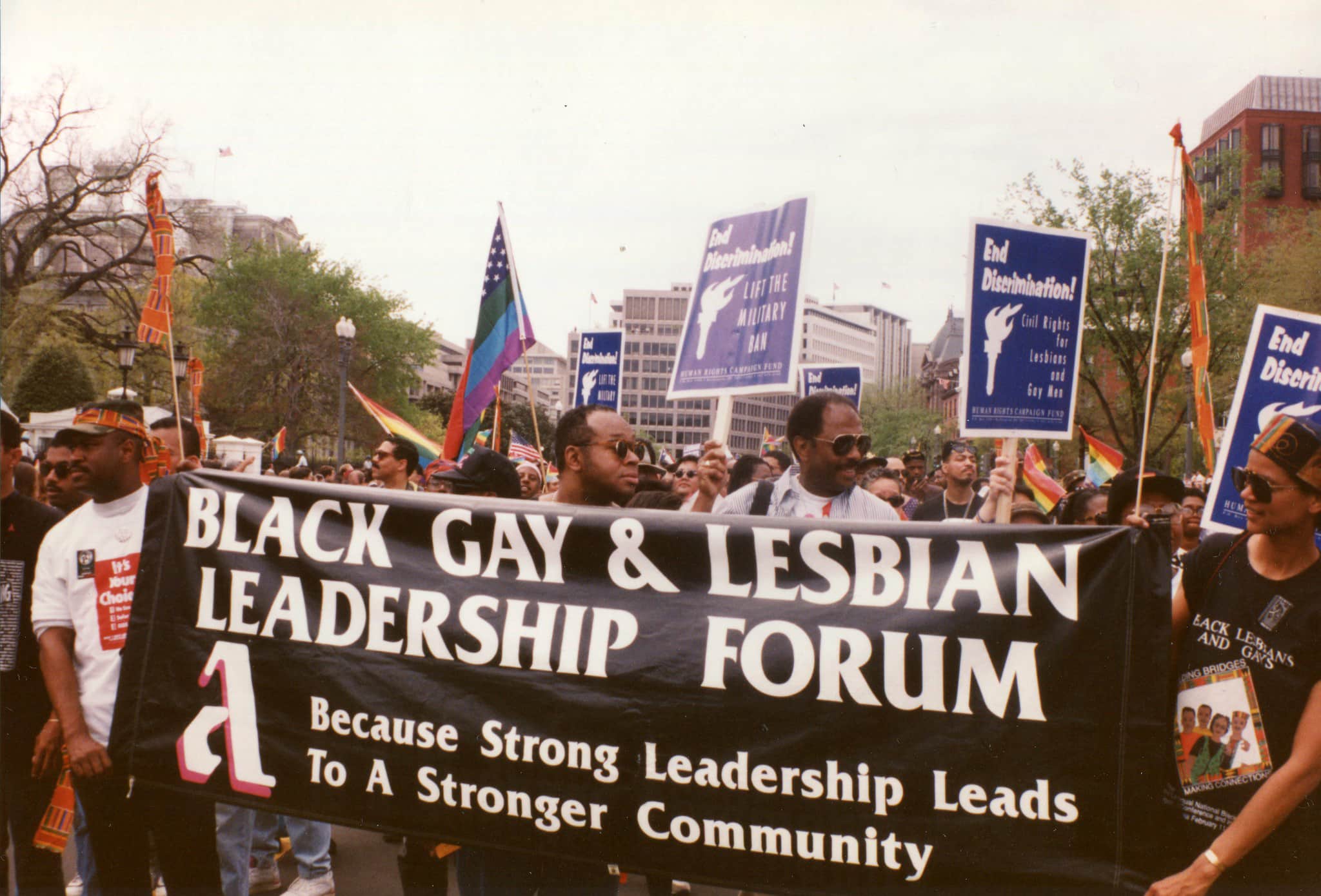
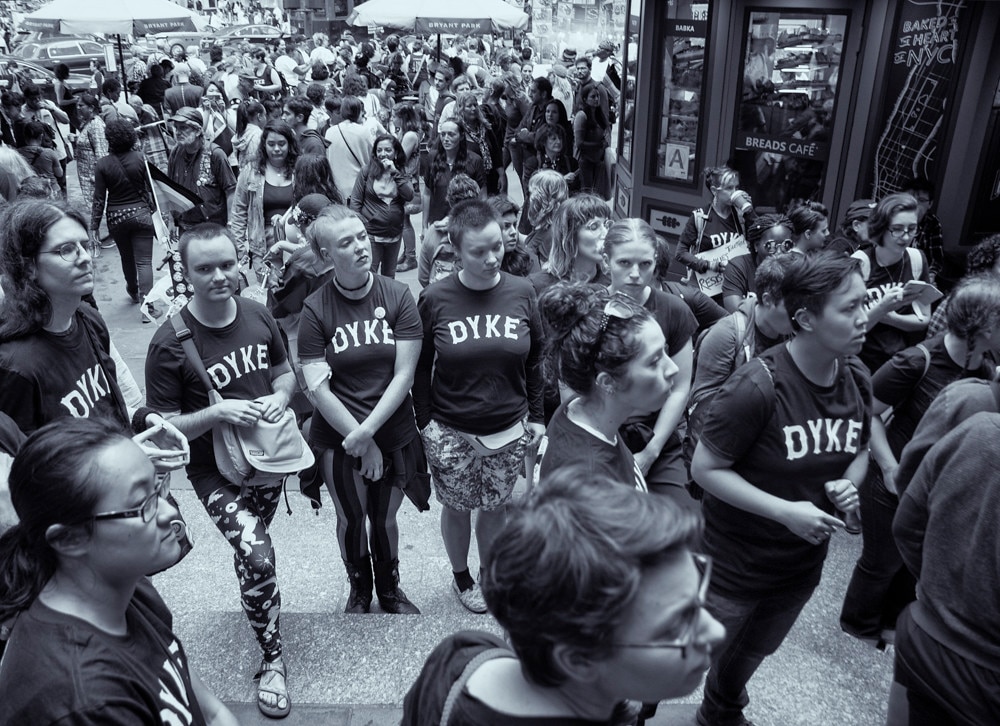
JG: Constellations are attached to myths: think of the Pleiades, the Seven Sisters constellation, or Draco the dragon. I wanted to evoke an image that wasn’t exclusively territorial. Because when our territories disappoint us, or if and when they are taken away, I want us to see that we survive and thrive regardless.
UT: On that note, let’s talk about dating. You have written about the “blending of virtual and physical places.” How do digital communications and physical structures, paths, and intersections influence each other?
JG: The “blend” has always been part of how queer spaces are made. What Hil Malatino calls the “side affects” of trans oppression in his aptly named book Side Affects — disassociation, burnout, depression — come from a lack of in-person, real-time contexts to support your reality. 14 LGTBIQ+ people have always had to depend on virtual gathering places and reference points like books, films, and music, or fleeting experiences, like stolen glances. Now we are also digitally dependent. The Covid era has surely shown how much our physical and mental wellbeing depends on in-person contact — not just in bars and neighborhoods, but on basketball courts and in feminist bookstores and so forth. Yet it’s also true that, at times, people will admit they cannot tell the difference between what is “real” and what is “virtual.” Does this happen to you? It happens to me.
UT: Yes, I know this effect! It’s overlaps like these, between the real and the representational, that make the sharing of place-memories and constellations possible in the first place.
JG: Digital intersections and paths abound too — as we hit the “like” button, make flirty remarks in the comments, go off on rants in posts, or slide into someone’s DMs.
Queers have always had virtual spaces. So much of what fuels queer existence is not fixed but partial — or sometimes just imagined.
Queers have always had virtual spaces. So much of what fuels queer existence is not fixed, but partial — or sometimes just imagined. What was it like to subsist on the mere possibility finding a book in a library? Because that happened for so many people, long before we had the media we have produced in the last few decades. We’ve always stitched lives together as best we could, and digital platforms are now where we dwell — while being watched and analyzed, and heavily monitored. The internet is always being shaped by our searches and selections, our pauses and deep reads, mining the ways we type, or move our mouse, or even our eyes — and this requires intervention, attention, and activism. Being blocked by mainstream search engines, sex workers especially need our support. Sexually tinged hashtags get blocked. Trans youth trying to share their surgery scars get their posts disappeared for showing nipples.
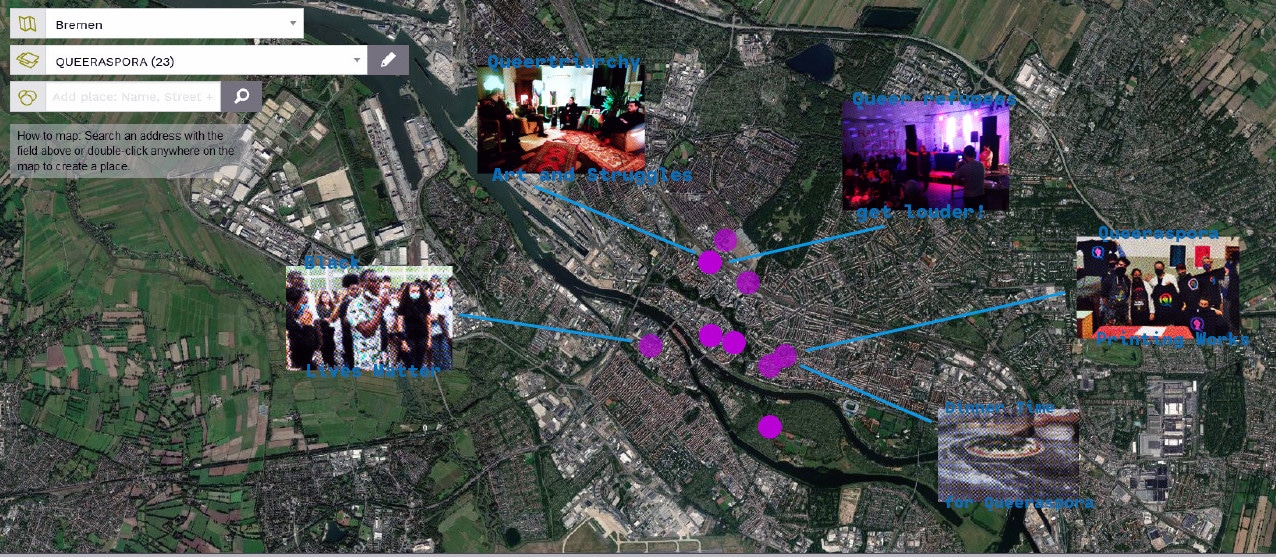
UT: In this context, it’s critical to consider which places are shown on digital maps at, say, Google or Bing, and which are not. Some things are highlighted, others overlooked, depending also on what a platform thinks it knows about you. In addition, the policies that shape the internet, country by country, create vastly different understandings of and possibilities for diversity in all its guises. So in order to find one another — which we will always do — we need to claim the internet in the ways we claim city streets for Pride.
JG: Indeed, we cannot expect a revolution through the iPhone. But we will find sustenance and connection, even if we have to keep clicking and hoping. 15


.jpg)
If you would like to comment on this article, or anything else on Places Journal, visit our Facebook page or send us a message on Twitter.