
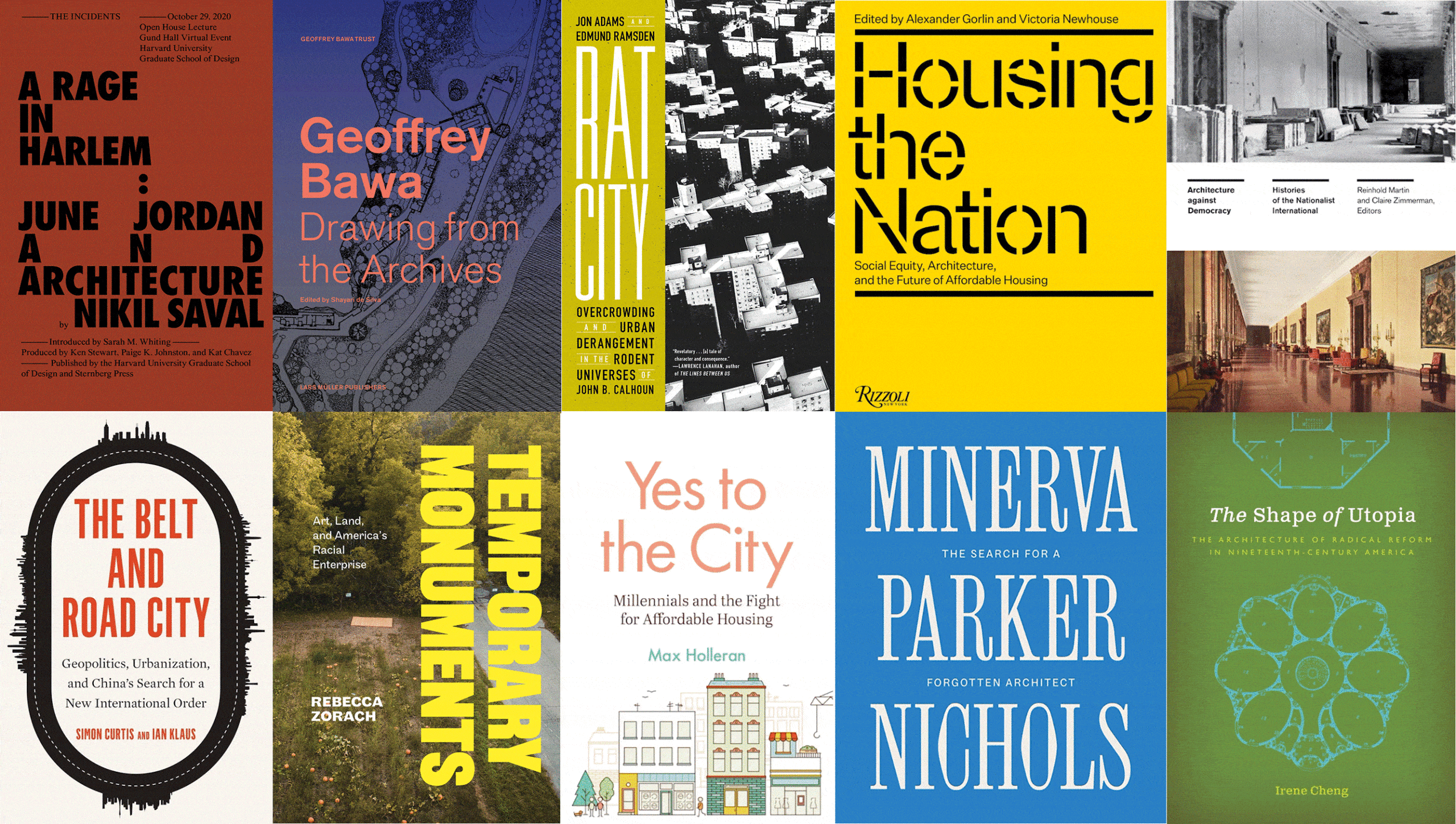
- Architecture against Democracy, edited by Reinhold Martin and Claire Zimmerman
- Rat City, by Jon Adams and Edmund Ramsden
- A Rage in Harlem, by Nikil Saval
- Geoffrey Bawa: Drawing from the Archives, edited by Shayari de Silva
- The Shape of Utopia, by Irene Cheng
- Temporary Monuments, by Rebecca Zorach
- The Belt and Road City, by Simon Curtis and Ian Klaus
- Yes to the City, by Max Holleran
- Housing the Nation, edited by Alexander Gorlin and Victoria Newhouse
- Minerva Parker Nichols, contributions by Heather Isbell Schumacher, Molly Lester, Franca Trubiano, and William Whitaker
Architecture against Democracy: Histories of the Nationalist International
Reinhold Martin and Claire Zimmerman, editors (University of Minnesota Press, 2024)
Reviewed by Simon Sadler
Is architecture truly supportive of democracy? The editors of this fascinating collection set out “to explore the history of architecture globally during the modern era as a form of political history, inclusive of economic relations but not the reducible to these.” Fifteen contributors explore nationalist, supremacist, and authoritarian architectures since Napoleon, taking us up to the recent capture of the public realm by neoliberalism harnessed to nationalism. Gathering the essays into three sections — “Hegemony: Coercion with Consent,” “Technocracy: Ideologies of Expertise,” and “Democracy: Perennially Deferred?” — the editors conduct us through examples in the United States, Germany, Italy, Brazil, the United Arab Emirates, France, Iraq, and Turkey. The book doesn’t, of course, uncover some actual, organized “Nationalist International.” But showing that architecture is frequently anti-democratic in its aims and results provides a corrective to what the canon would have its students believe.
The volume sheds new light on familiar case studies, like that of Albert Speer (found, in these pages, acting not only as a neoclassicist but as a technocrat, transferring his expertise from the Reich to the architectural profession after his release from Spandau prison). We also visit more obscure sites, such as the UAE’s suburban developments. Martin and Zimmerman have assembled with their authors critical and archival scholarship of the highest order, grounded in regional and historical expertise, and approaching architecture across multiple formats — not just its construction, theory, and style, but its exhibition, planning, bureaucracy, and embodied performance.
Drawing on the political philosophy of Hannah Arendt, the editors wager
that if we continue collectively to invoke a demos, articulate its possible modes more fully, and render it legible, that demos may be easier to build … If we are able to see in buildings the physical marks of hegemony, technocracy, and democracy … these may provide society with a useful diagnostic device, whether after the fact or prior to building. As part of the public realm, buildings can be legible to anyone who might wish to read them.
It’s a hopeful takeaway.
Rat City: Overcrowding and Urban Derangement in the Rodent Universes of John B. Calhoun
Jon Adams and Edmund Ramsden (Melville House, 2024)
Reviewed by Hunter Dukes
“I shall largely speak of mice, but my thoughts are on man.” This statement by John B. Calhoun (1917–1995) characterizes the ethologist’s lifework. Across his early research on rat populations in Baltimore through to Universe 25 — a 1968–1972 experiment to build a “utopia” for mice, featuring abundant sustenance and hundreds of “high-rise apartments” in a pen with four-and-a-half-foot galvanized-metal walls — Calhoun fashioned himself as a rodent sociologist. Unlike his neo-Malthusian colleagues who prognosticated civilizational decline brought on by scarcity, Calhoun’s enduring hypothesis is “the behavioral sink”: an observation that resource-rich societies (like Universe 25) succumb to social isolation, violent behavior, the dissolution of mating rituals, cannibalism, and extinction when facing overcrowding and the infringement of personal space.
Jon Adams and Edmund Ramsden’s Rat City offers a comprehensive intellectual biography of Calhoun. From his childhood climbing chimneys to survey swifts through his decades at the National Institute of Mental Health, Calhoun’s life is narrated much as Calhoun himself studied rats: Adams and Ramsden chart social vectors and elaborate conceptual genealogies toward heady ends. To tell Calhoun’s story requires chapters on the history of urban planning and pest control. There are excurses on dozens of his contemporaries — Robert Ardrey, whose African Genesis: A Personal Investigation into the Animal Origins and Nature of Man (1961) inspired the opening sequence of 2001: A Space Odyssey; Humphry Osmond, the psychiatrist who dosed Aldous Huxley with mescaline; and Paul D. MacLean, proselytizer for ideas about the reptilian brain, among others. Myriad backdrops are explored: Walter Reed Medical Center and the tony summer enclave of Bar Harbor, Maine; sanitoriums and prison cells.
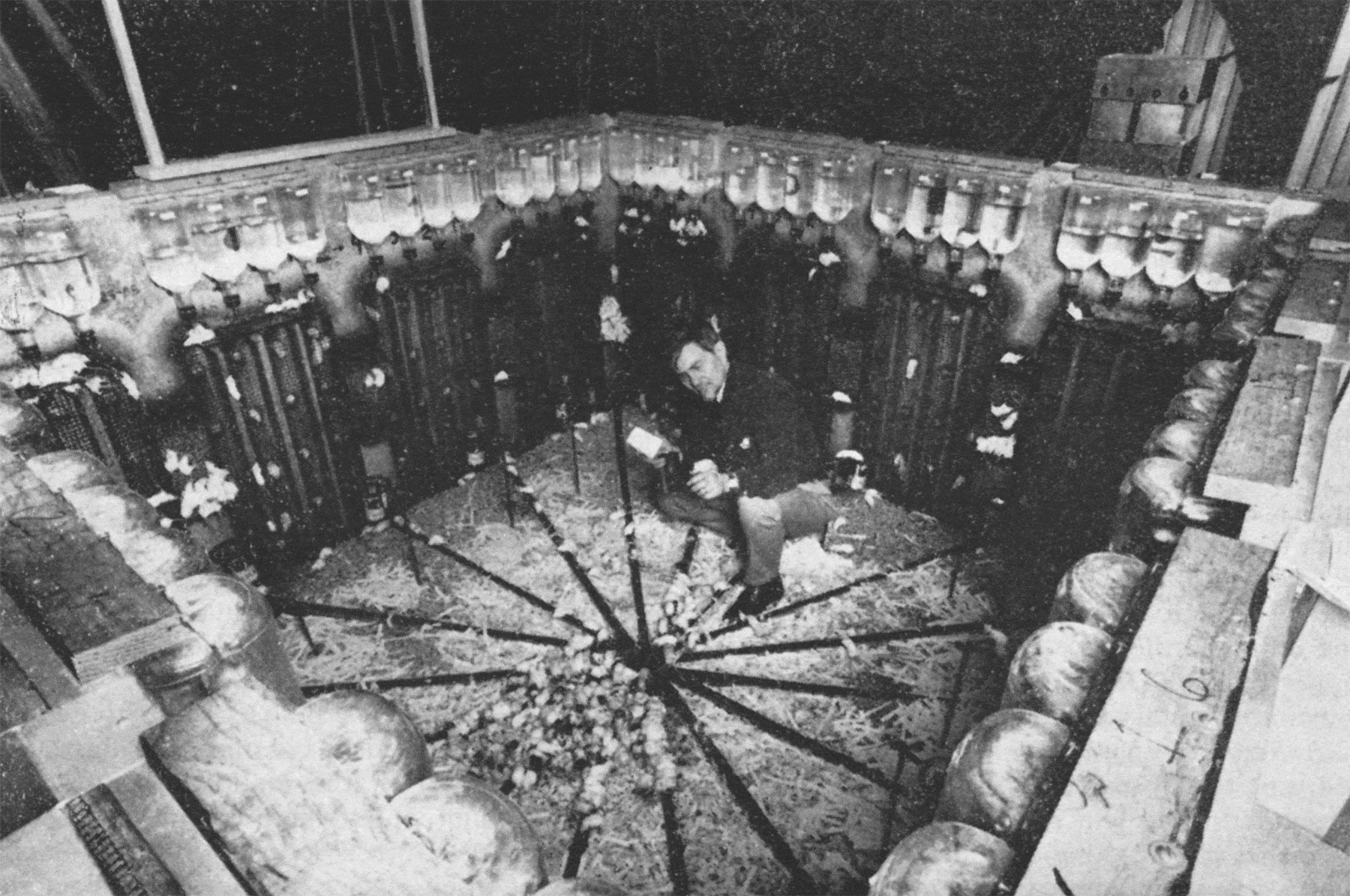
Calhoun’s theories can be fodder for a reactionary politics that diagnoses social liberation as an urban pathology — the kind intimated by Tom Wolfe, who took up Calhoun’s observation that overcrowding promotes “pansexuality” in order to playfully suggest that the same phenomenon is to blame for New York’s “queer, autistic, sadistic” citizens. Early in Rat City, Adams and Ramsden, scholars of literature and the behavioral sciences respectively, proclaim that they only seek to contextualize, not evaluate, Calhoun’s legacy. Their introduction nevertheless suggests that his rodents can teach us something about our own falling birth rates and severe forms of social withdrawal, from hikikomori syndrome in Japan to “involuntarily celibate” young American men. Throughout the book, Calhoun’s experiments are contextualized vis-à-vis urban centers he might have had in mind: densely populated African American neighborhoods in Baltimore; crowded Italian American communities in Boston’s West End; Chicago’s high-rise “vertical ghetto.”
Yet the authors never fully make a claim for Calhoun’s present-day relevance, a task that would require evaluation as well as context. Did this rodent sociologist successfully augur our future, or even succeed in explaining the social unrest of his era? Or might his lab rats’ experiences have promoted practices that — while sharing allegorical affinities with human behavior — bear scant scientific relevance to our own complex conditions? Utopia, not to mention dystopia, may require something more than endless food and galvanized steel.
A Rage in Harlem: June Jordan and Architecture
Nikil Saval (Sternberg Press, 2024)
Reviewed by Jess Myers
This is that curious form of book, which like Italo Calvino’s Six Memos or Michel Foucault’s Security, Territory, Population not only began as a lecture, but is still formulated as one, with images and texts organized as “slides.” Saval delivered his talk over Zoom on October 29, 2020, for Harvard’s Graduate School of Design, days before the high-stakes election between Donald Trump and Joe Biden. (Saval himself was also a candidate, although running virtually unopposed, for state senate in Philadelphia’s District 1.)
A former editor of the magazine n+1, Saval’s narrative ingenuity is on full display in this effort to claim the community ethic of poet and organizer June Jordan as architectural, owing to her collaboration with Buckminster Fuller on the project originally titled “Skyrise for Harlem,” published in Esquire in April, 1965. This speculative scheme proposed that cities within cities be built over Harlem’s existing urban fabric. In the wake of 1964’s violently repressed anti-police protests, these otherworldly space-frames would host everything a Harlemite might need, from housing to commerce, by (as Saval notes) hoovering residents away from that profoundly contested social incubator, the street.

Saval makes a nimble critique of urban renewal, in its capacity to act as a Trojan horse for the surveillance state. Yet he treats Jordan’s own intellectual project a bit too lightly. Other essays, namely Cheryl J. Fish’s “Place, Emotion, and Environmental Justice in Harlem: June Jordan and Buckminster’s Fuller’s 1965 ‘Architextual’ Collaboration” (2007), Alexis Pauline Gumbs’s “June Jordan and a Black Feminist Poetics of Architecture//Site 1” (2012), and Charles L. Davis II’s “Race, Rhetoric and Revision: June Jordan as Utopian Architect” (2014) deal more rigorously with her politics as the engine of her space-making. Saval over-relies on maudlin accounts of Jordan’s single motherhood and financial troubles, along with an autodidacticism which, given her status as a conscientious Barnard dropout, is somewhat overstated. I would have enjoyed an encounter between Saval the public servant and Jordan the radical, or Saval the critic and Jordan the poet. That dialogue might have yielded satisfying architectural thinking.
However, I push back against crowning Jordan with architectural laurels, not because she does not merit them, but because architecture doesn’t. As much as we in the discipline enjoy whittling our icons’ political positionalities out of their visions, we cannot claim Jordan’s spatial imaginaries without her radical politics. I push back against the Rosa Parks-ification of June Jordan. I doubt a woman who considered herself too radical for the Black Panthers would suffer our praise; I somehow doubt that the woman who wrote “what you think would happen if / everytime they kill a black boy / then we kill a cop” would see her architectural ideas as an alternative to the demands of the contemporary abolition movement — as Saval seems to suggest when he praises “Skyrise for Harlem” as “generative” and so more visionary than any act of “defunding” (his emphasis).
I, too, would love to claim June Jordan for architects. But this would require architects, in turn, to see our own work as radical political poetry. It would require architects to allow our full selves to be claimed.
Geoffrey Bawa: Drawing from the Archives
Shayari de Silva, editor (Lars Müller Publishers, 2023)
Reviewed by Dilshanie Perera
The Sri Lankan architect Geoffrey Bawa resisted cataloging his letters and drawings, and in 1997 burned much of his personal archive in a bonfire at his home in Colombo. Geoffrey Bawa: Drawing from the Archives acts as a corrective to this destruction by placing materials from the Geoffrey Bawa Trust in context with the full practice of Sri Lanka’s most famous tropical modernist. The book presents a curated selection of beautifully reproduced documents and images from across Bawa’s career, from the late 1950s to mid-1990s.
The critical essays, authored by an international group of curators, scholars, and practitioners of art and architecture, largely eschew hagiography. Contributors instead examine aspects of Bawa’s archives, ranging from specific projects both built and unbuilt, to the role of drawings and renderings done by hand (for geographer Tariq Jazeel, for instance, freehand drawings allow the architect to express a poetics of placemaking), to reflections on the possibilities and limitations of archives as such. Bawa’s own photographs of lesser-known finished projects are interspersed throughout the book.

The collection offers glimpses of Bawa the aesthete and Bawa the visionary, a practitioner who insisted on being on site to imagine what could exist there, creating buildings that frame and augment views of the existing landscape and take vernacular materials and local climate into account. The most compelling essays situate Bawa’s work within the Sri Lankan politics and social dynamics of the time, and make a case for what an archive can contain and reveal. Working in the immediate post-Independence period, Bawa shaped the built environment of the new country, celebrating a palimpsest of Lankan historical forms within his modernist designs. (Chief Curator of the Bawa Trust and volume editor Shayari de Silva, who also organized the 2022 exhibition “Geoffrey Bawa: It Is Essential To Be There” in Colombo, suggests that Bawa’s practice refused a colonialist tabula rasa approach, insisting instead on the specificity of place.) It’s also true that Bawa’s insistence on architecture being above nationalist politics, and his looking to Sinhala cultural forms and Buddhist architecture as his primary vernacular references, meant that he at times reproduced a version of exclusionary nation-making.
The imprint of the architects and engineers who worked in Bawa’s office can be discerned across Drawing from the Archives. Renderings showcase the distinctive styles of artist Laki Senanayake, and architects Sumangala Jayatillaka, Ismeth Raheem, and others. Architect Chelvadurai Anjalendran advocated for Bawa’s redesign of Galle Face Green — Colombo’s large oceanside park — with urban planners who solicited his input but were reluctant to implement his vision. Structural engineer Dr. K. Poologasundram determined how to bring Bawa’s fanciful ideas to life in steel, concrete, wood, and stone. It is fitting, then, that the last partner to join Bawa’s firm, architect Channa Daswatte, gets the last word as he recalls the multiple roles the office’s drawings played, offering insight into processes that Bawa himself refused to theorize.
The Shape of Utopia: The Architecture of Radical Reform in 19th-Century America
Irene Cheng (University of Minnesota Press, 2023)
Reviewed by Hubert Murray
To open Irene Cheng’s The Shape of Utopia is to be inducted into a Wunderkammer archiving the dreams of pre-Civil War Americans (exclusively White, mostly male), all expressed as congeries of geometry and desire. We are introduced to vegetarians, libertarians, socialists, egalitarians, anarchists, phrenologists, and reformers of spelling, each in their own ways peddling ideals for living through the graphic representation of built spaces based on hexagons, octagons, circles, and ellipses, at every scale from the residential to the regional. These politico-spiritual design visions, rendered in geometrical form in circulars, brochures, and the like, have been committed to blank paper — a terra nullius, as Cheng puts it, standing in for the open plains of North America.
As eccentric as many of the projects appear, Cheng examines each as a response to two urgent challenges facing White Man’s America in the early 19th century: the task of settling vast areas of land (negligent of Indigenous inhabitants); and the perceived ills of an emerging, urban capitalism. Democracy and social equity, fresh air and good health, individual freedom and strength of community are common themes.
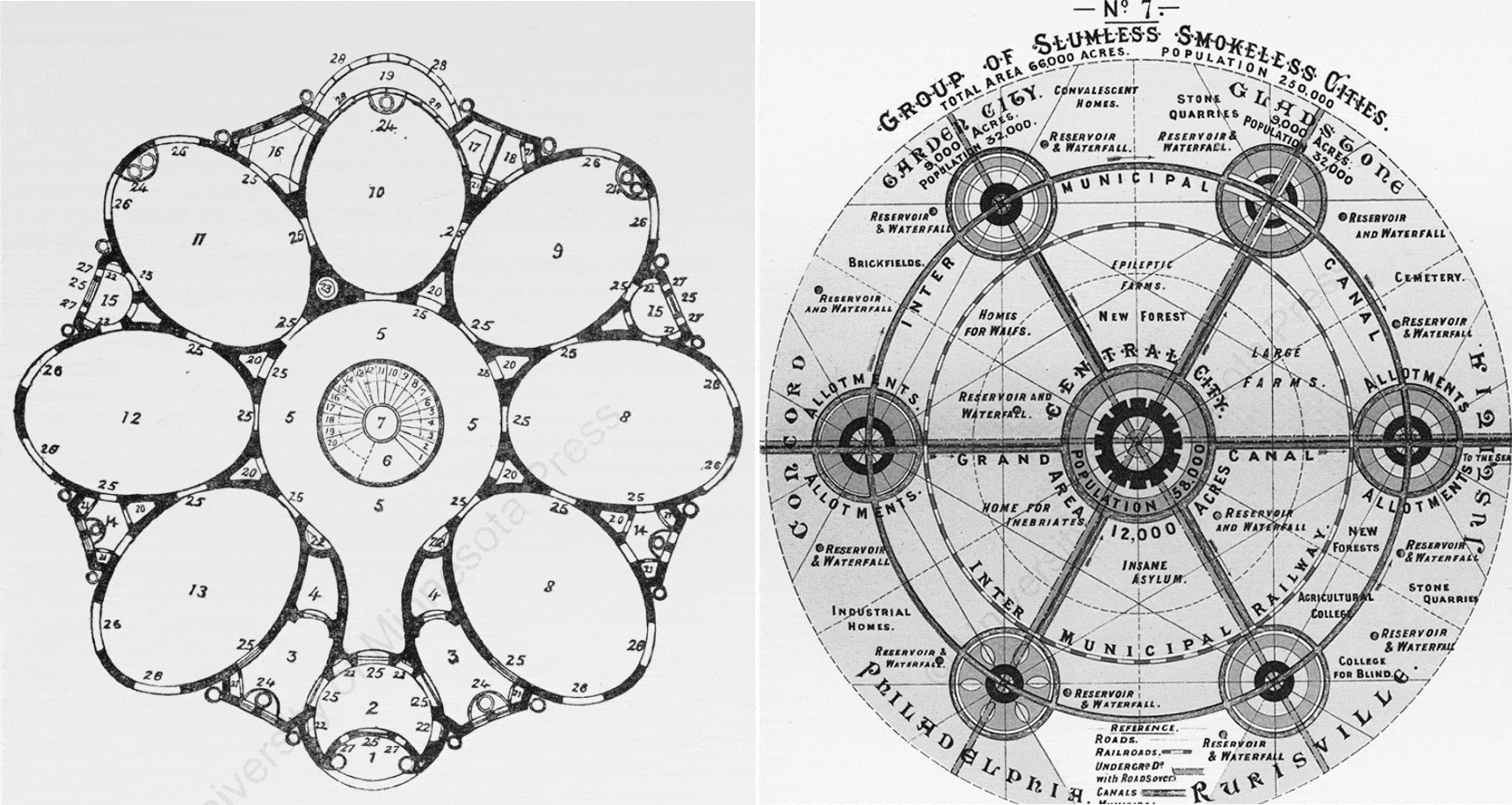
But why, Cheng asks, such adherence to geometry? And why the striking diagrammatic graphics put forward, from Jefferson’s austere and practical octagons to the egg-shaped spaces of Simon Crosby Hewitt’s “Home of Harmony … Transmitted from the Spirit World”? The certitude of mathematics, she suggests, was understood by the starry-eyed proponents of utopian possibility as bringing discipline to ideals that might otherwise appear unstable. These impresarios, she argues, understood a century before McLuhan that the (graphic) medium was itself the message. In their zeal to attract followers or sustain the envisioned communities, she sees the sublimation of politics to these orderly visions, especially in the run-up to the Civil War. It was those overwhelming realities, Cheng suggests, that restricted the utopias to small numbers and short lives.
What are the legacies of these experiments? Cheng’s final chapter considers Ebenezer Howard’s compellingly illustrated Garden Cities of Tomorrow: A Peaceful Path to Real Reform (1898) as a direct descendant of this American utopianism, reduced but still recognizable, as well, in Raymond Unwin and Barry Parker’s Letchworth, north of London (1904). While it is beyond the scope of Cheng’s study, one cannot help feeling that Bucky Fuller’s Dymaxion universe and Paolo Soleri’s Arcosanti are both 20th-century legatees of this graphic, geometrical utopianism.
Temporary Monuments: Art, Land, and America’s Racial Enterprise
Rebecca Zorach (University of Chicago Press, 2024)
Reviewed by Regan Good
Rebecca Zorach has written a fascinating investigation of America’s public spaces and monuments, tracing how their “permanent” nature “can be altered, given new meaning and new context” as our social, or more specifically, racial, landscape changes. Zorach discusses how European ideas about the natural world, race, art (in particular, abstraction), and place instituted a kind of White supremacist materiality once thought to be indelible. In six rich chapters, she unpacks related ideas about the museum, the wilderness, islands, gardens, the home, and “place holding” walls and borders, providing brilliant examples of what might be called monument mutability.
Case in point: For several surreal days during the BLM Movement in June 2020, the famous equestrian statue of Robert E. Lee in Richmond, Virginia, was radicalized and transmuted by layers of graffiti (“ACAB,” “Amerikkka,” “Stop White Supremacy,” “One Love,” “BLM”), as well as the enormous projected face of George Floyd. The base layer of this great American palimpsest, the equestrian statue, evidenced what Zorach calls America’s “racial enterprise,” our whitewashing of the built environment with Western structures and ideas. The graffiti and projection created a new sigil, a radically (and racially) moving piece of art that was telegraphed across the world.

In my favorite chapter, “The Garden: Violence and the Landscapes of Leisure,” Zorach looks at the gazebo and its role in the death of Tamir Rice, the twelve-year-old Black child murdered by a White police officer as Rice played with an “airsoft gun” outside Cleveland’s Cudell Recreation Center. The gazebo was dismantled and moved to its “temporary” home in a community garden in Chicago where it remains part monument, part working sun-shelter. There the gazebo is no longer just a place of repose; it is now a complicated memorial, half shed, half grave marker. (One oddity in the text: Zorach capitalizes the “w” in White — as does Places — explaining: “I do this not without some discomfort,” but noting that she is working under Eve Ewing’s argument that a lower case “w” helps to reinforce the idea that “White people in America do not have a racial identity.” For what it’s worth, the journal’s reasoning is the same.) Fair enough. This book does for space what Camille T. Dungy’s anthology Black Nature: Four Centuries of African American Nature Poetry (2009) has done for the wild. Temporary Monuments is endlessly interesting, and it feels like meaning-making.
The Belt and Road City: Geopolitics, Urbanization, and China’s Search for a New International Order
Simon Curtis and Ian Klaus (Yale University Press, 2024)
Reviewed by Keller Easterling
Simon Curtis and Ian Klaus, who bring experience from international relations and global affairs to an analysis of China’s Belt and Road Initiative, or BRI, have discovered that urbanism has something to do with it. They are even prepared to conclude that “BRI is urbanism as grand strategy.” This acknowledgement — that incontrovertible spatial evidence put forward by urban theorists is crucial to understanding the globalizing world — is only a few decades late.
That spatial evidence, countering anointed legal and econometric diagnoses, was offered as a means to thoroughly renovate 20th-century assumptions about nation states and rational actors. But in The Belt and Road City the arguments of urban theorists are strangely skewed or confused as they get filtered back through self-perpetuating IR-speak. So, while the authors come around to recognize that everything cannot be explained in terms of Westphalian sovereignty and Washington Consensus, disciplinary habits keep returning the analysis to a “grand strategy” or a “new international order.”

Maybe this is appropriate, since there is in the BRI a competitive mimicry of something like Marshall Plan strategies. Even so, the spatial evidence — vast networks of free zones, submarine cables, and transshipment infrastructure — can deliver more information and precision. For instance, urbanists quoted within — Neil Brenner, Xiangmin Chen, Edgar Pieterse, Łukasz Stanek, and me among them — have been reporting since the early 2000s that this urbanism creates not the familiar global city, but contagious forms of infrastructure. It is nearly impossible to understand the late 20th century neoliberal turn without examining these conurbations that further tilted the playing fields, weakened most of the Global South, and undermined labor everywhere in the world. And if one sets aside the usual analysis of nation states and rational actors, it is easier to see that, among other things, such spaces have become special tools for a new breed of political strongmen who garner loyalties through irrational means.
More interesting might have been a historical analysis of the potential for South-South cooperation that was squelched in that neoliberal turn, in part because of Chinese and Middle Eastern ambitions to global power. Arguably most important of all is the fact that even China’s titanic assertions are beginning to sound faint against the roar of climate catastrophe. Anyone studying the BRI will find informative sections in this book. But the terms of discussion perhaps obscure the urgent testimony of a multivalent planet that doesn’t respond to “world orders.”
Yes to the City: Millennials and the Fight for Affordable Housing
Max Holleran (Princeton University Press, 2022)
Reviewed by Ian Volner
It’s been two years since urban sociologist (and sometime Places contributor) Max Holleran published Yes to the City, his detailed chronicle of the still-rising rise of the pro-density, pro-housing supply movement in the United States and abroad. Now out in paperback, the book finds itself in a somewhat different economic and cultural landscape than it did the first time around. Or rather, it’s the same landscape, only with a lot more charred wreckage strewn about.
In the dogfight between Holleran’s “Yes In My Backyard” advocates and their “Not In My Backyard” antagonists, neither party has completely dominated, even as the dialectical turf identified by Holleran — “renters versus owners,” “gentrification versus construction,” ‘“insiders’ versus ‘outsiders’” — remains unchanged. The book details how the discursive lines were drawn, beginning circa 2014 in San Francisco, by a group of activists fed up with the city’s stifling anti-building culture; how the disagreement evolved into a generational divide, pitting apartment-dwelling Millennials against Boomer suburbanites; how it extended to places like Austin, Texas, and Boulder, Colorado; and how it began to take its show on the road, popping up in the U.K. and elsewhere. As Holleran informs us, there now exists a “Twitter group YIMBY Poland,” and another in Tehran.
So what have these folks, and their opposition, been up to since Holleran’s hardcover hit shelves? This much the author saw coming: “Both groups have been very busy savaging each other online.” That would be funny if the consequences of their quarrel were not so serious: notwithstanding a few local dips and plateaus, rents in American cities have continued to soar, with the most recent spikes in Midwestern markets previously immune to the trend. Yes to the City remains a valuable work of analysis, explaining how we reached the present impasse in American housing. What we need now is a guidebook to get us out of it.
Housing the Nation: Social Equity, Architecture, and the Future of Affordable Housing
Alexander Gorlin and Victoria Newhouse, editors (Rizzoli, 2024)
Reviewed by Karen Kubey
To call this book Housing the Nation is a stretch. Of eighteen essays in the edited volume, thirteen are by authors based along the northeast corridor, and seven focus on New York City. Robert Kuttner’s essay states America’s housing predicament clearly: “The core problem is that we lack a true social housing sector, except at very modest scale.” But the collection misses the chance to profile the transformative rise of green social housing and tenant movements across the U.S., or to probe the important question of how architects might contribute. Promoting a more just “Future of Housing in the United States” in 2024 requires that designers make alliances with activists — those behind establishment of the voter-approved Seattle Social Housing Developer, or the revolving Housing Production Fund in Montgomery County, Maryland, or the national Homes Guarantee platform, or the Green New Deal for Housing, to name a few.
The best essays in Housing the Nation draw attention to aspects of our housing system that are ripe for change, highlighting potential actions for architects. Christopher Hawthorne, former Chief Design Officer for the City of Los Angeles, writes that there is “a role for architects to play in making the debate over zoning reform safer for elected officials to explore in good faith — and, more broadly, in clarifying the benefits that more housing options would bring.” Hawthorne spearheaded the 2020 design challenge “Low-Rise: Housing Ideas for Los Angeles,” and his discussion of the project pairs well with an illuminating duet of an essay by Kenneth Frampton and Mark Ginsberg, architecture-team leads, respectively, for the 1976 low-rise, high-density Marcus Garvey Village in Brownsville, Brooklyn, and its ongoing renovation and expansion.
In their respective contributions, Rosanne Haggerty reports on communities that have effectively ended homelessness by creating a “housing sector that operates as an intentional, aligned system”; and David Dante Troutt uncovers the “stealth occurrence” of corporate house buyers in Newark and other majority Black and Latinx cities, who are “transforming the market one private transaction at a time,” leading to a reduction in homeownership by and a displacement of Black and Latinx households. These urgent, intersectional issues demand that we address housing questions not only as political and economic issues but also as problems of spatial justice. Only then can we meet residents’ human needs and realize the right to housing in our nation.
Minerva Parker Nichols: The Search for a Forgotten Architect
Heather Isbell Schumacher, Molly Lester, Franca Trubiano, William Whitaker / Foreword by Despina Stratigakos / Photography by Elizabeth Felicella (Yale University Press, 2024)
Reviewed by Justine Clark
Where do we find women in the history of architecture? What traces are left? What might we make of them? How does reintroducing forgotten practitioners force canonical norms to change? Adding more names is inadequate (although names are themselves loaded with meaning). Finding and filling gaps is not enough. When we pay attention, the professional lives of early women architects force reassessments of the entire canon, and our processes of collecting, archiving, and remembering.
Minerva Parker Nichols: The Search for a Forgotten Architect is an exemplary, hopeful publication that engages with all of this. This beautifully written book documents the seven-decade career of the first woman to establish and maintain an independent architectural practice in the United States. But it presents more than a story of the trials, successes, and production of one forgotten yet prolific architect. The book uses established formats — biography, photographic documentation, a catalogue raisonné, and essays — to both present the work and offer a nuanced rethinking of these forms. The archive is positioned as active in subtle, entrancing ways. As Heather Isbell Schumacher comments in the prologue, “Ultimately, the real value of our work is not to create a new silo of materials under her name, but rather to contribute to the collective mingling of the archive.”
The extensive biography by Molly Lester locates Minerva’s professional development in familial, social, and economic contexts. It charts her production and presents a considered discussion of design principles. Drawings are described as “savvy and sophisticated.” Specifications are understood as the foundation for good relationships on site. The narrative is broadly chronological, but much of the essay is organized through overlapping roles — Minerva as architect, as daughter and sister, as teacher, as wife and mother, as reformer, as colleague — with architectural practice as a “sustained and enduring presence” throughout. (The naming of the architect is itself an act of critical consideration; “Minerva,” “Parker Nichols,” “Nichols,” and “Parker” are all used, reflecting the contributor’s preference and the documents they draw on.)
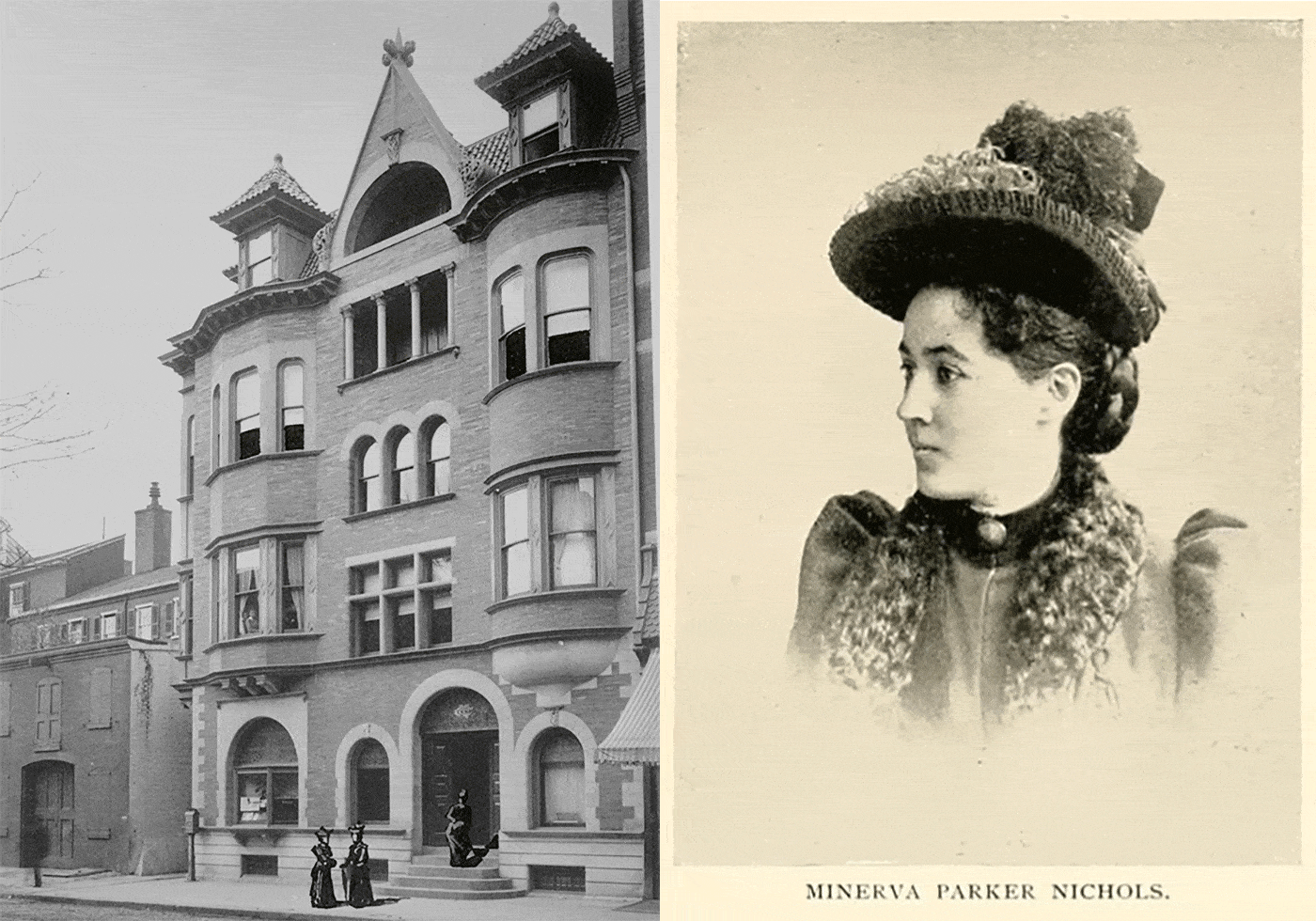
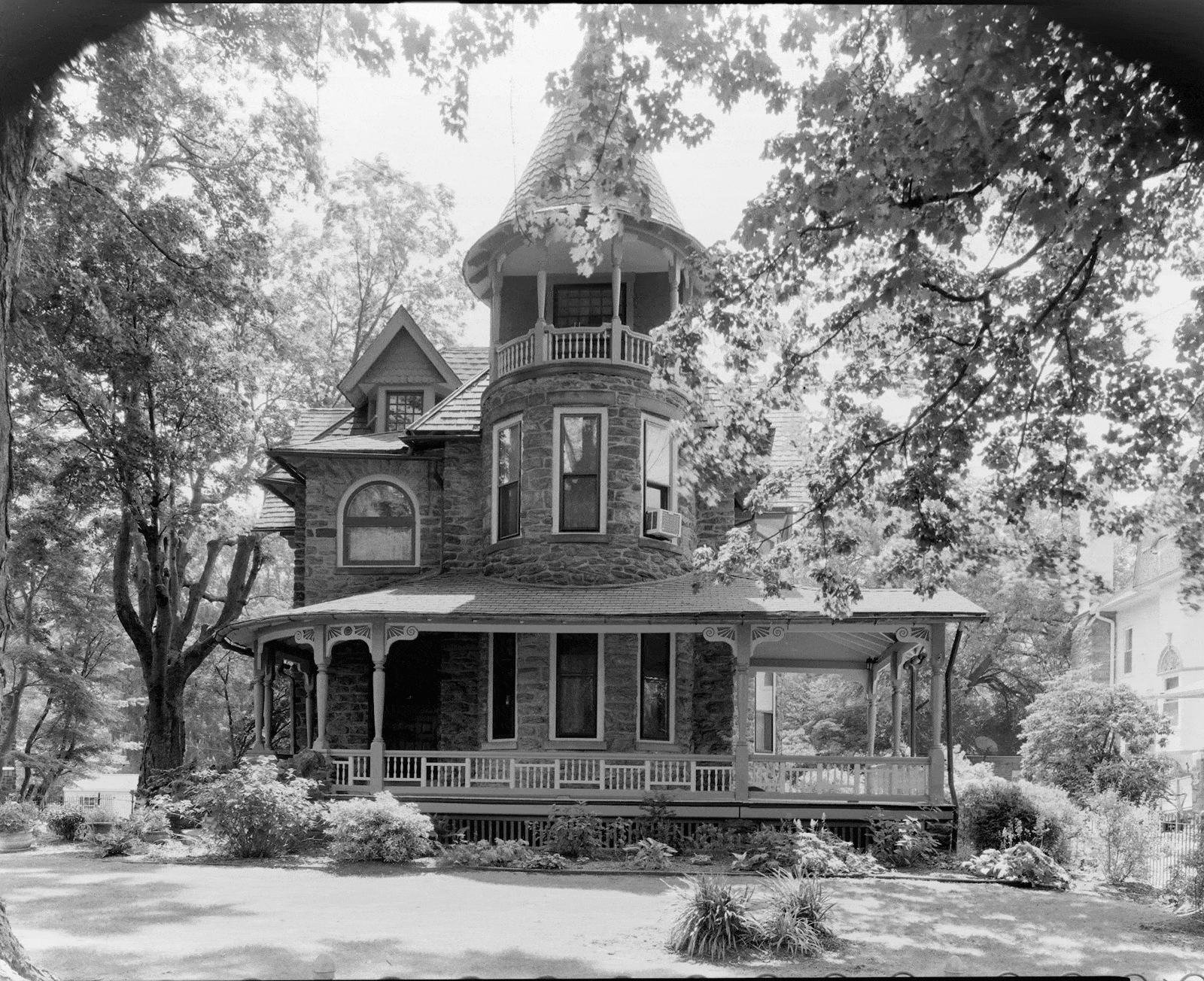
The new photographic archive is extraordinary. All extant buildings have been beautifully photographed by Elizabeth Felicella, following the requirements of the Historic American Buildings Survey: black-and-white, large-format negatives, shot on a camera as old as the buildings themselves. Felicella’s reflection on making them is fascinating, particularly her thoughts on how “‘things’ in [the HABS] collection speak among themselves,” and the role of HABS’s technical guidelines in “foster[ing] a conversation.”
William Whitaker’s catalogue raisonné documents known works, while an essay by Franca Trubiano turns to Minerva’s extensive early writing, exploring the agency she found though publication. Minerva Parker Nichols invites the reader to move between and among these components, stitching them together and making meaning through this new archive.
Assuming an American readership, Schumacher quips, “She may be the most famous architect you’ve never heard of.” For those of us reading in other places, these words will recall other “famous” architects, glimmers of other oeuvres. Minerva Parker Nichols offers sophisticated insight into how we might proceed in recalling these histories while examining our own archives as spaces for critical reflection. It is not a matter of mimicking this book, but of examining the specificity of our own locations, histories, and practices as we work to create, reimagine, and “mingle” our archives.




If you would like to comment on this article, or anything else on Places Journal, visit our Facebook page or send us a message on Twitter.