
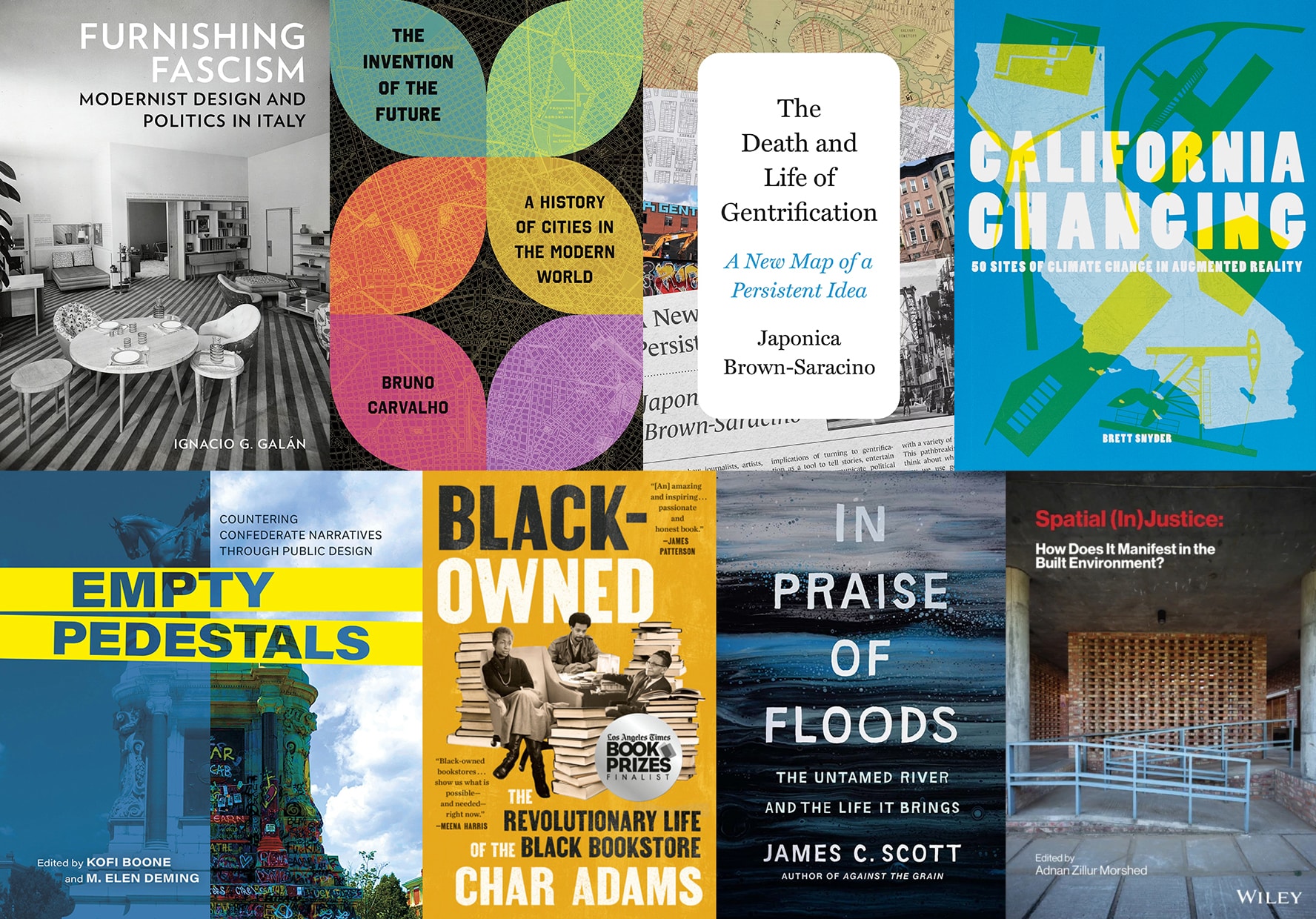
- The Death and Life of Gentrification, by Japonica Brown-Saracino
- Black-Owned, by Char Adams
- California Changing, by Brett Snyder
- The Invention of the Future, by Bruno Carvalho
- Spatial (In)Justice, edited by Adnan Zillur Morshed
- Empty Pedestals, edited by Kofi Boone and M. Elen Deming
- Furnishing Fascism, by Ignacio G. Galán
- In Praise of Floods, by James C. Scott
The Death and Life of Gentrification: A New Map for a Persistent Idea
Japonica Brown-Saracino (Princeton University Press, 2026)
Reviewed by Susanne Schindler
For a while now, I’ve been wanting to write a book about “community,” a term deeply engrained in academic and everyday use as a signifier so instantly recognizable in its positive connotations that its user is relieved of having to say what they actually mean. Community is invoked to imply social inclusion, non-profit exchange, belonging at a local scale, without committing the speaker to a position. Whose voice is being solicited, and whose is excluded, in a “community meeting”? Why is a developer negotiating a “community benefit” instead of paying taxes? There is power in using an amorphous word that keeps everyone happy while avoiding the hard questions.
Gentrification has proliferated beyond urban studies into cultural spheres such as film, music, and advertising.
So I was excited to read sociologist Japonica Brown-Saracino’s dissection of “gentrification,” another flexibly overused term. Coined in 1960s London to describe the displacement of working-class residents from urban neighborhoods as higher-income people moved in, gentrification has proliferated beyond urban studies into cultural spheres such as film, music, and advertising, morphing from what the author calls “literal” gentrification into a “metaphor” that makes sense of social transitions. If community is used to suggest something positive, invoking gentrification does the opposite. In the book’s first three chapters, Brown-Saracino discusses how this word is wielded and by whom, to describe often painful change in three distinct situations: the disappearance of lesbian bars, the new ethnic composition of residential neighborhoods, transformations of the self. In the fourth chapter, she reflects on the term as metaphor and heuristic.

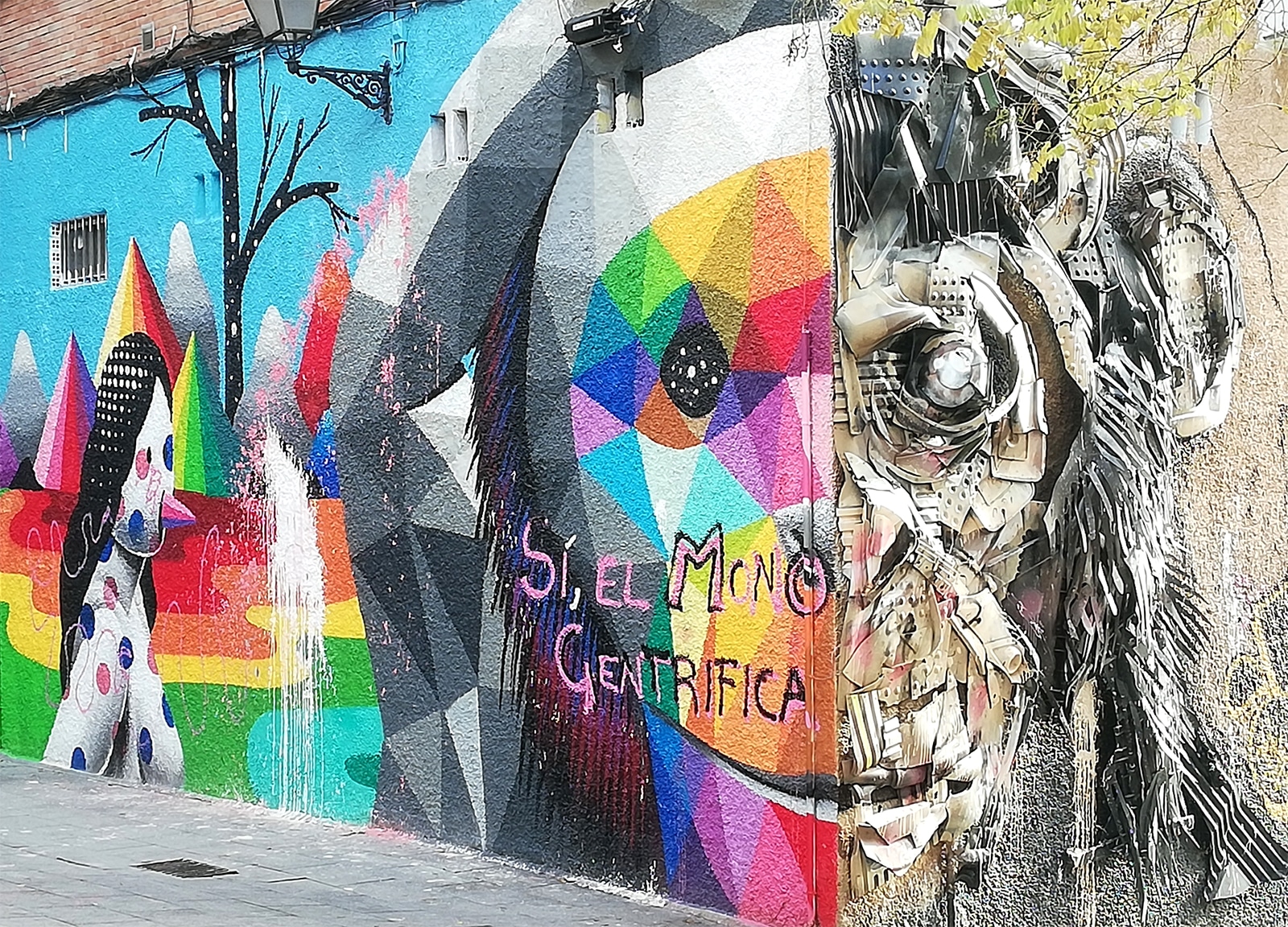
The rampant lexical sprawl distracts us from a systemic investigation of power structures in urban real estate.
The close reading of a wide set of evidence — from TV shows to academic literature — is refreshing. And the import is soon revealed: the rampant lexical sprawl of “gentrification” distracts us from a systemic investigation of underlying issues, namely power structures in urban real estate. At a book talk I attended, someone in the audience described his anguished choice to buy a home in a still affordable neighborhood. Was he personally responsible for the displacement of current residents? Brown-Saracino responded with an unequivocal no; he was acting within an increasingly financialized, globalized, deregulated housing system.
Unfortunately, the book does not explain that system in such clear terms. The title (why cite Jane Jacobs’s classic? why promise a “map” if there is no overview?) is a sign of what’s to come in the lengthy and often repetitive chapters. The author rarely moves beyond the insight that gentrification has been used as a vehicle, a trope, a mask, and in this way the book reproduces the problem it critiques.
Black-Owned: The Revolutionary Life of the Black Bookstore
Char Adams (Tiny Reparations Books, 2025)
Reviewed by Kwesi Daniels
Char Adams’s Black-Owned argues that Black bookstores have always been more than retail spaces; they are cultural and political sanctuaries. Using historical timelines, interviews, and archival research, Adams demonstrates that these establishments have served as sites of resistance to systemic oppression since David Ruggles opened the first known Black bookstore in New York City in 1834. Though they emerged independently across many decades, these local institutions to this day share a mission: to advance Black independence and empowerment.
Adams likens bookstores to ‘cultural pharmacies,’ where — generation by generation — customers have sought remedies for unspoken needs, and left with transformative ‘prescriptions.’
The fortunes of Black bookstores correlate to changes in the broader narrative of Black identity. When interest in Black culture surges, these spaces thrive; when it wanes, they struggle financially. Adams traces this pattern through pivotal moments in American history: the anti-slavery movement, the assassinations of Dr. Martin Luther King, Jr. and Malcolm X, and the Black Nationalism era that birthed Black Studies programs in universities. During these times, bookstores became essential educational hubs, offering counter-narratives to mainstream curricula. As White flight and integration altered urban demographics, and as literature by authors like Toni Morrison and Alice Walker emerged, Black bookstores continued to evolve in their civic roles. Urban uprisings, from the Rodney King riots to the protests following George Floyd’s death, reaffirmed their significance as spaces for dialogue and liberation.
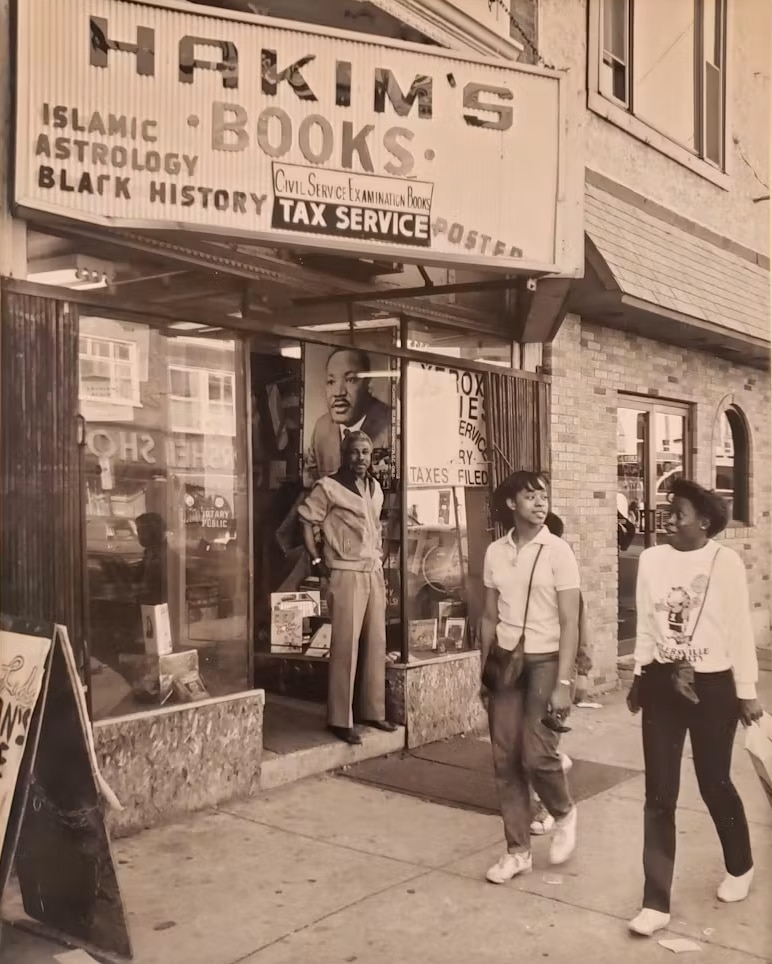
Adams also explores the challenges these bookstores have long faced, from FBI surveillance and harassment to economic pressures and market shifts. Despite such obstacles, owners like Lewis Michaux (National Memorial African Bookstore in Harlem), Una Mulzac (Liberation Bookstore in Harlem), Dawud Hakim (Hakim’s Bookstore & Gift Shop in Philadelphia), Clara Villarosa (Hue-Man Experience in Denver), and James Fugate (Eso Won Books in Los Angeles) created safe spaces for physical, mental, and spiritual healing. Adams likens bookstores to “cultural pharmacies,” where — generation by generation — customers have sought remedies for unspoken needs, and left with transformative “prescriptions”: e.g. 19th-century abolitionist newspapers, Zora Neale Hurston’s Their Eyes Were Watching God in the interwar period, or George G. M. James’s Stolen Legacy: Greek Philosophy is Stolen Egyptian Philosophy, first published in 1954. Such works, often unavailable in mainstream venues, function as alternative medicine for Black communities.
Ultimately, Black-Owned is more than a historical account; it is a tribute to the resilience of Black booksellers and their role in alternative education. Like the shops it highlights, Black-Owned is a resource, including recommended titles and a listing of present-day Black bookstores around the country. Adams demonstrates how, through diligence and community building, the unsung heroes of the Black bookstore movement have long sustained spaces that nurture Black consciousness and fuel social change.
California Changing: 50 Sites of Climate Change in Augmented Reality
Brett Snyder (ORO Editions, 2025)
Reviewed by Danika Cooper
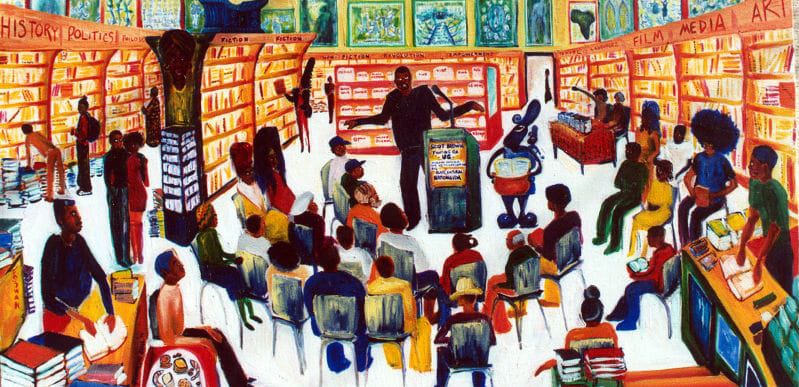
In this alphabetical catalog of 50 architectural projects that confront California’s climate crisis, Brett Snyder resists imposing a universal narrative or hierarchy. He is in a curatorial mode. Indeed, the book began as an extension of work his students exhibited in graphic posters at San Francisco Design Week. Each project gets a page of text, an illustration, and an augmented reality overlay, with only a state map to set the overall frame. The absence of a legible taxonomy produces a plural field of knowledge that aptly reflects the dispersed, contested, unstable, and uneven character of climate adaptation, which is experienced differently across communities and regions. Meaning emerges through selection and juxtaposition, rather than along a line of argument or sustained critique.
An augmented reality overlay encourages readers to navigate the material non-linearly and to draw their own connections across projects and scales.
The recognition that there is no one path to resilience is compelling, yet the curatorial approach has limits, particularly in its tendency to flatten contexts. The brevity of each entry limits Snyder’s ability to critically engage the distinct forces shaping the interventions, and the book often skips the analysis of sociopolitical conditions, efficacy, and long-term impacts that are essential to evaluating climate adaptation designs and strategies. There is no space to discuss how adaptation projects reproduce existing inequities, through the process that geographer Farhana Sultana calls “climate coloniality,” or to engage with Malini Ranganathan’s call for environmentalists to put “the abolishment of inequities spawned by bigotry, capitalism, and patriarchy” first in climate justice.
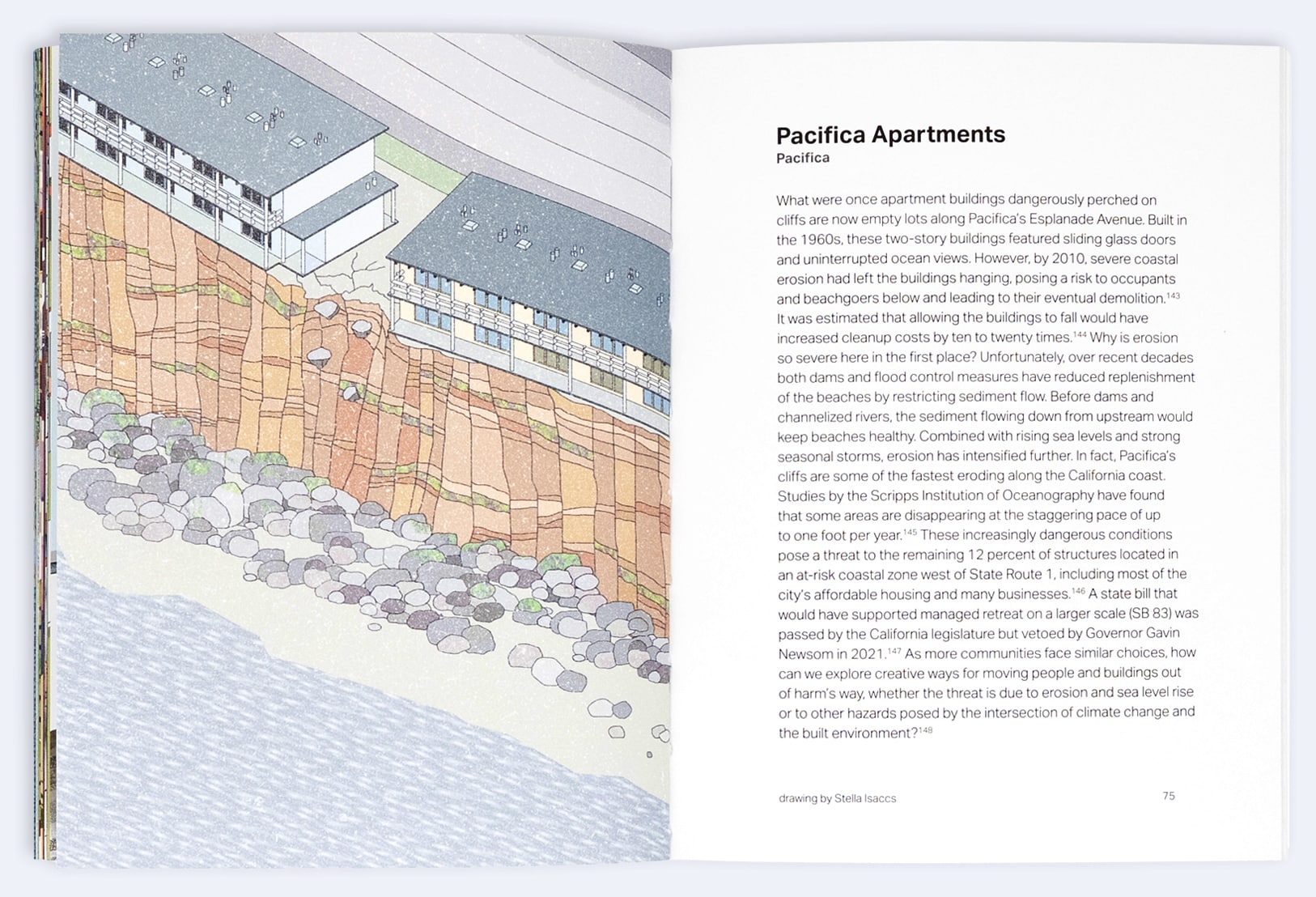
The tension between open breadth and critical depth extends through Snyder’s innovative use of augmented reality. If the printed volume already functions as a curated exhibition, the AR component makes it an interactive, layered media environment. The animated visualizations and spatial simulations encourage readers to navigate the material non-linearly and to draw their own connections across projects and scales. Yet this technology risks aestheticizing climate adaptation and drawing attention to the novel interface rather than the political and environmental stakes.
Ultimately, California Changing succeeds as a record of the uncertainty and immense experimentation of climate adaptation. Its intentionally fragmented structure, curatorial logic, and use of augmented reality characterize the possibilities and limitations of contemporary design responses to the climate crisis. While the book at times sacrifices critical depth, it nevertheless offers a valuable framework for thinking through how environmental futures are imagined, represented, contested, managed, and designed.
The Invention of the Future: A History of Cities in the Modern World
Bruno Carvalho (Princeton University Press, 2026)
Reviewed by David Grahame Shane
Juggling many concepts about time, cities, modernity, progress, and the world, Bruno Carvalho’s The Invention of the Future is a kaleidoscopic text that merges, questions, and reformats utopian stories in Latin America and West Africa, in those cities connected by South Atlantic trade flows, under the influence of the early slavery of the Spanish and Portuguese empires. It is an urban design study tucked inside a cultural history, tracking musical, literary, and poetic imports and exchanges.
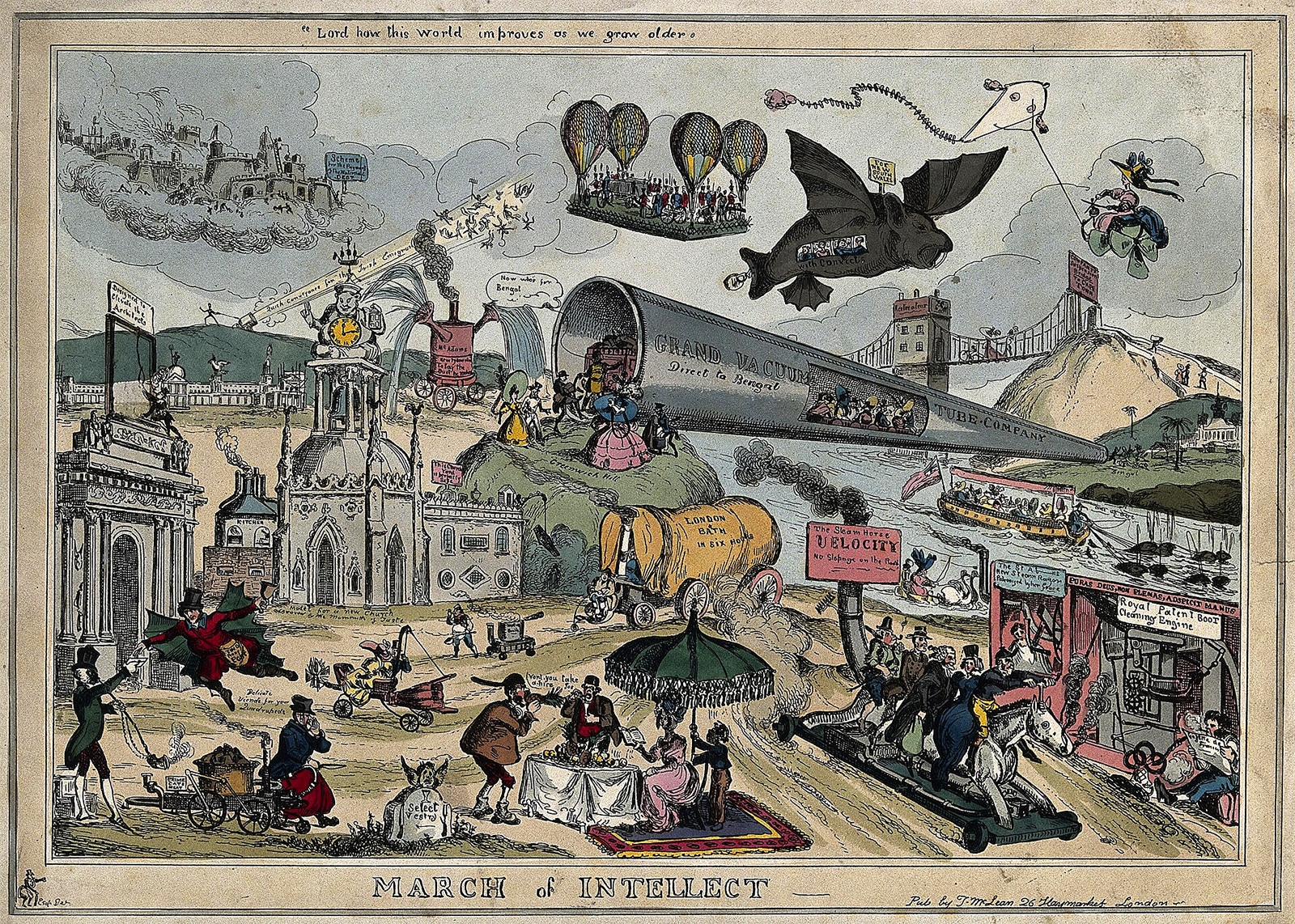
Carvalho presents the triumphant plans of the European “General Intellect” in Lisbon (1755), New York (1811), Cerda’s Barcelona (1860), and Le Corbusier’s futuristic autopias (1920s), softened by Josep Lluís Sert and exported to Harvard in the 1950s and ’60s — where Joan Busquet would produce an encyclopedic study on Urban Grids (2019), not mentioned here. Yet Carvalho argues that those progressive, rational, modern grids had unanticipated effects in the post-colonial world, where poor, rural migrants built their own housing from scraps. Like other scholars, Carvalho emphasizes that the modernist utopian capital Brasília depended on the self-built villages of the construction workers. Surprisingly, Carvalho’s extensive bibliography does not include Janice Perlman’s 1976 study of Rio’s unmapped favelas that coined the term “megacity.” He barely mentions Peter Hall’s Cities of Tomorrow, which in 1988 extended that term to the futuristic Pacific Rim metropolises of Tokyo, Hong Kong, and Singapore. The epilogue attempts to remedy this omission with a short survey of cybernetic, planetary, and local futures.
The speed and scale of Carvalho’s kaleidoscopic knowledge does reveal wonders. His best chapters — on Rio, Buenos Aires, and Lagos — show the contrast between the long-ingrained Portuguese extractive plantation system in Brazil and the British industrial extractive system in West Africa and Argentina, all leading to self-built megacities with hyper-modern enclaves and disastrous ecological and social consequences.
This deep narrative opens up a new perspective on the South Atlantic. Carvalho is an agile historian whose observations about the transnational migration of design ideas and poetics lucidly expand our understanding of these hybridized cities, their complex pasts, and their uncertain futures.
Spatial (In)Justice: How Does It Manifest in the Built Environment
Adnan Zillur Morshed, editor (Wiley, 2026)
Reviewed by Elgin Cleckley
An essential reference for the design community and beyond, this volume seeks not only to deepen understanding of injustice, but also to prescribe actions for addressing and reversing its effects. Adnan Z. Morshed — an architect, architectural historian, critic, and urban theorist — assembles 38 global perspectives, by designers including Esra Akcan, Bryan Bell, Yasmeen Lari, and Dahlia Nduom. Motivated by “outrage” as well as “intellectual curiosity,” the book responds to a growing urgency within our disciplines to develop the skills and frameworks necessary to pursue spatial justice. It takes seriously the manifest in the subtitle, moving from the theoretical to the real.
The book responds to a growing urgency within our disciplines. It takes seriously the manifest in the subtitle, moving from the theoretical to the real.
The lessons unfold across eight sections, progressing through themes that include the right to space (expanding Henri Lefebvre’s concept of the right to the city), the Symbiocene (the epoch of mutualism that will replace the Anthropocene), and justice in sacred space (elevating a part of human experience that is underexamined in design research). Under these headings, contributors share stories that exemplify co-creative practice.
Katie Swenson introduces us to Rwanda’s Institute for Conservation Agriculture, where the MASS Design Group embraced a “One Health” approach emphasizing the interconnection between human, animal, and ecological health. In a chapter on Dalston’s Gillet Square, Howard Davis and Adam Hart focus on small, gradual improvements, paying attention to everyday details, respecting community diversity, and being patient with the time it takes to manifest change.
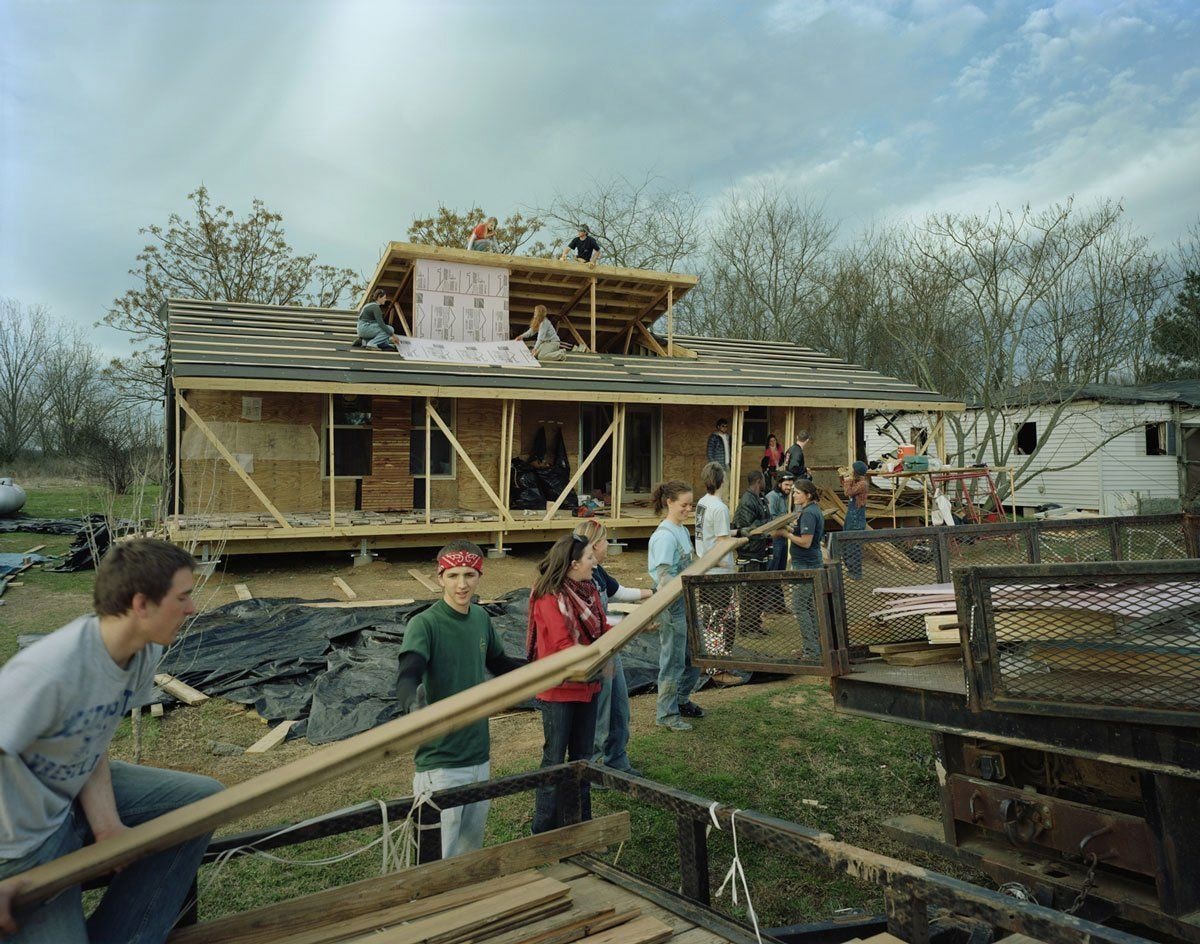
Interspersed throughout, conversations hosted by Morshed break the wall between academic inquiry and community-oriented design practice. “Empower yourself as an architect to get to know the community; listen and learn,” says architect Andrew Freear of Rural Studio, the design-build school carrying on the legacy of founder Samuel Mockbee. And he is serious about learning. “You should understand the financial systems, the legal systems, and the systems of a code, so you can manipulate them rather than see them as a barrier, roadblock, or difficult thing to just try to somehow avoid. Understand the processes and mechanisms of making architecture. And understand how to build, so you can detail and also talk to a builder.”
Architect Marina Tabassum emphasizes the importance of teaching socio-anthropological knowledge alongside people skills, so that designers are prepared to co-create buildings and landscapes with the people who use and maintain them. It’s a call for all of us in education to rethink our curricula, and for practitioners to embrace the methods shared in this well-crafted and important book.
Empty Pedestals: Countering Confederate Narratives through Public Design
Kofi Boone and M. Elen Deming, editors (Louisiana State University Press, 2024)
Reviewed by Moriah Ulinskas
This collection is a resource for educators, designers, civic leaders, and community members looking to foster public design initiatives to reclaim spaces once dominated by Confederate monuments. Arguing that such monuments are forms of ideological speech rather than historical markers, the editors and their fourteen contributors present case studies contextualizing and proposing to reframe these contested spaces. Landscape-based narratives have caused harm, the authors show. Landscape-based narratives can heal, they promise.
Landscape-based narratives have caused harm, the authors show. Landscape-based narratives can heal, they promise.
The book is divided in three sections, each preceded by data on specific monuments as they have risen, fallen, and — in a few cases — risen again. The trend that surged in 2020 of toppling these obelisks and statues was a long time coming. The 2015 massacre at Mother Emmanuel AME Church in Charleston, South Carolina, may have catalyzed it, after multiple images of the perpetrator posing with a Confederate flag circulated online. In any case, backlash against these public symbols extends beyond the removal of statues. Empty Pedestals considers the renaming of schools, roads, and bridges, as well as scrutiny of institutions founded on fortunes made from chattel slavery, or built by enslaved laborers.
An important clarification is made in these pages: public perception of these monuments and the Lost Cause narrative they promoted has been changed by evolving demographics and politics in southern states — not by pressure from elsewhere. Black civil leadership has insisted on confronting this legacy. White flight has shifted the demographics of southern urban elementary, middle, and high schools to include more Black and Latino students, and more liberal and left-leaning families. The push to remove Confederate names from schools accelerated ahead of the push to remove the monuments themselves.

The first section of Boone’s and Deming’s book, “Context, Experience, Perspective,” presents four accounts of Confederate monuments causing harm, specifically from non-White perspectives. Section two, “Narrative, Strategy, Design,” is the core of the volume, offering examples of projects designed to address such harm. These largely Black-led and antiracist interventions reclaim public space through art and performance, as well as via community engagement efforts connected to new landscape design. (For this reader, Sara Queen’s and Tania Allen’s student mapping projects visualizing proximities between monuments and multiple oppressive systems was especially compelling.)
The final section, “Action, Reflection, Healing,” provides interdisciplinary tools, or what the editors call “transferable tactics,” emphasizing the reparative power of public narrative. This echoes Walter Hood’s proposition in the book’s foreword, which is that the projects “examine how designers and planners can engage design in urban spaces that exist at the intersection of conflict, memory, and landscape.”
Empty Pedestals concludes with the full text of a 2017 speech by former New Orleans Mayor Mitch Landrieu, about his decision to remove Confederate monuments from the city. Of course, we know that some toppled statues have been re-erected by the Trump administration, and more may be revived through a 2025 Executive Order titled “Restoring Truth and Sanity to American History.” Other objects have been moved to private collections, and at least nine appear in the contemporary art exhibition “MONUMENTS” (recently on display at LA MOCA). Meanwhile, a school district in Virginia and another in Texas, each rechristened in 2020, have reinstated their Confederate names. The removal of Confederate monuments continues to cause anxiety and anger for those who cling to the Lost Cause.
But the latency of an empty pedestal is the promise of this book. The collection is a guide to engaging this history.
Furnishing Fascism: Modernist Design and Politics in Italy
Ignacio G. Galán (University of Minnesota Press, 2025)
Reviewed by Ecem Sarıçayır
This timely design history of Mussolini’s Italy moves beyond the usual focus on monumental constructions to show how fascism also took hold within the intimate sphere of the home. Ignacio C. Galán defines furnishing (arredamento) as a characteristically modernist technology of arranging, ordering, and controlling interior objects and spaces; and he explains how architects, designers, critics, and filmmakers conspired to use the “new Italian house” to promote a new national identity and political order.
The book traces in impressive detail how this new household aesthetics was shaped and disseminated by media and institutions — the “market-exhibitionary complex,” as Galán calls it — that made furnishing into a subject of public interest and circulated designed objects throughout Italy and its colonies. Each chapter focuses on a discrete modality of circulation: from department store displays and architectural magazines, to the glamorous melodramas known as “white telephone movies,” to colonial exhibitions and vacation homes.

Newspapers and magazines shaped a national taste through critics’ commentary. Moving image substituted the collective “Italian” household for fomenting class politics, attenuating the fragmentary nature of modern, urban society. Galán then explains how mobile furniture was designed so that it could circulate across Italy’s colonies and on international markets, and he closes with a look at the vacation homes and tourist furnishings on Italy’s Mediterranean coast, suggesting a domestic counterpart to the colonial venture.
Furnishing Fascism provides a fresh perspective on the manifold entanglements between fascism and modernist design in Mussolini’s Italy. Galán’s innovative approach decenters the predominant discourse on architectural monuments and spectacle, demonstrating how interior design gets put in service of fascism through a wide range of professionals. This raises the question of how the attempt to conquer the household translates into a mass politics. The conversation started by Galán’s book is important for anyone interested in examining historical and contemporary fascism, as it again grows around the world.
In Praise of Floods: The Untamed River and the Life It Brings
James C. Scott (Yale University Press, 2025)
Reviewed by Brian Davis
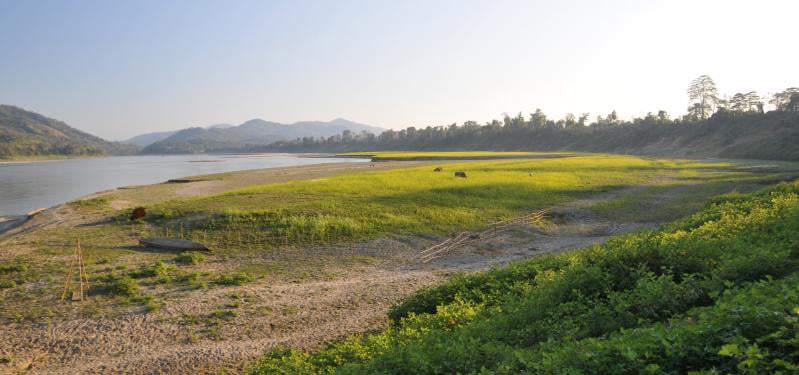
“The earth is fast becoming an unfit home for its noblest inhabitant,” wrote the conservationist George Perkins Marsh, in 1867. “Another era of equal human crime and human improvidence … would reduce it to such a condition of impoverished productiveness, of shattered surface, of climatic excess, as to threaten the depravation, barbarism, and perhaps even extinction of the species.” Did James C. Scott have these lines in mind when he wrote that Marsh understood “rivers are the outstanding example of the earliest human impact on natural systems”? Scott writes many things in this posthumous book, which pairs close study of the Ayeryarwady River in Myanmar with a broad overview of river-human relations. Not all of it adds up.
I wanted to hear from the man at the end of his life: his thoughts on rivers and floods and human societies.
Scott died at 87, a year before publication, after a long tenure in Yale’s agrarian studies program. For landscape designers and planners, he was a trusted interlocutor of the piles of scientific and historical writing informing huge social questions, as in his later works Seeing Like a State and Against The Grain. To appreciate this influence, see the great summary of his career in The New Yorker’s review of In Praise of Floods, which somehow avoids discussing the book at hand.

As to the Ayeryarwady, it is personal for Scott, who spent a year in Myanmar before graduate school. The book begins in a reflective and philosophical mood. We see how Mark Twain and Ellen Wohl and Joseph Stalin and Harold Fisk weave together in the author’s mind, and it is interesting. His stories of navigating small river towns and academic conference rooms over the decades are insightful and compelling.
We see how Mark Twain and Ellen Wohl and Joseph Stalin and Harold Fisk weave together in the author’s mind.
But in the later chapters, Scott slides toward the excesses of his late-career style, and the book loses charm and texture. Some concepts are intriguing (“technological lock-in”, “the Great Drying”) and some less so (“thick Anthropocene”, “iatrogenic effects”). None offer new understandings. Everything here has been discussed better elsewhere, by Richard White (The Organic Machine), Ruth Mostern (The Yellow River: A Natural and Unnatural History), Dilip da Cunha (The Invention of Rivers), or Wohl (A World of Rivers). Scott knows these works and draws from them, with citation. He just struggles to add anything, except when he makes it personal. He tries a couple of gambits — channeling the voices of non-humans that inhabit the Ayeryarwady; and splicing in prose from collaborators in Myanmar to give an account of the nats, or river spirits — but neither really works.
This is still a credible social history of rivers, thanks to Scott’s general knowledge about state formation and agriculture, both tied tightly with river design and flood control in many places and times. But in that vein I’d suggest John McPhee (The Control of Nature) or Robert MacFarlane (Is A River Alive?). I suppose what I wanted from this book was to just hear from the man at the end of his life: his thoughts on rivers and floods and human societies. We get a glimpse in those early chapters, and that glimpse is something.



If you would like to comment on this article, or anything else on Places Journal, visit our Facebook page or send us a message on Twitter.