
The dream of alienation inspires landscape modification in which only one stand-alone asset matters; everything else becomes weeds or waste.
— Anna Lowenhaupt Tsing, 2015
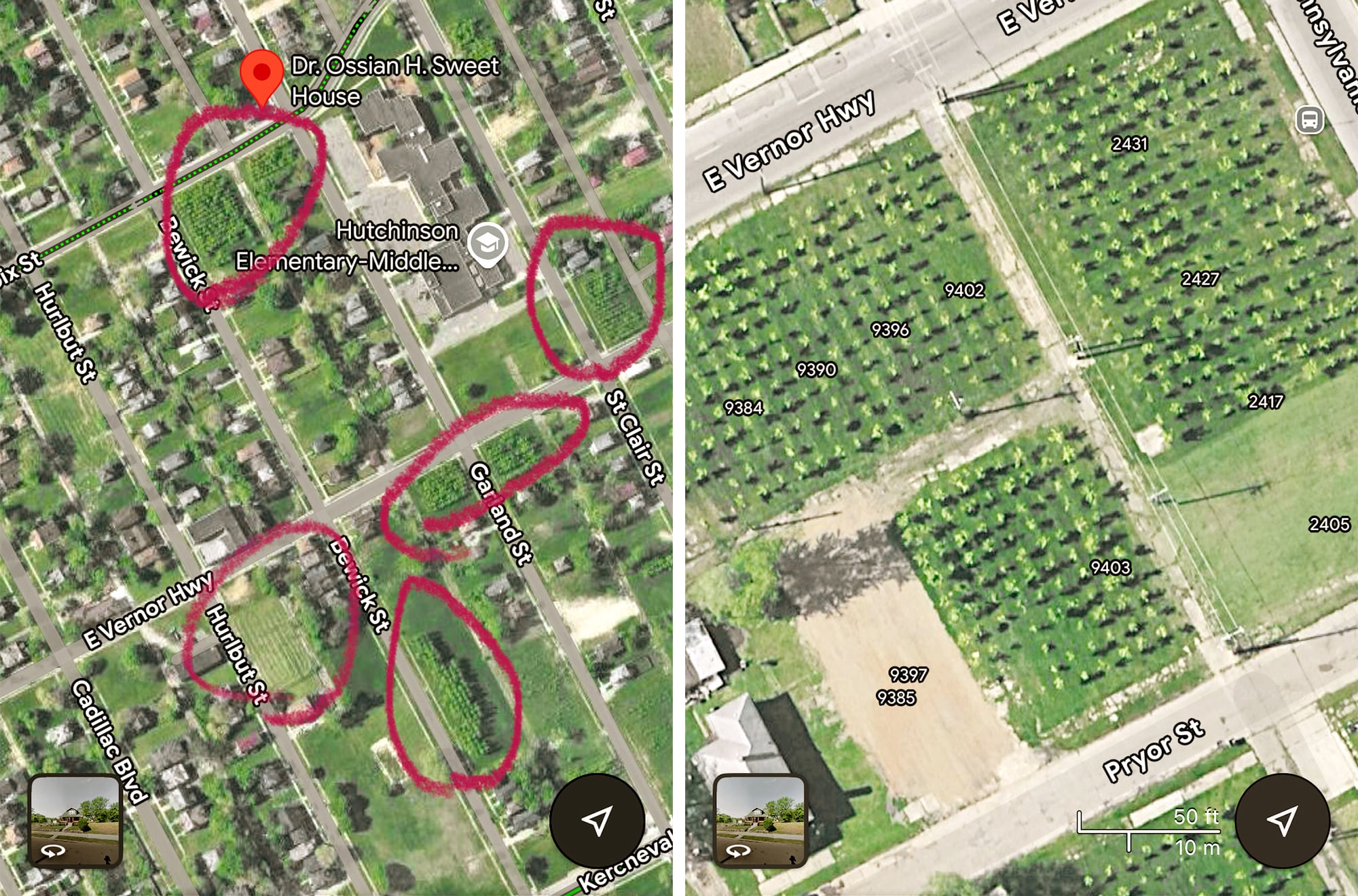
The screenshots came from my friend Vera. Dozens of perfect rows of trees, arrayed as tiny, Braille-like dots on Google Maps. “Look at the plot numbers too,” she texted, sending another image, even more zoomed in. Superimposed on this strange forest were abstract digits representing street addresses for houses that no longer exist.
The trees were planted as part of a controversial urban agriculture project known initially as Hantz Farms and today as Hantz Woodlands.
The tree plantations Vera wanted me to see, scattered across one square mile on the East Side of Detroit, were established as part of a controversial urban agriculture project known initially as Hantz Farms and today as Hantz Woodlands. A better name might be Hantz Holding Company. The con was obvious to many at the time. In 2008, as the housing market crashed, a wealthy financial services executive, John Hantz, announced his intention to acquire and demolish thousands of vacant properties to construct the world’s “largest urban farm.” 1 With an air of surety and condescension, he told city leaders his company would combine traditional agriculture with vertical hydroponics, employing up to 250 people and turning Detroit into a center for global innovation in food production. “Urban Ag Ground Zero,” he called it. 2
‘It is definitely a land grab,’ said founder John Hantz. The con was obvious to many at the time.
The idea was to invest $30 million over ten years “to grow fresh, natural foods; enhance the environment and aesthetics of the city; attract agritourists; increase the tax base; create jobs; and improve the quality of life.” 3 To realize this vision, Hantz wanted 10,000 acres — a full tenth of the city’s land area. 4 He was opposed by East Side residents and urban farmers, who saw the project as a land grab that would accelerate the transfer of wealth away from Black Detroiters, while appropriating a grassroots movement that originated as a protest against an unjust food system and a practical means of subsistence. Hantz played his critics’ concern for a laugh. “It is definitely a land grab,” he said at an early public meeting. “You can’t farm without land.” 5


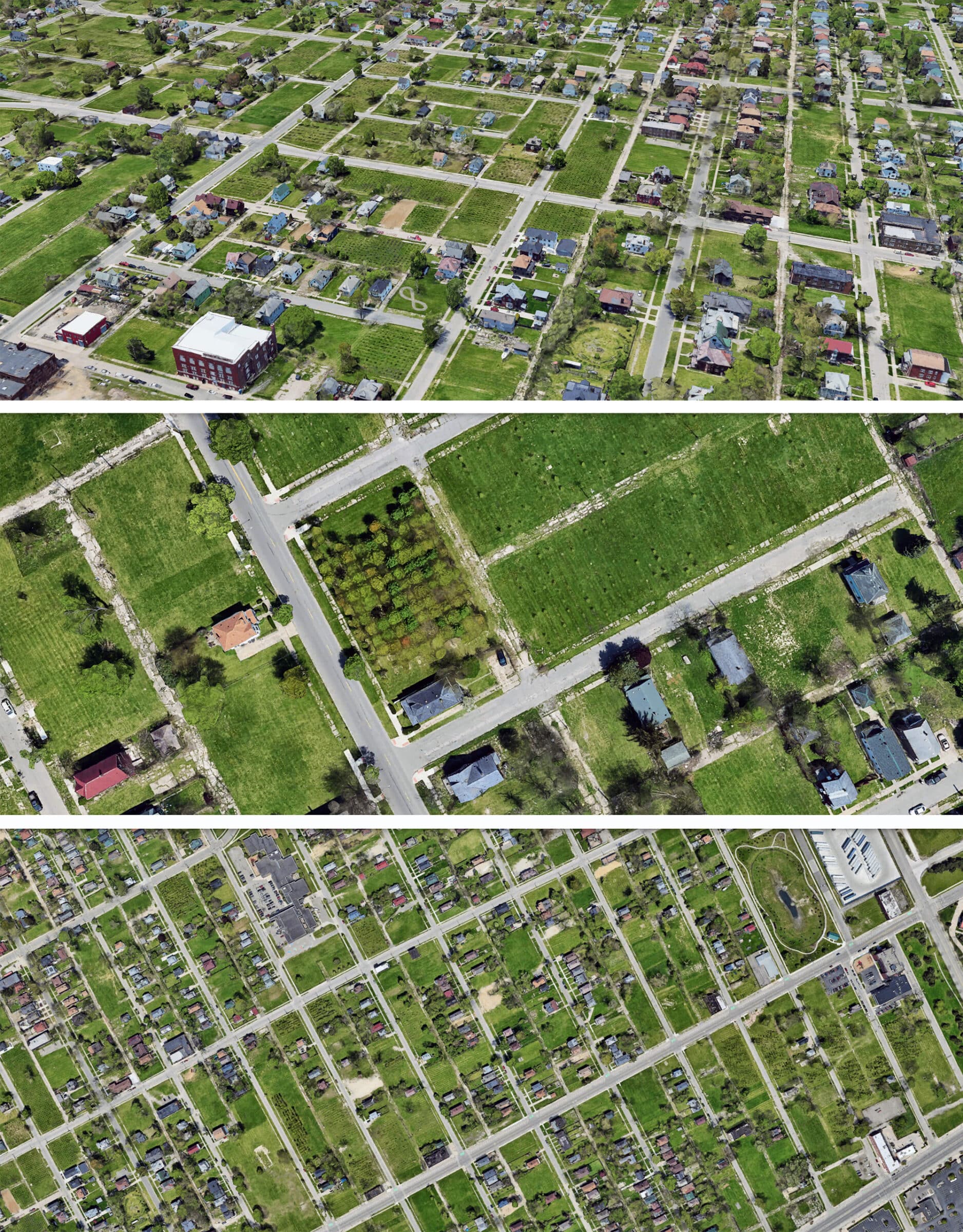
Elected officials balked at the size of Hantz’s ask, and he scaled back his plans, proposing timber plantations on 140 acres in and around Indian Village, where he owned a home. In 2012, after a contentious hearing, the city council voted 5-4 to approve the sale of 1,550 vacant or abandoned properties to Hantz Woodlands for $540,000. The name change reflected the evolving business strategy, from hydroponic greenhouses and fruit trees to plantations of hardwoods like oaks and maples. 6
Over the next decade, the for-profit company expanded its footprint, acquiring even more properties in a swap with the Detroit Land Bank Authority. Some of the lots were planted with uniform rows of young trees. Others were maintained as patches of mowed grass. None produced food. Today, Hantz Woodlands has only a handful of employees, with most of the trees planted and cared for by volunteers, including schoolchildren. A 2023 investigation by the nonprofit newsroom BridgeDetroit found that Hantz Woodlands had quietly sold off 600 of the 2,600 properties it owned, generating sales of more than $9.5 million. 7
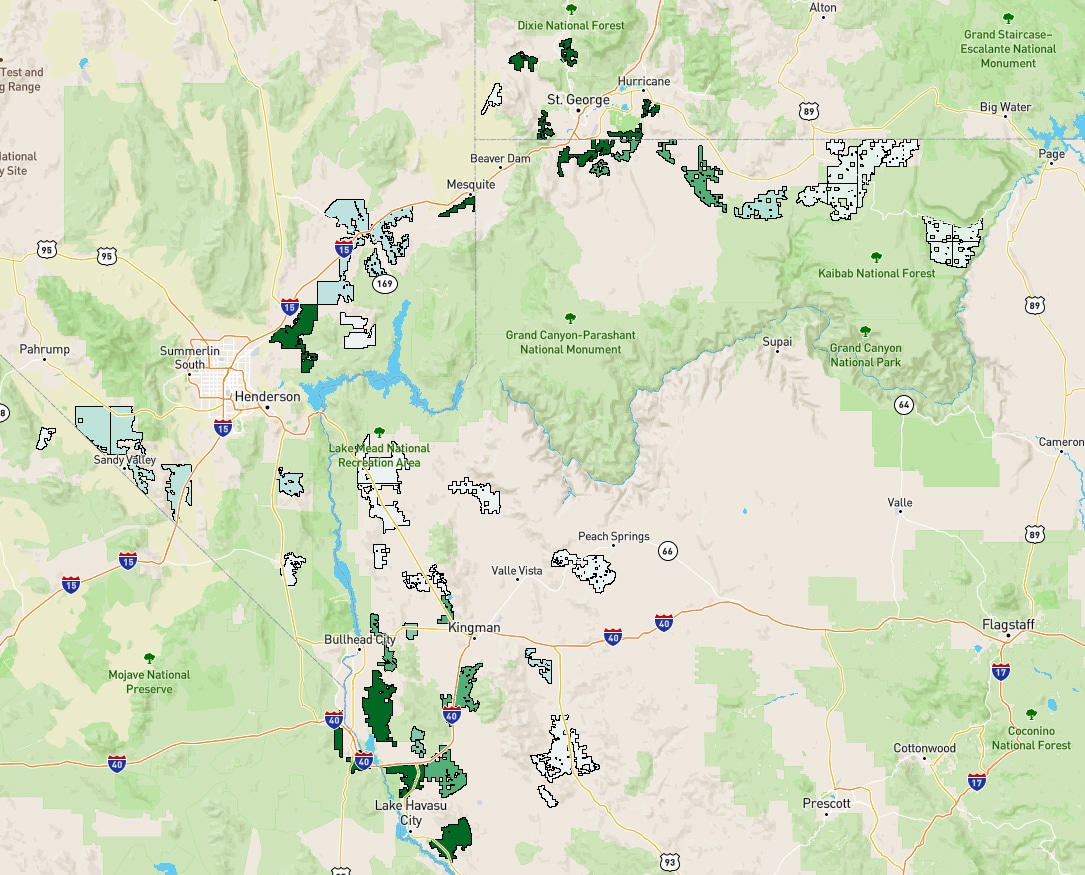
Vera’s texts arrived as I watched Donald Trump and his band of vandals perpetrate a similar con on the American public. “We should privatize anything we possibly can,” said pro tem shadow president Elon Musk, whose companies have received $38 billion in public funding. 8 That “anything” apparently includes the nation’s public lands. Former tech executive and current Secretary of the Interior Doug Burgum has described our shared natural resources as “the balance sheet of America.” 9 As I write, Republicans are pushing to sell millions of acres of federal land while taking a chainsaw to the National Park Service budget. At proposed funding levels, the park system could be reduced by 75 percent, with hundreds of historic sites deaccessioned and forced onto states or private foundations. National forests, wilderness areas, and tribal homelands could be sold to logging and mining companies and housing developers. 10
‘We should privatize anything we possibly can,’ said Elon Musk, whose companies have received $38 billion in public funding.
“Land grab” is too quaint a term for what we are witnessing. The old tools of privatization are being helped along by a methodical effort to end regulation and hollow out critical services — what Rebecca Solnit has described as a “blurry invasion from within.” 11 The public domain is being looted. Indeed, the very idea of a public realm is under attack. In a recent essay for the Guardian, Naomi Klein and Astra Taylor call out the Silicon Valley elites and far-right allies who for years have strategized about an “exit” from democratic society. These individuals want to “walk away from the obligations of citizenship, especially taxes and burdensome regulation. Retooling and rebranding the old ambitions and privileges of empires, they dream of splintering governments and carving up the world into hyper-capitalist, democracy-free havens under the sole control of the supremely wealthy, protected by private mercenaries, serviced by AI robots and financed by cryptocurrencies.” 12
In step with this withdrawal from democratic life, President Trump has proposed a contest to develop “freedom cities” on public lands. These privately controlled enclaves, according to Bloomberg Law, would be “free from state law and most federal rules.” 13 The idea resonates with libertarian initiatives that have gained ground at a shocking pace. The Sagebrush Rebellion gave us the Malheur Occupation, while the tools of extrastatecraft invented by multinational corporations are now applied to urban development in the Seasteading visions of Peter Thiel and the charter city Próspera on the Honduran island of Roatán, whose founders have been meeting with the White House. 14 Proponents of the so-called Network State want digital communities to supersede national governments, while Trump advisor Marc Andreesen is among the billionaires backing California Forever, a new city being stealthily planned between Sacramento and San Francisco. 15 Meanwhile, Elon Musk is the first billionaire to get his own private city on American soil. Last month, people living near the SpaceX launch facility voted to incorporate as Starbase, Texas. The mayor and city commissioners, all SpaceX employees, immediately advanced zoning changes that may force out longtime residents. At a recent public hearing, a neighbor accused Musk of building a “private interplanetarian community.” 16
Land grab is too quaint a term for what we are witnessing. The public domain is being looted. Indeed, the very idea of a public realm is under attack.
One group pushing for Trump’s “freedom cities” is the right-wing American Enterprise Institute, which frames its plan as a resurrection of the 1862 Homestead Act. Among the most consequential land-use policies in history, the original act offered settlers free title to a 160-acre plot between Ohio and California, so long as they “improved” it by planting crops, enabling the occupation and permanent transformation of the Western territories. In this way, the genocide of Native peoples was tied to a massive expansion of private property. AEI’s proposal, Homesteading 2.0, proudly invokes this history. It would have the Bureau of Land Management sell 850 square miles of land for the construction of 3 million new homes outside of existing metro areas and in 20 new “freedom cities” with “streamlined governance and targeted regulatory relief.” There is no guarantee that this housing would be affordable, and very little in the thirteen-page plan makes any sense, except as a giveaway to developers. 17 The political project is privatization in its own right.
The enduring trope of the homestead was also central to the discourse that surrounded Detroit in the 2000s and 2010s. In her indispensable history The City After Property, Sara Safransky notes that news stories were full of “overtures to the city as a new frontier, a place with vacant pristine land waiting to be claimed and tamed.” 18 The most explicit callback was the Michigan Urban Homestead Act, which in 1999 authorized the state to give away public lands for private homesteading. (The law was in part the work of John Weicher, a senior fellow at the Hudson Institute who was also instrumental in developing the federal program HOPE VI, which marked a turn away from government provision of public housing and toward a voucher system benefitting private developers.) 19
Of course, Detroit was not empty. As Sara Safransky observes, frontiers are ‘imaginative projects that erase history and geography.’
Of course, Detroit was not empty. The city was — and is — alive with people. Even now, at a third of its peak population, the city’s size and density are similar to Denver or Portland. But elites (including design and planning professionals) pretended otherwise. As Safransky observes, frontiers are “imaginative projects that erase history and geography.” She quotes the anthropologist Anna Lowenhaupt Tsing, who shows that erasure is necessary to create the illusion of “wild and empty landscapes where discovering resources, not stealing them, is possible.” 20
In Detroit, the frontier rhetoric disguised the theft that occurred when tax officials pushed 30 percent of homes into foreclosure because of a failure to pay property taxes — in many cases, because the homes were over-assessed. 21 And it disguised the theft that followed, when those public holdings were sold off cheaply to people like John Hantz, who decided that the city was empty and that emptiness was blight. Hantz himself evoked the Homestead Act, at one point advocating that a municipal version be enacted at the neighborhood scale, and Detroit settlers eventually got a full suite of neoliberal homestead reforms, with state and local tax incentives for occupying property, as well as a city program to buy vacant lots adjacent to their homes for only $100. 22
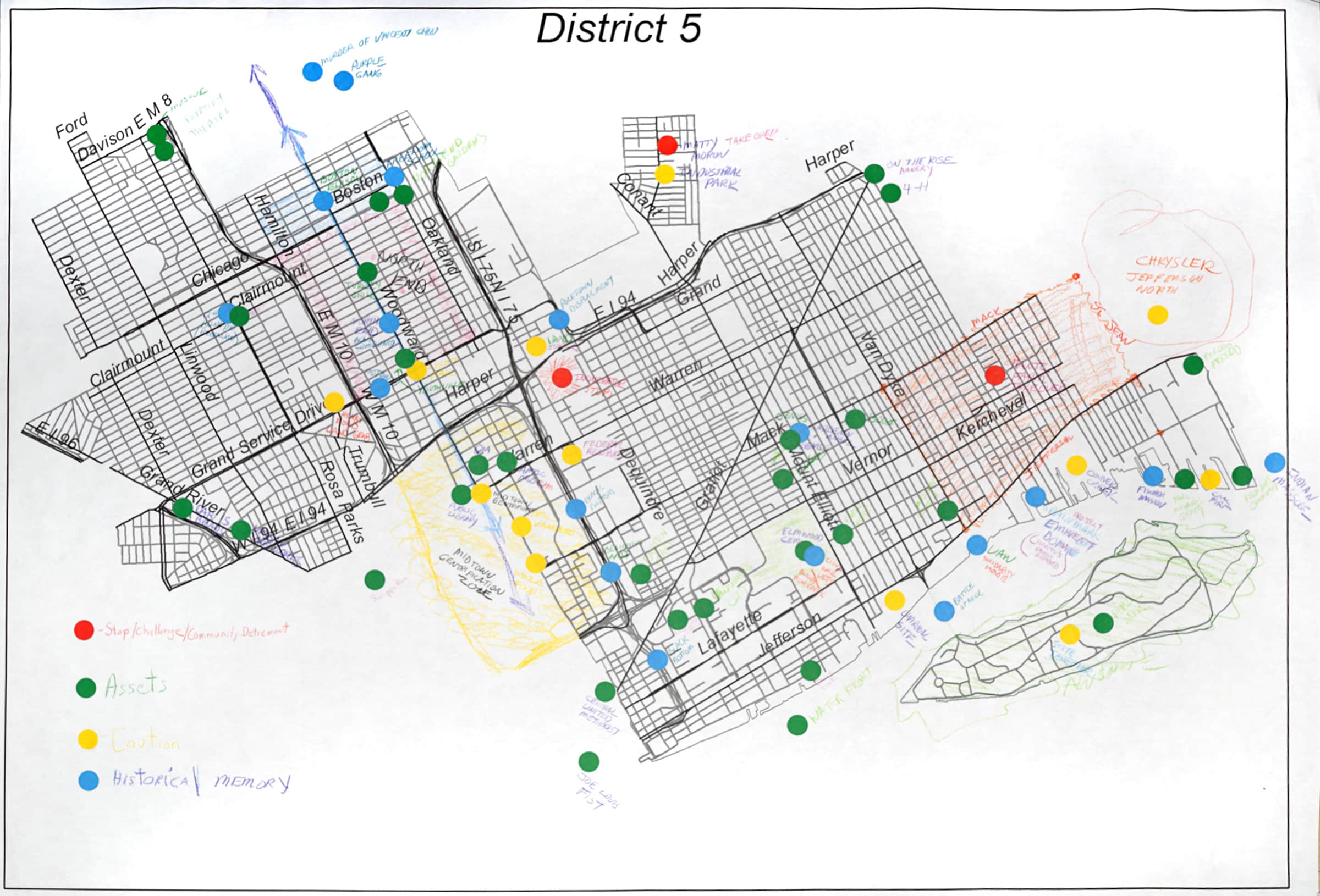
Meanwhile, residents who had been forced out of their homes, or who’d never left in the first place, had to constantly reaffirm their claims. In A People’s Atlas of Detroit, Safransky and her co-editors describe a 2012 workshop organized by the Uniting Detroiters Project, where participants mapped their neighborhoods, with one group using colored dots to denote sites of potential harm (red), caution (yellow), community empowerment (green), and historical significance (blue). Among the red dots was the Russell Street waste-to-energy facility, the largest municipal incinerator in the country, as well as a not-yet-approved venture known as Hantz Farms. Far outnumbering the red or yellow dots, however, were blue and green ones, which marked historical sites of Black resistance or cultural memory, as well as active community hubs: the North End Garden, the Dabls Mbad African Bead Museum, the James and Grace Lee Boggs Center’s new school. These “cartographies of liberation,” as Safransky calls them, showed “that the land was not vacant” nor “without memory.” 23
In 2012 alone, Wayne County foreclosed on 42,000 properties. Officials set up the quasi-public Detroit Land Bank Authority to receive ‘blight bundles’ at auction.
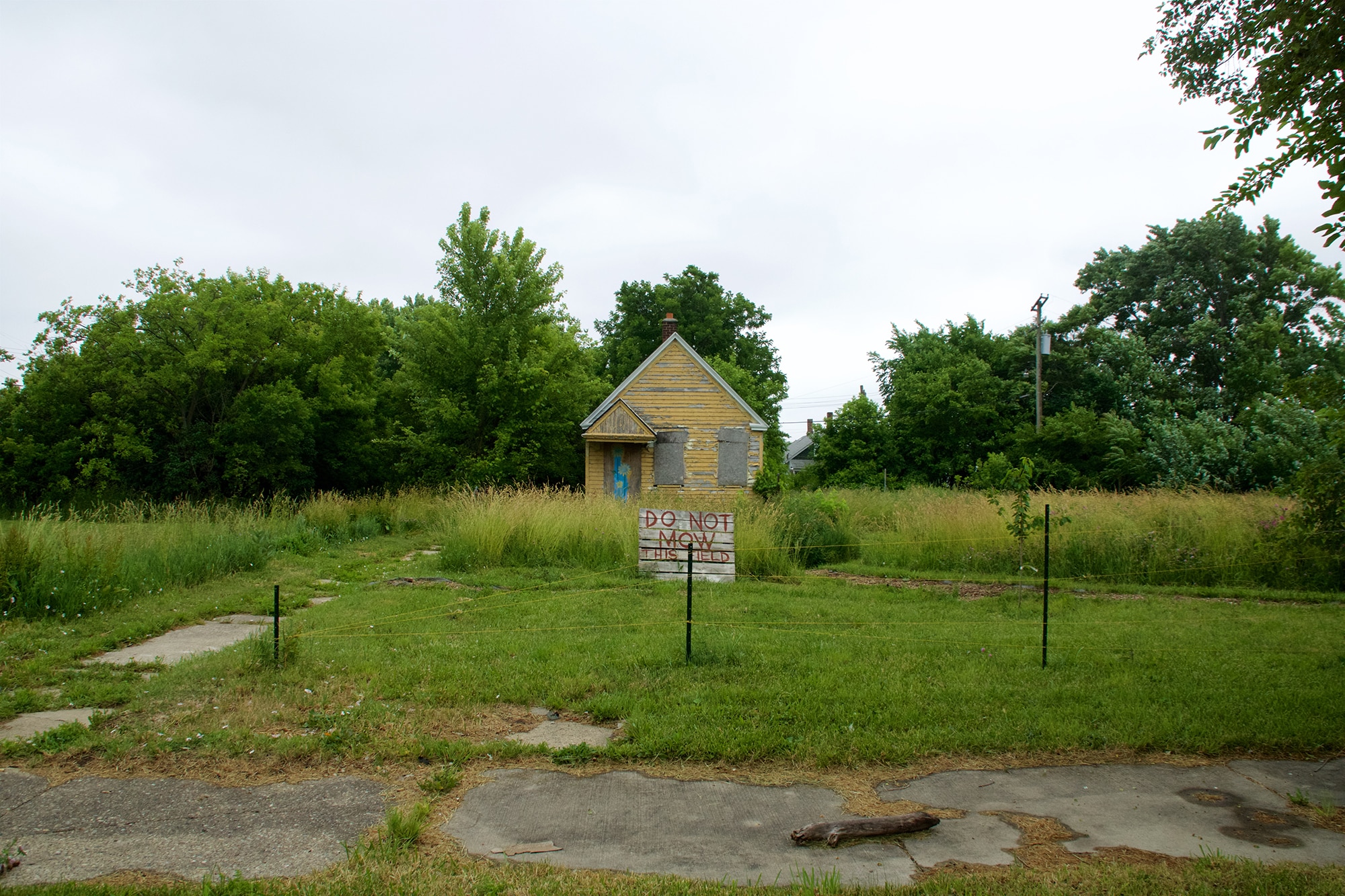
One of the challenges facing Detroit in the aftermath of the 2008 housing crash was the indeterminate status of much of the real estate. Properties described as vacant or abandoned were often contested in some way, “characterized by foreclosure and eviction defenses, cloudy titles, squatting, and efforts to ‘take back’ the land,” Safransky writes. With its tax coffers drained, the city cut back on municipal services, so residents became stewards, clearing sidewalks and mowing empty lots. “This caretaking,” Safransky argues, “led to a collective sense of ownership over de facto public lands.” Not everyone agreed that the vacant lots were public, but, operationally, the government had broad powers to do as it pleased. Michigan law says that if an owner has not paid property taxes for two years, counties can foreclose on the property and offer cities or individuals the right to purchase it. In 2012 alone, Wayne County foreclosed on 42,000 properties. Officials set up the quasi-public Detroit Land Bank Authority to receive “blight bundles” at auction. 24
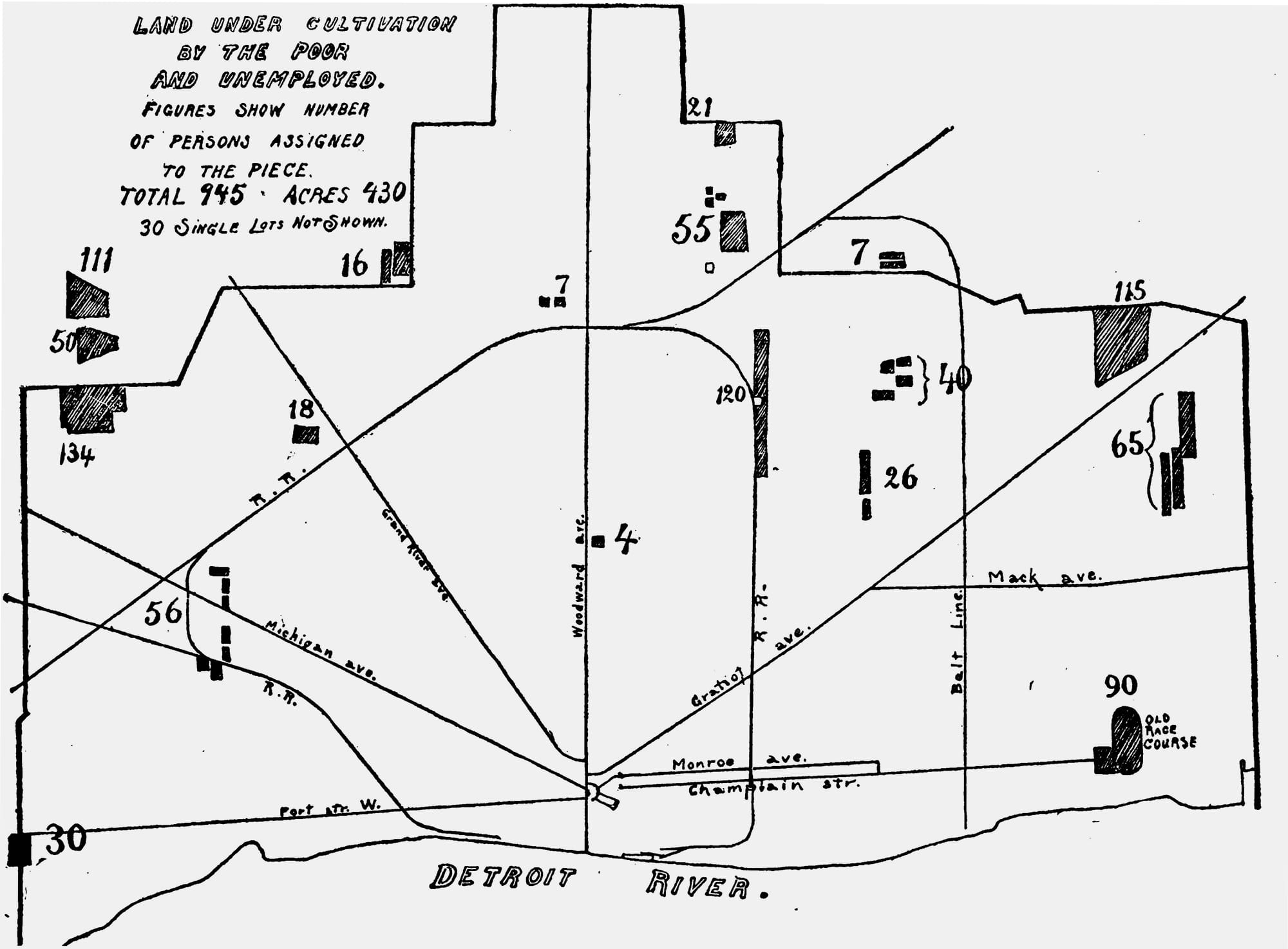
Against this backdrop, Hantz presented his plan as fiscal prudence; he claimed it made more sense for the government to offload properties in bulk than to pay for their indefinite maintenance or demolition. 25 But as geographer Rae Baker explains in Commoning the City, this was a departure from past policy. 26 Detroit has a long history of finding productive uses for idle land. In 1894, in the wake of a recession, Mayor Hazen Pingree set up a municipal committee to assemble 430 acres of public land that could be used for growing food. In the first year, nearly 1,000 people signed up for a garden plot, which made them eligible for public benefits. This became known as Pingree’s “potato patch plan,” though gardeners also grew corn, beans, beets, and pumpkins. 27
In 1975, during another recession, with the city’s population down one third from its peak of 2 million, Mayor Coleman Young launched the Farm-a-Lot program, which assigned residents a vacant lot and supplied them with free seeds and tools. 28 Baker contrasts those public efforts with the city’s approach after the 2008 crash, which reflected a “social relation to property reconfigured around the regulation of potential future land values, rather than harnessing socially reproductive surplus land management through tentative redistribution to residents.” 29
More than a decade on, it is easier to see Hantz Woodlands not as an audacious response to anomalous conditions but as part of a long lineage of “enclosures, privatization, wealth extraction, and capital accumulation,” as Safransky puts it — extending from the eradication of the commons in 16th century England to the push for corporate-controlled cities in 21st century America. 30
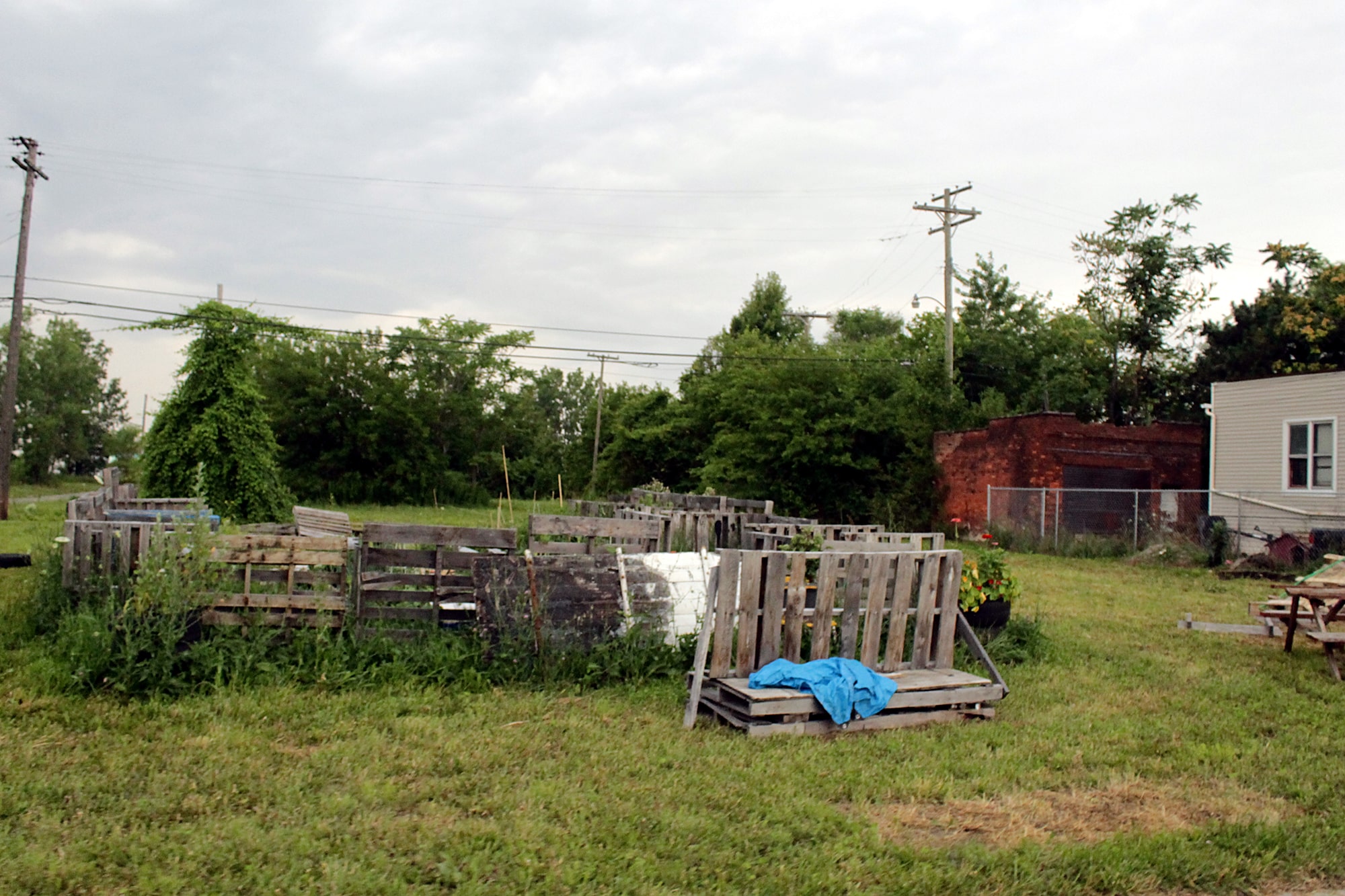
It’s worth asking what else the city of Detroit might do with surplus lands. Abandoned properties “represent an opportunity for reparations, for the seeding of communal wealth in the form of civic landscapes,” Jill Desimini writes, in Cyclical City: Five Stories of Urban Transformation. Documenting the evolution of “fallow,” collectively tended lands, from the natur-parks of Berlin to the hortas of Lisbon, Desimini conceives a “loose commons” that could inspire new models of land use and social relations. These “are sites of incredible environmental and social trauma” that nonetheless “hold the potential for true transformation, for new spatial forms, new material expressions, and new modes of collective governance.” 31 Or, as one Detroit resident put it plainly, at the community mapping workshop, “I would like to tender that the land that is open space is held in the commons, held by the people.” 32
With a message that foreshadowed Americans’ current resistance to the kleptocracy, Detroiters chanted “Hantz off our land!”
Viewed through this lens, the re-privatization of Detroit’s land bank properties is indeed a form of theft. What is stolen is not so much the land itself, but the potential it represents. Opponents of Hantz’s project understood as much. A coalition of Indian Village residents, community organizers, and members of the Detroit Black Community Food Sovereignty Network showed up at public meetings to testify against Hantz Farms. They explained the harm in turning a large part of the neighborhood over to a single individual, while calling out the lack of community benefits and the city’s favoritism toward well-capitalized investors above existing Black farms. They noted that DBCFSN’s own D-Town Farms had been blocked from acquiring seven acres of city-owned land it already occupied. With a message that foreshadowed Americans’ current resistance to a kleptocratic administration, they chanted “Hantz off our land!” 33

In her 2017 book Public Things: Democracy in Disrepair, political theorist Bonnie Honig argues that “public things are part of the ‘holding environment’ of democratic citizenship; they furnish the world of democratic life.” 34 Think of our streets and waterways, our historic sites and public universities. Our engagement with these everyday objects and spaces is a reminder of our membership in a self-governing plurality. “The democratic experiment involves living cheek by jowl with others,” Honig says, “sharing classrooms, roads, and buses, paying for them together, complaining about them together, and sometimes even praising and enjoying them together.” 35
We might cheer the retreat of seasteaders and space colonists from civil society, if not for the fact that the wealth used to construct their private worlds belongs to us.
And so Detroit’s ersatz tree plantations have me thinking about what is happening, at a larger scale, all around us. We might cheer the retreat of seasteaders and space colonists from civil society, if not for the fact that the wealth used to construct their private worlds belongs to us. Thiel and Musk and their allies have subverted democratic institutions to steal public resources, which they will use in ways that reshape the planet — its landscapes, economies, and information spaces — and in so doing make it less habitable for the rest of us.
For Honig, the consequences of the billionaires’ drive to privatize or else withdraw from public life are greater than the loss of access to formerly shared goods or spaces. Privatization threatens the very foundation of democratic society and, by extension, our ability to collectively solve planetary problems. “Public things are one of democracy’s necessary conditions,” she writes. “Without them democratic life is not just impoverished but unsustainable.” 36
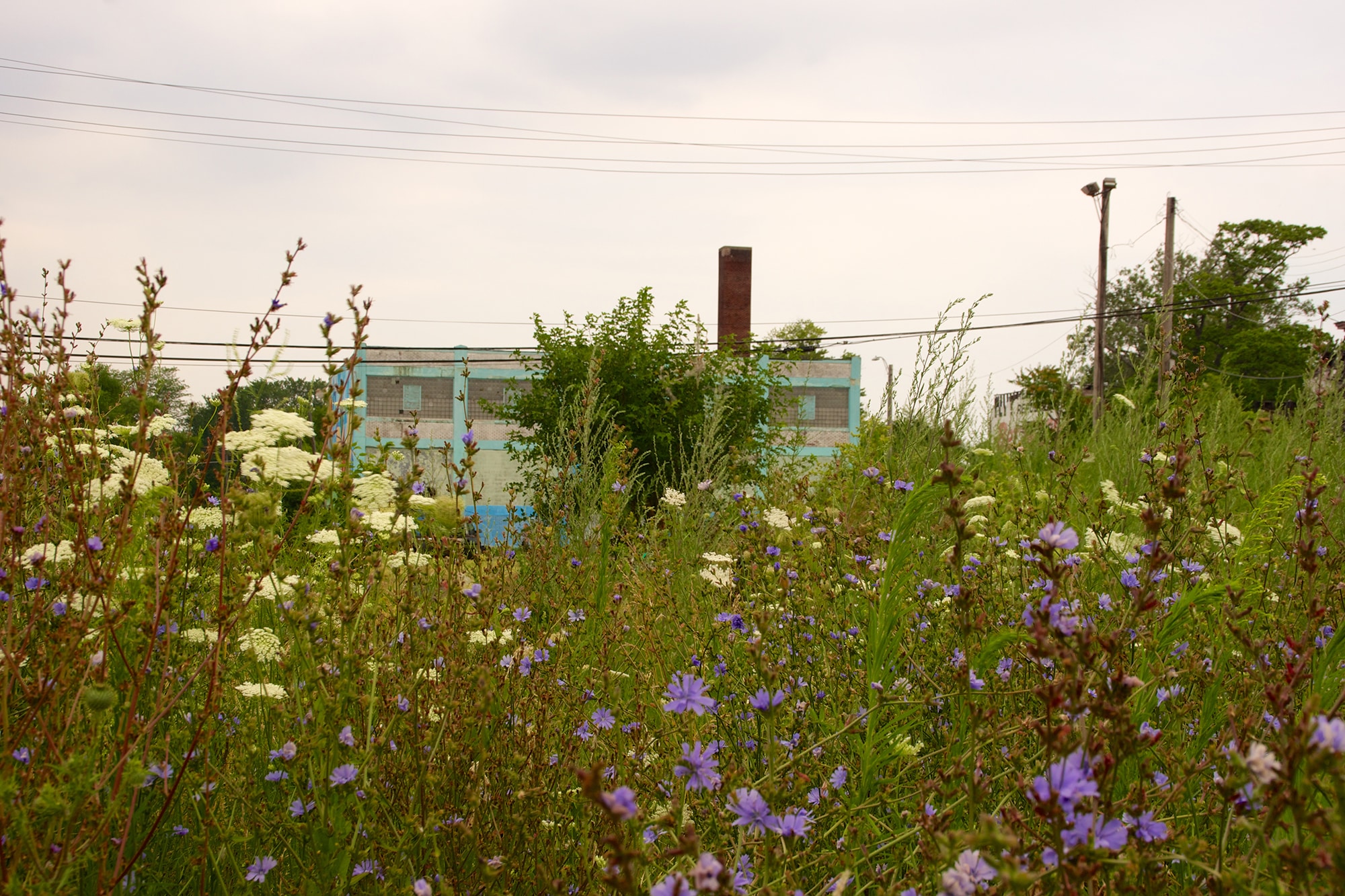
In a tagline on its website, Hantz Woodlands claims to be “creating truly liveable neighborhoods, one square mile at a time.” What it actually is creating is scarcity. This discontiguous forest is not optimized for carbon sequestration, or wildlife, or people. No paths invite the public in; no benches provide rest. It is simply an occupation of land. The trees are placeholders, symbols of ownership meant to preclude any alternative use. They are both enclosure and exclosure, locking up property and repelling would-be farmers and squatters. A hostile landscape architecture. To the degree that the trees are also meant to secure a long-term return on investment (and reduce the company’s property tax rate in the interim), they are financial instruments in their own right.
What Hantz Woodlands is actually creating is scarcity.
This fits within a long history of trees being used to secure property. In 1873, the Timber Culture Act augmented the Homestead Act by promising settlers an additional 160 acres in places like Iowa, Kansas, and Nebraska — the great treeless “deserts” of the young nation — if they planted one quarter with trees. (The rationale was to supply timber on the Plains and to seed the forest canopy that scientists believed would increase precipitation.) In Minnesota, 400,000 acres were privatized in this way. In Nebraska, the figure was five times that. As Rosetta Elkin notes in Plant Life: The Entangled Politics of Afforestation, the law helped “consolidate control” of the North American continent. “Growing trees,” she writes, “was the best way to hold onto your land and avoid the cancellation of your claim.” 37

And, again, the frontier requires erasure. In 2010s Detroit, yard signs reading “THIS IS A HOME DO NOT BID” spoke to the unabandoned state of many of the properties sold at auction. Detroiters today fight to buy back their family homes, 38 even as the city’s Department of Demolition bulldozes 25 structures a week, pursuing a policy of “blight reduction.” 39 Hantz Woodlands likewise touts the number of houses — or “dangerous structures” — the company has demolished (77 to date). 40 This is not urban arboriculture but vandalism. Even an abandoned home contains material traces of the lives lived there and provides displaced people with a tether to ancestral lands. 41
Abundance must be a social, collective, public project.
“We cannot create value until we create scarcity,” John Hantz believes. 42 It’s a statement that only makes sense in the mind of a land speculator. As Robin Wall Kimmerer has observed, “In order for capitalist market economies to function, there must be scarcity, and the system is designed to create scarcity where it does not actually exist.” She contrasts this “artificial scarcity” with genuine scarcity — “shortages of food and clean water, breathable air, and fertile soil” — which the “continued fealty to economies based on competition for manufactured scarcity” has produced. 43
The opposite of scarcity is abundance, which for Kimmerer means recognizing the “enoughness” of our shared resources when they are applied toward our mutual flourishing. Abundance, then, must be a social, collective, public project.
The libertarian withdrawal from democratic life is often imagined as a quest for freedom. In fact, it is a search for its opposite — control — which at the societal scale is tyranny. And while the right wing of the U.S. political establishment has been captured by interests and individuals contemptuous of the public, the left is beset by a more principled but no less obstructive skepticism of government. Honig acknowledges the ambivalence many people feel toward “state-supported public things,” which at times are “falsely universal, falsely inclusive, colonial, appropriative, [or] statist.” Honig encourages us not to shy away from the discomfort that follows this awareness. Part of the inherent value of public things is that they inevitably “involve us in matters not of our own choosing” and may even “implicate and enlist us in policies and actions we abhor.” 44
‘Public things are one of democracy’s necessary conditions,’ writes Bonnie Honig. ‘Without them democratic life is not just impoverished but unsustainable.’
Many public lands were acquired through theft, deception, and state violence, but that should not impede our commitment to defending them. Rather, it ought to inform our search for non-market-based valuations of land and place, as Kimmerer advocates. It ought to provide a basis for envisioning new — or perhaps old — models of collective governance. 45 It ought to press us more firmly into solidarity with tribes and Indigenous communities who had their lands stolen and their language and culture suppressed, and with Black residents in Detroit who lost their homes twice over, first to the government and then to private auction.
We ultimately lose so much more than an acre — or 500 or 5 million — when public lands are devalued and reduced to financial assets and liabilities to be traded, hoarded, or exploited by private interests. We lose our shared heritage. We lose potential futures. And we lose the mechanisms by which we participate in and imagine democracy. “Public things press us into relations with others,” Honig writes. “They are sites of attachment and meaning that occasion the inaugurations, conflicts, and contestations that underwrite everyday citizenships.” 46
We should hold onto them with all our power.


If you would like to comment on this article, or anything else on Places Journal, visit our Facebook page or send us a message on Twitter.