
Drone footage of Sara Delano Roosevelt Park. [Courtesy Jeremy Collyer]
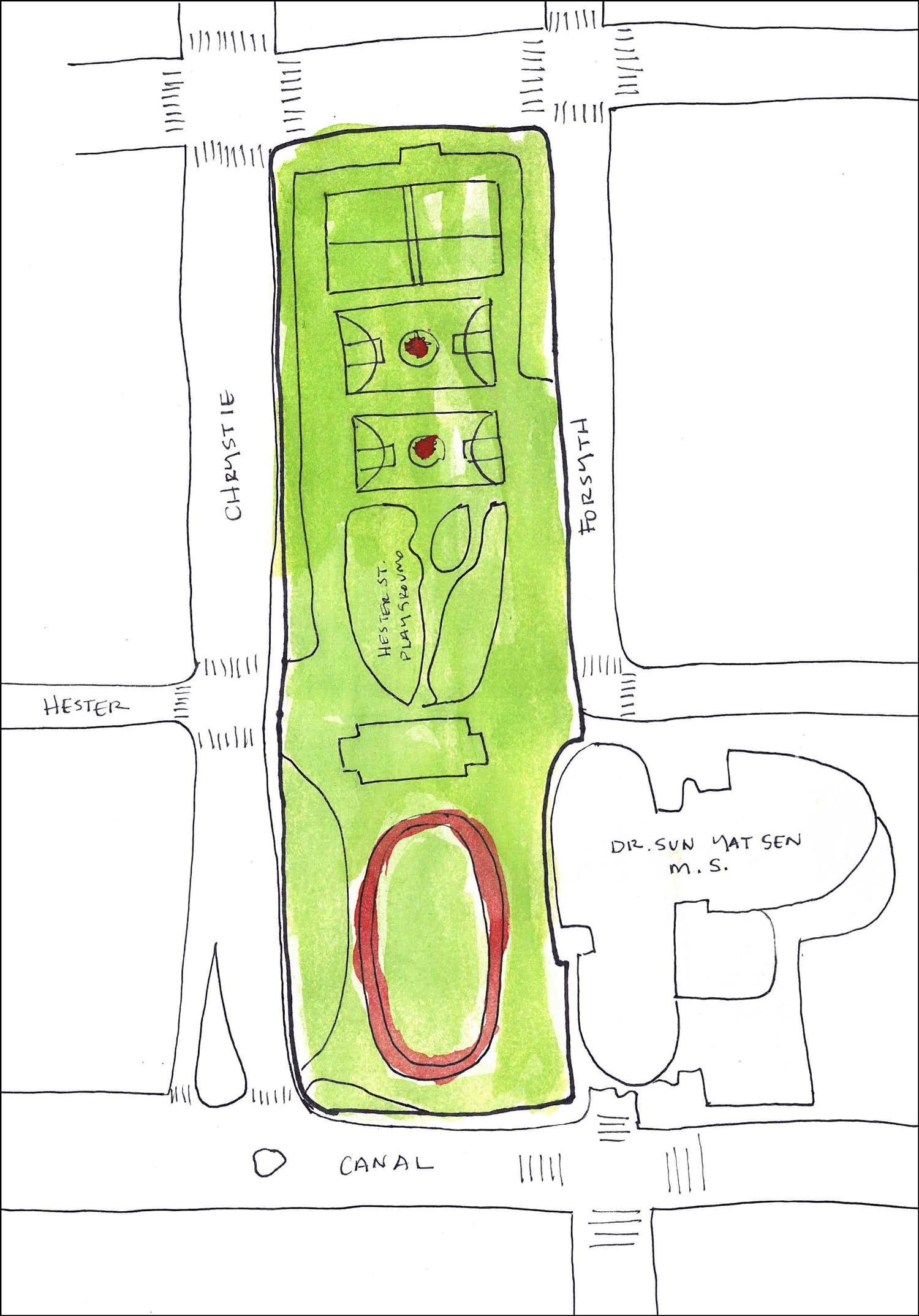
Early-morning, April, a middle-aged Chinese man in khaki pants lugged a plastic pail west on Grand Street. He crossed two lanes of traffic. The bucket was white and uncovered. As he walked, hunched and bowlegged, water sloshed out and drenched brief shadows on the pavement. He picked his way across Forsyth Street, then turned left beneath the splintering wooden gates that announce Sara Delano Roosevelt Park. Once inside, he pivoted right at the handball courts.
The elder Chinese of the park, mostly of Fujianese descent, detached themselves from their various posts as the man with the bucket passed.
The elder Chinese of the park — mostly of Fujianese descent — detached themselves from their various posts as he passed. They wore visors or baseball caps, secondhand shirts bearing the logos of North American entities like Winnipeg, Tesla, and Talladega Nights. Fanny packs, comfortable sneakers. They righted themselves from leaning on the wooden gates and brick-and-mortar walls; they let fall their circling hands from morning taijiquan sessions on the empty handball courts, abandoned their Bluetooth speakers clipped to the cyclone fences, alive with whinnying erhu; they paused pacing, ceased knocking their biceps with their respective opposite fists, unclasped their hands from their backs, and turned their bodies toward the bucket bearer, reading the wind.
He set the bucket down. The elder Fujianese huddled. From the bucket, he pulled out a transparent, sturdy plastic bag bouncy with clear water, striped in wavy light, and held it above their heads. Inside bobbed 30 or more shaggy cuboids of tofu. The elders parted and one man, a little taller than the rest, stiff white hair, inspected the shimmering bladder. He wore a black Adidas tracksuit, a crossbody bag embroidered NEW YORK NEW YORK, and a TEQUILA MARKET cap. Everyone, including my six-month-old baby, paid attention.
The bucket man pulled another, crinkly gray plastic bag from his backpack and blew it open. Still clutching the tofu bag, gripping the new bag in his free hand with his ring and pinky fingers, he loosened his grip on the tofu bag just enough for the top to open. He plunged his bare hand into the water and began chucking tofu blocks one by one into the new clean bag, which sank lower and more precariously from the hook of his smallest digits. He filled it with perhaps fifteen blocks, then handed it to the elders’ leader, who gave him a few crumpled bills. In the course of this transaction, the seller dropped the original bag of tofu entirely. It slumped to the ground, deflating, water seeping into the dirt. A block of tofu rushed out, picking up mulch and dust. The white-haired man reached down, poked the creamy block back in with a thumb, and handed the bag back gallantly to the seller. Specks of earth floated in the sunbeams. I felt as if I’d witnessed something illicit. Other park-goers streamed past.
I assumed that subsidiary transactions would occur, the tofu divvied among friends, but the bucket man and the white-haired man seemed to have agreed over the lot, and the other elders returned to their activities. Their white-haired leader headed west on Grand, stopping to converse for a moment with another man bearing a fish in yet another clear plastic bag. This time, no deal.
Specks of earth floated in the sunbeams. Everyone, including my six-month-old baby, paid attention.
Business as usual, it seems, in this part of Manhattan’s Chinatown, east of the Bowery. The micro-neighborhood is sometimes called Little Fuzhou, since in its present form it was pioneered by Fujianese immigrants, who began arriving at scale in the 1980s. They had trouble assimilating into Chinatown west of the Bowery, which had been established in the 1870s by Cantonese-speakers, and instead moved east, transforming streets of the Lower East Side: East Broadway, Eldridge, Hester, and, of course, Grand, where the baby and I were standing. No trace of the tofu negotiation remained; the white-haired man left well-supplied for the next few days. We continued along our regular circuit south, through the handball courts and the big kids’ playground with its crimson swingsets whose crossbeams warp out, evoking pagoda roofs and gates. We stopped to admire the sandbox, set on a slab of concrete. From the top of the slab rises a sculpture of an abbreviated Manhattan complete with a suspension bridge, a subway entrance, a hotel.
We crossed Hester Street, past the public bathrooms, and up the steps where another group of elder Chinese men, from various provinces, slouched over cardboard boxes sheared of their flaps, standing open on a table. Every now and then, a player tossed in a poker card or a few dollar bills. Further south, a tiny green lawn and a parked dolly bearing a speaker, from which flowed fuzzy Mandopop. Facing it, a group of Chinese damas in berry-hued dresses cycled through their guangchuang wu positions: skipping in place, arms swimming a steady freestyle; steady box step with long graceful arm sweeps. Some danced by rote, others with the languid grace that swans get for free.
A decade ago, in China China (as opposed to, say, Hong Kong or Taiwan or Sara Delano Roosevelt Park in New York City), authorities tried to do something about the guangchuang wu damas. City dwellers in Wuhan and elsewhere had complained about their domination of public space. Beijing wanted to limit them to twelve state-sanctioned dance routines, choreographed by a highly qualified technocrat. It fell through immediately. The damas crushed the technocrats. 1 In retrospect, this was inevitable. The damas are exactly the stuff of public space. They are an indicator species, mayflies or barred owls. Things are okay, at least relatively speaking, if you find them in your park. You are drawn to them, you are seen by them, organized at distance into recognition and safety. In the face of a dozen sharp-eyed damas — some who speak in Cantonese, some in Mandarin — I intuit that nothing unseemly will happen to us. The baby bounced in his carrier all the way around the southward curve of the track.
Business as usual, it seems, in this part of Manhattan’s Chinatown, in the micro-neighborhood sometimes called Little Fuzhou.
Here, the baby, in his six months, is saluted. Past the gamblers bent over their boxes, past unhoused migrants sharing a morning beer who like to wave and yell niñito, niñito at him, past the figure with gigantic swollen feet, sleeping under a stained comforter, past more gamblers, down the stairs on which other Fujianese men in drapey slacks and T-shirts raise little paper cups of coffee and lit cigarettes. On this day, by the southernmost entrance to Sara Delano Roosevelt Park, in the shadow of Dr. Sun Yat Sen Middle School (named for the founder of the Kuomintang Party and the Republic of China), we crossed paths again with the man with the bag of fish. On closer inspection, the plastic membrane bulged with just a few yellow eyes and a skull, diaphanous spotted fins and an opaque, blood-tinged jelly.
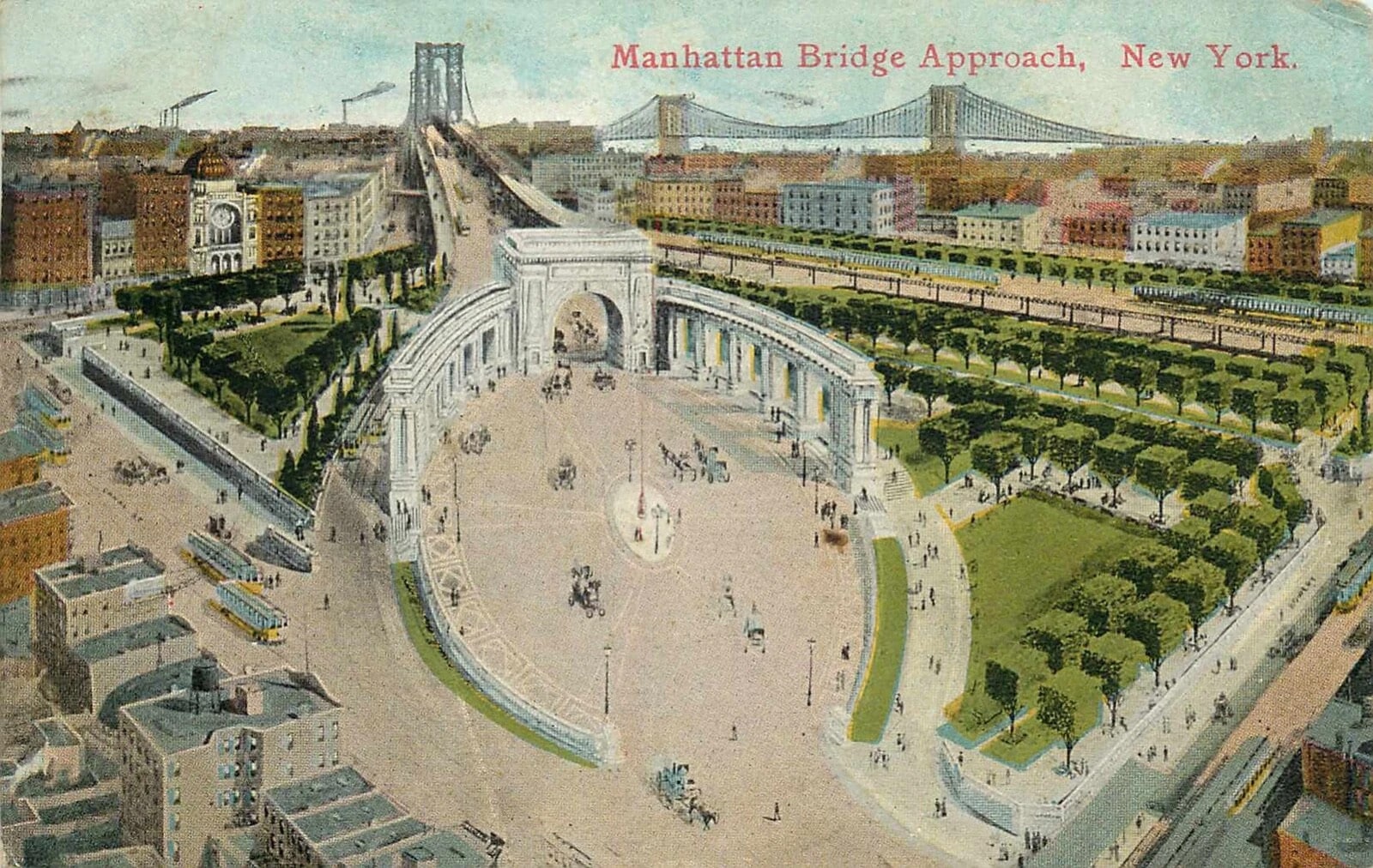
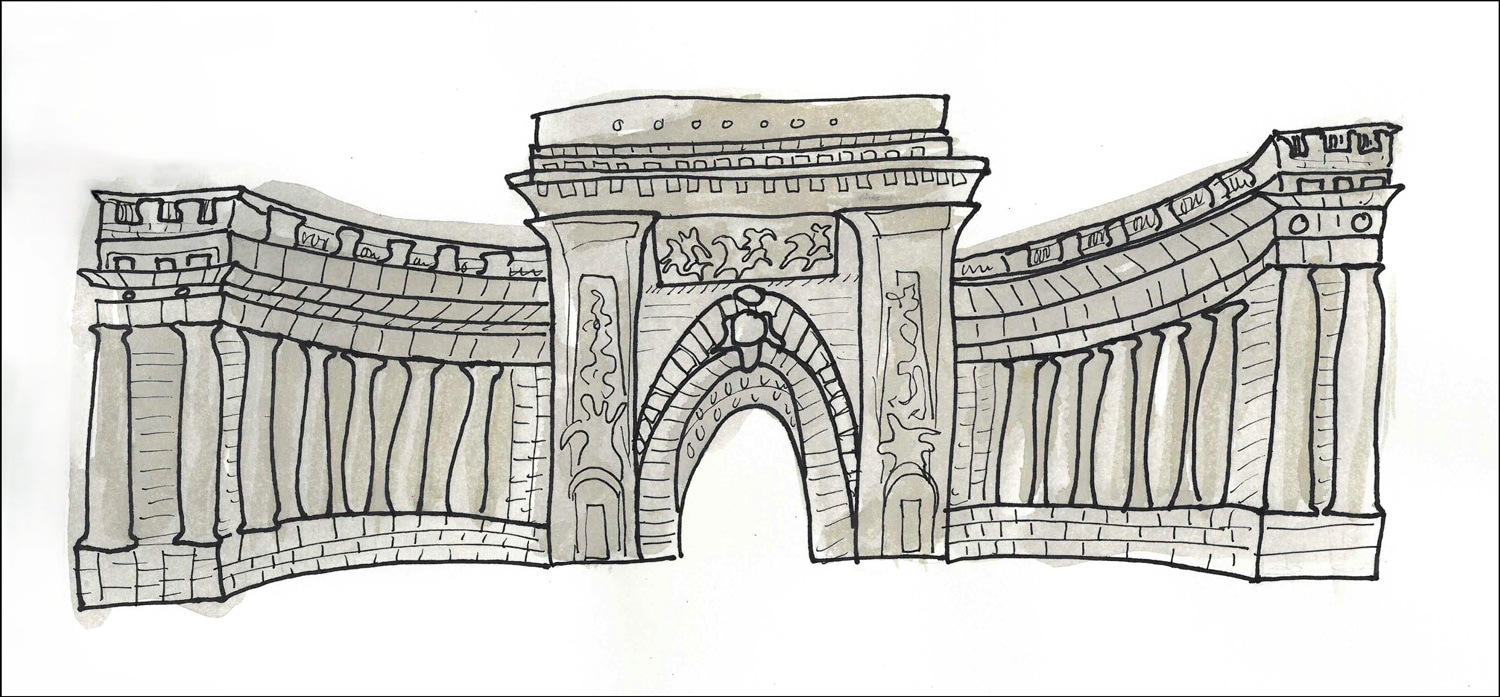
We crossed the bicycle path on Canal Street, to the left of the grand Beaux-Arts entrance to the Manhattan Bridge, which originally, in 1902, had been named Bridge #3. The New York Times hated this name and campaigned against it for two years. “All bridges across the East River,” they pointed out, “are Manhattan Bridges.” 2 But now, standing in the shadow of the triumphal-arch approach, designed by the firm of Carrère and Hastings in the midst of City Beautiful mania over neoclassical architecture, it is obvious that this is the Manhattan Bridge. Flanked by colonnades in rusticated white granite from Maine, modeled after 17th-century Porte Saint-Denis in the 10th Arrondissement of Paris, and referencing Bernini’s massive columniated parentheses that hug St. Peter’s Square in Rome 3 : ( ). Each pylon is carved with a winged figure, projecting the Spirit of Commerce east and the Spirit of Industry west. Just below the cornice are depicted generic Native Americans hunting buffalo. In 1913, the Times hailed Carrère and Hastings’ design as the “most artistic treatment of a bridge entrance attempted on this continent.” 4 Yes! Is the symbolism a little clumsy? Sure. But still, one feels the grandness of the attempt. Its announcement of Manhattan: the pounding noise of its greatness, its beauty, its stateliness, its strange invention, its careless dreams.
Rising just behind the bridge approach, to the southwest, stands Confucius Plaza, an enormous brick housing complex, 44 stories high, completed in 1976. It curves like an eyebrow. Standing flank to flank, the apartment building and the bridge approach would seem, in an aerial view, almost to brush, as if in a missed encounter: )( . From the point of view of a pedestrian walking northeast from Division to Hester Streets, these structures are set in a straight line, and at the end is Sara Delano Roosevelt Park. It’s a crucial constellation of public works for the gamblers, the damas, the elders who while away their days in Luosifuo (“Roosevelt”), as it’s known to the Chinese. Many live in or adjacent to Confucius.
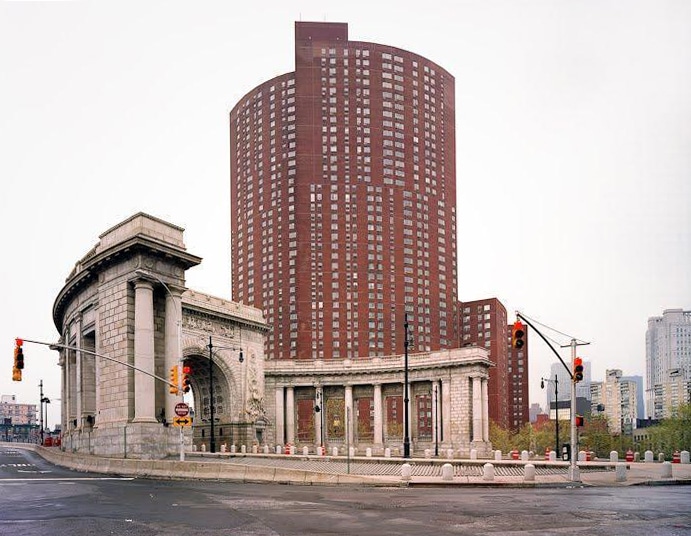
Establishment of the Confucius-to-Sara Roosevelt corridor depended, as perhaps all public works do, on a series of political coincidences. Just as the federal Hart-Cellar Act of 1965 was opening the way for Chinese immigrants to reunite with family members already in the United States, Robert Moses was on the verge of realizing plans for the Lower Manhattan Expressway, known fearsomely as LOMEX. 5 The proposed expressway — a topic of intense debate during that year’s mayoral election — would have carved across Lower Manhattan, connecting the Holland Tunnel to the Manhattan and Williamsburg Bridges, destroying parts of the expanding Chinatown. Had Jane Jacobs and a coalition of community activists not successfully protested the attempt, a ten-lane interstate would have been built along Canal Street. The bridge approach demolished; Luosifuo smothered.
The baby and I turned down the sidewalk under the bridge. The things we have seen under the Manhattan Bridge!
The baby and I turned down the sidewalk under the bridge, where the fuming, screeching ghost of LOMEX lives on. Cars crawled down congested Canal and along the bridge approach, above our heads. Here other Chinese vendors gathered in another gray (not exactly black) market. One was selling fading trays of convenience-store sushi and oozing cheeses mushed in saran wrap, laid out on the pavement. Another seller simply had two fish. One was large and rotund, the other small and angular. They glistened on upturned milk crates. I asked her where the fish came from, and she told me cheerfully, “nearby.” But when I pressed to know if they were from the East River, she exchanged looks with a man beside her and turned away.
The things we have seen under the Manhattan Bridge! Here is a guy who sells tangerine-orange dried shrimp and desiccated filets of tilapia. He dries the shrimp himself, I have seen him doing it, plump gray crustaceans laid out on pieces of cardboard in patches of sun on Monroe Street, during peak summer, another quarter-mile down under the Manhattan Bridge. On Division Street, a volunteer cherry-tomato plant grows out of a dime-sized crack in the bricks. Late in summer, I witnessed an elderly Chinese woman running a bubbler tube from a laundry basket into a plastic-bag-lined milk crate. The crate was pink and in it, curled into brackets, were two swamp eels, the kind sold all over Chinatown, an invasive species: ( ( . Occasionally a vigilante dumps swamp eels into a city lake — Prospect Park, Flushing Meadows — and a newspaper wonders what will happen. (Nothing ever does, since it’s unlikely the eels can survive a New York winter. At least for now. 6 ) The woman saw me looking, ran over and stooped. Her hands moved. On the ground I saw a flash of greasy skin the color of cement. She coaxed a third eel up from the pavement, tucking its head into a bag and scolding it a little. I still don’t know what I saw.
Perhaps it is monomaniacal to say so, but after the baby arrived, heather gray, swollen and sticky, laid on my chest pulsing and flexing as my teeth chattered and the nurses carried my quivering fuschia placenta out of the room on a tray, I felt that I had lost everything. I couldn’t have explained my grief then, but now I can tell you the relations that felt instantly and irrevocably changed: my marriage, my family, my friendships, my ambition, my desire, my intellect and emotionality, all the pins in the lock so banged up that the old key wouldn’t turn. The only sign of all this for most of the first year was that I did not feel very good at home. It was distinct from the sleep deprivation, and disbelief at having a little crying cat on my arm all the time. All of that pummeled me but was delicious, too, slipping from my fingers faster than I could grasp it, sitting wide-eyed on the couch at 4 a.m. The other thing lurked. It seemed there was no me there.
The southern end of Sara Delano Roosevelt Park takes 30 minutes to walk with baby attached. The whole park, from Canal Street to East Houston, takes an hour.
So I searched the city, alone, between feedings or during the baby’s naps, then with him between naps, closing loops around negative spaces. The southern end of Sara Delano Roosevelt Park takes 30 minutes to walk with baby attached. The whole park, from Canal to East Houston Street, takes an hour. If you perch on the astroturf inside the track for a while, read books, watch the damas, then take the long way back down East Broadway, you can squeeze out nearly two. Something else: the Chinese began talking to me, always about the baby: hello baobao, how big, how old, is he Chinese, is his daddy laowai? Before the baby, I’d had my routes around Sara Delano Roosevelt Park, but I was a walled-off observer of the Chinese community, so much so that I barely registered their activities. I just benefited from the safety created by their hanging around. My old runs used to circle the park without going into it. Before the baby, I was interested in efficiency, in the business of making time. But now, humbled and frail, I was inside a time that felt relentless, the minutes and hours interminable and ticking.
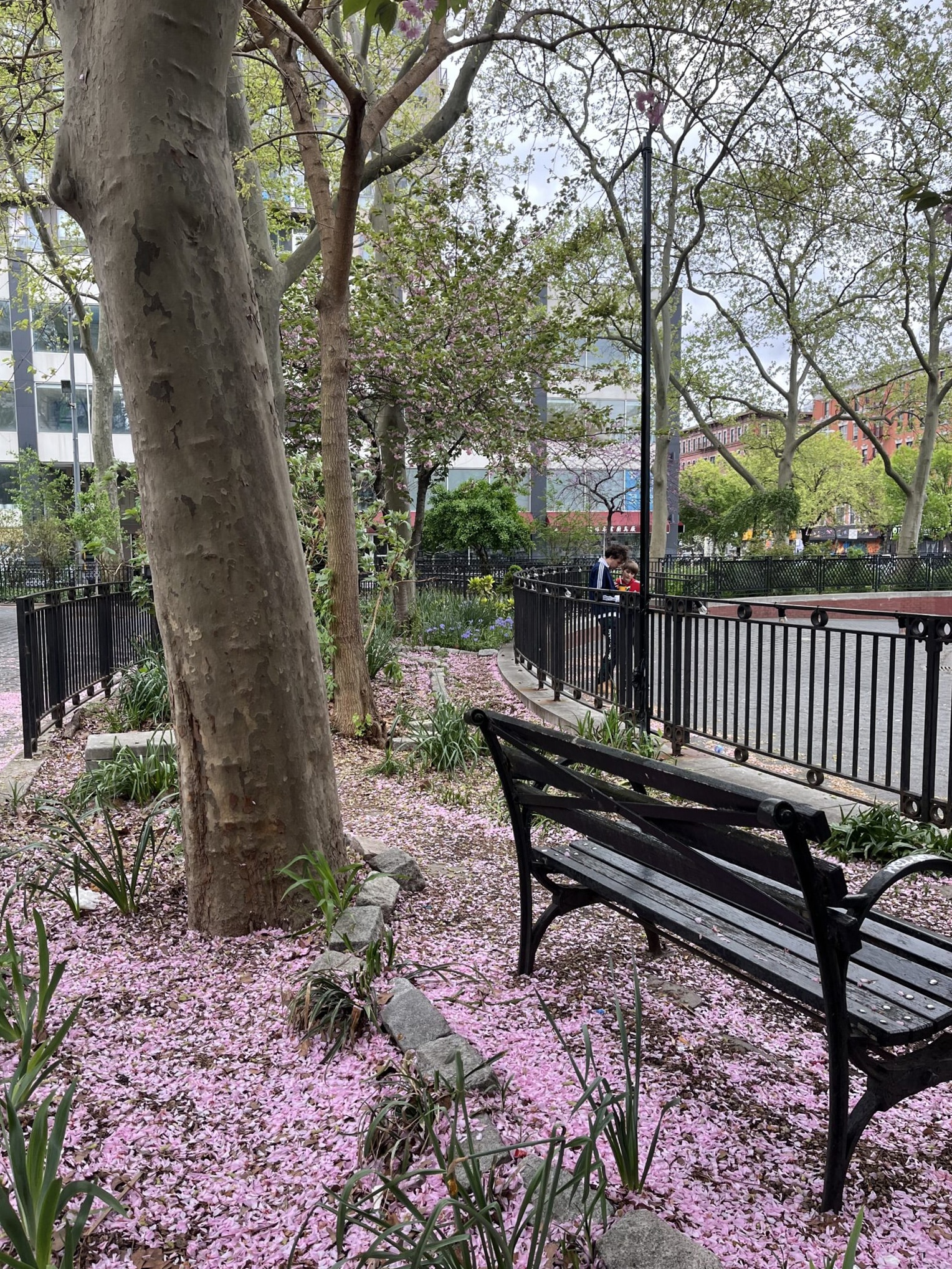
I was very lonely. I had imagined motherhood as a passage into intimacy: with one’s peers, with one’s family, with other mothers. But my pregnancy was hard. A pregnancy is about 40 weeks; I was sick for 38. When the baby came, I found it was just me, a hiccuping barnacle, and somewhere far away, everyone else. Then my barnacle and I discovered Sara Delano Roosevelt Park, or Sara Delano Roosevelt Park discovered us, and I saw that I hadn’t really lost anything. I was just a different person navigating the transformed spaces between me and everyone else. Maybe I didn’t recognize myself, but the Fujianese did, the aunties tagging along to sass me for forgetting the baby’s socks, or to grill me about his father’s ethnicity. Through their eyes, I finally perceived that it wasn’t just me anymore. It was the baby and me; it was “us.”
Sara Delano Roosevelt Park emerged as a place for me because I, in the park, had become a legible place for the Chinese, with my Chinese face and my Chinese-ish baby strapped to my chest. What were the textures of this new strange territory of me? Comfort? Nostalgia? The return to a place of recognition, of being cared for and caring unconditionally. The interwoven stories of family and community and home get scrambled the older we become, but a young mother is coherent, a beautiful land we don’t mind visiting. And what are the features of the baby? A native New Yorker. A biracial child who will be raised at the boundary between Chinatown and the Lower East Side. He started to wake to the world at six months, smiling at strangers, scritchy-scratching the scabbed trunks of trees, pulling at the growing shoots pushing through the beds in Sara Delano Roosevelt Park. I noticed his interest and instantly — albeit for the first time — memorized the names of our native species: common milkweed, red beak geranium, oxeye; the burly weeds of city spring.
Sara Delano Roosevelt Park emerged as a place for me because I, in the park, had become a legible place for the Chinese.
I began to see. I’d existed in New York like a block of tofu floating in a clear plastic bag. Now I was the first to ever experience the burdock, the plane tree, the paulownia bursting purple fire through a pavement crack. I was the singular genius who discovered and named the thistle flower on Stanton Street, ejecting lavender wisps into the air; I was the world’s expert on the marshmallow wedged into the fence near the Hester Street Playground. It hadn’t occurred to me that not just this park but its vegetation, its psychogeographic boundaries, its ethos have been designed and planned (even if its weeds have not).
Darkly now, I challenge my little brain to clutch the line of the present and tug at history, and reluctantly I start to intuit figures in the shadows, pencils scratching, policy. Parks weave their way into our lives, they guide our urban routines, our ability to be outdoors in something related to nature, to exercise, to meet, to set our children down. Especially in New York City, where apartments are small and gardens or terraces rare, and so many common spaces require spending money, drinking. A public city park is so essential that it feels violent to even suggest limited access. Parks are buffered and confined by streets and buildings, blocks and superblocks, towers, eyes on the street, public works, courthouses, shop fronts, fences, highways. I reel. Unrecognizable shapes and color patches. I am overwhelmed by questions. I am overwhelmed anticipating the baby’s questions. Our eyes adjust.
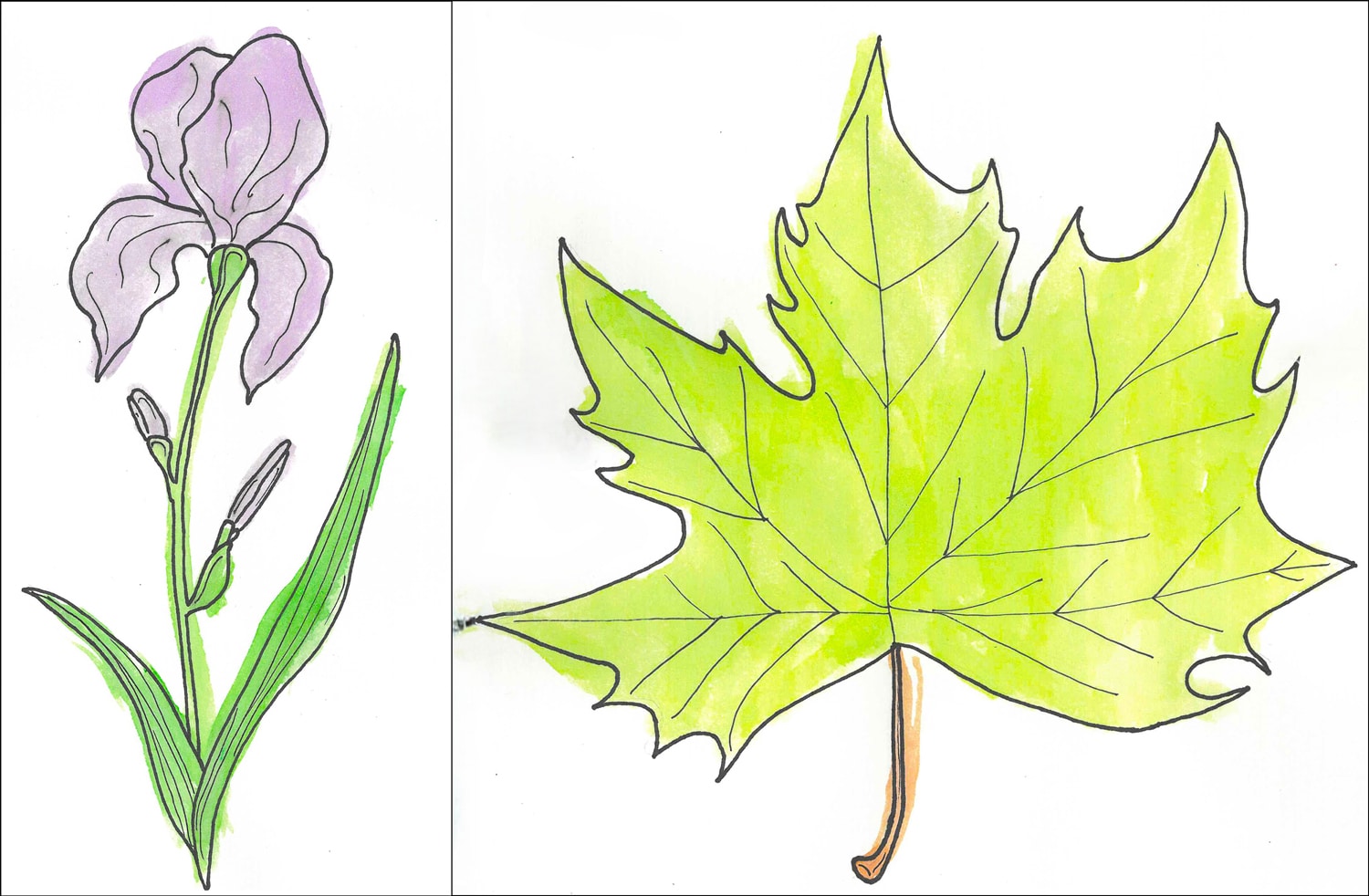
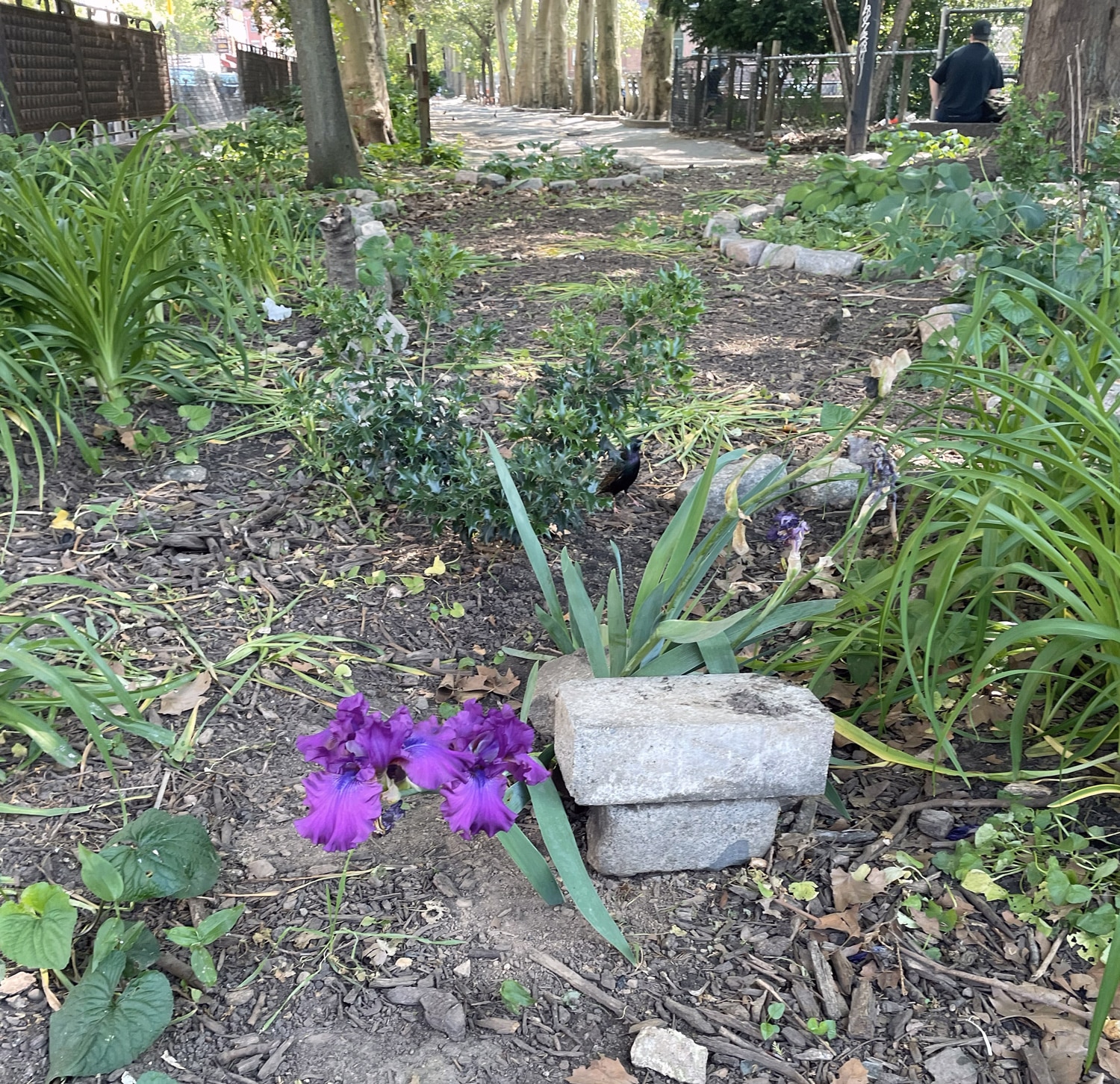
Why these sunken courtyards? Why this cyclone fencing? Why only men in this part of the park, and why are they so ill? Why the mulberry-stained pavement? Why this grid of plane trees? Why the random iris? How did the Fujianese get here, and why do they stay on the south side of Grand Street? Why had I rarely ventured north myself? What is Sara Delano Roosevelt Park?
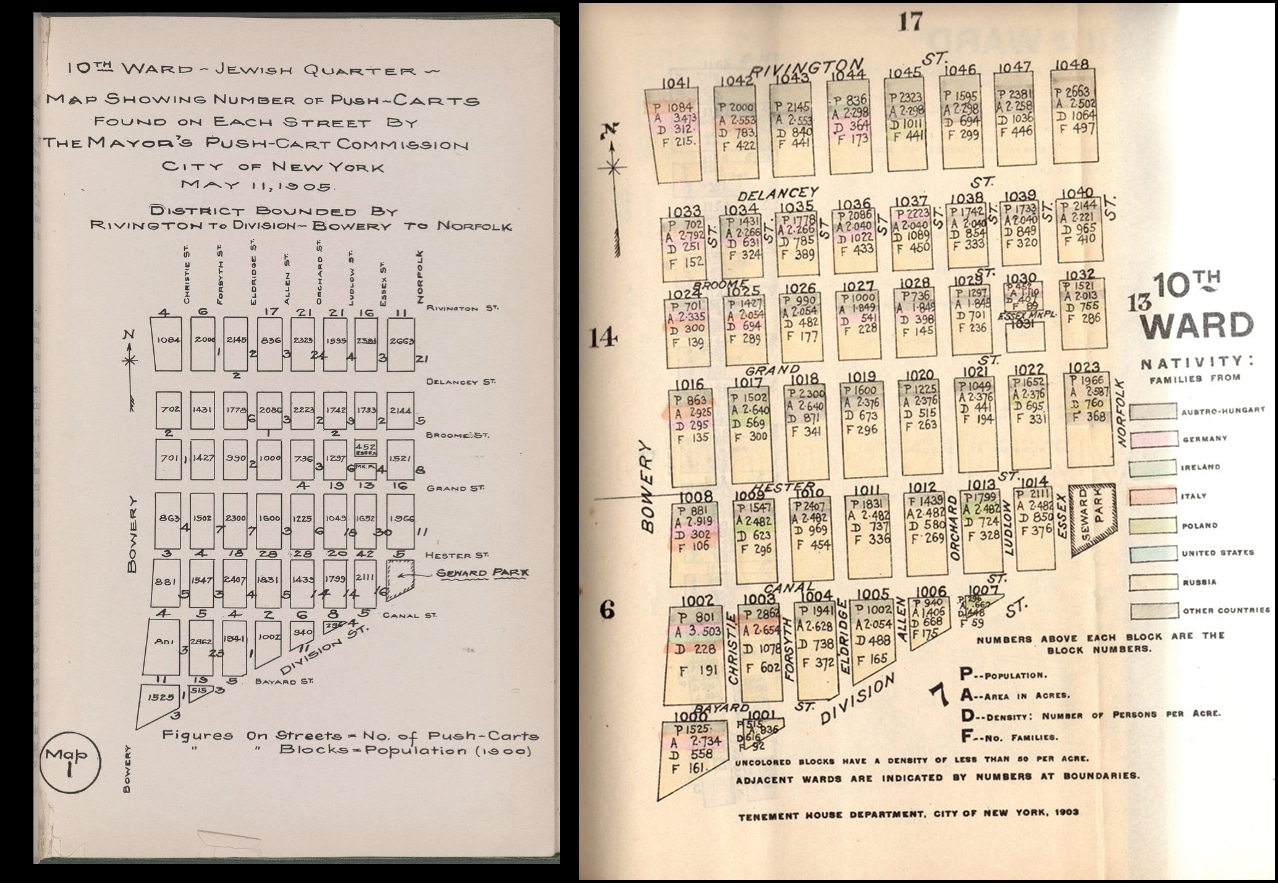
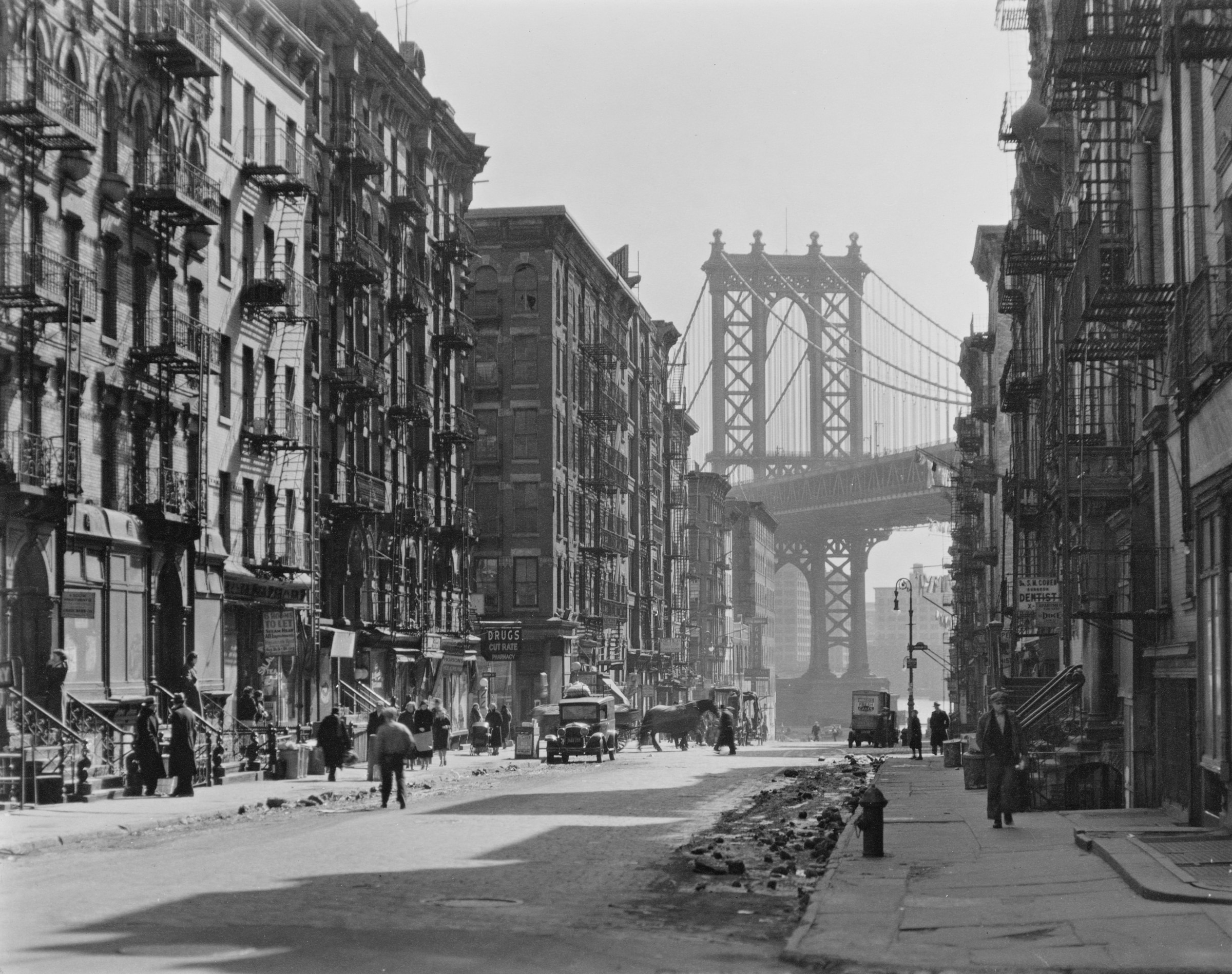
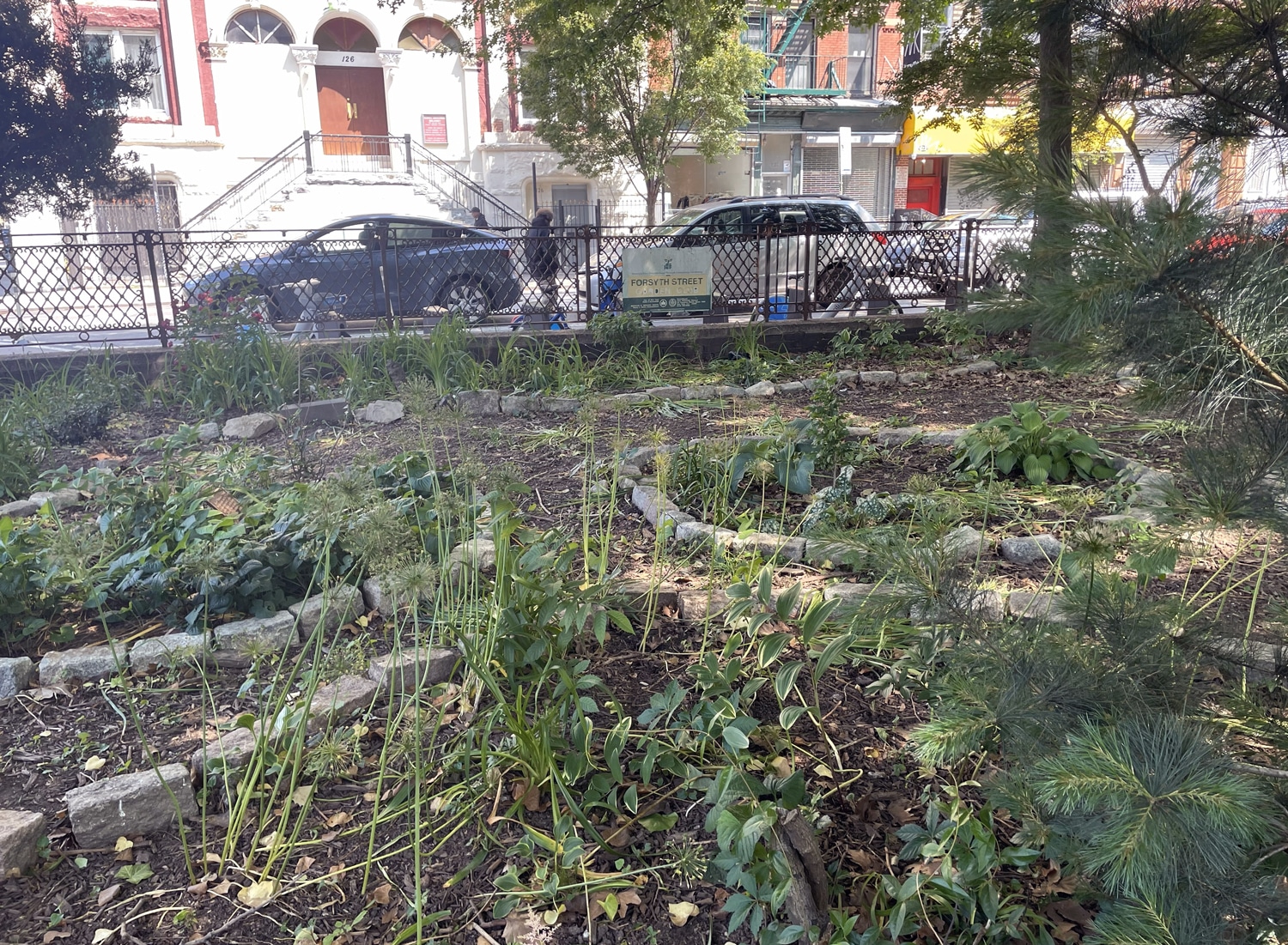
This park always was and continues to be a bureaucratic afterthought that flourishes in neglect, for better and for worse. Throughout the 19th century, the seven blocks between Chrystie and Forsyth Streets, comprising the present-day park, were packed corner-to-corner by 200 tenement buildings, built to accommodate the immense flow of immigrants: the Germans and Irish in the 1800s, followed by Italians, Eastern European Jews, Greeks, Ukrainians, Hungarians, Poles, Lithuanians, Albanians, among other nationalities. 7 (In 1885, at the age of sixteen, President Trump’s grandfather Friedrich immigrated from Kallstadt, and lived and worked as a barber at 76 Forsyth Street. 8 ) By 1900, the southern end of this plot of land, from Division to Rivington Streets, was known as the Jewish Quarter, a district with more than 700 people per acre, with individual blocks reaching more than 1,000 people per acre. This made it one of the most crowded places on earth at that time, its densest zones exceeding the most populous parts of Bombay. 9
Throughout the 19th century, the seven blocks comprising the present day park were packed corner-to-corner by 200 tenement buildings.
The tenement apartments doubled as garment workshops. With little oversight by the city, the buildings and the narrow passageways between them grew vibrant and genial, but also dangerous and exploitative in the usual modern ways: bad plumbing, no sunlight, no air; fire, tuberculosis. 10 Progressive Era organizations agitated for improvement and, in 1901, the New York State legislature passed the Tenement House Act, which banned construction of what came to be known as Old Law tenements, and set minimum standards for quality of life in such housing stock. 11 The reformers hoped that these rules would thin out the slums. But Old Law apartments remained the most affordable option for the poor, and landlords still managed to pack tenants into them. The buildings were still grimy, dark, and dangerous. At last, the 1924 federal Johnson-Reed Act throttled immigration and the tenements were slowly hollowed out. Eventually, the prevailing ideology was that the best way to fix the tenements was to raze them.
By the early 1900s, Henry Ford’s assembly line put millions of drivers into Model Ts. New York rose to the occasion, becoming (in the same year that the Tenement House Act was passed) the first state to require residents to register their motor vehicles, and undertaking the building of the Bronx River Parkway. The BRP was the first modern motor-vehicle highway in the world — a genuine controlled-access, grade-separated super-street on which no humans were allowed. 12 In New York City (and around the country), streets designed for horses and buggies were widened and smoothed.
In 1927, the world’s first mechanically ventilated vehicular tunnel was completed under the Hudson River. It was called Holland, after its chief engineer Clifford Milburn Holland. (He had made a career of digging, directing construction of the East River subway tunnels that take their names from termini at Clark Street and Montague Street in Brooklyn, and at 60th Street in Manhattan. But the stress of the Hudson River project was immense; the engineer suffered a nervous breakdown and died of a heart attack just two days before digging crews on opposite ends of the tunnel broke through to each other. 13 )
The same year the Holland Tunnel was completed, the city approved a plan to widen Chrystie Street from 50 to 100 feet, and Forsyth from 50 to 75, requiring the demolition of the seven blocks of tenements between. The plan did some handwaving in the direction of putting up model tenements in place of the old firetraps, and the Old Law buildings were demolished in December 1930, displacing up to 4,000 residents. Then, those in charge built nothing to replace them. 14 The country was in the claws of the Great Depression. The city abandoned the land to be roamed by hundreds of itinerant men. “Favored by a kindly landlord who never molests them with calls for rent payments, they gather nightly, singly and in groups of half a dozen or more, all along the bare stretch from Canal to East Houston Streets,” the Times reported in September 1931. “They fall asleep with cinders for a couch, a blue or gray sky for a canopy, and the rattle of the elevated in their ears.” 15
The Old Law tenements were demolished in 1930, displacing up to 4,000 residents. Then, those in charge built nothing to replace them.
It took me six naptimes and ~four post-bedtimes to discover, from the archive of the New York Times on my laptop, whether the proposed street widening ever happened. Many, many newspaper clips from the post-demolition era denounced the failure of the city to rebuild the demolished housing. Seven proposals were made between 1930 and 1933; all failed. None mentioned the street widening. I thought that if it had failed, too, then the chaos of the park during this period would be just a story about general governmental incompetence, rather than purposeful neglect. Finally I was saved from having to buy a longer tape measure by a single sentence from 1933, which noted, plainly and in retrospect, that “Chrystie and Forsyth Streets already have been widened and paved with asphalt.” 16 Thousands of poor people and their homes, in other words, were traded for car-ready streets during the worst financial crisis in the country’s history, and this was so unremarkable that it wasn’t reported as news.
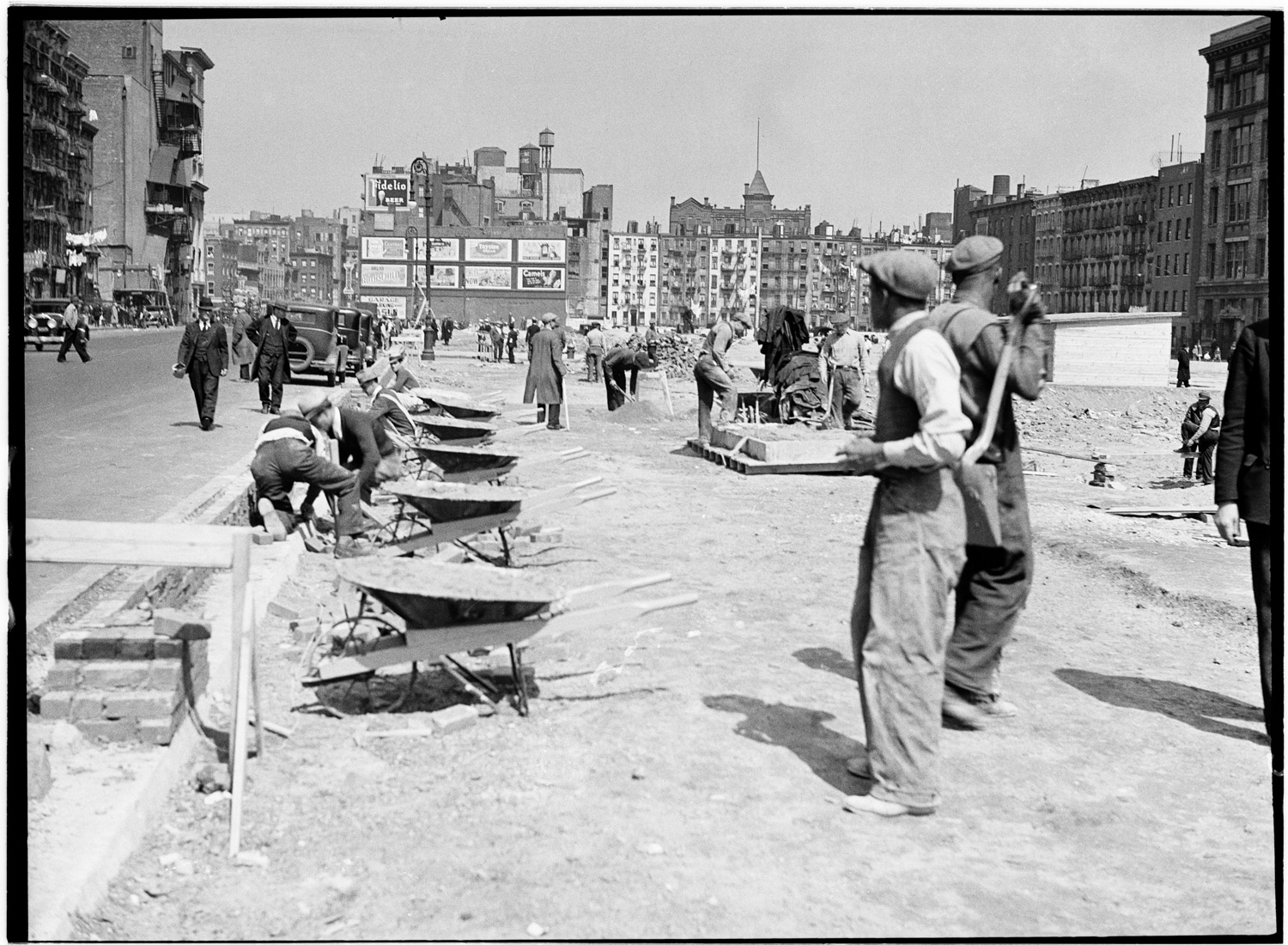
When Fiorella LaGuardia became mayor in 1934, he scuttled the housing schemes once and for all.17 Instead, he charged his new parks commissioner, Robert Moses, with using New Deal money to construct a park in the strip of rubble between Christie and Forsyth. This was to be one of the most significant projects in Moses’s whirlwind first 100 days of building. 18 The plan emphasized “playgrounds and resting places for mothers and children” as if making good on beliefs inherited from Progressive Era improvers that physical surrounds determine the quality of social life. 19
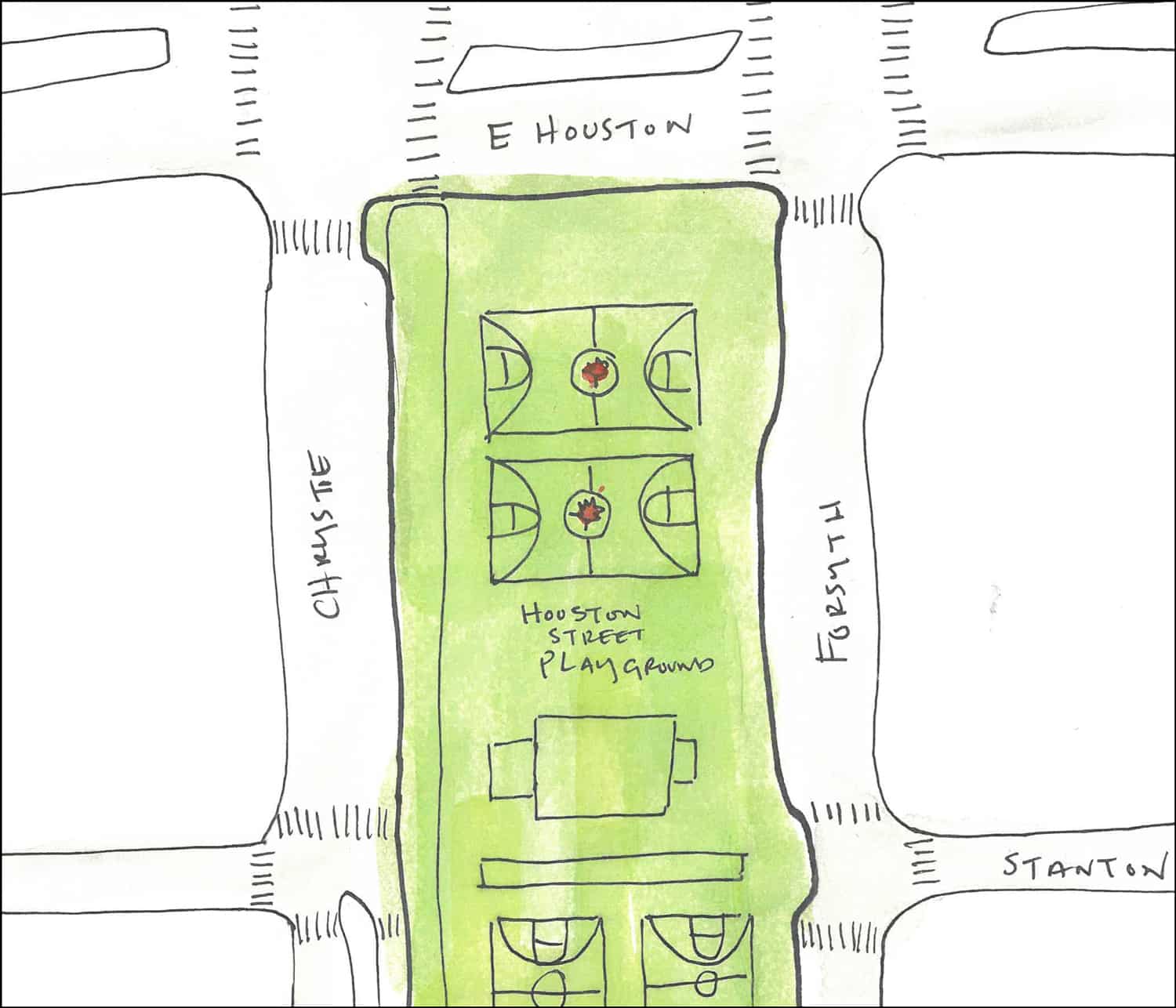
But the heart of the project was about politics and power. The Commissioner employed a design for seven distinct areas in four quadrants stacked south to north, closing Stanton, Rivington, Broome, and Hester Streets to traffic; Grand and Delancey Streets remained for cars cutting through the park. 20 Moses and his designers laid out wading pools, a roller-skating rink, and gender-separated playgrounds. Around the perimeter, benches were installed beneath shade trees, so mothers like me could watch their children from the shadows. It was the largest set of playgrounds in the city, and a badly needed public amenity for the immigrants of the Lower East Side. 21 (It is still, in fact, the closest public lawn, astroturf though it may be, where the baby and I can stretch out.) The park’s opening ceremony featured a cannon salute and a performance by the Parks Department Orchestra. Sara Roosevelt herself, FDR’s formidable mother, reportedly gave a speech, despite the fact that she didn’t want the honor, even writing to the Times in protest. 22 According to Moses’s biographer Robert Caro, LaGuardia had suggested the name as a way to “cultivate the president.” 23
Moses compared Sara Delano Roosevelt Park to the Rue de Rivoli in Paris — and why not? 24 I suppose the London plane trees, planted from Canal to Houston, can recall the Tuileries elms. The park’s lead architect, Gilmore Clarke, had also supervised construction, a decade earlier, for the epoch-making Bronx River Parkway, and he believed that paved roads should be woven into the natural landscape, offering pastoral views for drivers. 25 Ironic, then, that he was deputized to design a park woven into the city grid.
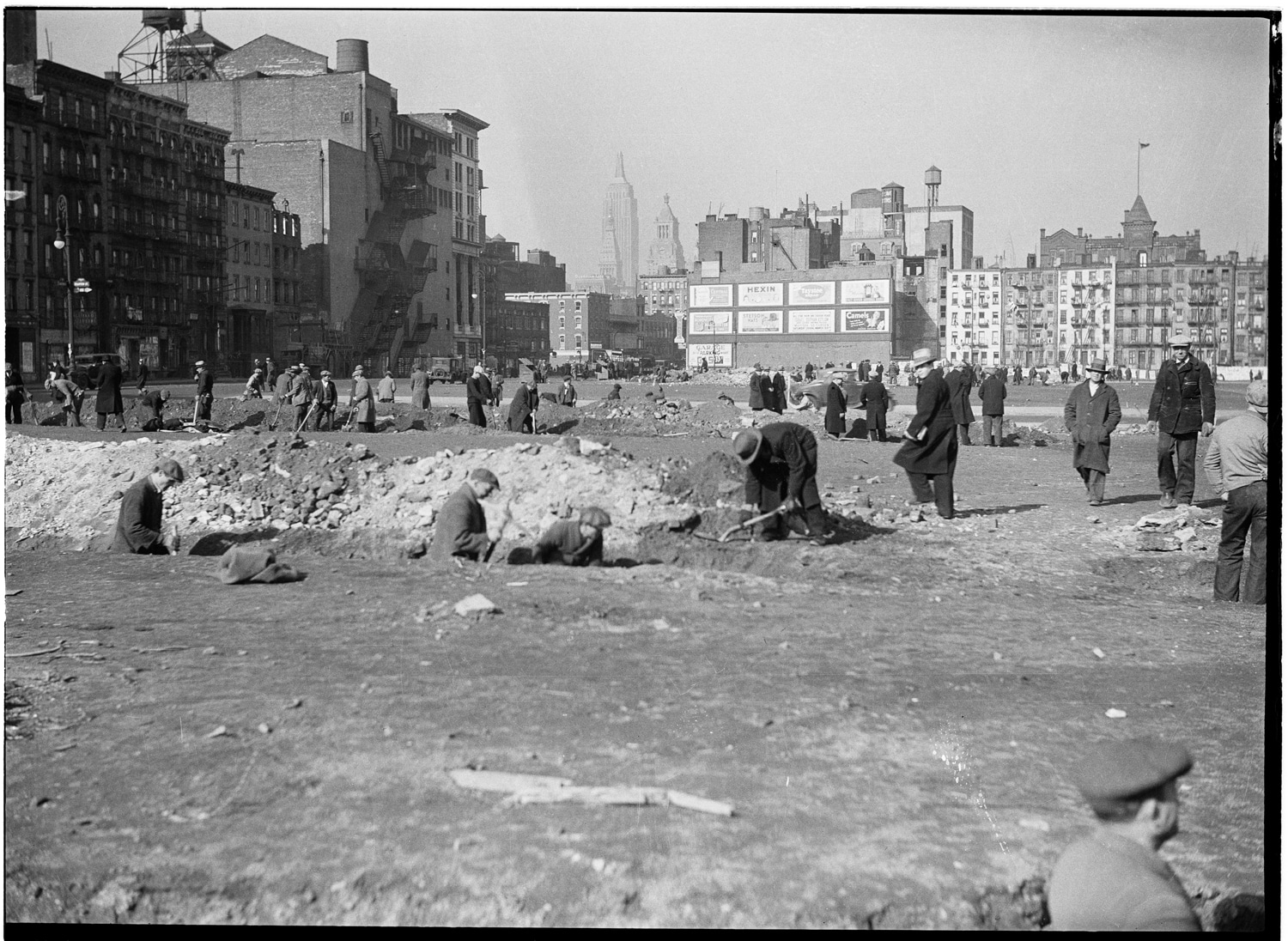
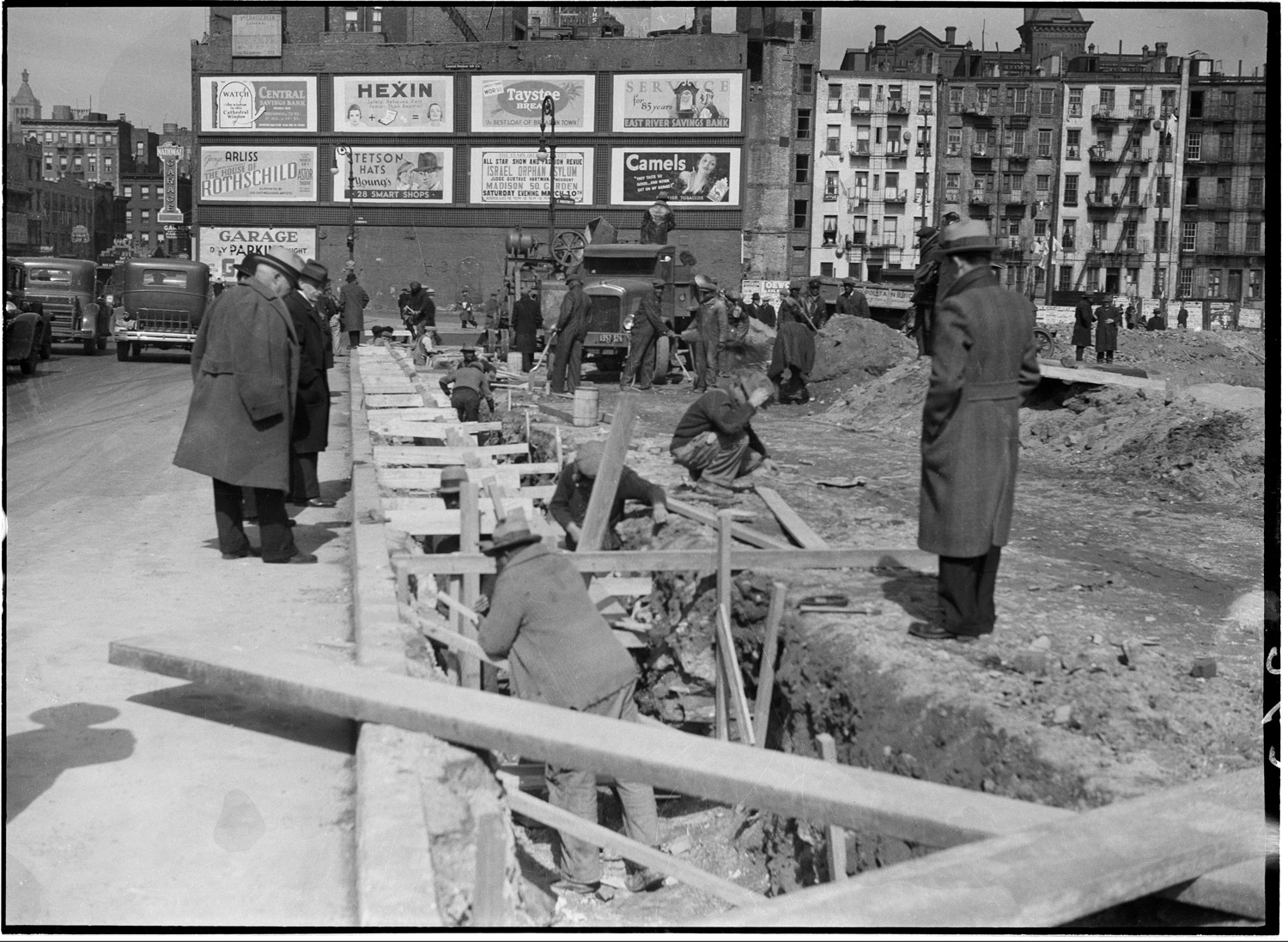
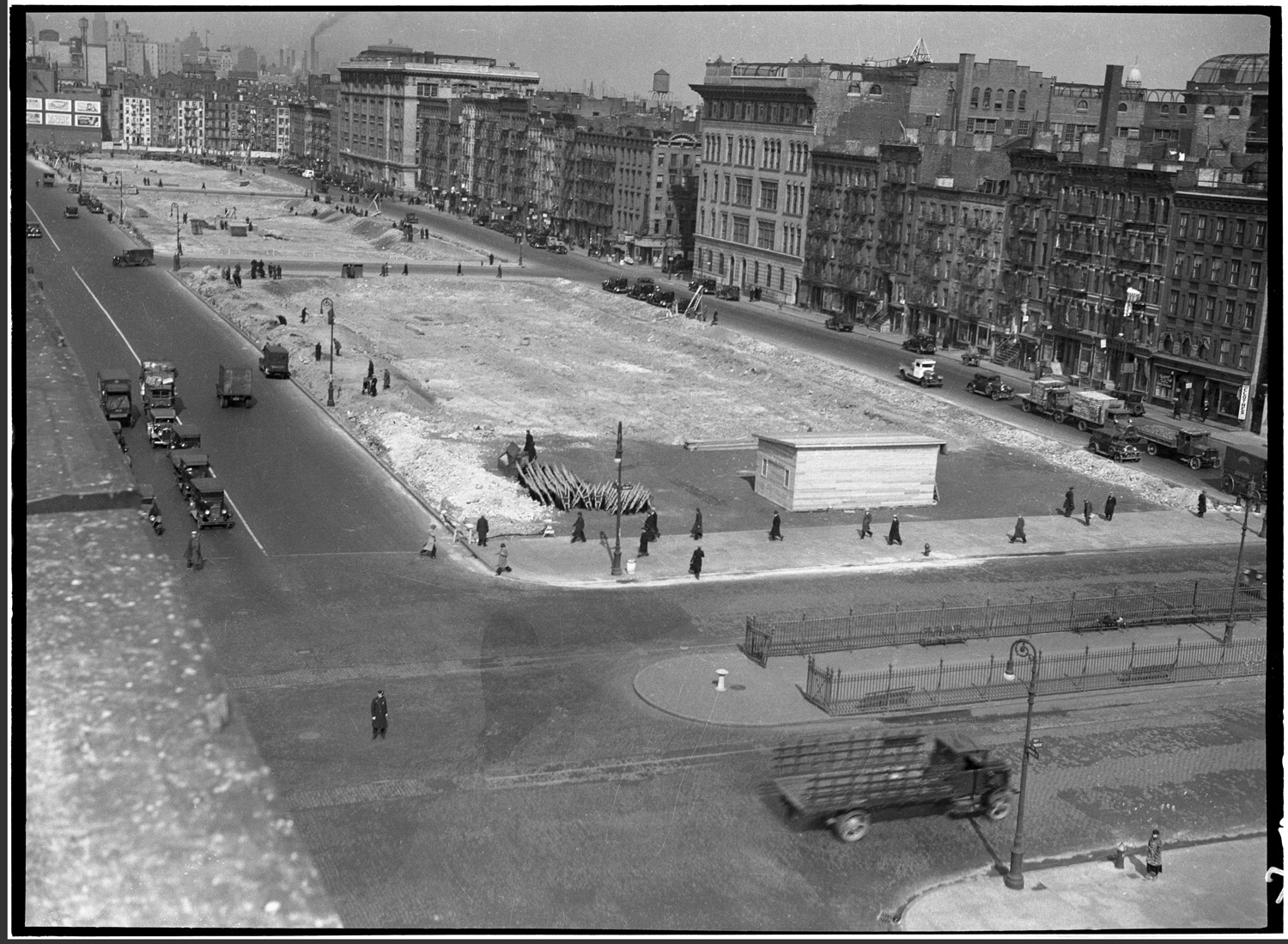
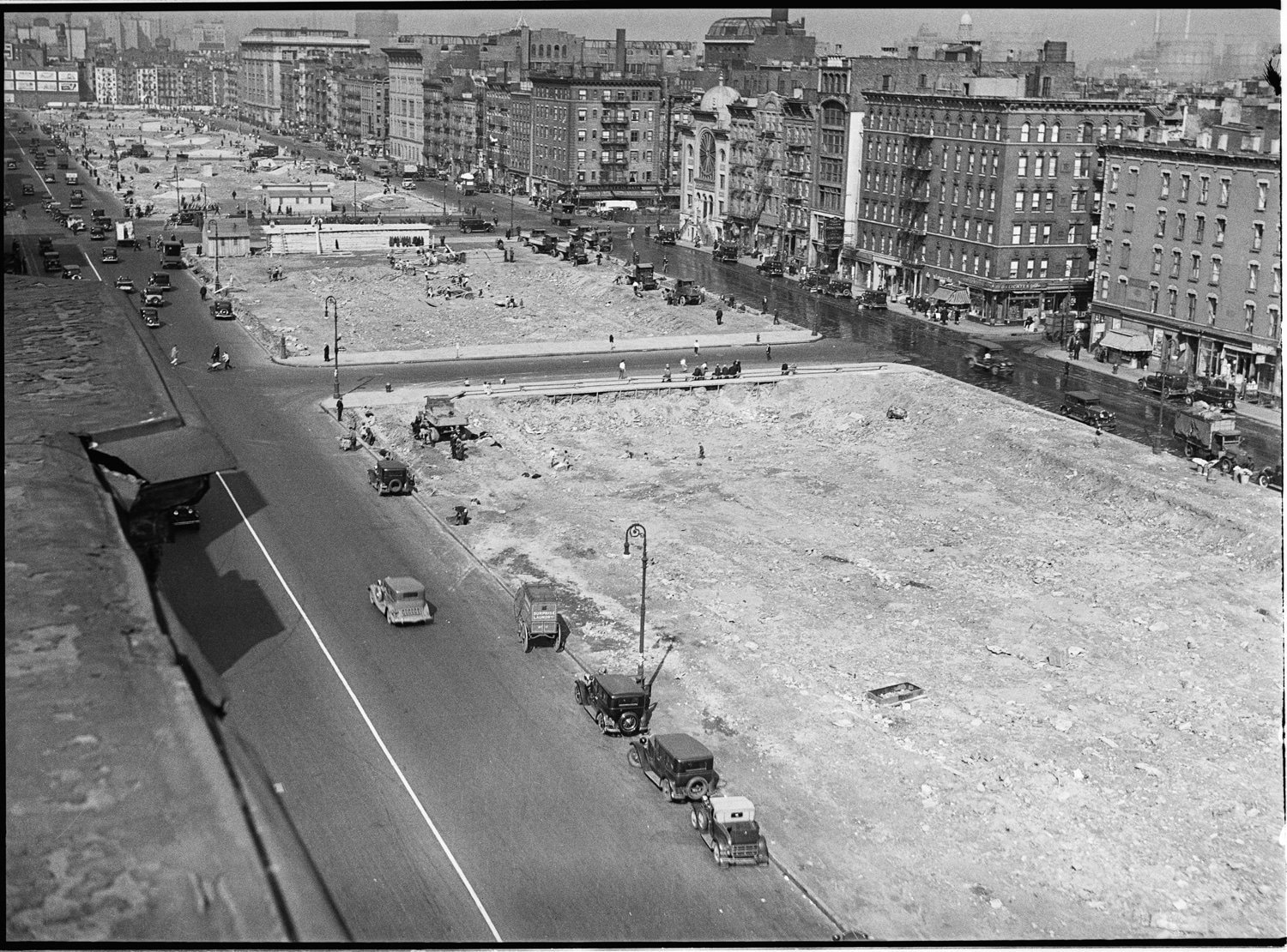
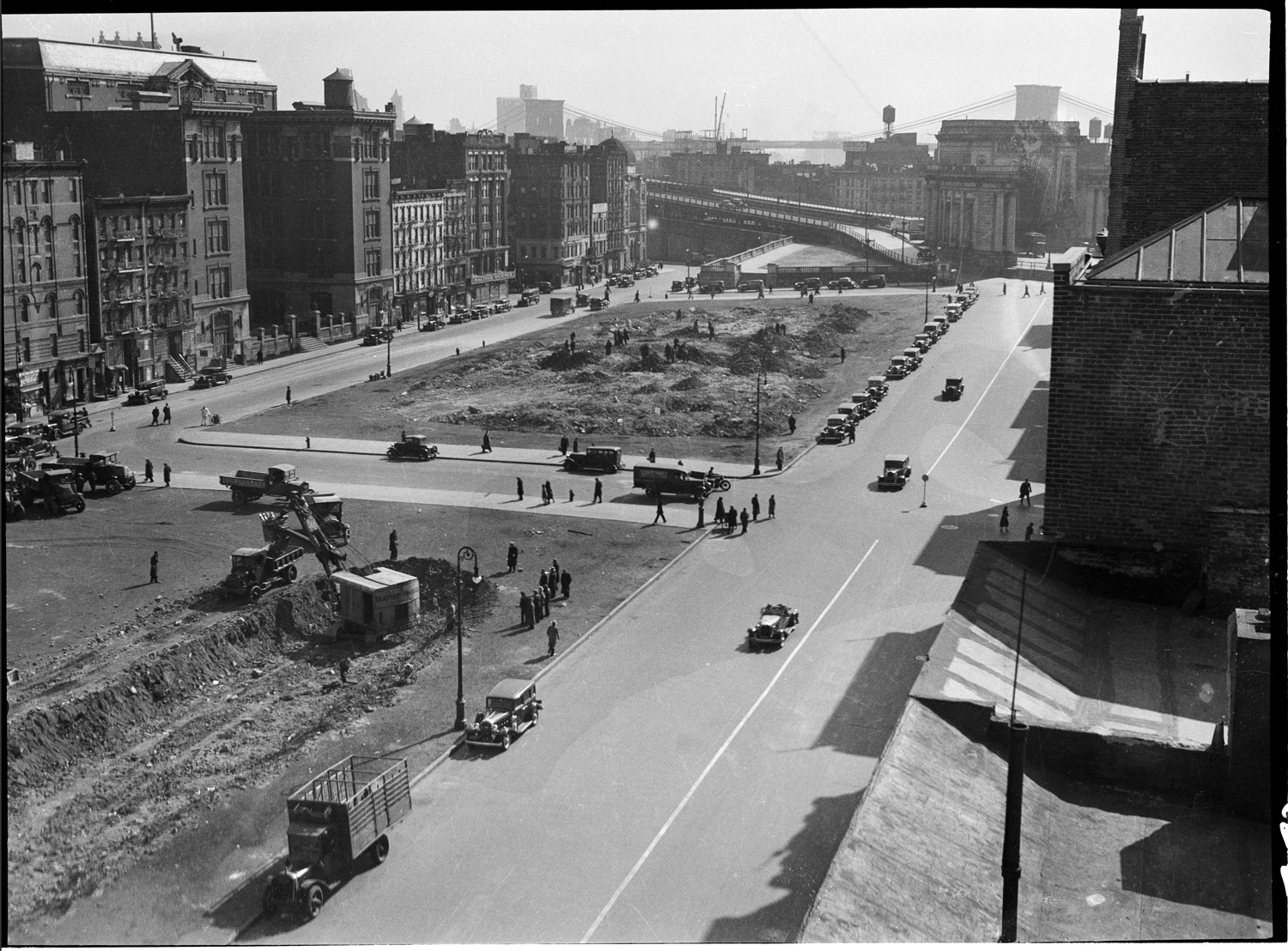
New York Parks Department photograph of Sara Delano Roosevelt Park under construction: men at work between Houston and Stanton Streets, March 1934. [NYC Department of Records and Information Services]

New York Parks Department photograph of Sara Delano Roosevelt Park under construction: building the wall on the west side, Stanton Street to Rivington Street, April 1934. [NYC Department of Records and Information Services]
New York Parks Department photograph of Sara Delano Roosevelt Park under construction, March 1934. [NYC Department of Records and Information Services]
New York Parks Department photograph of Sara Delano Roosevelt Park under construction, March 1934. [NYC Department of Records and Information Services]
New York Parks Department photograph of Sara Delano Roosevelt Park under construction: looking north from Broome Street, April 1934. [NYC Department of Records and Information Services]
New York Parks Department photograph of Sara Delano Roosevelt Park under construction, March 1934. [NYC Department of Records and Information Services]
New York Parks Department photograph of Sara Delano Roosevelt Park under construction, looking south from Delancey Street to Broome Street, July 1934. [NYC Department of Records and Information Services]
New York Parks Department photograph of Sara Delano Roosevelt Park under construction, March 1934. [NYC Department of Records and Information Services]
New York Parks Department photograph of Sara Delano Roosevelt Park under construction: planting area, west side from Rivington Street to Delancey Street, June 1934. [NYC Department of Records and Information Services]
New York Parks Department photograph of Sara Delano Roosevelt Park under construction: planting area, west side from Stanton Street to Houston Street, June 1934. [NYC Department of Records and Information Services]
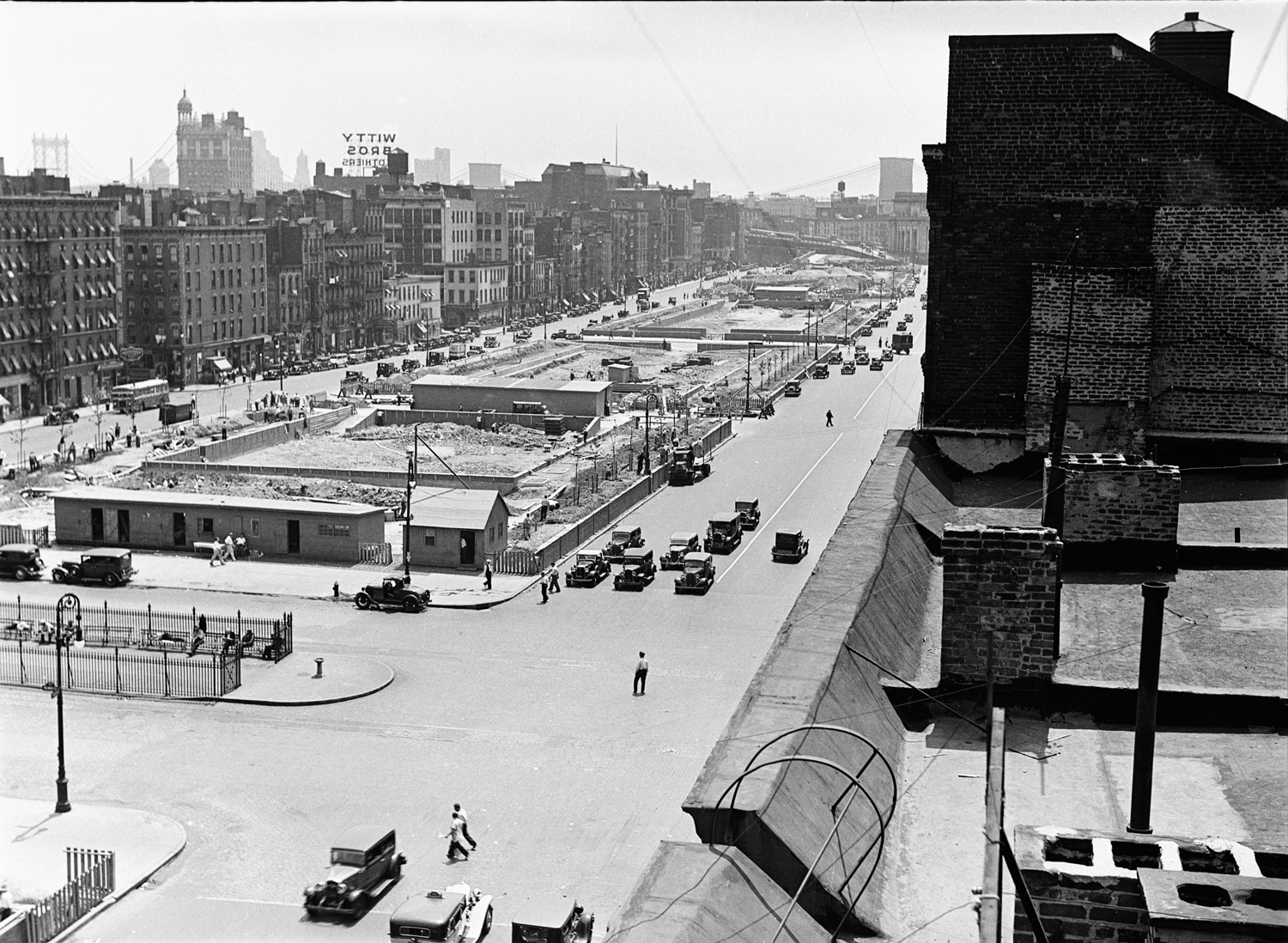
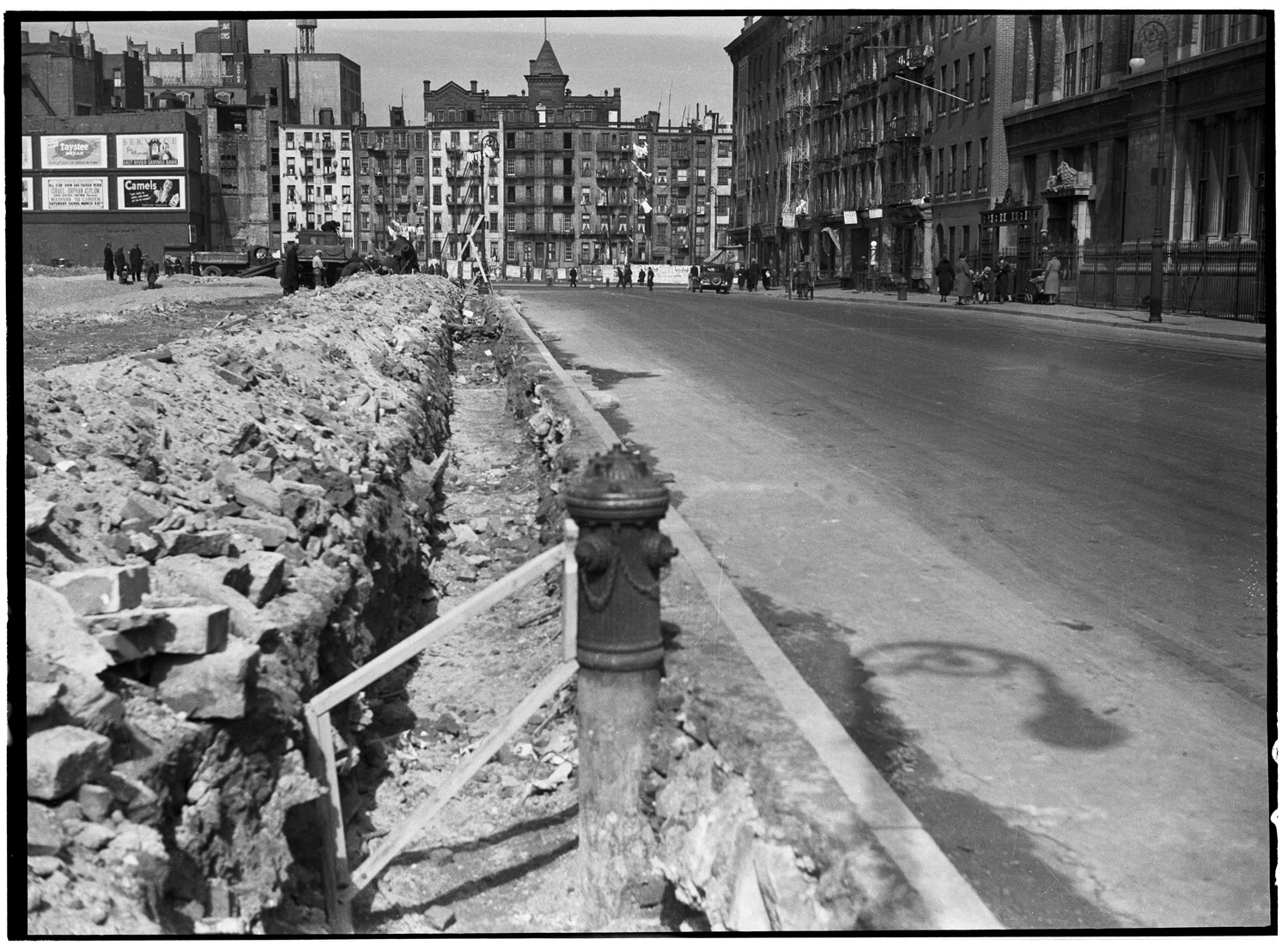
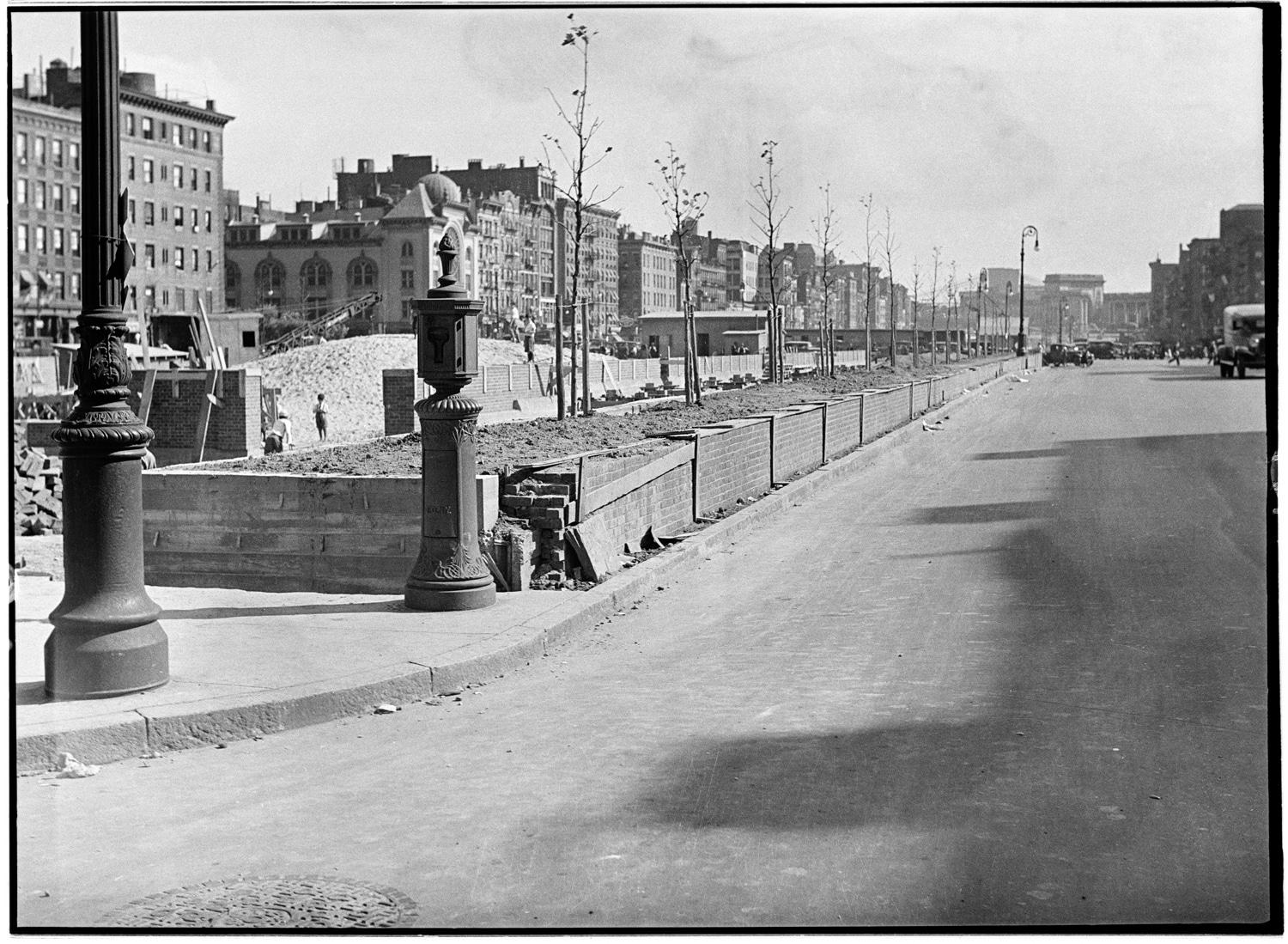
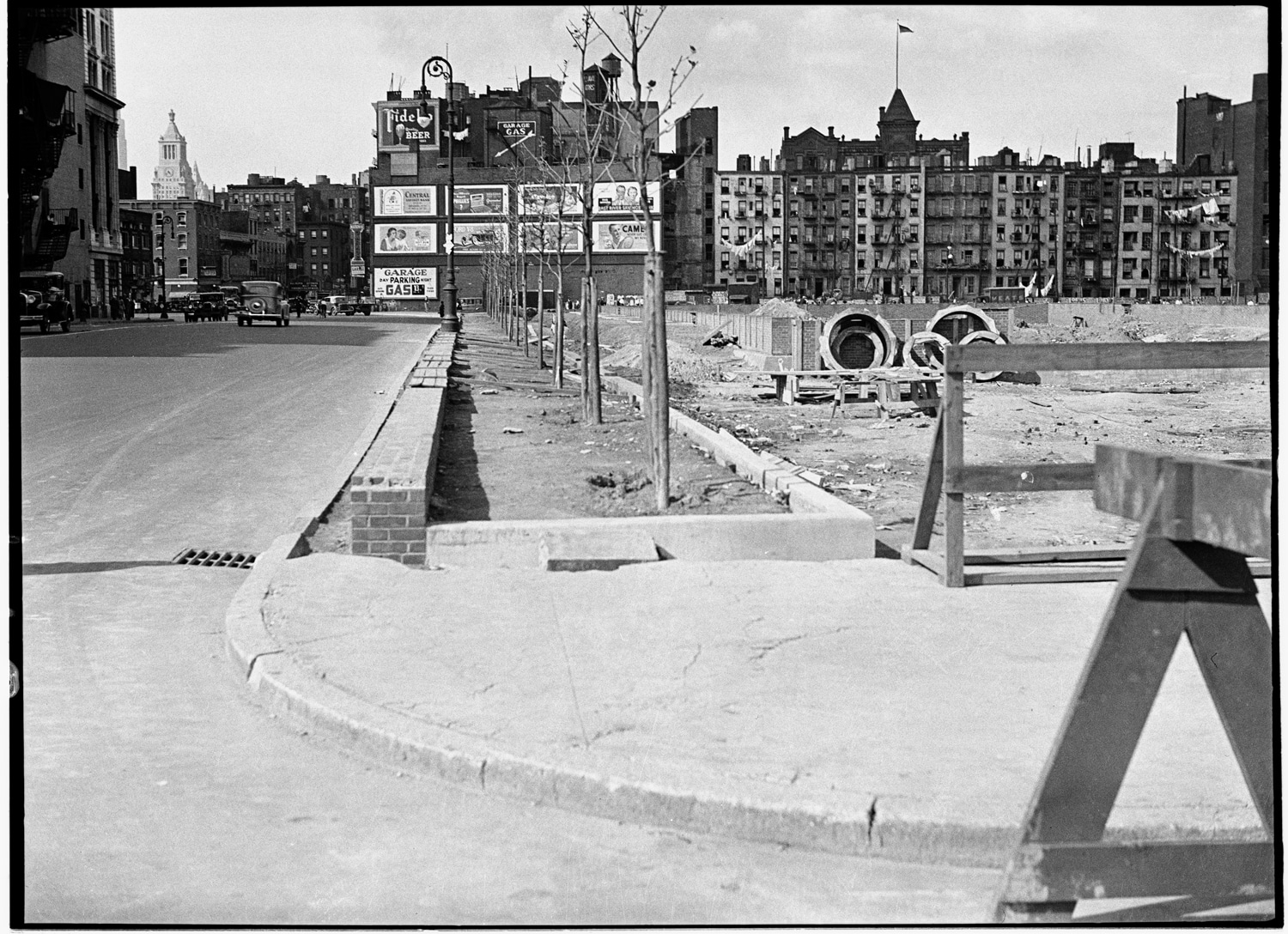
That car-centric paradigm reaches to the present day. Forsyth and Chrystie Streets have endured as essential corridors south toward the Manhattan Bridge. Delancey Street’s eight lanes of traffic bisect the park and funnel cars to the Williamsburg Bridge. Parallel to Delancey, Canal, Grand, and East Houston Streets are major east-west arteries across lower Manhattan. The motorists, in their carapaces, may hardly know they are passing through Sara Delano Roosevelt Park.
As Jane Jacobs was already pointing out in 1961, ‘the vicious Sara Delano Roosevelt park gets a lot of bums.’
Additional forms of neglect took hold during the 1960s, as the Lower East Side, along with much of the rest of the city, slid toward disorder. The relocation of industry and the construction of large housing projects displaced more residents and gutted more neighborhood economies. The same streets that had been widened to ease automobile access into the city carried the middle classes out to suburbs. Sara Delano Roosevelt Park became ill. Already in 1961, as Jane Jacobs pointed out, “the vicious Sara Delano Roosevelt park gets a lot of bums.” 26 She took a dim view of the park’s quadrangles, describing them as “four identical recreation barracks …. die-stamped design for die-stamped functions.” “What can users make of this?” she asked in The Death and Life of Great American Cities. “The more they move back and forth, the more they are in the same place. It is like a trudge on a treadmill.” The Depression-era mothers and children were gone. The plane trees were still there, growing a little taller and a little fuller with each passing year. The cars were streaming north and south on either side|| as well as east and west down East Houston, Grand, Delancey, and Canal ᆖ . Yet, as Jacobs noted: “You can neither lie to a neighborhood park, nor reason with it.” 27 The tenure of the unhoused men in the rubble continued into the postwar years. 28
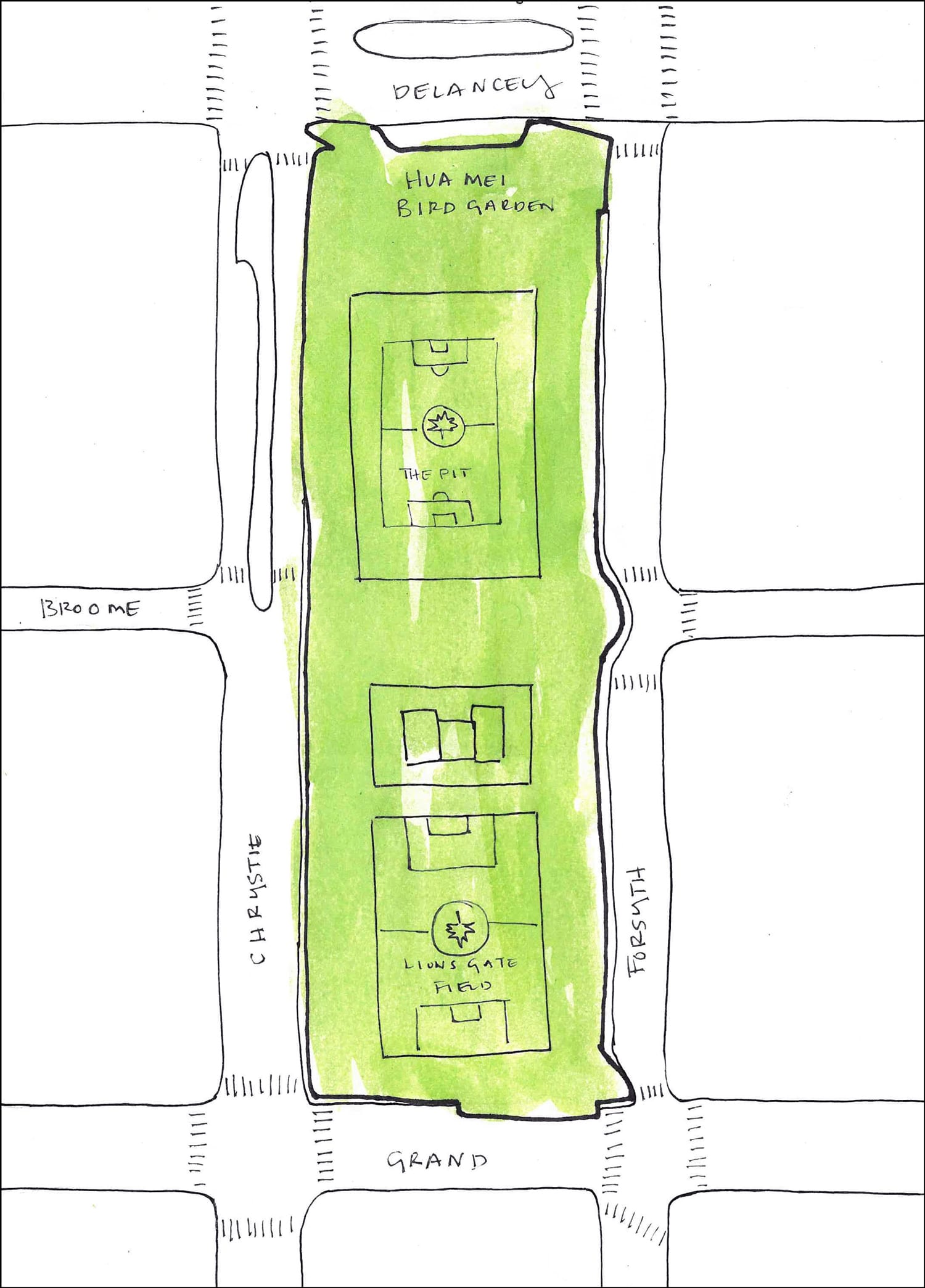
This un-lied-to park remains today. Its “vicious” aspect has been mostly shooed out of the south end by the Fujianese, the damas and the gamblers. The quadrant north of Grand Street and south of Delancey is now the place for rough sleepers and illegal drug use. It is known as Lion’s Gate, and life there is chancy: during the three months I was reporting this piece, one assault and seven counts of grand larceny were tallied, the third-highest number of high-value thefts in this period in the city (after Washington Square Park, which also struggles with crime, and Flushing Meadows Corona Park, which comprises nearly 900 acres). These, moreover, are instances only of the seven major felonies the city is required to report.
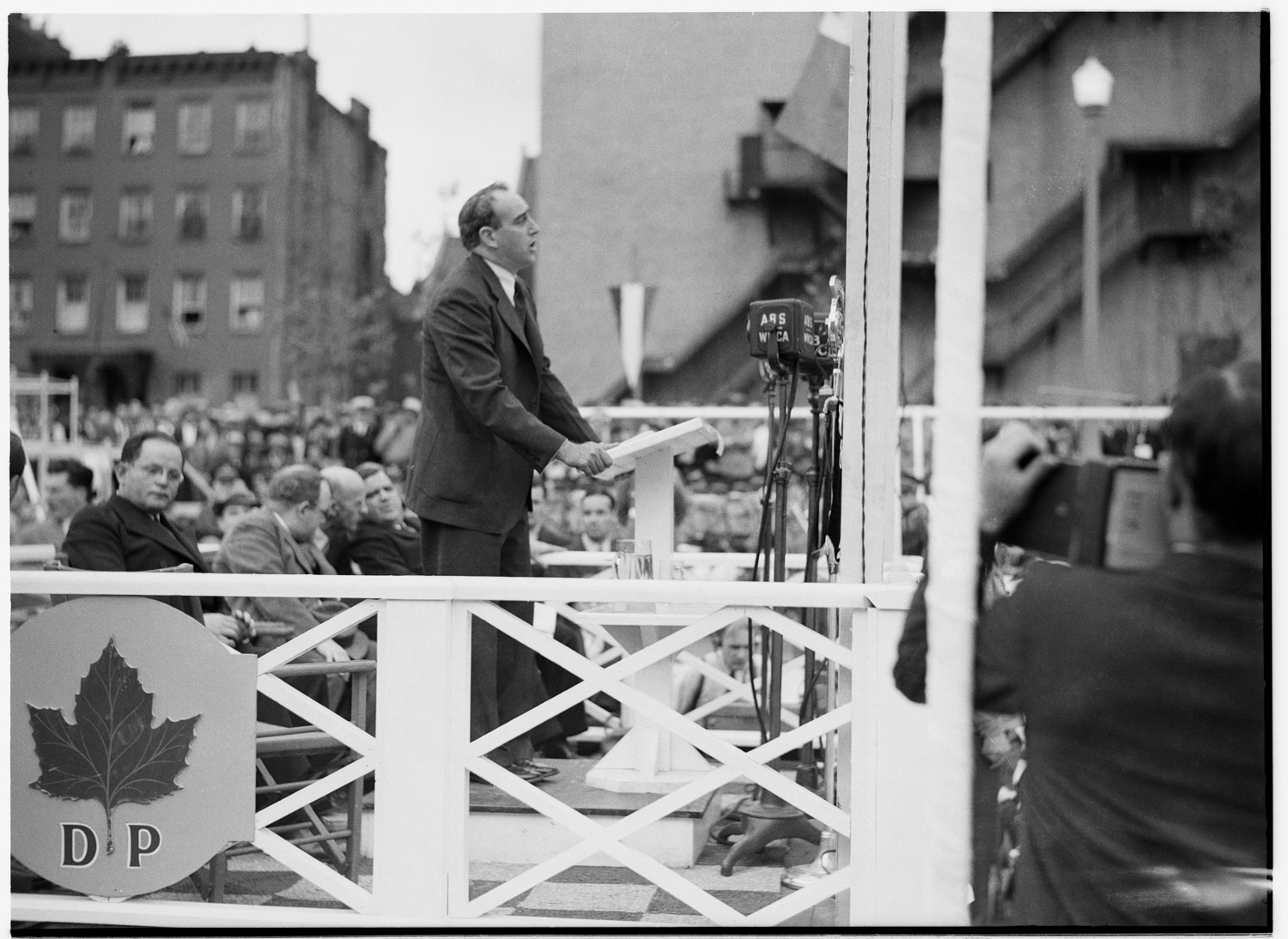
New York Parks Department photograph of Sara Delano Roosevelt Park playground dedication, with City Parks Commissioner Robert Moses at the microphone, September 1934. [NYC Department of Records and Information Services]
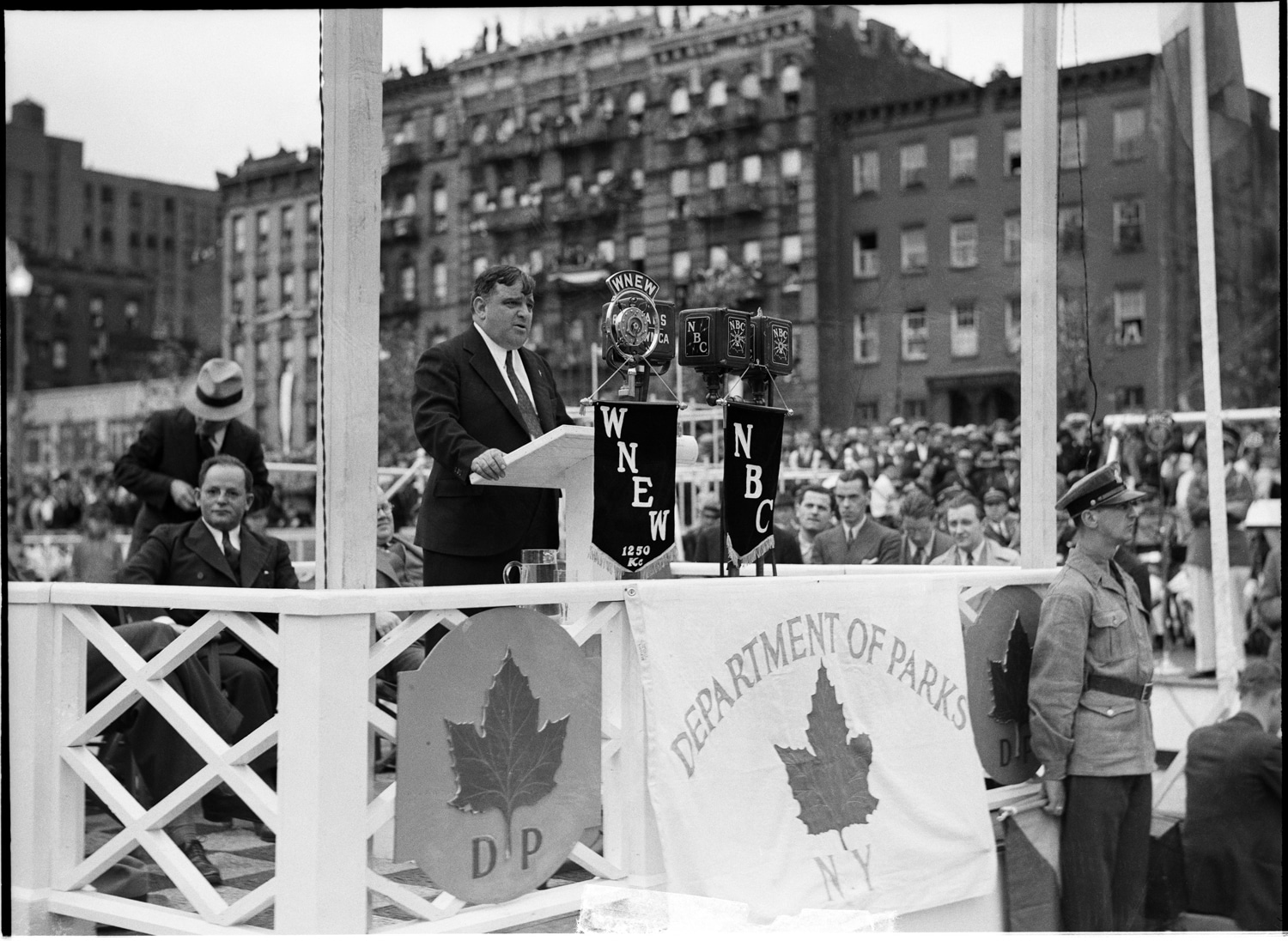
New York Parks Department photograph of Sara Delano Roosevelt Park playground dedication, with Mayor Fiorello LaGuardia at the microphone, September 1934. [NYC Department of Records and Information Services]
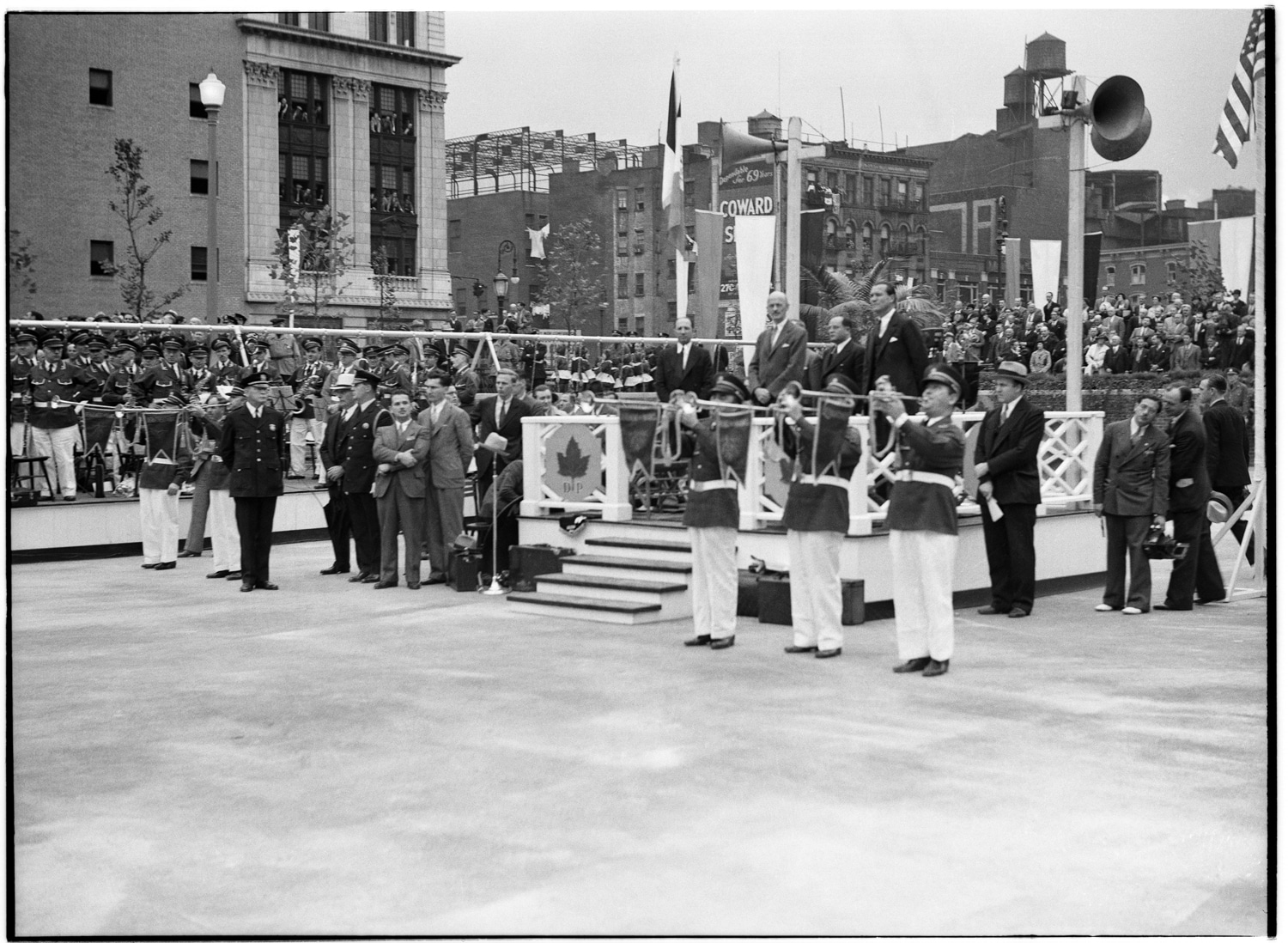
New York Parks Department photograph of Sara Delano Roosevelt Park: playground dedication with bugle corps, September 1934. [NYC Department of Records and Information Services]
New York Parks Department photograph of Sara Delano Roosevelt Park: playground dedication with view of wading pool, September 1934. [NYC Department of Records and Information Services]
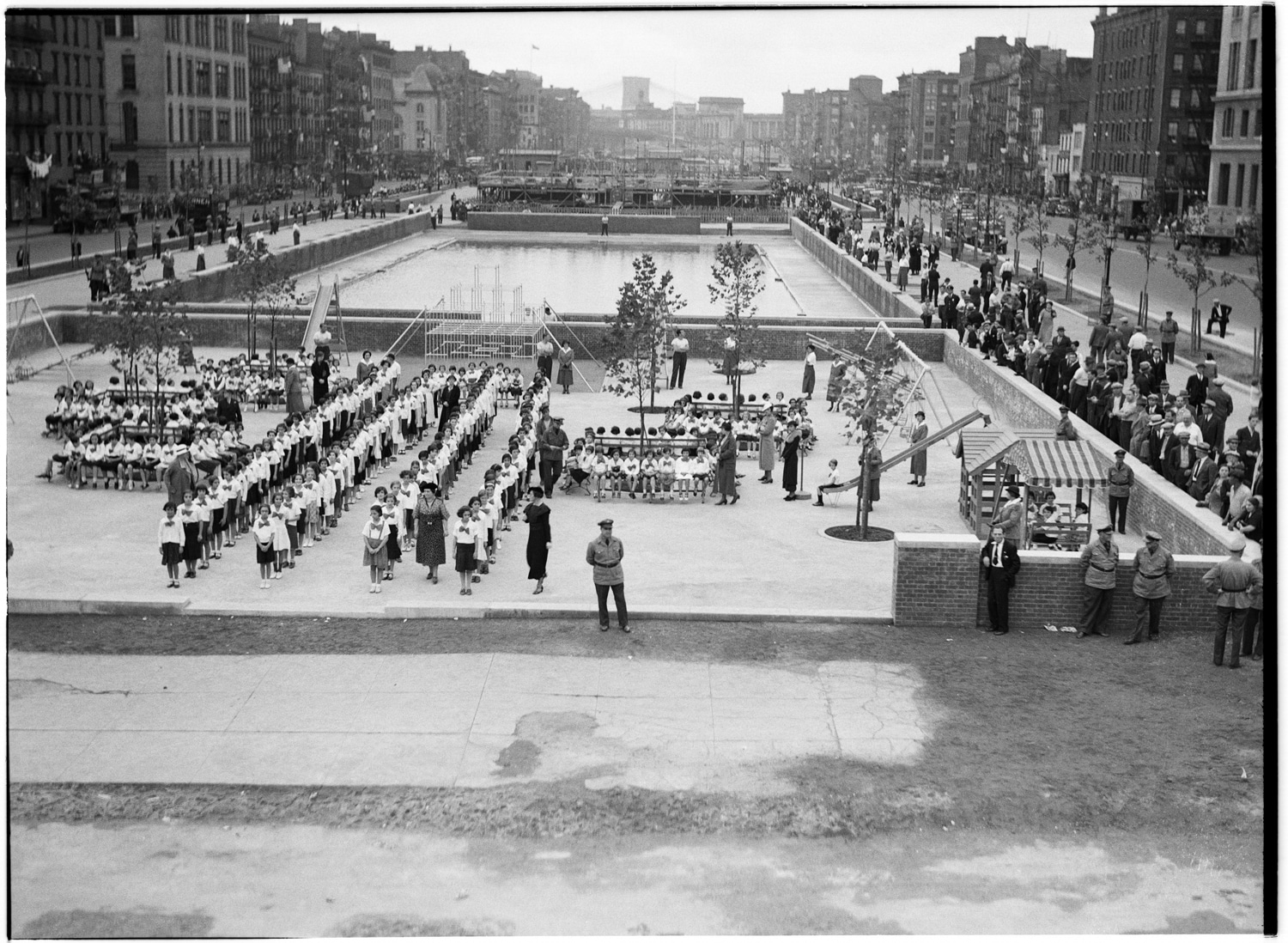
New York Parks Department photograph of Sara Delano Roosevelt Park playground dedication: children at attention, September 1934. [NYC Department of Records and Information Services]
New York Parks Department photograph of Sara Delano Roosevelt Park: boys' softball pitch, May 1935. [NYC Department of Records and Information Services]
New York Parks Department photograph of Sara Delano Roosevelt Park: girls' softball team, May 1935. [NYC Department of Records and Information Services]
New York Parks Department photograph of Sara Delano Roosevelt Park: girls' softball team, May 1935. [NYC Department of Records and Information Services]
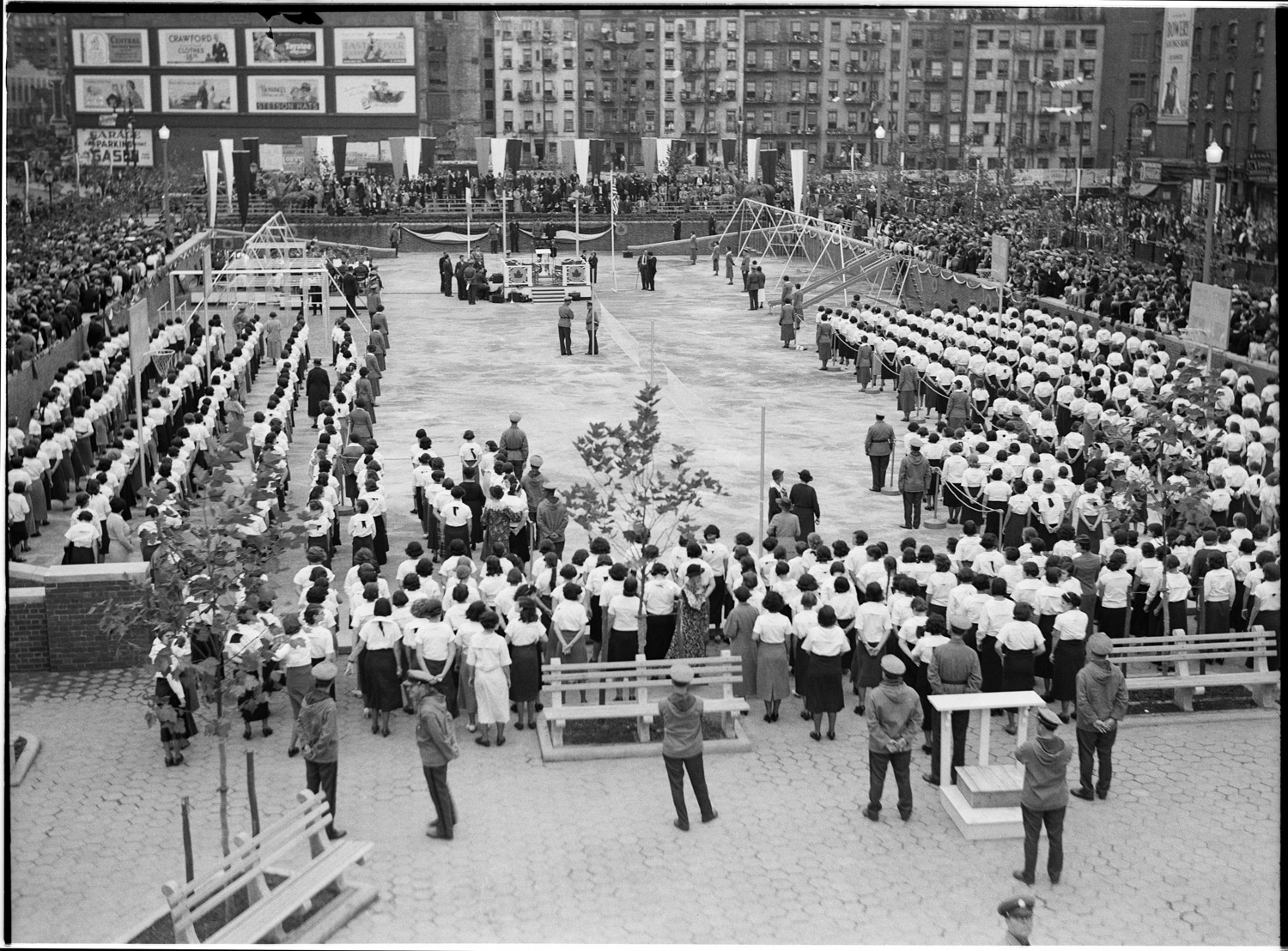
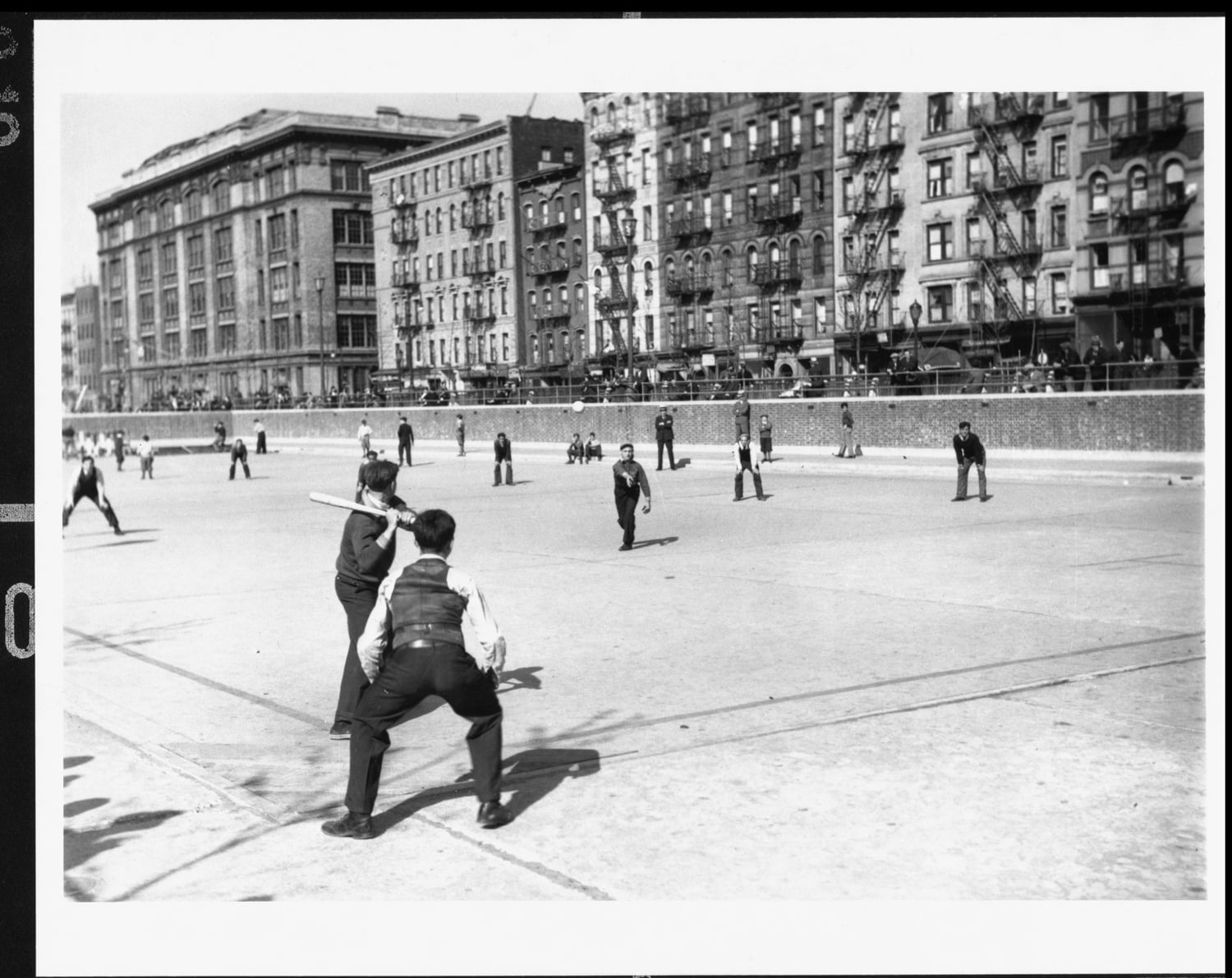
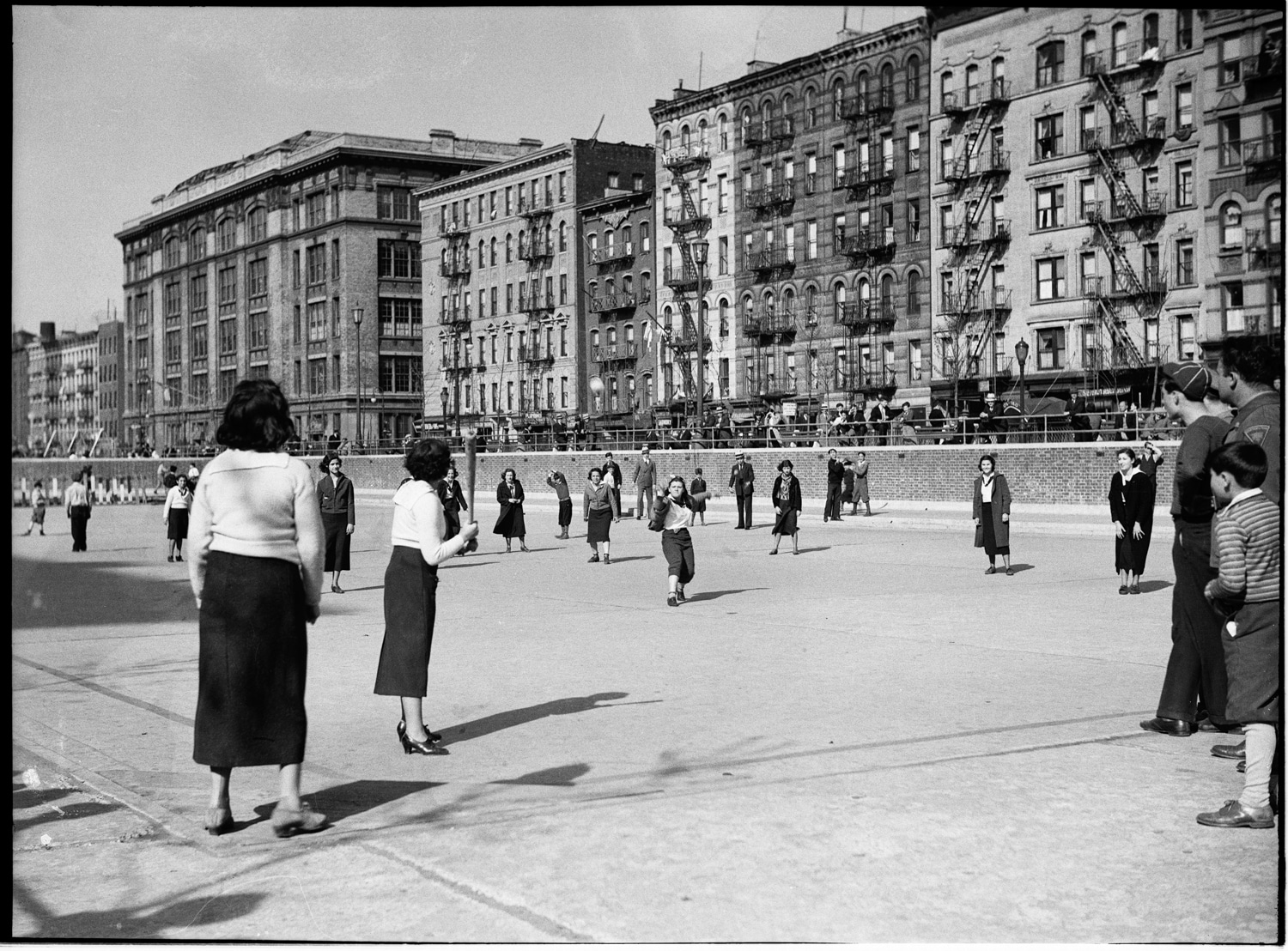
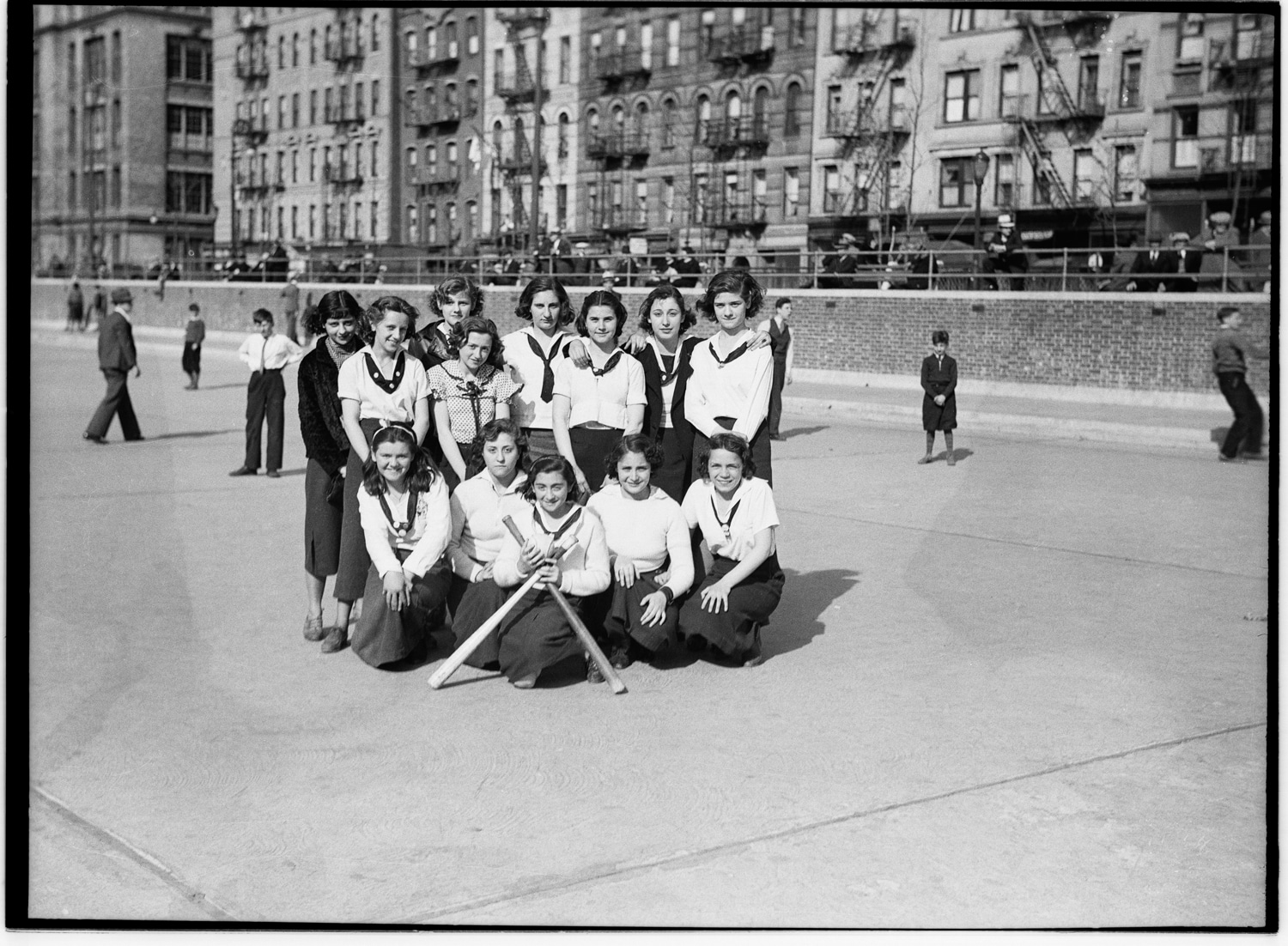
While statistics do not provide the whole picture, they are a useful index: most New York City parks do not report any felonies at all. 29 In 2021 and 2022, two high-profile murders were connected to Sara Delano Roosevelt Park, and just about everyone I meet there has a shocking story to tell: a scary bearhug from behind, a daytime stabbing with a shard of fluorescent tube. 30 Mine is this: when I was pregnant in 2023, I was constantly nauseous. I ran out of my usual antiemetic and wasn’t able, due to mysterious insurance guidelines, to acquire more. A nurse practitioner prescribed me a different drug that took away the vomiting but made me very sleepy. Left alone for ten minutes, I’d nod off. But I was determined to eat that afternoon at a restaurant on the south end of Forsyth, a few doors down from where grandfather Trump once lived. As I plodded down the street, a screaming man flew at me out of Lion’s Gate, arms raised in a cartoon attack. I registered this in slow motion, through the aquarium effect of my own drug, but I ran. He chased me, screaming, for two blocks, until I could slip into the restaurant and hold the glass door shut behind me. He pounded for a while, screaming.
I asked my brother, a supernaturally charismatic historian, fluent in Mandarin, to accompany me to the park’s northern quadrant.
The months went by. The baby arrived. I steered clear of the troubled quadrant to the north, and stuck to the Fujianese-held south. Why risk it? But I did wonder whether the Chinese ever wandered north of Grand Street. In August, I asked my brother Kang, a historian and supernaturally charismatic personality who is fluent in Mandarin, to accompany me. Kang immediately made friends with seven people who had ignored me for a year, and we learned that the Fujianese keep to their southern quadrant for the same reasons I do. North of Grand is simply too dangerous. A dama told me she wishes she might one day dance in Lion’s Gate, with its wading pool manqué inside a frame of plane trees. It’s greener and shadier than the southern end.
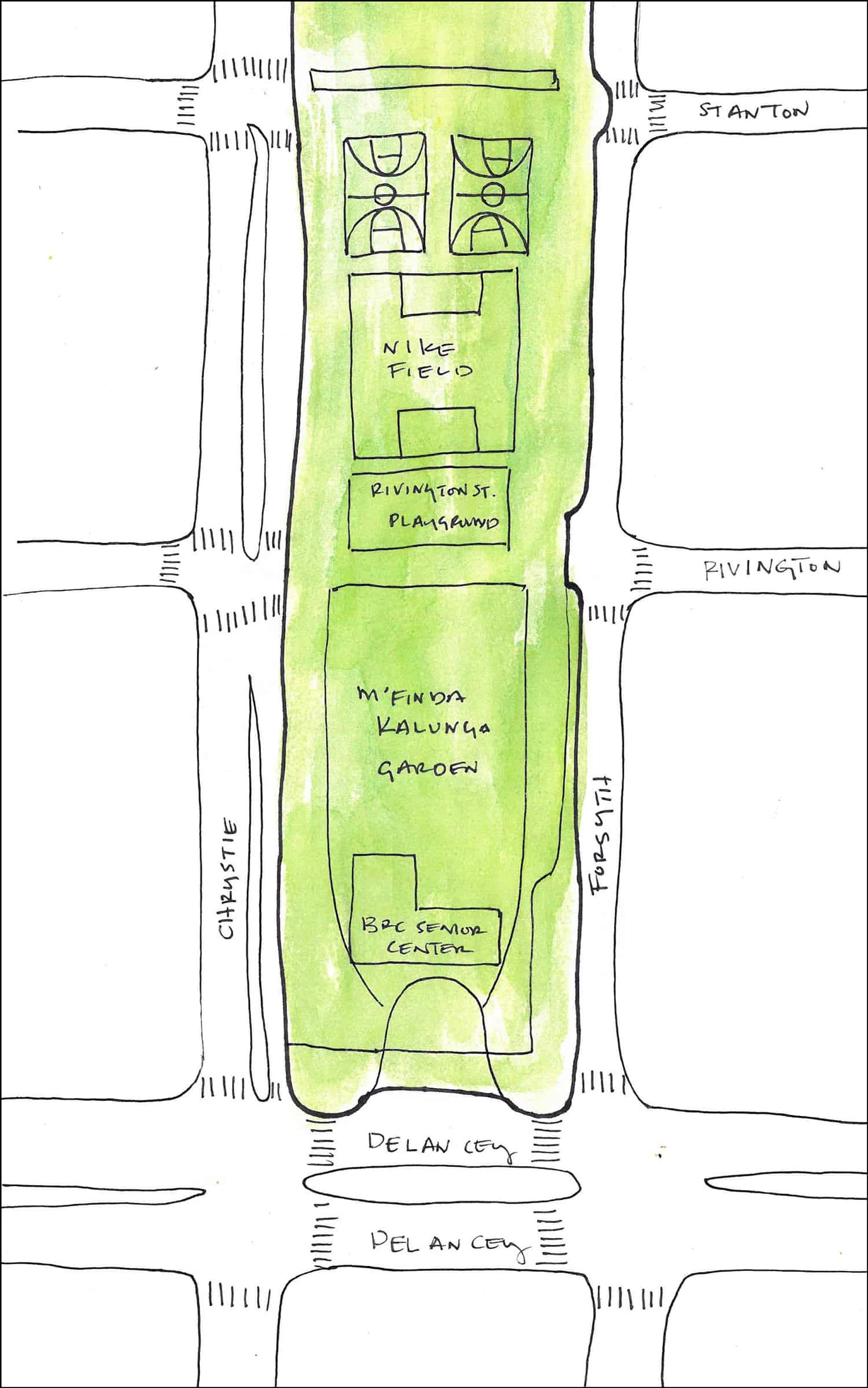
We also learned that this threshold between the jurisdictions has produced an informal marketplace, primarily for the sale of stolen goods. Many transactions, we were told, involve things robbed from nearby Whole Foods or Trader Joe’s by laowai, westerners, and sold to the Fujianese. Occasionally, I have also seen more familiar forms of New York City gray marketeering: hawkers with knockoff handbags or freshly baked Chinese crullers. Given the nature of the illegal market, Kang and I couldn’t confirm exactly who the sellers are, why they sell, and whether the buyers flip the goods. It’s clear, anyway, that the Fujianese enjoy the hustle bustle.
It goes like this: a man approaches the park’s entrance with a pillowcase (or a black trash bag or the basket of a Citi Bike) filled with things. A crowd of Fujianese people gather around. The seller names his price for, say, a pair of Apple headphones, the box shiny, shrinkwrap taut, and then the Fujianese wear him down from ten to seven dollars, from seven to five. Their mood is convivial and calculating. They collaborate to determine a fair price. They pass the goods around to inspect, weighing soaps in hand, trying on a hat, taking a bag of dried mangoes around the corner to show a friend, in case he or she might like to bid, too. The sellers seem to trust that the buyers will return the item. (Also, of course, they’re outnumbered.)
You regale your friend with your score, the thrill and friction of inventing a transaction, a community, and so, perhaps, a place.
The day Kang and I visited, groups of Fujianese anywhere between 30 and 80 years old chatted in small groups in the crisp late summer air. Individuals occasionally sprinted off to the latest little sale and sometimes carried back a handle of vodka, a three-pack of Lysol wipes, a five-pound bag of raw almonds. They were met by cheers, and usually opened up their loot to share. It seemed fun. I tried to confirm this by asking Kang to interview a middle-aged Fujianese man named Zheng, leaning against the park fence, smoking cigarettes. A rideshare driver who lives near Confucius Plaza, he was critical: the market draws in bad elements. Used needles are dropped in places children play, he said. People shit in the corners, because the nearby bathrooms aren’t reliably open. But, as we started to speak to his friends about their jobs (in construction and restaurants), and about their complaints regarding New York (too many people, too little housing, too little money), Zheng disappeared for a minute and reemerged, smile wide, hauling a case of Modelitos he’d just bought for ten dollars. There was a long tinny beep. The rear door of a Pathfinder parked nearby gaped open. Zheng chucked in the box and slammed the hatch shut. I reminded him that he’d just complained about the illegal selling, and he clapped me on the shoulder, said that his income was low, he just bought here and there. It’s good to get a deal. Besides, “If I don’t buy, someone else will.”
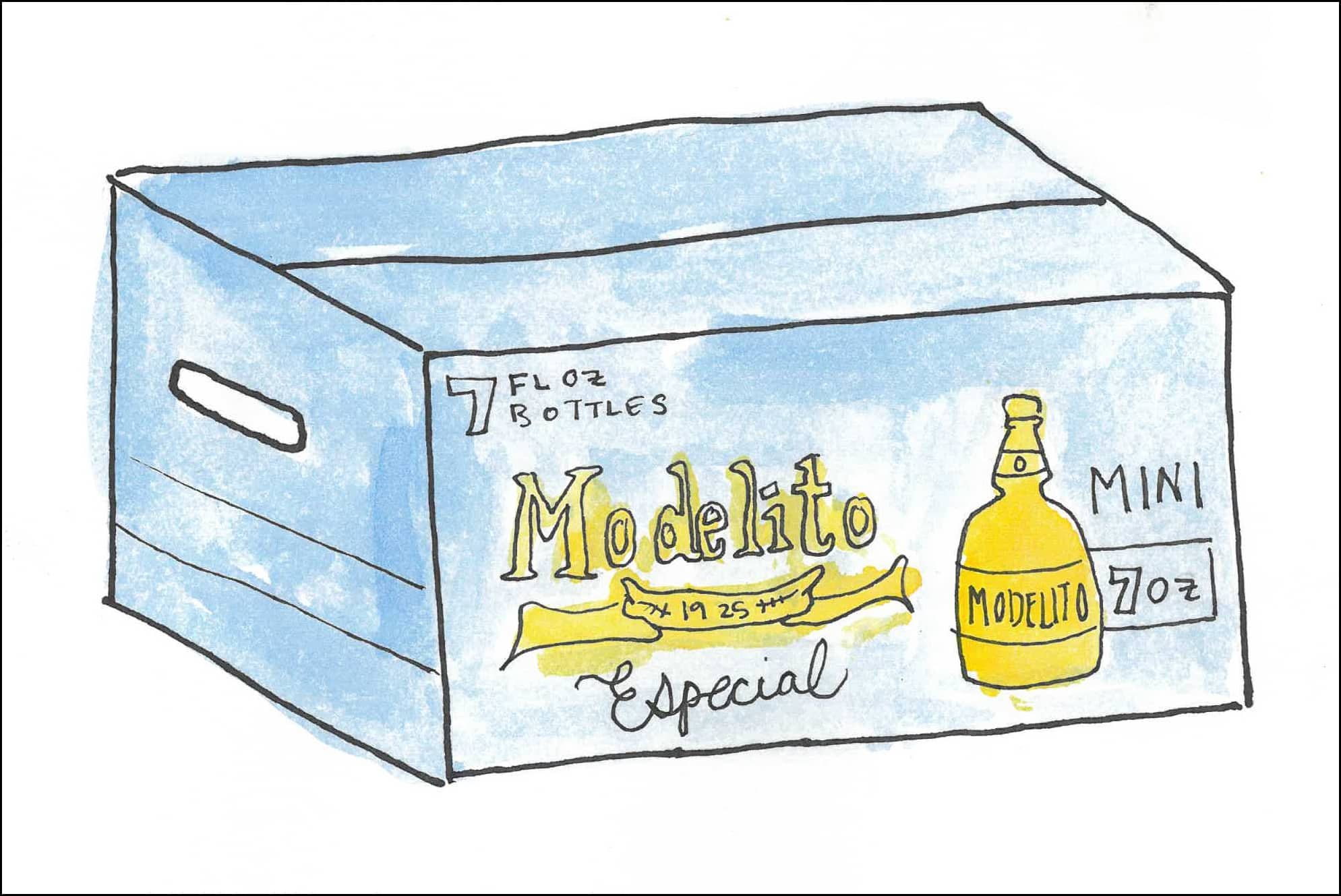
Zheng’s relish felt like the genuine thing, in spite of his complaints. It harked back to the mysterious tofu exchange I witnessed in April: someone gets a pail of tofu from a nearby factory — expired or lifted — and brings it to the market, where the Fujianese hang around, in part because they are poor, also because they have few other places to gather. A little back and forth lifts the spirits, a discount on something you’d have to buy anyway, even if it’s beat up. You regale your friend with your score, the thrill and friction — however dodgy — of engaging, inventing a transaction, a community, and so, perhaps, a place. I see the appeal. What’s a little dirt on your tofu, in exchange for all that? Wash it off, cook it tonight. I’m Chinese, too, and what can I say? My people love a deal. But another part of me, Chinese as well, feels dire frustration with the buyers. How does the market affect not just this corner of Grand Street, but the entire park?
I find it strange that these commodities, regardless of value, are largely offered for fifteen dollars or less, about the street price for a dose of many illicit drugs. In my months wandering Grand Street, I’ve been offered a package of local smoked fish for nine dollars, a pair of neon-yellow Puma sneakers that looked like they’d been worn exactly once for five dollars, and a phone case with an image of Barack and Michele Obama dancing at the 2009 presidential inauguration, for ten dollars. Many of the sellers appear psychologically unstable, or at least desperate. The way the Chinese negotiate with the bearers of such goods is forthright and unafraid. It gives me pause. I consider the way I interact with the urban unhoused or mentally ill when I walk by them: hurriedly, timidly, without eye contact. This stands in irreconcilable tension with the virtuous way I refer to these people in conversation with my peers and colleagues.
But what matters is how you acknowledge people on the street — and the Chinese engage boldly, looking the seemingly unstable in the eye, directly accusing them of price gouging by charging eight dollars for a pack of beef jerky. These are not nice encounters, but they are humanizing. For their part, the Fujianese can risk it: they have the safety they themselves create. These market negotiations unfold in the open, among a substantial crowd of onlookers — and the buyers’ limited English creates an additional barrier against law enforcement and abuse from the sellers alike. I cannot withstand a torrent of insults or threats in English, but most of the Chinese seem to listen only for the numbers.
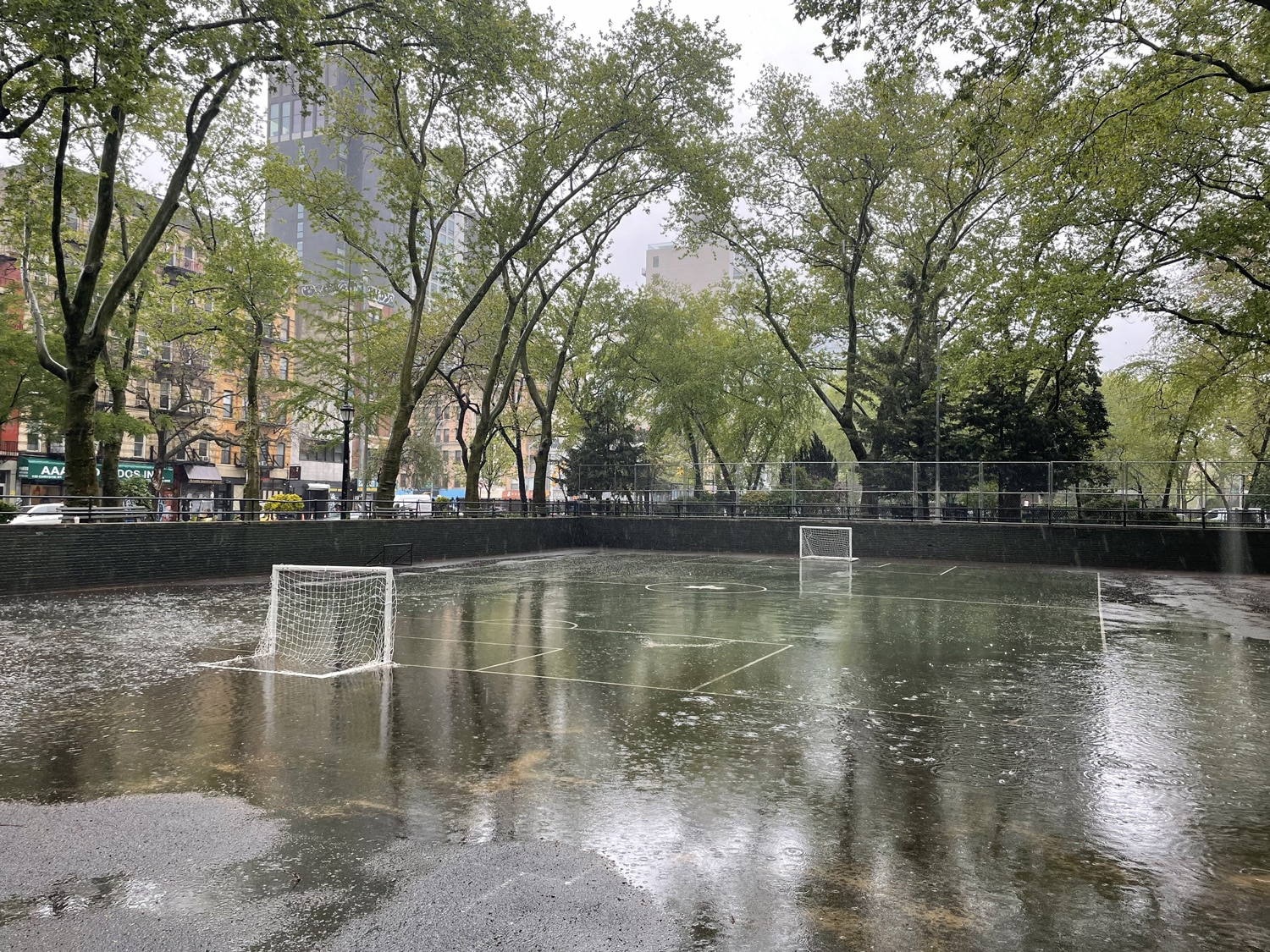
The dama I spoke to about the shaded empty wading pool told me, as Zheng did, that she abhorred the market for the bad elements it brings into the park. But later I noticed she was also haggling along with the rest of the Fujianese, over soap. She saw me watching and told me it wasn’t even a deal, really, she could get it cheaper on Youku. When I pressed again about the connection between the buyers at the market and the proliferation of stealing, the bad elements she criticized, she told me she just wanted Chinatown to be safe. I asked if she thought of the park north of Grand as Chinatown, and she seemed surprised. It’s Chinatown, she said. Absolutely.
In this part of the park, the pavement is spidery and uneven. You can’t see in very well, and it feels as if, once inside, you couldn’t easily get out.
But the atmosphere in the quadrant uptown from Grand Street is distinct from that in the more obviously Chinatown-adjacent parts. The air in Lion’s Gate is still. The population is mostly male, moving slowly, sitting slowly, looking around slowly. The pavement is spidery and uneven. Where the metal perimeter fence has deteriorated, chicken wire and plywood take its place. You can’t see in very well, and it feels as if, once inside, you couldn’t easily get out. Even so, like the Chinese, parkgoers here have their customs. In June, K Webster, president of the Sara Roosevelt Park Community Coalition (the SRPCC), a grassroots collective that has advocated for the park since 1982, told me she has found evidence of solidarity in Lion’s Gate’s overgrown gardens. 31 “Periodically, I’ll come across memorials to people who have died, clearly homeless folks,” she said. “There is a community there that tries to think about each other.”
I was walking along Forsyth in the park early one morning, with the baby. While we waited at a red light, a tall light-skinned Black man with a dancer’s aspect was rolling a four-foot brown velvet beanbag across Delancey. He was wearing a clean gray cardigan and khaki capris. His head was shaved. A shorter Black man, dark, with dreads, dirty clothes, and a missing hand, ran east from Chrystie Street to greet him. He smiled and chattered excitedly in lightly accented English, pointing at the beanbag. The man with the beanbag smiled beatifically.
“Damn, and you look so clean,” the man without a hand said, rubbing his wrist over his face. “You look so fresh!”
Late spring, around the time I witnessed the tofu sale, I started to frequent a pedestrianized zone on the west side of Forsyth, adjacent to Lion’s Gate: in 2008, the city had removed 50 parking spaces, painted this ten-foot strip of street beige, and returned it to foot traffic, in part because elderly Chinese were already using it as a desire path. 32 The Forsyth Street sidewalk on the Fujianese-held south side flows directly into this painted strip, creating a continuous, informal boulevard. Crucially, this path lies outside the northern-zone fence.
The baby was seven months. And we were safely, improbably, walking alongside Lion’s Gate.
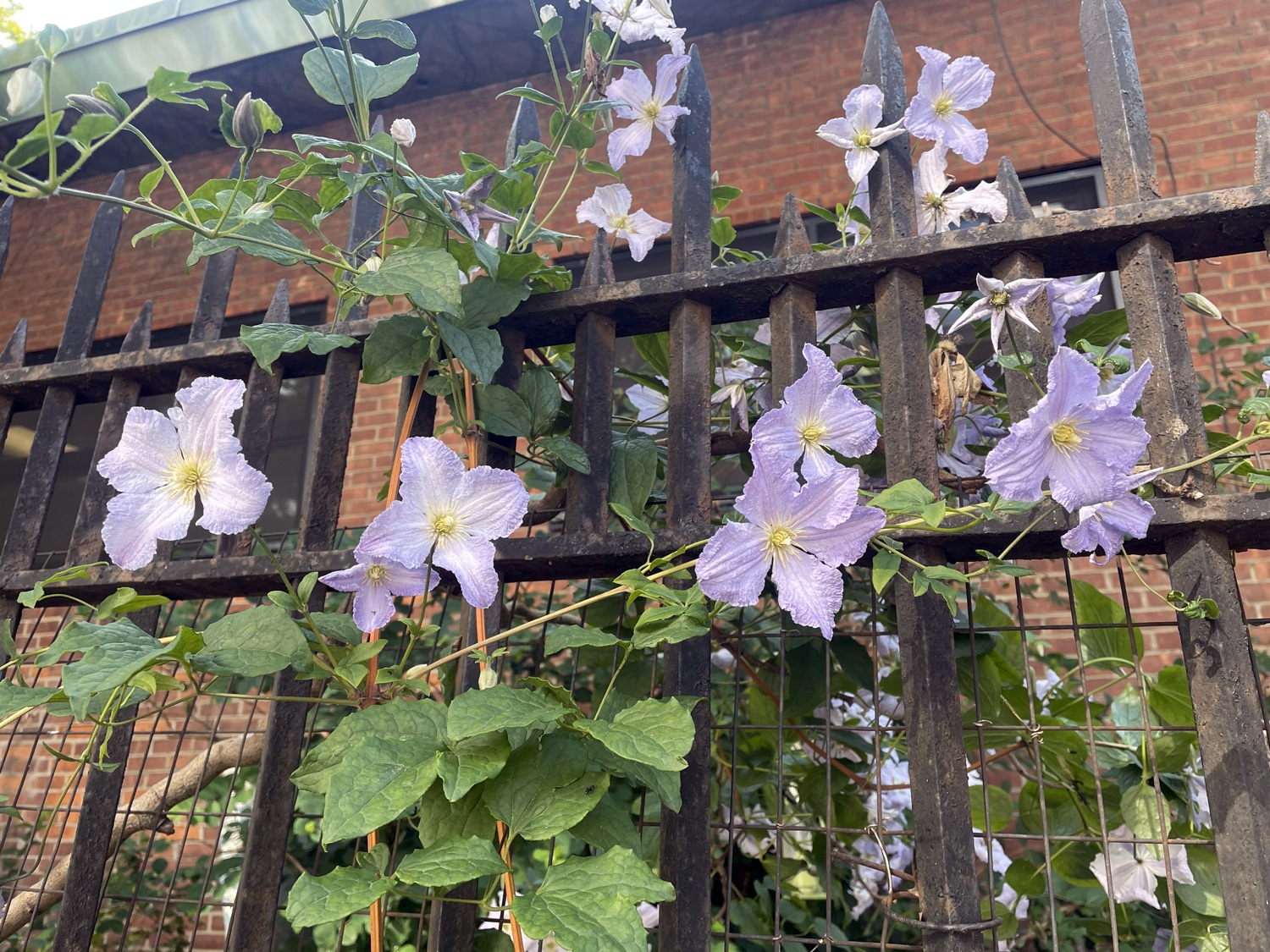
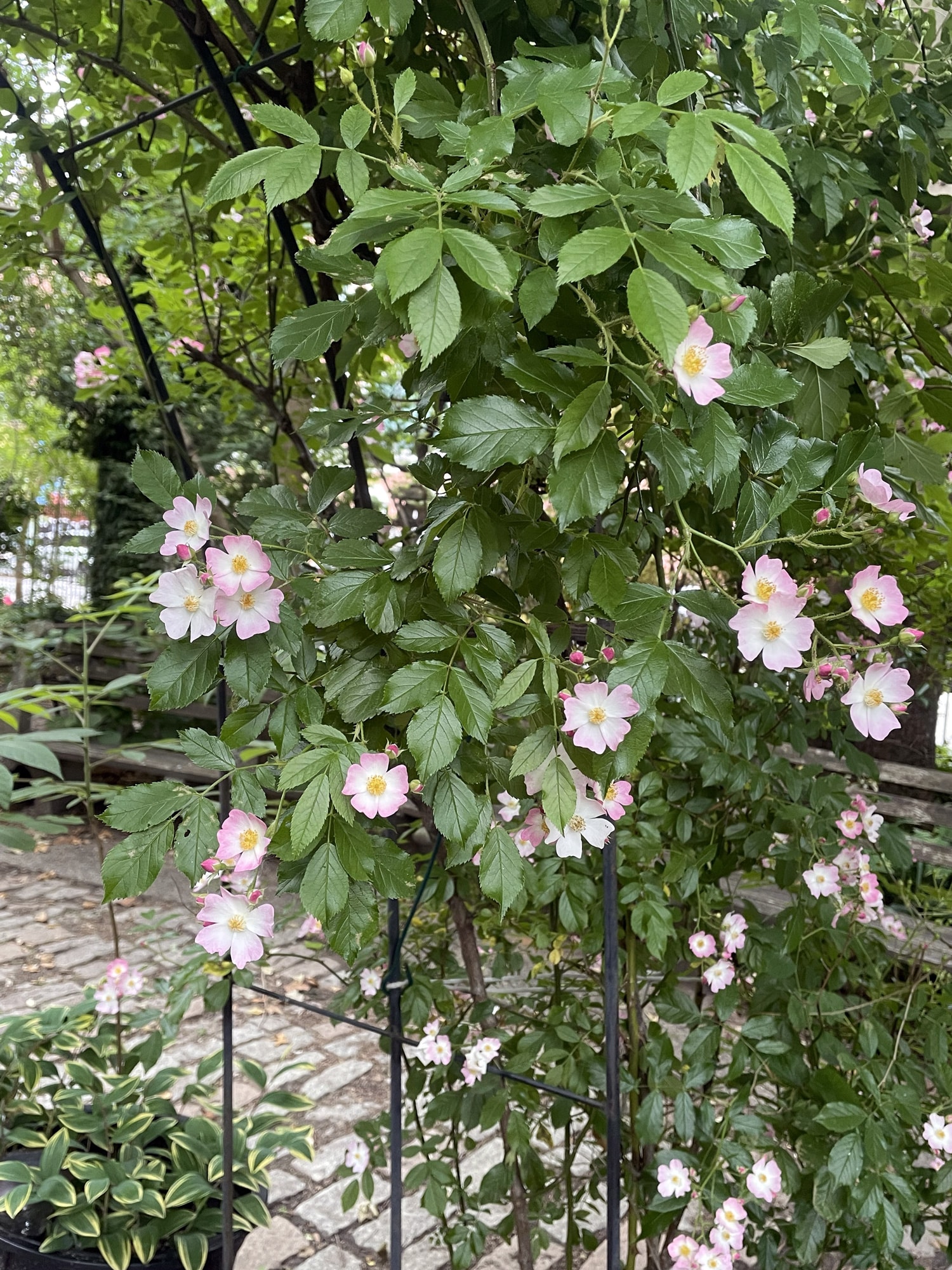
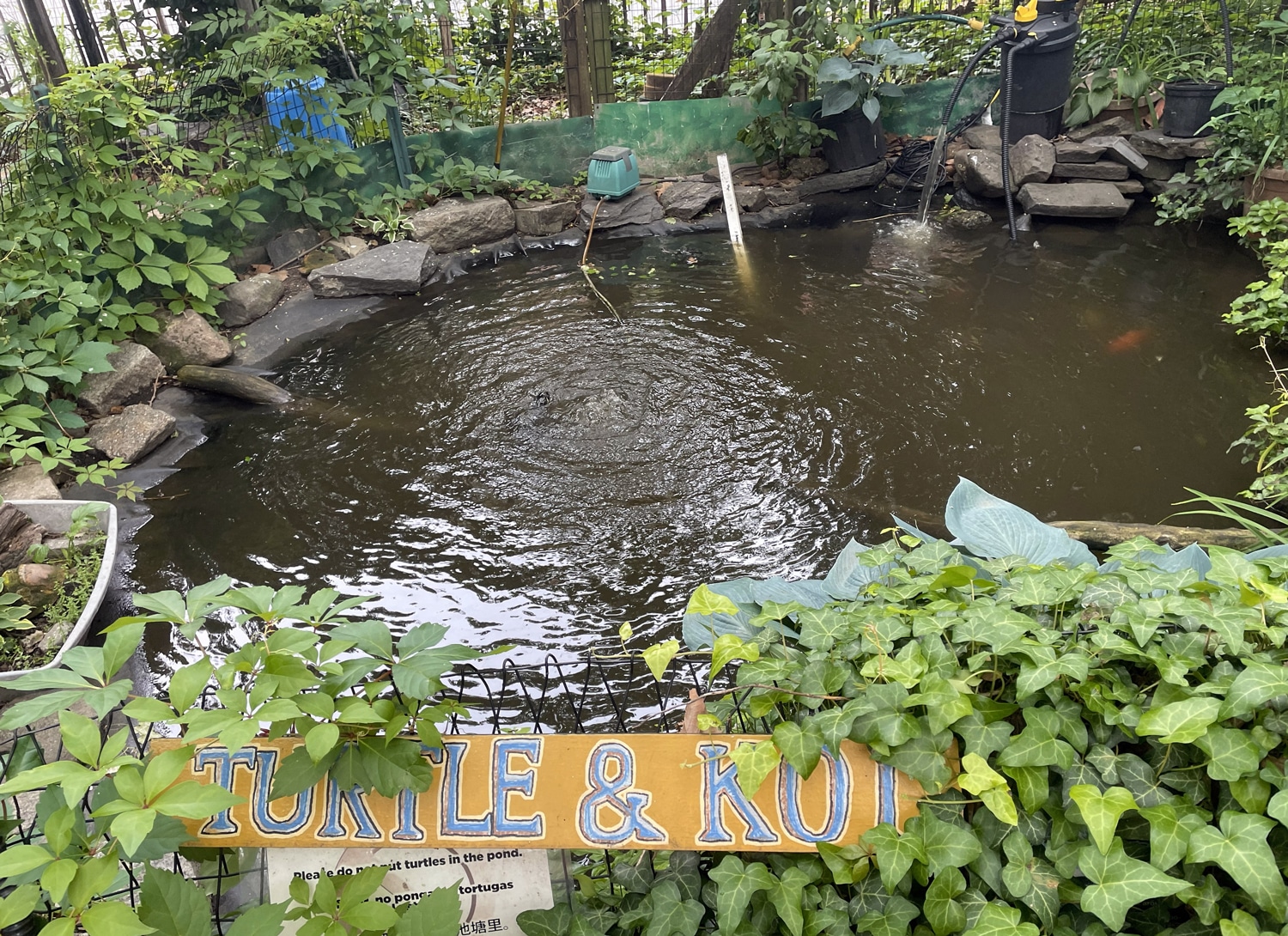
We crossed Delancey to the third quadrant of the park. On its south side is an arc of small, fenced gardens with a general disposition similar to that of Lion’s Gate: a little strange, a little dark, not a place to linger. For years, construction and scaffolding on Forsyth and its adjacent sidewalk deepened the seedy atmosphere, making the entire block a place to avoid. But the scaffolding had vanished last year, while I was locked inside postpartum upheaval, leaving a gleaming plaza-esque walkway planted with young trees. A hundred paces north, past the seedy gardens, a ten-foot wrought-iron fence enclosed an interior courtyard, a block nested into the block. In the days of scaffolding, I’d assumed this was a holding pen for dull city upkeep: storage for shovels and trash bags, a cubby for rodent traps. But now that I looked inside, I saw a fig tree, benches, a pond with tomato-orange koi, a wooden chicken coop with two floors. A gigantic mulberry tree bent over the sidewalk. Lush, unraveling ferns. Papery lavender leather flowers climbing the fence, and stone garden tables with scalloped edges.
But now I saw a fig tree, benches, a pond with koi. Papery lavender leather flowers climbing the fence, and stone garden tables with scalloped edges.
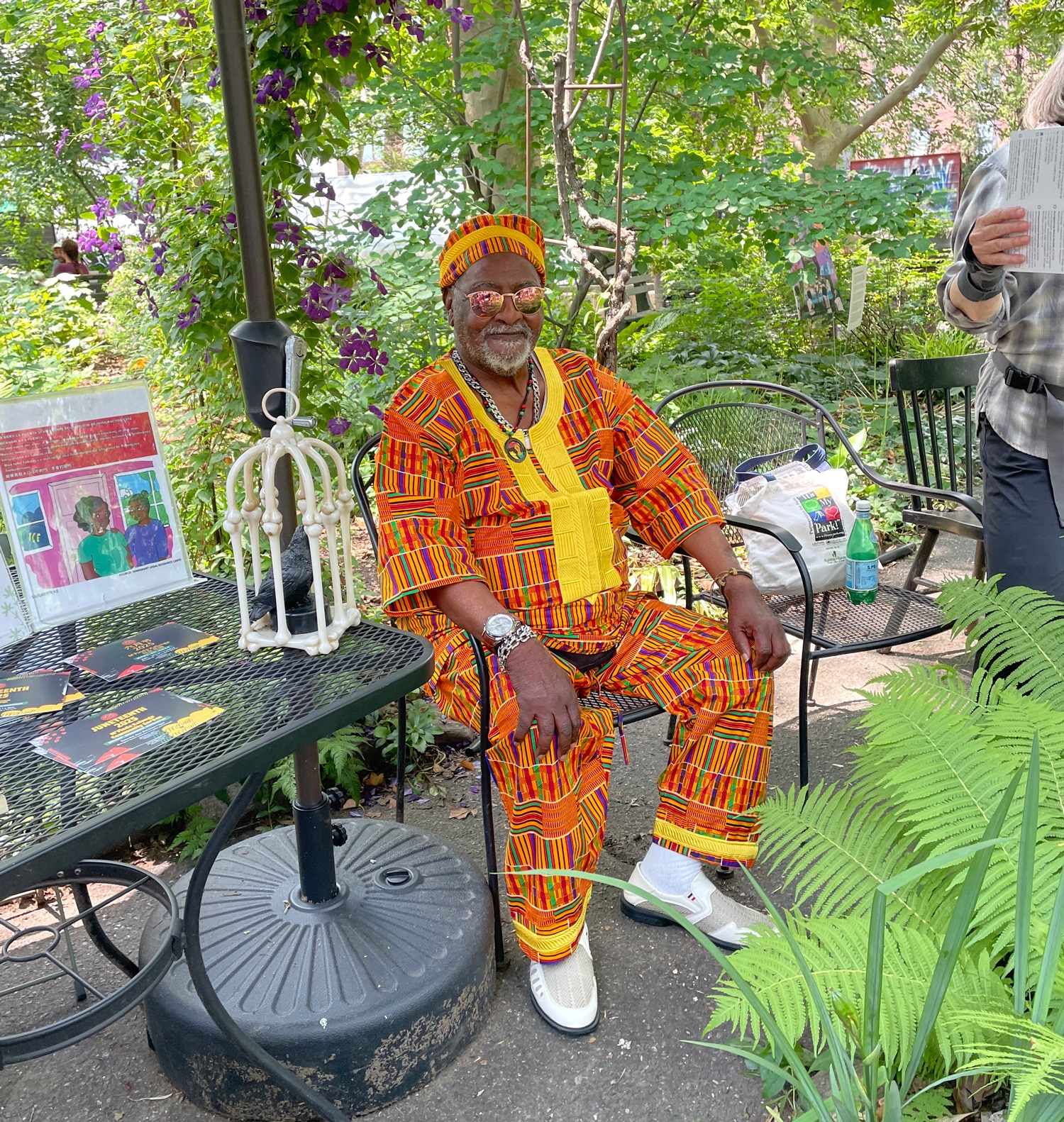
Many afternoons, a Black man with a white beard sits in his rollator outside the entrance to this walled garden where it is crossed by Rivington. Like the Fujianese in the south, Bob, who turned 89 this year, is alert and observant, his hands folded in his lap. The day I first noticed the gardens, he encouraged me to visit with the baby; ladybugs would be released that weekend, he said. I started stopping by to chat, and he knew just about everyone who walked by, calling out to them by name, asking after their families. He said that, over the years, well before the renovation, these gardens had become popular with parents. “It was a way of getting the community involved … the Chinese and Spanish and Blacks. I kind of pulled them all together.” He explained that groups planted, weeded, picked up trash. “Anytime I couldn’t think of someone’s name, I would say, ‘this is my daughter and this is my son,’ and so now you’ll see people come around, and they call me Pops.”
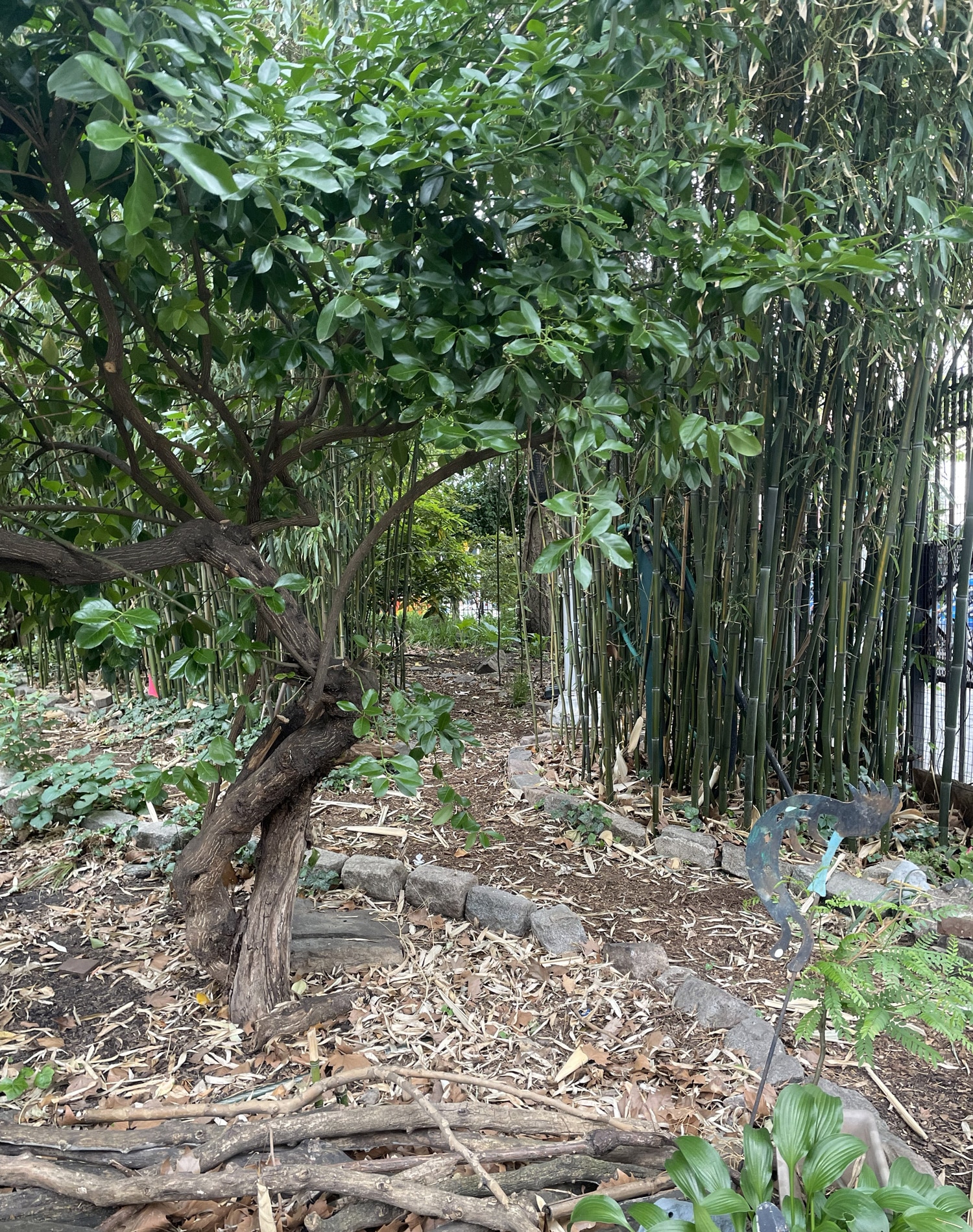
It was his work with children that initially brought Bob to the park; he was a special education teacher with the nonprofit Children’s Aid, responsible for boys’ programming downtown. He didn’t want to use the stoop of his apartment building as a meeting spot, so he brought his charges to the park, which in the 1970s and ’80s was known for being an open-air heroin market. He discouraged drug use around the children, organizing soccer and basketball in the abandoned fields. “I was putting up signs all over: ‘DXZ,’ drug-free zone … I don’t care what you do, but leave my kids alone.” He said the Parks Department didn’t like the signs. “I couldn’t care less, because I was saving lives.” He became familiar with the dealers and users, told them to move south, away from his activities in the north end. They came to respect him. In a 1994 Village Voice article about Sara Delano Roosevelt Park, Bob is quoted: “I caught a guy shooting up here once, and he said, ‘Oh Bob, I’m so sorry. I wish it was a police that caught me. I know you don’t like this.’” 33 Eventually, Bob took to patrolling with a whistle, blowing it when he saw drug use.
“I learned to take over the whole park piece by piece,” he told me, waving hi to a pedestrian over my shoulder. The man stopped and asked if Bob and I wanted anything to drink from the bodega. I told him I was interviewing Bob for a story. “His life story, huh?” the man said to Bob, smiling mischievously. “Yes, another life story,” said Bob. “Tell them the real one this time,” the man responded. All three of us laughed.
Instead of creating specialized structures to shape souls from the outside via concrete and rebar, he starts with the humans and works his way out.
In my time with Bob, these happy interruptions never stopped. His interactions with people in the park, and with the space itself, are the inverse of Robert Moses’s vision. Instead of creating specialized structures for humans, to shape their souls from the outside via concrete and rebar, Bob starts with the humans and works his way out. His gifts of directness and pragmatism allow him to zero in on his community’s needs and seek support from anyone equipped to lend it. The social and material structures created as a result are flexible and resilient. (If the place where the kids play soccer is damaged, you move the kids to a different place.) Debra Jeffrey-Glass, co-chair of the garden and vice president of the advocacy organization, the SRPCC, told me, “some of our folks that volunteer in this garden are people that he met sitting out there. Some of them are new migrants. Some of them are folks who have been struggling in some way.” Bob’s work, she said, allows people an “emancipation from not feeling like you have something to contribute. That’s what he gives people, this chance to feel a connection to the space. Like, I’m sweeping this space. This is what I do. This is what I’m contributing. So it’s also [my] space.”
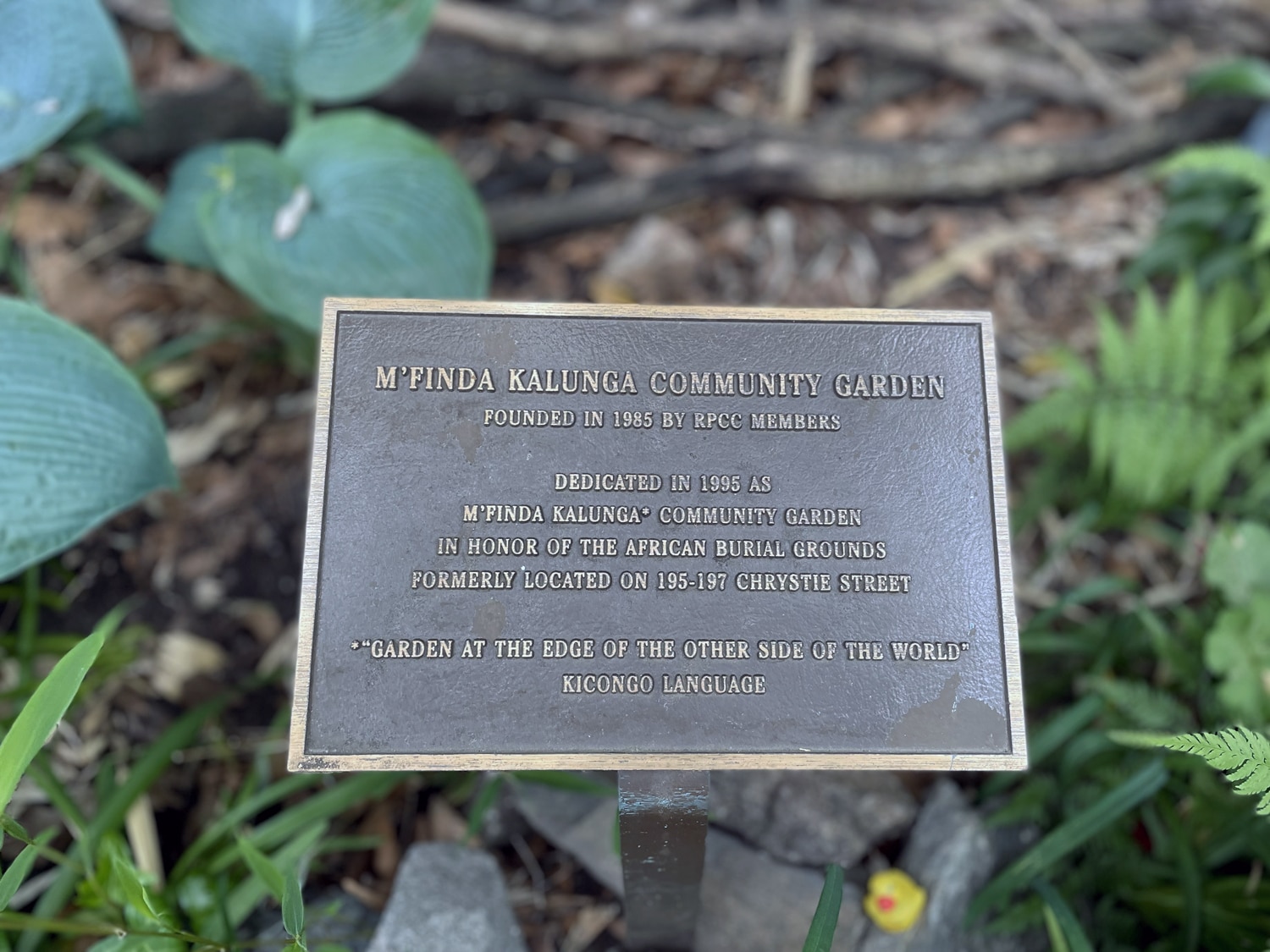
In 1983, Bob and members of the then-newly established SRPCC began imagining a new structure: the garden at whose threshold he and I and the baby now sat. Bob enlisted the help of the community as well as the police, hauling stones from other parts of the park to line the garden beds. Someone trucked in soil from Hershey, Pennsylvania; the dirt smelled like chocolate. Bob designated one side of the garden for children — hence the chicken coop, with chickens brought in each summer from upstate, the pond with koi and turtles, the colorful tables and chairs. Garden members tended their own beds, filling them with a riot of native and oriental species, annuals and perennials; pink climbing roses, painted ferns, swamp milkweed, blue hydrangeas. The garden became a place for neighborhood children to play, a place that allowed people who live nearby to get to know each other in an intimate, low-stakes setting, weeding, turning compost, treating fungus on a beloved rose bush. Information was exchanged, neighborhood issues were discussed, organized around. The park became a park.
A few years in, the gardeners discovered that, between 1795 and 1843, a portion of Chrystie Street, between Stanton and Rivington, had been one of the city’s only cemeteries for African Americans. Even earlier, in the late 17th century, the area was part of the 130-acre village known as The Land of the Blacks, sometimes considered the first free African community in the United States. (The Africans were granted conditional freedom from the Dutch West India Company, meaning they could be recalled for labor on a whim. 34 )
To honor these roots, the SRPCC garden was named M’Finda Kalunga, which means “the garden on the other side of the world” in the Kikongo language of central West Africa. 35 M’Finda Kalunga, which Bob refers to as the “mothership,” inspired other commemorative gardens in other parts of the park. The Sebastiaen de Britto Garden, named for a formerly enslaved African who owned six acres that comprise part of what is now Sara Delano Roosevelt Park, honors The Land of the Blacks. Another, The Rivington House Memorial Garden, commemorates residents of The Rivington House, a nursing home for patients with AIDS. 36 Another, The Memorial Garden for the Homeless Who Lost Their Lives, serves as a memorial to four men who were murdered in the neighborhood in 2019. 37
For the gardeners and the advocacy coalition, working to realign history is as material a process as planting irises, geraniums, and ivy.
For the gardeners and the advocacy coalition, working to realign history is as material a process as planting irises, geraniums, and ivy. Both involve real labor, hands in soil, managing logistics, the dissolution of certain boundaries. You become part of the place, exposed to its many realities. In order to tend the Lion’s Gate gardens, for instance, K Webster must haul water from M’Finda Kalunga across the eight lanes of traffic on Delancey. “I’ve talked to some of the guys and pointed out that this whole area was originally The Land of the Blacks, and these were African-heritage men, and they were so excited about it,” she said. “You can tell it’s like, if your whole history is written as it’s been written, then you find out that these were farmers who actually had agency, who made decisions, who were able to push back and fight for a piece of land so that their families could thrive .… It’s really important. That’s also your history.”
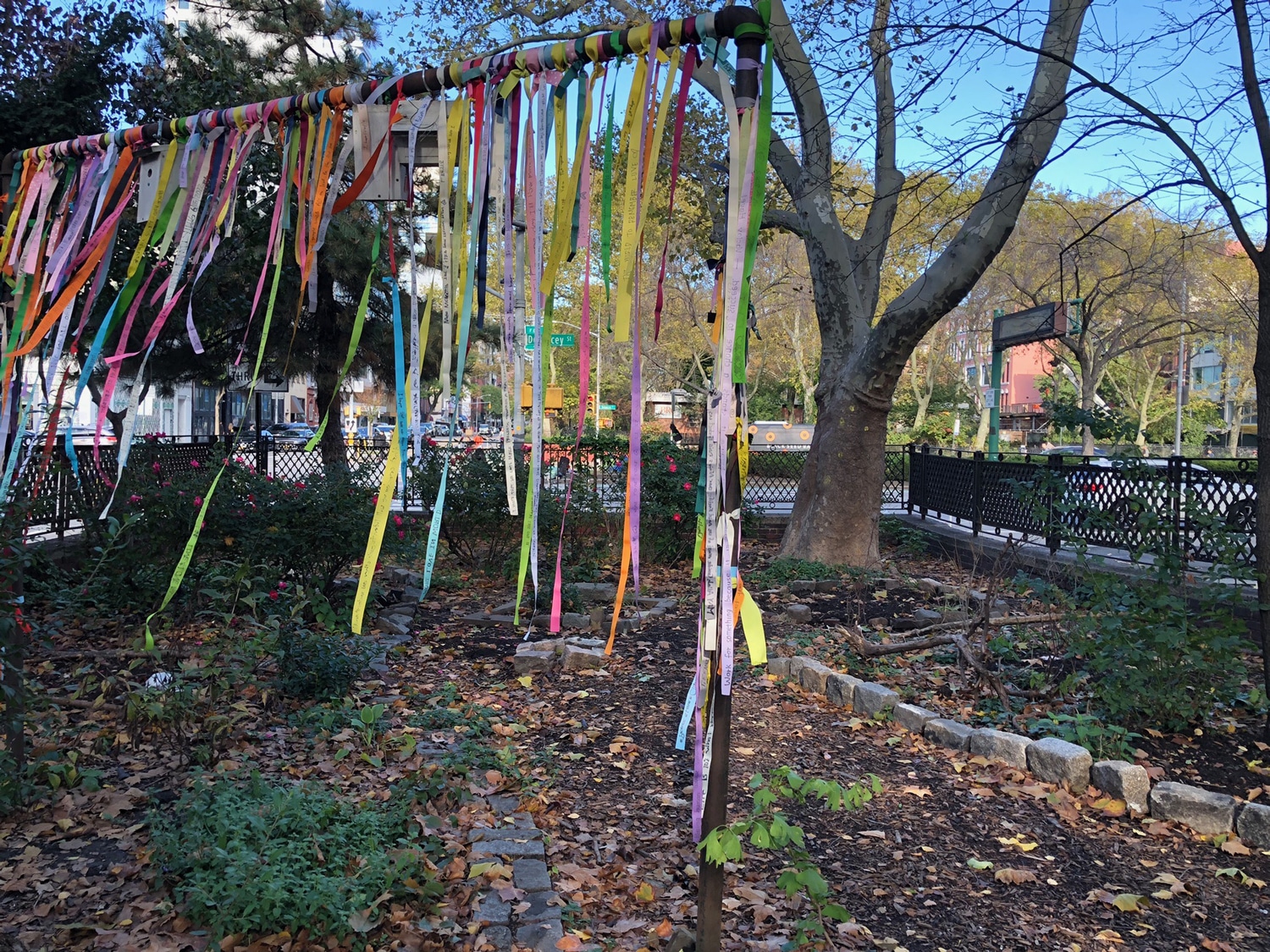
Other gardens look to the future. The Sunflower Garden, in Lion’s Gate, features a panel of ribbons on which wishes were written by the community, in the wake of the 2021 and 2022 murders in the park. “The ribbon project was really eye-opening,” K said.
Everyone — I mean, all different walks — made ribbons .… students, tourists, residents, police, homeless folks, drug dealers, drug users. And, I’ve got to tell you, they all had essentially the same message: we’re human, and we want human things. We want to be safe. We want to have a home. We want to have neighbors. We want to get along.
An attempt to reconcile those wishes is imminent: Lion’s Gate is slated for a dramatic $35 million renovation. The reconstruction was scheduled to begin this year, but according to the NYC Parks & Recreation Department, procurement hasn’t started yet. 38 Plans for the redesign, adopted in 2021, were not offered for community feedback, recalling Moses’s approach to simply designing disorder away. 39 These plans eliminated parts of the park that were counterintuitively safe and important for the community, Debra Jeffrey-Glass pointed out. “You can’t really create a design with your idea in mind without talking to the people that actually use the park and talking to people who actually are in the space,” she said. “I live on the sixth floor, and I can see the hand-passing drug deals. Yeah, I can see people sleeping in the park. But I also know what happens inside the Pit” — the erstwhile wading pool where the dama I spoke to hoped to dance. “It’s where my kids learned to ride their bike. There are people training their dogs.” Debra and the SRPCC pushed back.
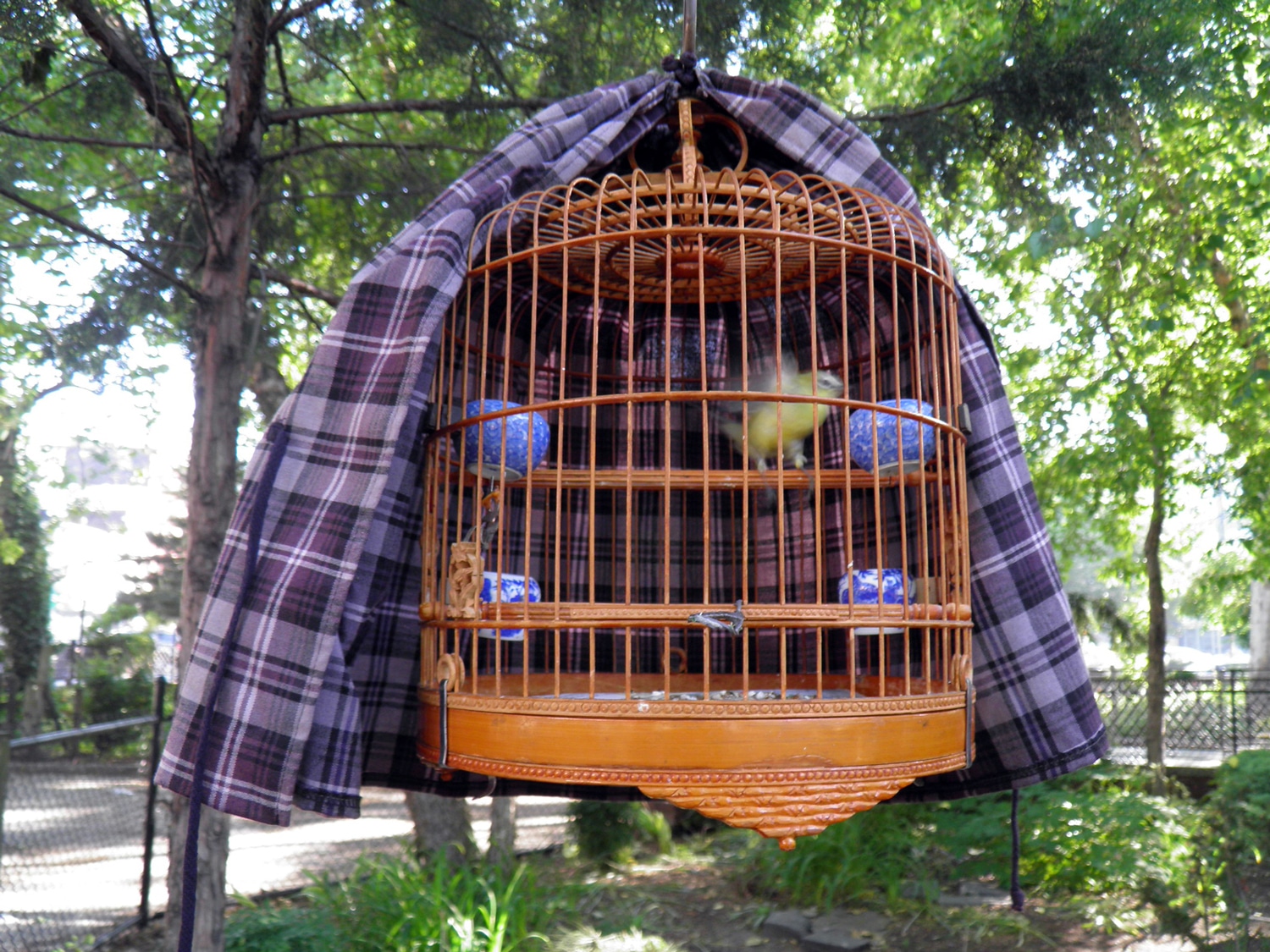
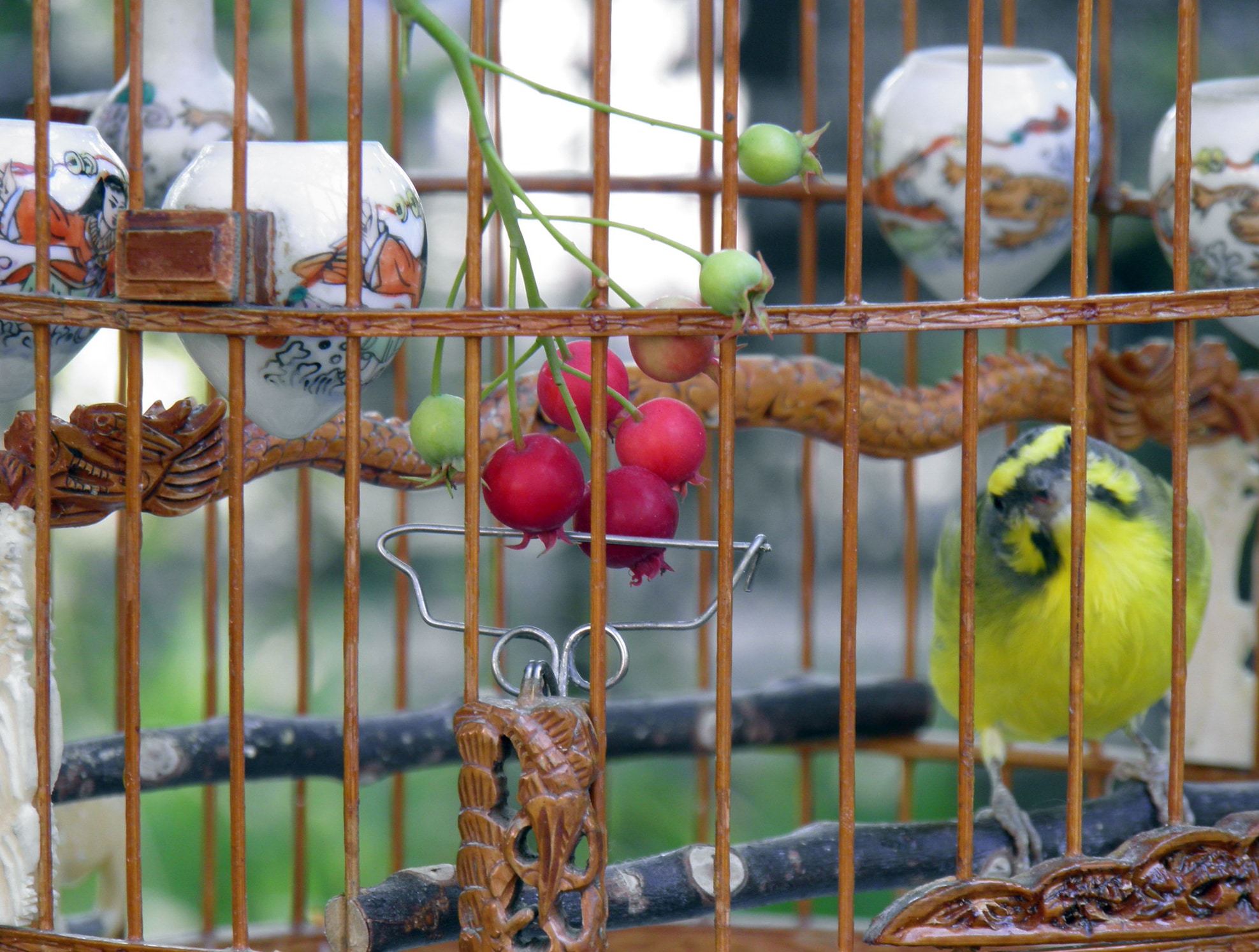
The city acquiesced and held community-input sessions that drew everyone from cyclists who play polo on their bikes in the Pit, to the Hua Mei Birders, a group of Chinese men who, for decades, have gathered with their songbirds in fine wooden cages. (I spoke to a polo player who recalled a polo ball striking a bird cage when both groups were present. The polo players were contrite, and set up a net to catch stray balls). The new plans made a genuine attempt to incorporate all their needs. “The plans look amazing,” said Debra. Yet questions remain about what will happen, during construction, to the people who currently live in Lion’s Gate, and what will occur as the southern and northern communities collide — the former who think of Lion’s Gate as Chinatown, and the latter who don’t.
There is so much willingness here. Enough to turn our heads, mine and the baby’s, and to teach us a little about what makes a park, and a life.
In the end, the misguided design of “die-stamped design for die-stamped functions” decried by Jane Jacobs, and the neglect of decades have given rise to protectiveness and vigilance by those who steward each of the four quadrants. Perhaps that chemistry is what makes the parkgoers so courageous, so intent on always noticing, engaging with one another. So human. There is so much willingness here. Enough to turn our heads, mine and the baby’s, and to teach us a little about what makes a park and, in turn, a life.
I have been mostly inside for months, with my books and reporter’s notes. The baby learned to crawl. I spend hours on elbows and knees corralling him, extricating damp charging cables and pens from his paws. But soon, he and I will be back out there every day, at Sara Delano Roosevelt Park, walking, saying hello, seeing. I’ve been brooding on my own tiny scheme lately. I want to call it “The Committee to Clean Up Ten Feet of the Pedestrianized Zone on Forsyth Street between Hester and Broome.” Everything can be a committee, Debra has taught me. I’ll be recruiting this fall, as soon as I get a little time off. My husband will be there, my new friend Jamie and her daughter, and maybe our old neighbor John, too. Maybe K and Debra will stop by. We can go see if Bob needs a soda.

If you would like to comment on this article, or anything else on Places Journal, visit our Facebook page or send us a message on Twitter.