
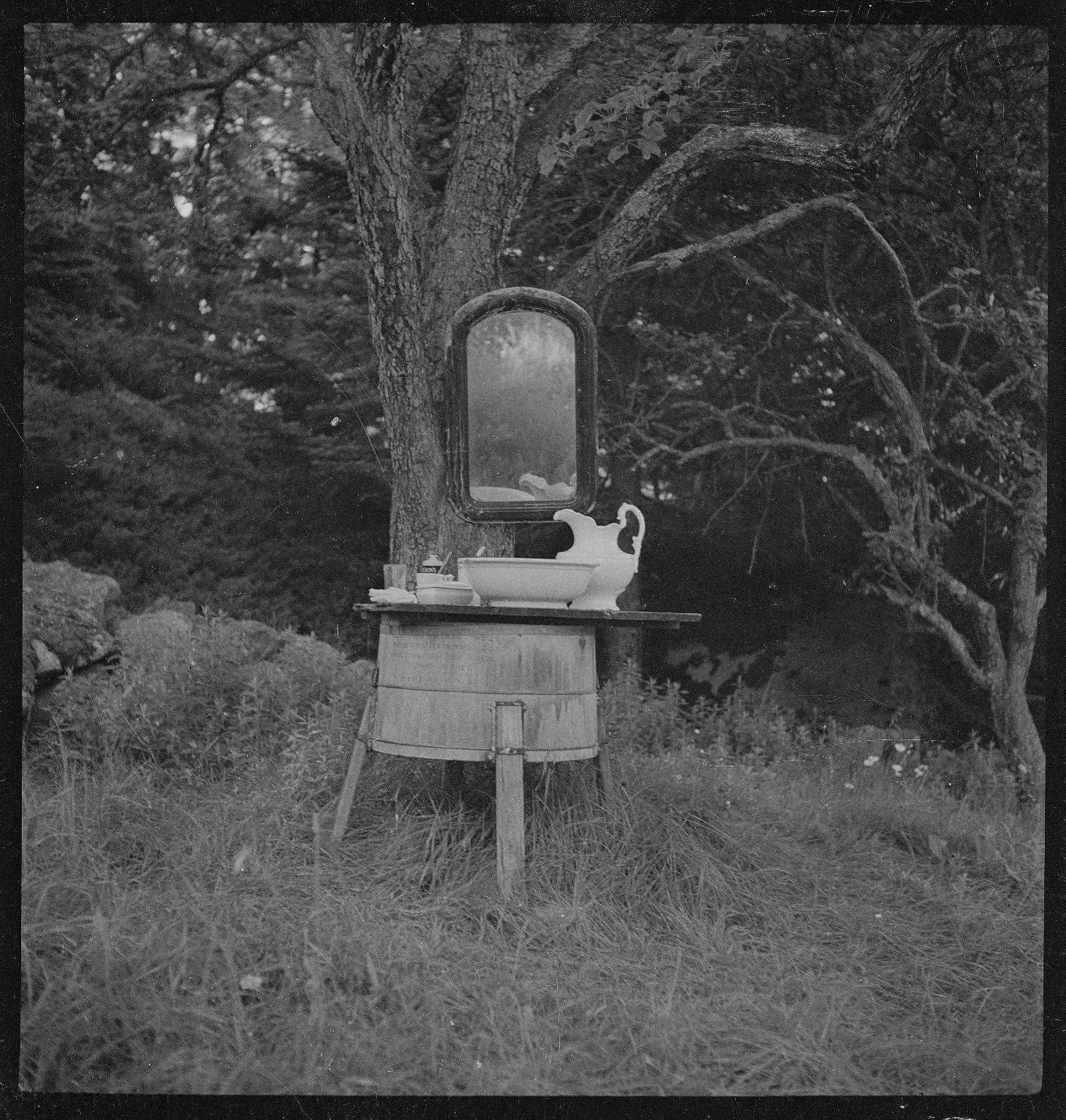
If there is something mysterious about an analogue photograph — a pattern of light reflected off an object placed before the camera’s lens, and fixed on a surface coated with light-sensitive emulsion — then there is a doubly mysterious quality to a photograph of a mirror. A mirror is a sheet of glass coated to reflect light. One could say that a photograph is a mirror of a kind, a device for framing a bit of the world to be examined closely. Each in its way promises objectivity. Each notoriously distorts that promise, or reneges on it entirely.
Surely, on some level, this doubling of photograph and mirror, clarity and ambiguity, is the subject of this image.
Surely, on some level, this doubling of photograph and mirror, clarity and ambiguity, is the subject of this image. Extant only as a negative, it was made by the American photographer Consuelo Kanaga in Vinalhaven, Maine, likely in 1948. This, at least, was the year in which the publishing house Simon and Schuster advertised a meet-and-greet with the children’s writer Margaret Wise Brown, author of The Runaway Bunny, Goodnight Moon, and many other books. It was to produce portraits of the author for the publisher that Kanaga had traveled to the island of Vinalhaven, some twelve miles off the mainland. 1


While she was there, she made pictures just for herself too, or for herself and her subject. Brown was living on a rocky shore in a barnlike wood-framed building she named the Only House. According to one biographer, this was because it was often the only house around with lights on. Presumably these were kerosene lamps or candles, because the place had no electricity or plumbing — hence the washstand al fresco. 2 At the same time, it is hard not to imagine that Brown, with her almost Steinian sense of wordplay, did not mean, simultaneously, to call to mind the lonely house. 3
Privacy and asceticism; a dreamlike poise that might owe something to Surrealism while embracing the basic fact of maintenance; a homespun magical danger waiting at the line where sun shifts into shadow: Kanaga gets at all this in the image titled “Margaret Wise’s Boudoir.” 4 In it, she centers the rectangular mirror, setting it slightly higher than halfway up in the vertical rectangle of the shot, as if hung at the right height for us as viewers to peer and primp. With its curved and beveled wooden frame, the mirror is placed precisely to act as a picture-within-the-picture, a kind of portal.
But a subtle spatial illusion is in effect. If the picture-plane of the negative were the interior wall of a house, the mirror would be at a good height for looking into. But there is no wall. The space where it should be, behind the mirror, falls back into an outdoor daytime darkness that’s hard to read, deepening into black between gnarled branches and dense leaves. Behind a low stone fence or pile of boulders, beyond the field of wildflowers and long grass, the land seems to go abruptly downhill. This sense of a drop-off, a plunge into the trees, has been heightened by Kanaga through attention to the slanting line that slices meadow off from woods. The space behind the mirror is more complicated than it first seems, and so is the space in front of it. We’re not close to the mirror at all; it’s hard to tell, actually, how far back we are. We’re standing where the photographer was standing. But where was that? Shouldn’t we be able to see her reflection in the glass?
If Margaret Wise Brown completed her toilette at this table, she did so exposed to the elements — and to the eyes of anyone, like Kanaga, or like us, who might be standing behind where Brown would stand to pour water from the pitcher into the basin and bathe.
So this is a delicate, sexy, one-frame narrative, meticulously composed and locked architectonically into place. Such oppositions in mood and structure, managed so deftly as to almost disappear, are a hallmark of Kanaga’s work. Born in 1894 in Oregon, and raised in San Francisco, she was influenced by the Pictorialism of Alfred Stieglitz and Paul Strand, in which elegant composition and subtle tonal shifts allowed photography to make a stand against painting as a fine art. But she had started as a newspaper photographer. (“A girl photographer was very unusual then,” Kanaga told an interviewer in 1976. 5 ) Colleagues honored her dedication to darkroom technique, and the chemical rhyme between photographic processing and the silvering of a mirror would not have escaped her. Nevertheless, the touchstone of Kanaga’s work is not abstraction but psychological attunement to the people, places, and things she situates in her viewfinder, the empathic rigor of her mediated gaze. “I have rather wanted my photographs to be very plain, everyday things,” she said. “They aren’t dull because everyday things aren’t dull.” 7
We fall back into an outdoor daytime darkness that’s hard to read, deepening into black between gnarled branches and dense leaves.
The word “boudoir” suggests not the plain and everyday, but interior space at its most luxuriously feminine. Yet in Margaret Wise’s Boudoir, in place of divan and dressing table, we get half a wooden barrel raised on staves in a field, with a board across the top. The washbowl is plain. The drinking glass and other items on the makeshift counter are utilitarian — a cloth, a container of some branded item like soap. Is that a toothbrush sticking up? Only the pitcher is in any way ornate, a curvaceous white shape silhouetted against lush dark. Kanaga invites us to gaze into the mirror, then denies that view; all we see is burnished shadow, and the lips of the basin and pitcher reflected. Unable to enter the mirror, our eyes shift to follow the doubled curve of the pitcher down to the right; not coincidentally, the angle of the china lip matches the lit diagonal along the meadow’s edge. (“I remember when I started at the newspaper,” Kanaga told an interviewer from a photography magazine, “everything had to be sharp, etched on the glass plates …. The editor would look up and down to see the sharp cut line.” 8 ) At the bottom of this visual slope is a bright scatter of daisies or Queen Anne’s lace. The gaze pauses. Then, almost helplessly, it finds access to the depths it has been seeking and slips backward into the forest, like a fairytale heroine being led astray. Or escaping.
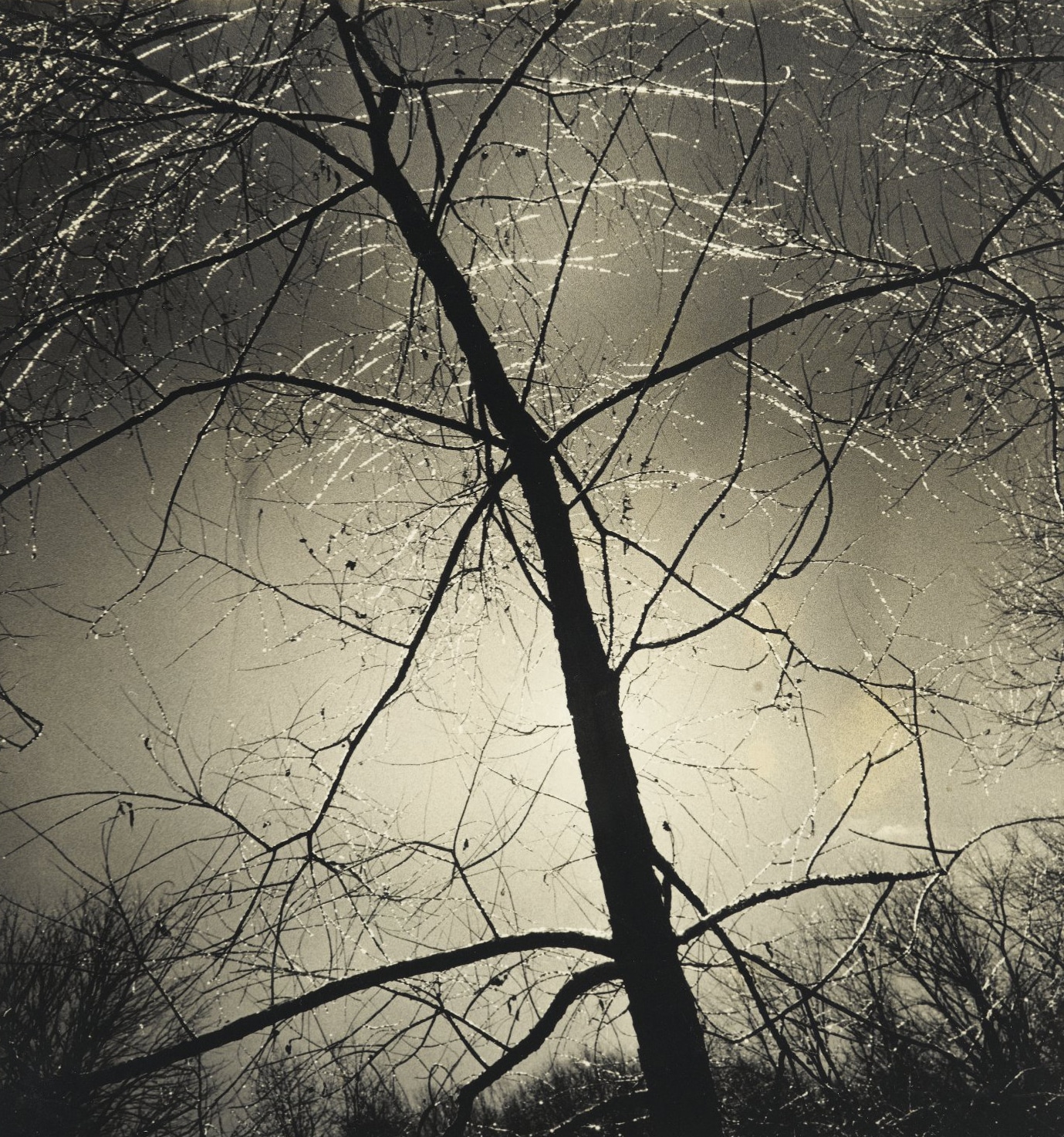
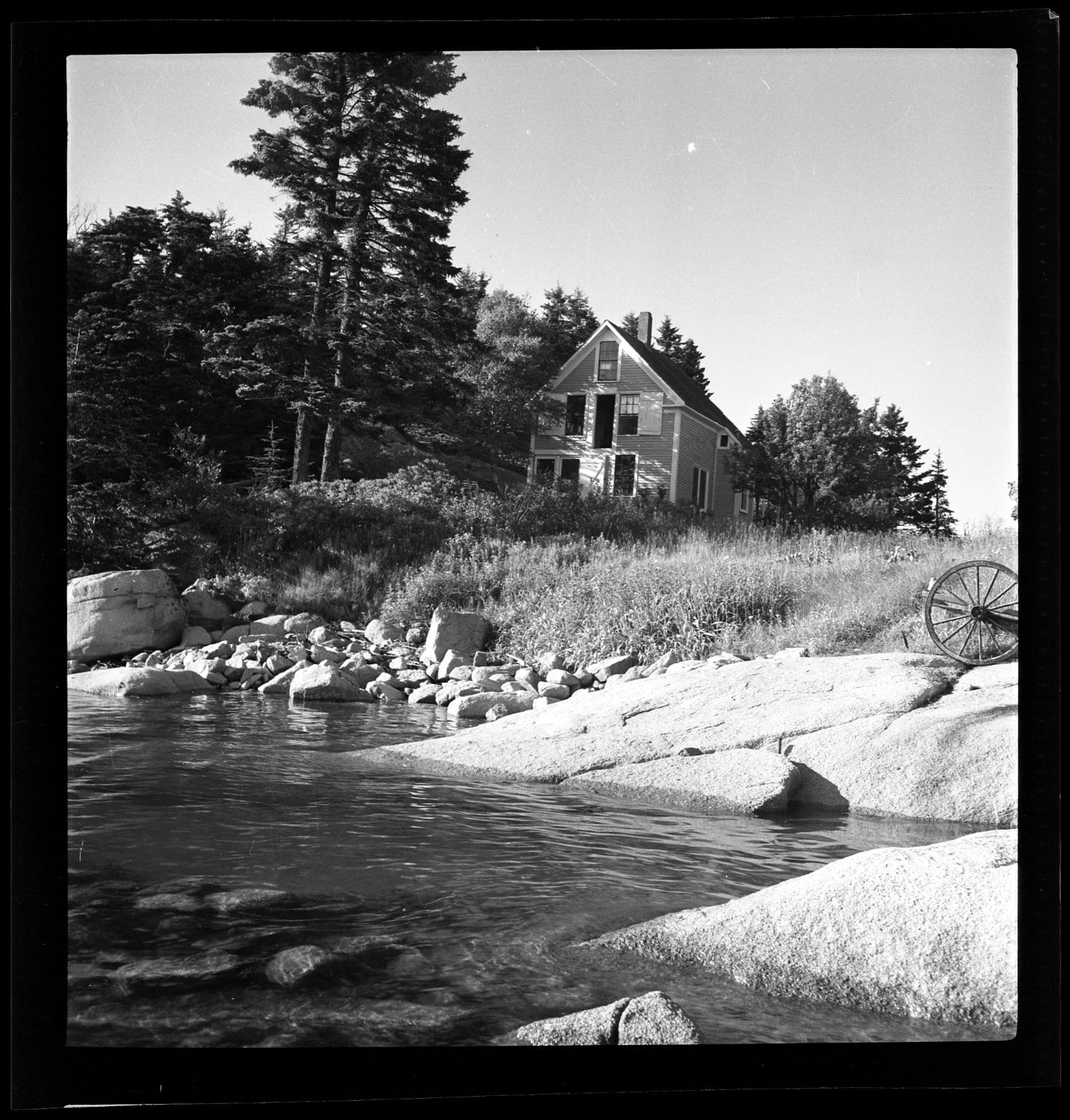
Margaret Wise’s Boudoir is a portrait, and so is the image of the Only House that Kanaga likely made on the same day. The latter is untitled, a synesthesia of hot sun, deep shade, and icy water; it is a brighter, crisper composition than Boudoir. Here, too, though, after a moment, a mysterious portal at the center draws the eye, revealing itself to be the organizing principle of the scene. The Only House has a second-story door, and it stands open, without railing or balcony, a black oblong giving straight into the air.
The word ‘boudoir’ suggests not the plain and everyday, but interior space at its most luxuriously feminine.
One longs to know more about the exchanges between these two women, both working artists, on a summer day in Maine a few years after the end of World War II — about the conversations that gave rise to the portraits of a beautiful blonde in a dark jacket, lounging on a striped daybed, lying in the grass, hugging a black dog, looking away from the camera with a warm yet ineffably distant expression — and about the photographer’s roaming, either in company or alone, through the field and down the shoreline. The literature on Kanaga is meager, and she goes unmentioned in biographies of Brown. 9 She was sixteen years older than the owner of the Only House. Neither had children. Kanaga’s friendship circle included Dorothea Lange and Edward Weston, Milton Avery and Mark Rothko, Countee Cullen, Langston Hughes, and Jean Toomer; she photographed striking dockworkers in San Francisco, itinerant field workers in Florida, and children on the streets in Kairouan, Tunisia and St. Croix, the Virgin Islands. 10 She married three times. Brown was at the height of her fame, “the laureate of the nursery,” when she died in a freak accident at age 42; including posthumous publications, her complete oeuvre numbers more than 100 books. At the time of her death, she was engaged to a great-nephew of John D. Rockefeller, Sr. Prior to that, however, she had been in a decade-long relationship with a dashing poet and playwright named Michael Strange, who — as Blanche Oelrichs — had been married to John Barrymore. Michael was 20 years older than Margaret, and they had stayed together until Michael died. 11
Of course, the tenderness that shimmers in Kanaga’s photograph of Brown’s boudoir need not be eroticized. Or, better put, an erotics of looking need not translate — perhaps cannot translate — uncomplicatedly into other parts of life. The mood remains, though.

If you would like to comment on this article, or anything else on Places Journal, visit our Facebook page or send us a message on Twitter.