

Back in the pre-pandemic winter of 2019, the University of Minnesota-Duluth held a two-day conference with a timely theme: “Our Climate Futures: Meeting the Challenges in Duluth.” 1 The keynote was delivered by Jesse M. Keenan, an urban planner whose research focuses on climate adaptation and the built environment. Keenan had been crunching the numbers and studying the projections on future climate migration — or “climigration” — in the United States; and he had begun speculating about where climate migrants would go. One place they might go, he told the audience, is Duluth. Yes, the city had suffered decades of post-industrial decline in the late 20th century, but what matters now, as the country adapts to new climate realities, is that Duluth is an upper Midwestern city, far from the eroding coastlines of the Southeast and the blistering heatwaves of the Southwest. The cost of living is relatively low, the education and healthcare sectors robust. Perhaps most important of all, the city is located at a latitude of 46° north on the western shores of Lake Superior, the largest of the Great Lakes and one of the largest sources of freshwater on the planet.
Keenan concluded his talk by offering a series of potential, somewhat hyperbolic taglines for the city. Among them: “Climate-Proof Duluth.” Though Keenan immediately qualified this idea (“No place is immune from climate change,” he told the audience), the slogan caught on, and a month later the New York Times published an article leaping off from Keenan’s talk: “Climate projections suggest that, because of geographic factors, the region around Duluth, the Great Lakes area, will be one of the few places in America where the effects of climate change may be more easily managed.” 2
America’s Rust Belt has emerged as the geographic focal point in a growing conversation about how the nation’s demography will shift.
Other northern cities have been making similar cases. The mayor of Buffalo, New York, declared that the former industrial city on the shores of Lake Erie — a sort of easterly twin to Duluth— will be a “climate refuge.” The chief sustainability officer of Cleveland, also on Lake Erie, described the Ohio city as a “haven,” where the “climate refugee crisis is bound to catalyze further growth.” And a Milwaukee public radio reporter asked, “Could Wisconsin become a climate haven?” 3 America’s Rust Belt has emerged as the geographic focal point in a growing conversation about how the nation’s demography will shift as places like Phoenix, Dallas, and Miami — Sunbelt cities that are still some of the fastest-growing in the country — experience ever deadlier weather that threatens to destabilize housing markets and jeopardize entire industries, such as agriculture and real estate development.
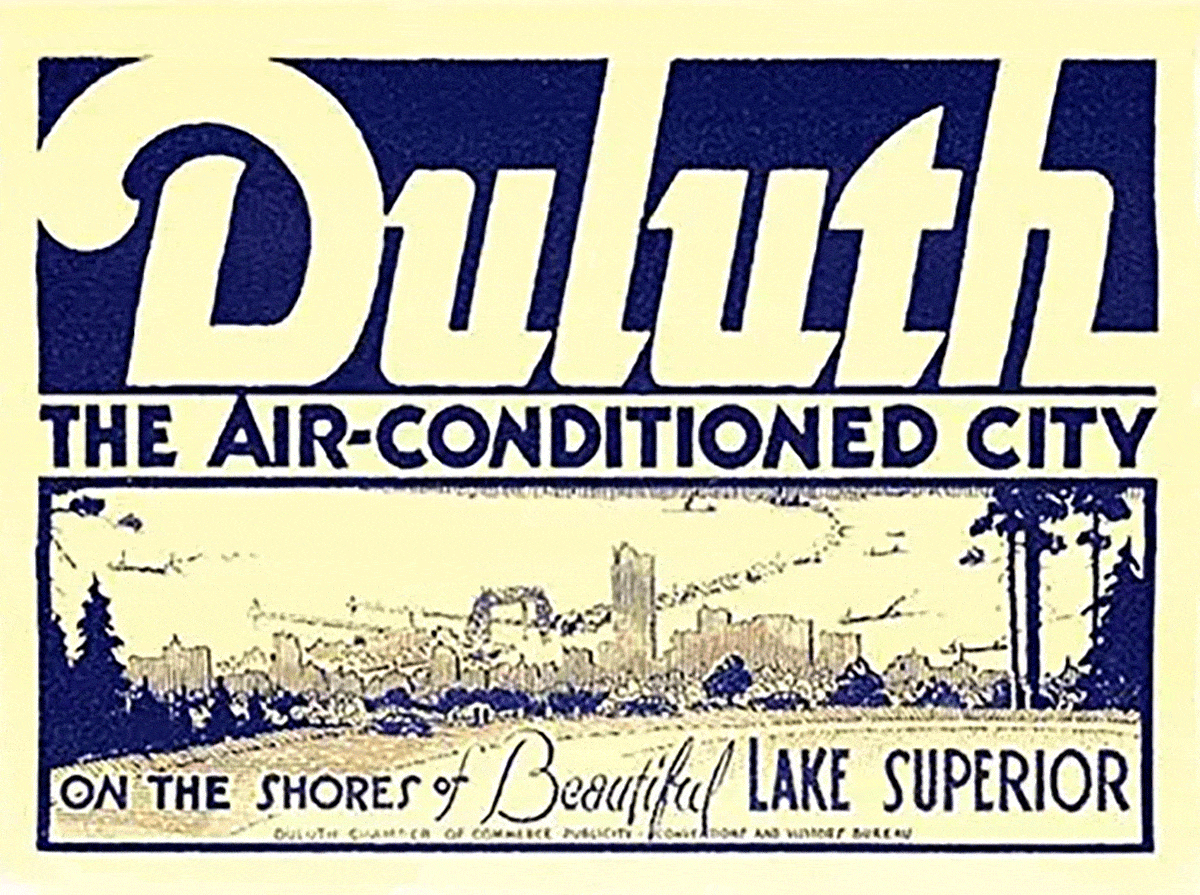
The questions raised by such a reversal of migratory patterns are as complex as they are urgent. In the coming decades, as rising seas and rising temperatures drive large-scale domestic migration, which places will lose population, and which places will see sizable gains? Which groups will be the first to flee, and which will struggle to find safety? America’s political leaders and policy makers ought to be grappling with these questions right now. Designers and planners, too, will need to help strategize how cities can grow (and shrink) in ways that avoid the enervating and often unjust cycles of boom and bust. “Climate-proof Duluth” is smart branding. But how will the city need to prepare for a surge in population, for tens of thousands of new residents, some of whom may need assistance, and all whom will rightly expect good housing, schools, hospitals, and services?
What will it take to create true climate havens?
Two recent books by leading climate reporters delve into these difficult and complicated questions. The Great Displacement: Climate Change and the Next American Migration, by Jake Bittle, and On the Move: The Overheating Earth and the Uprooting of America, by Abrahm Lustgarten, each tackle the vast and often overwhelming implications of climate migration across the United States. Such migration is not a matter of speculation. Rather, it is a certainty, a phenomenon that will without question redraw the demographic map of the country. Here is Bittle: “By the end of the century, climate change will displace more people in the U.S. than moved during the Great Migration, uprooting millions of people in every region of the country.” 4 And Lustgarten: “Drought, coastal flooding, crop failures, intensifying hurricanes, extreme heat, and wildfires will begin to overlap and close in on the country from its edges, slowly making entire regions less attractive and even, in some extreme cases, unlivable. …. Decades from now, the United States will be wildly different, even unrecognizable.” 5
Migration has long been seen as a secondary effect, a collateral consequence, of climate change. Yet arguably the most visceral way human beings will experience the cascading impacts of global warming will be through the loss of their homes, or their livelihoods, or their communal networks. In both The Great Displacement and On the Move, the authors chronicle the personal stories of individual Americans. They draw on copious data and numerous interviews to show us the crushing calculus that is involved in the decision to relocate, even temporarily, in the wake of catastrophe. Together these individual stories gather force to become an unsettling chronicle of migration, displacement, and retreat that is already underway.
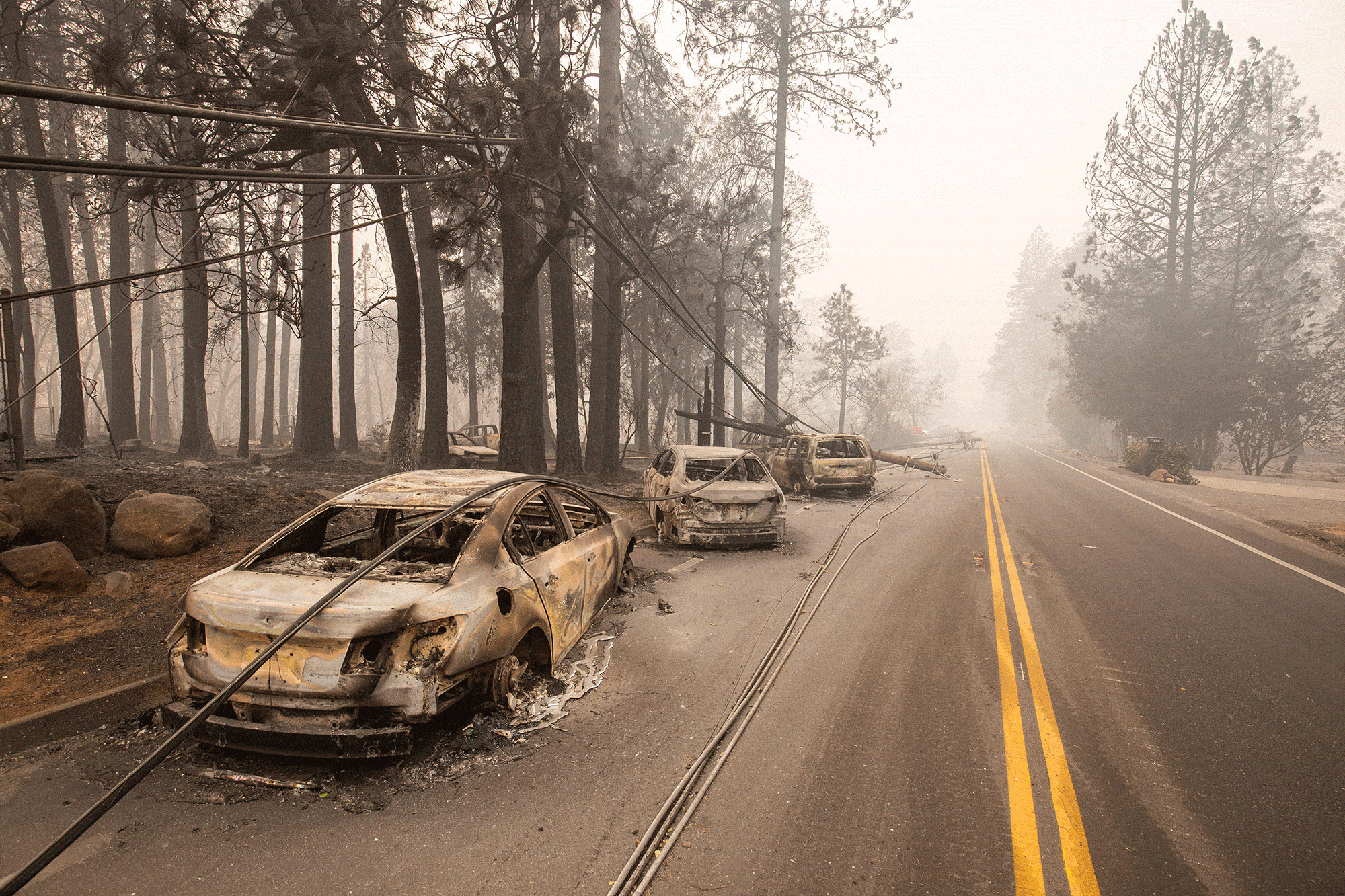
Indeed, as climate-related relocation becomes increasingly commonplace, discernible patterns are emerging. Both authors highlight the aftermath of the Camp Fire, which in November 2018 killed 85 people and destroyed most of the northern California town of Paradise. In the days and months afterward, a geographer and GIS analyst at nearby Chico State University, Peter Hansen, began the painstaking process of collecting addresses and relocation data for roughly 37,000 people who had been left without a home.
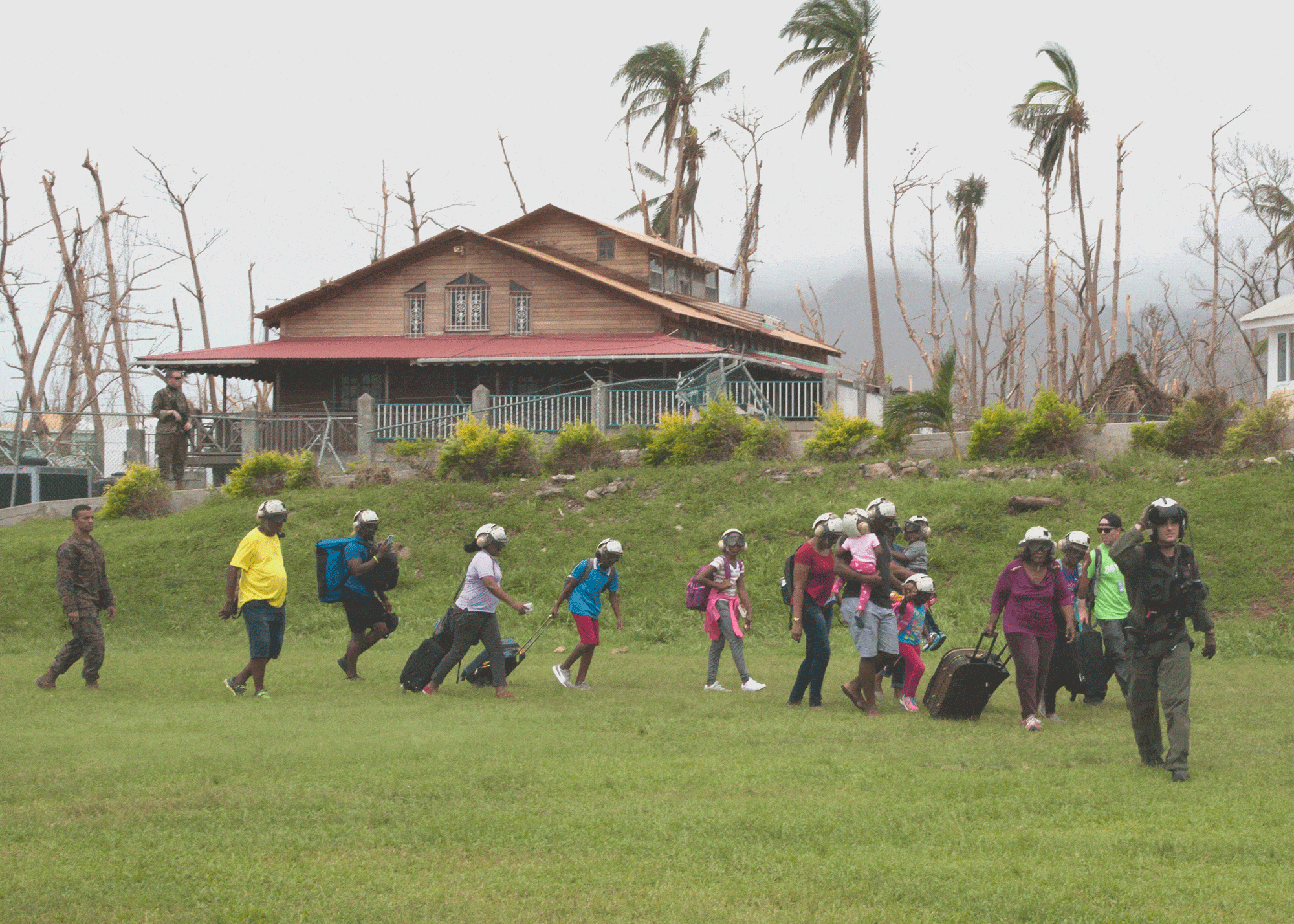
“Hansen was able to track where many of them went,” Lustgarten writes, “and in doing so, established a reference case for the kind of mass flight that demographers think may soon be increasingly common across the United States.” 6 Camp Fire refugees ultimately landed in all 50 states, but unsurprisingly, the largest number made their way to Chico, the closest large city, while sizable cohorts moved to nearby states like Oregon, Nevada and Idaho. Likewise, after Hurricane Maria devastated Puerto Rico in 2017, the post-disaster diaspora could be traced to every state in the nation, but most islanders fled to nearby cities in Florida.

Arguably the most visceral way human beings will experience the impacts of global warming will be through the loss of their homes, or their livelihoods, or their communal networks.
Within these exoduses, Bittle identifies more granular patterns of migration. While the majority of Puerto Ricans displaced by Maria chose to move to Orlando and Miami — cities with large Spanish-speaking populations that are a short flight from San Juan — a significant number chose less obvious destinations like Buffalo, New York, and Springfield, Massachusetts. Yet these places were not chosen at random. “Both cities boasted large Puerto Rican communities that had bloomed over generations as Puerto Ricans arrived to work manufacturing jobs,” Bittle writes, “and the thousands of Maria refugees who made their way to these cities after the storm found familiar community and social support.” 7 A similar dynamic, at a much smaller scale, can be seen in the relocation choices made by former residents of Paradise. On the one-year anniversary of the Camp Fire, dozens of people who had lost their houses gathered at a brewery in a suburb of Boise, Idaho. The area had become a receiver region for Camp Fire refugees, Bittle tells us, thanks in no small part to an enterprising realtor who had moved from Paradise to Boise many years earlier, and who, after the fire, “did her best to help as many of them as possible find a home in the Boise area.” 8
These fuzzy but nonetheless legible migratory patterns can be understood as early evidence of what Bittle terms “climate negentropy.” Negentropy, or negative entropy, is the “tendency of things to become more ordered over time.” Initial relocations after a disaster tend to be “chaotic and unpredictable,” but eventually the “churn of displacement will … coher[e] into identifiable patterns of long-distance migration.” 9
It’s difficult to assess the extent of climate migration in the U.S. today, but Bittle suggests it “may be more widespread than we think.” According to a 2021 survey from the real estate company Redfin, climate risks are at least a partial factor in nearly half the decisions to move within the U.S. “Moreover,” Bittle writes, “three-quarters of all respondents said they would hesitate to buy a home in an area threatened by climate change, even if it were more affordable.” 11From one vantage point, this is clearly good news. From another, it underscores one of the vexing contradictions of American demography. For decades the national housing market has been shaped, or misshaped, by what Lustgarten calls “rafts of incentives and bad policies” 12 that enable, even encourage, Americans to live in places that are increasingly environmentally vulnerable.
The housing market has been shaped by incentives and policies that enable Americans to live in places that are environmentally vulnerable.
Arguably the most influential of these incentives are the many state-subsidized insurance programs that help lower the cost of home ownership. The first program was started in Florida in the early 1990s, when the extensive damage caused by Hurricane Andrew provoked many insurance companies to raise their premiums or leave the state entirely. “For the first time,” Lustgarten writes, “the grim specter was raised that Floridians living on the coast might never be able to buy a homeowners insurance policy again.” The state’s response was swift. To shore up the insurance market — and, more broadly, the housing market — lawmakers began regulating the industry, either by imposing rules that prevented private companies from canceling policies or by offering state-based policies at below-market rates. It was, as Lustgarten puts it, “a bold experiment in pulling government levers to override market signals.” It has worked almost too well; within two decades, “Florida had become its own largest insurer, responsible for more than 1.5 million properties and more than half a trillion dollars in liabilities — a sum roughly six times the size of Florida’s entire annual budget.” 13 Today, a majority of states have similar insurance programs, all of which not only lower the financial cost of owning a home but also, and much more perilously, obscure awareness of the dangers of living in places of substantial risk.
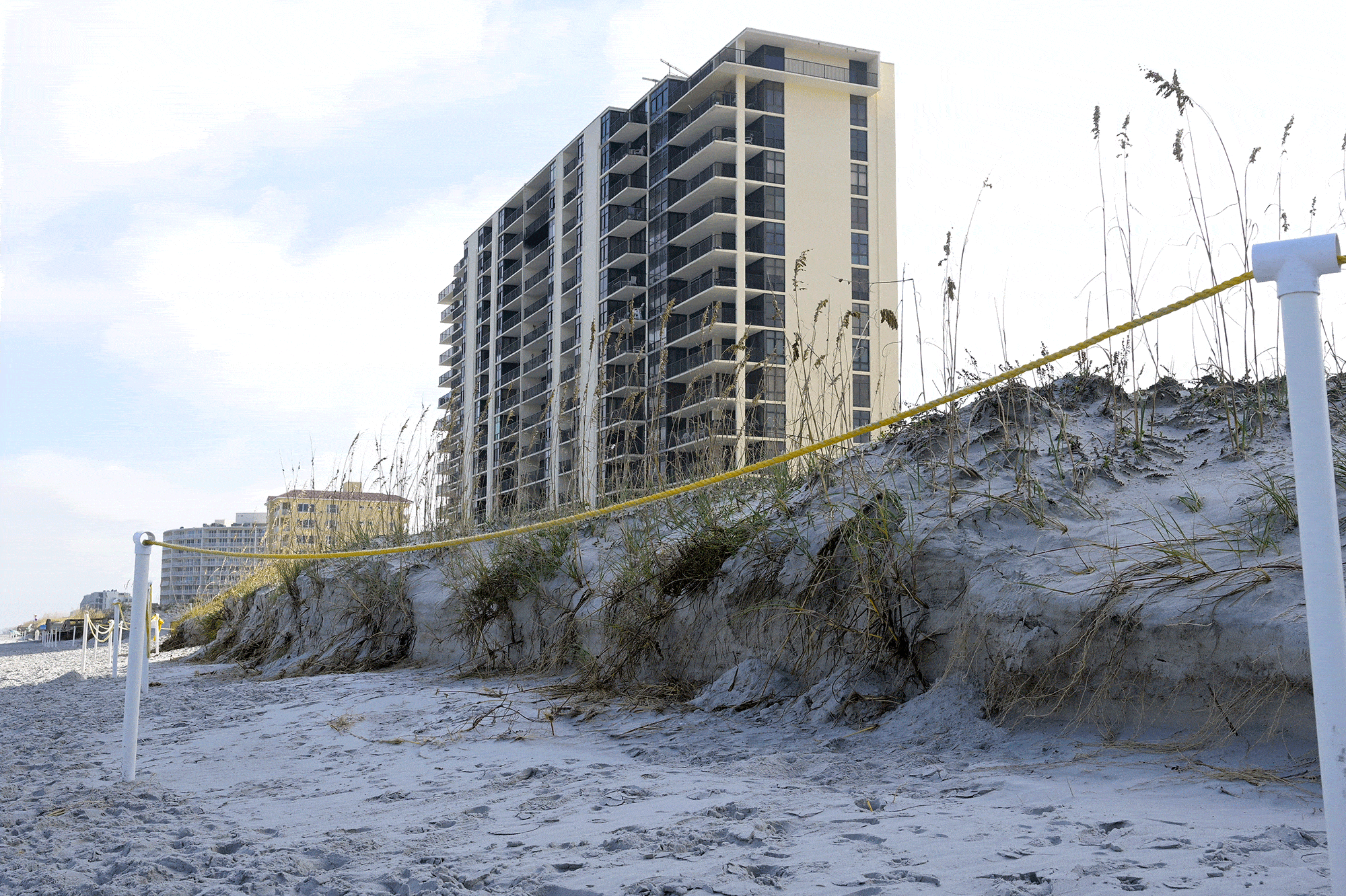
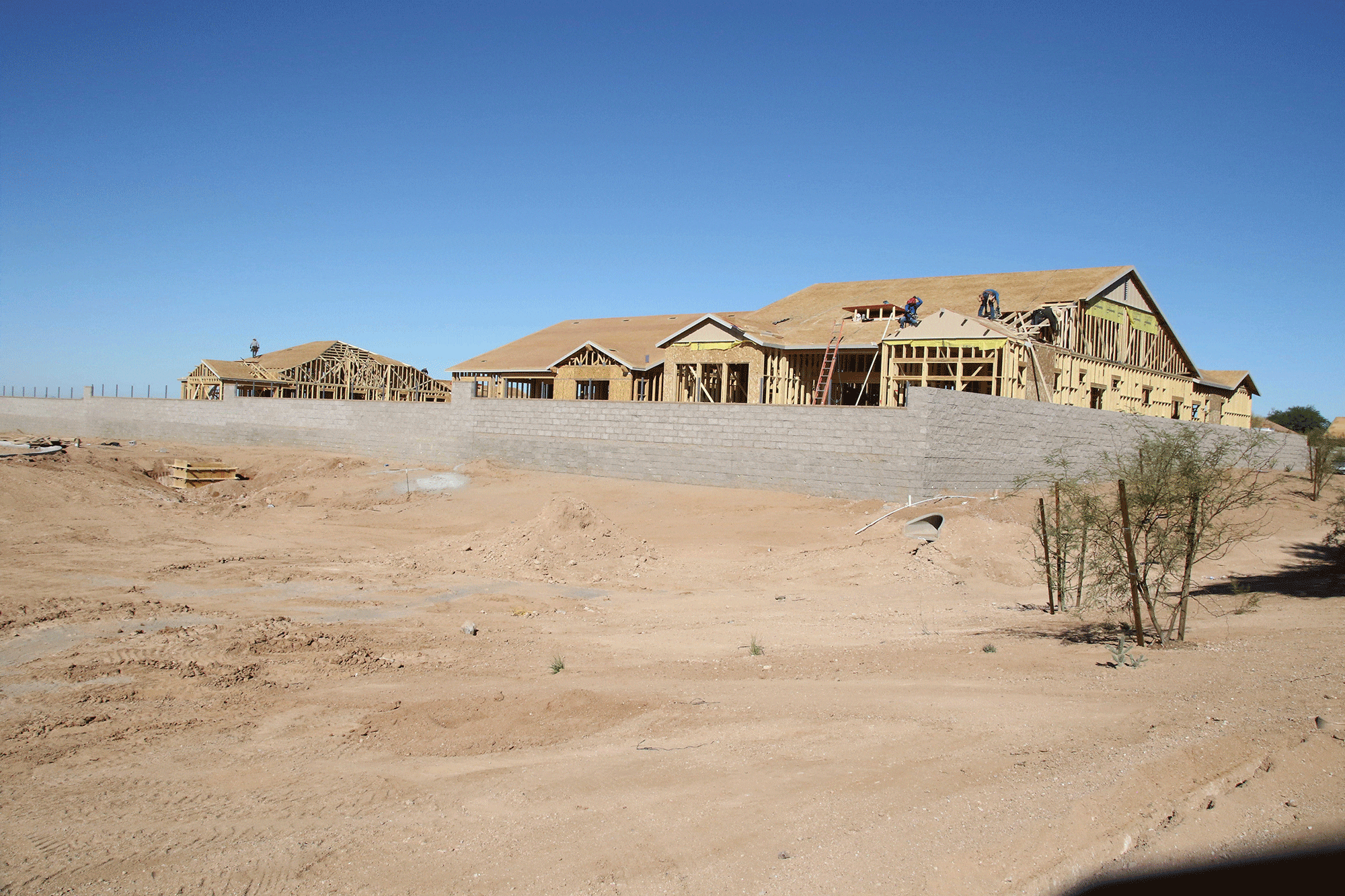
Around the same time that Florida was gaming the insurance market, lawmakers in a state across the country were intervening in the workings of an even more vital market. Much like Florida, Arizona had grown explosively in the latter half of the 20th century, and the fortunes of the state had become inextricably linked to the success of its housing market. And because much of Arizona is a desert, the success of that market is dependent upon the supply of water. By the mid-1990s this supply was increasingly imperiled.
Longstanding state regulations required that property developers show “an assured water supply” for new projects, and as a result groundwater was being over-pumped and depleted; this in turn led to new restrictions on pumping. In response, lawmakers and developers joined forces to create the Central Arizona Groundwater Replacement District. This “novel authority,” in Bittle’s words, allows developers to pump groundwater and “pay it back” with surface water drawn, sometime in the future, from the Colorado River. To put it another way, the CAGRD is a crafty accounting maneuver that lets private developers to stake a claim on a dwindling resource, “a giant loophole in the state’s groundwater restrictions, one that opened the gates to rampant development and deferred a difficult reckoning to someday in the distant future.” 14
Actually, that reckoning is imminent: Due to severely reduced flows on the Colorado River, for the first time in history, the federal government has imposed cuts to states’ water allocations, raising questions about the viability of future growth. Already, Arizona farmers are being told by their irrigation districts that no water will be coming after all.
How individual readers respond to these books will likely depend on where they live, on their sense of ambient danger and, perhaps, on the grief they feel about our climate future. For me, living in the center of the United States in a predominantly rural state, the books serve as a dire warning to farmers, farmworkers, and rural residents, as well as to our political leaders.
This past summer, I sat on the porch of my aunt and uncle’s farmhouse in Ada, Kansas, in the northern part of the state. My uncle and my cousin, who has his own farm in southwest Kansas, were discussing this year’s soybean harvest and whether it would be any better than the summer before, when the crop had failed all across the state because of multiple 100-plus-degree days amid an ongoing drought. The plants themselves had grown but, stunted by the excessive heat, no beans had developed in the pods. Statewide, 400,000 acres of soybeans went unharvested.
For farmers in Kansas, and in the southern half of the country, the new normal of extreme heat and erratic precipitation will pose an existential challenge.
For farmers in Kansas, and in the southern half of the country, the new normal of extreme heat and erratic precipitation will pose an existential challenge. “The last great disruption to American agriculture was the 1930s Dust Bowl,” Lustgarten writes. “A dust bowl of equal if not even greater proportions is likely to happen again.” 15 In Texas, by the second half of this century, crop yields might drop by as much as 90 percent; in Oklahoma and Georgia, by 40 to 60 percent. As Bittle points out, water scarcity and rising temperatures will affect entire regions. Describing the prospects of agricultural and real estate development in Pinal County, Arizona, he concludes: “If floods and fires had changed where people lived, the drought was changing where they could live.”16
As American farmland becomes less productive, and livelihoods harder to eke out, farmers will be forced to sell off their acreage, local businesses will close, and rural people will be out of work. This will be a crisis not just of identity but also of social welfare. Currently, federal assistance programs do not account for slow-moving events like drought; and in any case, these programs generally favor urban residents over rural ones. Given the significant gap between urban and rural costs of living, climate migrants fleeing small towns will struggle all the more to find affordable housing, potentially forcing them to travel further or else trapping them in place. 17
Recent scientific research suggests that the human climate niche is both shrinking and moving poleward.
As more and more Americans awake to the rising risks of a changing climate, some will opt to leave their homes. Others will be forced to. Where will they go? In his book, Lustgarten draws on a landmark study by the theoretical biologist Marten Scheffer, who argues that for millennia “people have lived in places that offered a very specific and narrow range of moderate temperatures and modest precipitation — a human niche.” 18 Today, according to Scheffer, that niche is both shrinking and moving poleward. As a consequence of global warming, vast regions of the planet — including Brazil, India, and Saudi Arabia; much of equatorial Africa and Southeast Asia — will become unendurable for human beings. In these temperature projections, the U.S. will fare better, but here, too, the niche will shift. “Scheffer’s models,” writes Lustgarten, “suggest the best living conditions on the North American continent will jump dramatically northward within fifty years.” 19

Both Lustgarten and Bittle follow the findings of Scheffer and agree that the likeliest migratory paths will be to the north, and in particular to the region that has long been shorthanded by the pejorative “Rust Belt.” We should pause and consider the historical significance of such a shift: The reversal of half a century of southward population flows. The end of an era of broad, technologically powered indifference to climate and geography. The belated acquiescence to geologist John Wesley Powell, who surveyed the American West in the late 19th century and warned that much of the land was too arid to sustain large-scale development. 20 What will this reversal look like? Bittle sketches the outlines of a new national demography:
The moderate temperature zone that scientists call “human climate niche,” which in the United States now stretches from South Dakota to the Sunbelt, will shift northward so that by 2070 its northern edge reaches into Canada and its southern edge ends around Kentucky. The areas below that niche will get hotter and more humid with every passing year, and as time goes on, they will start to seem more dangerous and less attractive. The already sweltering South will get even hotter, the temperate parts of the country will no longer feel temperate, and the frigid reaches of the North will feel a bit more hospitable. 21
It may take years for any northward migration to gather momentum, but both authors agree that the Rust Belt has clear attractions and advantages. Precisely because many of its cities were once more prosperous and populous than they are today, they have existing infrastructures — vacant housing and fallow urban fabrics — that could be rejuvenated. “Places like Detroit, Milwaukee Cleveland, Buffalo, and Duluth,” writes Lustgarten, “… have housing, space, extra road lanes, plentiful wastewater treatment … and even, perhaps, a public transit system made for a larger population, all of which could readily serve more people again in the future. They have, in a word favored by planning types and scientists, ‘capacity.’” 22
Rust Belt cities that were once more prosperous and populous than they are today have existing urban infrastructures that could be rejuvenated.
Rust Belt cities are, in other words, poised to become what some are calling “climate boomtowns.” For places that have seen their industries leave and populations dwindle, the prospect is understandably enticing; it’s no wonder they’re rolling out slogans like “climate-proof” and “climate haven.” But booms are as problematic as they are seductive. All too often, in booming places, housing prices are inflated, longtime residents are displaced, and socioeconomic and racial inequities are intensified. Bittle quotes a member of the Lake Superior Chippewa who fears that climate migration to Duluth could mean “cultural and spiritual genocide” for tribal communities. 23 Rapid growth attracts speculation, too, especially in regions where chronic disinvestment has kept land prices relatively low. From Lustgarten we learn that investors like Bill Gates “have snatched up thousands of acres of farmland” in the upper Midwest, causing land prices to “skyrocket.” 24 It’s easy to imagine corporate landlords buying up whole depopulated neighborhoods in, say, Toledo, Ohio, or Gary, Indiana, and leveraging municipal concessions in return for redeveloping their properties.
More immediately, the experience of Chico, California, offers a warning about the stresses of “receiver” cities. 25 After the Camp Fire, the city initially welcomed the refugees from Paradise; locals provided open space for tents, plus donations of food and clothing. But soon the city struggled to absorb the influx. In response to new demand, housing became extremely expensive; within a year, Chico’s unhoused population had grown by sixteen percent. As municipal services were stretched, “the situation became overwhelming,” Lustgarten writes.
The streets were clogged with traffic. Car accidents increased by nearly 50 percent. The sewage treatment plant began struggling as its capacity was overloaded. Planners said that the facility might need a $14 million upgrade a decade sooner than the city had expected. Property taxes and sales taxes would have to rise. Then, trailing the stress and the crowding and the desperation, crime began to increase, too. 26
All of which leads back to the question: What will it take to create true climate havens? How can cities avoid the all too predictable pitfalls of market-driven boomtowns that prioritize economic growth and private profit rather than larger public benefits? How can cities grow in ways that take seriously the fundamental lessons of the climate crisis and advance the well-being of both longtime residents and climate migrants? What new planning paradigms are needed in the coming era of mass climate migration across America?
Only the public sector has the power and resources to manage the immense collective challenges of displacement and resettlement that will unfold over decades.
Both The Great Displacement and On the Move are unsparing in their assessment of the shortcomings of current public planning and policy — all those insidious incentives and flawed policies that trap people in high-risk places. “The hierarchy of federal disaster policy is sluggish and outdated,” writes Bittle, “focused for the most part on rebuilding properties where they once stood.” 27 At the same time both authors are equally clear that it is only the public sector that has the power and resources to plan for and manage the immense collective challenges of climate-related displacement and resettlement that will unfold over decades. As the geologist Nicholas Pinter points out, in a recent article on “managed retreat,” there is precedent for federal involvement in community relocation. In 1937, after devastating floods along the Ohio River, the Works Progress Administration helped move at least two Midwestern towns — Shawneetown, Illinois, and Leavenworth, Indiana — to higher ground. The New Deal agency relocated entire buildings and constructed “streets, sidewalks, parking, water and sewer, and a new town hall.” 28 More recently, the federal government has funded the voluntary relocations of endangered tribal communities in Isle de Jean Charles, Louisiana; Taholah, Washington; and Newkok, Alaska. 29
And yet current federal programs are insufficient to respond to the scale and nature of many communities’ needs. Last year, in an essay in Bloomberg CityLab on climate migration and public policy, I made the case for a new federal agency, “a department that could plan and coordinate the challenging process of relocation and adaptation knowns as managed retreat.” 30 More recently, in the same magazine, Yuliya Panfil and Tim Robustelli, policy researchers at the think tank New America, argued for a “whole-of-government plan to incentivize climate transplants to the Great Lakes, the northern Great Plains and the Northeast.” 31
The agenda of a new government agency or relocation program will be vast and multi-pronged. As an essential first directive, it will need to actively discourage investment in vulnerable places. (Panfil and Robustelli warn that continuing growth across the southern United States will lead in the coming decades to a “climate-driven property meltdown.”) It will need policies that subsidize and incentivize both buyouts and resettlements, policies that ensure that the redrawing of America’s demographic map is fair and equitable to everyone; and it will need to sustain these policies over decades. As Bittle argues, the obligations of the nation’s lawmakers are not only political and practical but also ethical. “In an era of climate instability,” he writes, “we must do everything we can to create a universal guarantee of shelter.” 32

The future that Bittle and Lustgarten describe, the redrawing of the nation’s demographic map, will surely be met with resistance. Especially in the short term, cities and states will attempt to prop up the status quo, to maintain “business as usual.” Scottsdale, Arizona, for instance, is rolling out a branding campaign that downplays the risks of extreme heat, promoting nighttime mini golf and marketing the city with the slogan “It’s that hot!” Meanwhile, Las Vegas recently spent $1.2 billion to construct an underground tunnel — a “drain hole,” in Lustgarten’s words — that will allow the city to siphon every last drop of water from the rapidly shrinking Lake Mead. And just last month, I got a text from a colleague in South Dakota about a “massive project … to get Missouri River water to the Black Hills in anticipation of not having enough water to support development.” She predicts that the Missouri will be “the next Colorado River.”
Whether the U.S. makes progress on a climate migration plan will depend, in the near term at least, on the outcome of the presidential race.
Whether the United States makes progress on a comprehensive, proactive, and humane climate migration plan will depend, in the near term at least, on the outcome of the presidential race. In the past few years, the federal government has committed more funding for climate adaptation and renewable energy than ever before. The election of Donald Trump and the implementation of Project 2025 — the 887-page policy playbook developed by the right-wing Heritage Foundation — would undo many of those recent achievements. It would hamstring the Environmental Protection Agency, shrink the Department of Energy, and end federal restrictions on oil and gas drilling on public lands. It would privatize the National Weather Service and entirely eliminate the National Oceanic and Atmospheric Administration — a key agency in the production and distribution of climate data. 33 Project 2025 would, in short, be catastrophic for the climate.
Already, inaction on the part of governments and industries has foreclosed the most optimistic climate adaptation scenarios; several years ago, as Lustgarten writes, leading scientists came to the gloomy consensus that the world was “hitting critical warming benchmarks sooner, and with more dramatic consequences, than expected.” 34 In his 2019 talk, Jesse Keenan emphasized that there is no such thing as a “climate-proof” city; too much has changed, and too much rides on how we design, build, and manage the cities of the future. 35 But if the challenges are immense, even historically unprecedented, we still have the ability to respond, to shape our future. At the end of his sobering book, Jake Bittle offers this hope:
The world is already being remade, but its future shape is far from set in stone. The next century may usher us into a brutal and unpredictable world, a world in which only the wealthiest and most privileged can protect themselves from dispossession, or it may usher us into a fairer world — a world where one’s home may not be impregnable, but where one’s right to shelter is guaranteed. Both worlds are possible. We still have time to choose between them.” 36


If you would like to comment on this article, or anything else on Places Journal, visit our Facebook page or send us a message on Twitter.