

History and Decarbonization
Carbonization is an historical process, still ongoing in the built environment, the techno-sphere, and the atmosphere. Architecture, buildings, design; plumbing, structure, finishes; supply chains, energy networks, infrastructure: buildings are, as material systems, media for the throughput of processed fuel resources, their distribution, their becoming social. Extraction and exploitation of energy resources have dead-ended both ecologies and human-built environments, and as we are soaked in oil we are also net-zero-ized, solar farmed, everything-electrified. Even our solutions are energy intensive. Energy demand, long understood as progress and growth, now delivers an omnipresent shock to a bloated yet ossified system of energy provision, draining away the promise of tomorrow.
Architectural history is a history of carbonization. The emergence of architectural modernism saw a dramatic amplification in the flow of energy, and also carried that flow deeper into our lives and daily practices. Through buildings, architects design how we live with carbon. Indeed, the built environment more generally has a metabolic relationship with our socio-energetic system, mediating, adjusting (usually upward), materializing energy throughput and carbon emissions. Increased energy use is posed as a solution to social and industrial challenges, perhaps foremost in the simple connection of energy demand to economic growth.

For the past century, architects have by default worked as agents of carbonization, collaborating on systems that lock in carbon dependence through both embodied and operational demand. Architects lock in and perpetuate a wider system of carbon dependence, from the corporate boardroom to the oil well to the government subsidy, securing the place of oil, and its excesses, in our lives. Subject to repair, then: histories of architecture that uncritically circulate narratives of carbon intensification.
Subject to repair: histories of architecture that uncritically circulate narratives of carbon intensification.
The architectural history of decarbonization comprises an archive overflowing with experiments and technologies, with narratives of novel pasts and possible futures. If we schematically “bracket out” the oil-hungry architectures of 1930 to 2030 — veil a century of petroleum proliferation — a less carbon-intensive causal chain becomes available, one that reaches into the past and outlines a different future. It’s a chain, a network, a rhizome integrating tradition, intervention, and tacit knowledge; invention, aspiration, and speculation; a resurgent interest in the presence of the past in tools, patterns, and collectives.
It’s akin to what Kate Soper terms “avant-garde nostalgia” — not, pointedly for architects and historians of modernism, nostalgia for a progressive avant-garde, but rather a search for “new forms of representation of the relationship between past and present, tradition and modernity.” The architectural history of decarbonization opens up to a designed future of decarbonization. This repair of history, and history of repair, frames architecture as a social machine for climatic engagement, a medium for adaptation and mitigation, a cultural elaboration of whatever the opposite of carbon lock-in can be.
— Daniel A. Barber
It’s a warm afternoon in Nazareth. Children ramble while an old man in a white tank top feeds his parakeet on a balcony. In the background, a radio broadcasts a reporter explaining partition plans that will suspend the war in Bosnia and Herzegovina, in the former Yugoslavia.
The vignette is from Elia Suleiman’s 1996 film Chronicles of a Disappearance, a patchwork of intimate absurdities, alienations, and catastrophes that bear witness to Palestinian life since the Nakba in 1948. These few seconds of satire capture two worlds being broken, as the present in Bosnia and Herzegovina entangles with the present in Palestine, the stateless nation.
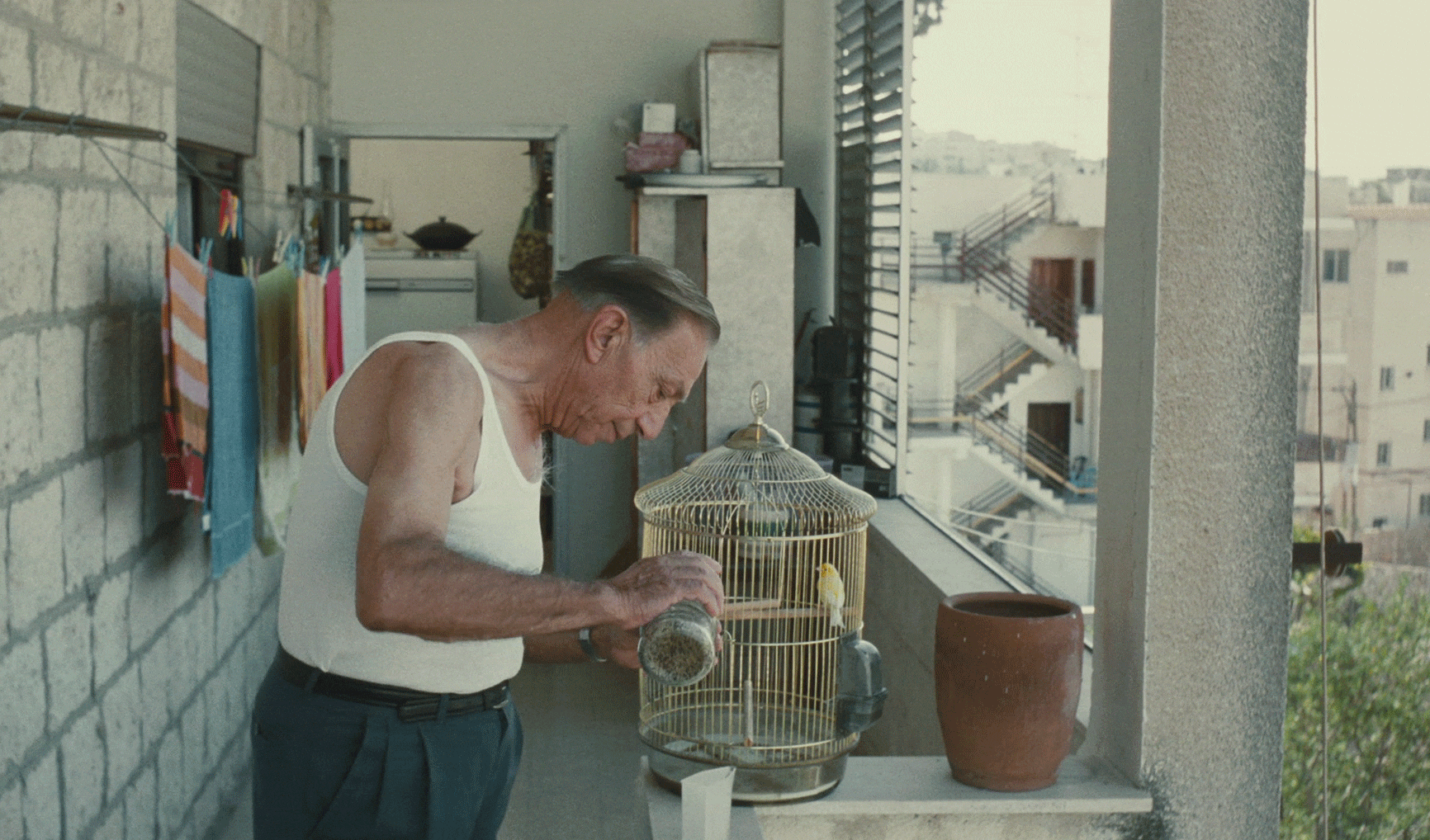
Suleiman made the movie in a period when western governments were celebrating the end of the Cold War and the “end of history.” Three decades later, we understand the 1990s as a period of genocidal violence in Africa and Europe, while synchronous peace processes — Dayton and Oslo — took center stage in global politics, one suspending the war after genocide against Bosnian Muslims, and the other making Palestine into a Bantustan for the new millennium.
But unlike geopolitics, a discipline that often neglects the depth and breadth of life as lived, in the minds of victims, a genocide hardly comes to a close. How does life go on in the midst and in the aftermath of such suffering?
In September 2020, two decades after burying the remains of his war-torn house in Kevljani, a hamlet in northwestern Bosnia and Herzegovina, Šerif Velić erected a memorial stone. Placed on a short concrete column next to the mound, it reads, “Here lies my house, raised 1974, razed 1992. Love built, hate demolished.” Survivors like Šerif Velić fight the ethno-nationalist entity Republika Srpska to acknowledge the genocidal destruction that lies at its foundation.
In November 2024, Palestinians continue to be killed or injured, or go missing in their thousands, while thousands are believed to be buried under the rubble or in mass graves. In Gaza, exhausted survivors collect debris from their destroyed homes, schools, universities, hospitals, and places of worship; as they dig out bodies, they also exhume concrete, cinderblock, and steel, to arrange dignified burials, despite the fact that no room is left in cemeteries. Imams and undertakers turn into bricklayers and masons.
Unnoticed, un-expert, and relentless, repair is a praxis that reassembles crumbling life-worlds.
Since the 1990s, we have learned that atrocities and genocides unfold in two acts: in the first phase come mass killings and humanitarian intervention, both likely sponsored by foreign state departments; in the second phase, development programs for reconstruction and recovery kick in, often under the aegis of the same foreign actors. Even as violence is going on, Disneyfied visions of real estate bubbles, free trade zones, skyscrapers, 5G, and solar power plants are generated by zealous experts and AI. Haunted by the ghost of a “peace” process, Bosnia and Herzegovina has been relegated (along with Serbia) to the status of sacrifice zone for the EU green transition, integrated into the development process as a silenced periphery. As the Israeli war machine reaches new peaks of destructive violence, the Gazan coastline has also become a training ground for Israeli, American, and Saudi planning and architecture departments, who envision a new economic “peace” after Gaza’s complete erasure.
Against this grand scheme of destruction/salvation, anecdotes of everyday resistance by Bosnian and Palestinian survivors tell us that reconstructions are always taking place. Unnoticed, un-expert, and relentless, repair is a praxis that reassembles crumbling life-worlds — here healing still feels like a luxury and grief is incorporated into the everyday. Where solutions cannot be permanent, and temporariness is existential, repairs are fugitive and contingent, spatial and material practices that escape theorization and canonization; recalling the Arabic word sumud or “steadfast perseverance,” acts of repair constitute an assiduous and exhausting re-ordering of what is broken, as rituals of survival aiming towards liberation.
— Emilio Distretti and Dubravka Sekulić
Mending our low-carbon futures, together
Repair cafés are gradually becoming part of the urban mainstream. Aside from their social benefits, these outlets lend visibility to practices of collective infrastructural maintenance. Repair hubs reflect an ethos of care as a response to the capitalist compulsion toward overconsumption and in-built obsolescence. They draw attention to a set of social relations that have traditionally remained outside the public realm.
This urban repair zeitgeist is developing alongside long-standing efforts to retrofit residential and commercial buildings in response to the climate crisis. Such work involves upgrading end-use energy efficiency across the built fabric, while installing new renewable heat and electricity production facilities. Here, the aim is to reduce energy demand, helping to bring down greenhouse gas emissions. However, the process also disrupts conventional framings of energy systems, because it transforms cities into sites that generate rather than consume energy.
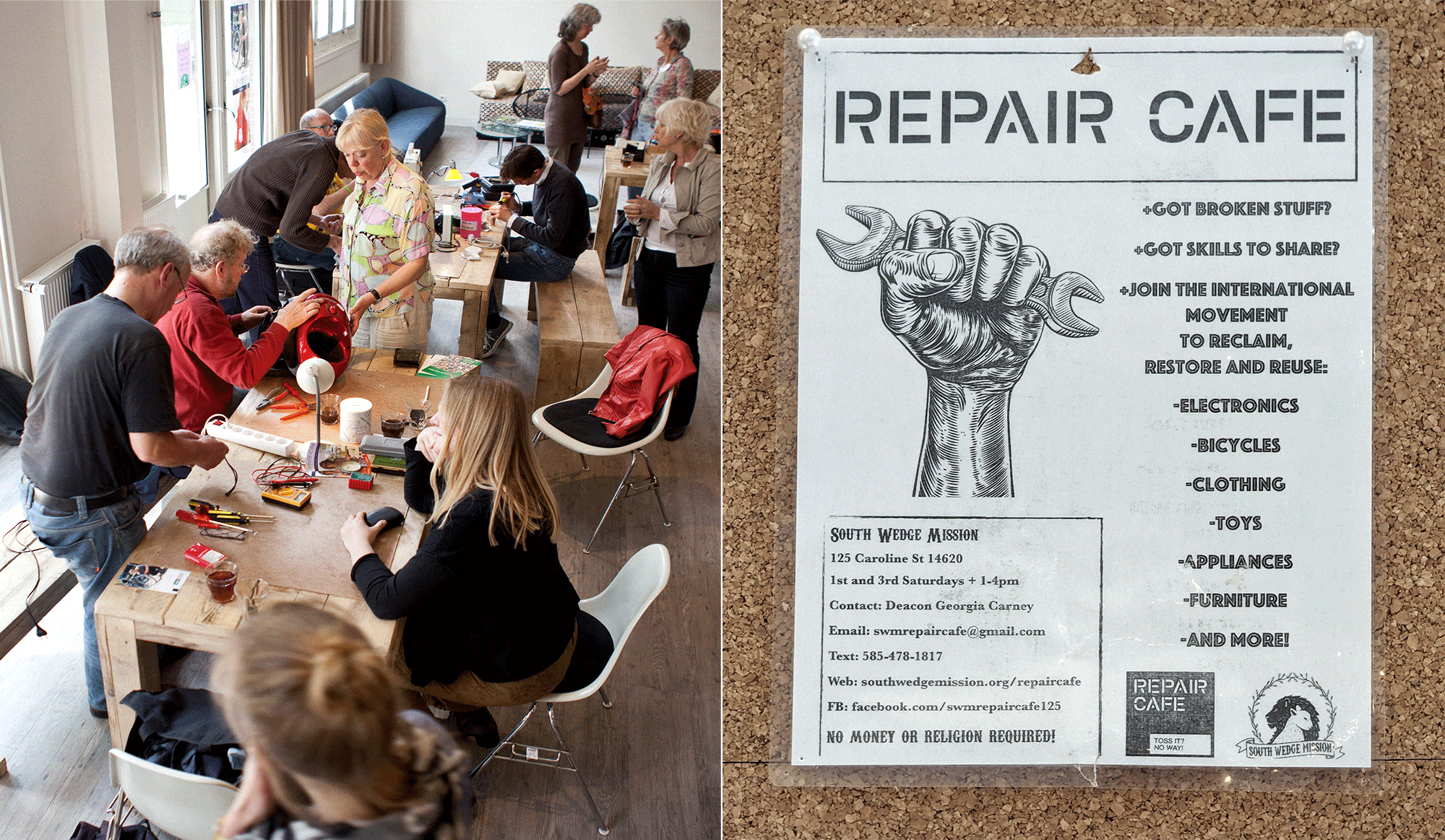
Repair cafés reflect an ethos of care as a response to the capitalist compulsion toward overconsumption.
When it comes to public policies and scholarship, the repair movement often remains disconnected from climate retrofitting. This is largely due to insufficient recognition, in the policy community, of grassroots initiatives, along with the top-down nature of low-carbon initiatives more generally. (The European Union’s right to repair is a notable exception.) It is rarely acknowledged, in these circles, that cities are not just collections of pipes, walls, and cables; they are underpinned by rich social and cultural infrastructures, created through lived interactions and interdependencies. Moreover, reducing carbon emissions means lengthening the life cycles of built structures — which is predicated in turn on their upkeep and modification, to ensure that cities can meet changing societal needs and expectations.
Practices of bottom-up climate retrofit and repair are proliferating, despite the lack of recognition by governmental decision makers. Much of this work is enabled by low-carbon intermediaries — principally third-sector bodies such as social enterprises, advocacy organizations, activist and community groups. In an era of shrinking government capacity (due to budget cuts and austerity) such groups supplement or even replace the functions of public authorities. This engagement exposes them to frequent criticisms, for instance, that they are legitimizing state withdrawal from environmental and social governance. Yet such organizations perform important civic duties by helping to build the complex technical, material, economic, cultural, and political relations that are needed to upgrade the climate credentials of cities.
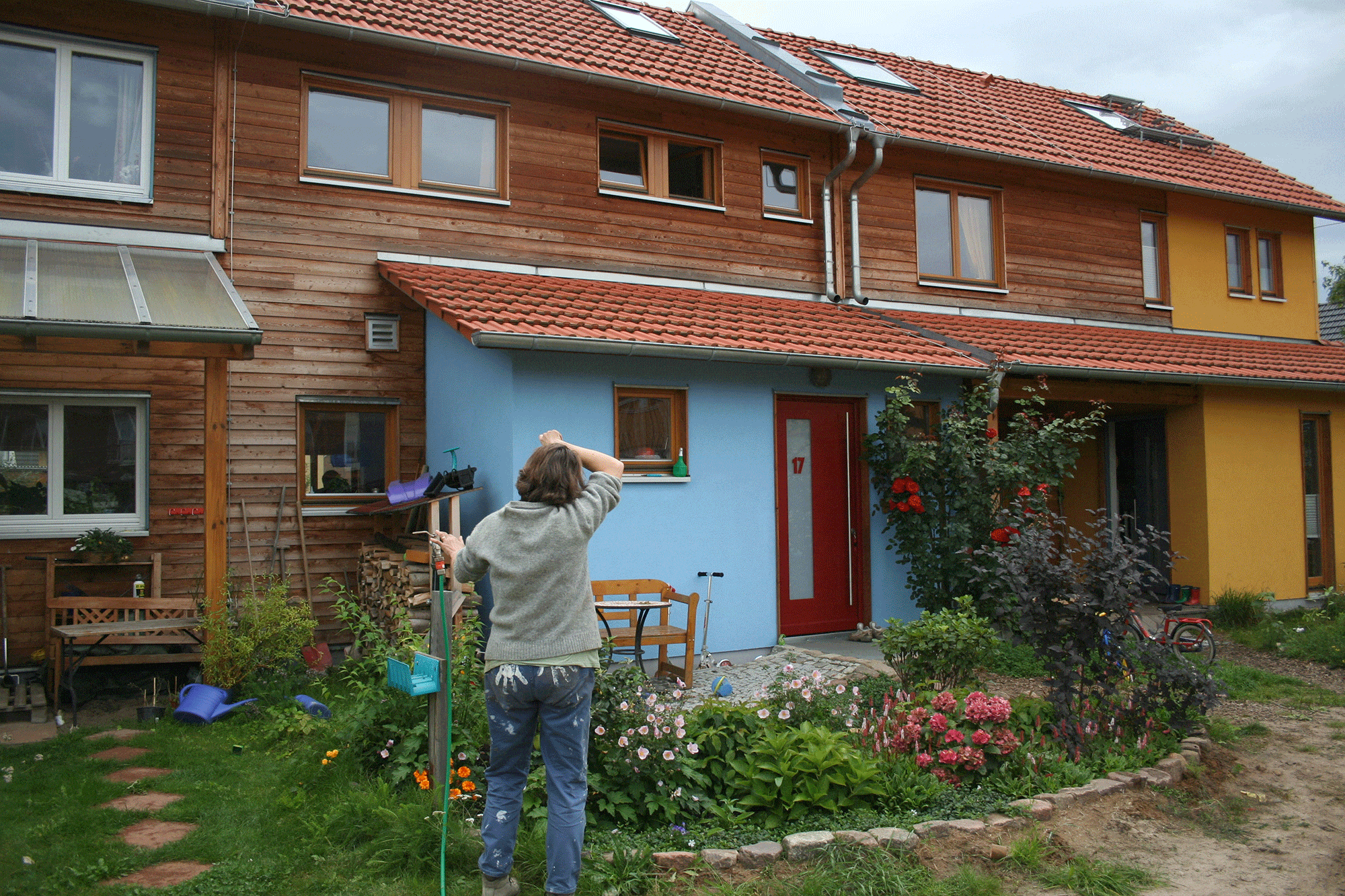
Alongside facilitating retrofit and repair, organizations that provide energy advice to residents (such as Revalue.io, Three cubed, Ecoserveis, Aisfor, National Energy Action) enact new forms of care and sociality. Low-income, marginalized people often live in housing that is expensive to heat and cool, due to its low energy efficiency. Improving the energy performance of such properties and districts requires working closely with local inhabitants to ensure access to needed forms of support — often extending beyond energy services themselves. As a result, nongovernmental organizations working in the climate sector need to mobilize diverse resources and forms of labor — much of which goes unpaid and unrecognized. Their work highlights the fact that transforming our cities in response to the climate challenge is — and must always be — primarily a collective act.
— Stefan Bouzarovski
Environment as collaborator
Does an “ethos of repair” necessarily exclude notions of novelty and innovation? As an architect, one question I grapple with is how we might reshape the perception that invention and experimentation contrast against preservation and restoration. As an educator, I introduce students to these tensions through studio projects that require tectonic and spatial innovation, yet remain grounded in thinking about ecology and biodiversity.
I often recall, for my students, conversations I’ve had with ecologists, in which they say something to the effect: “Well, the best thing you can do to increase urban biodiversity is to leave rotting logs in your yard,” or “Don’t rake up fallen leaves.” These straightforward suggestions are complex in their implications, particularly for architecture. Where, within our disciplinary framework, might we find discussions about rotting logs, and unraked yards, and their architectural equivalents? In a profession that values precision, how do we work with elements and processes beyond our control? How does a designer approach decay?
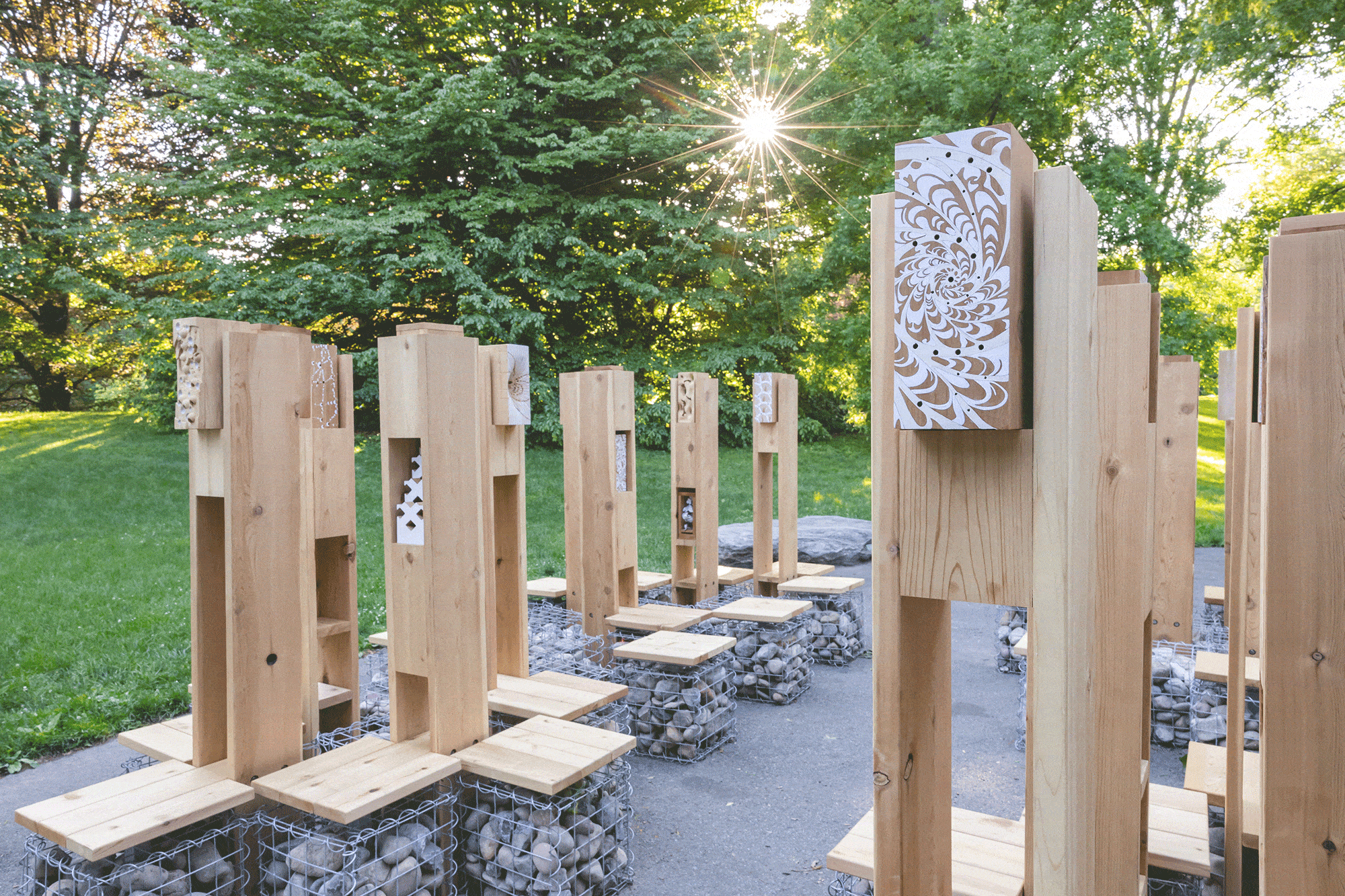
What are the architectural equivalents of rotting logs and unraked yards? How to approach decay in a profession that values precision?
To address these issues, I ask students to consider the environment and its constituent parts as stakeholders in their projects — even as collaborators. Project briefs in my studios often introduce the idea of the umwelt as theorized by biologist Jakob von Uexküll, describing a way of understanding the extended space or environment that matters to any organism. For example, if the rotting log establishes an umwelt for many species — animals live there — how might those considerations be translated, spatially and materially, for humans? What might be analogous constructs? Using experimental forms of representation and interpretation, the design studio can help students to more deeply understand, and perhaps empathize with, their environments and the species in them. Ultimately, my teaching focuses on including nonhuman species in the design process, not only in terms of biodiversity amplification and the provision of “ecosystem services,” but as our neighbors.
— Joyce Hwang
Absent a political program, repair doesn’t give us a way to think about liberatory progress. This impasse shows up in the history of community accountability processes, which have long grappled with the possibility of repair. Developed predominantly by racialized women, queer people, and others disproportionately subject to violence, particularly in the U.S. since the 1970s, these community practices seek to develop alternatives to the criminal justice system. In this history, we find suggestions for how to move beyond the dominant ethos of social disposability and punishment, using a language of resolution, restoration, repair, and more recently, transformation.
Absent a political program, repair doesn’t give us a way to think about liberatory progress.
In its material sense, repair brings to mind isolated attempts to extend the lifespan of made things around us: clocks, computers, bikes, cars, homes. Taken as a metaphor for political action, repair evokes attempts to patch or mend the systems we have in place, without necessarily discerning between elements that should be maintained, and ones worth doing away with. A repair mindset doesn’t always ask who was served in the first place, and at whose expense. In its tendency to focus on details, and to require specialized technical knowledge rather than political analysis, repair can restrict our attention to what’s already in front of us. The repair of broken things doesn’t lend itself to a framework for considering coordinated, systemic change.
Some of the same pitfalls open up when considering repair in social relations. When community accountability frameworks fail to acknowledge the political and economic contexts in which violence happens, they are more likely to be used inside prisons, thus helping to legitimize institutions that reproduce the very cycles of violence that community-based practitioners have set out to dismantle.
In the 1990s and early 2000s, such concerns motivated activists, scholars, and community groups in California to develop Transformative Justice — a set of practices for addressing conflict while rejecting the carceral culture enforced by policing, prisons, and other state interventions. Like an architect’s parti, this framework for transformation implies intentional change over time from a well-understood beginning toward a defined goal. TJ is practiced in a number of ways. But some tenets I find relevant include: centering community self-determination; establishing a common understanding of reality and what histories have led to a given present; and orienting the work at hand in explicit opposition to systemic oppression. This process affords participants the opportunity to question inherited structures, to revive suppressed cultural practices, and to meaningfully discuss what kind of life they — we — would like to make together.
As a road map and a philosophy, Transformative Justice imparts important lessons as we build, fix, dismantle, replace, upgrade, hack, retrofit, and transform the world together.
— Sasha Plotnikova
Non-reformist repair
The senescence of the 20th century, if not enlightenment modernity and historical progress altogether, has by now come for most of us. Even here, in New York City, a town not given to historicist sentimentality, our decaying infrastructures, along with hard limits on buildable land, are prompting new enthusiasm for restoration, reclamation, and reuse. In the past decade there have been numerous plans and projects to repair contaminated land, mitigate air pollution, and unravel the toxic legacies of infrastructural and carceral projects that have perpetuated injustice.
The scale of environmental remediation is staggering. Consider, for instance, the massive efforts to redevelop the land around the Gowanus Canal, the almost two-mile-long industrial waterway in Brooklyn that was designated a Superfund site fifteen years ago. Now the area has been rezoned for residential development — which raises serious questions about the wisdom of building housing atop a flood plain drenched in every pollutant imaginable.


Likewise, repair projects for the city’s aging inner-city roadways seem likely to reinforce old inequities. Back in the mid-20th century, when the Brooklyn-Queens Expressway and the Cross Bronx Expressway were constructed through dense neighborhoods, thousands lost their homes and communities; since then nearby residents have endured decades of environmental stresses. Now federally funded projects that aim to “repair” the damage are remarkable only for their lack of imagination. These include a “replaced and rearranged” BQE, and an expansion of the Cross Bronx, pitched as a “community connector.” Residents are rightly skeptical of these projects, which offer, at best, cosmetic “solutions” and do little to recompense those who have been harmed.
In contrast, a plan to redress the city’s cruelest infrastructure suggests a powerful alternative. Renewable Rikers is a visionary proposal to replace New York’s infamous jail with green energy and wastewater facilities, all relocated from communities that have been historically over-burdened with dirty infrastructure and disproportionate police presence and incarceration rates. Unfortunately, progress on that project seems to have stalled, while new jail construction proceeds apace.
Instead of shoring up noxious systems, activists who pursue non-reformist reforms seek genuinely new possibilities.
In this light the experience and logic of the prison abolition movement provides both a warning and alternative for infrastructural repairs. Instead of shoring up noxious systems, activists who pursue “non-reformist reforms” seek genuinely new possibilities. Now designers of the built environment need to make a similar distinction between so-called repair that reinforces the status quo, and what we might call non-reformist repair. At Gowanus and other sites around New York, municipal and state authorities promote “sustainable” brownfield reuse that largely serves to grease the machinery of real estate development. In Brooklyn, Queens, and the Bronx, they’re lining up once again for federal highway funding that repeats the mistakes of the past. These large-scale projects are, in short, business as usual. When is something too broken to fix? Can we envision a world in which we do more than patch things up —in which we abandon the broken systems altogether?
— Mariana Mogilevich
Repair To
According to our prevailing understanding, claims or acts of repair first require the recognition of harm. Consequently, what we define as repair is conditioned by injury. The commensurability between harm and repair, where repair is measured by its capacity to respond to violence, limits our ability to reconcile injury with the claims of the injured, and to imagine relations beyond damage. It is a conceptualization that, to me, evinces a troublesome preoccupation with the broken. It constrains our analyses of place and relations that occur therein. Ideologically, it suggests that many of our typically liberal frameworks for envisioning newer and more just terms of living — more just terms on which to theorize life — are inadequate.
Instead of viewing repair solely as a response to impairment, we must shift from the common verb “to repair” to the much less familiar “repair to.” The former encompasses familiar actions of fixing, mending, healing, or restoring. The latter, a phrasal verb, lends itself to anticipatory and collective engagement. It implies direction, intimates rest, and speaks to momentum, ultimately offering a notion of reparation that is more purposeful and place-based than “repair” alone.
To repair to is to move toward a sense of belonging; to take refuge in a future where restoration is more than a response to harm.
This notion of repairing to, of moving toward or going to a place (“especially in company,” says my dictionary), encourages a profound reevaluation of the values by which scholars, designers, and practitioners working for justice envision and articulate frameworks of care, community, and restoration. Such a conceptual shift evokes growth and renewal, highlighting the importance of nurturing what already exists, rather than perpetually seeking fault, failure, and fissures. Repairing to necessitates a fundamental change in how we theorize relationality. And this implies, in turn, a radical reconceptualization of space, not as a site for post-harm intervention, but as a landscape of preemptive caring. Our theoretical constructs must help us to advance built environments that, in their very design, resist the easy paradigms of ever-present destruction and fragmentation. Moreover, when critiquing design, planning, and other spatial processes, we must challenge the impulse to perpetuate the binary of damage and repair.
This should translate into design that prioritizes community well-being, where collective interdependence is as fundamental as aesthetics, functionality, density, and proportion. Design and planning have increasingly embraced equity-centered design and sustainability, and involved marginalized communities seeking to produce just and inclusive outcomes. But “repairing to” goes beyond integrating these practices. It calls for new analyses, perspectives, and principles, fostering spatial and political configurations to ensure that communities are not defined by injury.
To repair to is to move toward a sense of belonging, irrespective of violent exclusions or attempts at interruption. It is to take refuge in a future where restoration is not merely a response to harm, but an ongoing process of creating environments and relationships grounded in care. This approach challenges us to rethink not only our design frameworks but our politics, to transcend the reactive and become proactive, generative.
— Jovan Scott Lewis
Towards an Ethos of Repair and Care in Design and Architecture
The shift from prioritizing novelty and innovation to embracing an ethos of repair and care necessitates a fundamental reevaluation of societal ideals and educational practices, especially within the realms of design and architecture.
Firstly, we need to reassess our shared values, which idolize the new and shiny. This cultural fascination should be replaced by an appreciation for diversity in aesthetics and material authenticities, as these resonate with the relevant environment, histories, and imperfections. This would require us to let go of fixed ideas and open ourselves to multiple interpretations of what constitutes aesthetic excellence, and of worth beyond immediate monetary valuations. By reflecting on past mistakes and mis-learned lessons, each of us can help to pave the way for futures that are not confined by singular ideas of authorship.
Designers and builders should be re-harvesting construction and demolition waste.
Secondly, transitioning from a linear to a circular economy is critical. This entails moving away from the continuous degradation of natural resources through extraction, towards regenerating and reusing existing materials. For instance, we as designers and builders should be re-harvesting construction and demolition waste, which amounts to nearly 570 million tons annually, and reclaiming residual materials from the 7.6 billion tons of industrial waste created yearly in the U.S. alone. This reconceptualization involves seeing waste not as an end but as a beginning.

Appropriating and re-making materials are intentional processes of changing meanings, finding something extraordinary in the ordinary. This ongoing, iterative process should not be confined to single disciplines, but should involve collaborations among artists, designers, engineers, repairers, and the broader community. Together, we can rethink and reuse discarded and broken objects, in the process repairing not just those objects but the communities that form around them.
Radical pedagogies that integrate material circularity, reuse, and repair into the core of art and design curricula are also necessary. These interdisciplinary and collaborative frameworks should emphasize ethical learning and teaching, focusing on deconstructing and understanding existing resources. This educational shift challenges the primacy of newness and perfection, promoting an appreciation for the good inherent in what already exists.
Radical pedagogies must integrate material circularity, reuse, and repair into the core of design curricula.
Ultimately, we in the design professions must shift our focus from construction to deconstruction, emphasizing the regeneration of resources and safeguarding both material and immaterial values. Switching from the use of market-driven, virgin resources to re-harvesting construction waste and residual industrial waste is achievable. But turning our 20th-century modernist mindsets away from profit maximization, efficiency, and orientation toward growth requires difficult cultural work. Because this also means transforming designers and architects from authors to caretakers, maintainers, and repairers of our built environment.
— Markus Berger
Everyday Defenses
This past summer I returned home from a research trip to find a dripping roof in Houston. This was one of the countless aftereffects of Hurricane Beryl, which in July tore through the region with 80-mile-per-hour winds and inundating rainfall. Hurricane Beryl followed Hurricane Harvey (2017) and Hurricane Ike (2008), as well as several major floods in the city in the past two decades. I placed a bowl under the drip while I called our building manager; in a few hours, the drip was (temporarily) stopped. The experience brought to mind the various scenes of disrepair and ruination I had seen on my trip. I had traveled to Mumbai, which, much like Houston, has a history of storms and flooding that have intensified in recent decades.
Mumbai is wet, fragile, saturated with the effects of climate-related emergencies. The city is under continuous repair — repair that brings together labor, building practices, regulations, and risk. On the one hand, there are the officially planned renovations and restorations, involving expertise and capital. On the other, there are the provisional patch-ups and small-scale fixes, most of which are quick and messy, undertaken by precarious laborers and marginalized subjects.
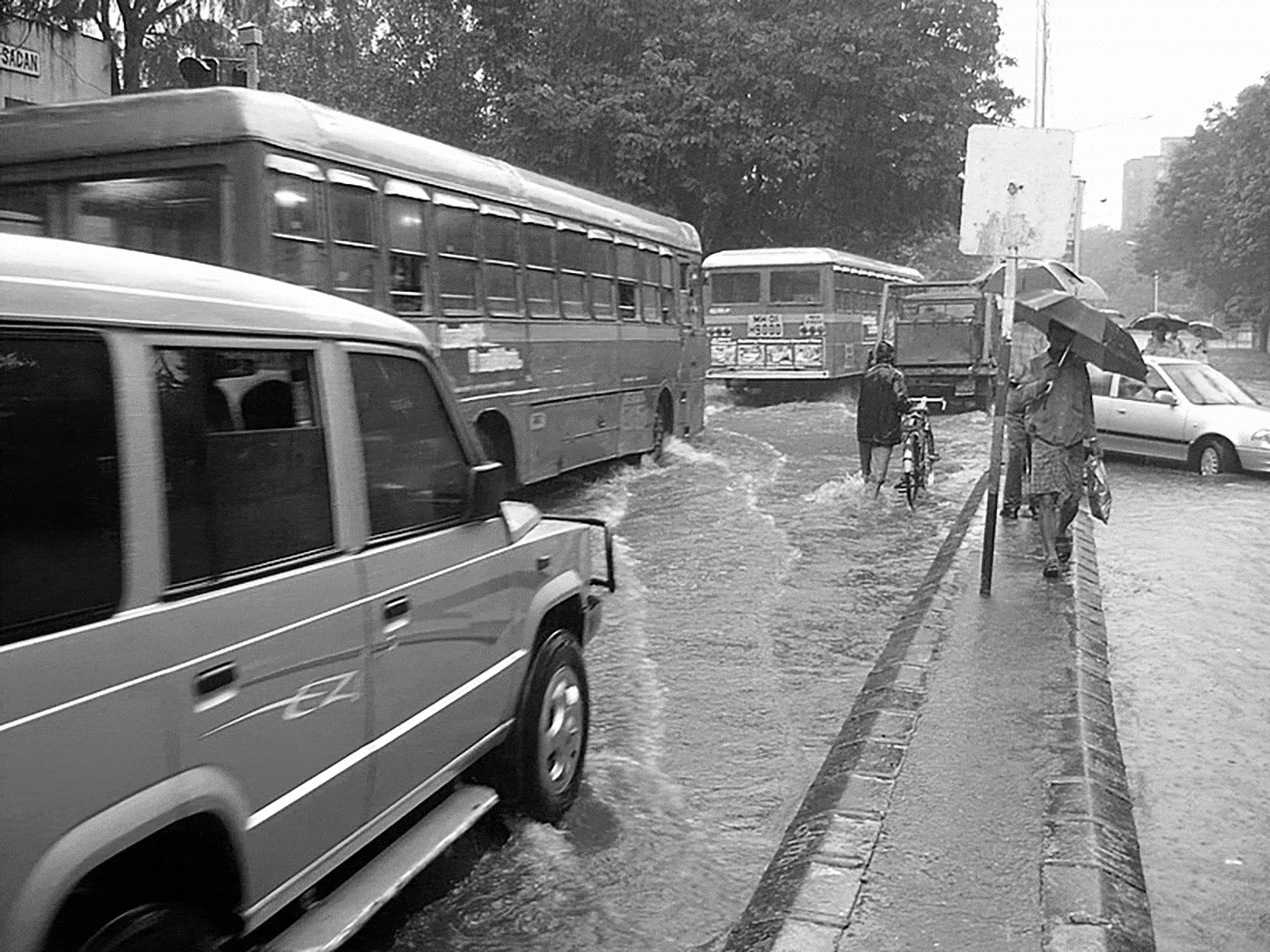
Mumbai is wet, fragile, saturated with the effects of climate-related emergencies. The city is under continuous repair.
Mumbai is teeming with informal construction; with ad-hoc repair practices and everyday maintenance and upkeep that are never acknowledged in dominant narratives of development and growth, in the scaled-up ethos that Steven Jackson calls the “productivist imagination.” Here’s one example: the indigenous Koli fishing community in eastern Mumbai has been practicing what we might call “mangrove vigilantism.” In the absence of timely municipal action, they’ve been monitoring city waterways in order to halt the illegal destruction of mangroves — spongy coastal forests that grow in brackish wetlands and function as vital protective buffers, preventing flooding and supporting ecosystems. Once abundant along coastal Mumbai, mangroves are now being sacrificed to urban and infrastructural development. The community’s vigilantism is an act of improvisational repair that reveals agency from those on the fringe, often in the face of propertied citizenship.
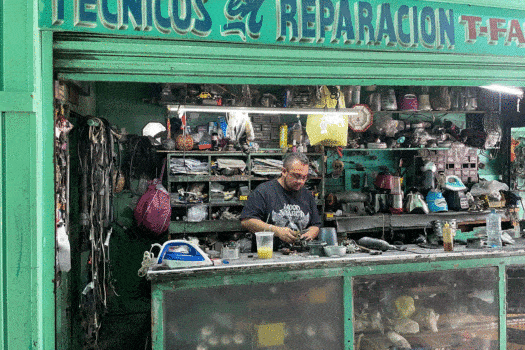
Here’s another example: after the devastating floods of 2005, many in Mumbai depended more on what sociologist Devanathan Parthasarathy calls “informal-sector service providers” than on state-sponsored disaster teams or insurance coverage. In the wake of emergency, it was local plumbers, masons, electricians, and carpenters who made the necessary repairs, and did so cheaply and quickly. They counterbalance the inequities of repair and, as Parthasarathy points out, are often part of “kinship networks.” As such they can respond with agility to disasters, and also to the particularities of local and slow-moving environmental neglect.
Improvised repair underscores the ways in which repair is tied to matters of ownership, citizenship, property, and expert culture; but now it needs to be much more visible to those who participate in global, institutionalized climate change discourse. Mumbai has a history of big-budget infrastructural construction and ongoing repair, of bridges, tunnels, freeways and roads. Yet the everyday defenses that are put in place by marginalized subjects and service providers — against the relentless wetness, corrosion, rusting, dripping, cracking — are just as vital.
— Deepa Ramaswamy
Initiatives for unbuilding, degrowth, and deceleration increasingly promise to reverse the ideology of “development,” yet often fail to substantially criticize it. In architecture (as pretty much everywhere), “development” is seldom questioned as a rhetorical and material enabler of occupation: of bodies, of land and its life-supporting systems.
But a future of social and environmental equity requires us to look to the past. If “development” has sanctioned dispossession and colonization, reparation will enable the only possible reversal. The undoing that architecture pursues via practices of degrowth and unbuilding can only take meaningful shape if those practices center on repair.
Where to find these key lessons on reparation? Where to learn care as an obligation (towards each other, towards planetary living systems), rather than as a mark of self-styled generosity?
Our teachers walk among us. Their lessons are not only a gift, but an urgent demand. More often than not, as we listen, we will learn that our so-called expertise — as architects — is the last thing needed. We are needed, rather, as civic actors conscious of an obligation to (re)build pathways towards justice, guided by teachers whose call for reparations start from the spatial.
Architects are not needed as experts but rather as civic actors conscious of an obligation to (re)build pathways towards justice.
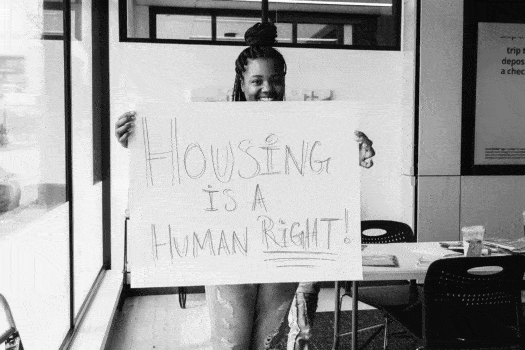
The Indigenous Otomí Community Residing in Mexico City started migrating from Santiago Mexquititlán (in the State of Querétaro) four decades ago. Their demands to the Mexican government and the non-Indigenous population begin with the right to housing in the capital, but, significantly, extend to stopping colonialism and extractivism at national and global scales. In 2020, the community peacefully took over a government building in Mexico City, then the seat of an assimilating institution. Following the takeover, the Otomí transformation of the space went from the meeting of basic needs — offering housing to families of the Otomí community — to the shaping of a site of resistance, where they organize alongside fellow Indigenous peoples. Traversing scales, their struggle outlines a renewed relationship between bodies and architectures, communities and landscapes.
This struggle calls for housing for the Otomíes: “Tener techo es un derecho.” (“A roof is a right.”) The neoliberal myth of meritocracy would ask: Why must the government create shelter for this Indigenous community rather than for other disadvantaged groups? This question calls for a reminder that the territories occupied by the Mexican State are stolen, and while its founding granted independence from the colonial power, it offered no restitution to Indigenous populations. Restoring Indigenous stewardship of and relationship to the land would have meant upending the property regime on which the state’s wealth was founded. Today, its land ownership infrastructure furthers dispossession through a gentrification process that benefits a minority.
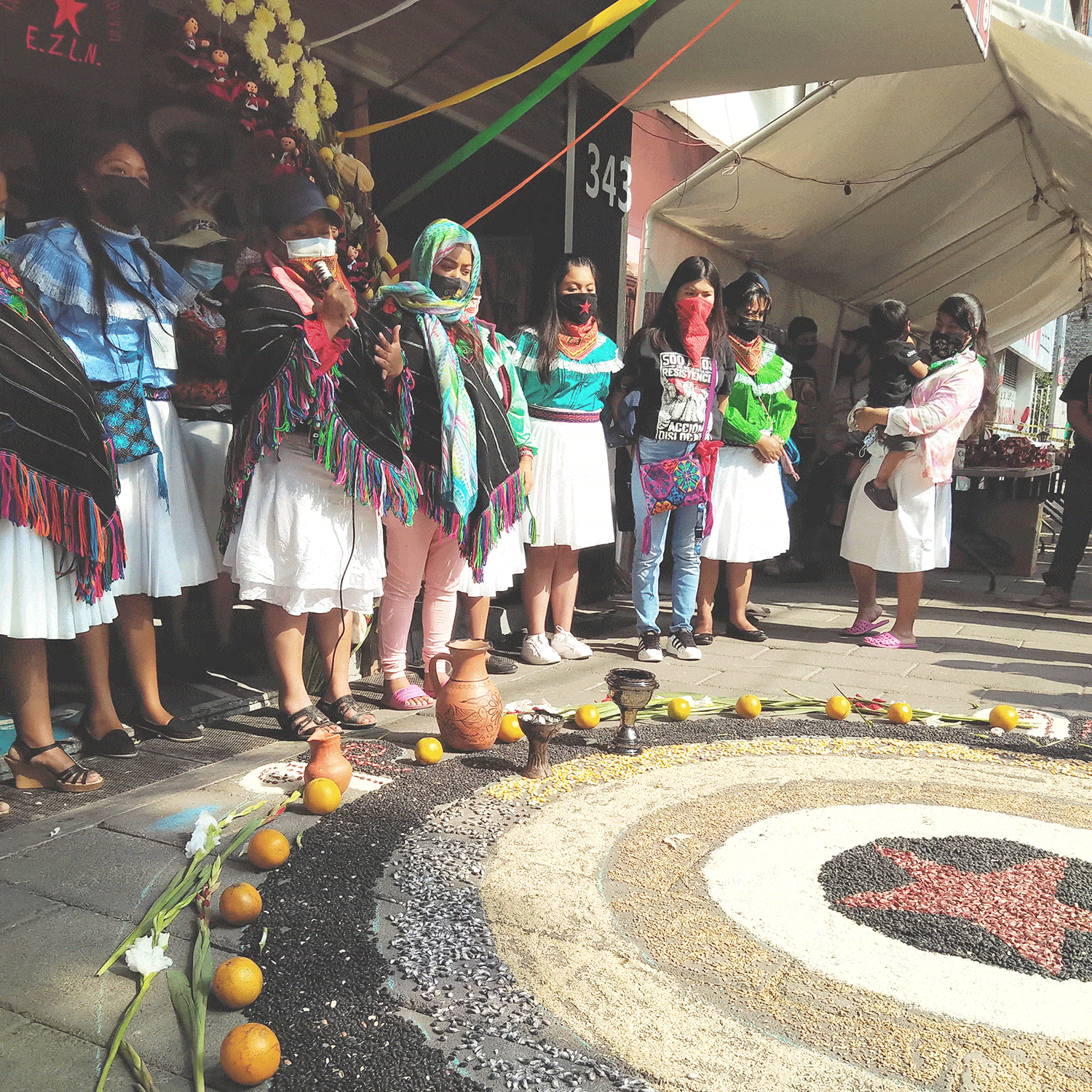
Nothing exposes structural racism more clearly than three generations of Indigenous migrants unable to secure shelter in the capital. Moreover, these families were forced to leave their homes as the neoliberal state has dispossessed people in rural areas. The housing that the Otomíes demand is not a gift, but an act of reparation to which the state is obligated.
The struggle calls for Indigenous peoples’ rights: “Trabajo, educación, salud, alimentación, vivienda digna, paz, justicia, libertad, democracia, tierra, independencia, igualdad.” (“Work, education, health, food security, a dignified dwelling, peace, justice, freedom, democracy, land, independence, equality.”) The Otomí Community CdMx has built a network alongside other Indigenous collectives via the grassroots Congreso Nacional Indígena (or CNI). Fighting for the rights that have not been granted to Indigenous peoples, they demand reparations, always following the principle stated by Maya Angelou and Emma Lazarus: “none of us can be free until we are all free.”
And the struggle calls for defending life: “El agua es vida y la vida se defiende.” (“Water is life, and life is to be defended.”) In the capital and in the rest of the country, the Otomí Community co-organizes with the CNI to protest neocolonialism. Pointing to water systems as reflecting the health of the land, these defenders fight capitalist extraction and state-sanctioned pollution. Chanting “we are one with the land,” their insurgent practices take up space: in such practices, caring is not delicate. It does not ask for permission. It is organized and tenacious. It is direct action and resistance.
— Tania Gutiérrez-Monroy
Fixing with a slingshot
Six years ago, I learned that a street crossing near the apartment building where I live would be rebuilt. I called the city office responsible, and asked how residents would be involved in the planning. The answer was accompanied by a giggle: “Oh, there will be no involvement. Citizens can’t reasonably take part in a traffic-planning process. They would just make things messy.”
Urban development is not for amateurs. Today, the work equipment and barriers are gone. The intersection looks clean and shiny, its markings designed by some highly motivated traffic planner using vector software: arrows, hatching, bars, dashed and solid lines, some red-painted areas.

I can’t say if a bipartisan process with local residents would have yielded perfect results. But certainly such a process would have included efforts to reduce motorized individual-transit traffic. Now there is an extra bus lane and new bike lanes, yet motorized traffic flows in the same quantity as before. To reach the train station, residents must now cross not once, as before, but three times, at more distant crosswalks. To avoid the new detour, some must brave four lanes of traffic. Of course, for less agile or less fully sighted people, for whom jaywalking is out of the question, this will not work.
I wonder what a fix for this crossing would look like?
Software will do the trick. Two years before my phone call to the city, in 2016, a flagship program was established at the local university of architecture and urban planning, heavily pushed by the city’s mayor (now chancellor of Germany). The project was a joint venture with MIT. Its physical manifestation was a mapping desk, where “citizen experts” could analyze urban structures and formulate proposals for container villages, which were to be built for refugees who had escaped the hell of civil war in Syria. The demographics of respondents at the mapping desk revealed a central problem in such government-sponsored initiatives: it attracted mainly White, middle-class citizens with not-so-amateurish backgrounds, including architects and urban designers. Since this pilot project, the city has developed a web-based platform called DIPAS to foster such participatory programming.
The ‘community’ process produced a nicely worded paragraph, two infographics, and a request for patience.
Dead-end bike lane. In 2022, the DIPAS planning platform was used to ask residents in a nearby neighborhood how to fix local cycling infrastructure. Plenty of people put their pins on a digital map. They added approximately 1,600 complaints about faulty planning, stories about dangerous encounters with cars, and ideas about how such dangers could be avoided. Now, two years later, the results of this collective brainstorming are a nicely worded paragraph on the website, two infographics, and a request for patience until the legislature develops its solutions. More transparency or further participation do not appear to be planned.
Slingshots and seeds. Two streets that join at our rebuilt intersection encompass the site of a former brewery. Three buildings are still standing; the rest of the lot is a desert of rubble and sand. The cause is an unpleasant mix of real-estate crisis, speculative misfortune, and naivete on the part of supervisory authorities.
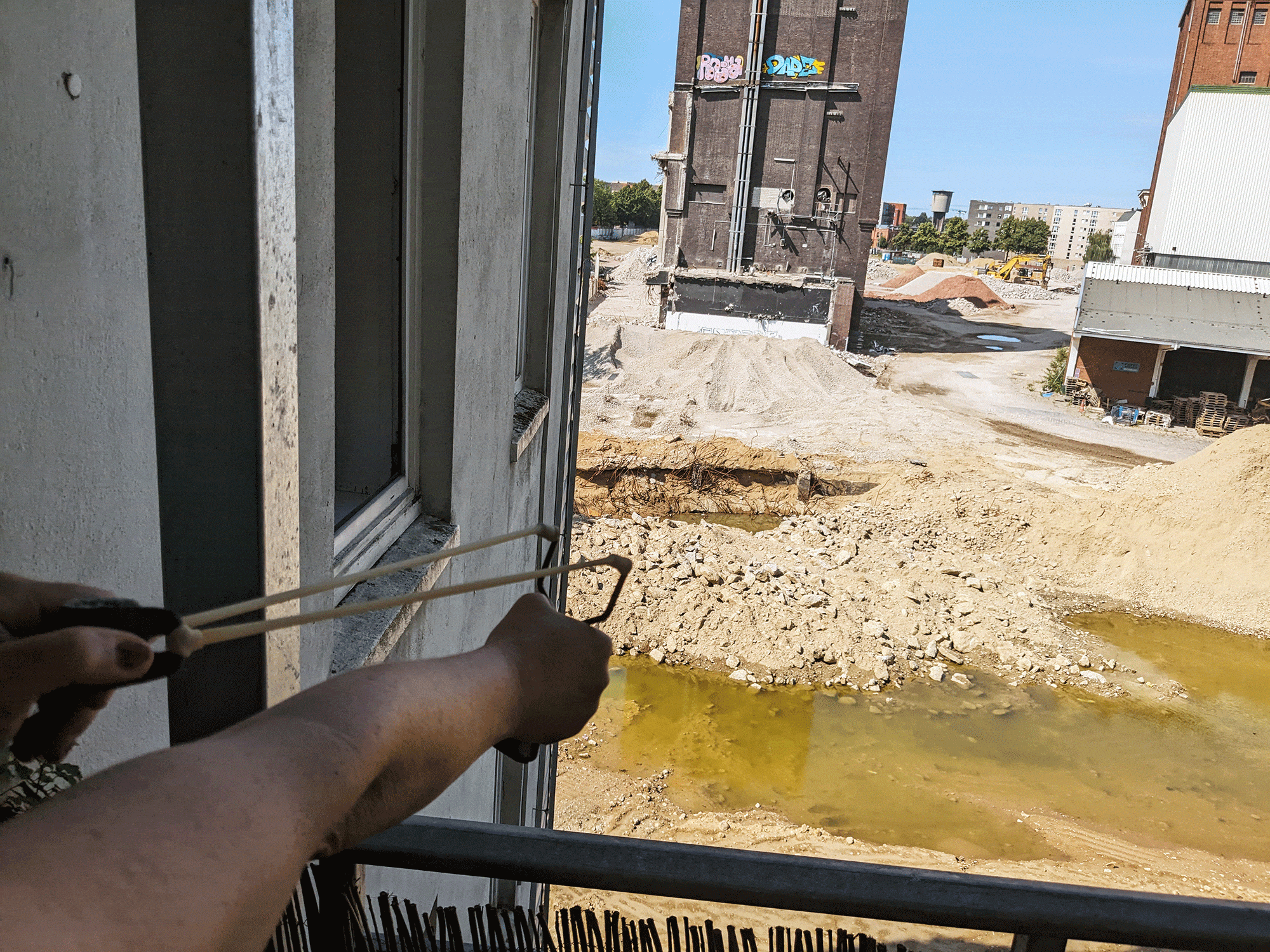
After three resales by investors, the site was overpriced, and the current owner, a real estate company based in Luxembourg, has no money left for building anything. Local authorities are insulted that the investors’ brilliant presentations have not materialized. The owner is desperately looking to sell. A local “Right to the City” group is trying to persuade the city itself to buy the site, which would allow for development of low-rent social housing and housing cooperatives — but these appeals have gone unanswered.
Even so, a slow appropriation is happening. It’s been a rainy year, and geese and ducks regularly stop by a pond that has formed. Young people congregate in the brewery’s ruins, and urban explorers stroll through. Pioneer plants cover the edges of the barren ground. After years of uncertainty and stagnation, we neighbors occasionally shoot seed bombs into the site, with slingshots and grim smiles. If there will be no (social) development, and if there are too few green spaces anyway, why not help nature to create a park, and remedy the failure of urban “repair”?
— Ulf Treger
Redefining Education: Embracing Repair, Preservation, and Sustainability
Given that the challenges of climate change, social justice, and sustainability are at the forefront of global concerns, architectural education must evolve. It is no longer sufficient to focus solely on new constructions; the field must embrace the principles of repair, preservation, and sustainability. How can architectural education ensure that future architects are not only technically proficient, but also deeply aware of the historical, environmental, and socio-cultural contexts of their work?
Architectural education must evolve. It is no longer sufficient to focus solely on new constructions.
I believe that repair is inherently interdisciplinary, and for many years have championed diversity, equity, and inclusion initiatives, and introduced culturally relevant pedagogy and culturally responsive teaching into departments of architecture, design, and construction science. Inspired by the work of pedagogical theorist Gloria Ladson-Billings, I reformed curricula to emphasize student success, cultural competence, and critical consciousness. Despite the passage of recent legislative restrictions in Alabama, these efforts have successfully shaped pedagogy at Tuskegee University and Auburn University.
At Tuskegee, I redesigned several required courses and architecture studios, particularly the Architecture Thesis Seminar, to equip students with essential tools for research and design experiments, focusing on theory, history, culture, and sustainability. The seminar aims to improve writing and presentation skills and ensures that students meet NAAB Criteria standard PC.5 — Research and Innovation. The syllabus incorporates practices that reflect diverse perspectives, traditions, and values. Design studios, which are linked to the seminar, include community-centered projects, such as the 2019 Tiny House initiative, which promotes social responsibility and sustainability. Hands-on experience in designing net-zero energy buildings further emphasizes sustainable design principles.
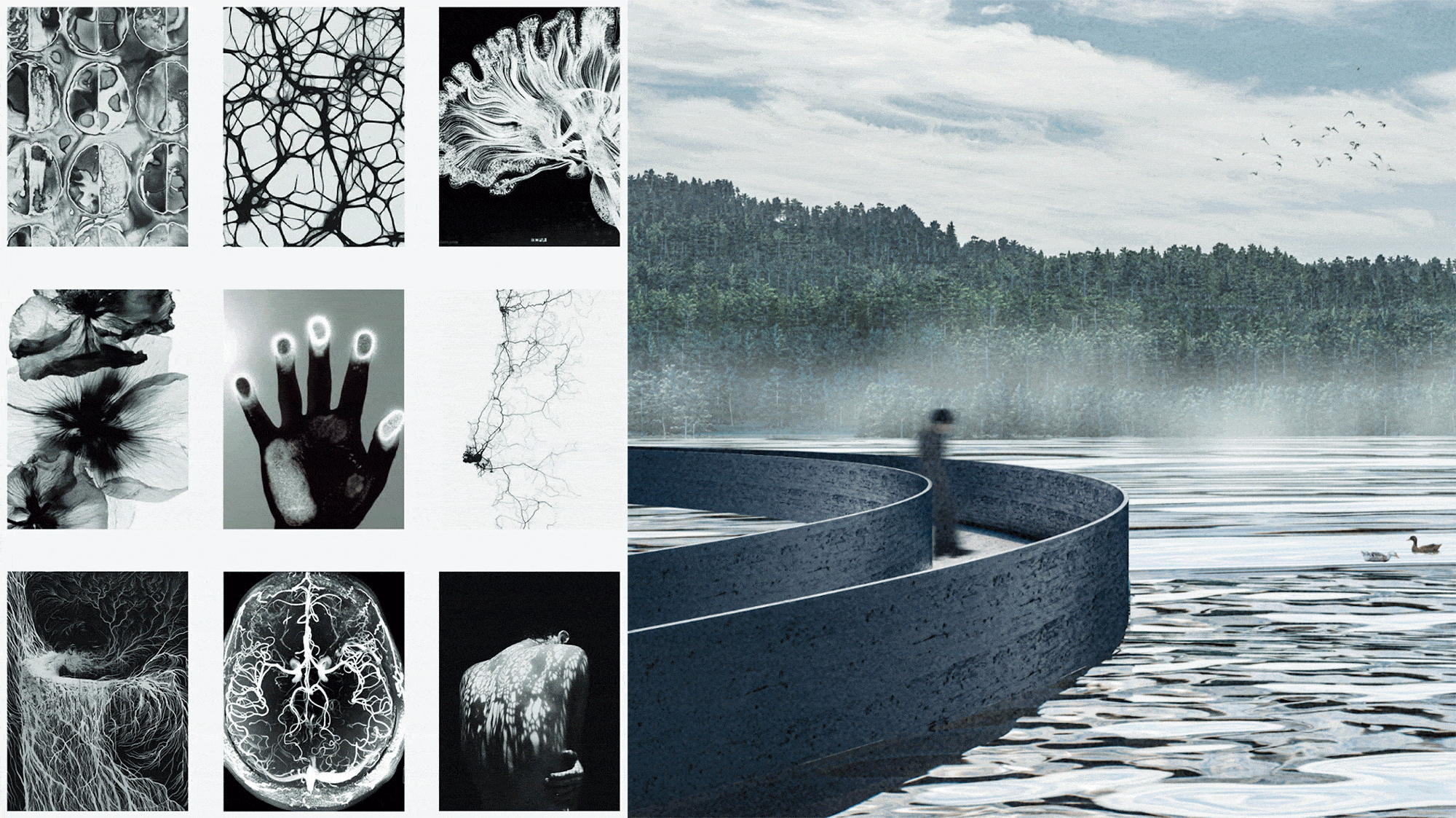
Successful thesis projects illustrate the integration of culturally relevant practices and architectural methodologies. These include projects by Journi Goodman (Fall 2023), who studied neuroarchitecture, examining the integration of neuroscience, psychology, and architecture in the design of wellness centers emphasizing sensory integration and biophilic principles; Trenton Scott (Fall 2022), who incorporated cultural sensitivity, vernacular architecture, and adaptive reuse to create inclusive spaces that honor diverse cultural identities, use local materials and techniques, and repurpose existing structures to preserve heritage and promote sustainability; Kayla Heard (Fall 2021), who designed a green building model that integrates urban agriculture, inspired by historical precedents like the Garden City Movement and Broadacre City, aiming to create a food-producing hub and educational resource in Montgomery, Alabama; and Jocelyn Johnson (Fall 2021), who explored biophilic design principles for a youth homeless shelter, incorporating an onsite farm maintained by the students to enhance well-being and healing for unhoused youth.
Interdisciplinary collaboration is crucial, as demonstrated by projects like the NFL stadium design for the city of Birmingham, led in 2023 by Tuskegee professor Roderick Fluker and involving students from architecture, construction, engineering, and business. Addressing systemic barriers through mentorship, targeted scholarships, and ethics courses promotes diversity and inclusion, fostering a responsible and community-centered approach to architecture. These efforts not only prepare students to tackle contemporary design challenges, but instill a culture of ethical practice.
The evolution of architectural education at Tuskegee University serves as a model for how institutions can adapt to meet contemporary demands. By embracing repair and preservation alongside new constructions, and by incorporating culturally relevant and sustainable practices, we can prepare our students to become innovative, socially conscious, and environmentally responsible architects.
— Carla Jackson Bell
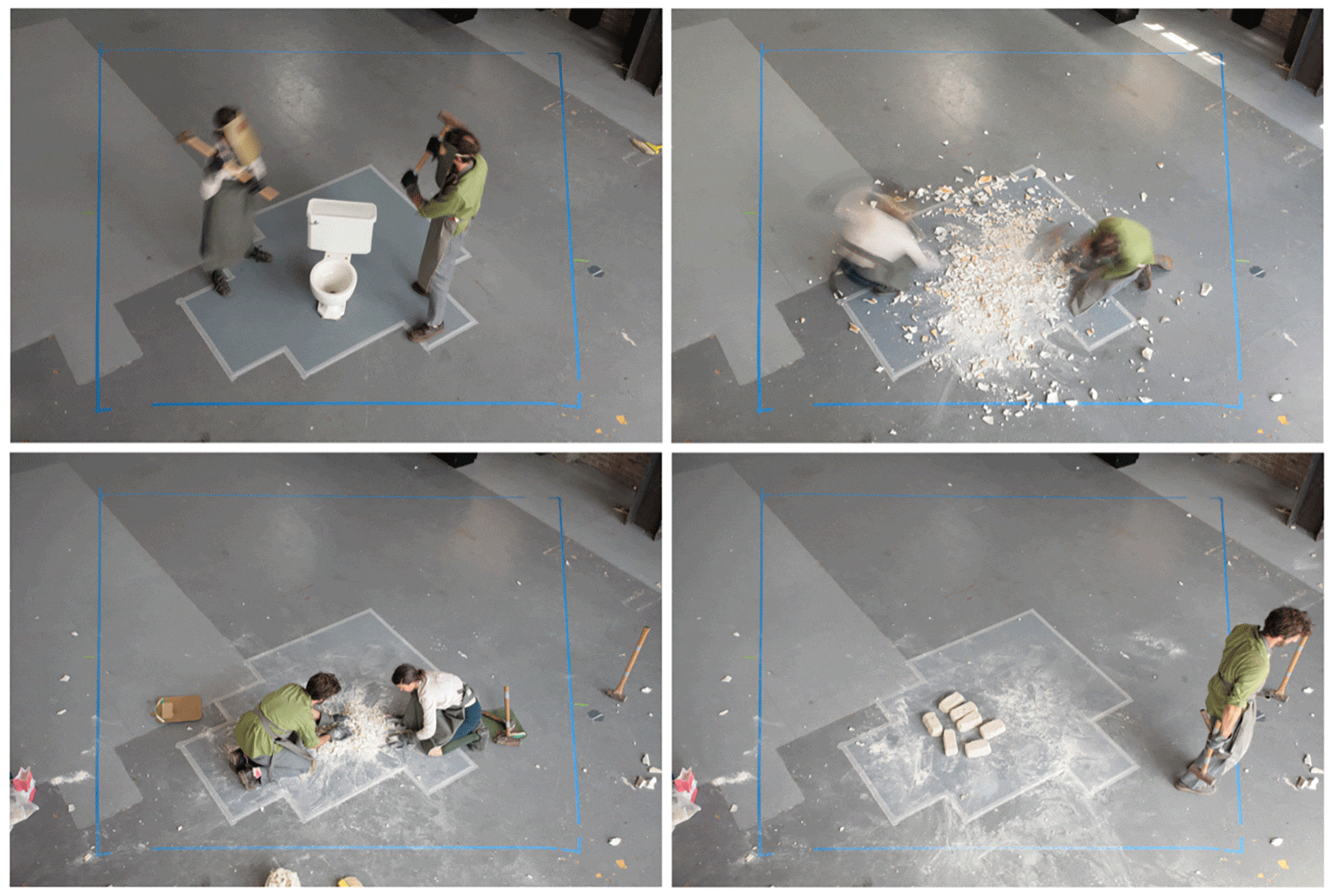
1. Between Us, Mending…
2. Mending as Commons
3. Meandering
There is a space between us
A felt space
We could say it has a shape
A texture
A thread count
Sometimes it is an elephant, like an elephant in the room
Sometimes it is a pea, like the princess and the pea
And other times it is a thin soft silk
Sometimes this space has holes
Some are for breathing
Others might be in need of repair
A delicate space.
M e n d i n g.
This is a complex journey, we invite you to mend the holes in your life…
…pick just one item of clothing to fix for this year.
Let’s all do this — everyone reading this text.
Then next year, fix two things per year,
all of us, and so on. When you are 70 years old,
how much will you have mended? If we all made this commitment…
As we walk around the city and look at all of the buildings (with air conditioning),
all of the people inside watching tv on their computers,
traffic is loud, cars rush by with windows closed, we are all in our own bubbles (holes)…
How do we connect?
Even the people on the streets have headphones.
A hole grows in our hearts,
and holes grow in our socks.
I feel the hole in my sock —
do you feel it?
I think I might get a sore as my skin rubs on the shoe…
Then I consider the hole in my heart.
I knew a Vietnam veteran who repaired the holes in his socks with staples.
So quick! But I worry about blisters.
My mom would say, Just throw them away and buy a new pair.
I have seen cotton balls stitched over the hole,
with a zigzag stitch on top of the cotton ball.
I’ve also seen other socks cut apart and attached to holes,
to cover up the holes.
DARN your socks:
(If you don’t know this word… it is a method to mend the hole in a sock.)
Find a rock that is the size of your toes put together, oblong but thin…
Or find a rock the size of your heel, a rounder egg-shape rock.
Place it in the sock, and then darn the hole using the rock to keep the shape.
MEND your car:
When I was young my brother fixed the lights on my Ford Mustang with a light switch from the house.
MEND your bike:
Carry a patch kit and tools. You will make
good friends if you happen upon a stranded biker.
FIX a relationship:
There is a paradox called the Ship of Theseus that asks whether an object is the same object after having all of its original components replaced over time.
MEND buildings:
If the goal is to always darn the buildings rather than building anew,
we could start with something like the 1% For Art laws, except
it would be 1% for mending architecture…
If you build a 10 million-dollar building you need to spend 1% repairing
some other building in your city.
We could extend the program every year
Year 1 = 2025 = 1% for mending
Year 2 = 2026 = 2% for mending
Year 10 = 2035 = 10% for mending
Year 100 = 2125 = 100% all funds go to mending buildings…
and no new buildings are built.
There is a space between us
We could say it has a shape
This shape keeps changing
Between us, a mending project.
— Futurefarmers



_from_the_High_Bridge_in_the_Bronx,_New_York_City,_New_York.jpg)
If you would like to comment on this article, or anything else on Places Journal, visit our Facebook page or send us a message on Twitter.