
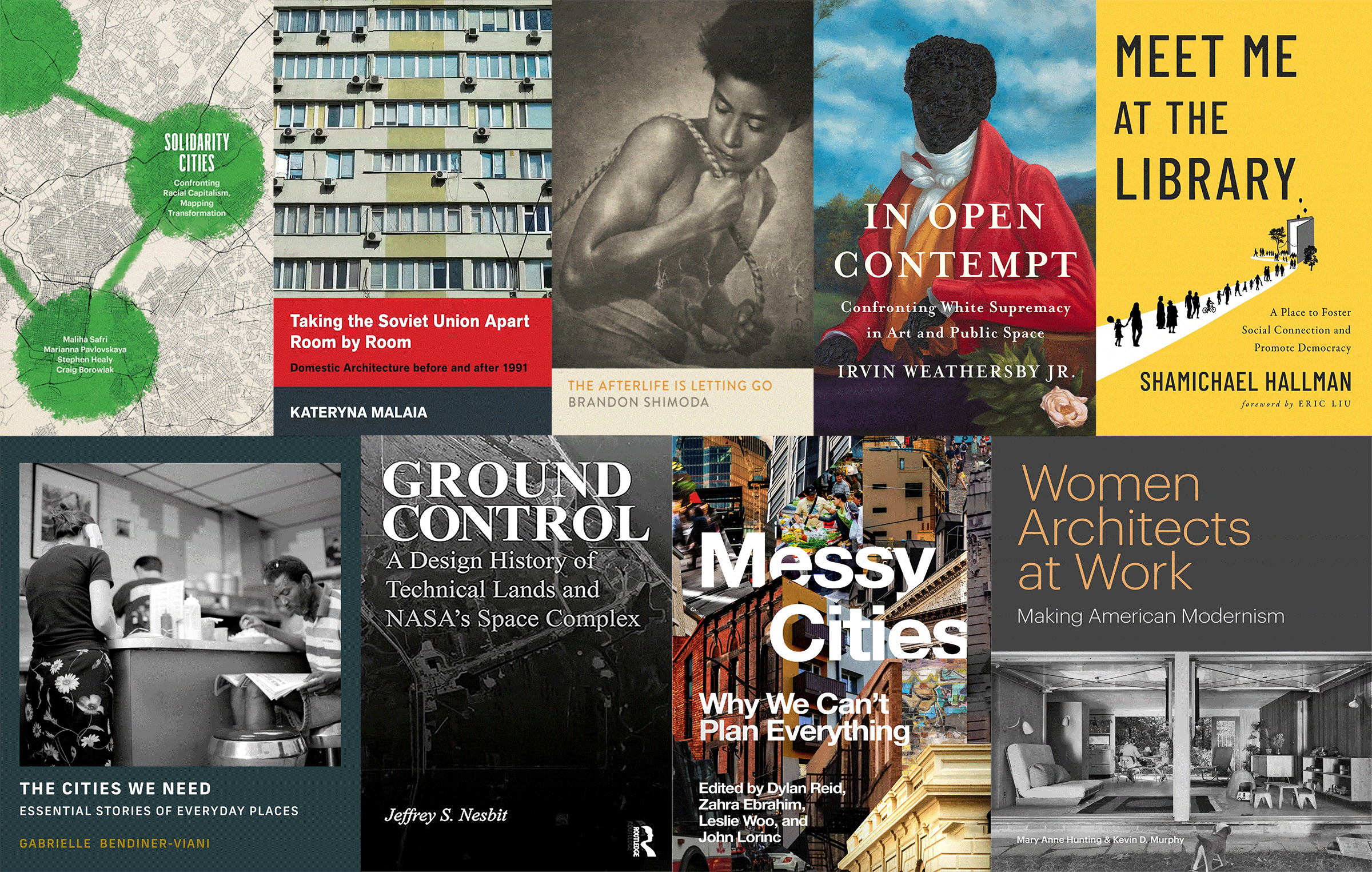
- Meet Me at the Library, by Shamichael Hallman
- The Cities We Need, by Gabrielle Bendiner-Viani
- The Afterlife Is Letting Go, by Brandon Shimoda
- Taking the Soviet Union Apart Room by Room, by Kateryna Malaia
- Women Architects at Work, by Mary Anne Hunting and Kevin D. Murphy
- Solidarity Cities, by Maliha Safri, Marianna Pavlovskaya, Stephen Healy, and Craig Borowiak
- Ground Control, by Jeffrey S. Nesbit
- In Open Contempt, by Irvin Weathersby Jr.
- Messy Cities, edited by Dylan Reid, Zahra Ebrahim, Leslie Woo, and John Lorinc
Meet Me at the Library: A Place to Foster Social Connection and Promote Democracy
Shamichael Hallman (Island Press, 2024)
Reviewed by Shannon Mattern
“Meet me at the library,” Shamichael Hallman proposes, inviting us to explore how these institutions have fostered — and might continue to promote — social connection and democracy. Such an invitation is particularly welcome in an era of increasing political fractionalization, expanding authoritarian rule, and “efficiency”-driven privatization. But his summons is also increasingly difficult to heed as those same political-economic forces incite surveillance of our online behavior, threats of violence in various public spaces, the sabotage of library boards, and the closure of library buildings across the United States.
Hallman’s book was published in 2024, but it takes on new resonance amidst the Trump regime’s attacks on the Institute for Museum and Library Services and other federal funding agencies, and on our schools and universities. Meet Me at the Library casts into relief what’s already been lost in some areas, what’s now under grave threat, what’s worth preserving with all our might, and which new solidarities and coalitions will need to emerge in order to do that work.
Informed by his own experience as senior manager of the Cossitt Library in Memphis, Tennessee; as a Loeb Fellow at Harvard’s Graduate School of Design; as a contributor to the Library Bridgebuilding research program; and now, as the Director of Civic Health and Economic Opportunity at the Urban Libraries Council, Hallman describes how the Cossitt Library and others around the country have developed programs, built collections, designed services, and established cross-institutional partnerships that foster learning, combat loneliness, facilitate dialogue, elevate local arts, and incite civic renewal.
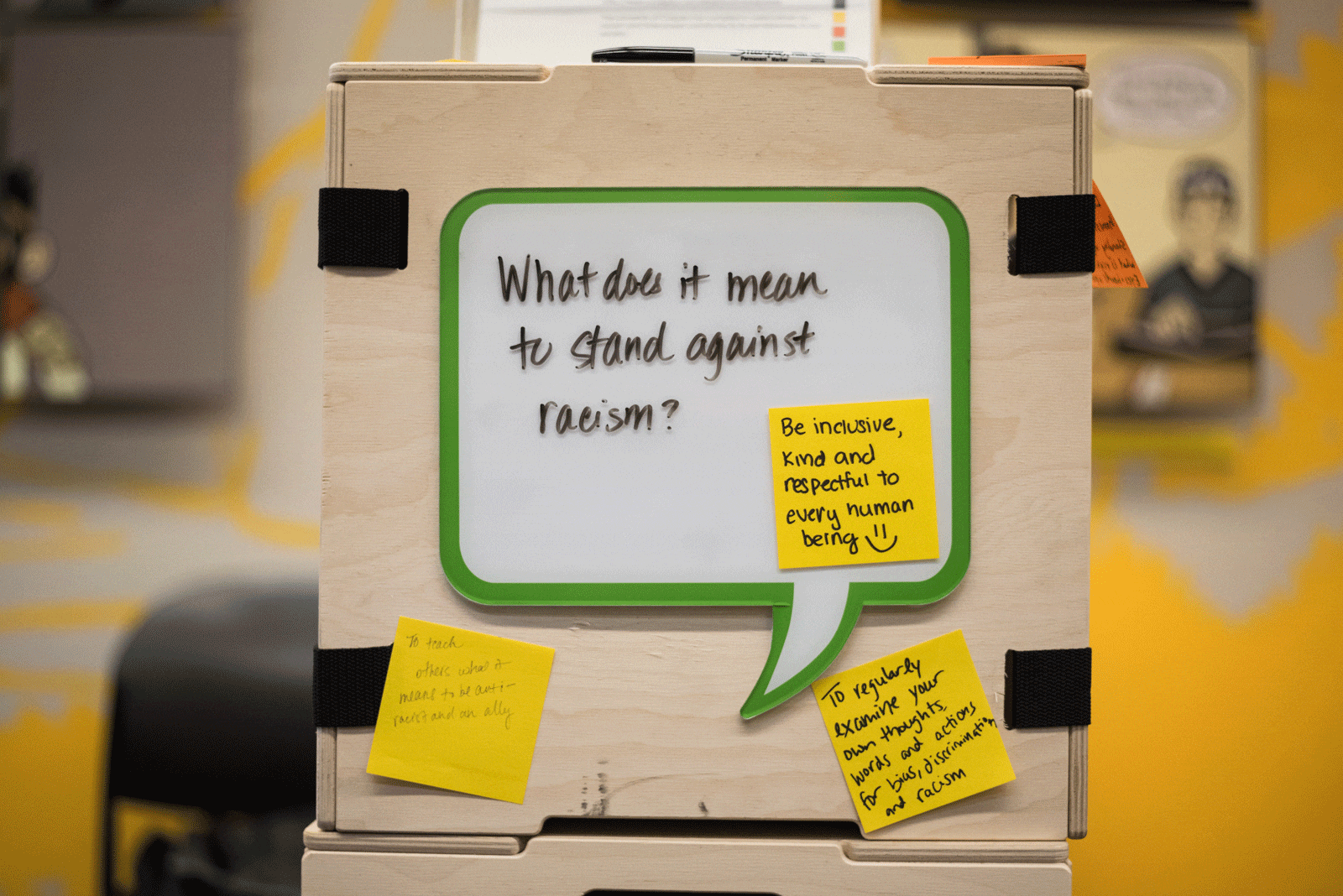

The book casts into relief what’s now under grave threat, and what’s worth preserving with all our might.
We read about bookmobiles, tool libraries, workforce-development programs, and digital-equity services. We learn about the Skokie Public Library’s Civic Lab (in Illinois), which encourages participation in public affairs; about the Cambridge Public Library’s Cambridge Cooks program (in Massachusetts), which promotes cultural literacy and cohesion through culinary experimentation; about the Mesa County Library’s Discovery Garden (in Colorado), which allows community members to practice growing and composting and mutual aid; about the Northern Liberty Library’s Pizza and Politicians program (in Iowa), which gathers teenagers and local leaders to talk about public service and civil rights; and about Memphis’s own CitizenFEST, a summit exploring means by which community members can exercise civic power.
In this age of hostility and intolerance, a bipartisan book club, or a civil town hall conducted in the library stacks, might seem inconceivable — but Hallman reminds us how important it is to “take advantage of public assets,” to safeguard the commons, to “reinforc[e] a sense of membership in a broader civic community.” And he offers a range of strategies we can deploy in pursuit of these goals: from using our library cards and voting for library-friendly civic officials, to volunteering and joining advocacy groups. Our libraries are among the few remaining beacons of democratic potential and loci of democratic practice. Their outposts extend across the nation; we need to activate that distributed network in order to meet the challenges of our moment.
The Cities We Need: Essential Stories of Everyday Places
Gabrielle Bendiner-Viani (MIT Press, 2024)
Reviewed by Karen Kubey
The neighborhoods of Mosswood in Oakland, California, and Brooklyn’s Prospect Heights embody comparable stories: 1940s growth, fueled by nearby shipyards and Black migration, followed in recent decades by real estate interests driving the displacement of Black and lower-income households and businesses. The Cities We Need: Essential Stories of Everyday Places charts the parallel histories that made and then threatened these neighborhoods, intertwining the human stories that are too often omitted from portrayals of urban change. Bringing together deep research with textual and photographic portraits, the book reveals — as one Mosswood resident puts it — “how people fit the big world into their small worlds.”
Presenting sites like parks, diners, and grocery stores as places for dwelling, the author offers an expansive idea of home.
The Cities We Need unfolds through nine synthetic essays on Mosswood and Prospect Heights, each paired with a portfolio of intimate photographs by the author, and an excerpt from a resident’s oral history. (A public artist, researcher, and former academic, Bendiner-Viani draws from her experiences as a resident of both neighborhoods.) Through these studies, she introduces the concept of placework, the set of functions that neighborhoods fulfill for us, or “the ways that [everyday public spaces] do nothing less than help us become ourselves and help us to be together.” Presenting sites like parks, diners, and grocery stores as places for dwelling, the author offers an expansive idea of home.
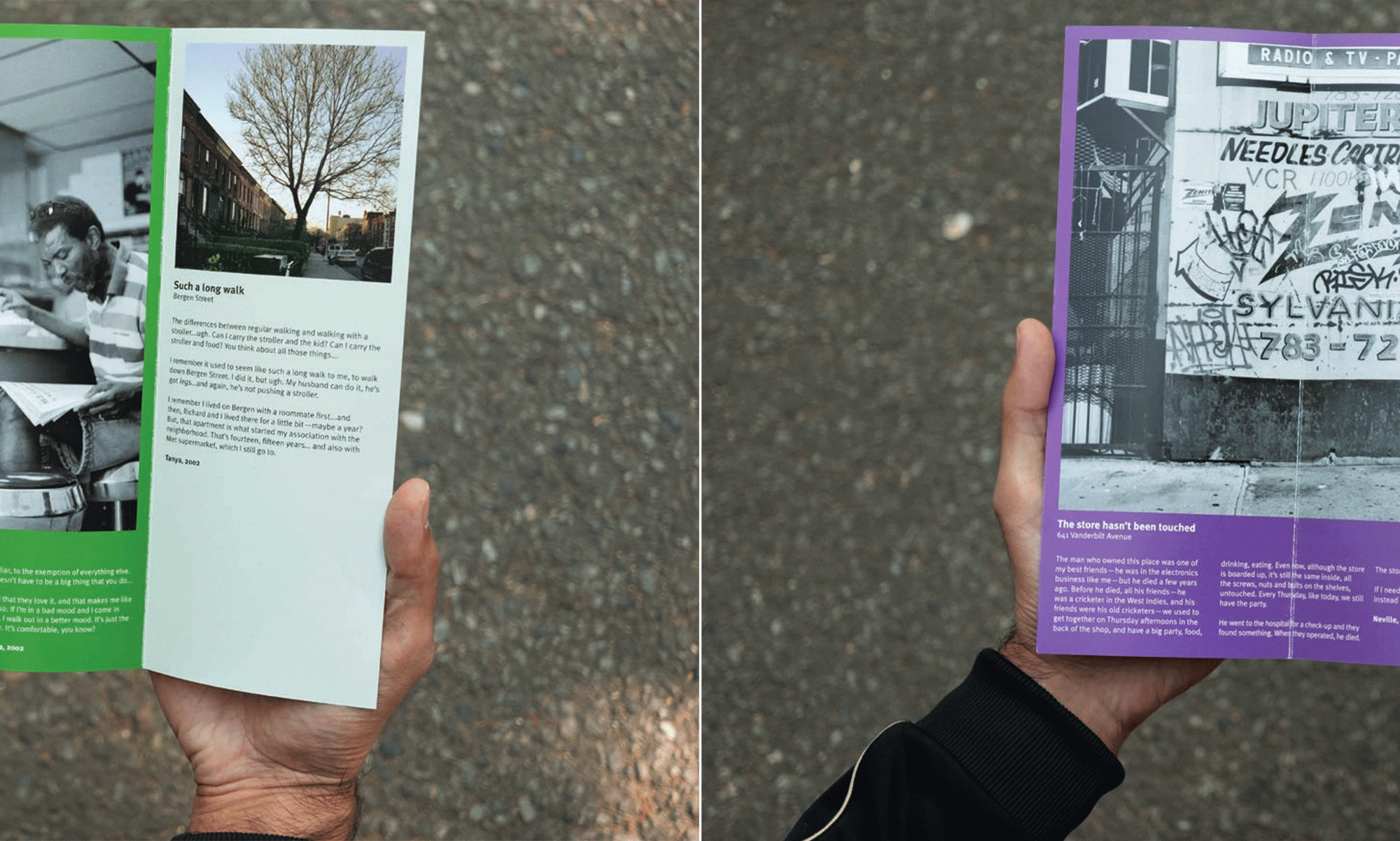
The book emerges from 20 years of research, centered on “guided tours” with residents — walking oral histories through which diverse local informants have shown Bendiner-Viani how they define their neighborhoods. In this lovingly and critically annotated version of these tours, the author takes the reader out onto the street alongside her subjects, while “navigating [her] own experiences of walking.” The Cities We Need offers a new kind of urban history, weaving together archival research, oral histories, autobiography, and daydreams. Bendiner-Viani expertly cites sources from Martin Heidegger (on dwelling) to Dolly Parton (on work). The effect is refreshing, moving, and true-to-life. This book sets a new bar for holistic urban research. As the author asks the reader, “What stories would you tell?”
The Afterlife Is Letting Go
Brandon Shimoda (City Lights Books, 2024)
Reviewed by Ken Tadashi Oshima
The incarceration of Japanese immigrants and Japanese Americans during World War II left indelible traces, including personal impacts on those whose forebears were interned. Out of such legacies, poet and essayist Brandon Shimoda assembles fifteen essays that masterfully bring to life a multitude of places and perspectives. As a biracial 4th-generation Japanese American, the author sensitively weaves together familial history with years of research, interviews, and travel to memorials, museums, and ruins of internment camps including those at Topaz, Utah, and Poston, Arizona. Shimoda’s multivalent title, The Afterlife Is Letting Go, expresses an essential question — “how do we let go without forgetting?” — that he contemplated across his physical and metaphysical journeys. The photograph on the book’s cover (taken by Shimoda’s grandfather) of a youthful man tugging a rope, half looking back while leaning forward, embodies the ethos of the essays.
Written after the 2016 election, these stories haunt the built and cultural landscapes of the ongoing present.
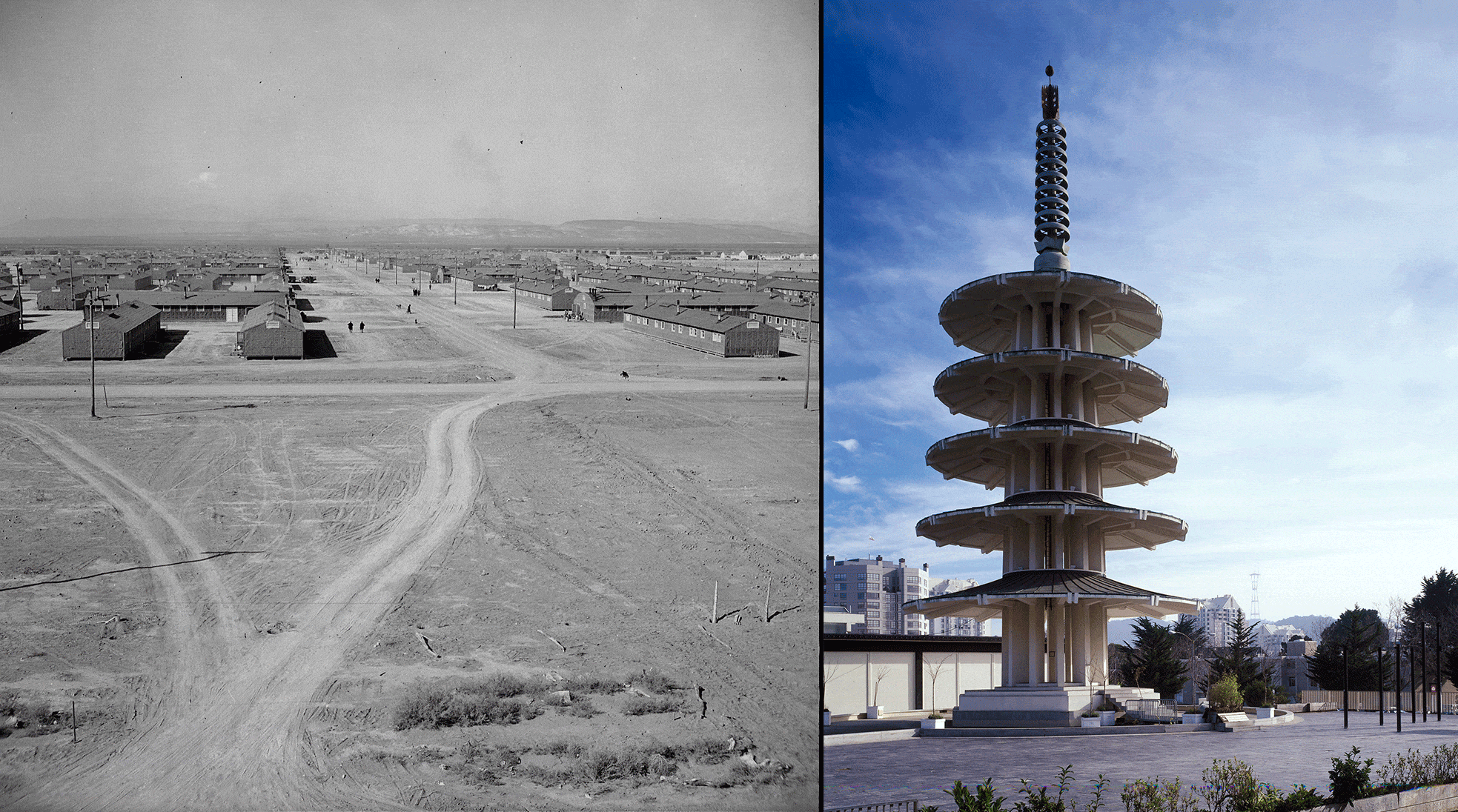
The work reflects a poet’s perspective, combining abstract ideas with concrete impressions. Ruminating on Yoshirō Taniguchi’s five-story pagoda in Peace Plaza in San Francisco’s Japantown, Shimoda highlights the structure’s dual origin as a gift commemorating 25 years since the end of the war, and as an element of the country’s first federally funded urban renewal project, a sweep that razed nearly half of Japantown. The author’s own impressions interweave through his conversation with a “woman with a red scarf,” who is dismissive of “writing a book about Japanese American incarceration.” Contemplating the impact of forced removal, Shimoda asks, “what does it mean for people to survive a trauma and how can anyone be sure they have survived, rather than, more simply, not died?”
He also quotes artist Sandra Honda in her attempts to “express this sense that past is present is future … The thread that stitches past to present to future is memory embodied in stories and the emotions flowing from them. In these ways, ancestors are time and the lessons left by them, if we are smart enough to listen.” The Afterlife Is Letting Go was written in the years following the 2016 presidential election, and these stories haunt the built and cultural landscapes of the ongoing present.
Taking the Soviet Union Apart Room by Room
Kateryna Malaia (Cornell University Press, 2023)
Reviewed by Jess Myers
In the practice of architecture, an important aspect of practical analysis remains a white whale: the post-occupancy study. By this, I do not mean the 25th anniversary celebration where a building is cleared of its regular inhabitants to capture a photo for the retrospective. Nor do I mean a chunk of the original form being carted off to a biennale. Rather, the illusive post-occupancy study is an exercise in curiosity, not just about a structure’s performance but about its use, how its presence and possibilities have been subsumed into the folds of everyday life.
Soviet apartment dwellers had long histories of DIY undertakings that filled the gaps when bureaucracy and neglect made official maintenance impossible.
Since it is nearly impossible for such a study to be included in the architect’s regular fee schedule (or so I’ve been told), the curious must rely on historians like Kateryna Malaia. Taking the Soviet Union Apart Room by Room, Malaia’s microhistory of post-Soviet renovation practices, offers a keyhole-view into the lives of others by examining the state of mass housing in the decades leading up to and following the collapse of the Union of Soviet Socialist Republics. In the 1980s and ’90s, as residents gained more agency over their homes through ownership, they initiated a boom in domestic renovation, or “remont.” Malaia once joked to an interviewer (me) that the entire project of the Soviet Union was an enormous renovation, “building the new world on the ruins of the old.” In Room by Room, though the scale of the nation state is narrowed to that of the apartment, the social agendas of a proper remont are not so very different.
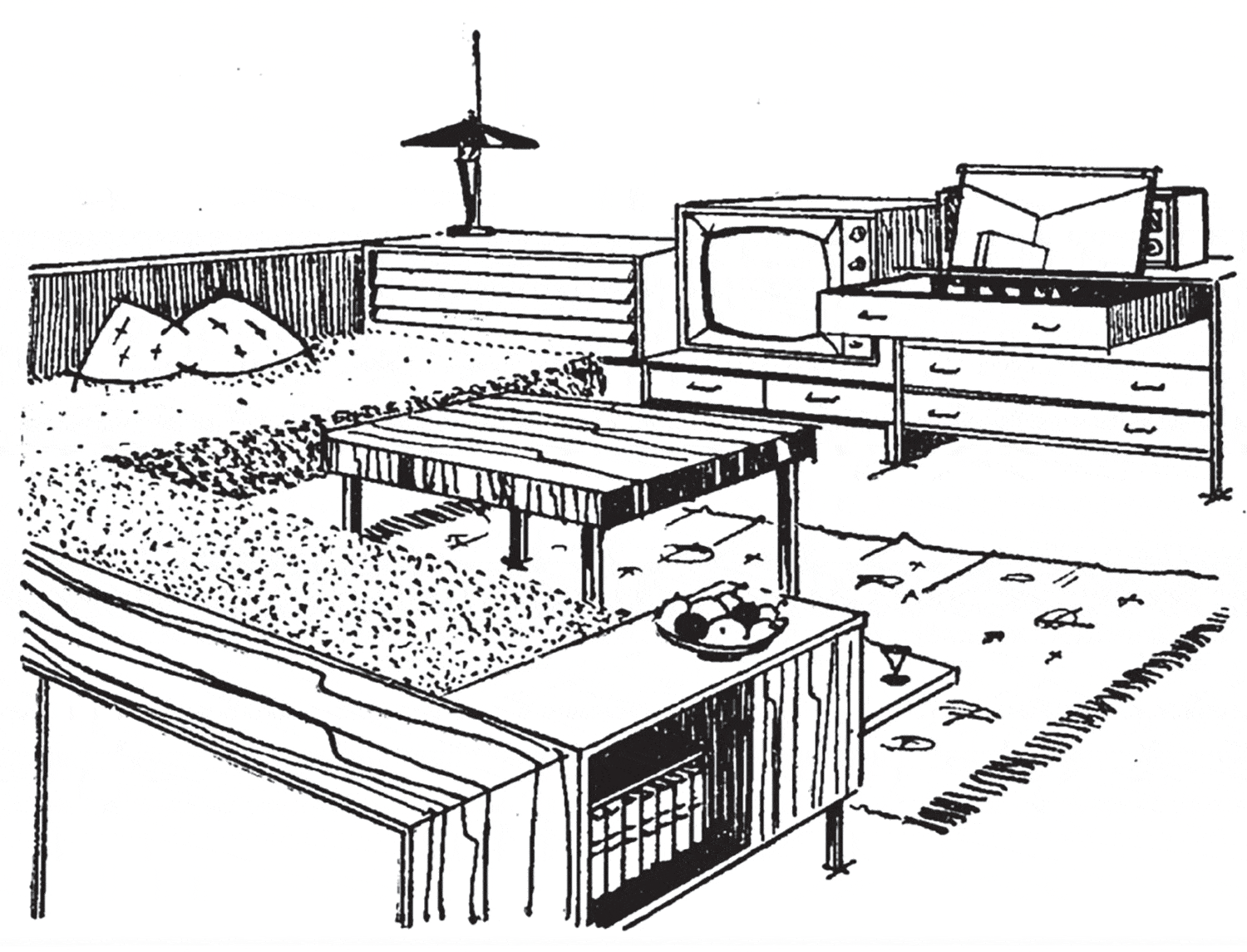

Remodeling, in the last years of the USSR, was not a completely new idea; many Soviet apartment dwellers had long histories of DIY undertakings that filled the gaps when bureaucracy and neglect made official maintenance impossible. However, the renovations of the ’80s and ’90s were a substantially different enterprise, in that they marked the material establishment of a rising but precarious middle class, one that could emphatically declare itself “post-Soviet” even as the awkward transition from a socialist housing market to a capitalist one caused deep financial insecurity.
Malaia does the careful work of site visits and interviews with residents and the practitioners they employ to undertake domestic transformations. The accounts she discovers reveal entanglements between ambitions for personally tailored domestic spaces and the shifting possibilities of the post-Soviet building and construction industry. In this book, the joys and terrors of a remodeling project become just the post-occupancy study I’ve been seeking, one that succeeds in describing the life of built space after the glory of “designing” is over. Even the process of parquet selection that may drive one to drink reflects the interconnectedness of our domestic spaces with flows of commercial goods, all borne along by the economies and politics that shape the everyday.
Women Architects at Work: Making American Modernism
Mary Anne Hunting and Kevin D. Murphy (Princeton University Press, 2025)
Reviewed by Nora Wendl
There are huge gaps in the historical accounting of women’s contributions to the field of architecture. How to address them is tricky. While the most efficient approach might be a centuries-spanning anthology that glosses the life of each architect, this would do little to express the extent of their creative achievements, personal lives, and professional networks. Rather than offering yet another “binder full of women,” in Women Architects at Work: Making American Modernism, Mary Anne Hunting and Kevin D. Murphy go deep. Their book tells the story of the women who enrolled in American architecture schools in the decades before World War II, and shows in meticulous detail (with stunning illustrations) the significant contributions to architecture and its allied disciplines made by these designers, despite the sexism, racism, and classism they faced. Critically, this is not just a history of women architects but of their projects and archives; their political, social, and economic circumstances; and the often lesser-known allies and patrons who supported them.
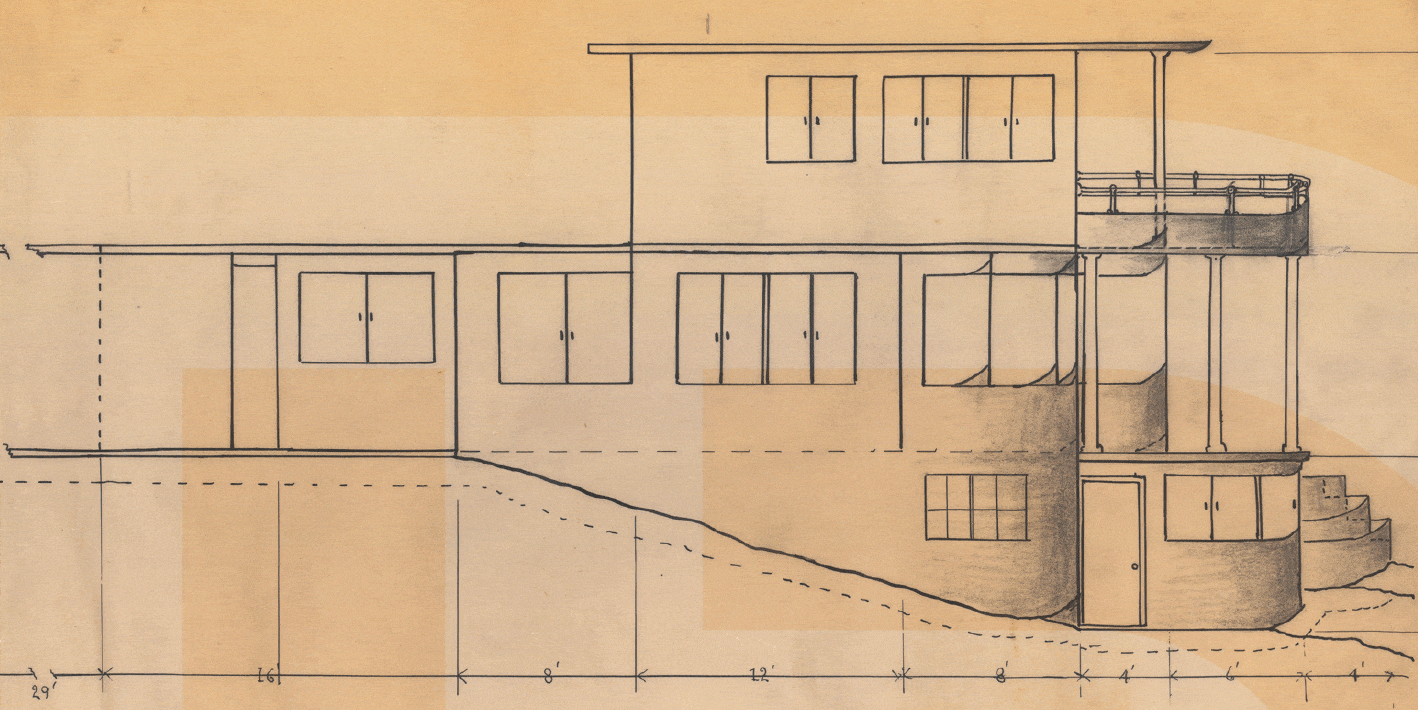
This is not just a history of women architects but of their projects and archives; their political, social, and economic circumstances; their allies and patrons.
Foundational to the book’s arc are the women educated at the Cambridge School of Architecture and Landscape Architecture from 1916 to 1942, by faculty who also taught at the nearby Harvard Graduate School of Design (including its director, Henry Atherton Frost). Though the school closed not long after the GSD opportunistically admitted female students — mitigating a wartime drop in male enrollment — the authors show its graduates as early leaders in modernism. In doing so, Hunting and Murphy elegantly dispose of a number of myths: though Gropius is credited with bringing modernism to New England, the Bauhaus-inspired Rachel Raymond House by Eleanor Raymond (Belmont, Massachusetts, 1931) precedes the Gropius House by six years.
The book powerfully dispels the belief that women architects had to stand apart from one another in order to succeed by tracing their robust educational, professional, and social interconnections through a series of remarkable network diagrams. Satisfyingly, the authors also draw wry perspectives from other historians and critics, such as Alice Rawsthorn, who has observed that 20th-century women architects often invented alternate career paths — sometimes tangential to the discipline, but no less engaged in modernism — because “[h]istorically women have thrived on new turf where there are no male custodians, and they are free to invent their own ways of working.”
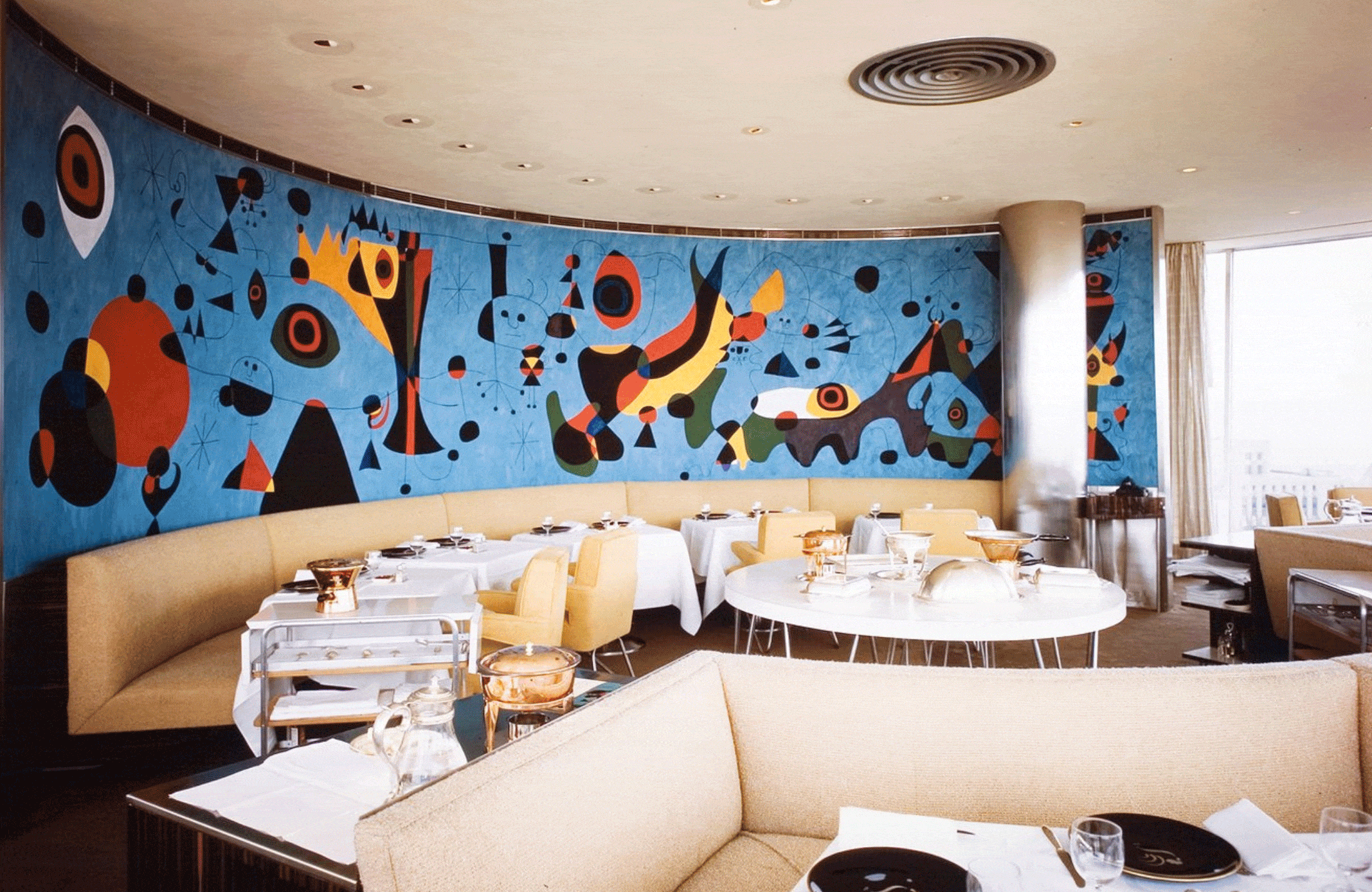
In Women Architects at Work, the “male custodians” are not held blameless, and their outrageous efforts to obstruct are acknowledged — imagine SOM denying Natalie Griffin de Blois access to the construction site of her Terrace Plaza Hotel (Cincinnati, Ohio, 1948), not to mention refusing to grant her credit for being the actual project designer? However, the bulk of this highly readable and brilliantly researched book concentrates on the impact made by women in fields from architecture itself, to curation (including in MoMA’s Department of Architecture, where women were often hired but rarely promoted), to writing and educating, to photography.
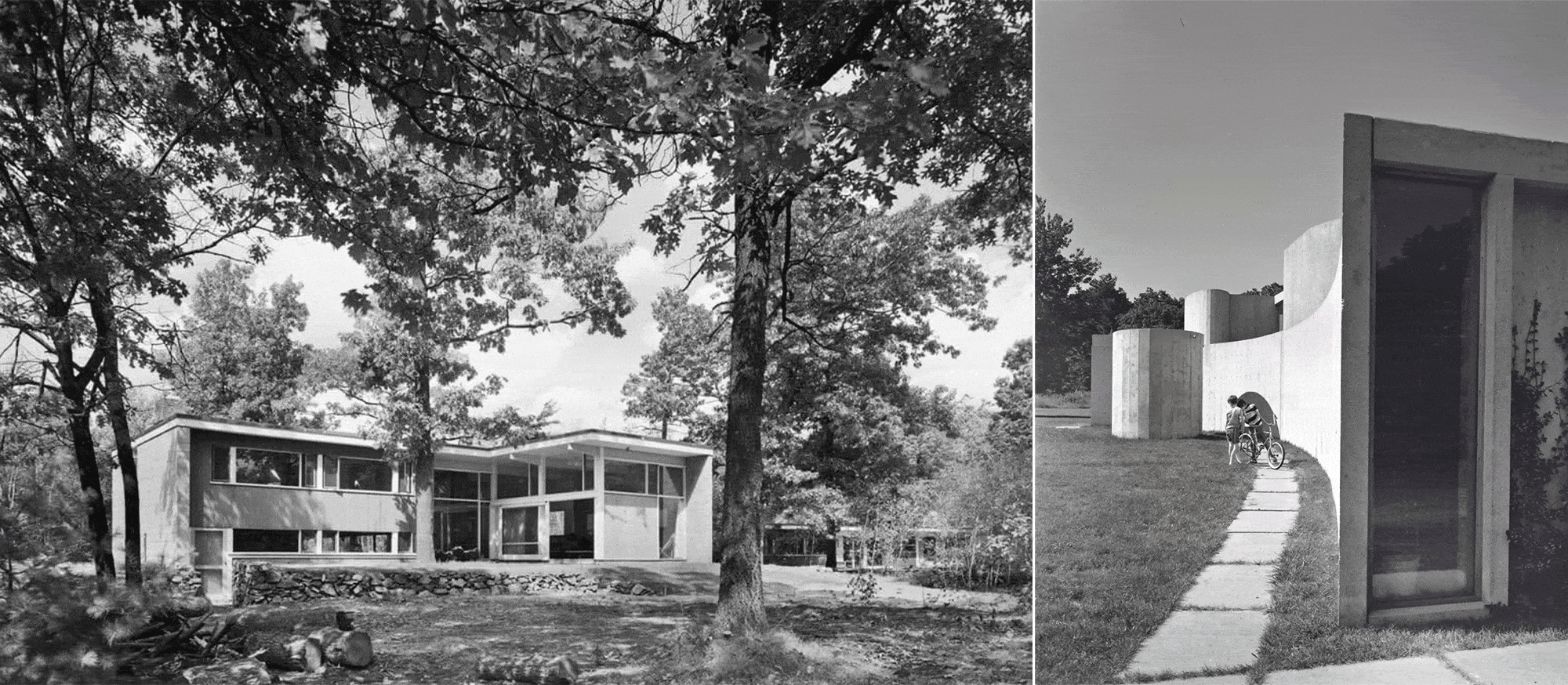
The focus on projects emphasizes the outsize role women often played in collaboration. We read, for instance, about the contributions of Sarah Pillsbury Harkness and Jean Bodman Fletcher, members of The Architects Collaborative, on the postwar development Six Moon Hill (Lexington, Massachusetts, 1947 – 1953); about Amaza Lee Meredith’s co-founding, with her sister, Maude Terry, of Azurest North — a visionary project for an African American vacation destination (Sag Harbor, Long Island, 1947); and about Mary Otis Stevens and Tom McNulty’s Lincoln House (Lincoln, Massachusetts, 1965), recognized as the first house in the United States made entirely of concrete and glass, which was destroyed in 2001 and has long been omitted from discussions of Brutalism.
With women’s contributions being actively erased from federal websites in the United States, this book is more than an important resource for educators, historians, and students. It is an active reminder of what is true: women have helped to build and continue to build the world we inhabit.
Solidarity Cities: Confronting Racial Capitalism, Mapping Transformation
Maliha Safri, Marianna Pavlovskaya, Stephen Healy, and Craig Borowiak (University of Minnesota Press, 2025)
Reviewed by Jay Cephas
Credit unions, barter exchanges, cohousing developments, community land trusts, time banks, freecycle networks — these components of cooperative urbanism are analyzed in Solidarity Cities: Confronting Racial Capitalism, Mapping Transformation. Written collectively by an economist, a political scientist, and two geographers, the book traces the social impacts of solidarity economies in three contemporary American cities: New York, Philadelphia, and Worcester, Massachusetts. Defining solidarity as “a sense of collective responsibility and shared purpose that connects an individual to a group or community,” the authors consider the solidarity city not just as a place where such relations arise, but as the always-in-process urbanism that those relations forge.
Their research proceeds from a critique of racial capitalism that foregrounds its totalizing ideology, described by J. K. Gibson-Graham (a.k.a. the feminist-economist duo of Julie Graham and Katherine Gibson) as capitolocentrism: “if racial capitalism becomes that which determines everything, a totality in which there is no outside, then … there is no space for postcapitalist possibilities in this world.” Solidarity Cities recognizes that this economic diversity is more than possible. It already exists.
The authors understand visionary worldmaking to be incremental yet immediate.
Like many informal economies, those outlined in Solidarity Cities help to correct the inequitable distribution of surplus value that drives capitalism as such. Inequities in property ownership and exploitation in rent are alleviated by housing cooperatives; predatory lending is circumvented by credit unions; food insecurity is addressed by community-supported agriculture and consumer cooperatives. The authors treat solidarity economies not as marginal activities but as constitutive practices. For people who rely on them, these systems occupy the center of urban life.
This is what I appreciate about Solidarity Cities: it understands visionary worldmaking as incremental yet immediate, and it envisions a just society as one that privileges collective, sustainable systems.
![The Diverse Economies Iceberg, created by Community Economies Collective, and modified from original rendering by Maliha Safri, and featured in Solidarity Cities.This drawing represents the economy as vast, diverse, and mostly invisible because hegemonic capitalism dominates all economic activities. [CC License 4.0]](https://placesjournal.org/wp-content/uploads/2025/07/Bookshelf-Summer-2025-Cephas-2.gif)
The authors recognize that solidarity economies remain fissured by the divides of race and class upon which racial capitalism is based. Yet race and class fault lines do wind through the book, beginning with a claim that the solidarity economy was virtually unknown prior to establishment of the U.S. Solidarity Economy Network, an outgrowth of the Solidarity Economy Caucus held in 2007 in Atlanta. Given that the authors acknowledge, at numerous points, the long history of cooperativism in Black, Latino, and immigrant communities, I found this collapsing of timelines curious. The (re)casting of community cooperation as a solidarity economy, and the authors’ association of the concept with a specific academic conference, reminded me of the re-namings that come with gentrification.
In fact, the discourses and practices of economic mutualism have long histories in the United States. In 1916, Carter G. Woodson wrote in A Century of Negro Migration about the Pennsylvania Quakers who in the early 19th century set up mutual aid associations to support escaping enslaved workers, establishing what would become key stops on the Underground Railroad. Mutualism structured Black freedom towns and church-run credit cooperatives throughout the 19th century. One might think, too, of the childcare and food networks formed by the Black Panther Party in the 1960s.
Solidarity economies are not merely marginal activities but constitutive practices. For some, these systems occupy the center of urban life.
Economic mutualism is equally engrained in labor organizing. Solidarity Cities contextualizes Bronx housing cooperatives through the legislation that funded these developments. But by the time the Mitchell-Lama Act was signed into law in New York State in 1955, the Amalgamated Clothing Workers Union and the International Ladies Garment Workers Union had spent decades establishing and managing cooperatives in the Bronx and lower Manhattan. Union campaigns for affordable housing pressured city and state officials to act as they did. Moreover, garment workers’ unions of the 1950s emerged from the social unionism of the 1910s, itself rooted in the 1880s, when the Knights of Labor and the International Workers of the World diverged from other industrial unions to insist that labor organizing should not be limited to a particular trade, but should include every worker in the workplace, and extend to the neighborhood. In this respect, Mitchell-Lama was not the origin of cooperative housing in New York City, but a culmination of activism over generations.
Solidarity Cities thus reveals a conundrum. The informality of cooperative networks — especially those sustained by BIPOC folks — can make them undetectable to outsiders. But this invisibility allows them to evade powerful institutions — who might, for example, want to assert property rights over “vacant” land cultivated by urban farmers. When small-scale solidarities interface with sanctioned forces (like the Mitchell-Lama law), old practices with long histories are suddenly made visible.
These issues aside, the authors’ unyielding but not boosterish optimism feels necessary, encouraging us to celebrate, normalize, quantify, and critique the everyday work of mutually beneficial micro-economies. To that persistent question circulating in our political moment — “what do we do?” — Solidarity Cities answers: We form place-based networks, and work in solidarity.
Ground Control: A Design History of Technical Lands and NASA’s Space Complex
Jeffrey S. Nesbit (Routledge, 2024)
Reviewed by Fred Scharmen
What is a spaceship? Most of us are familiar with the image of the Millennium Falcon from Star Wars, swooping away from the bad guys at the last minute, leaving dangers behind on the troublesome planet below. In another franchise, we remember the Starship Enterprise cruising serenely through space, sheltering a city’s worth of crew, scientists, staff, and their families in voyages to the “final frontier.”
Back in the nonfictional world, it’s hard to follow the news without seeing video of Elon Musk’s SpaceX Starship exploding dramatically over Cuba, as it did in March, or of Jeff Bezos’ Blue Origin New Shepard rocket carrying Katy Perry into space only a month later. In Ground Control: A Design History of Technical Lands and NASA’s Space Complex, architect and researcher Jeffrey S. Nesbit steers us away from the rockets and spacecraft, and asks us rather to attend to the background of these pictures. A spaceship is, among other things, a distraction, and as Nesbit shows, we can often learn more by looking at what’s happening on the ground.
It’s not the ship that matters, so much as the port, and the design of spaceports — a strikingly new typology that draws on some old but surprising precedents — is the subject of this book. This careful history and contextually thoughtful tour of the contemporary spaceport will leave you wondering how no one else managed to get to the topic first, and glad that our guide is well equipped to show us the territory. For Nesbit, spaceports are an example of “technical lands,” a designation that captures the functional role of these places, and their relative indifference to visibility. But nevertheless, as we see, these sites are directly connected to prominent centers of modernist spectacle like Madison Square Garden and the Astrodome in Houston.
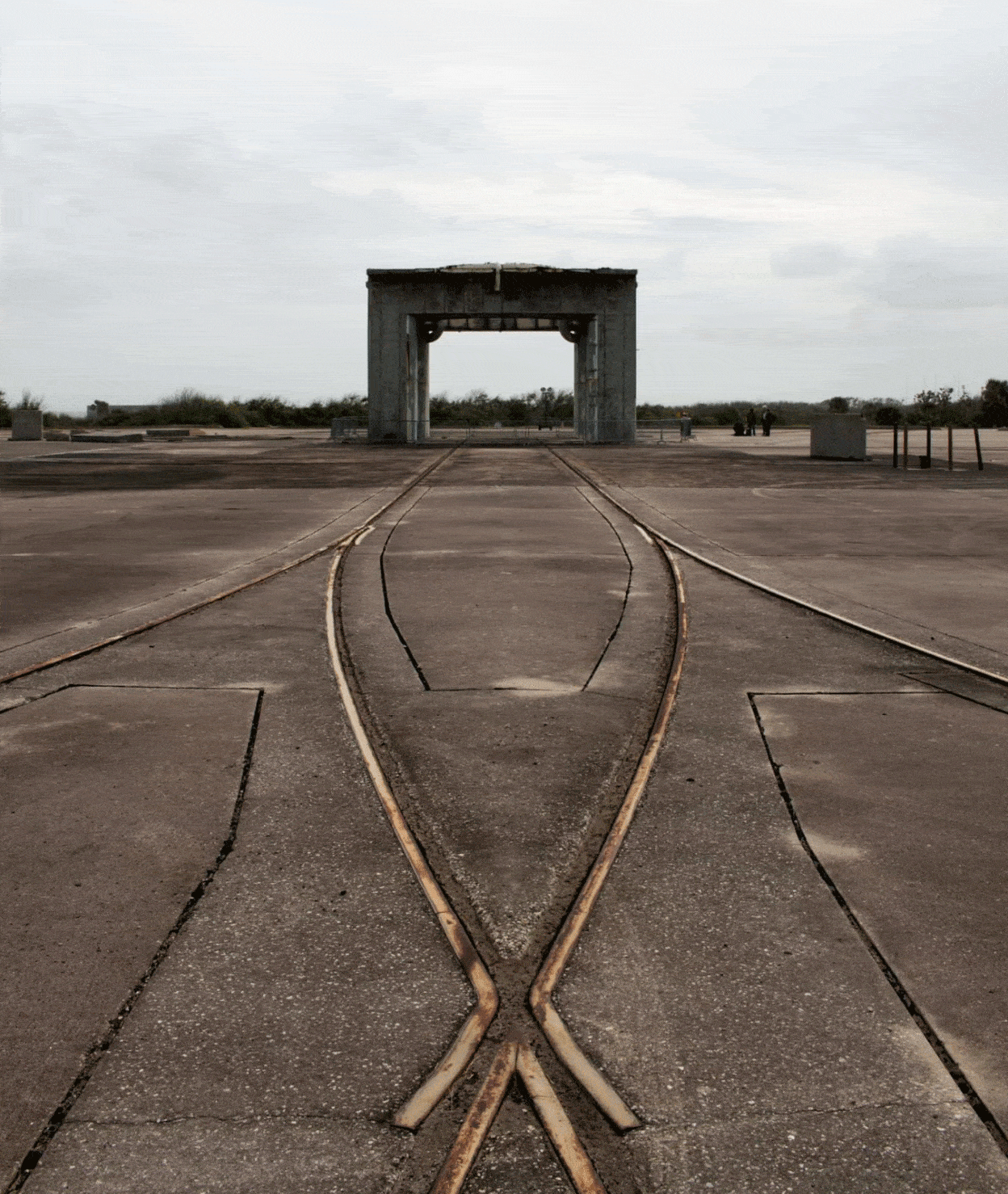

It’s not the spaceship that matters so much as the spaceport —a strikingly new typology that draws on old but surprising precedents.
Nesbit walks us through five spatial typologies that compose the spaceport: the blockhouse or control room, the service tower or launch gantry, the assembly facility where the rockets are stacked, the office buildings that support it all, and the recovery capsule and range. Along the way, he takes the opportunity to trouble more than our understandings of spaceships. These five types of structure, and the technical lands they compose, invoke and complicate ideas about visibility, technology, territory, autonomy, urbanism, and yes, ground itself. The blockhouse bunkers half buried in the sandy soil of Cape Canaveral, where NASA technicians and engineers nervously watched the first rockets launching (or exploding) had, it turns out, antecedents in the commemorative burial mounds constructed on this site for centuries by the indigenous Ais people. And the almost anti-urban design principles that defined the layout of the huge NASA facilities in Florida and Texas prefigure the sprawling, problematic urbanism of Houston itself.
Nesbit quotes the historian of technology Rosalind Williams: “the spaceship has become the standard image of the megatechnic ideal of complete detachment from the organic habitat.” But alongside this reputation as a signifier of ultimate autonomy, a spaceship does in fact need a habitat; or, in the words of NASA promotional materials, a “rocket garden” in which to cultivate the machine. Nesbit shows us that everything needs a support network, and even people, and technology, that leave Earth still need ground control.
In Open Contempt: Confronting White Supremacy in Art and Public Space
Irvin Weathersby Jr. (Viking, 2025)
Reviewed by Curry J. Hackett
In Open Contempt arrives in a moment of remarkable political and cultural whiplash. Published this year, Weathersby’s book was likely completed sometime before the 2024 presidential election came into focus. Yet, the argument finds itself instantly relevant, given the dizzying pace at which 2020-era sentiments around diversity, equity, and inclusion are being recast, reshaping academia, employment, and, crucially, the arts and humanities.
The book sits with complexities brought to bear by Confederate monuments, the visual cultures of Euro-American colonialism, and Black artists’ role in telling the stories of Afro-descendants. Weathersby engages such topics through both personal anecdotes and history lessons: the book reads at some moments like an autobiography, at others like a eulogy, and at still others like an ethnography. This agility is an asset, affording the author the space to examine myriad forms of fabulation that shape American power dynamics and orientation toward empire: not only monuments and works of site-specific art, but tourism, the military, the police, law, religion, public education, and property.



Weathersby travels from place to place to examine iconographies of American history, often encountering dueling narratives: Mount Rushmore and the Crazy Horse Memorial; Monticello, downtown Charlottesville, and the University of Virginia; Monument Avenue in Richmond, Virginia; and Kara Walker’s 2014 site-specific sculpture A Subtlety, or the Marvelous Sugar Baby, installed in a former Domino sugar factory on the Brooklyn waterfront, among others. The quotations that open each of the book’s sections put familiar figures — Ralph Ellison, Audre Lorde, Malcolm X — in dialogue with contemporary poets like Jericho Brown and Layli Long Soldier.
The book explores important questions about how — and which — American histories should be narrated, and takes up the politics of historically informed public art.
A work of care and vulnerability (Weathersby notes that he was at times brought to tears when studying heavy histories), In Open Contempt is careful not to position White actors in the United States as having a monopoly on effecting cultural erasure. The chapter detailing the author’s search for hidden-in-plain-sight references to slavery and colonialism in Paris — from an abolitionist painting tucked away in the Louvre to a hotly debated illustration on the façade of a colonial-era café — does important work to demonstrate European entanglement in what Saidiya Hartman calls “the afterlives of slavery.” This thoroughness extends to spectacular works by Black artists, including Walker, Simone Leigh, and Kehinde Wiley, as Weathersby reflects on the complications that arise when artworks centered on the Black figure are positioned in otherwise White institutional spaces.
In Open Contempt explores important questions about how — and which — American histories should be narrated, and takes up the politics of historically informed public art. Educators, historians, landscape architects, and artists alike will find themselves revisiting this book to contend with the (at once spectral and quotidian) imagery of White supremacy.
Messy Cities: Why We Can’t Plan Everything
Edited by Dylan Reid, Zahra Ebrahim, Leslie Woo, and John Lorinc (Coach House Books, 2025)
Reviewed by Sabina Sethi Unni
When I think of messy cities, I think of the street vendor selling durian, mango, and “very sweet jackfruit” near my office in Manhattan (near Chinatown’s looming “community” jail), where I work as a planner on occasionally unpopular and always bureaucratic pedestrian safety projects. This unlicensed stall spills over the sidewalk, occupying the crosswalk, sewer grate, and a parking spot. Besides selling cheap, fresh, and culturally specific, hand-cut produce, this vendor creates a DIY traffic-calming reform that our local Department of Transportation has been stalling (pun intended) for years, despite advocates’ best efforts: promoting what DOT calls “hardened daylighting” by removing a parking space at the intersection to improve pedestrian visibility.
Am I glamorizing urban informality as a corrective to state failure, or peddling anti-regulation propaganda under the guise of praising ingenuity? What are the political implications (if any) of this or any other small-scale spatial change that may have no clear orientation — or aspiration — towards the structural? What is lost when we forgo the proceduralism and community-engagement protocols that accompany a more formal approach?
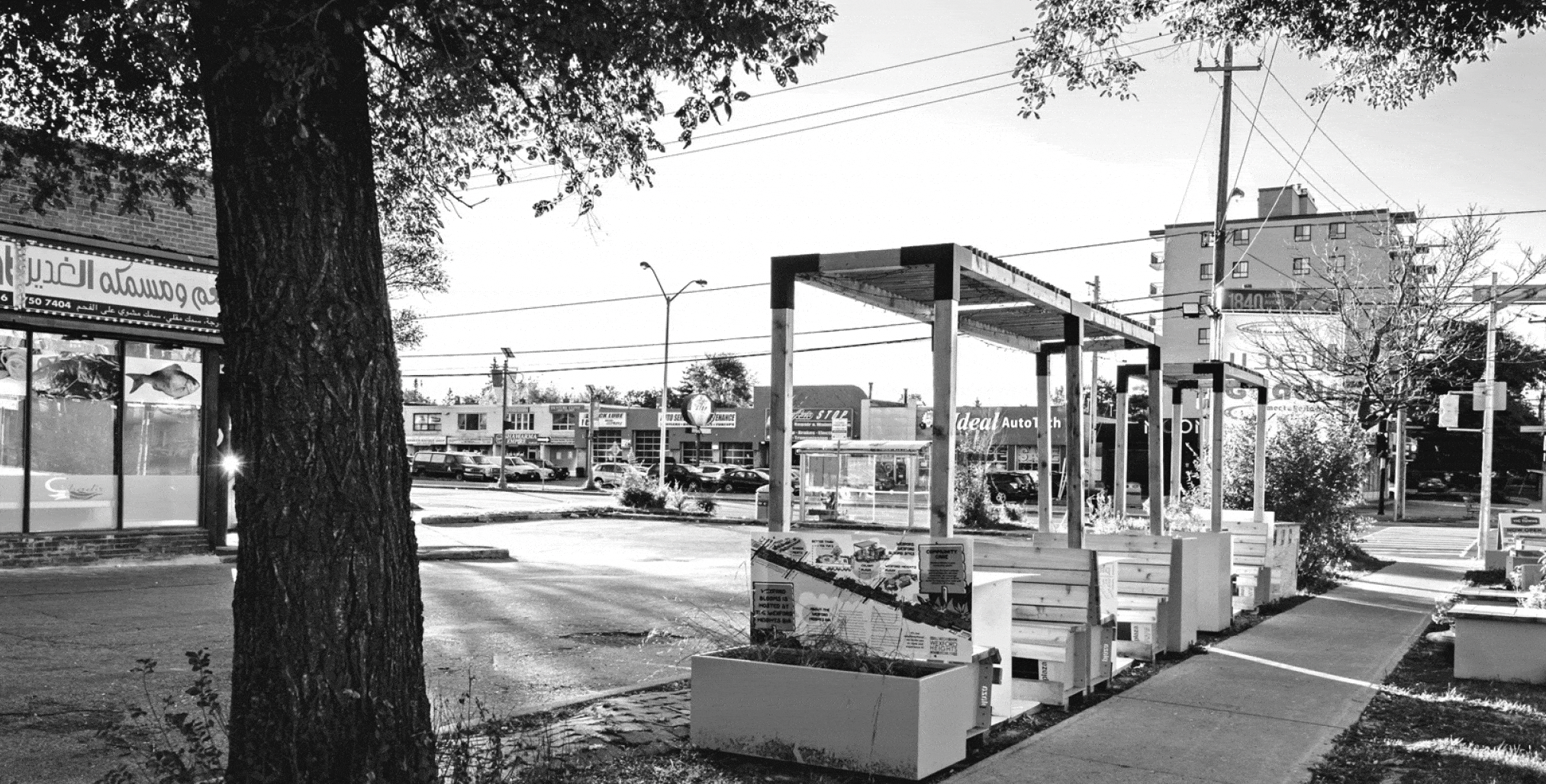
I look to Messy Cities: Why We Can’t Plan Everything — an anthology of 43 very sweet chapters by 40 contributors, edited by Canada-based urbanists Dylan Reid, Zahra Ebrahim, Leslie Woo, and John Lorinc — for engagement with these perennial questions. In an era of shiny, clinical architecture projects that mostly feel like a corporate cafeteria (so many grain bowls), this collective refusal to over-plan makes a welcome intervention.
Am I glamorizing urban informality as a corrective to state failure, or peddling anti-regulation propaganda under the guise of praising ingenuity?
Centering on Toronto, with a few international comparisons sprinkled in, this anthology is an ode to everyday (and not so everyday) planners, showing us a school construction site transformed into a guerilla landlocked beach (with signs détourned to say things like “LINGER SO YESPASSING”); a family history of steelpan drummers doubling as a policy proposal about noise ordinances; a chronicle of a clothing-optional-but-not-explicitly-queer beach and its goers fighting threats from both rezoning and erosion; best practices from urban designers who turn strip malls into multiracial plazas; speculative fictions about what it might look like for brown and Black kids to walk home from school safely; ethnographies cataloguing the dangers of flexible streetscapes for vision-impaired users and their guide dogs; field notes on leaf litter and municipal “mess” ordinances. Messy Cities doubles as a love letter to Toronto’s growing immigrant neighborhoods, and an archive of the everyday strategies by which communities make an often hostile city work for them.
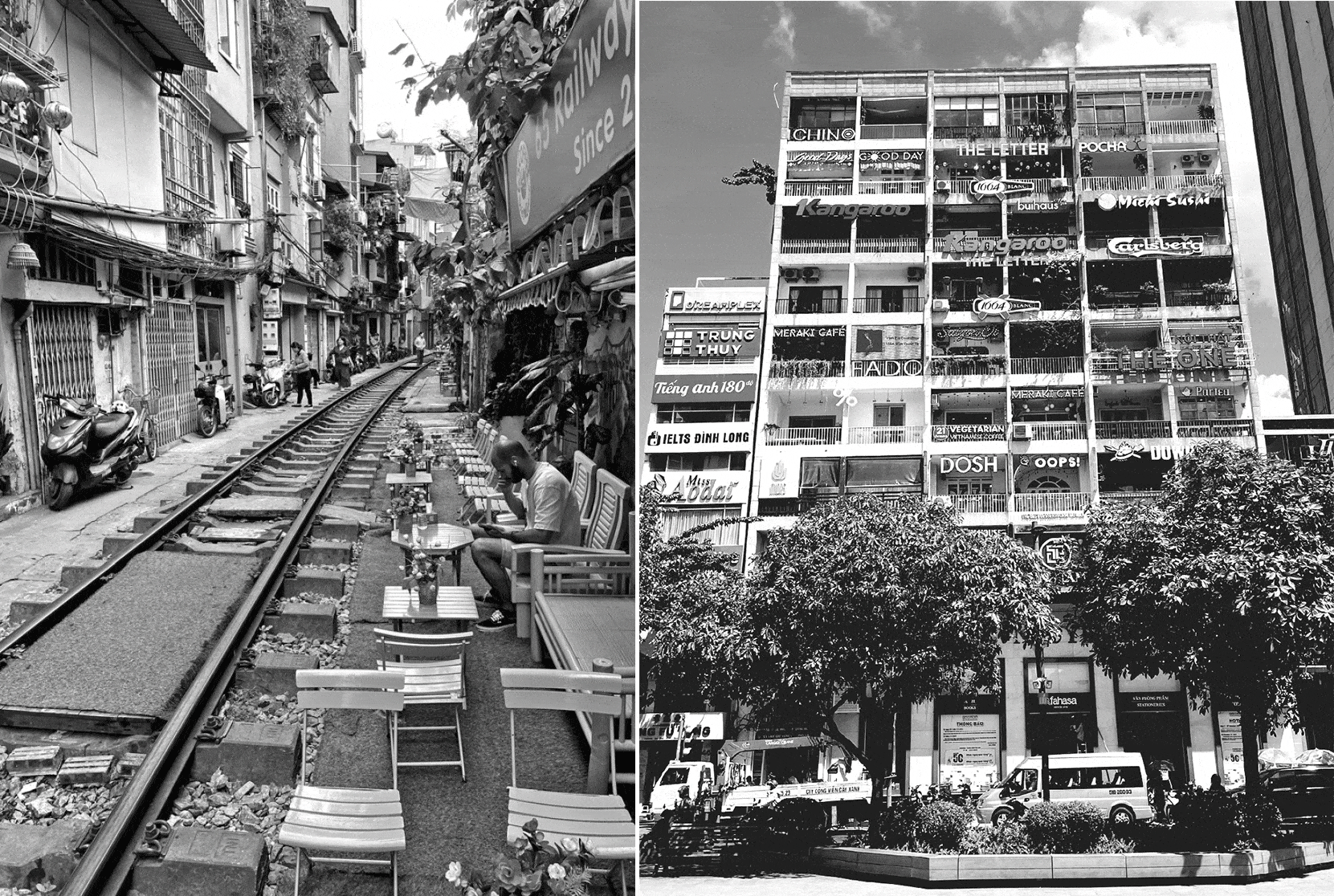
Messiness does not quite mean informality, but something more deliberately capacious. This expansive approach, while admirable, occasionally becomes challenging to follow, let alone to mobilize around politically (despite co-editor Reid’s hopes that the anthology will “inspire readers to take action”). Some contributors argue that municipalities ought to loosen regulations to allow for more flexibility; others that planners ought to sound the alarm against the “aggressive deregulation” that informality can imply; still others that historic preservationists ought to codify informal spaces through formal landmark planning commissions; a handful romanticize authentic-ethnic-no-frills-hole-in-the-wall-ramshackle-savory-vibrant-chaotic-government-failure urbanism.
Messiness does not quite mean informality, but something more deliberately capacious.
Overall, I wanted a clearer articulation of the long-term, radical possibilities nascent within everyday urbanism, challenging the misguided notion that temporary, tactical interventions (like mobile library pop-ups or public art projects in bus stops) constitute superficial recognition of identity/aesthetics at the expense of “real” change. Chiyi Tam’s chapter, “Arguments Worth Having,” comes closest: chronicling an argument with “Business Uncle” over a new community center established as part of Tam’s work with the Toronto Chinatown Land Trust. Toggling between planning debates unfolding over rice rolls at a dim sum restaurant, and the deployment of stock community engagement tools from the city’s planning department (“Urbanism and its goddamn Post-it Notes”), Tam looks to informal planning as a locus of generative conflict where political consciousness is raised.
Still, I leave with a renewed desire for very sweet jackfruit and a one-way ticket to Toronto.



If you would like to comment on this article, or anything else on Places Journal, visit our Facebook page or send us a message on Twitter.