

What Repair? For Whom?
I don’t mean to be oppositional, but the issue is not repair. Not repair as restoration, not rehabilitation. The issue is anything but repair; it is, rather, building something entirely other than what we currently “have.” “Have” is in quotation marks, because contemporary questions of repair mean nothing unless we act on the issues and provocations of property, abolition, and justice, acknowledging what Jennifer Newsom and Tom Carruthers have called “trouble with the word ‘repair.’”
I don’t want to repair the broken political system that criminalizes homelessness, elevates corporations, bankrolls Cop City, and co-signs genocide. I don’t want a repair that, here in so-called c/a/n/a/d/a, delivers the lip service of land acknowledgements, forms of Indigenous reconciliation that often seem merely a bait-and-switch, preservation of the privilege embedded in our famous Canadian cultural “mosaic” — and all this in the face not only of ongoing genocide but of chronocide, urbicide, scholasticide, epistemicide. Olúfẹ́mi Táíwò says, in Reconsidering Reparations, that reparations necessitate something wholly new. What, after all, do we value in these infrastructures and processes that have gotten us to where we are? You can repair a broken clock, but the old tool still tells the same time; what we need are new temporalities. The instrumentality of repair means nothing if it doesn’t fundamentally grapple with what the tool (call it racial capitalism, for starters) has done, the ways in which it continues to be weaponized.

We need new dreams, new worlds. Bathwater and baby. And the kitchen sink, too. We need new politics. New languages — not just English.
We need new dreams, new worlds. Bathwater and baby. And the kitchen sink, too. We need new politics. And new languages — not just English. We need politics and practices that we haven’t seen. Or, often, that we’ve dismissed outright as not being civilized enough, palatable enough, White enough. We need new geographies, beyond the usual centers and audiences (and definitions). “Let me be very clear. Europe is not my center,” declares Sembène Ousmane, in the 1983 documentary Camera d’Afrique: Filming Against the Odds. A character in the now-classic film Touki Bouki, by Djibril Diop Mambéty: “France? Nothing good will come of it.” Another in An Egyptian Story, by Youssef Chahine: “The world is not America and England.” Repair — outside such contexts of epistemic dreaming, tender futures, projects enacted otherwise — is hollow, a business-as-usual. In my case, this means the practice of architecture as a prioritization and manipulation, indeed a worship, of property and labor.
“Repair isn’t so circumscribed, you know. You’re being semantic, Ozayr,” someone says. I say, “Words are worlds.”
I’m tired — as are many of us Brown, Black, Asian, and othered others — of being asked to repair (and save) the profoundly extractionist, racist, suprematist systems that we are told “care” for us, are good for us. You want me to repair the border wall? The curriculum? Funding to weapons manufacturers? Property law? You want me to repair the image of your university, your institution, your political party? Why on earth would I want to repair a discipline, a process, a protocol, a legal system that clearly is for some, and not for others? Refuse that form of repair. Resist that form of care. Tunnel under it, fly over it. That repair and that care are forms of bypass urbanism, border architecture, and knowledge gatekeeping, whose raisons d’etre are, well, to maintain business as usual. To challenge that repair is, in part, to ask as Táíwò does:
What forms of social life are compatible with our flourishing? What must our economies look like to respond to our social problems? What are the root causes — in a material and institutional sense, from a righteous perspective — of our current problems, and which of them are alterable? How can we build algorithms, institutions, rules, laws, social movements, or revolutions that do the altering?
The point isn’t to repair. It’s to re-build, to build anew. The point is epistemic dreaming, epistemic construction, epistemic wrecking or “wreckonciliation.” The point is that other worlds, and universities, and disciplines, are possible.
— Ozayr Saloojee
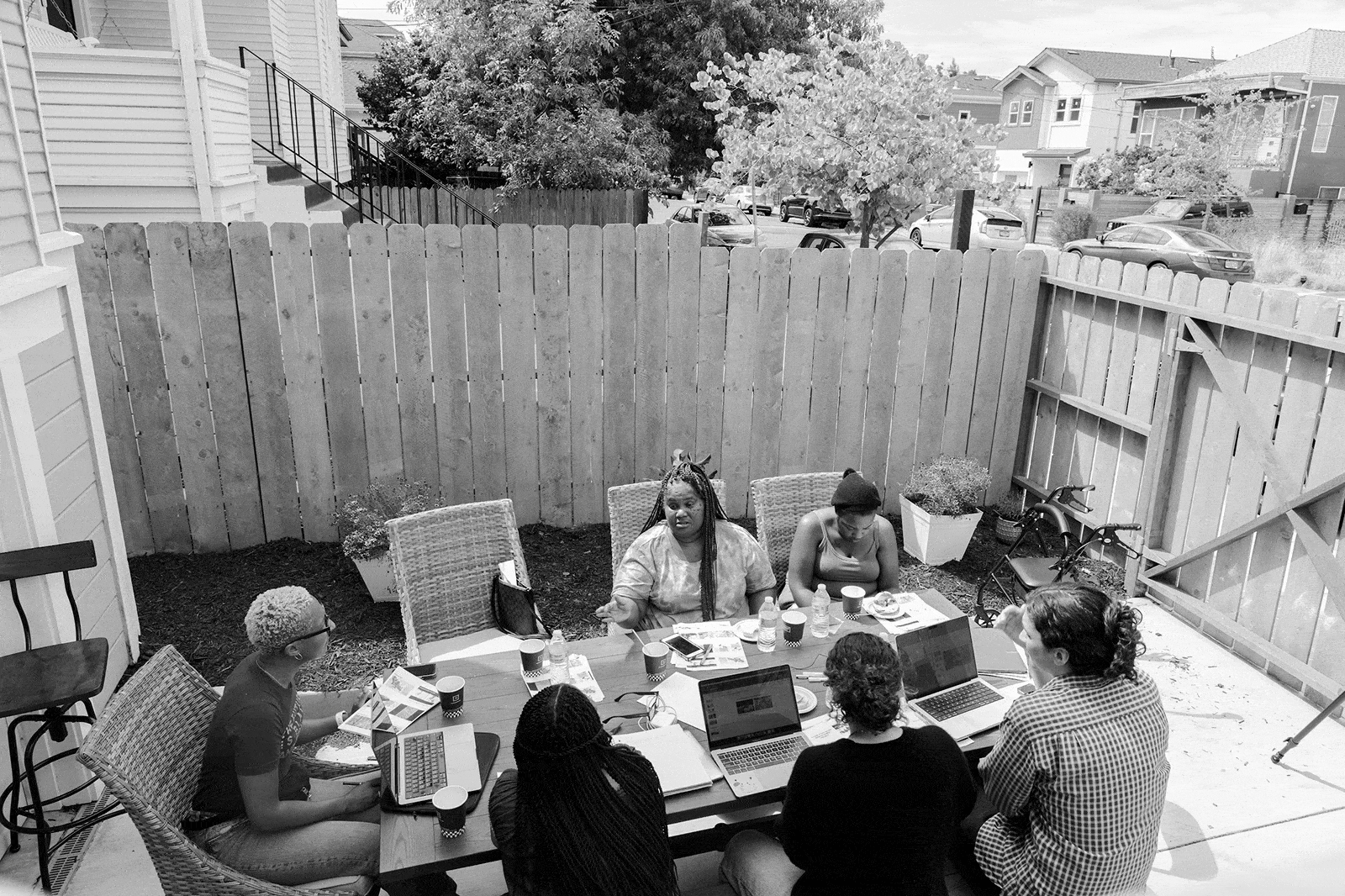
For the last several years, I have been in collaboration with, and endlessly inspired by, a group of formerly homeless Black mothers and organizers based in Oakland, California. I will refer to them here, simply and lovingly, as the Moms. Their deployment of a Black feminist politics to repair what has been destroyed by cycles of removal and disinvestment has been remarkable to witness.
Maybe you’ve heard of them: the Moms gained international attention (notoriety) with their occupation of a vacant house in West Oakland.
It’s possible you’ve heard of them: the Moms first gained international attention (i.e., notoriety) in 2019 with their clandestine occupation of a house in West Oakland that had been vacant for two years. At the time, this house at 2928 Magnolia Street was owned by a real estate investment company that had taken possession of it in the enduring foreclosure crisis, which has disproportionately impacted Oakland’s most vulnerable Black and Latinx residents. Like too many others, this developer trafficked in distressed residential properties, and had acquired the house at auction. The Moms were unwilling to accept as normal any circumstance or logic that would leave investor-owned housing sitting vacant, while mothers and their babies slept on city streets.

Their occupation on Magnolia Street was a remarkable act of refusal, eventually met with an eviction notice. What came next was a disproportionate and terrifying display of force: armed deputies arrived in a pre-dawn raid, with rifles drawn and a tank in tow.
Ultimately, the Moms’ movement proved too powerful. After their occupation and the attempted removal, the group gained ownership, and they now steward the home on Magnolia Street as a transitional space for mothers and their children who are experiencing housing instability. But what appeared to many to transpire over a few short months had actually begun much earlier.
Simply put, “Moms House” was compelled into existence by decades of organized abandonment, including the continuous withdrawal of critical resources and public funding. In Oakland, and West Oakland in particular, state-sanctioned redlining, restrictive covenants, and other mechanisms of systemic racism have long facilitated extractive, exclusionary, and predatory investments. These instruments and techniques of property manipulation have at once created and decimated Black neighborhoods, corralling Black people in particular parts of the city, only to make those Black spaces vulnerable to further cycles of speculation, hyper-/de-valuation, and exploitation.
The legal scholar Cheryl Harris presents us with the idea that property is not a thing but a right; she argues, moreover, that property as the right to ownership (of one’s own body, of land, of others) is a vector for the enactment of Whiteness. Both property — as a right — and Whiteness are made material precisely as mechanisms of exclusion, dispossession, and violence. Thus prevailing geometries of power are inscribed onto Black skin and coded into the physical landscape via parcel numbers and land deeds.
Recovery demands time, compassion, and acceptance; it allows for making (space) anew.
Given all this, I prefer to understand the Moms’ movement as one of recovery rather than repair, which presupposes a brokenness that can be fixed, even if the upgrade is invasive or violent. Recovery instead speaks to a period of prolonged and necessary healing without attachments to a normative state of being. Recovery demands time, compassion, and acceptance; it allows for making (space) anew. It centers the agency of the afflicted, and needn’t rely on the external affordances that might be implied by repair. In a different but related sense, the Moms are recovering a primordial sense of dwelling embedded in the making of home, making commitments to communal care centered in housing, and reclaiming livability in the face of ever-evolving urbicide (this time via gentrification). Through their resolve and their care, a site of real estate speculation has become a sanctuary for Black maternal life.
The presence of the Black body — always fugitive — is especially vital for Black placemaking in the midst and aftermath of capitalist dispossession. Moms House is no exception, and the Moms’ occupation-as-refusal has made a radical intervention into the politics of property and Whiteness, or Whiteness as property. Turning a vacant “unit” into a vibrant home for their children, their community, and each other, the Moms are reconfiguring the terms on which ownership and community are created.
— Brandi T. Summers
Repair is not a metaphor. For Indigenous peoples, the paradigm shifts from building worlds to repairing worlds happened a long time ago.
I’ve been watching the dams come down from afar. This summer, I was captivated by a series of time-lapse photos showing trucks hauling 800,000 cubic yards of material away from the Iron Gate Dam in northern California. Around the same time, international news headlines declared the Klamath River was flowing freely for the first time in more than a century. A BBC headline quotes Brook Thompson of the Yurok and Karuk tribes: “Anything that can be built can be taken down.” Four dams along a 240-mile stretch of the river have been removed over the past year. Endangered chinook salmon and other species are expected to start returning to their ancestral spawning grounds almost immediately. Led by local tribes such as Yurok, Karuk, and Klamath, the largest dam removal project in U.S. history has me thinking a lot about demolition as repair.
Dam removal is a powerful act of ‘affirmative refusal,’ both destructive and constructive.
Dam removal is not metaphorical. Indeed, it’s quite concrete. It is a powerful act of “affirmative refusal” that is simultaneously destructive and constructive. It entails eliminating barriers and enacting and repairing relationalities, particularly Indigenous relationalities with non-human kin like salmon. In As We Have Always Done, the Michi Saagiig Nishnaabeg artist and writer Leanne Betasamosake Simpson describes how affirmative refusal results “in the creation of not just points of disruption but collective constellations of disruption, interrogation, decolonial love, and profound embodiments of nation-based Indigeneity.” In her more recent book, A Short History of the Blockade, Simpson develops the theory of affirmative refusal through stories about beavers. The “life-giving possibilities of dams and the world-building possibilities of blockades,” she argues, deepen “our understanding of Indigenous resistance as both a negation and an affirmation.” The real work of restoration and repair is only beginning on the Klamath River, but removing the dams was an essential first step.

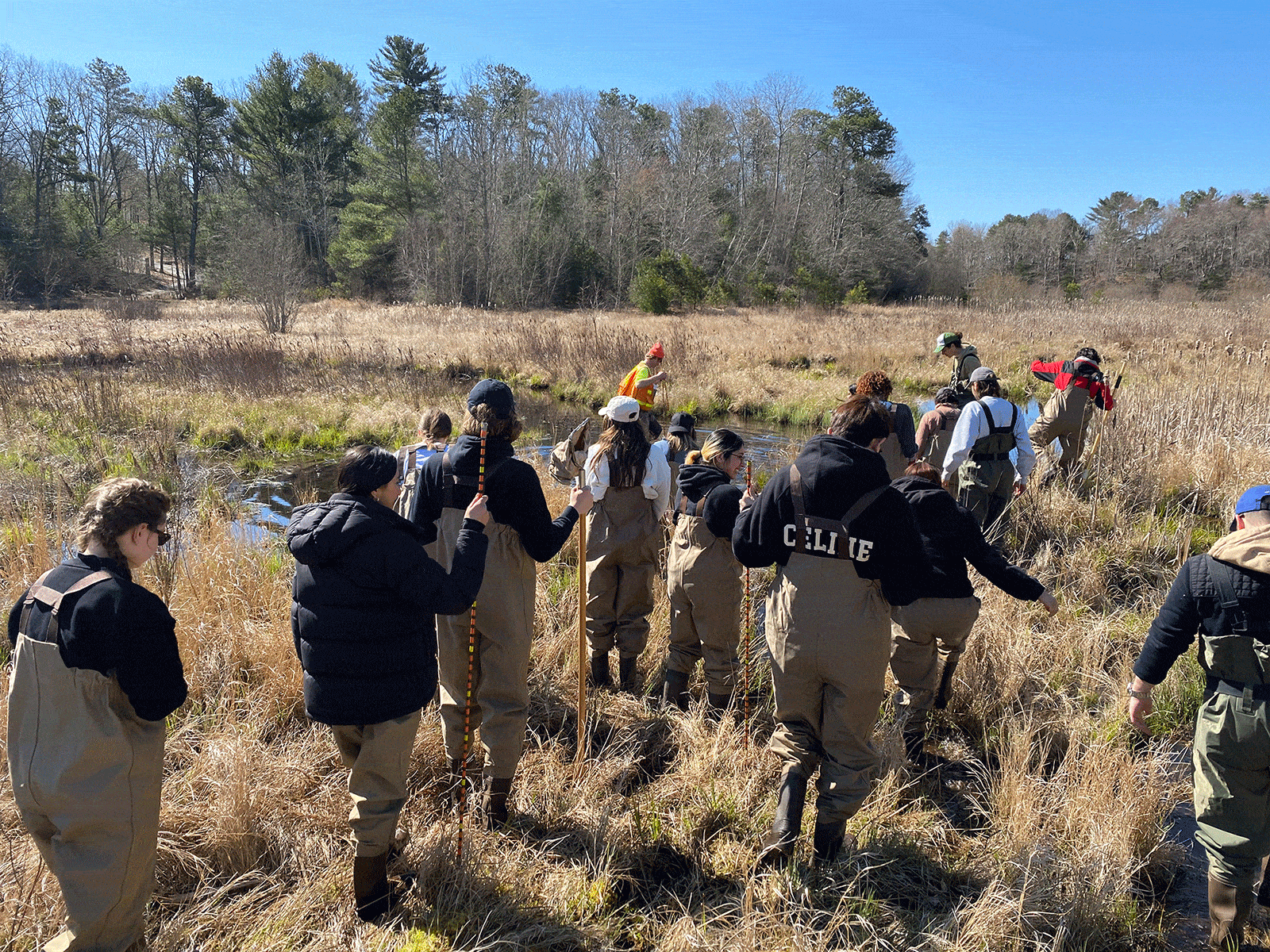
Over the past year I’ve been talking to my students about the Klamath, Snake, Elwha, and White Salmon rivers in the Pacific Northwest, even though we sit along the banks of the Charles, Neponset, and Mystic rivers in the Northeast. And I’ve been sharing the work of Indigenous scholars like Leanne Simpson, Sarah Hunt, and Lindsey Schneider, which I consider essential reading in the context of contemporary design education. In a powerful essay about Indigenous futures, published in Voices of the River, Schneider describes the dams on the Columbia River as settler colonial infrastructure, and asks us: “What do we owe the rivers?”
In class we talk a bit about the role of dam construction on Indigenous dispossession in the United States, including in New England. Heather Randell and Andrew Curley estimate that over 1.13 million acres of tribal land have been flooded under the reservoirs of 424 dams. We visit smaller scale dam removal and river restoration projects in eastern Massachusetts, including the Eel River Preserve and Tidmarsh Wildlife Sanctuary. We learn about the return of fish like river herring and alewife, and the advocacy of local tribes such as the Wampanoag, Massachusett, and Nipmuck in Taunton, Watertown, Natick, and other places. For many of my students the idea that building dams to produce hydropower has serious downsides comes as a surprise. As a teacher, I find this to be an incredibly generative and reparative moment.
— Nicholas Anthony Brown
It’s time for immeasurable yields in design
Helping to protect biodiversity … actually has a direct link to climate change and through that link to the survivability of our species on this planet.
— Rick Ridgeway, in the documentary Wild Life
Built environments worldwide are responsible for 50 to 70 percent of global warming. It is up to practitioners in our field to promote a shift from the parasitism of buildings that depend on non-renewable resources to a mutualism in which not only a given building’s users but also the planet as a whole benefit from our designs.
Can we become true (r)evolutionaries and dare to unthink how we inhabit Earth?
Every life form has an inalienable right to inhabit this planet. Architects must commit to human settlement ecologies that seed rather than deplete Earth’s extraordinary natural wealth. As designers, we must presume that all living organisms are fundamental to life; we must strengthen our conviction that all life deserves consideration. We must pride ourselves in promoting biodiversity; we must go beyond notions of net zero and net positive, and aspire to think in terms of generative yields — design outcomes that will help Earth to cool down, rewild, and reboot biodiversity, even if our civilization falls into ruins. Imagine if we built with biodegradable materials that have seeds embedded in them? Even in the final stages of its useful life, a building could then spawn a fresh round of biodiversity.
May the legacies of conservationists Kristine Tompkins and her late husband Doug, who spent their lives protecting and promoting vast swaths of wild lands as national parks in Chile and Argentina, inspire us as designers in a renewed commitment to immeasurable yields. As Tompkins says in the documentary Wild Life:
Maybe national parks are like petri dishes … and … when everything goes to hell, national parks being protected areas might be a petri dish in which evolution could kind of restart itself. Who knows?
Do we have it in us to become true (r)evolutionaries and dare to unthink how we inhabit Earth, to protect its wealth for future generations? Do we have it in us to design with death in mind, given that no civilization lasts forever? Are we capable of dealing with our collective mortality, and stepping up our responsibility to a unique and spectacular planet? Who knows?
— Anna Loreina Georas Santos
Radical Reimagination
Hopefulness empowers us to continue our work for justice even as the forces of injustice may gain greater power for a time.
— bell hooks, Teaching Community
We stand at a crossroads. To effectively address the interconnected challenges of climate crisis and entrenched inequity, the design disciplines need to undergo a profound ideological shift. Disciplines that have long valued novelty and innovation — that have been fascinated by the shiny and the disruptive — need to pivot towards an ethos of repair and care.
In her seminal book, Teaching Community: A Pedagogy of Hope, bell hooks illuminates the power of education to inspire these kinds of radical change. “Progressive education, education as the practice of freedom,” hooks writes, “enables us to confront feelings of loss and restore our sense of connection. It teaches us how to create community.” She reminds us that it is vital to value what already exists. Abandoned brownfields, forgotten urban corners, aging infrastructure, dispossessed communities — all tell significant stories. They are repositories of memory, culture, and ecological potential. An ethos — an ethic — of repair invites us to see such places and spaces not simply as properties to be bulldozed or redeveloped but rather as sites for regeneration — sites where past, present, and future can be creatively woven together to make more inclusive and meaningful communities.
Repair is not a solitary act; it requires collective wisdom. Community-centered design requires active listening — listening not just to the loudest voices in the room but also to the marginalized. Communities can best articulate their own needs and aspirations; they can tell us about the intricate web of relationships that give purpose to their environment. In true partnership with communities, we can co-create with care, honoring the lived experiences of those who inhabit the landscapes we shape.
Abandoned brownfields, forgotten urban corners, aging infrastructure, dispossessed communities — all tell significant stories.
In thinking about the scale of the climate crisis, I want to critique dominant narratives that emphasize its impossible largeness while at the same time overlooking specific lives and localized experiences. I want to stress the importance of centering the voices and experiences of marginalized communities in climate discourse and action. For the design and planning professions, addressing the climate emergency requires radical reimagination. It means envisioning societal structures rooted not in capitalism, patriarchy, and White supremacy, but instead in sustained commitment to equity and justice. It means shifting from projects that showcase technical prowess and aesthetic novelty towards projects that foster communal well-being and environmental sustainability. It means rejecting exploitation and consumption and embracing stewardship and regeneration. The metaphor of “building” has long dominated our thinking about progress. Now it’s time to take up metaphors of repairing and reweaving, healing and caring. We can repair damaged ecosystems, heal fragmented habitats, reweave social bonds. In these ways our designs can become acts of love — for people, for nature, for collective well-being.
— CL Bohannon
In response to the question posed for this series — “what ideological or conceptual changes are required to help disciplines that reward novelty and innovation shift toward an ethos of repair and care?” — I want to reframe Steven J. Jackson’s amazing article, “Rethinking Repair.” Jackson insists that prioritizing “repair” in technology studies pushes technology itself toward greater relationality. Here, quoting directly from his essay, I will substitute “architecture” for “technology” and “labor organizing” for “repair.” Which is to argue that labor organizing is the repair that architecture needs.
In Jackson’s article, repair is posited as secondary, temporally and conceptually, to innovation/object making. In my transposition, the temporal secondariness of labor organizing to architecture object-making is less obvious — but only if we think of design labor and ignore construction labor. The conceptual subordination of labor organizing to architectural object-making, however, cannot be disputed; neither labor nor organizing — let alone labor organizing — gets attention.
Jackson identifies three spheres that will open up in technology through a focus on repair: innovation, power/knowledge, and the ethics of care. What would that look like in design?
Innovation: In scientific computation and collaboration the field of architecture, the language of innovation is generally reserved for new shiny objects and computationally intensive “bright and shiny tools,” while repair labor organizing … at best is relegated to the mostly neglected story of people (researchers, information managers, beleaguered field technicians) working to fit such artifacts to the sticky realities of field-level practices and needs …. From this perspective, worlds of maintenance and repair labor organizing and the instances of breakdown that occasion them are is not separate or alternative to innovation in object production, but [a]sites for some of its most interesting and consequential operations.
Power/Knowledge: Can breakdown, maintenance, and repair labor organizing confer special epistemic advantage in our thinking about technology architecture? … [On the ground] insights call attention to the world-disclosing properties of breakdown professional failure and the distinct epistemic advantages that can follow from moving repair (and repair workers) labor organizing to the center of our thinking about architectural production.
Ethics of Care: Finally, foregrounding maintenance and repair labor organizing as an aspect of technological work architectural professionalism invites not only new functional but also moral relations to the world of technology our profession. It references what is in fact a very old but routinely forgotten relationship of humans to things in the world: namely, an ethics of mutual care and responsibility.
Jackson then suggests that five things can be done to spotlight repair as the essential arena of technical value. Here are my transpositions (again, of passages quoted directly from his essay):
First, and if nothing else, foregrounding labor organizing can help us think beyond the remarkably restricted and usually binary sets of actors that have dominated media and technology architectural studies to date.
Second, attention to maintenance and repair labor organizing may help to redirect our gaze from moments of object production to moments of sustainability and the myriad forms of activity by which the shape, standing, and meaning of objects in the world is produced and sustained.
Third, maintenance and repair labor organizing may have particular contributions to make to our thinking around the timeliness of technology architecture, something we have, as a field, been remarkably bad at to date.
Fourth, recentering maintenance and repair labor organizing may help with the necessary project of building bridges to new and adjacent fields whose methods, insights, and modes of work hold great promise to complement and enrich our own (and vice versa).
Finally, moving maintenance and repair labor organizing back to the center of thinking around media and technology architecture may help to develop deeper and richer stories of relationality to the technological architectural artifacts and systems that surround us, positioning the world of things as an active component and partner in the ongoing project of building more humane, just, and sustainable collectives.
Repair, here we come.
— Peggy Deamer
A practice centered on repair can pull in two directions
A practice centered on repair pulls in two directions. On one hand, repair is a commitment to conservation and continuity, a pledge to maintain and care for what we have inherited so as to chart a sustainable future. On the other hand, repair is also a demand for rupture, an insistence that certain habits of history be broken to avoid perpetuating the violences that structure our present. Repair declares, “Honor the past”; “This can be saved”; “We are stewards of something greater than ourselves.” At the same time, it also promises, “Never again”; “It will be different”; even, “We must create something new.”
As an artist who makes work about difficult things — reproductive unfreedom, sexual violence, the complexities of consent — I feel the tug in both directions. At the core of my practice is the belief that the future must be different, and that making visible unjust operations of power can be a mechanism for change. Yet equally operative is a desire for belonging, and the positioning of my work within a legacy of artists and thinkers who came before. This queer feminist genealogy makes my work possible — I am inspired and indebted — and it also makes my work legible. Were I not able to claim this precedent, I might be called a monster.
Repair is tricky because its actual politics emerge only in the specific instance.
Maddeningly, auspiciously, the desire to repair and be repaired cuts across the ideological spectrum. As an abstract concept, repair is shot through with contradictory, politically-coded ambivalences. Fealty to legacy and preservation can be a radical practice of maintenance labor, but they can also be regressive devotional delusions. Capitalist techno-fetishism fixates on the horizon of change, with talk of disruption, innovation, and the new, but so does hope. Repair is tricky because its actual politics emerge only in the specific instance. We all want to fix what is broken, we all want returned what is lost, we all want to feel whole, we all want to experience something new. What matters is how we move from desire to practice.
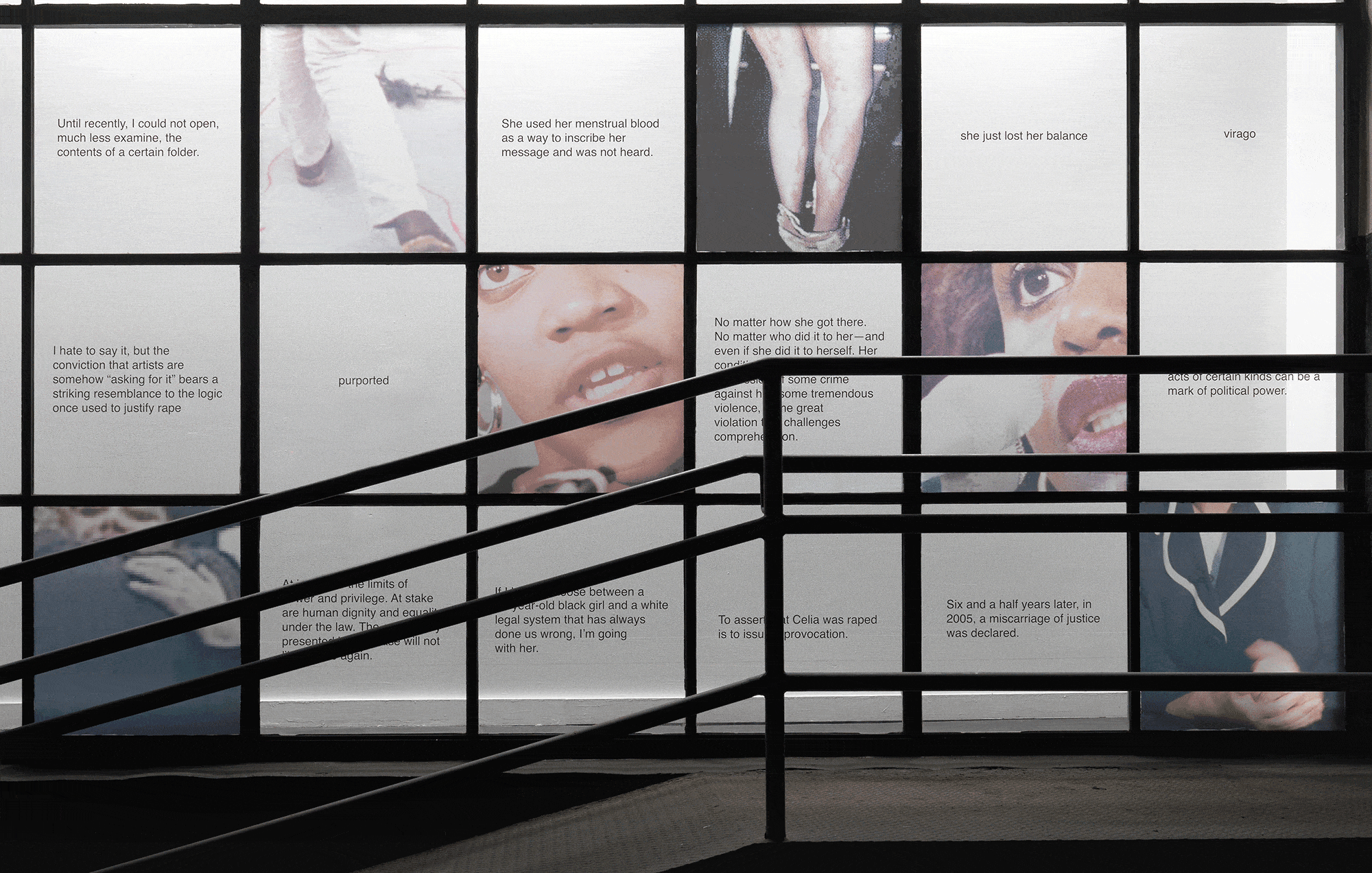
How we imagine repair has everything to do with how we imagine injury. Is the breakdown of the body — and by extension, the built environment, the planet, our society — inevitable? Or an aberration? Perhaps the difference between a belief in injury as everyday certainty versus outrageous exception arises from how we recognize and sit with wounds. What is our attachment to woundedness, and what do we believe pain justifies? Wounds can stem from the violent malicious action of another or from something as all-encompassing and indifferent as time. Similarly, repair can range from the unending work of maintaining and enduring, to a demand for justice premised on the logic of perpetration — making it at times indistinguishable from revenge.
How we imagine repair has everything to do with how we imagine injury.
I ascribe no moral valence to any particular understanding of injury; each has its place. Instead, I am interested in how different conceptions of repair are axiomatic to different discourses. Repairing the body, for example, can look starkly different in a medical context compared to a religious one or a legal one. Repairing a city can look different in a civic or social sphere compared to an economic or ecological one. Repairing the planet can look different on a cosmic scale compared to an anthropocentric one. What is always true, however, is that the most radical notions of repair entail risking one’s own orthodoxies, and stepping outside the dictums that circumscribe what is valuable and acceptable in one’s field. Repair can be found in suffering, healing, forgiveness, punishment, compromise, refusal, peace, insurrection, development, conservation, spending, saving, annihilation, or eternity. If we pause to feel the edges and overlaps of these contradictions, we might see new openings.
— Aliza Shvarts
Building Cultivation
The present separation between building design and building maintenance has a long but precise history. Prior to the 20th century, people who called themselves “architects,” “contractors,” “carpenters,” “masons,” “builders,” or “engineers” did a range of overlapping and intersecting work. Artisans with the expertise to design buildings were the same people who had the expertise to build and repair them. When the American Institute of Architects formed in 1857, it did so with the express intent to distinguish amongst these varied building practices, enforcing divisions between what was perceived as manual versus mental labor. This meant privileging invention, newness, and creativity as expressions of thought, and at the same time disassociating such mental acuities from the work of construction and repair. Design became the rubric under which the mental effort necessary for architectural production was structured, and by which the social class of architects was organized.
This association of invention with mental labor, and of mental labor with design, reflects what anthropologist Mary Douglas has referred to as the purity rule, whereby higher social status requires distancing oneself from embodiment; higher social class is conveyed in part by one’s detachment from physicality. The modern architectural profession was founded on these distinctions.
Accordingly, a shift to an ethic of maintenance and repair requires a reinvention of architectural practice.
Rather than designing buildings, what would it mean for architects to cultivate buildings? More than simply creating something new, cultivation implies sustained presence broken into an infinity of tiny temporalities. Cultivation requires constant care, and care requires being invested in outcomes — personally, socially, and culturally — while understanding such outcomes not as endpoints after which maintenance ceases, but rather as those tiny moments that, at one and the same time, end what has passed and begin what follows. Care means reconfiguring architectural practice to embrace this sense of “a forever ongoing,” in contrast to a project timeline that posits a fixed start, middle, and end. Care means accounting for how a project will persist after one’s own moment, under the care of others. This means attaching temporalities to the project, not to one’s role in it.
Care means reconfiguring architectural practice to embrace ‘a forever ongoing,’ in contrast to a timeline that posits a fixed start, middle, and end.
Cultivation cannot be a sole-authored undertaking, and perhaps cannot be authored at all, as it requires a choreography amongst various elements. Building cultivation thus means acknowledging that all built environments require diverse teams of people to conceive, construct, and sustain them. Architect, builder, engineer, landscaper, janitor — all are important in the life of the building. In this way, building cultivation means challenging the socially constructed hierarchy of mental and manual labor, embracing the role of manual work in building practices, and also acknowledging the creativity, invention, and mental labor required in construction, maintenance, and repair. The fluid relationships among these forms of work reflect the inherent circularity of cultivation, whereby the seedlings of one season bear fruit for the next.
— Jay Cephas
Life at the margins is life in the main
Repair is a tall order sometimes, even just sewing a button back on a shirt. Mend the world? You’ve got to be kidding, right? Global warming obligates the unwinding of almost 200 years of human industrial, agricultural, and economic systems, and that, in turn, demands the interrogation of politics, capital, and social organization. This is not a Friday-afternoon-at-four o’clock problem.
But this is where global warming has us, thanks to accumulated inactions. Repair this? Sure, pal, no problem. Pick it up at five.
My method for complex repair has always been to break the endeavor into discrete, ordered operations while bearing in mind the margins — as something to protect, to ensure that all the beings who dwell there win the benefit. By focusing on margins, the “how” in addressing problems can be clarified. An example: we need to attend to the mental and emotional health of wildfire dispatch workers. More fires, more dispatcher stress: a margin.
Life-or-death work, poorly paid and subject to staff shortages that obligate overwork, is plunging first responders into shell shock.
Global warming begets wildfires. We respond to them, in part, via fire dispatchers. Dispatchers sit for hours on every shift peering at monitors, often long into overtime. They triage urgent calls to prioritize multiple needs, with consequences affecting fire spread and the life safety of civilians and fire personnel. Every facet of the fight crosses their desks: ground and air resources, weather information, distress calls. Regularly, impossible horrors come surging through their headsets. They are not doing well, psychologically — 73 percent of dispatchers suffer depression (more than nine times the rate for the U.S. population at large); 32 percent have experienced suicidal thoughts; ten percent are coping with active suicidal ideation (compared to four and three percent, respectively, in the total U.S. population).

Life-or-death work, poorly compensated and subject to staffing shortages that obligate overwork, is plunging a critical cadre of first responders into shell shock. This is no way to support those on the first lines of climate crisis defense.
In that last sentence, the word support, as defined in my edition of Merriam-Webster, includes the meaning “to pay the costs of: MAINTAIN.” This is not something we do well. We have obviously not paid the true, social costs of carbon-based fuels. Our wont, once a thing is built, is to move on; we build something and expect that structure to endure forever. In this case, as we increase development in fire-prone areas, and as global warming escalates, wildfire becomes more prevalent, and the incidents are more severe. We have built it, but we are not supporting — maintaining — it in the face of increasing peril.
To support is to understand that nothing in our world gets along without care, without aid. There is associated with “support” a sense of femininity to which the macho trope of “building” is antipathetic. But a loudly public campaign to improve the lot of wildfire dispatchers, framed as a necessary support for people doing an increasingly essential job, could conceivably expand to encompass ideas of supporting more of the people, places, and types of workers most directly affected, even as we speak, by global warming.
In this way, improvement at the margins could occasion a broader societal reframing. Our repaired world might stand a chance of being ready before it is too late.
Or we could just hold carbon-fuel businesses accountable for the grim consequences, once upon a time unintended and now long accepted, of their actions.
— J. Matt
How can we disentangle the production of buildings from the preferences of a private market that privileges newness? We are collectively well aware of the obscene carbon footprint of the American construction industry; as architects, we are also in the business of balancing social benefits and moral imperatives with immediate client needs and preferences; and of course, these may or may not align.
How can we disentangle the production of buildings from the preferences of a private market that privileges newness?
Here I offer three modest proposals for how architects can shift focus from novelty to repair and reuse, highlighting the importance of material sourcing and site selection. In general, these are less about changing what happens creatively within a professional office — the alchemy of the design process — and more about adjusting the regulatory frameworks within which projects are approved and constructed. Given the pace and complexity of architectural work, and the fact that it is fundamentally a profit-driven service (which, at a disciplinary level, we still struggle to honestly discuss), the argument for repair must be made through actionable convenience rather than moral recalibration alone.
First: states could require that architects prioritize locally available and recycled materials. A digital catalogue of recommended products, organized by type or use, could be assembled and updated frequently to make the specification process convenient for practitioners. All licensed architects would receive access to this catalogue, and to samples for a materials library. States in similar climate zones could share catalogues to ensure that projects are climate-sensitive across a region.
Second: states could set up material reuse rebate programs for those in a position to finance construction, especially for individuals undertaking small-scale residential renovations. (In Chicago, where I practice, this micro-sector is booming.) Just as electrical utilities offer energy rebates for the installation of efficient appliances, a state could provide up-front rebates at the start of construction for the implementation of recycled products.
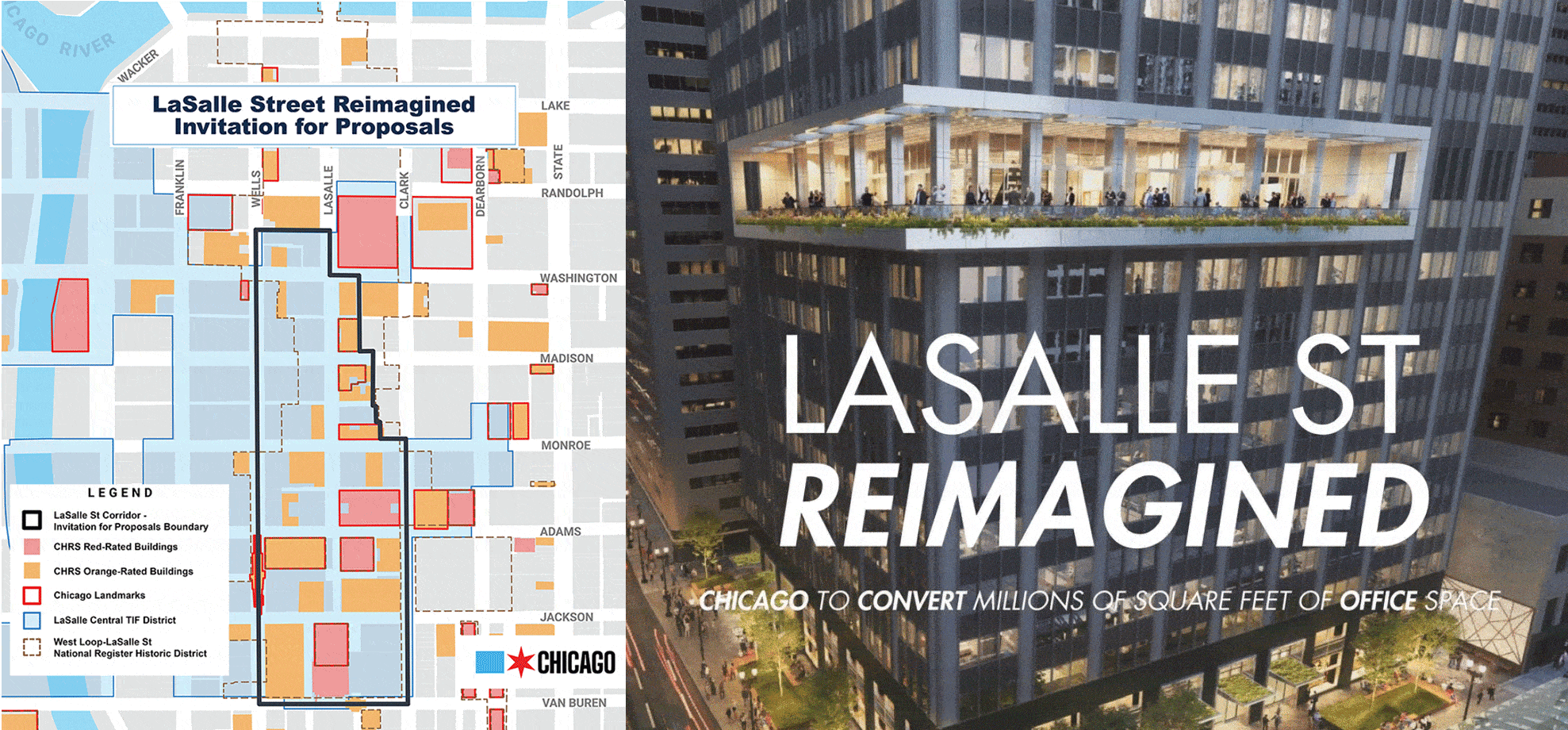
Third: cities could establish a vetting process to screen any proposed new construction project for its adaptive reuse potential, and then match the project with an appropriate existing structure. This proposal is, of course, potentially the most disruptive, and also the most impactful. Here in Chicago, the downtown sector is still struggling with a post-Covid office vacancy rate of over 25%. In response, in some areas the city is prioritizing the redevelopment of offices into residences (with affordable unit requirements). The LaSalle Corridor Adaptive Reuse program, which began in 2022, issued a voluntary Invitation for Proposals to jump-start this transition.
Repair happens at all scales, including big initiatives and many small, distributed efforts. As these efforts proliferate, the impacts are likely to be out-sized.
— Aneesha Dharwadker
Repair Requires Creation Via Undoing
In my eyes, to repair anything necessitates a deep recognition of how and why it broke.
A design of repair is as much about undoing breakage as it is about doing something new. To undo requires relational knowledge, not merely distributional knowledge: we need to know what is broken, and who experiences the impacts of the breaking. A design for repair, and thus care, requires a radical situational awareness, in which social critique becomes more important than site analysis. Using what Dr. Destiny Deguzman (née Thomas) and the other planners who make up Thrivance Group call “dignity-infused community engagement,” a participatory design process can illuminate the moral and ethical dilemmas underpinning an issue at hand. A “gaps analysis,” as planners call it, can then elevate these dilemmas by bridging between the present and future, in ways that allow us to develop radically aspirational alternatives to broken systems.
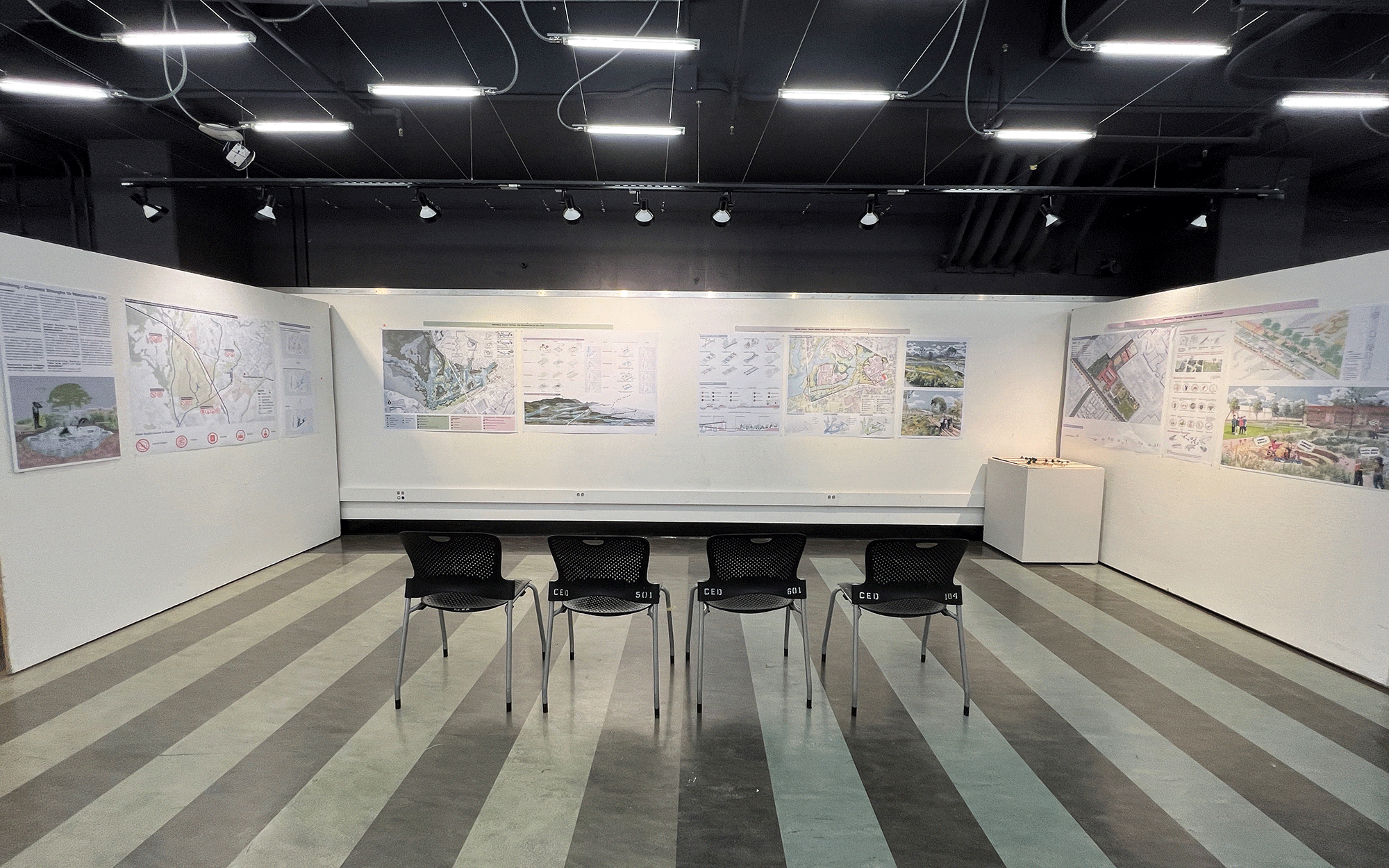
Repair requires a radical situational awareness, in which social critique becomes more important than site analysis.
The difficulty of undertaking repair in design is that few of our tools have been created to advance such social critique. In the sphere of design and planning for environmental and climate justice, I’ve watched habits of layered or interdisciplinary data analysis, derived from the work of Ian McHarg, transform over time into the instrumental mapping of social vulnerabilities and/or the creation of “digital twin” models, which are assumed to automatically bring about justice and reparations for historic ills merely by describing harms, producing what are called “disparity studies.” These disparity studies are unable to amend historic wrongs (see Deadric T. Williams and Fayola Jacobs on this subject). They are often spatially inaccurate (as Selena Hinojos et al. show), and can even exacerbate wrongs through what has been called (by Sara Safransky) algorithmic violence. The core issue is that the specifics of experience are lost to the models and metrics.
We need to move beyond “doing math” on communities. If our goals are repair and care, we’ll upend old assumptions about site analysis and design process to make possible a design of care from the start. We’ll outgrow site readings, which still center the gaze of an exogenous designer. We’ll build a design practice around radical social critique, listening to and acknowledging real struggles before re-envisioning a future where the underlying causes of those struggles are no more. This is the undoing at the heart of a repair that leads to care.
— Danielle Zoe Rivera


If you would like to comment on this article, or anything else on Places Journal, visit our Facebook page or send us a message on Twitter.