

- American Modern, by Matt Shaw, with Iwan Baan
- London Estates, by Thaddeus Zupančič
- Botanical Architecture, by Paul Dobraszczyk
- Beyond Molotovs, edited by International Research Group on Authoritarianism and Counter-Strategies, and kollektiv orangotango
- The Organizer’s Guide to Architecture Education, by Kirsten Day, Peggy Deamer, Andrea Dietz, Tessa Forde, Jessica Garcia Fritz, Palmyra Geraki, and Valérie Lechêne
- A Just Transition for All, by J. Mijin Cha
- The Makeshift City, by Joshua Dudley Greer
- A Natural History of Empty Lots, by Christopher Brown
- The Rights of Nature and the Testimony of Things, by Mark Anderson
- Is a River Alive?, by Robert Macfarlane
- The Land Is Our Community, by Roberta L. Millstein
American Modern: Architecture, Community / Columbus, Indiana
Matt Shaw, with photographs by Iwan Baan (Phaidon, 2024)
Reviewed by Belmont Freeman
Every aficionado of modern architecture knows the story of Columbus, Indiana. Starting in the mid-20th century, the enlightened patronage of local industrialist J. Irwin Miller brought Good Design to his small midwestern city through a novel form of cultural philanthropy: Miller set up a foundation that would pay the design fees for new public buildings provided the architect was selected from a pre-approved list. As a result, an unexceptional Midwestern town was transformed into a modernist showcase, with dozens of schools, churches, fire houses, and civic buildings that embody what Matt Shaw, in this new history of the city, calls its “own utopian ideals.” “Architecture here was not just about neat buildings and elite taste,” Shaw writes. “It was a way to build a better society, to literally reorganize how people of all classes interact and grow as a community.”
American Modern is not a guidebook; it’s a well-researched and highly readable monograph that explores the complex economic, political, and social backstory that’s usually missing from standard architectural narratives. It’s illuminating to learn, for instance, that the Miller family’s civic generosity was, as Shaw writes, “borne out of a wholly American combination of enterprising business success and a devotion to Christian scripture.” The author then recounts the story of how the Millers, made wealthy by their Cummins Engine Company, led the campaign to build a new sanctuary for the Tabernacle Church of Christ; and how young Irwin Miller, a recent graduate of Yale, persuaded his devout family to commission the Finnish-American Eliel Saarinen for the project. (Apparently Frank Lloyd Wright was deemed unsuitable because of his reputation as an adulterer.)
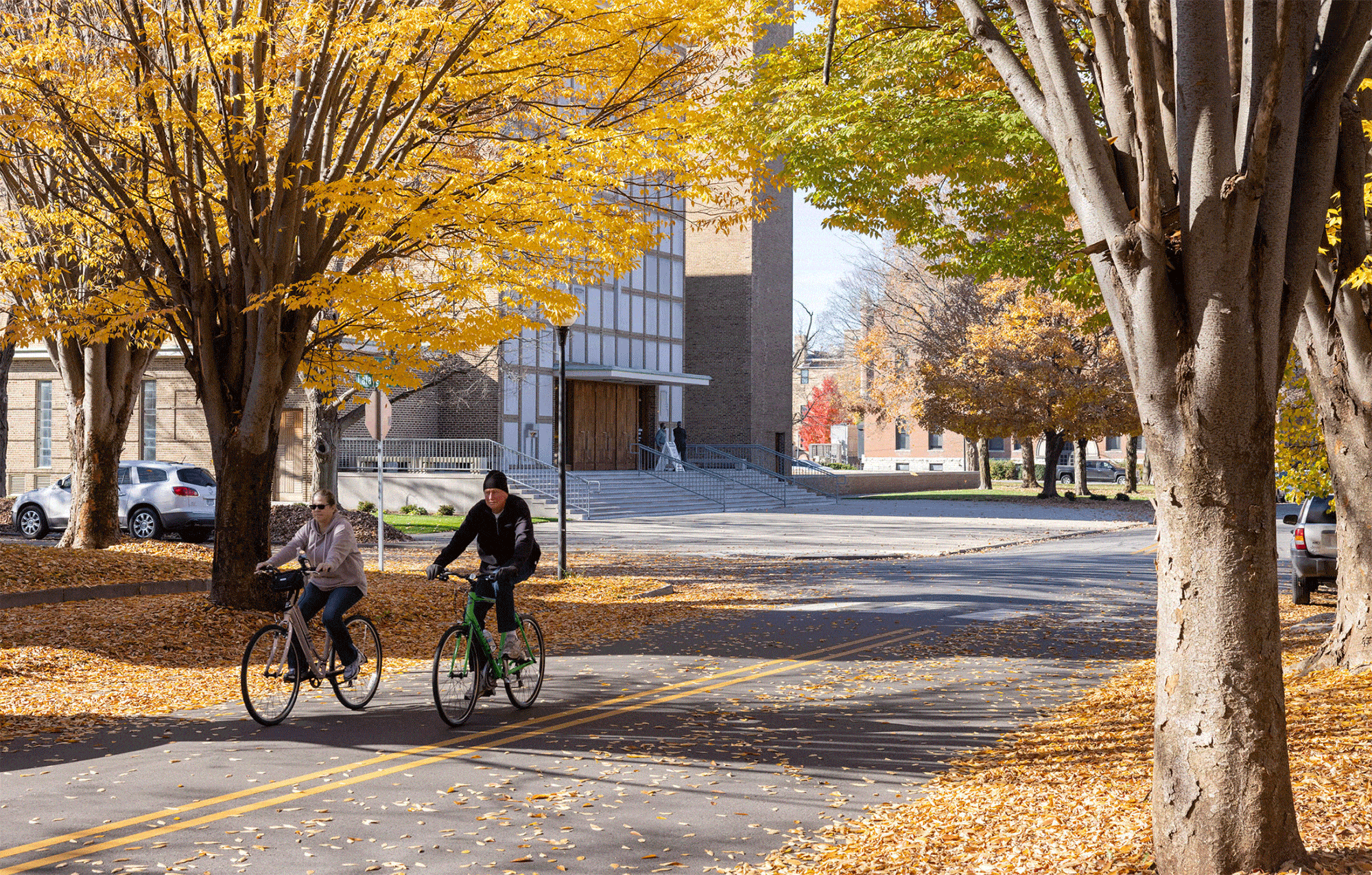
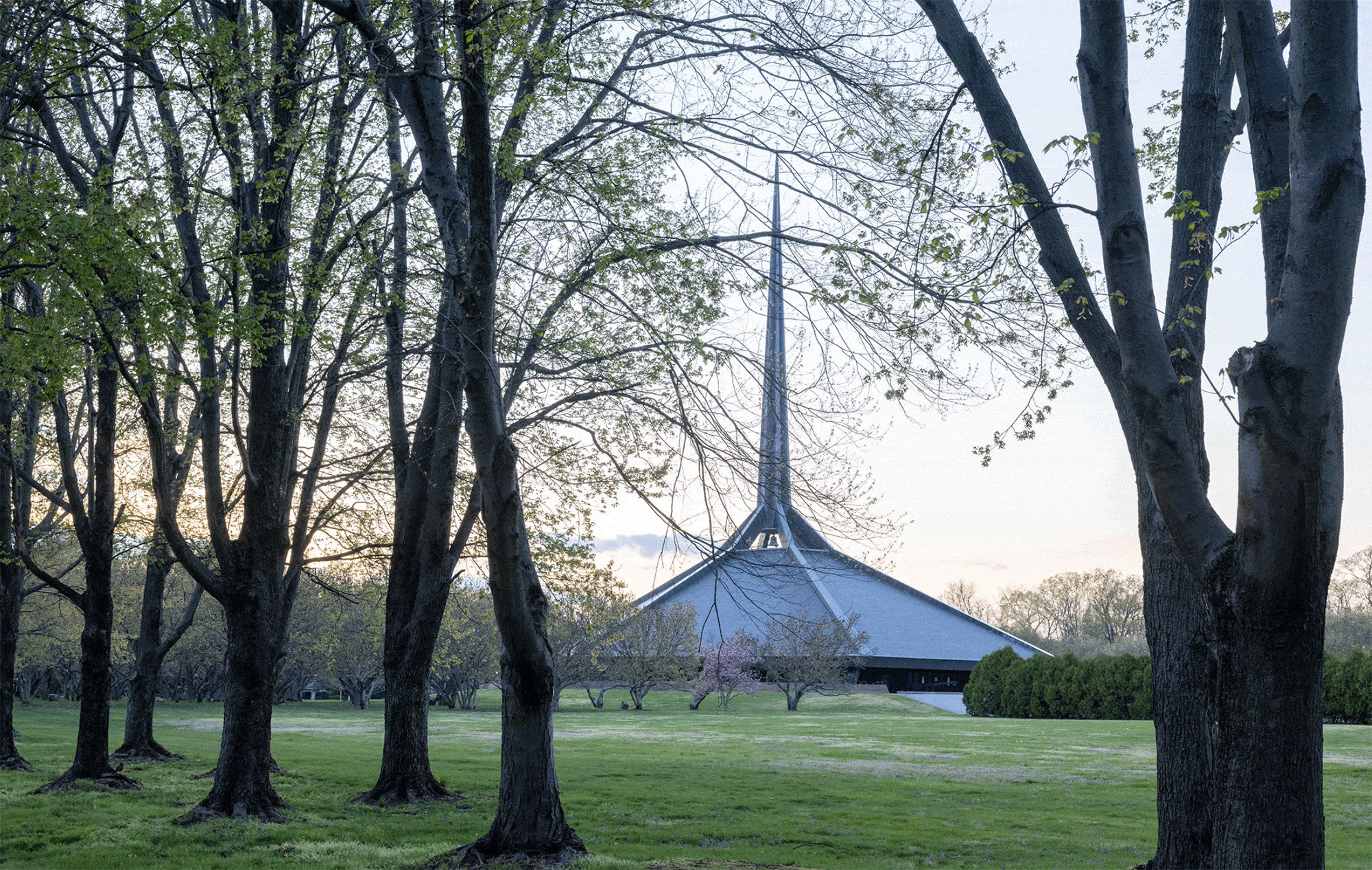

Columbus civic leaders sought to create a progressive image for their town to attract business investment and a talented workforce.
Irwin Miller and other Columbus civic leaders sought to create a progressive image for their town to attract business investment and a talented workforce. Shaw traces their efforts, over decades, from what he calls the “high period” from 1954 to 1974, when projects by Saarinen (Eero as well as Eliel), Kevin Roche, Harry Weese, John Johansen, and Robert Venturi were commissioned, through more recent decades, when the roster of designers became more diverse, and architects including Susana Torre, Andrea Leers, Carlos Jimenez, and Deborah Berke made their marks on Columbus. Throughout the volume, gorgeous photographs by Iwan Baan show us the buildings in their contemporary context.
Irwin Miller died in 2004, aged 95, and in recent years the architectural ambitions of his city have become less bold. That may have been inevitable, Shaw argues, given the socio-cultural shifts in America. Columbus in its midcentury heyday, he writes, reflected “a time when a belief in institutions was stronger in America.” And, he continues, that belief would help to produce, in a small Indiana city, “a culture in which everyday life seamlessly merges with innovative design.”
Today, that innovative, forward-looking architecture has become historic, and the city is now focused on “progressive preservation” of its mid-20th-century legacy. One of the sponsors of American Modern is the Columbus Heritage Foundation, and the organization understands that just as modernist architecture was a boost to business in the postwar years, that same architecture is now a boost to one of the city’s newer businesses: architectural tourism.
London Estates: Modernist Council Housing, 1946-1981
Thaddeus Zupančič (FUEL, 2024)
Reviewed by Kathryn Firth
Thaddeus Zupančič opens this comprehensive photographic survey with the claim that council estates are “the greatest gift that architects have bequeathed London.” If that formulation seems slightly off — emphasizing the generosity of designers rather than the rights of people or the obligations of the state — it nonetheless clarifies the author’s enthusiasm for his subject, the city’s rich stock of modernist social housing built after World War II, which by the 1970s sheltered almost a third of Londoners, until Margaret Thatcher’s Housing Act opened the door to privatization.
Today we rely on the private sector to provide adequate affordable housing. It is easy to feel nostalgic for postwar public housing built by the London County Council.
This book arrives as the Labour government endeavors to meet its target of delivering 400,000 new homes in London over the next five years. Today we operate in a context of understaffed planning authorities and an extreme reliance on the private sector to provide adequate — in all senses of the word — affordable housing. It is, therefore, easy to feel nostalgic for the public housing divisions of the London County Council, which built 44,000 homes in the first few years after the war, and its successor, the Greater London Council, which once employed more than 200 architects. However, the rushed chronology in the ten-page introduction does not provide much evidence to substantiate Zupančič’s belief that the council estates have “contributed immeasurably” to the city’s social and architectural identity.


The measure here is the photographs, and what they register is a dramatic range of quality and typologies. The Alexandra & Ainsworth Estate by Neave Brown (a low-rise development with shared and private outdoor space that allows for resident expression, as evidenced by flowerpots on balconies) is in a league above the John Keats House by the Wood Green Engineer’s Department (a somewhat dystopian tower surrounded by asphalt and untended lawn). The photographs also reveal differences in maintenance and upkeep.
While many of London’s estates are loved by their residents, the buildings are rarely integrated into the urban fabric. Zupančič hasn’t photographed the maps at the fenced perimeter that outsiders need to navigate these complexes. To appreciate London Estates, one must accept it as a geographical compendium, wherein the author passes no judgment and offers no lessons. Questions about urban integration, the design and use of the space between the buildings, their conservation, and even their architectural amenities must be set aside. Among the 275 estates featured here, only one photograph shows any people.
Botanical Architecture: Plants, Buildings and Us
Paul Dobraszczyk (Reaktion Books, 2024)
Reviewed by Hubert Murray
I will arise and go now, and go to Innisfree,
And a small cabin build there, of clay and wattles made …
— W.B. Yeats, The Lake Isle of Innisfree
Ah, yes, wouldn’t that be grand, especially in these hard times, to retreat to Yeats’s Innisfree, Thoreau’s hermitage at Walden, or Marc-Antoine Laugier’s Ur-hut of live trunks and leafy branches. In pursuing a study of “plants, buildings and us,” Paul Dobraszczyk leads us through much of the western canon on this large subject, including Vitruvius, Leonardo, Goethe, Ruskin, and on through Joseph Rykwert’s treatise on Adam’s house in Paradise.
More than this tour of luminaries, however, Dobraszczyk constructs his thesis through instances of “vegetal” architecture since the turn of the century, with chapters organized around the structure of a tree: Seeds, Roots, Trunks, Branches, Leaves, Flowers, and Canopies. Each section is amplified with examples such as Thomas Heatherwick’s “Seed Cathedral” pavilion erected in Shanghai in 2010 (seed); David Chipperfield’s 2014 “Sticks and Stones” exhibit in Berlin (trunk); Bolle Tham and Martin Videgård’s 2010 “Mirrorcube” in a Swedish forest (branches); Patrick Blanc’s “Living Wall” on the Athenaeum Hotel in London, installed in 2009 (leaves); and Grimshaw’s bubble-like “biomes” for the Eden Project in Cornwall in 2001 (canopy). This is a thrilling read, and every reference sends one off on a search to learn more. A passage on rhizomes and allusions to anarchic growth evokes Lucien Kroll’s “La Memé” student dorms in Louvain; a section on mimicry suggests the absurd “Palm Jumeirah” in Dubai.


In his introduction, Dobraszczyk ponders the tension between controlling plants and caring for them. “If this book has one aim,” he writes, “it is to stay with that tension and see what emerges from it.” He concludes by declaring “that plants have desires: they want things — water, nutrients, light, pollinators — completely independent of humans. Perhaps it is time that we built as much for them as for ourselves, understanding that our lives are always totally dependent on theirs.”
The author ponders the tension between controlling plants and caring for them.
As worthy as these aims are, and as stimulating the portfolio of exemplars presented, I am not sure that Dobraszczyk resolves the tension between care and control. Green walls for instance, are labor intensive and notoriously dependent on sophisticated technologies. In addition, although attractive as an organizing principle, a tree’s structural anatomy is unduly restrictive, omitting an essential element of plant life directly relevant to buildings — its systems. It is as if, in concentrating on external appearances, Dobraszczyk is mistaking form for function, overlooking the diurnal, seasonal, and annual metabolism of plants, their respiration, transpiration, and circulation. It is surely in these processes that we can find much information important for us as designers of environments, for plants and humans alike.
Beyond Molotovs: A Visual Handbook of Anti-Authoritarian Strategies
Edited by International Research Group on Authoritarianism and Counter-Strategies and kollektiv orangotango (transcript publishing, 2024)
Reviewed by Ivonne Santoyo-Orozco
Few books are as ambitious in scope and diverse in content as Beyond Molotovs, a collection of short essays that gathers grassroots practices for countering authoritarianism around the world. Organized by the International Research Group on Authoritarianism and Counter Strategies (a project of the Rosa Luxemburg Foundation) and kollektiv orangotango, a collective of critical geographers founded in 2008, Beyond Molotovs is a kit of regenerative ideas, a manual of subversive possibilities that range from counter-mappings to performances, films, soundtracks, poems, murals, and many others.
More than a call to mobilize against oppressive regimes, this kaleidoscopic work seeks to expand the meanings and tactics commonly associated with political resistance. The entire book is freely accessible online through a Creative Commons license, emphasizing the editors’ ambition to frame the collection as a project of political education. In the words of the editors, Beyond Molotovs attempts to “celebrate life over death, connection over individualization, multiplicity over reduction, and chaos over order.” Every entry documents a contemporary local struggle, and in so doing represents a vividly illustrated collective response to systemic repression and violence.


This kaleidoscopic work seeks to expand the meanings and tactics of political resistance.
To mention just a few such spaces and strategies: In Hong Kong in 2019, activists against the extradition bill mobilized art to counter official narratives that vilified protesters (essay by Sophie Mak); across Cuba between 2019 and 2022, LGBTIQ+ communities advocated for gender-equality rights by disseminating stickers under copyleft license, in order to challenge normative concepts of marriage (essay by Plataforma 11M); in the Philippines, during the administration of Rodrigo Duterte between 2016 and 2019, Indigenous peoples of Mindanao Island produced counter-maps to document their experiences of dispossession (essay by Counter-Mapping PH Collective); in South Africa, between 2015 and 2016, in the context of the Fees Must Fall Movement and massive protests demanding the decolonization of higher education, a group of women claimed their role as leaders (essay by Bonisma Khumalo); in Chiapas, Mexico, between 2016 and 2019, members of the Zapatista Army of National Liberation used songs as a reminder of their struggle for Indigenous self-determination (essay by Francisco De Parres Gómez). Taken together, these stories present a nuanced and intersectional activism which — despite its dizzying variety — never embraces any form of militaristic rapid action.
A collage of geographically specific and politically situated struggles, Beyond Molotovs maps the contours of shared struggle against global capitalism and its polycrisis. Where censure and discrimination seem to foreclose a just future, Beyond Molotovs is an opening, in the full extent of the word.
The Organizer’s Guide to Architecture Education
Kirsten Day, Peggy Deamer, Andrea Dietz, Tessa Forde, Jessica Garcia Fritz, Palmyra Geraki, and Valérie Lechêne (Routledge, 2024)
Reviewed by Simon Sadler
“We unanimously agree,” say these seven authors, with one voice,
that architecture education can no longer be confined to producing the monolithic “good designer” creating architecture solely for capitalist ends, and learning only to perpetuate myths about individualism, originality, and design virtuosity. Our goal is to transcend such limited ambitions and prepare architects to operate and practice in wider worlds — beyond the boundaries of traditional architecture.
How? By taking “strategic, collective action” to (re)organize education at four scales — small, medium, large, extra-large. The small scale is the architecture studio, which the authors say should be social and dynamic, not object-oriented. The medium scale is a curriculum that integrates Indigenous knowledge and digital tools while “generating media that constructs the conceptual space of the discipline.” The large scale is the university, a center for “all teaching, learning, and research around specific sited, conceptual, or speculative projects related to local, global and emergent challenges, and societal questions.” (Examples include the Green Reconstruction framework at Columbia’s Buell Center.)
The politics and pedagogy acknowledge ancestry in the New Deal, in environmentalist and countercultural movements, Paulo Freire and bell hooks, the Rural Studio and Center for Land Use Interpretation.
Last is the extra-large scale of architectural professionalism, regulation, and prestige bounded by the nation-state. Here the authors disagree about whether the new paradigm should be reprofessionalization (a reassessment of ethical frameworks), deprofessionalization (“separating architectural licensure from the state apparatus”), or transprofessionalization (organizing across, or above, national institutions, in the manner of CIAM, which engineered European modernism after 1928; or the ABC School of The Architecture Lobby, which inspired this book; or the African Futures Institute, which will convene its first nomadic studio this summer). After that heady setup, the book gets into practical detail through a multitude of case studies, historical and ongoing, gathered under the rubrics of educational/disciplinary horizontality, climate justice, race and space, care work/survival, feminism/gender, and plural worldmaking. The final section, “Toward the Planetary,” imagines architecture students “work[ing] through what it means to live in community with one another and to steward a common planet.” The authors engage Social-Ecological-Technological Systems as a method of tracing “layered relationships of cause” that improves the “limited grasp of ecological dynamics” held by Western practitioners.
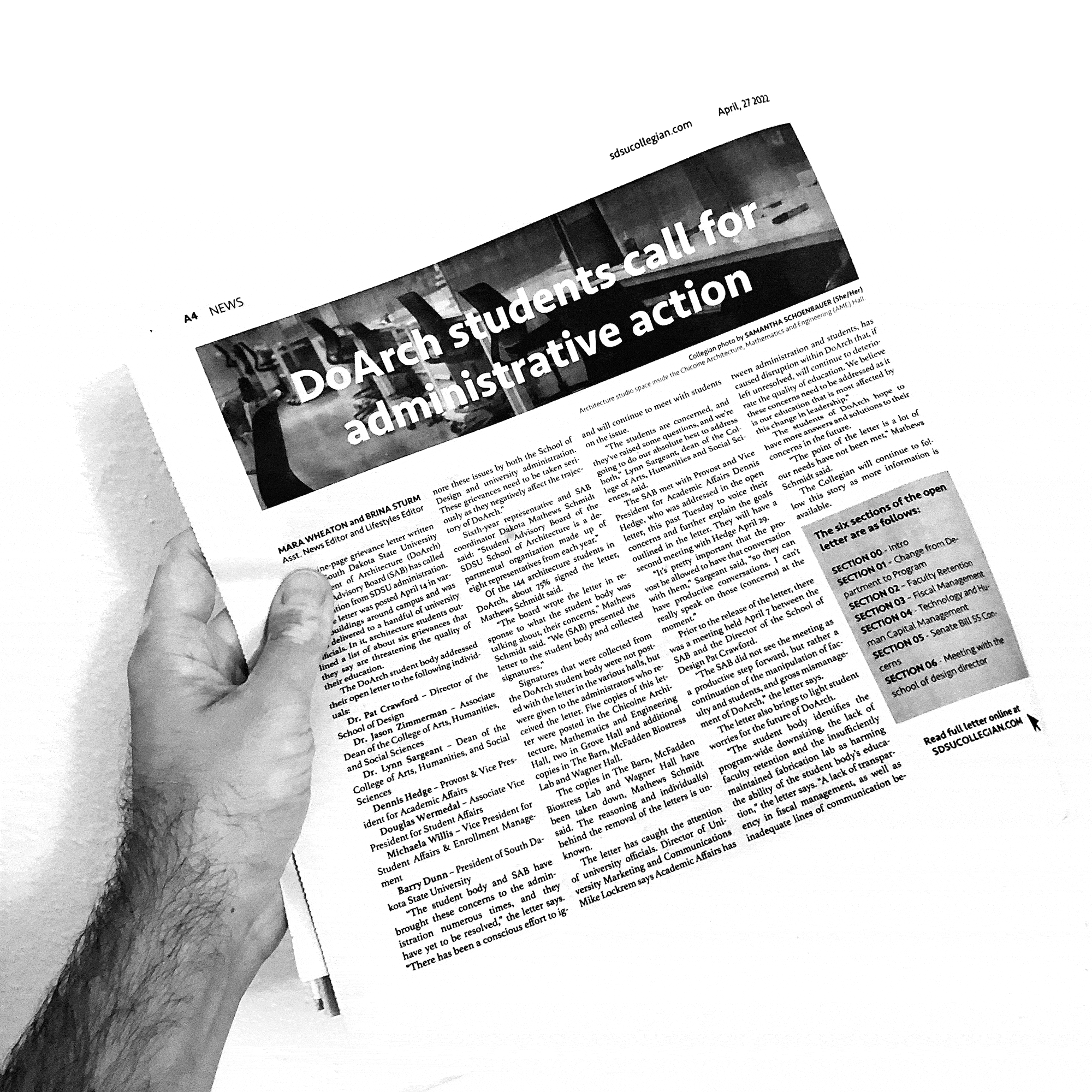
Readers will find a ton of useful ideas here — on accreditation, the hidden curriculum, faculty-student relations, and strikes.
Everything comes back to organization: “as architecture moves to expand and decenter, it must structure a ‘just transition.’” The politics and pedagogy acknowledge ancestry in the New Deal, in environmentalist and counterculture movements, in Paulo Freire and bell hooks, and in projects such as the Rural Studio and Center for Land Use Interpretation. But “shortcomings in the most recent bursts of disciplinary fluidity,” the authors find, “have pushed the field of architecture back into its shell; they also have revealed that the structures to develop a new kind of architect do not yet exist.” There is work still to be done.
Readers wanting to do the work will find a ton of useful ideas and detail here, as the authors lift the hood on accreditation, the hidden curriculum, faculty-student relations, and strikes — and even their own decisions to write a book collectively and publish with Routledge. “What we advocate for in this guide is grounded in practicality — none of it is radical. These motions for changing architecture are already unfolding, embedded in communities seeking mutualism.” This is true, though the book remains as much domiciled in the S,M,L,XL of the disciplinary system as in grassroots organizing. “Rather than choosing between Princeton or a pedagogy of the oppressed,” it asks, “what is the marriage between the two?” Meanwhile the MAGA fury barreling down on the U.S. academy might well push the field of architecture even deeper into that shell.
A Just Transition for All: Workers and Communities for a Carbon-Free Future
J. Mijin Cha (MIT Press, 2024)
Reviewed by Jeremy Till
Opening with an urgent call to end fossil fuel dependency, J. Mijin Cha situates the energy transition within the context of societal justice. She argues that current economic models, based on extractive principles and practices, invariably lead to the exploitation of human and natural resources. Any movement toward decarbonization that maintains those practices “cannot deliver a just future and, as such, cannot be a just transition.”
Cha forcefully critiques ‘green capitalism’ for replicating underlying systems of extraction and attendant injustices.
The book that follows is admirably clear and meticulously researched, but it gets weighed down in applying a “Four Pillars” model for how justice is achieved. Cha has studied cases, mainly from the United States, where extraction sites and power plants were closed while protecting workers and communities. These cases include Colorado’s Office of Just Transition, set up in 2019 to support coal mining communities as operations ended. Drawn from these examples, the Four Pillars are “(1) substantial governmental support; (2) dedicated funding streams to support transition programs and efforts, including job training and creation; (3) diversifying economic opportunity; and (4) strong and diverse coalitions.” The difficulty arises, as Cha acknowledges, in that the first three are tied to current economic models and thus constrained as levers for change. In analyzing Joe Biden’s policies to expand environmental infrastructure under the Inflation Reduction Act, Cha finds that neoliberal mechanisms like tax credits generate more benefits for corporations than communities, while ensuring that “continued use of fossil fuels is virtually guaranteed.”
Aware of these limits, Cha supplements the Four Pillars with a suite of “non-reformist reforms.” These are “outside capitalist logic; they are not about what could occur but what should occur.” The real promise of the book rests here, in its description of necessary systemic changes and how they might be achieved. As suggested by the subtitle, one pathway to a just future is through the agency of labor and community organizing. Cha offers inspiring examples of how local actors can effectively challenge existing power structures. One is the Climate Jobs National Resource Center, a coalition of labor-led organizations that advocates for both decarbonization and job protection.
Too many architects, landscape architects, planners, and engineers remain captivated by quick fixes and the greenwashed allure of sustainable design.
The central insight is that a just transition must go beyond the technical problem of replacing fossil fuels. Modified systems of technocracy and capitalism are both inadequate and inappropriate in addressing climate breakdown. At best, they can mitigate crisis; at worst, they perpetuate it. “At what point,” she asks, “does a policy move from being too dependent upon existing systems to be able to build something new?” Cha forcefully critiques “green capitalism” for replicating underlying systems of extraction and attendant injustices. Yet too many architects, landscape architects, planners, and engineers remain captivated by quick fixes and the greenwashed allure of sustainable design — as evidenced by the technological spectacle of the 2025 Venice Architecture Biennale. Above all, the just transition needs a clear theory of power that includes a roadmap to changing the current economic and cultural models. Professionals need to be brought into this work in a way that manifestly reconstructs their underlying value system, away from obsessions with aesthetics and technical mastery and toward concern for spatial and social justice.
The Makeshift City
Joshua Dudley Greer (GOST, 2024)
Reviewed by Virginie Drujon-Kippelen
The visual history of the American South is intertwined with the legacies of slavery, poverty, environmental degradation, and racism. Joshua Dudley Greer’s The Makeshift City reflects this all — but at a slant. The book is a time capsule of contemporary Atlanta, one of the largest and most progressive cities in the South. Its 69 color photographs collectively show a metropolis in a “state of flux,” a city that keeps reinventing itself while unapologetically erasing its past.
Greer is a self-described “driving photographer,” whose first book, Somewhere Along the Line, published in 2019, was created in the course of driving some 100,000 highway miles along the U.S. Interstates. For this latest book, Greer worked within city limits. The Makeshift City was created between 2020 to 2024 — tumultuous years that saw the covid pandemic, the George Floyd protests, a contentious presidential election, and, in Atlanta, rising income inequality. Yet here you will not find photographs of protests, although Greer says he attended many. Nor will you see formal portraiture. Greer is more interested in capturing small moments that allude to big issues, including race relations, income inequality, broken politics.
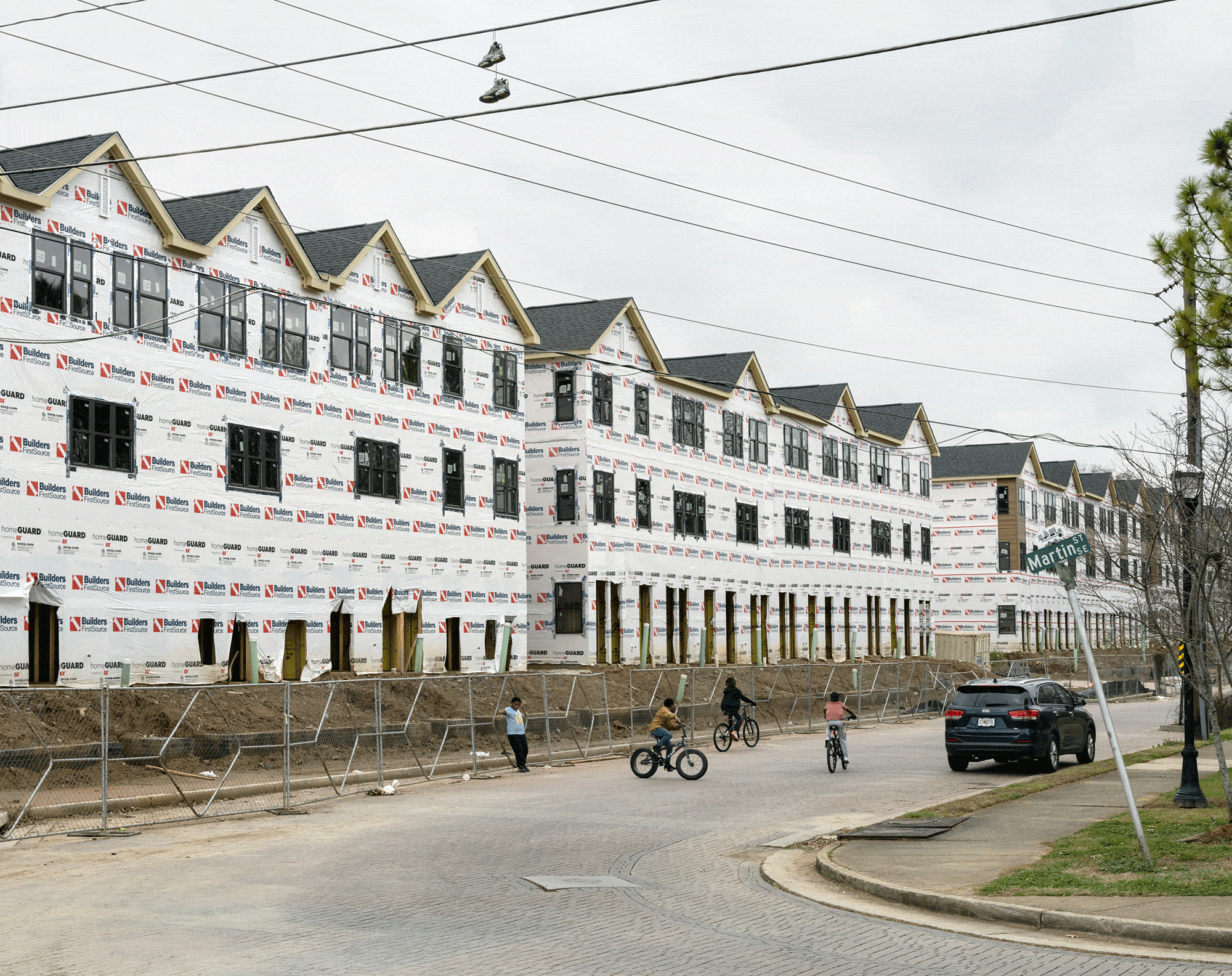

Greer is interested in capturing small moments that allude to big issues, including race relations, income inequality, broken politics.
Peoplestown, Atlanta, from 2021, for instance, depicts four Black children riding their bikes along a street where new apartment complexes are under construction. The neighborhood is clearly gentrifying; the scale of the buildings, stretching beyond the frame of the photo, conveys a sense of inexorability, and the children’s presence feels fleeting. Confederate Obelisk, also from 2021, shows “Black Lives Matter” spray-painted on the base of a monument; the paint is now faded and the stones are smudged by fire. In Buckhead, a Tesla Cybertruck is recklessly parked in a rooftop lot in the heart of the city’s financial district; in the background are mirrored-walled skyscrapers. For Greer, a successful image captures “a sense of breakdown”; something feels “slightly askew.” Many of his images underscore the tensions between opposing forces: rich and poor, history and modernity, preservation and erasure.
“I watched people go about their daily lives in spite of everything that might act against them,” writes Greer. “There were times of resilience, activism, selflessness, and joy. But there were also moments of banality, privilege and ignorance, even disdain. … There is so much about Atlanta that I don’t understand, and perhaps, probably, never will.” Greer’s open-ended curiosity makes his work seductive. He may not understand Atlanta, but his attention to what is so often overlooked captures the city’s “strange, wonderful and unpredictable spirit.”
A Natural History of Empty Lots: Field Notes from Urban Edgelands, Back Alleys, and Other Wild Places
Christopher Brown (Timber Press, 2024)
Reviewed by Rob Walker
Just as an empty lot is never really empty, Christopher Brown’s A Natural History of Empty Lots is not really a natural history. The book is better described as a series of meditations on learning to see, interrogate, and appreciate the undeveloped land that’s tucked into and around urban spaces. Even the most bland and unmolested acre hosts flora, native and invasive; earth, stones, maybe fossils; animal life from butterflies to coyotes; and of course, stories and histories, often forgotten or untold, and frequently rewritten by the Anthropocene. What the book captures is a mindset of seeking and embracing the way the human-made and the natural overlap: “the everyday wonders of the feral city.”
Brown’s personal story involves an urban-explorer habit that he shares with his young son, and that grows over time — from spotting foxes and delving into arboreal histories, to buying a deindustrialized lot just east of downtown Austin. Here, he decided, was the place for his dream house. Its non-emptiness included an abandoned petroleum pipeline, an abandoned Impala, a flock of parakeets, a weary tree. Brown is a lawyer, and also a science fiction novelist. “I was studying the legal history of early medieval England when I first saw the birds,” one section begins. Skipping around in time, place, and sub-topic, the book has no linear narrative; I finally stopped looking for wayfinding cues and let myself drift.
Even the most unmolested acre hosts flora, native and invasive; earth, stones, maybe fossils; animal life from butterflies to coyotes; and stories and histories, often forgotten or untold.
The house Brown builds is characterized by an unusual indoor-outdoor configuration with a vegetation-covered roof. It’s now known as the Edgeland House, having won architectural and press attention. Brown mentions few problems along the way and makes little of those he does mention — an issue with poisonous coral snakes, an incursion of “hundreds” of indoor millipedes combatted with a Shop Vac — such that there are no real moments of self-doubt. The idea seems to be that these challenges are part of the wildness to be appreciated. The book is more of a spiritual declaration than an empirical argument: a call to pay attention to what’s right in front of us, even an empty lot, and to learn from it. “Learning to see the wild nature around you, in the heart of the city, can also help you awaken your own true nature,” Brown writes. That might not be enough to cope with the Anthropocene, but it’s a start.
The Rights of Nature and the Testimony of Things: Literature and Environmental Ethics from Latin America
Mark Anderson (Vanderbilt University Press, 2024)
Reviewed by Anna L. Georas Santos
Our long colonial past in the Americas means that we communicate via languages rooted in Euro-American notions of dominance over nonhuman species and natural elements. Often international relations operate in languages that represent the interests of global commerce and power, and this narrows the possibility that the same languages can successfully defend the rights of Nature.
Considering this dilemma, Mark Anderson, a scholar of Latin American literature, offers a fresh and nuanced perspective on lexicons, rhetoric, and legal and literary canons, aiming to improve the terms with which we frame our relationships with other species and the natural world in general. The pressing concern of protecting Earth’s life-sustaining environment moves him, in this book, to ask:
… in what ways do nonhumans communicate their intrinsic values and interests, defined by their own specific, systematic relations with the world, to us, the humans? And how might those values simultaneously exceed and pervade symbolic representation in language, reordering our concepts of the social and the political?
The Rights of Nature and the Testimony of Things advocates for a fusion of old and new world conceptions of the natural world, anchored in the intimate understandings that Indigenous peoples of the Americas have forged with natural forms over millennia. Anderson argues that such ancient bio-ontologies can help activists and legislators to forge more effective linguistic and rhetorical tools in defense of Nature’s rights.
To model what this might look like, Anderson analyses examples of Latin American literature and environmental activism; he also considers the defense of rivers or forests as entities with legal rights. For example: a leap of faith is required in order for us in industrialized economies to relate to plants or geological formations as global citizens. Yet defending the “personhood” or “citizenship” of a forest or a river is key to the protection of all life. The well-being of trees helps to secure a healthful atmosphere for people; the well-being of plants protects the food chain; the health of water bodies safeguards the water supply. In short, Anderson reveals the obsolescence of human politics in the face of a “cosmopolitics” that recognizes the interconnectedness of Earth’s entire community.
Anderson argues that ancient bio-ontologies can help activists and legislators to forge more effective linguistic and rhetorical tools in defense of Nature’s rights.
Indigenous peoples’ solidarity with nonhuman life centers on what Anderson describes as interspecies affective encounters, a series of “multispecies technological interventions oriented toward the facilitation and maintenance of more-than-human social networks” that impel in humans a deeper understanding of their place in a vast system of vital reciprocity. Ethical truths are conveyed across such networks. A succession of such encounters leaves an indelible mark on human awareness of a shared world ecology. The implicit goal of such awareness is to establish an affective understanding with all organisms, including microorganisms in the soil beneath our feet, with absolute respect for their role in our shared well-being. To achieve this, Anderson asks if we must undo long-held humanist values, to launch “a posthumanist future in which cosmopolitics become the predominant political practice in the multispecies construction of environments that are livable for all species?”
This book is a must-read for those of us who seek to protect Earth’s wealth so that future generations of all species have equal rights to life on a thriving planet. The Rights of Nature and the Testimony of Things issues a call for what I consider to be a progressive interspecies bio-affective ethical code that allows room for the equal representation of all elements of nature.
Is a River Alive?
Robert Macfarlane (Hamish Hamilton, 2025)
Reviewed by Joshua Mabie
In the introduction to his latest book, Robert Macfarlane characterizes Is a River Alive? as an attempt to “daylight long-buried ways of feeling about water, both in history and in us — and to see what transformations occur when rivers are recognized as both alive and killable.” Macfarlane argues that rivers are living beings with interests — and therefore, they demand legal protection. For readers steeped in contemporary environmental philosophy and legal theory, championing the rights of rivers might not seem radical.
But Macfarlane is not merely preaching to the (motley) choir of “Indigenous communities … artists and writers and fringe weirdos”; he’s trying to convince what he calls “the power-holders” — “state actors, corporate actors, industrial actors, the whole cast.” He is uniquely positioned to make this argument. Like Rachel Carson, who followed three lovely nature books with a world-changing polemic about the dangers of toxic chemicals, Macfarlane is ready to hazard the love, respect, and fame he has earned from a series of beloved and bestselling books about landscape and the human heart to make a radical political statement about the rights of nature.

Macfarlane argues that rivers are living beings with interests — and therefore, they demand legal protection.
In the first section, Macfarlane visits the valley of the Río Los Cedros in Ecuador, a landscape that environmentalists salvaged from the destruction that had been wrought by mining industries. In the second section, he focuses on three rivers in Chennai, India, all of which had been polluted — killed — by development and industry. In the third and final section, he kayaks down Mutehekau Shipu, in eastern Québec, a still-living torrent running near other rivers drowned by hydroelectric dams. Macfarlane frequently acknowledges that he feels out of his depth in the unfamiliar geography and history of these rivers, all far from his home in Cambridge. The writer who has dedicated years of his life to describing landscapes, and whose stylistic superpowers include command of the perfect simile, confesses time and again that the rivers he encounters here put him at a loss for words.
Macfarlane responds by seeking friends with intimate knowledge of these waters to guide him. Giuliana Furci, a mycologist searching for new mushroom species, leads him through the Los Cedros cloud forest. Yuvan Aves, a young teacher and environmental advocate, guides him through Chennai’s rivers, marshes, and beaches. Significant portions of the book are entrusted to these guides, who are quoted extensively. By ceding narration and description to others, Macfarlane puts into practice an imperative articulated by the Columbian environmental lawyer César Rodríguez-Garavito, whom he quotes: “You must forge relations with international allies, get other voices to amplify yours.” Is a River Alive? is a generous book, with a harder political edge than I’ve come to expect from Macfarlane. I think it will roil some waters.
The Land Is Our Community: Aldo Leopold’s Environmental Ethic for the New Millennium
Roberta L. Millstein (University of Chicago Press, 2024)
Reviewed by Regan Good
A note found in Aldo Leopold’s papers after his death reads: “the new ecology … is daily uncovering a web of interdependencies so intricate to amaze … even Darwin himself.” In The Land Is Our Community, Roberta L. Millstein, professor emerita of philosophy at University of California, Davis — in particular, a philosopher of biology — aims to reinstate Leopold’s ideas to their full meaning. According to Millstein, contemporary ecologists have variously misunderstood or rejected Leopold’s three central ideas: interdependence, land community, and land health. In contemporary ecology, Leopold is sometimes considered to be ethically imprecise, and to have advocated for static and impossible human-free ecosystems. Millstein asks: Is this fair? Are these interpretations really what his scholarship inferred?
As a young hunter, and then as a forester, herd manager, ecologist, conservationist, and professor, Leopold saw past the land into a complex ‘web of interdependencies.’
Millstein believes Leopold’s shaky reputation is subject to what she calls the “six myths.” The most maddening is myth number one, which claims there is a two-sentence “summary moral maxim” in his famous essay, “The Land Ethic” (published in 1949, a year after his death). These sentences — “A thing is right when it tends to preserve the integrity, stability, and beauty of the biotic community. It is wrong when it tends otherwise.” — are baggy enough to have allowed for far narrower interpretations than Leopold intended. Myth number four is also, in Millstein’s view, especially problematic; this myth argues that “the central message of the land ethic is to set aside human-free ecosystems.” Not at all. Leopold saw land as deserving both direct and indirect moral considerations, and his ethics extend to a group of interacting living organisms, what he called “the land community” or the “biotic community,” which includes humans. As Millstein argues, “Leopold spoke of the land ethic as a continually evolving product of social evolution.”
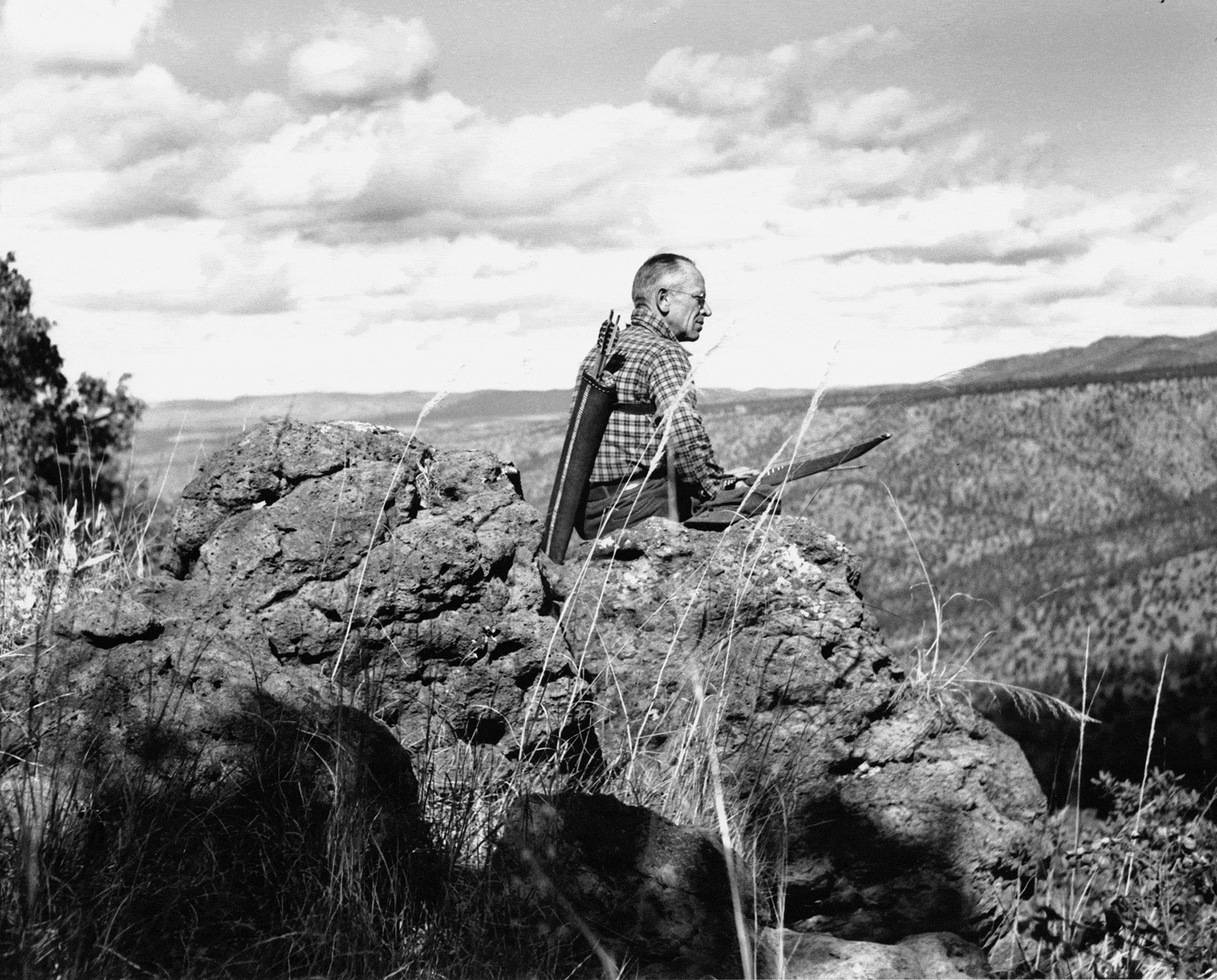
The Land Is Our Community is a book of dense argument, and it is most enjoyable when we are in the presence of Leopold’s own observations assembled over a lifetime. Observing “life-cycles” in nature, first as an enthusiastic young hunter, and then as a professional forester, herd manager, ecologist, conservationist, and professor, Leopold saw past the land into the complex “web of interdependencies.” Descriptions of ecosystems involving bees, wolves, geese, ponds, vegetation, water, and humans reminds one that observation lies at the heart of his contribution. We are simply delighted to read his descriptions of “pin-clad mesas spangled with flowers” and “lazy trout streams burbling along under great sycamores and cottonwoods.” His eye is excellent.
Here is one example of his thinking and work that sheds light on his published ideas: his attempt to increase deer populations near the Grand Canyon. Leopold learned that it was not enough simply to remove predators; that other biotic chains are involved in the ecosystem. “Wolflessness,” then, is not beneficial. As Leopold wrote: “I have seen every edible tree defoliated to the height of a saddlehorn. … In the end the starved bones of the hoped-for deer herd, dead of its own too-much, bleach with the bones of the dead sage, or molder under the high-lined junipers.”


.jpg)
If you would like to comment on this article, or anything else on Places Journal, visit our Facebook page or send us a message on Twitter.